66.
Calculating the Probability of Bankruptcy A linear probability model you have developed
finds there are two factors influencing the past bankruptcy behavior of firms: the debt–to–
equity ratio and the profit margin. Based on past bankruptcy experience, the linear
probability model is estimated as:
PDi = 0.02 (debt/equity) + 0.80 (profit margin)
A firm you are thinking of lending to has a debt-to-equity ratio of 110 percent and its
expected probability of default, or bankruptcy, is estimated to be 8 percent. If sales are $2
million, calculate the firm’s net income.
67.
Calculating the Probability of Bankruptcy A linear probability model you have developed
finds there are two factors influencing the past bankruptcy behavior of firms: the debt–to–
equity ratio and the profit margin. Based on past bankruptcy experience, the linear
probability model is estimated as:
PDi = 0.03 (debt/equity) + 0.65 (profit margin)
A firm you are thinking of lending to has a debt-to-equity ratio of 105 percent and its
expected probability of default, or bankruptcy, is estimated to be 7 percent. If sales are $3
million, calculate the firm’s net income.
68.
Peter’s TV Supplies is considering a merger with Jan’s Radio Supply Stores. Peter’s total
operating costs of producing services are $330,000 for a sales volume (S
P
) of $4.5 million.
Jan’s total operating costs of producing services are $30,000 for a sales volume (S
J
) of
$550,000. Suppose that synergies in the production process result in a cost of production
for the merged firms totaling $360,000 for a sales volume of $5,050,000. Calculate the total
average cost (TAC) for the merged firm.
69.
Cindy’s Computer Corp. is considering a merger with Bobby’s Hard Drive, Inc. Cindy’s total
operating costs of producing services are $2.1 million for a sales volume (S
C
) of $13
million. Bobby’s total operating costs of producing services are $2.5 million for a sales
volume (S
B
) of $7 million. If the two firms merge, calculate the total average cost (TAC) for
the merged firm assuming no synergies.
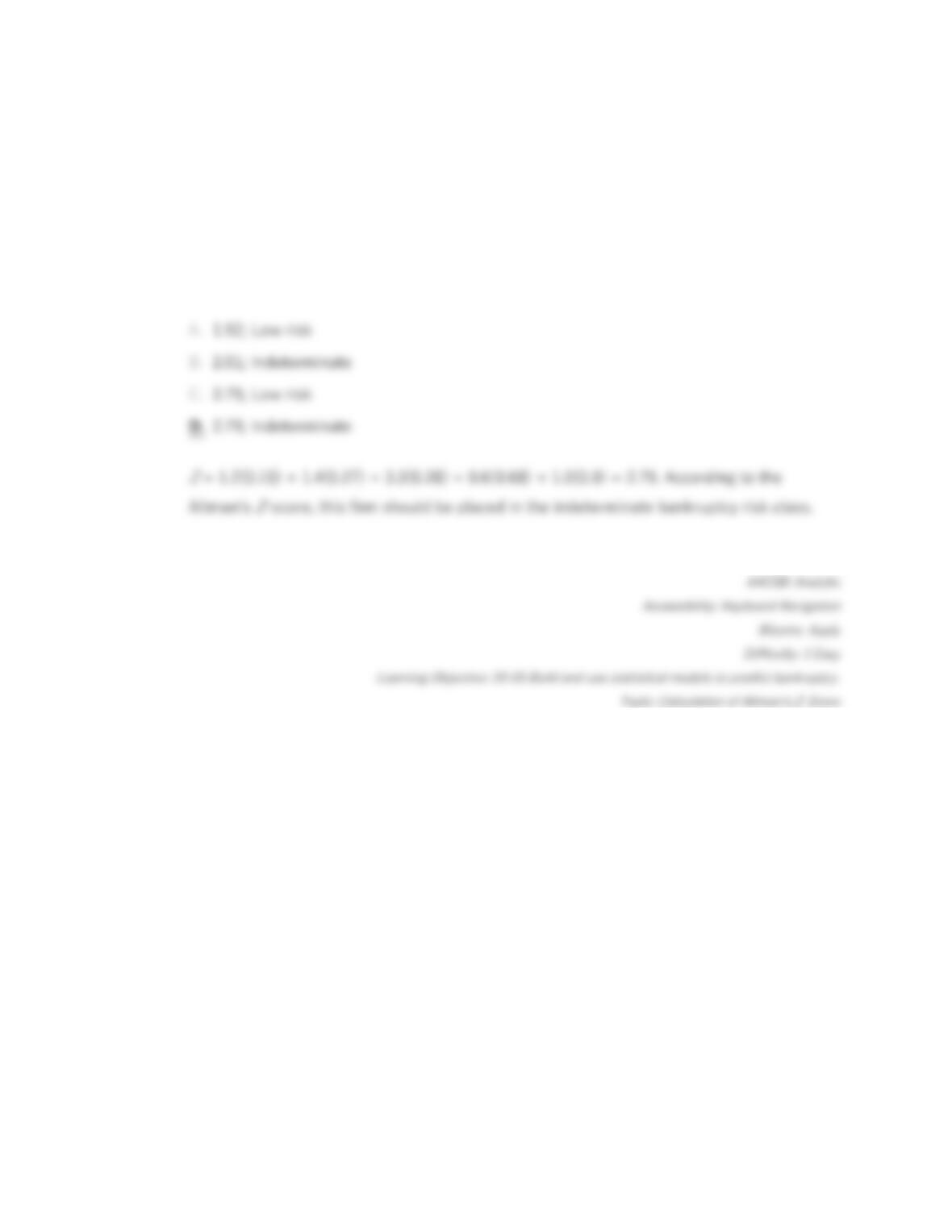
70.
Suppose that the financial ratios of a potential borrowing firm took the following values:
X1
= Net working capital/Total assets = 0.15,
X2
= Retained earnings/Total assets = 0.27,
X3
= Earnings before interest and taxes/Total assets = 0.28,
X4
= Market value of
equity/Book value of long-term debt = 0.68,
X5
= Sales/Total assets ratio = 0.9. Calculate
and interpret the Altman’s
Z
-score for this firm.
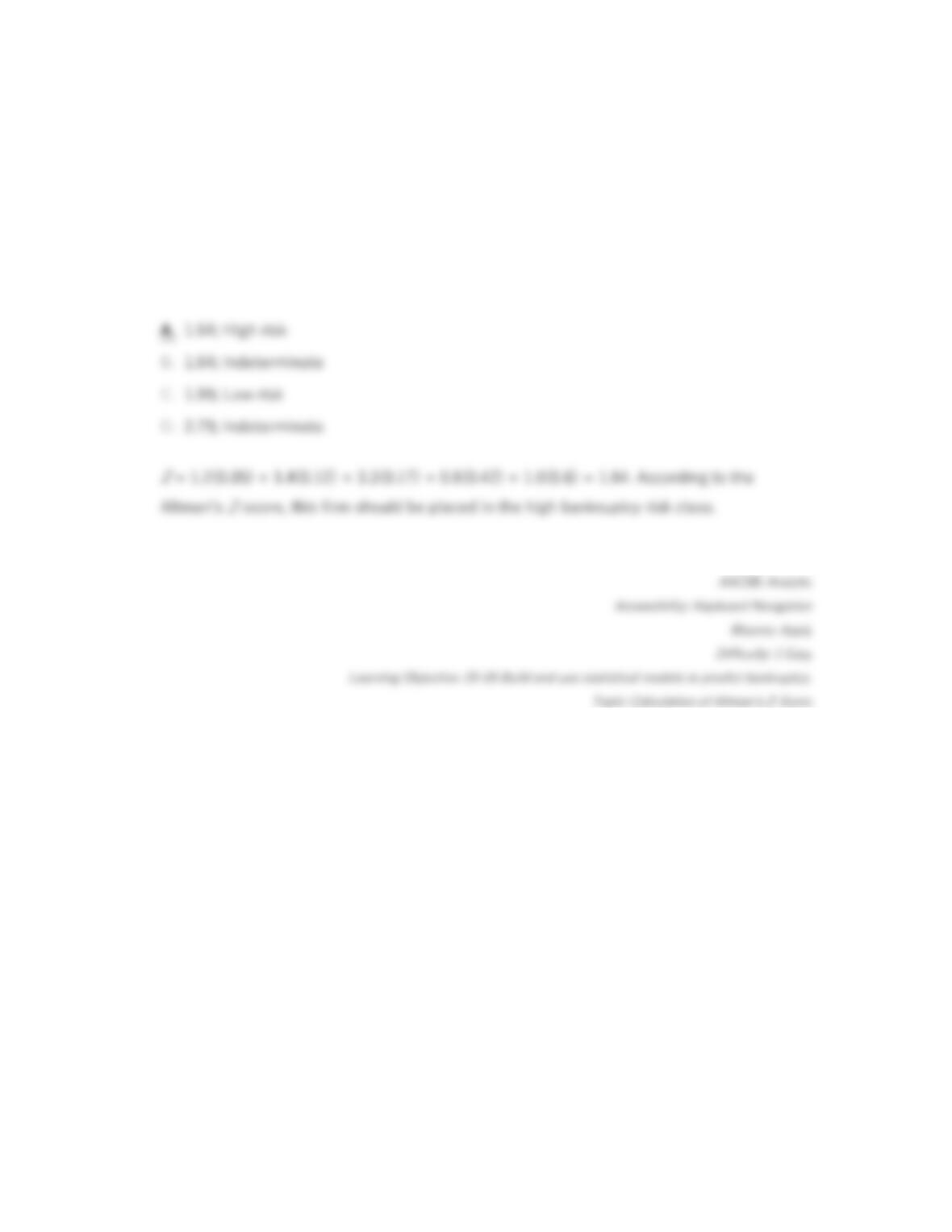
71.
Suppose that the financial ratios of a potential borrowing firm took the following values:
X1
= Net working capital/Total assets = 0.05,
X2
= Retained earnings/Total assets = 0.12,
X3
= Earnings before interest and taxes/Total assets = 0.17,
X4
= Market value of
equity/Book value of long-term debt = 0.42,
X5
= Sales/Total assets ratio = 0.6. Calculate
and interpret the Altman’s
Z
-score for this firm.
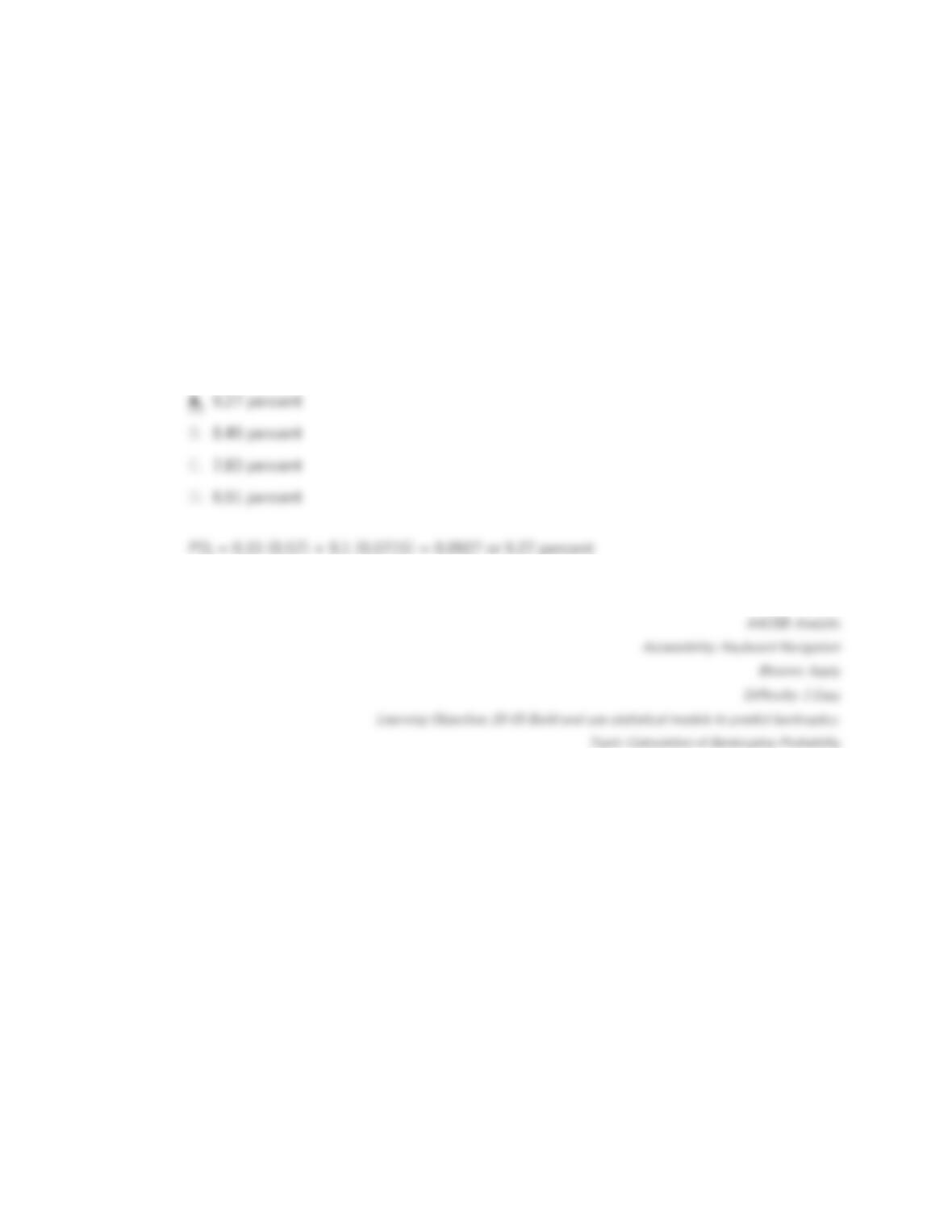
72.
Suppose a linear probability model you have developed finds there are two factors
influencing the past bankruptcy behavior of firms: the debt ratio and the profit margin.
Based on past bankruptcy experience, the linear probability model is estimated as:
PDi = 0.15 (debt ratio) + 0.1 (profit margin)
A firm you are thinking of lending to has a debt ratio of 57 percent and a profit margin of
7.15 percent. Calculate the firm’s expected probability of default, or bankruptcy.
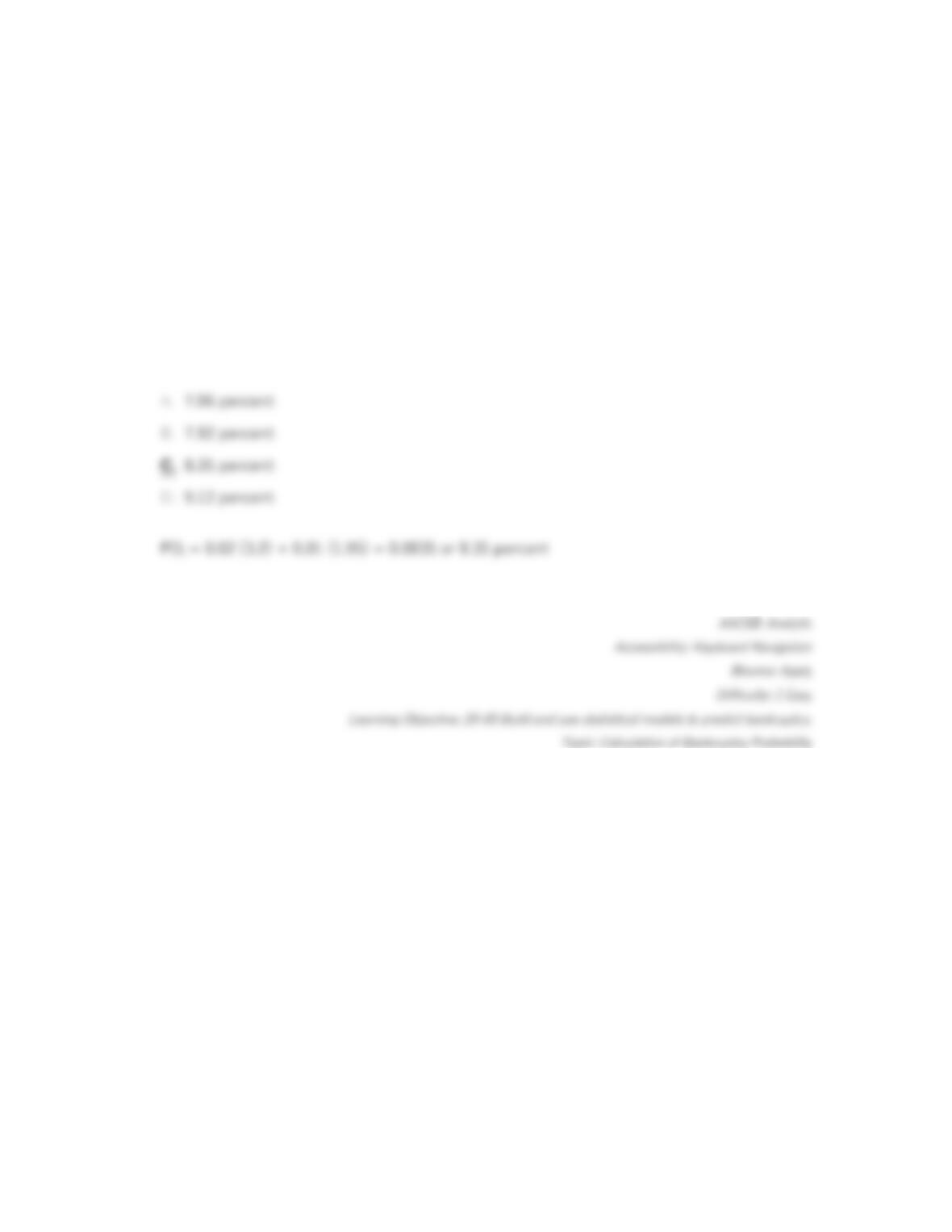
73.
A linear probability model you have developed finds there are two factors influencing the
past bankruptcy behavior of firms: the equity multiplier and the total asset turnover ratio.
Based on past bankruptcy experience, the linear probability model is estimated as:
PDi = 0.02 (equity multiplier) + 0.01 (total asset turnover)
A firm you are thinking of lending to has an equity multiplier of 3.2 times and a total asset
turnover ratio of 1.95. Calculate the firm’s expected probability of default, or bankruptcy.
74.
George’s Dry Cleaning is considering a merger with Weezzie’s Laundry Supply Stores.
George’s total operating costs of producing services are $790,000 for sales volume (S
G
) of
$4.7 million. Weezzie’s total operating costs of producing services are $202,000 for a sales
volume (S
W
) of $2.3 million. For a sales volume of $7 million, calculate the reduction in
production costs the merged firms need to experience such that the total average cost
(TAC) for the merged firms is equal to 12 percent.
75.
George’s Dry Cleaning is considering a merger with Weezzie’s Laundry Supply Stores.
George’s total operating costs of producing services are $590,000 for sales volume (S
G
) of
$4.7 million. Weezzie’s total operating costs of producing services are $152,000 for a sales
volume (S
W
) of $2.3 million. For a sales volume of $7 million, calculate the reduction in
production costs the merged firms need to experience such that the total average cost
(TAC) for the merged firms is equal to 9 percent.
76.
Jenny’s Day Care is considering a merger with Lionel’s Diaper Manufacturers. Jenny’s total
operating costs of producing services are $350,000 for sales volume of $1.4 million.
Lionel’s total operating costs of producing services are $300,000 for a sales volume of $1.3
million. For a sales volume of $2.7 million, calculate the reduction in production costs the
merged firms need to experience such that the total average cost (TAC) for the merged
firms is equal to 20 percent.
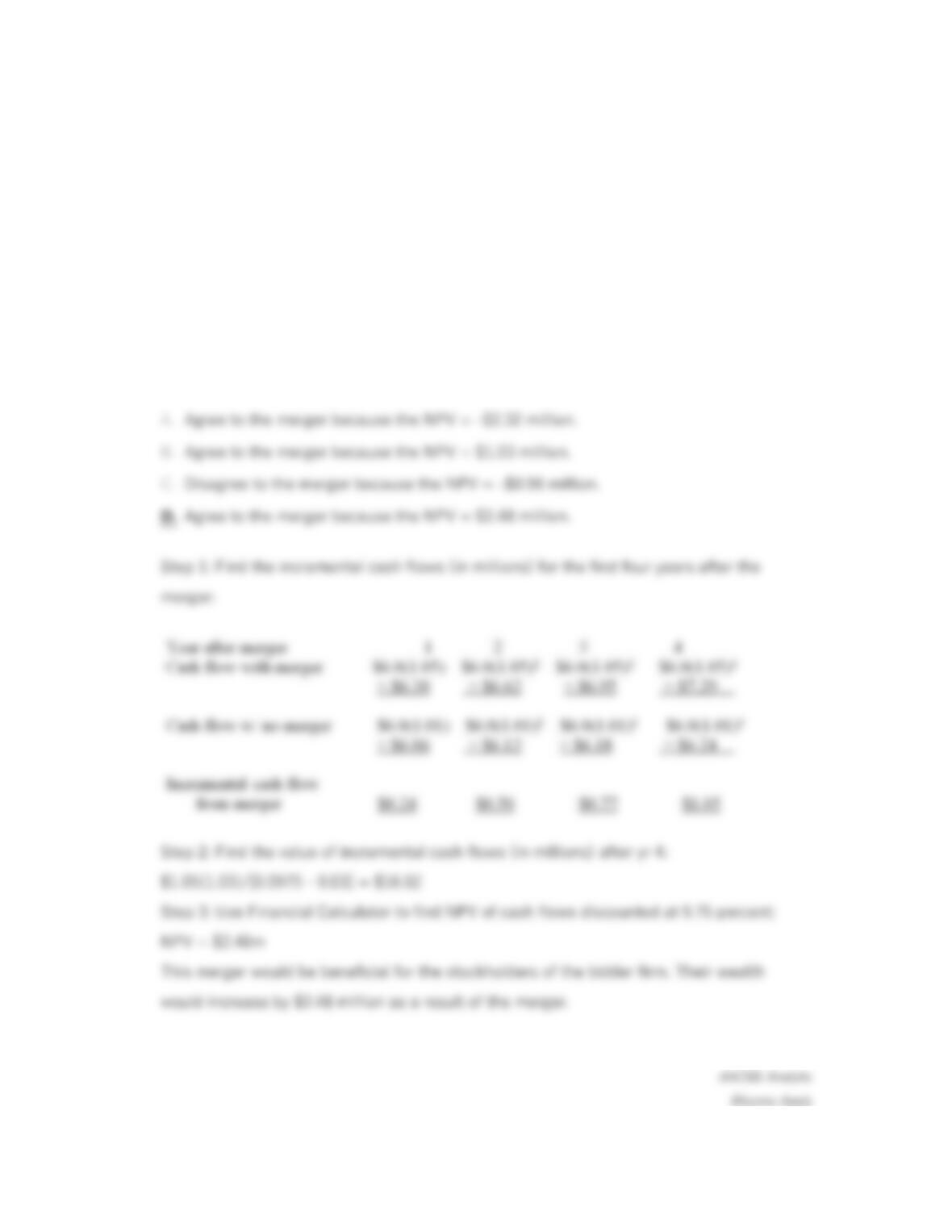
77.
Stubborn Motors, Inc., is asking a price of $10.5 million to be purchased by Rubber Tire
Motor Corp. Rubber Tire currently has total cash flows of $6 million which are growing at 1
percent annually. Managers estimate that because of synergies the merged firm’s cash
flows will increase by an additional 4 percent for the first four years following the merger.
After the first four years, incremental cash flows will grow at a rate of 3 percent annually.
The WACC for the merged firms is 9.75 percent. Calculate the NPV of the merger. Should
Rubber Tire Motor Corporation agree to acquire Stubborn Motors for the asking price of
$10.5 million?
78.
Suppose a linear probability model you have developed finds there are two factors
influencing the past bankruptcy behavior of firms: the debt ratio and the profit margin.
Based on past bankruptcy experience, the linear probability model is estimated as:
PDi = 0.28 (debt ratio) + 0.51 (profit margin)
You know a particular firm has a debt ratio of 46 percent and a probability of default of 18
percent. Calculate the firm’s profit margin.
79.
A linear probability model you have developed finds there are two factors influencing the
past bankruptcy behavior of firms: the equity multiplier and the total asset turnover ratio.
Based on past bankruptcy experience, the linear probability model is estimated as:
PDi = 0.02 (equity multiplier) + 0.06 (total asset turnover)
A firm has an equity multiplier of 1.1 times and a probability of default of 6.2 percent.
Calculate the firm’s total asset turnover ratio.
80.
A survey of a local market has provided the following average cost data: Johnson
Construction Corp. (JCC) has assets of $3 million and an average cost of 22 percent.
Anderson Architects (AA) has assets of $4 million and an average cost of 31 percent. Cole
Home Builders (CHB) has assets of $5 million and an average cost of 28 percent. For each
firm, average costs are measured as a proportion of assets. JCC is planning to acquire AA
and CHB with the expectation of reducing overall average costs by eliminating the
duplication of services. If JCC plans to reduce operating costs by $500,000 after the
merger, what will the average cost be for the new firm?
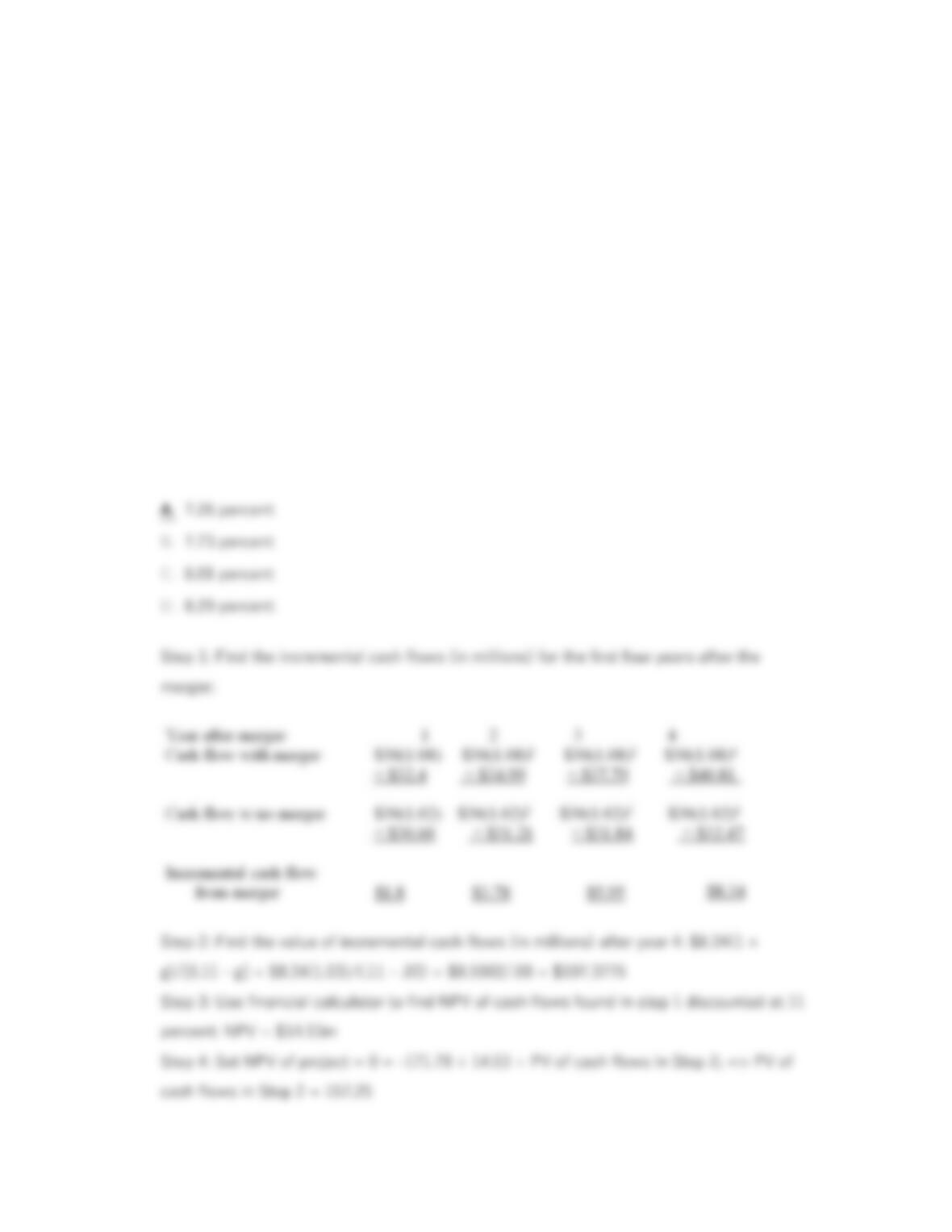
81.
The managers of State Bank have been approached by City Bank about a possible merger.
State Bank is asking a price of $171.78 million to be purchased by City Bank. City Bank
currently has total cash flows of $30 million that are growing at 2 percent annually.
Managers of State Bank estimate that because of synergies the merged firm’s cash flows
will increase by an additional 6 percent for the first four years following the merger. After
the first four years, managers of State Bank have estimated that incremental cash flows
will grow at a rate of 3 percent. The WACC for the merged firms is 11 percent. Managers
of City Bank agree that cash flows should grow at an additional 6 percent for the first four
years, but are unsure of the long-term growth rate in incremental cash flows estimated by
City Bank. Calculate the minimum growth rate needed after the first four years such that
City Bank would see this merger as a positive NPV project.
82.
A linear probability model you have developed finds there are two factors influencing the
past bankruptcy behavior of firms: the debt–to-equity ratio and the sales–to-total assets
ratio. Based on past bankruptcy experience, the linear probability model is estimated as:
PDi = 0.52 (debt/equity) + 0.01 (sales/total assets)
A firm you are thinking of lending to has a sales–to-assets ratio of 2.0 and its expected
probability of default, or bankruptcy, is estimated to be 12 percent. Calculate the firm’s
debt ratio.
83.
A linear probability model you have developed finds there are two factors influencing the
past bankruptcy behavior of firms: the debt–to-equity ratio and the profit margin. Based on
past bankruptcy experience, the linear probability model is estimated as:
PDi = 0.01 (debt/equity) + 0.76 (profit margin)
A firm you are thinking of lending to has a debt-to-equity ratio of 121 percent and its
expected probability of default, or bankruptcy, is estimated to be 8.125 percent. If sales
are $1 million, calculate the firm’s net income.
84.
A linear probability model you have developed finds there are two factors influencing the
past bankruptcy behavior of firms: the debt–to-equity ratio and the profit margin. Based on
past bankruptcy experience, the linear probability model is estimated as:
PDi = 0.013 (debt/equity) + 0.78 (profit margin)
A firm you are thinking of lending to has a debt-to-equity ratio of 112 percent and its
expected probability of default, or bankruptcy, is estimated to be 15.35 percent. If sales
are $1.55 million, calculate the firm’s net income.
85.
A merger between BankOne and Amcore is an example of a:
86.
The main motive for a merger is:
87.
Which of the following is NOT a source of value-enhancing synergy in a merger?