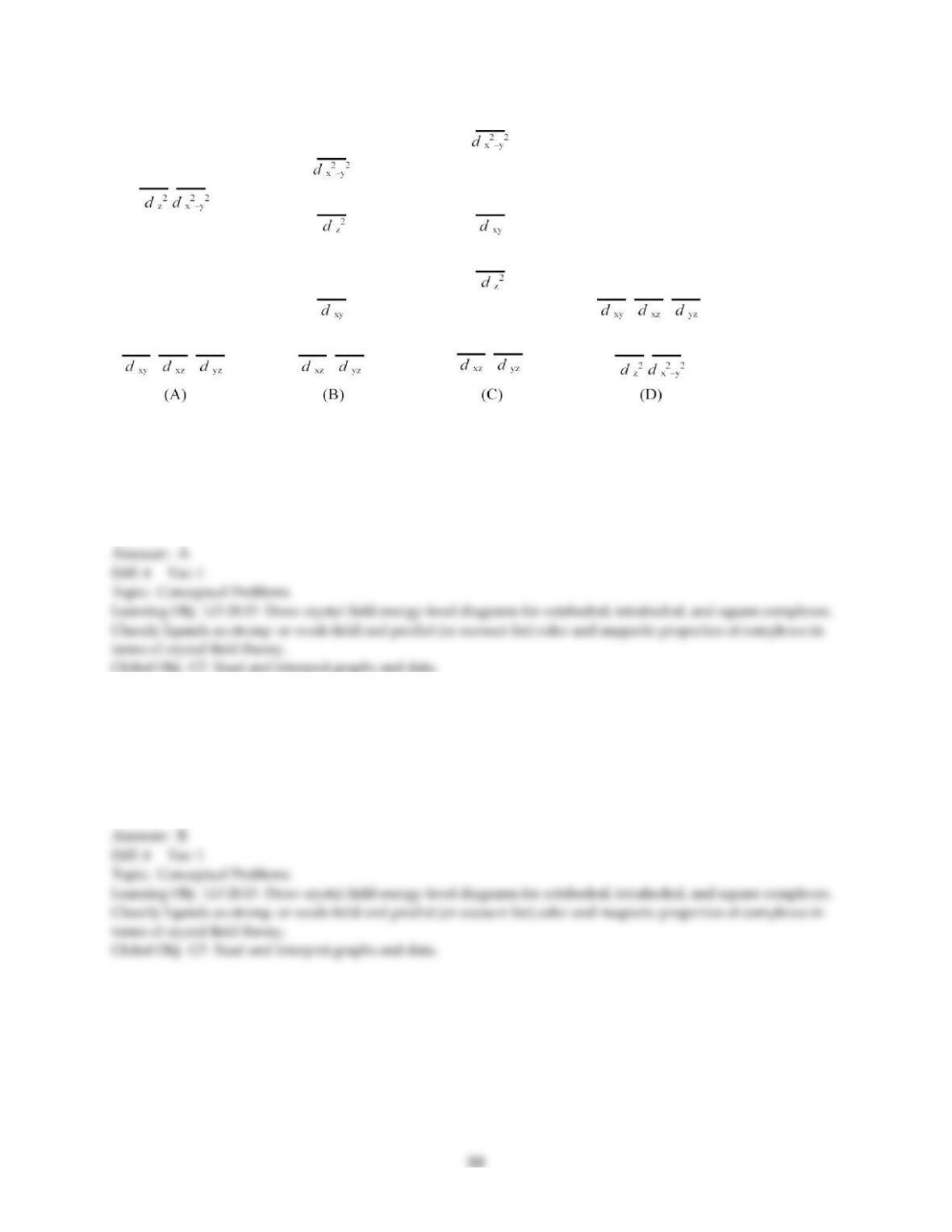
121) Which is the crystal field energy level diagram for an octahedral ML6 complex?
A) (A)
B) (B)
C) (C)
D) (D)
122) Which is the crystal field energy level diagram for a square pyramidal ML5 complex that contains a
single ligand on the z-axis?
A) (A)
B) (B)
C) (C)
D) (D)
123) Which is the crystal field energy level diagram for a square planar ML4 complex that contains no
ligands on the z–axis?
A) (A)
B) (B)
C) (C)
D) (D)
124) Which is the crystal field energy level diagram for a tetrahedral ML4?
A) (A)
B) (B)
C) (C)
D) (D)
41
20.2 Algorithmic Questions
1) Which of the following elements is an inner transition metal?
A) No
B) Ni
C) Ne
D) Na
2) What is the ground-state electron configuration for the element nickel (Z = 28)?
A) [Ne] 4s1 3d9
B) [Ar] 4s1 3d9
C) [Ar] 4s2 3d8
D) [Ar] 3d10
3) What is the ground-state electron configuration for Fe2+ (Z = 26)?
A) [Ar] 4s2 3d8
B) [Ar] 4s2 3d4
C) [Ar] 3d6
D) [Ar] 4s1 3d5
4) How many d electrons are there in Cr
O42-?
A) 0
B) 1
C) 2
D) 3
5) Which of the following species has the electron configuration [Ar]3d3?
A) Sc
B) V3+
C) Cr3+
D) Fe3+
6) Which is a third transition series element?
A) B
B) Mg
C) Y
D) Ta
7) Which of the following elements is an inner transition metal?
A) Pm
B) Ni
C) Zr
D) Lu
8) Which element is most likely to have an anomalous electron configuration?
A) Zr
B) Mn
C) Au
D) Ca
9) Which of the following species has the ground-state electron configuration [Ar]3d4?
A) V
B) Ti+
C) V+
D) Fe2+
10) How many valence electrons does the element Co have?
A) 1
B) 10
C) 12
D) 9
11) How many electrons are in the ground state of Tl+?
A) 2
B) 3
C) 4
D) 5
12) What two transition elements have the highest electrical conductivity of any elements at room
temperature?
A) copper and zinc
B) copper and silver
C) iron and gold
D) silver and chromium
13) Which first row transition element has the highest melting point?
A) Sc
B) V
C) Fe
D) Zn
14) Which transition element has the highest melting point?
A) Sc
B) V
C) Cu
D) W
15) Which of the following elements has the highest density?
A) Cr
B) Cu
C) Os
D) Re
16) Which of the following transition elements (Cr, Co, Ni, and Cu) have positive oxidation potentials?
A) Cr
B) Cu
C) Cr, Cu, and Ni
D) Cr, Co, and Ni
45
17) Which transition element is difficult to oxidize with hydronium ion?
A) Ti
B) Cu
C) Mn
D) Zn
18) What is the highest possible oxidation state for vanadium?
A) +2
B) +3
C) +4
D) +5
19) What is the highest possible oxidation state for chromium?
A) +2
B) +4
C) +7
D) +6
20) Vanadium in the +5 oxidation is most often found as compounds of
A) bromides.
B) chlorides.
C) oxides.
D) phosphides.
46
21) What is the compound responsible for the green patina seen on bronze monuments?
A) CuCO3
B) Cu2(OH)
CO3
C) Cu(OH)
D) Cu2(OH)2SO4
22) Which one of the following compounds is not consistent with the terminology of a complex?
A) [Cu(NH3)3]2+
B) BaSO4 ∙ 5H2O
C) Na3[Fe(CN)6]
D) [Cr(NH3)6]F3
23) Which is a complex ion?
A) FeBr3
B) CrO42-
C) [Cr(H2O)6]3+
D) Cr2O72-
24) Which of the following can function as a bidentate ligand?
A) NO
+
B) Cl
–
C) S
CN
–
D) H2NCH2CO2 –
25) Which of the following can function as a chelating agent?
A) I–
B) NH3
C) C2O42-
D) H2O
26) Which of the following can function as a bidentate ligand?
A) NH3
B) CN–
C) N3-
D) C2O42-
27) Which of the following can function as a bidentate ligand?
A) sulfide
B) hydroxide
C) oxalate
D) fluoride
28) Ethylenediaminetetraacetate ion (EDTA4-) is commonly referred to as a ________ ligand.
A) monodentate
B) tridentate
C) pentadentate
D) hexadentate
29) Which ligand when bonded to a metal would be incorrectly named?
A) H2O, aqua
B) NH3, carbonyl
C) CO, carbonyl
D) I–, iodo
30) In order to form a neutral compound, hexafluoroaluminate would require
A) three Na+ ions.
B) three Br– ions.
C) six K+ ions.
D) six I– ions.
31) Identify the classification of isomers illustrated by [Co(NO2)(NH3)5]2+ and [Co(ONO)(NH3)5]2+.
A) linkage isomers
B) ionization isomers
C) geometric isomers
D) mirror image isomers
32) Which ion has cis and trans isomers?
A) [PdCl3NH3]–
B) [Pt(OH)5NH3]–
C) [PtF2(CN)2]2–
D) [Pt(C2O4)2]2-
33) Which complex cannot exist as enantiomers?
A) [CoF2(H2O)4]+
B) [Co(gly)3]3+
C) cis-[CrCl2(C2O4)2]+
D) [Fe(C2O4)2(en)]–
34) Which definition best describes isomers that are non-superimposable mirror images of each other that
rotate plane polarized light to the same degree but in opposite directions?
A) diastereoisomers
B) enantiomers
C) ionization isomers
D) racemic mixture
35) Which one of the following objects is chiral?
A) a bottle
B) a chair
C) a blank paper
D) a shoe
36) A complex ion that has a broad absorption band at 530 nm in its visible absorption spectrum will
appear to be
A) red.
B) colorless.
C) green.
D) aqua.
37) Which of the following species is diamagnetic?
A) an isolated, gas-phase Ni2+ ion
B) a high-spin octahedral Ru2+ complex
C) an isolated, gas-phase Co2+ ion
D) a low-spin octahedral Os2+ complex
38) How many d electrons are there on the Fe metal atom in Li3[Fe(OH)6]?
A) 1
B) 3
C) 5
D) 6
39) Which ion would you expect to have the largest crystal field splitting Δ?
A) [Co(CN)6]4-
B) [Co(CN)6]3–
C) [Co(H2O)6]2+
D) [Co(H2O)6]3+
40) Which of the following complexes has five unpaired electrons?
A) [Mn(H2O)6]2+
B) [Mn(OH)6]3–
C) CrF3(H2O)3
D) [Ag(NH3)2]+
41) Which one of the following complexes is considered to be tetrahedral?
A) [FeF4]–
B) [Ni(CN)4]2-
C) [PtF4]2-
D) [PdI2(NH3)2]
20.3 Short Answer Questions
1) Transition elements are located in the ________-block of the periodic table.
2) Inner transition elements are found in the ________-block of the periodic table.
3) Using shorthand notation, the electron configuration of Co3+ is ________.
4) Copper has the anomalous short-hand electron configuration ________.
5) Cr2+ has ________ d electrons.
6) Cr3+ has ________ valence electrons.
7) The element that forms a 2+ ion with the electron configuration [Xe] 4f14 5d8 is ________.
Answer: Pt
8) The short hand electron configuration of iron in [FeF6]3- is ________.
9) The small sizes of third transition series atoms is referred to as the ________ contraction.
10) The first transition series element expected to have the lowest second ionization energy is ________.
11) The oxidation state of chromium in Cr2O72- is ________.
12) The highest oxidation state attainable by Zn is ________.
13) The coordination number of platinum in Pt(NH3)2Cl2 is ________.
14) The coordination number of cobalt in [Co(NH3)4Cl2]F is ________.
54
15) The coordination number of chromium in [Cr(EDTA)]– is ________.
16) The oxidation state of palladium in K2[PdCl4] is ________.
17) Polydentate ligands are known as ________ agents.
18) The formula for tetraamminediiodochromium(III) bromide is ________.
19) The number of diastereoisomers possible for [Co(en)2Cl2]+ is ________.
20) [Co(NH3)5NCS]2+ and [Co(NH3)5SCN]2+ are examples of ________ isomers.
21) The color exhibited by coordination compounds is usually due to the absorption of light by a d–
electron, resulting in the promotion of the d-electron from its ground-state d–orbital to a higher energy
orbital. The first transition series element expected to have a colorless aqueous solution M2+ ion is
________.
22) Platinum uses ________ hybrid orbitals to accept electron pairs from ligands in cis-Pt(NH3)2Cl2.
23) The number of unpaired electrons in Co(NH3)63+ is ________.
24) The number of unpaired electrons in square planar PtCl42- is ________.
25) The number of unpaired electrons in tetrahedral NiBr42- is ________.