Quantity of Movies Michelle’s Total Robert’s Total
Watched per Week Utility per Week Utility per Week
0 0 0
1100 100
2195 190
3270 270
4340 340
5390 400
6420 350
7435 390
8445 420
9450 440
10 440 450
142)
Refer to the above table. The marginal utility of the 5th movie for Michelle is
142)
A)
40 units of utility.
B)
50 units of utility.
C)
390 units of utility.
D)
60 units of utility.
143)
If the commercial is correct that every additional bite tastes as good as the first, the marginal utility
from consuming more of the advertised product must be
143)
A)
increasing.
B)
zero.
C)
constant.
D)
decreasing.
144)
Sam loves cookies. She receives 200 utils for one cookie, 360 for two cookies, 480 for the third, 560
for four cookies, and 600 for five cookies. The marginal utility of the third cookie is
144)
A)
120.
B)
80.
C)
480.
D)
unable to determine.
145)
The real–income effect of a price change is most significant when
145)
A)
the substitution effect is insignificant.
B)
the good under consideration constitutes a major portion of the consumer’s budget.
C)
the marginal utility per dollar spent on the last unit is high.
D)
the substitution effect is significant too.
Quantity Total Utility
Per Week Amy Robert David Michelle
0 0 0 0 0
15.0 100 600 60
2 9.9 190 1200 130
314.7 270 1800 220
419.4 340 2400 310
524.0 400 3000 425
628.5 450 3600 575
732.9 490 4200 900
837.2 520 4800 1275
941.4 510 5400 1770
146)
Refer to the above table. The one who likes the good the most is
146)
A)
David.
B)
Robert.
C)
Michelle.
D)
uncertain since we cannot compare utility across people.
147)
When a consumer shifts his purchases from product A to product B, the marginal utility of
147)
A)
A falls and the marginal utility of B will increase.
B)
both A and B will decrease.
C)
A increases and the marginal utility of B will fall.
D)
both A and B will increase.
148)
Basket of goods A is on an indifference curve that lies further from the origin than basket B. From
this we know that
148)
A)
all other consumers would also rank B above A.
B)
the satisfaction from consuming A is more than the satisfaction from consuming B.
C)
the prices of the goods in A are more than the prices of the goods in B.
D)
the marginal utility from consuming A is more than the marginal utility from
consuming B.
149)
If a consumer is initially at an optimum, and then the price of Y falls, then
149)
A)
MUX/PX< MUY/PY.
B)
MUX/PX= MUY/PY.
C)
MUX/PX> MUY/PY.
D)
MUX/MUY> PY/PX.
150)
An indifference curve
150)
A)
must slope downward towards the right.
B)
may be upsloping or downsloping, depending on whether the two products are complements
or substitutes.
C)
is upsloping and is concave to the origin.
D)
is positively sloped.
151)
Newspaper vending machines are often built so that customers can pay to lift a door and take a
paper off a pile of daily newspapers. Newspaper distributors are not concerned about customers
taking the whole stack of papers because
151)
A)
the marginal utility of a second daily newspaper is zero.
B)
the marginal utility of any one daily newspaper is zero.
C)
the total utility of a daily newspaper is zero.
D)
the price of a daily newspaper is relatively low.
152)
When you tell your mother, “I’ll never be tired of your cooking,” you are saying the
152)
A)
marginal utility of her cooking to you will never be 0.
B)
marginal utility of her cooking to you is 0.
C)
total utility of her cooking to you is constant.
D)
total utility of her cooking to you is equal to 1.
153)
Holding all other prices and money income constant, if the price of food rises, then the consumer
will adjust her expenditures and
153)
A)
her level of satisfaction may go up or down.
B)
reach an optimum on a lower indifference curve.
C)
reach an optimum on a higher indifference curve.
D)
reach an optimum on the same indifference curve.
154)
Mathematically the marginal rate of substitution is
154)
A)
always a positive number.
B)
is equal to 1.
C)
sometimes a positive and sometimes a negative number.
D)
always a negative number.
155)
The tendency of people to substitute cheaper commodities for more expensive commodities is the
155)
A)
law of diminishing marginal utility.
B)
price income effect.
C)
real–income effect.
D)
substitution effect.
156)
John is currently spending all of his income. For the last unit of Good A consumed John gets 20 utils
and for the last unit of Good B consumed he gets 10 utils. The price of Good A is $2. The price of
Good B is $5. If John wants to maximize his utility he should
156)
A)
continue to purchase the same amount of Good A and Good B.
B)
increase the consumption of Good A and decrease the consumption of Good B.
C)
decrease the consumption of Good A and increase the consumption of Good B.
D)
decrease the consumption of Good A and decrease the consumption of Good B.
Quantity Total Utility
per Week Michelle Robert David Lauren
0 0 0 0 0
1 50 1000 60 60
2 99 1900 120 130
3 147 2700 180 220
4 194 3400 240 310
5 240 4000 300 425
6 285 4500 360 575
7 329 4900 420 900
8 372 5200 480 1275
9 414 5400 540 1770
157)
According to the above table, what is David’s marginal utility of the 7th unit?
157)
A)
400
B)
120
C)
420
D)
60
158)
The price of a hamburger is $1 and the price of a movie is $4 and the consumer has $10. A
consumer has purchased 2 hamburgers and 2 movies, receiving 25 units of utility for the second
hamburger and 100 units of utility for the second movie. The set of goods
158)
A)
is an optimum since the entire income is spent and the marginal utility per dollar spent is the
same for the last unit of each good.
B)
is not an optimum because the marginal utility per dollar spent is greater for hamburgers
than for movies.
C)
is an optimum since the entire income is spent and total utility is minimized.
D)
is not an optimum because the consumer has not spent all of his money.
Quantity of Total Quantity of Total
Hamburgers/Wk Utility Movies/Wk Utility
140 1400
2 60 2 700
376 3 850
486 4950
5 91 51000
693 61025
159)
Refer to the above table. The price of a hamburger is $2, the price of a movie is $5, and the
consumer‘s income is $29. What is the marginal utility per last dollar spent on movies equal to if the
consumer is at an optimum?
159)
A)
10
B)
50
C)
40
D)
20
Quantity of Total Quantity of Total
Magazines/Wk Utility Paperbacks/Wk Utility
0 0 0 0
160 1200
2100 2400
3130 3500
4 140 4550
5142 5575
6142 6 580
160)
Refer to the above table. If the consumer’s equilibrium consists of 3 magazines and 6 books, then we
know that
160)
A)
the price of a book is 3 times more than the price of a magazine.
B)
the price of a book is 2 times more than the price of a magazine.
C)
the price of a magazine is 4.5 times more than the price of a book.
D)
the price of a magazine is 6 times more than the price of a book.
Quantity Total Utility
Per Week Amy Robert David Michelle
0 0 0 0 0
15.0 100 600 60
2 9.9 190 1200 130
314.7 270 1800 220
419.4 340 2400 310
524.0 400 3000 425
628.5 450 3600 575
732.9 490 4200 900
837.2 520 4800 1275
941.4 510 5400 1770
161)
Refer to the above table. David’s utility schedule is characterized by
161)
A)
diminishing marginal utility.
B)
increasing marginal utility.
C)
decreasing marginal utility.
D)
constant marginal utility.
162)
To derive the law of demand, we assume that
162)
A)
tastes are constant.
B)
marginal utility is constant.
C)
real prices are constant.
D)
prices are constant.
163)
Economists assume that people make decisions regarding consumption based on comparing
163)
A)
additional units of satisfaction with additional costs.
B)
average satisfaction with average costs.
C)
average satisfaction with additional costs.
D)
additional units of satisfaction with average costs.
164)
John is currently spending all of his income. For the last unit of Good A consumed John gets 20 utils
and for the last unit of Good B consumed he gets 10 utils. The price of Good A is $4. The price of
Good B is $1. If John wants to maximize his utility he should
164)
A)
continue to purchase the same amount of Good A and Good B.
B)
increase the consumption of Good A and decrease the consumption of Good B.
C)
decrease the consumption of Good A and increase the consumption of Good B.
D)
decrease the consumption of Good A and decrease the consumption of Good B
165)
Which of the following statements is TRUE with respect to total utility and marginal utility?
165)
A)
Total utility can decline while marginal utility rises.
B)
Total utility is not related to marginal utility.
C)
Marginal utility always rises as total utility increases.
D)
Marginal utility can decline as total utility rises.
166)
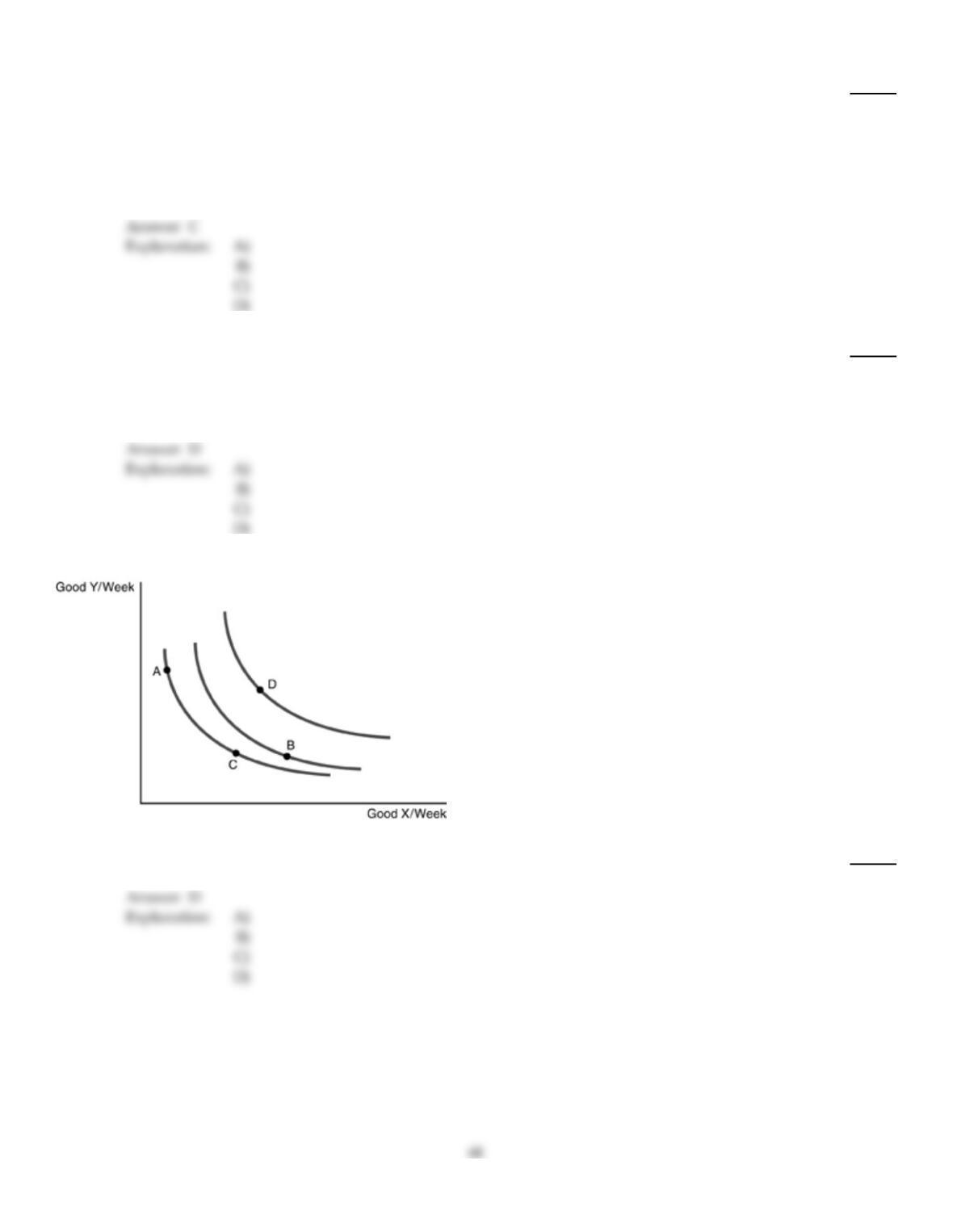
Refer to the above figure. Which point represents the highest level of utility?
166)
A)
Point A
B)
Point B
C)
Point C
D)
Point D
167)
When you purchase the lower–priced store brand bread instead of the more expensive name brand,
you are experiencing
167)
A)
the substitution effect.
B)
a fall in total utility.
C)
the income effect.
D)
diminishing marginal product.
Pizza Marginal Utility
1st Slice 7 utils
2nd Slice 6 utils
3rd Slice 4 utils
4th Slice 3 utils
168)
Suppose the price of pizza falls to $1 per slice. Assuming that Tom’s preferences continue to be
those shown in the above table, and assuming that MU/P = 3 is still the point at which his
consumer optimum is reached, how many slices will Tom now buy?
168)
A)
1 slice
B)
2 slices
C)
3 slices
D)
4 slices
169)
If the price of coffee rises relative to all other prices, consumers are likely to
169)
A)
buy less tea.
B)
buy less coffee and more tea.
C)
buy more coffee.
D)
buy less coffee and less tea.
170)
A consumer’s optimum is found when
170)
A)
the total utility of each good is the same and the total income is spent.
B)
the marginal utility of the last dollar spent on each good is the same and all income is spent.
C)
the marginal utility of the last dollar spent equals zero for each good.
D)
the marginal utility of each good is increasing and the total income is spent.
Slices of Pizza Total Utility Marginal Utility
0 0 –
120
250
320
410
5 0
171)
In the above table, the total utility of 4 slices of pizza is
171)
A)
70.
B)
50.
C)
20.
D)
80.
172)
Use the above figure. What would make all possible points attainable for the individual to
consume?
172)
A)
a decrease in income
B)
an increase in the price of good x
C)
an increase in the price of good y
D)
a decrease in the price of good y
173)
A higher price for a good implies that
173)
A)
the marginal utility of the good has declined.
B)
the marginal utility of another good has decreased.
C)
the total value of the good to the consumer has increased.
D)
the sacrifice of utility of another good has increased.
174)
When marginal utility is positive, but decreasing, then total utility is
174)
A)
increasing at an increasing rate.
B)
negative.
C)
increasing at a decreasing rate.
D)
decreasing.
175)
When you buy something, you do so because of the satisfaction you expect to receive from having
and using that good. Another term that can be used for satisfaction is
175)
A)
utility.
B)
need.
C)
price elasticity.
D)
purchasing power.
Quantity of Movies Michelle’s Total Robert’s Total
Watched per Week Utility per Week Utility per Week
0 0 0
1100 100
2195 190
3270 270
4340 340
5390 400
6420 350
7435 390
8445 420
9450 440
10 440 450
176)
Refer to the above table. The marginal utility of the 8th movie for Robert is
176)
A)
420 units of utility.
B)
30 units of utility.
C)
5 units of utility.
D)
20 units of utility.
177)
Suppose that the quantity of good y is measured along the vertical axis and that the quantity of
good x is measured along the horizontal axis. If the price of good x is $5 and the price of good y is
$10 when income is $200 per time period, the slope of the consumer‘s budget constraint will be
177)
A)
–5.
B)
–10.
C)
–2.
D)
–0.5.
178)
Along an indifference curve
178)
A)
utility increases as you move to the right.
B)
every combination of goods the consumer can purchase with their income is given.
C)
every combination of the goods give the same level of satisfaction.
D)
the prices of goods will change.
179)
An increase in consumer income will
179)
A)
shift out the budget constraint and increase the consumption of both goods, if they are normal
goods.
B)
reduce consumption of all normal goods.
C)
pivot the budget constraint on the axis with the good that has the higher price.
D)
shift the budget constraint and increase its slope.
180)
John is currently spending all of his income. For the last unit of Good A consumed John gets 20 utils
and for the last unit of Good B consumed he gets 10 utils. The price of Good A is $10. The price of
Good B is $1. If John wants to maximize his utility he should
180)
A)
continue to purchase the same amount of Good A and Good B.
B)
increase the consumption of Good A and decrease the consumption of Good B.
C)
decrease the consumption of Good A and increase the consumption of Good B.
D)
decrease the consumption of Good A and decrease the consumption of Good B.
181)
The slope of the budget constraint line is the
181)
A)
ratio of different levels of income.
B)
rate of exchange between the two goods.
C)
income of consumers divided by the price of each good.
D)
ratio of this year’s income to last year’s income.
Quantity Total Utility
Per Week Amy Robert David Michelle
0 0 0 0 0
15.0 100 600 60
2 9.9 190 1200 130
314.7 270 1800 220
419.4 340 2400 310
524.0 400 3000 425
628.5 450 3600 575
732.9 490 4200 900
837.2 520 4800 1275
941.4 510 5400 1770
182)
Refer to the above table. Which of the four people have utility schedules characterized by the law of
diminishing marginal utility?
182)
A)
Amy, Robert, and David only
B)
Michelle and David only
C)
Michelle only
D)
Amy and Robert only
183)
Refer to the above figure. Which point represents the second highest level of utility?
183)
A)
Point A
B)
Point B
C)
Point C
D)
Point D
Bob’s Marginal Utility for consuming beer and pizza with $8.00 in income
Quantity Marginal Quantity of Marginal
of Pizza Utility Beer Utility
1 45 1 40
2 40 2 40
3 30 3 35
4 15 410
5 –5 5 0
184)
In the above table, how much beer and pizza will Bob consume if the price of a piece of pizza is
$2.00 and the price of a beer is $2.00?
184)
A)
2 pieces of pizza and 2 beers
B)
2 pieces of pizza and 3 beers
C)
1 piece of pizza and 3 beers
D)
3 pieces of pizza and 1 beer
185)
Referring to the above table, suppose Bob’s ratios of marginal utility of beer to the price of beer and
the marginal utility of pizza to the price of pizza are equal. If the price of beer increases
185)
A)
Bob will probably consume more beer and less pizza.
B)
Bob will probably consume less beer and more pizza.
C)
Bob will probably consume less beer and less pizza.
D)
Bob will still consume the same amount of beer and pizza.
186)
A decrease in the price of a good causes
186)
A)
the nominal wealth of a person to increase.
B)
purchasing power of a person’s income to increase.
C)
the marginal utility of the good to decrease.
D)
the utility of the good to decrease.
187)
In order for a consumer to choose between two different goods, he has to take into consideration
the
187)
A)
marginal utility plus the price.
B)
total utility divided by price.
C)
marginal utility divided by the price.
D)
marginal utility of production.
188)
A consumer has been buying 4 magazines and 3 books a month for many months. The price of
magazines then decreases, which directly causes the marginal utility per dollar spent on
188)
A)
magazines to increase, thereby inducing the consumer to purchase more magazines and
fewer books.
B)
books to increase, thereby inducing the consumer to purchase fewer magazines and more
books.
C)
books to decrease, thereby inducing the consumer to purchase fewer magazines and more
books.
D)
magazines to increase, thereby inducing the consumer to purchase fewer magazines and
more books.
189)
If marginal utility is zero, total utility is
189)
A)
at its maximum.
B)
increasing.
C)
falling.
D)
negative.
190)
Along an indifference curve, as the consumer reduces the quantity of Good A in favor of more
Good B the marginal rate of substitution of Good A for Good B will
190)
A)
fall.
B)
rise.
C)
fall and eventually turn negative.
D)
stay the same.
191)
A consumer is at an optimum when the price of one good she has been consuming decreases. As a
result
191)
A)
the price of the other good must decrease too.
B)
the value of the marginal utility of the last unit consumed has increased.
C)
the value of the marginal utility of the last unit consumed has decreased.
D)
the marginal utility of the last dollar spent on this good is now greater than the marginal
utility of the last dollar spent on other goods.
Bob’s Marginal Utility for consuming beer and pizza with $8.00 in income
Quantity Marginal Quantity of Marginal
of Pizza Utility Beer Utility
1 45 1 40
2 40 2 40
3 30 3 35
4 15 410
5 –5 5 0
192)
According to the above table, how much total utility does Bob get from 3 pieces of pizza?
192)
A)
85 utils
B)
130 utils
C)
115 utils
D)
30 utils
193)
The price of a hamburger is $1, the price of a movie is $5, and the consumer has $13. A consumer
has purchased 3 hamburgers and two movies, receiving 10 units of utility for the last hamburger
and 10 units of utility for the last movie. The set of goods
193)
A)
is an optimum since the entire income is spent and the marginal utility is the same for the last
unit of each good.
B)
is not an optimum because the marginal utility per dollar spent is greater for the hamburger
than for the movie.
C)
is not an optimum because the marginal utility for the second hamburger was less than the
marginal utility for the first hamburger.
D)
is an optimum because the consumer has maximized her utility given the limited income she
had.
194)
When marginal utility is zero, total utility is
194)
A)
at its maximum.
B)
increasing.
C)
at its minimum.
D)
decreasing.
Quantity Quantity Quantity
of A MUa of B MUb of C MUc
115 112 115
212 210 210
3 9 3 8 3 5
4 6 4 4 4 4
195)
Based on the information in the above table, the price of A is $3, the price of B is $2, and the price of
C is $5. If Mary has $22 to spend, what combination of products A, B, and C should she buy in
order to maximize her satisfaction?
195)
A)
3 units of product A; 4 units of product B; 0 units of product C
B)
3 units of product A; 3 units of product B; 1 unit of product C
C)
2 units of product A; 3 units of product B; 2 units of product C
D)
2 units of product A; 1 unit of product B; 4 units of product C
196)
If two units of a good provide 7 utils and the marginal utility of the third unit of the good is 2 utils,
what is the total utility from consuming three units of the good?
196)
A)
10 utils
B)
7 utils
C)
9 utils
D)
3 utils
197)
When the price of DVDs falls relative to movie and restaurant prices, and consumers buy more of
the DVDs, economists call this
197)
A)
satisfaction.
B)
marginalization.
C)
substitution.
D)
indifference.
198)
The price of a large pepperoni pizza used to be $14, but this week the price rose to $18. With a
budget of just $30, you can‘t afford as many pizzas at the higher price. This change in consumer
behavior reflects the
198)
A)
concept of diminishing marginal utility.
B)
nominal income effect.
C)
real income effect.
D)
substitution effect.
Combination Good A Good B
A17 4
B13 5
C10 6
D 8 7
199)
Refer to the above table. The table gives the various combinations of Good A and Good B along
Jane’s indifference curve. The marginal rate of substitution when Jane goes from combination B to
combination C is
199)
A)
3:1.
B)
0.
C)
2:1.
D)
4:1.
200)
The price of hamburgers is $2 and the price of movies is $4. The consumer has $14 of income. The
consumer is purchasing 3 hamburgers and receiving 30 utils for the last hamburger. He is also
purchasing 2 movies and receiving 40 utils for the last movie. This set of goods
200)
A)
is not an optimum because the marginal utility per dollar spent is greater for hamburgers
than for movies.
B)
is an optimum since the entire income is spent and total utility is maximized.
C)
is an optimum since the entire income is spent and the marginal utility per dollar spent is the
same for the last unit of each good.
D)
is not an optimum because the consumer has not spent all of his money.
201)
The quantities of Good M are plotted on the vertical axis while the quantities of Good N are plotted
on the horizontal axis. The prices of both M and N fall. The intercepts of the budget line would
201)
A)
rise on the vertical axis and also rise on the horizontal axis.
B)
rise on the vertical axis but stay unchanged along the horizontal axis.
C)
rise on the horizontal axis but stay unchanged on the vertical axis.
D)
decline along both axes.
202)
The reason that all–you–can–eat restaurants can make a profit is due to
202)
A)
the law of demand.
B)
the law of increasing relative costs.
C)
the law of diminishing marginal returns.
D)
the law of diminishing marginal utility.
Quantity of Total Quantity of Total
Hamburgers/Wk Utility Movies/Wk Utility
140 1400
2 60 2 700
376 3 850
486 4950
5 91 51000
693 61025
203)
Refer to the above table. Suppose the price of a hamburger is $2, the price of a movie is $5, and the
income of the consumer is $29. What will the consumer‘s total utility equal at an optimum?
203)
A)
70
B)
1025
C)
1118
D)
1060
204)
A consumer’s optimum is found when
204)
A)
the consumer saves part of their income.
B)
prices of goods go down.
C)
the consumer is achieving the maximum level of utility given market prices and their limited
income.
D)
the marginal utility of the last dollar spent equals 0 for every good.
205)
The concept of utility is
205)
A)
objective so that devices can be developed that would measure a person’s utility.
B)
subjective so measurement of someone’s utility must be done scientifically.
C)
subjective so that there can be no true measurement of someone’s utility.
D)
objective so that psychologists can measure utility and compare one person’s utility with that
of another person.
206)
If total utility is unchanged, then marginal utility is
206)
A)
increasing.
B)
zero.
C)
negative.
D)
positive.
207)
In economic utility analysis, consumer tastes and preferences are assumed
207)
A)
given and stable for an individual.
B)
to be influenced by the prices of goods.
C)
to be determined by income.
D)
given but rapidly changeable.
208)
When consumers shift away from relatively higher price goods and services in favor of those that
are less expensive, this is known as the
208)
A)
principle of increasing opportunity costs.
B)
principle of substitution.
C)
principle of supply.
D)
principle of utility.
209)
Which of the following statements is FALSE, with respect to what economist Adam Smith called
the diamond–water paradox?
209)
A)
Total utility does not determine what people are willing to pay for a unit of a particular
commodity; marginal utility does.
B)
There are relatively few diamonds, so the marginal utility of the last diamond consumed is
relatively high.
C)
The total utility of water greatly exceeds the total utility derived from diamonds.
D)
The demand for water is much smaller than the demand for diamonds.
210)
Assume that Jackie concludes that he should eat less and play racquetball more. In this situation, it
must be true that the marginal utility of the last dollar spent on food is
210)
A)
more than the marginal utility of the last dollar spent on racquetball.
B)
negative and less than the marginal utility of the last dollar spent on racquetball.
C)
equal to the marginal utility of the last dollar spent on racquetball.
D)
less than the marginal utility of the last dollar spent on racquetball.