158. Amos Company’s molding department opened on October 1, 2012. During October, 35,000 units were
completed and transferred out to the next department. On October 31, 2012, the 9,000 units which remained in
inventory were 40% complete with respect to conversion costs and 100% complete with respect to materials.
Required:
How many equivalent units of work did the molding department complete during October for materials and
conversion costs?
159. Kamin Company’s mixing department had a beginning inventory of 4,000 units which had accumulated
conversion costs of $55,000. During the period, the mixing department accumulated conversion costs of
$92,000 and started 8,000 new units. Ending inventory was 2,500 units which were 40% complete with respect
to conversion costs. Kamin uses the average cost method to cost inventories.
Required:
Calculate the cost per equivalent unit for conversion costs in the mixing department.
160. Kramer Company started its production operations on August 1. During August, the printing department
completed 17,600 units. There were 4,400 units in ending inventory which were 80% complete with respect to
materials and 10% complete with respect to conversion costs. During August, the department accumulated
materials costs of $45,408 and conversion costs of $76,670.
Required:
a. Calculate the cost of the goods transferred out.
b. What is the value of the ending inventory?
Round intermediate computation to nearest cent.
161. On March 1, Upton Company’s packaging department had Work in Process inventory of
8,820 units, which had been transferred in from the finishing department. These units had accumulated costs of
$315,000 in previous departments and $16,000 for conversion costs in the packaging department.
During March, 30,000 units were transferred into the department. These units had
accumulated costs of $770,000 in the previous departments. The packaging department incurred $54,000 in
conversion costs during the month.
Seven hundred units remained in ending inventory on March 31. These units were 80% complete with respect
to conversion costs.
Required:
Calculate the cost per equivalent unit for transferred-in costs and for conversion costs for the packaging
department using the average cost method.
162. Match the following terms with their definitions.
1. Focuses on reducing time, cost, and poor quality
2. Measures the quantity of output of production
cost of production
3. Work centers for processing in a just in time
just-in-time
4. Provides information for controlling and
equivalent units of
5. The portion of whole units that are complete with
163. Match the correct term with the statement that describes it.
1. Costing system used by a company producing by a
3. Measure of the work done during a production
period, expressed in terms of fully complete units of
direct labor and
4. Costs incurred in a previous process that are carried
forward as part of the product’s cost when it moves to
cost of production
5. Costing system used by a company producing
direct labor and
7. Summary of the activity in a processing department
8. A process costing method that costs each period’s
equivalent units of work with that period’s costs per
164. The inventory at June 1 and costs charged to Work in Process – Department 60 during June are as follows:
3,800 units, 60% completed
$ 60,400
Direct materials, 32,000 units
378,000
Direct labor
274,000
Factory overhead
168,000
Total cost to be accounted for
$880,400
During June, 32,000 units were placed into production and 31,200 units were completed, including those in inventory on June 1. On June 30, the
inventory of work in process consisted of 4,600 units which were 85% completed. Inventories are costed by the first-in, first-out method and all
materials are added at the beginning of the process.
Determine the following, presenting your computations (Prepare your computations using unit cost data to four decimal places, i.e. $4.4444, to
minimize rounding differences):
(a)
equivalent units of production for conversion cost
(b)
conversion cost per equivalent unit
(c)
total and unit cost of finished goods started in prior period and completed in the current period
(d)
total and unit cost of finished goods started and completed in the current period
(e)
total cost of work in process inventory at June 30
(a)
Equivalent units of production:
To process units in inventory on June 1:
3,800 ´ 40%
1,520
To process units started and completed in June:
31,200 – 3,800
27,400
To process units in inventory on June 30:
4,600 ´ 85%
3,910
Equivalent units of production for conversion cost
32,830
(b)
Conversion cost per equivalent unit of production:
Direct labor
$274,000
Factory overhead
168,000
$442,000
Unit conversion cost, $442,000 32,830
(c)
Cost of finished goods started in the prior period and completed in current period:
Work in process inventory on June 1:
3,800 ´ 60%
$60,400
Conversion costs in current period,
3,800 ´ 40% = 1,520 units at $13.4633
20,464
Total cost
$80,864
Beginning inventory,
Unit cost, $80,864 3,800
(d)
Cost of finished goods started and completed in current period:
Direct materials, 27,400 units at $11.8125
$323,663
Conversion costs, 27,400 units at $13.4633
368,894
Total cost
$692,557
Unit cost, $692,557 27,400
(e)
Cost of work in process inventory at June 30:
Direct materials, 4,600 units at $11.8125
$ 54,338
Conversion costs, 3,910 units at $13.4633
52,642
Total cost accounted for, $80,864 + $692,557 + $106,980
$880,401*
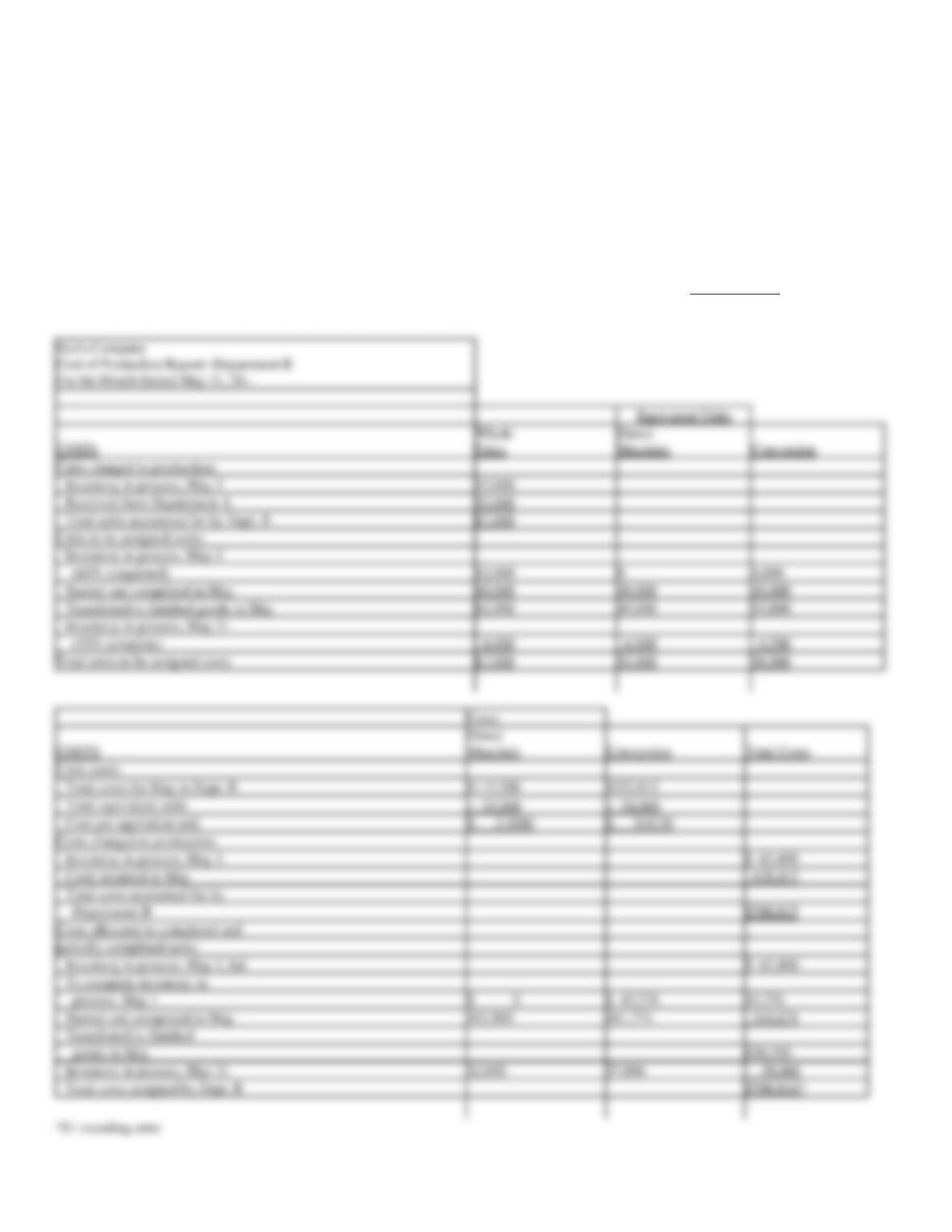
165. The inventory at May 1 and the costs charged to Work in Process—Department B during May for Stella
Company are as follows:
Beginning WIP, 12,000 units, 60% completed
$ 62,400
From Department A, 55,000 units started this period
Direct materials added
115,500
Direct labor incurred
384,915
Factory overhead incurred
138,000
During May, all direct materials are transferred from Department A, the units in process at May 1 were completed, and of the 55,000 units entering
the department, all were completed except 6,000 units which were 70% completed. Inventories are costed by the first-in, first-out method.
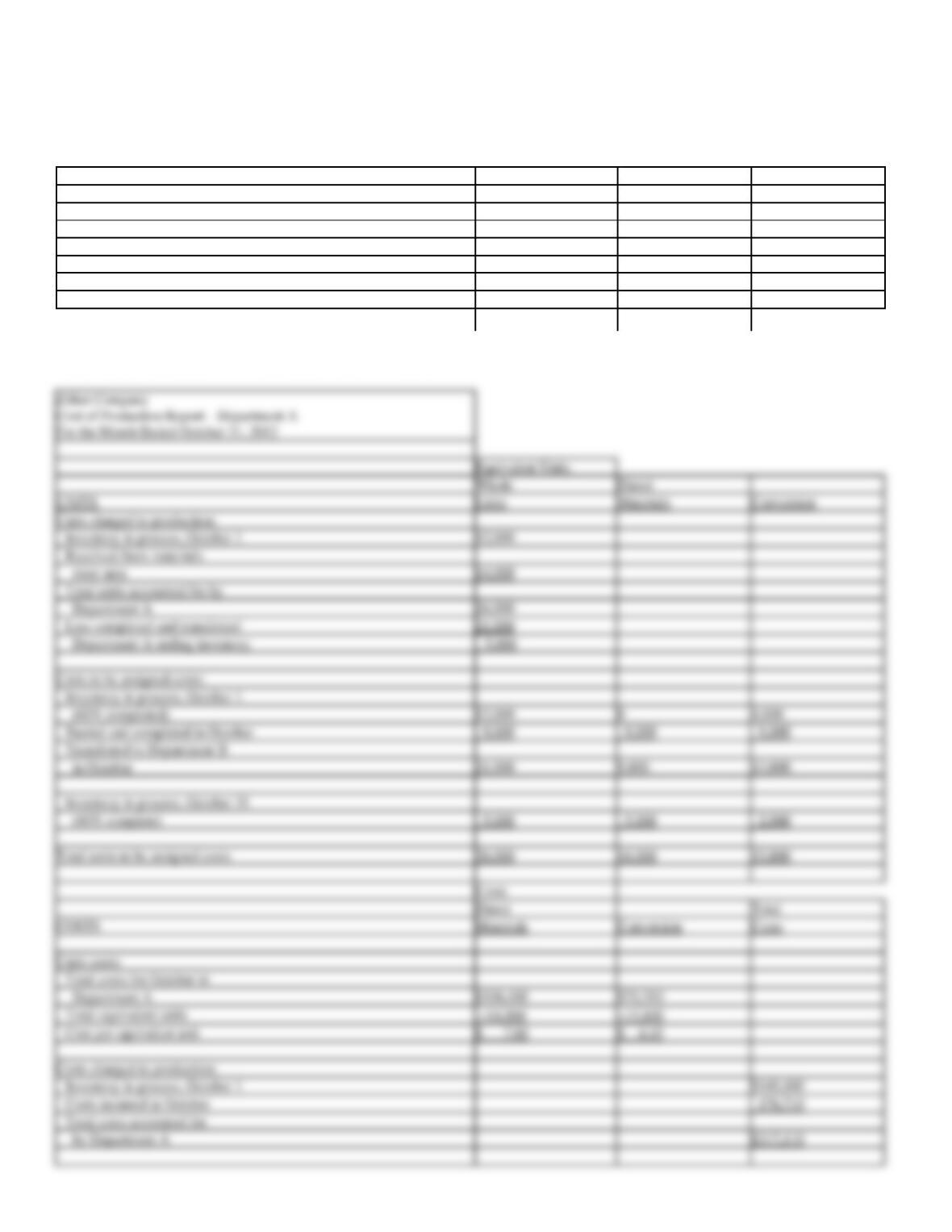
Prepare a cost of production report for May. Round unit cost data to four decimal places and total cost to nearest cent.
Equivalent Units
Units charged to production:
Inventory in process, May 1
12,000
Received from Department A
55,000
Total units accounted for by Dept. B
67,000
Units to be assigned costs:
Inventory in process, May 1
(60% completed)
12,000
0
4,800
Started and completed in May
49,000
49,000
49,000
Transferred to finished goods in May
61,000
49,000
53,800
Inventory in process, May 31
(70% complete)
6,000
6,000
4,200
Total units to be assigned costs
67,000
55,000
58,000
Costs
Units costs:
Total costs for May in Dept. B
$115,500
$522,915
Cost per equivalent unit
$ 2.1000
$ 9.0158
Costs charged to production:
Inventory in process, May 1
$ 62,400
Costs incurred in May
638,415
Total costs accounted for by
Department B
$700,815
Costs allocated to completed and
partially completed units:
Inventory in process, May 1, bal
$ 62,400
To complete inventory in
process, May 1
$ 0
$ 43,276
43,276
Started and completed in May
102,900
441,774
544,674
Transferred to finished
goods in May
650,350
166. Zither Co. manufactures a product called Zens in a three-process series. All materials are introduced at the
beginning of the first process. Zither uses the first-in, first-out method of inventory costing. Unit and cost data
for the first process (Department A) for the month of October 2012 follow:
Conversion
Units
Completion
Cost
Work in process inventory:
October 1
12,000
60%
$140,400
October 31
5,000
40%
?
Started in October
14,000
Direct materials cost
106,400
Conversion cost
70,310
Completed in October
21,000
?
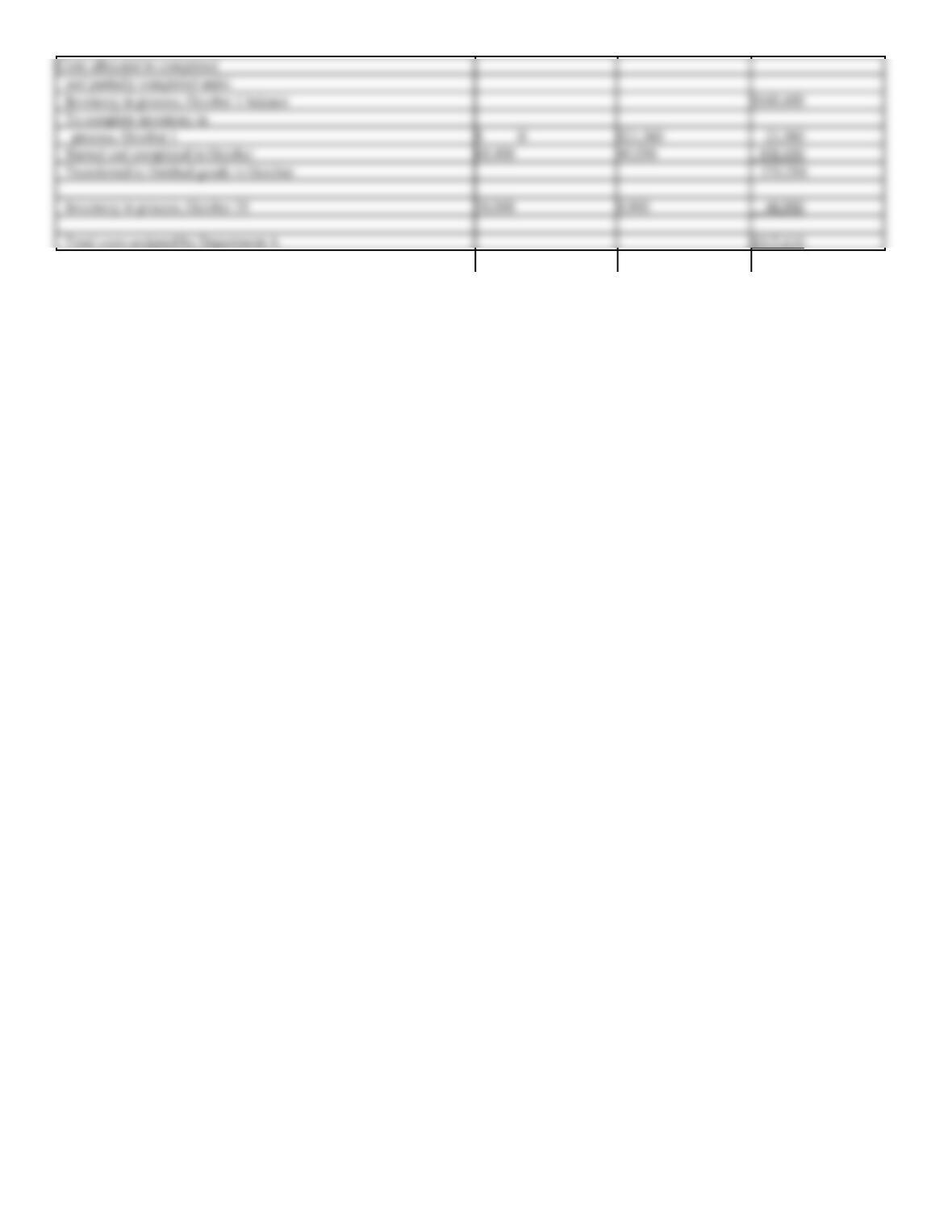
Prepare Zither’s Department A cost of production report for October.
Equivalent Units
Whole
Direct
UNITS
Units
Materials
Conversion
Units charged to production:
Inventory in process, October 1
12,000
Received from materials
store area
14,000
Total units accounted for by
Department A
26,000
Less completed and transferred
21,000
Department A ending inventory
5,000
Units to be assigned costs:
Inventory in process, October 1
(60% completed)
12,000
0
4,800
Started and completed in October
9,000
9,000
9,000
Transferred to Department B
in October
21,000
9,000
13,800
Inventory in process, October 31
(40% complete)
5,000
5,000
2,000
Total units to be assigned costs
26,000
14,000
15,800
Costs
COSTS
Materials
Conversion
Costs
Units costs:
Total costs for October in
Department A
$106,400
$70,310
Cost per equivalent unit
$ 7.60
$ 4.45
167. The inventory at April 1, 2012, and the costs charged to Work in Process—Department B during April for
Zarley Company are as follows:
1,200 units, 40% completed
$ 47,800
From Department A, 26,000 units
845,000
Direct labor
312,000
Factory overhead
176,770
During April, all direct materials are transferred from Department A, the units in process at April 1 were completed, and of the 26,000 units entering
the department, all were completed except 1,000 units which were 70% completed as to conversion costs. Inventories are costed by the first-in,
first-out method.
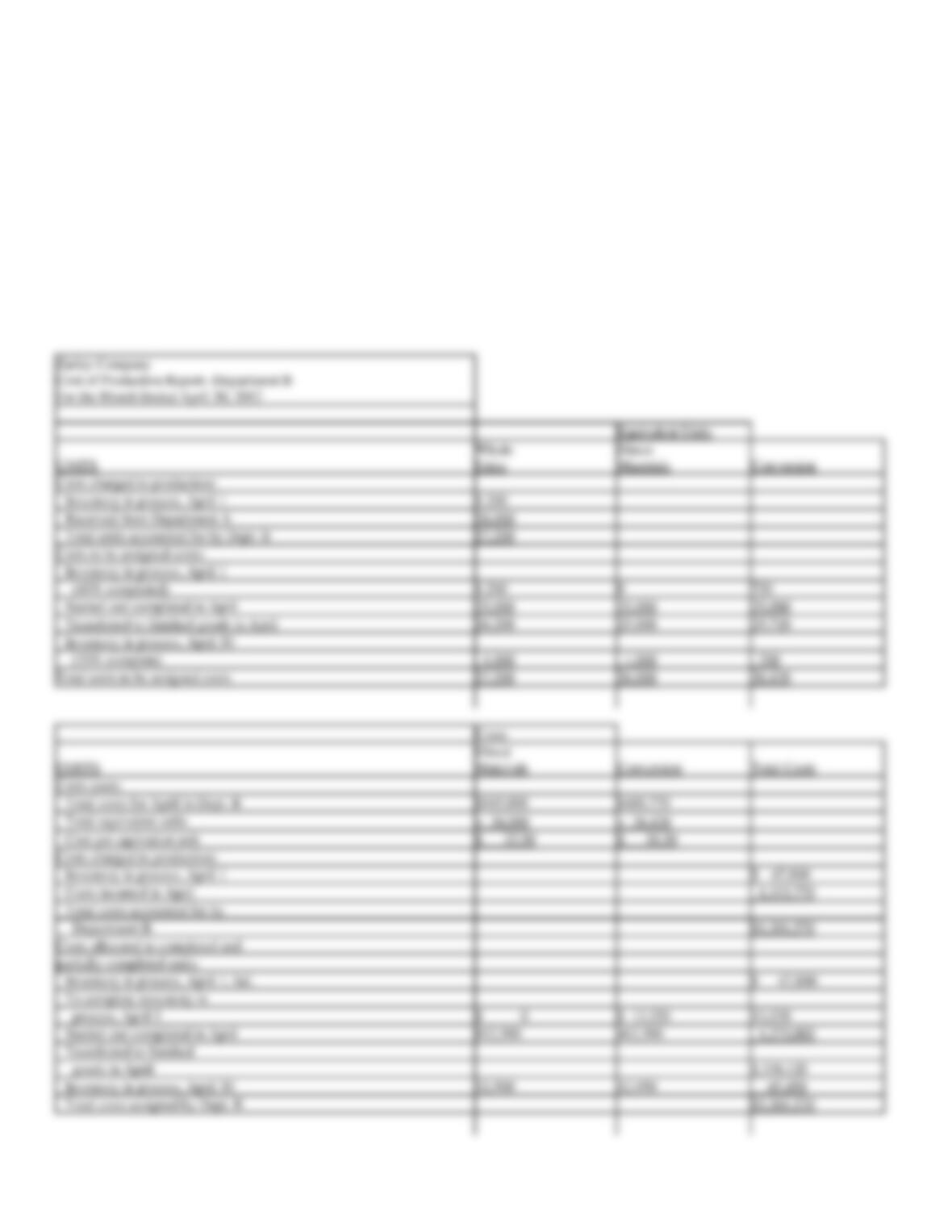
Prepare a cost of production report for April.
Equivalent Units
Units charged to production:
Inventory in process, April 1
1,200
Received from Department A
26,000
Total units accounted for by Dept. B
27,200
Units to be assigned costs:
Inventory in process, April 1
(40% completed)
1,200
0
Started and completed in April
25,000
25,000
25,000
Transferred to finished goods in April
26,200
25,000
25,720
Inventory in process, April 30
(70% complete)
1,000
1,000
700
Total units to be assigned costs
27,200
26,000
26,420
Costs
Units costs:
Total costs for April in Dept. B
$845,000
$488,770
Cost per equivalent unit
$ 32.50
$ 18.50
Costs charged to production:
Inventory in process, April 1
$ 47,800
Costs incurred in April
1,333,770
Total costs accounted for by
Department B
$1,381,570
Costs allocated to completed and
partially completed units:
Inventory in process, April 1, bal.
$ 47,800
To complete inventory in
process, April 1
$ 0
$ 13,320
13,320
Started and completed in April
812,500
462,500
1,275,000
Transferred to finished
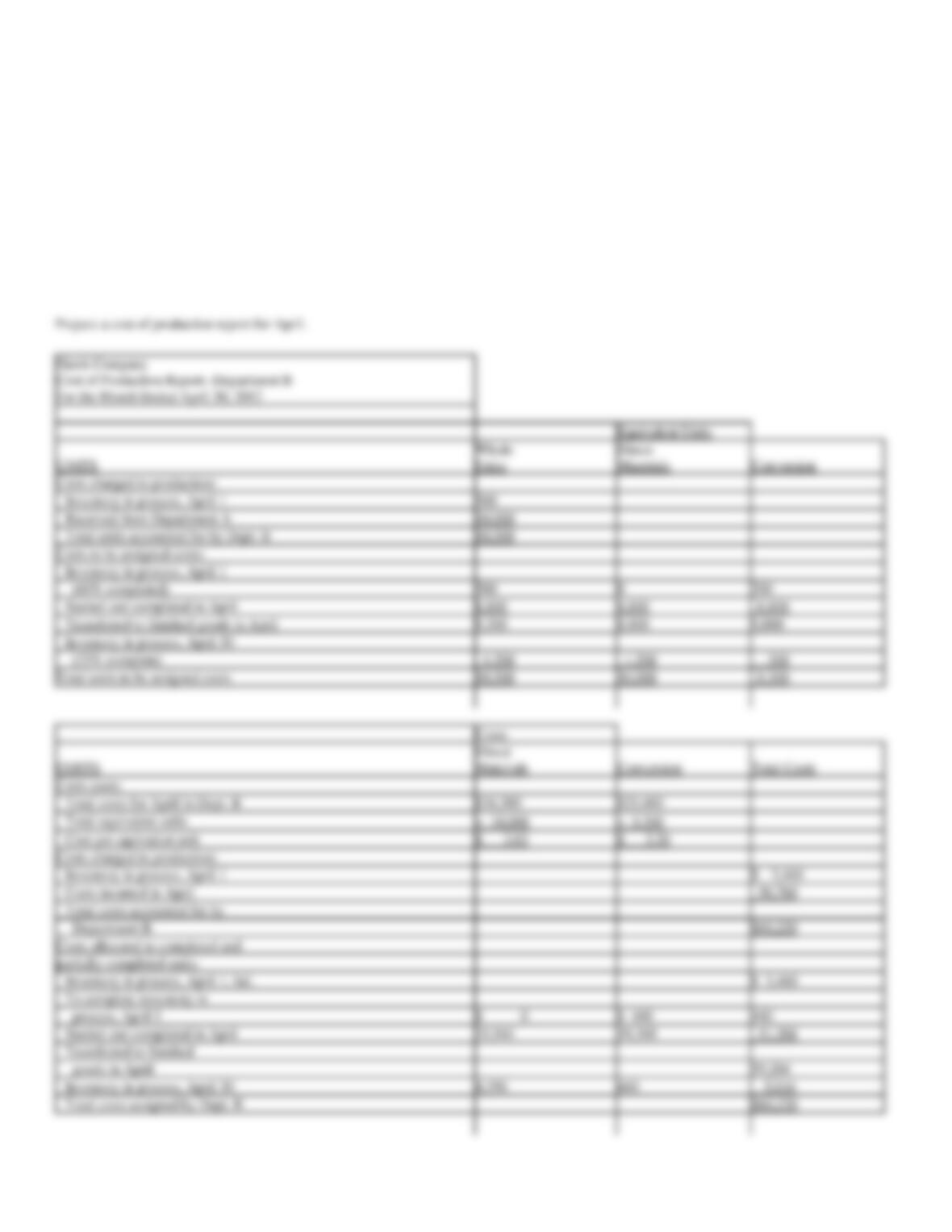
168. The inventory at April 1, 2012, and the costs charged to Work in Process—Department B during April for
Hawk Company are as follows:
500 units, 60% completed
$ 3,460
From Department A, 10,000 units
36,300
Direct labor
7,960
Factory overhead
12,500
During April, all direct materials are transferred from Department A, the units in process at April 1 were completed, and of the 10,000 units entering
the department, all were completed except 1,200 units which were 25% completed as to conversion costs. Inventories are costed by the first-in,
first-out method.
Equivalent Units
Units charged to production:
Inventory in process, April 1
Received from Department A
10,000
Total units accounted for by Dept. B
10,500
Units to be assigned costs:
Inventory in process, April 1
(60% completed)
0
Started and completed in April
8,800
8,800
8,800
Transferred to finished goods in April
9,300
8,800
9,000
Inventory in process, April 30
(25% complete)
1,200
1,200
300
Total units to be assigned costs
10,500
10,000
9,300
Costs
Units costs:
Total costs for April in Dept. B
$36,300
$20,460
Cost per equivalent unit
$ 3.63
$ 2.20
Costs charged to production:
Inventory in process, April 1
$ 3,460
Costs incurred in April
56,760
Total costs accounted for by
Department B
$60,220
Costs allocated to completed and
partially completed units:
Inventory in process, April 1, bal.
$ 3,460
To complete inventory in
process, April 1
$ 0
$ 440
Started and completed in April
31,944
19,360
51,304
Transferred to finished
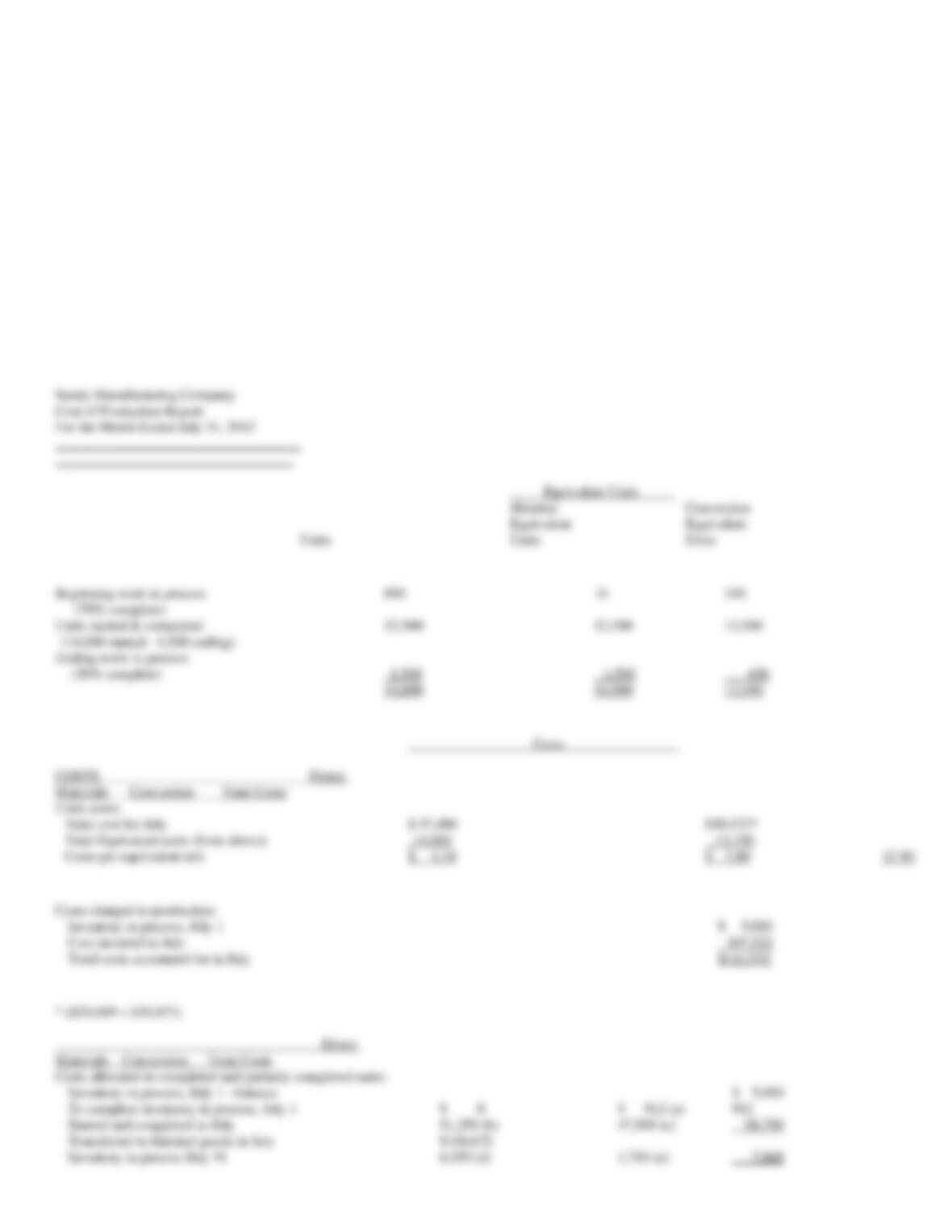
169. Information for the Sandy Manufacturing Company for the month of July 2012 is as follows:
Beginning work in process:
Cost of Inventory at process, July 1
$5,010
Units – 800
Direct materials = 100% complete
Conversion costs = 70% complete
Units started in July = 14,000
Costs charged to Work in Process during July:
Ending work in process inventory:
Direct materials costs = $57,400
Units = 1,500
Direct labor costs = 20,049
Direct materials = 100% complete
Factory overhead costs = 30,073
Conversion costs = 30% complete
Prepare a cost of production report for the month of July, using the FIFO method.
Sandy Manufacturing Company
Cost of Production Report
For the Month Ended July 31, 2012
Equivalent Units
Material
Conversion
Equivalent
Equivalent
Units
Units
Units
Beginning work in process
-0-
(70% complete)
Units started & completed
12,500
12,500
12,500
(14,000 started – 1,500 ending)
Ending work in process
(30% complete)
1,500
1,500
450
14,800
14,000
13,190
Units costs;
Total cost for July
$ 57,400
$50,122*
Total Equivalent units (from above)
¸14,000
¸13,190
Costs per equivalent unit
$ 4.10
$ 3.80
Inventory in process, July 1
$ 5,010
Cost incurred in July
107,522
Total costs accounted for in July
$112,532

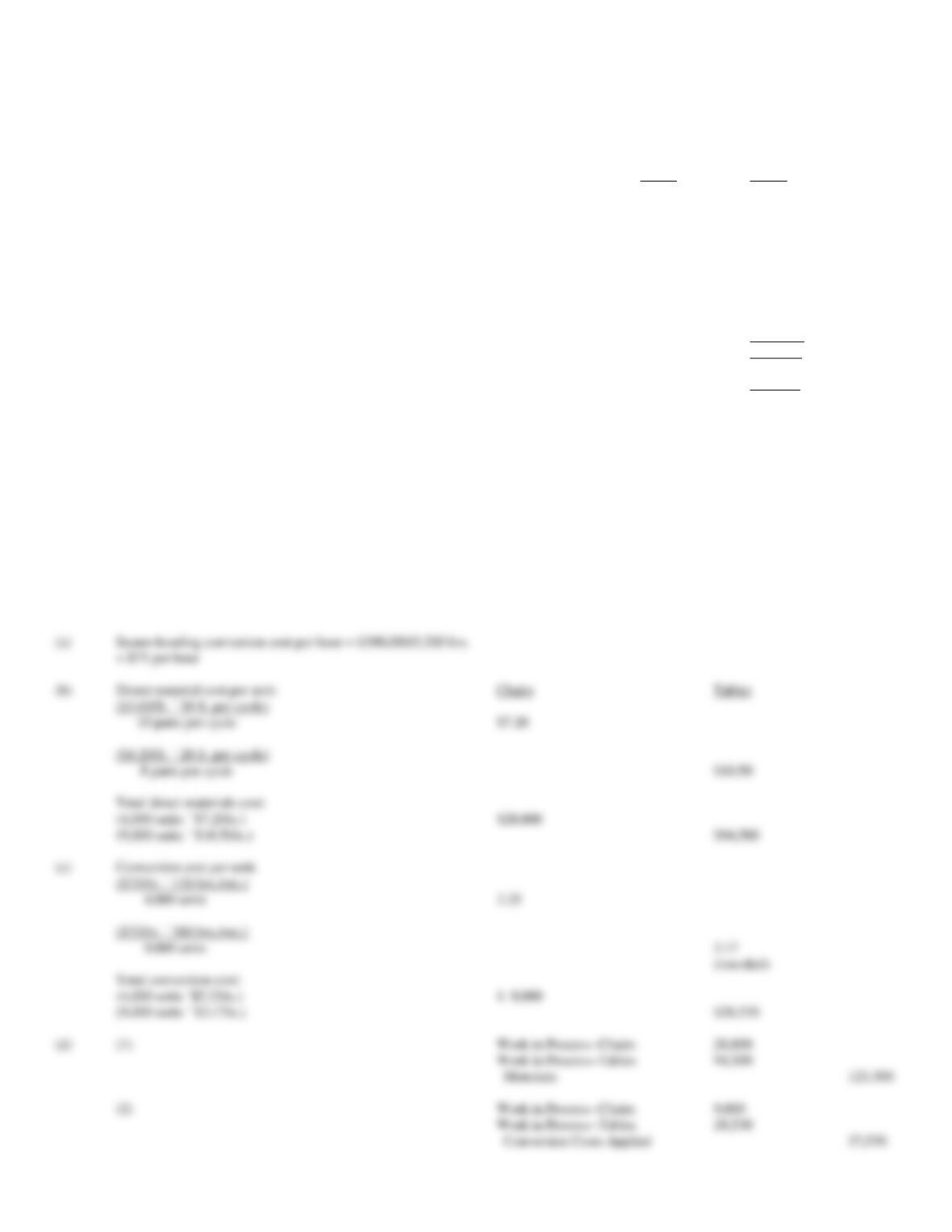
170. Eagle Co. manufactures bentwood chairs and tables. Wood for both products is steam-bent in the same
process, but different types of wood are used for each product. Thus, materials cost is identified separately to
each product. One production cycle uses 20 board feet. Labor cost is identified to the process as a whole, as is
overhead cost. Data for the month of July follow:
Chairs
Tables
Direct material cost per board foot
$ 3.60
$ 4.20
Number of parts formed per production cycle (20 board feet)
10
8
Actual operating hours in July
120
380
Parts produced during July
4,000
9,000
Budgeted annual conversion cost:
Labor
$150,000
Utilities
125,000
Depreciation
65,000
Other overhead
50,000
Total
$390,000
Budgeted annual operating hours for steam-bending
5,200
(a)
Compute July’s predetermined rate for the steam-bending process.
(b)
Compute July’s direct material costs for chairs and tables.
(c)
Compute conversion costs to be applied to chairs and tables in
July.
(d)
Journalize the following entries:
(1)
Assignment of direct materials to chairs and tables.
(2)
Application of conversion costs to chairs and tables.
(3)
The transfer of completed chairs and tables to the
Finishing Department. All of July’s production was
completed in July.
(a)
Steam-bending conversion cost per hour = $390,000/5,200 hrs.
= $75 per hour
(b)
Direct material cost per unit:
Chairs
Tables
($3.60/ft. ´ 20 ft. per cycle)
10 parts per cycle
$7.20
($4.20/ft. ´ 20 ft. per cycle)
8 parts per cycle
$10.50
Total direct materials cost:
(4,000 units ´ $7.20/u.)
$28,800
(9,000 units ´ $10.50/u.)
$94,500
(c)
Conversion cost per unit:
($75/hr. ´ 120 hrs./mo.)
4,000 units
2.25
($75/hr. ´ 380 hrs./mo.)
9,000 units
3.17
(rounded)
Total conversion cost:
(4,000 units ´$2.25/u.)
$ 9,000
(9,000 units ´ $3.17/u.)
$28,530
(d)
(1)
Work in Process—Chairs
28,800
Work in Process—Tables
94,500
(2)
Work in Process—Chairs
9,000
Work in Process—Tables
28,530