81. Sam Mahoney, the CEO of Mahoney Technologies, Inc. (MTI), a biotechnology firm had recently returned
from a conference on modern cost management and performance measurement methods where he was exposed
to target costing, value-chain analysis, balanced scorecard, activity–based management and other ideas.
MTI is a five-year old company operating in a growing, but competitive market. It develops and produces a
number of different enzymes for use by research scientists and pharmaceutical companies. Its main competitors
are also small to medium sized firms just like MTI. The key to growth in this industry is the ability to develop
new products in a short time. Gail Stevenson, the vice-president (VP) for research & development (R&D) has
noticed that some of MTI’s new developments did not perform well because of the delays in their introduction
into the market. Stevenson is very keen on hiring the best scientists and ensuring that they stay current in their
fields because knowledge is the key competitive weapon in the biotechnology industry.
Bob Phillips, the controller of MTI had another concern. He has been noticing that the new products were not
only delayed but their actual development costs were usually higher than budgeted. One of his goals was to see
that the new products were profitable for the company.
Linda Joseph, the production manager, had a different concern of her own. Based on her observation, the
production of the new enzymes was taking longer. Her feeling was that the products spent too much time in the
quality control (QC) department. Barry Laker, the manager of the QC department argued that the new enzymes
lacked the rigorous specifications that are demanded in the marketplace. Consequently, the QC department has
had to perform additional tests to get to the root cause of the problems.
Mahoney had heard complaints from all quarters, and decided to convene a meeting of all the department heads.
Mahoney: Good afternoon, everyone. I am troubled that despite hiring a number of talented scientists, we are
unable to compete effectively in the marketplace. Many of the recent entrants in the game seem to be beating us
easily.
Stevenson: Sam, the key to our growth is rapid introduction of new products. Although my scientists are
developing new enzymes in record times, they seem to be getting held up in manufacturing and especially the
QC department.
Laker: Sam, I think I can pinpoint the root cause of the problem. I agree that our scientists are developing new
enzymes in record times, but they do not seem to be paying any attention to standards. It looks like my
department will have to provide training to them regarding quality control matters.
Stevenson: With due respect, I do not think there is more to know about QC standards. It looks like the
department wants more attention and is therefore creating all this unnecessary fuss.
Joseph: I think I will agree with Barry that there are problems at the R&D side. My production scientists are
also complaining that adequate specifications have not been developed; they have to constantly phone their
R&D counterparts for clarifications.
Stevenson: I do not believe that the production problems can be attributed to R&D) I have personally screened
each and every scientist during the hiring process.
Phillips: I don’t think we will make much progress as a company if we keep pointing fingers at one another. We
all must realize that all problems, regardless of their origin, finally affect the bottom-line of our company.
Unless we set aside our differences and work together as a team, we will be unable to compete with our rivals.
Some of our competitors follow best practices, which we must try to emulate.
Mahoney: I agree with Bob. We must all look for solutions. I recently attended a conference where noted
speakers talked about the value-chain of a company, interrelationships between functions, and the balanced
scorecard. In fact, some speakers suggested that companies must stop discussing in terms of individual
functions or departments; instead they must talk in terms of processes and understand linkages among all the
processes that exist in an organization. I believe there are a number of ideas that we could adopt. I will leave the
conference proceedings in the library, and suggest that we all read about these different topics. How about
getting together after six weeks and discussing a plan of action? Thank you and see you all after six weeks.
Required
Assume the role of a consultant preparing a report for MTI. Discuss the following aspects in your report:
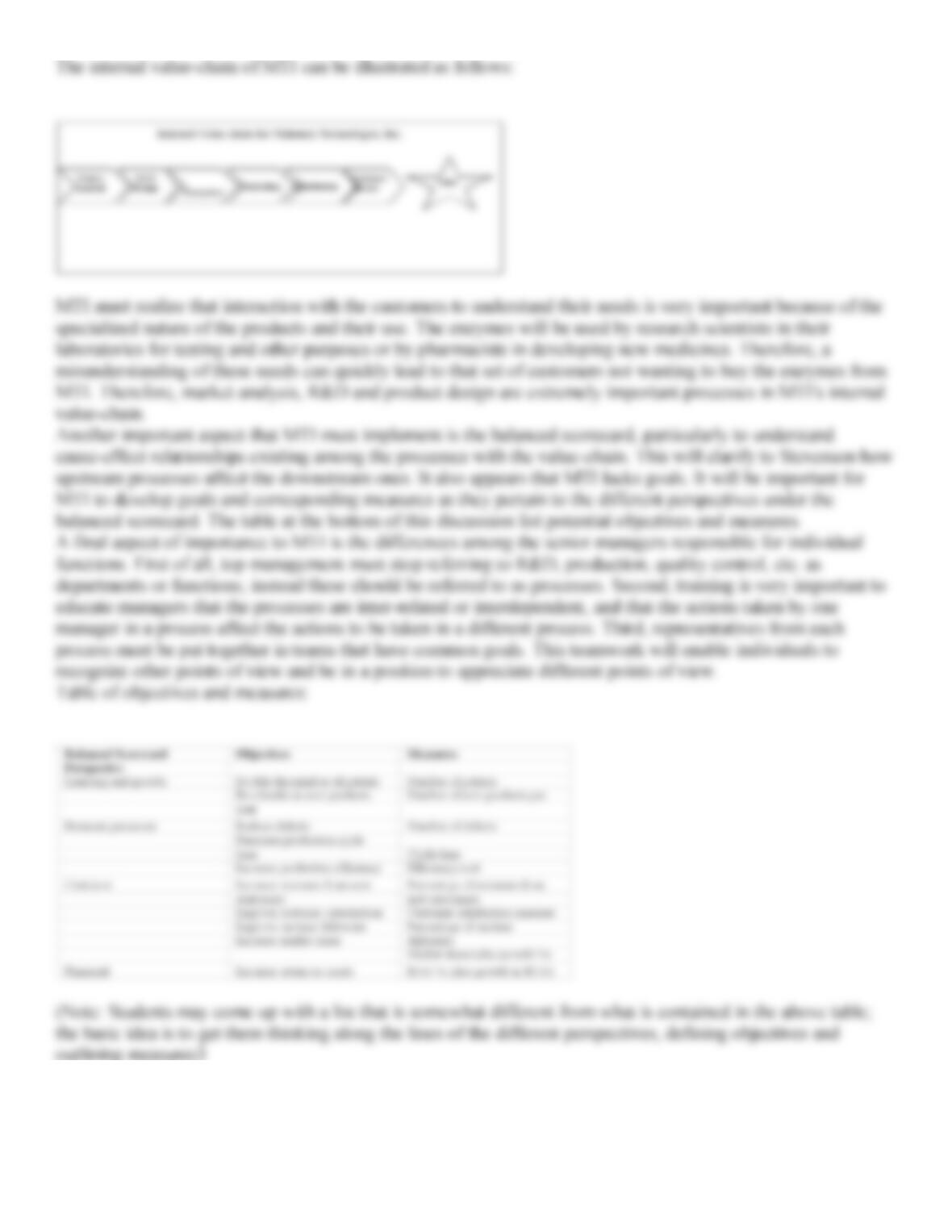
The internal value-chain of MTI
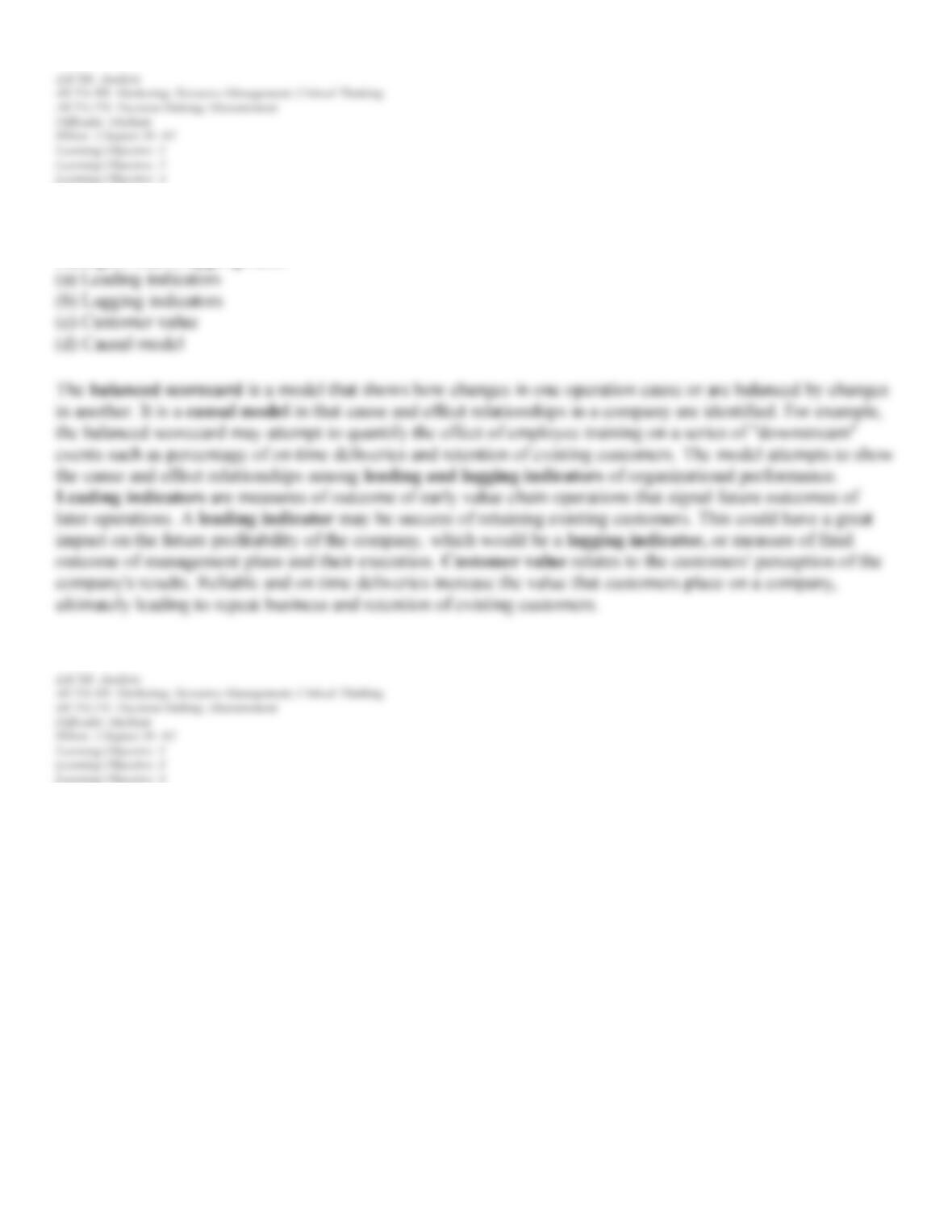
The balanced scorecard. Identify the goals of the company under each perspective of the scorecard and
cause-effect relationships, and develop potential measures that could be used
How the inter-departmental differences can be eliminated
82. Indicate how the following concepts are used in the preparation of a balanced scorecard: Provide
examples where appropriate.
83. The New York Times recently reported that a number of publicly–held corporations have been accused of
illegally doctoring hourly employees’ time records. Examples included:
Ⴠ Workers sued Family Dollar and Pep Boys, accusing managers of deleting hours from their time records.
Ⴠ More than a dozen former Wal-Mart employees said in interviews and depositions that managers had altered
time records to shortchange employees.
Ⴠ The Department of Labor reached two back-pay settlements with Kinko’s photocopy centers after finding
that managers had erased time for 13 employees.
When interviewed, many of the managers cited pressure from upper–management and the impact of their
actions on their own compensation as underlying causes for their actions. All of the companies strongly denied
encouraging such illegal and unethical behavior by managers. Compensation experts interviewed agreed that the
companies‘ incentive performance systems may have contributed to the managers‘ behavior. (New York Times,
April 4, 2004)
Required:
(a) Explain how the incentive performance systems of the above named companies could have contributed to
this illegal behavior by managers.
(b) Discuss the ethical issues involved in the design of incentive performance systems. In designing a
performance-based incentive system, what measures should companies take to avoid illegal and unethical
behavior by supervisors?

84. In designing incentive systems, companies should be aware of the different aspects of motivation and
behavior. Several theories of motivation and incentive stress different aspects of motivation and behavior. Three
major theories are expectancy theory, goal–setting theory, and agency theory. (Appendix)
Required:
Briefly explain the underlying principle behind each of the theories of motivation and behavior. What specific
aspects are built into incentive plans that are based on each of the theories?
85. David Palmer, manager of the Paper Products Division of a Graham Corporation, is a strong believer of
outcome measures. During one of his management meetings, he impressed upon his management team that
financial measures are the most important, and that his managers should only focus on improving those
measures.
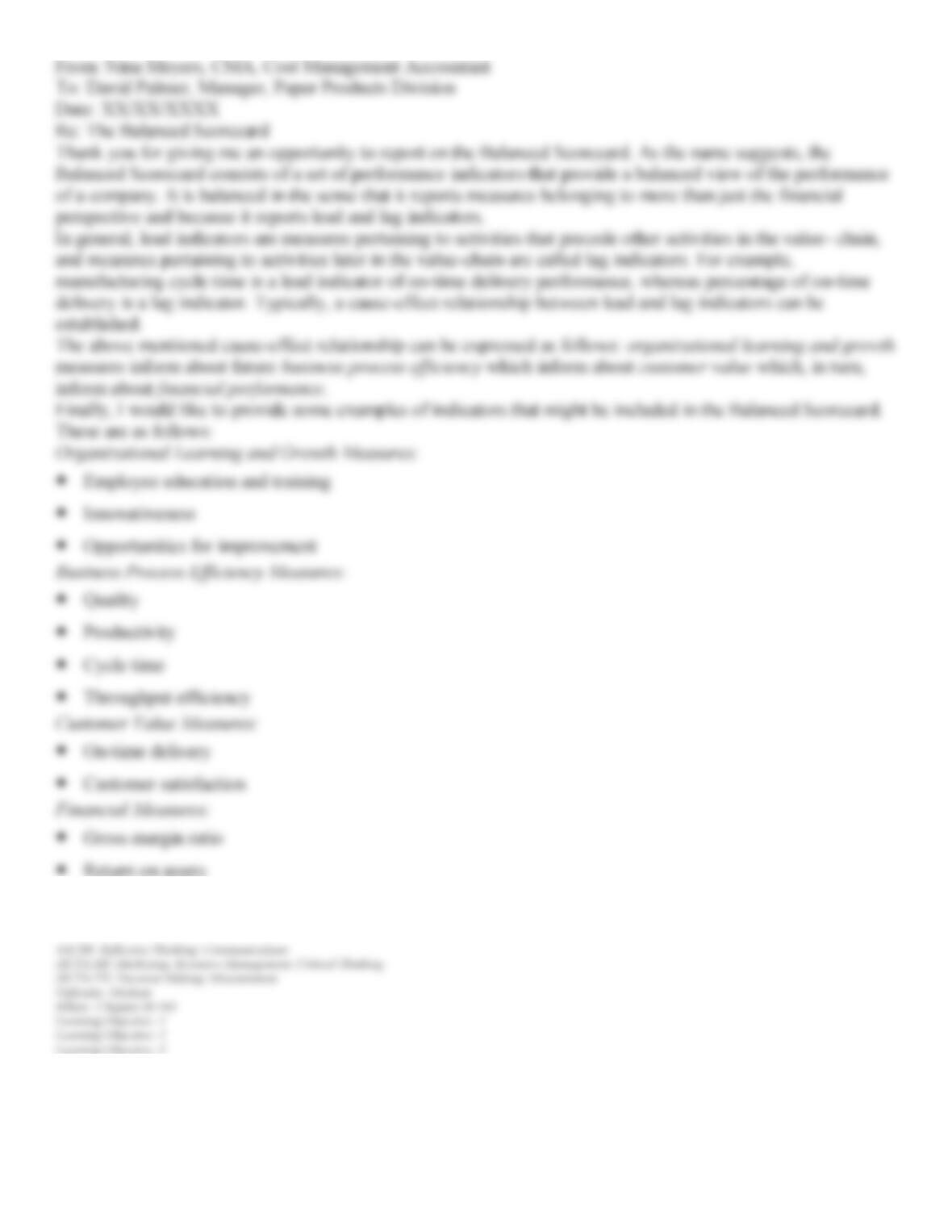
Nina Meyers, a recent CMA who was at the meeting filling in for her superior, was not too impressed with
Palmer’s exclusive focus on financial measures. As the meeting was about to end, she nervously pointed out to
Palmer that his focus on outcome measures could be detrimental to the performance of the company.
Meyers: Excuse me, Mr. Palmer, but I think it is wrong to place exclusive emphasis on financial outcome
measures. Instead, the emphasis must be on what are known as lead indicators, which provide information about
the likely outcome of managerial decisions.
Palmer: I commend you for your knowledge on recent developments. However, I have more than 20 years’
experience in this field and I think I know what I am doing. After all, ultimately financial results are what we
want.
Meyers: I do not dispute that the ultimate result may largely be the financial returns to our shareholders.
However, unless we pay attention to the drivers of the results, we will not understand the problems that exist in
our processes. I can bring you up to date on a new performance measurement system known as the Balanced
Scorecard if you like.
Although Palmer was not too impressed at being challenged, he instructed Meyers to write him a report on the
Balanced Scorecard.
Required:
Prepare a brief report on the Balanced Scorecard with particular emphasis on the following aspects:
Ⴠ What are leading and lagging indicators?
Ⴠ Why are leading indicators important?
Ⴠ What is the relationship between leading and lagging indicators (cause–effect relationships)?
Ⴠ What are the different dimensions of the Balanced Scorecard?
Ⴠ What are some examples of indicators pertaining to the different dimensions of the Scorecard?
86. The order entry department of a Ahura Associated Industries is considering improvements in the order entry
process, which includes preparing quotations based on customers’ requests (via the sales representative) and
processing orders received from customers.
A typical sequence of events might begin with a sales representative meeting with a customer to discuss the
type of system desired. The sales representative then fills out a paper form and faxes it or phones it in to an
order entry associate, who might make several subsequent phone calls to the sales representative, the potential
customer, or the manufacturing department to prepare the quote properly. These phone calls deal with such
questions as exchangeability of parts, part numbers, current prices for parts, or allowable sales discounts. Order
entry staff then keys in the configuration of the desired system, including part numbers, and informs the sales
representative of the quoted price. Each quote is assigned a quotation number. To smooth production,
manufacturing often produces systems with standard configurations in anticipation of obtaining orders from
recent quotes for systems. The systems usually involve adding on special features to the standard configuration.
Production in advance of orders sometimes results in duplication in manufacturing, however, because customers
often fail to put the assigned quotation numbers on their orders. When order entry receives an order, the
information on the order is reentered into the computer to produce an order acknowledgement. This order
acknowledgement is sent to the manufacturing department, which produces the system ordered by customer.
When the order acknowledgement is sent to the invoicing department, the information is reviewed again to
generate an invoice to send to the customer.
Domingo Perez, the order entry manager, has received many complaints from the order entry department‘s
internal customers regarding quality and timeliness problems, and is considering ways to improve the efficiency
and quality of the order entry process.
Required:
(a) Develop some indicators that Perez could use to assess the performance of the order entry process.
(b) List four possible errors that might be found in the quote and/or the order acknowledgement (i.e., the outputs
of the order entry process).
(c) What do you think are the likely causes of delays and quality problems?