72. Which of the following is not an accepted theory of motivation and incentives? (Appendix)
73. Which of the following statements about agency theory is True? (Appendix)
74. Which of the following statements about goal-setting theory is False? (Appendix)
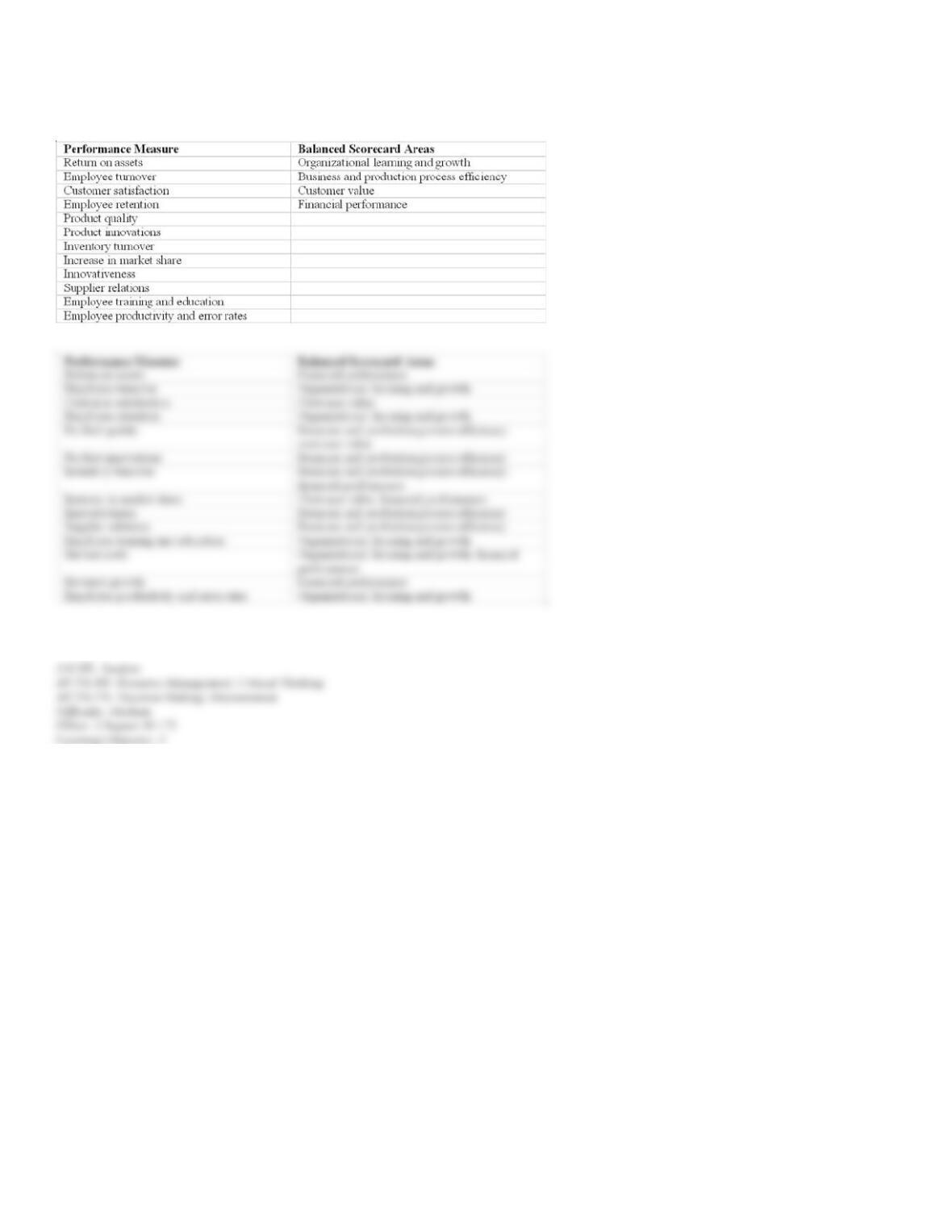
75. Match each of the following performance measures to one or more of the four areas of a balanced scorecard.
Note that a performance measure can relate to more than one area.
76. Holloway Corporation estimates that a three percentage point increase in retained customers is estimated to
cause the organization’s gross margin ratio to increase by 2.4 percentage points.
77. Aries Corporation places great importance on organizational learning to enhance the skills and capabilities
of its employees. Ming Tsai, the Human Resources Manager of Aries, encourages all employees to acquire
relevant skills and knowledge by attending evening courses in the local community college and special training
sessions arranged in-house.
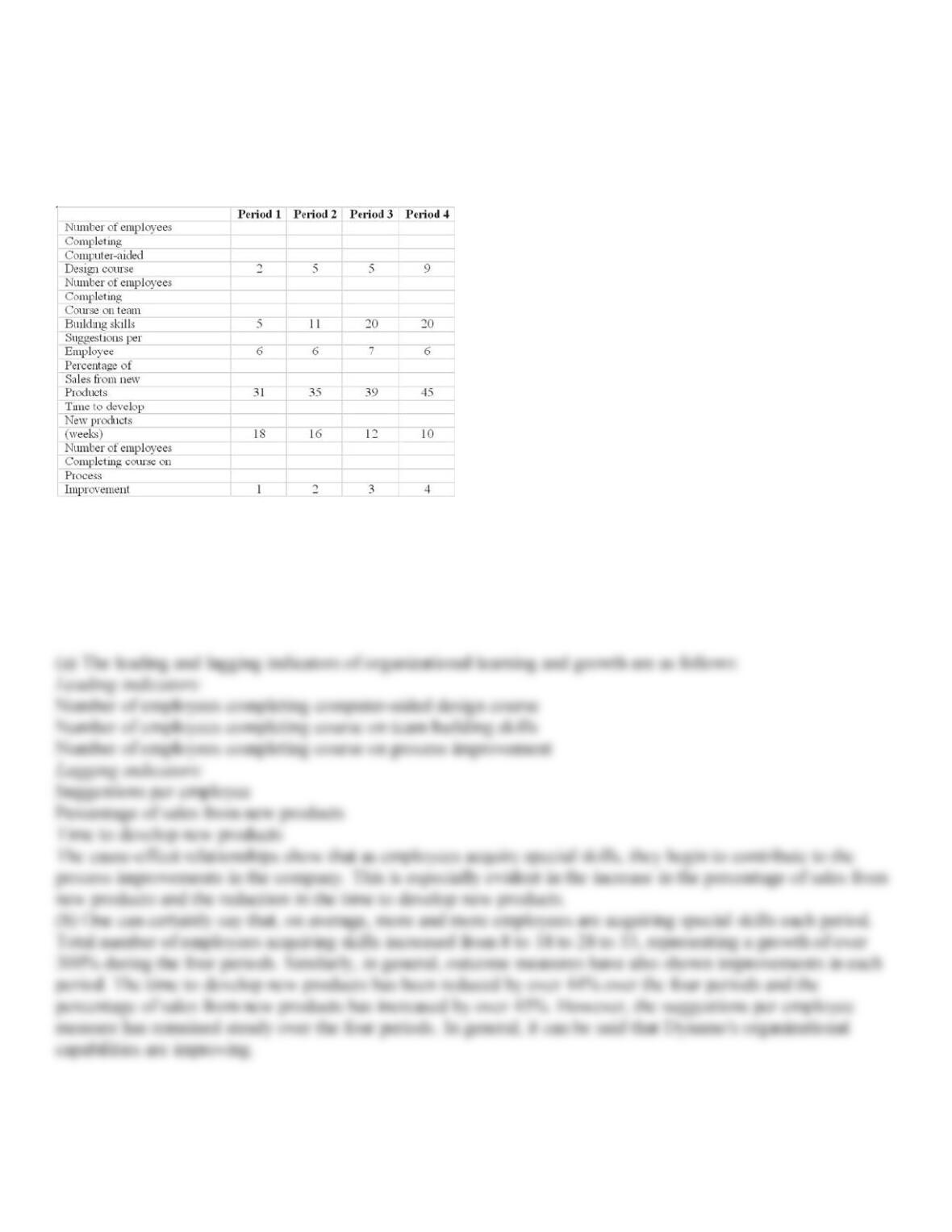
Tsai tracked the following data for the last four periods:
Required:
(a) From the above list of indicators, identify the leading and lagging indicators and indicate the cause-effect
relationships.
(b) Comment on the trends present in the above indicators of organizational learning and growth. Do you
believe that organizational capabilities are improving?

78. Fred Doyle, assistant controller, was analyzing alternative ways of increasing gross margin of Somerset
Corporation, a manufacturer of fashion clothing. He knew that the following relationship existed between the
increase in the sales levels through retention of customers (dX) and the increase in gross margin (dY):
dY = (0.60) * (dX)
The marketing and department provided information about four different alternative plans of improving the
retention rate of customers.
Alternative #1 Improving quality will retain 20 customers who might have otherwise switched suppliers. Each
retained customer will bring in sales revenues of $21,000 on average. The improvements in quality will come
through two measures: switching to a substitute material that will cost $8,500 per customer, and purchasing an
automatic inspection unit that will cost $80,000.
Alternative #2 An increase in advertising will likely retain 12 customers at an average sales revenue of $25,000
per customer. Increased advertising will cost the company $200,000.
Alternative #3 A price discount will retain 18 customers at an average sales revenue of $30,000 per customer.
The discount offer will cost the company $240,000 in lost contribution margin. In addition, the company must
spend $70,000 in advertising the sales discount promotion to customers.
Alternative #4 The company has made improvements in the process which will improve its on-time delivery
performance by 28% over the previous year. Consequently, it can retain 32 customers at an average sales
revenue of $20,000 per customer. Improvements in the process cost the company cost the company as follows:
(1) increase in labor costs $170,000, (2) increase in processing costs due to flexible processing technology
$180,000, and (3) increase in miscellaneous costs $26,000.
Required
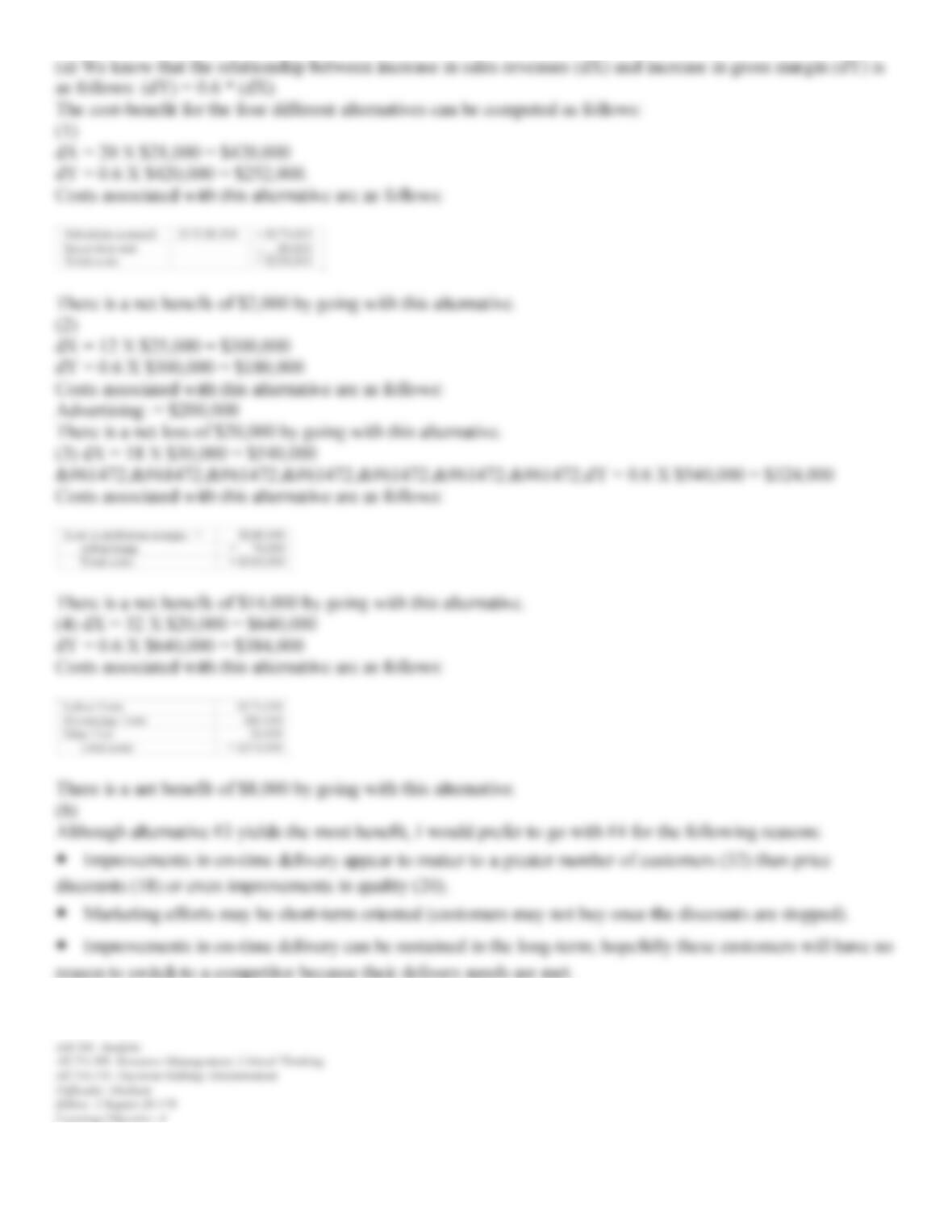
(a) Compute the cost-benefit of the four alternatives.
(b) Which of the above alternatives would you recommend to the operations manager of the company? Why?
79. Consider the following information pertaining to the balanced scorecard of a company:
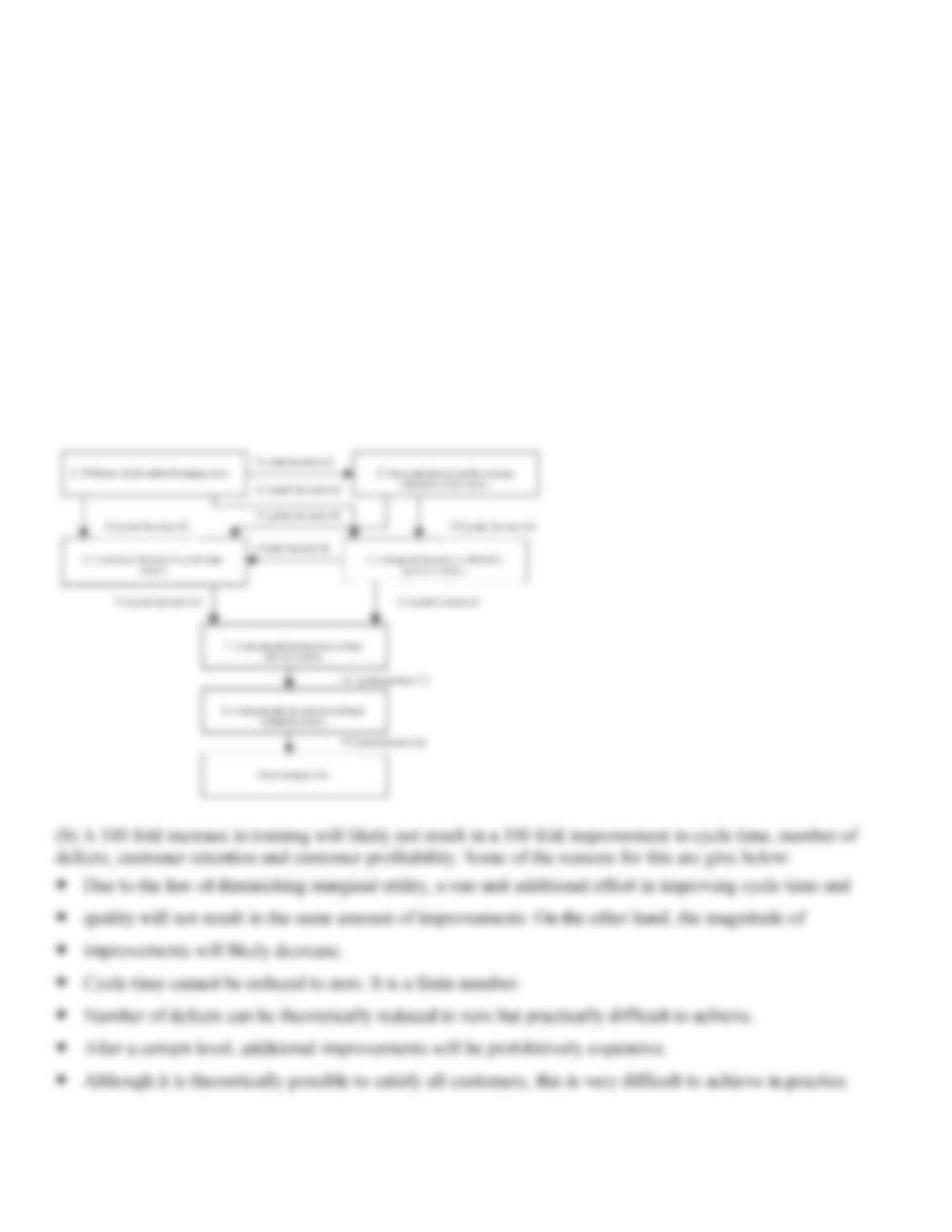
Ⴠ A 500-hour increase in job-related training will (a) increase the average employee education level by 1 point
on a 100-point scale, (b) reduce cycle time by 0.8 hours, and (c) decrease defective products by 0.3% points.
Ⴠ A one-point increase in the average education level (on a 100-point scale) will (d) decrease average cycle
time by 0.5 hours and (e) decrease defective products by 0.1% points.
Ⴠ A 1% decrease in defective products will (f) decrease average cycle time by 1 hour and (g) increase on-time
deliveries by 0.2%.
Ⴠ A one-hour decrease in average cycle time will (h) increase on-time deliveries by 0.1% points.
Ⴠ A 1% point increase in on-time deliveries will (i) increase retained customers by 0.7% points.
Ⴠ A 1% point increase in retained customers will (j) increase the gross margin ratio by 0.3% points.
Required (Appendix)
(a) Express the cause-effect relationships among the different indicators visually.
(b) Would you expect the benefits of job related training to increase proportionately? For example, would you
expect the benefit of 50,000 hours of job-related training to be 100 times the impact of 500 hours of training?

80. Syed Ali, an accountant, was recently hired by LOGAN INDUSTRIES, Inc. As part of his first task,
Feingold was asked to develop a balanced scorecard for the company. He developed the following measures:
On-time deliveries
Customer retention
Customer profitability
Product innovation
Market share
Return on assets
Number of defectives
Employee satisfaction
Employee training
Ali knows that some of these indicators are what are called leading indicators and others are lagging indicators.
However, he does not know enough and has approached you to help him.
Required
(a) Re-arrange the above indicators to reflect whether they are lead or lag indicators. Also identify the
cause-effect relationships that may exist.
(b) Why is it important for managers to differentiate between leading and lagging indicators?
(c) Classify the above indicators under the different perspectives of the balanced scorecard.
(d) How many measures under each perspective of the balanced scorecard should a company use? Why?
(e) Briefly discuss the major benefits of the balanced scorecard.
(f) Identify and briefly discuss three types of costs associated with the balanced scorecard.