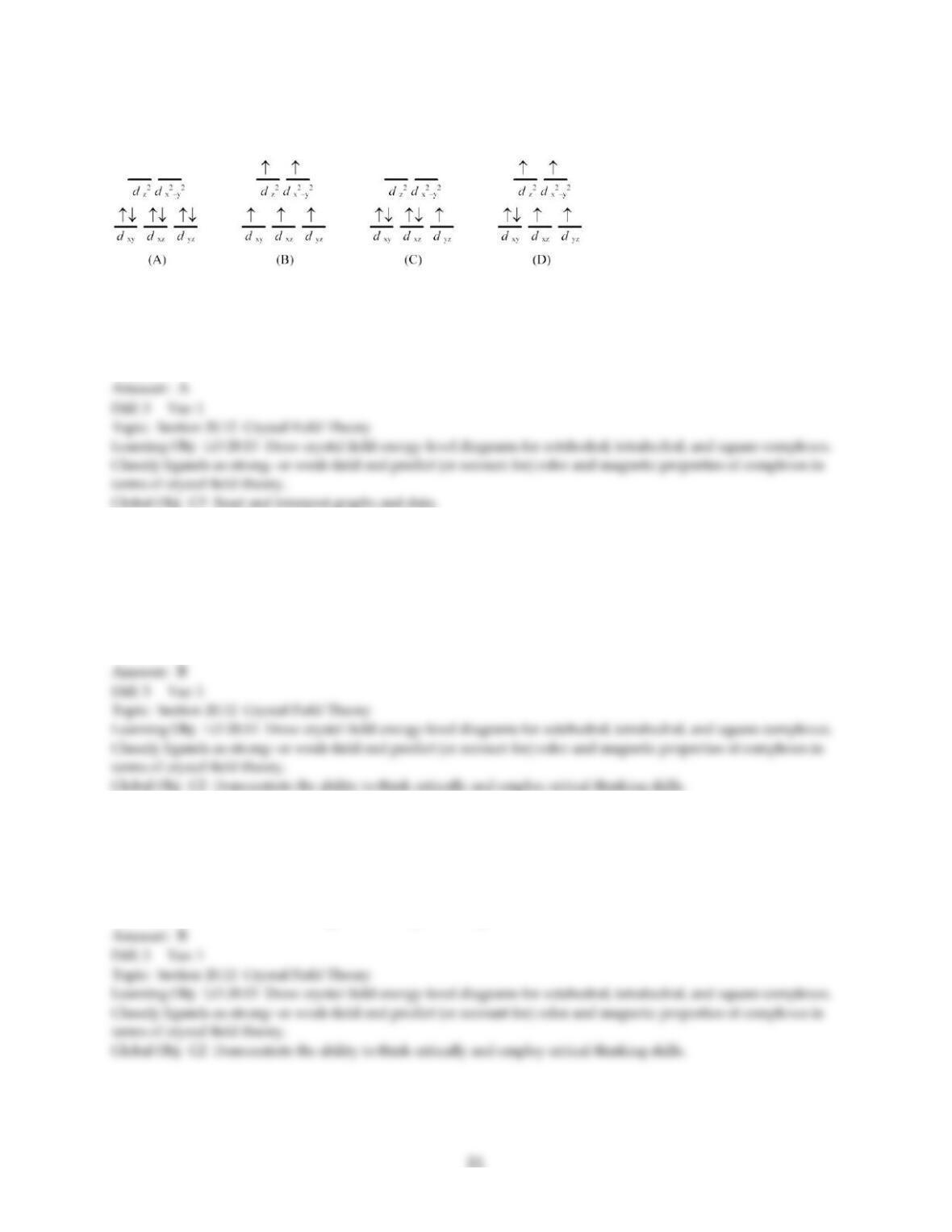
67) What is the crystal field energy level diagram for the complex [Co(CN)6]3-?
A) (A)
B) (B)
C) (C)
D) (D)
68) Which ion would you expect to have the largest crystal field splitting Δ?
A) [Fe(CN)6]4-
B) [Fe(CN)6]3-
C) [Fe(H2O)6]2+
D) [Fe(H2O)6]3+
69) What statement is inconsistent with the crystal field theory of tetrahedral complexes?
A) Δt is about 4/9 that of Δ0.
B) Tetrahedral complexes are nearly all low spin.
C) The dxy, dxz, and dyz orbitals are higher in energy than the dz² and dx²–y² orbitals.
D) None of the metal d orbitals point directly at the ligands in a tetrahedral environment.
70) How many unpaired electrons will Co have in the complex [CoCl4]2–?
A) 1
B) 3
C) 4
D) 5
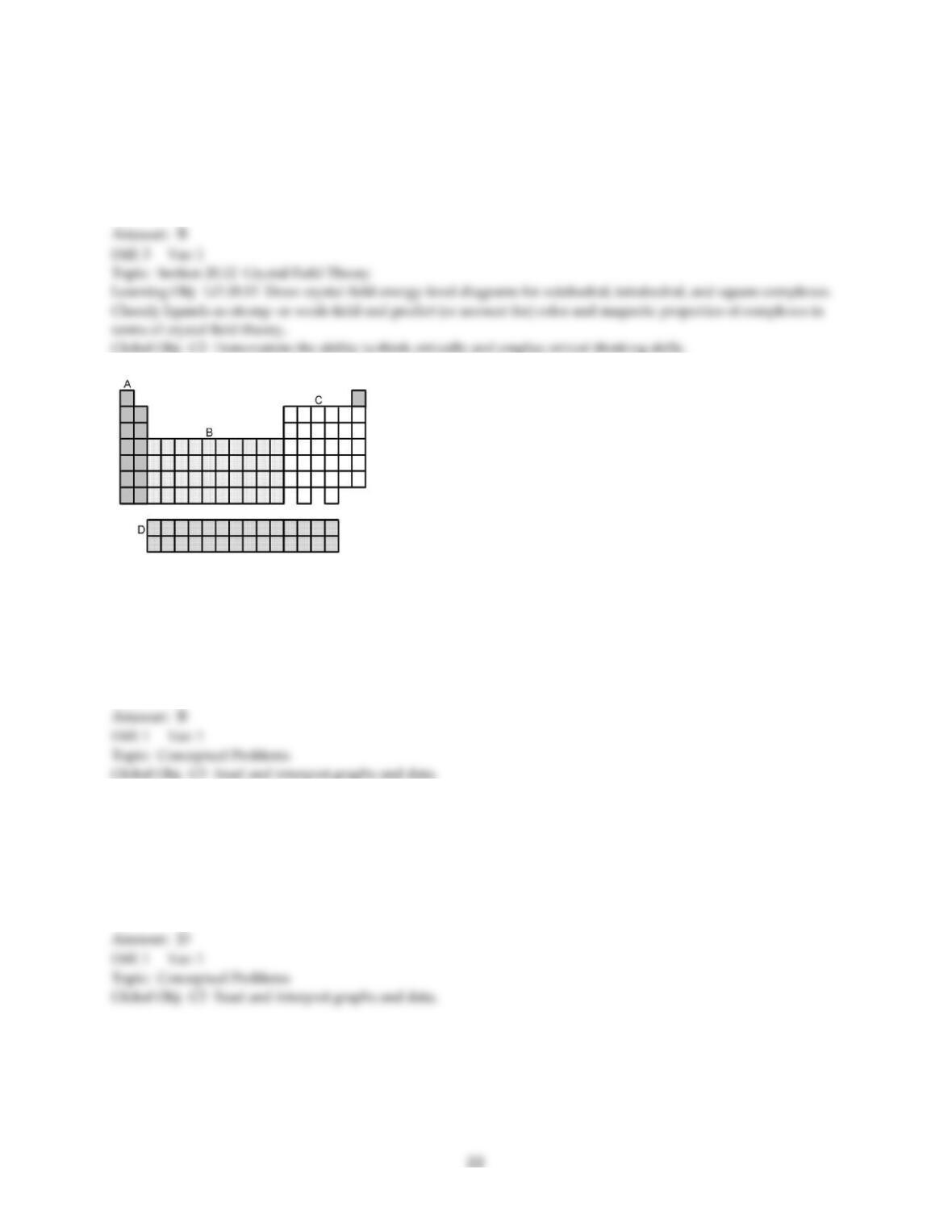
71) Which group of elements, indicated by letter and shading on the periodic table above, represents the
transition elements?
A) A
B) B
C) C
D) D
72) Which group of elements, indicated by letter and shading on the periodic table above, represents the
inner transition elements?
A) A
B) B
C) C
D) D
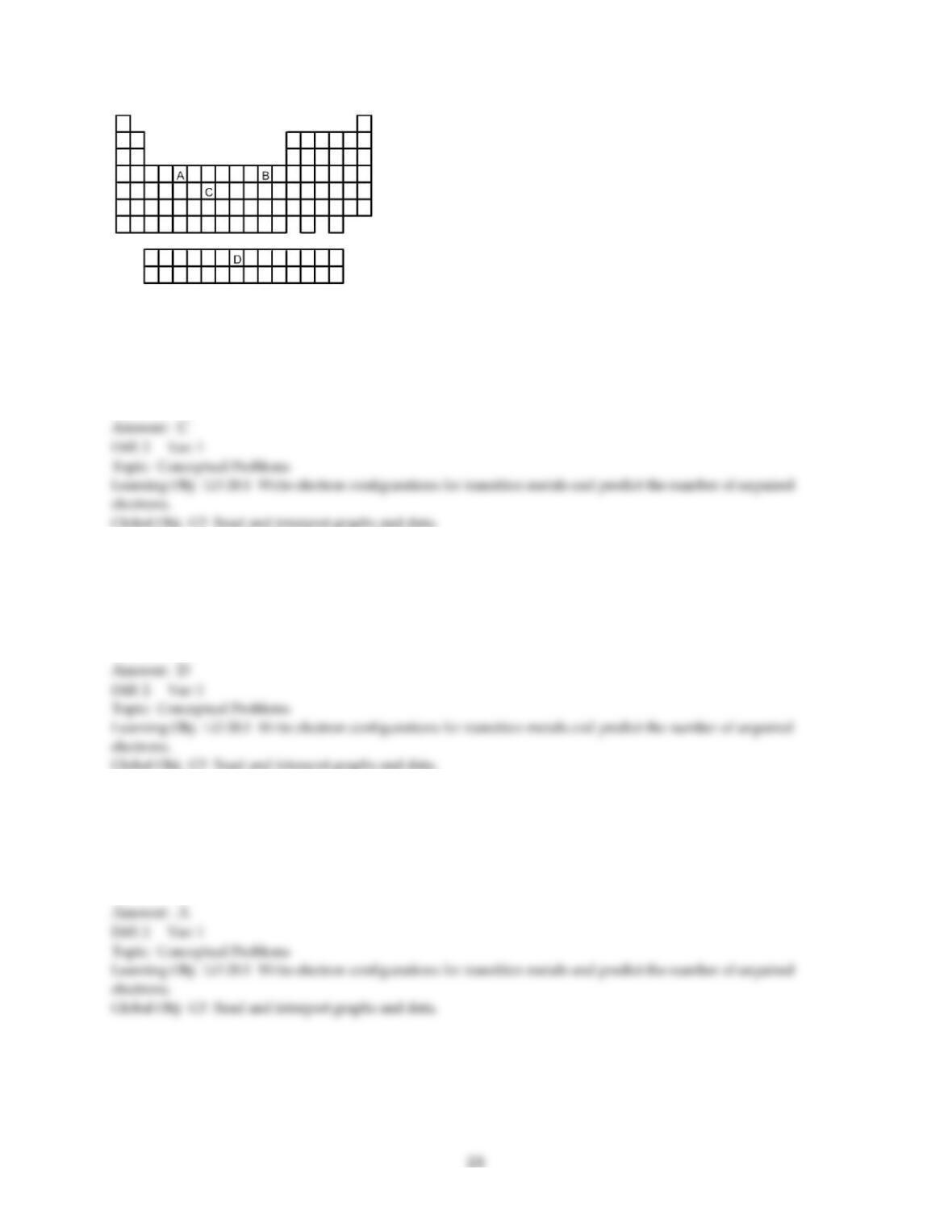
73) Which element indicated on the above periodic table has the electron configuration [Kr] 4d5 5s2?
A) element A
B) element B
C) element C
D) element D
74) Which element indicated on the above periodic table has the electron configuration [Xe] 4f7 5d1 6s2?
A) element A
B) element B
C) element C
D) element D
75) Which element indicated on the above periodic table has the electron configuration [Ar] 3d3 4s2?
A) element A
B) element B
C) element C
D) element D
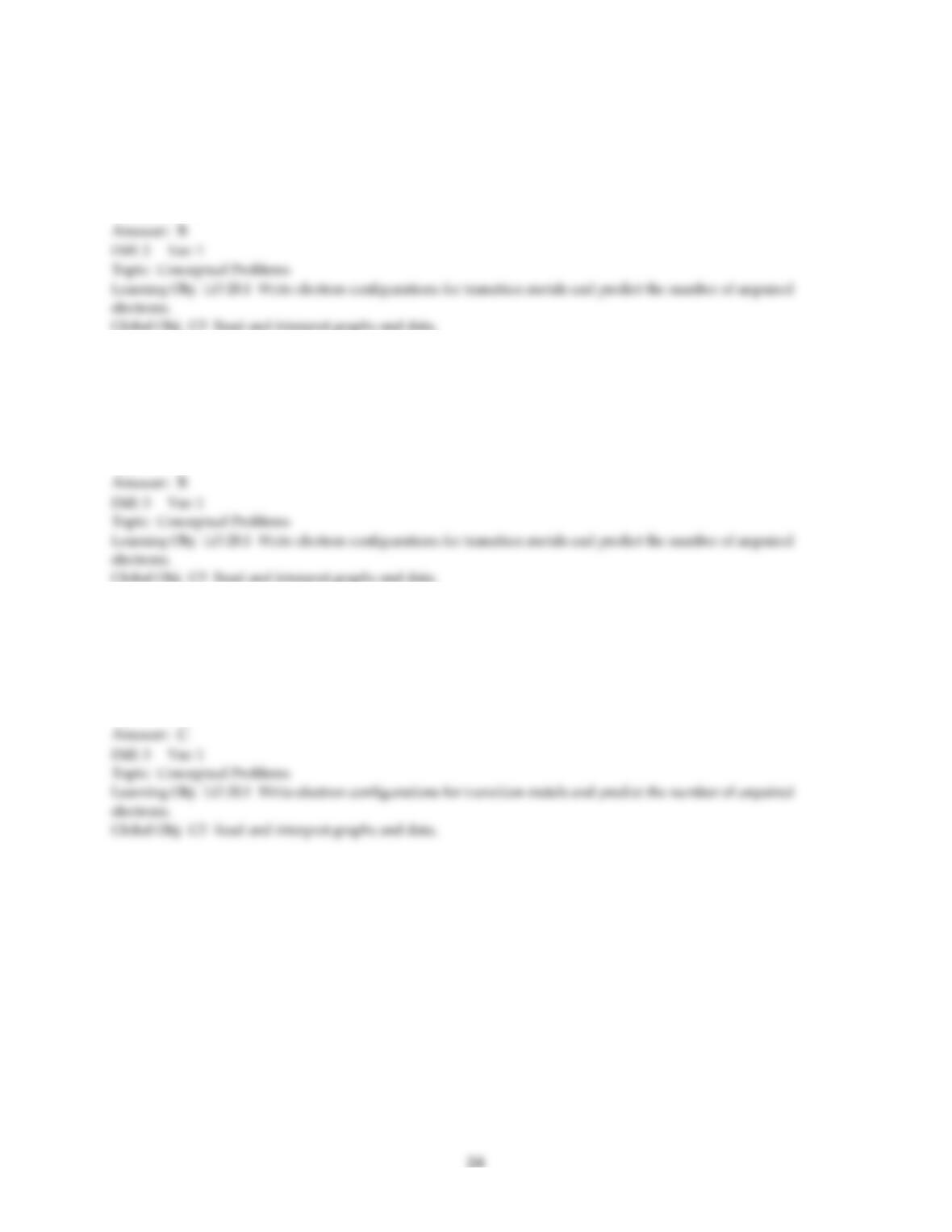
76) Which element indicated on the above periodic table has the electron configuration [Ar] 3d10 4s1?
A) element A
B) element B
C) element C
D) element D
77) Which is the most common ion formed by element B on the above periodic table?
A) B+
B) B2+
C) B3+
D) B4+
78) Which is the most common ion formed by element D on the above periodic table?
A) B+
B) B2+
C) B3+
D) B7+
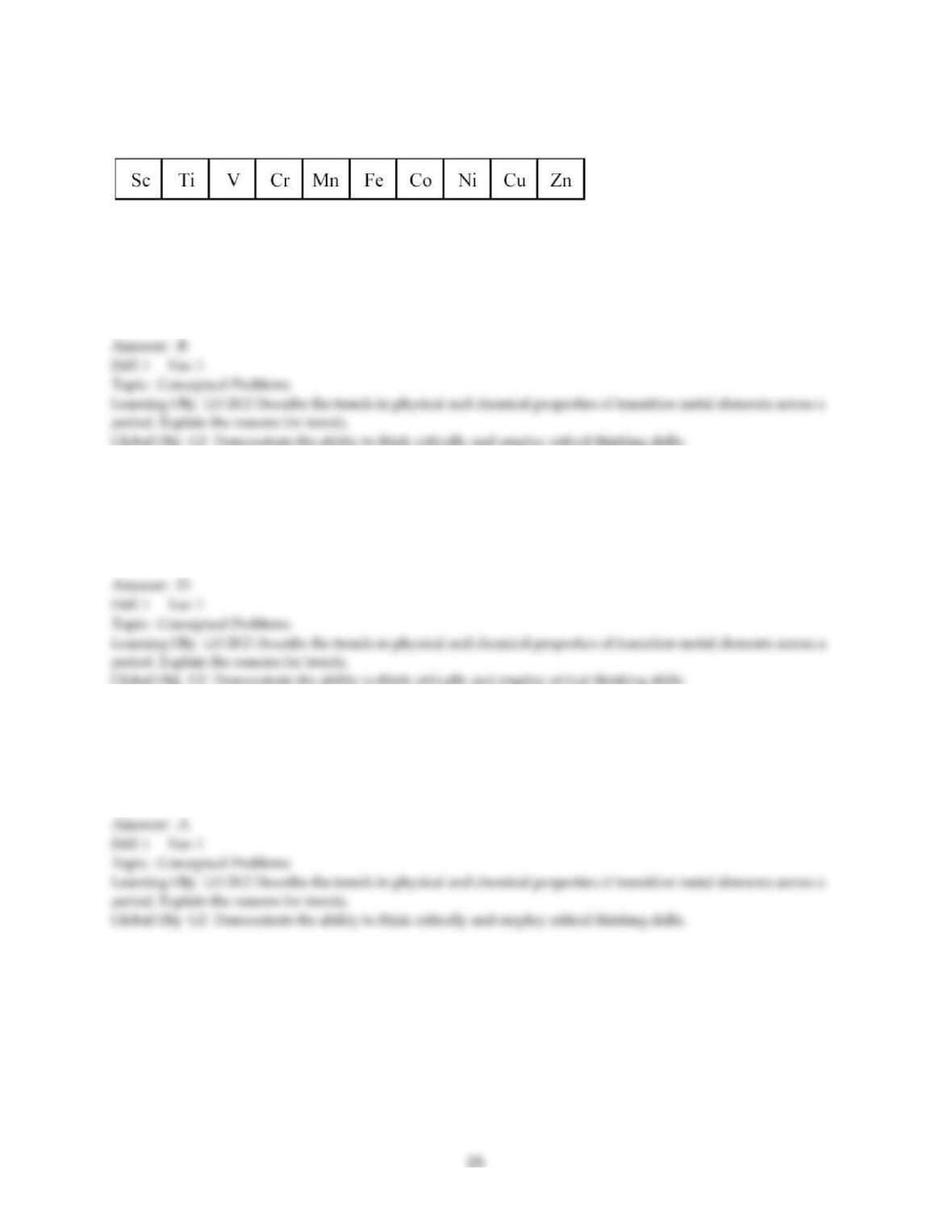
The first transition series metals are shown below.
79) Which has the highest melting point?
A) Sc
B) V
C) Mn
D) Zn
80) Which has the lowest melting point?
A) Sc
B) V
C) Mn
D) Zn
81) Which has the largest atomic radius?
A) Sc
B) V
C) Ni
D) Zn
82) Which has the smallest atomic radius?
A) Sc
B) V
C) Ni
D) Zn
83) Which has the greatest density?
A) Sc
B) V
C) Cu
D) Zn
84) Which has the most positive standard oxidation potential?
A) Sc
B) V
C) Cu
D) Zn
85) Which has the most negative standard oxidation potential?
A) Sc
B) V
C) Cu
D) Zn
86) Based on the variation in Zeff, which M2+ ion should be the strongest reducing agent?
A) Ti
B) Cr
C) Fe
D) Zn
87) Based on the variation in Zeff, which M2+ ion should be the weakest reducing agent?
A) Ti
B) Cr
C) Fe
D) Zn
88) Based on the variation in Zeff, which oxoanion should be the strongest oxidizing agent?
A) VO43-
B) CrO42-
C) MnO42-
D) FeO42-
89) Based on the variation in Zeff, which oxoanion should be the weakest oxidizing agent?
A) VO43-
B) CrO42-
C) MnO42-
D) FeO42-
90) Which metal exhibits the highest oxidation state in its compounds?
A) Sc
B) Cr
C) Mn
D) Zn
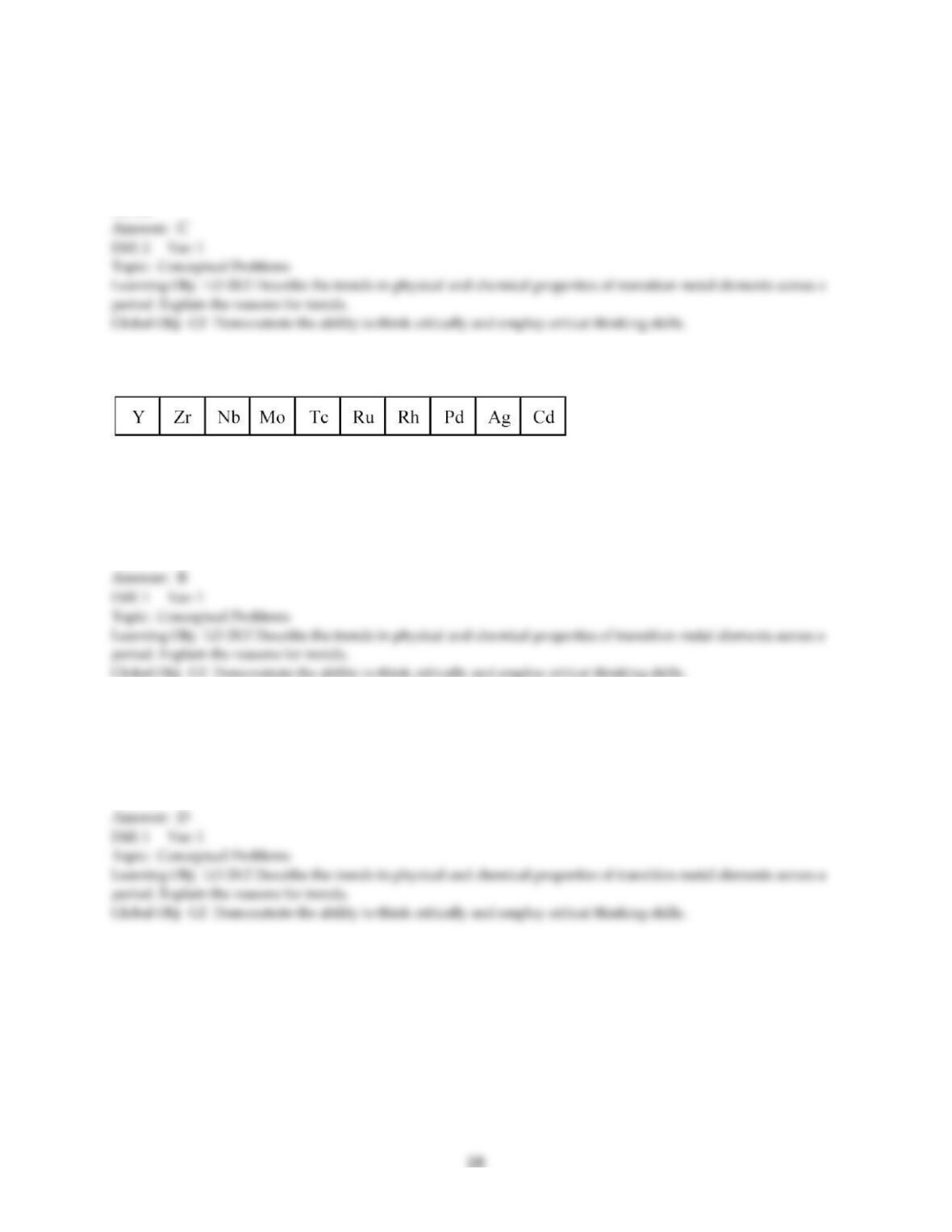
The second transition series metals are shown below.
91) Which has the highest melting point?
A) Y
B) Mo
C) Tc
D) Cd
92) Which has the lowest melting point?
A) Y
B) Mo
C) Tc
D) Cd
93) Which has the largest atomic radius?
A) Y
B) Mo
C) Rh
D) Cd
94) Which has the smallest atomic radius?
A) Y
B) Mo
C) Rh
D) Cd
95) Which has the greatest density?
A) Y
B) Mo
C) Rh
D) Cd
96) Which has the lowest density?
A) Y
B) Mo
C) Rh
D) Cd
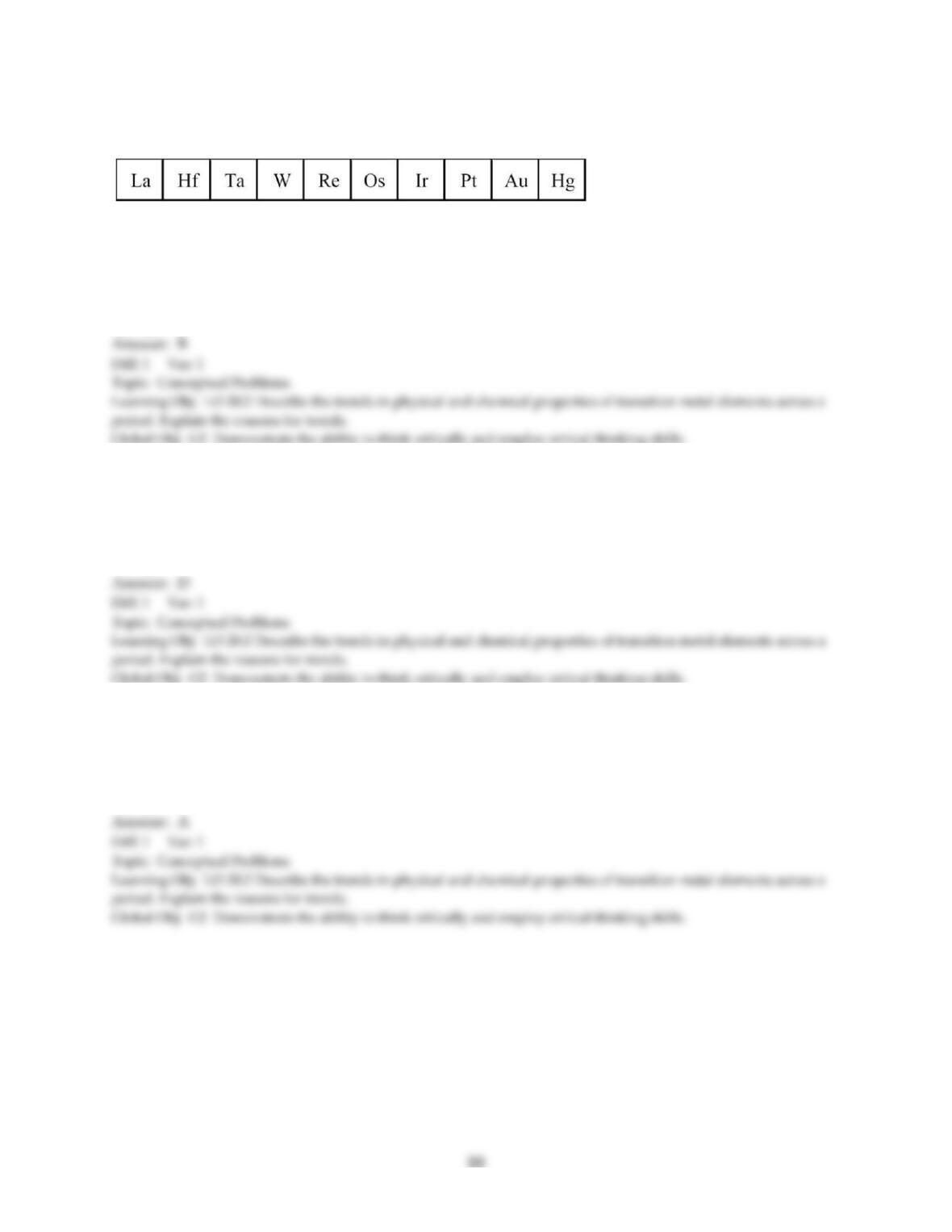
The third transition series metals are shown below.
97) Which has the highest melting point?
A) La
B) W
C) Os
D) Hg
98) Which has the lowest melting point?
A) La
B) W
C) Os
D) Hg
99) Which has the largest atomic radius?
A) La
B) W
C) Os
D) Hg
100) Which has the smallest atomic radius?
A) La
B) W
C) Os
D) Hg
101) Which has the greatest density?
A) La
B) W
C) Os
D) Hg
102) Which has the lowest density?
A) La
B) W
C) Os
D) Hg
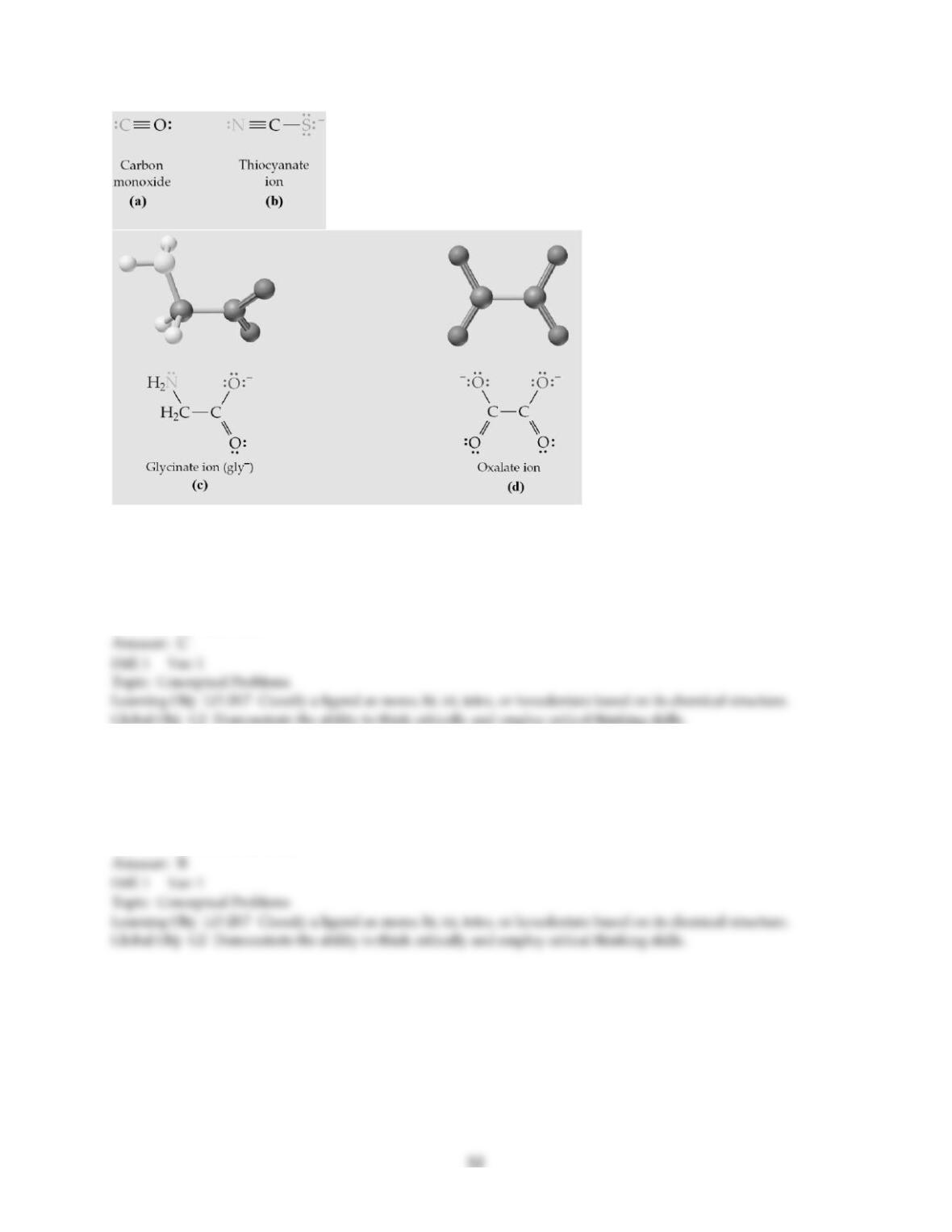
103) Which of the above are bidentate ligands?
A) All are bidentate.
B) (a) and (b)
C) (c) and (d)
D) None are bidentate.
104) Which of the above are monodentate ligands?
A) All are monodentate.
B) (a) and (b)
C) (c) and (d)
D) None are monodentate.
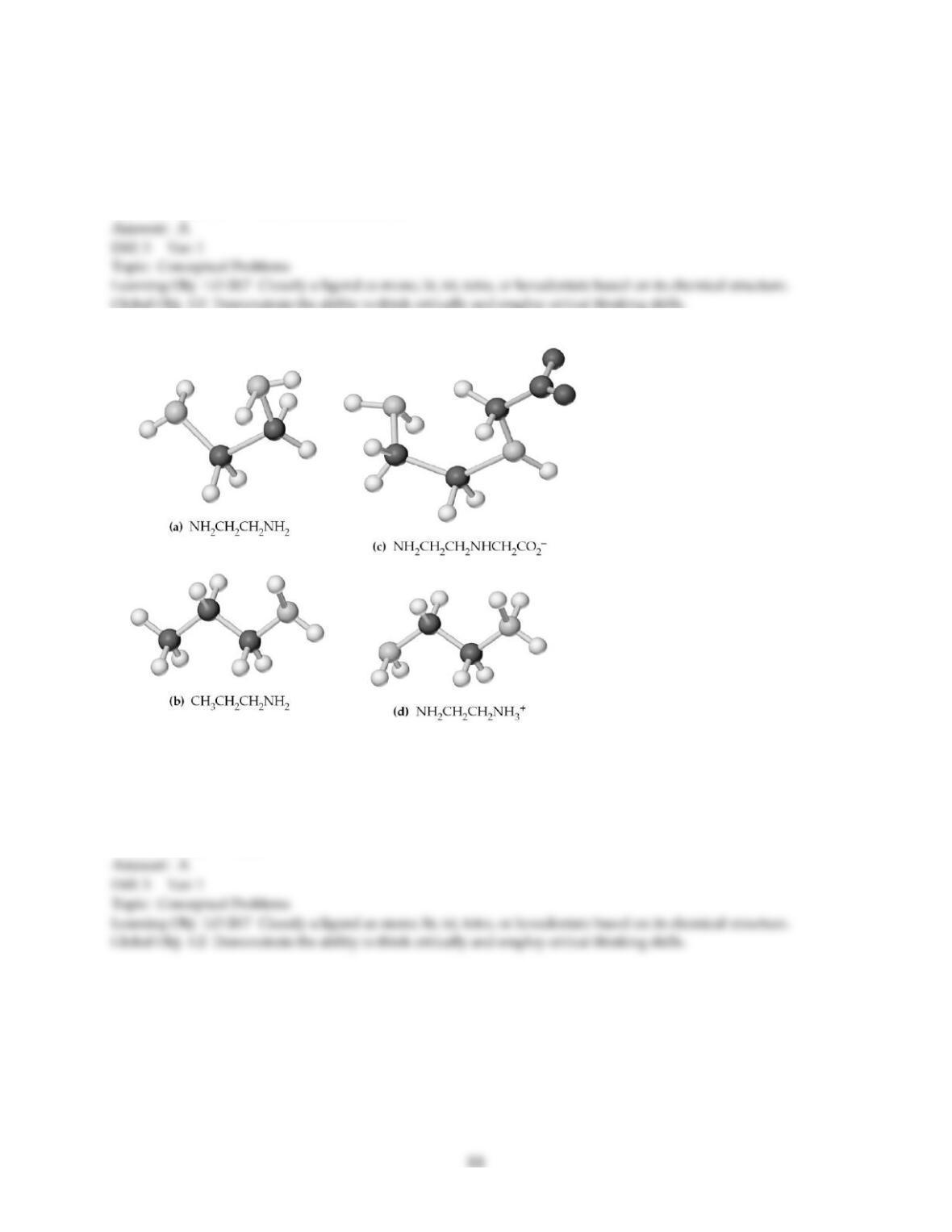
105) Which of the above are ligands that contain two or more donor atoms?
A) All contain two or more donor atoms.
B) (a) and (b)
C) (c) and (d)
D) None contain two or more donor atoms.
106) Which of the above are bidentate or tridentate ligands, capable of forming chelate rings?
A) (a) and (c)
B) (b) and (d)
C) (a), (b), and (c)
D) (a), (b), (c), and (d)
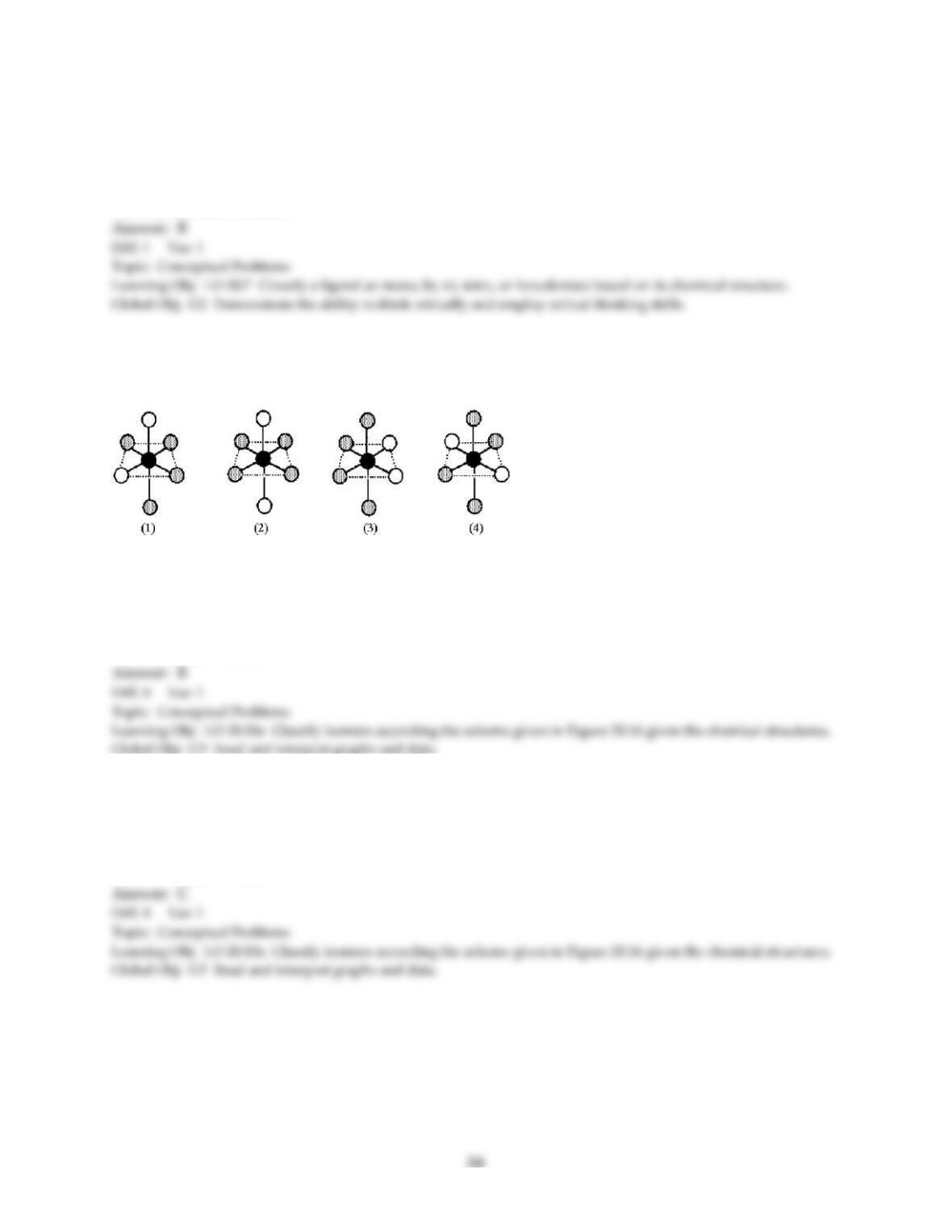
107) Which of the above are monodentate ligands?
A) (a) and (c)
B) (b) and (d)
C) All are monodentate.
D) None are monodentate.
Consider the following isomers of [Co(NH3)4Br2]+. The black sphere represents Co, gray spheres
represent NH3, and unshaded spheres represent Br.
108) Which are cis-isomers?
A) isomers (1) and (2)
B) isomers (1) and (3)
C) isomers (2) and (4)
D) isomers (3) and (4)
109) Which are trans-isomers?
A) isomers (1) and (2)
B) isomers (1) and (3)
C) isomers (2) and (4)
D) isomers (3) and (4)
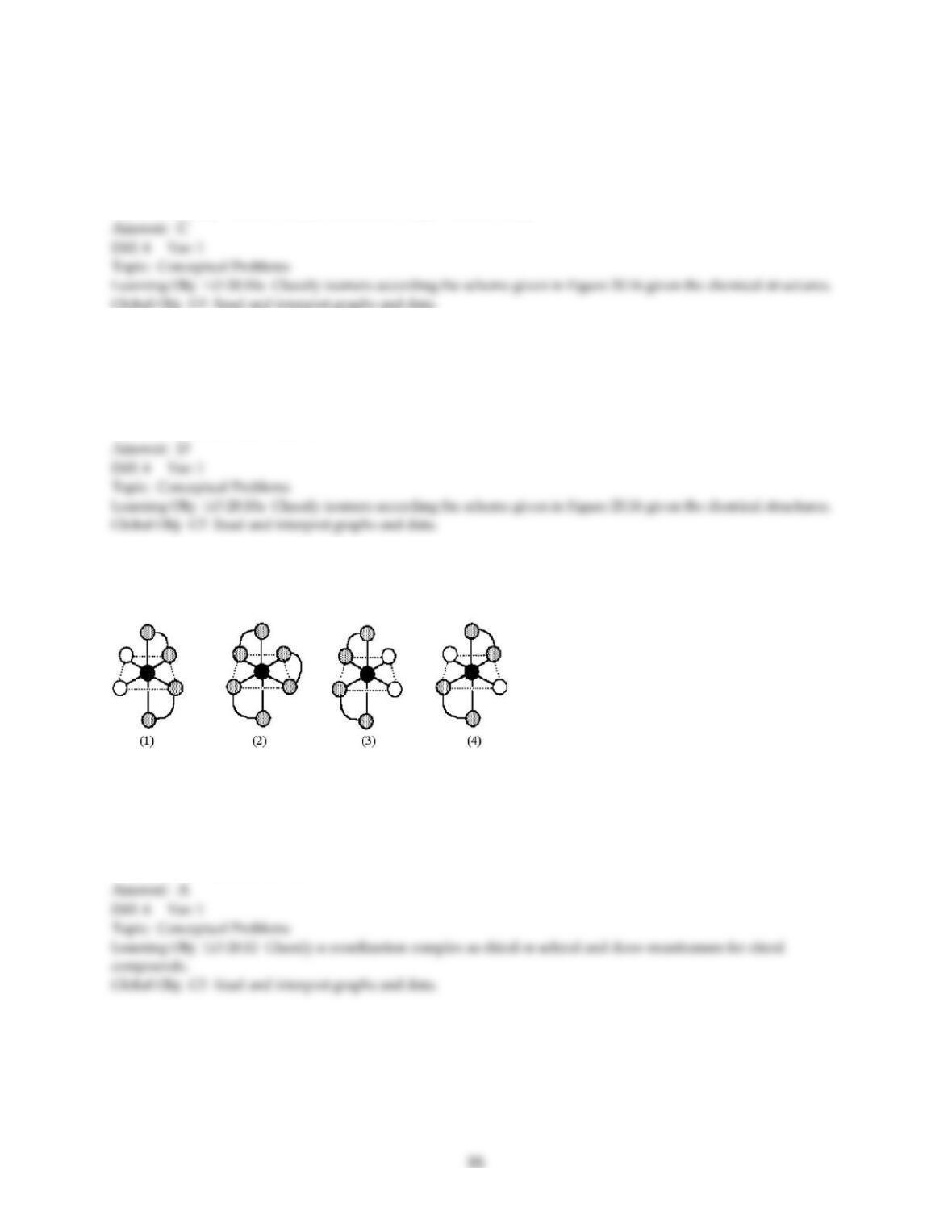
110) Which structures are identical?
A) None of the structures are identical.
B) structure (1) = structure (2) and structure (3) = structure (4)
C) structure (1) = structure (3) and structure (2) = structure (4)
D) structure (1) = structure (4) and structure (2) = structure (3)
111) Which exist as enantiomers?
A) All exist as enantiomers.
B) isomers (1) and (3)
C) isomers (2) and (4)
D) None exist as enantiomers.
Consider the following ethylenediamine complexes. The black sphere represents Co, gray connected
spheres represent ethylenediamine, NH2CH2CH2NH2, and unshaded spheres represent Br.
112) Which complexes are chiral?
A) complexes (1), (2), and (3)
B) complexes (1), (2), and (4)
C) complexes (1), (3), and (4)
D) complexes (2), (3), and (4)
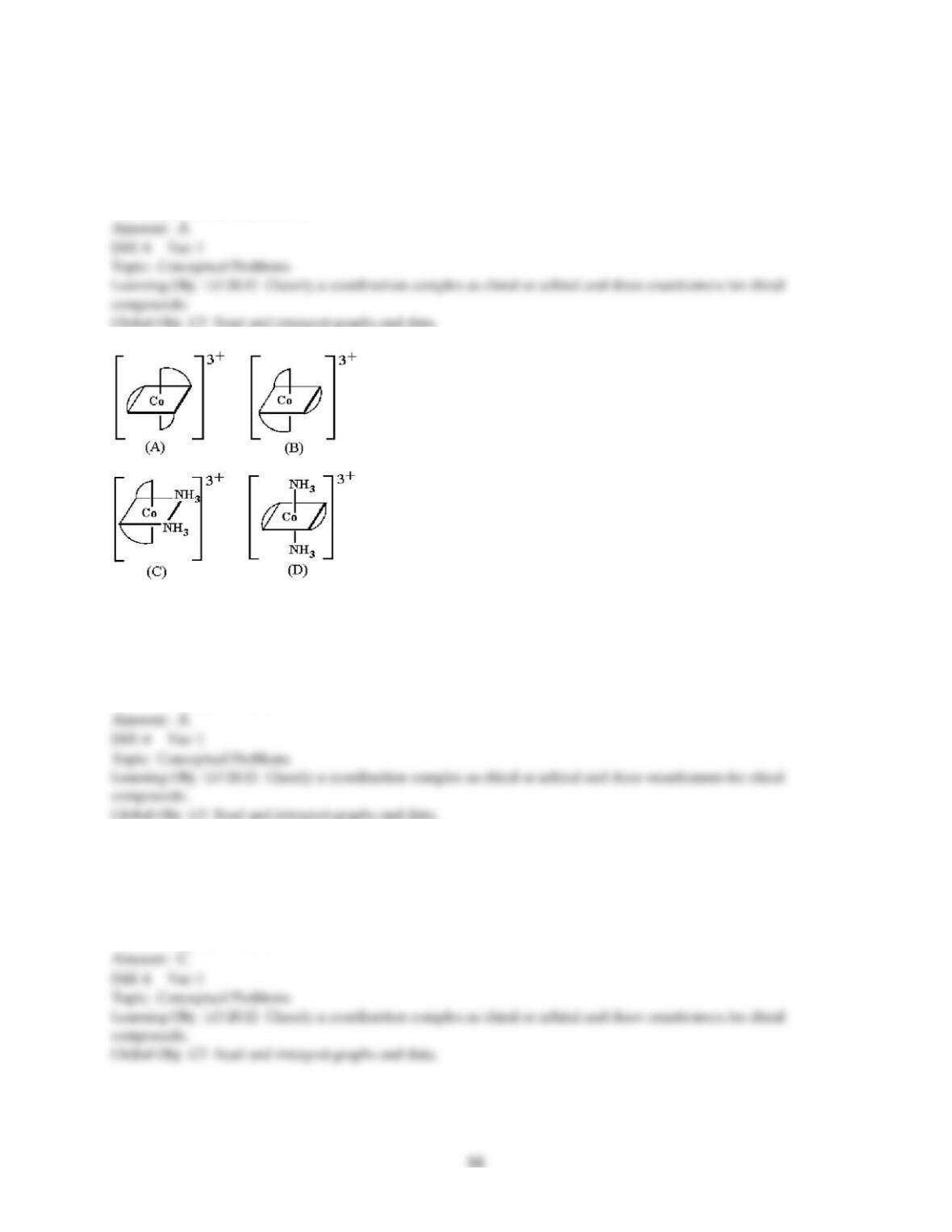
113) Which complexes are enantiomers of one another?
A) complexes (1) and (3)
B) complexes (1) and (4)
C) complexes (3) and (4)
D) complexes (1), (3), and (4)
114) Which of the Co(III) complexes above are enantiomers of each other?
A) (A) and (B)
B) (C) and (D)
C) (A), (B), and (C)
D) (A), (B), (C), and (D)
115) Which of the Co(III) complexes above are optically active?
A) (A) and (B)
B) (C) and (D)
C) (A), (B), and (C)
D) (A), (B), (C), and (D)
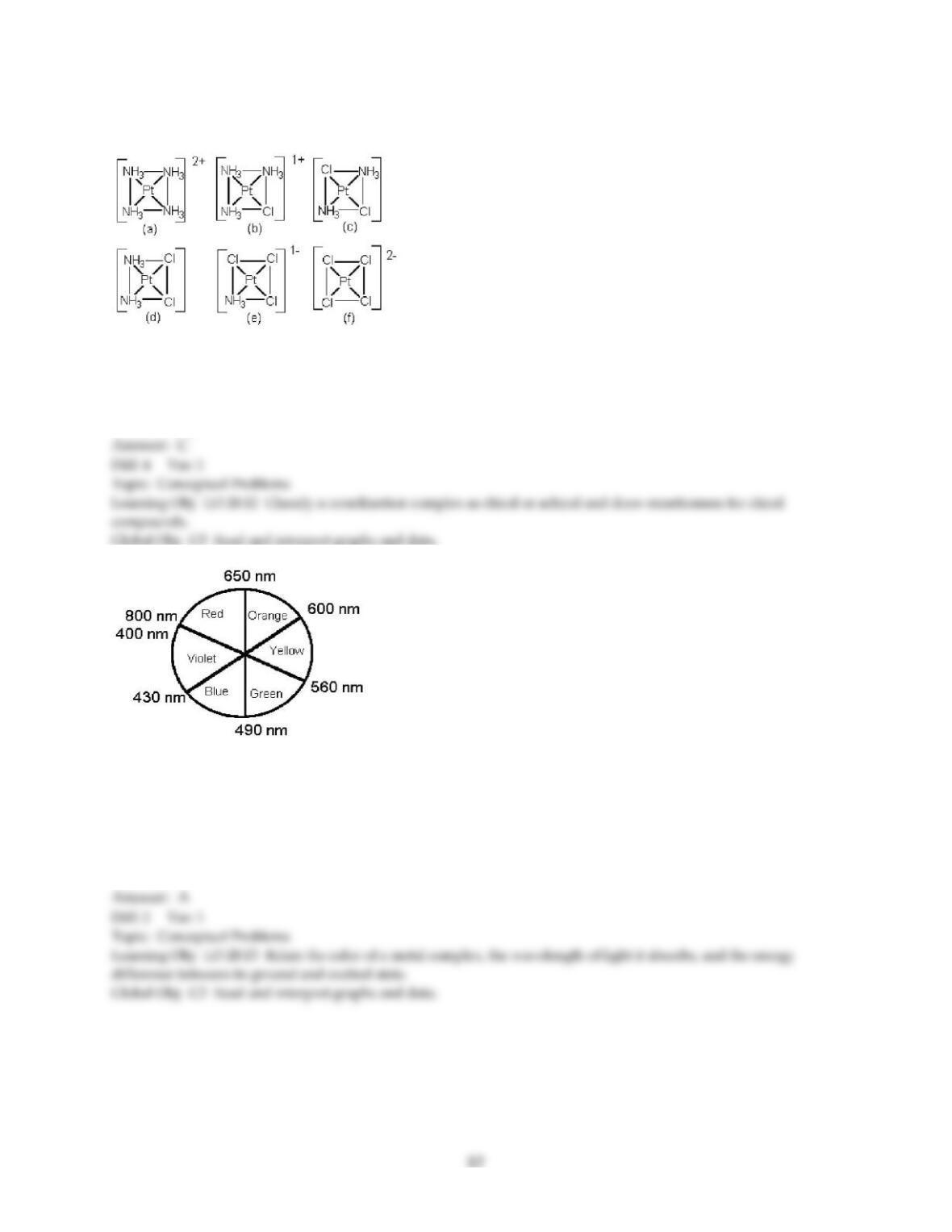
116) Which Pt(II) complexes are geometric isomers of each other?
A) (a) and (f)
B) (b) and (e)
C) (c) and (d)
D) (a) and (b)
117) Using the above schematic of an artist’s color wheel, determine the color seen if a substance absorbs
red and yellow light.
A) blue
B) green
C) orange
D) violet
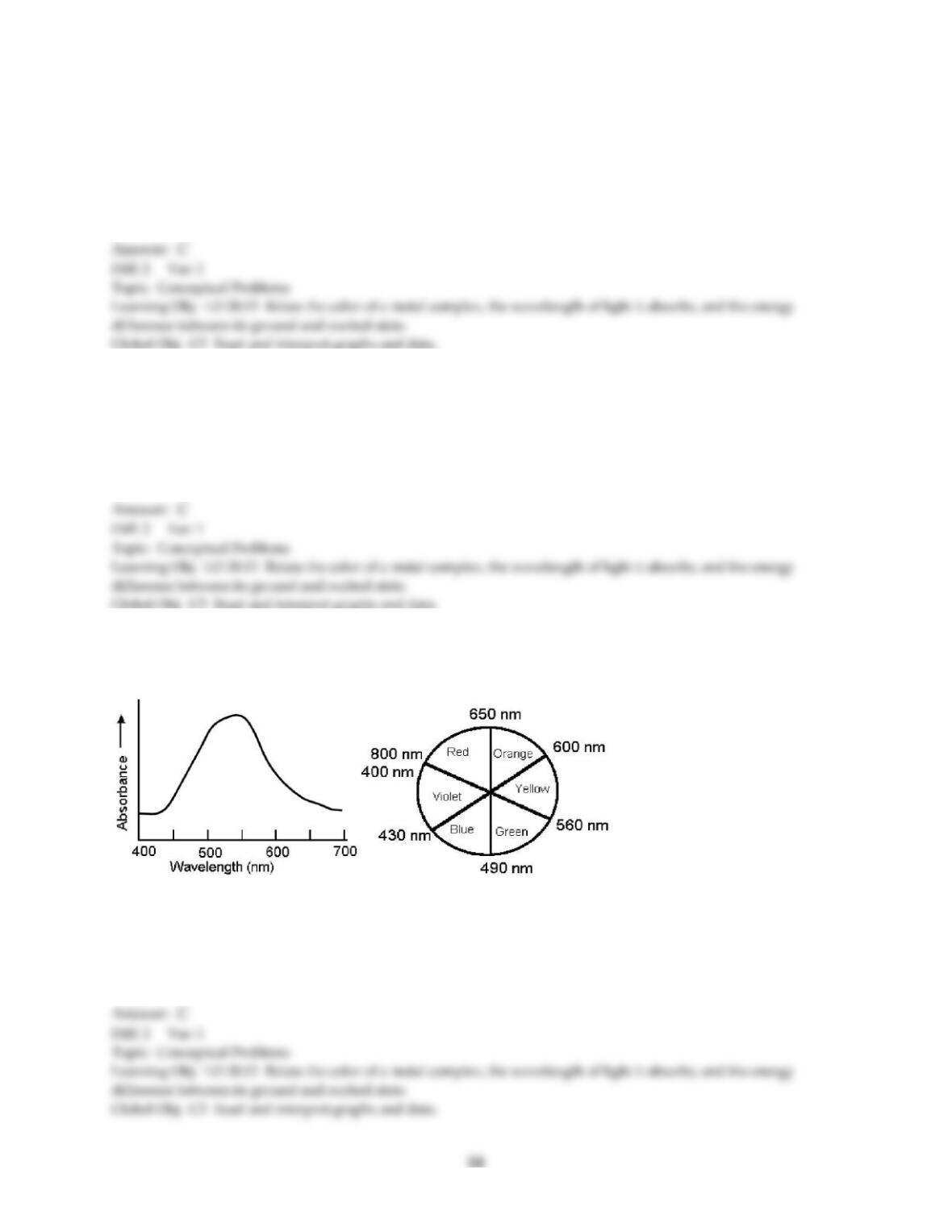
118) Using the above schematic of an artist’s color wheel, determine the color seen if a substance absorbs
yellow and blue light.
A) green
B) orange
C) red
D) violet
119) Using the above schematic of an artist’s color wheel, determine the color absorbed if a substance is
seen as being green in color.
A) blue
B) orange
C) red
D) violet
120) The absorbance spectrum of a complex along with an artist’s color wheel is shown below. Determine
the color one might see for this complex.
A) green
B) red
C) red-violet
D) yellow