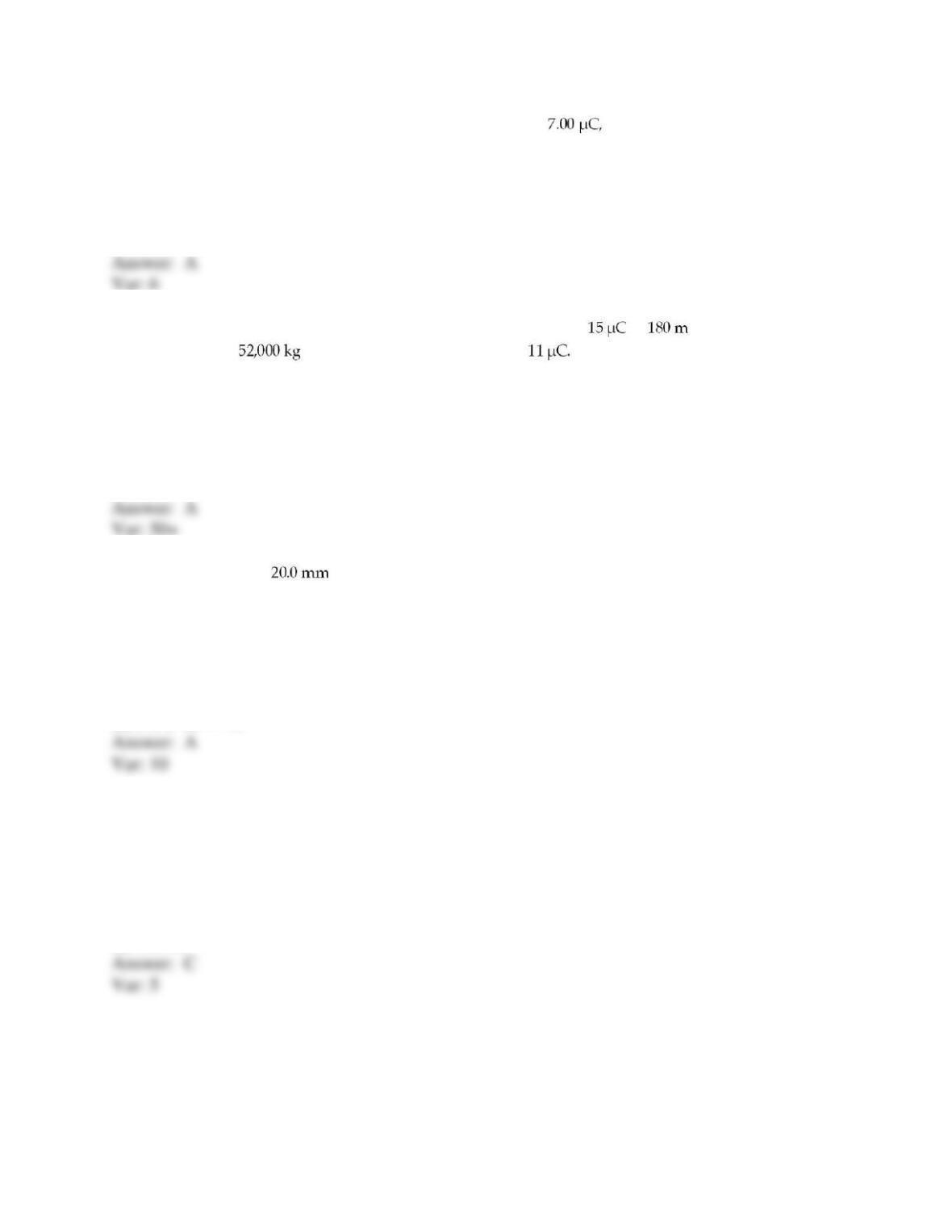
4) If a charge generator builds a negative static charge of – how many electrons are
transferred to it during this process. (e = 1.60 × 10⁻¹⁹ C)
A) 4.38 × 10¹³
B) 7.0
C) 1.12 × 10⁻¹⁸
D) 43.8
5) An asteroid of mass 58,000 kg carrying a negative charge of is from a second
asteroid of mass carrying a negative charge of What is the magnitude of the net
force the asteroids exert upon each other, assuming we can treat them as point particles? (G =
6.67 × 10⁻¹¹ N ∙ m2/kg2, k = 1/4 πε0 = 8.99 × 10⁹ N ∙ m2/C2)
A) 0.000040 N
B) 0.0062 N
C) 570,000 N
D) 510,000 N
6) Two electrons are apart at closest approach. What is the magnitude of the maximum
electric force that they exert on each other? (e = 1.60 × 10⁻¹⁹ C, k = 1/4πε0 = 9.0 109 N ∙
m2/C2)
A) 5.8 × 10⁻²⁵ N
B) 2.3 × 10¹⁰ N
C) 2.3 N
D) 5.8 × 10⁻²⁷ N
7) The force of attraction that a –40.0 μC point charge exerts on a +108 μC point charge has
magnitude 4.00 N. How far apart are these two charges? (k = 1/4πε0 = 8.99 × 10⁹ N ∙ m2/C2)
A) 2.10 m
B) 3.67 m
C) 3.12 m
D) 2.49 m
E) 1.13 m
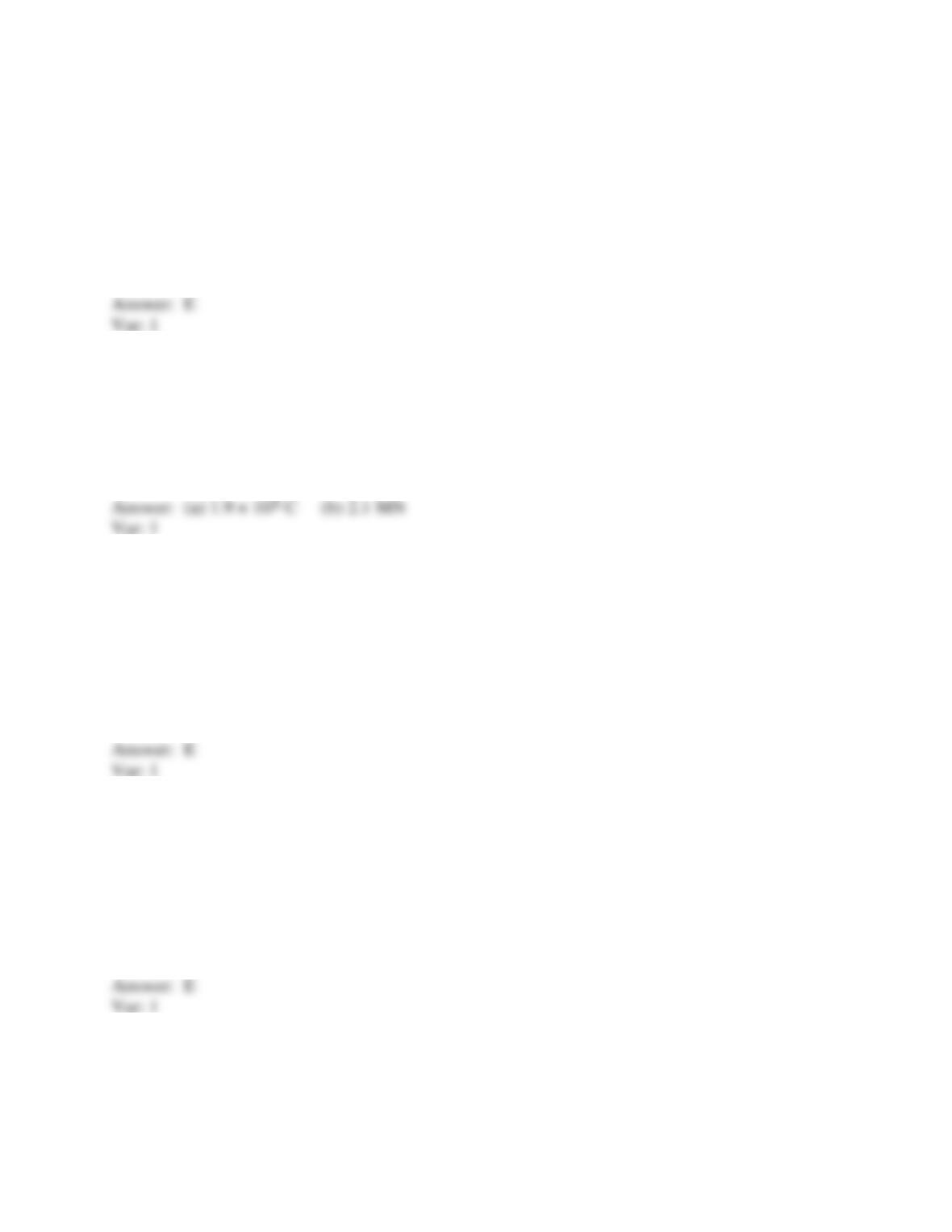
8) When 1.0-µC point charge is 15 m from a second point charge, the force each one experiences
a force of 1.0 µN. What is the magnitude of the second charge? (k = 1/4πε0 = 9.0 × 10⁹ N ∙
m2/C2)
A) 25 C
B) 1.0 C
C) 10 nC
D) 0.025 C
E) 25 nC
9) Consider a container of 2.0 g of hydrogen, H2 (one mole). Suppose you removed all the
electrons and moved them to the other side of the earth (Earth’s radius is 6380 km, k = 1/4πε0 =
9.0 × 10⁹ N ∙ m2/C2, NA = 6.022 × 10²³ molecules/mol, e = 1.60 × 10⁻¹⁹ C)
(a) How much charge is left behind after you remove the electrons?
(b) What electric force do the protons exert on the electrons after they are separated as
described?
10) Two 10¢ coins (dimes) carrying identical charges are lying 2.5 m apart on a table. If each of
these coins experiences an electrostatic force of magnitude 2.0 N due to the other coin, how large
is the charge on each coin? (k = 1/4πε0 = 9.0 × 10⁹ N ∙ m2/C2)
A) 2.6 μC
B) 26 μC
C) 6.7 μC
D) 5.2 μC
E) 52 μC
11) Two point charges each experience a 1-N electrostatic force when they are 2 cm apart. If
they are moved to a new separation of 8 cm, what is the magnitude of the electric force on each
of them?
A) 2 N
B) 1/2 N
C) 1/4 N
D) 1/8 N
E) 1/16 N
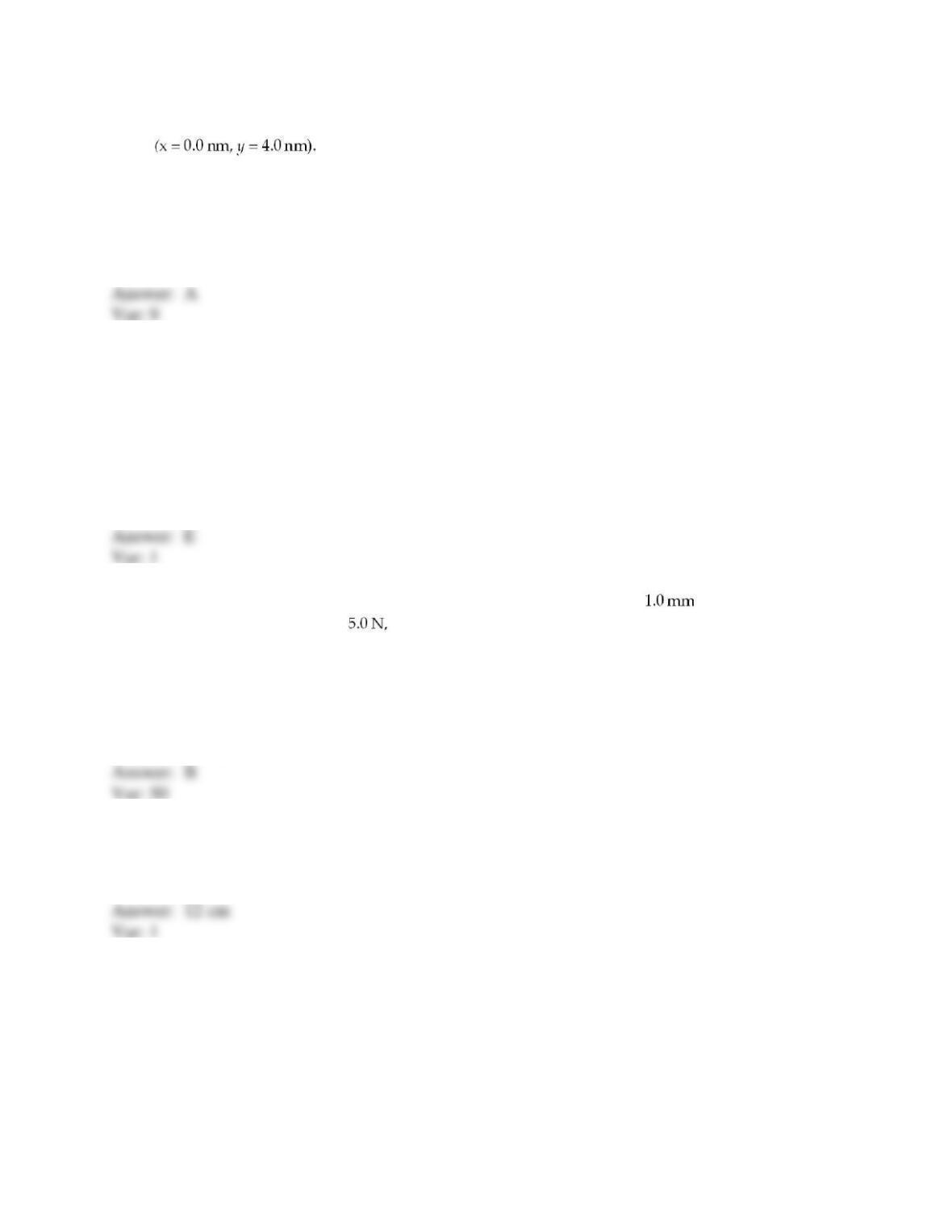
12) A proton is located at the point (x = 1.0 nm, y = 0.0 nm) and an electron is located at the
point Find the magnitude of the electrostatic force that each one exerts on
the other. (k = 1/4πε0 = 9.0 × 10⁹ N ∙ m2/C2, e = 1.6 × 10⁻¹⁹ C)
A) 1.4 × 10⁻¹¹ N
B) 5.3 × 10⁻¹⁸ N
C) 5.3 × 10⁸ N
D) 5.9 × 10⁻¹⁵ N
13) The zirconium nucleus contains 40 protons, and an electron is 1.0 nm from the nucleus.
What is the electric force on the electron due to the nucleus? ( e = 1.60 × 10⁻¹⁹ C, k = 1/4πε0 =
9.0 × 10⁹ N ∙ m2/C2)
A) 2.9 nN
B) 1000 C
C) 3.7 nN
D) 6.8 nN
E) 9.2 nN
14) Two tiny particles carrying like charges of the same magnitude are apart. If the
electric force on one of them is what is the magnitude of the charge on each of these
particles?(k = 1/4πε0 = 9.0 × 10⁹ N ∙ m2/C2)
A) 2.4 × 10⁻² C
B) 2.4 × 10⁻⁸ C
C) 4.5 × 10⁴ C
D) 2.4 × 10⁻⁵ C
15) How far apart should two protons be if the electrical force of repulsion on each one is equal
to its weight on the earth? (k = 1/4πε0 = 9.0 × 10⁹ N ∙ m2/C2, e = 1.6 × 10⁻¹⁹ C, mproton = 1.67
× 10-27 kg)
16) Suppose you wanted to hold up an electron against the force of gravity by the attraction of a
fixed proton some distance above it. How far above the electron would the proton have to be?
(k = 1/4πε0 = 9.0 × 10⁹ N ∙ m2/C2, e = 1.6 × 10⁻¹⁹ C, mproton = 1.67 × 10⁻²⁷ kg, melectron =
9.11 × 10⁻³¹ kg)
A) 1.5 m
B) 2.3 m
C) 3.7 m
D) 4.6 m
E) 5.1 m
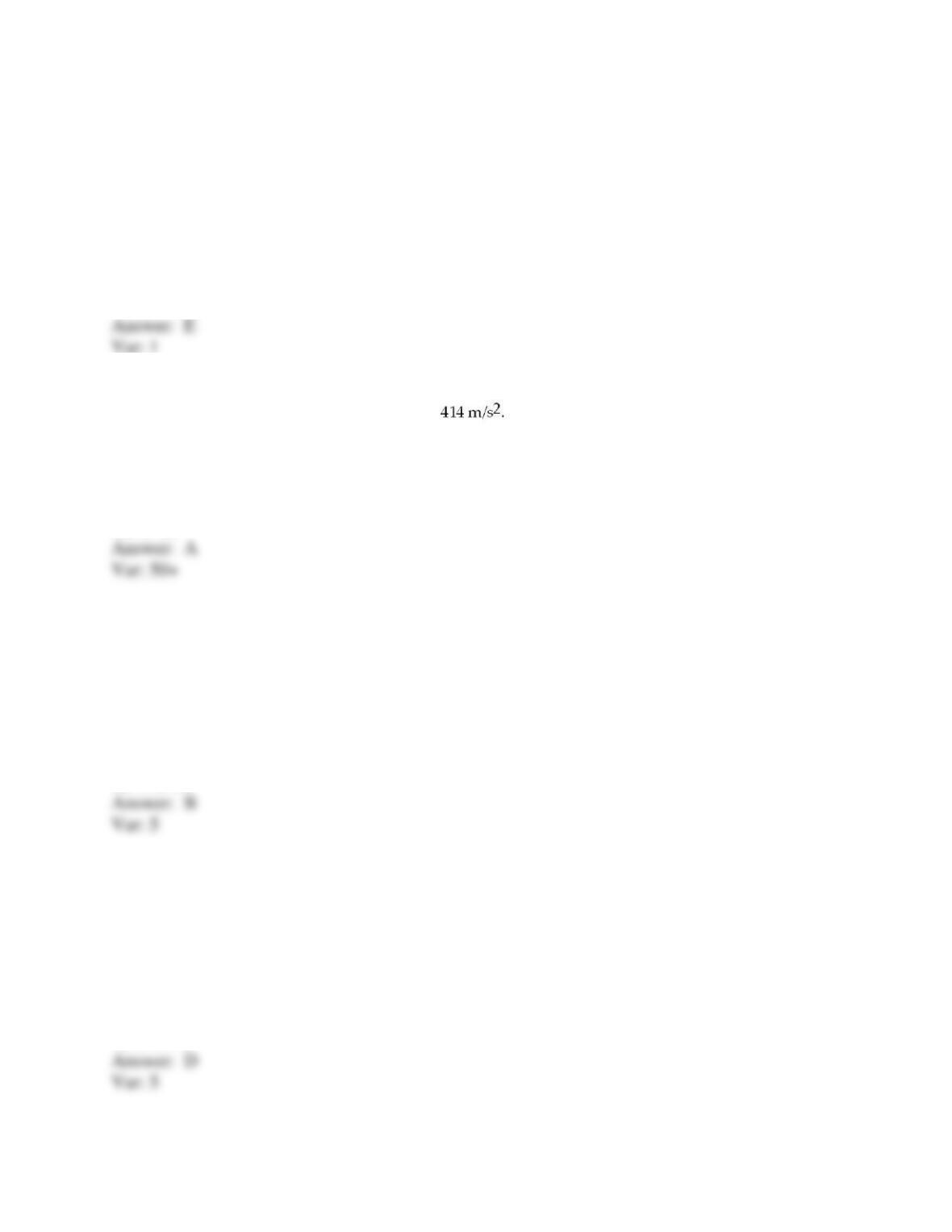
17) Two equally charged tiny spheres of mass 1.0 g are placed 2.0 cm apart. When released, they
begin to accelerate away from each other at What is the magnitude of the charge on
each sphere, assuming only that the electric force is present? (k = 1/4πε0 = 9.0 × 10⁹ N ∙ m2/C2)
A) 140 nC
B) 120 nC
C) 95 nC
D) 75 nC
18) Two tiny particles having charges of +5.00 μC and +7.00 μC are placed along the x-axis. The
+5.00-µC particle is at x = 0.00 cm, and the other particle is at x = 100.00 cm. Where on the x–
axis must a third charged particle be placed so that it does not experience any net electrostatic
force due to the other two particles?
A) 4.58 cm
B) 45.8 cm
C) 50 cm
D) 9.12 cm
E) 91.2 cm
19) Two tiny particles having charges of +7.00 μC and –9.00 μC are placed along the y-axis. The
+7.00-µC particle is at y = 0.00 cm, and the other particle is at y = 40.00 cm. Where must a third
charged particle be placed along the y-axis so that it does not experience any net electric force
due to the other two particles?
A) 0.200 m
B) 2.99 m
C) -0.187 m
D) -2.99 m
E) 0.187 m
20) A particle of charge +2q is placed at the origin and particle of charge –q is placed on the x–
axis at x = 2a. Where on the x-axis can a third positive charge be placed so that the net electric
force on it is zero?
A) 3.4a
B) 6.8a
C) 8.6a
D) 9.3a
E) 1.0a
21) Two tiny beads, each of mass 3.2 g, carry equal-magnitude charges. When they are placed
6.4 cm apart and released in outer space, they begin to accelerate toward each other at 538 m/s2.
What is the magnitude of the charge on each bead? (k = 1/4πε0 = 9.0 × 10⁹ N ∙ m2/C2)
A) 510 nC
B) 44 nC
C) 1800 nC
D) 890 nC
E) 1300 nC
22) Three point charges are located on the x-axis at the following positions: Q1 = +2.00 μC is at
x = 1.00 m, Q2 = +3.00 μC is at x = 0.00, and Q3 = –5.00 μC is at x = -1.00 m. What is the
magnitude of the electric force on Q2? (k = 1/4πε0 = 8.99 × 10⁹ N ∙ m2/C2)
A) 0.0540 N
B) 0.135 N
C) 0.158 N
D) 0.0810 N
E) 0.189 N
23) Three point charges are placed on the x–axis, as follows. A charge of +2.0 μC is at the
origin, a charge of –2.0 μC is at x = 50 cm, and a charge of +4.0 μC is at x = 100 cm. What are
the magnitude and direction of the electrostatic force on the charge at the origin due to the other
two charges? (k = 1/4πε0 = 9.0 × 10⁹ N ∙ m2/C2)
24) A point charge Q1 = +6.0 nC is at the point (0.30 m, 0.00 m); a charge Q2 = -1.0 nC is at
(0.00 m, 0.10 m), and a charge Q3 = +5.0 nC is at (0.00 m, 0.00 m). What are the magnitude and
direction of the net force on the +5.0-nC charge due to the other two charges? (k = 1/4πε0 = 9.0
× 109 N ∙ m2/C2)
25) The three point charges +4.0 μC, –5.0 μC, and –9.0 μC are placed on the x-axis at the points x
= 0 cm, x = 40 cm, and x = 120 cm, respectively. What is the x component of the electrostatic
force on the –9.0 μC charge due to the other two charges? (k = 1/4πε0 = 9.0 × 10⁹ N ∙ m2/C2)
A) -0.55 N
B) 0.55 N
C) 0.64 N
D) 0.41 N
E) -0.41 N
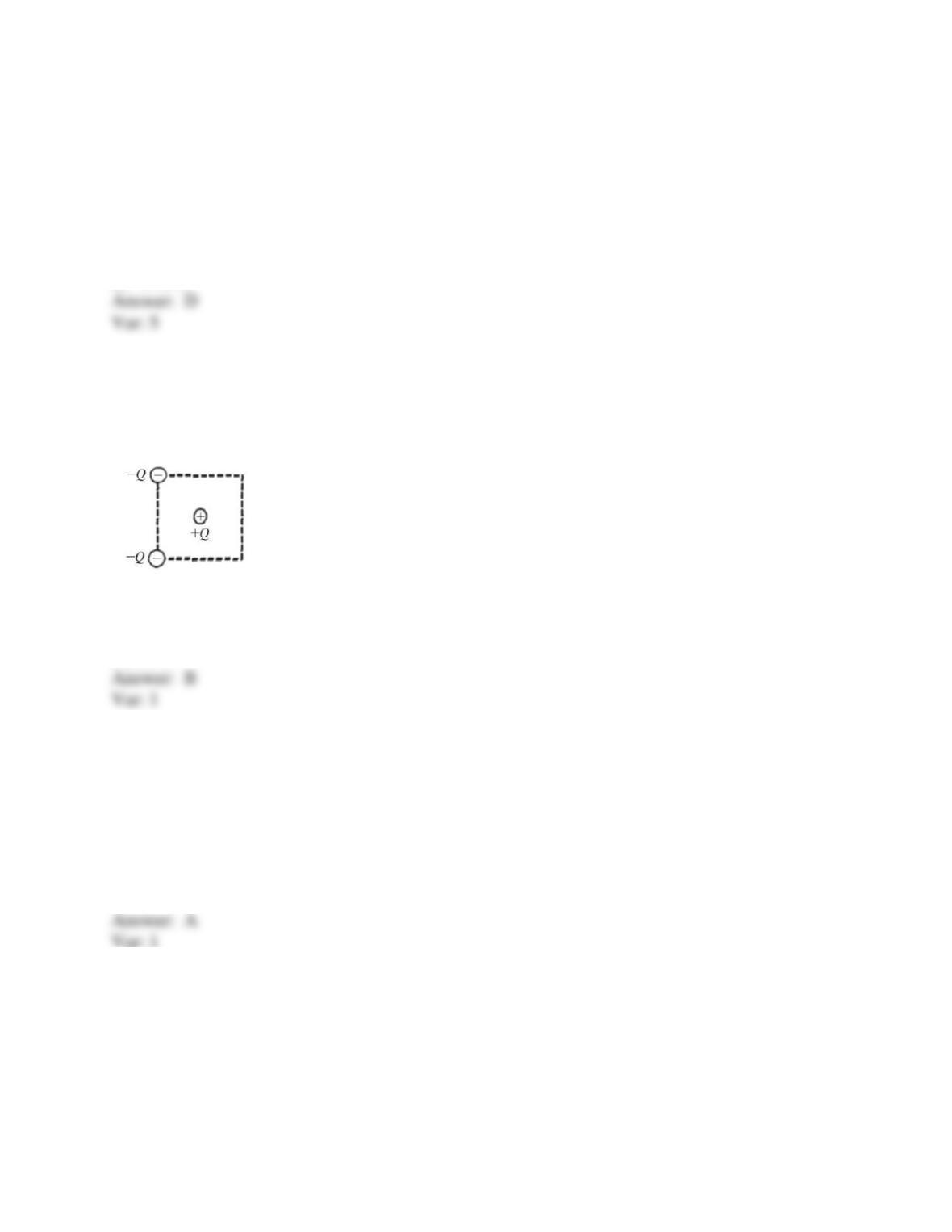
26) One point charge +Q is placed at the center of a square, and a second point charge –Q is
placed at the upper-left corner of the square. It is observed that an electrostatic force of
magnitude 2.0 N acts on the positive charge at the center. Now a third charge –Q is placed at the
lower-left corner of the square, as shown in the figure. What is the magnitude of the net force
that acts on the center charge now?
A) 0.0 N
B) 2.8 N
C) 4.0 N
D) 5.3 N
27) Three identical 3.0-µC charges are placed at the vertices of an equilateral triangle that
measures 30 cm on a side. What is the magnitude of the electrostatic force on any one of the
charges? (k = 1/4πε0 = 9.0 × 10⁹ N ∙ m2/C2)
A) 1.6 N
B) 1.8 N
C) 2.0 N
D) 2.2 N
E) 2.4 N
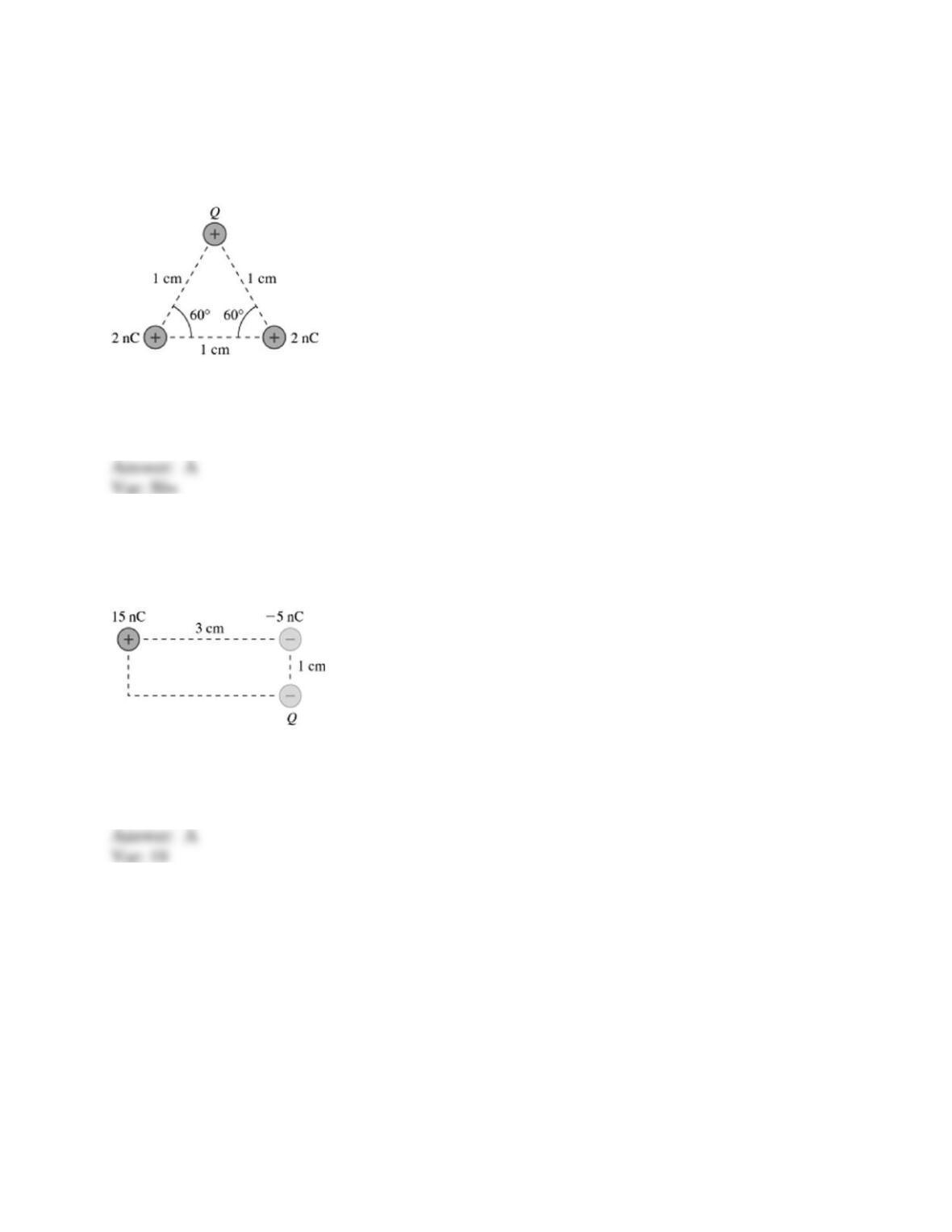
28) As shown in the figure, three charges are at the vertices of an equilateral triangle. The charge
Q is 6.7 nC, and all the other quantities are accurate to two significant figures. What is the
magnitude of the net electric force on the charge Q due to the other two charges? (k = 1/4πε0 =
9.0 × 10⁹ N ∙ m2/C2)
A) 2.1 × 10⁻³ N
B) 1.2 × 10⁻³ N
C) 1.0 × 10⁻³ N
D) 1.4 × 10⁻³ N
29) As shown in the figure, three charges are at corners of a rectangle. The charge in the bottom
right corner is Q = – 90 nC, and all the other quantities are accurate to two significant figures.
What is the magnitude of the net electrical force on Q due to the other two charges? (k = 1/4πε0
= 9.0 × 10⁹ N ∙ m2/C2)
A) 3.8 × 10⁻² N
B) 2.8 × 10⁻² N
C) 5.3 × 10⁻² N
D) 7.1 × 10⁻² N
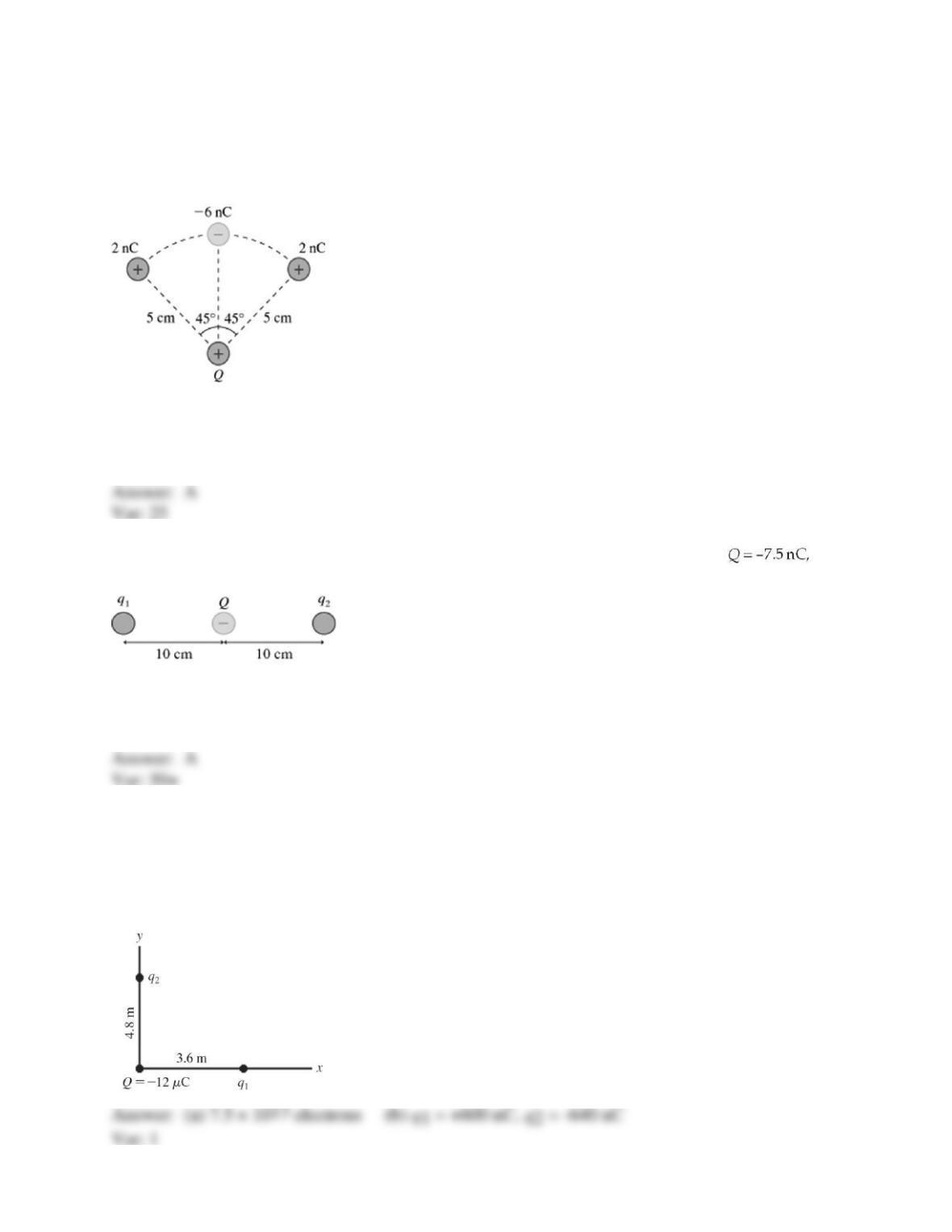
30) As shown in the figure, three small charges are equally spaced on the arc of a circle that is
centered at the charge Q, where Q = +23 nC and all the other quantities are accurate to two
significant figures. What is the magnitude of the net electric force on the charge Q due to the
other three charges? (k = 1/4πε0 = 9.0 × 10⁹ N ∙ m2/C2)
A) 2.6 × 10⁻⁴ N
B) 1.7 × 10⁻⁴ N
C) 2.1 × 10⁻⁴ N
D) 3.1 × 10⁻⁴ N
31) As shown in the figure, the charge Q is midway between two other charges. If
what must be the charge q1 so that charge q2 remains stationary as Q and q1 are held in place?
A) 30 nC
B) 15 nC
C) 7.5 nC
D) 60 nC
32) A point charge Q = -12 μC, and two other charges q2 and q2, are placed on x–y axes as
shown in the figure. The electric force components on charge Q are Fx = +0.005 N and Fy = –
0.003 N. (k = 1/4πε0 = 9.0 × 10⁹ N ∙ m2/C2, e = 1.6 × 10⁻¹⁹ C)
(a) How many excess electrons are there in charge Q?
(b) What are the charges q1 and q2, including their signs?
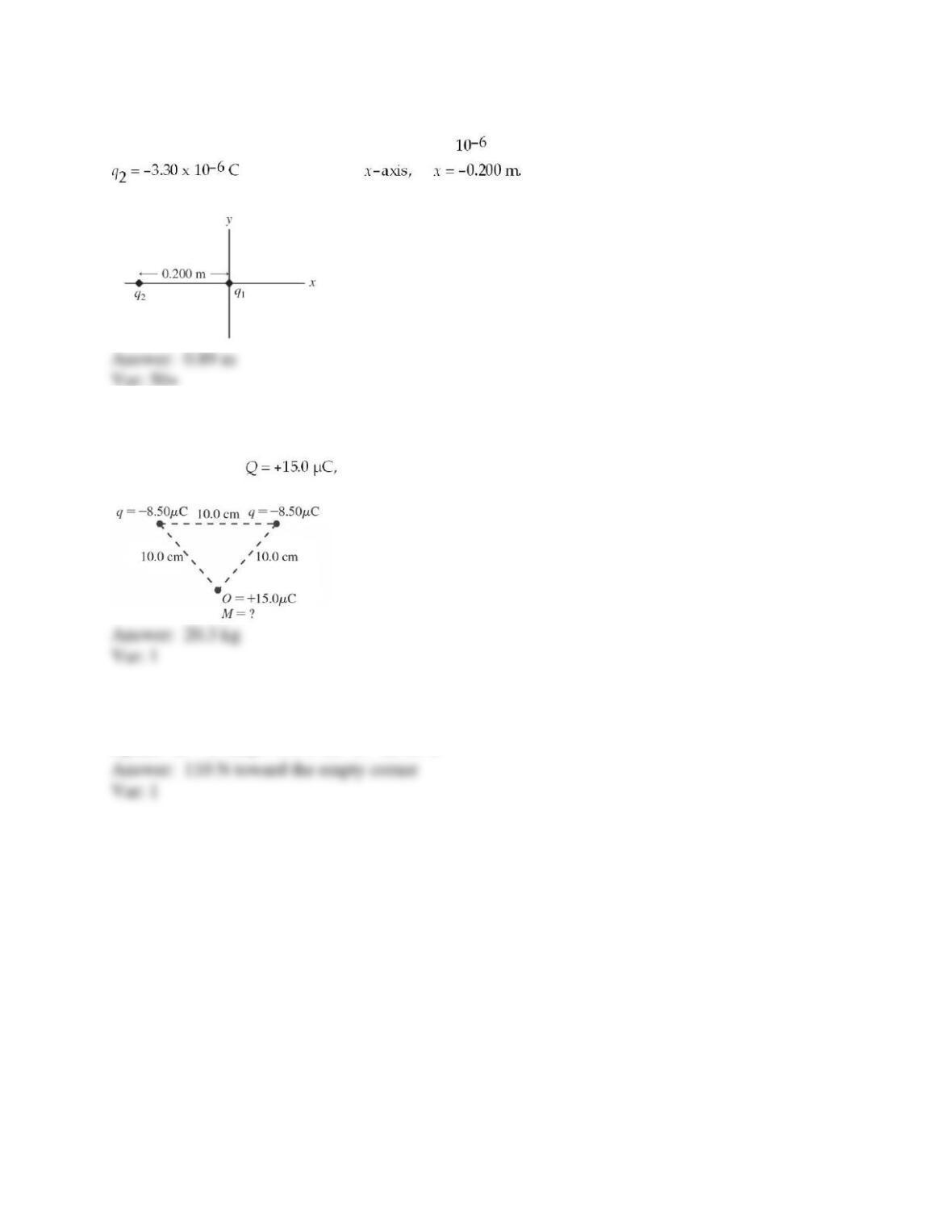
33) As shown in the figure, charge q1 = 2.2 x C is placed at the origin and charge
is placed on the at Where along the x-axis can a third charge
Q = -8.30 × 10⁻⁶ C be placed so that the resultant force on Q is zero?
34) Two point charges q = -8.50 µC are fixed 10.0 cm apart along a horizontal bar, as shown in
the figure. Their electrical forces will be used to balance the weight of a very small sphere
carrying a charge 10.0 cm from each of them in a place where g = 9.80 m/s2. What
is the greatest mass M this sphere can have without falling? (k = 1/4πε0 = 8.99 × 10⁹ N ∙ m2/C2)
35) There is a +5.0-μC charge at three corners of a square having sides 70 mm long. What are
the magnitude and direction of the net electrostatic force on +6.0 μC placed at the center of the
square? (k = 1/4πε0 = 9.0 × 10⁹ N ∙ m2/C2)
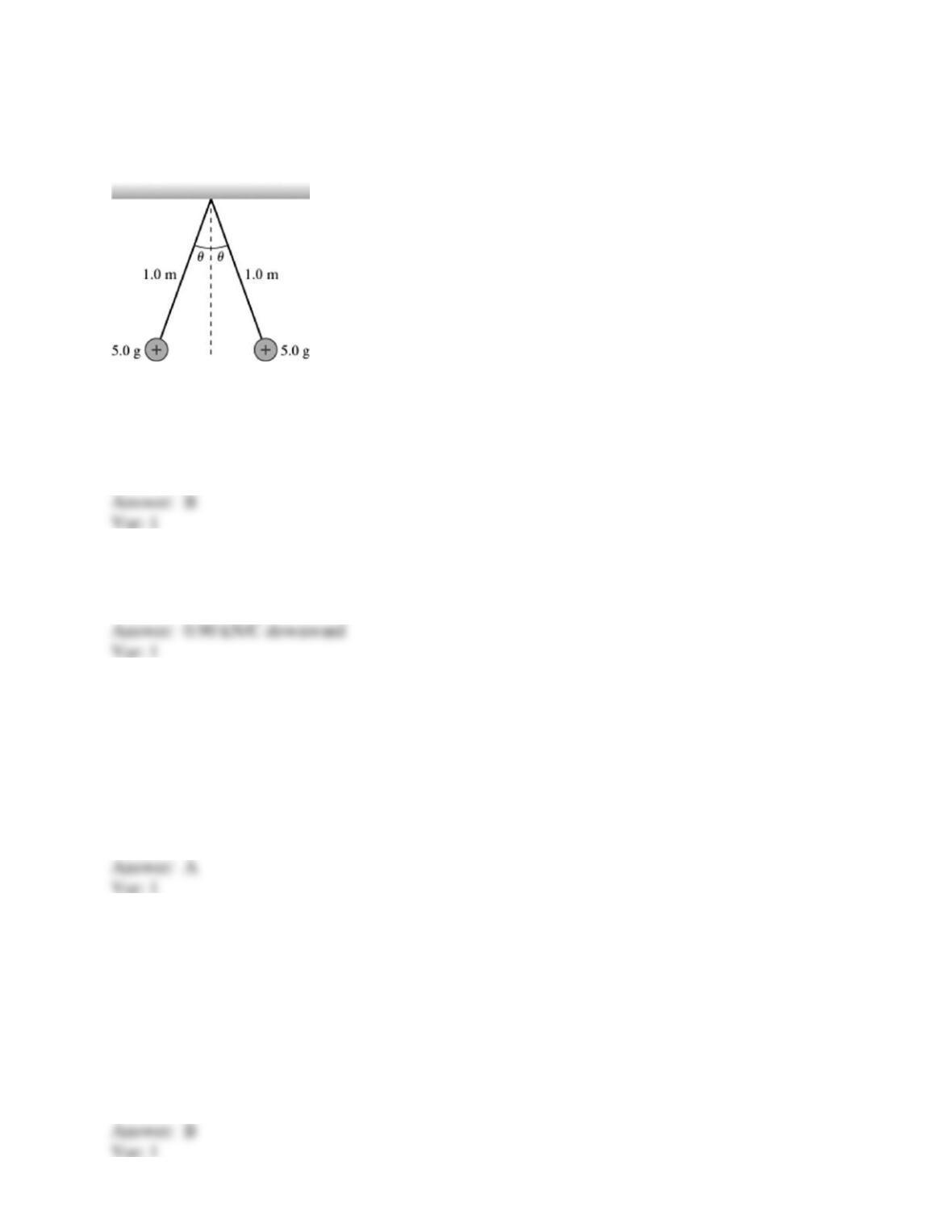
36) The figure shows two tiny 5.0-g spheres suspended from very light 1.0-m-long threads. The
spheres repel each other after each one is given the same positive charge and hang at rest when θ
= 4.1°. What is the charge on each sphere? (k = 1/4πε0 = 9.0 × 10⁹ N ∙ m2/C2)
A) 22 nC
B) 89 nC
C) 360 nC
D) 180 nC
E) 45 nC
37) If a point charge of -30 µC experiences an electrostatic upward force of 27 mN at a certain
location in the laboratory, what are the magnitude and direction of the electric field at that
location?
38) A small object with a 5.0-μC charge is accelerating horizontally on a friction-free surface at
0.0050 m/s2 due only to an electric field. If the object has a mass of 2.0 g, what is the magnitude
of the electric field?
A) 2.0 N/C
B) 4.0 N/C
C) 0.0020 N/C
D) 0.0040 N/C
E) 1.0 N/C
39) A small 0.050-kg insulating sphere carries a charge of –60 μC and is hanging by a vertical
silk thread from a fixed point in the ceiling. An external uniform vertical electric field is now
applied. If the applied electric field has a magnitude of 3000 N/C and is directed downward,
what is the tension in the silk thread? (k = 1/4πε0 = 9.0 × 10⁹ N ∙ m2/C2)
A) 0.19 N
B) 0.31 N
C) 0.41 N
D) 0.52 N
E) 0.71 N
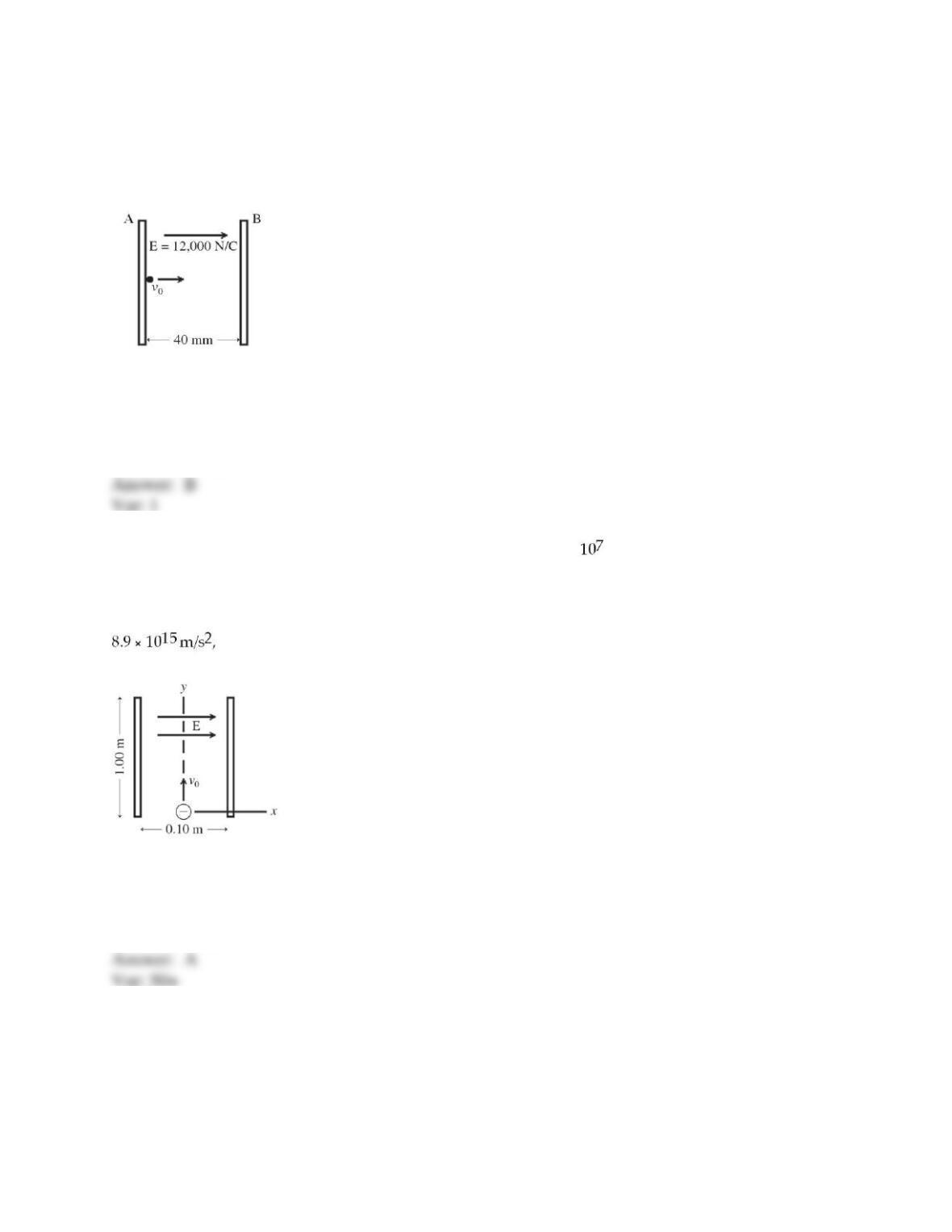
40) A pair of charged conducting plates produces a uniform field of 12,000 N/C, directed to the
right, between the plates. The separation of the plates is 40 mm. An electron is projected from
plate A, directly toward plate B, with an initial speed of v0 = 2.0 × 10⁷ m/s. What is the speed of
the electron as it strikes plate B? (e = 1.6 × 10⁻¹⁹ C, melectron = 9.11 × 10⁻³¹ kg)
A) 1.2 × 10⁷ m/s
B) 1.5 × 10⁷ m/s
C) 1.8 × 10⁷ m/s
D) 2.1 × 10⁷ m/s
E) 2.4 × 10⁷ m/s
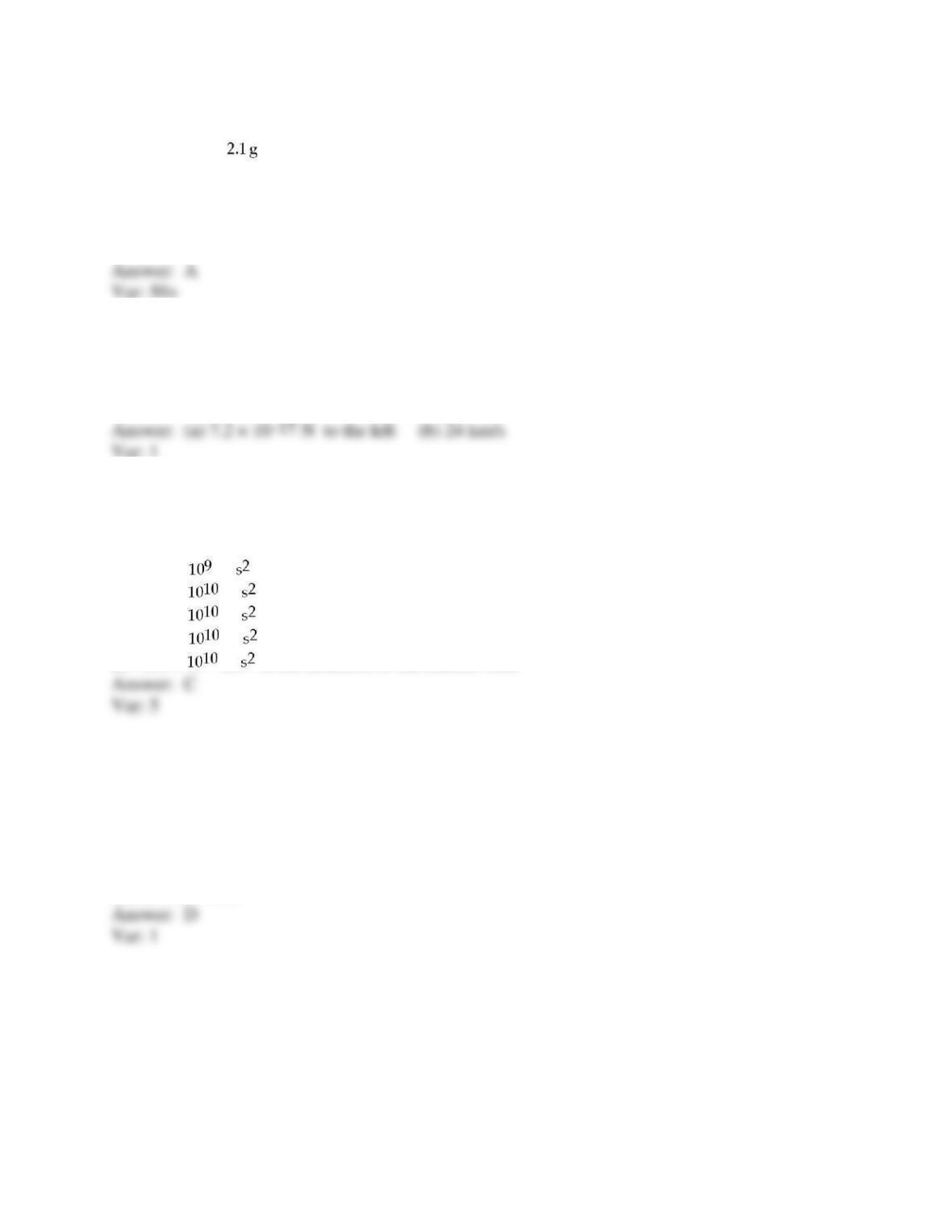
41) An electron is projected with an initial velocity v0 = 8.4 × m/s along the y-axis, which is
the centerline between a pair of charged plates, as shown in the figure. The plates are 1.0 m long
and are separated by 0.10 m. A uniform electric field of magnitude E in the +x-direction is
present between the plates. If the magnitude of the acceleration of the electron is measured to be
what is the magnitude of the electric field between the plates? (e = 1.6 × 10⁻¹⁹ C,
melectron = 9.11 × 10⁻³¹ kg)
A) 51,000 N/C
B) 45,000 N/C
C) 40,000 N/C
D) 35,000 N/C
E) 29,000 N/C
42) What is the magnitude of a the vertical electric field that will balance the weight of a plastic
sphere of mass that has been charged to -3.0 nC? (k = 1/4πε0 = 9.0 × 10⁹ N ∙ m2/C2)
A) 6.9 × 10⁶ N/C
B) 7.8 × 10⁵ N/C
C) 1.5 × 10⁶ N/C
D) 2.1 × 10⁶ N/C
43) An electron is placed in a uniform electric field of 4.5 × 10⁴ N/C that points to the right. (e =
1.6 × 10⁻¹⁹ C, melectron = 9.11 × 10⁻³¹ kg)
(a) What are the magnitude and direction of the force on the electron?
(b) If the electron is released from rest, what is its speed after 3.0 ps?
44) A proton is placed in an electric field of intensity 800 N/C. What are the magnitude and
direction of the acceleration of the proton due to this field? (e = 1.60 × 10⁻¹⁹ C, mproton = 1.67
× 10-27 kg)
A) 7.66 × m/ opposite to the electric field
B) 7.66 × m/ opposite to the electric field
C) 7.66 × m/ in the direction of the electric field
D) 76.6 × m/ opposite to the electric field
E) 76.6 × m/ in the direction of the electric field
45) A particle with a charge of +4.0 μC has a mass of 5.0 g. What magnitude electric field
directed upward will exactly balance the weight of the particle?
A) 4.1 × 10⁴ N/C
B) 8.2 × 10⁴ N/C
C) 4.4 × 10⁴ N/C
D) 1.2 × 10⁴ N/C
E) 5.1 × 10⁴ N/C
46) A small styrofoam ball of mass 0.120 g is placed in an electric field of 6000 N/C pointing
downward. What excess charge must be placed on the ball for it to remain suspended in the
field?
A) -16.0 nC
B) -18.0 nC
C) -57.2 nC
D) -125 nC
E) -196 nC
47) A small glass bead has been charged to 1.9 nC. What is the strength of the electric field 2.0
cm from the center of the bead? (k = 1/4πε0 = 8.99 × 10⁹ N ∙ m2/C2)
A) 4.3 × 10⁴ N/C
B) 8.5 × 10² N/C
C) 8.1 × 10⁻⁵ N/C
D) 8.5 × 10⁻⁷ N/C
48) What is the magnitude of the electric field 2.8 cm from a tiny object that carries an excess
charge of –16 nC? (k = 1/4πε0 = 9.0 × 10⁹ N ∙ m2/C2)
A) 180,000 N/C
B) 5100 N/C
C) 1.8 × 10¹⁴ N/C
D) -180,000 N/C
E) -5100 N/C
49) Two tiny particles having charges +20.0 μC and –8.00 μC are separated by a distance of 20.0
cm. What are the magnitude and direction of electric field midway between these two charges?
(k = 1/4πε0 = 9.0 × 10⁹ N ∙ m2/C2)
A) 25.2 × N/C directed towards the negative charge
B) 25.2 × N/C directed towards the positive charge
C) 25.2 × N/C directed towards the negative charge
D) 25.2 × N/C directed towards the positive charge
E) 25.2 × N/C directed towards the negative charge
50) The electric field at a point 2.8 cm from a small object points toward the object with a
strength of 180,000 N/C. What is the object’s charge q? (k = 1/4πε0 = 8.99 × 10⁹ N ∙ m2/C2)
A) -16 nC
B) +16 nC
C) -17 nC
D) +17 nC
51) A +5.00-μC point charge is placed at the 0.0 cm mark of a meter stick and a -4.00-μC point
charge is placed at the 50.0 cm mark. At what point on a line through the ends of the meter stick
is the electric field equal to zero?
A) 1.4 m from the 0 cm mark
B) 2.5 m from the 0 cm mark
C) 2.9 m from the 0 cm mark
D) 3.3 m from the 0 cm mark
E) 4.7 m from the 0 cm mark
52) A +5.0-μC point charge is placed at the 0 cm mark of a meter stick and a -4.0-μC charge is
placed at the 50 cm mark. What is the net electric field at the 30 cm mark? (k = 1/4πε0 = 8.99 ×
109 N ∙ m2/C2)
A) 4.0 × 10⁵ N/C
B) 5.0 × 10⁵ N/C
C) 9.0 × 10⁵ N/C
D) 1.4 × 10⁶ N/C
53) An electric dipole consists of charges of ±6.00 µC that are 10.0 cm apart, as shown in the
figure. Find the magnitude and direction of the electric field this dipole produces at point P,
which is 7.00 cm from each charge. (k = 1/4πε0 = 8.99 × 10⁹ N ∙ m2/C2)
54) A thin spherical copper shell of radius 9.5 cm carries an excess charge of -4.2 nC. How many
excess electrons are on (a) the outer surface of the shell, and (b) the inner surface? (e = 1.60 ×
10-19 C)
55) Two parallel square metal plates, 8.4 cm on each side, are 2.5 mm apart and carry equal but
opposite charge uniformly distributed over their facing surfaces. How much excess charge is
there on each plate if the electric field between the plates has a magnitude of 2.0 × 10⁶ N/C? (k
= 1/4πε0 = 8.99 × 10⁹ N ∙ m2/C2)
56) Two parallel square metal plates that are 1.5 cm apart and 22 cm on each side carry equal but
opposite charges uniformly spread out over their facing surfaces. How many excess electrons are
on the negative surface if the electric field between the plates has a magnitude of 18,000 N/C? (k
= 1/4πε0 = 9.0 × 10⁹ N ∙ m2/C2, e = 1.6 × 10⁻¹⁹ C)
57) A tiny 0.0250-µg oil drop containing 15 excess electrons is suspended between two
horizontally closely-spaced metal plates that carry equal but opposite charges on their facing
surfaces. The plates are both circular with a radius of 6.50 cm. (k = 1/4πε0 = 9.0 × 10⁹ N ∙
m2/C2, e = 1.6 × 10⁻¹⁹ C)
(a) How much excess charge must be on each plate to hold the oil drop steady?
(b) Which plate must be positive, the upper one or the lower one?
58) Two large closely-spaced parallel metal plates are uniformly and oppositely charged and the
electric field between them is 7.6 × 10⁶ N/C.
(a) What is the charge per unit area on each plate?
(b) If the plates are now moved two times farther apart, what is the electric field between the
plates?