Quantity of Movies Michelle’s Total Robert’s Total
Watched per Week Utility per Week Utility per Week
0 0 0
1100 100
2195 190
3270 270
4340 340
5390 400
6420 350
7435 390
8445 420
9450 440
10 440 450
66)
Refer to the above table. The marginal utility of the 7th movie for Michelle is
66)
A)
35 units of utility.
B)
15 units of utility.
C)
435 units of utility.
D)
20 units of utility.
67)
Suppose that indifference curve I1 lies to the left of indifference curve I2. We can conclude that
67)
A)
all points along indifference curve I1 will correspond to higher utility than points along
indifference curve I2.
B)
all points along indifference curve I1 will correspond to lower utility than points along
indifference curve I2.
C)
some, but not all, points on indifference curve I1 will correspond to higher utility than points
along indifference curve I2.
D)
some, but not all, points on indifference curve I1 will correspond to lower utility than points
along indifference curve I2.
68)
The price of a hamburger is $1 and the price of a movie is $6 and the consumer has $14. A
consumer has purchased 2 hamburgers and 2 movies, receiving 20 units of utility for the second
hamburger and 100 units of utility for the second movie. The set of goods
68)
A)
is not an optimum because the marginal utility per dollar spent is greater for hamburgers
than for movies and the consumer is not spending all of his income.
B)
is an optimum since the entire income is spent and total utility is maximized.
C)
is not an optimum because the marginal utility for each good is not equal.
D)
is an optimum since the entire income is spent and the marginal utility per dollar spent is the
same for the last unit of each good.
69)
In a restaurant we can observe people consuming coffee, tea, and soft drinks. All are priced the
same. If Sally consumes coffee and Ali consumes soft drinks, we can conclude that
69)
A)
Bill will be drinking tea.
B)
Sally likes coffee more than Ali does, and Ali likes soft drinks more than Sally does.
C)
the utility Sally receives from coffee consumption equals the utility that Ali receives from
consuming soft drinks.
D)
Sally derives more utility from coffee than from tea or soft drinks, and Ali derives more utility
from soft drinks than from tea or coffee.
70)
The idea that consumers continue to adjust their purchases until the marginal utility per last dollar
spent on all items is equal is called the
70)
A)
consumer optimum.
B)
law of diminishing marginal utility.
C)
rule of 72.
D)
law of increasing costs.
71)
Juan and Sophia have decided to stop studying economics and get a bite to eat. Juan wants to go for
a pizza and Sophia wants a hamburger. They decide to go for pizza. What can we conclude from
this?
71)
A)
Sophia gets less utility from pizza than she could from a hamburger.
B)
Juan always gets more utility from pizza than Sophia does.
C)
Utility analysis does not work here since Sophia did not eat a hamburger.
D)
Sophia will get negative utility from the pizza.
72)
The real–income effect shows that
72)
A)
if the consumer‘s income rises, he or she buys more of inferior goods and less of normal
goods.
B)
when the price of a good rises, consumers are able to buy more of other goods because of the
increase in the purchasing power of income.
C)
if a good is inferior, a decrease in the purchasing power of income results in less of the good
being consumed.
D)
a decrease in the price of a good increases the purchasing power of the consumer’s income.
73)
The change in the total utility as a result of increasing consumption by one unit is known as
73)
A)
average utility.
B)
utils.
C)
proportional utility.
D)
marginal utility.
74)
A consumer has spent all of his funds on hamburgers and movies. The price of a hamburger is $1
and the price of a movie is $5. The marginal utility of the last hamburger is 5 and the marginal
utility of the last movie is 40. This consumer has
74)
A)
not maximized utility. To maximize utility, he should cut back on movies and buy more
hamburgers.
B)
not maximized utility. To maximize utility, he should cut back consumption of each.
C)
not maximized utility. To maximize utility, he should cut back on hamburgers and buy more
movies.
D)
maximized utility.
75)
The change in the consumption of one good that just offsets a one–unit change in the consumption
of another good is the
75)
A)
marginal utility.
B)
marginal rate of satisfaction.
C)
marginal rate of consumption.
D)
marginal rate of substitution.
76)
If the price of a pizza slice falls, Tom can
76)
A)
buy more pizza with his paycheck.
B)
buy more soft drinks with his paycheck.
C)
no longer afford pizza on his paycheck.
D)
Either A or B is possible.
77)
The substitution effect shows that
77)
A)
if the price of a good falls, consumers buy less of all goods.
B)
if the price of a good increases, consumers buy more of that good and less of all others.
C)
if the price of a good falls relative to all other goods, consumers buy less of that good and
more of all others.
D)
if the price of a good rises, consumers buy less of that good and more of others.
78)
If your money income stays the same but the price of one good that you are buying goes up, your
effective purchasing power
78)
A)
cannot be determined.
B)
does not change.
C)
rises.
D)
falls.
79)
If the quantity of hamburgers is measured along the horizontal axis and the quantity of movies is
measured along the vertical axis, and the price of a hamburger is $2.00 while the price of a movie is
$12, then the slope of the budget line is
79)
A)
–6.
B)
–3.5
C)
–1/3.
D)
–1/6.
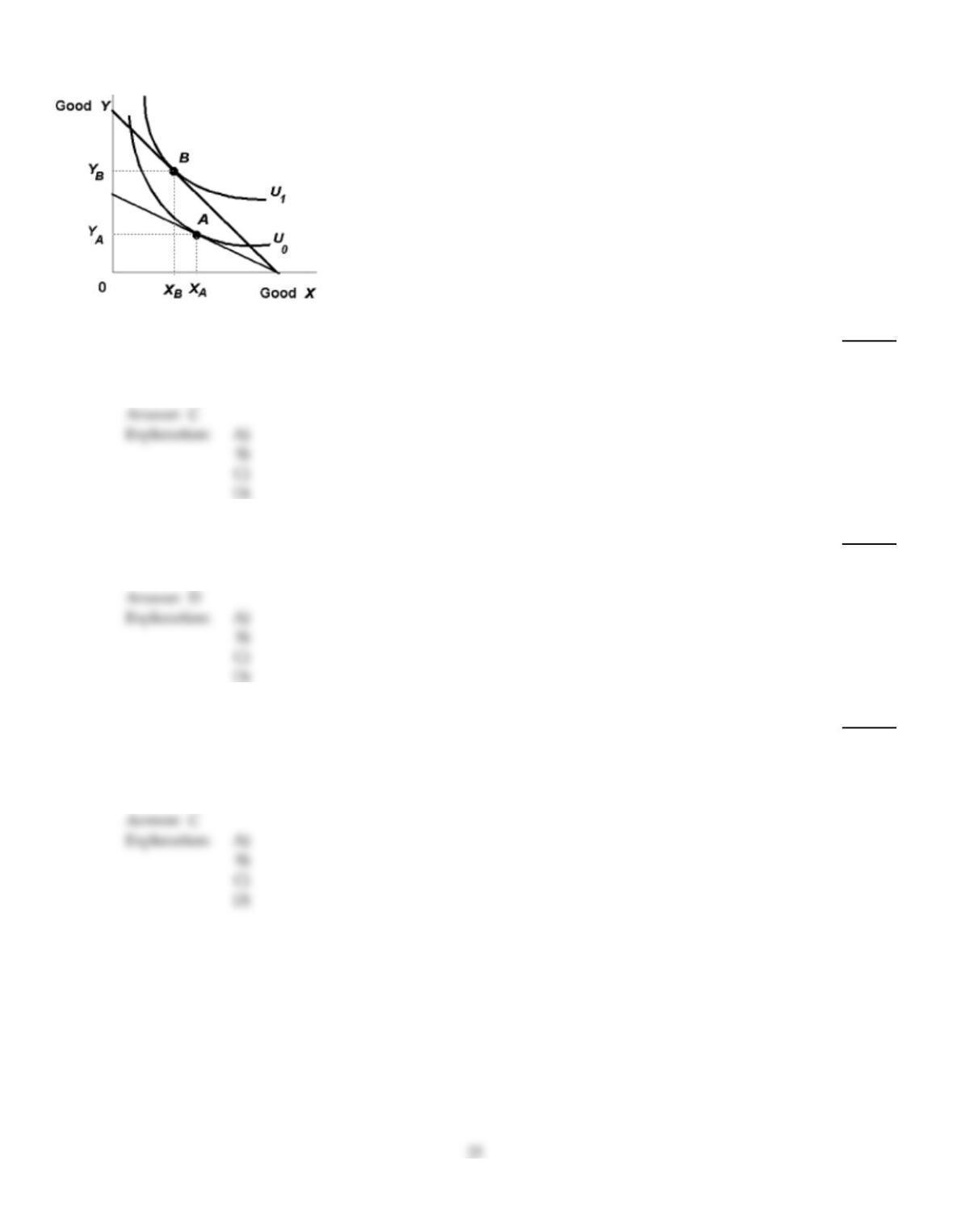
80)
Use the above figure. Last week Joe consumed combination “A” of goods “X” and “Y.” This week he
purchased combination “B.” The reason for this change is that the
80)
A)
price of good X has increased.
B)
price of good Y has increased.
C)
price of good Y has decreased.
D)
price of good X has decreased.
81)
If your dinner guest said, “Every bite, including the last bite, tasted as good as the first,” then the
marginal utility for him
81)
A)
is increasing.
B)
is positive.
C)
is decreasing.
D)
is constant.
82)
A well–known athlete loves cupcakes. He receives 200 utils for the first cupcake, an additional 160
for the second, an additional 120 for the third, another 80 for the fourth, and another 40 for the fifth.
The marginal utility of the fourth cupcake is ________ and the total utility of consuming four
cupcakes is ________.
82)
A)
40; 40
B)
80; 600
C)
80; 560
D)
40; 80
83)
Based on the material presented in the chapter, can we conclude that people will consume goods
until the marginal utility of each good is zero?
83)
A)
Yes, because at that point total utility is maximum.
B)
No, because consumption is determined by total utility.
C)
No, because consumption is determined by the marginal utility/price ratio.
D)
Yes, because at that point marginal utility is minimum.
84)
As marginal utility declines but remains positive, then
84)
A)
total utility is unaffected.
B)
total utility also declines.
C)
total utility continues to increase but at a decreasing rate.
D)
none of the above.
C
85)
A certain athlete loves donuts. He receives 100 units of utility for the first donut, an additional 80
for the second, an additional 60 for the third, another 40 for the fourth, and another 20 for the fifth.
The marginal utility of the fourth donut is ________ and the total utility from consuming four
donuts is ________.
85)
A)
40; 280
B)
140; 280
C)
280; 100
D)
40; 40
A
86)
When an individual’s purchasing power changes due to a change in the price of a good or service,
this is referred to as
86)
A)
real–income effect.
B)
substitution effect.
C)
utility effect.
D)
marginal effect.
A
C
87)
The concept of marginality is important in economics because
87)
A)
marginal decisions indicate a lack of importance.
B)
large expenditures are the only factor influencing consumption.
C)
individuals make decisions based on tastes only.
D)
individuals make decisions at the margin.
88)
A budget constraint shows
88)
A)
all of the combinations of sets of goods that yield the same level of satisfaction.
B)
all of the goods that a consumer substitutes for other goods when prices fall.
C)
all of the goods the consumer gets positive marginal utility from when the goods are
consumed.
D)
all of the possible combinations of goods that can be purchased with a specific budget.
D
89)
Utility analysis is the analysis of
89)
A)
consumer decision making based on utility maximization.
B)
the psychology of decision making.
C)
the formation of tastes and preferences.
D)
how consumers decide how to spend their money.
A
90)
Given the utility–optimizing rule and the presence of diminishing marginal utility for a good
90)
A)
the demand curve for the good will be vertical.
B)
there will not be a well–defined demand curve.
C)
the demand curve for the good will be negatively sloped.
D)
there will not be a substitution effect.
C
D
91)
When marginal utility is negative, total utility is
91)
A)
increasing at a decreasing rate.
B)
decreasing.
C)
zero.
D)
at its maximum.
92)
Initially, a consumer is at an optimum. Then the price of X decreases. Consequently,
92)
A)
MUX/PX> MUY/PY.
B)
MUX> MUY.
C)
MUX/PX= MUY/PY.
D)
MUX/PX< MUY/PY.
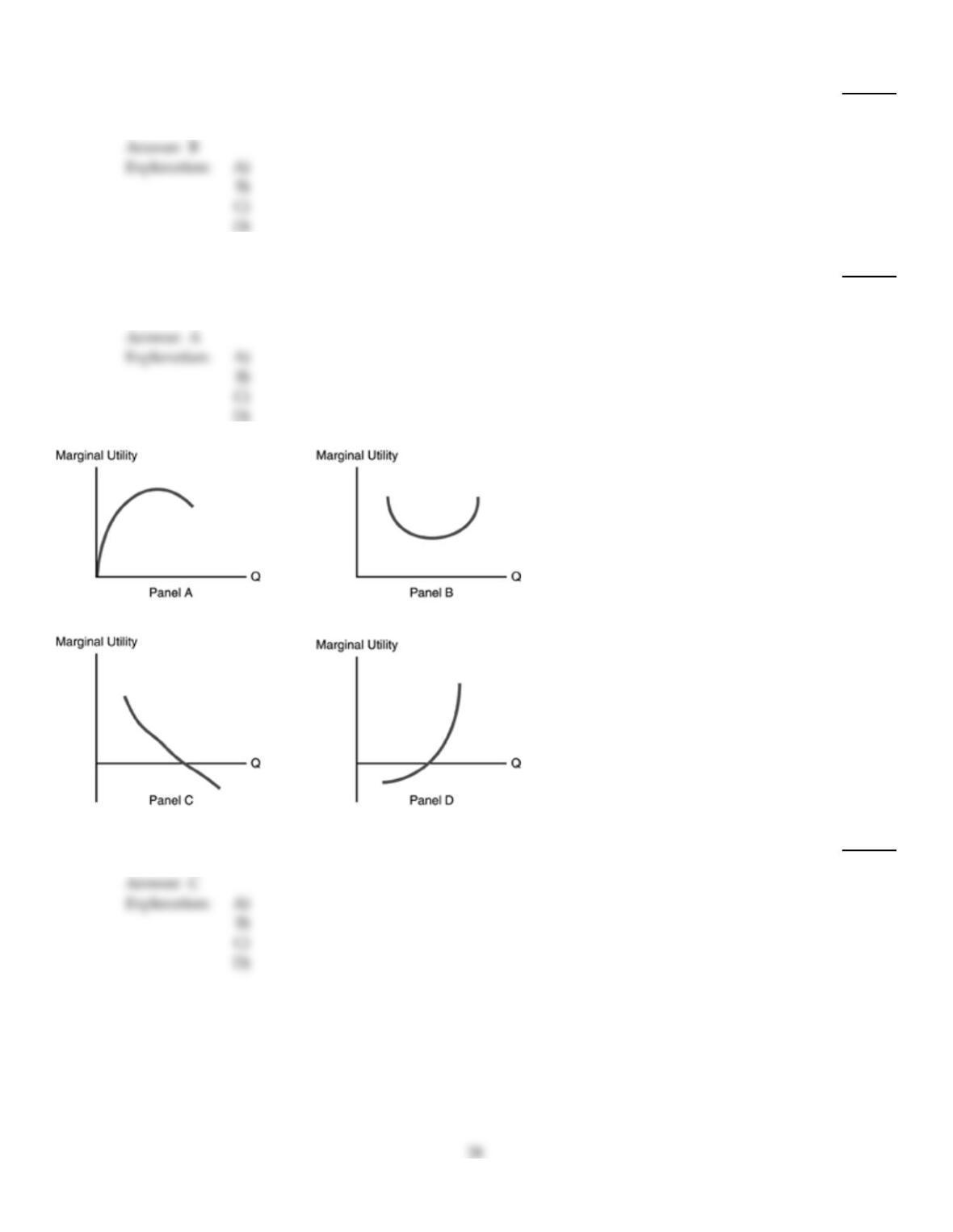
93)
Refer to the above figures. Which panel best represents marginal utility?
93)
A)
Panel A
B)
Panel B
C)
Panel C
D)
Panel D
94)
If a dinner guest is serious when claiming he just could not get enough of your lasagna and that the
more he ate the more he wanted, you would conclude that for him the marginal utility of lasagna
was
94)
A)
increasing.
B)
zero.
C)
decreasing.
D)
constant.
95)
Karen has decided that she would enjoy eating another cookie. Which of the following statements is
consistent with Karen’s decision?
95)
A)
Karen’s marginal and total utility remain unchanged.
B)
Karen’s marginal utility has decreased with a corresponding decrease in total utility.
C)
Karen’s total utility has increased but it is unclear what has happened to her marginal utility.
D)
Karen’s marginal utility has decreased but it is unclear what has happened to total utility.
96)
The quantity of good A is measured along the vertical axis, and the quantity of good B is measures
along the horizontal axis. If the price of Good A falls
96)
A)
the horizontal intercept (along Good B) of the budget line will increase.
B)
the vertical intercept of the budget line moves along the vertical axis away from the origin.
C)
the vertical intercept of the budget line moves along the vertical axis toward the origin.
D)
none of the above
97)
The consumer optimum is defined as
97)
A)
the set of goods and services that maximizes marginal utility for each good.
B)
the set of goods and services, subject to the limited income of the consumer, that maximizes
the total utility of the consumer.
C)
the set of goods and services such that the marginal utility of each good equals zero.
D)
the set of goods and services that maximizes the marginal utility of each good consumed.
98)
Bill ate four hot dogs at the baseball game. The first one tasted best, but he found that as he ate
more hot dogs the amount of extra satisfaction he was receiving was beginning to fall. This would
demonstrate
98)
A)
the law of zero utility.
B)
the law of total utility maximization.
C)
the law of diminishing costs.
D)
the law of diminishing marginal utility.
Bob’s Marginal Utility for consuming beer and pizza with $8.00 in income
Quantity Marginal Quantity of Marginal
of Pizza Utility Beer Utility
1 45 1 40
2 40 2 40
3 30 3 35
4 15 410
5 –5 5 0
99)
In the above table, Bob experiences diminishing marginal utility after consuming how many beers?
99)
A)
1
B)
2
C)
3
D)
4
100)
If marginal utility is zero,
100)
A)
people will not consume the good even if the price is zero.
B)
total utility is at a maximum.
C)
total utility increases at an increasing rate.
D)
total utility increases at a decreasing rate.
101)
The marginal rate of substitution is the
101)
A)
change in the quantity of one good that changes the utility received by one unit.
B)
rate at which the consumer can exchange one good for the other.
C)
change in the quantity of one good that just offsets a one–unit change in the consumption of
another good such that the total satisfaction remains constant.
D)
same thing as the marginal utility of a good.
102)
Utility analysis helps economists understand
102)
A)
how people make decisions about what they buy and how much.
B)
how to eliminate scarcity.
C)
how to eliminate opportunity costs.
D)
none of the above.
103)
Which English philosopher set out to develop an arithmetic formula for measuring happiness and
along the way invented the util?
103)
A)
Adam Smith
B)
Jeremy Bentham
C)
Milton Friedman
D)
John Maynard Keynes
B
104)
Which of the following is FALSE?
104)
A)
A consumer is maximizing total utility when he or she gets the same amount of marginal
utility from the last dollar spent on each good purchased.
B)
Utility is want–satisfying power.
C)
As additional units of a good or service are consumed, marginal utility diminishes.
D)
Assuming that the law of diminishing marginal utility holds, the demand curve must be
upward sloping.
D
105)
To calculate marginal utility, divide the change in total utility by
105)
A)
the number of units consumed.
B)
the consumer’s subjective level of preference.
C)
the change in the number of units consumed.
D)
the price of the product.
C
A
106)
The budget line
106)
A)
has a positive slope.
B)
shifts to the left as income increases.
C)
is a vertical line.
D)
shows the combination of goods that can be purchased at fixed prices and with a given
income.
107)
In order to maximize utility, a consumer should allocate money income so that
107)
A)
the marginal utility of the last unit of each product consumed is greater than the total utility
of each product consumed.
B)
the marginal utility obtained from the last dollar spent on each product is the same.
C)
the total utility derived from each product consumed is the same.
D)
the elasticity of demand on all products purchased is the same.
B
108)
Using the above table, what is the total utility of the third piece of pizza?
108)
A)
75 utils
B)
25 utils
C)
–25 utils
D)
0 utils
A
109)
If the price of X is $3 and the price of Y is $5, then, in a consumer optimum
109)
A)
the quantity purchased of Y must be 60 percent of the quantity of X purchased.
B)
the marginal utility of X must equal 3 and the marginal utility of Y must equal 5.
C)
the quantity purchased of Y must be 67 percent of the quantity of X purchased.
D)
the marginal utility of Y must be 67 percent more than the marginal utility of X.
D
110)
Using the above table, what is the total utility of the first piece of pizza?
110)
A)
0 utils
B)
50 utils
C)
100 utils
D)
75 utils
B
D
Quantity Quantity Quantity
of A MUa of B MUb of C MUc
115 112 115
212 210 210
3 9 3 8 3 5
4 6 4 4 4 4
111)
Based on the information in the above table, what is the total satisfaction Mary can achieve if she is
a wise consumer?
111)
A)
74 utils
B)
30 utils
C)
111 utils
D)
82 utils
Quantity Total Utility
per Week Michelle Robert David Lauren
0 0 0 0 0
1 50 1000 60 60
2 99 1900 120 130
3 147 2700 180 220
4 194 3400 240 310
5 240 4000 300 425
6 285 4500 360 575
7 329 4900 420 900
8 372 5200 480 1275
9 414 5400 540 1770
112)
According to the above table, what is Michelle’s marginal utility of the 8th unit?
112)
A)
43
B)
372
C)
42
D)
44
113)
If marginal utility is positive but decreasing, total utility is
113)
A)
constant.
B)
decreasing.
C)
negative.
D)
increasing.
114)
The indifference curve between eggs and dozens of eggs would be
114)
A)
bowed out from the origin.
B)
bowed in to the origin.
C)
a rectangular hyperbola.
D)
a downward sloping straight line with a slope of –12.
115)
The equation for the calculation of marginal utility is
115)
A)
change in total utility/number of units consumed.
B)
change in total utility/change in number of units consumed.
C)
total utility/change in number of units consumed.
D)
total utility/number of units consumed.
B
116)
If an individual’s total utility from consuming two goods increases, then there must be
116)
A)
a downward rotation of the individual’s indifference curve.
B)
an inward shift of the individual’s indifference curve.
C)
an outward shift of the individual’s indifference curve.
D)
an inward rotation of the individual’s indifference curve.
C
117)
The marginal rate of substitution is measured along
117)
A)
the total utility curve.
B)
the demand curve.
C)
a given budget line.
D)
a given indifference curve.
D
118)
A curve that shows a set of consumption alternatives that give the same level of satisfaction is
118)
A)
an indifference curve.
B)
an income curve.
C)
a budget line.
D)
a substitution curve.
A
D
119)
Utility refers to
119)
A)
the want–satisfying power of a good or service.
B)
the usefulness of a good or service.
C)
the degree to which a good or service is needed.
D)
the value of a good or service.
Combination Good A Good B
A17 4
B13 5
C10 6
D 8 7
120)
Refer to the above table. The table gives the various combinations of Good A and Good B along
Jane’s indifference curve. The marginal rate of substitution when Jane goes from combination A to
combination B is
120)
A)
4:1.
B)
3:1.
C)
0.
D)
2:1.
121)
Using the above table, what is the marginal utility of the 4th soda?
121)
A)
23.2
B)
15
C)
10
D)
5
Slices of Pizza Total Utility Marginal Utility
1 50
2 90
3 120
4 130
5 137
6 120
122)
In the above table, what is the marginal utility of the fourth slice of pizza consumed?
122)
A)
130
B)
30
C)
10
D)
120
123)
The average demand curve slopes downward due to all of the following EXCEPT
123)
A)
the real–income effect.
B)
the laws of diminishing marginal utility.
C)
the law of increasing relative costs.
D)
the principle of substitution.
124)
The diamond–water paradox was solved by knowing that
124)
A)
the price of water and diamonds is determined by total utility received, not marginal utility.
B)
the total utility of water is greater than the total utility of diamonds.
C)
the price of water and diamonds is determined by marginal utility, not total utility.
D)
the marginal utility of water is greater than the marginal utility of diamonds.
C
125)
If a consumer chooses a combination of goods that are inside of her budget line, than
125)
A)
the consumer is spending more than her current income.
B)
the consumer has a constant marginal rate of substitution for the two goods.
C)
the consumer is not maximizing her satisfaction.
D)
the consumer is maximizing her satisfaction.
C
126)
Despite the fact that water is necessary to sustain life, it is less expensive than soft drinks. Economic
theory suggests that this is so because
126)
A)
although the total utility of water consumption is high, its marginal utility per dollar spent is
low when compared to soft drinks.
B)
sellers of water hold the price of water artificially low because of its importance.
C)
consumers are irrational.
D)
there is a conspiracy among soft drinks producers to hold prices artificially high.
A
C
127)
Consumers are most satisfied when
127)
A)
the total level of utility is as high as possible.
B)
they save more than they spend.
C)
goods are bought “on sale.”
D)
all of their income has been saved.
128)
The marginal rate of substitution measures
128)
A)
the consumer’s willingness to substitute one product for another so that total utility will
remain unchanged.
B)
the consumer’s willingness to substitute one product for another so that marginal utility will
remain unchanged.
C)
the changes in marginal utility along the indifference curve.
D)
the impact of product substitution.
A
129)
If total utility is decreasing, then marginal utility is
129)
A)
negative.
B)
increasing.
C)
positive.
D)
zero.
A
130)
If you and a group of friends have been consuming large quantities of liquid beverages on a hot
summer afternoon and you decide to refrain from any additional consumption, it can be concluded
that
130)
A)
total utility has reached a minimum and the marginal utility of an additional drink would be
large.
B)
total utility has reached a maximum and the marginal utility of an additional drink would be
zero.
C)
total utility has reached a minimum and the marginal utility of an additional drink would be
negative.
D)
total utility has reached a maximum and the marginal utility of an additional drink would be
small.
B
A
Quantity of Marginal Quantity of Marginal
Good X/Wk Utility Good Y/Wk Utility
11200 11700
21000 21400
3 800 31100
4 600 4800
5 400 5500
6100 6200
131)
Refer to the above table. If the price of Good X is $2, the price of Good Y is $2, and the consumer
has $14, the rational consumer will purchase
131)
A)
6 units of Good X and 0 units of Good Y.
B)
6 units of Good X and 6 units of Good Y.
C)
3 units of Good X and 3 units of Good Y.
D)
3 units of Good X and 4 units of Good Y.
132)
A consumer is maximizing utility when
132)
A)
the slope of the budget constraint equals the marginal rate of substitution.
B)
the consumer has spent all of his income.
C)
diminishing marginal utility has set in.
D)
the slope of the budget constraint has reached –1.
133)
The additional utility or satisfaction that one derives from consuming one more unit of any good or
service is referred to as
133)
A)
total utility.
B)
average utility.
C)
substantive utility.
D)
marginal utility.
134)
Diminishing marginal utility means that as more of a good is consumed
134)
A)
the rate at which total utility increases stays the same.
B)
the rate at which total utility increases starts to diminish.
C)
the rate at which total utility increases starts to increase.
D)
there is no impact on the rate of change of total utility.
Slices of Pizza Total Utility Marginal Utility
0 0 –
120
250
320
410
5 0
135)
In the above table, the marginal utility of the second slice of pizza is
135)
A)
30.
B)
10.
C)
20.
D)
50.
136)
Marginal utility
136)
A)
can be thought of as being the equivalent to total utility.
B)
equals the total satisfaction from consumption of goods and services.
C)
is stable, but then as a person consumes more of a good or service, has a propensity to
increase.
D)
at first rises and then declines as a person consumes more of a good or service.
137)
Suppose that a consumer is currently at an optimum when consuming goods A and B. Which of the
following must be TRUE?
137)
A)
The marginal utility to price ratio of A is equal to the marginal utility to price ratio of B.
B)
The marginal utility of A is equal to the marginal utility of B.
C)
The price of A is equal to the price of B.
D)
The total utility from A is equal to the total utility from B.
138)
If the total utility derived from consuming three oysters was 40 utils and the total utility derived
from consuming four oysters was 52 utils, what was the marginal utility derived from the
consumption of the fourth oyster?
138)
A)
12 utils
B)
52 utils
C)
92 utils
D)
It is impossible to determine.
139)
The real–income effect is likely to be greater when
139)
A)
the marginal utility of the last unit is high.
B)
the substitution effect is not very large.
C)
the marginal utility per dollar spent on the last unit is high.
D)
the good is an expensive good.
140)
If a person claims, “I wouldn‘t eat liver if you paid me,” we can assume that his marginal utility of
liver is
140)
A)
zero.
B)
positive, but decreasing.
C)
negative.
D)
positive.
141)
If a college student stays home and watches a rented DVD for $5 rather than going out to a $10
movie, this is an example of the
141)
A)
income effect.
B)
substitution effect.
C)
utility effect.
D)
value effect.