Exam
Name___________________________________
MULTIPLE CHOICE. Choose the one alternative that best completes the statement or answers the question.
1)
Which of the following is not a function of the lymphatic system?
1)
A)
transporting respiratory gases
B)
carrying out immune responses
C)
draining excess interstitial fluid
D)
transporting dietary fats
2)
Lymph leaves a lymph node via ________.
2)
A)
the subcapsular sinus
B)
afferent lymphatic vessels
C)
the cortical sinus
D)
efferent lymphatic vessels
Explanation:
3)
Which cells become immunocompetent due to thymic hormones?
3)
A)
macrophages
B)
basophils
C)
lymphocytes
D)
monocytes
Explanation:
4)
What is a bubo?
4)
A)
an infected Peyer’s patch
B)
a wall in a lymph node
C)
an infected lymph node
D)
a lobe of the spleen
Explanation:
5)
Which of the following is not a method that maintains lymph flow?
5)
A)
capillary smooth muscle contraction
B)
valves in lymph vessel walls
C)
skeletal muscle contraction
D)
breathing
Explanation:
Explanation:
6)
Antibodies that act against a particular foreign substance are released by ________.
6)
A)
T lymphocytes
B)
lymph nodes
C)
medullary cords
D)
plasma cells
7)
Which of the following would not be classified as a lymphatic structure?
7)
A)
pancreas
B)
tonsils
C)
Peyer’s patches of the intestine
D)
spleen
8)
The lymphatic capillaries are ________.
8)
A)
more permeable than blood capillaries
B)
as permeable as blood capillaries
C)
less permeable than blood capillaries
D)
completely impermeable
9)
Which lymphatic structure drains lymph from the right upper limb and the right side of the head
and thorax?
9)
A)
right lymphatic duct
B)
lumbar trunk
C)
cisterna chyli
D)
thoracic duct
10)
The tonsils located at the base of the tongue are the ________.
10)
A)
Peyer’s tonsils
B)
palatine tonsils
C)
lingual tonsils
D)
pharyngeal tonsils
11)
Which of the following is not a function of lymph nodes?
11)
A)
produce lymphoid cells and house granular WBCs
B)
serve as antigen surveillance areas
C)
produce lymph fluid and cerebrospinal fluid
D)
act as lymph filters and activate the immune system
12)
Which of the following are functions of lymphoid tissue?
12)
A)
house and provide a proliferation site for lymphocytes
B)
house and provide a proliferation site for neutrophils
C)
furnish an ideal surveillance vantage point for lymphocytes and macrophages
D)
A and C
D
13)
Lymphoid tissue that appears as a swelling of the mucosa in the oral cavity is called a(n) ________.
13)
A)
Peyer’s patch
B)
tonsil
C)
thymus
D)
appendix
B
14)
When the lymphatic structures of a limb are blocked due to tumors, the result is ________.
14)
A)
shrinkage of tissues distal in the limb to the blockage due to inadequate delivery of lymph
B)
severe localized edema distal to the blockage of that limb
C)
abnormally high lymph drainage from the distal region
D)
increased pressure in the lymphatics proximal in the limb to the blockage
B
15)
Digestive tract–associated lymphatic tissue includes all of the following except ________.
15)
A)
islets of Langerhans
B)
Peyer’s patches
C)
lingual tonsils
D)
palatine tonsils
A
C
16)
Select the correct statement about lymphoid tissue.
16)
A)
Lymphoid tissue is predominantly reticular connective tissue.
B)
T lymphocytes act by ingesting foreign substances.
C)
Once a lymphocyte enters the lymphoid tissue, it resides there permanently.
D)
Lymphoid macrophages secrete antibodies into the blood.
17)
Lymph transport involves all but which of the following?
17)
A)
lymph capillary minivalve action
B)
milking action of active muscle fibers
C)
smooth muscle contraction in the lymph capillary walls
D)
thorax pressure changes during breathing
C
18)
Select the correct statement about lymphocytes.
18)
A)
The two main types are T cells and macrophages.
B)
T cells are the precursors of B cells.
C)
B cells produce plasma cells, which secrete antibodies into the blood.
D)
T cells are the only form of lymphocyte found in lymphoid tissue.
C
19)
Which of the following does not contain a mucosa–associated lymphatic tissue?
19)
A)
appendix
B)
tonsil
C)
Peyer’s patch
D)
thymus
D
20)
Lymph capillaries are absent in all except which of the following?
20)
A)
digestive organs
B)
CNS
C)
bones and teeth
D)
bone marrow
A
A
21)
Functions of the spleen include all of those below except ________.
21)
A)
removal of old or defective blood cells from the blood
B)
storage of iron
C)
forming crypts that trap bacteria
D)
storage of blood platelets
22)
Which of the following statements regarding the thymus is not true?
22)
A)
Its stroma consists of epithelial tissue.
B)
It does not fight antigens.
C)
It functions strictly in T lymphocyte maturation.
D)
It has follicles similar to those in the spleen.
23)
Which of the following is not a part of the lymphatic system?
23)
A)
lymph nodes
B)
erythrocytes
C)
lymph
D)
lymphatic vessels
24)
Large clusters of lymph nodes occur in all of the following locations except the ________.
24)
A)
cervical region
B)
lower extremities
C)
inguinal region
D)
axillary region
25)
Small organs associated with lymphatic vessels are termed ________.
25)
A)
lymph follicles
B)
lymphatics
C)
lymph nodes
D)
lacteals
26)
The thymus is the only lymphoid organ that does not ________.
26)
A)
directly fight antigens
B)
have a cortex and medulla
C)
have lymphocytes
D)
produce hormones
27)
A sentinel node is ________.
27)
A)
a small node in the spleen
B)
the first node to receive lymph from an area suspected to be cancerous
C)
the first node at the junction of all the lumbar trunks
D)
a lymph node found in the intestinal lamina propria
28)
Which of the following is not a normal component of lymph?
28)
A)
plasma proteins
B)
ions
C)
red blood cells
D)
water
29)
The thymus is most active during ________.
29)
A)
middle age
B)
old age
C)
childhood
D)
fetal development
30)
Select the correct statement about lymph transport.
30)
A)
Lymph transport is faster than that occurring in veins.
B)
Under normal conditions, lymph vessels are very high–pressure conduits.
C)
Lymph transport is only necessary when illness causes tissue swelling.
D)
Lymph transport depends on the movement of adjacent tissues, such as skeletal muscles.
31)
Peyer’s patches are found in the ________.
31)
A)
large intestine
B)
jejunum of the small intestine
C)
duodenum of the small intestine
D)
ileum of the small intestine
SHORT ANSWER. Write the word or phrase that best completes each statement or answers the question.
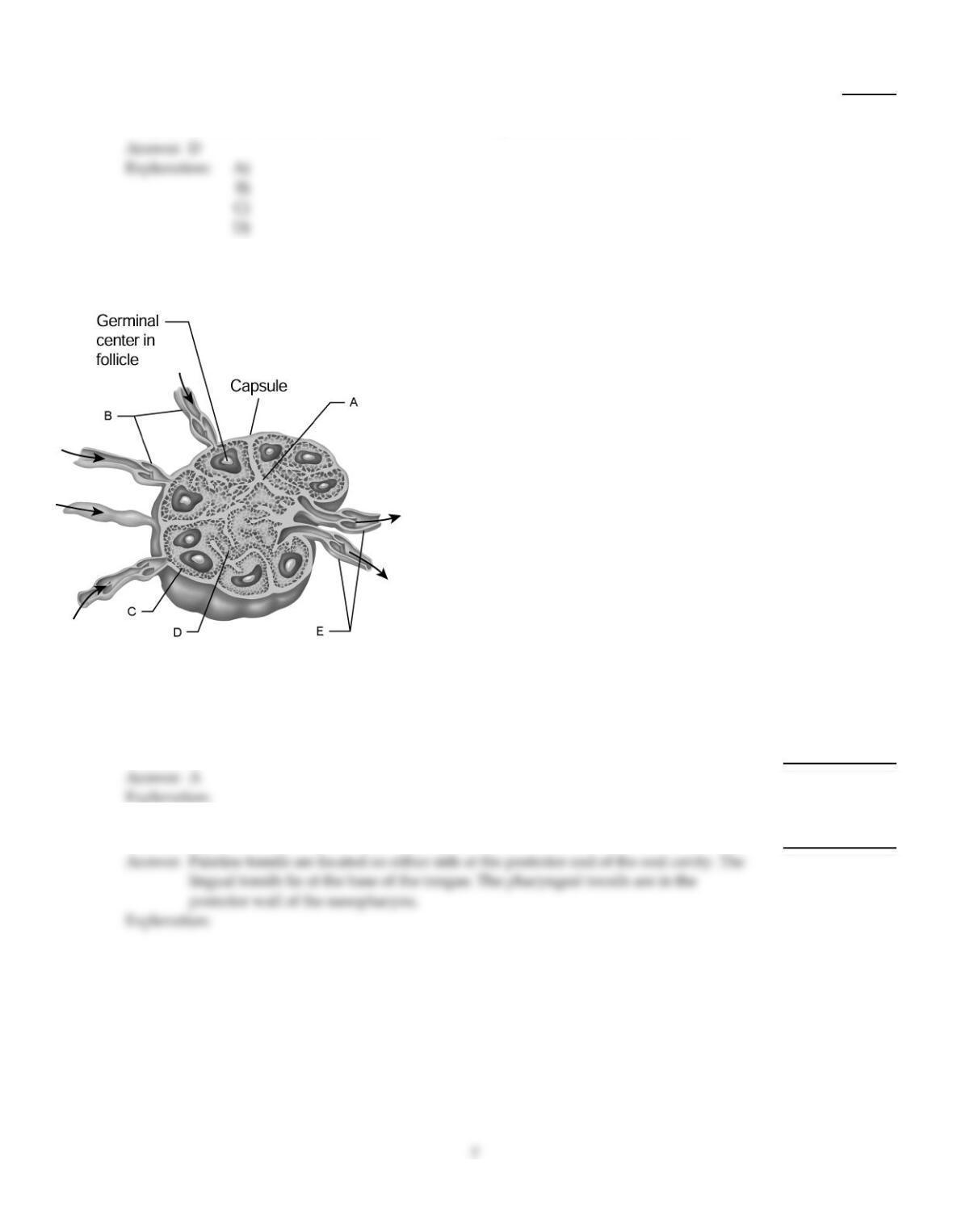
Figure 20.2
Using Figure 20.2, match the following:
32)
Trabecula.
32)
33)
Name the tonsils and state their body locations.
33)
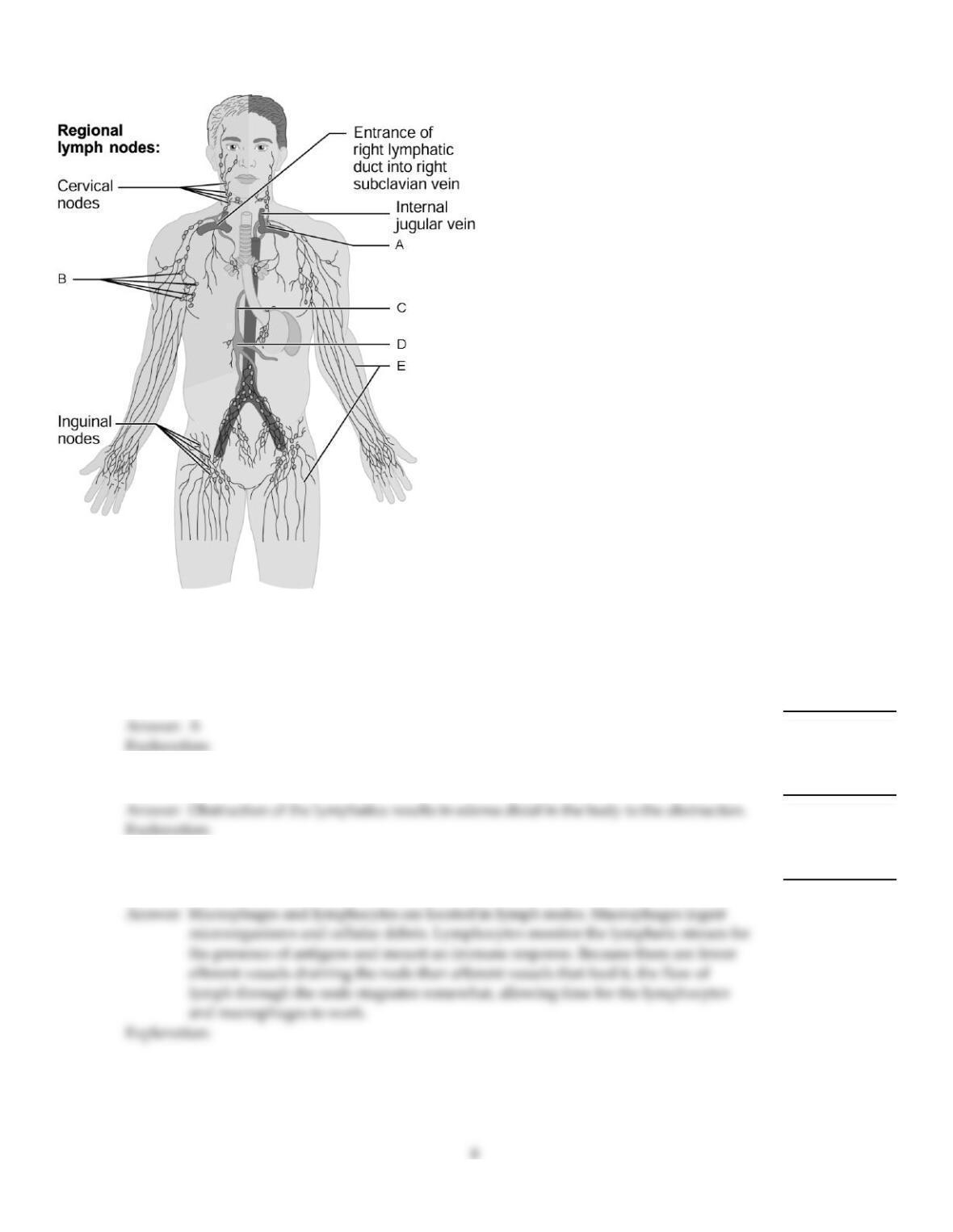
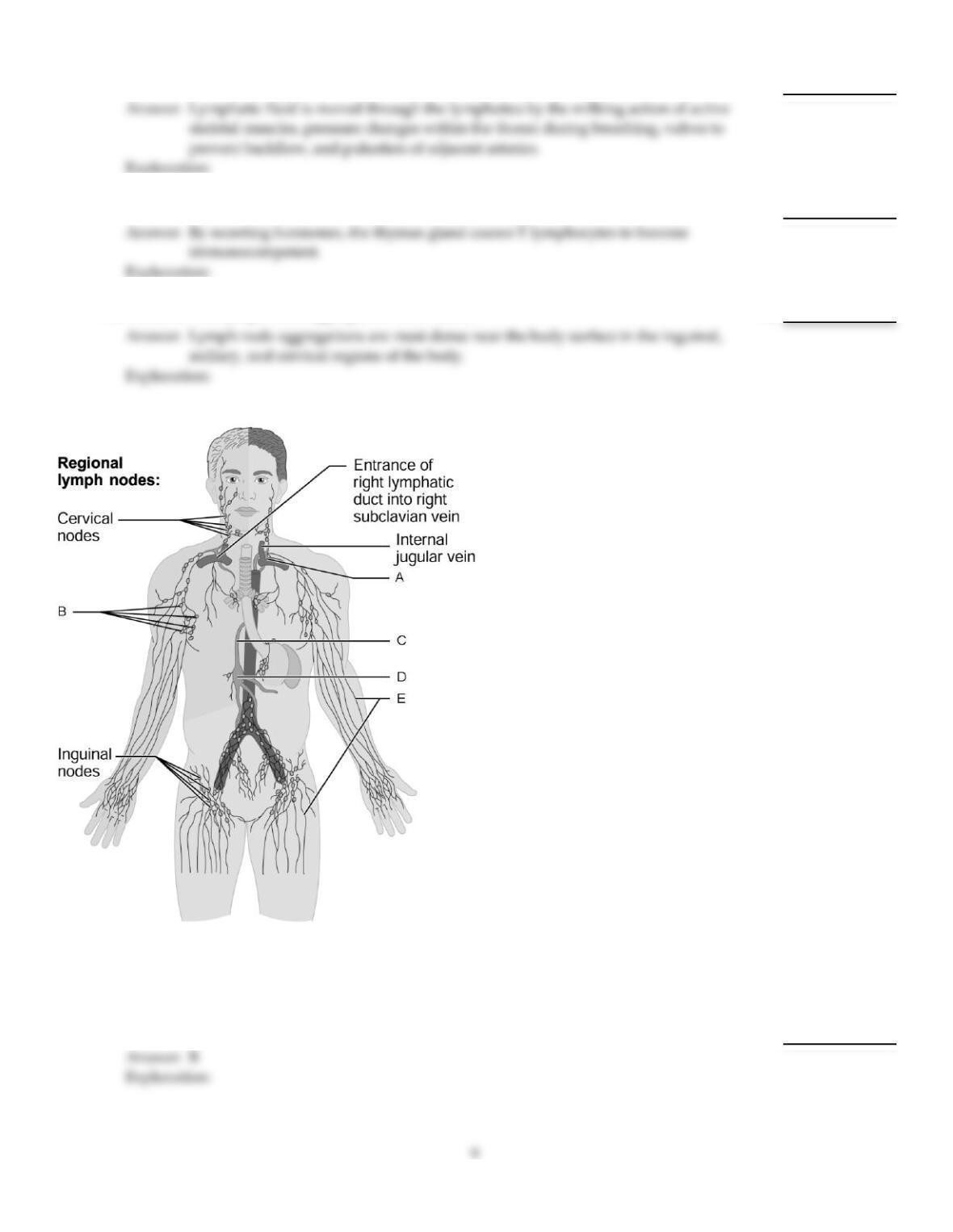
Figure 20.1
Using Figure 20.1, match the following:
34)
Entrance of thoracic duct into subclavian vein.
34)
35)
What is the consequence of obstruction of the lymphatics?
35)
36)
How does the structure of a lymph node allow lymphocytes and macrophages to perform
their protective function?
36)
37)
Describe the mechanisms by which lymphatic fluid is moved through the lymphatics.
37)
38)
What is the special role of the thymus gland?
38)
39)
Where are the lymph node aggregations most dense?
39)
Figure 20.1
Using Figure 20.1, match the following:
40)
Axillary node(s).
40)
41)
How does the lymphatic system both help and hinder the spread of cancer through the
body?
41)
42)
How is the skeletal system tied to the lymphatic system?
42)
43)
Explain the term MALT. What is its function?
43)
44)
Splenic ________ pulp is primarily concerned with immune functions of the spleen.
44)
45)
Lymphatic ________ are formed from the union of the largest collecting vessels.
45)
46)
Thymic corpuscles are always found in the lighter–colored ________ regions of the
thymus.
46)
47)
How do the lymphatic capillaries differ from blood capillaries?
47)
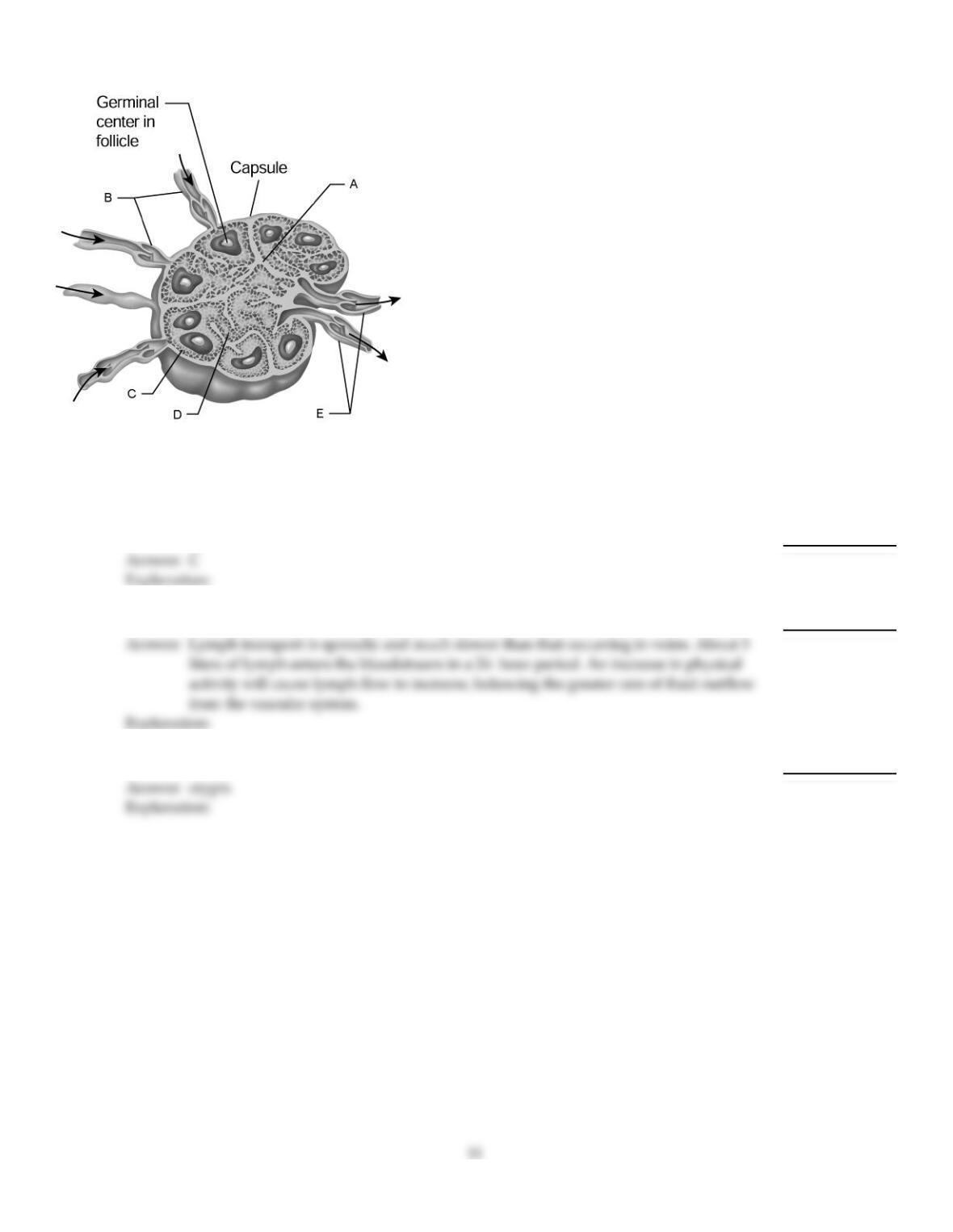
Figure 20.2
Using Figure 20.2, match the following:
48)
Cortex.
48)
49)
Characterize lymph transport in terms of rate, volume, and ability to change.
49)
50)
Tonsils have blind–ended structures called ________.
50)