Exam
Name___________________________________
MULTIPLE CHOICE. Choose the one alternative that best completes the statement or answers the question.
1)
The price of good “a” is $5 and the price of good “b” is $15. If the marginal utility of good “a” is 20
then the marginal utility of good “b” must be ________ to have an optimum combination of goods
purchased.
1)
A)
60
B)
4
C)
20
D)
80
2)
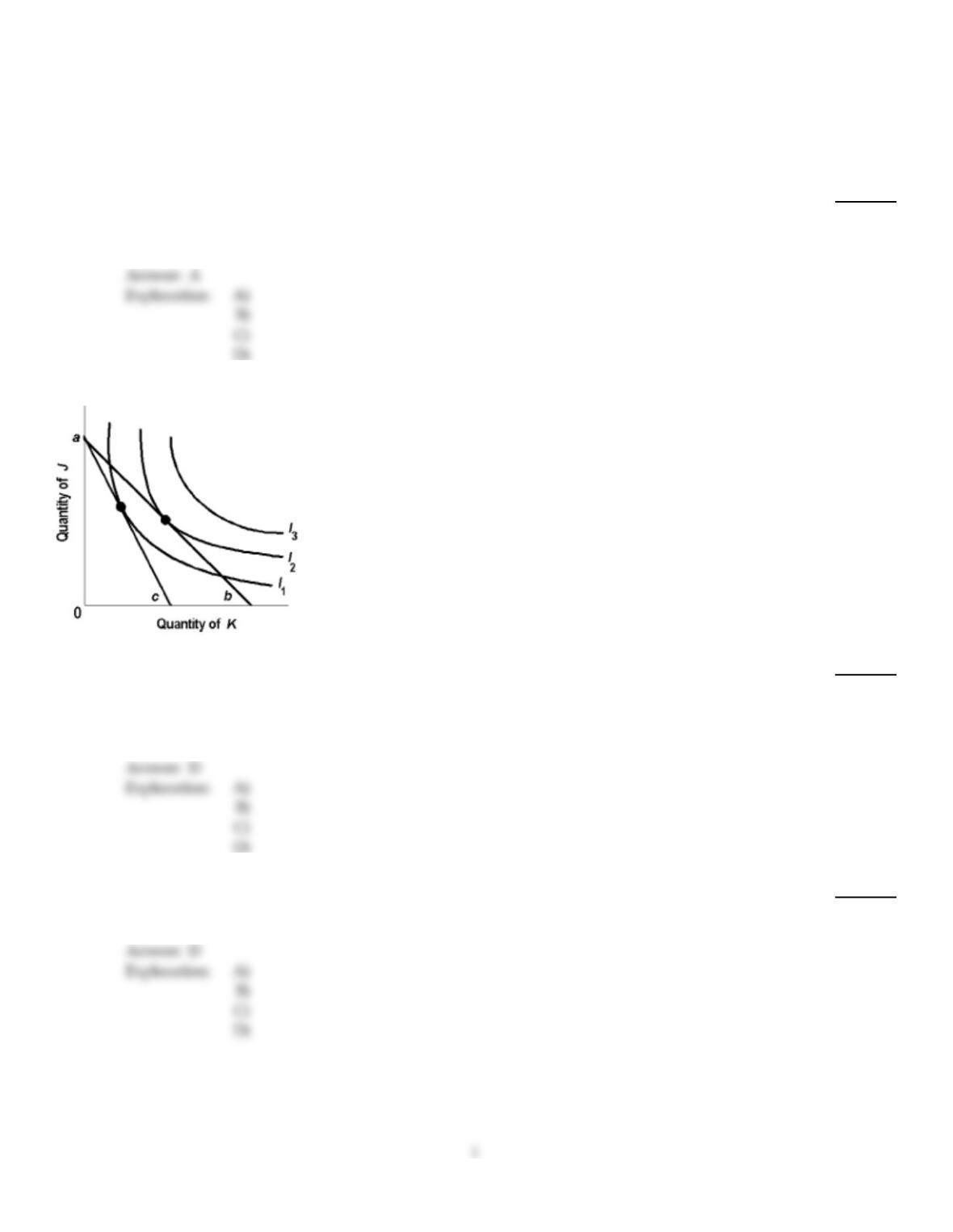
Use the above figure. When the budget line rotates from “c” to “b”
2)
A)
fewer units of J and fewer units of K will be purchased.
B)
more units of J and fewer units of K will be purchased.
C)
more units of J and more units of K will be purchased.
D)
fewer units of J and more units of K will be purchased.
3)
The possible combinations of goods that can be purchased with a specific income are called the
3)
A)
income–consumption curve.
B)
marginal rate of substitution.
C)
indifference map.
D)
budget constraint.
4)
The want–satisfying power of a good or service is known as
4)
A)
consumer optimum.
B)
utility.
C)
principle of substitution.
D)
purchasing power.
5)
When indifference curve analysis is used, a consumer optimum occurs at the point at which
5)
A)
the indifference curve is tangent to the budget line.
B)
the indifference curves intersect.
C)
total utility is maximum.
D)
marginal utility/price ratio of all goods consumed is equal.
A
6)
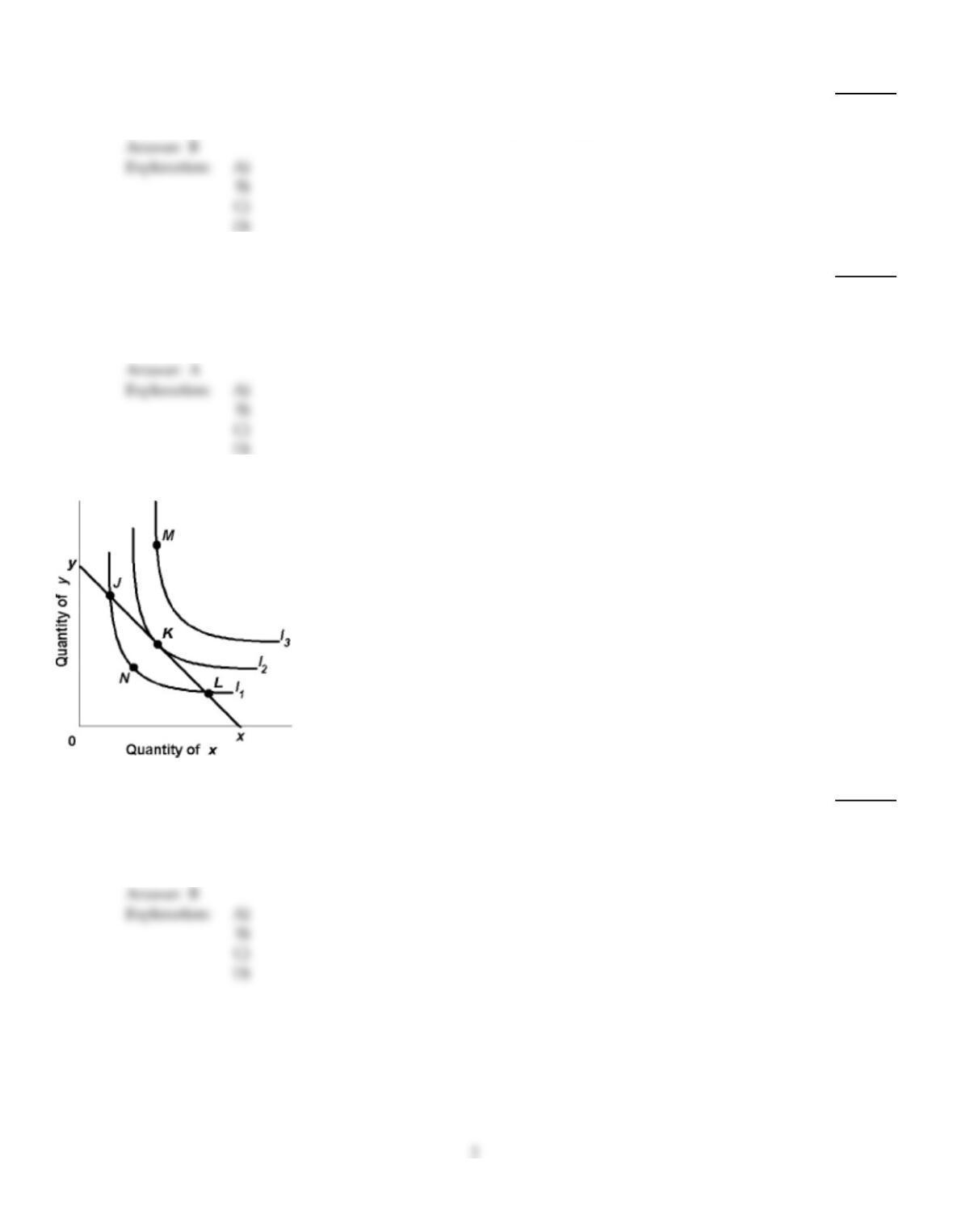
Use the above figure. What does point N represent?
6)
A)
a consumer is spending more than her current income
B)
a consumer not maximizing her satisfaction
C)
a consumer maximizing her satisfaction
D)
a less satisfying point than compared to point J
B
B
7)
If you regularly spend $100 a month on gasoline and the price of gasoline doubles, your purchasing
power has
7)
A)
decreased.
B)
became stable.
C)
increased.
D)
remained constant.
8)
The information on a demand curve is also on a(n)
8)
A)
price–consumption curve.
B)
income–consumption curve.
C)
budget constraint.
D)
indifference curve.
Quantity of Total Utility Total Utility
Movies Mary John
3100 190
4140 250
5170 300
6190 340
7200 370
8210 390
9210 405
10 200 415
11 190 420
9)
According to the above table, Mary’s marginal utility from watching the 4th movie is
9)
A)
30 units of utility.
B)
60 units of utility.
C)
140 units of utility.
D)
40 units of utility.
10)
A consumer has spent all of his income on hamburgers and movies. The price of a hamburger is $1
and the price of a movie is $6. The marginal utility of the last hamburger is 5 and the marginal
utility of the last movie is 24. The consumer has
10)
A)
not maximized utility. He should cut back consumption of each good.
B)
not maximized utility. He should cut back on movies and buy more hamburgers.
C)
not maximized utility. He should cut back on hamburgers and buy more movies.
D)
maximized utility.
11)
Which of the following statements is NOT true about marginal utility when total utility is at its
maximum point?
11)
A)
Marginal utility is zero.
B)
Marginal utility is decreasing.
C)
Marginal utility is undefined.
D)
A rational consumer will not consume additional units beyond this point.
12)
If Frank has been consuming 5 hamburgers per week at a consumer optimum, and the price of
hamburgers falls, how will Frank respond?
12)
A)
He will save more income.
B)
He will buy more burgers.
C)
He will buy more of everything except burgers.
D)
He will buy more of everything.
13)
As an individual consumes more of a particular commodity, the total level of utility derived from
that consumption will
13)
A)
increase at a constant rate.
B)
increase at an increasing rate.
C)
increase at a decreasing rate.
D)
remain constant.
14)
When the price of a normal good decreases, people increase their consumption of the good. The
reason is
14)
A)
the income effect only.
B)
the substitution effect only.
C)
the law of diminishing marginal utility.
D)
the substitution and income effects.
15)
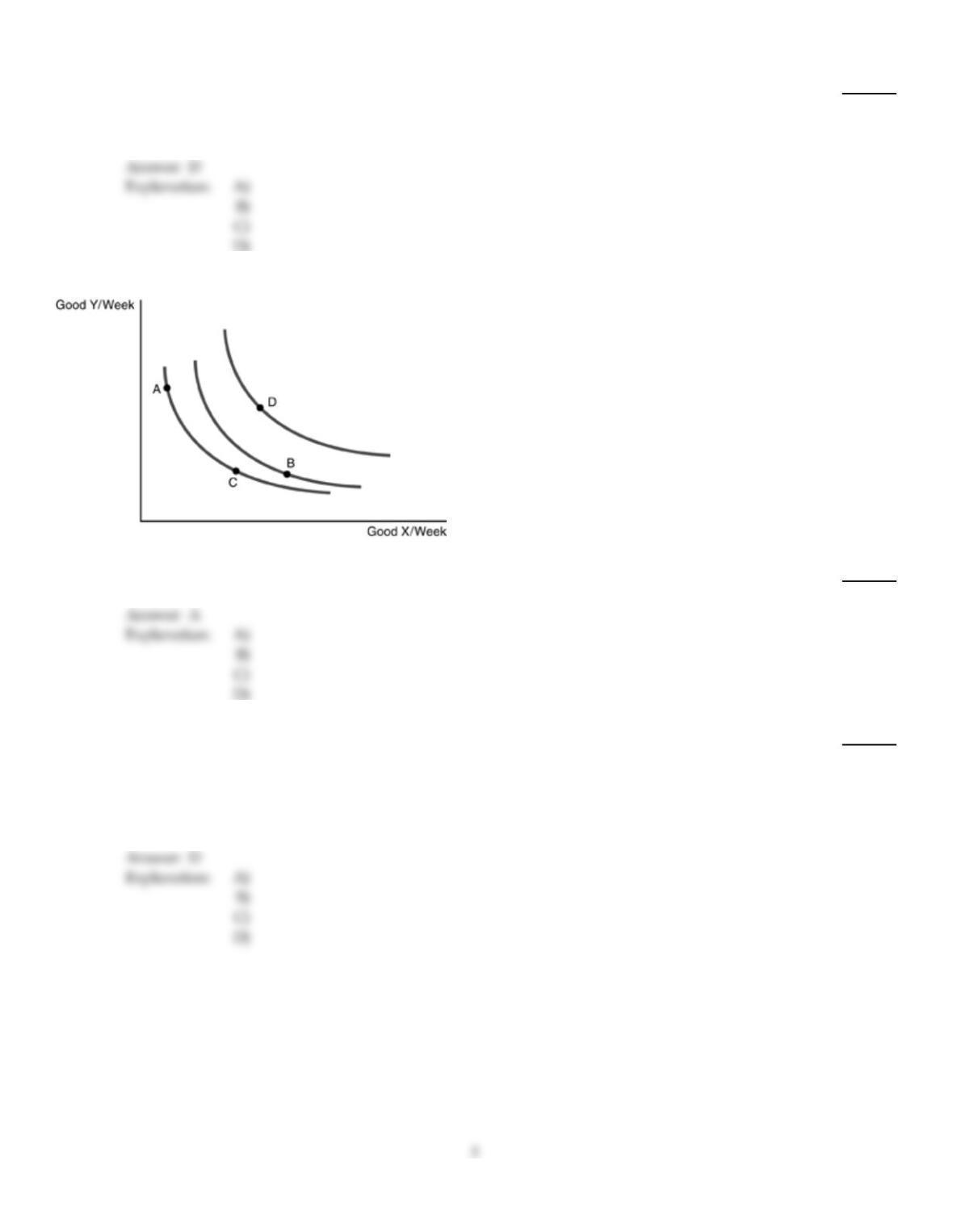
Refer to the above figure. Which point(s) represents the lowest level of utility?
15)
A)
Points A & C
B)
Point B
C)
Point C only
D)
Point D
16)
For most goods, the real–income effect of a price change is
16)
A)
large because the price of the good is in terms of the currency and the income of the person is
also in terms of the currency.
B)
zero because the real–income effect only applies to durable goods.
C)
small because the decision to buy a good depends only on the income of a consumer.
D)
small because the good accounts for a small part of the consumer’s budget.
Quantity of Marginal Quantity of Marginal
Good X/Wk Utility Good Y/Wk Utility
11200 11700
21000 21400
3 800 31100
4 600 4800
5 400 5500
6100 6200
17)
Refer to the above table. If the price of Good X is $2, the price of Good Y is $1, and the consumer
has $9, the rational consumer will purchase
17)
A)
6 units of Good X and 3 units of Good Y.
B)
2 units of Good X and 5 units of Good Y.
C)
6 units of Good X and 0 units of Good Y.
D)
5 units of Good X and 6 units of Good Y.
18)
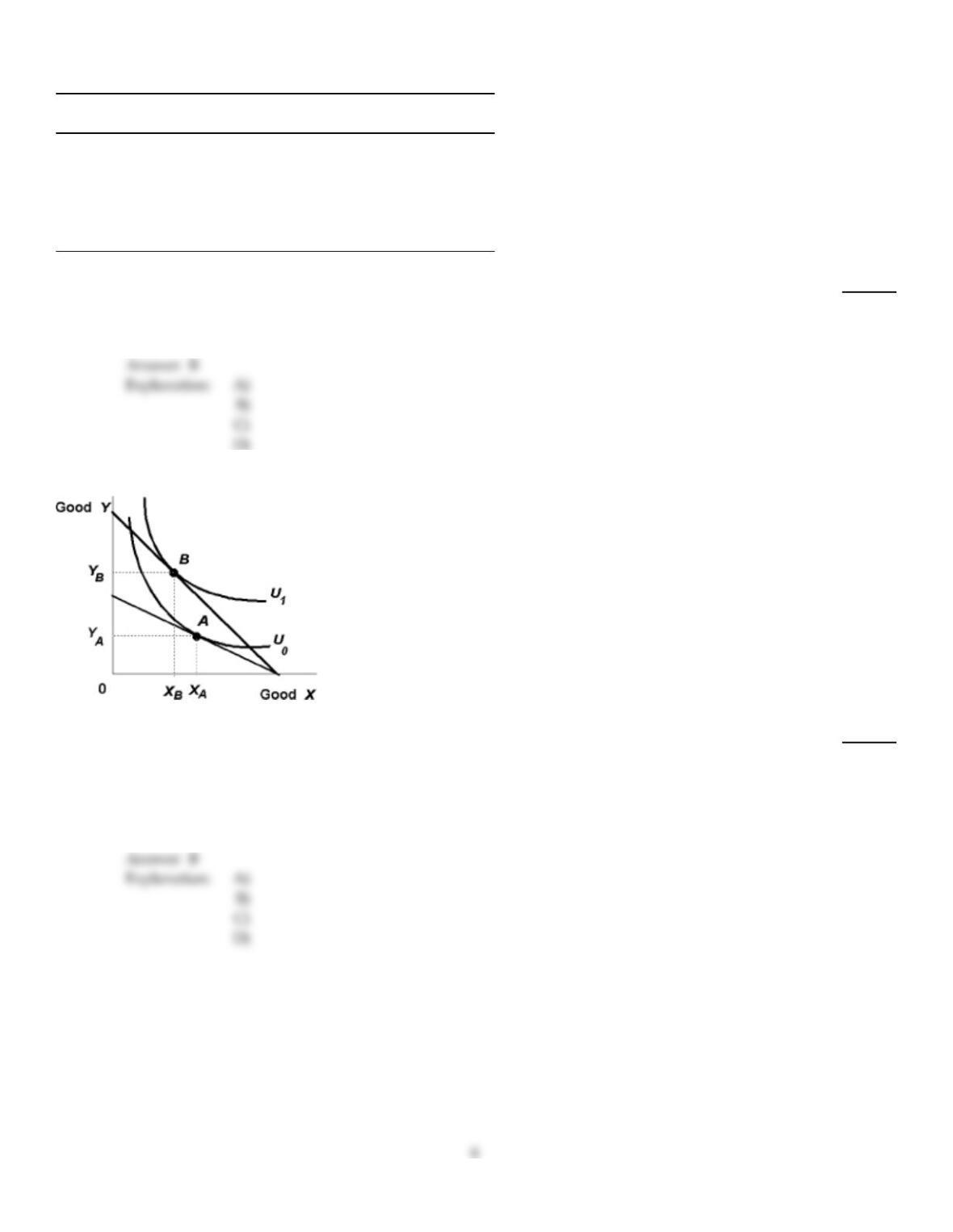
Use the above figure. The consumer’s choice changes from YB to YA. Which of the following
statements is TRUE?
18)
A)
This change in the consumer’s choice results from a rise in the price of good X.
B)
This change in the consumer’s choice results from a rise in the price of good Y.
C)
This change in the consumer’s choice results from an increase in the consumer’s income.
D)
This change in the consumer’s choice results from a fall in the price of good X.
Quantity of Total Quantity of Total
Hamburgers/Wk Utility Movies/Wk Utility
0 0 0 0
125 1 200
2 45 2260
3 55 3300
460 4320
5 61 5325
19)
Refer to the above table. Assume the consumer spends his entire income. The price of a hamburger
is $1, the price of a movie is $6, and the consumer has $15. What is the consumer’s optimum?
19)
A)
0 hamburgers and 2.5 movies
B)
2 hamburgers and 2 movies
C)
4 hamburgers and 4 movies
D)
3 hamburgers and 2 movies
20)
In the above figure, point C is
20)
A)
preferred to points G, A, and B.
B)
less preferred than point H.
C)
less preferred than point G.
D)
preferred to points A and B.
21)
If we are graphing total utility, then the total utility curve will
21)
A)
always be decreasing.
B)
always be increasing.
C)
be horizontal if marginal utility is positive.
D)
be increasing as long as marginal utility is positive.
22)
The quantity of good Y is measured along the vertical axis, and the quantity of good X is measured
along the horizontal axis. If the prices of both good Y and good X rise, the budget line
22)
A)
shifts outward to the right and the vertical and horizontal intercepts will both rise.
B)
rotates, rising along the vertical axis but falling along the horizontal axis.
C)
shifts inward to the left and both intercepts will decline.
D)
none of the above.
C
23)
The substitution effect refers to
23)
A)
the change in purchasing power when the price of a good changes.
B)
the want–satisfying power of a good or service.
C)
the law of diminishing marginal utility.
D)
substitution of less expensive commodities for more expensive commodities.
D
24)
The marginal rate of substitution is the
24)
A)
rate at which the consumer will give up one good for an additional unit of the other good,
such that total satisfaction is constant.
B)
same thing as the marginal utility of a good.
C)
change in the quantity of one good that changes the utility received by one unit.
D)
rate at which the consumer can trade one good for the other in the marketplace.
A
D
25)
If incomes fall, then
25)
A)
the budget constraint shifts out.
B)
there is no change in the budget constraint.
C)
there is no relationship between the budget constraint and income.
D)
the budget constraint shifts inward.
26)
When total utility is falling
26)
A)
marginal utility is at zero.
B)
marginal utility is at a maximum.
C)
marginal utility is negative.
D)
marginal utility has decreased, but is now increasing.
27)
Dr. Rodriguez is consuming beer and wine. At his current level of consumption, the marginal
utility per dollar is 30 units for beer and 15 units for wine. Dr. Rodriguez should
27)
A)
consume twice as much wine as beer.
B)
consume twice as much beer as wine.
C)
increase his consumption of beer relative to wine.
D)
increase his consumption of wine relative to beer.
28)
John has just eaten another potato chip and his total utility increased. This means that John’s
marginal utility for this additional potato chip is
28)
A)
positive.
B)
negative.
C)
zero.
D)
not determinable without more information.
Quantity of Total Quantity of Total
Magazines/Wk Utility Paperback Books/Wk Utility
0 0 0 0
150 1 300
290 2 500
3120 3 600
4130 4 650
5132 5 675
6132 6 680
29)
The price of a magazine is $2, the price of a paperback book is $5, and the consumer has $33.
According to the above table, the rational consumer will purchase
29)
A)
4 magazines and 5 books.
B)
5 magazines and 6 books.
C)
1 magazine and 2 books.
D)
2 magazines and 3 books.
Quantity of Movies Michelle’s Total Robert’s Total
Watched per Week Utility per Week Utility per Week
0 0 0
1100 100
2195 190
3270 270
4340 340
5390 400
6420 350
7435 390
8445 420
9450 440
10 440 450
30)
Refer to the above table. The marginal utility of the 2nd movie for Robert is
30)
A)
95 units of utility.
B)
80 units of utility.
C)
90 units of utility.
D)
190 units of utility.
31)
Refer to the above table. What is the marginal utility for the 10th unit for Michelle and for Robert?
31)
A)
Michelle: 15; Robert: 20
B)
Michelle: –10; Robert: 10
C)
Michelle: 10; Robert: 10
D)
Michelle: 50; Robert: 50
32)
After consuming what quantity of pizza does the consumer in the table below experience
diminishing marginal utility?
Quantity Marginal Utility
of Pizza of Pizza
1 100
2 80
3 60
4 40
32)
A)
1
B)
2
C)
3
D)
4
33)
The law of demand is derived under the assumption of
33)
A)
constant real incomes.
B)
constant marginal utility.
C)
constant consumer tastes and preferences.
D)
constant prices.
34)
If the quantity of hamburgers is measured along the horizontal axis and the quantity of movies is
measured along the vertical axis, an increase in the price of a movie would be shown by
34)
A)
making the budget constraint steeper.
B)
rotating the budget constraint around the horizontal intercept such that the new vertical
intercept is closer to the origin.
C)
shifting the budget constraint out.
D)
shifting the budget constraint in towards the origin.
35)
The price of hamburgers is $2 and the price of movies is $4. The consumer has $14 of income. The
consumer is purchasing 3 hamburgers and receiving 20 utils for the last hamburger. He is also
purchasing 2 movies and receiving 40 utils for the last movie. This set of goods
35)
A)
is not an optimum because the consumer has not spent all of his money.
B)
is an optimum since the entire income is spent and the marginal utility per dollar spent is the
same for the last unit of each good.
C)
is not an optimum because the marginal utility per dollar spent is greater for hamburgers
than for movies.
D)
is an optimum since the entire income is spent and total utility is minimized.
36)
With a given level of money income, when the price of a product that a consumer buys declines,
the purchasing power of your money income
36)
A)
decreases.
B)
can increase or decreases depending on the goods being consumed.
C)
is unchanged.
D)
increases.
37)
Assuming that the marginal utility of the first four pieces of candy was 30, 28, 24, and 18
respectively, how much total utility was derived from eating the first three pieces of candy?
37)
A)
54
B)
82
C)
100
D)
58
38)
The utility analysis theory assumes that consumers try to
38)
A)
maximize the difference between total and marginal utility.
B)
maximize their total utility.
C)
maximize their average utility.
D)
maximize their marginal utility.
39)
The idea that people will substitute cheaper commodities for more expensive commodities is called
39)
A)
the substitution effect.
B)
the utility effect.
C)
the marginal effect.
D)
the real–income effect.
40)
In cardinal utility analysis
40)
A)
it is recognized that numbers can not be assigned to utility.
B)
the concept of marginal utility exists while in ordinal utility analysis marginal utility does not
exist.
C)
numbers can be assigned to utility.
D)
marginal utility always increases as more of a good is consumed.
41)
A consumer with unlimited income will continue consuming goods until
41)
A)
the marginal utility of each is negative.
B)
marginal utility equals total utility.
C)
total utility rises.
D)
the marginal utility of each is equal to zero.
42)
The term marginal means
42)
A)
additional.
B)
cumulative.
C)
subjective.
D)
total.
43)
To remain in consumer optimum
43)
A)
prices must remain static.
B)
a price decrease requires an increase in consumption.
C)
a price increase requires an increase in consumption.
D)
a price decrease requires a decrease in consumption.
44)
At a ball game we can observe people eating hot dogs, chips, and burgers. If all are priced the same
and we observe Michelle eating a hot dog and David eating a hamburger, we can conclude that
44)
A)
Robert will be eating chips.
B)
Michelle likes hot dogs better than David does and David likes hamburgers better than
Michelle does.
C)
at this time Michelle derives more utility from eating a hot dog than from eating either a
hamburger or chips, while David derives more utility from eating a hamburger than from
eating either a hot dog or chips.
D)
Michelle derives the same amount of utility from eating a hot dog as David derives from
eating a hamburger.
45)
Marginal utility is
45)
A)
the change in total utility due to a one–unit change in the quantity of a good consumed.
B)
the utility received from consuming one unit of a good.
C)
the utility received by the last consumer of a good.
D)
the total utility received from consuming a certain quantity of a good divided by the quantity.
46)
Given the price of a good or service, what determines how much a person is willing to pay for that
good or service?
46)
A)
total utility
B)
the substitution effect
C)
average utility
D)
marginal utility
47)
A representative unit that measures the want–satisfying power of a good is
47)
A)
purchasing power.
B)
income.
C)
a margin.
D)
a util.
48)
A consumer optimum is characterized by
48)
A)
the marginal rate of substitution of one good divided by its price equal to the marginal rate of
substitution of the other good divided by its price.
B)
the marginal rate of substitution divided by the price ratio of the two goods equal to the
income of the consumer.
C)
the marginal rate of substitution equal to unity.
D)
the marginal rate of substitution equal to the ratio of the prices of the two goods.
Pepsi MU of Pepsi Pizza MU of Pizza
1st can 18 1st slice 7
2nd can 15 2nd slice 6
3rd can 12 3rd slice 4
4th can 9 4th slice 3
5th can 6 5th slice 0
49)
Assume that Jack has the preferences shown in the above table. Also assume that the price of a can
of Pepsi is $3.00 and that the price of a slice of pizza is $1.00. If he has $16 available to spend, what
combination of Pepsi and pizza will be his consumer optimum?
49)
A)
2 cans of Pepsi, 4 slices of pizza
B)
4 cans of Pepsi, 1 slice of pizza
C)
4 cans of Pepsi, 4 slices of pizza
D)
3 cans of Pepsi, 2 slices of pizza
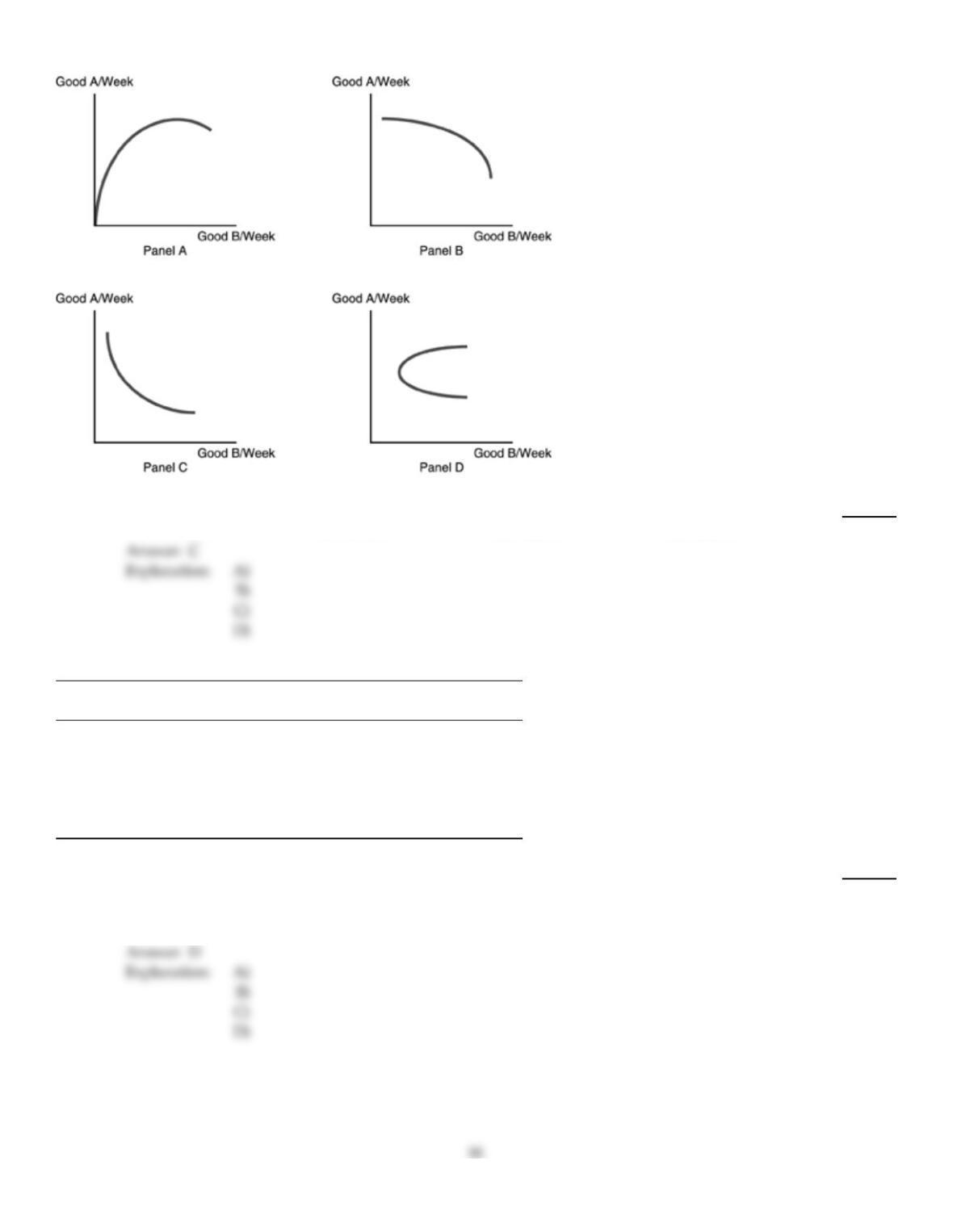
50)
Refer to the above figures. Which panel best represents an indifference curve?
50)
A)
Panel A
B)
Panel B
C)
Panel C
D)
Panel D
Quantity of Total Quantity of Total
Hamburgers/Wk Utility Broadway Shows/Wk Utility
1 40 1 400
260 2700
376 3850
486 4950
591 51000
693 61025
51)
Refer to the above table. If the price of a hamburger is $2, the price of a Broadway Show is $60, and
the consumer has $190, what is the consumer optimum?
51)
A)
0 hamburgers and 6 Broadway shows
B)
4 hamburgers and 2 Broadway shows
C)
6 hamburgers and 0 Broadway shows
D)
5 hamburgers and 3 Broadway shows
Quantity of Marginal Quantity of Marginal
Good X/Wk Utility Good Y/Wk Utility
11200 11700
21000 21400
3 800 31100
4 600 4800
5 400 5500
6100 6200
52)
Refer to the above table. If the price of Good X is $1, the price of Good Y is $2, and the consumer
has $13, the rational consumer will purchase
52)
A)
5 units of Good X and 4 units of Good Y.
B)
6 units of Good X and 0 units of Good Y.
C)
3 units of Good X and 4 units of Good Y.
D)
1 units of Good X and 1 units of Good Y.
53)
If someone complains that she doesn’t feel very well because she ate too much pizza, we would
conclude that the marginal utility of the last piece of pizza eaten was
53)
A)
negative.
B)
positive.
C)
very large.
D)
zero.
54)
The total utility of water is
54)
A)
lower than the total and marginal utility of diamonds.
B)
higher than the total utility of diamonds, but the marginal utility of diamonds is higher.
C)
lower than the total utility of diamonds, but the marginal utility is higher.
D)
the same as the total utility of diamonds, but the marginal utilities are the same.
55)
The marginal rate of substitution is
55)
A)
the additional satisfaction from consuming an additional unit of a good or service.
B)
the change in the quantity of one good that just offsets a one unit change in the consumption
of another such that the total satisfaction remains constant.
C)
positively related to the level of income.
D)
the set of goods and services that are available to the consumer given his income.
56)
Which of the following is NOT true of utility?
56)
A)
Utility can be measured objectively.
B)
It represents the want–satisfying power of a good.
C)
The utility that a good provides depends on a consumer’s preferences.
D)
It is measured using a representative unit called a util.
57)
In economics, another term for satisfaction is
57)
A)
marginal productivity.
B)
utility.
C)
price elasticity.
D)
income elasticity.
Quantity of Movies Michelle’s Total Robert’s Total
Watched per Week Utility per Week Utility per Week
0 0 0
1100 100
2195 190
3270 270
4340 340
5390 400
6420 350
7435 390
8445 420
9450 440
10 440 450
58)
Refer to the above table. In examining the utility schedules for Michelle and Robert, we can
conclude that
58)
A)
Michelle likes movies more than Robert does.
B)
they like movies the same.
C)
they like the third movie the same.
D)
they both received the same satisfaction from watching the fourth movie.
59)
A consumer who has chosen the right mix of goods and services to maximize his or her utility is
said to have achieved
59)
A)
consumer optimum.
B)
consumer surplus.
C)
consumer equilibrium.
D)
consumer benefit.
60)
If the price of a slice of pizza falls from $2 to $1, a pizza–loving consumer will
60)
A)
substitute more Chinese food for pizza.
B)
spend more on soft drinks and less on pizza.
C)
see her purchasing power fall.
D)
see her purchasing power rise.
Combination Good A Good B
A17 4
B13 5
C10 6
D 8 7
61)
Refer to the above table. The table gives the various combinations of Good A and Good B along
Jane’s indifference curve. The marginal rate of substitution when Jane goes from combination C to
combination D is
61)
A)
3:1.
B)
2:1.
C)
0.
D)
4:1.
62)
Because the behavioral economics approach suggests many alternative behaviors that people might
exhibit if they fail to behave as if they are rational, this approach
62)
A)
ignores the possibility of bounded rationality.
B)
often fails to provide clearly testable behavioral predictions.
C)
reproduces the same predictions as utility analysis.
D)
has an over reliance on the rationality assumption.
63)
If you could pay for a product according to the marginal utility that you gain from additional
consumption, then as you consume more of a product the price you pay would
63)
A)
increase.
B)
be deferred.
C)
decline.
D)
remain the same.
Quantity Total Utility
per Week Michelle Robert David Lauren
0 0 0 0 0
1 50 1000 60 60
2 99 1900 120 130
3 147 2700 180 220
4 194 3400 240 310
5 240 4000 300 425
6 285 4500 360 575
7 329 4900 420 900
8 372 5200 480 1275
9 414 5400 540 1770
64)
According to the above table, what is Lauren‘s marginal utility of the 4th unit?
64)
A)
90
B)
220
C)
115
D)
310
65)
The consumer optimum is the set of goods and services, subject to the limited income of the
consumer, that
65)
A)
maximizes the level of satisfaction for each consumer.
B)
is characterized by increasing marginal utility.
C)
is characterized by zero marginal utility on each good and service.
D)
the consumer can afford to buy.