
ch20 Key
1. Leading indicators are measures that identify future financial and non–financial outcomes as guides to
management decision making.
2. Lagging indicators measure the final outcomes of management plans and their execution.
3. Leading indicators of performance are always financial in nature.
4. Organizational learning and growth is a major lagging indicator of a company’s performance.

5. A leading indicator at one stage of the value-chain can be a lagging indicator at another stage.
6. Most financial performance measures are leading indicators.
7. A successful balanced scorecard is a random selection of readily available measures of performance.
8. The internal business process area of a balanced scorecard indicates how processes work to add value to
customers.

9. Balanced scorecards are primarily used by mid and upper-level management personnel.
10. A balanced scorecard contains only qualitative measures of performance.
11. A balanced scorecard contains both quantitative and qualitative measures of performance.
12. When using a balanced scorecard approach, it is not possible to quantify the benefit received from employee
training.

13. Employee productivity can be measured in either physical measures or financial measures.
14. The number of units inspected would be an example of a financial measure of employee productivity.
15. Customer satisfaction is the degree to which an organization’s products and services meet customers’ needs.
16. Customer value measures the revenues generated per customer.

17. Logically, a cause-and-effect relationship exists between improvements in organizational learning and
growth and improvements in internal business and production processes.
18. Customer value reflects the degree to which products and services satisfy customers‘ expectations about the
price, function and quality of those products and services.
19. Customer satisfaction with current products and services is a lagging indicator.
20. Market share is usually measured by the percentage of a company’s customers over the total potential
customers.

21. Market share can be measured in terms of dollar sales, unit volume, or number of customers.
22. Poor financial performance can often be traced to lapses in leading indicator performance.
23. The balanced scorecard is a causal model of leading and lagging indicators of performance.
24. The balanced scorecard uses only lagging indicators of performance to communicate to employees the
impacts and values of their actions.

25. Balanced scorecards do not work well in nonprofit environments because of their lack of financial
performance measures.
26. The greatest benefit of using a balanced scorecard is that company profits always improve.
27. Critical success factors are important key performance indicators in a corporation.
28. Companies that have achieved the most success using balanced scorecards have utilized a top-down
management approach in its design.

29. The primary purpose of the balanced scorecard should be as a management tool for employee incentives and
financial rewards.
30. The primary purpose of the balanced scorecard should be to communicate and implement corporate
strategy.
31. Most observers believe that a top-down management approach is the most successful way to implement a
balanced scorecard.
32. A participative, bottom-up approach to designing a balanced scorecard improves its acceptance and use by
the organization’s members.

33. Measurement of average cycle time would be found in the financial performance section of a balanced
scorecard.
34. Market share would most likely be found in the customer value section of a balanced scorecard.
35. The financial performance section of a balanced scorecard would include a company’s revenue growth.
36. Pay for performance incentive systems base at least some portion of a manager‘s income on measures of
organizational performance rather than a guaranteed amount.

37. Absolute performance evaluation compares an individual‘s performance to that of others.
38. Absolute performance evaluation compares individual performance to set objectives or expectations.
39. A performance evaluation formula computes rewards earned for specific achievements.
40. Stock appreciation rights (SARs) confer bonuses to employees based on increases in stock prices for a
predetermined number of shares.
41. A manager receiving a deferred reward is less likely to invest in new technology because of the impact on
earnings of the company of such an investment.
42. It is impossible to use the balanced scorecard as a basis for incentive systems because it contains so many
non financial measures of performance.
43. A leading indicator:
44. Which of the following statements about customer satisfaction is false?
45. A balanced scorecard is:
46. A balanced scorecard shows measures of performance as they related to areas of performance. Which of the
following is a measure of performance of customer value?
47. In a balanced scorecard, which of the following would be a measure of the business and production process
performance?
48. In a balanced scorecard, which of the following would be a measure of the learning and growth area of
performance?
49. Which of the following is not one of the four areas of strategic action on a balanced scorecard?
50. Which of the following best describes the business and production process performance area of the balanced
scorecard?
51. Which of the following best describes the customer performance area of the balanced scorecard?
52. Which of the following is true about balanced scorecards?
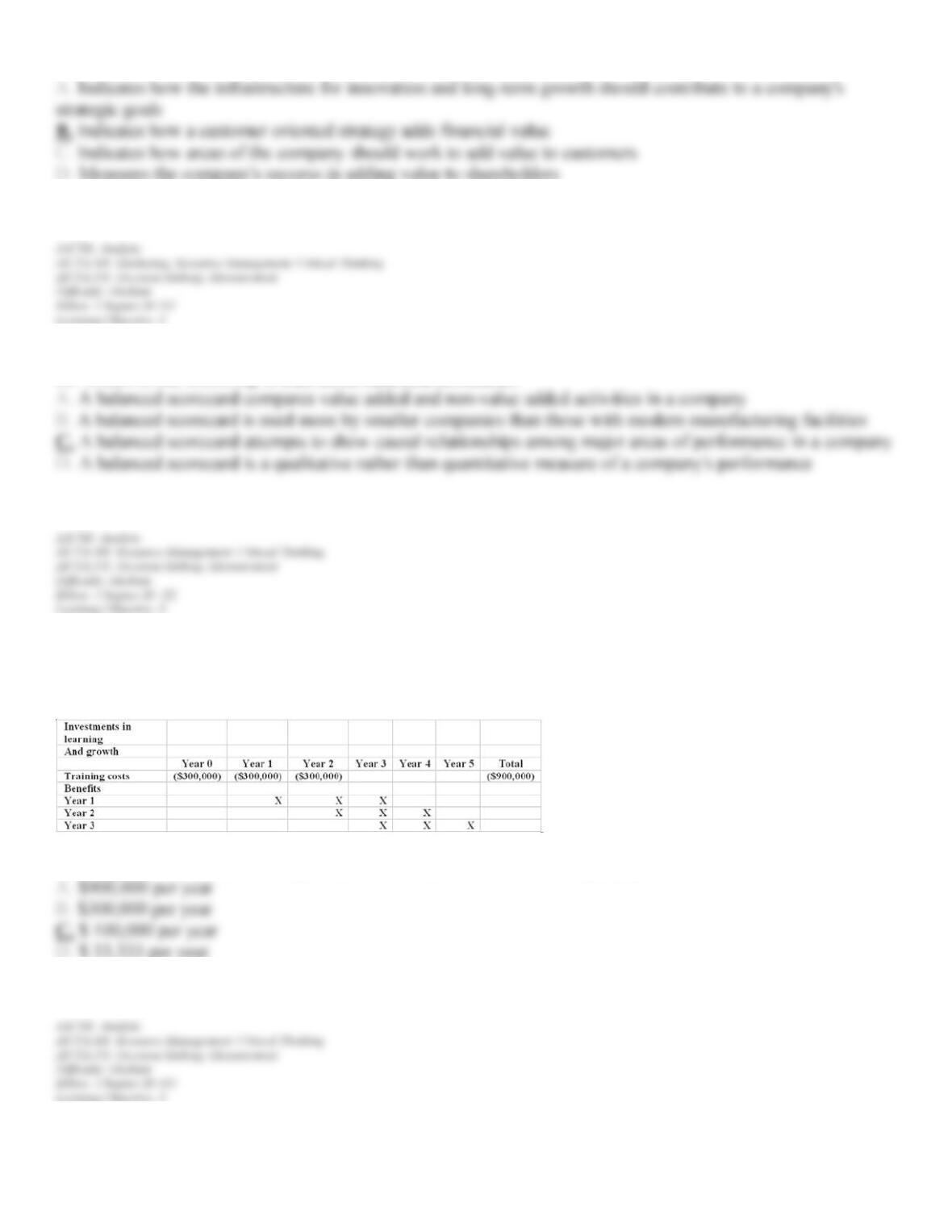
53. Joplin Corporation showed the following relationship between training costs and training benefits:
Ignoring the time value of money, what is the break–even benefit level per year?
54. Nino Corporation conducted a study of the relationship between employee training costs and benefits. The
company determined that it has break-even benefit level of $45,698 per year. This result indicates that Schiller
should:
55. Which of the following statements regarding balanced scorecards isFalse?
56. Which of the following would be a balanced scorecard measurement of customer value?

57. Which of the following would be a balanced scorecard measure in the financial performance area?
58. Which of the following would not be a balanced scorecard measure in the business and production
efficiency area?
59. Which of the following is measured in the organizational learning and growth area of a balanced scorecard?
60. Which of the following would be a performance target in the financial performance area of a balanced
scorecard?
61. Which of the following is not a commonly used theory of incentive and behavior?
62. Which of the following statements regarding incentive reward systems is False?
63. Absolute performance evaluation:
64. Relative performance evaluation:
65. Subjective performance evaluation:
66. Which of the following is not a financial performance measure?
67. Which of the following is not a cost of including nonfinancial measures in incentive plans?
68. Stock appreciation rights (SARs):
69. Which of the following statements is True regarding balanced scorecard-based incentive systems?
70. Which of the following is not an element that should be considered when designing an incentive system?
71. Which of the following statements describes expectancy theory? (Appendix)