Chemistry, 6e (McMurry/Fay)
Chapter 20 Transition Elements and Coordination Chemistry
20.1 Multiple-Choice Questions
1) The number of transition series is
A) one
B) two
C) four
D) seven
2) In which blocks of the periodic table are the transition series and inner transition series elements
found?
A) d, p
B) d, f
C) s, d
D) s, p
3) Which is a third transition series element?
A) Al
B) Mg
C) Pr
D) Pt
4) Which of the following elements is an inner transition metal?
A) Eu
B) Fe
C) Ru
D) Sc
5) What is the characteristic outer electron configuration for transition elements?
A) (n – 1)d10-xns2
B) (n)d10-xns2
C) (n + 1)d10-xns1
D) (n – 1)d10-x(n + 1)s2
2
6) What is the ground-state electron configuration for the element cobalt (Z = 27)?
A) [Ar] 4s2 3d7
B) [Ar] 3d9
C) [Ar] 4s2 4p6 5s1
D) [Ar] 3d7
7) Which element is most likely to have an anomalous electron configuration?
A) Y
B) Tc
C) Ag
D) Cd
8) What is the ground-state electron configuration for the element chromium (Z = 24)?
A) [Ne] 4s2 3d4
B) [Ar] 4s2 3d4
C) [Ar] 4s1 3d5
D) [Ar] 3d6
9) What is the ground-state electron configuration for Cr in Cr2O72-?
A) [Ar] 4s1 3d5
B) [Ar] 4s2 3d6
C) [Ar] 3d4
D) [Ar] 3d0
10) What is the ground-state electron configuration for Co2+ (Z = 27)?
A) [Ar] 4s2 3d9
B) [Ar] 4s2 3d5
C) [Ar] 3d7
D) [Ar] 4s1 3d6
11) Which transition metal has the anomalous ground-state electron configuration: [Kr] 4d10?
A) Rh
B) Pd
C) Ag
D) Cd
12) Which of the following species has the ground-state electron configuration [Ar]3d4?
A) Ti
B) V2+
C) Cr2+
D) Fe2+
13) Element M has the valence electron configuration 3d6 4s2. What is the valence electron
configuration of The M3+ ion?
A) 3d5
B) 3d3 4s2
C) 3d4 4s1
D) 3d9 4s2
14) How many d electrons are there in MnO4–?
A) 0
B) 1
C) 2
D) 3
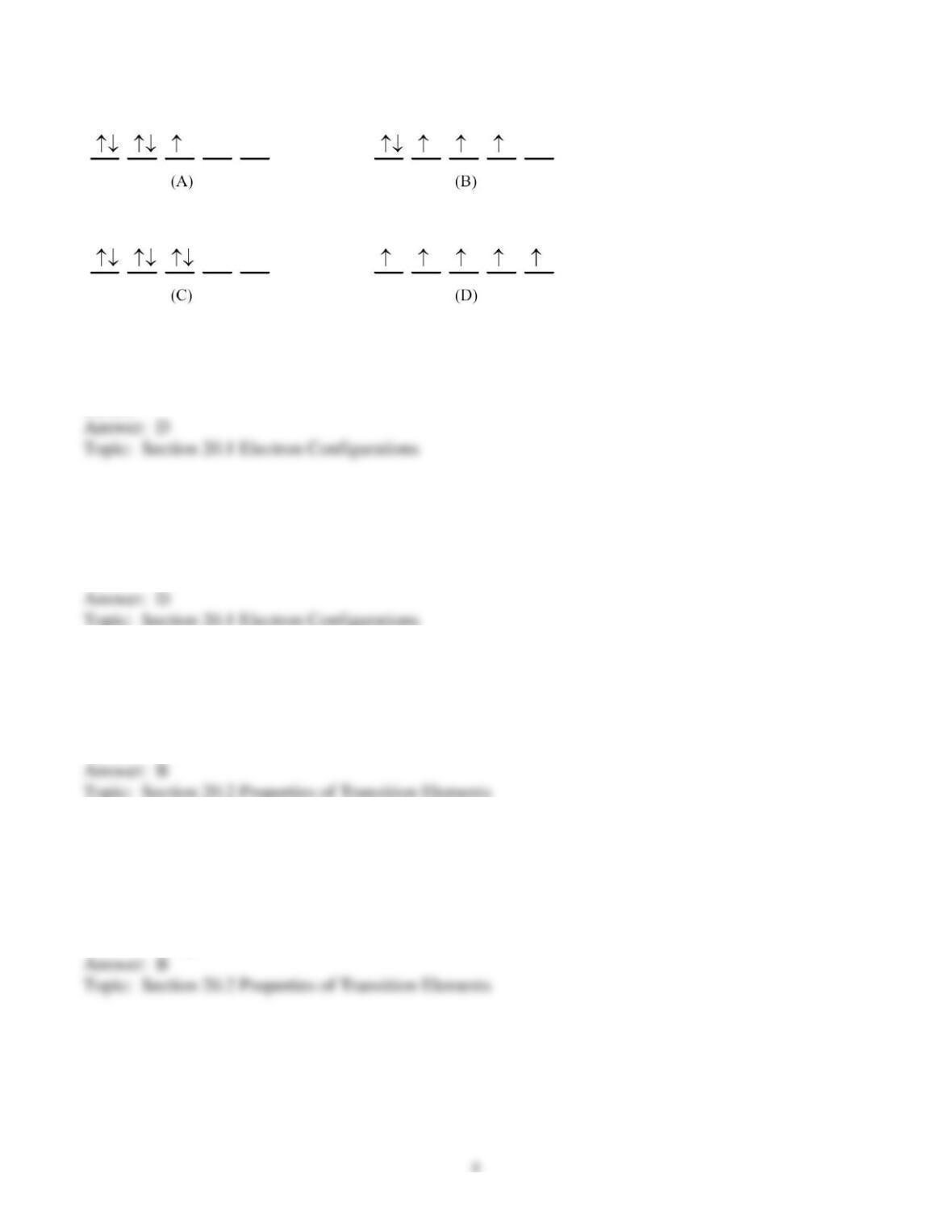
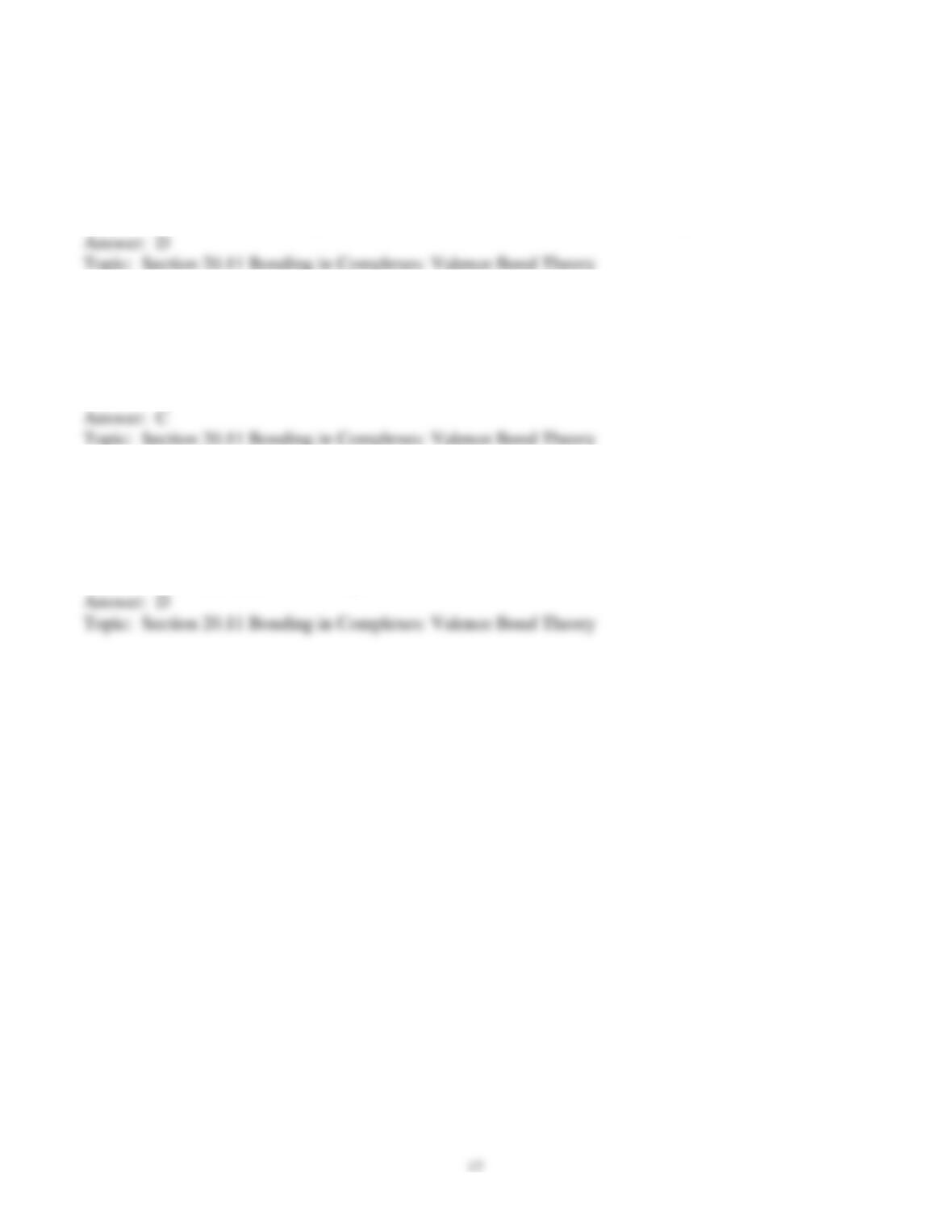
15) What is the d orbital-filling diagram for Fe3+ (Z = 26)?
A) (A)
B) (B)
C) (C)
D) (D)
16) How many valence electrons does the element Co have?
A) 2
B) 7
C) 8
D) 9
17) Transition series elements are all
A) gases.
B) metals.
C) nonmetals.
D) semimetals.
18) What two transition elements have the highest electrical conductivity of any elements at room
temperature?
A) copper and iron
B) copper and silver
C) iron and chromium
D) silver and gold
19) Which first row transition element has the highest melting point?
A) Sc
B) V
C) Fe
D) Zn
20) Which transition element has the highest melting point?
A) Fe
B) V
C) Mo
D) W
21) Which of the following elements has the highest density?
A) Cr
B) Ni
C) Os
D) Ta
22) For transition elements, which of the following occurs as the effective nuclear charge increases?
A) The atomic radius increases.
B) The density increases.
C) Both the atomic radius and the density increase.
D) The atomic radius decreases and the density increases.
23) Though we would expect an increase in atomic radii going down a group from the second to the
third transition series of elements, the actual radii are nearly identical. The term commonly used to
describe this phenomenon is the ________.
A) atomic disparity
B) effective nuclear charge
C) lanthanide contraction
D) transition default
6
24) Which of the following transition elements (Sc, Ti, V, Mn, and Cu) have positive oxidation
potentials?
A) Sc
B) Cu
C) Sc, Ti, and V
D) Sc, Ti, V, and Mn
25) Which transition element is difficult to oxidize with hydronium ion?
A) Cr
B) Cu
C) Mn
D) Ti
26) What oxidation state(s) is(are) exhibited by all first row transition elements except scandium?
A) +2
B) +3
C) +2 and +3
D) +2, +3 and +4
27) What is the highest possible oxidation state for chromium?
A) +3
B) +4
C) +5
D) +6
28) What statement is most inconsistent with the chemistry of transition elements?
A) Bromide, chloride and iodide stabilize the higher oxidation states of the transition elements.
B) Early transition metal ions with the metal in its lowest oxidation state are good reducing agents.
C) Ions that have transition metal in their highest oxidation state tend to be good oxidizing agents.
D) The stability of the higher oxidation states increases down a periodic group.
29) Vanadium in the +5 oxidation is most often found as compounds of ________.
A) bromides
B) chlorides
C) fluorides
D) iodides
30) What is the strongest oxidizing agent of the following set: VCl2, CrCl3, KMnO4, KReO4?
A) VCl2
B) CrCl3
C) KMnO4
D) KReO4
31) What is the strongest oxidizing agent of the following set: MnCl2, Mn(OH)3, MnO2, KMnO4?
A) MnCl2
B) Mn(OH)3
C) MnO2
D) KMnO4
32) What chemical equation represents the best method for obtaining pure chromium?
A) FeCr2O4(s) + 4 C(s) + heat → Fe(s) + 2 Cr(s) + 4 CO(g)
B) Cr2O3(s) + 2 Al(s) + heat → 2 Cr(s) + Al2O3(s)
C) Cr2O3(s) + 2 Fe(s) + heat → Fe2O3(s) + 2 Cr(s)
D) Cr2+(aq) + H2(g) → Cr(s) + 2 H+(aq)
33) Which is not a characteristic reaction of chromium metal or chromium(II) ion?
A) Cr(s) + 2 H+(aq) → Cr2+(aq) + H2(g)
B) 4 Cr2+(aq) + O2(g) + 4 H+(aq) → 4 Cr3+(aq) + 2 H2O(l)
C) Cr(OH)2(s) + 2 H3O+(aq) → Cr2+(aq) + 4 H2O(l)
D) Cr(OH)2(s) + OH–(aq) → Cr(OH)3–(aq)
34) Which of the following chromium species is the strongest acid?
A) Cr(OH)2
B) Cr(OH)3
C) CrO2(OH)2
D) CrO42-
35) Which chromium species exists only under acidic conditions?
A) Cr(OH)2
B) Cr(OH)4–
C) CrO42-
D) Cr2O72-
36) Which is the strongest oxidizing agent under acidic conditions?
A) Cr2+
B) Cr3+
C) CrO42-
D) Cr2O72-
37) In the two half-reactions shown below, which chromium species is the strongest oxidizing agent?
Cr2O72–(aq) + 14 H+(aq) + 6 e– → 2 Cr3+(aq) + 7 H2O(l) E° = + 1.33 V
CrO42–(aq) + 4 H2O(l) + 6 e– → Cr(OH)3(s) + 5 OH–(aq) E° = – 0.13 V
A) Cr2O72–
B) Cr3+
C) CrO42–
D) Cr(OH)3
38) What statement is inconsistent with the chemistry of iron?
A) Iron is the fourth most abundant element in the earth’s crust.
B) Iron is obtained from the reduction of hematite (Fe2O3) and magnetite (Fe3O4) by carbon in a blast
furnace.
C) Iron is a relatively hard metal and it is relatively unreactive with haloacids.
D) The majority of iron in a healthy human is present in the oxygen-carrying protein hemoglobin.
39) What are two of the major components of stainless steel?
A) iron and carbon
B) iron and chromium
C) iron and titanium
D) iron and tungsten
40) What statement is most inconsistent about the chemistry of iron?
A) Iron(III) hydroxide is very soluble and reacts readily with hydroxide to form Fe(OH)4–.
B) Iron reacts with hydrochloric acid in the absence of air to yield iron(II) ion and hydrogen gas.
C) Iron reacts with nitric acid to yield iron(III) ion and nitric oxide.
D) The most common oxidation states of iron are +2 (ferrous) and +3 (ferric).
41) What is the strongest oxidizing agent of the following set: FeO, Fe2O3, Fe3O4, FeO42-?
A) FeO
B) Fe2O3
C) Fe3O4
D) FeO42-
42) What statement is inconsistent with the chemistry of copper?
A) It has a high electrical conductivity and is widely used to make electrical wiring.
B) It is commonly found in the elemental state.
C) It is a reddish colored metal that accounts for only 0.0068% of the earth’s crust by mass.
D) It is used to make corrosion-resistant water pipes because it has a positive oxidation potential.
43) What is the compound responsible for the green patina seen on bronze monuments?
A) CuCO3
B) Cu2(OH)2CO3
C) Cu(OH)2
D) Cu2(OH)2SO4
44) Which of the following is a disproportionation reaction?
A) Cu2S(l) + O2(g) → 2 Cu(l) + SO2(g)
B) 3 Cu(s) + 2 NO3-(aq) + 8 H+(aq) → 3 Cu2+(aq) + 2 NO(g) + 4 H2O(l)
C) 2 Cu+(aq) → Cu(s) + Cu2+(aq)
D) Cu2+(aq) + 4 NH3(aq) → Cu(NH3)42+(aq)
45) Using the following reduction potentials for copper determine the unstable copper compound.
Cu+(aq) + e– → Cu(s) E° = +0.52 V
Cu2+(aq) + e– → Cu+(aq) E° = +0.15 V
A) CuCl
B) CuCl2
C) CuSO4
D) Cu(OH)2
46) Describe what happens when 3.0 M NH3 is slowly added to an aqueous solution of CuSO4.
A) A blue precipitate of Cu(OH)2 forms.
B) A royal blue complex of [Cu(NH3)4]2+ is formed.
C) A blue precipitate of Cu(OH)2 is formed which is then converted to the royal blue complex
[Cu(NH3)4]2+.
D) A royal blue complex of [Cu(NH3)4]2+ is formed which then is converted to a blue precipitate of
Cu(OH)2.
47) Which one of the following compounds is not consistent with the terminology of a complex?
A) [Cu(NH3)4]2+
B) CuSO4 ∙ 5H2O
C) K3[Fe(CN)6]
D) [Cr(NH3)6]Cl3
48) Which is a complex ion?
A) CrCl3
B) CrO42–
C) [Cr(H2O)6]3+
D) Cr2O72–
49) What is the coordination number of the Fe atom in K3[Fe(C2O4)3]?
A) 2
B) 3
C) 4
D) 6
50) What is the coordination number of the Au atom in K [Au(CN)2(SCN)2]?
A) 2
B) 3
C) 4
D) 6
51) What is the oxidation state of the Cr atom in [Ni(en)3]3[Cr(CN)6]2?
A) +2
B) +3
C) +4
D) +6
52) What is the oxidation state of the Co atom in [Co(NH3)5Cl](NO3)2?
A) +2
B) +3
C) +4
D) +6
53) A chromium(III) ion forms a complex ion with two ammonia molecules and four thiocyanate ions.
What is the formula of the complex ion?
A) [Cr(NH3)2(NCS)4]3+
B) [Cr(NH4)2(NCS)4]+
C) [Cr(NH3)2(NCS)4]–
D) [Cr(NH3)2(NCS)4]4-
54) Which of the following can function as a bidentate ligand?
A) CO
B) OH–
C) NH3
D) C2O42-
55) Which of the following can function as a bidentate ligand?
A) CN–
B) NCS–
C) H2NCH2CO2–
D) All of these can function as bidentate ligands.
56) Ethylenediaminetetraacetate ion (EDTA4-) is commonly referred to as a ________ ligand.
A) monodentate
B) bidentate
C) tetradentate
D) hexadentate
57) Which of the following can function as a chelating agent?
A) CN–
B) CO
C) H2NCH2CH2NH2
D) NCS–
58) When the oxalate ion, C2O42– is bonded to the iron(III) ion in the complex ion [Fe(C2O4)3]3–, a
________-membered chelate ring is formed.
A) 3
B) 4
C) 5
D) 6
59) Which ligand when bonded to a metal would be incorrectly named?
A) H2O, aqua
B) NH3, ammonia
C) CO, carbonyl
D) F–, fluoro
60) Write the chemical formula for aquabromobis(ethylenediamine)chromium(III) chloride.
A) [CrBr(H2O)(en)]Cl
B) [CrBr2(H2O)(en)]Cl2
C) [CrBr(H2O)(en)2]Cl2
D) [CrBr(H2O)(en)2]Cl3
61) Write the chemical formula for pentaamminenitritocobalt(III) ion.
A) [Co(NO)(NH3)5]3+
B) [Co(NO2)(NH3)5]2+
C) [Co(ONO)(NH3)5]2+
D) [Co(NH3)5(N2O)]2+
62) What is the correct formula for tetraamminecarbonatoiron(III) chloride?
A) (NH3)4[FeCO3]Cl
B) [Fe(CO3)(NH3)4]Cl
C) [Fe(CO3)(NH3)4]Cl2
D) [Fe(CO3)Cl(NH3)4]
63) The complex cis-[CoCl(NH3)(NH2CH2CH2NH2)2]2+ was resolved into optical isomers in 1911 by
Alfred Werner, demonstrating the octahedral geometry of the ion. Name this complex ion.
A) cis-chloroammineethylenediaminecobalt(II) ion
B) cis-amminechloroethylenediaminecobalt(III) ion
C) cis-amminechlorobis(ethylenediamine)cobalt(II) ion
D) cis-amminechlorobis(ethylenediamine)cobalt(III) ion
64) What is the name of the complex [Ni(en)3]3[Cr(CN)6]2?
A) ethylenediaminenickel(III) hexacyanochromate(II)
B) tris(ethylenediamine)nickel(III) hexacyanochromate(II)
C) tris(ethylenediamine)nickel(II) hexacyanochromate(III)
D) bis(ethylenediamine)nickel(II) hexacyanochromate(III)
65) What is the name of the complex [Ni(H2O)4(NH2CH2CH2NH2)]SO4 ∙ 5H2O?
A) aquaethylenediaminenickel(II) sulfate hydrate
B) tetraaquaethylenediaminenickel(II) sulfate pentahydrate
C) tetraaquabis(ethylenediamine)nickel(II) sulfate pentahydrate
D) tetraaquabis(ethylenediamine)nickel(III) sulfate pentahydrate
66) What is the name of the complex ion [AuBrCl(CN)2]–?
A) bromochlorodicyanogold(I) ion
B) bromochlorodicyanoaurate(III) ion
C) bromochlorodicyanoargentate(III) ion
D) bromochlorodicyanoaurate(IV) ion
67) In order to form a neutral compound, hexafluoroaluminate would require
A) three K+ ions.
B) three Cl– ions.
C) six Na+ ions.
D) six Br– ions.
68) Identify the classification of isomers illustrated by [Co(NO2)(NH3)5]2+ and [Co(ONO)(NH3)5]2+.
A) linkage isomers
B) ionization isomers
C) geometric isomers
D) optical isomers
69) Which pair of isomers illustrates the concept of ionization isomers?
A) [Cr(SCN)(NH3)5]2+ and [Cr(NCS)(NH3)5]2+
B) [CoCl(NH3)5]SO4 and [Co(SO4)(NH3)5]Cl
C) cis -[PtCl2(NH3)2] and trans -[PtCl2(NH3)2]
D) (+)-[Co(en)3]3+ and (-)-[Co(en)3]3+
70) The compounds [Cr(H2O)6]Cl3 and [CrCl3(H2O)3] ∙ 3H2O are examples of ________.
A) diastereoisomers
B) enantiomers
C) ionization isomers
D) linkage isomers
71) Which ion has cis and trans isomers?
A) [PdCl3NH3]–
B) [Pt(CN)5NH3]–
C) [PtCl2(CN)2]2-
D) [Pt(C2O4)2]2-
72) Which complex is optically active?
A) [CoCl4en]2-
B) trans-[CrCl2(en)2]+
C) cis-[CrCl2(en)2]+
D) [PtCl2(NH3)2]
73) Which complex cannot exist as enantiomers?
A) [CoCl2(H2O)4]+
B) [Co(en)3]3+
C) cis-[CrCl2(C2O4)2]+
D) [Fe(C2O4)2(en)]–
74) Which definition best describes isomers that are non-superimposable mirror images of each other
that rotate plane polarized light to the same degree but in opposite directions?
A) diastereoisomers
B) enantiomers
C) linkage isomers
D) racemic mixture
75) Which one of the following objects is chiral?
A) a bottle
B) a chair
C) a glass
D) a glove
76) A complex ion that has a broad absorption band at 625 nm in its visible absorption spectrum will
appear to be
A) blue
B) colorless
C) red
D) yellow
77) What hybridization scheme is used for Ni in the square planar complex of [Ni(CN)4]2–?
A) sp3
B) dsp2
C) dsp3
D) d2sp3
78) What type of hybrid orbitals are used by the Ti atom to form chemical bonds in the complex ion
[Ti(H2O)6]3+?
A) sp3
B) dsp2
C) dsp3
D) d2sp3
79) How many unpaired electrons are present in the high spin form of the [CoF6]3- complex and what
metal orbitals are used in bonding?
A) 0 unpaired electrons and 4s, 4p and 4d orbitals to give sp3d2
B) 4 unpaired electrons and 4s, 4p and 4d orbitals to give sp3d2
C) 0 unpaired electrons and 3d, 4s, and 4p orbitals to give d2sp3
D) 4 unpaired electrons and 3d, 4s, and 4p orbitals to give d2sp3
80) Which metal ion is most likely to form a square planar complex ion with CN–?
A) Co2+
B) Cu2+
C) Ni2+
D) Zn2+
81) The complex [Ni(CN)4]2- is diamagnetic and the complex [NiCl4]2- is paramagnetic. What can you
conclude about their molecular geometries?
A) Both complexes have square planar geometries.
B) Both complexes have tetrahedral geometries.
C) [NiCl4]2- has a square planar geometry while [Ni(CN)4]2- has a tetrahedral geometry.
D) [NiCl4]2- has a tetrahedral geometry while [Ni(CN)4]2- has a square planar geometry.
82) How many d electrons are there on the Fe metal atom in Na3[Fe(CN)6]?
A) 1
B) 3
C) 5
D) 6
83) Which of the following species is diamagnetic?
A) an isolated, gas-phase V3+ ion
B) a high-spin octahedral Fe2+ complex
C) an isolated, gas-phase Cu2+ ion
D) a low-spin octahedral Co3+ complex
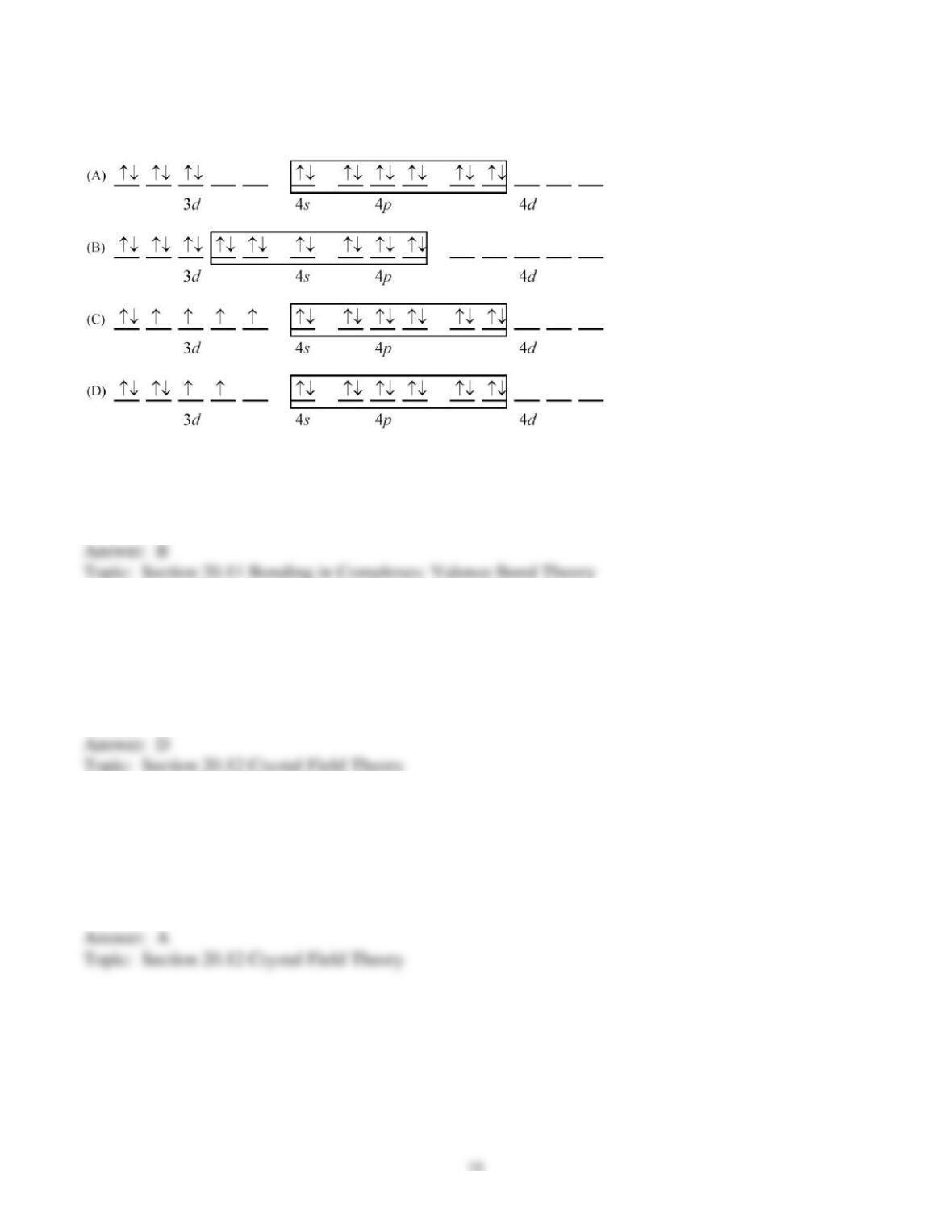
84) What is a representative orbital-filling diagram for the cobalt ion in the low spin complex of
[Co(CN)6]3-?
A) (A)
B) (B)
C) (C)
D) (D)
85) Which of the following complex ions is colorless?
A) [Co(H2O)6]2+
B) [Mn(CN)6]3-
C) [CrCl3(H2O)3]
D) [Ag(NH3)2]+
86) Which of the following complexes has five unpaired electrons?
A) [Mn(H2O)6]2+
B) [Mn(CN)6]3-
C) CrCl3(H2O)3
D) [Ag(NH3)2]+
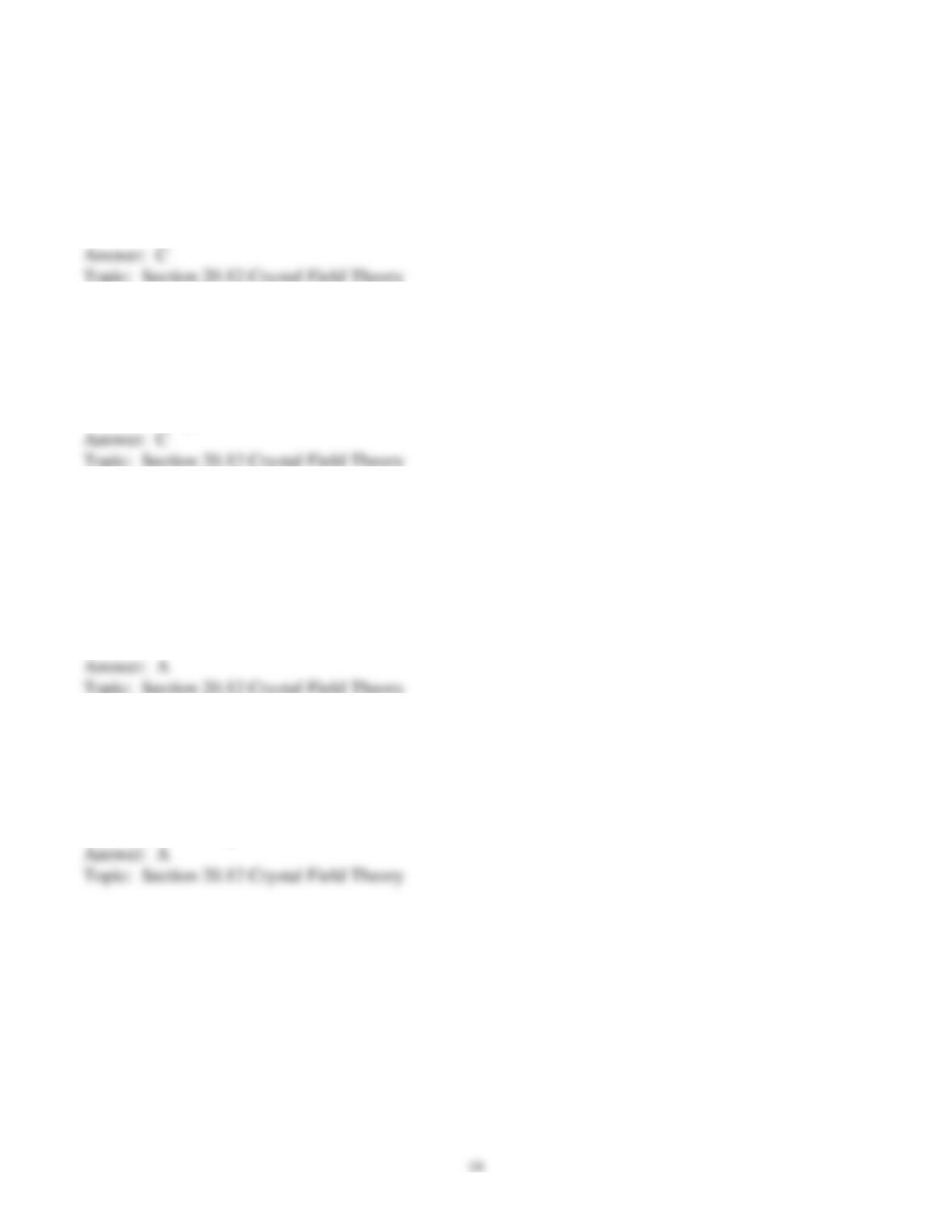
87) Which of the following complexes are diamagnetic?
[Mn(CN)6]3- [Zn(NH3)4]2+ [Fe(CN)6]4- [FeF6]3-
A) [Zn(NH3)4]2+
B) [Zn(NH3)4]2+ and [FeF6]3-
C) [Zn(NH3)4]2+ and [Fe(CN)6]4-
D) [Mn(CN)6]3-, [Zn(NH3)4]2+ and [Fe(CN)6]4-
88) For an octahedral complex what metal d orbitals are directly towards the ligands?
A) dxy, dxz
B) dxy, dxz, dyz
C) dz², dx²–y²
D) dz², dxz, dyz
89) What is the expected order for increasing octahedral (Δ0) crystal field splitting for the ligands I–, F–,
H2O, NH3, en, CO?
A) I– < F– < H2O < NH3 < en < CO
B) F– < I– < NH3 < en < CO < H2O
C) I– < F– < H2O < CO < NH3 < en
D) CO < en < NH3 < H2O < F– < I–
90) What is the expected order for increasing octahedral (Δ0) crystal field splitting for ligands?
A) halides < O ligands < N ligands < CN–
B) halides < CN– < O ligands < N ligands
C) CN– < N ligands < O ligands < halides
D) O ligands < N ligands < CN– < halides
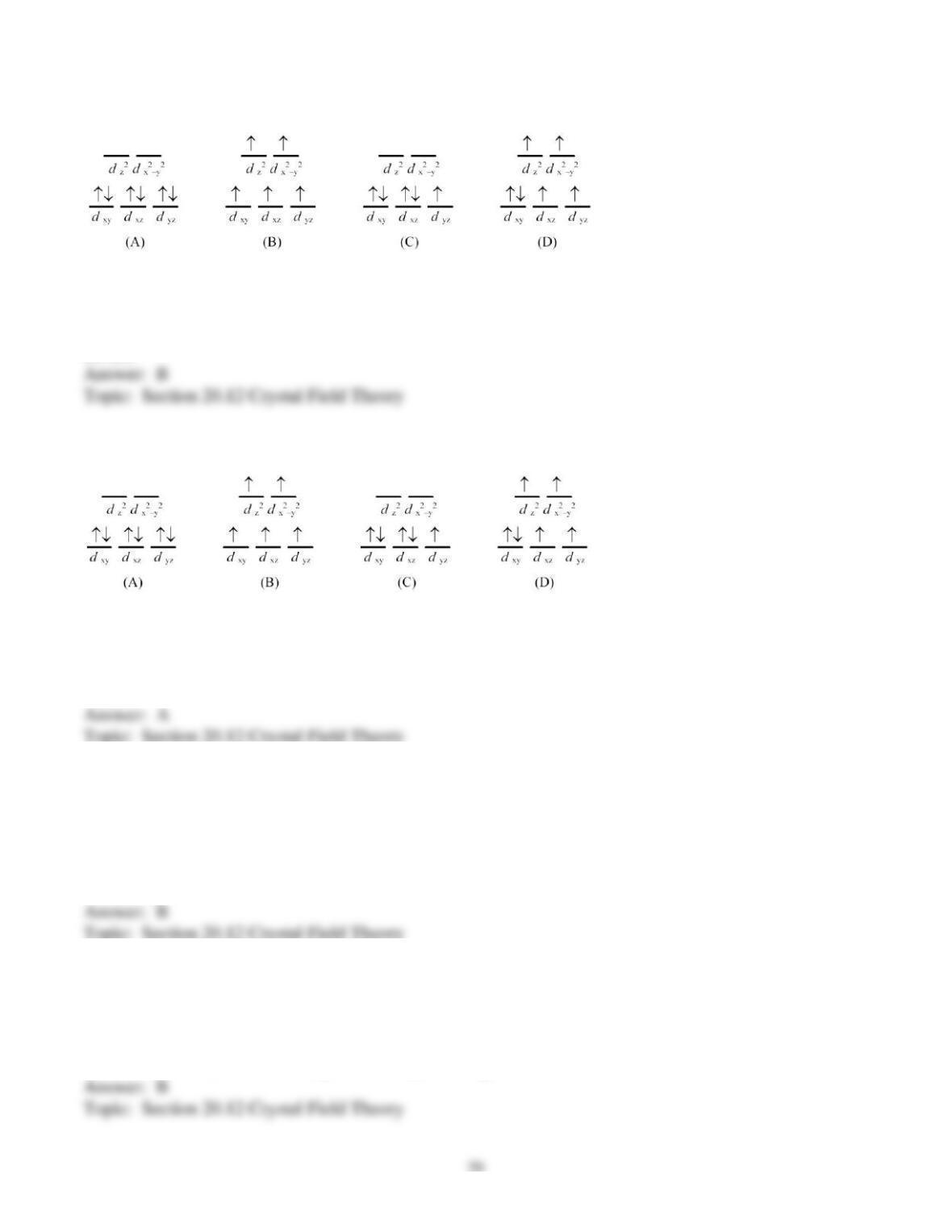
91) What is the crystal field energy level diagram for the complex [Fe(H2O)6]3+?
A) (A)
B) (B)
C) (C)
D) (D)
92) What is the crystal field energy level diagram for the complex [Co(CN)6]3-?
A) (A)
B) (B)
C) (C)
D) (D)
93) Which ion would you expect to have the largest crystal field splitting Δ?
A) [Fe(CN)6]4-
B) [Fe(CN)6]3-
C) [Fe(H2O)6]2+
D) [Fe(H2O)6]3+
94) What statement is inconsistent with the crystal field theory of tetrahedral complexes?
A) Δt is about 4/9 that of Δ0.
B) Tetrahedral complexes are nearly all low spin.
C) The dxy, dxz, and dyz orbitals are higher in energy than the dz² and dx²–y² orbitals.
D) None of the metal d orbitals point directly at the ligands in a tetrahedral environment.