Environment: Science Behind the Stories, 2e Cdn. Ed. (Withgott)
Chapter 20 The Urban Environment: Creating Livable Cities
20.1 Graph and Figure Interpretation Questions
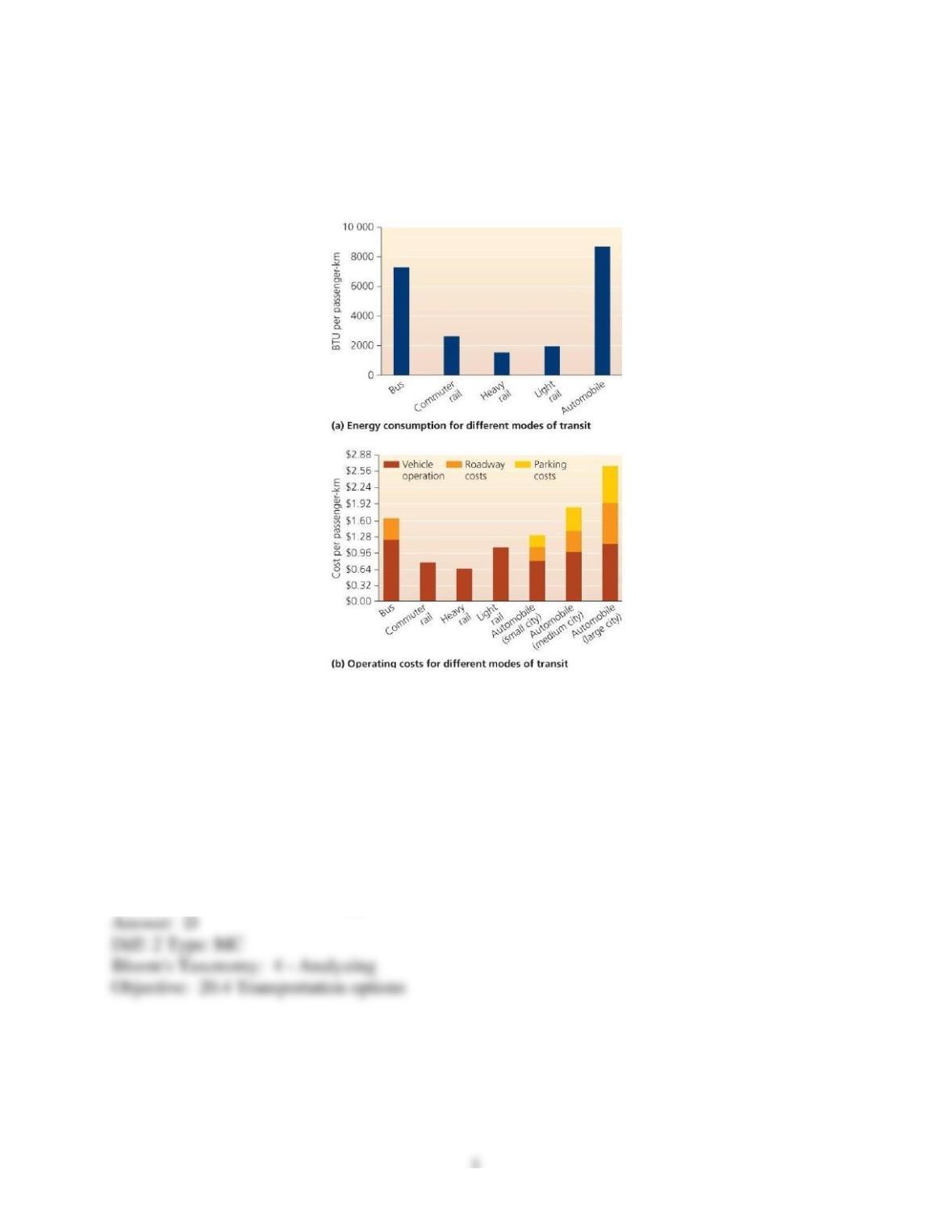
Figure 20.1
Use Figure 20.1 to answer the following questions.
1) Refer to Figure 20.1. According to the graphs, the energy consumption per passenger km
________.
A) rises as you get farther from the city centre
B) is more than twice as high for automobiles as it is for any other form of transportation
C) is only half as high for bus riders as it is for people in cars
D) is higher for all types of road use than it is for rail use
E) continues to increase for all types of transit
2) Refer to Figure 20.1. The operating costs for transportation ________.
A) clearly show the benefits of economies of scale in automobile transportation
B) show that automobile transport in a small city is less expensive than light rail
C) indicate that city planners should invest more in parking lots
D) take into account the costs to public health and to the environment of vehicle emissions
E) indicate that rail is the most sensible means of transport
3) Refer to Figure 20.1. Given the energy consumption and operating costs per passenger km,
one of the best overall strategies for cities to consider is to ________.
A) create carpool lanes on all major routes
B) increase affordable, high-rise parking sites in multiple locations throughout the city
C) create or improve a convenient, affordable rail transit system
D) create more suburban communities with work, shopping, and housing in central locations
E) improve and increase city bus routes, providing affordable, pleasant buses
4) Refer to Figure 20.1. Prices of which form of transportation are the least vulnerable (i.e., will
increase by the least percentage) to the expected future increases in the costs of energy?
A) commuter
B) heavy rail
C) light rail
D) automobile
E) bus
20.2 Matching Questions
Match the following.
A) suburbanization
B) neo-Luddism
C) suburban communities
D) semi-urban communities
E) new urbanism
F) light rail
G) tiered utilization
H) heavy rail
I) urbanization
J) zoning
K) sprawl
1) The shift from rural to urban living
2) Residential/commercial communities that ring cities just outside city limits
3) The spread of low-density urban or suburban development outward from an urban centre
4) Designing neighbourhoods on a walkable scale
5) The practice of classifying areas for different types of development and land use
6) The least energy-consuming and the cheapest form of urban transportation
Diff: 1 Type: MA
Bloom’s Taxonomy: 4 – Analyzing
Objective: 20.4 Transportation options
4
20.3 Short Answer Questions
1) What is the single greatest shift in population distribution in Canada over the last century?
2) What impact does increased distance from natural areas, as a consequence of urbanization,
have on human views of nature? How do we ameliorate this?
3) Compare the two sometimes conflicting goals that motivated the establishment and design of
early city parks.
4) According to the 2006 census, the urbanized land area in Canada increased by 2% between
2001 and 2006, whereas the urban population increased only by 0.3% over the same time period.
What process does these numbers illustrate? Explain your reasoning.
5) List the two reasons for recent rapid urban growth.
6) The professional pursuit called ________ attempts to design cities in such a way as to
maximize their efficiency, functionality, and beauty.
7) The phenomenon of urban and suburban spread across the landscape has been given the name
________.
8) The use of what type of resource constitutes the single largest component of the
environmental footprint of Canadian cities?
9) The reason why many cities have established an urban growth boundary (UGB) is ________.
10) What is a downside of establishing urban growth boundaries (UGB)?
11) What are advantages of city zoning?
12) Can the suburban sprawl be analyzed from the point of view of social justice?
20.4 Multiple-Choice Questions
1) Which of the following is most likely to drive people to move to the suburbs from cities?
A) the desire to have a garden
B) the availability of more jobs in the suburbs
C) the desire to live in less stressful, more peaceful park-like conditions
D) concern over demographic transitions
E) the desire for close-knit communities
2) The greatest general problem with the suburbs is ________.
A) high population density
B) lack of resources
C) that they spread environmental impact over a larger area
D) decreased water quality
E) lack of nearby shopping
3) Curitiba, Brazil, has shown us that ________.
A) unregulated urban sprawl produces severe air pollution
B) a walkable city centre and an expanded bus system can solve a large city’s traffic congestion
C) once roads are widened, traffic congestion decreases
D) prohibition of motorized vehicles in urban areas reduces pollution and saves energy
E) traffic flows smoothly once pedestrians and bicycles are eliminated
4) Toronto’s greenbelt, created by the government of Ontario, is a means of ________.
A) developing more golf courses in the region
B) containing urban development while protecting natural or agricultural lands in the area
C) ensuring greenery within and around the City of Toronto
D) replanting trees where vacant lots were once located
E) restoring Toronto’s closed landfill sites by covering them with soil and replanting with trees
5) The world’s urban populations are ________.
A) shrinking, compared to rural populations
B) growing faster than the population as a whole
C) growing at about the same rate as rural populations
D) growing most rapidly in developed nations
E) shrinking in developed nations
6) In developing nations such as India and Nigeria, ________.
A) most of the population is moving to the suburbs from the city centres
B) very little change has occurred in the past 40 years regarding where people live
C) small numbers of people have moved into the cities
D) rural people are moving to the cities in large numbers
E) more people are moving to the suburbs than to the city centres
7) Canadian Western cities, especially Vancouver, Edmonton, and Calgary ________.
A) have steadily but very slowly increased its population in recent years
B) grew very rapidly in recent years
C) have begun a slow decline as people move to the suburbs
D) have maintained a steady state population since the 1970s
E) have decreased their rate of growth dramatically in the past 20 years
8) Worldwide, the fastest growing cities today are ________.
A) cities in Western Canada such as Calgary, Vancouver, and Edmonton
B) small cities in Eastern Canada such as Sydney, Nova Scotia, and St. Catharines, Ontario
C) the megacities such as Tokyo, Mexico City, and Toronto
D) cities such as Cairo, Egypt, and Mumbai (Bombay), India
E) large cities worldwide, such as Paris, London, and Montreal
9) Around the world, most major cities are situated ________.
A) at elevations above 500 m
B) near mountains, usually in a valley
C) on the more northern continents
D) along rivers, oceans, roads, or train routes
E) in agricultural areas
10) Throughout history, all cities have ________.
A) been influenced by the rural areas surrounding them
B) had disagreements with the rural areas surrounding them
C) dominated the rural areas surrounding them through conquest or politics
D) drawn resources from surrounding areas by trade, persuasion, or conquest
E) been major sources of labour for the rural areas surrounding them
11) Over the past 50 years, most Canadians and Americans who could afford to do so ________.
A) migrated into the cities
B) improved the cities
C) left the cities for the suburbs
D) moved into high-rise condominiums
E) moved into “downtown” city centre areas
12) Air travel, the Internet, cheap fossil fuels, phones, and television have all allowed people to
________.
A) consume less energy and materials
B) move to cities
C) live in less centralized communities
D) return to an agricultural society
E) live within the UGB’s demanded by smart city design
13) Any consideration of the true costs of sprawl must include ________.
A) the restoration of natural areas to inner cities
B) the problems of decreased water and energy consumption
C) increasing use of pesticides
D) crumbling inner cities with deteriorating facilities, increased use of fossil fuels
E) more time for families to be together
14) One of the things that contributes to sprawl is ________.
A) the steady state of human populations
B) the steadily increasing prices for gasoline
C) zoning
D) the trend toward increasing the per capita land consumption
E) developer’s fees
15) Pat and Terry are considering moving from near the centre of a large city into the suburbs.
Which of the following discussion points is valid?
A) If they move to the suburbs, it will cost much less for transportation.
B) If they stay in the city, they will probably get less exercise.
C) If they stay in the city, they will contribute more to local pollution.
D) It will be easier to have a vegetable garden if they move to the suburbs.
E) They’ll experience more stress if they move to the suburbs.
16) A city planner needs to consider ________ as a first priority.
A) the amount of money investors have available for new business
B) optimal land use strategies for different areas of the city
C) local laws pertaining to property rights
D) railroads, subway systems, and how much they charge riders
E) the best use of sales tax money within the city proper
17) An urban growth boundary (UGB) is intended to ________.
A) ensure that businesses do not locate in residential areas
B) enforce certain restrictions within neighbourhoods
C) help an area retain its distinctive character
D) prevent suburban sprawl and protect non-urban areas
E) maintain low housing costs for the average homeowner
18) The new urbanism tries to ________.
A) develop walkable communities, with homes and businesses close together
B) use zoning to keep small neighbourhoods intact
C) keep business in a central location, near transportation centres
D) provide low-cost, long-distance, mass transit systems
E) use tiered taxation to maintain inner cities as vibrant, livable communities
19) Which of the following is a method that governments use to improve urban transportation?
A) Give tax rebates to people who use only public transportation.
B) Designate carpool lanes and carpool parking spots in many public places.
C) Make some public buildings and some communities accessible only by public transportation.
D) Provide bicycle lanes on freeways.
E) Let motorcycles share streetcar rail lanes.
20) Matthew Turner uses ________ to investigate factors that drive and control urban sprawl.
A) census figures
B) satellite imagery
C) business statistics
D) door-to-door questionnaires
E) mail questionnaires
21) The original purpose of parks in eastern U.S. cities was to ________.
A) provide protected places for hunting foxes, birds, and deer
B) provide wildlife sanctuaries within cities
C) protect passenger pigeons, Carolina parakeets, and other rapidly declining species
D) provide a place where wealthier people could go to “see and be seen”
E) provide open places for games, such as football, cricket, and lawn tennis
22) The role of zoning is to ________.
A) promote urbanization
B) classify areas for different types of urban development and land use
C) integrate agriculture with urban land use
D) run city governments like the federal government
E) promote zone taxation according to land use
23) A resource sink ________.
A) has an environmental footprint much larger than the area it physically occupies
B) has an environmental footprint much smaller than the area it physically occupies
C) produces many things and needs to export them to a variety of places to be able to import
things it does not produce
D) is a depression in the ground caused by the removal of underground resources
E) is a resource that is desirable, such that different cities must compete to obtain enough of it for
their citizens