College Physics: A Strategic Approach, 3e (Knight)
Chapter 20 Electric Fields and Forces
20.1 Conceptual Questions
1) Electrically neutral objects cannot exert an electrical force on each other, but they can exert a
gravitational force on each other.
A) True
B) False
2) If two objects are electrically attracted to each other,
A) both objects must be negatively charged.
B) both objects must be positively charged.
C) one object must be negatively charged and the other object must be positively charged.
D) the objects could be electrically neutral.
E) None of the above statements are absolutely true.
3) A plastic rod is charged up by rubbing a wool cloth, and brought to an initially neutral
metallic sphere that is insulated from ground. It is allowed to touch the sphere for a few seconds,
and then is separated from the sphere by a small distance. After the rod is separated, the rod
A) is repelled by the sphere.
B) is attracted to the sphere.
C) feels no force due to the sphere.
4) A negatively-charged plastic rod is brought close to (but does not touch) a neutral metal
sphere that is connected to ground. After waiting a few seconds, the ground connection is
removed (without touching the sphere), and after that the rod is also removed. The sphere is now
A) negatively charged.
B) positively charged.
C) neutral.
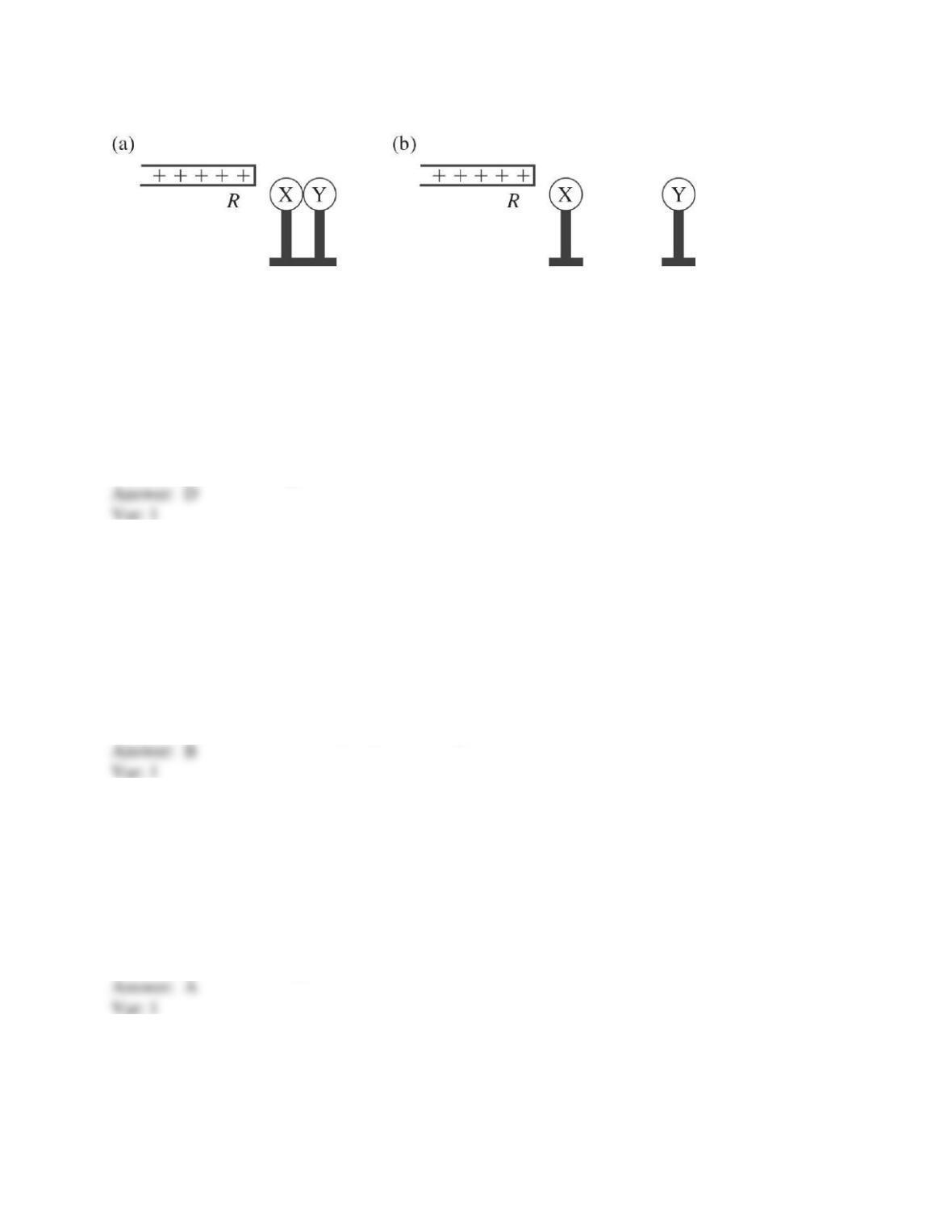
5)
X and Y are two initially uncharged metal spheres on insulating stands, and they are in contact
with each other. A positively charged rod R is brought close to X as shown in part (a) of the
figure. Sphere Y is now moved away from X, as shown in part (b). What are the final charge
states of X and Y?
A) Both X and Y are neutral.
B) X is positive and Y is neutral.
C) X is neutral and Y is positive.
D) X is negative and Y is positive.
E) Both X and Y are negative.
6) Two uncharged metal spheres, #1 and #2, are mounted on insulating support rods. A third
metal sphere, carrying a positive charge, is then placed near #2. Now a copper wire is
momentarily connected between #1 and #2 and then removed. Finally, sphere #3 is removed. In
this final state
A) spheres #1 and #2 are still uncharged.
B) sphere #1 carries positive charge and #2 carries negative charge.
C) sphere #1 carries negative charge and #2 carries positive charge.
D) spheres #1 and #2 both carry positive charge.
E) spheres #1 and #2 both carry negative charge.
7) A negatively-charged rod is brought close to (but does not touch) two neutral spheres that are
in contact with each other but insulated from the ground. If the two spheres are then separated,
what kind of charge will be on the spheres?
A) The sphere near the charged rod becomes positive and the other one becomes negative.
B) The sphere near the charged rod becomes negative and the other one becomes positive.
C) The spheres do not get any charge.
D) Both spheres become negative.
E) Both spheres become positive.

8) Two tiny beads are 25 cm apart with no other charges or fields present. Bead A carries 10 µC
of charge and bead B carries 1 µC. Which one of the following statements is true about the
magnitudes of the electric forces on these beads?
A) The force on A is 10 times the force on B.
B) The force on B is 10 times the force on A.
C) The force on A is exactly equal to the force on B.
D) The force on A is 100 times the force on B.
E) The force on B is 100 times the force on A.
9) Two very small plastic balls of equal mass are released from rest. One of them carries +10 µC
of excess charge and the other one carries +1µC of charge. No other charges or fields are present.
Which of the following statements are true about them as they move away from each other?
(There may be more than one correct choice.)
A) The acceleration of the 10-µC ball is 10 times that of the 1-µC ball.
B) The acceleration of the 1-µC ball is 10 times that of the 10-µC ball.
C) The balls always have accelerations of equal magnitude.
D) The speed of the balls keeps increasing.
E) The acceleration of the balls keeps increasing.
10) In outer space, a positive charge q is released near a positive fixed charge Q, as shown in the
figure. As q moves away from Q, what is true about the motion of q? (There may be more than
one correct choice.)
A) It will move with decreasing speed.
B) It will move with constant acceleration.
C) It will move with increasing acceleration.
D) It will move with decreasing acceleration.
E) It will move with increasing speed.
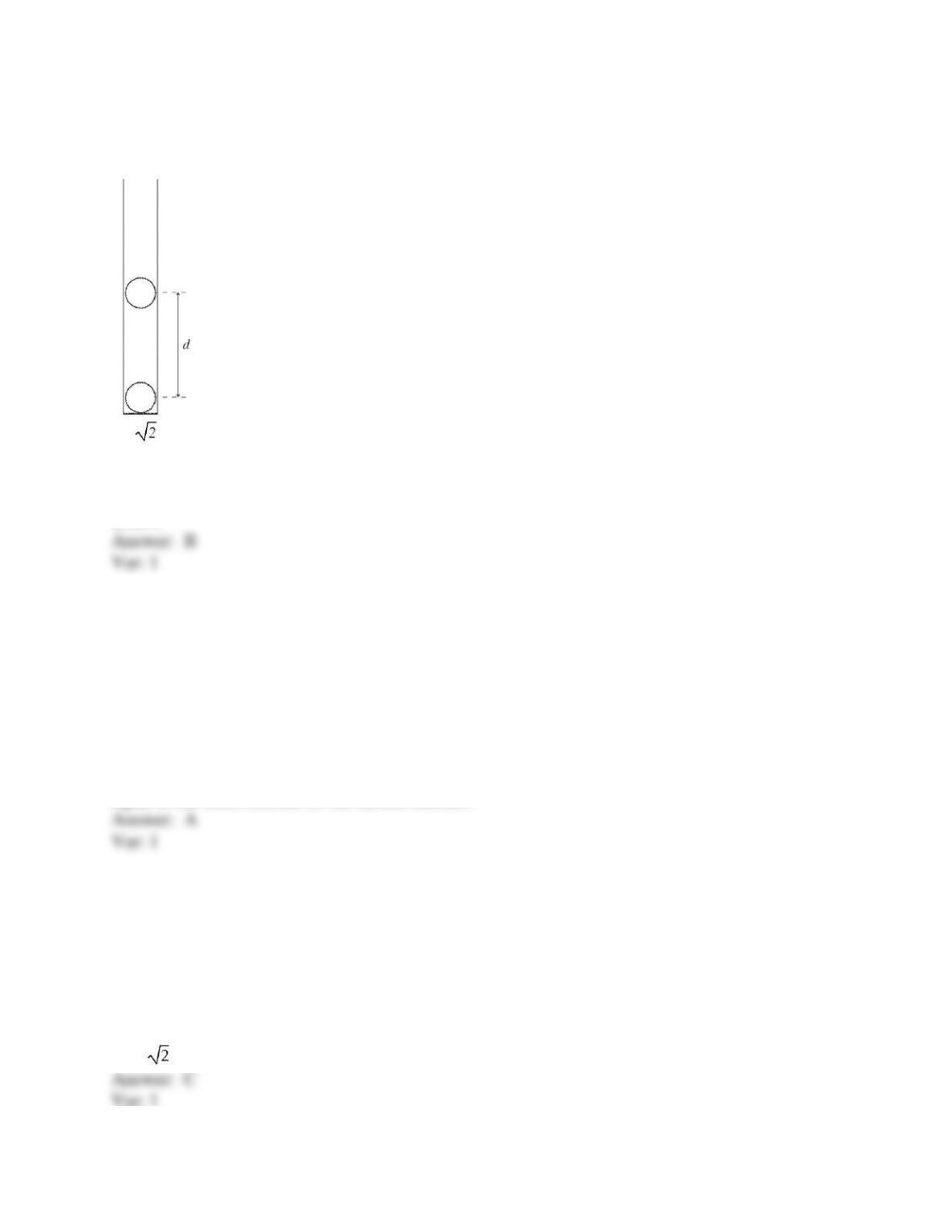
11) A small charged plastic ball is vertically above another charged small ball in a frictionless
test tube as shown in the figure. The balls are in equilibrium a distance d apart. If the charge on
each ball is doubled, the equilibrium distance between the balls in the test tube would become
A) d.
B) 2d.
C) 4d.
D) 8d.
E) d/4.
12) A hydrogen nucleus, which has a charge +e, is situated to the left of a carbon nucleus, which
has a charge +6e. Which statement is true?
A) The electrical force experienced by the hydrogen nucleus is to the left, and the magnitude is
equal to the force exerted on the carbon nucleus.
B) The electrical force experienced by the hydrogen nucleus is to the left, and the magnitude is
greater than the force exerted on the carbon nucleus.
C) The electrical force experienced by the hydrogen nucleus is to the left, and the magnitude is
less than the force exerted on the carbon nucleus.
D) The electrical force experienced by the hydrogen nucleus is to the right, and the magnitude is
equal to the force exerted on the carbon nucleus.
13) Two identical small charged spheres are a certain distance apart, and each one initially
experiences an electrostatic force of magnitude F due to the other. With time, charge gradually
diminishes on both spheres by leaking off. When each of the spheres has lost half its initial
charge, what will be the magnitude of the electrostatic force on each one?
A) 1/16 F
B) 1/8 F
C) 1/4 F
D) 1/2 F
E) 1/ F
14) Two point charges, Q1 and Q2, are separated by a distance R. If the magnitudes of both
charges are doubled and their separation is also doubled, what happens to the electrical force that
each charge exerts on the other one?
A) It increases by a factor of 2.
B) It increases by a factor of .
C) It is reduced by a factor of .
D) It increases by a factor of 4.
E) It remains the same.
15) Two point charges, Q1 and Q2, are separated by a distance R. If the magnitudes of both
charges are halved and their separation is also halved, what happens to the electrical force that
each charge exerts on the other one?
A) It increases by a factor of 16.
B) It increases by a factor of 8.
C) It increases by a factor of 2.
D) It increases by a factor of 4.
E) It remains the same.
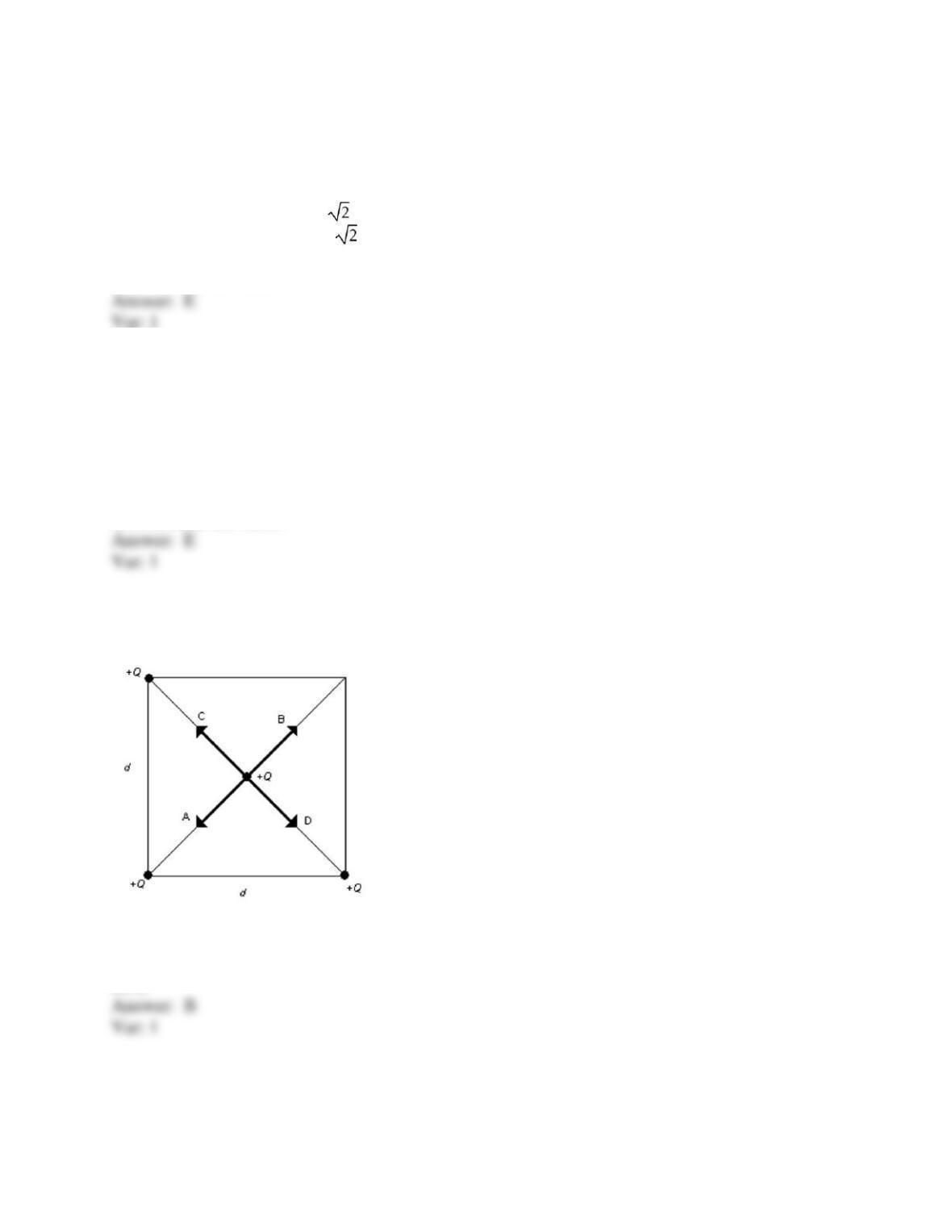
16) Three equal charges +Q are at three of the corners of a square of side d. A fourth charge +Q
of equal magnitude is at the center of the square as shown in the figure Which one of the arrows
shown represents the net force acting on the charge at the center of the square?
A) A
B) B
C) C
D) D
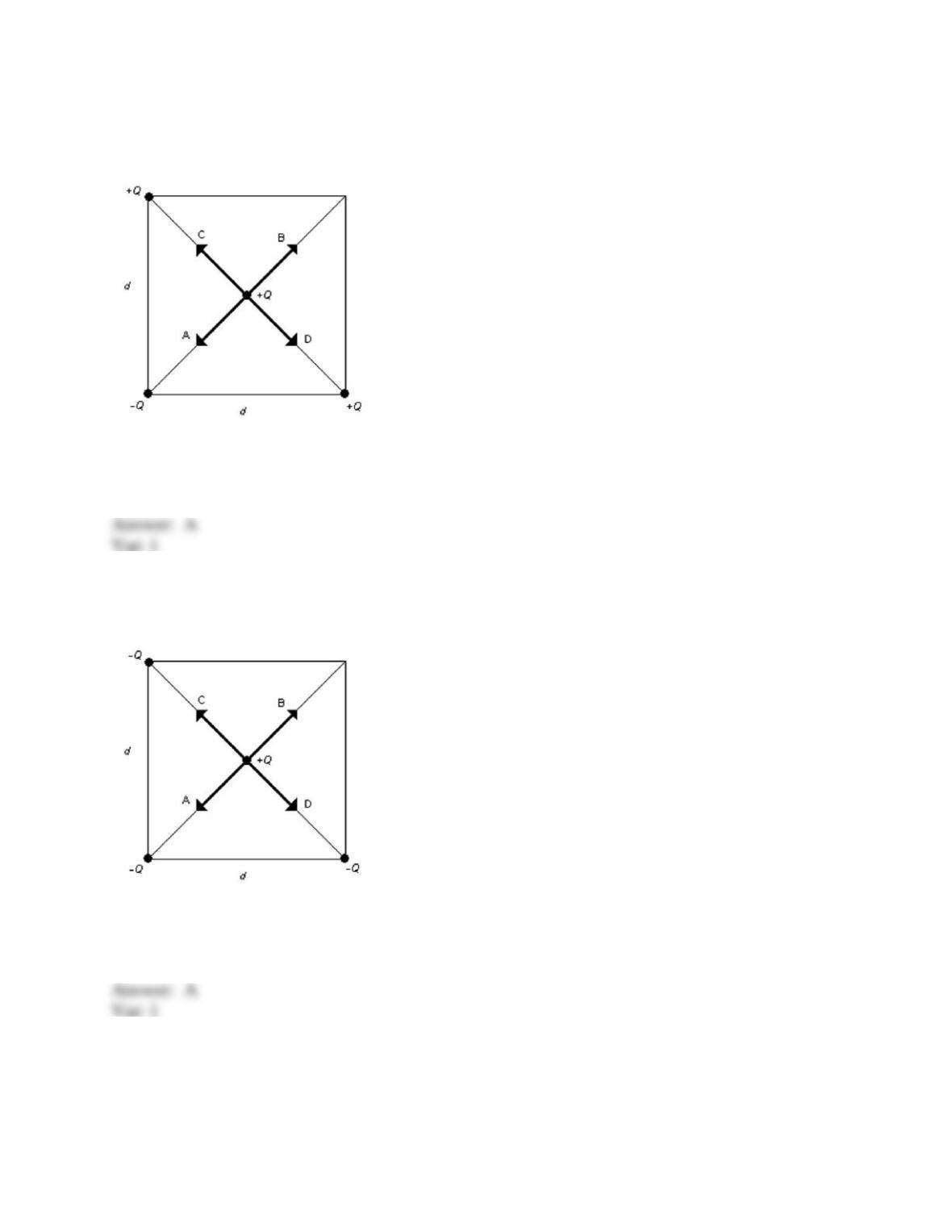
17) Four point charges of equal magnitudes but with varying signs are arranged on three of the
corners and at the center of the square of side d as shown in the figure. Which one of the arrows
shown represents the net force acting on the center charge?
A) A
B) B
C) C
D) D
18) Four point charges of equal magnitude but with varying signs are arranged on three of the
corners and at the center of the square of side d as shown in the figure. Which one of the arrows
shown represents the net force acting on the center charge?
A) A
B) B
C) C
D) D
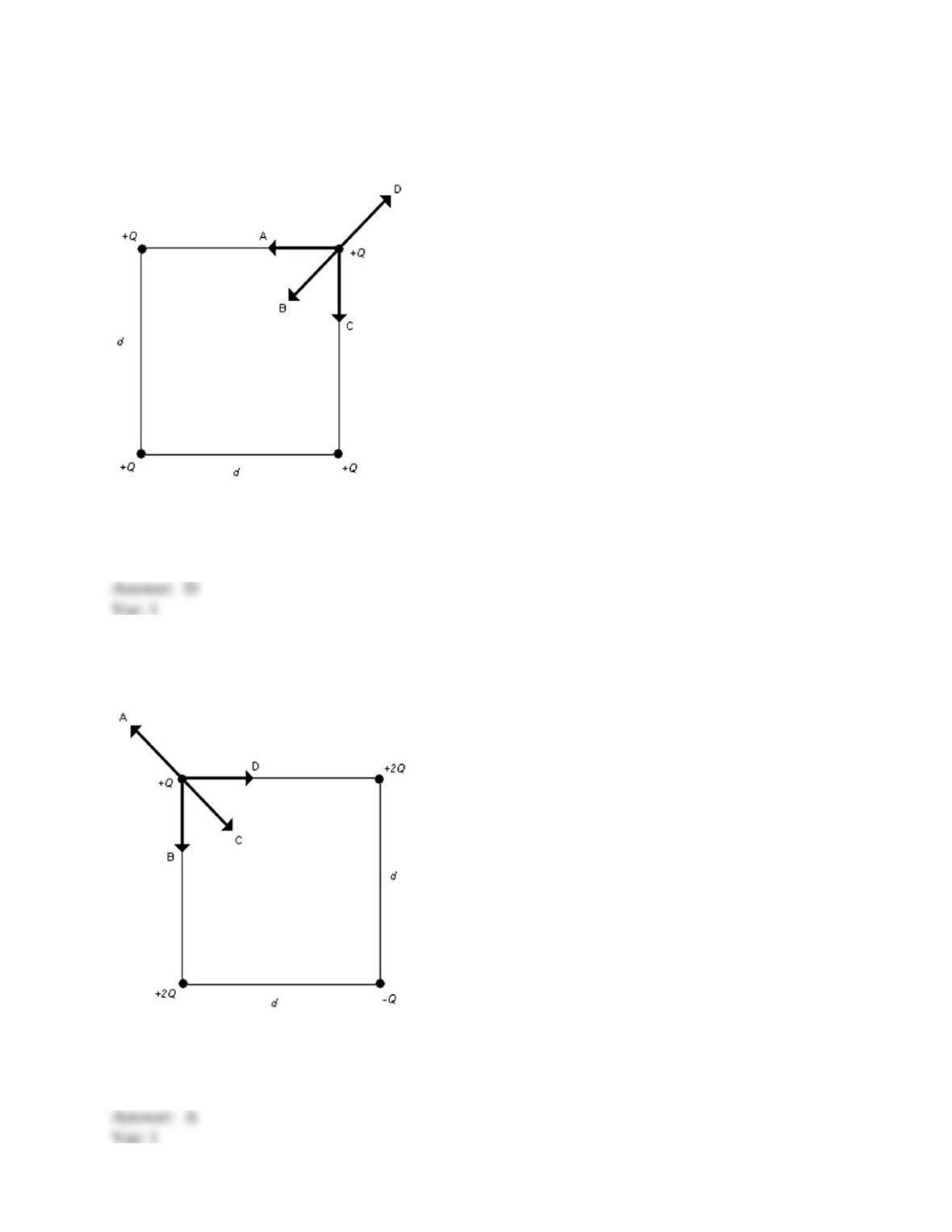
19) Four point charges Q of equal magnitude and sign are arranged on three of the corners of the
square of side d as shown in the figure Which one of the arrows shown represents the net force
acting on the charge at the upper right hand corner of the square?
A) A
B) B
C) C
D) D
20) Four point charges of varying magnitude and sign are arranged on the corners of the square
of side d as shown in the figure. Which one of the arrows shown represents the net force acting
on the point charge with a charge +Q?
A) A
B) B
C) C
D) D
21) An electron and a proton are released simultaneously from rest and start moving toward each
other due to their electrostatic attraction, with no other forces present. Which of the following
statements are true just before they are about to collide? (There could be more than one correct
choice.)
A) They are closer to the to the initial position of the electron that to the initial position of the
proton.
B) They are closer to the to the initial position of the proton that to the initial position of the
electron.
C) They are at the midpoint of their initial separation.
D) They both have the same speed.
E) The electrostatic force on the proton is greater than the electrostatic force on the electron.
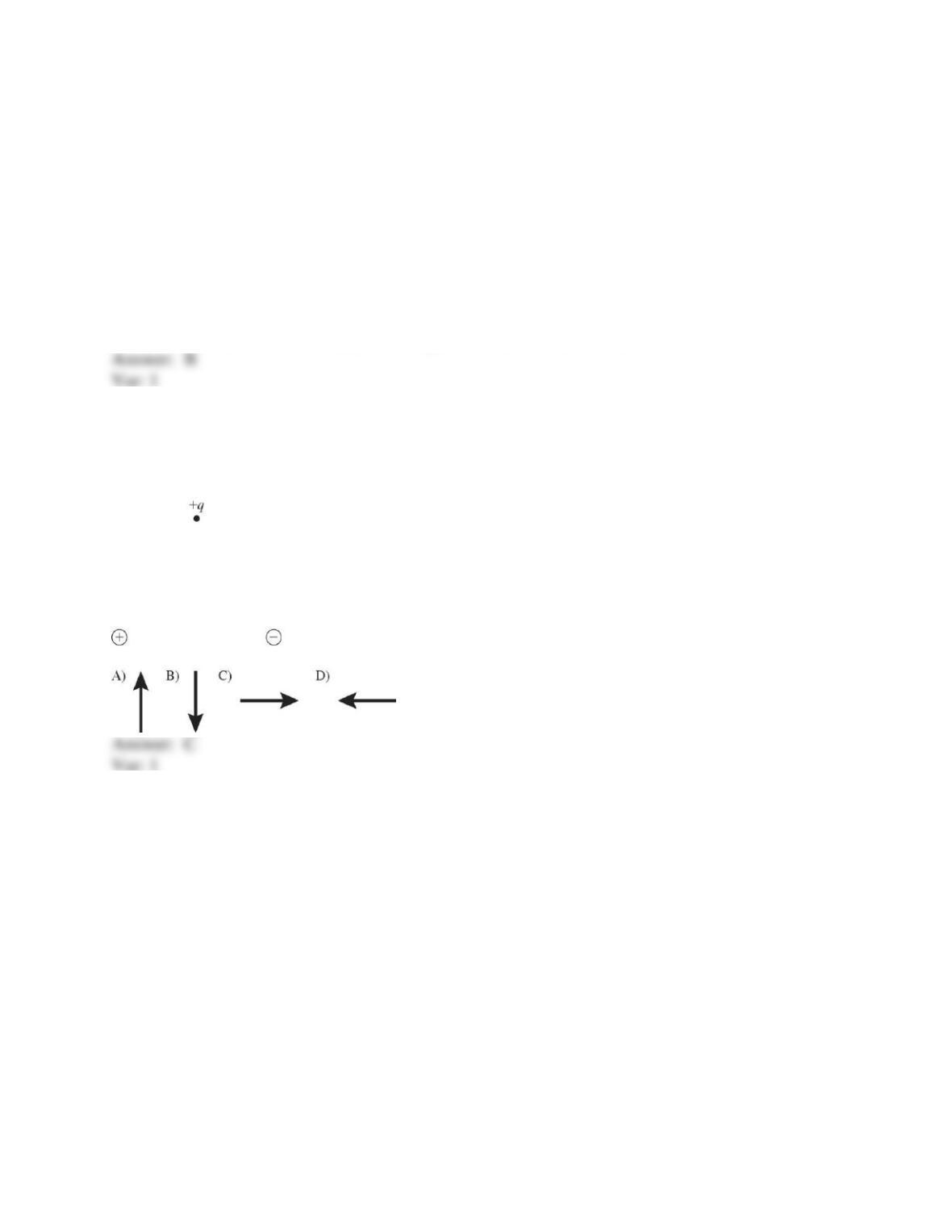
22) Two equal and opposite charges are a small distance apart, forming an electric dipole. A
positive charge +q is placed above these charges, as shown in the figure, equidistant from both of
them. Which diagram below best gives the direction of the net force the dipole exerts on the
charge +q?
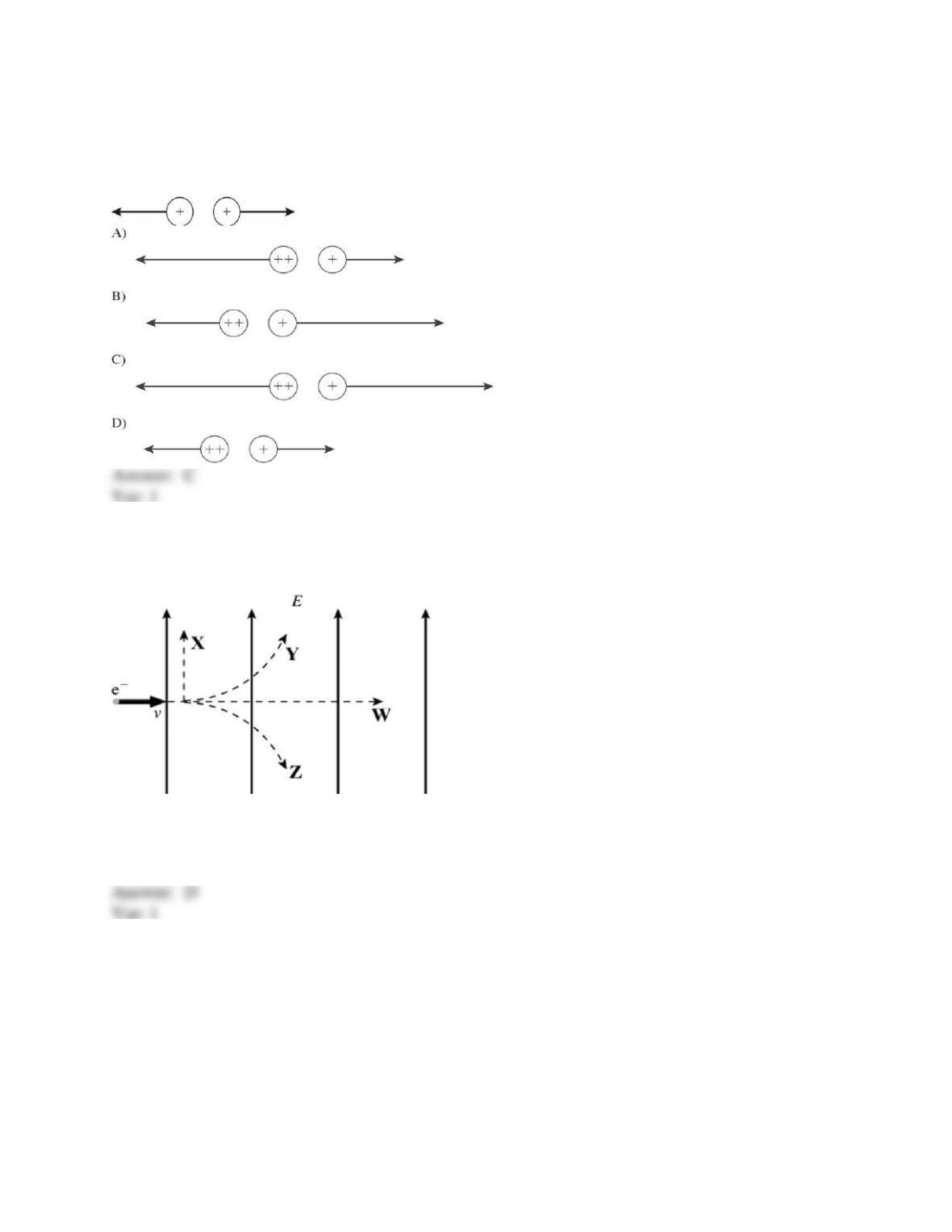
23) Two small identically charged balls are a certain distance apart. The vectors in the figure
show the magnitude and direction of the electrostatic force on each ball due to the other one.
Suppose that the charge on the left ball is now doubled (represented by two plus signs). Which
vector diagram below best represents the forces that now act on each of the two balls?
24) An electron is initially moving to the right when it enters a uniform electric field directed
upwards, as shown in the figure. Which trajectory (X, Y, Z, or W) will the electron follow in the
field?
A) trajectory W
B) trajectory X
C) trajectory Y
D) trajectory Z
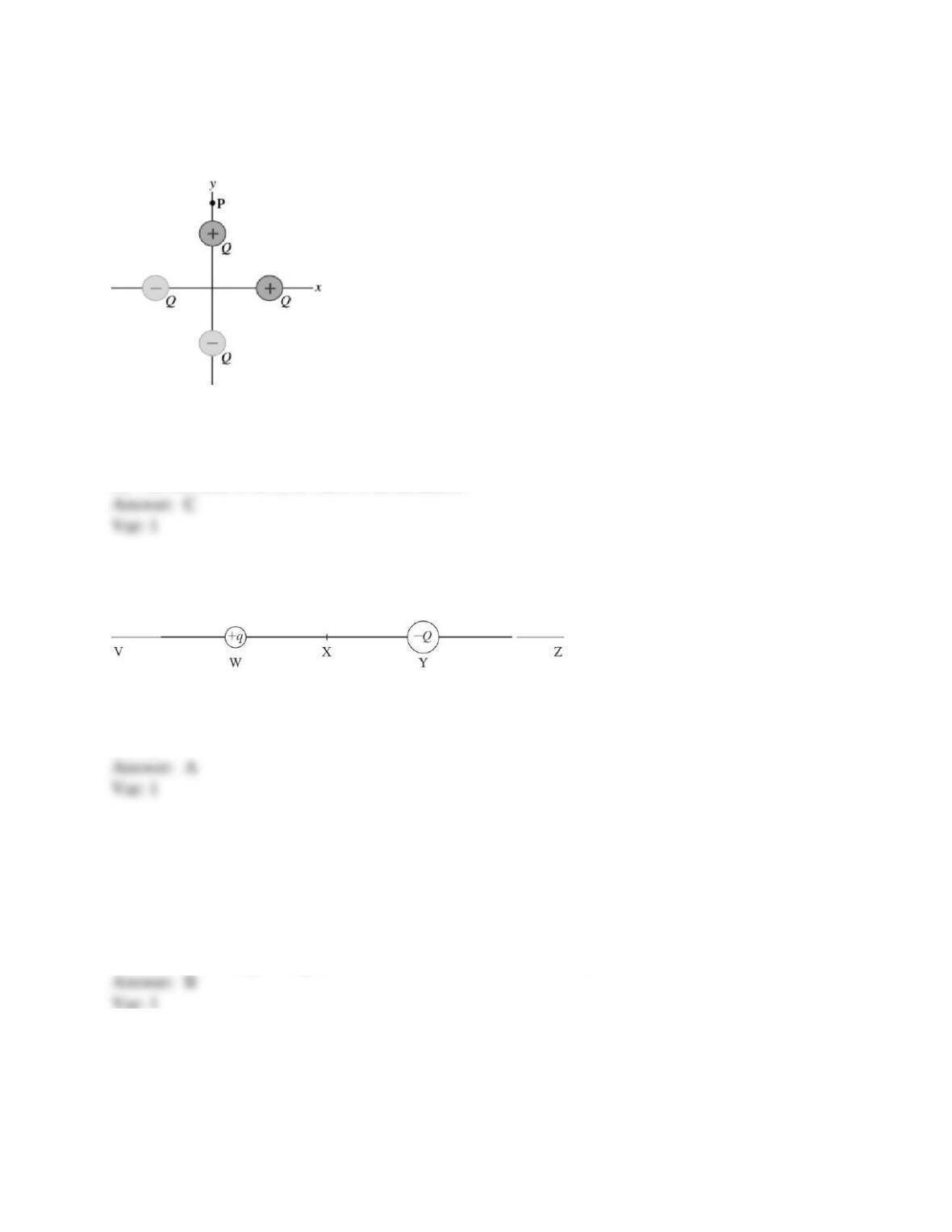
25) Four tiny charged particles (two having a charge +Q and two having a charge –Q) are
distributed on the x- and y-axes as shown in the figure. Each charge is equidistant from the
origin. In which direction is the net electric field at the point P on the y-axis?
A) directly up (in the +y direction)
B) directly left (-x direction)
C) upwards and towards the left
D) upwards and towards the right
E) The net field is zero, so there is no direction.
26) The figure shows two unequal charges, +q and –Q. Charge –Q has greater magnitude than
charge +q. Point X is midway between the charges. In what section of the line will there be a
point where the resultant electric field is zero?
A) VW
B) WX
C) XY
D) YZ
27) The electric field at point P due to a point charge Q a distance R away from P has magnitude
E. In order to double the magnitude of the field at P, you could
A) double the distance to 2R.
B) double the charge to 2Q.
C) reduce the distance to R/2.
D) reduce the distance to R/4.
E) double the charge to 2Q and at the same time reduce the distance to R/2.
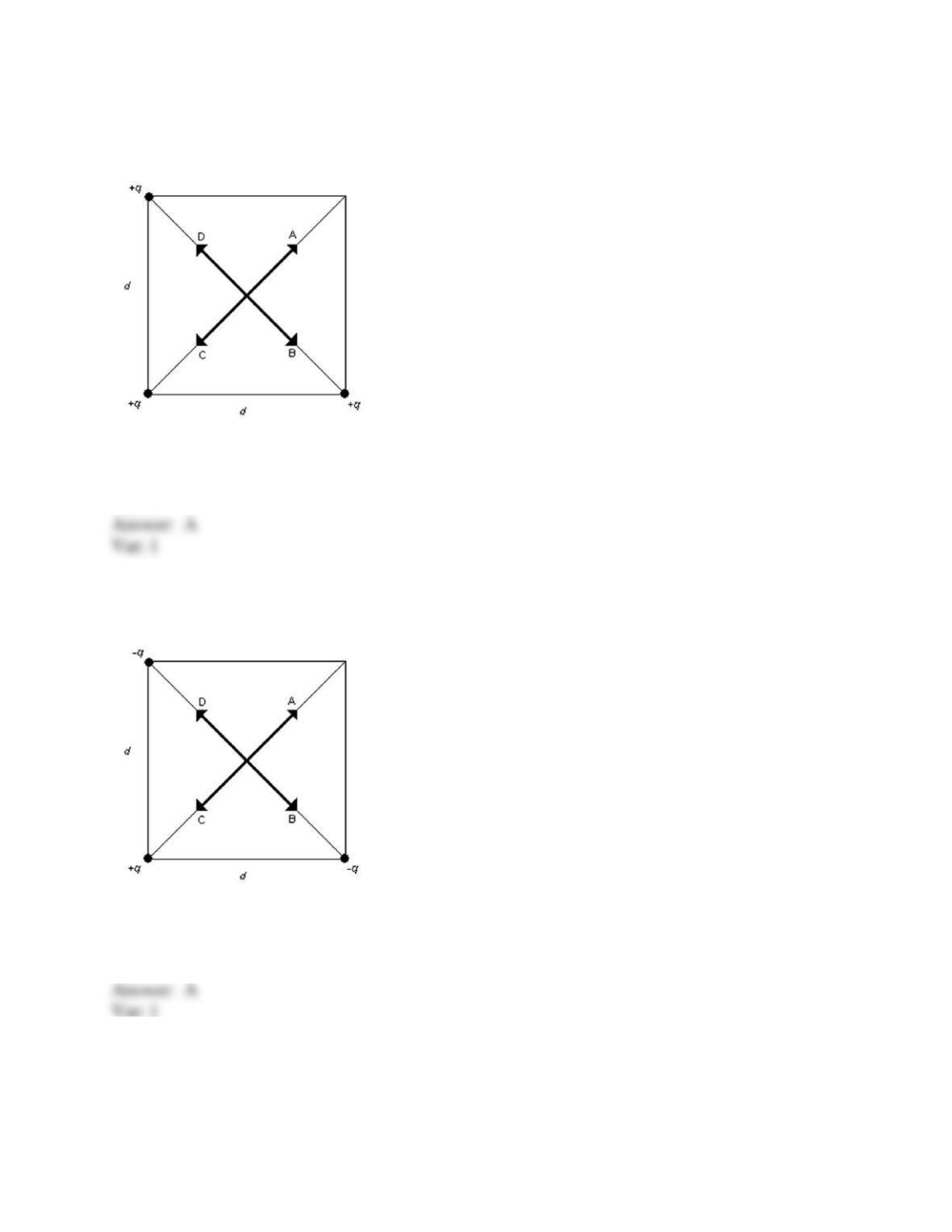
28) Three equal positive point charges +q are placed at the corners of a square of side d as shown
in the figure. Which one of the arrows shown represents the direction of the net electric field at
the center of the square?
A) A
B) B
C) C
D) D
29) Three equal-magnitude point charges of varying signs are placed at the corners of a square of
side d as shown in the figure. Which one of the arrows shown represents the direction of the net
electric field at the center of the square?
A) A
B) B
C) C
D) D
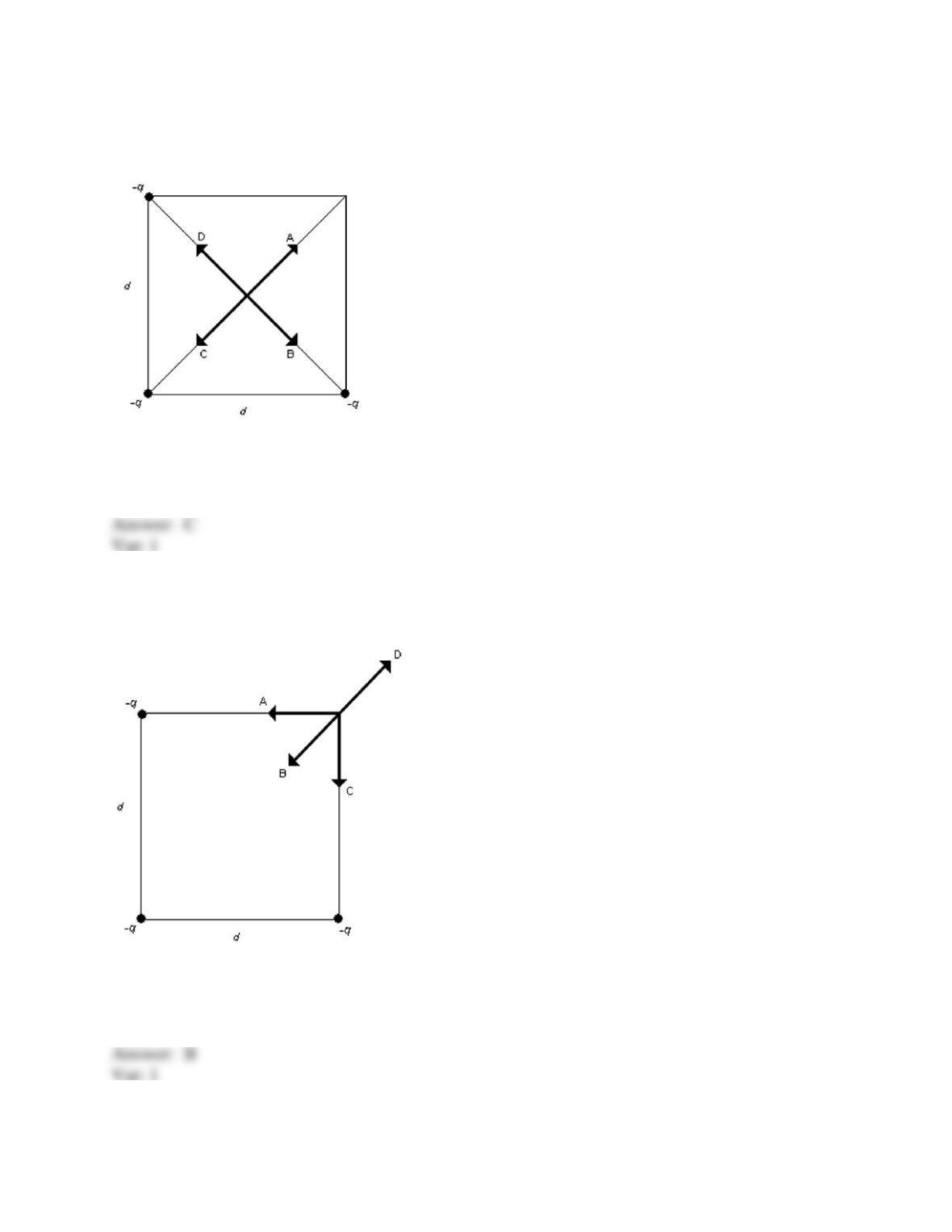
30) Three equal negative point charges –q are placed at three of the corners of a square of side d
as shown in the figure. Which one of the arrows shown represents the direction of the net electric
field at the center of the square?
A) A
B) B
C) C
D) D
31) Three equal negative point charges –q are placed at three of the corners of a square of side d
as shown in the figure. Which one of the arrows shown represents the direction of the net electric
field at the vacant corner of the square?
A) A
B) B
C) C
D) D
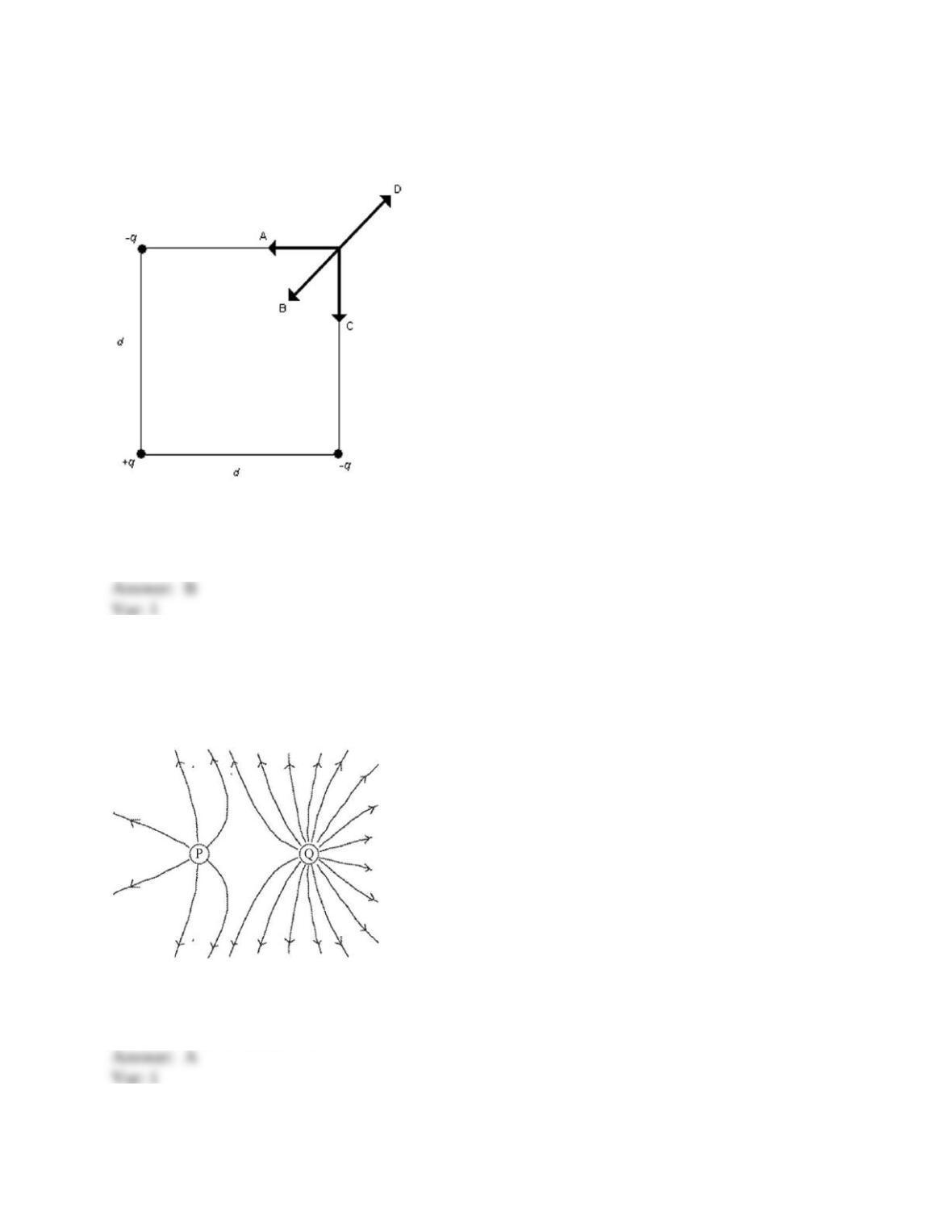
32) Three equal-magnitude point charges of varying signs are placed at three of the corners of a
square of side d as shown in the figure. Which one of the arrows shown represents the direction
of the net electric field at the vacant corner of the square?
A) A
B) B
C) C
D) D
33) The figure shows electric field lines arising from two small charged particles P and Q.
Consider the following two statements:
(i) The charge on P is smaller than the charge on Q.
(ii) The electrostatic force on P is smaller than the force on Q.
Which of the above statements are true?
A) Only (i) is true.
B) Only (ii) is true.
C) Both (i) and (ii) are true.
D) Neither (i) nor (ii) is true.
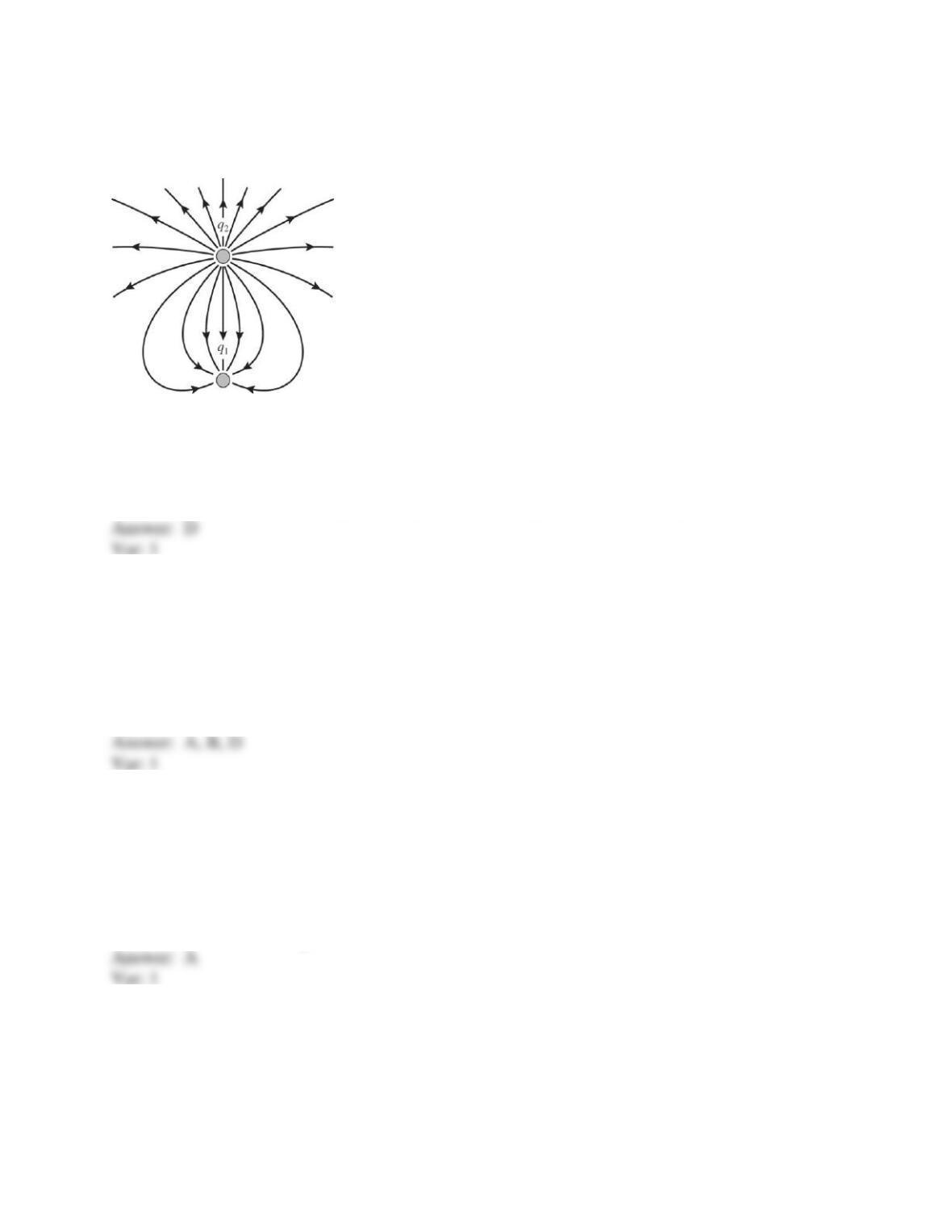
34) Two stationary point charges q1 and q2 are shown in the figure along with a sketch of some
field lines representing the electric field produced by them. What can you deduce from the
sketch?
A) q1 is negative and q2 is positive; the magnitudes are equal.
B) q1 and q2 have the same sign; the magnitudes are equal.
C) q1 is positive and q2 is negative; the magnitude of q1 is greater than the magnitude of q2.
D) q1 is negative and q2 is positive; the magnitude of q1 is less than the magnitude of q2.
E) q1 and q2 have the same sign; the magnitude of q1 is greater than the magnitude of q2.
35) A conductor is placed in a steady external electric field. Which of the following statements
are correct for this situation? (There could be more than one correct choice.)
A) The electric field is zero inside the conductor.
B) All the free electrons go to the surface of the conductor.
C) The surface of the conductor is neutral.
D) The electric field just outside the surface of the conductor is perpendicular to the surface.
E) None of the above statements are correct.
36) A solid aluminum cube rests on a wooden table in a region where a uniform external electric
field is directed straight upward. What can we say concerning the charge on the top surface of
the cube?
A) The top surface is charged positively.
B) The top surface is charged negatively.
C) The top surface is neutral.
D) The top surface’s charge cannot be determined without further information.
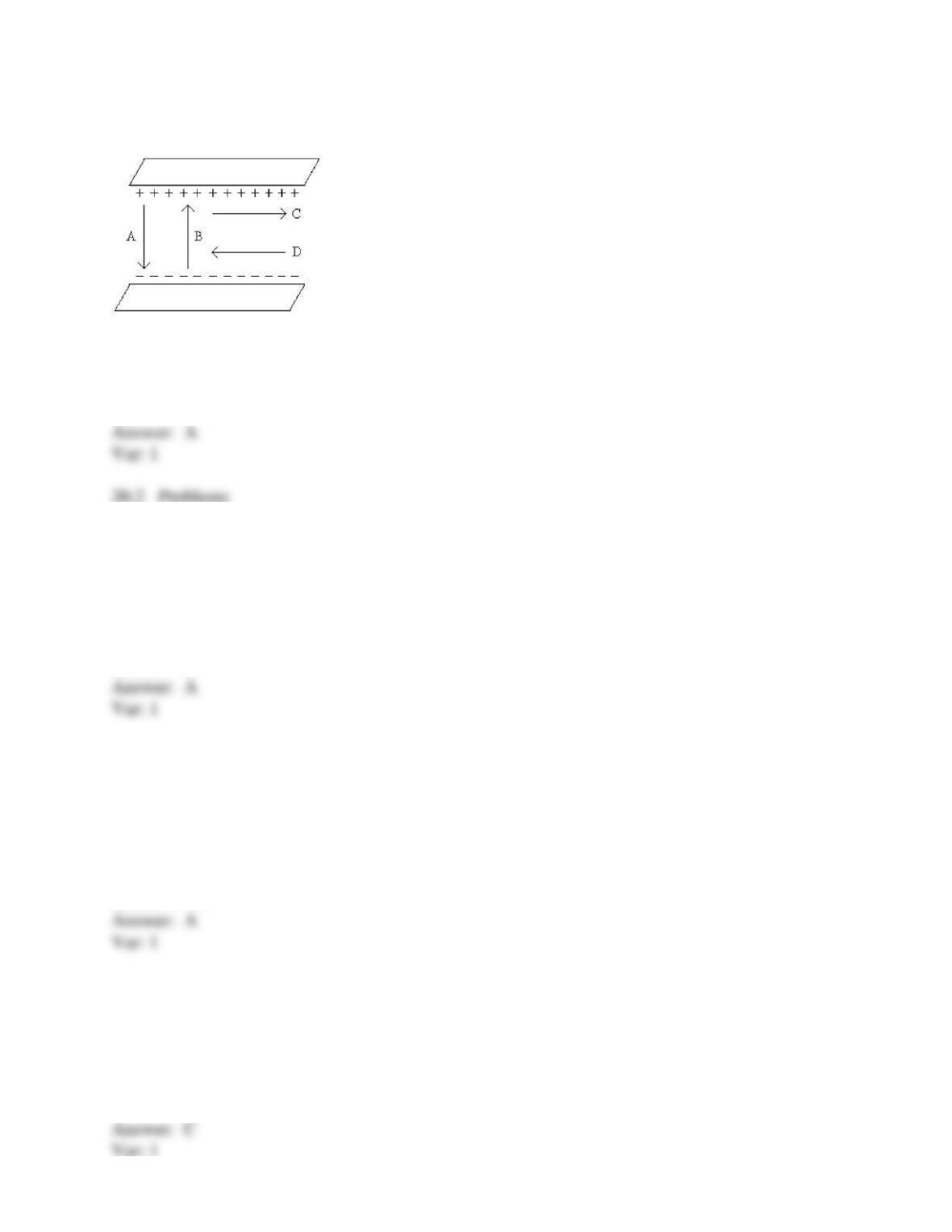
37) Which one of the arrows shown in the figure best represents the direction of the electric field
between the two uniformly charged metal plates?
A) A
B) B
C) C
D) D
E) None of the above
1) How many electrons are necessary to produce 1.0 C of negative charge? (e = 1.60 × 10⁻¹⁹ C)
A) 6.3 × 10¹⁸
B) 6.3 × 10⁹
C) 1.6 × 10¹⁹
D) 1.6 × 10⁹
E) 6.0 × 10²³
2) A piece of plastic has a net charge of +2.00 μC. How many more protons than electrons does
this piece of plastic have? (e = 1.60 × 10⁻¹⁹ C)
A) 1.25 × 10¹³
B) 1.25 × 10¹⁹
C) 2.50 × 10¹³
D) 2.50 × 10¹⁹
E) 3.01 × 10²³
3) What is the charge on 1.0 kg of protons?(e = 1.60 × 10⁻¹⁹ C, mproton = 1.67 × 10⁻²⁷ kg)
A) 1.0 C
B) 1000 C
C) 9.6 × 10⁷ C
D) 6.0 × 1026 C
E) 6.0 × 10²³ C