
Chapter 2—The Accounting Information System Key
1. The time-period assumption assumes that a company prepares its financial statements every month.
2. Because it tends to provide the most reliable measure of activity, all assets are reported on the balance sheet
at their fair market values.
3. The term used to refer to an asset’s original cost is book value.
4. The going concern assumption infers that a company will continue to operate into the near future.
5. A company in the process of liquidation is considered to be under the going concern assumption.
6. The International Accounting Standards Board (IASB) was created in order to develop worldwide accounting
standards that are required for all financial statements, regardless of the country where the financial statements
were prepared.
7. The initial step in the recording process is sometimes referred to as journalizing.
8. The issuance of common stock increases a company’s assets and stockholders’ equity.

9. The payment of a dividend increases both cash and stockholders’ equity of the distributing entity.
10. According to the historical cost principle, assets are always carried at their current market value.
11. An accounting transaction may impact only one financial statement or multiple statements.
12. The accounting equation must balance before and after every accounting transaction.
13. A chart of accounts is prepared to determine whether the books have gotten out of balance.
14. GAAP has established a universal chart of accounts that is applicable to all businesses in the United States.
15. A T-account for Cash cannot contain any credits.
16. A debit entry increases assets and revenue accounts.
17. The dividends account has a normal debit balance.
18. Under the double-entry system of accounting, every transaction is entered in at least two accounts on
opposite sides of a T-account.

19. Under the double-entry system of accounting, a debit is always a negative entry.
20. Income statement accounts have normal credit balances.
21. Only events that can be measured with sufficient reliability will be recognized in the accounting system.
22. The general ledger is an example of a book of original entry.
23. The general ledger is often used for the initial recording of repetitive transactions.
24. A trial balance is the listing of each active account and its corresponding debit or credit balance at a
particular point in time.
25. Even though a trial balance reveals that the debits equal the credits, there still may be errors in the
company’s books.
26. The purchase of office supplies from a supplier is an example of an external event.
27. The conservatism principle is concerned with the possibility of understating assets or income.

28. A full disclosure policy stipulates that all information that would make a difference to financial statement
users should be revealed.
29. If a company performed services for credit, then the debit side of the journal entry would be to Accounts
Payable and the credit would be to Service Revenue.
30. If a company made a payment on account, then assets and liabilities would both decrease.
31. The various rules and conventions that have evolved over time to guide the preparation of financial
statements in the U.S. are called ____________________.
32. The concept that assumes that assets are recorded at the amount to acquire them is called the
____________________ principle.
33. The concept that assumes that an entity is not in the process of bankruptcy is called the ___________
concept.
34. The ____________________ is the U.S. federal government agency with the ultimate authority to
determine the accounting rules for companies whose stock is sold to the public.
35. The ____________________ is the private sector group with authority to set accounting standards in the
United States.

36. ____________________ is the magnitude of an omission or misstatement in accounting information that
will influence the decision of someone relying on the information.
37. ____________________ is the capacity of information to make a difference in a decision by helping make
timely predictions or provide timely feedback.
38. When preparing the financial statements, the accountant must estimate the balances of certain accounts.
When two possible estimates are available and when these estimates are about equally likely, the accountant’s
prudent reaction is to select the least optimistic estimate in terms of the recorded amounts of assets or income
statement accounts. This is referred to as the principle of ____________________.
39. ____________________ is the quality of accounting information that makes it dependable in representing
the events that it purports to represent.
40. ____________________ is the quality of accounting information that allows a user to analyze two or more
companies and look for similarities and differences.
41. ____________________ is the quality of accounting information that allows a user to compare two or more
accounting periods for a single company.
42. In order for an internal or external event to be recognized in an accounting system, the items making up the
event must impact the financial statements and they must be sufficiently reliable and ____________________.
43. ____________________ documents provide the evidence needed in an accounting system to record a
transaction.

44. The issuance of common stock increases both ____________________ and stockholders’ equity.
45. Borrowing from the bank in order to acquire computer equipment for $1,500 has the effect of increasing
both assets and ____________________.
46. If a law firm provides services on account for its clients, both ____________________ and retained
earnings will increase.
47. The payment of salaries to employees will result in a debit to an expense account and a credit to the
___________ account.
48. The ____________________ principle says that assets of a company are initially recorded at their original
cost.
49. The ____________________ is a list of all the accounts used by an entity.
50. The ____________________ is the file or book that contains all of the company’s accounts.
51. The ____________________ side, or left-side, of a liability account is used to record decreases in the
account balance.
52. For assets, expenses, and dividend accounts, a credit will _______ the balance in the account.

53. For liabilities, stockholders’ equity, and revenue accounts, debits will _____________ the account balance.
54. Credits are always on the ____________________ side of a T-account.
55. A revenue account has a normal ___________ balance.
56. The ___________________ is a chronological record of all transactions entered into by a business.
57. The ___________________ is a list of each active account and its debit or credit balance at a specific point
in time.
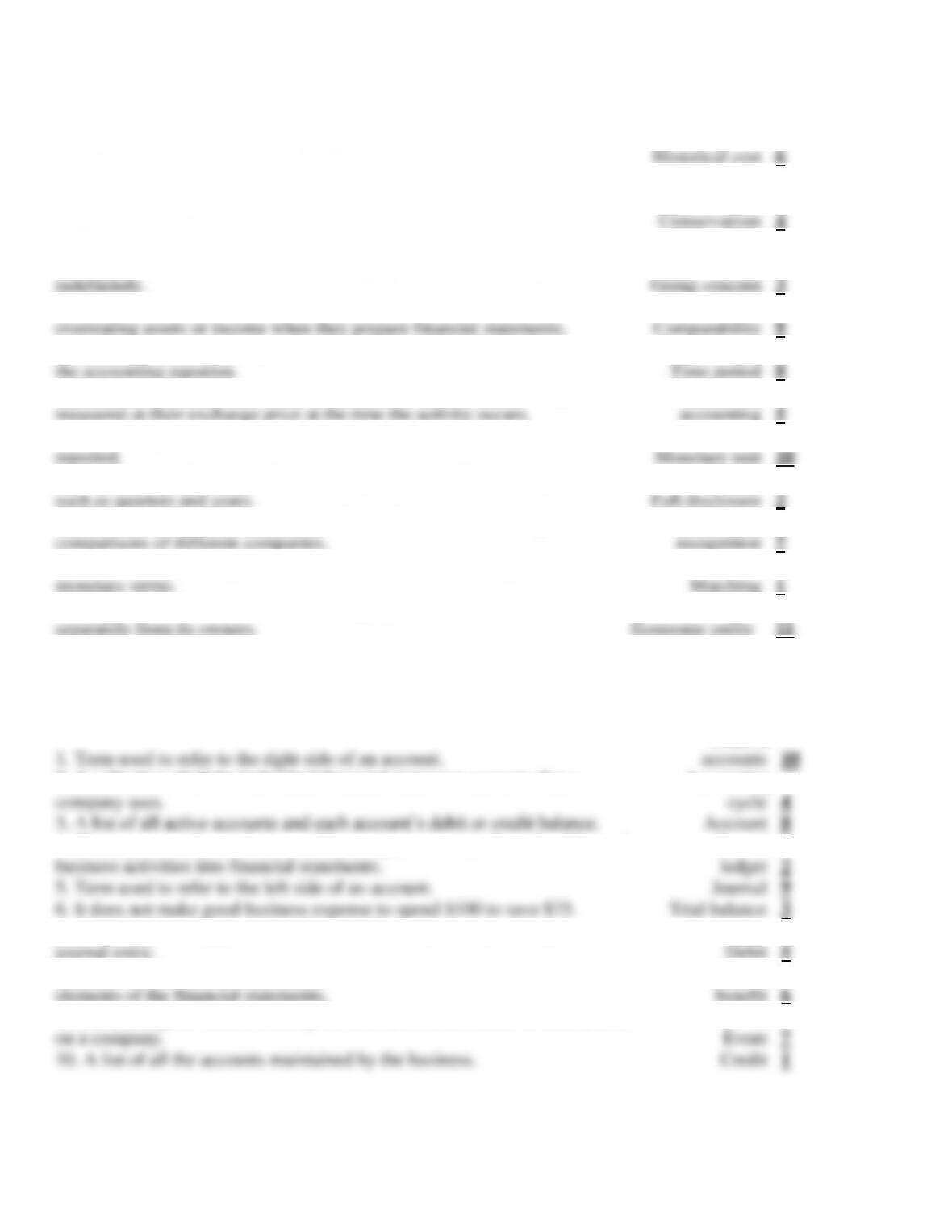
58. Match the following principles with their correct definition.
1. This principle requires that an expense be recorded and reported in the
same period as the revenue it helped generate.
2. Any information that would make a difference to financial statement
users should be reported.
3. This assumption states that in the absence of information to the
contrary, it should be assumed that a company will continue to operate
4. This principle states that accountants should take care to avoid
5. The system used by companies to record the effects of transactions on
6. This principle requires that the activities of a company be initially
Double-entry
7. This principle is used to determine when revenue is recorded and
8. This principle divides the life of a company into artificial time periods
9. This principle states that users should be able to make meaningful
Revenue
10. This assumption requires that financial information be reported in
11. This assumption states that each company will be accounted for
59. Match the following terms with their correct definition.
Chart of
2. A collection of all the individual financial statement accounts that a
Accounting
4. The sequence of procedures used by companies to transform the effects of
General
7. Something that happens to the business that may or may not require a
8. A device used to record increases and decreases in each of the basic
Cost vs.
9. A chronological record showing the debit and credit effects of transactions
60. Which of the following statements is true regarding economic events?
61. Which of the following underlying assumptions for the conceptual framework is the reason the dollar is
used in the preparation of financial statements?
62. Which of the following is an assumption made in the preparation of the financial statements?
63. The time-period assumption is necessary because
64. Which of the following statements is true concerning assets?
65. Homevestors purchased land for $400,000 in 2001. In 2013, an independent appraiser assessed the value of
the land at 900,000. At what amount should the land be recorded on the company’s 2013 financial statements?
66. Which of the following organizations is primarily responsible for establishing GAAP in the United States?
67. The Securities Exchange Commission (SEC) is concerned with
68. Which organization has the power to set accounting rules for companies whose stock is publicly-traded in
the U.S. stock markets, but has delegated its power to another organization?
69. In order for accounting information to be useful in making informed decisions, it must be
70. Which of the following is a constraint to the qualitative characteristics of useful accounting information?
71. The principle of conservatism is concerned with
72. The going concern assumption is concerned with
73. Which of the following statements is false with respect to the qualitative characteristics of useful accounting
information?
74. Which of the following is an internal event?
75. All of the following are external events except:
76. Which of the following is an internal event for a business entity?
77. Which of the following statements is true?
78. Which of the following statements is false regarding the use of source documents?
79. The purchase of office equipment on credit has what effect on the accounting equation?
80. The payment of employee salaries has what effect on the accounting equation?
81. During March, Honeybaked Spam purchased supplies for cash. The supplies will be used in April. What
effect does this transaction have on the accounting equation at the time the supplies are purchased?
82. High Point Furniture Company manufactures furniture. The company has applied for a sizeable loan to
expand its operations. Based on the company’s annual report, the loan officer concludes that High Point is very
profitable and appears to have a strong financial position. However, watching the nightly news on television
that evening, the banker discovers that High Point is a defendant in a class action lawsuit related to defective
products. Serious injuries were allegedly caused by the company’s infant high chairs overturning. The television
news report is an example of financial information that is
83. If an investor can use accounting information for two different companies to evaluate the types and amounts
of expenses, the information is said to have the quality of
84. Hunsinger Enterprises purchases many small pieces of office furniture, such as trash cans, that cost less than
$100 each. The company accounts for these items as expenses when acquired rather than reporting them as
property, plant, and equipment on its balance sheet. The company’s accountant states that no accounting
principle has been violated. Justification for expensing these furniture items is based on cost vs. benefit
considerations as well as the accounting constraint of
85. A company follows the qualitative characteristic of consistency. This means that
86. Information that is material means that an error in recording the dollar amount of a transaction would
87. An accountant is uncertain about the best estimate of an amount for a business transaction. If there are two
possible amounts that could be recorded, the amount least likely to overstate assets and earnings is selected.
Which of the following qualities is characterized by this action?
88. The qualitative characteristics of accounting information include
89. A novelties company makes cash sales to customers. What effect does this transaction have on the
accounting equation?
90. Two friends decide to launch a new business by investing $25,000 each in Hot Spot Tanning. They are
given shares of stock as evidence of their ownership interest. What effect does this transaction have on the
accounting equation?
91. Machinery is purchased on credit. What effect does this transaction have on the accounting equation?
92. A company provided services to customers then sent them invoices for the amounts owed. What effect does
this transaction have on the accounting equation?
93. Hypnosis Institute received payments from customers who had been billed earlier for services provided.
What effect does this transaction have on the accounting equation?
94. Payment is made for machinery purchases previously on credit. What effect does this transaction have on
the accounting equation?
95. The telephone bill for the current period is received and recorded, but payment will be made later. What
effect does this transaction have on the accounting equation?
96. Payment is made for the telephone bill which was recorded previously. What effect does this transaction
have on the accounting equation?
97. Services are provided for customers who pay for their services immediately. What effect does this
transaction have on the accounting equation?
98. Dividends are declared and paid to the company’s stockholders. What effect does this transaction have on
the company’s accounting equation?
99. When a firm borrows money, one effect on the accounting equation is a(n)
100. Which of the following statements best describes the effects of recognizing revenue earned by a business
entity?
101. Which of the following best describes one effect of recognizing expenses incurred by a business entity?
102. Which of the following statements regarding a company’s operating activities is true?
103. Which of the following transactions does not affect total assets?
104. Which of the following transactions affects total liabilities?
105. A company purchased equipment for $150,000 cash. What is the effect on total assets?
106. A consulting firm provided services last month and billed its client. This month, the company received
payment from the customer. What impact does this month’s transaction have on the firm’s working capital?
107. A company’s current ratio is 2.00. If the company makes a payment on account, what is the effect on the
current ratio?
108. A company’s current ratio is 1.5, what is the effect of obtaining land by issuing shares of stock?
109. A list of all asset, liability, stockholders’ equity, revenue, expense, and dividend accounts which are used
by the company is called a(n)
110. The two-column record used to accumulate monetary increases and decreases for individual assets,
liabilities, stockholders’ equity, revenue, expense, and dividends items is a(n)
111. The chronological record in which transactions are initially recorded in the order in which they occur is
called a(n)
112. A list of all active accounts and their balances at a particular date, which is used to prove the equality of
debits and credits, is a
113. The process of transferring amounts from the book of original entry into specific account records is
referred to as
114. The correct term for the entry made on the left side of a T-account is
115. The term for the process of recording business events in a book of original entry is
116. The system of accounting in which there are at least two accounts affected in every transaction so that the
accounting equation stays in balance is called
117. A credit means
118. When the amount for a debit entry in a journal is transferred to a specific account in the general ledger, it
must be posted as a
119. An entry made to the right side of an account is always a(n)
120. An abbreviated version of an account, which is useful for analyzing the effects of business events, is the
121. Debit entries are used to
122. Credit entries are used to
123. Which of the following accounts is decreased by a debit entry?
124. Which of the following accounts is decreased by a debit entry?
125. Which of the following accounts is increased by a debit entry?