Chapter 2: Financial Statements and the Annual Report
84. During its fifth year of operations, Bright Creations Company reports a beginning cash balance of $132,000, cash
inflows from investing activities of $210,000, cash outflows for financing activities of $79,000, and cash outflows for
operating activities of $13,000. What was Bright Creations’ cash balance at the end of the fifth year?
a. $250,000
b. $434,000
c. $276,000
d. $132,000
85. Which of the following best describes a company’s financing activities?
a. Financing activities focus on the sale of products and services.
b. Financing activities include selling products.
c. Financing activities enable a company to acquire assets needed to run a business.
d. Financing activities are represented by the revenues and expenses on the income statement.
86. Which of the following best describes a company’s operating activities?
a. Operating activities focus on the sale of products and services.
b. Operating activities are necessary to provide the money to start a business.
c. Operating activities are needed to provide the valuable assets required to run a business.
d. Operating activities represent the right to receive a benefit in the future.
87. Which one of the following is an investing activity of a business?
a. Paying for purchases of inventory
b. Issuing stock for cash
c. Borrowing money from a bank.
d. Purchasing a manufacturing plant for cash
88. Which one of the following is a financing activity of a business?
a. Paying for purchases of inventory
b. Issuing stock for cash
c. Paying salaries
d. Purchasing a manufacturing plant
Chapter 2: Financial Statements and the Annual Report
89. Which one of the following is an operating activity of a business?
a. Paying for purchases of inventory
b. Issuing stock for cash
c. Borrowing money from a bank
d. Purchasing a manufacturing plant.
90. Which of the following represents the correct sequence of the three business activities on the Statement of Cash
Flows?
a. Financing – Operating – Investing
b. Investing – Operating – Financing
c. Operating – Investing – Financing
d. Financing – Investing – Operating
91. Business entities generally carry on:
a. operating, investing, and financing activities.
b. operating activities, but only corporations engage in financing and investing activities.
c. investing and operating activities, but only corporations engage in financing activities.
d. either investing or financing activities, but not both.
92. Although businesses engage in a wide variety of activities, all of these activities can be categorized into three types.
Which of the following choices best reflects these three types of business activities?
a. Operating, financing, reporting
b. Investing, reporting, financing
c. Operating, financing, investing
d. Investing, reporting, operating
93. As used in accounting, the “Notes to the Financial Statements” should be:
a. listed with the liabilities on the balance sheet.
b. omitted at the option of the company.
c. included as an integral part of the financial statements.
d. reported as expenses on the Income Statement.
Chapter 2: Financial Statements and the Annual Report
94. Which of the following items will be found in a corporate annual report?
a. Company budgets
b. Notes to the financial statements
c. Selected financial data from competitor companies
d. Management’s statement that the auditors are responsible for the financial statements.
95. Which one of the following sections is least likely to be found in a corporate annual report?
a. Notes to the Financial Statements
b. Forecasts of Cash Flows and Earnings
c. Report of the Independent Accountants
d. Management’s Discussion and Analysis
96. Supplementary disclosures required by GAAP that help explain detail behind the accounting treatment of certain
items in the financial statements is most likely found in which of the following sections of a corporate annual report?
a. Report of the Independent Accountants
b. Notes to the Financial Statements
c. Management’s Discussion and Analysis
d. Balance Sheet
97. An investor found the following in an annual report: “The financial statements, in our opinion, present fairly the
financial position, operating results, and cash flows, in conformity with accounting principles generally accepted
in the United States.” In which section of the annual report did the investor find this?
a. Balance Sheet
b. Notes to the Financial Statements
c. Management’s Discussion and Analysis
d. Report of the Independent Accountants
98. Which of the following represents one of the purposes of the notes to financial statements?
a. To provide a place for management to justify questionable items in the statements.
b. To provide comparative ratios for the company’s financial data.
c. To provide the CPA‘s opinion of the fairness of the financial statements.
d. To satisfy the need for full disclosure of all the facts relevant to a company‘s results and financial position.
Chapter 2: Financial Statements and the Annual Report
99. Financial statements are intended to tell the reader the value of a company.
a. True
b. False
100. Accountants are the main reason financial statements are prepared.
a. True
b. False
101. The Financial Accounting Standards Board defined the objectives of financial reporting.
a. True
b. False
102. The purpose of financial reporting is to provide economic information to external decision makers only.
a. True
b. False
103. An objective of financial reporting is to reflect economic information concerning a company’s cash flows.
a. True
b. False
104. The concept of conservatism is the capacity of information to make a difference in a decision.
a. True
b. False
105. Materiality deals with the size of an error in accounting information.
a. True
b. False
106. Most businesses have an operating cycle of less than one year.
a. True
b. False
Chapter 2: Financial Statements and the Annual Report
107. Current assets, other than cash, are expected to be sold or consumed are during a company’s normal operating
cycle.
a. True
b. False
108. Obligations related to operating activities that will be paid within the company‘s operating cycle must be reported as
current liabilities on a classified balance sheet.
a. True
b. False
109. The operating cycle for all businesses is one year.
a. True
b. False
110. A construction company that builds skyscrapers is likely to have an operating cycle longer than one year.
a. True
b. False
111. Three common categories of long-term assets are: 1) property, plant, and equipment, 2) investments, and 3)
intangibles.
a. True
b. False
112. In the stockholders’ equity section of a classified balance sheet, a distinction is made between amounts invested by
owners and amounts accumulated from business earnings.
a. True
b. False
113. One primary purpose of a classified balance sheet is to help users evaluate the liquidity of a company.
a. True
b. False
Chapter 2: Financial Statements and the Annual Report
114. Companies prepare classified financial statements because they are required by international accounting principles.
a. True
b. False
115. The current ratio is irrelevant in liquidity analysis for service companies because they do not have inventories
among their current assets.
a. True
b. False
116. An advantage of the current ratio is that it considers the makeup of the current assets.
a. True
b. False
117. The excess of current assets over current liabilities is referred to as working capital.
a. True
b. False
118. A balance sheet shows cash, $75,000; marketable securities, $115,000; accounts receivable, $150,000 and $222,500
of inventories. Current liabilities are $225,000. The current ratio is 2.5 to 1.
a. True
b. False
119. If a firm has a current ratio of 2, the subsequent receipt of a 60–day note receivable to settle an open account
will cause the ratio to decrease.
a. True
b. False
120. The purchase of inventory for cash will cause the current ratio to decrease.
a. True
b. False
Chapter 2: Financial Statements and the Annual Report
121. Income from operations does not include interest revenue and interest expense because these items are considered
to be non–operating in nature.
a. True
b. False
122. A 12% change in sales will result in a 12% change in net income.
a. True
b. False
123. Some analysts properly refer to a company’s profit margin as its return on assets.
a. True
b. False
124. Dividends declared and paid reduce a company’s retained earnings balance.
a. True
b. False
125. Dividends paid appears on both the income statement and the statement of retained earnings.
a. True
b. False
126. Investing activities are needed to provide the funds to start a business.
a. True
b. False
127. The statement of cash flows, like the income statement, reports only operating activities of a company.
a. True
b. False
128. Funds raised from financing activities should be invested in assets that can be used to carry on business operations.
a. True
b. False
Chapter 2: Financial Statements and the Annual Report
129. The primary responsibility for the preparation and integrity of the financial statements in an annual report belongs to
the company‘s independent accountants (CPAs).
a. True
b. False
130. Independent auditors (CPAs) render an opinion that the financial statements do or do not fairly present
a company’s financial position, operating results, and cash flows.
a. True
b. False
131. An independent auditor’s (CPA’s) report is a guarantee that the financial statements are free from fraud or material
error.
a. True
b. False
132. In the independent auditors’ report included with the annual report, management discusses the financial statements
and provides the shareholders with explanations for certain amounts reported in the statements.
a. True
b. False
133. ____________________ and ____________________ have claims to an entity’s economic resources.
134. is the magnitude of an omission or misstatement in accounting information that will
affect the judgment of someone relying on the information.
135. is the capacity of information to make a difference in a decision.
136. ____________________ is the practice of using the least optimistic estimate when two estimates of amounts
are about equally likely.
Chapter 2: Financial Statements and the Annual Report
137. is the quality of accounting information that makes it comprehensible to those willing to
spend the necessary time.
138. is the quality of accounting information that makes it dependable in representing the
events that it purports to represent.
139. is the quality of accounting information that allows a user to analyze two or more
companies and look for similarities and differences.
140. is the quality of accounting information that allows a user to compare two or more
accounting periods for a single company.
141. have claims to an entity’s economic resources.
142. are cash and other assets that are reasonably expected to be realized in cash
during the normal operating cycle of the business.
143. Property, plant and equipment are classified as assets on the balance sheet.
144. ____________________ is the process of writing off the cost of tangible assets and
____________________ is the process of writing off the cost of intangible assets.
145. is a liquidity measure that is calculated by subtracting current assets from
current liabilities.
146. The ability of a company to pay its debt as it comes due relates to .
Chapter 2: Financial Statements and the Annual Report
Accounts payable
Interest payable
Income taxes payable
147. In a -step income statement, all expenses and losses are added together, then deducted
from the sum of all revenues and gains.
148. The statement of explains changes in the components of owners’ equity during the
period.
149. On the statement of cash flows, the section involves the acquisition and
sale of long-term assets.
150. On the statement of cash flows, the section involves the purchase and
sale of products and services.
151. On the statement of cash flows, the section involves the issuance and
repayment of long term liabilities and stock transactions.
Cargo Corporation
Listed below is information from the financial records of Cargo Corporation at December 31, 2015:
Retained earnings
$37,000
Notes payable—Due July 1, 2018
$12,000
Accumulated depreciation
13,000
Interest payable
1,000
Income taxes payable
24,000
Office supplies
2,000
Buildings
48,000
Accounts payable
36,000
Cash
11,000
Inventory
33,000
Accounts receivable
35,000
Land
50,000
Capital stock
60,000
Prepaid rent
4,000
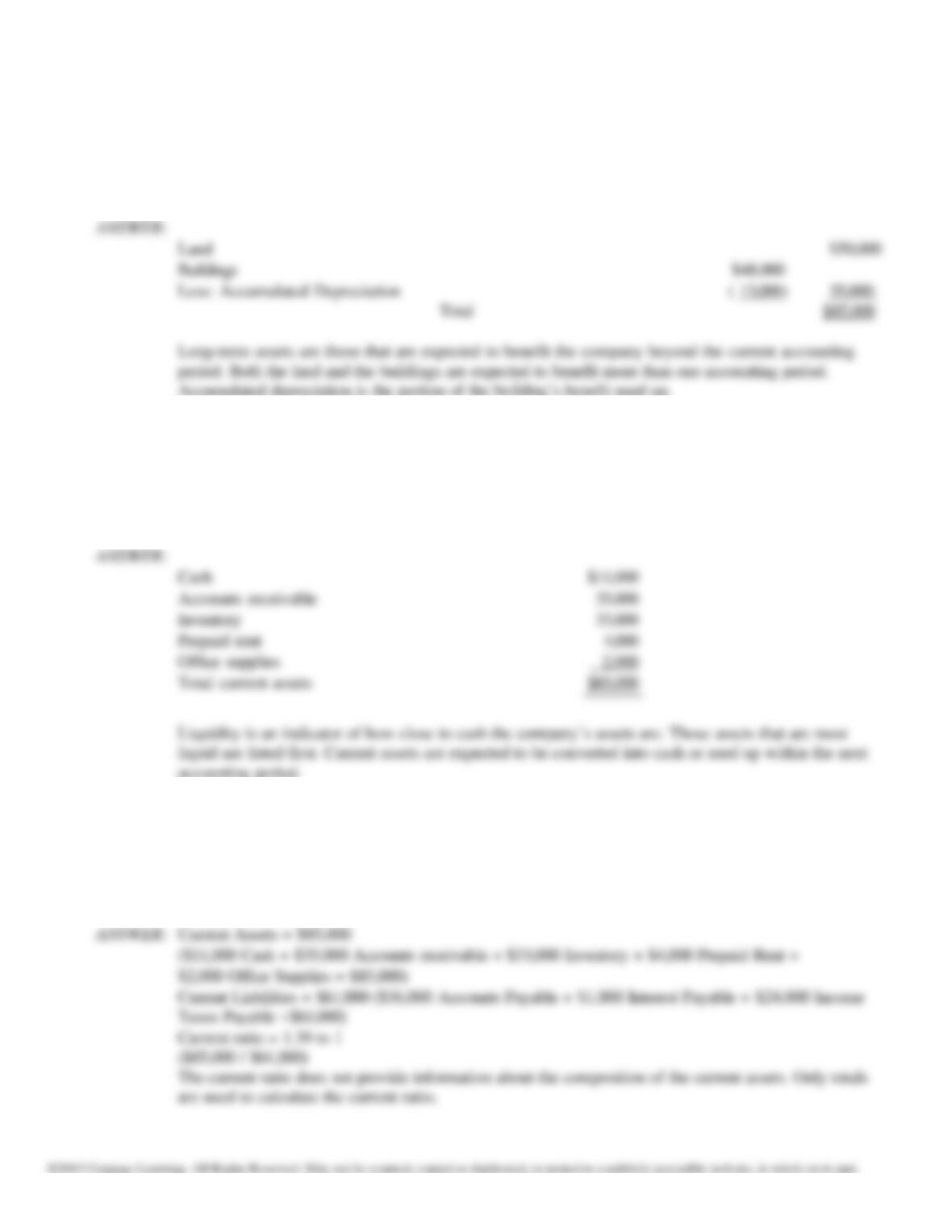
152. Read the information about Cargo Corporation.
Required:
Prepare the current liabilities section of the balance sheet for Cargo Corp. at December 31, 2015. You may omit
the heading. If the amount of current liabilities were larger, what effect would this have on the current ratio?
Chapter 2: Financial Statements and the Annual Report
153. Read the information about Cargo Corporation.
Required:
Prepare the long-term asset section of Cargo Corp.’s balance sheet at December 31, 2015. You may omit the
heading. Why are these amounts classified as “long-term”?
154. Read the information about Cargo Corporation.
Required:
Prepare the current assets section of the balance sheet for Cargo Corp. at December 31, 2015. You may omit the
heading. How does the concept of liquidity apply?
155. Read the information about Cargo Corporation.
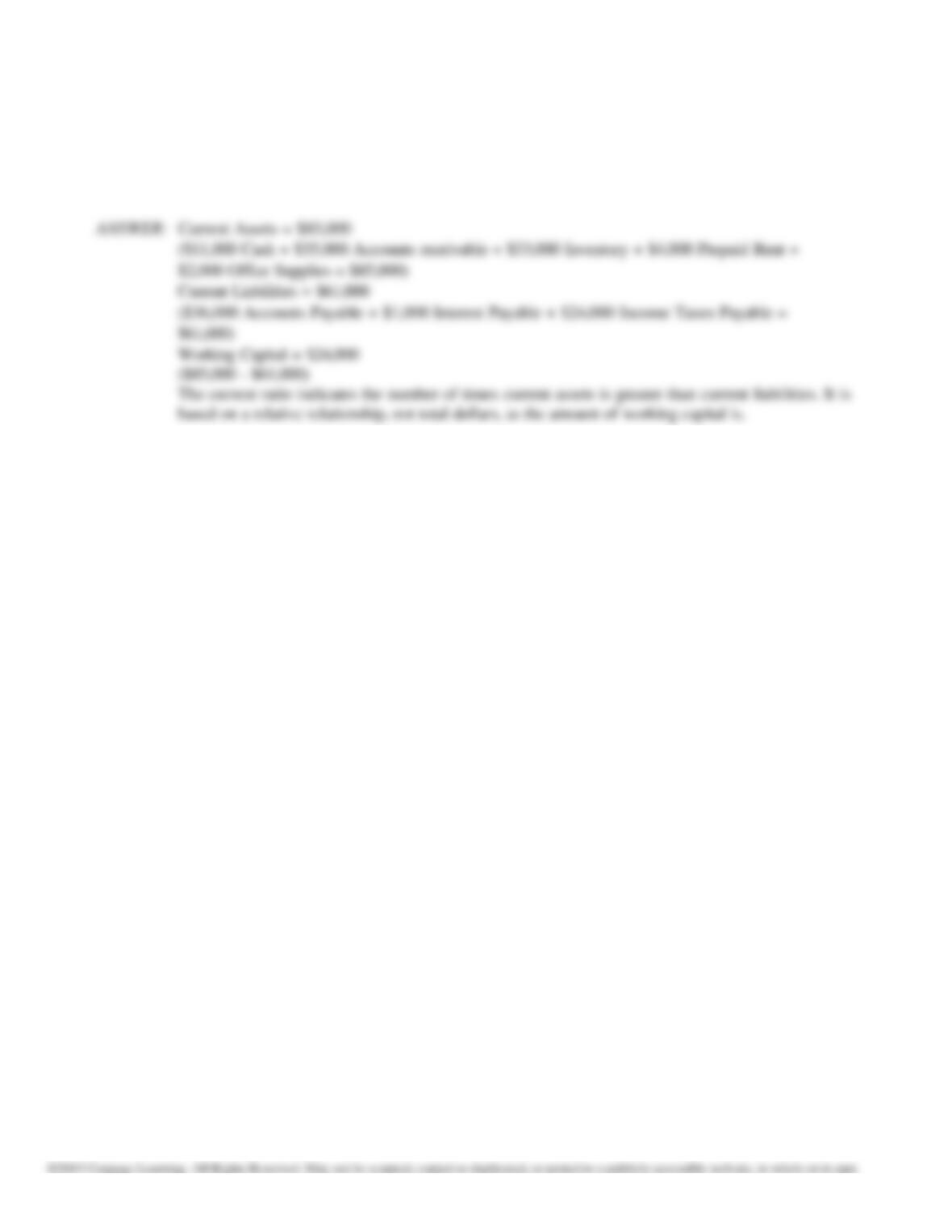
Required:
Calculate Cargo’s current ratio at December 31, 2015. What does this ratio tell you about the “composition” of the
current assets?
Chapter 2: Financial Statements and the Annual Report
156. Read the information about Cargo Corporation.
Required:
Calculate the amount of working capital at December 31, 2015 for Cargo Corp. What can you learn from the
current ratio that you cannot learn from the amount of working capital?
Fasoli, Inc.
The following balance sheet items from Fasoli, Inc. are listed for December 31, 2015:
Accounts payable
$32,650
Interest payable
2,200
Accounts receivable
26,500
Land
250,000
Accumulated depreciation—buildings
40,000
Marketable securities
15,000
Merchandise inventory
112,900
Accumulated depreciation—equipment
12,500
Notes payable, due April 15, 2016
6,500
Office supplies
200
Notes payable, due December 31, 2019
251,630
Paid-in capital in excess of par value
75,000
Buildings
150,000
Patents
45,000
Capital stock, $1 par value
200,000
Prepaid rent
3,800
Cash
60,990
Retained earnings
113,510
Equipment
84,500
Salaries payable
7,400
Income taxes payable
7,500
Chapter 2: Financial Statements and the Annual Report
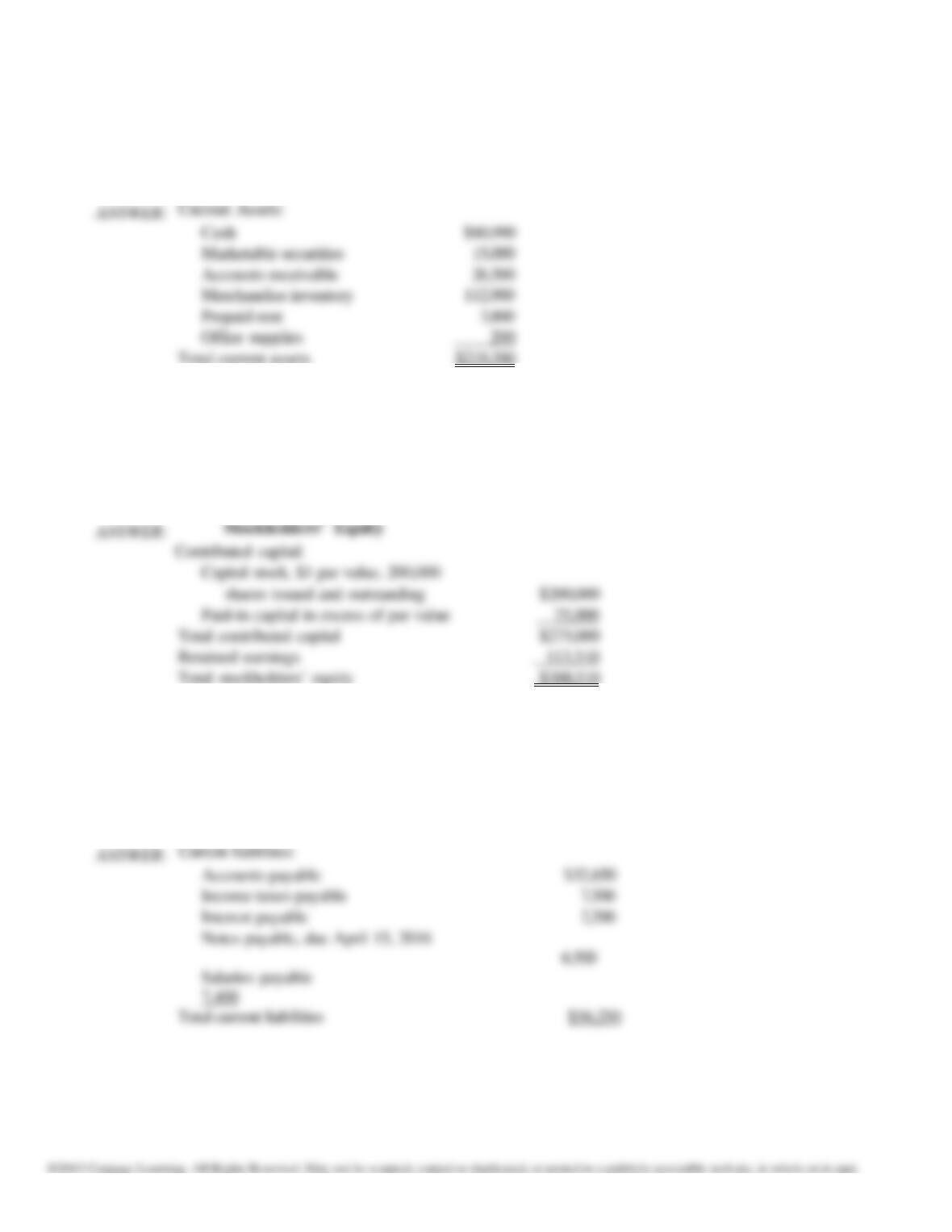
157. Read the information about Fasoli, Inc.
Required:
Present the Current Assets section (including the total) of a classified balance sheet.
158. Read the information about Fasoli, Inc.
Required:
Prepare the Stockholders’ Equity section of the classified balance sheet, including the total stockholders’ equity
amount.
159. Read the information about Fasoli, Inc.
Required:
Present the current liabilities section (including the total) of a classified balance sheet.
Chapter 2: Financial Statements and the Annual Report
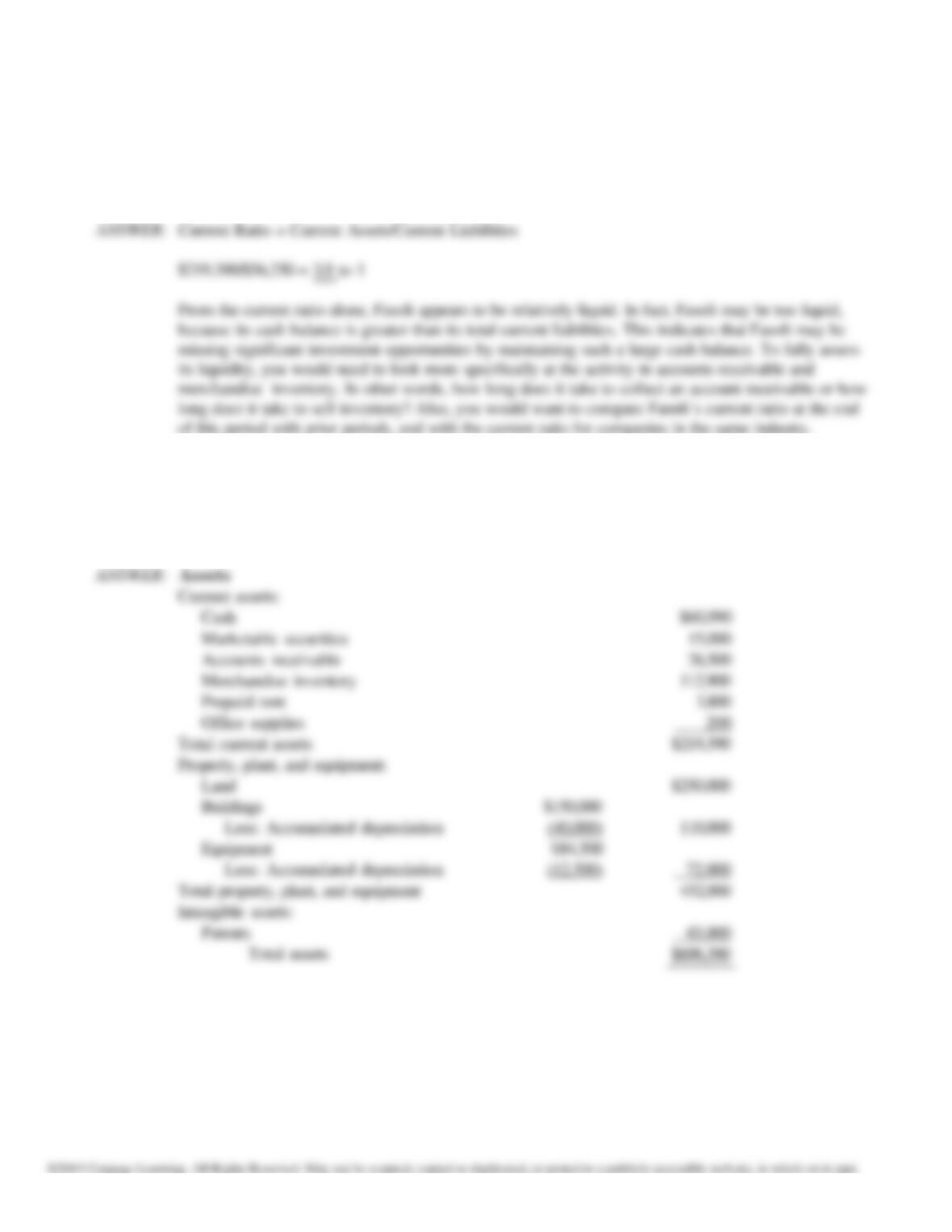
160. Read the information about Fasoli, Inc.
Required:
Compute Fasoli’s current ratio. On the basis of your answer, does Fasoli appear to be liquid? What other
information do you need to fully answer that question?
161. Read the information about Fasoli, Inc.
Required:
Prepare the Assets section of the classified balance sheet.
Chapter 2: Financial Statements and the Annual Report
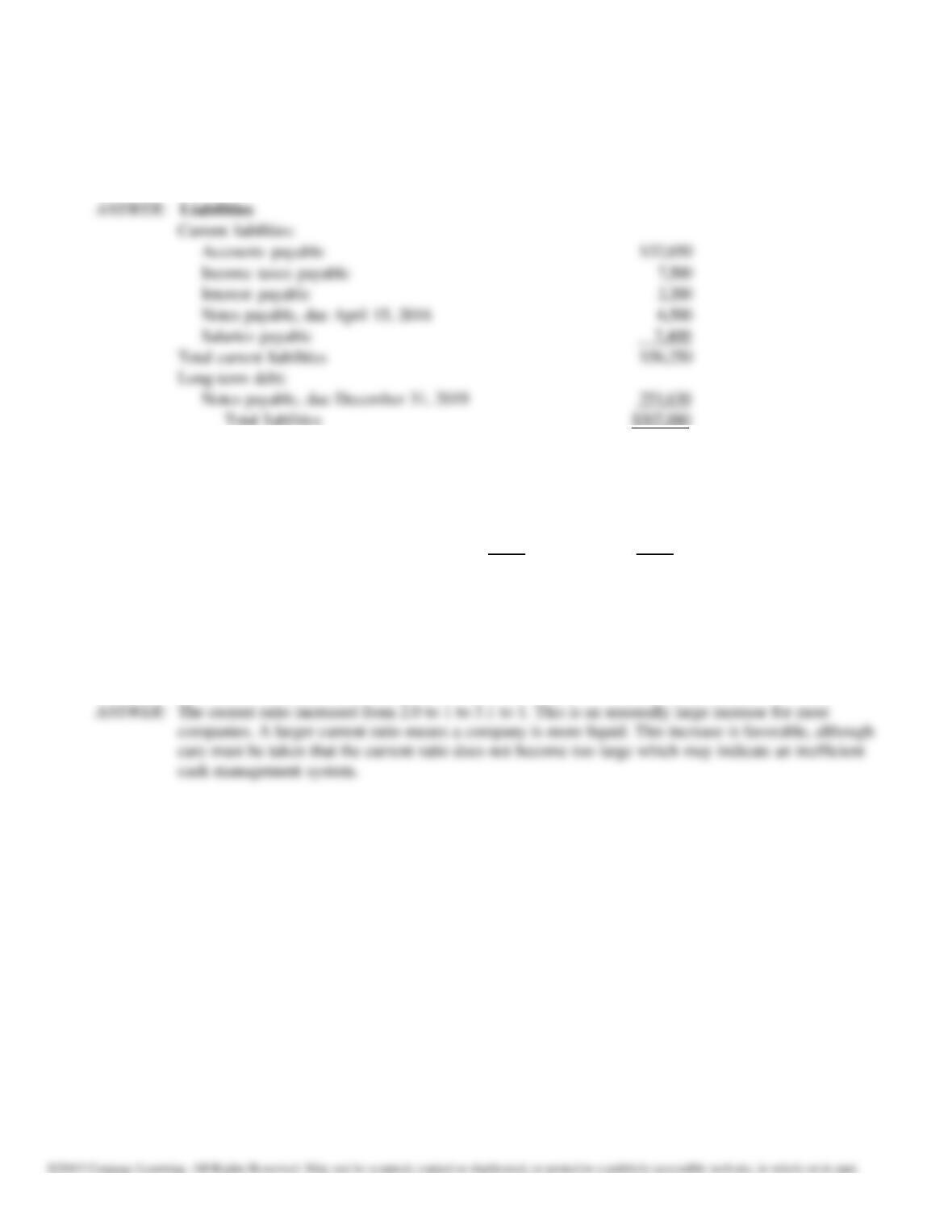
162. Read the information about Fasoli, Inc.
Required:
Prepare the Liabilities section of the classified balance sheet, including total liabilities balance.
163. Harrison Company calculated the following amounts concerning its financial information for the years ending
December 31, 2015 and 2014:
2015
2014
Current ratio
3.1 to 1
2.0 to 1
Profit margin
22 %
18%
REQUIRED:
Examine Harrison’s ratios. Is the change in the current ratio favorable or not? Explain.
Chapter 2: Financial Statements and the Annual Report
Accounts receivable
Building
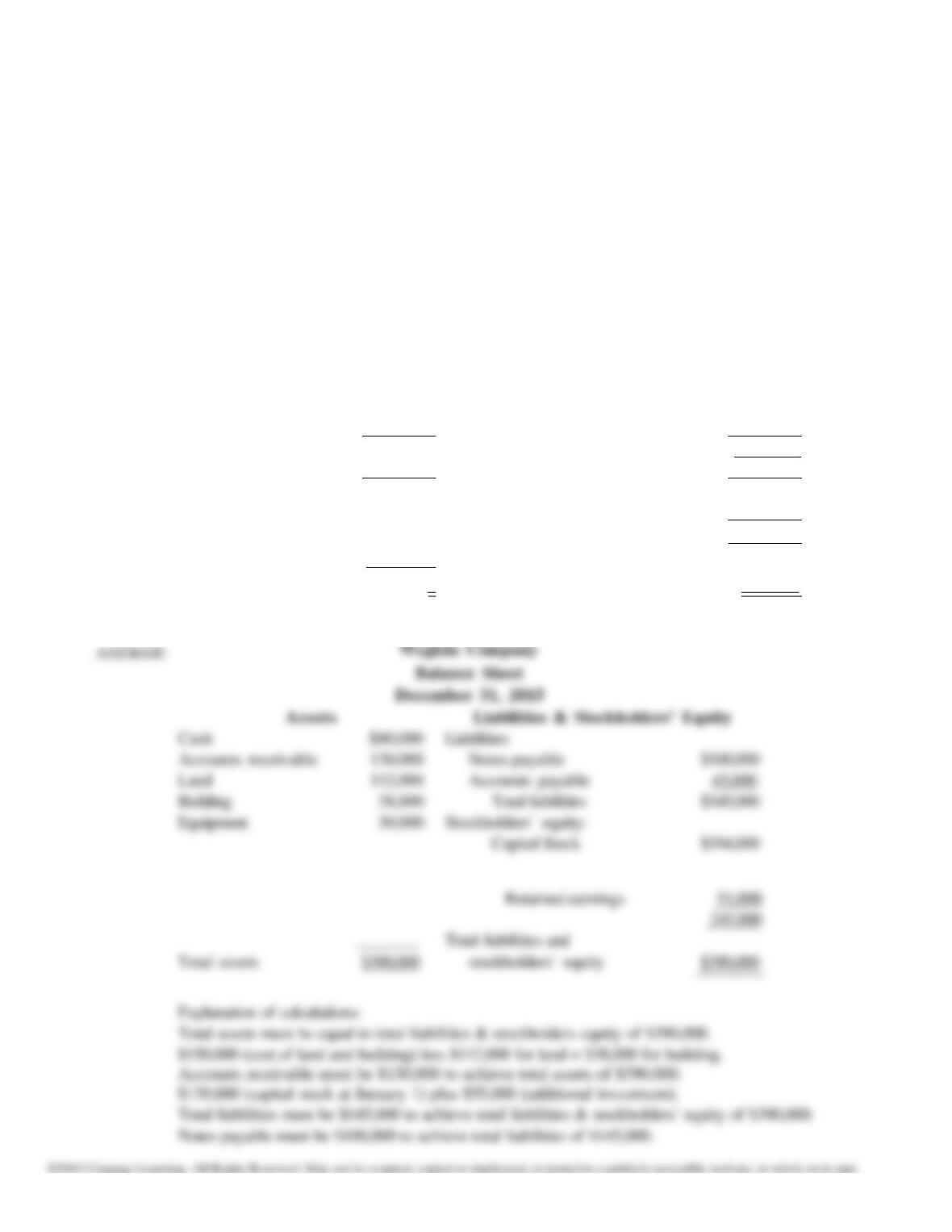
164. Complete the December 31, 2015 (first year of operation) Balance sheet for Weglein Company using the following
information:
(a) Retained earnings at December 31, 2015 was $51,000.
(b) Total stockholders’ equity at January 1, 2015 was $139,000.
(c) On December 30, 2015, additional capital stock was sold for cash, $55,000
(d) The land and building were purchased on December 30, 2015 for $150,000.
Weglein Company
Balance Sheet
December 31, 2015
Cash
Assets
Liabilities & Stockholders’ Equity
$80,000
Liabilities:
Accounts receivable
?
Notes payable ?
Land
112,000
Accounts payable 45,000
Buildings
?
Total liabilities ?
Equipment
30,000
Stockholders’ equity:
Capital Stock ?
Retained earnings ?
Total liabilities and
Total assets $ stockholders’ equity $390,000

Chapter 2: Financial Statements and the Annual Report
165. Harrison Company calculated the following amounts concerning its financial information for the years ending
December 31, 2015 and 2014:
2015
2014
Current ratio
3.1 to 1
2.0 to 1
Profit margin
22 %
18%
REQUIRED:
Suppose Harrison Company had a decrease in its cash account from 2014 to 2015. Would the other current asset
amounts have increased or decreased? Explain.
Fellsmere Corporation
Presented below are the condensed balance sheets of Fellsmere Corporation at December 31, 2014 and 2013. Net
income for the years ending December 31, 2014 and 2013 is $346,000 and $109,000, respectively.
Current assets
Property, plant, & equipment
(net)
Intangibles and other assets
Total assets
December 31, 2014
$2,228,186
December 31, 2013
$2,544,683
530,589
376,647
131,206
118,121
$2,889,981
$3,039,451
Current liabilities
$1,429,674
$1,003,906
Long-term obligations
3,360
7,240
Warranty and other liabilities
112,971
98,081
Total liabilities
$1,546,605
$1,109,227
Stockholders’ equity:
Common stock
$ 1,566
$ 501,631
Additional paid-in capital
365,986
799,483
Retained earnings
980,509
634,509
Accumulated other
comprehensive loss
(4,085)
(5,489)
Total stockholders’ equity
$1,343,976
$1,930,224
Total liabilities and stockholders’
it
$2,889,981
$3,039,451
Chapter 2: Financial Statements and the Annual Report
166. Read the information about Fellsmere Corporation.
Required:
(A) Did Fellsmere’s current ratio increase or decrease from 2013 to 2014? Make any necessary calculations and
explain your answer. Which financial statement users are most concerned with this ratio?
(B) The balance sheets show a large increase in retained earnings during 2014. Identify the possible reason(s) for
this increase.
167. Read the information about Fellsmere Corporation.
Required:
(A) Explain the change in Fellsmere’s working capital from 2013 to 2014. Why do users believe the current ratio
provides more information than the dollar amount of working capital? Explain.
(B) Fellsmere Corporation’s creditors need to know whether its working capital position improved during the year.
How would you evaluate this?
Chapter 2: Financial Statements and the Annual Report
Crystal, Inc.
Crystal, Inc. reported $52,000 of net income for 2014. Crystal’s balance sheet at December 31, 2014 includes the
following amounts:
Wages payable
$1,000
Inventory
$26,000
Prepaid rent
3,000
Land
40,000
Cash
15,000
Accounts receivable
22,000
Accounts payable
25,000
Capital stock
40,000
Retained earnings
29,000
Income taxes payable
11,000
168. Read the information about Crystal, Inc. Which item is most “liquid“? Why is liquidity important?
169. Read the information about Crystal, Inc. Has Crystal been profitable since it began operations? How do you know?
Chapter 2: Financial Statements and the Annual Report
170. The balance sheet of Evanston Inc. includes the following items:
Cash
$21,500
Accounts receivable
12,400
Inventory
45,300
Prepaid insurance
1,800
Land
80,000
Accounts payable
49,000
Salaries payable
1,625
Capital stock
105,100
Retained earnings
5,700
Required:
(1) Determine the current ratio and working capital.
(2) What does the composition of the current assets tell you about Evanston’s liquidity?
(3) What other information do you need to fully assess Evanston’s liquidity?
Eagle Corporation
Presented below are all of the items from Eagle Corporation’s income statement for the years ending December
31, 2014 and 2013.
December 31, 2014
December 31, 2013
Service fees
$2,300,000
$2,100,000
General and administrative expenses
1,900,000
1,500,000
Other income, net
40,000
20,000
Income taxes
150,000
180,000