Cost Accounting: A Managerial Emphasis, 6e
Chapter 2 – An Introduction to Cost Terms and Purposes
35) Which of the following is true of period costs?
A) They are also called fixed costs.
B) They are part of the cost of goods sold.
C) They are expected to benefit future periods.
D) They are costs incurred to generate revenue in a specific time period except the cost of manufacturing
accumulated as cost of goods sold.
E) For merchandising sector companies they include all costs not related to the cost of goods purchased
for resale.
36) Generally, costs which are initially recorded as an asset and subsequently become an expense are
called
A) inventoriable costs.
B) non-manufacturing costs.
C) manufacturing costs.
D) non-capitalized costs.
E) non-inventoriable costs.
37) Finished goods inventory would normally include
A) direct materials in stock and awaiting use in the manufacturing process.
B) goods partially worked on but not yet fully completed.
C) goods fully completed but not yet sold.
D) products in their original form intended to be sold without changing their basic form.
E) goods completed and sold.
38) Inventoriable costs
A) include administrative and marketing costs.
B) are expensed in the accounting period in which the products are sold.
C) are particularly useful in management accounting.
D) are also referred to as nonmanufacturing costs.
E) are similar to period costs.
Cost Accounting: A Managerial Emphasis, 6e
Chapter 2 – An Introduction to Cost Terms and Purposes
Answer the following question(s) using the information below.
The Singer Company manufactures several different products. Unit costs associated with Product ICT101
are as follows:
Direct materials
$60
Direct manufacturing labour
10
Variable manufacturing overhead
18
Fixed manufacturing overhead
32
Sales commissions (2% of sales)
4
Administrative salaries
16
Total
$140
39) What are the variable costs per unit associated with Product ICT101?
A) $18
B) $22
C) $88
D) $92
E) $28
40) What are the fixed costs per unit associated with Product ICT101?
A) $102
B) $48
C) $52
D) $32
E) $36
41) What are the inventoriable costs per unit associated with Product ICT101?
A) $120
B) $140
C) $50
D) $88
E) $70
Cost Accounting: A Managerial Emphasis, 6e
Chapter 2 – An Introduction to Cost Terms and Purposes
42) What are the period costs per unit associated with Product ICT101?
A) $4
B) $16
C) $20
D) $52
Answer the following question(s) using the information below.
The West Company manufactures several different products. Unit costs associated with Product ORD203
are as follows:
Direct materials
$40
Direct manufacturing labour
8
Variable manufacturing overhead
12
Fixed manufacturing overhead
23
Sales commissions (2% of sales)
6
Administrative salaries
9
Total
$98
43) What are the variable costs per unit associated with Product ORD203?
A) $60
B) $83
C) $66
D) $48
E) $12
44) What are the inventoriable costs per unit associated with Product ORD203?
A) $60
B) $66
C) $48
D) $83
E) $92
Cost Accounting: A Managerial Emphasis, 6e
Chapter 2 – An Introduction to Cost Terms and Purposes
45) What are the fixed costs per unit associated with Product ORD203?
A) $23
B) $32
C) $35
D) $44
E) $38
46) What are the period costs per unit associated with Product ORD203?
A) $15
B) $6
C) $9
D) $27
E) $48
Cost Accounting: A Managerial Emphasis, 6e
Chapter 2 – An Introduction to Cost Terms and Purposes
47) Macadamia Co. produced and sold 40,000 units last year. Per unit revenue and costs were as follows:
Revenues
$120.00
Cost of Goods Sold:
Direct Materials
$15.00
Direct Labour
20.00
Variable Manufacturing Overhead
10.00
Fixed Manufacturing Overhead
6.00
Total Cost of Goods Sold
51.00
Gross Margin
$69.00
Selling and Administrative Costs:
Sales Commissions (10% of Sales)
$12.00
Administrative Salaries
5.00
Total Selling and Administrative
17.00
Operating Income <Loss>
$52.00
The Fixed Manufacturing Overhead provides a capacity of 50,000 units. The Production Manager has
proposed leasing a new machine at a cost of $80,000 per year. This will reduce Direct Labour by 30% and
improve quality so the the selling price per unit can be increased by $10. Production and sales are
expected to remain the same as last year.
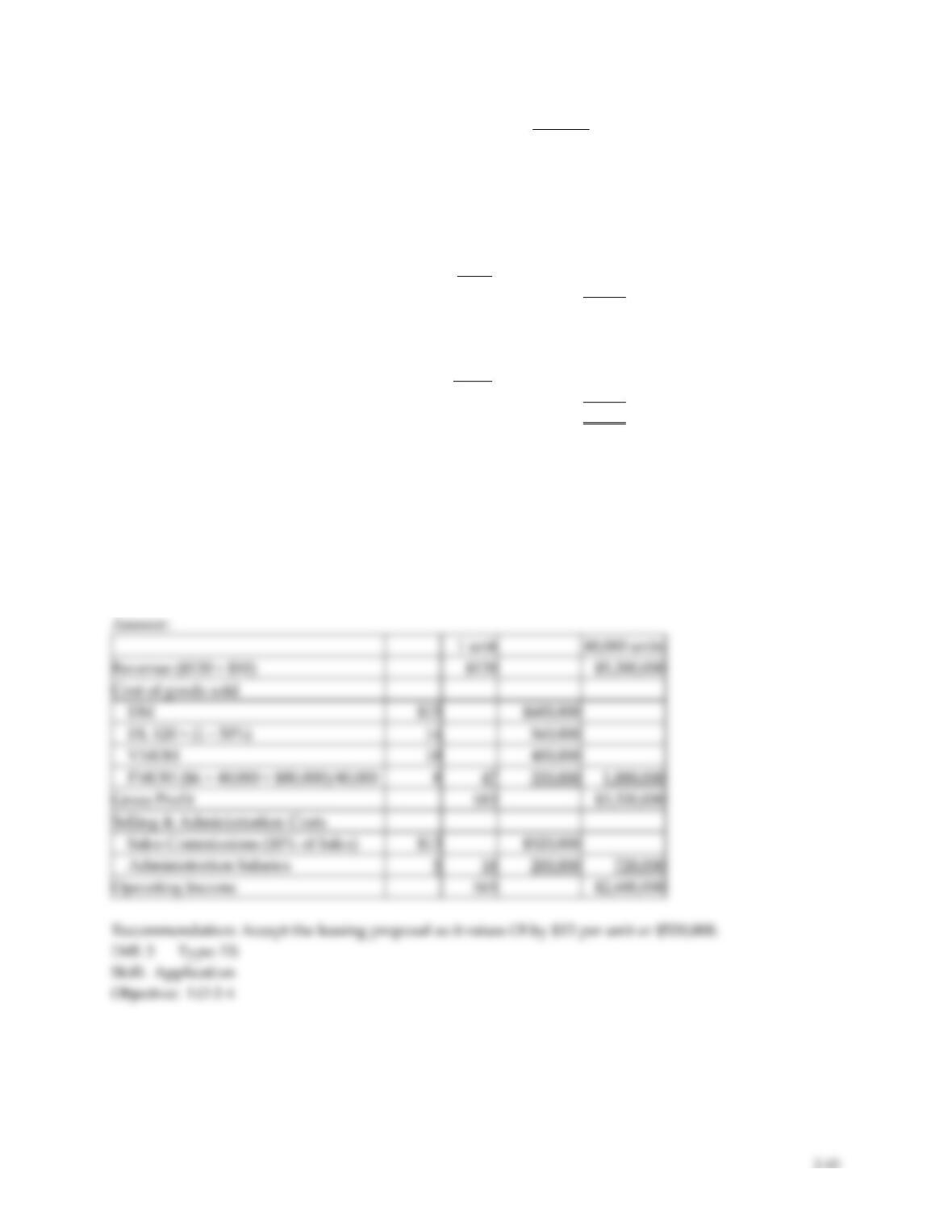
Required:
Prepare a statement of operating income assuming the leasing proposal is accepted.
Revenue ($120 + $10)
Cost of goods sold
Gross Profit
Selling & Administration Costs
Operating Income
Cost Accounting: A Managerial Emphasis, 6e
Chapter 2 – An Introduction to Cost Terms and Purposes
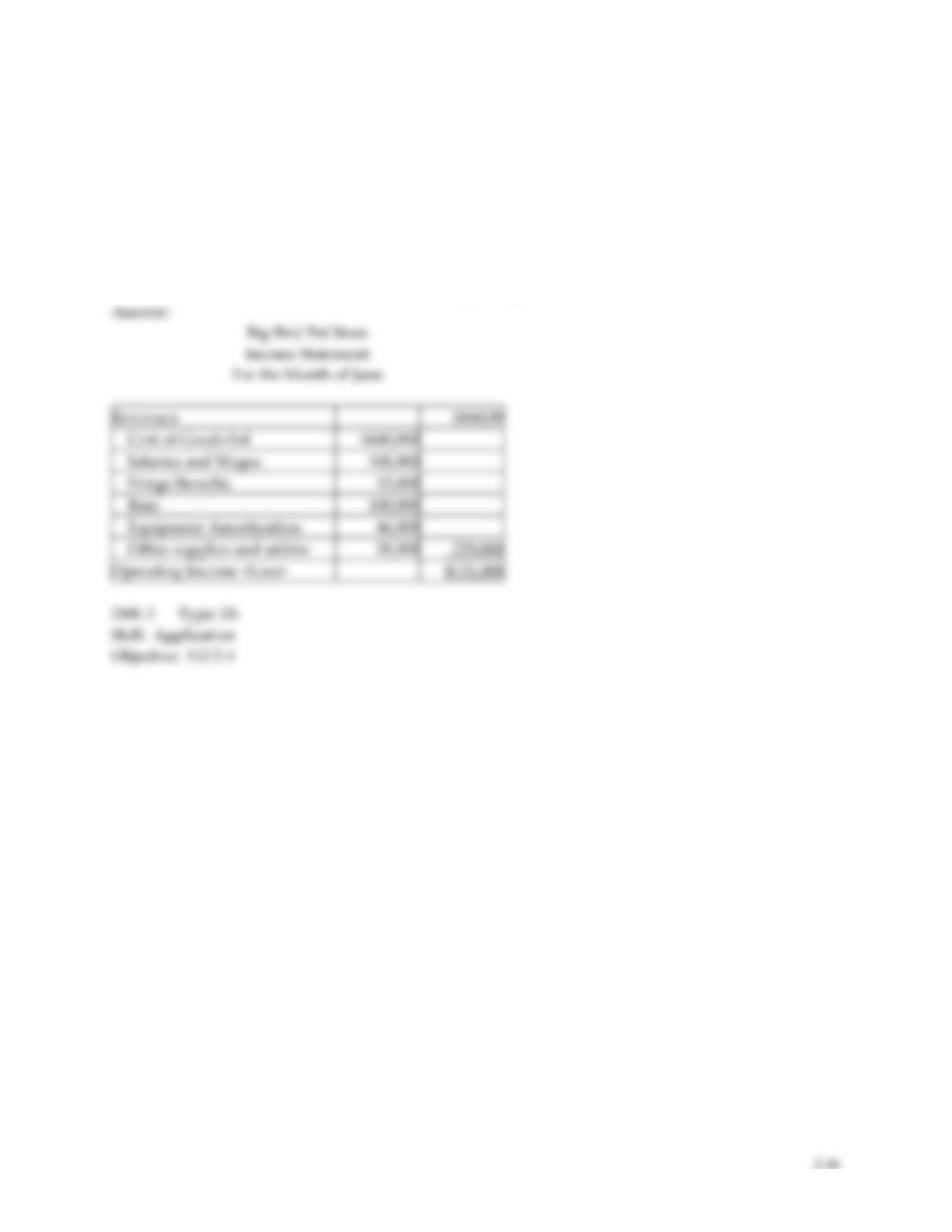
48) Big Bird Pet Store had the following financial activities for June. Revenue was $860,000 with cost of
goods sold equalling $440,000. Salaries and wages of all employees were $100,000. Fringe benefits were 15
percent of salaries and wages. Rent on the building was $100,000 and equipment amortization was
$46,000. Office supplies and utilities totalled $28,000. Income taxes withheld from employees totalled
$46,000 for the month while ending accounts payable were $24,680. Cash flows from accounts receivable
totalled $880,000.
Required:
Using an income statement format, determine the operating income of the store.
Cost Accounting: A Managerial Emphasis, 6e
Chapter 2 – An Introduction to Cost Terms and Purposes
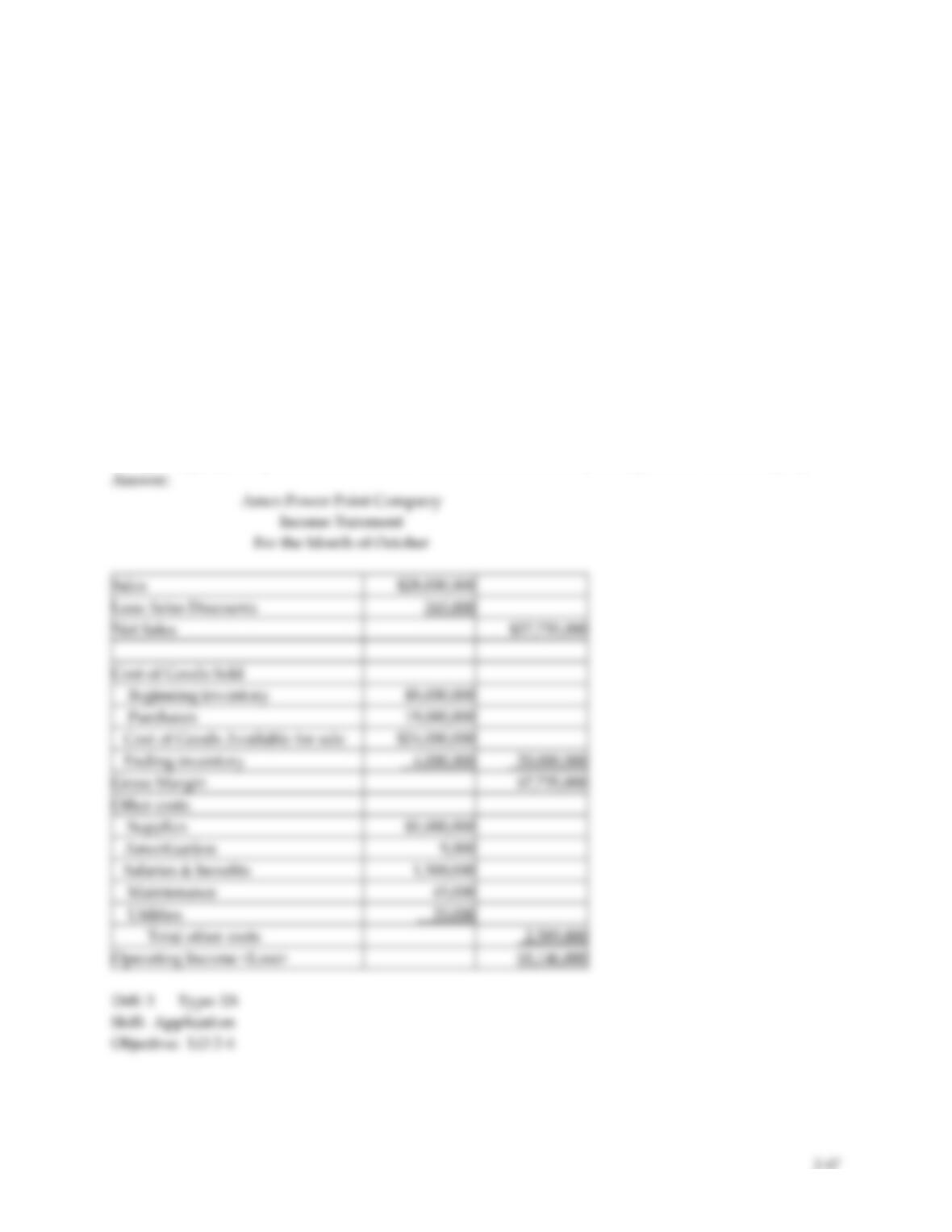
49) Ames Power Point had sales in October of $28,000,000 for its three stores in Toronto. The beginning
merchandise inventories for October and November were $5,000,000 and $4,000,000, respectively.
October purchases totalled $19,000,000. All sales are on account (terms 2/15, net 30 days) and are collected
50 percent in the month of the sale and 50 percent in the following month. One-half of all sales discounts
are taken for a total of $265,000. September sales totalled $25,000,000 while November sales were
$30,000,000. Additional information for October is as follows:
Supplies used $1,000,000
Salaries and benefits 1,500,000
Maintenance 45,000
Amortization 9,000
Utilities 35,000
Principal payment on maturing bonds 2,000,000
Required:
Using an appropriately formatted income statement, determine the operating income of the company.
Cost Accounting: A Managerial Emphasis, 6e
Chapter 2 – An Introduction to Cost Terms and Purposes
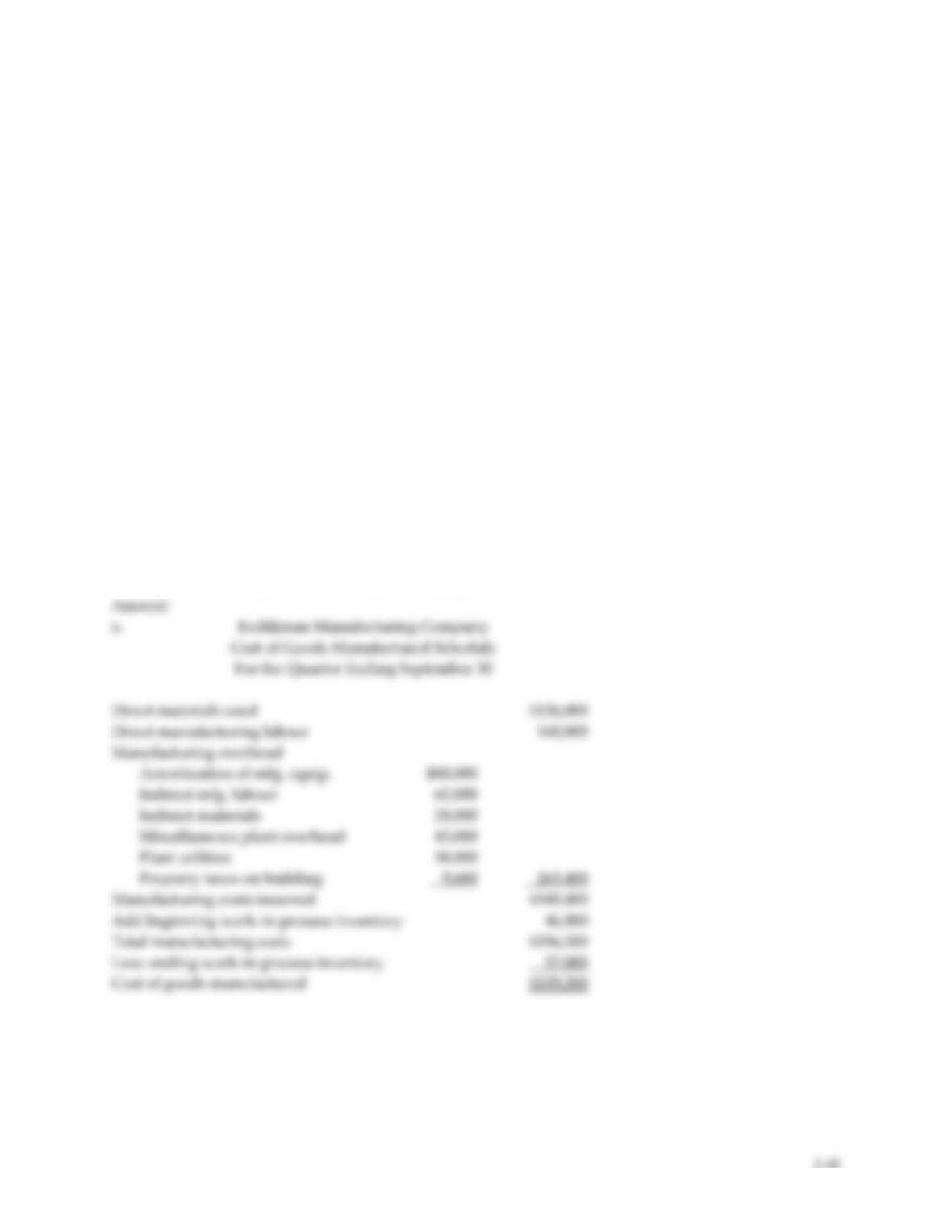
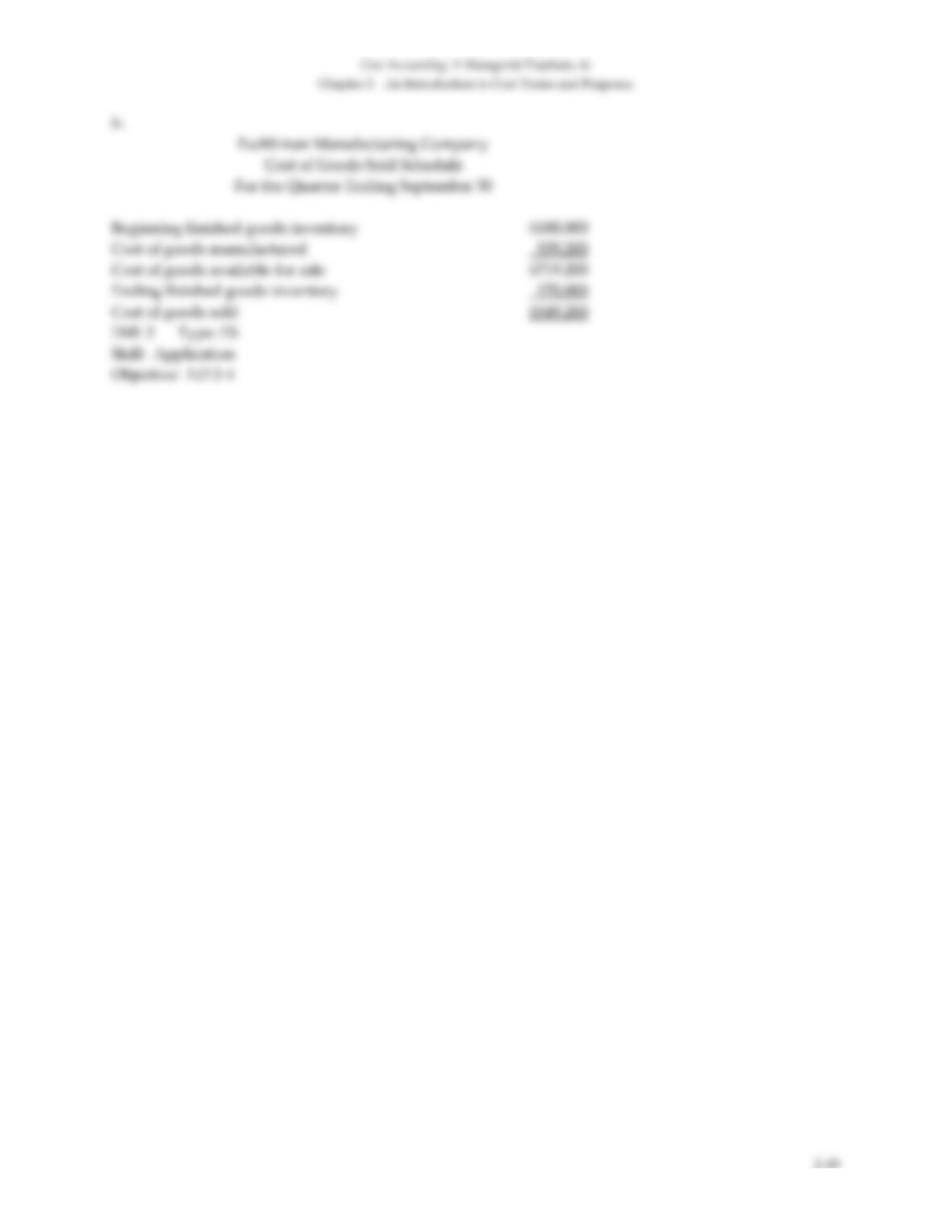
50) Eschliman Manufacturing Company had the following account balances for the quarter ending
September 30, unless otherwise noted:
Amortization of manufacturing equipment $88,000
Amortization of office equipment 41,200
Direct manufacturing labour 160,000
Direct materials used 126,000
Finished goods inventory (July 1) 180,000
Finished goods inventory (September 30) 170,000
General office expenses 101,800
Indirect manufacturing labour 62,000
Indirect materials used 28,000
Marketing distribution costs 10,000
Miscellaneous plant overhead 45,000
Plant utilities 30,800
Property taxes on plant building 9,600
Property taxes on salespersons’ company vehicles 4,000
Work-in-process inventory (July 1) 46,800
Work-in-process inventory (September 30) 57,000
Required:
a. Prepare a cost of goods manufactured schedule for the quarter.
b. Prepare a cost of goods sold schedule for the quarter.
Cost Accounting: A Managerial Emphasis, 6e
Chapter 2 – An Introduction to Cost Terms and Purposes
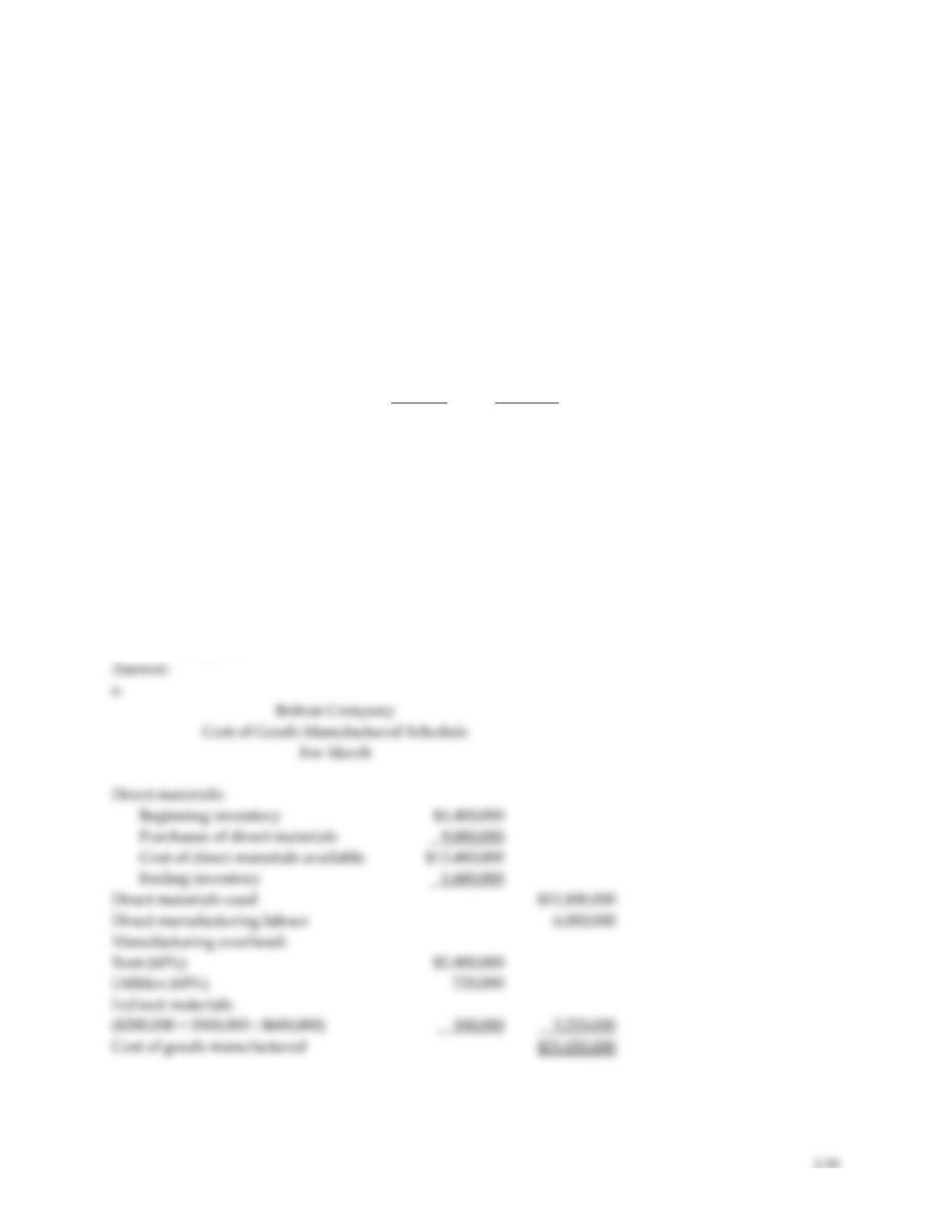
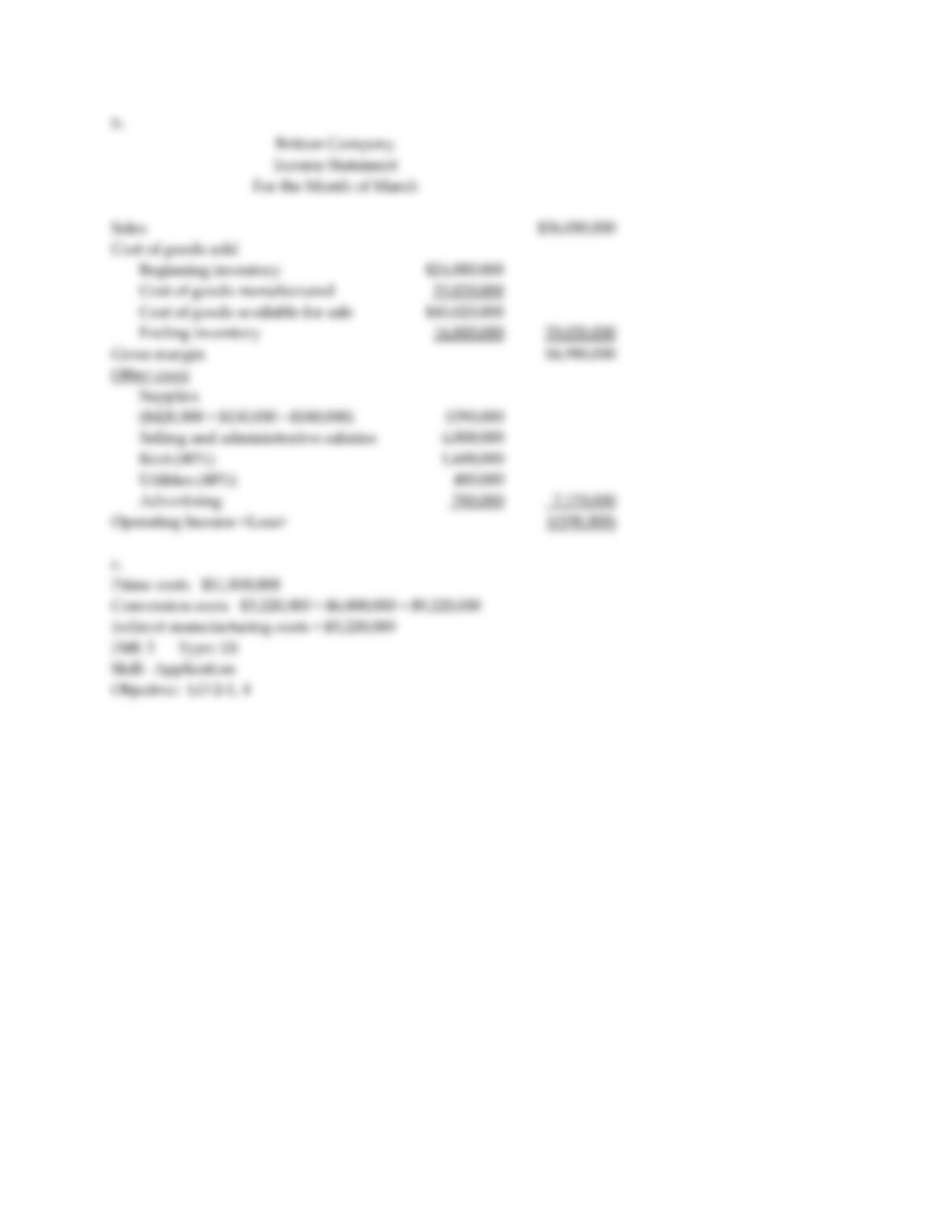
51) The following information is taken from the records of Britton Company for March:
Purchases:
Direct materials $9,000,000
Indirect materials 200,000
Office supplies 420,000
Sales 36,000,000
Salaries and Benefits:
Selling and administrative 4,000,000
Direct manufacturing labour 6,000,000
Rent* 4,000,000
Utilities* 1,200,000
Advertising 700,000
Inventories: March 1 March 31
Direct materials $4,400,000 $1,600,000
Indirect materials 500,000 600,000
Office supplies 150,000 180,000
Finished goods 24,000,000 16,000,000
* Of these costs, 60 percent are assigned to manufacturing and 40 percent to selling and administration.
Required:
a. Prepare a schedule of cost of goods manufactured.
b. Prepare an income statement for the month.
c. Compute the prime costs using a two-part production costing system, conversion costs, and indirect
manufacturing costs.
Cost Accounting: A Managerial Emphasis, 6e
Chapter 2 – An Introduction to Cost Terms and Purposes
2-51