
Chapter 2—Assisted Reproductive Technology
MULTIPLE CHOICE
1. The process of ____ results in the formation of eggs.
a.
oogenesis
b.
implantation
c.
mitosis
d.
spermatogenesis
e.
fertilization
2. Which of the following statements is FALSE about female reproduction?
a.
Fallopian tubes have fingerlike projections.
b.
Fertilization occurs most often in the fallopian tubes.
c.
Fallopian tubes are part of the uterus.
d.
Oogenesis produces eggs in the ovaries.
e.
Females have a pair of ovaries.
3. What is the role of the uterus?
a.
It produces eggs.
b.
It serves as the birth canal.
c.
It holds the embryo and the fetus during pregnancy.
d.
It facilitates egg movement through the fallopian tubes.
e.
It connects the fallopian tubes and the ovaries.
4. Which of the following is NOT part of the male reproductive system?
a.
testes
b.
urethra
c.
epididymis
d.
cervix
e.
vas deferens
5. Which of the following is NOT part of the female reproductive system?
a.
ovaries
b.
urethra
c.
fallopian tubes
d.
uterus
e.
cervix

6. Where does egg production occur in females?
a.
In the fallopian tubes.
b.
In the endometrium of the uterus.
c.
In the ovaries.
d.
In the myometrium of the uterus.
e.
In the vagina.
7. Which of the following is not a possible cause of infertility in women?
a.
blockage of the fallopian tubes
b.
high levels of estrogen
c.
damaged ovaries
d.
premature menopause
e.
All of these are possible causes of infertility in women.
8. Which of the following is true for secondary amenorrhea?
a.
It can be caused by obesity.
b.
It can be caused by excessive physical conditioning.
c.
It can be caused by endometriosis.
d.
It can cause an increased risk of miscarriages.
e.
It can be caused by lack of physical conditioning.
9. What is the most common cause of infertility in females?
a.
hormone imbalance
b.
blocked fallopian tubes
c.
damaged ovaries
d.
endometriosis
e.
obesity
10. Which of the following can lead to blockage of the fallopian tubes?
a.
appendicitis
b.
bowel problems
c.
scar tissue following surgery
d.
viral infections
e.
All of these can lead to blockage of the fallopian tubes.
11. Which of the following statements is FALSE?
a.
Ovaries contain several hundred follicles.
b.
If fertilization does not occur, the endometrium is shed.
c.
Secondary oocytes are released from follicles during ovulation.
d.
Oogonia begin meiosis after birth.
e.
At birth a female has a lifetime supply of developing eggs.

12. An increase in this hormone level is measured by home ovulation tests.
a.
chorionic gonadotropin hormone
b.
luteinizing hormone
c.
estrogen
d.
testosterone
e.
None of these are measured by home ovulation tests.
13. How does low sperm count in males result in infertility?
a.
It makes it difficult for the necessary number of sperm to reach the egg.
b.
It hinders the ability of sperm to leave the male reproductive tract.
c.
It leads to erectile dysfunction.
d.
It leads to the production of sperm without tails.
e.
None of these.
14. Erectile dysfunction can be caused by all of following EXCEPT
a.
the penis getting too much blood.
b.
emotional stress.
c.
diabetes.
d.
hormonal imbalance.
e.
All of these are possible causes of erectile dysfunction.
15. Causes of male infertility include all of the following EXCEPT
a.
no sperm formation.
b.
impotence.
c.
low sperm motility.
d.
low sperm count.
e.
endometriosis.
16. All of the following can be causes of aspermia EXCEPT
a.
a vasectomy.
b.
drug usage.
c.
birth defects affecting the reproductive system.
d.
lack of sexual intercourse.
e.
All of these are possible causes of aspermia.
17. What environmental influence(s) lead(s) to an increased risk of infertility and miscarriages?
a.
exposure to lead
b.
exposure to ethylene oxide
c.
exposure to excessive radiation
d.
smoking
e.
All of these lead to an increased risk.

18. Which of the following is NOT a known factor for increased risk of infertility?
a.
the age of the mother
b.
contraction of a sexually-transmitted disease
c.
the age of the father
d.
smoking cigarettes
e.
exposure to some environmental factors
19. Which of the following is FALSE?
a.
Overweight females can have difficulty conceiving.
b.
Smoking cigarettes lowers sperm count.
c.
Smoking cigarettes increases the risk of miscarriage.
d.
Women working on farms often have a harder time conceiving than women who do not.
e.
The woman’s age is unrelated to infertility.
20. Which of the following statements is FALSE about in vitro fertilization?
a.
Donor eggs can be used.
b.
Donor sperm can be used.
c.
Sperm or eggs of the couple themselves can be used.
d.
Only donor eggs and donor sperm can be used.
e.
Donor eggs, donor sperm, and/or the sperm or egg of the couple themselves can be used.
21. What is the most common reason that an infertile couple would choose surrogacy?
a.
The male does not produce sperm.
b.
The woman cannot ovulate.
c.
The couple would like to choose the sex of their child.
d.
The male’s sperm lack tails.
e.
The woman’s uterus is incapable of maintaining a pregnancy.
22. During spermatogenesis, these are the first cells that are haploid.
a.
spermatocytes
b.
spermatids
c.
sperm
d.
spermatogonia
e.
oocytes
23. Secretions from the seminal vesicles, prostate gland and bulbourethral gland are important for all of
the following except
a.
assisting the movement of sperm through the female reproductive system.
b.
acid neutralization.
c.
lubrication during intercourse.
d.
providing an energy source for the sperm.
e.
increasing sperm production.

21
24. After a successful vasectomy,
a.
sperm production stops.
b.
only secretions from the prostate gland will be found in the ejaculate.
c.
the ejaculate will not contain sperm.
d.
none of the glandular secretions will be found in the ejaculate.
e.
there will be very few sperm present in the ejaculate.
25. Spermatogenesis occurs in the
a.
urethra.
b.
seminiferous tubules.
c.
epididymis.
d.
seminal vesicles.
e.
prostate gland.
26. An egg will only complete meiosis immediately after _____ occurs.
a.
fertilization
b.
ovulation
c.
menstruation
d.
menopause
e.
formation of the secondary oocyte
27. Which pairing is INCORRECT?
a.
epididymis – storage of sperm
b.
seminiferous tubules – spermatogenesis
c.
urethra – exit of sperm from body
d.
vas deferens – sperm move through this
e.
scrotum – secretions are part of semen
28. One example of this procedure combines a sperm sample and harvested eggs from the infertile couple
in a lab dish. The embryos are placed in the woman’s own uterus.
a.
in vitro fertilization (IVF)
b.
artificial insemination
c.
surrogacy
d.
intra-cytoplasmic sperm injection (ICSI)
e.
gamete injection into the fallopian tube (GIFT)
29. One example of this procedure involves injection of single sperm into harvested eggs. The embryos
are placed in the woman’s uterus.
a.
in vitro fertilization (IVF)
b.
artificial insemination
c.
surrogacy
d.
intra-cytoplasmic sperm injection (ICSI)
e.
gamete injection into the fallopian tube (GIFT)

Chapter 2 – Assisted Reproductive Technology
30. One example of this procedure combines a sperm sample and harvested eggs from the infertile couple
in a lab dish. The embryos that result are then placed in another woman’s uterus.
a.
in vitro fertilization (IVF)
b.
artificial insemination
c.
surrogacy
d.
intra-cytoplasmic sperm injection (ICSI)
e.
gamete injection into the fallopian tube (GIFT)
31. One example of this procedure combines a sperm sample and donated eggs in the woman’s fallopian
tubes.
a.
in vitro fertilization (IVF)
b.
artificial insemination
c.
surrogacy
d.
intra-cytoplasmic sperm injection (ICSI)
e.
gamete injection into the fallopian tube (GIFT)
32. This procedure places a sperm sample into the woman’s uterus.
a.
in vitro fertilization (IVF)
b.
artificial insemination
c.
surrogacy
d.
intra-cytoplasmic sperm injection (ICSI)
e.
gamete injection into the fallopian tube (GIFT)
TRUE/FALSE
1. Freezing donor eggs is a very successful and commonly used procedure.
2. Spermatids lack tails.
3. The action of the sperm entering the egg triggers the completion of meiosis of the egg.
4. Sperm and eggs have half the number of chromosomes as normal cells of the body.
5. If estrogen levels are low, ovulation will not be affected.

23
6. Hormonal problems in women account for about 75 percent of all cases where ovulation does not
occur.
7. Complete androgen insensitivity syndrome can lead to fertility problems in women.
8. Smoking cigarettes increases the chances of having a child.
9. Laparoscopy is a surgical procedure that is used to remove eggs from the donor.
10. In vitro fertilization, as the procedure is commonly used today, can lead to multiple births.
MATCHING
Match the structure to the function in the male reproductive tract.
a.
Provides a path for sperm to travel to the urethra
b.
Holds the testes away from the body
c.
Organ of intercourse
d.
Produces sperm
e.
Stores sperm
1. Testes
2. Vas deferens
3. Penis
4. Scrotum
5. Epididymis
Chapter 2 – Assisted Reproductive Technology
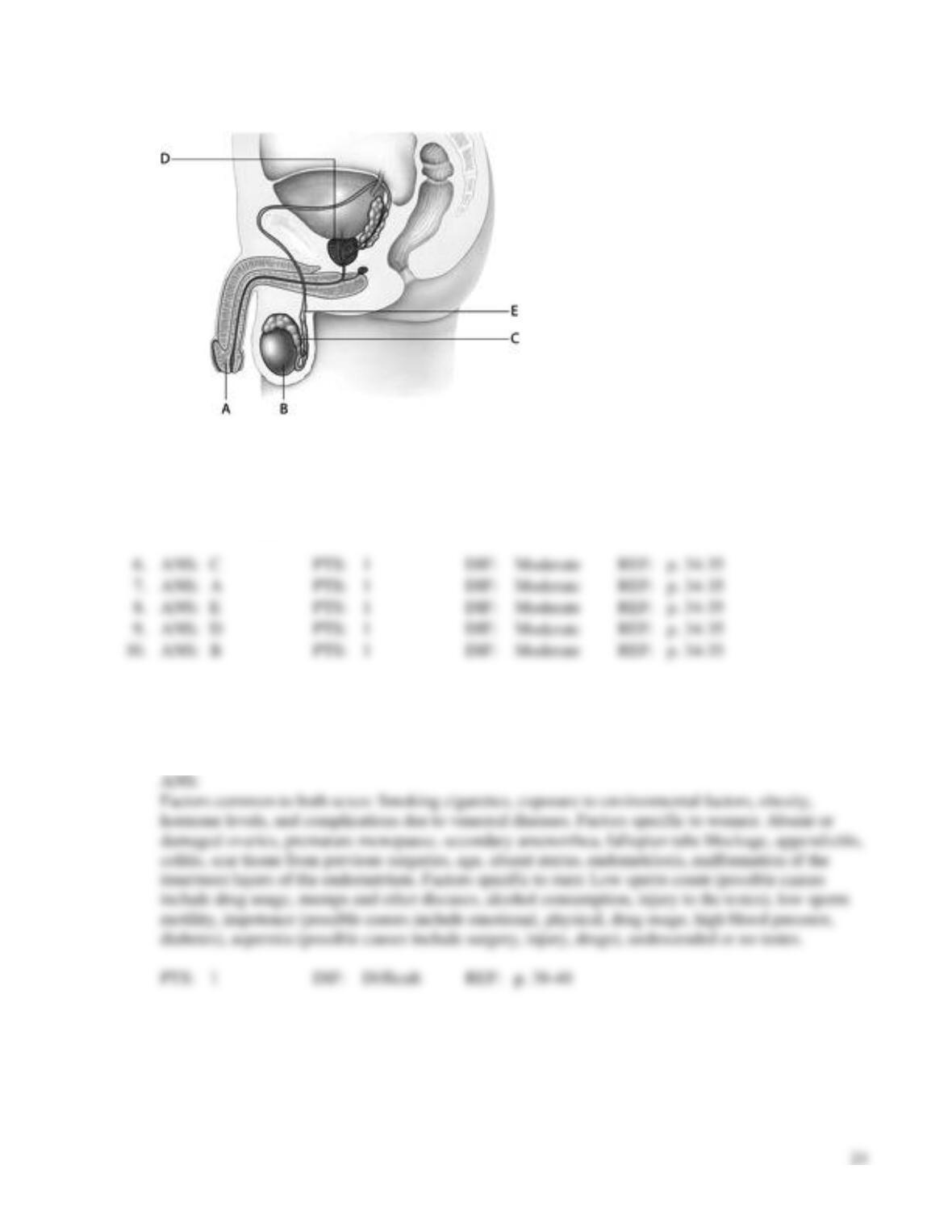
Match the following descriptions with the appropriate letter.
6. sperm are stored here
7. sperm exit the male body
8. sperm travel through this during sexual arousal
9. important for the production of semen
10. testosterone is produced here
ESSAY
1. Compare and contrast possible factors responsible for female and male infertility problems.
2. Discuss some of the implications of assisted reproductive technologies (ART).
SHORT ANSWER
1. How can in vitro fertilization be used to help infertile couples conceive? Describe the process.
2. Under what circumstances might a couple decide to use a paid surrogate stranger?
3. What are some of the legal and ethical issues involved in using a surrogate?
4. The number of couples with infertility problems has increased in recent years. What are some of the
possible reasons for this increase in infertility?