
Chapter 2 — Consolidated Statements: Date of Acquisition
MULTIPLE CHOICE
1.
Account Investor Investee
Sales $500,000 $300,000
Cost of Goods Sold 230,000 170,000
Gross Profit $270,000 $130,000
Selling & Admin.
Expenses 120,000 100,000
Net Income $150,000 $ 30,000
======== ========
Dividends paid 50,000 10,000
Assuming Investor owns 70% of Investee. What is the amount that will be
recorded as Net Income for the Controlling Interest?
a.
$164,000
b.
$171,000
c.
$178,000
d.
$180,000
2. Consolidated financial statements are designed to provide:
a.
informative information to all shareholders.
b.
the results of operations, cash flow, and the balance sheet in an
understandable and informative manor for creditors.
c.
the results of operations, cash flow, and the balance sheet as if
there was a single entity.
d.
subsidiary information for the subsidiary shareholders.
3. The FASB Exposure Draft assumes consolidation financial statements are
appropriate even without a majority of controlling share if which of
the following exists:
a.
the subsidiary has the right to appoint member’s of the parent
company’s board of directors.
b.
the parent company has the right to appoint a majority of the
members of the subsidiary’s board of directors through a large
minority voting interest.
c.
the subsidiary owns a large minority voting interest in the parent
company.
d.
The parent company has an ability to assume the role of general
partner in a limited partnership with the approval of the
subsidiary’s board of directors.

4. The SEC and FASB has recommended that a parent corporation should
consolidate the financial statements of the subsidiary into its
financial statements when it exercises control over the subsidiary,
even without majority ownership. In which of the following situations
would control NOT be evident?
a.
Access to subsidiary assets is available to all shareholders.
b.
Dividend policy is set by the parent.
c.
The subsidiary does not determine compensation for its main
employees.
d.
Substantially all cash flows of the subsidiary flow to the
controlling shareholders.
5. The goal of the consolidation process is for:
a.
asset acquisitions and stock acquisitions to result in the same
balance sheet.
b.
goodwill to appear on the balance sheet of the consolidated
entity.
c.
the assets of the noncontrolling interest to be predominately
displayed on the balance sheet.
d.
the investment in the subsidiary to be properly valued on the
consolidated balance sheet.
6. A subsidiary was acquired for cash in a business combination on
December 31, 20X1. The purchase price exceeded the fair value of
identifiable net assets. The acquired company owned equipment with a
fair value in excess of the book value as of the date of the
combination. A consolidated balance sheet prepared on December 31,
20X1, would
a.
report the excess of the fair value over the book value of the
equipment as part of goodwill.
b.
report the excess of the fair value over the book value of the
equipment as part of the plant and equipment account.
c.
reduce retained earnings for the excess of the fair value of the
equipment over its book value.
d.
make no adjustment for the excess of the fair value of the
equipment over book value. Instead, it is an adjustment to expense
over the life of the equipment.

2-3
7. Parr Company purchased 100% of the voting common stock of Super Company
for $2,000,000. There are no liabilities. The following book and fair
values are available:
Book Value Fair Value
Current assets…………………. $300,000 $600,000
Land and building………………. 600,000 900,000
Machinery……………………… 500,000 600,000
Goodwill………………………. 100,000 ?
The machinery will appear on the consolidated balance sheet at
________.
a.
$560,000
b.
$860,000
c.
$600,000
d.
$900,000
8. Pagach Company purchased 100% of the voting common stock of Rage
Company for $1,800,000. The following book and fair values are
available:
Book Value Fair Value
Current assets…………………. $ 150,000 $300,000
Land and building………………. 280,000 280,000
Machinery……………………… 400,000 700,000
Bonds payable………………….. (300,000) (250,000)
Goodwill………………………. 150,000 ?
The bonds payable will appear on the consolidated balance sheet
a.
at $300,000 (with no premium or discount shown).
b.
at $300,000 less a discount of $50,000.
c.
at $0; assets are recorded net of liabilities.
d.
under a net amount of $250,000 since it is a bargain purchase.
9. The investment in a subsidiary recorded as a purchase by the parent
should be recorded on the parent’s books at
a.
underlying book value of the subsidiary’s net assets.
b.
the fair value of the subsidiary’s net identifiable assets.
c.
the fair value of the consideration given.
d.
the fair value of the consideration given plus an estimated value
for goodwill.
10. Which of the following costs of a business combination are included in
the value charged to paid-in-capital in excess of par?
a.
direct and indirect acquisition costs
b.
direct acquisition costs
c.
direct acquisition costs and stock issue costs if stock is issued
as consideration

Chapter 2
2-4
d.
stock issue costs if stock is issued as consideration
11. When it purchased Sutton, Inc. on January 1, 20X1, Pavin Corporation
issued 500,000 shares of its $5 par voting common stock. On that date
the fair value of those shares totaled $4,200,000. Related to the
acquisition, Pavin had payments to the attorneys and accountants of
$200,000, and stock issuance fees of $100,000. Immediately prior to the
purchase, the equity sections of the two firms appeared as follows:
Pavin Sutton
Common stock…………………… $ 4,000,000 $ 700,000
Paid-in capital in excess of par…. 7,500,000 900,000
Retained earnings………………. 5,500,000 500,000
Total…………………………. $17,000,000 $2,100,000
=========== ==========
Immediately after the purchase, the consolidated balance sheet should
report paid-in capital in excess of par of
a.
$8,900,000
b.
$9,100,000
c.
$9,200,000
d.
$9,300,000
12. Judd Company issued nonvoting preferred stock with a fair value of
$1,500,000 in exchange for all the outstanding common stock of the Bath
Corporation. On the date of the exchange, Bath had tangible net assets
with a book value of $900,000 and a fair value of $1,400,000. In
addition, Judd issued preferred stock valued at $100,000 to an
individual as a finder’s fee for arranging the transaction. As a result
of these transactions, Judd should report an increase in net assets of
__________.
a.
$900,000
b.
$1,400,000
c.
$1,500,000
d.
$1,600,000
13. In an 80% purchase accounted for as a tax-free exchange, the excess of
cost over book value is $200,000. The equipment’s book value for tax
purposes is $100,000 and its fair value is $150,000. All other
identifiable assets and liabilities have fair values equal to their
book values. The tax rate is 30%. What is the total deferred tax
liability that should be recognized on the consolidated balance sheet
on the date of purchase?
a.
$12,000
b.
$60,000
c.
$72,857
d.
$85,714

Chapter 2
2-5
14. On June 30, 20X1, Naeder Corporation purchased for cash at $10 per
share all 100,000 shares of the outstanding common stock of the Tedd
Company. The total fair value of all identifiable net assets of Tedd
was $1,400,000. The only noncurrent asset is property with a fair value
of $350,000. The consolidated balance sheet of Naeder and its wholly
owned subsidiary on June 30, 20X1, should reflect
a.
an extraordinary gain of $50,000.
b.
goodwill of $50,000.
c.
an extraordinary gain of $350,000.
d.
goodwill of $350,000.
________________________________________________________________
Pinehollow-Stonebriar Scenario
Pinehollow acquired all of the outstanding stock of Stonebriar by
issuing 100,000 shares of its $1 par value stock. The shares have a
fair value of $15 per share. Pinehollow also paid $25,000 in direct
acquisition costs. Prior to the transaction, the have companies has the
following balance sheets:
Assets
Pinehollow Stonebriar
Cash………………………….. $ 150,000 $ 50,000
Accounts receivable…………….. 500,000 350,000
Inventory……………………… 900,000 600,000
Property, plant, and equipment(net). 1,850,000 900,000
Total assets…………………… $3,400,000 $1,900,000
========== ==========
Liabilities and Stockholders’ Equity
Current liabilities…………….. $ 300,000 $ 100,000
Bonds payable………………….. 1,000,000 600,000
Common stock ($1 par)…………… 300,000 100,000
Paid-in capital in excess of par…. 800,000 900,000
Retained earnings………………. 1,000,000 200,000
Total liabilities and equity…….. $3,400,000 $1,900,000
========== ==========
The fair values of Stonebriar’s inventory and plant, property and
equipment are $700,000 and $1,000,000, respectively.
________________________________________________________________
15. Refer to the Pinehollow-Stonebriar Scenario. The journal entry to
record the purchase of Stonebriar would include a
a.
credit to common stock for $1,500,000.

Chapter 2
b.
credit to additional paid-in capital for $1,100,000.
c.
credit to cash for $1,525,000.
d.
debit to investment for $1,525,000.
16. Goodwill associated with the purchase of Stonebriar is __________.
a.
$100,000
b.
$125,000
c.
$300,000
d.
$325,000
17. On April 1, 20X1, Paape Company paid $950,000 for all the issued and
outstanding stock of Simon Corporation in a transaction properly
recorded as a purchase. The recorded assets and liabilities of the
Prime Corporation on April 1, 20X1, follow:
Cash……………………………………… $ 80,000
Inventory…………………………………. 240,000
Property and equipment
(net of accumulated depreciation
of $320,000)……………………………. 480,000
Liabilities……………………………….. (180,000)
On April 1, 20X1, it was determined that the inventory of Paape had a
fair value of $190,000, and the property and equipment (net) had a fair
value of $560,000. What is the amount of goodwill resulting from the
business combination?
a.
$0
b.
$120,000
c.
$300,000
d.
$230,000
18. Paro Company purchased 80% of the voting common stock of Sabon Company
for $900,000. There are no liabilities. The following book and fair
values are available:
Book Value Fair Value
Current assets…………………. $100,000 $200,000
Land and building………………. 200,000 200,000
Machinery……………………… 300,000 600,000
Goodwill………………………. 100,000 ?
Using the parent company concept, the machinery will appear on the
consolidated balance sheet at __________.
a.
$600,000
b.
$540,000
c.
$480,000
d.
$300,000

Chapter 2
2-7
19. When a company purchases another company that has existing goodwill and
the transaction is accounted for as a stock acquisition, the goodwill
should be treated in the following manner.
a.
Goodwill on the books of an acquired company should be
disregarded.
b.
Goodwill is recorded prior to recording fixed assets.
c.
Goodwill is not recorded until all assets are stated at full fair
value.
d.
Goodwill is treated consistent with other tangible assets.
20. The SEC requires the use of push-down accounting in some specific
situations. Push-down accounting results in:
a.
goodwill be recorded in the parent company separate accounts.
b.
eliminating subsidiary retained earnings and paid-in capital in
excess of par.
c.
reflecting fair values on the subsidiary’s separate accounts.
d.
changing the consolidation worksheet procedure because no
adjustment is necessary to eliminate the investment in subsidiary
account.
PROBLEM
1. The Income Statements of Ruger Inc. and Nina Co. are:
Ruger Nina
Sales $1,000,000 $400,000
Cost of Goods Sold 500,000 150,000
Gross Profit 500,000 250,000
Sales and Administration Expenses 300,000 170,000
Net Income $ 200,000 $ 80,000
========== ========
Dividends Paid $60,000 $20,000
Compute Ruger’s Net Income based upon the following ownership of Nina
Co.
a. 10%
b. 40%
c. 80%
Chapter 2
2-8
2. Supernova Company had the following summarized balance sheet on
December 31, 20X1:
Assets
Accounts receivable……………………………… $ 200,000
Inventory………………………………………. 450,000
Property and plant (net)…………………………. 600,000
Goodwill……………………………………….. 150,000
Total………………………………………… $1,400,000
==========
Liabilities and Equity
Notes payable…………………………………… $ 600,000
Common stock, $5 par…………………………….. 300,000
Paid-in capital in excess of par………………….. 400,000
Retained earnings……………………………….. 100,000
Total………………………………………… $1,400,000
==========
The fair value of the inventory and property and plant is $600,000 and
$850,000, respectively.
Assume that Redstar Corporation exchanges 45,000 of its $3 par value
shares of common stock, when the fair price is $4/share, for 100% of
the common stock of Supernova Company. Redstar incurred direct
acquisition costs of $5,000 and stock issuance costs of $5,000.
Required:
a.
What journal entry will Redstar Corporation record for the
investment in Supernova?
b.
Prepare a supporting determination and distribution of excess
schedule
c.
Prepare Redstar’s elimination and adjustment entry for the
acquisition of Supernova.
Chapter 2

Chapter 2
2-10
3. On December 31, 20X1, Priority Company purchased 80% of the common
stock of Subsidiary Company for $1,550,000. On this date, Subsidiary
had total owners’ equity of $650,000 (common stock $100,000; other
paid-in capital, $200,000; and retained earnings, $350,000). Any excess
of cost over book value is due to the under or overvaluation of certain
assets and liabilities. Assets and liabilities with differences in book
and fair values are provided in the following table:
Book Fair
Value Value
Current Assets…………………… $500,000 $800,000
Accounts Receivable………………. 200,000 150,000
Inventory……………………….. 800,000 800,000
Land……………………………. 100,000 600,000
Buildings (net)………………….. 700,000 900,000
Current Liabilities………………. 800,000 875,000
Long-Term Debt…………………… 850,000 930,000
Remaining excess, if any, is due to goodwill.
Required:
a.
Using the information above and on the separate worksheet,
prepare a schedule to determine and distribute the excess of
cost over book value.
b.
Complete the Figure 2-1 worksheet for a consolidated balance
sheet as of December 31, 20X1.
Chapter 2
2-11
4. On December 31, 20X1, Parent Company purchased 80% of the common stock
of Subsidiary Company for $280,000. On this date, Subsidiary had total
owners’ equity of $250,000 (common stock $20,000; other paid–in
capital, $80,000; and retained earnings, $150,000). Any excess of cost
over book value is due to the under or overvaluation of certain assets
and liabilities. Inventory is undervalued $5,000. Land is undervalued
$20,000. Buildings and equipment have a fair value which exceeds book
value by $30,000. Bonds payable are overvalued $5,000. The remaining
excess, if any, is due to goodwill.
Required:
a.
Using the information above and on the separate worksheet,
prepare a schedule to determine and distribute the excess of
cost over book value. Use the parent company concept (pro rata
fair value approach) in any revaluation of net assets.
Determination and Distribution of Excess of Cost over Book
Value Schedule:
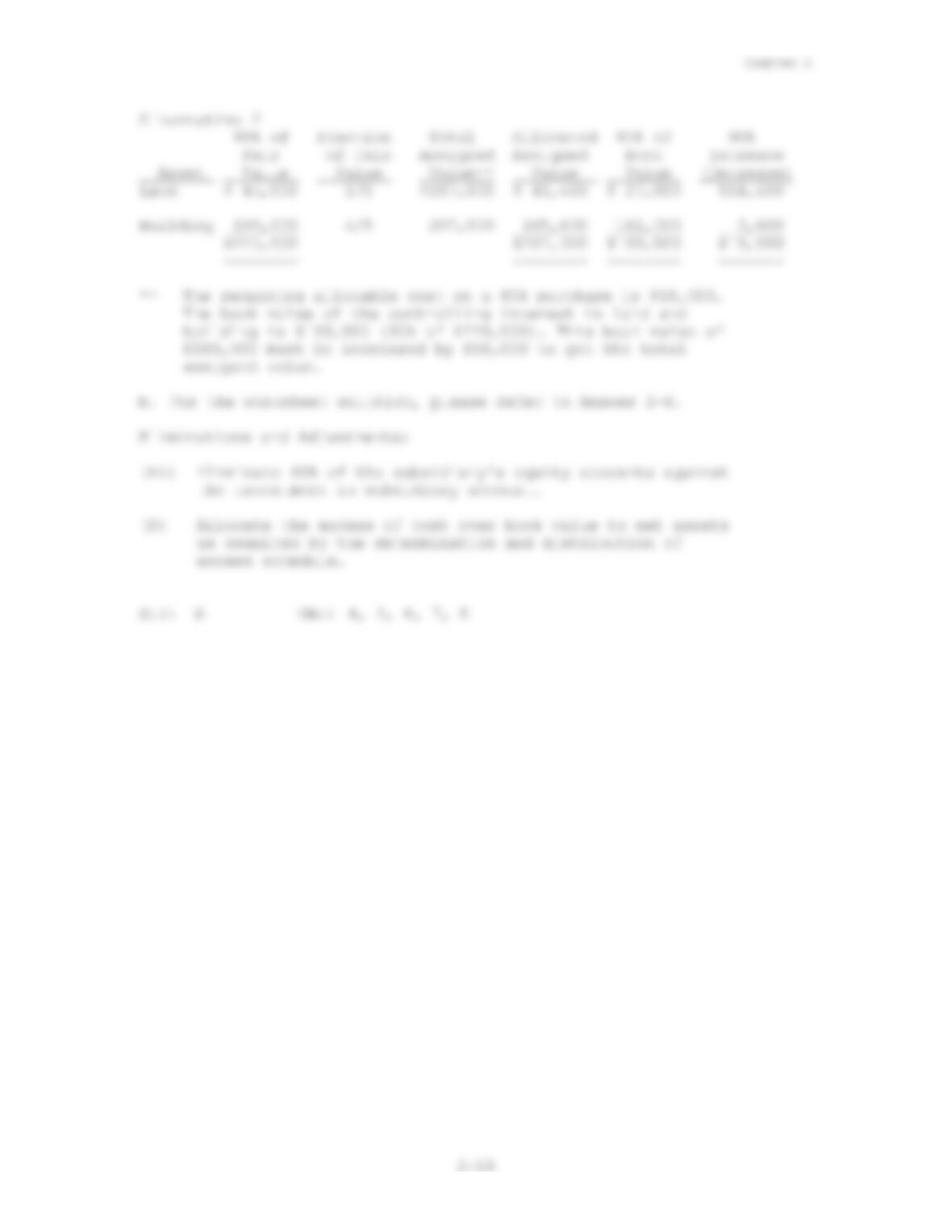
For the worksheet solution, please refer to Answer 2-1.
Chapter 2
2-12
b.
Complete the Figure 2-2 worksheet for a consolidated balance
sheet as of December 31, 20X1.
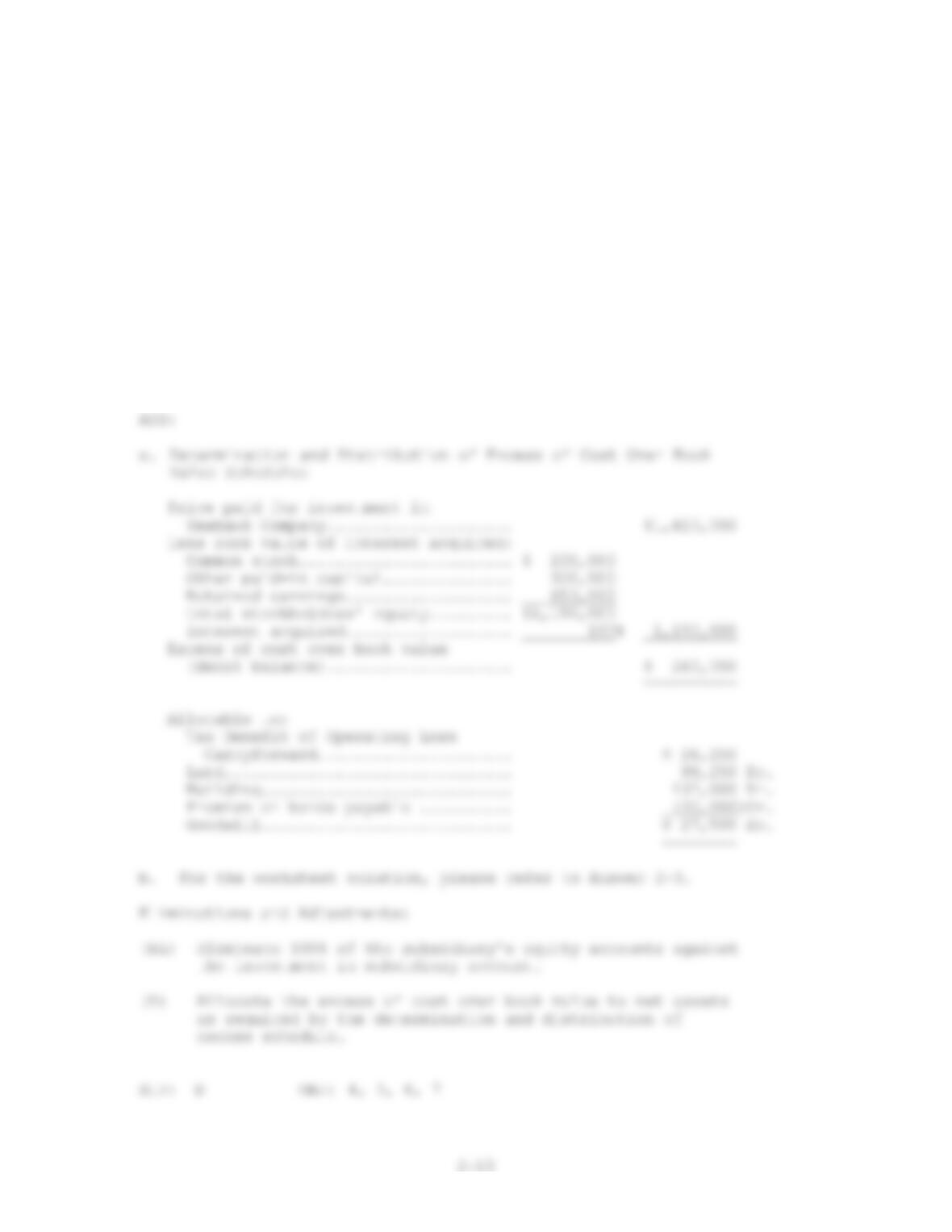
5. On January 1, 20X1, Panther Company purchased 100% of the common stock
of Seahawk Company for $1,410,000. On this date, Seahawk had total
owners’ equity of $1,150,000.
On December 31, 20X4, Seahawk Company had reported an operating loss
before taxes of $175,000. Assume a tax rate of 35%. Since a carryback
of $75,000 was available, a tax refund receivable of $26,250 was
recorded and a net-of-tax loss of $148,750 was reported. At the date of
purchase, Panther Company has concluded that the balance of the tax
benefit of the operating loss will be realized in 20X1 when a
consolidated tax return is prepared.
a.
Determination and Distribution of Excess of Cost over Book
For the worksheet solution, please refer to Answer 2-2.
Chapter 2
On January 1, 20X1, the excess of cost over book value is due to the
tax benefit above, to a $30,000 undervaluation of Bonds Payable, to an
undervaluation of land, building and equipment, and to goodwill. The
fair value of land is $500,000. The fair value of building and
equipment is $750,000. The book value of the land is $400,750. The book
value of the building and equipment is $613,000.
Required:
a.
Using the information above and on the separate worksheet,
complete a schedule for determination and distribution of the
excess of cost over book value.
b.
Complete the Figure 2-3 worksheet for a consolidated balance
sheet as of January 1, 20X1.
a.
Determination and Distribution of Excess of Cost Over Book
Value Schedule:
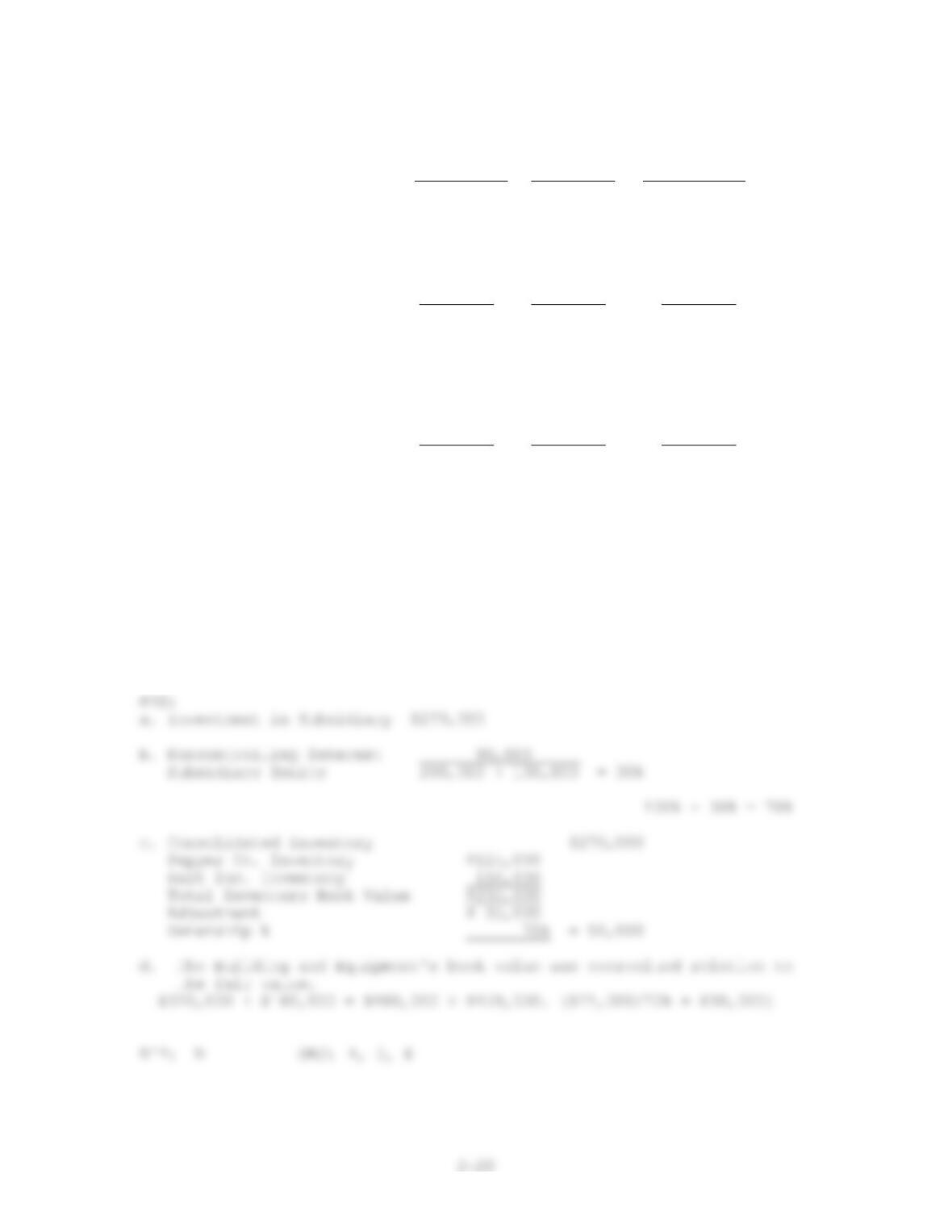
For the worksheet solution, please refer to Answer 2-3.
Chapter 2
2-14
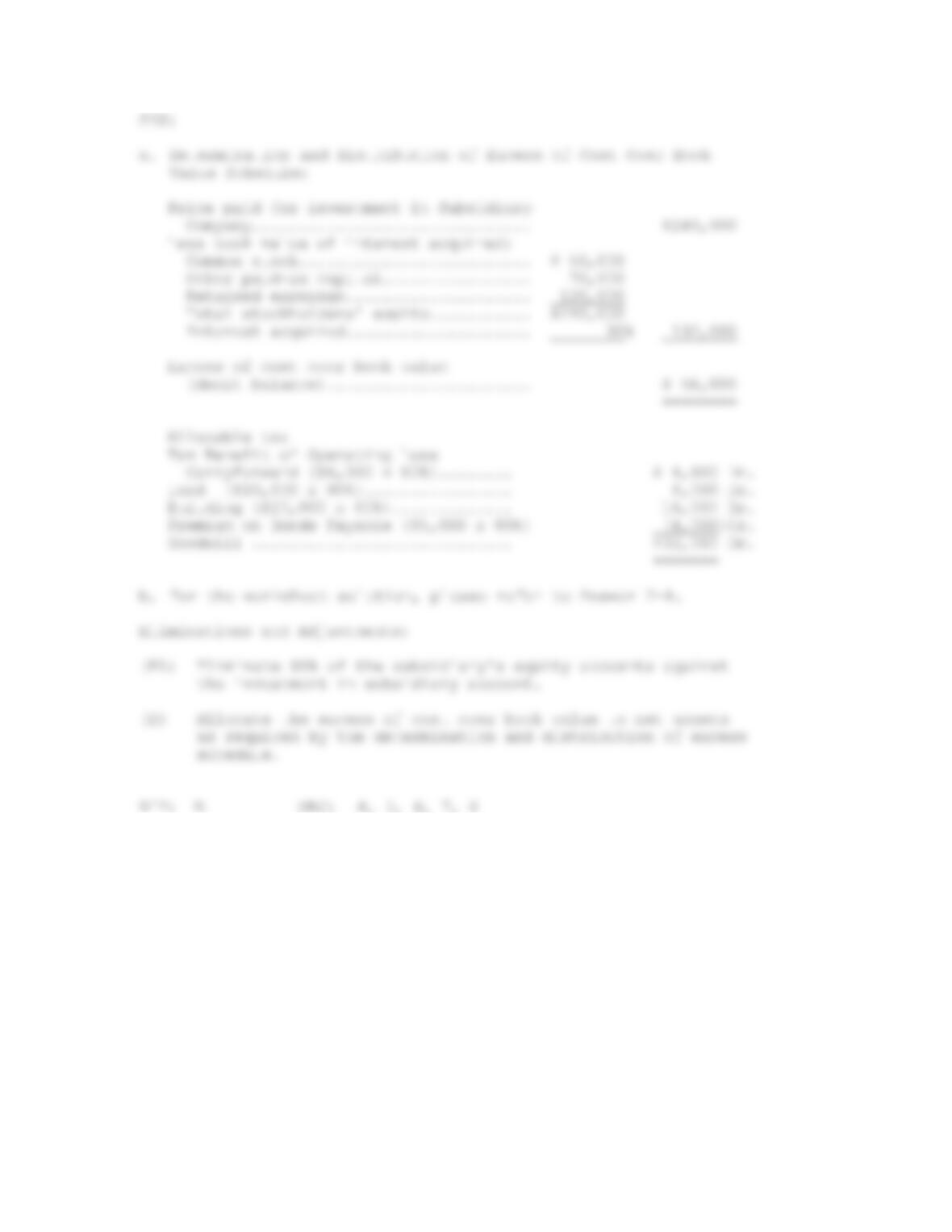
6. On January 1, 20X1, Parent Company purchased 80% of the common stock of
Subsidiary Company for $248,800. On this date, Subsidiary had total
owners’ equity of $240,000.
On December 31, 20X4, Subsidiary Company had reported an operating loss
before taxes of $40,000. Assume a tax rate of 30%. Since a carryback of
$20,000 was available, a tax refund receivable of $6,000 was recorded
and a net-of-tax loss of $34,000 was reported. At the date of purchase,
Parent Company has concluded that the balance of the tax benefit of the
operating loss will be realized in 20X1 when a consolidated tax return
is prepared.
On January 1, 20X1, the excess of cost over book value is due to the
tax benefit above, to a $5,000 undervaluation of Bonds Payable, to an
undervaluation of land, building and equipment, and to goodwill. The
fair value of land is $40,000. The fair value of building and equipment
is $200,000. The book value of the land is $30,000. The book value of
the building and equipment is $180,000.
Required:
a.
From the information above and on the separate worksheet,
complete a schedule for determination and distribution of the
excess of cost over book value. Use the parent company concept
(pro rata fair value approach) in any revaluation of net
assets.
b.
Complete the Figure 2-4 worksheet for a consolidated balance
sheet as of January 1, 20X1.
Chapter 2
2-15
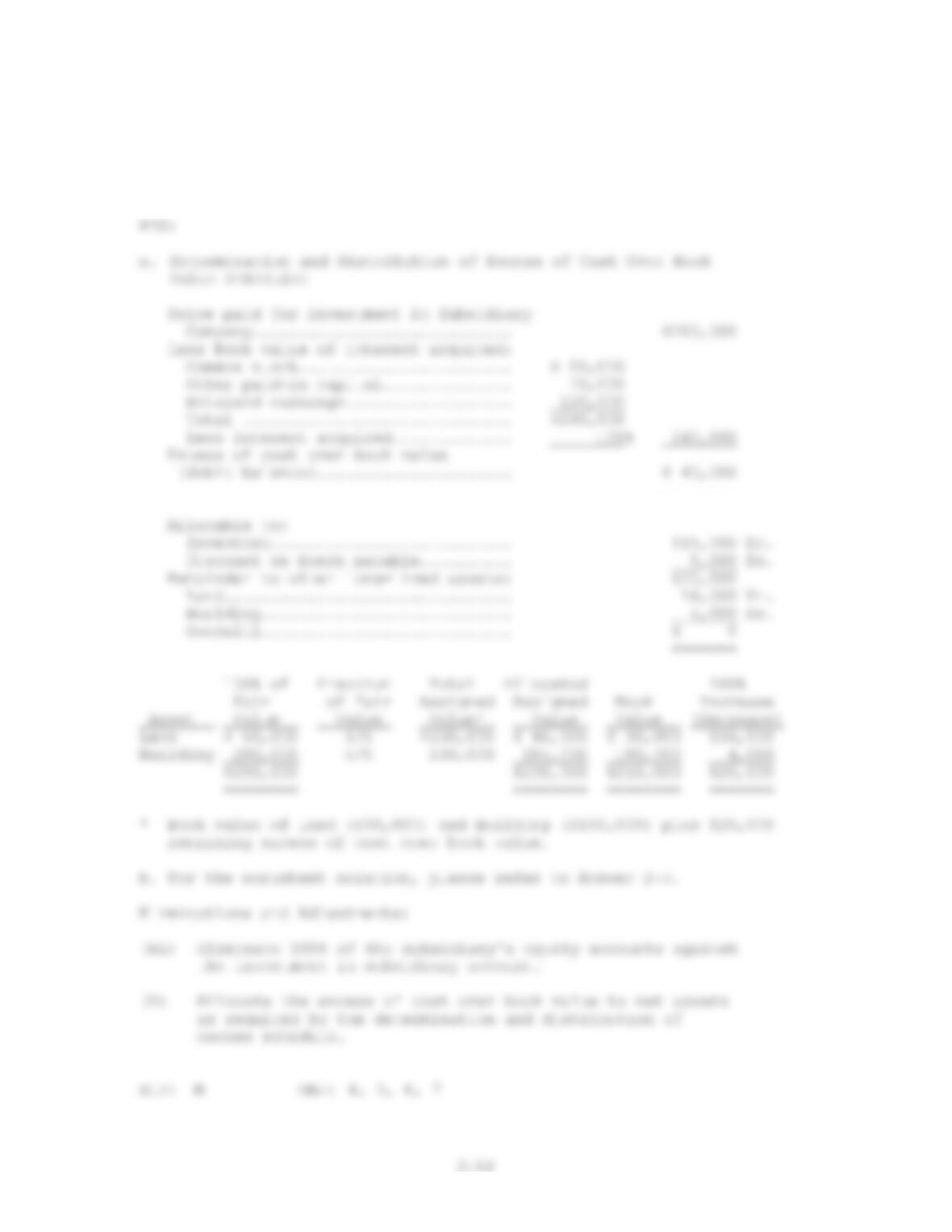
7. On January 1, 20X1, Parent Company purchased 100% of the common stock
of Subsidiary Company for $280,000. On this date, Subsidiary had total
owners’ equity of $240,000.
On January 1, 20X1, the excess of cost over book value is due to a
$15,000 undervaluation of inventory, to a $5,000 overvaluation of Bonds
Payable, and to an undervaluation of land, building and equipment. The
fair value of land is $50,000. The fair value of building and equipment
is $200,000. The book value of the land is $30,000. The book value of
the building and equipment is $180,000.
Required:
a.
Using the information above and on the separate worksheet,
complete a schedule for determination and distribution of the
a.
Determination and Distribution of Excess of Cost Over Book
Value Schedule:
Chapter 2
excess of cost over book value.
b.
Complete the Figure 2-5 worksheet for a consolidated balance
sheet as of January 1, 20X1.
Value Schedule:
Chapter 2
2-17
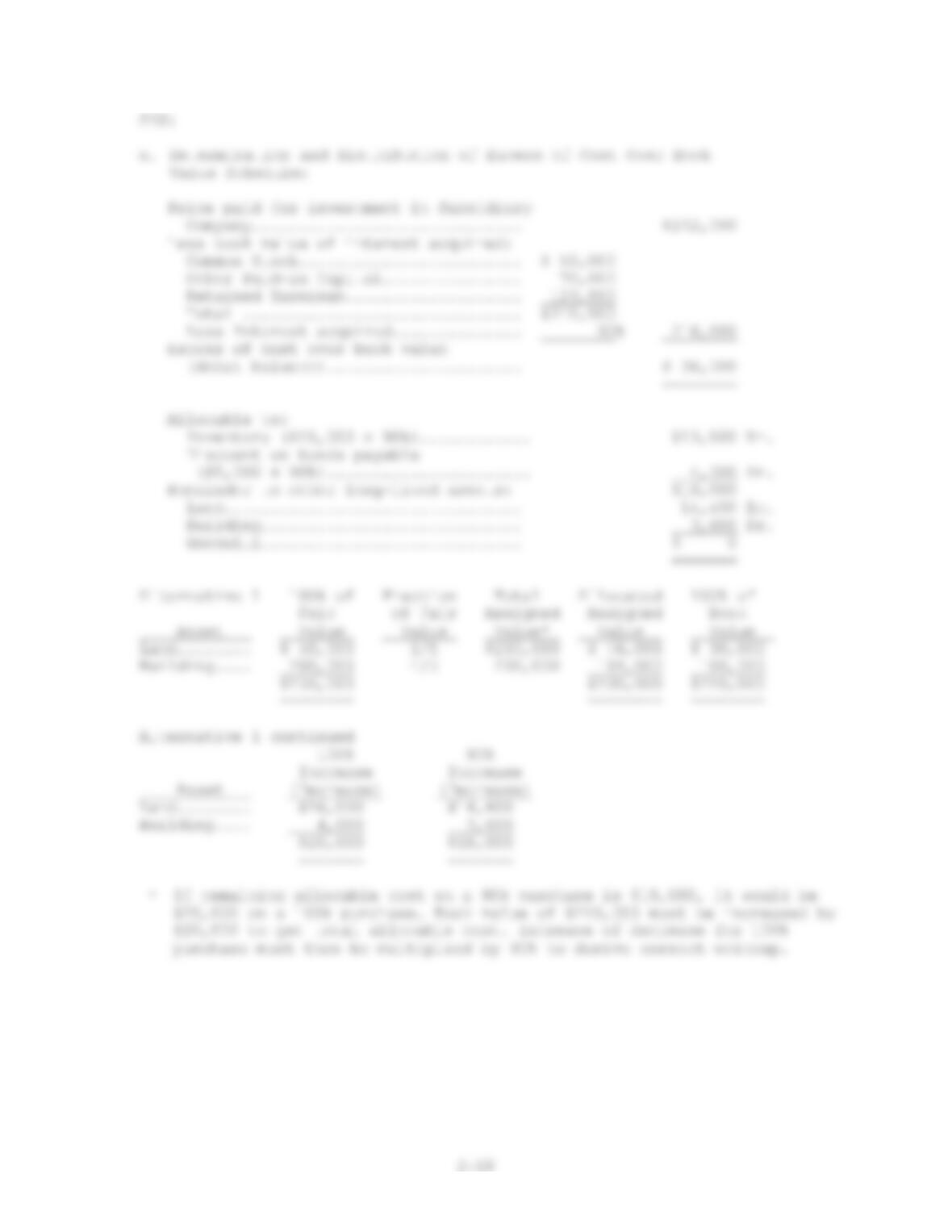
8. On January 1, 20X1, Parent Company purchased 90% of the common stock of
Subsidiary Company for $252,000. On this date, Subsidiary had total
owners’ equity of $240,000.
On January 1, 20X1, the excess of cost over book value is due to a
$15,000 undervaluation of inventory, to a $5,000 overvaluation of Bonds
Payable, and to an undervaluation of land, building and equipment. The
fair value of land is $50,000. The fair value of building and equipment
is $200,000. The book value of the land is $30,000. The book value of
the building and equipment is $180,000.
Required:
a.
From the information above and on the separate worksheet,
complete a schedule for determination and distribution of the
excess of cost over book value. Use the parent company concept
(pro rata fair value approach) in any revaluation of net
assets.
b.
Complete the Figure 2-6 worksheet for a consolidated balance
sheet as of January 1, 20X1.
Chapter 2
Chapter 2
9.
Consolidated
Financial
Pepper Co. Salt Inc. Statements
Cash $ 26,000 $ 20,000 $ 46,000
Accounts Receivable, net 20,000 30,000 50,000
Inventory 125,000 110,000 270,000
Land 30,000 80,000 124,000
Building and Equipment 320,000 160,000 459,000
Investment in Subsidiary 279,000 – –
Goodwill – – 41,000
Total Assets $800,000 $400,000 $990,000
======== ======== ========
Accounts Payable $ 40,000 $ 40,000 $ 80,000
Other Liabilities 70,000 60,000 130,000
Common Stock 400,000 200,000 400,000
Retained Earnings 290,000 100,000 290,000
Noncontrolling Interest – – 90,000
Total Liabilities &
Stockholders’ Equity $800,000 $400,000 $990,000
======== ======== ========
Answer the following based upon the above financial statements:
a. How much did Pepper Co. pay to acquire Salt Inc.?
b. What percentage ownership did Pepper Co. acquire of Salt Inc.?
c. What was the fair value of Salt’s Inventory at the time of
acquisition?
d. Was the book value of Salt’s Building and Equipment overvalued or
undervalued relative to the Building and Equipment’s fair value at
the time of acquisition?
Chapter 2
2-21
10. On January 1, 20X1, Parent Company acquired 80% of the common stock of
Subsidiary Company by issuing Parent common stock with a fair value of
$250,800. On this date, Subsidiary had total owners’ equity of
$240,000.
Even though the combination must be accounted for as a purchase, it is
a tax-free combination for Federal income tax purposes. The corporate
tax rate is 30%.
On January 1, 20X1, the excess of cost over book value is due to an
undervaluation of land, building, and goodwill. The fair value of land
is $40,000. The fair value of building is $200,000. The book value of
the land is $30,000. The book value of the building is $180,000.
Required:
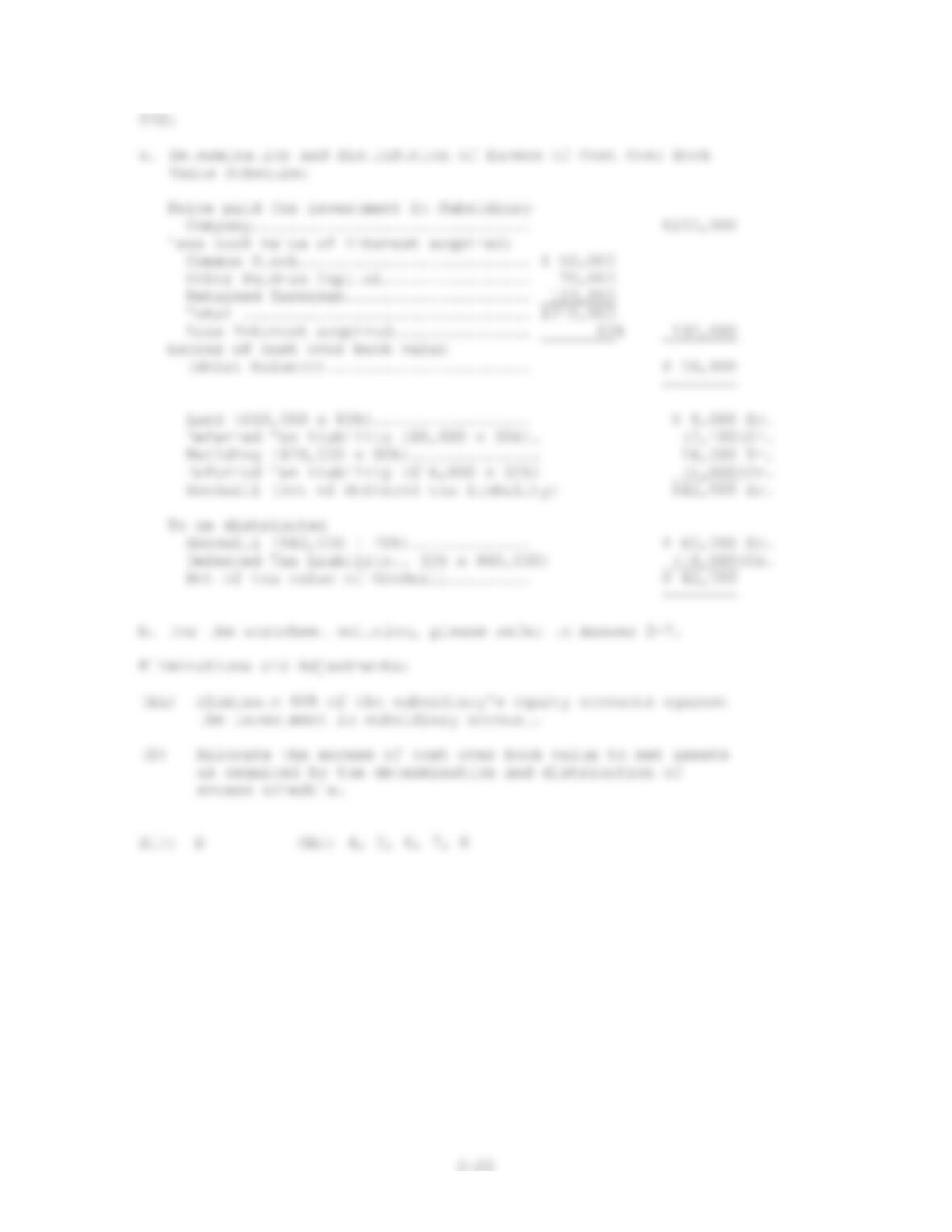
a.
From the information above and on the separate worksheet,
complete a schedule for determination and distribution of the
excess of cost over book value. Use the parent company concept
(prorata fair value approach) in any writeup of net assets.
b.
Complete the Figure 2-7 worksheet for a consolidated balance
sheet as of January 1, 20X1.
Chapter 2

Chapter 2
2-23
11. Supernova Company had the following summarized balance sheet on
December 31, 20X1:
Assets
Accounts receivable……………………………… $ 200,000
Inventory………………………………………. 450,000
Property and plant (net)…………………………. 600,000
Goodwill……………………………………….. 150,000
Total………………………………………… $1,400,000
==========
Liabilities and Equity
Notes payable…………………………………… $ 600,000
Common stock, $5 par…………………………….. 300,000
Paid-in capital in excess of par………………….. 400,000
Retained earnings……………………………….. 100,000
Total………………………………………… $1,400,000
==========
The fair value of the inventory and property and plant is $600,000 and
$850,000, respectively.
Required:
a.
Assume that Redstar Corporation purchases 100% of the common
stock of Supernova Company for $1,800,000. What value will be
assigned to the following accounts of the Supernova Company
when preparing a consolidated balance sheet on December 31,
20X1?
(1) Inventory _________
(2) Property and plant _________
(3) Goodwill _________
(4) Noncontrolling interest _________
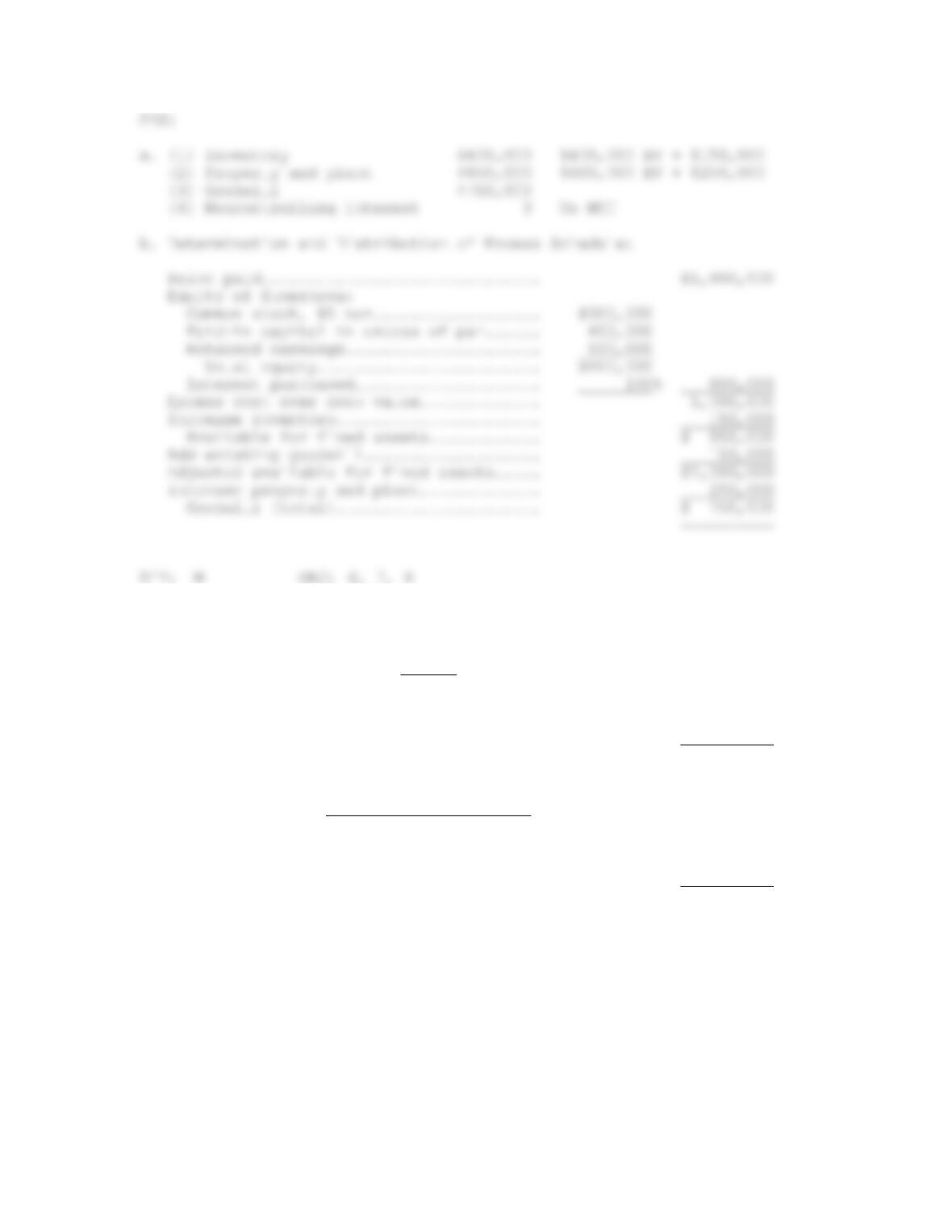
b.
Prepare a supporting determination and distribution of excess
schedule.
Chapter 2
2-24
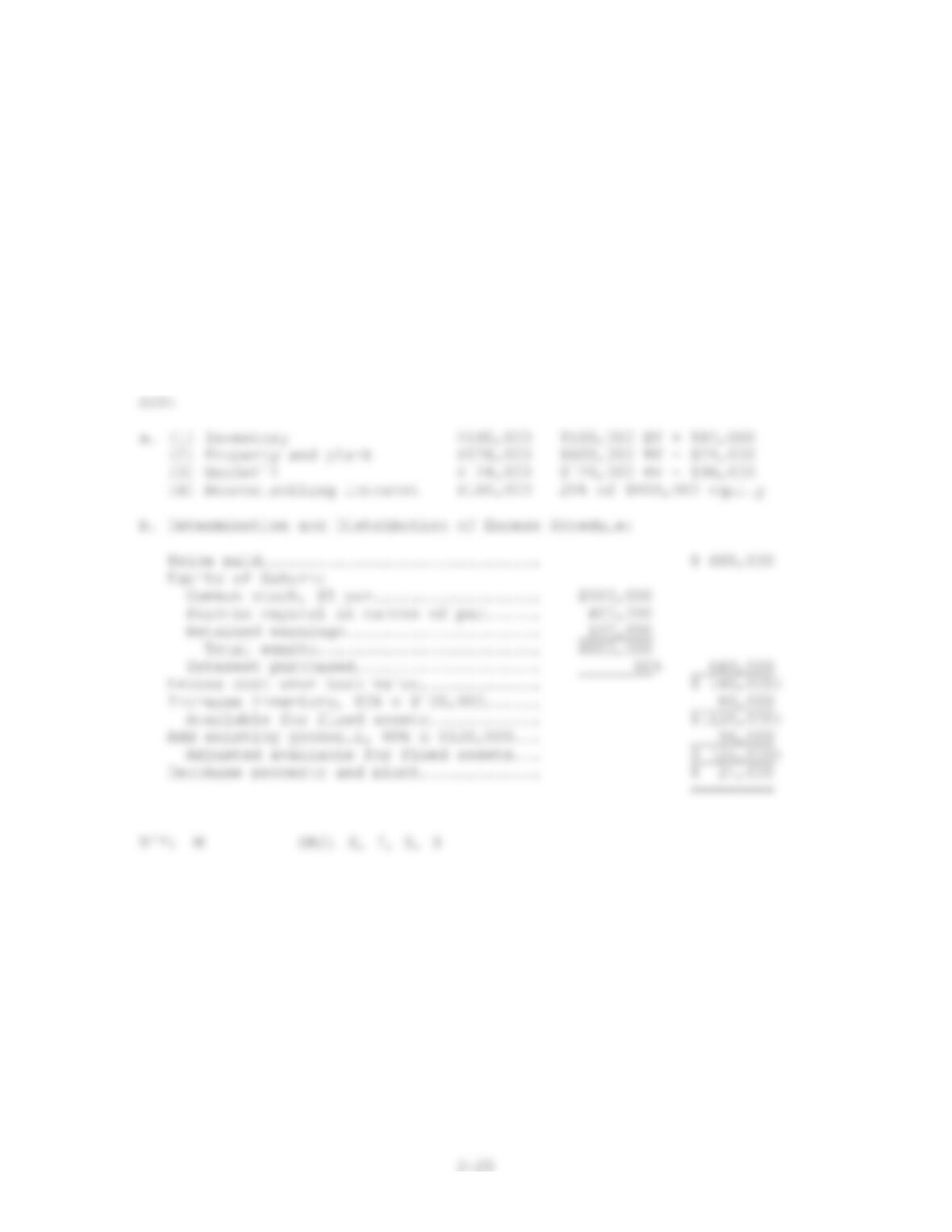
12. Saturn Company had the following summarized balance sheet on December
31, 20X1:
Assets
Accounts receivable……………………………… $ 180,000
Inventory………………………………………. 500,000
Property and plant (net)…………………………. 600,000
Goodwill……………………………………….. 120,000
Total………………………………………… $1,400,000
==========
Liabilities and Equity
Notes payable…………………………………… $ 600,000
Common stock, $5 par…………………………….. 300,000
Paid-in capital in excess of par………………….. 400,000
Retained earnings……………………………….. 100,000
Total………………………………………… $1,400,000
==========
The fair value of the inventory and property and plant is $600,000 and
$850,000, respectively.
Chapter 2
Required:
a.
Assume that Return Corporation purchases 80% of the common
stock of Saturn Company for $600,000. What value will be
assigned to the following accounts of the Saturn Company when
preparing a consolidated balance sheet on December 31, 20X1?
(1) Inventory _________
(2) Property and plant _________
(3) Goodwill _________
(4) Noncontrolling interest _________
b.
Prepare a supporting determination and distribution of excess
schedule.

Chapter 2
2-26
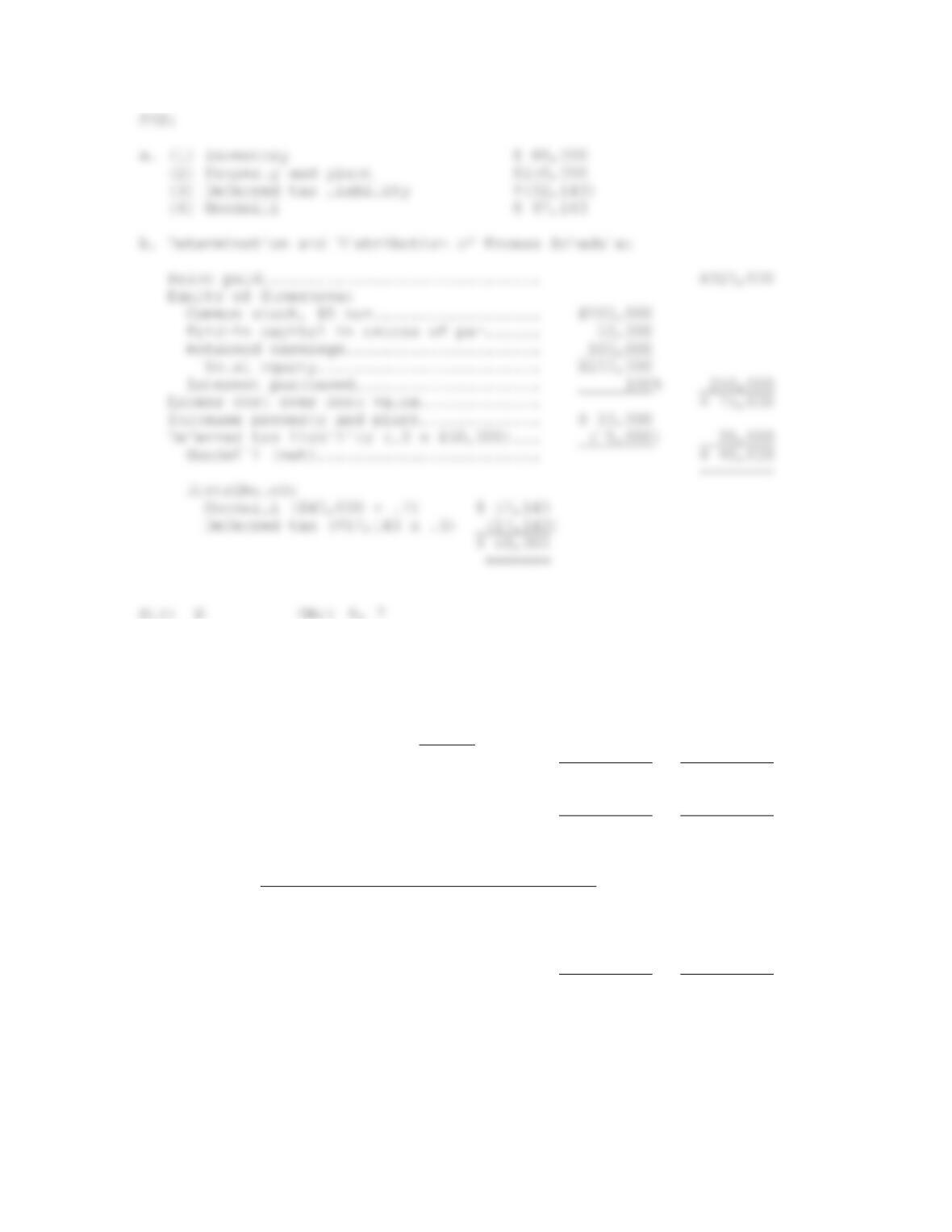
13. Pluto purchased 100% of the common stock of the Saturn Company for
$325,000 when Saturn had the following balance sheet:
Assets
Current assets………………………………….. $ 50,000
Inventory………………………………………. 60,000
Property and plant………………………………. 300,000
Accumulated depreciation…………………………. (110,000)
Total………………………………………… $ 300,000
=========
Liabilities and Equity
Current liabilities……………………………… $ 50,000
Common stock, $5 par…………………………….. 100,000
Pain-in capital in excess of par………………….. 50,000
Retained earnings……………………………….. 100,000
Total………………………………………… $300,000
========
The fair value of the plant is $250,000.
The purchase is a tax free exchange as to the seller; thus, the
purchaser will be able to depreciate only the book value of the assets
purchased. The applicable tax rate is 30%.
Required:
a.
At what amount will the following accounts be listed on the
consolidated balance sheet prepared on the date of purchase?
(1) Inventory _________
(2) Property and plant _________
(3) Deferred tax liability _________
(4) Goodwill _________
b.
Prepare a supporting determination and distribution of excess
schedule.
Chapter 2
2-27
14. Fortuna Company issued 51,500 shares of $1 par stock, with a fair value
of $21 per share, for 80% of the outstanding shares of Acappella
Company. The firms had the following separate balance sheets prior to
the acquisition:
Assets
Fortuna Acappella
Current assets……………………….. $2,100,000 $ 960,000
Property, plant, and equipment (net)…….. 4,600,000 1,300,000
Goodwill…………………………….. 240,000
Total assets…………………………. $6,700,000 $2,500,000
========== ==========
Liabilities and Stockholders’ Equity
Liabilities………………………….. $3,000,000 $ 800,000
Common stock ($1 par)…………………. 800,000
Common stock ($5 par)…………………. 200,000
Paid-in capital in excess of par……….. 2,200,000 300,000
Retained earnings…………………….. 700,000 1,200,000
Total liabilities and equity…………… $6,700,000 $2,500,000
========== ==========
Book values equal fair values for the assets and liabilities of
Acappella Company, except for the property, plant, and equipment, which
has a fair value of $1,600,000.
Chapter 2
2-28
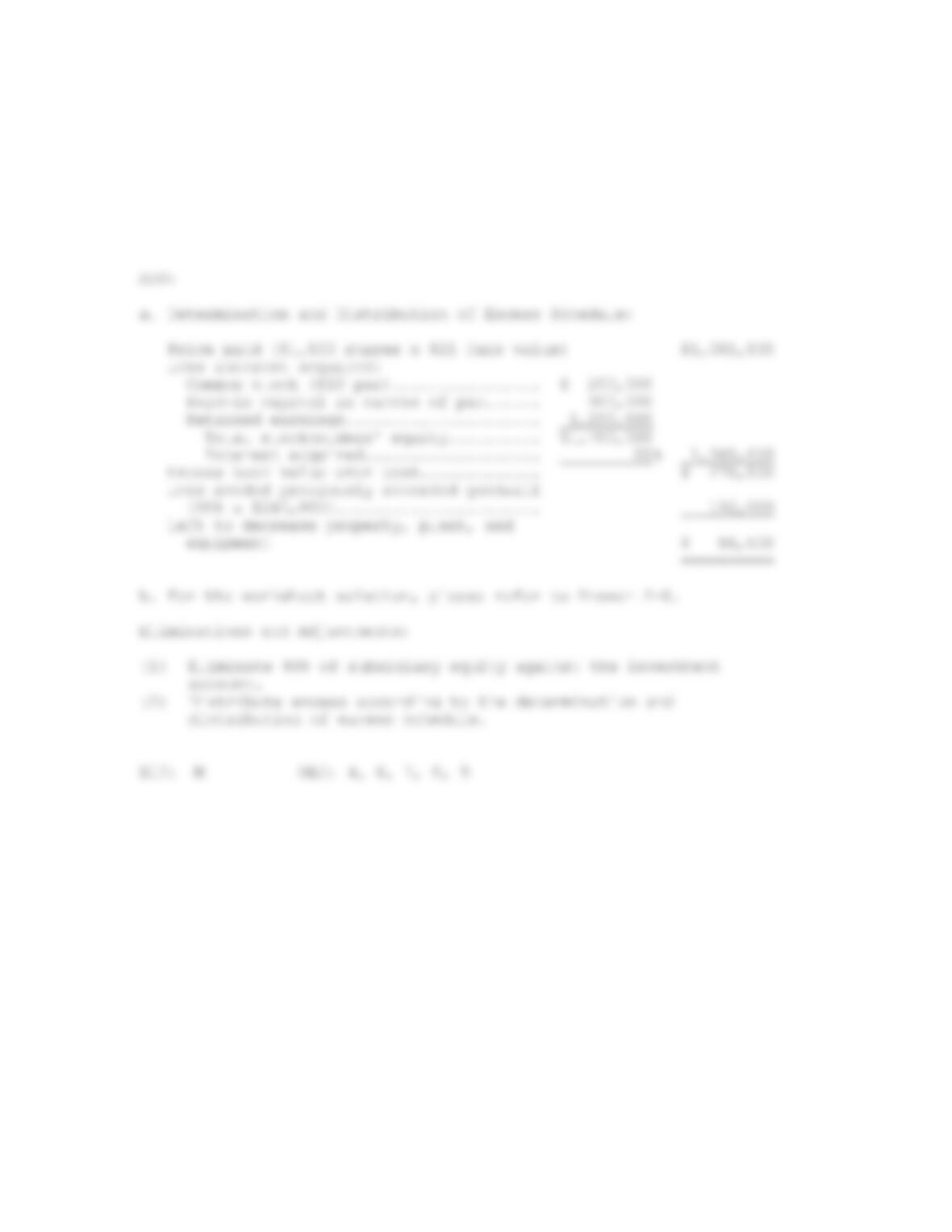
Required:
a.
Prepare a determination and distribution of excess schedule.
b.
Provide all eliminations on the partial balance sheet
worksheet provided in Figure 2-8 and complete the
noncontrolling interest column.
ESSAY
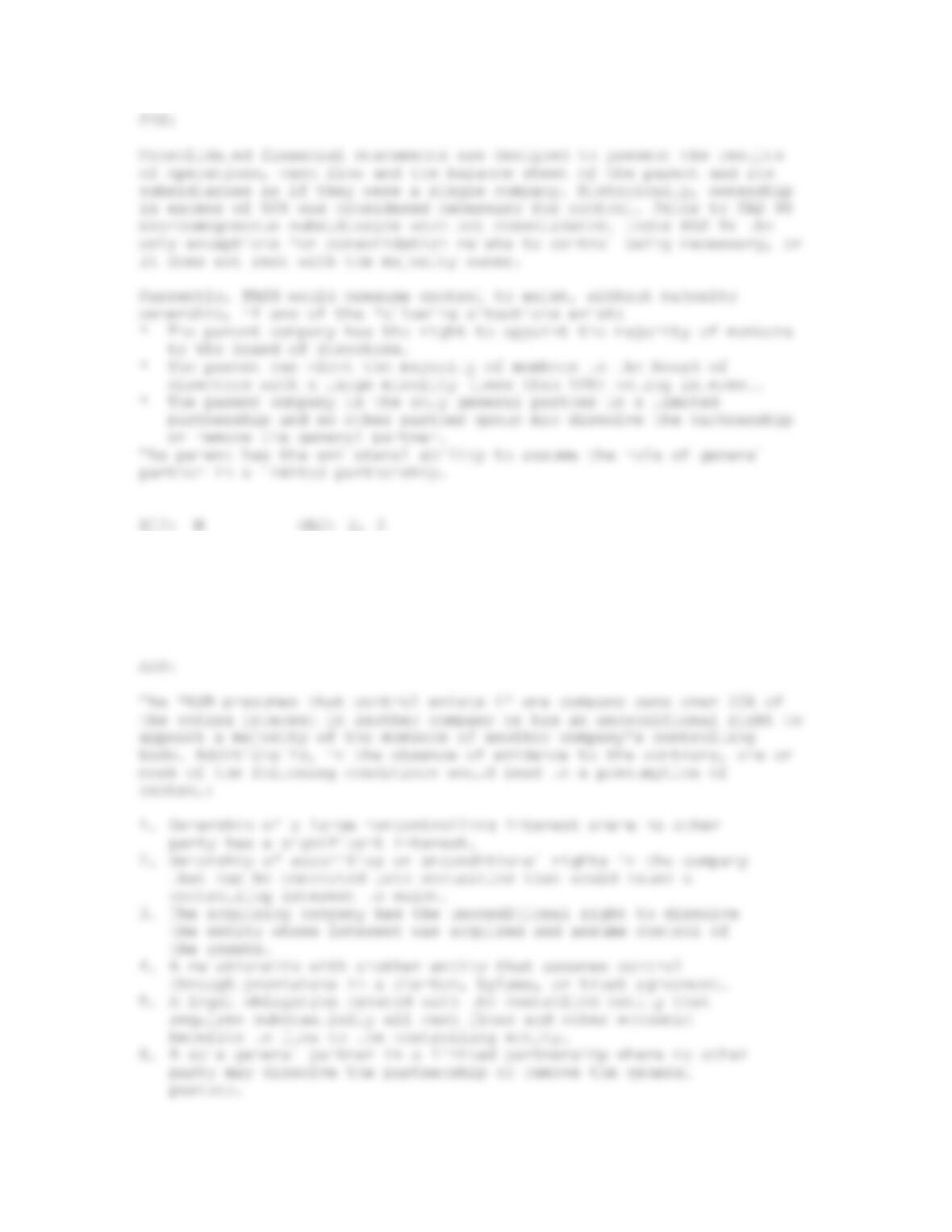
1. Historically the SEC and the FASB have considered majority ownership to
define control as a necessary condition prior to preparing
consolidating financial statements. Now, both of these organizations
are considering a change in the definition of control.
Discuss the historical perspective on consolidation and now under what
situations control would be considered appropriate without majority
ownership. In your response describe the function of consolidated
financial statements.
Chapter 2
2-29
2. Discuss the conditions under which the FASB would assume a presumption
of control. Additionally, under what circumstances might the FASB
require consolidation even though the parent does not control the
subsidiary?
Chapter 2
DIF: M OBJ: 3
3. A parent company purchases an 80% interest in a subsidiary at a price
high enough to revalue all assets and allow for goodwill on the
interest purchased. If “push down accounting” were used in conjunction
with the “economic entity concept,” what unique procedures would be
used that are not normally used for such an 80% purchase?