Chapter 2 – Analyzing Transactions
135.
May
24
Land
105,000
Cash
105,000
Purchased land for business.
What effects does this journal entry have on the accounts?
a.
increase Cash and increase Land
b.
decrease Cash and increase Land
c.
decrease Cash and decrease Land
d.
increase Cash and decrease Land
136.
March
10
Accounts Payable
800
Cash
800
Paid creditors on account.
What effects does this journal entry have on the accounts?
a.
decrease Accounts Payable, increase Cash
b.
increase Accounts Payable, decrease Cash
c.
increase Accounts Payable, increase Cash
d.
decrease Accounts Payable, decrease Cash
Chapter 2 – Analyzing Transactions
137. Which of the following accounts would be increased with a credit?
a.
Land; Accounts Payable; Dividends
b.
Accounts Payable; Unearned Revenue; Common Stock
c.
Dividends; Accounts Receivable; Unearned Revenue
d.
Cash; Accounts Receivable; Common Stock
138. In accordance with the debit and credit rules, which of the following is true?
a.
Debits increase assets.
b.
Credits increase assets.
c.
Debits increase both assets and common stock.
d.
Credits increase both assets and liabilities.
139. All of the following accounts are increased with a debit except
a.
Unearned Revenues
b.
Land
c.
Accounts Receivable
d.
Cash
Chapter 2 – Analyzing Transactions
140. Which of the following stockholders’ equity accounts follows the same debit and credit rules as liabilities?
a.
expense accounts only
b.
dividends accounts only
c.
revenue, common stock, and retained earnings accounts
d.
expense and dividends accounts
141. The payment for the monthly rent will require which of the following entries?
a.
debit Cash and debit Rent Expense
b.
credit Cash and credit Rent Expense
c.
debit Rent Expense and credit Cash
d.
credit Rent Expense and debit Cash
142. Expenses follow the same debit and credit rules as
a.
revenues
b.
assets
c.
the Common Stock account
d.
liabilities
Chapter 2 – Analyzing Transactions
143. Net income will result when
a.
revenues (credits) > expenses (debits)
b.
revenues (debits) > expenses (credits)
c.
expenses (credits) = revenues (debits)
d.
revenues (credits) = expenses (debits)
144. Which of the following will increase stockholders’ equity?
a.
expenses > revenues
b.
the company pays dividends
c.
revenues > expenses
d.
cash is received from customers on account
145. Which of the following situations increase stockholders’ equity?
a.
Supplies are purchased on account.
b.
Services are provided on account.
c.
Cash is received from customers on account.
d.
Utility bill will be paid next month.
Chapter 2 – Analyzing Transactions
146. Which of the following groups of accounts are increased with a debit?
a.
assets, liabilities, stockholders’ equity
b.
assets, dividends, expenses
c.
assets, revenues, expenses
d.
assets, liabilities, revenues
147. Which of the following groups of accounts increase with a credit?
a.
common stock, revenues, expenses
b.
assets, common stock, revenues
c.
liabilities, common stock, revenues
d.
none of these
148. Which of the following is true regarding normal balances of accounts?
a.
All accounts have a normal debit balance.
b.
The normal balance of all accounts will have either a positive or negative balance.
c.
Accounts that have a normal debit balance will only have debit entries, never credit entries.
d.
The normal balance is on the increase side of the account.
Chapter 2 – Analyzing Transactions
149. Which of the following is not true with a double-entry accounting system?
a.
The accounting equation remains in balance.
b.
The sum of all debits is always equal to the sum of all credits in each journal entry.
c.
Each business transaction will have two debits.
d.
Every transaction affects at least two accounts.
150.
March
6
Cash
2,500
Unearned Fees
2,500
????????????.
What is the best explanation for this journal entry?
a.
Received cash for services performed.
b.
Received cash for services to be performed in the future.
c.
Paid cash in advance for services to be performed.
d.
Performed services for which cash is owed.
151.
April
14
Equipment
15,000
Cash
5,000
Note Payable
10,000
????????????.
Which is the best explanation for this journal entry?
a.
Purchased equipment; paid cash of $5,000, with the remainder to be paid in the future.
b.
Purchased equipment; paid cash of $10,000, with the remainder to be received in the future.
c.
Purchased equipment with cash.
d.
Purchased equipment on account.
Chapter 2 – Analyzing Transactions
152. The process of transferring the debits and credits from the journal entries to the accounts is called
a.
sliding
b.
transposing
c.
journalizing
d.
posting
153. The posting process will include the transfer of which of the following data from the journal to the account?
a.
date, amount (debit or credit)
b.
date, amount (debit or credit), journal page number
c.
amount (debit or credit), account number
d.
date, amount (debit or credit), account number
154. The Posting Reference columns are used to trace transactions from the accounts to the journal. What will be entered
in the Posting Reference column of (1) the journal and (2) the account?
a.
(1) the amount of the debit or credit and (2) the journal page number
b.
(1) the journal page number and (2) the date of the transaction
c.
(1) the journal page number and (2) the account number
d.
(1) the account number and (2) the journal page number
Chapter 2 – Analyzing Transactions
The chart of accounts for the Corning Company includes the following:
Account Name
Account Number
Cash
11
Accounts Receivable
13
Prepaid Insurance
15
Accounts Payable
21
Unearned Revenue
24
Common Stock
31
Dividends
32
Fees Earned
41
Salaries Expense
54
Rent Expense
56
Page 3 of the journal contains the following entry:
Prepaid Insurance
1,530
Cash
1,530
Use the above information to answer the questions that follow.
155. What is the posting reference that will be found in the cash account?
a.
11
b.
15
c.
3
d.
13
156. What is the posting reference that will be found in the prepaid insurance account?
a.
11
b.
15
c.
3
d.
13
Chapter 2 – Analyzing Transactions
157. What posting references will be found in the journal entry?
a.
15, 11
b.
15, 3
c.
11, 3
d.
3, 15
158. The chart of accounts for the Miguel Company includes the following:
Account Name
Account Number
Cash
11
Accounts Receivable
13
Prepaid Insurance
15
Accounts Payable
21
Unearned Revenue
24
Common Stock
31
Dividends
32
Fees Earned
41
Salaries Expense
54
Rent Expense
56
Page 3 of the journal contains the following transaction:
Cash
640
Fees Earned
640
What posting references will be found in the journal entry?
a.
41, 3
b.
3, 11
c.
11, 41
d.
11, 3
Chapter 2 – Analyzing Transactions
159. The chart of accounts for the Miguel Company includes the following:
Account Name
Account Number
Cash
11
Accounts Receivable
13
Prepaid Insurance
15
Accounts Payable
21
Unearned Revenue
24
Common Stock
31
Dividends
32
Fees Earned
41
Salaries Expense
54
Rent Expense
56
Page 5 of the journal contains the following transaction:
Salaries Expense
525
Cash
525
What is the posting reference that will be found in the salaries expense account?
a.
5
b.
11
c.
54
d.
21
160. Which of the following errors, each considered individually, would cause the trial balance totals to be unequal?
a.
A transaction was not posted.
b.
A payment of $67 for insurance was posted as a debit of $76 to Prepaid Insurance and a credit of $76 to Cash.
c.
A payment of $4,450 to a creditor was posted as a debit of $4,500 to Accounts Payable and a credit of $450 to
Cash.
d.
Cash received from customers on account was posted as a debit of $720 to Cash and a credit of $720 to
Accounts Payable.
Chapter 2 – Analyzing Transactions
161. Proof that the dollar amount of the debits equals the dollar amount of the credits in the ledger means
a.
all of the information from the journal was correctly transferred to the ledger
b.
all accounts have their correct balances in the ledger
c.
only the journal is accurate; the ledger may be incorrect
d.
only that the debit dollar amounts equal the credit dollar amounts
162. That the total dollar amount of the debits equals the total dollar amount of the credits in the ledger accounts can be
verified through a(n):
a.
chart of accounts
b.
trial balance
c.
income statement
d.
balance sheet
Chapter 2 – Analyzing Transactions
163. Randomly listed below are the steps for preparing a trial balance:
(1)
Verify that the total of the Debit column equals the total of the Credit column.
(2)
List the accounts from the ledger and enter their debit or credit balance in the Debit or
Credit column of the trial balance.
(3)
List the name of the company, the title of the trial balance, and the date the trial balance
is prepared.
(4)
Total the Debit and Credit columns of the trial balance.
What is the proper order of these steps?
a.
(3), (2), (4), (1)
b.
(2), (3), (4), (1)
c.
(3), (2), (1), (4)
d.
(4), (3), (2), (1)
164. A trial balance is prepared to
a.
prove that there were no errors made in recording transactions into the journal
b.
prove that no errors were made in posting to the ledger
c.
prove that each account balance is correct
d.
discover errors that affect the equality of debits and credits
165. The accounts in the ledger of Monroe Entertainment Co. are listed below. All accounts have normal balances.
Accounts Payable
$1,500
Fees Earned
$3,600
Accounts Receivable
1,800
Insurance Expense
1,300
Prepaid Insurance
2,000
Land
3,000
Cash
3,200
Wages Expense
1,400
Dividends
1,200
Common Stock
8,800
Chapter 2 – Analyzing Transactions
Prepare a trial balance. The total of the debits is
a.
$13,900
b.
$11,200
c.
$12,700
d.
$9,700
166. Of the following, which is an internal report that will determine if the total of the debit balances equal the total of the
credit balances in the ledger?
a.
chart of accounts
b.
income statement
c.
trial balance
d.
horizontal analysis
Chapter 2 – Analyzing Transactions
167. An overpayment error was discovered in computing and paying the wages of a Jamison Tree Trimming
employee. When Jamison receives cash from the employee for the amount of the overpayment, which of the following
entries will Jamison make?
a.
Cash, debit; Wages Expense, credit
b.
Wages Payable, debit; Wages Expense, credit
c.
Wages Expense, debit; Cash, credit
d.
Cash, debit; Wages Payable, credit
168. If the two totals of a trial balance are not equal, it could be due to
a.
failure to record a transaction
b.
recording the same erroneous amount for both the debit and the credit parts of a transaction
c.
an error in determining the account balances, such as a balance being incorrectly computed
d.
recording the same transaction more than once
169. When a transposition error is made on the trial balance, the difference between the debit and credit totals on the trial
balance will be
a.
zero
b.
twice the amount of the transposition
c.
one-half the amount of the transposition
d.
divisible by 9
Chapter 2 – Analyzing Transactions
170. Which of the following errors could cause the trial balance totals to be unequal?
a.
posting the debit portion of a journal entry incorrectly when the credit portion of the entry is correctly posted
b.
failure to record a transaction or to post a transaction
c.
recording the same transaction more than once
d.
recording the same erroneous amount for both the debit and the credit parts of a transaction
171. The trial balance is out of balance and the accountant suspects that a transposition or slide error has occurred. What
will the accountant do to confirm this suspicion?
a.
Determine the amount of the error and look for that amount on the trial balance.
b.
Determine the amount of the error and divide by two, then look for that amount on the trial balance.
c.
Determine the amount of the error and refer to the journal entries for that amount.
d.
Determine the amount of the error and divide by nine. If the result is evenly divided, then this type of error is
likely.
172. The purchase of supplies on account was recorded and posted as a debit to Supplies for $500 and a credit to Accounts
Receivable for $500. The correcting entry would include a:
a.
credit to Accounts Receivable for $500
b.
credit to Accounts Receivable for $1,000
c.
credit to Accounts Payable for $500
d.
credit to Accounts Payable for $1,000
Chapter 2 – Analyzing Transactions
173. Which of the following is not a useful step in finding errors on the trial balance?
a.
Determine the difference between debits and credits and look for the amount.
b.
Determine the difference between debits and credits and change any account to make the trial balance correct.
c.
Determine the difference between debits and credits, divide the amount by 2, and look for the amount.
d.
Determine the difference between debits and credits, divide the amount by 9, and if it divides evenly, look for
a transposition or slide error.
174. All of the following statements regarding a horizontal analysis are true except:
a.
A horizontal analysis is used to compare an item in a current statement with the same item in prior statements.
b.
A horizontal analysis can be performed on a balance sheet and income statement, but not on a statement of
cash flows.
c.
If Fees Earned in Year 1 is $125,000 and Fees Earned in Year 2 is $143,750, a horizontal analysis will indicate
a 15% increase over this period.
d.
When two statements are compared in horizontal analysis, the earlier statement is used as the base for
computing the amount and the percent of change.
175. McNally Industries has a condensed income statement as shown.
Year 2
Year 1
Sales
$198,000
$165,500
Total operating expenses
163,000
147,500
Net income
35,000
18,000
Using horizontal analysis, calculate the amount and percent change for sales. Round percentages to one decimal place.
a.
$32,500, 19.6%
b.
$(32,500), (19.6)%
c.
$32,500, 16.4%
d.
$(32,500), (16.4)%
Chapter 2 – Analyzing Transactions
176. Richardson Company has a condensed income statement as shown.
Year 2
Year 1
Sales
$150,000
$165,500
Total operating expenses
133,000
147,500
Net income
17,000
18,000
Using horizontal analysis, calculate the amount and percent change for sales. Round percentages to one decimal place.
a.
$15,500, 19.6%
b.
$(15,500), (10.3)%
c.
$15,500, 10.3%
d.
$(15,500), (9.4)%
177. The chart of accounts classifies the accounts to make identification of the accounts easier. Describe the numbering
system businesses use in setting up the chart of accounts.
Chapter 2 – Analyzing Transactions
178. On January 31, the cash account balance was $96,750. During January, cash receipts totaled $305,000 and cash
payments totaled $375,880. Determine the cash balance on January 1.
179. Organize the following accounts into the usual sequence of a chart of accounts.
Miscellaneous Expense
Accounts Payable
Accounts Receivable
Cash
Common Stock
Fees Earned
Prepaid Rent
Salaries Expense
Unearned Revenue
Dividends
Chapter 2 – Analyzing Transactions
180. Calculate the following:
(a)
Determine the cash receipts for April based on the following data:
Cash payments during April
$63,000
Cash account balance, April 1
25,500
Cash account balance, April 30
31,750
(b)
Determine the cash received from customers on account during April based on
the following data:
Accounts receivable account balance, April 1
$22,500
Accounts receivable account balance, April 30
15,250
Fees billed to customers during April
45,000
(a)
(b)
LEARNING OBJECTIVES:
181. Selected accounts from the ledger of Garrison Company appear below. For each account, indicate the following:
(a) In the first column at the right, indicate the nature of each account, using the
following abbreviations:
Asset – A
Revenue – R
Liability – L
Expense – E
None of the above – N
(b) In the second column, indicate the increase side of each account by inserting
Dr. or Cr.
Account
Type of
Account
Increase Side
(1)
Supplies
_______
________
(2)
Fees Earned
_______
________
(3)
Retained Earnings
_______
________
(4)
Accounts Payable
_______
________
(5)
Salaries Expense
_______
________
(6)
Common Stock
_______
________
(7)
Accounts Receivable
_______
________
(8)
Equipment
_______
________
(9)
Notes Payable
_______
________
Chapter 2 – Analyzing Transactions
(1)
(2)
(3)
(4)
(5)
(6)
(7)
(8)
(9)
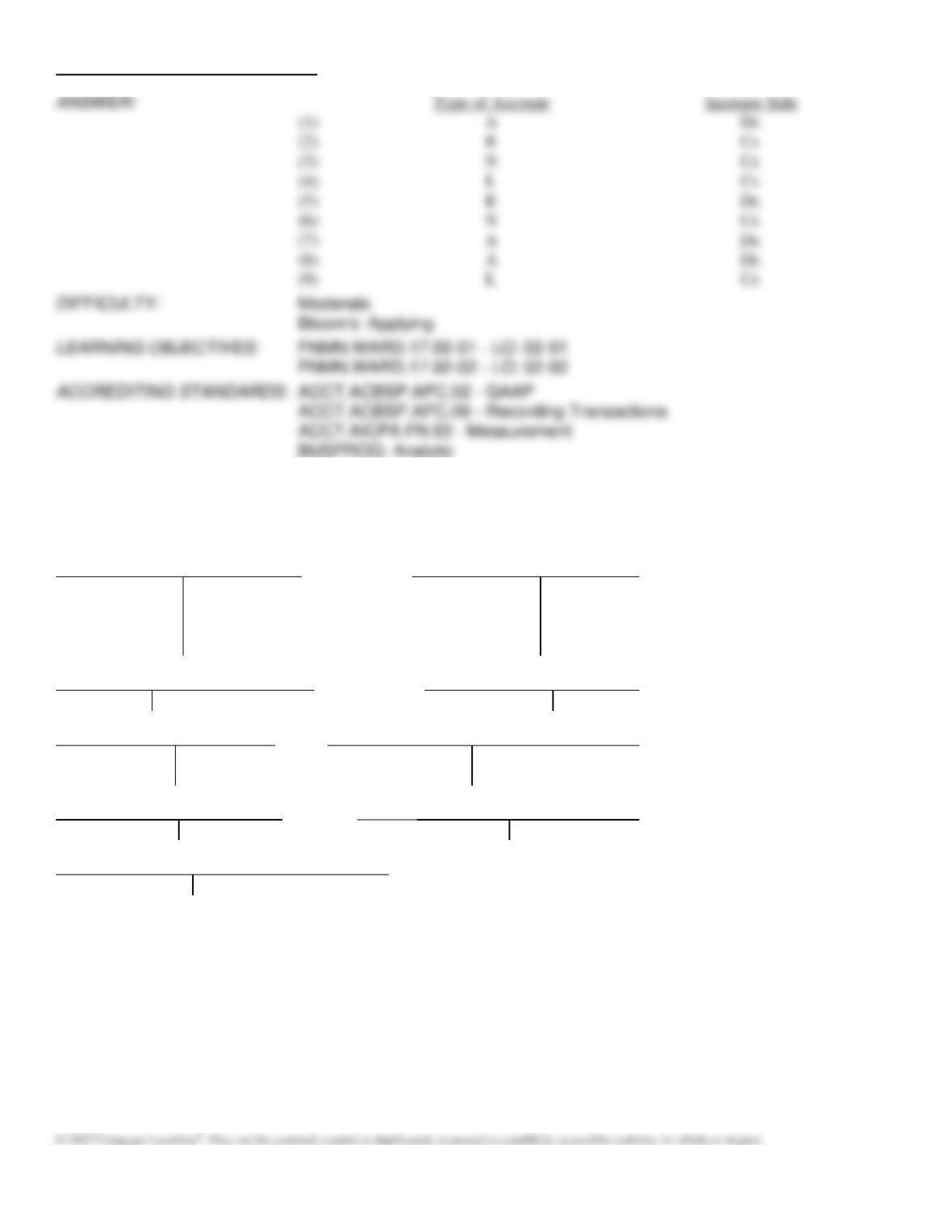
182. All nine transactions for Dalton Survey Company for September, the first month of operations, are recorded in the
following T accounts:
Cash
Common Stock
(1)
20,000
(3)
7,500
(1)
20,000
(7)
6,900
(5)
2,600
(9)
4,700
(6)
5,500
(8)
2,000
Accounts Receivable
Dividends
(4)
4,900
(9)
4,700
(8)
2,000
Supplies
Fees Earned
(3)
7,500
(4)
4,900
(7)
6,900
Equipment
Operating Expenses
(2)
4,500
(6)
5,500
Accounts Payable
(5)
2,600
(2)
4,500
Indicate the following for each debit and each credit:
(a)
The type of account affected (asset, liability, equity, dividends, revenue, or
expense).
(b)
The effect on the account, using “+” for increase and “−” for decrease.