Chapter 2: The Cost Function
Learning Objective
True /
False
Multiple Choice
Matching
Exercises
Short
Answer
Problems
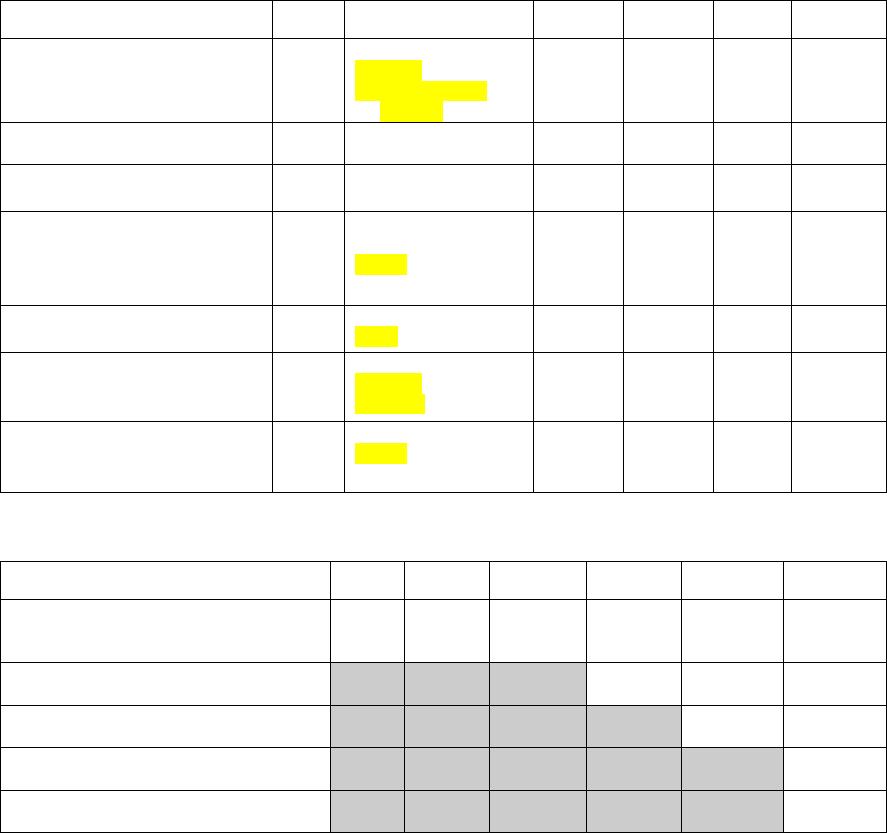
1: What are different ways to
describe cost behavior?
1-4
1-13, 21, 68–74
S: 75–83
W: 91-93, 97-103,
106, 107
1, 2
7, 8, 9
1, 6
2, 3, 6, 8,
9
2: What is a learning curve?
5-8
14-20, 67
S: 84, 85
6, 10, 14
3: What process is used to
estimate future costs?
9-11,
18, 19
22–29
4, 6, 8, 9,
10
4: How are engineered
estimates, account analysis,
and two-point methods used to
estimate cost functions?
12, 13,
16, 17
30–38, 40, 41, 45, 46,
66
W: 104
1-5, 8, 9,
11
4, 11
3, 5
5: How does a scatter plot
assist with categorizing a cost?
14, 15
42–44, 47
W: 94
7
6: How is regression analysis
used to estimate a mixed cost
function?
21–23
39, 50–63
S: 86–90
W: 95, 96
3
12, 15
4, 11
1, 2, 6, 7
7: What are the uses and
limitations of future cost
estimates?
20,
24–26
48, 49, 64, 65
W: 105
2, 4, 11-
14, 16
2-5, 8-
10
1-9
S: Questions from the study guide
W: Questions from web quizzes on the student web site
Level of Complexity*
True /
False
Multiple
Choice
Matching
Exercises
Short
Answer
Problems
Foundation: Repeat or paraphrase
information; Reason to single correct
solution; Perform computations; etc.
All
All
All
1-12, 14
1-8, 11
1-7, 9
Step 1: Identify the problem, relevant
information, and uncertainties
4, 11-14,
16
3, 4, 9, 10
1-4, 7-9
Step 2: Explore interpretations and
connections
8
1, 5, 6, 8
Step 3: Prioritize alternatives and
implement conclusions
Step 4: Envision and direct strategic
innovation
*Based on level in Steps for Better Thinking (Exhibit 1.10, textbook p. 16):
Note: Step 1, 2, 3, and 4 questions in this test bank are intentionally open-ended and subjective, giving students the
opportunity to demonstrate skills such as judgment, reasoning, identification of uncertainties, identification or analysis of
pros and cons, and so on. Therefore, student answers may not exactly match those shown in the solutions.

2-2 Cost Management
True / False
1. Steel used in the production of automobiles would generally be classified as a direct cost.
2. Traceability can be used as a criterion to differentiate direct and indirect costs.
3. Textbook costs are an opportunity cost of earning a college degree.
4. Salaries and wages you could earn while in college constitute a sunk cost.
5. The learning curve refers to declines in the cost of materials as production volume increases.
6. The learning curve refers to increases in sunk costs as production volume decreases.
7. A new product’s learning curve rate can be expressed as (direct material cost / total cost).
8. Learning curves lead to greater productivity over time.
9. Past costs are irrelevant for both decision making and predicting future costs.
10. Past costs are relevant for decision making, but irrelevant for predicting future costs.
11. Past costs are irrelevant for decision making, but may be relevant for predicting future costs.
12. Managers should be trained in engineering to calculate an engineered cost estimate.
13. Reviewing the pattern of a cost over time is a critical step in determining an engineered cost estimate.
14. A scatter plot provides helpful information about the relationship between a cost and a potential cost
driver.
15. Preparing a scatter plot is a requirement before applying the two-point method of cost estimation.
16. The high-low method is a specific application of the two-point method of cost estimation.
17. The high-low method frequently distorts a cost function because it uses too many data points to make
an estimate.
18. The first step in estimating a cost function for relevant costs is to select a cost estimation technique.
19. Categorizing costs by their behavior is one step in estimating relevant costs for a cost object.
20. Uncertainties and information quality are evaluated when determining relevant costs, then not
considered again.
21. Regression analysis is classified as simple or multiple depending upon the number of dependent
variables to be estimated.
22. Simple regression analysis produces an equation of the form: Y = + X + .
23. In regression analysis, the Adjusted R-square statistic is used to evaluate how well the cost driver
explains the behavior in the cost.
24. Estimates of future costs can be used in budgeting.
25. Regression analysis usually provides a higher quality cost function than the high-low method.
26. Changes in cost behavior over time are one source of uncertainty in estimating future costs.

Chapter 2: The Cost Function 2-3
Multiple Choice
1. When the cost object is a unit produced, lubricating oil for production machines would be a(n)
a. Direct cost
b. Indirect cost
c. Sunk cost
d. Opportunity cost
2. When the cost object is a unit produced, straight-line depreciation on manufacturing equipment would
be a
Variable Cost Fixed Cost Direct Cost
a. No Yes No
b. Yes No No
c. Yes No Yes
d. Yes No Yes
3. Fixed costs per unit
a. Vary inversely with changes in volume
b. Change regardless of changes in volume
c. Will not change over the relevant range
d. Increase with an increase in volume
4. Mixed costs
a. Consist of fixed and variable costs
b. Are constant in total
c. Consist of the variable portion of all costs
d. Have a constant per-unit value
5. Mixed costs
a. Vary with production in direct proportion to volume
b. Vary with production but not in direct proportion to volume
c. Do not vary with production
d. Include only different types of fixed costs
6. The relevant range is defined as
a. The period of time over which costs do not change
b. The volume of production over which the cost assumptions hold
c. The volume of production over which step-wise fixed costs increase
d. The time period in which the level of production does not change
7. Which of the follow is not an assumption when estimating a cost function over the relevant range of
activity?
a. Mixed costs will change in total
b. Mixed costs will change per unit
c. Variable costs will be constant in total
d. Fixed costs will be constant in total.
Use the following data for the next 6 questions:
Janice’s Kennel and Pet Spa is located in a small town in central California. The company employs three pet
attendants, four pet groomers and two front office staff who book appointments and keep records. The spa
provides a range of services for dogs and cats including boarding, grooming, and obedience training. The
grooming area includes a small retail section that carries dog and cat food, pet supplies, and toys.
2-4 Cost Management
8. If the cost object is cost per day of boarding, which of the following is a direct cost?
a. Pet food
b. Front office staff salaries
c. Grooming supplies
d. Depreciation on shelving and equipment used in the grooming and retail area
9. If the cost object is the total cost of the grooming product line, which of the following is an indirect
cost?
a. Front office staff salaries
b. Labor cost of employees who groom pets
c. Cost of grooming supplies
d. Depreciation on grooming tables
10. Which of the following is a sunk cost for any cost object related to Janice’s Kennel and Pet Spa?
a. Cost of the automobile Janice is planning to buy for pet transportation
b. Cost of existing computer equipment used to keep company records
c. Cost of annual wages for full-time employees
d. Cost of rent for the next period
11. Assume Janice’s Kennel and Pet Spa is currently boarding ten pets. The cost of food to board one
more pet is best described as a
a. Fixed cost
b. Marginal cost
c. Sunk cost
d. Mixed cost
12. Which of the following is the best example of a discretionary cost for Janice’s Kennel and Pet Spa?
a. Pet food
b. Facility rent
c. Wages of pet groomers
d. Professional travel for Janice
13. Janice’s relevant range of activity would best be measured in terms of:
a. The number of staff she employs
b. The number of pets she services
c. The maximum amount of pet food she can buy each month based on the current budget
d. The number of parking spaces available in the parking lot
Use the following values as needed to respond to the next 5 questions.
ln(95%) / ln(2) = –0.074
ln(90%) / ln(2) = –0.152
ln(85%) / ln(2) = –0.234
ln(80%) / ln(2) = –0.322
ln(75%) / ln(2) = –0.415
ln(70%) / ln(2) = –0.515
14. The labor cost to construct the first unit of a special piece of equipment was $126,000. If labor costs
are subject to a 90% learning curve, what will be the cost to build the second unit?
a. $126,000
b. $113,000
c. $100,800
d. $113,400
Chapter 2: The Cost Function 2-5
15. A firm will build 8 units of a product. All costs are subject to an 85% learning curve. The first unit
cost $75,000 to build. If the firm values inventory and cost of goods sold at the average cost for all
units in the production run, what will be the cost to produce the second unit?
a. $63,750
b. $69,375
c. $75,000
d. Some other amount
16. Assume an 80% learning curve and that the first unit takes 6 hours. How long does it take to produce
the second unit?
a. 4.1 hours
b. 3.6 hours
c. 4.8 hours
d. Some other amount
17. Managers at Art’s Custom Saddle Manufacturers believe that the learning rate for new employees is
about 90%. If it takes a new employee 10 hours to make the first saddle, estimate the cumulative
average time per saddle for a new employee to make four saddles.
a. 8.1 hours per saddle
b. 5.3 hours per saddle
c. 7.6 hours per saddle
d. Cannot be determined
18. The cumulative average-time learning curve can be represented mathematically as
a. ln(percent learning) / ln(2)
b. Y = αXr
c. Y = αXr
d. α = YXr
19. A learning curve is the rate at which
a. Students learn material for an exam
b. Direct labor employees are provided training by their organizations
c. Labor hours decrease as production increases when a new product is manufactured
d. Profitability decreases because employees have become less efficient.
20. Bob and James are installing new flooring in their home. The house has 5 rooms of approximately
equal size where the flooring will be replaced. Bob and James spent 3 hours removing the old
flooring from the first room. If Bob and James are operating with an 85% learning curve, what is the
estimated average time to remove the flooring from all 5 rooms? Note: ln(85%) / ln(2) = –0.234.
a. 2.05 hours total
b. 2.05 hours per room
c. 2.55 hours total
d. 2.55 hours per room
21. Discretionary costs reflect
a. The costs that managers incur to purchase new production machines when the old machines need
replacing
b. Decisions about the maximum amount that will be spent next period for activities such as travel
and marketing
c. Decisions about the amount of variable costs that will be incurred next period
d. The costs that managers incur to pay overtime when production levels are high
2-6 Cost Management
22. Which of the following statements is true?
a. Past costs are always relevant for decisions and are often useful in estimating future cost behavior
b. Past costs are always relevant for decisions, but are rarely useful in estimating future cost
behavior
c. Past costs are never relevant for decisions, nor are they useful in estimating future cost behavior
d. Past costs are never relevant for decisions, but are often useful in estimating future cost behavior
23. The best source for determining historical costs is usually
a. The Internet
b. Interviews with managers
c. The company’s accounting information system
d. Financial statements
24. Which of the following statements is false?
a. Information for some costs cannot easily be obtained from the accounting information system.
b. Useful cost information is rarely available from the accounting information system.
c. The accounting system design affects the availability of useful cost information.
d. The nature of cost information affects its usefulness for decision making.
25. In most accounting information systems, costs are often recorded and coded so they can be
summarized based on different
a. Cost drivers
b. Cost objects
c. Volumes of activity
d. Independent variables
26. Past cost information, although accurate in predicting future costs, may be
I. Unavailable
II. Irrelevant
III. Outdated
a. I and II only
b. II and III only
c. II only
d. I, II, and III
27. Managers go through a series of questions to decide whether to use past costs to estimate future costs.
Which of the following questions is least likely to be one of them?
a. Is the cost relevant to the decision?
b. Is the cost highly discretionary?
c. Is the cost an engineered estimate?
d. Is the cost expected to change?
28. Estimating a cost function using past cost data to help determine future costs is useful if
a. Past costs are irrelevant and highly discretionary
b. Past costs are irrelevant and not discretionary
c. Past costs are relevant and highly discretionary
d. Past costs are relevant and not discretionary
29. After estimating a past cost function, managers
I. May need to update it for future changes.
II. Have all of the information they need to predict future costs
III. May or may not use it to estimate future costs.
a. I only
b. II only
c. II and III only
d. I and III only

Chapter 2: The Cost Function 2-7
Use the following data for the next 3 questions.
Liva Company wants to develop a cost function for its maintenance costs to estimate such costs for the
coming year. The following data are available:
Direct Maintenance
Month Labor Hours Costs Incurred
January 4,000 $ 900
February 6,500 1,325
March 7,000 1,500
April 5,500 1,150
30. Using the high-low method, what is the variable maintenance cost per direct labor hour?
a. $1.00
b. $0.10
c. $0.20
d. $1.50
31. Using the high-low method, what is the fixed maintenance cost?
a. $500
b. $300
c. $200
d. $100
32. Using the high-low method, what is the cost function for maintenance costs?
a. $500 + $1.00 per direct labor hour
b. $300 + $1.50 per direct labor hour
c. $100 + $0.20 per direct labor hour
d. $200 + $0.10 per direct labor hour
33. The major disadvantage of the high-low method is that
a. It uses the two most extreme data points in determining a cost function
b. It is difficult to calculate
c. It is difficult to understand
d. It involves more judgmental factors than do other methods
Use the following data for the next 3 questions.
Cosby Company is attempting to develop the cost function for repair costs. The following past data are
available:
Machine Hours Repair Costs
4,800 $6,385
3,400 4,585
4,000 5,285
5,900 7,085
34. Using the high-low method, what is the variable repair cost per machine hour?
a. $0.15
b. $1.00
c. $4.00
d. $5.00
35. Using the high-low method, what is the fixed repair cost?
a. $1,185
b. $850
c. $475
d. $565
2-8 Cost Management
36. Using the high-low method, what is the estimated repair cost for 4,500 machine hours?
a. $5,785
b. $5,585
c. $5,685
d. $5,985
Use the following data for the next 2 questions.
Milano Company has an average overhead cost per hour of $10.50 at 3,500 machine hours, and at 3,000 hours
it is $11.25. The company managers wish to estimate the overhead cost function.
37. What is the variable overhead cost per machine hour?
a. $1.00
b. $2.00
c. $6.00
d. $8.00
38. What is the fixed overhead cost?
a. $15,750
b. $36,750
c. $21,000
d. $18,000
39. Assuming that a cost is mixed and linear, and that past cost behavior is expected to continue into the
future, which of the following is mostly likely the best technique for estimating future costs?
a. Engineered estimate of cost
b. Two-point method
c. Scatter plot
d. Regression analysis
40. Managers analyze production activities and assign costs based on the estimated amount of resources
used when they use this method.
a. A scatter plot
b. The high-low method
c. Regression analysis
d. Engineered estimate of cost
41. Reviewing cost behavior patterns over time from the accounting records and using that review to
predict future costs best describes
a. Regression analysis
b. Scatter plots
c. Analysis at the account level
d. Two-point methods
42. Which of the following techniques relies on visual analysis?
a. Scatter plots
b. Analysis at the account level
c. High-low method
d. Engineered estimate of cost
43. A scatter plot is especially useful when managers wish to
a. Compute a cost function
b. Update a past cost function for future changes
c. Study the relationship between a cost and a potential cost driver
d. Analyze cost behavior when only one period of data is available
Chapter 2: The Cost Function 2-9
44. The trend line from a scatter plot can be used to identify data points for
a. The two-point method
b. Analysis at the account level
c. Engineered estimate of cost
d. Regression analysis
45. The high-low method is a specific application of this method of cost estimation
a. Two-point
b. Scatter plot
c. Engineered estimate of cost
d. Analysis at the account level
46. Which of the following is the most valid criticism of the high-low method?
a. It never produces accurate results
b. It is mathematically too complex for most managers to comprehend
c. It is a specialized case of the two-point method
d. Data points might be outside the normal range of activity
47. A manager might use this method to create a graph of cost behavior without any statistical techniques
a. Engineered estimate of cost
b. High-low method
c. Scatter plot
d. Regression analysis
48. Which of the following cost estimation techniques makes assumptions about the data being analyzed?
I. Analysis at the account level
II. Two-point method
III. Regression analysis
a. I only
b. I and II only
c. II and III only
d. I, II, and III
49. Which cost estimation technique is useful in all situations?
a. Analysis at the account level
b. Regression analysis
c. Two-point method
d. No one method is useful in all situations
50. An organization’s accountant is estimating next period’s total overhead costs. She performed two
regression analyses, one based on direct labor hours and the other based upon machine hours. The
results were:
Total overhead = $150,000 + $4 x direct labor hours
Adjusted R-square = 0.65
Total overhead = $130,000 + $5 x machine hours
Adjusted R-square = 0.77
For the next period the accountant anticipates using 28,000 direct labor hours and 26,000 machine
hours. Based upon this information, what is the best estimate for overhead for the next period?
a. $262,000
b. $260,000
c. $254,000
d. $270,000
2-10 Cost Management
51. (Appendix 2A) Which of the following is not an assumption of linear regression analysis
a. The error terms have a constant variance
b. The error terms are independent
c. A linear relationship exists between the dependent and independent variables
d. There is a cause and effect relationship between the dependent and independent variables
52. Which of the following are forms of regression analysis?
a. Quantitative and qualitative
b. Fixed and variable
c. Simple and multiple
d. Financial and managerial
53. Simple regression analysis differs from multiple regression analysis based on the number of
a. Cost drivers used
b. Costs predicted
c. Data points incorporated
d. Personnel analyzing the data
54. Simple regression minimizes the distance from each data point to
a. A trend line
b. The y-intercept
c. The error term
d. The x-axis
55. Which of the following is an alternative name for a cost driver in a regression analysis?
a. Dependent variable
b. Independent variable
c. Beta
d. Error term
56. Which of the following is an alternative name for the cost being predicted in a regression analysis?
a. Dependent variable
b. Independent variable
c. Beta
d. Slope
57. Regression analysis works best when the relationship between costs and cost drivers is
a. Positive and linear
b. Linear and direct
c. Positive and indirect
d. Positive, linear, and indirect
58. In a regression equation, fixed costs are represented by the
a. Slope
b. Intercept
c. Error term
d. Adjusted R-square coefficient
59. In a regression equation, variable costs are represented by the
a. Slope
b. Intercept
c. Adjusted R-square coefficient
d. t-statistic
Chapter 2: The Cost Function 2-11
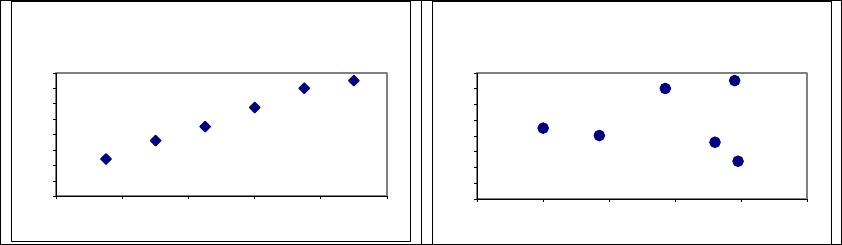
Use the following graphs for the next 2 questions.
60. Which graph shows data that are more suitable for regression analysis?
a. Graph A
b. Graph B
c. Neither Graph A nor Graph B
d. Cannot be determined
61. Simple regression analysis output produces a variety of information and statistics. Which of the
following statistics provides information for fixed costs?
a. T-statistic and p-value for the alpha coefficient
b. T-statistics for alpha and beta coefficients
c. Adjusted R-square
d. P-values for alpha and beta coefficients
62. Simple regression analysis output produces a variety of statistics. Which of the following statistics
provides information for variable costs?
a. Adjusted R-square
b. P-values for alpha and beta coefficients
c. T-statistic and p-value for the beta coefficient
d. T-statistics for alpha and beta coefficients
63. Simple regression analysis output produces a variety of statistics. Which of the following statistics
best summarizes how well the cost driver explains the behavior of the cost?
a. T-statistics for alpha and beta coefficients
b. T-statistic and p-value for the alpha coefficient
c. P-values for alpha and beta coefficients
d. Adjusted R-square
64. When estimating future costs, information quality is higher when
a. Costs must be allocated
b. The accounting system can trace relevant costs to a cost object
c. The regression Adjusted R-square is near zero
d. Most costs are fixed, rather than variable
65. Past cost information might be too unreliable for future cost estimation because
a. An organization has been operating too long in a stable environment
b. The costs are primarily mixed
c. A company has added a new product line
d. Managers expect no changes in the cost function
0
20
40
60
80
100
120
140
160
020 40 60 80 100
Graph A
0
20
40
60
80
100
120
140
160
020 40 60 80 100
Graph B

2-12 Cost Management
66. This method of estimating future costs can be used when only one period of data is available.
a. Scatter plot
b. High-low method
c. Analysis at the account level
d. Regression analysis
More Difficult Multiple Choice
These multiple choice questions require more complex computations or present information differently than
in the textbook.
67. Bob and James are installing new flooring in their home. The house has 5 rooms of approximately
equal size where the flooring will be replaced. Bob and James spent 3 hours removing the old
flooring from the first room. The average time to remove the flooring from 2 rooms is 2.25 hours per
room. Determine the learning curve percentage experienced by Bob and James.
Below are values that may be useful in answering this question.
ln(95%) / ln(2) = –0.074
ln(90%) / ln(2) = –0.152
ln(85%) / ln(2) = –0.234
ln(80%) / ln(2) = –0.322
ln(75%) / ln(2) = –0.415
ln(70%) / ln(2) = –0.515
a. 70%
b. 75%
c. 80%
d. Some other percentage
Use the following information for the next 3 questions.
Consider the following cost data for the cost object, number of machine setups. Each set of costs (A, B, and
C) is from a different type of manufacturing operation and represents the cost behavior for the cost of that
company’s machine setups.
Number of
Machine Setups Cost A Cost B Cost C
0 $ 0 $80 $ 5
10 20 79 37
20 40 82 66
30 60 78 91
40 80 81 123
50 100 79 154
68. Cost A is best described as
a. Fixed
b. Variable
c. Mixed
d. Direct
69. Cost B is best described as
a. Fixed
b. Variable
c. Mixed
d. Discretionary

Chapter 2: The Cost Function 2-13
70. Cost C is best described as
a. Fixed
b. Variable
c. Mixed
d. Indirect
Use the following information for the next 3 questions.
Three different divisions of a toy manufacturing company are estimating costs for their human resources
departments. Each division has a cost structure that is different from the other divisions’ and those structures
are represented by the following cost behavior patterns (A, B, and C).
Number of
Employees Cost A Cost B Cost C
0 $ 0 $120 $118
25 50 118 180
50 100 123 245
75 125 124 296
100 200 119 360
71. Which cost is best described as fixed?
a. Cost A
b. Cost B
c. Cost C
d. Cost B and Cost C
72. Which cost is best described as variable?
a. Cost A
b. Cost B
c. Cost C
d. Cost A and Cost C
73. Which cost is best described as mixed?
a. Cost A
b. Cost B
c. Cost C
d. Cost B and Cost C
74. A firm has the capacity to produce 3,100 units per week. At 80% capacity, the average total cost per
unit is $12.50 and the average variable cost per unit is $7.50. What is the total fixed cost per week,
assuming the firm is still operating within its relevant range?
a. $10,400
b. $14,400
c. $ 8,400
d. $12,400
Multiple Choice from Study Guide
s75. Fixed costs
a. Do not vary in total within the relevant range
b. Do not vary on a per-unit basis within the relevant range
c. Vary on a per-unit basis in direct proportion to changes in the cost driver within the relevant
range
d. Vary in total as the cost driver changes within the relevant range
2-14 Cost Management
s76. Variable costs
a. Do not vary in total within the relevant range
b. Do not vary on a per-unit basis within the relevant range
c. Vary on a per-unit basis within the relevant range
d. Both (a) and (c)
s77. Which of the following could be defined as a cost object?
a. A single unit of product in a manufacturing process
b. A batch of products in a manufacturing process
c. A business process, such as managing accounts receivable
d. All of the above
s78. Which of the following statements is false?
a. A cost can be defined as a direct cost if the bookkeeping system can keep track of how much of
the cost was consumed by the cost object
b. Whether a cost is direct or indirect cannot be determined until the cost object has been defined
c. If the cost object is a batch of 1000 units of production, then factory property taxes could be a
direct cost if the bookkeeping system is detailed enough
d. Some indirect costs might have been considered direct costs if a company had better technology
for capturing information
s79. The total cost of salaries of production supervisors, where 2 supervisors are needed for each 8-hour
shift, where the relevant range is 0 units to the number of units that can be produced at full capacity
using 2 8-hour shifts is a
a. Fixed cost
b. Variable cost
c. Mixed cost
d. Stepwise linear cost
s80. The total cost of materials, where the supplier charges $9/lb if 0-1000 pounds are purchased, $8/lb if
1001-2000 pounds are purchased and $7 if 2001 or more pounds are purchased, is a
a. Fixed cost
b. Variable cost
c. Mixed cost
d. Stepwise linear cost
s81. The rent on a store, where the landlord charges $1,200 per month plus a percentage of sales revenue,
is a
a. Fixed cost
b. Variable cost
c. Mixed cost
d. Stepwise linear cost
s82. The depreciation on a factory machine is a
a. Fixed cost
b. Variable cost
c. Mixed cost
d. Stepwise linear cost
s83. Which of the following statements is true?
a. Opportunity costs are never relevant for decision making
b. Discretionary costs are never relevant for decision making
c. Marginal costs are never relevant for decision making
d. Sunk costs are never relevant for decision making
Chapter 2: The Cost Function 2-15
s84. If firm A has a learning curve with 90% learning and firm B has a learning curve with 80% learning,
then
a. Firm A has more experienced workers
b. Firm B will be more cost efficient over time
c. Firm A workers learn more quickly
d. Firm B has less experienced workers
s85. A firm’s production is expected to show an 85% learning rate. The first unit took 200 hours to
produce. The second unit will take
a. 170 hours
b. 140 hours
c. 200 hours
d. 289 hours
s86. A high adjusted R-square for the regression of a cost against a cost driver indicates
a. The predicted linear relationship between the cost and the cost driver is probably correct
b. The relationship between the cost and the cost driver is probably linear
c. The cost driver explains a high percentage of the variation of the cost
d. The cost driver is statistically significant
s87. A p-value of 1% for the intercept term in a regression of a cost driver against a cost indicates
a. The true fixed costs are statistically significantly different from zero
b. There is only a 1% chance the true fixed costs are zero
c. The variable costs are immaterial in this cost function
d. Both (a) and (b)
s88. A p-value of 89% for the slope coefficient in a regression of a cost driver against a cost indicates
a. The true variable costs are statistically significantly different from zero
b. There is only an 11% chance the true variable costs are zero
c. The relationship between the cost and the cost driver is nonlinear
d. None of the above
s89. The difference between simple regression and multiple regression is that
a. Simple regression is easier to perform in Excel than multiple regression
b. Simple regression is only performed once when estimating a cost function, whereas multiple
regression is performed more than once
c. Simple regression uses only one cost driver, whereas multiple regression uses more than one cost
driver
d. Simple regression is for estimating only one cost, and multiple regression is for estimating more
than one cost
s90. A regression of total selling expenses against number of units sold yields an intercept of 178,024 and
a slope of 12.3. This indicates that
a. Total fixed selling expenses are predicted to be $178,024.
b. Variable selling expenses are predicted to be $12.30/unit.
c. Total selling expenses are predicted to be $190,324 when 1000 units are sold
d. All of the above

2-16 Cost Management
Multiple Choice from Web Quizzes (Available on Student Web Site)
w91. If we are determining costs for a particular case at a law office, the cost of rent for the office would be
a. A direct cost
b. An indirect cost
c. A mixed cost
d. An irrelevant cost
w92. If we want to estimate the cost of lumber for manufacturing chairs, the cost function most likely
reflects
a. Only a variable cost
b. Only a fixed cost
c. A mixed cost
d. An irrelevant cost
w93. Which one of following is not a reason to take into account the relevant range when estimating a
cost?
a. The cost function is nearly linear within a relevant range
b. It is reasonable to assume that fixed costs remaining fixed in this range
c. It is reasonable to assume that variable costs remain constant in this range
d. We cannot make assumptions about linearity within a relevant range
w94. If you create a scatter plot of a cost against a cost driver
a. You gain information about whether there is a seeming relation between the cost and cost driver
b. For all costs, you will have completed your analysis
c. You gain no new information about the relationship between the cost and cost driver
d. You will not need to perform regression analysis to estimate the cost function
w95. In a regression analysis for estimating a cost function, t-statistics and their p-values do not provide
information about
a. Whether the cost and cost drivers are related
b. How confident we can be that the intercept or slope coefficients are different from zero
c. The amount of variation in cost that is explained by variation in the cost driver
d. Whether the cost is totally fixed, totally variable, or mixed
w96. In a regression analysis for estimating a cost function, the adjusted R-Square statistic provides
information about
a. The amount of variation in cost that is explained by variation in the cost driver
b. The size of the slope coefficient
c. Whether the cost is a fixed, variable, or mixed cost
d. How confident we can be that the intercept or slope coefficients are different from zero
w97. Marginal cost is
a. The average cost per unit
b. The incremental cost of the next unit
c. Not relevant for decision making
d. Constant even if the relevant range changes
w98. All of the following are true about average cost per unit except
a. Average cost equals variable cost per unit plus average fixed cost per unit
b. Average costs are used in financial statements
c. Average costs are usually irrelevant for decision making because they include a portion of fixed
cost
d. Average costs are usually good estimates of future costs
Chapter 2: The Cost Function 2-17
w99. Opportunity costs are
a. Benefits foregone from one project because another project is chosen
b. Irrelevant
c. The same as sunk costs
d. Easy to value
w100. Sunk costs are
a. The same as opportunity costs
b. Expenditures made in the past
c. Relevant to decisions
d. Difficult to value
w101. Direct costs are
a. Costs that need to be assigned but cannot be traced easily to cost objects
b. Only variable costs
c. Costs that can easily be traced to cost objects
d. Only fixed costs
w102. Indirect costs are
a. Costs that need to be assigned but cannot easily be traced to cost objects
b. Only variable costs
c. Costs that can easily be traced to cost objects
d. Only fixed costs
w103. All of the following are examples of variable costs except
a. The cost of tires if the cost object is the number of automobiles produced
b. Professional labor cost when the cost object is the audit of a business
c. The cost for wood in a baseball bat manufacturing company if the cost object is bats
produced
d. The cost to lease a manufacturing plant if the cost object is the product manufactured
w104. All of the following are true about analysis at the account level except
a. It is a method for separating fixed and variable costs
b. It uses information from the general ledger
c. It is a qualitative method for separating costs
d. It requires very little judgment to determine cost behavior
w105. All of the following are assumptions for developing and using a cost linear function except
a. Past costs rarely need updating to be good predictors of future costs
b. Operations are within the relevant range
c. Variable costs remain constant within the relevant range
d. Fixed costs remain fixed within the relevant range
w106. The relevant range in cost accounting is the range over which
a. Costs may fluctuate
b. Cost relationships are valid
c. Production may vary
d. Relevant costs are incurred
w107. (CMA) Cost drivers are
a. Activities that cause costs to increase as the activity increases
b. Accounting techniques used to control costs
c. Accounting measurements used to evaluate whether or not performance is proceeding according
to plan
d. A mechanical basis, such as machine hours, computers time, size of equipment, or square footage
used to assign costs to activities.

2-18 Cost Management
Matching
1. ABC Manufacturing wants to determine whether its various product costs are direct or indirect, and
variable or fixed. This information will be used to determine product unit costs. All employees are
guaranteed a 40 hour work-week except factory employees, who are paid an hourly wage and can be
sent home when there is no work. The following classification scheme has been developed:
A. Direct variable cost
B. Indirect variable cost
C. Direct fixed cost
D. Indirect fixed cost
Using the categories shown above, indicate how each of the following costs should be classified if the
cost object is a single unit of product:
____ 1. Labor in the maintenance department
____ 2. Glue and tacks used in production
____ 3. Lubricating oil for production machines
____ 4. Salary of the plant accountant
____ 5. Oil used for monthly preventive maintenance on production machines
____ 6. Insurance on the plant machinery
____ 7. Hourly factory wages
____ 8. Wages in the materials receiving and handling department
____ 9. Taxes on plant equipment
____ 10. Shipping costs for direct materials
2. Various terms are listed in the right-hand column below; several definitions are listed on the left.
Match the appropriate term with each definition. Some of the lettered terms may be used more than
once, while others may not be used at all. Each numbered definition has only one best response.
____ 1. A thing or activity for which managers
measure costs
____ 2. Input or activity that causes changes in
costs
____ 3. Analysis at the account level
____ 4. Cost incurred in the past
____ 5. Easily traced to individual cost objects
____ 6. Has a cause-and-effect relationship with
costs
____ 7. Often estimated based on a budget
established by management
____ 8. Often increase in a stepwise manner
____ 9. Benefits of the next best alternative that
we forego when we make a decisions
____ 10. Represented mathematically as
TC = F + V x Q
A. Cost driver
B. Cost estimation method
C. Cost object
D. Direct cost
E. Fixed cost
F. Indirect cost
G. Opportunity cost
H. Mixed cost
I. Discretionary cost
J. R-square statistic
K. Relevant range
L. Sunk cost

Chapter 2: The Cost Function 2-19
____ 11. Scatter plots
____ 12. Span of activity for which cost behavior
can be reliably predicted
3. The steps for using regression analysis to estimate a cost function are listed below in random order.
Correctly number the steps from 1 to 8.
____ Write the cost function.
____ Plot the cost for each potential cost driver.
____ Perform the regression analysis.
____ Generate a list of possible cost drivers.
____ Gather cost and cost driver data.
____ Evaluate the sign and significance of the cost function’s components.
____ Discard potential cost drivers that fail to explain a high proportion of variability in the cost.
____ Consider the behavior of the cost.
Exercises
1. The average cost of producing 200 units is $82 for Alpha Company. If production increases by 300
units, the average cost falls to $61.
a. What is the variable cost per unit?
b. What is the fixed cost?
c. What is the average cost of producing 250 units?
2. Total fixed costs are $20,000 per month and last month total variable costs were $7,000 when total
revenue was $28,000.
a. Write the algebraic expression for this flexible budget for total cost.
b. What assumptions are made for a linear cost function like this?
3. The average cost to produce 10,000 units is $88.00, and the average cost to produce 15,000 units is
$84.00.
a. Develop a cost function for this cost.
b. Estimate the average cost to produce 18,000 units.
4. Total fixed costs are $25,000 per year. The variable cost per unit is $10.00 per unit up to 5,000 units
per year and $7.50 per unit thereafter.
a. Develop a cost function for this cost.
b. What could cause the change in variable costs shown above? Explain
c. List three assumptions that are made when developing these types of cost functions and give one
reason that each assumption might not hold
5. Strawser Company is developing a cost function for its maintenance costs using the high-low method.
The following data have been collected for the past year:
Direct Labor Maintenance
Quarter Hours Costs Incurred
1 5,000 $ 745
2 6,500 820
3 7,000 850
4 8,000 1,000
2-20 Cost Management
Calculate the following amounts:
a. The variable cost per direct labor hour
b. The fixed cost
c. The estimated total cost for 9,000 direct labor hours
d. The estimated total cost for 6,000 direct labor hours
6. During 20×1, Advanced Systems introduced complex oil well monitoring equipment and produced
100 units in anticipation of selling to the major oil-producing companies. The first unit produced cost
$125,000, and production costs are subject to a 90% learning curve. Note: ln(90%) / ln(2) = –0.152.
During 20×1 the company sold 20 units, and during 20×2 the company sold 40 units. Each unit sells
for $100,000. If costs are assigned to cost of goods sold based on the average expected cost for all
units in the 20×1 production run, what is the company’s gross profit during 20×2?
7. Chabu’s managerial accountant, Yi–Fan, is classifying the company’s costs according to their
behavior to prepare next year’s budget. Therefore, the cost object is the entire company. Chabu
produces and sells aluminum beverage cans, such as those used for soft drinks. You may find the
following facts about Chabu’s operation useful in responding to this problem:
• Production machines must be cleaned monthly, regardless of the amount of use.
• The more cans produced, the more lubrication is needed.
• Chabu’s monthly production and sales volume is usually at least 1,000 cans, but can be as
much as 5,000 cans depending on demand.
• Material handling costs include depreciation on equipment and fuel for loaders.
• Cans are packaged into 100-unit groups prior to sale.
• Research and development costs vary between $10,000 and $10,500 per month
• The factory maintenance costs vary between $6,000 and $6,500 monthly.
• Chabu’s staff level is constant at 25 people, who are all paid salaries.
• Raw materials are purchased based on expected production levels.
• Sales commissions (based on a per-case amount) are included in marketing department costs.
Yi-Fan has classified the costs into three categories: fixed, variable, and mixed.
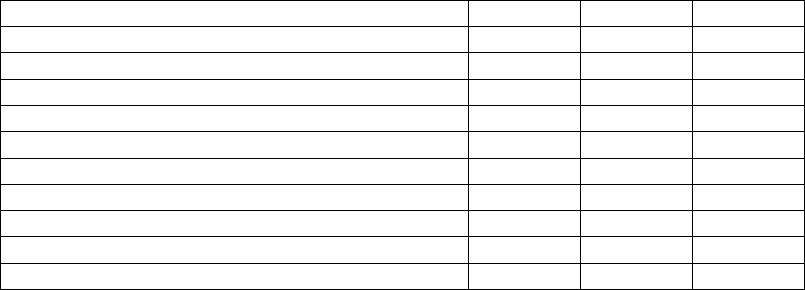
Place an X in the appropriate column of the table below to indicate the most likely behavior of each
cost:
Fixed
Variable
Mixed
Oil to lubricate the machines
Salary of the plant manager
Annual subscription to a trade journal
Vacation pay for salaried production employees
Packaging materials
Research and development
Raw materials
Material handling costs
Marketing department costs
Factory maintenance

Chapter 2: The Cost Function 2-21
8. The following data were obtained from the accounting information system of POC Corporation:
Production
Units Raw Materials Factory Manager
Month Produced Used Supplies Salary
January 60 $1,560 $550 $3,000
February 80 2,000 700 3,000
March 50 1,300 475 3,000
April 30 775 325 3,000
a. Describe the behavior of each of the costs shown above as fixed, variable or mixed. You may
wish to draw scatter plots or analyze the cost using your knowledge of costs and the actual
variation in cost pattern from above (in other words, perform an informal analysis at the account
level).
b. Use the data for February and March and the two-point method to determine a cost function for
any mixed cost(s).
c. Use the high-low method to determine a cost function for any mixed cost(s).
9. Consider the pairs of data presented below for 3 costs of USM Corporation:
Cost Driver A Cost A Cost Driver B Cost B Cost Driver C Cost C
0 1,200 0 0 0 600
80 1,380 130 1,735 110 890
175 1,495 130 1,735 209 1,200
244 1,475 314 5,488 325 1,500
377 1,390 422 6,987 457 1,700
462 1,500 507 8,723 560 2,000
a. Using scatter plots or other informal methods such as studying the variation in cost compared to
the variation in cost driver, describe the behavior of each cost.
b. For each cost that you described above, give one example of a cost that would behave similarly.
For variable and mixed costs, also identify the cost driver.
10. The managers of Web Design Services Company hired three recent college graduates. When they
began preparing simple web pages, it took about ten hours to complete the first page. The supervisor
believes a 90% learning rate is typical for this type of work. Note: ln(90%) / ln(2) = –0.152.
a. Estimate the cumulative average time per page to prepare six web pages.
b. Estimate the total time to prepare ten web pages.
11. Stacy Kuh, the manager of the Ice Cream Igloo, has been told that to earn a reasonable profit she
should price her products at 200% of the cost of ingredients. Ms. Kuh has gathered the following data
on the cost of ingredients used to make a banana split.
• The distributor charges $12.00 for a dozen bananas; each banana split uses one banana.
• Ice cream costs $3.20 per gallon; each banana split uses two cups of ice cream.
• One gallon of ice cream equals thirty-two cups of ice cream.
• Stacy makes her own fruit toppings at a cost of $0.25 per tablespoon; each banana split uses
six tablespoons of fruit toppings.
• Each banana split uses three tablespoons of premium chocolate sauce, which costs $0.25 per
tablespoon.
• The cost of other miscellaneous ingredients, such as whipped cream and nuts, totals $0.05 per
banana split.
a. Calculate the cost of a banana split.
b. List two factors that could cause these estimated costs to be inaccurate.
2-22 Cost Management
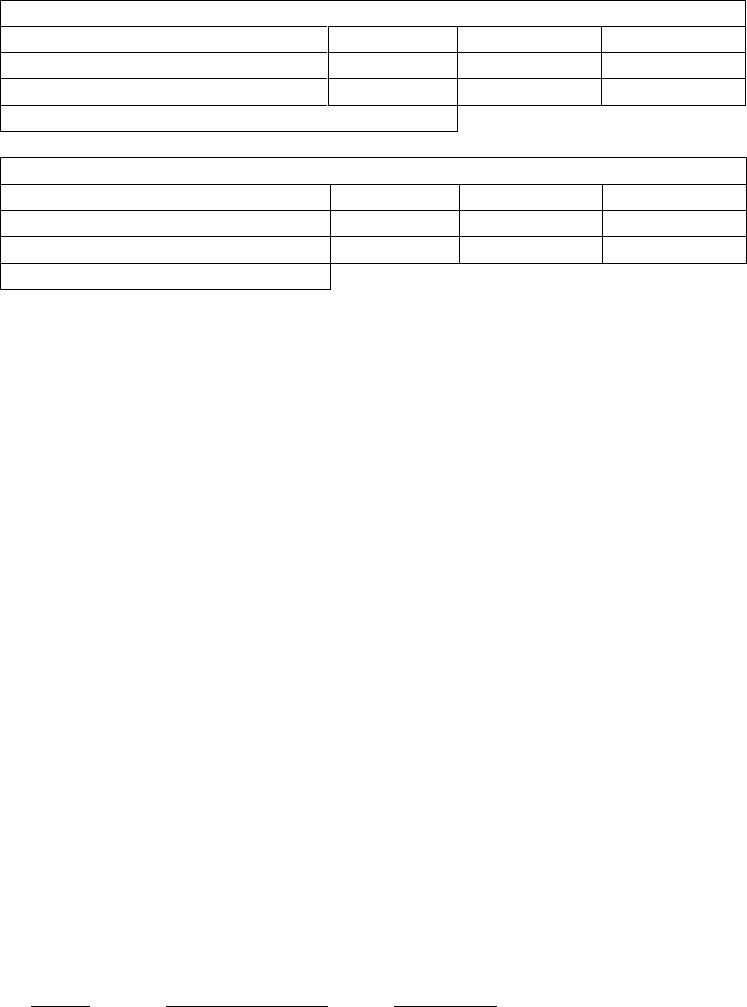
12. Following are the results from two different simple regression analyses estimating the costs of the
purchasing department using number of purchase orders and number of vendors as potential cost
drivers.
Purchasing costs vs. Number of purchase orders
Variable
Coefficient
t-statistic
p-value
Intercept
497.25
3.39
0.04
Number of purchase orders
18.72
5.48
0.001
Adjusted R-square = 0.79
Purchasing costs vs. Number of vendors
Variable
Coefficient
t-statistic
p-value
Intercept
691.15
1.45
0.25
Number of vendors
115.88
2.75
0.15
Adjusted R-square = 0.53
a. Which independent variable explains more of the variation in purchasing costs? Explain your
choice.
b. Choose the most appropriate cost driver and write the cost function.
c. For an upcoming month, the number of vendors is estimated to be 150, while the number of
purchase orders is estimated to be 340. Using the most appropriate cost driver, estimate the total
cost for that month.
d. List several uncertainties that could affect the accuracy of the cost function in estimating the cost
for the upcoming month.
13. NTQ Corporation manufactures and sells compact discs with music and nature sounds as relaxation
and concentration tools.
a. Describe why there is no single “correct” way to determine the cost of a compact disc.
b. Identify three reasons why the cost of a compact disc might change or vary over time.
14. Bob and Andrea were recently hired as accountants for PTR Corporation. PTR uses an enterprise
resource planning (ERP) system to coordinate its accounting, sales, and manufacturing operations.
Bob and Andrea must learn to use the ERP system effectively to perform their job duties. Their
supervisor expects a 70% learning curve to apply to that task.
a. Define the concept of a “learning curve” in your own words.
b. Identify two reasons why the rate of learning might be different than 70%.
15. Eastwood Consulting rents a photocopy machine for a monthly rental of $100 plus $0.02 per copy.
Photocopier usage varies from month to month depending primarily on the type and volume of
consulting reports completed each month. Photocopier usage and cost data for the past several
months are as follows:
Month Number of Copies Rental Cost
January 11,498 $330
February 14,649 392
March 12,719 354
April 10,347 307
May 16,114 422
June 12,648 353

Chapter 2: The Cost Function 2-23
The accountant for Eastwood Consulting would like to develop a budget for July’s photocopier rental
cost. Would regression analysis be an appropriate technique for estimating the cost function? Why
or why not?
16. Total revenues for the month were $80,000. Total fixed costs were $40,000. Total variable costs
were $20,000.
a. Write the algebraic expression for the cost function.
b. Describe the general assumptions of the cost function.
c. Discuss reasons why a cost function might provide poor estimates of future costs.
Short Answer
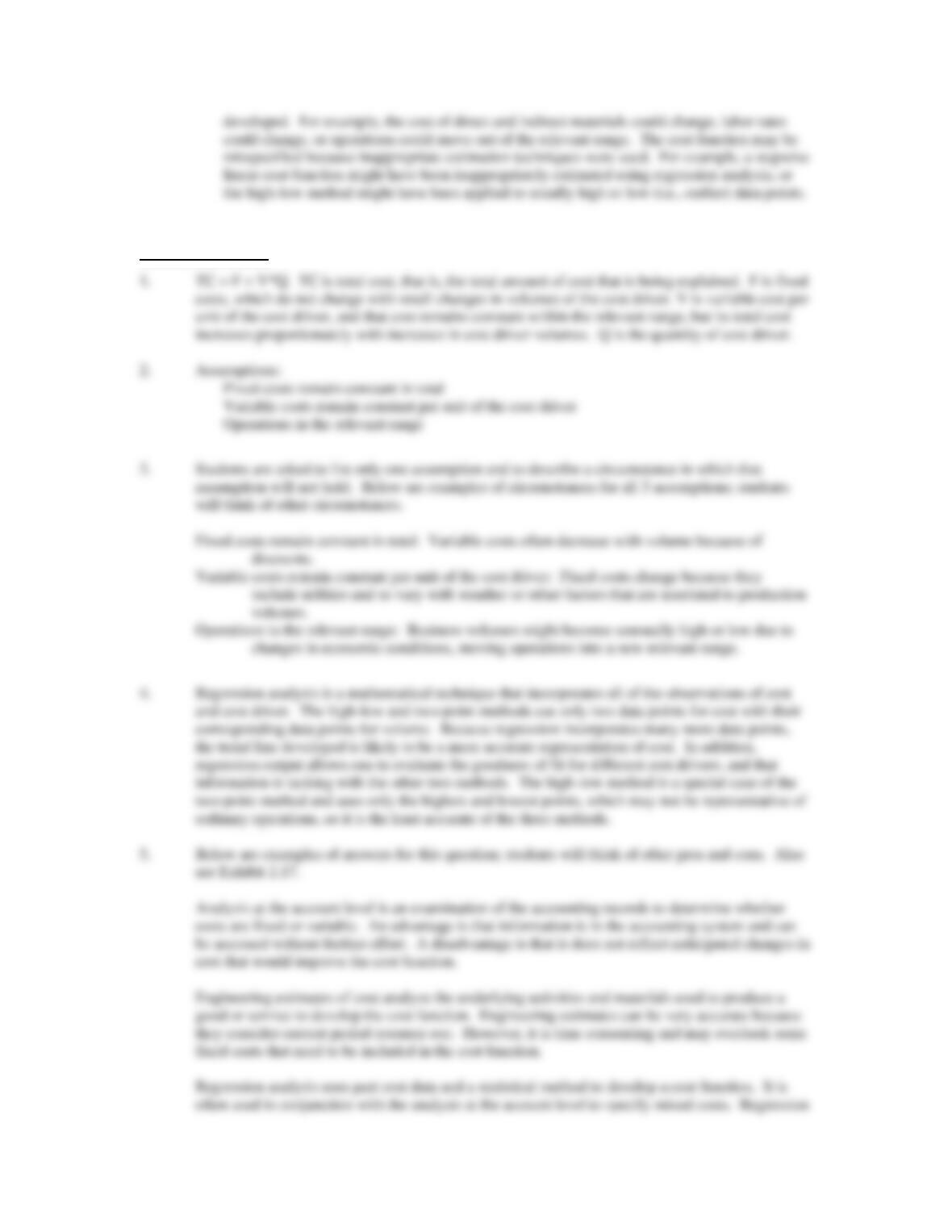
1. Write out the algebraic formula that represents a cost function, and explain each item in the equation.
2. List the assumptions made when a linear cost function is developed.
3. List one assumption made when a linear cost function is developed and describe a circumstance in
which that assumption would not hold.
4. A cost function estimated using regression analysis is more accurate than a cost function estimated
using either the high-low method or the two-point method. Explain the differences among the three
methods. As you discuss these differences, explain why regression analysis provides higher quality
information.
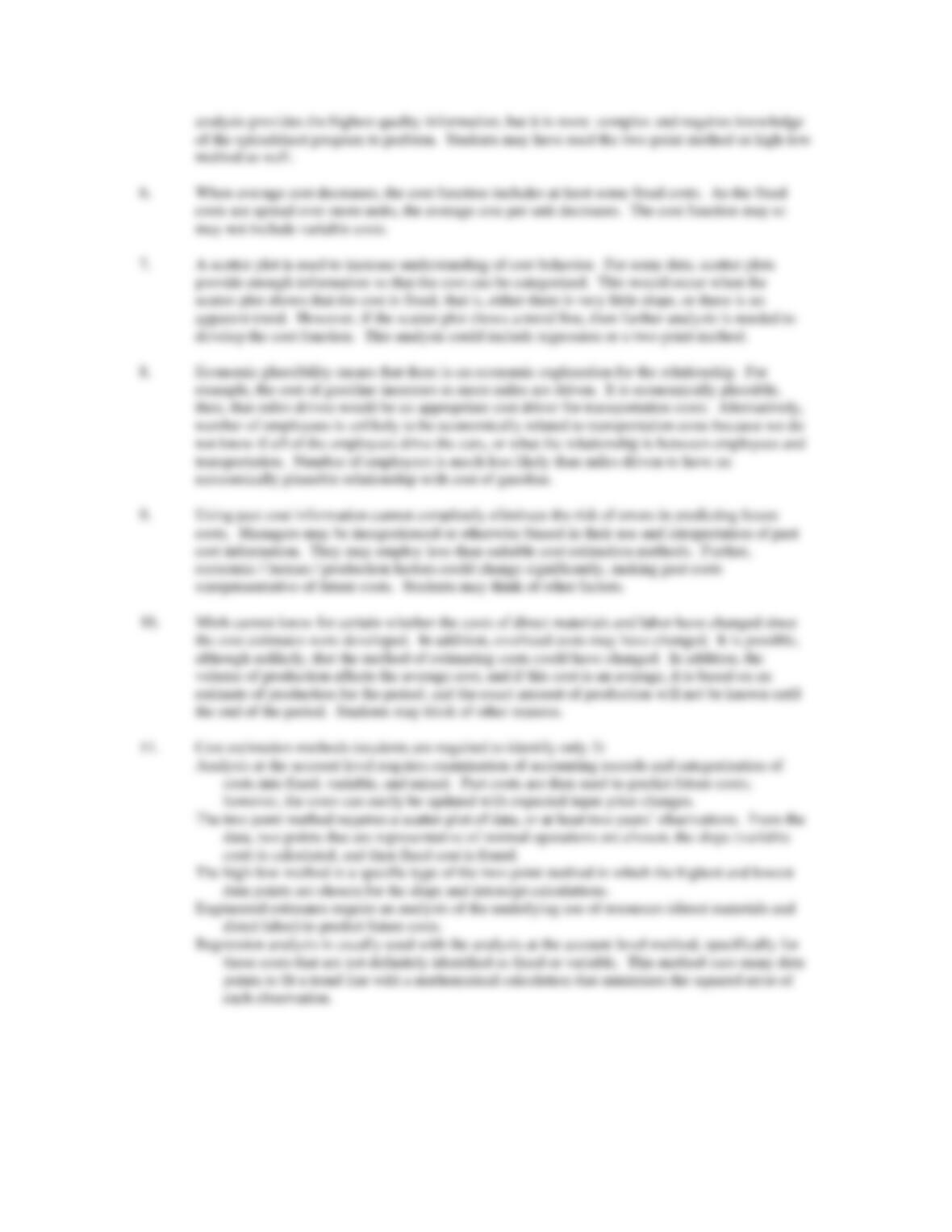
5. List and describe three methods for developing a cost function. List one pro and one con for each
method.
6. If the average cost decreases as volume of production increases, what kinds of costs are included in
the cost function? Explain your reasoning.
7. Explain how scatter plots are used in the process of developing cost functions.
8. (Appendix 2A) One of the questions that needs to be asked before data from regression analysis is
used to develop a cost function is whether the relationship between the cost and the cost driver is
economically plausible. Explain what this means. In addition, give an example of a cost with one
cost driver that would be economically plausible, and an example of one cost driver that would not be
economically plausible.
9. When estimating a cost function, accountants often begin with past cost information if it is available.
Explain why accountants cannot be certain that past costs will provide a good estimate of future costs.
10. Minh is a cost analyst for TRN Corporation. As part of his job, he must estimate the cost to
manufacture wooden and metal computer desks. A recent cost analysis showed the cost of a wooden
desk to be $130, while the cost of a metal desk was $107. Can Minh be confident that the cost to
produce a wooden desk next period will be $130? Why or why not?
11. Suppose you are a newly hired accountant for a television production studio. One of your first tasks
is to estimate the costs of an upcoming episode of the studio’s hit unscripted show, “Who Wants to
Be an Accountant?” Identify three potential methods for estimating the costs, and describe them.

2-24 Cost Management
Problems
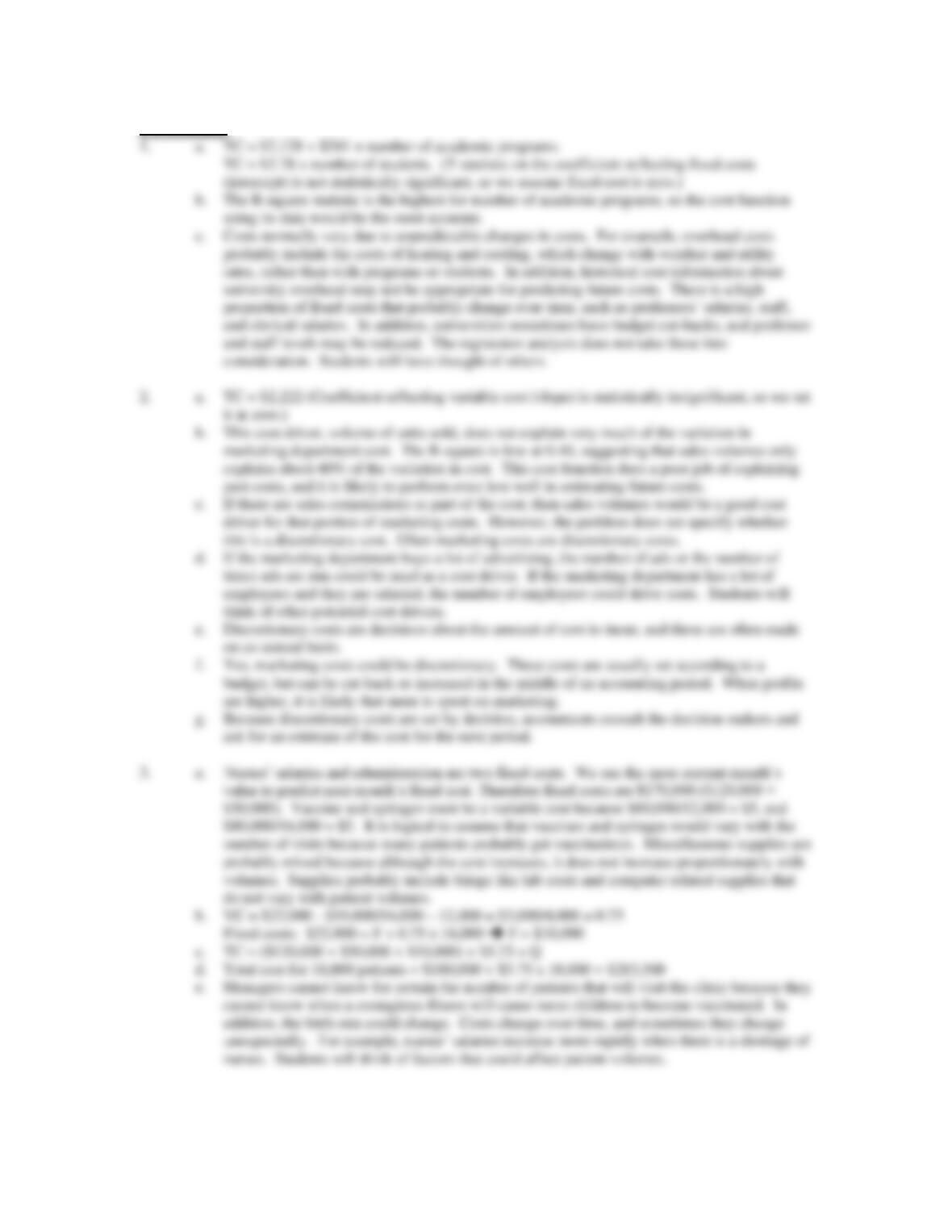
1. Here is the output from two regression models for overhead costs at a university using number of
academic programs and number of students as potential cost drivers.
Number of academic programs
Adjusted R-square = 0.72
Intercept = 7,127.75 t-statistic = 2.14 p-value = .05
X1 variable = 240.64 t-statistic = 5.08 p-value = .001
Number of students
Adjusted R-square = 0.55
Intercept = 5,991.75 t-statistic = 1.18 p-value = .35
X1 variable = 3.78 t-statistic = 3.53 p-value = 0.01
a. Develop a cost function for each potential cost driver.
b. Compare the output for the two drivers. Choose the best cost driver for overhead costs and
explain how you made that choice.
c. Suppose you use the best cost function from part (b) to estimate overhead cost for the next
semester. Why is it highly unlikely that the actual cost will be exactly the same as the cost you
estimated?
2. The new cost analyst in your accounting department has just received a computer-generated report
that contains the results from a simple regression analysis. He was estimating the marketing
department costs using volume of units sold as the cost driver. The summary results of the report
appeared as follows:
Variable Coefficient t-statistic p-value
intercept 2,222.35 2.48 p<0.01
X1 12.44 1.39 p = 0.25
Adjusted R-square = 0.40
a. Write an equation for total cost based upon the regression analysis.
b. What does the Adjusted R-square tell you about the quality of information that would be
produced using this cost driver? Explain.
c. Is it economically plausible that volume of units sold could drive the costs of the marketing
department? Explain.
d. List two other cost drivers that the cost analyst could try and explain why they might be useful.
e. Describe discretionary costs.
f. Is it possible for marketing costs to be discretionary? Explain.
g. Describe how to estimate a discretionary cost.
3. Following are the income statements for Grandview Well-Child Clinic for the years 2004 and 2005:
2004 2005
Patient Visits 12,000 16,000
Revenue $216,000 $288,000
Costs:
Nurses Salaries 80,000 120,000
Vaccine and Syringes 60,000 80,000
Miscellaneous Supplies 19,000 22,000
Administration 50,000 50,000
Surplus $ 7,000 $ 16,000

Chapter 2: The Cost Function 2-25
A nurse was added as patient visits increased in 2005. This nurse can handle up to 4,000 additional
patients in the next period. Miscellaneous supplies include the cost of supplies for medical records.
Administration is primarily salary cost of the clinic director.
a. Categorize each cost as fixed, variable, or mixed, and explain your categorizations.
b. If you have categorized a cost as mixed, use the high-low method to separate out the fixed and
variable portions.
c. Develop a cost function for Grandview Well-Child Clinic.
d. Predict the cost for 18,000 patients in 2006.
e. List two factors that could affect patient volumes. Can the managers be certain that the volume of
patients expected in 2005 will 18,000? Explain
4. You work for a company that manufactures computer chips. You need to develop a cost function for
maintenance cost, which consists of the cost for routine maintenance and repair of machines used to
manufacture the chips.
a. List the steps you would take to develop a cost function for predicting next year’s maintenance
cost. The maintenance department head has suggested these three possible cost drivers: machine
setups, labor hours, or machine hours. Include a detailed explanation of how you would
determine the best cost driver among these three.
b. You have developed the cost function and used it to develop part of next year’s budget. During
the first few months of the year, you find that the estimate is off by several thousand dollars.
Provide reasons why this could occur.
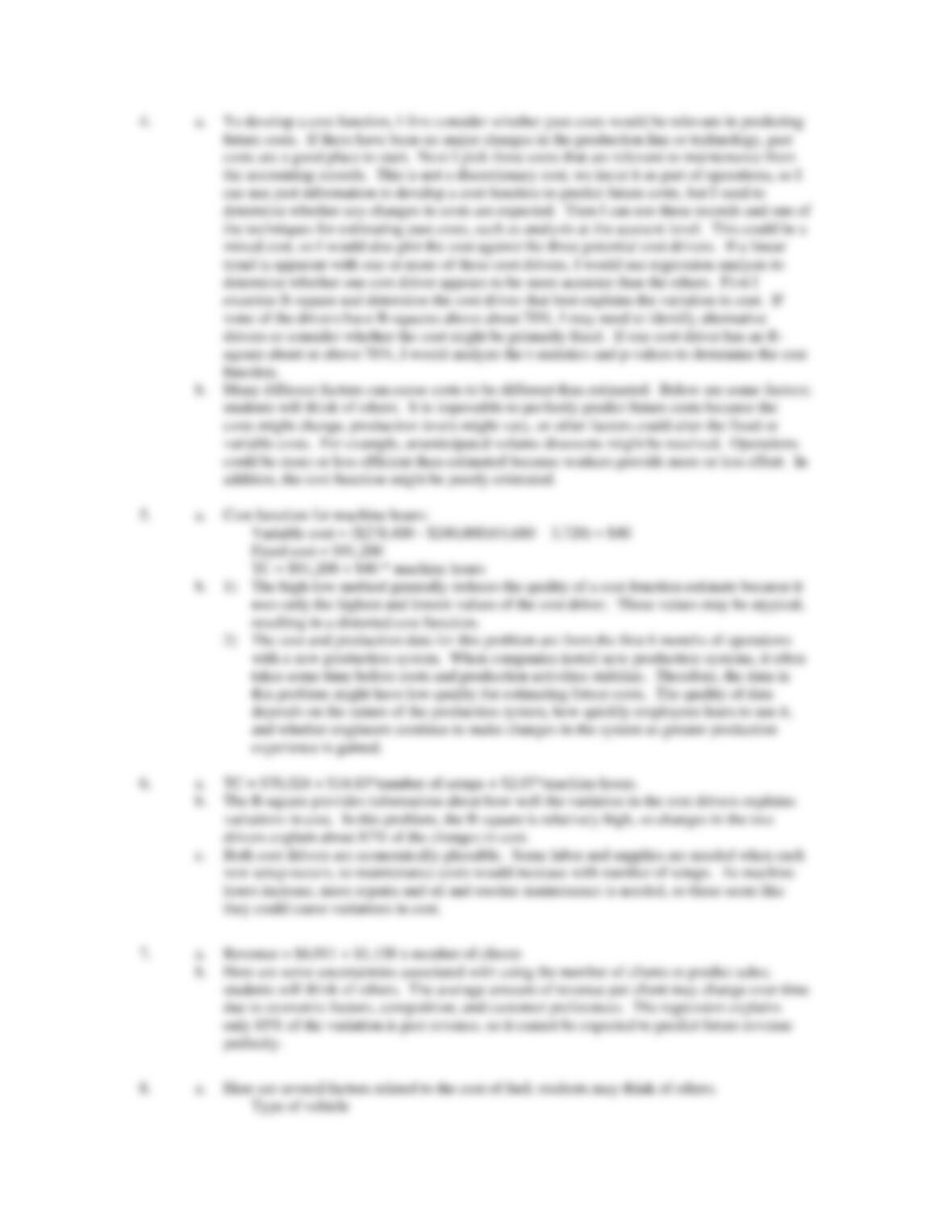
5. Jackalope Ski Company manufactures snow skis in a highly automated assembly plant in Jackson
Hole, Wyoming. The automated system is in its first year of operation, and management is still
unsure of the best way to estimate the overhead costs of operation for budgetary purposes. The
following cost and potential cost driver data were collected for the first six months of operations:
Month Machine Hours Total Overhead
January 4,560 $276,000
February 4,380 $273,600
March 4,680 $278,400
April 3,960 $270,000
May 3,900 $252,000
June 3,720 $240,000
a. Compute a cost function using machine hours under the high-low method.
b. Discuss how each of the following is likely to affect the quality of the cost functions you
estimated in part (a). Do not perform any calculations.
1) Use of the high-low method
2) Newness of the automated system
6. (Appendix 2A) Here are the results using regression analysis on maintenance and repair costs for the
production machines in a manufacturing company. Two cost drivers were chosen: number of
machine setups (X1) and machine hours (X2).
Variable Coefficient t-statistic p-value
intercept 70,324.15 2.81 p<0.01
X1 14.83 2.39 p <0.05
X2 2.07 2.24 p<0.05
Adjusted R-square = 0.87
2-26 Cost Management
a. Write an equation for total cost based upon the regression analysis.
b. What does the Adjusted R-square tell you about the quality of information that would be
produced using this cost driver? Explain.
c. Is it economically plausible that number of setups and machine hours could drive the costs of the
maintenance and repair for the machines? Explain.
7. Elliott is the vice-president of marketing for NYP Corporation. He has called upon you, a member of
the accounting staff, to help him forecast future sales. A regression analysis, with sales as the
dependent variable and number of credit clients as the independent variable, yielded the following
results: Variable Coefficient t-statistic p-value
Intercept 6911.45 3.45 0.01
Number of clients 1157.88 3.75 0.01
Adjusted R-square = 0.85
a. Write out the revenue function for this regression.
c. Identify two uncertainties associated with using the number of clients to predict sales.
8. Managers might estimate a cost function for a variety of reasons including: budgeting, setting
employee work schedules, or discontinuing a line of business. Consider the problem of predicting the
future cost of fuel for a company’s fleet of automobiles.
a. Identify three factors that might influence the actual future cost of fuel.
b. Identify and explain two potential cost drivers for the cost of fuel.
c. Suppose actual fuel costs turn out to be higher than estimated cost. Would this mean that an
inappropriate estimation method was used? Explain.
9. Coffee Cart sells a variety of hot and cold coffee beverages. Data for a recent month appear below:
Revenue $20,000
Costs:
Ingredients $7,800
Miscellaneous supplies (napkins, etc.) 1,200
Rent 1,000
Wages for part time employees 3,000
Cart attendant salary 5,000
Total costs 18,000
Profit $ 2,000
Part time employees are scheduled for busy times, but are sent home as soon as volumes drop enough
to warrant it.
a. Categorize each cost as fixed or variable and explain your choice.
b. Create a cost function.
c. Discuss three reasons why the cost function you estimated in part (b) might provide an inaccurate
estimate for next month’s costs.
Chapter 2: The Cost Function 2-27
Answers
True / False
Multiple Choice
2-28 Cost Management
Matching
Chapter 2: The Cost Function 2-29
Exercises
2-30 Cost Management
Chapter 2: The Cost Function 2-31
2-32 Cost Management
Chapter 2: The Cost Function 2-33
2-34 Cost Management
Short Answer
Chapter 2: The Cost Function 2-35
2-36 Cost Management
Problems
Chapter 2: The Cost Function 2-37
2-38 Cost Management