Name:
Class:
Date:
Access 2013 Chapter 02: Querying a Database
1. To create a new query in Design view, tap or click CREATE on the ribbon to display the CREATE tab and then tap or
click the ____ button to create a new query.
a.
Query
b.
Design View
c.
Query Design
d.
Select Query
c
1
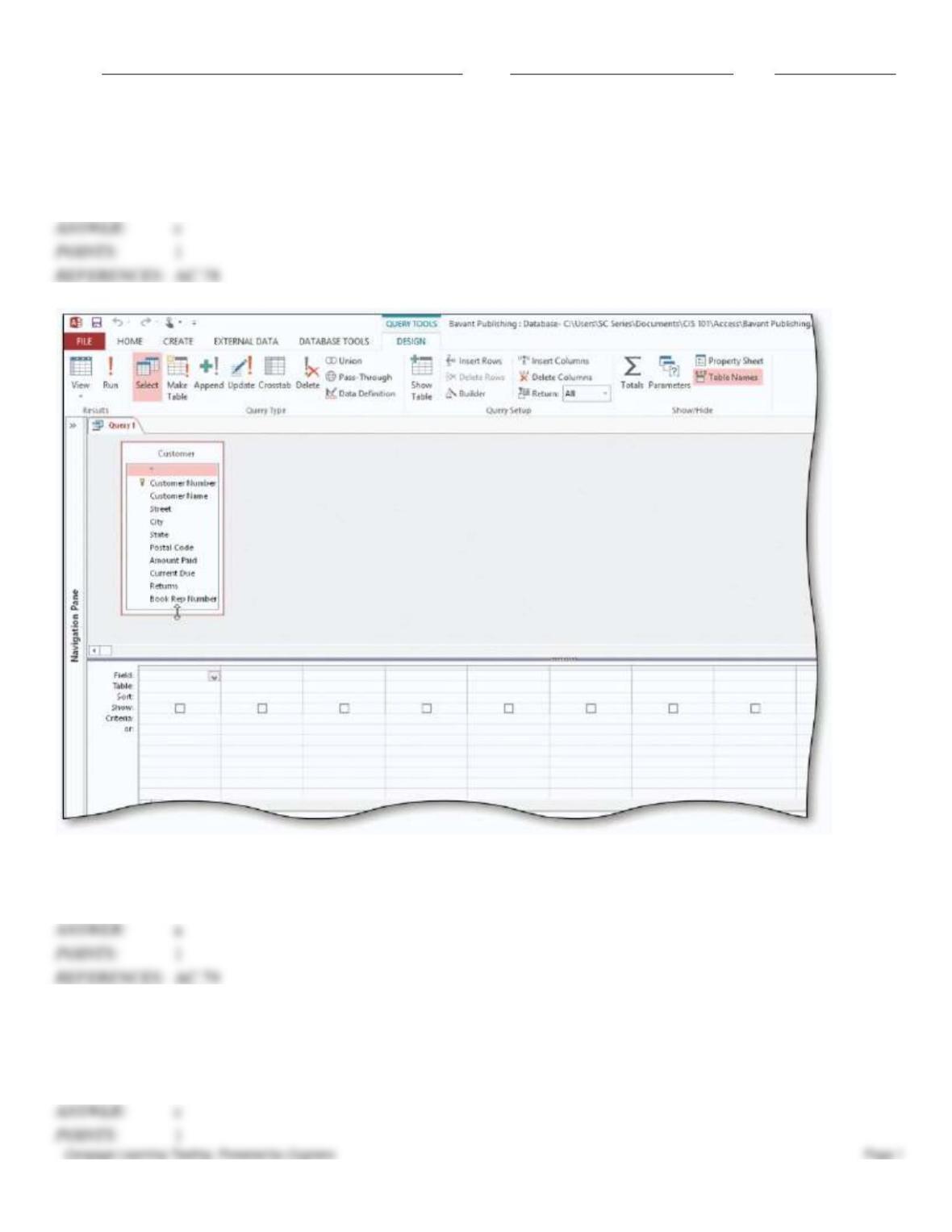
2. In the accompanying figure, the lower pane in the window where you enter criteria is called the ____.
a.
design grid
b.
query grid
c.
criteria grid
d.
column grid
a
1
3. In the accompanying figure, you can delete the table by pressing and holding or right-clicking the field list and tapping
or clicking ____ on the shortcut menu.
a.
Delete Table
b.
Hide Table
c.
Remove Table
d.
Erase Table
c
1
4. In the accompanying figure, the Customer table was added to the query by selecting the table and tapping or clicking
the Add button in the ____ dialog box.
a.
Show Table
b.
Add Table
c.
Select Table
d.
Field List
a
1
5. In the accompanying figure, you can enter CSU10 in the ____ row of the Customer Number field to find all customers
whose customer number is CSU10.
a.
Sort
b.
Show
c.
or
d.
Criteria
d
1
6. In the accompanying figure, you can remove a column by tapping or clicking just above the field name to select the
column and then tapping or clicking the ____ key(s).
a.
CTRL+DELETE
b.
CTRL+Y
c.
DELETE
d.
CTRL+ALT
c
1
7. To save a query, tap or click the Save button on the ____.
a.
status bar
b.
Quick Access Toolbar
c.
CREATE tab on the ribbon
d.
HOME tab on the ribbon
b
1
8. To view the results of a query, open it by pressing and holding or right-clicking the query in the Navigation Pane and
tapping or clicking ____ on the shortcut menu.
a.
Datasheet View
b.
Design View
c.
Open
d.
Run
c
1
9. To change the design of a query that is not currently open, press and hold or right-click the query and then tap or click
____ on the shortcut menu.
a.
Datasheet View
b.
Layout View
c.
Change View
d.
Design View
Name:
Class:
Date:
Access 2013 Chapter 02: Querying a Database
d
1
AC 82
10. To print the results of a query that is open, tap or click FILE on the ribbon, tap or click the ____ tab in the Backstage
view, and then tap or click Quick Print.
a.
Preview
b.
Query
c.
Print Query
d.
Print
d
1
AC 82
11. To find all customers whose names begin with S, enter ____ in the Criteria row of the Customer Name field.
a.
S?
b.
S*
c.
S#
d.
S&
b
1
AC 83
12. To find all individuals whose name is Robin or Robyn, enter ____ in the Criteria row of the appropriate column.
a.
Rob#n
b.
Rob%n
c.
Rob$n
d.
Rob?n
1
AC 83
13. To create a parameter query, enter a parameter rather than a specific value as a criterion in the design grid. The
parameter must be enclosed in ____.
a.
curly braces { }
b.
square brackets [ ]
c.
parentheses ( )
d.
single quotes ‘’
b
1
AC 87
14. To use a parameter query, press and hold or right-click the query in the Navigation Pane and then tap or click ____ on
the shortcut menu.
a.
Use Parameter
b.
Enter Values
c.
Open
d.
Run
c
1
AC 88
15. If the criterion for Current Due field is 0, the query results for this query will display ____ in the Current Due field.
a.
0.00
b.
$0
Name:
Class:
Date:
Access 2013 Chapter 02: Querying a Database
c.
0
d.
$0.00
d
1
AC 89
16. To find all customers whose current due amount is greater than $1,000.00, enter ____ in the Criteria row of the
Current Due column.
a.
> $1000
b.
> 1000
c.
> 1,000
d.
> $1,000
b
1
AC 90
17. Less than (<), greater than (>), and NOT (not equal to) are examples of ____.
a.
compound conditions
b.
comparison operators
c.
compound values
d.
conditions
b
1
AC 90
18. The ____ operator allows you to search for a range of values in one field.
a.
BETWEEN
b.
RANGE
c.
IN
d.
SEARCH
a
1
AC 92
19. To order the records in the answer to a query in a particular way, you ____ the records.
a.
index
b.
sort
c.
arrange
d.
list
b
1
AC 93
20. To sort records in a query, specify the sort order in the ____ row of the design grid below the field that is the sort key.
a.
Show
b.
List
c.
Sort
d.
Order
c
1
AC 93
21. To omit duplicates from a query, use the property sheet and change the Unique Values property to ____.
a.
No
b.
Yes
c.
Off
d.
On
Name:
Class:
Date:
Access 2013 Chapter 02: Querying a Database
b
1
22. The accompanying figure illustrates using a query to ____ tables; that is, to find records in two tables that have
identical values in matching fields.
a.
combine
b.
concatenate
c.
interleave
d.
join
1
23. In the accompanying figure, the ____ line between matching fields in the two tables indicates that the tables are
related.
a.
infinity
b.
join
c.
connector
d.
inner
b
1
24. In the accompanying figure, press and hold or right-click the join line and tap or click ____ on the shortcut menu to
display the Join Properties dialog box.
a.
Properties
b.
Join Properties
c.
Property Sheet
d.
Modify Properties
b
1
25. To use the Report Wizard to create a report for a query, select the query in the Navigation Pane, tap or click ____ on
the ribbon, and then tap or click the Report Wizard button.
Name:
Class:
Date:
Access 2013 Chapter 02: Querying a Database
a.
CREATE
b.
DATABASE TOOLS
c.
REPORT
d.
FILE
a
1
26. To export data from a query to Excel, select the query in the Navigation Pane, tap or click ____ on the ribbon, and
then tap or click the Excel button.
a.
DATABASE TOOLS
b.
EXTERNAL DATA
c.
OFFICE EXPORT
d.
CREATE
b
1
27. To re-use saved export steps, tap or click the Saved Exports button on the ____ tab on the ribbon.
a.
FILE
b.
CREATE
c.
DATABASE TOOLS
d.
EXTERNAL DATA
d
1
28. To use the Expression Builder to create a calculated field, select the column in the Field row, right-click to display the
shortcut menu, and then click ____.
a.
Expression Builder
b.
Builder box
c.
Build
d.
Field Builder
c
1
29. To include calculated fields in queries, enter a name for the calculated field, a(n) ____, and then the expression in one
of the columns in the Field row.
a.
colon (:)
b.
semi-colon (;)
c.
equal sign (=)
d.
exclamation point (!)
a
1
30. To display the entire entry for a calculated field, select the column in the Field row, right-click to display the shortcut
menu, and then click ____.
a.
Enlarge
b.
Resize
c.
Magnify
d.
Zoom
d
1
Name:
Class:
Date:
Access 2013 Chapter 02: Querying a Database
31. You can include ____ in calculations to indicate which calculation should be done first.
a.
curly braces { }
b.
brackets [ ]
c.
parentheses ( )
d.
slashes //
c
1
32. To change the caption for a field in a query, click the field in the design grid, click the ____ button on the Design tab,
click the Caption box, and enter the new caption.
a.
Caption
b.
Property Sheet
c.
Field Name
d.
Format
a
1
33. To include the Total row in the design grid, click the ____ button on the DESIGN tab.
a.
Aggregate
b.
Statistics
c.
Calculations
d.
Totals
d
1
34. To find the largest amount paid amount for a client, select ____ as the entry in the Total row for the Amount Paid
column.
a.
Large
b.
Maximum
c.
LGE
d.
MAX
d
1
35. To calculate statistics for only those records that satisfy certain criteria, select ____ as the entry in the Total row for
the field, and then enter the criterion in the Criteria row.
a.
Having
b.
Where
c.
Restrict
d.
Find
b
1
36. To indicate grouping in Access, select ____ as the entry in the Total row for the field to be used for grouping.
a.
Like
b.
Where
c.
Same
d.
Group By
d
1
Name:
Class:
Date:
Access 2013 Chapter 02: Querying a Database
37. To create a crosstab, click the ____ button on the CREATE tab.
a.
Crosstab Wizard
b.
Query Wizard
c.
Statistics
d.
Chart
b
1
AC 119
38. To show the Navigation Pane if it is hidden, click the ____ Button.
a.
Show
b.
Shutter Bar Open/Close
c.
Restore
d.
Show/Hide
b
1
AC 122
39. To organize entries in the Navigation Pane by table, click ____ on the Navigation Pane menu.
a.
Objects by Table
b.
Table Object
c.
Tables and Related Views
d.
Default
c
1
AC 122
40. To quit Access, click the ____ button on the right side of the Access title bar.
a.
Quit
b.
Close
c.
Stop
d.
Exit
b
1
AC 124
Modified Multiple Choice
41. The special criteria that can be used in queries are ____.
a.
AND
b.
INCLUSIVE
c.
BETWEEN
d.
IN
a, c, d
1
AC 92
AC 118
Name:
Class:
Date:
Access 2013 Chapter 02: Querying a Database
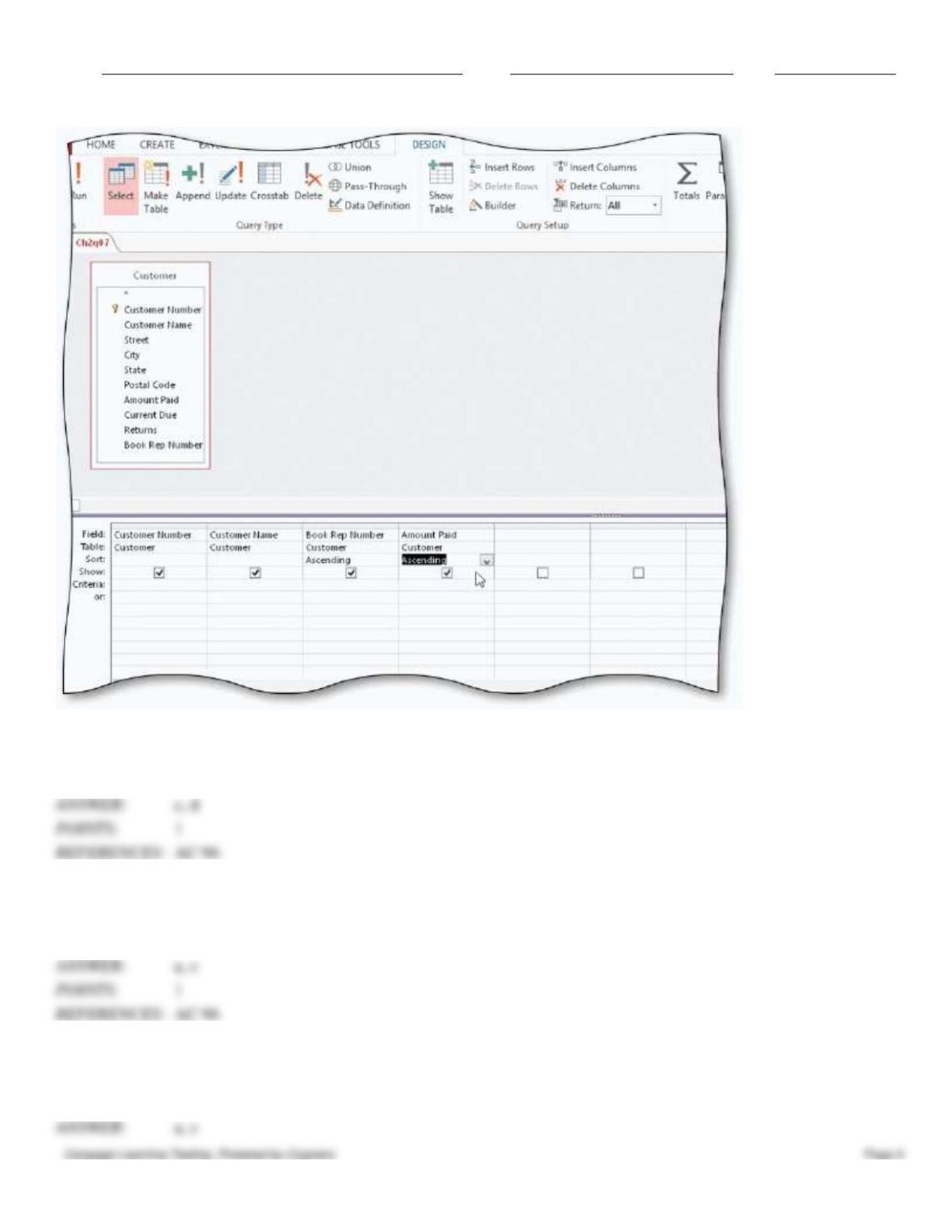
42. In the accompanying figure, Amount Paid is the ____ key.
a.
major
b.
primary sort
c.
minor
d.
secondary sort
c, d
1
43. In the accompanying figure, Book Rep Number is the ____ key.
a.
major
b.
minor
c.
primary sort
d.
secondary sort
a, c
1
44. The arithmetic symbols for use in query calculations are ____.
a.
asterisk (*)
b.
ampersand (&)
c.
slash (/)
d.
question mark (?)
a, c
Name:
Class:
Date:
Access 2013 Chapter 02: Querying a Database
45. For group calculations, Microsoft Access supports ____ built-in statistics.
a.
STDEV
b.
VAR
c.
MAX
d.
LOW
a, b, c
1
AC 115
46. When you enter text data in a criterion, you must enclose the text in quotation marks.
a.
True
b.
False
False
1
AC 81
47. The asterisk (*) wildcard represents any collection of characters.
a.
True
b.
False
True
1
AC 83
48. The question mark (?) wildcard represents any collection of characters.
a.
True
b.
False
False
1
AC 83
49. To find all customers whose names begin with S, enter S? in the Criteria row of the design grid.
a.
True
b.
False
False
1
AC 83
50. To enter a criterion for a particular field without displaying the field in the results of the query, include the field in the
design grid, enter the criterion, and remove the check mark from its Show check box.
a.
True
b.
False
True
1
1
AC 112
Name:
Class:
Date:
Access 2013 Chapter 02: Querying a Database
51. A query that prompts for input whenever it is run is a dialog query.
a.
True
b.
False
False
1
52. To create a parameter query that will prompt users to enter a city name as input, place [Enter City] as the criterion in
the City field.
a.
True
b.
False
True
1
53. To enter a number in a criterion, type the number without any dollar signs or commas.
a.
True
b.
False
True
1
54. Unless you specify otherwise, Access assumes that the criteria you enter involve equality (exact matches).
a.
True
b.
False
True
1
55. To find all customers whose returns are greater than $0.00 and whose book rep is book rep number 42, enter each
criterion on the same row.
a.
True
b.
False
True
1
56. To find all customers whose returns are greater than $0.00 or whose book rep is book rep number 42, enter each
criterion on the same row.
a.
True
b.
False
False
Name:
Class:
Date:
Access 2013 Chapter 02: Querying a Database
1
57. The field or fields on which records are sorted is called the sort key.
a.
True
b.
False
True
1
58. If you specify more than one sort key, the sort key on the left will be the major sort key and the one on the right will
be the minor sort key.
a.
True
b.
False
True
1
59. When you sort data in a query, the records in the underlying table are actually rearranged.
a.
True
b.
False
False
60. A property sheet is a window containing the various properties of the object.
a.
True
b.
False
True
1
61. When you sort data, duplicates are not included.
a.
True
b.
False
False
1
62. To create a top-values query, use the Top Values box on the DESIGN tab to change the number of records to be
included from All to the desired number.
a.
True
b.
False
False
Name:
Class:
Date:
Access 2013 Chapter 02: Querying a Database
63. Joining tables in a query creates an ad hoc relationship, that is, a relationship between tables created for a specific
purpose.
a.
True
b.
False
True
1
64. You cannot create a report for a query.
a.
True
b.
False
False
1
65. You can export data from Access to the standard Word format.
a.
True
b.
False
False
66. In fixed-width files, each record is on a separate line and the fields are separated by a special character.
a.
True
b.
False
False
1
67. The expression for a calculated field can be typed directly into the Field row.
a.
True
b.
False
True
1
68. The only calculated fields you can create in Access are those involving addition and subtraction.
a.
True
b.
False
False
1
1
Name:
Class:
Date:
Access 2013 Chapter 02: Querying a Database
69. Grouping means creating groups of records that share some common characteristic.
a.
True
b.
False
True
1
70. Crosstab queries are useful for summarizing data by category or group.
a.
True
b.
False
True
1
71. To include all fields in the design grid, double-click the question mark (?) in the field list. ____________________
1
72. Wildcards are symbols that represent any character or combination of characters. ____________________
True
1
73. A summary function is a function that performs some mathematical function against a group of records.
____________________
1
74. A crosstab query calculates a statistic for data that is grouped by two different types of information.
____________________
True
1
75. To restrict the objects that appear on the Navigation Pane use the Retrieval Bar. ____________________
1
76. A question that is asked of Access or any other database management system is called a(n) ____________________.
query
Name:
Class:
Date:
Access 2013 Chapter 02: Querying a Database
77. If a Security Warning appears when you open an Access database, tap or click the ____________________ button.
78. To include all fields for a table in the design grid, double-tap or double-click the ____________________ in the field
list.
79. The results of a query display in ____________________ view.
80. To change the design of a query that is not currently open, press and hold or right-click the query in the Navigation
Pane and then tap or click ____________________ on the shortcut menu.
81. To find all customers whose names begin with Sr, enter ____________________ as the criterion for the Customer
Name field.
82. ____________________ are symbols that represent any character or combination of characters.
83. The ____________________ wildcard represents any collection of characters.
84. The ____________________ wildcard represents any individual character.
Name:
Class:
Date:
Access 2013 Chapter 02: Querying a Database
85. A(n) ____________________ query is a query that prompts for input whenever it is used.
86. To find all book reps whose start date is after 1/1/2013, use the ____________________ operator.
greater than
87. To combine criteria with ____________________, place the criteria on the same row.
88. To combine criteria with ____________________, each criterion must go on separate rows in the Criteria area of the
grid.
89. A(n) ____________________ is a window containing the various properties of the object.
property sheet
90. To sort records by amount paid within book rep number, specify Book Rep Number as the ____________________
key.
major sort
91. In ____________________ files, the width of any field is the same on every record.
92. The type of join that finds records from both tables that have identical values in matching fields is called a(n)
____________________ join.
Name:
Class:
Date:
Access 2013 Chapter 02: Querying a Database
93. The ____________________ is an Access tool that helps you create complex expressions.
94. The ____________________ function finds the smallest value in a group of records.
95. A(n) ____________________ function is a function that performs some mathematical function against a group of
records.
96. After you create and save a query, you can use it in a variety of ways. Name three of these ways.
97. Explain the difference between an inner join and an outer join.
98. When you create a query, you should follow some general guidelines for query design. What are these six guidelines?
Name:
Class:
Date:
Access 2013 Chapter 02: Querying a Database
Critical Thinking Questions
Case 2-1
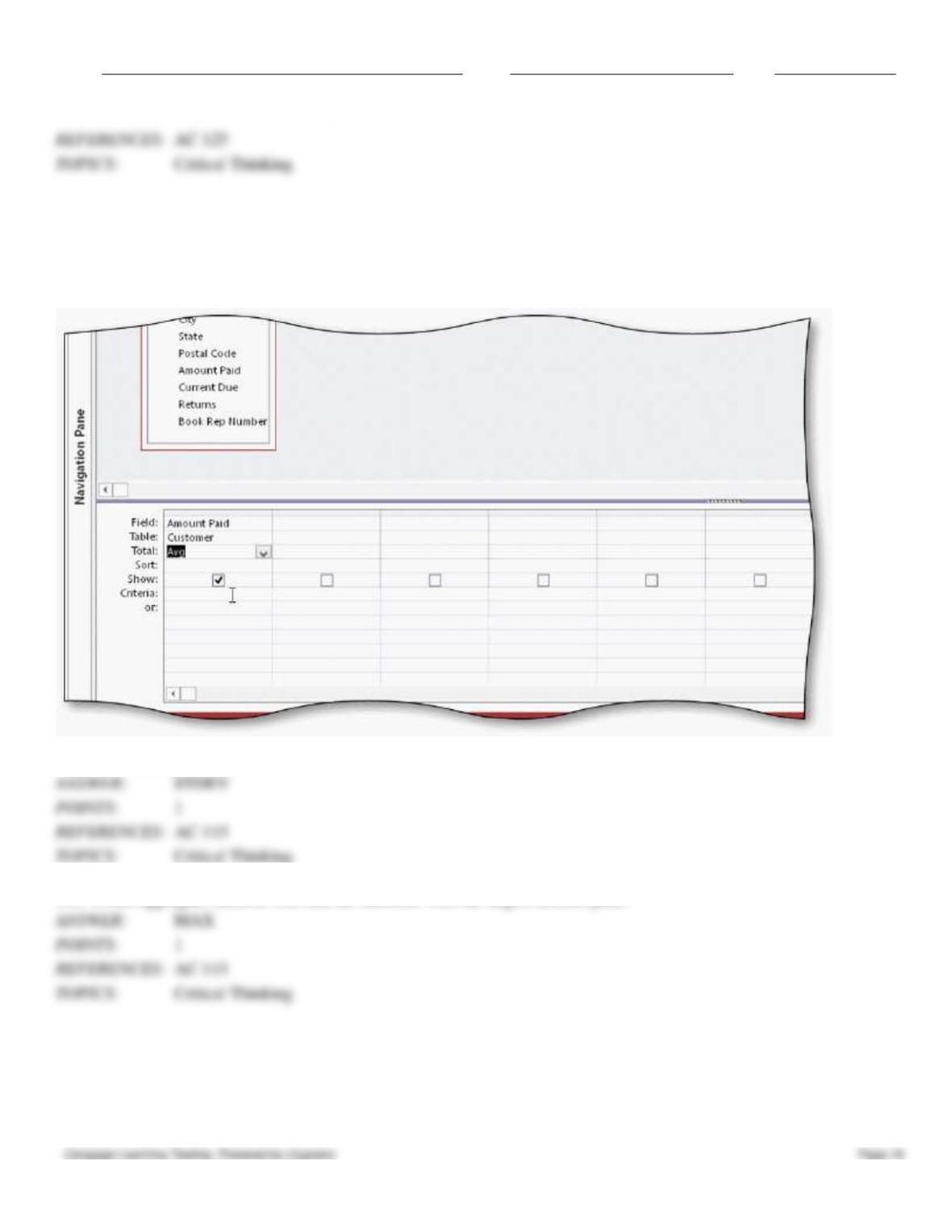
Bavant needs to gather some additional statistics on its customers. An employee at Bavant has created an initial query as
shown in the accompanying figure that calculates the average amount paid. The employee is unsure what aggregate
functions to use for additional calculations.
99. Which aggregate function will find the standard deviation?
1
Critical Thinking
100. Which aggregate function will find the customer with the largest amount paid?
1
Critical Thinking
Critical Thinking Questions
Case 2-2
Bavant Publishing needs to find the book reps whose start date is earlier than 1/1/2013.
101. What criteria should Bavant enter in the Start Date column of the design grid?
Critical Thinking
Name:
Class:
Date:
Access 2013 Chapter 02: Querying a Database
<1/1/2013
1
AC 90
102. The caption for the Start Date field should be Started when the query results display. How can Bavant change the
caption?
1
AC 114
Identify the letter of the choice that best matches the phrase or definition.
a.
*
b.
?
c.
/
d.
Total
e.
AND criterion
f.
NOT
g.
BETWEEN
h.
OR criterion
i.
IN
j.
FIRST
REFERENCES:
AC 91
AC 83
AC 90
AC 112
AC 83
AC 91
AC 115
AC 115
AC 92
AC 92
103. Each individual criterion must be true in order for the compound criterion to be true.
e
1
104. Represents any collection of characters.
a
1
105. A comparison operator.
f
Name:
Class:
Date:
Access 2013 Chapter 02: Querying a Database
106. A mathematical operator for division.
107. Represents any individual character.
108. Either individual criterion must be true in order for the compound criterion to be true.
109. Row that displays in the design grid when aggregate functions are used.
110. An aggregate function.
111. Use to select values in a list.
112. Use to select values in a given range.