Chapter 2
Foreign Exchange Parity Relations
Note: In the sixth edition of Global Investments, the exchange rate quotation symbols differ from previous
editions. We adopted the convention that the first currency is the quoted currency in terms of units
of the second currency.
For example, €:$ = 1.4 indicates that one euro is priced at 1.4 dollars. In previous editions we used
the reversed convention $/€ = 1.4, meaning 1.4 dollars per euro.
All problems in this test bank still use the old convention and have not been adapted to reflect the
new quotation symbols used in the 6th edition.
◼ Questions and Problems
1. The current Swiss franc/U.S. dollar spot exchange rate is 2 Swiss francs per dollar, or CHF/$ = 2.
The expected inflation over the coming year is 2% in Switzerland and 5% in the United States.
What is the expected value for the spot exchange rate a year from now, according to purchasing
power parity?
Solution
2. The spot exchange rate is CHF/$ = 2.00. The one-year interest rate is equal to 4% in Switzerland and
8% in the United States. What should the current value of the forward exchange rate be?
Solution
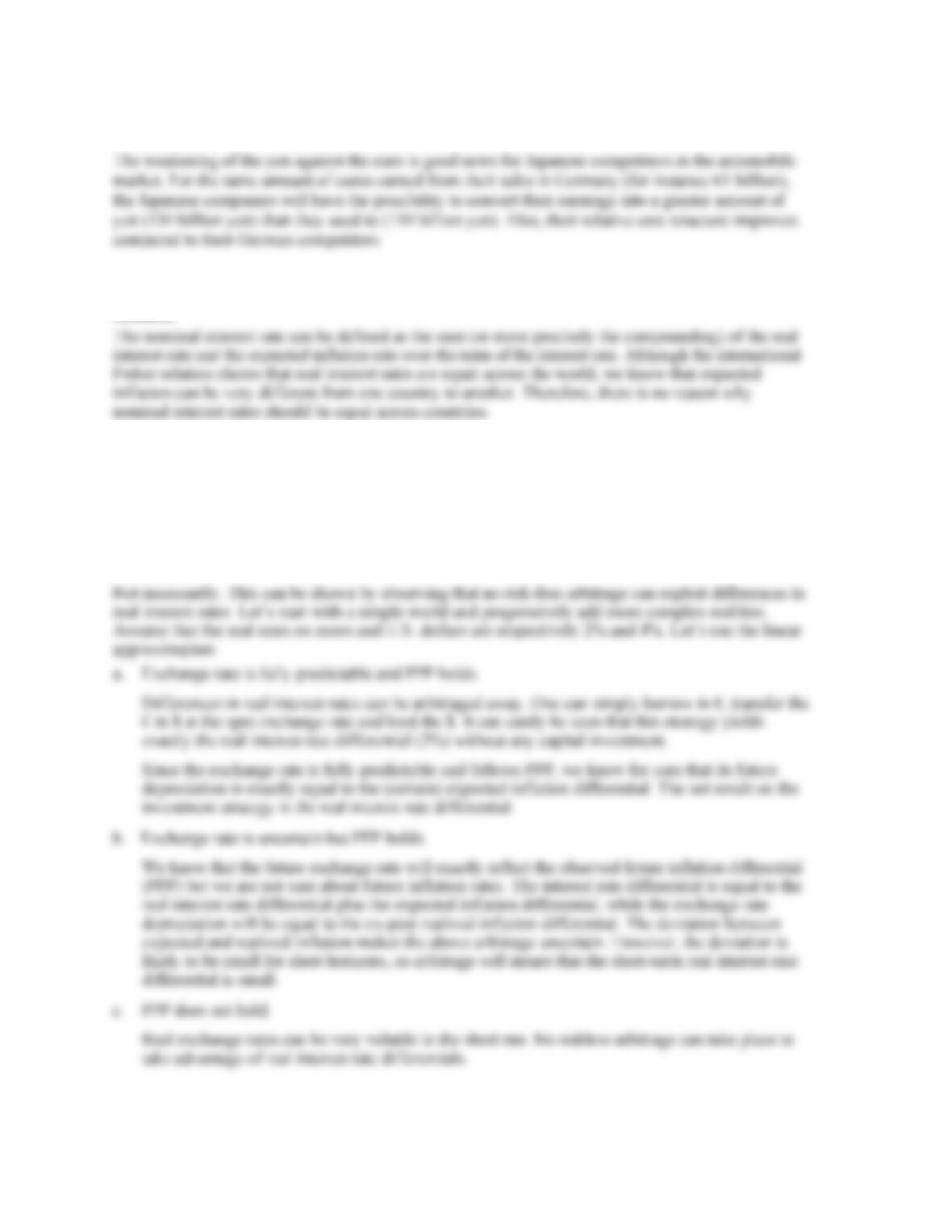
3. The ¥/€ spot exchange rate is 130 yen per euro. Inflation rates in Japan and Germany are similar.
Over the past year the ¥/€ rate moved from 110 to 130. Is this good news or bad news for Japanese
firms competing with German firms in the automobile market?
10 Solnik/McLeavey • Global Investments, Sixth Edition
Solution
4. Should nominal interest rates be equal across countries? Why or why not?
Solution
5. Should real interest rates be equal across countries? Can a financial arbitrage take place in case of
significant and persistent real interest rate differences? To answer this question:
a. First assume that exchange rates are fully predictable and follow purchasing power parity (PPP).
b. Then assume that they are uncertain but that PPP holds.
c. Finally, assume that exchange rates are uncertain and that PPP does not hold.
Solution
Chapter 2 Foreign Exchange Parity Relations 11
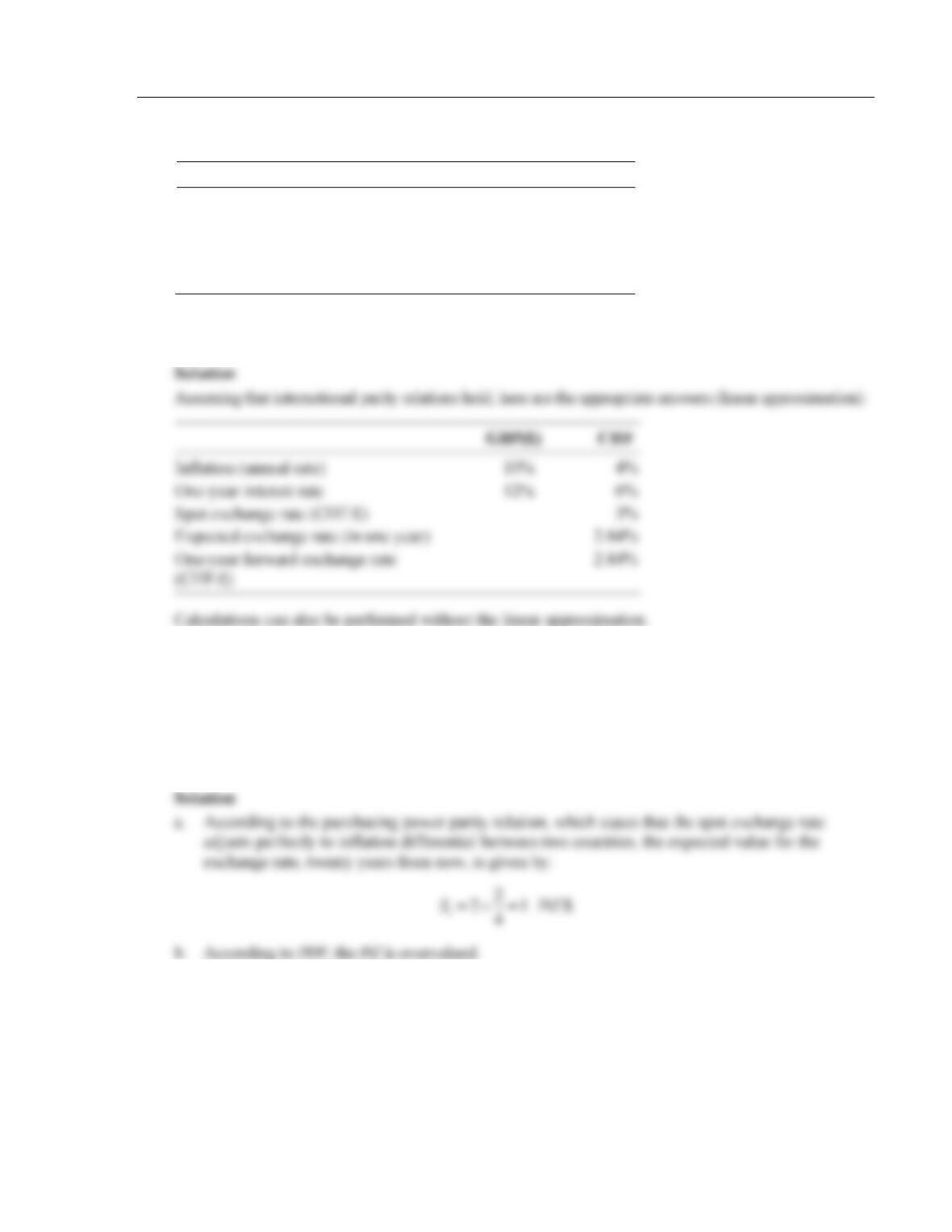
6. Here are some statistics:
GBP(£)
CHF
Inflation (annual rate)
10%
4%
One-year interest rate
12%
?%
Spot exchange rate (CHF/£)
3%
Expected exchange rate (in one year)
?%
One-year forward exchange rate (CHF/£)
?%
Based on the linear approximation of international parity relations, replace the question marks with
the appropriate answers.
7. Paf is a small country. Its currency is the pif and the exchange rate with the U.S. dollar was 2 pifs
per dollar in 1980. The inflation indexes in 1980 were equal to 100 in the United States and in Paf.
Twenty years later, the inflation indexes were equal to 400 in the United States and 200 in Paf. The
current exchange rate is 0.9 pifs per dollar.
a. What should the current exchange rate be if PPP prevailed?
b. Is the Pif over/undervalued according to PPP?
8. Fundamental Value Based on Absolute PPP. Ideally, one would like to compare directly the price
of goods in two countries to see if an exchange rate conforms to absolute PPP, or whether it is
overvalued or undervalued in real terms. As mentioned in Chapter 2, this can only be done for some
individual goods that are clearly comparable (“law of one price”), and the estimation for different
goods can lead to opposing conclusions. In Chapter 2, we provide an analysis based on the well-
known Big Mac report of The Economist. Of course, the Big Mac is a very particular product and a
fundamental PPP value can be computed on a wide range of products. The results are often conflicting.
For example, one can look at production prices rather than consumption prices. Some studies are
Inflation (annual rate)
4%
One-year interest rate
6%
Spot exchange rate (CHF/£)
3%
Expected exchange rate (in one year)
12 Solnik/McLeavey • Global Investments, Sixth Edition
conducted by looking at labor costs. Rather than looking at unit labor costs for unskilled workers, as
is often done, the exhibit below reports the average annual remuneration of the chief executive officer
(CEO) of industrial companies with annual revenues of $250 million to $500 million in ten selected
areas of the world. The figures are also from April 1998. They include all forms of compensation, such
as bonuses, perks, and stock options, but are not adjusted for different taxes or costs of living.
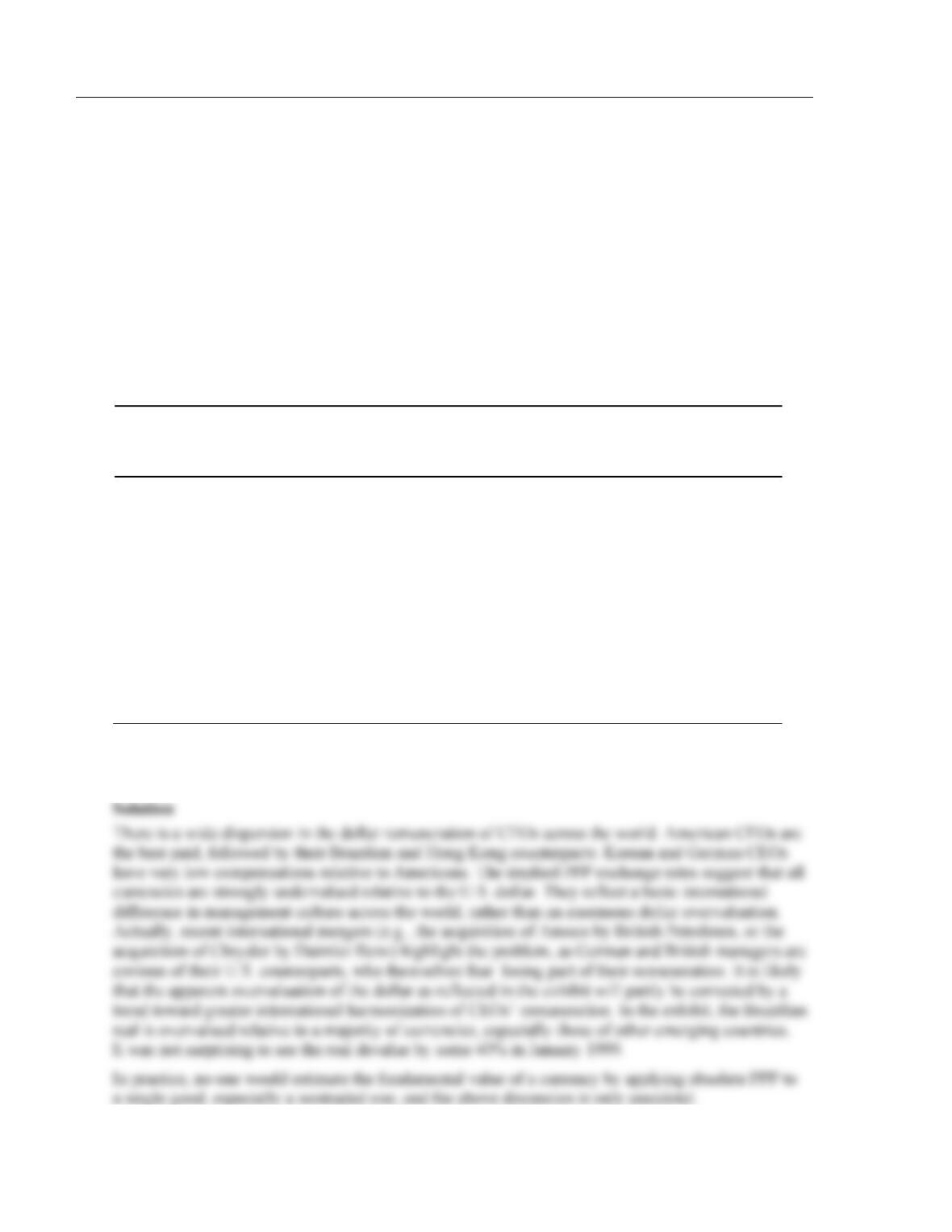
The first column gives the total CEO compensation measured in U.S. dollars using the actual
exchange rate, which is indicated in the second column. The third column gives the fundamental PPP
value of each currency, implied by the national CEO compensations. It is the exchange rate with the
dollar that would make CEO compensation identical in all countries. The fourth column gives the
actual overvaluation (if positive) or undervaluation (if negative) of the local currency relative to its
fundamental value in terms of CEO compensation.
EXHIBIT: Determining a Fundamental PPP Value Based on CEOs’ Remuneration
Total
Compensation
in US $
Actual
Exchange Rate
(1 US $ = )
Fundamental
PPP Value
(1 US $ = )
Undervaluation
in %
South Korea
150,711
1474
207
−86
Germany
398,430
1.84
0.68
−63
Japan
420,855
135
53
−61
Mexico
456,902
8.54
3.64
−57
Canada
498,118
1.42
0.66
−54
France
520,389
6.17
2.99
−51
U.K.
645,540
0.6024
0.3626
−40
Hong Kong
680,616
7.75
4.92
−37
Brazil
701,219
1.14
0.75
−35
U.S.A.
1,072,400
1
1
Source: Total compensation data comes from Towers Perrin, 1998.
What conclusions can you draw from this exhibit?
Chapter 2 Foreign Exchange Parity Relations 13
9. The exhibit below presents the 1997 balance of payments statistics for France, Germany, Japan, the
United Kingdom, and the United States. The various balance of payments items have been aggregated
using the presentation outlined in Chapter 2.
EXHIBIT: 1997 Balance of Payments of Five Major Countries
Billions of U.S. Dollars
France
Germany
Japan
U.K.
U.S.A.
Current Account
39
−1
94
7
−167
Exports
284
510
409
279
680
Imports
−256
−436
−308
−300
−877
Trade Balance
28
74
101
−21
−197
Balance of Services
17
−41
−54
15
87
Net Income
3
−2
56
19
−18
Current Transfers
−9
−32
−9
−7
−39
Capital and Financial Account
−33
−1
−88
−11
168
Direct Investments
−12
−33
−23
−21
−11
Portfolio Investments
−24
−5
29
−22
308
Other Financial and Capital
Flows
−2
36
−128
25
−32
Net Errors and Omissions
5
1
34
7
−97
Official Reserve Account
−6
2
−6
4
−1
Source: Adapted from International Monetary Fund, International Financial Statistics, 1998
Yearbook.
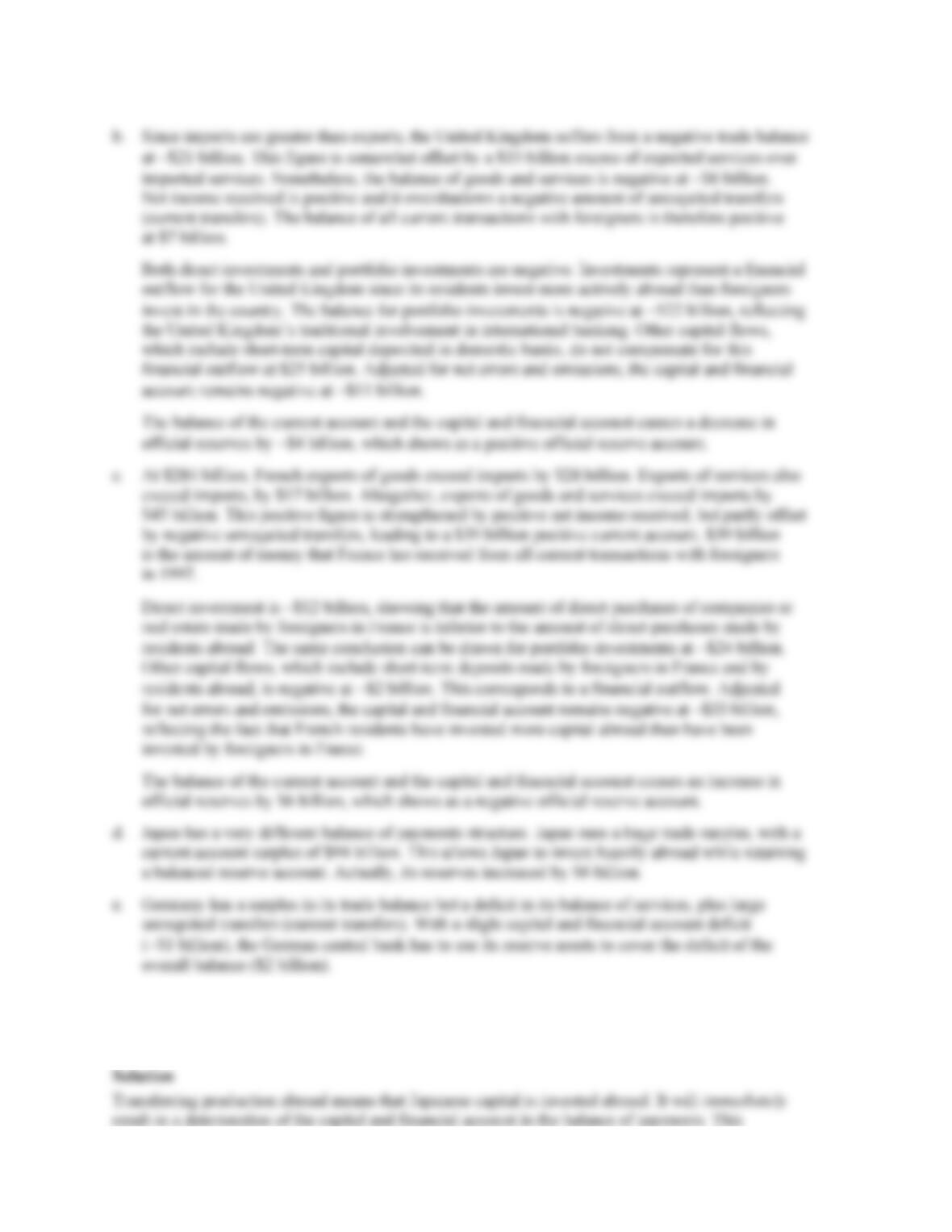
a. Provide an analysis of the U.S. balance of payments.
b. Provide an analysis of the British balance of payments.
c. Provide an analysis of the French balance of payments.
d. Provide a brief analysis of the Japanese balance of payments.
e. Provide a brief analysis of the German balance of payments.
14 Solnik/McLeavey • Global Investments, Sixth Edition
10. Because of the relative rise in local production costs brought about by the appreciation of the yen,
many Japanese corporations have decided to transfer production abroad. What should be the
immediate and future impact on the Japanese balance of payments?
Chapter 2 Foreign Exchange Parity Relations 15
11. The Japanese balance of payments from 1987 to 1993 is as follows. All numbers are reported in
billions of U.S. dollars. The last line gives the real effective exchange rate index of the yen relative
to other currencies. An increase in the index means a real appreciation of the yen.
1987
1988
1989
1990
1991
1992
1993
Merchandise: Exports
224
260
270
280
307
331
351
Merchandise: Imports
−128
−165
−193
−217
−203
−198
−210
Services: Credit
29
35
40
41
45
48
52
Services: Debit
−48
−64
−75
−82
−85
−90
−93
Income: Credit
51
77
104
125
144
146
152
Income: Debit
−37
−60
−85
−106
−121
−114
−115
Current Transfers
−4
−4
−4
−6
−12
−5
−6
Direct Investments
−18
−35
−45
−45
−29
−15
−14
Portfolio Investments
−91
−53
−33
−14
35
−28
−66
Other Financial and Capital
Flows
64
21
30
39
−78
−64
−24
Net Errors and Omissions
−4
3
−22
−21
−8
−10
0
Reserve Account
Real Effective Yen Rate
128
135
128
114
122
127
160
1988
1989
1990
1992
Trade Balance
77
Current Account
57
Account
Official Reserves
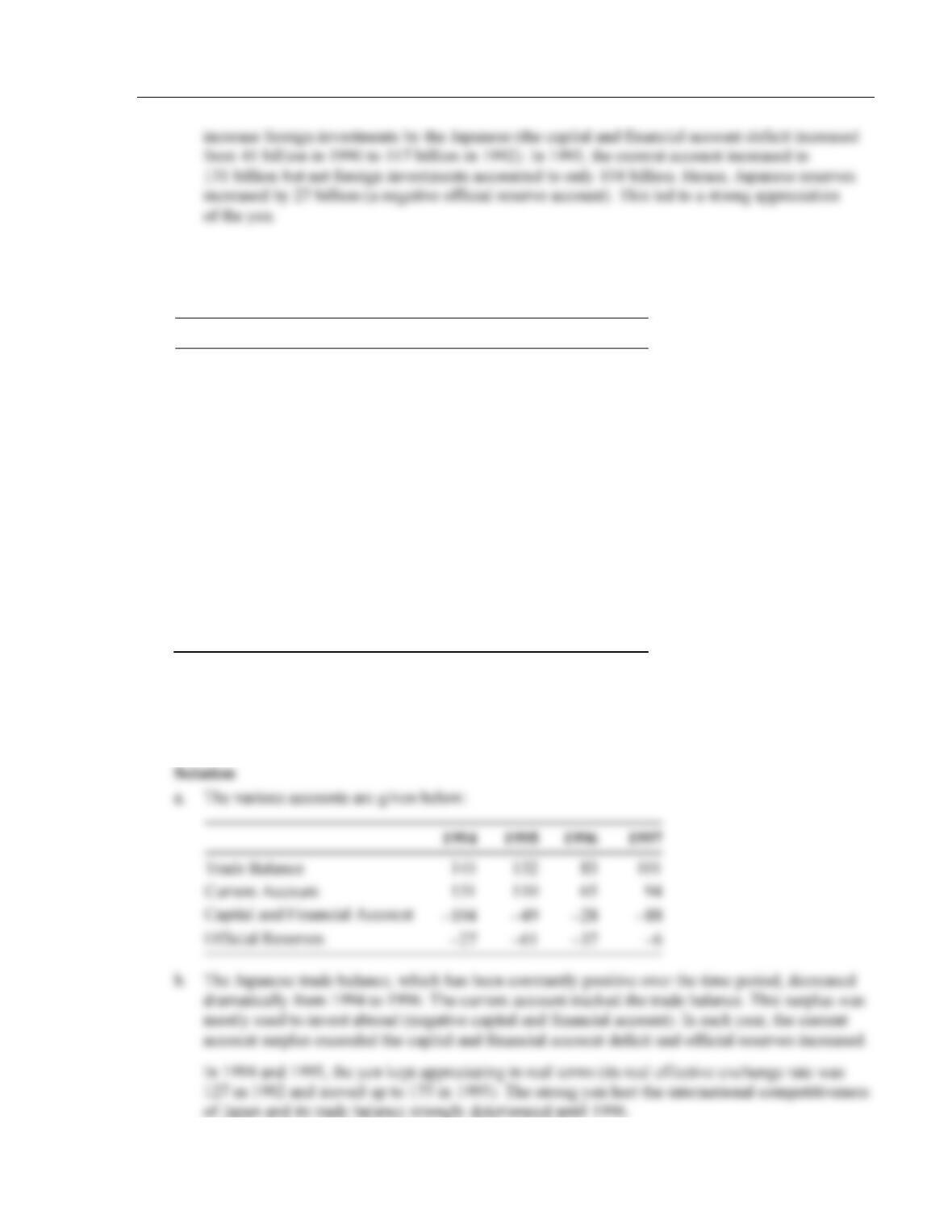
a. Calculate the trade balance, current account, capital and financial account, and official reserve
account for each year.
b. Use these numbers to describe what has happened in terms of Japanese financial transactions
with the rest of the world.

16 Solnik/McLeavey • Global Investments, Sixth Edition
Chapter 2 Foreign Exchange Parity Relations 17
12. The Japanese balance of payments from 1994 to 1997 is as follows. All numbers are reported in
billions of U.S. dollars. The last line gives the real effective exchange rate index of the yen relative
to other currencies. An increase in the index means a real appreciation of the yen.
1994
1995
1996
1997
Merchandise: Exports
386
429
400
409
Merchandise: Imports
2241
2297
2317
2308
Services: Credit
58
65
68
69
Services: Debit
2106
2123
2130
2123
Income: Credit
155
192
225
222
Income: Debit
2115
2148
2172
2166
Current Transfers
26
28
29
29
Direct Investments
217
222
223
223
Portfolio Investments
228
236
242
29
Other Capital Flows
241
25
36
2128
Net Errors and Omissions
218
14
1
34
Reserve Account
Real Effective Yen Rate
169
175
146
137
Trade Balance
83
Current Account
110
65
a. Calculate the trade balance, current account, capital and financial account, and official reserve
account for each year.
b. Use these numbers to describe what has happened in terms of Japanese financial transactions
with the rest of the world.
18 Solnik/McLeavey • Global Investments, Sixth Edition
13. Under a system of fixed exchange rates, a nation experiencing an excess of imports over exports can
try to remedy this situation by:
a. Adopting tariffs and quotas.
b. Reducing its income from investments abroad.
c. Applying an expansionary macroeconomic policy to drive prices up and interest rates down.
d. Building up its reserves of foreign currencies and reserve balances with the International
Monetary Fund.
14. Under a system of fixed exchange rates, a nation can try to remedy its balance of payments deficit by:
a. Applying expansionary macroeconomic policy to drive prices up and interest rates down.
b. Applying restrictive macroeconomic policy to keep prices down and interest rates up.
c. Reducing its income from investments abroad.
d. Building up its reserves of foreign currencies and reserve balances with the International
Monetary Fund.
15. In 1994, the United States was experiencing a fairly strong economic recovery, ahead of other
nations. Fears of an overheating economy led to sudden inflationary fears for the next few years.
a. Would you expect U.S. interest rates to rise or drop?
b. Would you expect the dollar to depreciate or appreciate?
c. Would you expect a foreign bond portfolio to be a good investment compared to a U.S. dollar
portfolio under this scenario?
16. Exchange Rate Dynamics. Britain and Europe have no inflation, a constant money supply and
(annualized) interest rates equal to 2% for all maturities. The exchange rate is equal to one pound per
euro; this is its PPP value and the price indexes can be assumed to be equal to one in both countries.
Suddenly and unexpectedly, Britain increases its money supply by 5%. This is a one-time but
permanent shock. Immediately upon the announcement, the British interest rate drops from 2% to 1%
for all maturities (excess liquidity induces a drop in the real interest rate). It is expected that it will
take three years for the shock in money supply to translate fully into a price increase. There is no
effect on the real sector, nor any effect on Europe. Assume that the Eurozone is the domestic country.
What will be the exchange rate dynamics?
Chapter 2 Foreign Exchange Parity Relations 19
Solution