Fundamentals of Derivatives Markets (McDonald)
Chapter 2 An Introduction to Forwards and Options
2.1 Multiple Choice Questions
1) The spot price of the market index is $900. A 3–month forward contract on this index is
priced at $930. What is the profit or loss to a short position if the spot price of the market
index rises to $920 by the expiration date?
A) $20 gain
B) $20 loss
C) $10 gain
D) $10 loss
2) The spot price of the market index is $900. A 3–month forward contract on this index is
priced at $930. The market index rises to $920 by the expiration date. The annual rate of
interest on treasuries is 4.8% (0.4% per month). What is the difference in the payoffs between
a long index investment and a long forward contract investment? (Assume monthly
compounding.)
A) $10.84
B) $19.16
C) $26.40
D) $43.20
3) The spot price of the market index is $900. A 3–month forward contract on this index is
priced at $930. The annual rate of interest on treasuries is 4.8% (0.4% per month). What
annualized rate of interest makes the net payoff zero? (Assume monthly compounding.)
A) 4.8%
B) 8.5%
C) 11.2%
D) 13.2%
4) The spot price of the market index is $900. After 3 months the market index is priced at $920.
An investor has a long call option on the index at a strike price of $930. After 3 months what
is the investor’s profit or loss?
A) $10 loss
B) $0
C) $10 gain
D) $20 gain
5) The spot price of the market index is $900. After 3 months the market index is priced at $920.
The annual rate of interest on treasuries is 4.8% (0.4% per month). The premium on the long
put, with an exercise price of $930, is $8.00. What is the profit or loss at expiration for the
long put?
A) $2.00 gain
B) $2.00 loss
C) $1.90 gain
D) $1.90 loss

6) The spot price of the market index is $900. After 3 months the market index is priced at $920.
The annual rate of interest on treasuries is 4.8% (0.4% per month). The premium on the long
put, with an exercise price of $930, is $8.00. At what index price does a long put investor
have the same payoff as a short index investor? Assume the short position has a breakeven
price of $930.
A) $921.90
B) $930.00
C) $938.10
D) $940.00
7) All of the positions listed will benefit from a price decline, except:
A) Short put
B) Long put
C) Short call
D) Short stock
8) The spot price of the market index is $900. The annual rate of interest on treasuries is 4.8%
(0.4% per month). After 3 months the market index is priced at $920. An investor has a long
call option on the index at a strike price of $930. What profit or loss will the writer of the call
option earn if the option premium is $2.00?
A) $2.00 gain
B) $2.00 loss
C) $2.02 gain
D) $2.02 loss
9) The spot price of the market index is $900. After 3 months the market index is priced at $920.
The annual rate of interest on treasuries is 4.8% (0.4% per month). The premium on the long
put, with an exercise price of $930, is $8.00. Calculate the profit or loss to the short put
position if the final index price is $915.
A) $15.00 gain
B) $15.00 loss
C) $6.90 gain
D) $6.90 loss
10) If your homeowner’s insurance premium is $1,000 and your deductible is $2000, what could
be considered the strike price of the policy if the home has a value of $120,000?
A) $118,000
B) $120,000
C) $117,000
D) $122,000
11) A put option if purchased and held for 1 year. The Exercise price on the underlying asset is
$40. If the current price of the asset is $36.45 and the future value of the original option
premium is (– $1.62 ), what is the put profit, if any at the end of the year?
A) $1.62
B) $1.93
C) $3.55
D) $5.17
12) The premium on a long term call option on the market index with an exercise price of 950 is
$12.00 when originally purchased. After 6 months the position is closed and the index spot
price is 965. If interest rates are 0.5% per month, what is the Call Payoff?
A) $2.64
B) $12.00
C) $12.36
D) $15.00
13) The premium on a call option on the market index with an exercise price of 1050 is $9.30
when originally purchased. After 2 months the position is closed and the index spot price is
1072. If interest rates are 0.5% per month, what is the Call Profit?
A) $9.30
B) $9.39
C) $12.61
D) $22.00
14) Which of the following phrases is used to describe an option where the strike price is
approximately equal to the asset price?
A) At–the–money
B) In–the–money
C) Near–the–money
D) Out–of–the–money
15) Which of the following phrases is used to describe an option where immediate exercise
results in a negative payoff?
A) At–the–money
B) In–the–money
C) Near–the–money
D) Out–of–the–money
16) Which of the following phrases is used to describe an option where immediate exercise
results in a positive payoff?
A) At–the–money
B) In–the–money
C) Near–the–money
D) Out–of–the–money
17) What term may be used to describe a long call position in which the exercise price is below
the asset price?
A) At–the–money
B) In–the–money
C) Near–the–money
D) Out–of–the–money
18) What term may be used to describe a long put position in which the exercise price is below
the asset price?
A) At–the–money
B) In–the–money
C) Near–the–money
D) Out–of–the–money
19) Which type of option is least likely to be exercised?
A) At–the–money
B) In–the–money
C) Near–the–money
D) Out–of–the–money
20) Which strike price is reflective of an out–of– the–money long call with an asset price of $34?
A) $32
B) $34
C) $36
D) $38
2.2 Short Answer Essay Questions
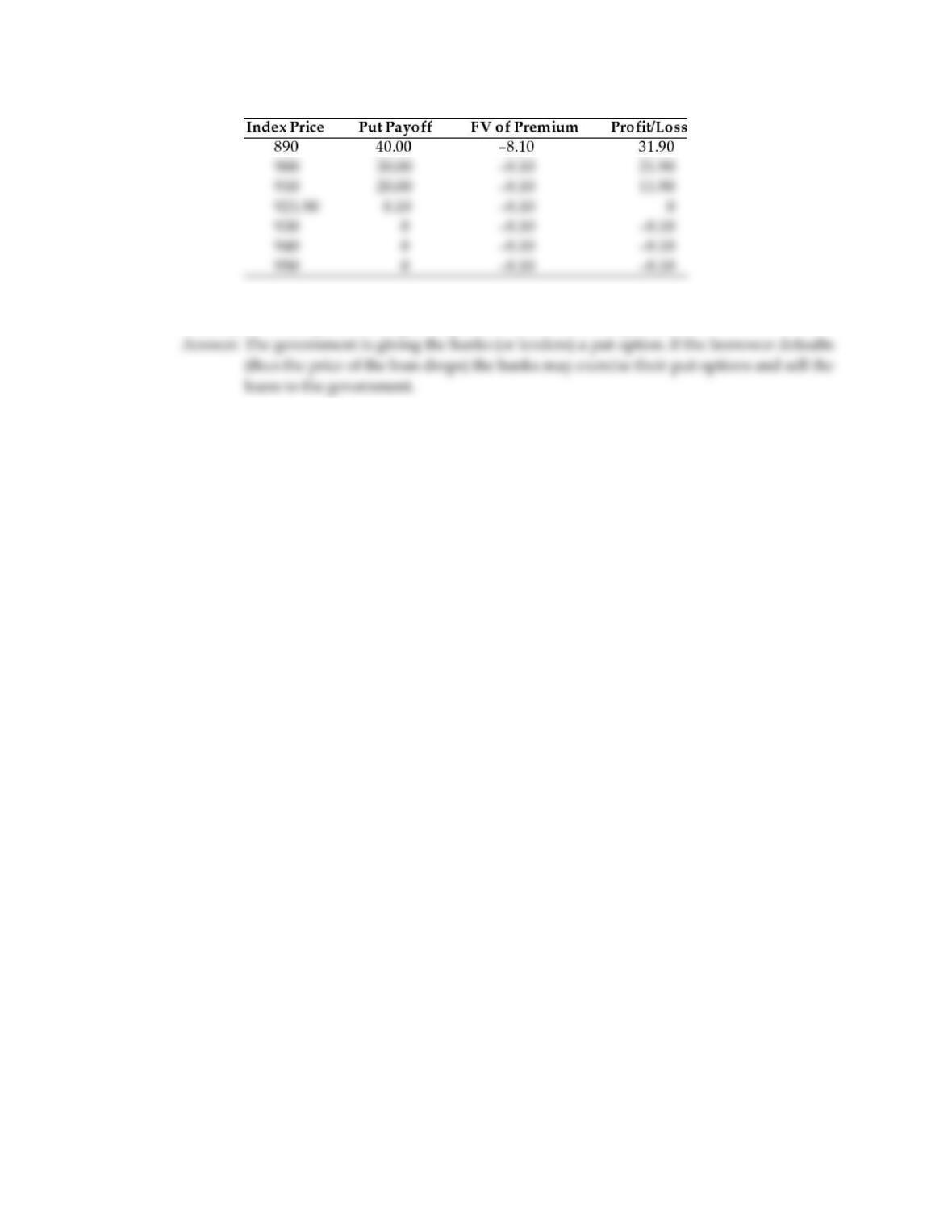
1) The spot price of the market index is $900. A 3–month forward contract on this index is
priced at $930. Draw the payoff graph for the short position in the forward contract.
Answer:
2) An investor has a long call option on the market index at a strike price of $930. At expiration
the index price is $920. Explain the profit and loss.
3) The spot price of the market index is $900. After 3 months the market index is priced at $920.
The annual rate of interest on treasuries is 4.8% (0.4% per month). The premium on the long
put, with an exercise price of $930, is $8.00. Draw the payoff graph for the long put position
at expiration. Include strike price, breakeven price, and max loss.
5
4) Develop the payoff table for the previous question, using at least five different possible
index prices, in addition to the strike price and breakeven price.
Answer:
5) As with Chrysler Corp. many years ago, the government occasionally guarantees loans.
What option is the government granting and to whom in a loan guarantee?
2.3 Class Discussion Question
1) Engage the class in a conversation about auto insurance. Why do people feel their premium
is wasted if they do not file a claim? Steer the class towards an understanding of put options
and potential gain should a loss occur. It may also be beneficial to ask students to relate
insurers’ pooling of losses with the concept of risk management.