
The Essential Cosmic Perspective, 8e (Bennett et al.)
Chapter 2 Discovering the Universe for Yourself
2.1 Multiple Choice Questions
1) Which of the following statements about the celestial equator is true at all latitudes?
A) It lies along the band of light we call the Milky Way.
B) It represents an extension of Earth’s equator onto the celestial sphere.
C) It cuts the dome of your local sky exactly in half.
D) It extends from your horizon due east, through your zenith, to your horizon due west.
E) It extends from your horizon due north, through your zenith, to your horizon due south.
2) At midnight, on a clear and moonless night, the number of stars that are distinctly visible to
the eye is in the range
A) 2000-5000.
B) 20,000-50,000.
C) 200,000-500,000.
D) 2 million-5 million.
3) The number of official constellations is
A) 56.
B) 88.
C) 123.
D) 205.
4) How many arcseconds are in one degree?
A) 60
B) 360
C) 3,600
D) 100
E) 10,000
5) What is a circumpolar star?
A) a star that is close to the north celestial pole
B) a star that is close to the south celestial pole
C) a star that always remains above your horizon
D) a star that makes a daily circle around the celestial sphere
E) a star that is visible from the Arctic or Antarctic circles

6) Which of the following statements about circumpolar stars is true at all latitudes?
A) They are the stars close to the north celestial pole.
B) They always remain above your horizon.
C) They make relatively small circles, traveling clockwise around the north celestial pole.
D) Like all other stars, they rise in the east and set in the west.
E) You cannot see them from the Southern Hemisphere.
7) What makes the North Star, Polaris, special?
A) It is the brightest star in the sky.
B) It is the star straight overhead.
C) It appears very near the north celestial pole.
D) It is the star directly on your northern horizon.
E) It can be used to determine your longitude on Earth.
8) You are standing on Earth’s equator. Which way is Polaris, the North star?
A) 30 degrees up, due West
B) on the northern horizon
C) directly overhead
D) The answer depends on whether it’s winter or summer.
E) The answer depends on what time of day (or night) it is.
9) By locating the north celestial pole (NCP) in the sky, how can you determine your latitude?
A) The altitude of the NCP is the same as your latitude.
B) The altitude of the NCP is your angular distance from the North Pole.
C) The direction of the NCP is the same as your latitude.
D) The direction of the NCP is the angular distance from the North Pole.
E) The altitude of the NCP is the same as your distance from the North Pole.
10) The constellation Orion, located on the celestial equator, is visible on winter evenings but not
on summer evenings because of
A) blockage by the full moon.
B) the tilt of Earth’s rotation axis.
C) the location of Earth in its orbit around the Sun.
D) the precession of Earth’s rotation axis.

11) Why is it summer in the Northern Hemisphere when it is winter in the Southern Hemisphere?
A) Due to Earth’s tilt, the Northern Hemisphere is closer to the Sun than the Southern
Hemisphere.
B) The Northern Hemisphere is tilted toward the Sun and receives more direct sunlight.
C) The Northern Hemisphere is tilted away from the Sun and receives more indirect sunlight.
D) It isn’t; both hemispheres have the same seasons at the same time. Summer comes when Earth
is nearest the Sun.
12) Which of the following statements is true?
A) Both the Northern and Southern hemispheres receive the same amount of sunlight on the
equinoxes.
B) Both the Northern and Southern hemispheres receive the same amount of sunlight on the
solstices.
C) The Northern Hemisphere receives the most direct sunlight on the June solstice.
D) The Southern Hemisphere receives the most direct sunlight on the June solstice.
E) Both A and C are true.
13) Which of the following statements about constellations is false?
A) There are only 88 official constellations.
B) Some constellations can be seen from both the Northern and Southern hemispheres.
C) Some constellations can be seen in both the winter and summer.
D) It is possible to see all the constellations from Earth’s equator.
E) Most constellations will be unrecognizable hundreds of years from now.
14) Which of the following statements about lunar phases is true?
A) The time between new moons is two weeks.
B) Only one quarter of the first-quarter moon is illuminated by the Sun.
C) The full moon sometimes rises around midnight.
D) It is possible to have two full moons during January, but not during February.
E) It is possible to have two full moons during November, but not during December.
15) While the historical definition of a constellation is “a pattern or figure of stars in the sky,”
the modern definition used by astronomers is
A) a group of stars in the sky that are all very close to each other.
B) a specifically named and bordered region of the celestial sphere.
C) any grouping of very bright stars in our galaxy, often hosting a star cluster.
D) no definition. Astronomers no longer use the term constellation, just numerical coordinates.

16) The celestial sphere is
A) the central spherical region of the Milky Way Galaxy, dense with stars.
B) a spherical galaxy, centered on the Sun.
C) a useful illusion used to map the stars and other objects in the sky.
D) the star-sphere discovered by the Greeks and other ancient civilizations which shows the
physical location in space of the nearby stars.
E) the orb of the Sun; a normal star.
17) If the Moon is setting at 6 A.M., the phase of the Moon must be
A) first quarter.
B) third quarter.
C) full.
D) new.
E) waning crescent.
18) The celestial equator
A) is another name for the ecliptic.
B) defines the path of the Sun through the stars, and it also defines the plane of the solar system.
C) is a projection into space of Earth’s equator onto the celestial sphere.
D) is the technical name of the Sun’s equator.
19) The Sun
A) seems to move around the celestial sphere daily to the East.
B) is a fixed point on the celestial sphere at its distance from Earth.
C) circles around the celestial equator once each year.
D) is the fixed point at the north celestial pole.
20) At approximately what time would a full moon be on your meridian?
A) 6 A.M.
B) 9 A.M.
C) noon
D) 6 P.M.
E) midnight

21) Consider three circles that may be imaginatively “drawn” across the night sky (note that we
see only parts of each circle at any time): the Milky Way; the ecliptic; and the celestial equator.
Which statement about these circles is true?
A) The celestial equator is unique, since it traces the path of an object, namely, the Sun.
B) The ecliptic circle is unique as it traces a broad band of stars.
C) The Milky Way and the ecliptic are the only two circles that are tilted relative to each other.
D) Only the ecliptic circle passes through all the zodiacal constellations.
E) All three circles cross at the same two points: the equinoxes.
22) The stars stay in “fixed” positions on the celestial sphere because
A) the stars on the sphere are all chosen to be approximately the same distance from Earth.
B) while they actually move through space, they are too far away for their motion to be seen.
C) the sphere to which they are attached moves with them through space.
D) they are all expanding away, so they have no transverse (sideways) motions.
23) In which direction on the horizon does a crescent moon rise?
A) north
B) south
C) east
D) west
E) The Moon can become a crescent moon only after it has risen and changed its phase.
24) Which of the following statements about the Moon is true?
A) The Moon goes through its cycle of four phases in a month (30 or 31 days).
B) If you see a full moon from North America, someone in South America will be seeing a new
moon.
C) The Moon’s distance from Earth varies during its orbit.
D) The Moon is visible only at night.
E) The side of the Moon facing away from Earth is in perpetual darkness.
25) What effect or effects would be most significant if the Moon’s orbital plane were exactly the
same as the ecliptic plane?
A) Solar eclipses would be much rarer.
B) Solar eclipses would be much more frequent.
C) Total solar eclipses would last much longer.
D) Both A and C
E) Both B and C

26) What conditions are required for a solar eclipse?
A) The phase of the Moon must be new, and the nodes of the Moon’s orbit must be nearly
aligned with Earth and the Sun.
B) The phase of the Moon must be full, and the nodes of the Moon’s orbit must be nearly aligned
with Earth and the Sun.
C) The phase of the Moon can be new or full, and the nodes of the Moon’s orbit must be nearly
aligned with Earth and the Sun.
D) The phase of the Moon must be new, and the Moon’s orbital plane must lie in the ecliptic.
E) The phase of the Moon must be full, and the Moon’s orbital plane must lie in the ecliptic.
27) What conditions are required for a lunar eclipse?
A) The phase of the Moon must be new, and the nodes of the Moon’s orbit must be nearly
aligned with Earth and the Sun.
B) The phase of the Moon must be full, and the nodes of the Moon’s orbit must be nearly aligned
with Earth and the Sun.
C) The phase of the Moon can be new or full, and the nodes of the Moon’s orbit must be nearly
aligned with Earth and the Sun.
D) The phase of the Moon must be new, and the Moon’s orbital plane must lie in the ecliptic.
28) In addition to the conditions required for any solar eclipse, what must also be true in order
for you to observe a total solar eclipse?
A) Earth must lie completely within the Moon’s umbra.
B) Earth must lie completely within the Moon’s penumbra.
C) Earth must be near aphelion in its orbit of the Sun.
D) The Moon’s umbra must touch the area where you are located.
E) The Moon’s penumbra must touch the area where you are located.
29) If part of the full moon passes through Earth’s umbra, we will see a(n)
A) total lunar eclipse.
B) penumbral lunar eclipse.
C) partial lunar eclipse.
D) partial solar eclipse.
E) annular eclipse.

30) The Milky Way shows itself as a blurry circle of light in the sky because
A) we are looking along the plane of our galaxy that is filled with stars. When we look in other
directions, we see fewer stars because we are looking through (at a steep angle to) the plane of
our galaxy. We actually see only a small fraction of the stars of the Milky Way Galaxy.
B) the Sun is at the center of the Milky Way Galaxy. The galaxy is a flat disk of stars appearing
as a blurry band or ring of stars and dust in the sky, all seen at great distances.
C) it is a ring-like structure of stars and dust located hundreds of thousands of light-years from
Earth. It is blurry because it is so far away.
D) the spinning Earth blurs the stars above its equator onto this faint circle of blurry starlight and
dust.
31) When we look toward the constellation Sagitarius, we are looking
A) at the galaxy’s central bulge.
B) toward Polaris, the “Pole Star.”
C) toward the Winter Triangle.
D) out towards the outer Milky Way.
32) What is represented by the figure-eight analemma?
A) a positional map of Earth’s wandering north celestial pole projected into the sky over the
course of the next 10,000 years
B) the time-lapse photograph of a planet (e.g., Mars) as it undergoes retrograde motion
C) an eight-fold intermediate analytical theorem (lemma) pertaining to all astronomical motions
D) a composite snapshot of the Sun taken from the same location at the same time of day over
one year
33) Ancient people who knew the saros cycle could
A) completely predict every lunar eclipse.
B) completely predict every solar eclipse.
C) predict what type of eclipse would occur.
D) predict when they’d see the next total solar eclipse in their area.
E) predict when an eclipse would happen, but not necessarily what type and where it would be
visible.
34) What happens during the apparent retrograde motion of a planet?
A) The planet rises in the west and sets in the east. This is an illusion completely due to Earth’s
motion.
B) The planet appears to turn around in its eastward path through the stars and backs up for many
nights traveling westwardly.
C) The planet, under strong gravitational influences, travels backwards, westward in its orbit
around the Sun.
D) The planet’s orbit decays and it retrogressively returns to its former orbit.

35) What causes the apparent retrograde motion of the planets?
A) As Earth passes another planet, its gravitational pull slows that planet and causes it to travel
backwards for a short period.
B) Planets, when further from the Sun, move more slowly than when nearer the Sun. It is during
this slower period that they appear to move backwards, in retrograde.
C) The other planets never really appear to move backward; the background stars shift due to
Earth’s revolution around the Sun.
D) As Earth passes another planet, the planet appears to move backward with respect to the
background stars. This is an apparent effect; the planet’s true motion has not changed.
E) Planets have slowed in their orbits since their formation, leading to retrograde motions.
36) Which of the following never goes in retrograde motion?
A) the Sun
B) Venus
C) Mars
D) Jupiter
E) Saturn
37) Which of the following statements about parallax is not true?
A) You can demonstrate parallax simply by holding up a finger and looking at it alternately from
your left and right eyes.
B) The existence of stellar parallax is direct proof that Earth orbits the Sun.
C) Measurement of stellar parallax allows us to determine distances to nearby stars.
D) The technique of stellar parallax was used by Hubble to determine that the Andromeda
Galaxy (M 31) is about 2 million light-years away.
E) Ancient astronomers were unable to measure parallax and used the absence of any changes in
the stars’ separations as an argument in favor of an Earth-centered universe.
38) Which of the following statements about stellar parallax is true?
A) We observe all stars to exhibit at least a slight amount of parallax.
B) Stellar parallax was first observed by ancient Greek astronomers.
C) The amount of parallax we see depends on how fast a star is moving relative to us.
D) It takes at least 10 years of observation to measure a stars parallax.
E) The closer a star is to us, the more parallax it exhibits.
39) We can’t detect stellar parallax with naked-eye observations. Which of the following would
make parallax easier to observe?
A) increasing the size of Earth’s orbit
B) speeding up Earth’s orbital motion
C) slowing down Earth’s orbital motion
D) speeding up the precession of Earth’s axis

40) Why were ancient peoples unable to detect stellar parallax?
A) They did not look for it.
B) They could not see distant stars.
C) They did not have the ability to measure very small angles.
D) They did not observe for long enough periods of time.
E) They did detect it, but they rejected the observations.
41) How many arcseconds are in one arcminute?
A) 60
B) 360
C) 3600
D) 100
E) 10,000
42) How many arcminutes are in one degree?
A) 60
B) 360
C) 3600
D) 100
E) 10,000
43) Has Polaris always been the “North Star”, also known as the “Pole Star”?
A) Yes, because stars position change little over many centuries.
B) No, because it is a young star which formed only a few hundred years ago.
C) No, because the Earth’s axis slowly changes the direction it points.
D) No, because the Milky Way blocked our line of site to it for a long time.
44) If you see Polaris directly overhead at midnight, you must be at
A) the equator.
B) the South Pole.
C) the Tropic of Cancer.
D) the North Pole.
45) You experience night-time when
A) the Moon blocks the Sun’s light.
B) the Earth revolves 90 degrees in its orbit.
C) the side of the Earth you occupy is facing away from the Sun.
D) the Earth’s axis precesses.

46) If the Moon is setting at noon, then it rose at
A) 6 A.M.
B) 9 A.M.
C) noon.
D) 6 P.M.
E) midnight.
2.2 True/False Questions
1) In South Africa, it’s usually quite warm around the time of the December solstice and quite
cool around the time of the June solstice.
2) You can find the tilt of Earth’s axis by measuring the angle between your horizon and the
North Star.
3) 23-1/2 degrees is the angle between Earth’s rotation axis and the celestial equator.
4) We have been able to view farther through the Milky Way Galaxy by viewing it with
telescopes sensitive to X-ray radiation, infrared light, and radio waves than with telescopes
sensitive to optical light.
5) When the Sun sets exactly in the West, it is at an azimuth of 90 degrees.
6) In the Northern Hemisphere, the day that the Sun is up the longest in the sky is on the June
solstice.
7) Planets are normally seen to pass through the stars going westward, except during periods of
retrograde motion when they are seen to turn around and travel eastward.
8) If you lived on the Moon, you’d see full Earth when we see new moon.
9) More extreme seasons occur at locations of higher latitude on Earth because the number of
daylight hours varies greatly during the year.
10) The Moon and the Sun are approximately the same angular size.

11) A solar eclipse occurs only when the Moon is full.
12) When an object ‘s angular size is (about 57°), its distance from you is equal to its
physical size.
13) Earth spins once on its axis in 23 hours and 56 minutes, not 24 hours.
14) If you hold your hand out at arm’s length, you can block the entire disk of the Sun with your
little finger.
15) The stars are present in the local sky during the daytime. We just can’t see them.
16) At the North Pole, on the June equinox, the Sun sets and six months of night begins.
17) The North Star (Polaris) is always located at the zenith.
18) During a total eclipse the Moon shadow travels across at 170 km/hour.
19) During a total eclipse of the Sun the Moon’s shadow (the dark umbra) is about 270 km (170
miles) wide.
2.3 Process of Science Questions
1) Models in Science: Models play a central role in astronomy and science in general. Two
models used extensively are the celestial sphere and the heliocentric (Sun-centered) model for
the solar system. Astronomers clearly believe that the celestial sphere model is false and the
heliocentric model is true. Given this, why do you think astronomers persist in using the celestial
sphere model to describe the night sky?

2) Cognitive Dissonance? You are talking to a friend who insists that the seasons are caused by a
varying Earth-Sun distance over the course of a year. What other fact does your friend likely
know that completely contradicts this view of how the seasons are caused? Can you think of
other examples of two beliefs that many people feel are both true but which completely
contradict each other? How does science view this situation?
3) The Sidereal Day: Using your wristwatch and observations of the night sky over the course of
a few weeks, how can you demonstrate to a friend that 24 hours cannot be the true rotation
period of the Earth (often called the sidereal day)? What assumptions do you make in this
argument?
4) Scientific Reasoning: The scientific method requires that we put any hypothesis about how the
universe works to the test by conducting observations of the natural world. Consider the Greek
reaction to the idea of a heliocentric (Sun-centered) solar system. Why did most Greeks reject
this hypothesis in favor of the geocentric (Earth-centered) model? Do you think that the Greeks
were following a scientific form of reasoning to reach this conclusion? Does the fact that the
Greeks reached the wrong conclusion affect your answer?
5) Scientific Reasoning: The temperature at any location on Earth depends on the Sun angle, the
number of daylight hours, and the history of the season. Extreme examples include: the high
angles of the Sun (sometimes overhead) at tropical latitudes, and the extremely low angles at
high arctic latitudes. Extreme daylight examples include: 12 hours of daylight always at the
equator with longer summer days as one goes north or south, to a long six months of constant
daylight at the poles. These two heating effects work against each at both high and low latitudes.
Given these facts, why are the hottest places on Earth found not on the equator where the Sun
can be directly overhead, but at latitudes of 30° degrees North and South? (Hint: at 30° degrees
latitude, the summer Sun can reach 81° in altitude, and summer daylight can be 14 hours long.)
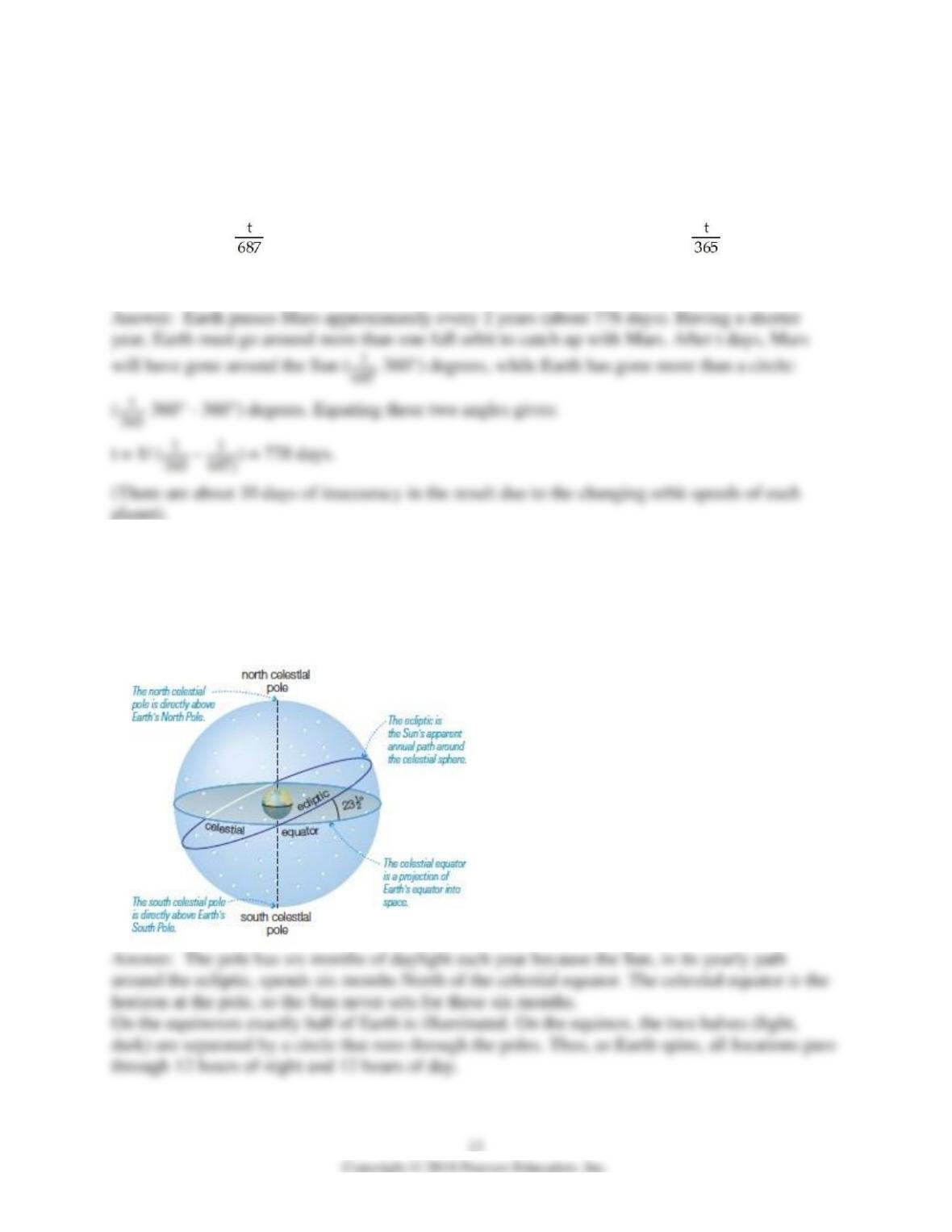
6) Scientific Reasoning: Earth sees Mars exhibiting retrograde motion each time Earth overtakes
Mars as Earth orbits around the Sun. Earth goes around the Sun in 365 days while Mars goes
around the Sun in 687 days. How often does Earth pass Mars?
Suggested approach: having a shorter year, Earth must go around more than one full orbit to
catch up with Mars again. After t days, where t is more than 365 days, Mars will have gone
around the Sun ( 360°) degrees, while Earth has gone more than a circle: ( 360° – 360° )
degrees. To solve the problem, equate these two angles and find t, the number of days between
passings.
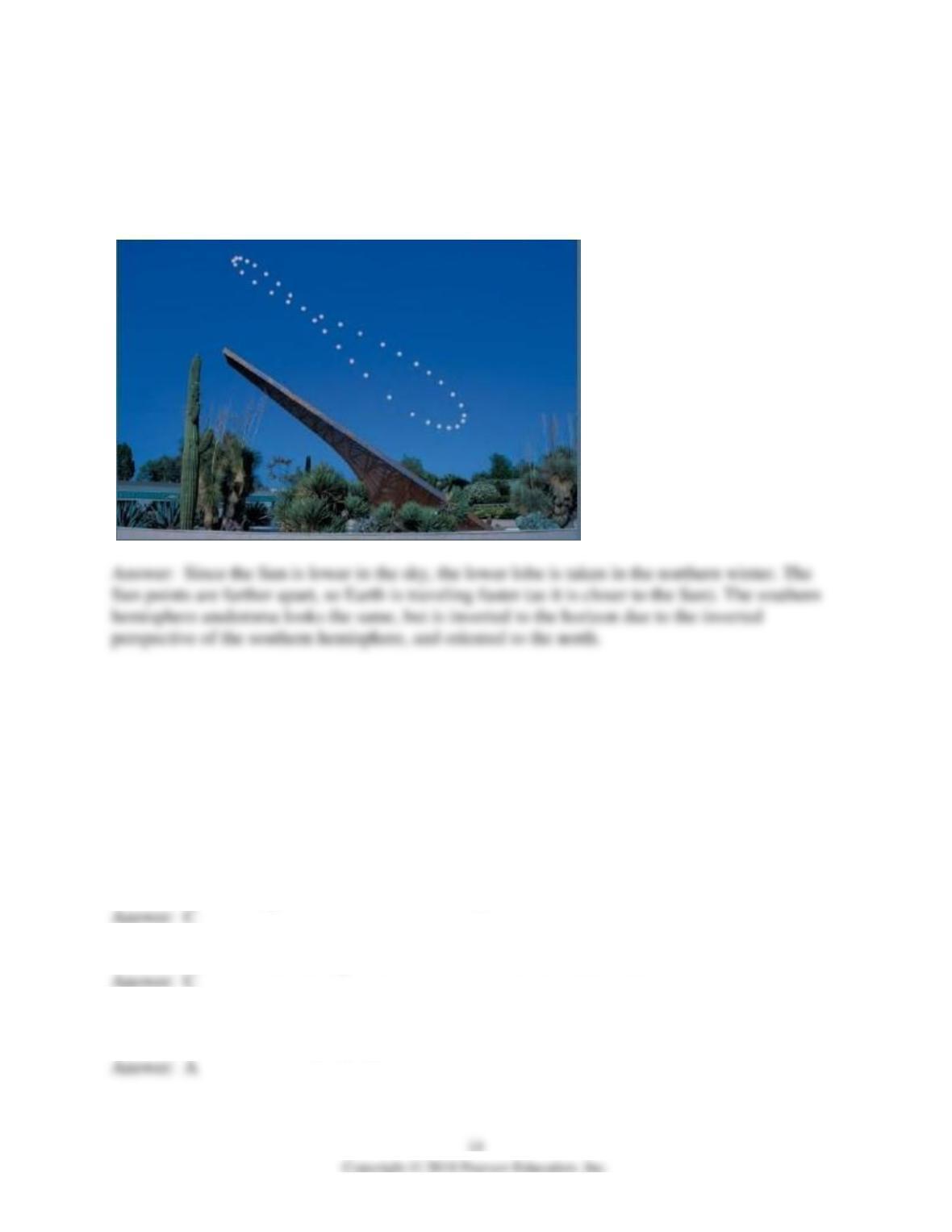
7) Scientific Reasoning: By considering the ecliptic and the celestial equator on the celestial
sphere pictured below, can you explain why the North Pole experiences six continuous months
of daylight each year? Can you explain why all locations on the Earth’s equator experience
exactly 12 hours of daylight every day?
8) Scientific Reasoning: The northern analemma, below, shows the Sun photographed at the
same time each day producing a lopsided figure-eight. Is the lower, larger lobe taken in winter or
in summer? If the time intervals between snapshots are equal, is Earth moving faster or slower in
the lower lobe? Would an analemma photographed from the southern hemisphere look
differently?
2.4 Short Answer Questions
The choices below are for the following questions. For each question, choose the letter for the
real motion that is responsible for the apparent motion as seen from Earth.
A. Earth rotates once each day.
B. Earth revolves around the Sun once each year.
C. The direction of Earth’s axis in space precesses with a period of 26,000 years.
D. The universe is expanding.
1) Polaris will no longer be the North Star 1,000 years from now.
2) In the year A.D. 15,000, Vega will be a better “north star” than Polaris.
3) When the Moon casts its shadow on the Earth during a total solar eclipse, the shadow moves
across the face of Earth very rapidly.