
FOR INSTRUCTOR USE ONLY
CHAPTER 2
A FURTHER LOOK AT FINANCIAL STATEMENTS
SUMMARY OF QUESTIONS BY LEARNING OBJECTIVE AND BLOOM’S TAXONOMY
Item
LO
BT
Item
LO
BT
Item
LO
BT
Item
LO
BT
Item
LO
BT
True-False Statements
1.
1
K
12.
3
C
23.
5
K
34.
7
K
45.
7
K
2.
1
K
13.
3
C
24.
5
K
35.
7
C
46.
7
K
3.
1
K
14.
3
K
25.
5
C
36.
7
K
47.
7
K
4.
1
K
15.
4
K
26.
6
K
37.
7
K
48.
7
K
5.
1
C
16.
4
C
27.
6
K
38.
7
C
49.
7
K
6.
1
K
17.
4
K
28.
6
K
39.
7
K
50.
7
K
7.
1
C
18.
4
K
29.
7
K
40.
7
K
51.
7
K
8.
2
K
19.
4
K
30.
7
K
41.
7
K
52.
7
K
9.
2
C
20.
5
K
31.
7
K
42.
7
K
53.
7
K
10.
2
K
21.
5
K
32.
7
C
43.
7
K
54.
7
K
11.
3
K
22.
5
K
33.
7
K
44.
7
K
55.
7
K
Multiple Choice Questions
56.
1
K
86.
1
AP
116.
4
K
146.
4
AP
176.
7
K
57.
1
K
87.
1
AP
117.
4
K
147.
4
AP
177.
7
C
58.
1
K
88.
1
AP
118.
4
C
148.
4
K
178.
7
C
59.
1
K
89.
1
AP
119.
4
K
149.
5
K
179.
7
C
60.
1
K
90.
4
AP
120.
4
K
150.
5
K
180.
7
K
61.
1
K
91.
4
AP
121.
4
K
151.
5
K
181.
7
C
62.
1
K
92.
2
K
122.
4
K
152.
5
AP
182.
7
C
63.
1
K
93.
2
AP
123.
4
C
153.
5
AP
183.
7
C
64.
1
K
94.
2
AP
124.
4
C
154.
5
AN
184.
7
C
65.
1
K
95.
2
K
125.
4
K
155.
5
AP
185.
7
K
66.
1
K
96.
2
K
126.
4
K
156.
5
AP
186.
7
C
67.
1
K
97.
2
C
127.
1
AP
157.
5
C
187.
7
C
68.
1
K
98.
2
K
128.
4
AP
158.
6
K
188.
7
K
69.
1
K
99.
2
AN
129.
4
AP
159.
6
K
189.
7
K
70.
1
K
100.
2
AN
130.
4
AP
160.
6
K
190.
7
K
71.
1
K
101.
2
AP
131.
2
AP
161.
6
K
191.
7
K
72.
1
AP
102.
2
AN
132.
4
AP
162.
7
K
192.
7
C
73.
1
K
103.
3
AP
133.
4
AP
163.
7
K
193.
7
K
74.
2
K
104.
3
AP
134.
4
AP
164.
7
K
194.
7
K
75.
1
AP
105.
3
C
135.
2
AP
165.
7
K
195.
7
K
76.
1
AP
106.
3
K
136.
4
AP
166.
7
K
196.
7
K
77.
1
AP
107.
3
K
137.
4
K
167.
7
K
197.
7
K
78.
4
AP
108.
3
C
138.
4
K
168.
7
K
198.
7
C
79.
4
AP
109.
3
C
139.
4
K
169.
7
K
199.
7
C
80.
1
AP
110.
3
C
140.
4
C
170.
7
K
200.
7
K
81.
1
AP
111.
3
AP
141.
4
C
171.
7
K
201.
7
K
82.
1
AP
112.
3
AP
142.
4
C
172.
7
K
202.
7
C
83.
4
AP
113.
3
AN
143.
4
C
173.
7
K
203.
7
C
84.
4
AP
114.
3
AN
144.
4
AP
174.
7
K
204.
7
C
85.
1
AP
115.
4
K
145.
4
AP
175.
7
K
Brief Exercises
205.
1
AP
207.
3
C
209.
7
K
211.
7
C
213.
7
C
206.
2
AP
208.
4
AP
210.
7
K
212.
7
C
214.
7
K
Test Bank for Financial Accounting: Tools for Business Decision Making, Seventh Edition
FOR INSTRUCTOR USE ONLY
2-2
Exercises
215.
1
AP
219.
1, 2, 4
AP
223.
2, 4
AP
227.
2, 4, 5
K
216.
1
K
220.
1, 3
AP
224.
2, 4, 5
AP
228.
2, 4
AP
217.
1.
AP
221.
1, 3
AP
225.
2, 4
AP
229.
3
AP
218.
1, 2, 3, 4
AP
222.
2
AP
226.
2, 4, 5
AN
230.
4
AN
Completion Statements
231.
6
K
233.
7
K
235.
4
K
237.
4
K
238.
5
K
232.
7
K
234.
7
K
236.
1
K
Matching
239.
1-7
K
Short Answer Essay
240.
1
K
243.
2, 4
C
246.
7
C
249.
4
E
250.
7
E
241.
2,4
K
244.
7
C
247.
7
K
242.
1, 4
K
245.
7
C
248.
7
K
SUMMARY OF LEARNING OBJECTIVES BY QUESTION TYPE
Learning Objective 1
Item
Type
Item
Type
Item
Type
Item
Type
Item
Type
Item
Type
1.
TF
58.
MC
67.
MC
77.
MC
127.
MC
236.
CS
2.
TF
59.
MC
68.
MC
80.
MC
205.
BE
239.
Ma
3.
TF
60.
MC
69.
MC
81.
MC
215.
Ex
240.
SA
4.
TF
61.
MC
70.
MC
82.
MC
216.
Ma
242.
SA
5.
TF
62.
MC
71.
MC
85.
MC
217.
Ma
6.
TF
63.
MC
72.
MC
86.
MC
218.
Ma
7.
TF
64.
MC
73.
MC
87.
MC
219.
Ex
56.
MC
65.
MC
75.
MC
88.
MC
220.
Ma
57.
MC
66.
MC
76.
MC
89.
MC
221.
Ma
Learning Objective 2
Item
Type
Item
Type
Item
Type
Item
Type
Item
Type
Item
Type
8.
TF
93.
MC
98.
MC
131.
MC
222.
Ma
227.
Ex
9.
TF
94.
MC
99.
MC
135.
MC
223.
Ex
228.
Ma
10.
TF
95.
MC
100.
MC
206.
BE
224.
Ma
239.
Ma
74.
MC
96.
MC
101.
MC
218.
Ma
225.
Ma
241.
SA
92.
MC
97.
MC
102.
MC
219.
Ex
226.
Ma
243.
SA
Learning Objective 3
Item
Type
Item
Type
Item
Type
Item
Type
Item
Type
Item
Type
11.
TF
103.
MC
107.
MC
111.
MC
207.
BE
229.
Ma
12.
TF
104.
MC
108.
MC
112.
MC
218.
Ma
239.
Ma
13.
TF
105.
MC
109.
MC
113.
MC
220.
Ma
14.
TF
106.
MC
110.
MC
114.
MC
221.
Ma
A Further Look at Financial Statements
FOR INSTRUCTOR USE ONLY
2-3
Learning Objective 4
Item
Type
Item
Type
Item
Type
Item
Type
Item
Type
Item
Type
15.
TF
91.
MC
124.
MC
137.
MC
147.
MC
228.
Ma
16.
TF
115.
MC
125.
MC
138.
MC
148.
MC
230.
Ma
17.
TF
116.
MC
126.
MC
139.
MC
208.
BE
235.
CS
18.
TF
117.
MC
128.
MC
140.
MC
218.
Ex
237.
CS
19.
TF
118.
MC
129.
MC
141.
MC
219.
Ex
239.
Ma
78.
MC
119.
MC
130.
MC
142.
MC
223.
Ex
241.
SA
79.
MC
120.
MC
132.
MC
143.
MC
224.
Ma
242.
SA
83.
MC
121.
MC
133.
MC
144.
MC
225.
Ma
243.
SA
84.
MC
122.
MC
134.
MC
145.
MC
226.
Ma
249.
SA
90.
MC
123.
MC
136.
MC
146.
MC
227.
Ex
Learning Objective 5
Item
Type
Item
Type
Item
Type
Item
Type
Item
Type
Item
Type
20.
TF
24.
TF
151.
MC
155.
MC
226.
Ma
21.
TF
25.
TF
152.
MC
156.
MC
227.
Ex
22.
TF
149.
MC
153.
MC
157.
MC
238.
CS
23.
TF
150.
MC
154.
MC
224.
Ex
239.
Ma
Learning Objective 6
Item
Type
Item
Type
Item
Type
Item
Type
Item
Type
Item
Type
26.
TF
28.
TF
159.
MC
161.
MC
239.
Ma
27.
TF
158.
MC
160.
MC
231.
CS
Learning Objective 7
Item
Type
Item
Type
Item
Type
Item
Type
Item
Type
Item
Type
29.
TF
44.
TF
165.
MC
180.
MC
195.
MC
214.
BE
30.
TF
45.
TF
166.
MC
181.
MC
196.
MC
232.
CS
31.
TF
46.
TF
167.
MC
182.
MC
197.
MC
233.
CS
32.
TF
47.
TF
168.
MC
183.
MC
198.
MC
234.
CS
33.
TF
48.
TF
169.
MC
184.
MC
199.
MC
239.
Ma
34.
TF
49.
TF
170.
MC
185.
MC
200.
MC
244.
SA
35.
TF
50.
TF
171.
MC
186.
MC
201.
MC
245.
SA
36.
TF
51.
TF
172.
MC
187.
MC
202.
MC
246.
SA
37.
TF
52.
TF
173.
MC
188.
MC
203.
MC
247.
SA
38.
TF
53.
TF
174.
MC
189.
MC
204.
MC
248.
SA
39.
TF
54.
TF
175.
MC
190.
MC
209.
BE
250.
SA
40.
TF
55.
TF
176.
MC
191.
MC
210.
BE
41.
TF
162.
MC
177.
MC
192.
MC
211.
BE
42.
TF
163.
MC
178.
MC
193.
MC
212.
BE
43.
TF
164.
MC
179.
MC
194.
MC
213.
BE
Note: TF = True-False C = Completion
MC = Multiple Choice Ex = Exercise
Ma = Matching SA = Short Answer Essay

Test Bank for Financial Accounting: Tools for Business Decision Making, Seventh Edition
FOR INSTRUCTOR USE ONLY
2-4
CHAPTER LEARNING OBJECTIVES
1. Identify the sections of a classified balance sheet. In a classified balance sheet,
companies classify assets as current assets; long-term investments; property, plant, and
equipment; and intangibles. They classify liabilities as either current or long-term. A
stockholders’ equity section shows common stock and retained earnings.
2. Identify tools for analyzing financial statements and ratios for computing a company’s
profitability. Ratio analysis expresses the relationship among selected items of
financial statements data. Profitability ratios, such as earnings per share (EPS), measure
aspects of the operating success of a company for a given period of time.
3. Explain the relationship between a retained earnings statement and a statement of
stockholders’ equity. The retained earnings statement presents the factors that changed the
retained earnings balance during the period. A statement of stockholders’ equity presents the
factors that changed stockholders’ equity during the period, including those that changed
retained earnings. Thus, a statement of stockholders’ equity is more inclusive.
4. Identify and compute ratios for analyzing a company’s liquidity and solvency using a
balance sheet. Liquidity ratios, such as the current ratio, measure the short-term ability of a
company to pay its maturing obligations and to meet unexpected needs for cash. Solvency
ratios, such as the debt to assets ratio, measure the ability of a company to survive over a
long period.
5. Use the statement of cash flows to evaluate solvency. Free cash flow indicates a
company’s ability to generate cash from operations that is sufficient to pay debts, acquire
assets, and distribute dividends.
6. Explain the meaning of generally accepted accounting principles. Generally accepted
accounting principles are a set of rules and practices recognized as a general guide for
financial reporting purposes. The basic objective of financial reporting is to provide
information that is useful for decision making.
7. Discuss financial reporting concepts. To be judged useful, information should have the
primary characteristics of relevance and faithful representation. In addition, useful information
is comparable, consistency, verifiable, timely, and understandable.
The monetary unit assumption requires that companies include in the accounting records only
transaction data that can be expressed in terms of money. The economic entity assumption
states that economic events can be identified with a particular unit of accountability. The
periodicity assumption states that the economic life of a business can be divided into artificial
time periods and that meaningful accounting reports can be prepared for each period. The
going concern assumption states that the company will continue in operation long enough to
carry out its existing objectives and commitments.
The historical cost principle states that the companies should record assets at their cost. The
fair value principle indicates that assets and liabilities should be reported at fair value. The full
disclosure principle requires that companies disclose circumstances and events that matter to
financial statement users.
The cost constraint weighs the cost that companies incur to provide a type of information
against its benefit to financial statement users.
A Further Look at Financial Statements
2-5
TRUE-FALSE STATEMENTS
1. Cash and supplies are both classified as current assets.
2. Long-term investments appear in the property, plant, and equipment section of the
balance sheet.
3. A liability is classified as a current liability if it is to be paid within the coming year.
4. Stockholders’ equity is divided into two parts: common stock and retained earnings.
5. It is possible for an asset to be a current asset even though the expected conversion of
that asset into cash is to be longer than one year or the normal operating cycle.
6. The investment category on the balance sheet normally includes investments that are
intended to be held for a short period of time (less than one year).
7. The main difference between intangible assets and property, plant and equipment is the
length of the asset’s life.
8. Profitability means having enough funds on hand to pay debts when they fall due.
9. Earnings per share is calculated by dividing net income minus preferred stock dividends
for the period by the average number of common shares outstanding during the period.
10. Earnings per share measures the net income earned on each share of common stock.
11. The retained earnings statement describes the changes in retained earnings during the
period.
12. The retained earnings statement is more comprehensive than the statement of
stockholders’ equity.
Test Bank for Financial Accounting: Tools for Business Decision Making, Seventh Edition
2-6
13. Revenues have the effect of increasing retained earnings.
14. Most companies use a retained earnings statement rather than a statement of
stockholders’ equity.
15. The excess of current assets over current liabilities is called working capital.
16. The current ratio takes into account the composition of current assets.
17. Solvency ratios measure the short-term ability of the company to pay its maturing
obligations.
18. The debt to assets ratio measures the percentage of assets financed by creditors.
19. Solvency is a company’s ability to pay interest as it comes due and to repay the balance
of a debt due at its maturity.
20. Net cash provided by operating activities takes into account that a company must invest in
capital expenditures just to maintain its current level of operations.
21. Both investors and creditors have an interest in a company’s ability to generate favorable
cash flows.
22. Free cash flow is net cash provided by operating activities less capital expenditures.
23. In the statement of cash flows, Net cash provided by operating activities indicates the
cash-generating capability of the company.
24. Free cash flow is Net cash provided by operating activities less dividends.
25. Long-term creditors consider a high free cash flow amount an indication of solvency.
A Further Look at Financial Statements
2-7
26. The primary accounting standard-setting body in the United States is the Securities and
Exchange Commission.
27. Generally accepted accounting principles are rules and practices that are recognized as a
general guide for financial reporting purposes.
28. GAAP stands for generally accepted accounting procedures.
29. To be faithfully representative, accounting information should predict future events,
confirm prior expectations, and be reported on a timely basis.
30. In order for information to be relevant, it must be reported on a monthly basis.
31. For information to be useful, it must be both relevant and faithfully representative.
32. Consistent use of the same accounting principles and methods is necessary for
meaningful analysis of trends within a company.
33. A major function of management is to provide the accountant with relevant and useful
information.
34. The advantage of accounting information is that it provides exact and completely reliable
measures.
35. Consistency in accounting means that a company uses the same generally accepted
accounting principles from one accounting period to the next accounting period.
36. The convention of consistency pertains to the use of the same accounting principles by
firms in the same industry.
37. The periodicity assumption states that the business will remain in operation for the
foreseeable future.
Test Bank for Financial Accounting: Tools for Business Decision Making, Seventh Edition
2-8
38. If a building is offered for sale at $100,000 and the buyer pays $95,000 cash for it, the
buyer would record the building at $100,000.
39. The most generally accepted value used in accounting is market value.
40. For accounting purposes, business transactions should be kept separate from the
personal transactions of the stockholders of the business.
41. The economic entity assumption states that economic events can be identified with a
particular unit of accountability.
42. The economic entity assumption states that assets should be recorded at their cost.
43. The monetary unit assumption states that transactions that can be measured in terms of
money should be recorded in the accounting records.
44. The monetary unit assumption has led to an increase in the notes to financial statements.
45. The going concern assumption is that the business will continue in operation long enough
to carry out its existing objectives and commitments.
46. When preparing financial statements, the accountant assumes that the business will stay
in business for the foreseeable future.
47. Full disclosure of all important facts aids in overcoming the limitations of accounting
information.
48. The economic entity assumption is that a company will remain in operations for the
foreseeable future.
49. Materiality is a company-specific aspect of faithful representation.
A Further Look at Financial Statements
FOR INSTRUCTOR USE ONLY
2-9
50. Relevance and cost are two constraints in accounting.
51. Materiality relates to whether an item is large enough to likely influence the decision of an
investor or creditor.
52. Cost constraint weighs the cost that companies incur to provide a type of information
against its benefit to financial statement users.
53. In general, the FASB indicates that most assets must follow the fair value principle.
54. A material item is one that is likely to influence an investor’s decision.
55. The periodicity assumption states that every economic entity can be separately identified
and accounted for.
Answers to True-False Statements
Test Bank for Financial Accounting: Tools for Business Decision Making, Seventh Edition
2-10
MULTIPLE CHOICE QUESTIONS
56. In a classified balance sheet, assets are usually classified as
a. current assets; long-term assets; property, plant, and equipment; and intangible
assets.
b. current assets; long-term investments; property, plant, and equipment; and common
stocks.
c. current assets; long-term investments; tangible assets; and intangible assets.
d. current assets; long-term investments; property, plant, and equipment; and intangible
assets.
57. On a classified balance sheet, short-term investments are classified as
a. an intangible asset.
b. property, plant, and equipment.
c. a current asset.
d. a long-term investment.
58. A current asset is
a. the last asset purchased by a business.
b. an asset which is currently being used to produce a product or service.
c. usually found as a separate classification in the income statement.
d. expected to be converted to cash or used in the business within a relatively short
period of time.
59. Which of the following is not classified properly as a current asset?
a. Supplies
b. Debt investments
c. A fund to be used to purchase a building within the next year
d. A receivable from the sale of an asset to be collected in two years
60. An intangible asset
a. derives its value from the rights and privileges it provides the owner.
b. is worthless because it has no physical substance.
c. is converted into a tangible asset during the operating cycle.
d. cannot be classified on the balance sheet because it lacks physical substance.
A Further Look at Financial Statements
2-11
61. Which of the following is not considered an asset?
a. Equipment
b. Dividends
c. Accounts receivable
d. Inventory
62. Trademarks would appear in which balance sheet section?
a. Intangible assets
b. Investments
c. Property, plant, and equipment
d. Current assets
63. Liabilities are generally classified on a balance sheet as
a. small liabilities and large liabilities.
b. present liabilities and future liabilities.
c. tangible liabilities and intangible liabilities.
d. current liabilities and long-term liabilities.
64. Which of the following would not be classified as a long-term liability?
a. Current maturities of long-term debt
b. Bonds payable
c. Mortgage payable
d. Lease liabilities
65. Which of the following is not a current liability?
a. Salaries and Wages Payable
b. Accounts Payable
c. Taxes Payable
d. Bonds Payable
66. Equipment is classified on the balance sheet as
a. a current asset.
b. property, plant, and equipment.
c. an intangible asset.
d. a long-term investment.
67. It is not true that current assets are resources that are expected to be
a. realized in cash within one year.
b. sold within one year.
c. consumed within one year.
d. acquired within one year.
Test Bank for Financial Accounting: Tools for Business Decision Making, Seventh Edition
2-12
68. The operating cycle of a company is the average time that is required to go from cash to
a. sales in producing revenues.
b. cash in producing revenues.
c. inventory in producing revenues.
d. accounts receivable in producing revenues.
69. On a classified balance sheet, companies usually list current assets
a. in alphabetical order.
b. with the largest dollar amounts first.
c. in the order in which they are expected to be converted into cash.
d. in the order of acquisition.
70. Intangible assets are
a. listed directly under current assets on the balance sheet.
b. not listed on the balance sheet because they do not have physical substance.
c. listed after property, plant, and equipment.
d. listed as a long-term investment on the balance sheet.
71. Which statement about long-term investments is not true?
a. They will be held for more than one year.
b. They are not currently used in the operation of the business.
c. They include investments in stock of other companies and land held for future use.
d. They do not include long-term notes receivable.
72. These are selected account balances on December 31, 2014.
Land $100,000
Land (held for future use) 150,000
Buildings 800,000
Inventory 200,000
Equipment 450,000
Furniture 100,000
Accumulated Depreciation 300,000
What is the total amount of property, plant, and equipment that will appear on the balance
sheet?
a. $1,500,000
b. $1,300,000
c. $1,800,000
d. $1,150,000

A Further Look at Financial Statements
2-13
73. What is the order in which assets are generally listed on a classified balance sheet?
a. Current and long-term
b. Current; property, plant and equipment; long-term investments; intangibles
c. Current; property, plant and equipment; intangibles; long-term investments
d. Current; long-term investments; property, plant and equipment, intangibles
74. Ratios that measure the income or operating success of a company for a given period of
time are
a. liquidity ratios.
b. profitability ratios.
c. solvency ratios.
d. trending ratios.
75. Use the following data to determine the total dollar amount of assets to be classified as
current assets. Koonce Office Supplies
Balance Sheet
December 31, 2014
Cash $ 130,000 Accounts payable $ 140,000
Accounts receivable 100,000 Salaries and wages payable 20,000
Inventory 110,000 Mortgage payable 160,000
Prepaid insurance 60,000 Total liabilities $320,000
Stock investments 170,000
Land 180,000
Buildings $210,000 Common stock $240,000
Less: Accumulated Retained earnings 500,000
depreciation (40,000) 170,000 Total stockholders’ equity $740,000
Trademarks 140,000 Total liabilities and
Total assets $1,060,000 stockholders’ equity $1,060,000
a. $570,000
b. $400,000
c. $340,000
d. $290,000

Test Bank for Financial Accounting: Tools for Business Decision Making, Seventh Edition
2-14
76. Use the following data to determine the total dollar amount of assets to be classified as
property, plant, and equipment.
Koonce Office Supplies
Balance Sheet
December 31, 2014
Cash $ 130,000 Accounts payable $ 140,000
Accounts receivable 100,000 Salaries and wages payable 20,000
Inventory 110,000 Mortgage payable 160,000
Prepaid insurance 60,000 Total liabilities $320,000
Stock investments 170,000
Land 180,000
Buildings $210,000 Common stock $240,000
Less: Accumulated Retained earnings 500,000
depreciation (40,000) 170,000 Total stockholders’ equity $740,000
Trademarks 140,000 Total liabilities and
Total assets $1,060,000 stockholders’ equity $1,060,000
a. $660,000
b. $350,000
c. $490,000
d. $390,000
77. Use the following data to determine the total dollar amount of assets to be classified as
investments. Koonce Office Supplies
Balance Sheet
December 31, 2014
Cash $ 130,000 Accounts payable $ 140,000
Accounts receivable 100,000 Salaries and wages payable 20,000
Inventory 110,000 Mortgage payable 160,000
Prepaid insurance 60,000 Total liabilities $320,000
Stock investments 170,000
Land 180,000
Buildings $210,000 Common stock $240,000
Less: Accumulated Retained earnings 500,000
depreciation (40,000) 170,000 Total stockholders’ equity $740,000
Trademarks 140,000 Total liabilities and
Total assets $1,060,000 stockholders’ equity $1,060,000
a. $0
b. $350,000
c. $170,000
d. $310,000

A Further Look at Financial Statements
2-15
78. Use the following data to determine the total amount of working capital.
Koonce Office Supplies
Balance Sheet
December 31, 2014
Cash $ 130,000 Accounts payable $ 140,000
Accounts receivable 100,000 Salaries and wages payable 20,000
Inventory 110,000 Mortgage payable 160,000
Prepaid insurance 60,000 Total liabilities $320,000
Stock investments 170,000
Land 180,000
Buildings $210,000 Common stock $240,000
Less: Accumulated Retained earnings 500,000
depreciation (40,000) 170,000 Total stockholders’ equity $740,000
Trademarks 140,000 Total liabilities and
Total assets $1,060,000 stockholders’ equity $1,060,000
a. $240,000
b. $390,000
c. $130,000
d. $180,000
79. Use the following data to calculate the current ratio.
Koonce Office Supplies
Balance Sheet
December 31, 2014
Cash $ 130,000 Accounts payable $ 140,000
Accounts receivable 100,000 Salaries and wages payable 20,000
Inventory 110,000 Mortgage payable 160,000
Prepaid insurance 60,000 Total liabilities $320,000
Stock investments 170,000
Land 180,000
Buildings $210,000 Common stock $240,000
Less: Accumulated Retained earnings 500,000
depreciation (40,000) 170,000 Total stockholders’ equity $740,000
Trademarks 140,000 Total liabilities and
Total assets $1,060,000 stockholders’ equity $1,060,000
a. 2.13 : 1
b. 1.44 : 1
c. 2.86 : 1
d. 2.50 : 1

Test Bank for Financial Accounting: Tools for Business Decision Making, Seventh Edition
2-16
80. Use the following data to determine the total dollar amount of assets to be classified as
current assets. Carne Auto Supplies
Balance Sheet
December 31, 2014
Cash $ 35,000 Accounts payable $ 65,000
Accounts receivable 50,000 Salaries and wages payable 10,000
Inventory 70,000 Mortgage payable 90,000
Prepaid insurance 40,000 Total liabilities $165,000
Stock investments 90,000
Land 95,000
Buildings $115,000 Common stock $120,000
Less: Accumulated Retained earnings 250,000
depreciation (30,000) 85,000 Total stockholders’ equity $370,000
Trademarks 70,000 Total liabilities and
Total assets $535,000 stockholders’ equity $535,000
a. $195,000
b. $125,000
c. $285,000
d. $165,000
81. Use the following data to determine the total dollar amount of assets to be classified as
property, plant, and equipment.
Carne Auto Supplies
Balance Sheet
December 31, 2014
Cash $ 35,000 Accounts payable $ 65,000
Accounts receivable 50,000 Salaries and wages payable 10,000
Inventory 70,000 Mortgage payable 90,000
Prepaid insurance 40,000 Total liabilities $165,000
Stock investments 90,000
Land 95,000
Buildings $115,000 Common stock $120,000
Less: Accumulated Retained earnings 250,000
depreciation (30,000) 85,000 Total stockholders’ equity $370,000
Trademarks 70,000 Total liabilities and
Total assets $535,000 stockholders’ equity $535,000
a. $270,000
b. $250,000
c. $180,000
d. $210,000
A Further Look at Financial Statements
2-17
82. Use the following data to determine the total dollar amount of assets to be classified as
investments. Carne Auto Supplies
Balance Sheet
December 31, 2014
Cash $ 35,000 Accounts payable $ 65,000
Accounts receivable 50,000 Salaries and wages payable 10,000
Inventory 70,000 Mortgage payable 90,000
Prepaid insurance 40,000 Total liabilities $165,000
Stock investments 90,000
Land 95,000
Buildings $115,000 Common stock $120,000
Less: Accumulated Retained earnings 250,000
depreciation (30,000) 85,000 Total stockholders’ equity $370,000
Trademarks 70,000 Total liabilities and
Total assets $535,000 stockholders’ equity $535,000
a. $0
b. $160,000
c. $90,000
d. $140,000
83. Use the following data to determine the total amount of working capital.
Carne Auto Supplies
Balance Sheet
December 31, 2014
Cash $ 35,000 Accounts payable $ 65,000
Accounts receivable 50,000 Salaries and wages payable 10,000
Inventory 70,000 Mortgage payable 90,000
Prepaid insurance 40,000 Total liabilities $165,000
Stock investments 90,000
Land 95,000
Buildings $115,000 Common stock $120,000
Less: Accumulated Retained earnings 250,000
depreciation (30,000) 85,000 Total stockholders’ equity $370,000
Trademarks 70,000 Total liabilities and
Total assets $535,000 stockholders’ equity $535,000
a. $130,000
b. $120,000
c. $80,000
d. $210,000
Test Bank for Financial Accounting: Tools for Business Decision Making, Seventh Edition
2-18
84. Use the following data to calculate the current ratio.
Carne Auto Supplies
Balance Sheet
December 31, 2014
Cash $ 35,000 Accounts payable $ 65,000
Accounts receivable 50,000 Salaries and wages payable 10,000
Inventory 70,000 Mortgage payable 90,000
Prepaid insurance 40,000 Total liabilities $165,000
Stock investments 80,000
Land 95,000
Buildings $100,000 Common stock $120,000
Less: Accumulated Retained earnings 250,000
depreciation (30,000) 85,000 Total stockholders’ equity $370,000
Trademarks 70,000 Total liabilities and
Total assets $535,000 stockholders’ equity $535,000
a. 2.07 : 1
b. 1.67 : 1
c. 3.00 : 1
d. 2.60 : 1
85. N3 Corporation has assets of $3,000,000, common stock of $780,000, and retained
earnings of $475,000. What are the creditors’ claims on their assets?
a. $2,695,000
b. $1,255,000
c. $1,745,000
d. $3,305,000
86. K2 Corporation has assets of $2,400,000, common stock of $624,000, and retained
earnings of $380,000. What are the creditors’ claims on their assets?
a. $2,156,000
b. $1,004,000
c. $1,396,000
d. $2,644,000
A Further Look at Financial Statements
2-19
87. Use the following data to determine the total dollar amount of assets to be classified as
current assets. Eddy Auto Supplies
Balance Sheet
December 31, 2014
Cash $ 84,000 Accounts payable $ 110,000
Accounts receivable 80,000 Salaries and wages payable 20,000
Inventory 140,000 Mortgage payable 180,000
Prepaid insurance 60,000 Total liabilities $310,000
Stock investments 170,000
Land 190,000
Buildings $226,000 Common stock $240,000
Less: Accumulated Retained earnings 500,000
depreciation (40,000) 186,000 Total stockholders’ equity $740,000
Trademarks 140,000 Total liabilities and
Total assets $1,050,000 stockholders’ equity $1,050,000
a. $534,000
b. $224,000
c. $364,000
d. $304,000
88. Use the following data to determine the total dollar amount of assets to be classified as
property, plant, and equipment.
Eddy Auto Supplies
Balance Sheet
December 31, 2014
Cash $ 84,000 Accounts payable $ 110,000
Accounts receivable 80,000 Salaries and wages payable 20,000
Inventory 140,000 Mortgage payable 180,000
Prepaid insurance 60,000 Total liabilities $310,000
Stock investments 170,000
Land 190,000
Buildings $226,000 Common stock $240,000
Less: Accumulated Retained earnings 500,000
depreciation (40,000) 186,000 Total stockholders’ equity $740,000
Trademarks 140,000 Total liabilities and
Total assets $1,050,000 stockholders’ equity $1,050,000
a. $686,000
b. $516,000
c. $556,000
d. $376,000

Test Bank for Financial Accounting: Tools for Business Decision Making, Seventh Edition
2-20
89. Use the following data to determine the total dollar amount of assets to be classified as
investments. Eddy Auto Supplies
Balance Sheet
December 31, 2014
Cash $ 84,000 Accounts payable $ 110,000
Accounts receivable 80,000 Salaries and wages payable 20,000
Inventory 140,000 Mortgage payable 180,000
Prepaid insurance 60,000 Total liabilities $310,000
Stock investments 170,000
Land 190,000
Buildings $226,000 Common stock $240,000
Less: Accumulated Retained earnings 500,000
depreciation (40,000) 186,000 Total stockholders’ equity $740,000
Trademarks 140,000 Total liabilities and
Total assets $1,050,000 stockholders’ equity $1,050,000
a. $0
b. $310,000
c. $170,000
d. $390,000
90. Use the following data to determine the total amount of working capital.
Eddy Auto Supplies
Balance Sheet
December 31, 2014
Cash $ 84,000 Accounts payable $ 110,000
Accounts receivable 80,000 Salaries and wages payable 20,000
Inventory 140,000 Mortgage payable 180,000
Prepaid insurance 60,000 Total liabilities $310,000
Stock investments 170,000
Land 190,000
Buildings $226,000 Common stock $240,000
Less: Accumulated Retained earnings 500,000
depreciation (40,000) 186,000 Total stockholders’ equity $740,000
Trademarks 140,000 Total liabilities and
Total assets $1,050,000 stockholders’ equity $1,050,000
a. $404,000
b. $234,000
c. $254,000
d. $174,000
A Further Look at Financial Statements
2-21
91. Use the following data to calculate the current ratio.
Eddy Auto Supplies
Balance Sheet
December 31, 2014
Cash $ 84,000 Accounts payable $ 110,000
Accounts receivable 80,000 Salaries and wages payable 20,000
Inventory 140,000 Mortgage payable 180,000
Prepaid insurance 60,000 Total liabilities $310,000
Stock investments 170,000
Land 190,000
Buildings $226,000 Common stock $240,000
Less: Accumulated Retained earnings 500,000
depreciation (40,000) 186,000 Total stockholders’ equity $740,000
Trademarks 140,000 Total Liabilities and
Total assets $1,050,000 stockholders’ equity $1,050,000
a. 2.34 : 1
b. 2.80 : 1
c. 3.31 : 1
d. 1.26 : 1
92. A measure of profitability is the
a. current ratio.
b. debt to assets ratio.
c. earnings per share.
d. working capital.
93. For 2014 Kuhlman Corporation reported net income of $28,000; net sales $400,000; and
average share outstanding 16,000. There were no preferred dividends. What was the
2014 earnings per share?
a. $1.75
b. $0.57
c. $25.00
d. $0.07
94. For 2014 Fielder Corporation reported net income of $30,000; net sales $400,000; and
average share outstanding 16,000. There were no preferred dividends. What was the
2014 earnings per share?
a. $0.08
b. $0.53
c. $25.00
d. $1.88
Test Bank for Financial Accounting: Tools for Business Decision Making, Seventh Edition
2-22
95. Earnings per share are calculated by dividing
a. gross profit by average common shares outstanding.
b. (net income less preferred dividends) by average common shares outstanding.
c. net income by average common shares outstanding.
d. net sales by average common shares outstanding.
96. Earnings per share is a
a. profitability ratio.
b. liquidity ratio.
c. solvency ratio.
d. trending ratio.
97. Which of the following statements is true?
a. Earnings per share is an internal measure and is not used by stockholders.
b. The denominator used in computing earnings per share represents the shares of
common stock outstanding on the last day of the accounting period.
c. Net income is not adjusted when computing earnings per share.
d. By comparing earnings per share of a single corporation over time, a stockholder can
evaluate the corporation’s relative earnings performance.
98. Earnings available to common stockholders is equal to
a. total revenues
b. net income + preferred dividends.
c. preferred dividends – net income.
d. net income – preferred dividends.
99. The following information is available for Bradshaw Corporation and Newell Corporation:
(in millions)
Bradshaw Corporation
Newell Corporation
2014
2013
2014
2013
Preferred dividends
25
10
0
30
Net income
500
480
490
520
Shares outstanding at the
end of the year
200
180
150
200
Shares outstanding at the
beginning of the year
180
150
200
220
Based on this information, the earnings per share calculations (rounded to two decimals)
suggest
a. lower performance in 2013 than in 2014 for Bradshaw Corporation.
b. higher performance in 2014 than in 2013 for Bradshaw Corporation.
c. fewer earnings available to Bradshaw’s common stockholders in 2014 than in 2013.
d. an increase in the average number of common shares outstanding between 2013 and
2014 for Bradshaw Corporation.
A Further Look at Financial Statements
2-23
100. The following information is available for Bradshaw Corporation and Newell Corporation:
(in millions)
Bradshaw Corporation
Newell Corporation
2014
2013
2014
2013
Preferred dividends
25
10
0
30
Net income
500
480
490
520
Shares outstanding at the
end of the year
200
180
150
200
Shares outstanding at the
beginning of the year
180
150
200
220
Based on this information, which of the following is suggested by the earnings per share
calculations (rounded to two decimals) and the information given?
a. There is lower performance in 2013 than in 2014 for Newell Corporation.
b. There is higher performance in 2013 than in 2014 for Newell Corporation.
c. There are fewer earnings available to Newell’s common stockholders in 2014 than in
2013.
d. There is a decrease in preferred shares of stock in 2014 as compared with 2013.
101. The following information is available for Bradshaw Corporation and Newell Corporation:
(in millions)
Bradshaw Corporation
Newell Corporation
2014
2013
2014
2013
Preferred dividends
25
10
0
30
Net income
500
480
490
520
Shares outstanding at the
end of the year
200
180
150
200
Shares outstanding at the
beginning of the year
180
150
200
220
Based on this information, what is the amount of Bradshaw’s earnings per share (rounded
to two decimals) for 2014?
a. $2.76
b. $2.50
c. $1.25
d. $1.32
Test Bank for Financial Accounting: Tools for Business Decision Making, Seventh Edition
FOR INSTRUCTOR USE ONLY
2-24
102. The following information is available for Bradshaw Corporation and Newell Corporation:
(in millions)
Bradshaw Corporation
Newell Corporation
2014
2013
2014
2013
Preferred dividends
25
10
0
30
Net income
500
480
490
520
Shares outstanding at the
end of the year
200
180
150
200
Shares outstanding at the
beginning of the year
180
150
200
220
Based on the information for both Bradshaw and Newell over the two-year period, the
earnings per share calculations (rounded to two decimals) indicate that
a. Bradshaw is seeing a greater performance improvement than Newell.
b. the earnings available to common stockholders is decreasing for Newell and
increasing for Bradshaw.
c. the earnings per share calculations for both companies assume that changes in
shares between 2013 and 2014 occur in the middle of the year.
d. Newell is more financially stable than Bradshaw.
103 Dawson Corporation has the following information available for 2014:
(in millions)
Issued common stock
$45
Retired common stock
$65
Paid dividends
$75
Net income
$130
Beginning Common Stock balance
$625
Beginning Retained Earnings balance
$475
Based in this information, what is Dawson’s Common Stock balance at the end of the
year?
a. $605
b. $735
c. $245
d. $680
A Further Look at Financial Statements
2-25
104. Dawson Corporation has the following information available for 2014:
(in millions)
Issued common stock
$45
Retired common stock
$65
Paid dividends
$75
Net income
$130
Beginning Common Stock balance
$625
Beginning Retained Earnings balance
$475
Based on this information, what is Dawson‘s Retained Earnings balance at the end of the
year?
a. $680
b. $530
c. $420
d. $605
105. Which of the following is the least likely consideration that management uses when
deciding whether to pay a dividend?
a. Does the company have more cash than it has opportunities?
b. Is the company’s average number of common shares outstanding decreasing?
c. Does the company have uses for cash that will increase its value?
d. What are the company’s cash needs?
106. Most companies use a(n) _________ rather than a retained earnings statement.
a. balance sheet
b. income statement
c. statement of cash flows
d. statement of stockholders’ equity
107. Dividends appear on
a. the retained earnings statement only.
b. the income statement only.
c. both the retained earnings statement and the balance sheet.
d. the balance sheet only.
108. Issuing new shares of common stock will
a. increase retained earnings.
b. decrease retained earnings.
c. increase common stock.
d. decrease common stock.
Test Bank for Financial Accounting: Tools for Business Decision Making, Seventh Edition
2-26
109. Declaring a cash dividend will
a. increase retained earnings.
b. decrease retained earnings.
c. increase common stock.
d. decrease common stock.
110. Reporting a net income of $95,000 will
a. increase retained earnings.
b. decrease retained earnings.
c. increase common stock.
d. decrease common stock.
111. McKinney Corporation had beginning retained earnings of $2,242,000 and ending
retained earnings of $2,499,000. During the year they issued common stock totaling
$141,000. No dividends were paid. What was their net income for the year?
a. $257,000
b. $116,000
c. $398,000
d. $323,000
112. Wilton Corporation had beginning retained earnings of $724,000 and ending retained
earnings of $833,000. During the year they issued common stock totaling $47,000. No
dividends were paid. What was Wilton’s net income for the year?
a. $109,000
b. $62,000
c. $156,000
d. $131,000
113. At December 31, 2014 Lowery Company had retained earnings of $2,384,000. During
2014 they issued stock for $98,000, and paid dividends of $34,000. Net income for 2014
was $402,000. The retained earnings balance at the beginning of 2014 was
a. $2,752,000.
b. $2,016,000.
c. $2,114,000.
d. $2,654,000.
A Further Look at Financial Statements
2-27
114. At December 31, 2014 Keen Company had retained earnings of $1,292,000. During 2014
they issued stock for $49,000, and paid dividends of $17,000. Net income for 2014 was
$201,000. The retained earnings balance at the beginning of 2014 was
a. $1,476,000.
b. $1,108,000.
c. $1,157,000.
d. $1,427,000.
115. The relationship between current assets and current liabilities is important in evaluating a
company’s
a. profitability.
b. liquidity.
c. market value.
d. solvency.
116. Which of the following is a measure of liquidity?
a. Working capital
b. Profit margin
c. Earnings per share
d. Debt to assets ratio
117. Current assets divided by current liabilities is known as the
a. working capital.
b. current ratio.
c. profit margin.
d. capital structure.
118. The most important information needed to determine if companies can pay their current
obligations is the
a. net income for this year.
b. projected net income for next year.
c. relationship between current assets and current liabilities.
d. relationship between short-term and long-term liabilities.
119. A short-term creditor is primarily interested in the __________ of the borrower.
a. liquidity
b. profitability
c. consistency
d. solvency
Test Bank for Financial Accounting: Tools for Business Decision Making, Seventh Edition
2-28
120. The current ratio is
a. current assets plus current liabilities.
b. current assets minus current liabilities.
c. current assets divided by current liabilities.
d. current assets times current liabilities.
121. Working capital is calculated by taking
a. current assets plus current liabilities.
b. current assets minus current liabilities.
c. current assets divided by current liabilities.
d. current assets times current liabilities.
122. Working capital is a measure of
a. consistency.
b. liquidity.
c. profitability.
d. solvency.
123. Long-term creditors are usually most interested in evaluating
a. liquidity and profitability.
b. consistency and profitability.
c. liquidity and solvency.
d. consistency and solvency.
124. A liquidity ratio measures the
a. income or operating success of a company over a period of time.
b. ability of a company to survive over a long period of time.
c. short-term ability of a company to pay its maturing obligations and to meet unexpected
needs for cash.
d. percentage of total financing provided by creditors.
125. Working capital is
a. calculated by dividing current assets by current liabilities.
b. used to evaluate a company’s liquidity and short-term debt paying ability.
c. used to evaluate a company’s solvency and long-term debt paying ability.
d. calculated by subtracting current assets from current liabilities.
A Further Look at Financial Statements
2-29
126. The ability of a business to pay obligations that are expected to become due within the
next year or operating cycle is
a. leverage.
b. liquidity.
c. profitability.
d. wealth.
127. Based on the following data, what is the amount of current assets?
Accounts payable……………………………………………………….. $62,000
Accounts receivable…………………………………………………….. 100,000
Cash………………………………………………………………………. 50,000
Intangible assets………………………………………………………… 100,000
Inventory…………………………………………………………………. 138,000
Long–term investments…………………………………………………. 160,000
Long–term liabilities……………………………………………………… 200,000
Short-term investments…………………………………………………. 80,000
Notes payable……………………………………………………………. 56,000
Property, plant, and equipment…………………………………………… 1,340,000
Prepaid insurance……………………………………………………….. 2,000
a. $212,000
b. $370,000
c. $232,000
d. $230,000
128. Based on the following data, what is the amount of working capital?
Accounts payable……………………………………………………….. $64,000
Accounts receivable…………………………………………………….. 114,000
Cash………………………………………………………………………. 60,000
Intangible assets………………………………………………………… 100,000
Inventory…………………………………………………………………. 138,000
Long–term investments…………………………………………………. 160,000
Long–term liabilities……………………………… ……………………. 200,000
Short-term investments…………………………………………………. 80,000
Notes payable (short-term)……………………………………………… 56,000
Property, plant, and equipment…………………………………………… 1,340,000
Prepaid insurance……………………………………………………….. 2,000
a. $274,000
b. $322,000
c. $360,000
d. $316,000
Test Bank for Financial Accounting: Tools for Business Decision Making, Seventh Edition
2-30
129. Using the following balance sheet and income statement data, what is the total amount of
working capital?
Current assets $ 16,000 Net income $ 21,000
Current liabilities 8,000 Stockholders’ equity 39,000
Average assets 80,000 Total liabilities 21,000
Total assets 60,000
Average common shares outstanding was 10,000.
a. $ 4,000
b. $16,000
c. $ 5,000
d. $ 8,000
130. Using the following balance sheet and income statement data, what is the current ratio?
Current assets $ 16,000 Net income $ 21,000
Current liabilities 8,000 Stockholders’ equity 39,000
Average assets 80,000 Total liabilities 21,000
Total assets 60,000
Average common shares outstanding was 10,000.
a. 2.0 : 1
b. 2.6 : 1
c. 0.5 : 1
d. 2.9 : 1
131. Using the following balance sheet and income statement data, what is the earnings per
share?
Current assets $ 16,000 Net income $ 21,000
Current liabilities 8,000 Stockholders’ equity 39,000
Average assets 80,000 Total liabilities 21,000
Total assets 60,000
Average common shares outstanding was 10,000.
a. $3.90
b. $6.00
c. $2.10
d. $0.48
A Further Look at Financial Statements
2-31
132. Using the following balance sheet and income statement data, what is the debt to assets
ratio?
Current assets $ 14,000 Net income $ 21,000
Current liabilities 8,000 Stockholders’ equity 39,000
Average assets 80,000 Total liabilities 21,000
Total assets 60,000
Average common shares outstanding was 10,000.
a. 26 percent
b. 13 percent
c. 65 percent
d. 35 percent
133. Using the following balance sheet and income statement data, what is the total amount of
working capital?
Current assets $ 7,000 Net income $ 15,000
Current liabilities 4,000 Stockholders’ equity 21,000
Average assets 44,000 Total liabilities 9,000
Total assets 30,000
Average common shares outstanding was 10,000.
a. $7,000
b. $5,000
c. $3,000
d. $2,000
134. Using the following balance sheet and income statement data, what is the current ratio?
Current assets $ 7,000 Net income $ 15,000
Current liabilities 4,000 Stockholders’ equity 21,000
Average assets 44,000 Total liabilities 9,000
Total assets 30,000
Average common shares outstanding was 10,000.
a. 0.78 : 1
b. 3.33 : 1
c. 0.57 : 1
d. 1.75: 1
Test Bank for Financial Accounting: Tools for Business Decision Making, Seventh Edition
2-32
135. Using the following balance sheet and income statement data, what is the earnings per
share?
Current assets $ 7,000 Net income $ 15,000
Current liabilities 4,000 Stockholders’ equity 21,000
Average assets 44,000 Total liabilities 9,000
Total assets 30,000
Average common shares outstanding was 10,000.
a. $1.50
b. $2.50
c. $0.67
d. $0.55
136. Using the following balance sheet and income statement data, what is the debt to assets
ratio?
Current assets $ 7,000 Net income $ 15,000
Current liabilities 4,000 Stockholders’ equity 21,000
Average assets 44,000 Total liabilities 9,000
Total assets 30,000
Average common shares outstanding was 10,000.
a. 20.5 percent
b. 30 percent
c. 33.3 percent
d. 40.9 percent
137. The debt to assets ratio is computed by dividing
a. long-term liabilities by total assets.
b. long-term liabilities by average assets.
c. total liabilities by total assets.
d. total liabilities by average assets.
138. A useful measure of solvency is the
a. current ratio.
b. earnings per share.
c. return on assets ratio.
d. debt to assets ratio.
139. Which of the following is not considered a measure of liquidity?
a. Current ratio
b. Working capital
c. Debt to assets ratio
d. Each of these answer choices are liquidity measures
A Further Look at Financial Statements
2-33
140. Which measure would a long-term creditor be least interested in reviewing?
a. Free cash flow
b. Debt to assets ratio
c. Current ratio
d. Solvency measure
141. Bathlinks Corporation has a debt to assets ratio of 73%. This tells the user of Bathlinks’s
financial statements that
a. Bathlinks is getting a 27% return on its assets.
b. there is a risk that Bathlinks cannot pay its debts as they come due.
c. 73% of the assets are financed by the stockholders.
d. based on this measure, the user should not invest in Bathlinks.
142. Ace Company is a retail store. Due to competition, it is having trouble selling its products.
Thus, inventory has been building up. Ace’s current ratio has not changed for the past
three years, in spite of the inventory build up. Which of the following statements is true?
a. As long as the current ratio remains constant, there is no need for concern.
b. The composition of current assets and current liabilities does not matter.
c. The management of Ace should consider the effect of slow moving inventory on its
liquidity.
d. Since inventory is a current asset, any increases should automatically cause the
current ratio to rise.
143. How can a company improve its current ratio?
a. Work with a creditor to reclassify some current debt into long-term debt
b. Use cash to reduce current liabilities
c. Nothing can ethically be done to improve the current ratio
d. Use excess cash to buy new equipment
144. Kingery Corporation has current assets of $1,800,000 and current liabilities of $750,000. If
they pay $250,000 of their accounts payable what will their new current ratio be?
a. 3.1:1
b. 2.4:1
c. 3.6:1
d. 2.0:1
Test Bank for Financial Accounting: Tools for Business Decision Making, Seventh Edition
2-34
145. Kingery Corporation has current assets of $1,800,000 and current liabilities of $750,000. If
they issue $100,000 of new stock what will their new current ratio be? (rounded)
a. 2.5:1
b. 2.1:1
c. 2.3:1
d. 2.4:1
146. Mitchell Corporation has current assets of $1,600,000 million and current liabilities of
$750,000. If they pay $250,000 of their accounts payable what will their new current ratio
be?
a. 2.7:1
b. 3.2:1
c. 1.69:1
d. 2.1:1
147. Mitchell Corporation has current assets of $1,600,000 and current liabilities of $750,000. If
they issue $100,000 of new stock what will their new current ratio be? (rounded)
a. 2.27:1
b. 2.04:1
c. 1.88:1
d. 2.13:1
148. The debt to assets ratio is a
a. liquidity ratio.
b. profitability ratio.
c. solvency ratio.
d. None of the answer choices is correct.
149. Free cash flow provides an indication of a company’s ability to
a. generate cash to invest in new capital expenditures.
b. generate net income.
c. generate cash to pay dividends.
d. generate cash to invest in new capital expenditures and to pay dividends.
150. Free cash flow represents
a. cash provided by operations less adjustments for capital expenditures and dividends.
b. a measurement of a company’s cash generating ability.
c. a measure of solvency.
d. All of these answer choices are correct.
A Further Look at Financial Statements
2-35
151. Free cash flow is Net cash provided by operating activities
a. less capital expenditures.
b. less cash dividends.
c. less capital expenditures and cash dividends.
d. less capital expenditures and salaries expense.
152. In 2014 Grider Corporation had cash receipts of $56,000 and cash disbursements of
$32,000. Grider’s ending cash balance at December 31, 2014 was $88,000. What was
Grider’s beginning cash balance?
a. $64,000
b. $80,000
c. $120,000
d. $112,000
153. In 2014 Grider Corporation had cash receipts of $35,000 and cash disbursements of
$20,000. Grider’s ending cash balance at December 31, 2014 was $55,000. What was
Grider’s beginning cash balance?
a. $40,000
b. $50,000
c. $75,000
d. $70,000
154. Suppose that Morgan Corporation produced and sold 4,800 laptop computers during
2014. It reported $150,000 cash provided by operating activities. In order to maintain
production at 4,800 laptops, Morgan invested in $8,600 in equipment. Morgan paid $1,400
in dividends. What is Morgan’s free cash flow?
a. $140,000
b. $160,000
c. $157,000
d. $150,000
Test Bank for Financial Accounting: Tools for Business Decision Making, Seventh Edition
2-36
155. The following information is available for Cooke Corporation:
(in million)
Cash receipts from operating activities
$980
Cash payments from operating activities
$240
Net cash used by investing
$210
Net cash provided by financing
$750
Net increase in cash and equivalents
?
Cash and equivalents at start of year
$550
Cash and equivalents at year-end
?
What is the net increase in cash and equivalents?
a. $1,700
b. $1,280
c. $730
d. $2,250
156. The following information is available for Cooke Corporation:
(in million)
Cash receipts from operating activities
$980
Cash payments from operating activities
$240
Net cash used by investing
$210
Net cash provided by financing
$750
Net increase in cash and equivalents
?
Cash and equivalents at start of year
$550
Cash and equivalents at year-end
?
What is the cash and equivalents amount at year-end?
a. $1,290
b. $730
c. $1,830
d. $2,730
157. If Morris Corporation has a negative $131 million free cash flow, which of the following
statements is most likely true?
a. Morris’ capital expenditures plus its cash dividends are less than its cash provided by
operations.
b. This free cash flow indicates that Morris is in good shape to repay its long-term
obligations when they come due.
c. This free cash flow indicates that Morris presents good cash generating ability to retire
stock.
d. Morris’ cash provided by operations is less than its cash dividends plus capital
expenditures.
A Further Look at Financial Statements
2-37
158. Which of the following organizations issues accounting standards for countries outside the
United States?
a. SEC
b. GAAP
c. IASB
d. FASB
159. Generally accepted accounting principles
a. are accounting rules formulated by the Internal Revenue Service.
b. are sound in theory but rarely used in real life.
c. are accounting rules that are recognized as a general guide for financial reporting.
d. have eliminated all errors in accounting.
160. The agency of the United States Government that oversees the U.S. financial markets is
the
a. Internal Revenue Service.
b. Security Exchange Commission.
c. Financial Accounting Standards Board.
d. International Auditing Standards Committee.
161. What organization issues U.S. accounting standards?
a. Security Exchange Commission
b. International Accounting Standards Committee
c. International Auditing Standards Committee
d. Financial Accounting Standards Board
162. Which one of the following is not an enhancing quality of useful information?
a. Timeliness
b. Understandability
c. Materiality
d. Comparability
163. All of the following are qualities of useful information except
a. faithful representation.
b. materiality.
c. relevance.
d. flexibility.
Test Bank for Financial Accounting: Tools for Business Decision Making, Seventh Edition
2-38
164. The two fundamental qualities of useful information are
a. relevance and faithful representation.
b. verifiability and timeliness.
c. comparability and flexibility.
d. understandability and consistency.
165. The convention of consistency refers to consistent use of accounting principles
a. among firms.
b. among accounting periods.
c. throughout the accounting periods.
d. within industries.
166. The quality of consistency enhances
a. relevance.
b. materiality.
c. comparability.
d. faithful representation.
167. Information that is presented in a clear fashion, so that users of that information can
interpret it is an example of
a. relevance.
b. faithful representation.
c. understandability.
d. comparability.
168. In order for accounting information to be relevant, it must
a. have very little cost.
b. help predict future events or confirm prior expectations.
c. not be reported to the public.
d. be used by a lot of different firms.
169. Accounting information should be verifiable in order to enhance
a. comparability.
b. faithful representation.
c. consistency.
d. relevance.
A Further Look at Financial Statements
2-39
170. Accounting information is relevant to business decisions because it
a. has been verified by external audit.
b. is prepared on an annual basis.
c. confirms prior expectations.
d. is neutral in its representations.
171. If accounting information has relevance, it is useful in making predictions about
a. future IRS audits.
b. new accounting principles.
c. foreign currency exchange rates.
d. the future events of a company.
172. Relevant accounting information
a. is information that has been audited.
b. must be reported within the operating cycle or one year, whichever is longer.
c. has been objectively determined.
d. is information that is capable of making a difference in a business decision.
173. Which of the following is not a quality associated with faithful representation?
a. Complete
b. Materiality
c. Neutral
d. All of these answer choices are correct.
174. Accounting information should be neutral in order to enhance
a. faithful representation.
b. consistency.
c. comparability.
d. relevance.
175. Characteristics associated with relevant accounting information are
a. comparability and timeliness.
b. predictive value and confirmatory value.
c. neutral and verifiable.
d. consistency and understandability.
176. Characteristics associated with faithfully representative accounting information are
a. verifiable and timely.
b. verifiable and neutral.
c. complete and neutral.
d. relevance and verifiable.
Test Bank for Financial Accounting: Tools for Business Decision Making, Seventh Edition
2-40
177. Which of the following statements is not true?
a. Comparability means using the same accounting principles from year to year within a
company.
b. Faithful representation is the quality of information that gives assurance that it is free
of error.
c. Relevant accounting information must be capable of making a difference in the
decision.
d. The primary objective of financial reporting is to provide financial information that is
useful to investors and creditors for making decisions.
178. A company can change to a new method of accounting if management can justify that the
new method results in
a. more meaningful financial information.
b. a higher net income.
c. a lower net income for tax purposes.
d. less likelihood of clerical errors.
179. An item is considered material if
a. it doesn’t costs a lot of money.
b. it is of a tangible good.
c. its size is likely to influence the decision of an investor or creditor.
d. the cost of reporting the item is greater than its benefits.
180. Information presented in a clear and concise fashion so that users can comprehend its
meaning is an application of
a. consistency.
b. timeliness.
c. verifiability.
d. understandability.
181. A company using the same accounting principles from year to year is an application of
a. timeliness.
b. consistency.
c. full disclosure.
d. materiality.
182. Information is _________ if independent measures, using the same methods, obtain
similar results.
a. Verifiable
b. Consistent
c. Understandable
d. Relevant
A Further Look at Financial Statements
2-41
183. Different companies using the same accounting principles is an application of
a. consistency.
b. materiality.
c. full disclosure.
d. comparability.
184. The assumption that requires only those things that can be expressed in money are
included in the accounting records is the
a. economic entity assumption.
b. monetary unit assumption.
c. going concern assumption.
d. periodicity assumption.
185. Which of the following is a constraint in accounting?
a. Comparability
b. Cost
c. Consistency
d. Relevance
186. The accounting concept that indicates assets should be reported at the price received to
sell an asset is the
a. economic entity assumption.
b. monetary unit assumption.
c. fair value principle.
d. historical cost principle.
187. For accounting information to have relevance, it must be
a. consistent.
b. timely.
c. verifiable.
d. understandable.
188. The periodicity assumption states that the economic life of a business can be divided into
a. equal time periods.
b. cyclical time periods.
c. artificial time periods.
d. perpetual time periods.
Test Bank for Financial Accounting: Tools for Business Decision Making, Seventh Edition
2-42
189. Which accounting assumption requires that only those things that can be expressed in
dollar values are included in the accounting records?
a. monetary unit assumption.
b. historical cost principle.
c. periodicity assumption.
d. full disclosure principle.
190. The principle that indicates that assets should be reported at the price received to sell an
asset is the
a. historical cost principle.
b. fair value principle.
c. full disclosure principle.
d. consistency principle.
191. Which accounting assumption assumes that an enterprise will continue in operation long
enough to carry out its existing objectives and commitments?
a. Monetary unit assumption
b. Economic entity assumption
c. Periodicity assumption
d. Going concern assumption
192. It is assumed that the activities of Ford Motor company can be distinguished from those of
General Motors because of the
a. going concern assumption.
b. economic entity assumption.
c. monetary unit assumption.
d. periodicity assumption.
193. The going concern assumption assumes that the business
a. will be liquidated in the near future.
b. will be purchased by another business.
c. is in a growth industry.
d. will remain in operation for the foreseeable future.
194. The economic entity assumption states that economic events
a. of different entities can be combined if all the entities are corporations.
b. must be reported to the Securities and Exchange Commission.
c. of a sole proprietorship cannot be distinguished from the personal economic events of
its owners.
d. of every entity can be separately identified and accounted for.
A Further Look at Financial Statements
2-43
195. The concept that a business has a reasonable expectation of remaining in business for
the foreseeable future is called the
a. economic entity assumption.
b. monetary unit assumption.
c. periodicity assumption.
d. going concern assumption.
196. Which of the following is not an accounting assumption?
a. Integrity
b. Going concern
c. Periodicity
d. Economic entity
197. The periodicity assumption states
a. the business will remain in operation for the foreseeable future.
b. the life of a business can be divided into artificial time periods and that useful reports
covering those periods can be prepared.
c. every economic entity can be separately identified and accounted for.
d. only those things that can be expressed in money are included in the accounting
records.
198. The TNT Company has five plants nationwide that cost $300 million. The current fair value
of the plants is $500 million. The plants will be reported as assets at
a. $200 million.
b. $800 million.
c. $300 million.
d. $500 million.
199. The Mac Company has four plants nationwide that cost $350 million. The current fair
value of the plants is $300 million. The plants will be reported as assets at
a. $350 million.
b. $700 million.
c. $300 million.
d. $600 million.
200. The historical cost principle requires that when assets are acquired, they be recorded at
a. market value.
b. the amount paid for them.
c. selling price.
d. list price.
Test Bank for Financial Accounting: Tools for Business Decision Making, Seventh Edition
2-44
201. Valuing assets at their fair value rather than at their cost is inconsistent with the
a. economic entity assumption.
b. historical cost principle.
c. periodicity assumption.
d. full disclosure principle.
202. Jackson Cement Corporation reported $35 million for sales when it only had $20 million of
actual sales. Which of the following qualities of useful information has Jackson most likely
violated?
a. Comparability
b. Relevance
c. Faithful representation
d. Consistency
203. Connor Corporation hired a new accountant. Over the next four years, the accountant
used four different accounting methods to depreciation for Connor’s equipment. Which of
the following qualities of useful information has Connor most likely violated?
a. Comparability
b. Relevance
c. Faithful representation
d. Consistency
204. Garrison Company prepares quarterly reports, which it distributes to all stockholders and
other entities that rely on its accounting information. Which of the following is the best
term for the key assumption in financial reporting that Garrison is following?
a. Monetary unit assumption
b. Going concern assumption
c. Economic entity assumption
d. Periodicity assumption.
A Further Look at Financial Statements
FOR INSTRUCTOR USE ONLY
2-45
Answers to Multiple Choice Questions
Test Bank for Financial Accounting: Tools for Business Decision Making, Seventh Edition
FOR INSTRUCTOR USE ONLY
2-46
BRIEF EXERCISES
BE. 205
A list of financial statement items for Maloney Company includes the following:
Accounts receivable $19,500 Prepaid insurance $5,400
Cash $22,400 Supplies $1,800
Debt investments $ 6,200
Prepare the current assets section of the balance sheet listing the items in the proper sequence.
BE. 206
The following information (in millions of dollars) is available for Kline Sportswear for 2014:
Sales revenue $6,300 Net income $588.7
Stock price per share $18.45 Preferred stock dividend $0
Average shares outstanding 336.4 million
Compute the earnings per share for Kline Sportswear.
A Further Look at Financial Statements
2-47
BE. 207
For each of the following events affecting the stockholders’ equity of Carney, indicate whether the
event would: increase retained earnings (IRE), decrease retained earnings (DRE), increase
common stock (ICS), or decrease common stock (DCS).
_____1. Declared a cash dividend.
_____2. Issued new shares of common stock.
_____3. Reported net loss of $40,000
_____4. Reported net income of $20,000.
BE. 208
These selected condensed data are taken from a recent balance sheet of Sanson Company (in
millions of dollars).
Cash $ 7.2
Accounts receivable 14.4
Inventory 18.0
Other current assets 11.1
Total current liabilities $ 24.8
Additional information: Current liabilities at the beginning of the year were $35.6 million.
What are (a) the working capital, and (b) the current ratio?
Test Bank for Financial Accounting: Tools for Business Decision Making, Seventh Edition
2-48
BE. 209
Insert the qualitative characteristics listed below that are associated with relevance and faithful
representation.
Confirmatory value Materiality
Free from error Complete
Neutral Predictive value
RELEVANCE FAITHFUL REPRESENTATION
1. _______________________ 1. _______________________
2. _______________________ 2. _______________________
3. _______________________ 3. _______________________
BE. 210
The following terms relate to the fundamental qualities of useful information. Match the key letter
of the correct term with the descriptive statement below.
a. Confirmatory value
b. Neutral
c. Predictive value
d. Relevant
e. Faithful representation
f. Timely
g. Verifiable
_____ 1. Accounting information that is not biased toward one position or another.
_____ 2. Providing information before it loses its capacity to influence decisions.
_____ 3. Providing information that is proven to be free from error.
_____ 4. Providing information that would make a difference in a business decision.
_____ 5. Provide information that accurately depicts what really happened.
_____ 6. Confirms or corrects prior decisions.
A Further Look at Financial Statements
2-49
BE. 211
For each of the independent situations described below, list the fundamental or enhancing of
quality or useful information that has been violated, if any. List only one term for each case.
1. Carrier Company is in its third year of operation and has yet to issue financial statements.
2. Larsen Corporation has selected the FIFO inventory costing method during the current year.
Last year it used the LIFO method and next year it plans to change to the average cost
method.
3. Reiser Company expenses some office equipment that is inexpensive even though it has a
useful life that exceeds 1 year.
BE. 212
Each of the following statements is justified by an accounting concept. Write the letter in the blank
next to each statement corresponding to the concept involved.
a. Consistency
b. Materiality
c. Full disclosure
d. Periodicity
1. The life of a business is divided into artificial time periods.
2. This characteristic best enhances comparability of financial statements between
years.
3. A merger agreed on just after the balance sheet date nevertheless is reported in the
notes to the financial statement.
4. A large company rounds its financial statement figures to the nearest thousand.
Test Bank for Financial Accounting: Tools for Business Decision Making, Seventh Edition
FOR INSTRUCTOR USE ONLY
2-50
BE. 213
Each of the following statements is justified by a fundamental quality or an enhancing of quality
accounting. Write the letter in the blank next to each statement corresponding to the quality
involved.
a. Comparability d. Consistency
b. Understandability e. Relevance
c. Verifiable f. Faithful representation
_____ 1. A company uses the same accounting principles from year to year.
_____ 2. Information that is free from error.
_____ 3. Information presented in a clear and concise fashion.
_____ 4. Information that makes a difference in a decision.
_____ 5. Information accurately depicts what really happened.
A Further Look at Financial Statements
FOR INSTRUCTOR USE ONLY
2-51
Be. 214
Presented below are the basic assumptions and principles underlying financial statements.
a. Historical cost principle d. Going concern assumption
b. Economic entity assumption e. Monetary unit assumption
c. Full disclosure principle f. Periodicity assumption
Identify the basic assumption or principle that is described below.
____ 1. The economic life of a business can be divided into artificial time periods.
____ 2. The business will continue in operation long enough to carry out its existing objectives.
____ 3. Assets should be recorded at their cost.
____ 4. Economic events can be identified with a particular unit of accountability.
____ 5. Circumstances and events that make a difference to financial statement users should
be disclosed.
____ 6. Only transaction data that can be expressed in terms of money should be included in
the accounting records.
Test Bank for Financial Accounting: Tools for Business Decision Making, Seventh Edition
FOR INSTRUCTOR USE ONLY
2-52
EXERCISES
Ex. 215
The following information is available for Mullen Company for the year ended December 31,
2014:
Accounts payable 4,700
Stock investments 8,400
Accumulated depreciation, equipment 4,000
Retained earnings 16,000
Common stock 4,800
Intangible assets 2,500
Notes payable (due in 5 years) 6,000
Accounts receivable 1,500
Cash 2,600
Debt investments 3,000
Land 10,000
Equipment 7,500
Instructions
Use the above information to prepare a classified balance sheet for the year ended December 31,
2014.
A Further Look at Financial Statements
FOR INSTRUCTOR USE ONLY
2-53
Solution 215 (Cont.)
Ex. 216
The following lettered items represent a classification scheme for a balance sheet, and the
numbered items represent data found on balance sheets. In the blank next to each account,
write the letter indicating to which category it belongs.
A. Current assets
B. Investments
C. Property, plant, and equipment
D. Intangible assets
E. Current liabilities
F. Long-term liabilities
G. Stockholders’ equity
H. Not on the balance sheet
Test Bank for Financial Accounting: Tools for Business Decision Making, Seventh Edition
FOR INSTRUCTOR USE ONLY
2-54
Ex. 217
These items are taken from the financial statements of Donovan Company. at December 31,
2014.
Buildings $95,800
Accounts receivable 15,600
Prepaid insurance 4,680
Cash 18,840
Equipment 79,400
Land 61,200
Insurance expense 780
Depreciation expense 7,300
Interest expense 2,600
Common stock 57,000
Retained earnings (January 1, 2014) 40,000
Accumulated depreciation—buildings 45,600
Accounts payable 15,500
Mortgage payable 88,600
Accumulated depreciation—equipment 18,720
Interest payable 3,600
Service revenue 17,180
Instructions
Prepare a classified balance sheet. Assume that $13,600 of the mortgage payable will be paid in
2015.
A Further Look at Financial Statements
FOR INSTRUCTOR USE ONLY
2-55
Solution 217 (Cont.)
Ex. 218
The following items are taken from the financial statements of Tracy Company for 2014:
Accounts payable $ 10,000
Accounts receivable 11,000
Accumulated depreciation—equipment 38,000
Advertising expense 21,000
Cash 14,000
Common stock 90,000
Depreciation expense 12,000
Dividends 15,000
Equipment 210,000
Insurance expense 3,000
Notes payable (due 2017) 70,000
Prepaid insurance 6,000
Rent expense 17,000
Retained earnings (beginning) 12,000
Salaries and wages expense 34,000
Salaries and wages payable 3,000
Service revenue 130,000
Supplies 4,000
Supplies expense 6,000
Test Bank for Financial Accounting: Tools for Business Decision Making, Seventh Edition
FOR INSTRUCTOR USE ONLY
2-56
Ex. 218 (Cont.)
Instructions
(a) Calculate the net income.
(b) Calculate the retained earnings balance that would appear on a balance sheet at December
31, 2014
(c) Prepare a classified balance sheet for Tracy Company at December 31, 2014 assuming the
note payable is a long–term liability.
(d) Compute the current ratio, debt to assets ratio, and earnings per share value. The average
number of shares outstanding for 2014 was 10,000.
A Further Look at Financial Statements
2-57
Solution 218 (Cont.)
Ex. 219
The following items are taken from the financial statements of Grove Company for 2014:
Accounts payable $18,500
Accounts receivable 8,000
Accumulated depreciation-equipment 4,800
Bonds payable 18,000
Cash 24,000
Common stock 25,000
Cost of goods sold 27,000
Depreciation expense 4,800
Dividends 5,300
Equipment 44,000
Interest expense 2,500
Patents 7,500
Retained earnings, January 1 16,000
Salaries and wages expense 5,200
Sales revenue 50,500
Supplies 4,500
Instructions
(a) Prepare an income statement and a classified balance sheet for Grove Company.
(b) Compute the following ratios and values:
1. Current ratio
2. Debt to assets ratio
3. Working capital
4. Earnings per share (Grove’s average number of shares outstanding during the year was
5,000.)
Test Bank for Financial Accounting: Tools for Business Decision Making, Seventh Edition
FOR INSTRUCTOR USE ONLY
2-58
A Further Look at Financial Statements
2-59
Ex. 220
These financial statement items are for Snyder Corporation at year-end, July 31, 2014.
Salaries and wages payable $ 2,580
Salaries and wages expense 50,700
Utilities expense 22,600
Equipment 21,000
Accounts payable 4,100
Service revenue 62,100
Rent revenue 8,500
Notes payable (due 2016) 1,800
Common stock 16,000
Cash 20,200
Accounts receivable 12,780
Accumulated depreciation—equipment 6,000
Dividends 5,000
Depreciation expense 4,000
Retained earnings (beginning of the year) 35,200
Instructions
(a) Prepare an income statement and a retained earnings statement for the year ended July
31, 2014. Snyder Corporation did not issue any new stock during the year.
(b) Prepare a classified balance sheet at July 31, 2014.
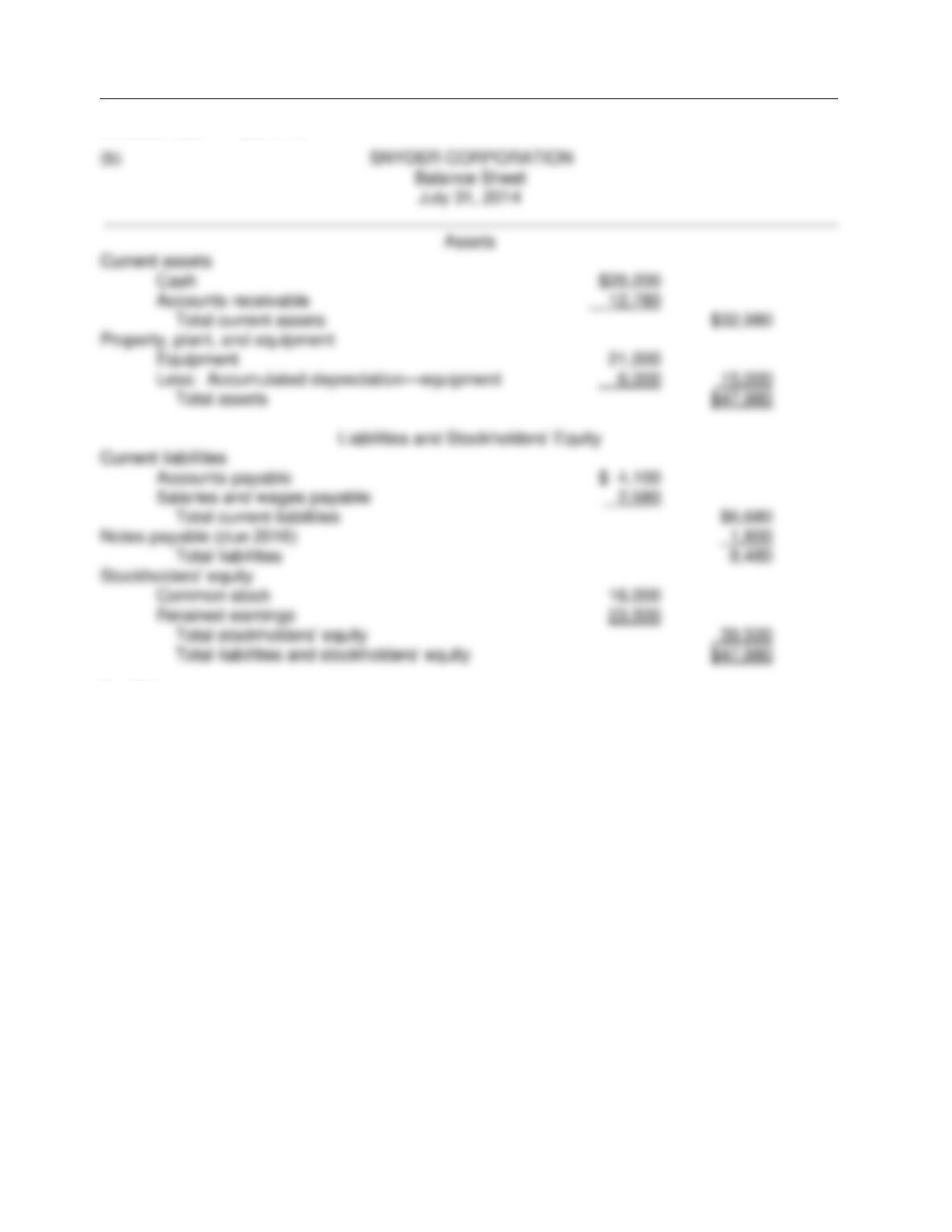
Test Bank for Financial Accounting: Tools for Business Decision Making, Seventh Edition
FOR INSTRUCTOR USE ONLY
2-60
Solution 220 (25 min.)
Ex. 221
These items are taken from the financial statements of Drew Corporation for 2014.
Retained earnings (beginning of year) $33,000
Utilities expense 2,000
Equipment 56,000
Accounts payable 15,300
Cash 15,900
Salaries and wages payable 3,000
Common stock 13,000
Dividends 14,000
Service revenue 78,000
Prepaid insurance 3,500
Maintenance and repairs expense 1,800
Depreciation expense 3,300
Accounts receivable 14,200
Insurance expense 2,200
Salaries and wages expense 47,000
Accumulated depreciation—equipment 17,600
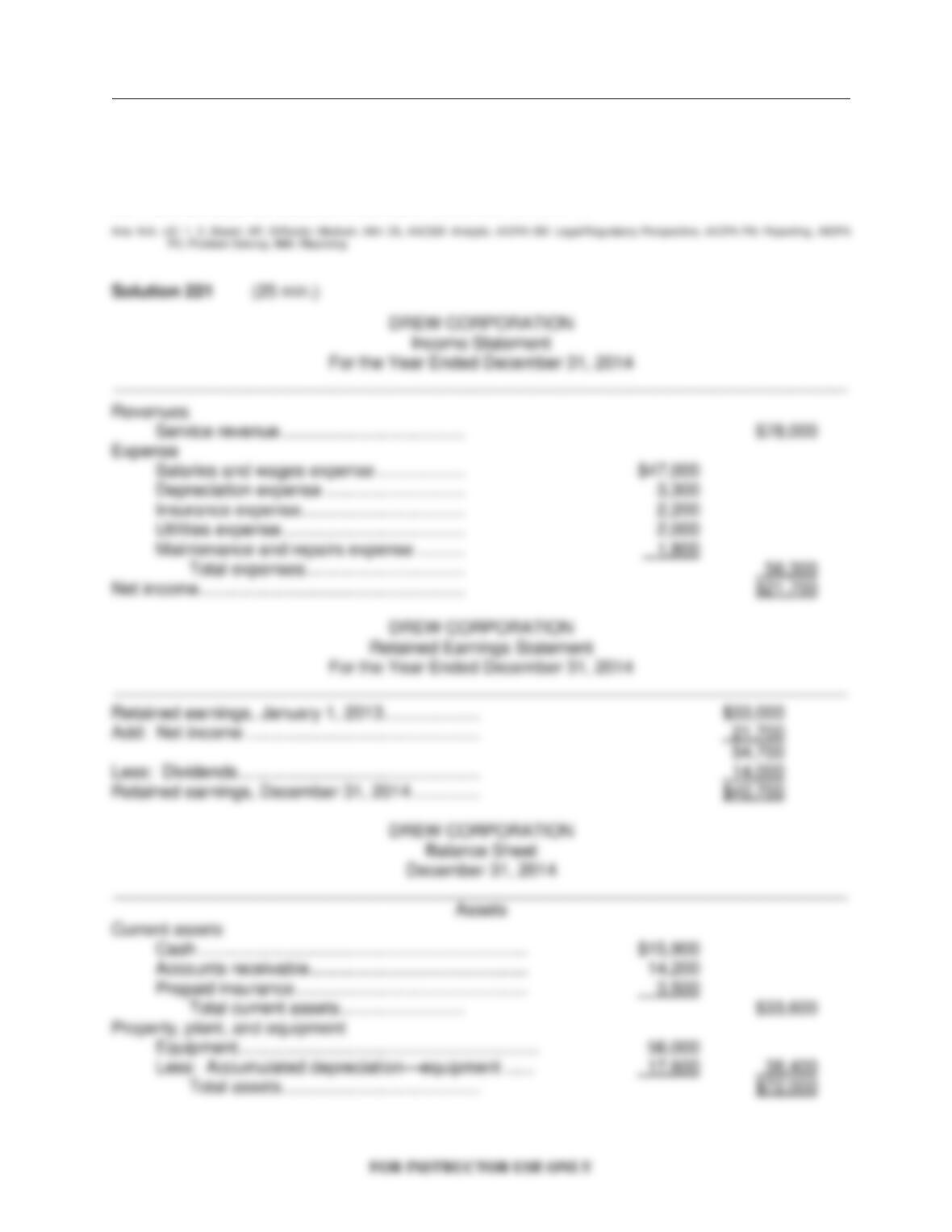
A Further Look at Financial Statements
2-61
Ex. 221 (Cont.)
Instructions
Prepare an income statement and a retained earnings statement for the year ended December 31,
2014 and a classified balance sheet as of December 31, 2014.
Test Bank for Financial Accounting: Tools for Business Decision Making, Seventh Edition
FOR INSTRUCTOR USE ONLY
2-62
Ex. 222
The Dobson Company gathered the following condensed data for the year ended December 31,
2014:
Cost of goods sold $ 720,000
Net sales 1,249,000
Administrative expenses 289,000
Interest expense 68,000
Dividends paid 38,000
Selling expenses 45,000
Instructions
Prepare an income statement for the year ended December 31, 2014.
Revenues
Net sales …………………………………………………………………………… $1,249,000
Expenses
Cost of goods sold …………………………..………………………………….. $720,000
Administrative expenses ………………………………………………………. 289,000
Selling expenses …………………………..……………………………………. 45,000
Interest expense …………………………………………………………………. 68,000
Total expenses …………………………………………………………… 1,122,000
Net income ……………………………………………………………………….. $ 127,000
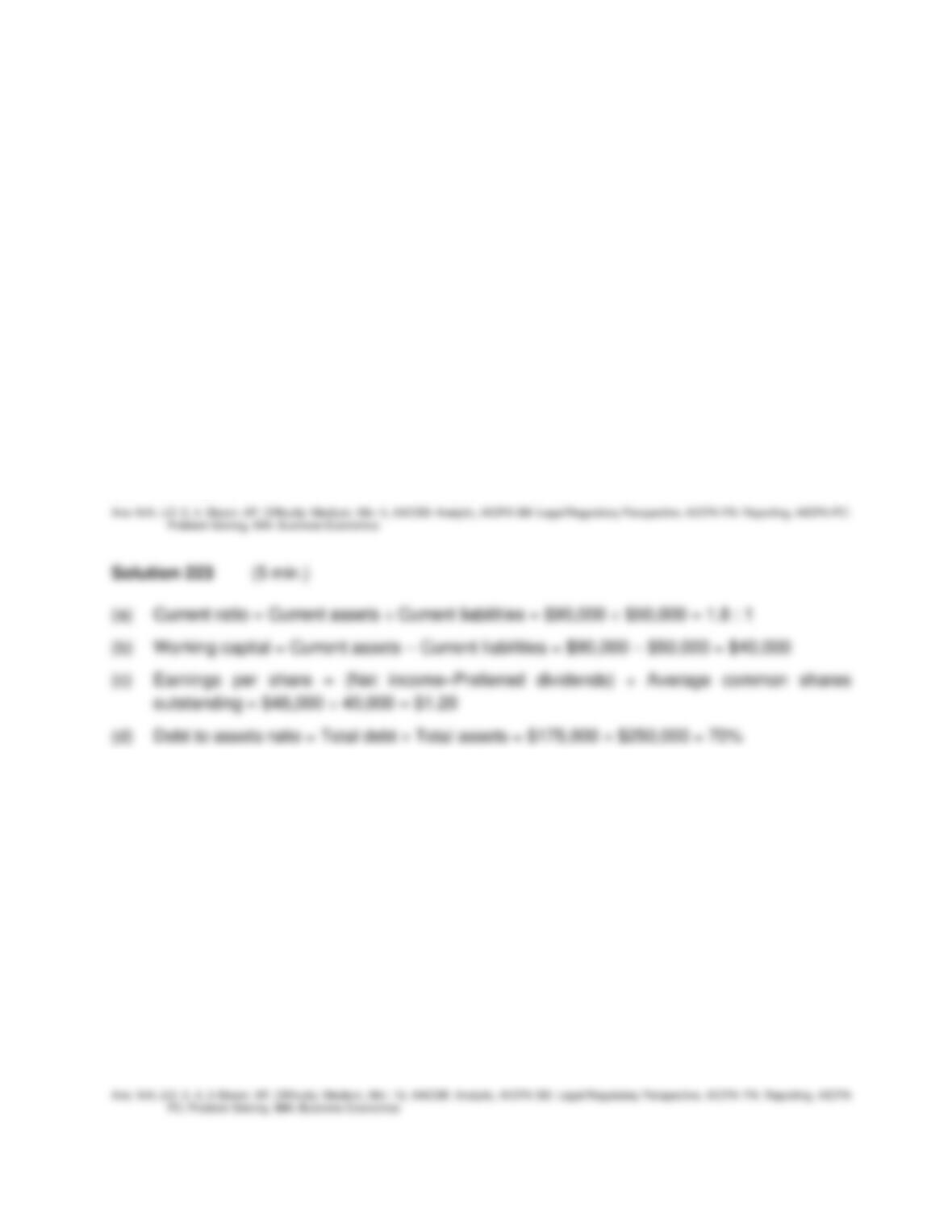
A Further Look at Financial Statements
FOR INSTRUCTOR USE ONLY
2-63
Ex. 223
The following data are taken from the financial statements of Rosen, Inc. as of the end of the year
2014. The data are in alphabetical order.
Accounts payable $ 28,000 Net income $ 48,000
Accounts receivable 66,000 Other current liabilities 17,000
Cash 24,000 Salaries and wages payable 5,000
Gross profit 160,000 Total assets 250,000
Income before income taxes 54,000 Total liabilities 175,000
Additional information: The average common shares outstanding during the year was 40,000.
Instructions
Compute the following:
(a) Current ratio. (c) Earnings per share.
(b) Working capital. (d) Debts to assets ratio.
Ex. 224
Use the following data to calculate the liquidity and profitability ratios listed below.
Average common shares outstanding 10,000 Current liabilities $100,000
Capital expenditures $20,000 Net income 21,000
Cash provided by operating activities 32,000 Net sales 150,000
Dividends paid 5,000 Total liabilities 126,000
Current assets 190,000 Total assets 210,000
Instructions
Compute the following:
(a) Current ratio. (d) Debt to assets ratio.
(b) Working capital. (e) Free cash flow.
(c) Earnings per share.
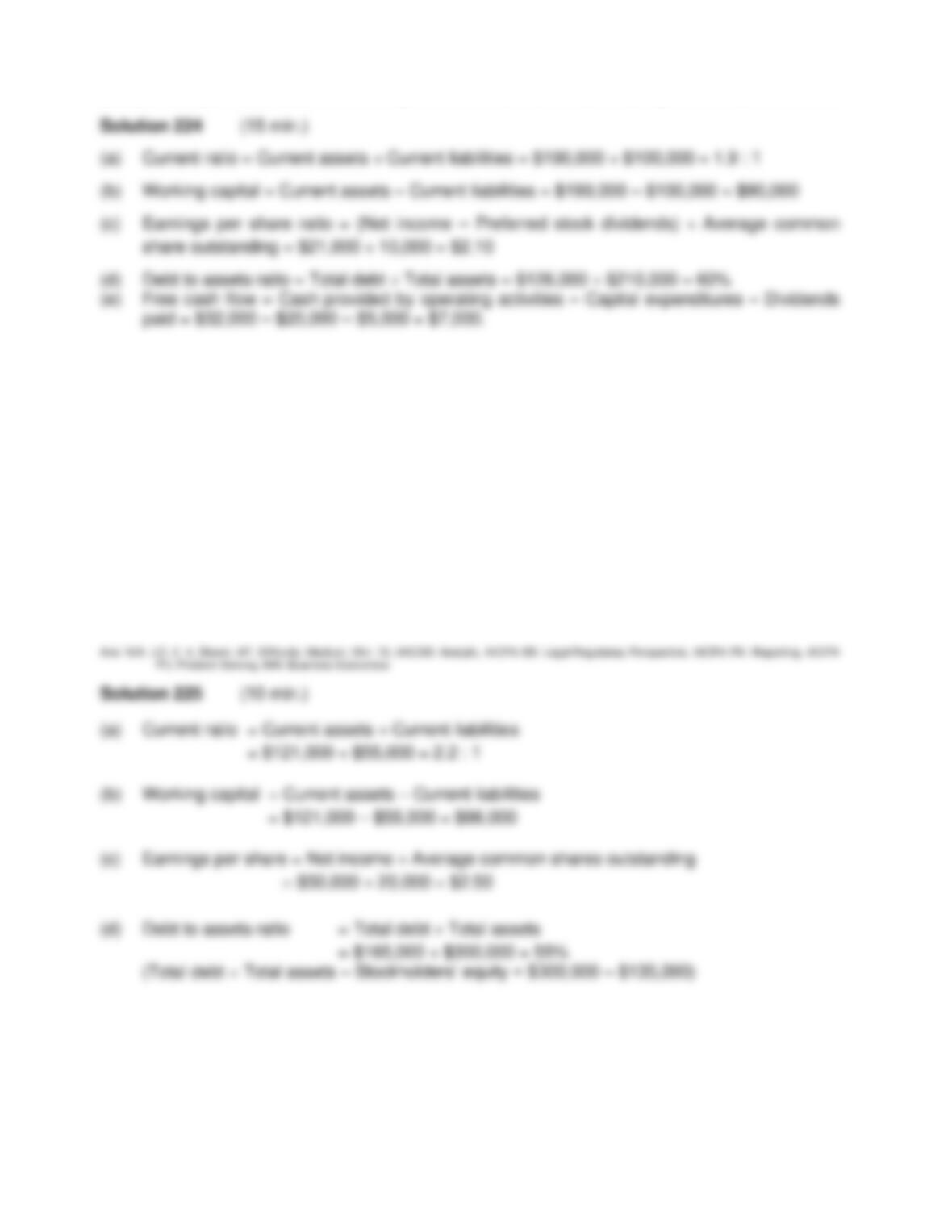
Test Bank for Financial Accounting: Tools for Business Decision Making, Seventh Edition
FOR INSTRUCTOR USE ONLY
2-64
Ex. 225
The following data are taken from the financial statements of Edington Company. The data
are in alphabetical order.
Accounts payable $ 28,000 Net sales 500,000
Accounts receivable 65,000 Other current liabilities 20,000
Average common shares out. 20,000 Salaries and wages payable 7,000
Cash 56,000 Stockholders’ equity 135,000
Gross profit 190,000 Total assets 300,000
Net income 50,000
Instructions
Compute the following:
(a) Current ratio. (c) Earnings per share.
(b) Working capital. (d) Debt to assets ratio.
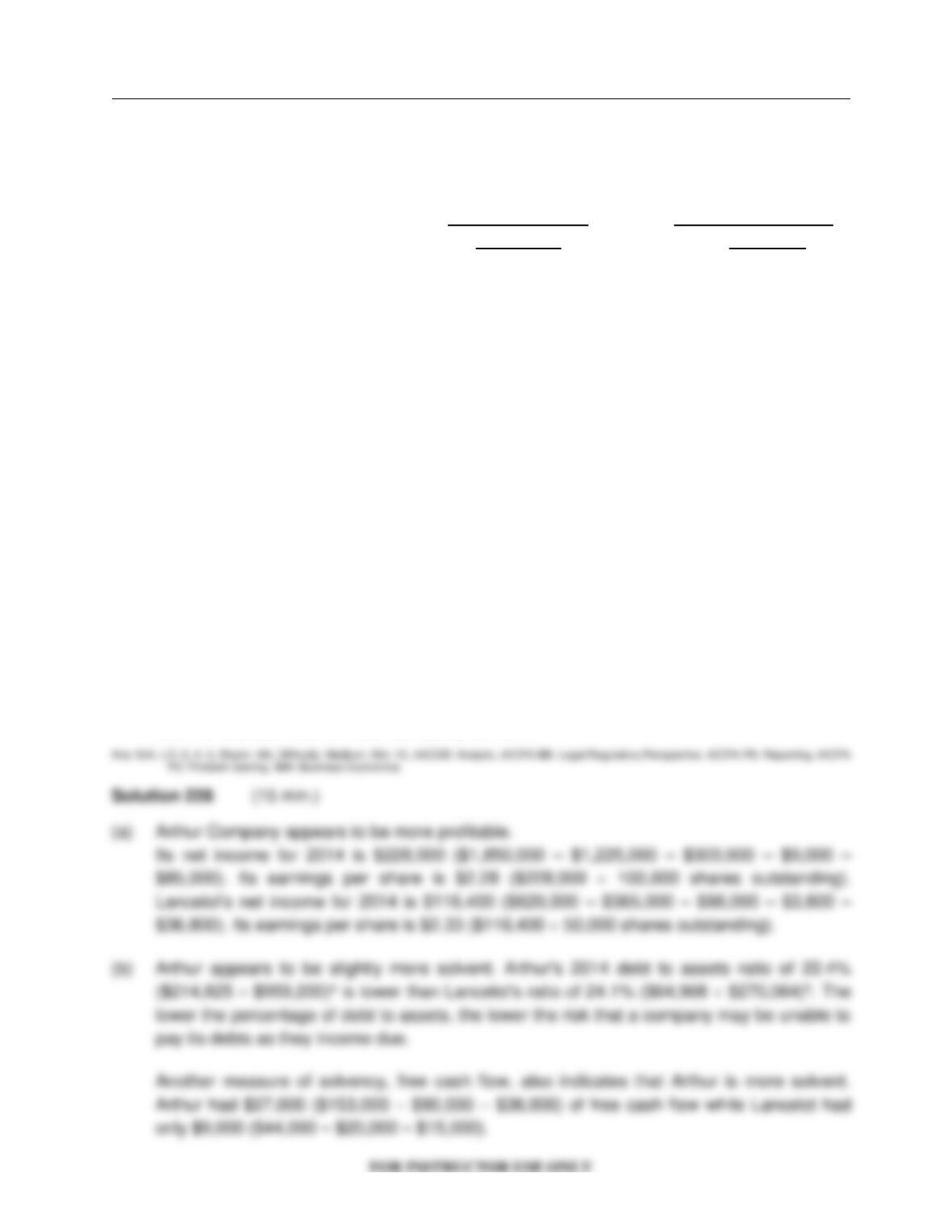
A Further Look at Financial Statements
2-65
Ex. 226
Comparative financial statement data for Arthur Corporation and Lancelot Corporation, two
competitors, appear below. All balance sheet data are as of December 31, 2014.
Arthur Corporation Lancelot Corporation
2014 2014
Net sales $1,850,000 $620,000
Cost of goods sold 1,225,000 365,000
Operating expenses 303,000 98,000
Interest expense 9,000 3,800
Income tax expense 85,000 36,800
Current assets 427,200 130,336
Plant assets (net) 532,000 139,728
Current liabilities 66,325 35,348
Long-term liabilities 148,500 29,620
Additional Information:
Cash from operating activities $153,000 $44,000
Capital expenditures $90,000 $20,000
Dividends paid $36,000 $15,000
Average number of shares outstanding 100,000 50,000
Instructions
(a) Comment on the relative profitability of the companies by computing the net income and
earnings per share for each company for 2014.
(b) Comment on the relative solvency of the companies by computing the debt to assets ratio
and the free cash flow for each company for 2014.
Test Bank for Financial Accounting: Tools for Business Decision Making, Seventh Edition
FOR INSTRUCTOR USE ONLY
2-66
Ex. 227
For each of the ratios listed below, indicate by the appropriate code letter, whether it is a liquidity
ratio, a profitability ratio, or a solvency ratio.
Code:
L = Liquidity ratio
P = Profitability ratio
S = Solvency ratio
____ 1. Price-earnings ratio
____ 2. Free cash flow
____ 3. Debt to assets ratio
____ 4. Earnings per share
____ 5. Current ratio
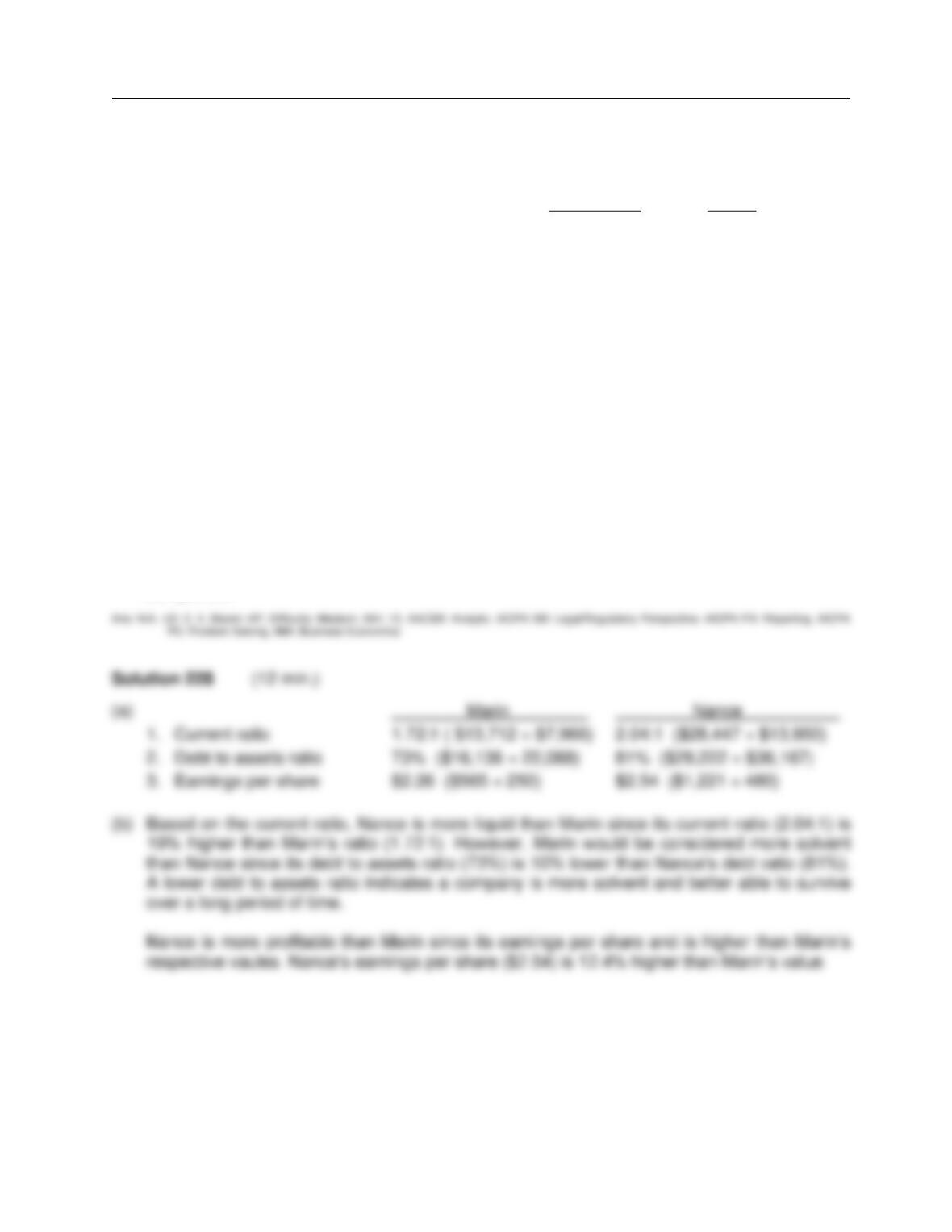
A Further Look at Financial Statements
FOR INSTRUCTOR USE ONLY
2-67
Ex. 228
The following information is available from the annual reports of Marin Company and Nance
Company.
(amounts in millions)
Marin Nance
Sales $26,510 $34,512
Gross profit 6,610 8,887
Net income 565 1,221
Current assets 13,712 28,447
Beginning total assets 17,102 33,130
Ending total assets 22,088 36,167
Current liabilities 7,966 13,950
Total liabilities 16,136 29,222
Average common shares outstanding 250 480
Preferred stock dividends paid -0- -0-
Instructions
(a) For each company, compute the following ratios:
1. Current ratio
2. Debt to assets ratio
3. Earnings per share
(b) Based on your calculations, discuss the relative liquidity, solvency, and profitability of the two
companies.
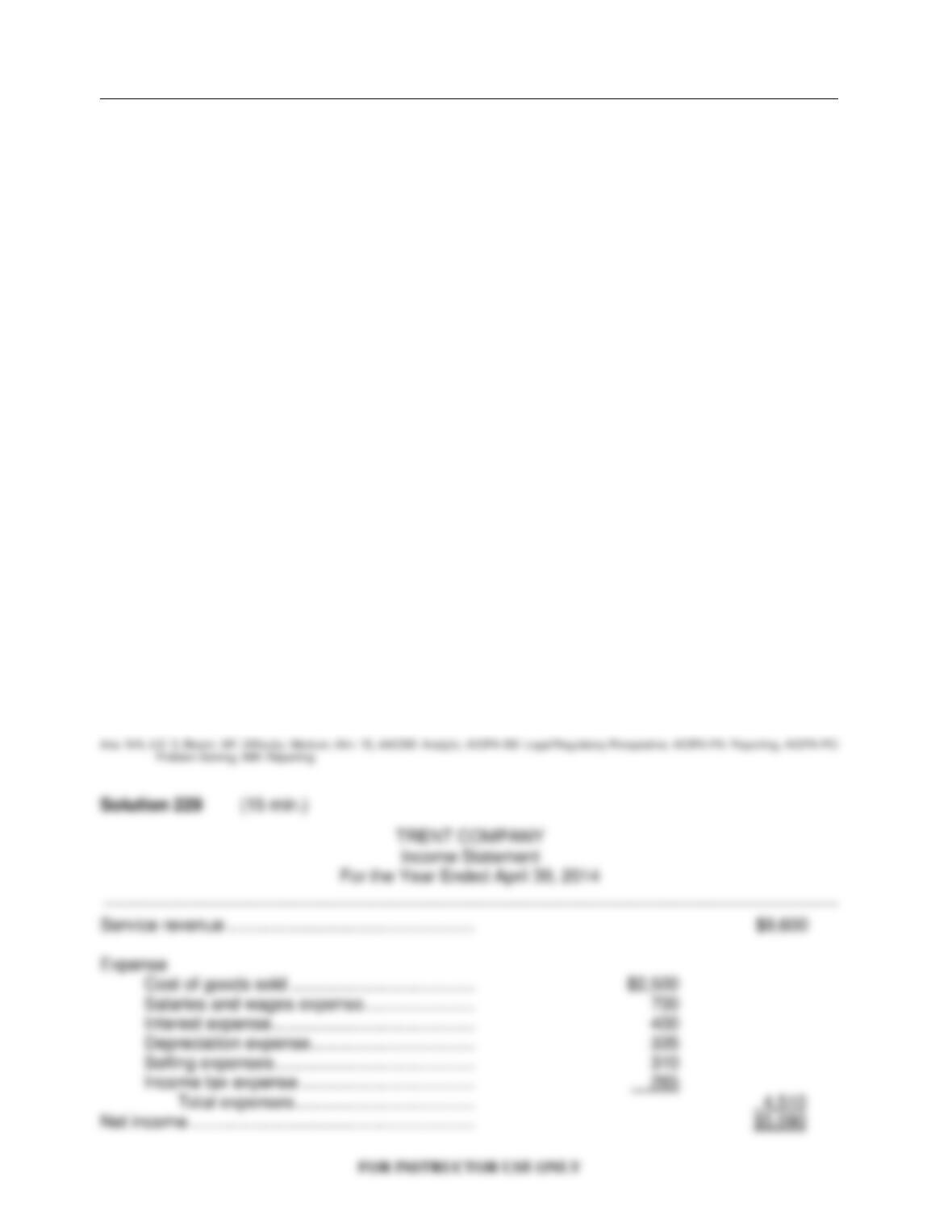
Test Bank for Financial Accounting: Tools for Business Decision Making, Seventh Edition
2-68
Ex. 229
You are provide with the following information for Trent Company, effective as of its April 30,
2014, year-end.
Accounts payable $ 834
Accounts receivable 810
Buildings, net of accumulated depreciation 3,537
Cash 770
Common stock 900
Cost of goods sold 2,500
Current portion of long-term debt 450
Depreciation expense 335
Dividends paid during the year 475
Equipment, net of accumulated depreciation 1,220
Income tax expense 265
Income taxes payable 265
Interest expense 400
Inventory 967
Land 1,600
Long-term debt 3,500
Prepaid expenses 12
Retained earnings, beginning 1,600
Service revenue 9,600
Selling expenses 310
Debt investments 1,200
Salaries and wages expense 700
Salaries and wages payable 222
Instructions
Prepare an income statement and a retained earnings statement for Trent Company for the year
ended April 30, 2014.
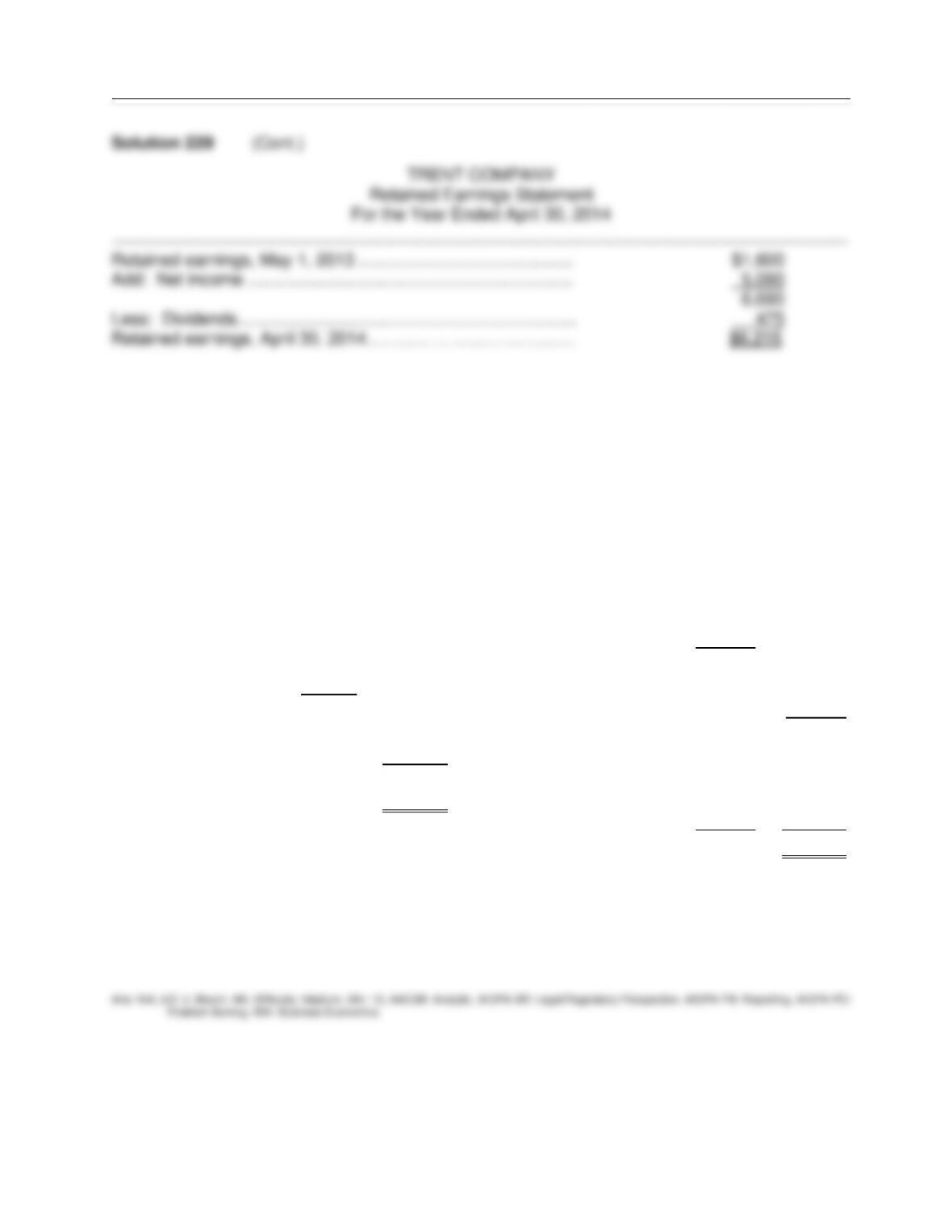
A Further Look at Financial Statements
FOR INSTRUCTOR USE ONLY
2-69
Ex. 230
The chief financial officer (CFO) of SuperClean Corporation requested that the accounting
department prepare a preliminary balance sheet on December 30, 2014, so that the CFO could
get an idea of how the company stood. He knows that certain debt agreements with its creditors
require the company to maintain a current ration of at least 2:1. The preliminary balance sheet is
as follows. SUPERCLEAN CORPORATION
Balance Sheet
December 30, 2014
Current assets
Current liabilities
Cash
$25,000
Accounts payable
$ 20,000
Accounts receivable
20,000
Salaries and wages
payable
10,000
$ 40,000
Prepaid insurance
15,000
$ 60,000
Long-term liabilities
Notes payable
90,000
Total liabilities
130,000
Property, plant, and equipment
(net)
210,000
Stockholders’ equity
Total assets
$270,000
Common stock
100,000
Retained earnings
40,000
140,000
Total liabilities and
stockholders equity
$270,000
Instructions
(a) Calculate the current ratio and working capital based on the preliminary balance sheet.
(b) Based in the results in (a), the CFO requested that $20,000 of cash be used to pay off the
balance of the accounts payable account on December 31, 2014. Calculate the new current
ratio and working capital after the company takes these actions.
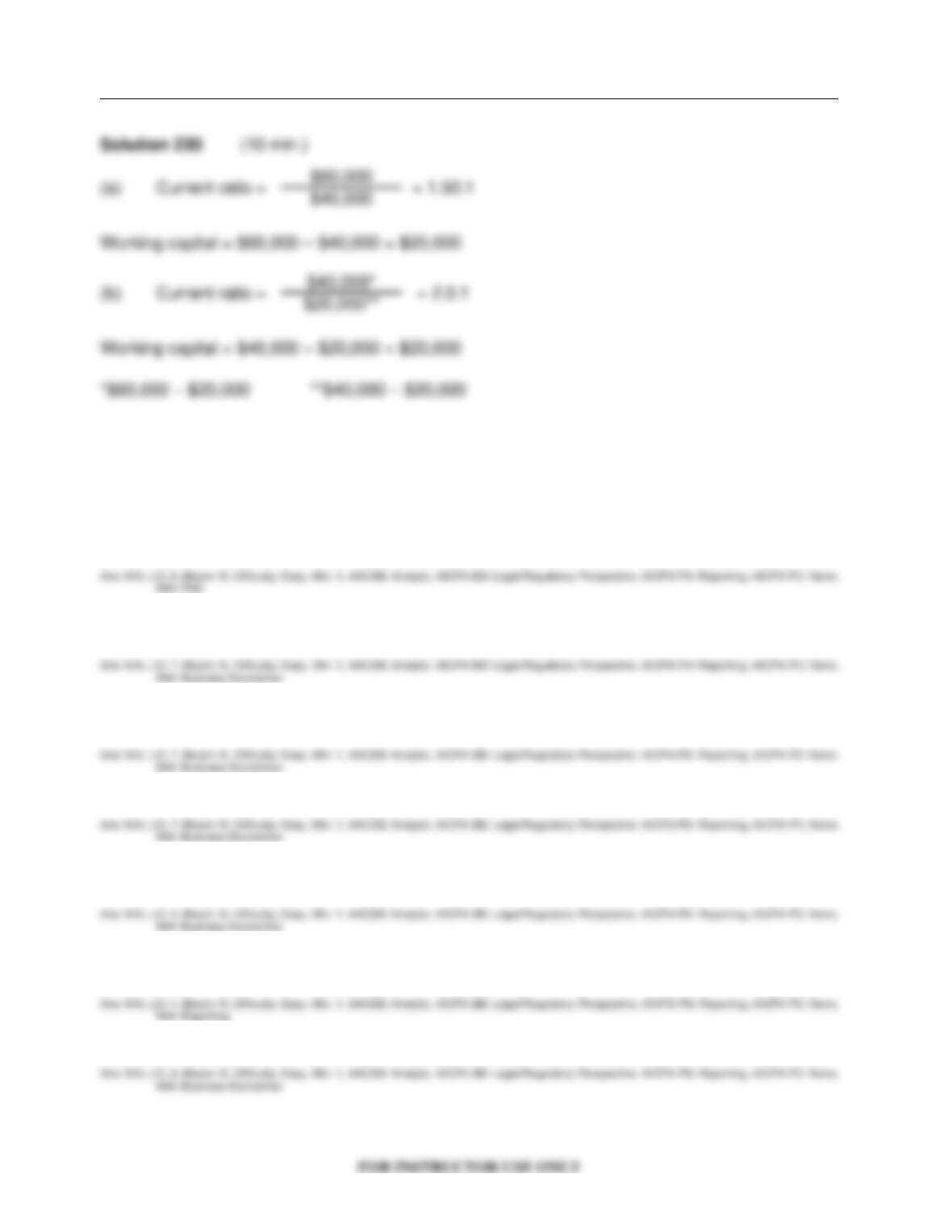
Test Bank for Financial Accounting: Tools for Business Decision Making, Seventh Edition
2-70
COMPLETION STATEMENTS
231. The rules and practices that are recognized as general guides for financial reporting are
called ______________ _____________ _______________.
232. In accounting, ____________ results when different companies use the same accounting
principles.
233. _______________ is a company-specific aspect of relevance where size is likely to
influence the decision of an investor or creditor.
234. The _______________ constraint relates to the fact that providing information is costly.
235. The earnings per share value is calculated by dividing net income – preferred stock
dividends by _______________ ______________ ______________.
236. Assets that are expected to be converted to cash or used in the business within a relatively
short period of time are called ______________.
237. The ________________ is current assets divided by current liabilities.
A Further Look at Financial Statements
2-71
238. A measurement to provide additional insight regarding a company’s cash-generating ability
is _____________.
Answers to Completion Statements
MATCHING
239. Match the items below by entering the appropriate code letter in the space provided.
A. Relevance G. Working capital
B. Liquidity ratios H. Current ratio
C. Comparability I. Earnings per share
D. Consistency J. Solvency ratios
E. Intangible assets K. Economic entity assumption
F. Free cash flow L. Materiality
____ 1. Measures of the ability of the company to survive over a long period of time.
____ 2. Current assets divided by current liabilities.
____ 3. Information that has a bearing on a decision.
____ 4. Economic events can be identified with a particular unit of accountability.
____ 5. An item important enough to influence the decision of an investor or creditor.
____ 6. Same accounting principles and methods used from year to year within a company.
____ 7. Cash from operating activities less capital expenditures and cash dividends.
____ 8. Noncurrent assets that do not have physical substance.
____ 9. (Net income – preferred stock dividends) divided by average common shares
outstanding.
____ 10. Different companies using the same accounting principles.
____ 11. Measures of the short-term ability of the enterprise to pay its maturing obligations.
____ 12. The excess of current assets over current liabilities.
Test Bank for Financial Accounting: Tools for Business Decision Making, Seventh Edition
FOR INSTRUCTOR USE ONLY
2-72
Answers to Matching
SHORT-ANSWER ESSAY QUESTIONS
S-A E 240
Identify the two parts of stockholders’ equity in a corporation and indicate the purpose of each.
S-A E 241
What do these classes of ratios measure?
(a) Liquidity ratios.
(b) Profitability ratios.
(c) Solvency ratios.
S-A E 242
Give the definition of current assets, current liabilities and the current ratio.
A Further Look at Financial Statements
FOR INSTRUCTOR USE ONLY
2-73
S-A E 243
Are short-term creditors, long-term creditors, and stockholders primarily interested in the same
characteristics of a company? Explain.
S-A E 244
Relevance and faithful representation are the fundamental qualities of useful information.
(a) Briefly define each term.
(b) Why are these characteristics important to users of financial statements?
Test Bank for Financial Accounting: Tools for Business Decision Making, Seventh Edition
FOR INSTRUCTOR USE ONLY
2-74
S-A E 245
You and the CEO of your company are waiting on an elevator. You are going to the 25th floor and
the CEO is going to the 35th floor. The CEO says “What is the difference between consistency
and comparability?” You have two minutes to respond. What will you say?
S-A E 246
Comparability and consistency are enhancing qualities that make accounting information useful
for decision-making purposes. Briefly explain the difference between these two qualities and
explain how they are related to each other.
S-A E 247
Identify and briefly explain the two fundamental qualities of useful information.
A Further Look at Financial Statements
FOR INSTRUCTOR USE ONLY
2-75
S-A E 248
What are three of the five enhancing qualities of useful information.
S-A E 249 (Ethics)
Many bonus plans are based upon the attainment of some specified short-term goal. For
example, sales personnel at Metal Crafters are given a bonus of 5% of the amount by which their
sales exceed $100,000. Sometimes the attainment of these goals is achieved by methods
detrimental to the long-term needs of the company. Sales representative Sara Crown, for
example, finds herself tempted to court certain customers that place large orders, even though
she knows they may not be able to pay. She complains that the bonus system itself is unethical.
Required:
Is a bonus system like the one at Metal Crafters unethical? Explain.
Test Bank for Financial Accounting: Tools for Business Decision Making, Seventh Edition
FOR INSTRUCTOR USE ONLY
2-76
S-A E 250 (Communication)
Sunshine Sugar grows sugar cane in Florida, California, and Hawaii. Its investment in land to
grow sugar exceeds $2 million. Currently, land whose original cost was more than $300,000 in
Florida is threatened by plans to flood the Everglades to reclaim the wetlands. Sunshine plans to
fight vigorously to keep its land in production, particularly because most of the rest of its land is in
California, which is threatened by water shortages. The land in Florida is also significantly more
productive than that in California, and the wages paid to workers to process the sugar cane are
substantially less. Current plans include litigation to prevent government seizure of the land, an
extensive public education campaign, and intense lobbying efforts.
Required:
Sunshine has determined that a footnote disclosure should be made in the financial statements to
alert the investors of the threat to the land. Carefully consider how much of the above information
is appropriate for inclusion in the footnote. Write the footnote.
A Further Look at Financial Statements
2-77
IFRS Questions
1. The classified balance sheet is
a. required under GAAP but not under IFRS.
b. required under IFRS in the same format as under GAAP.
c. required under IFRS but not under GAAP.
d. required under IFRS with certain variations in format as compared to GAAP.
2. IFRS requires the use of
a. the term balance sheet.
b. the term statement of financial position.
c. neither balance sheet nor statement of financial position, but recommends use of the
term balance sheet.
d. neither balance sheet nor statement of financial position, but recommends use of the
term statement of financial position.
3. IFRS
a. requires a specific format for the balance sheet (statement of financial position) that is
identical to U.S. GAAP.
b. requires a specific format for the balance sheet (statement of financial position) that is
different from U.S. GAAP.
c. requires no specific format for the balance sheet (statement of financial position) but
most companies that follow IFRS prepare the statement identical to U.S. GAAP .
d. requires no specific format for the balance sheet (statement of financial position) but
most companies that follow IFRS prepare the statement in a different format from U.S.
GAAP.
4. Most companies that follow IFRS present balance sheet (statement of financial position)
information in this order.
a. current assets; investments; property; plant and equipment; intangible assets; current
liabilities; long term liabilities; owners’ equity.
b. intangible assets; property; plant and equipment; investments; current assets; current
liabilities; owners’ equity; long term liabilities.
c. current assets; noncurrent assets; current liabilities; noncurrent liabilities; equity.
d. noncurrent assets; current assets; equity; noncurrent liabilities; current liabilities.
5. Under IFRS and under GAAP, current assets are listed in
IFRS GAAP
a. order of liquidity order of liquidity
b. reverse order of liquidity order of liquidity
c. order of liquidity reverse order of liquidity
d. reverse order of liquidity reverse order of liquidity
Test Bank for Financial Accounting: Tools for Business Decision Making, Seventh Edition
FOR INSTRUCTOR USE ONLY
2-78
6. The subtotal net assets is used in
a. both GAAP and IFRS.
b. GAAP but not IFRS.
c. IFRS but not GAAP.
d. neither IFRS nor GAAP.
7. Both IFRS and GAAP require disclosure about
a. accounting policies followed.
b. judgements that management has made in the process of applying the entity’s
accounting policies.
c. the key assumptions and estimation uncertainty.
d. all of the above.
8. Under IFRS
a. comparative prior-period information must be presented, but financial statements need
not be provided annually.
b. comparative prior-period information must be presented, and financial statements
must be provided annually.
c. comparative prior-period information is not required, but financial statements need not
be provided annually.
d. comparative prior-period information is not required, but financial statements must be
provided annually.
9. The use of fair value to report assets
a. is not allowed under GAAP or IFRS.
b. is required by GAAP and IFRS.
c. is increasing under GAAP and IFRS, but GAAP has adopted it more broadly.
d. is increasing under GAAP and IFRS, but IFRS has adopted it more broadly.
10 Under IFRS
a. companies can apply fair value to property, plant, and equipment and natural
resources.
b. companies can apply fair value to property, plant, and equipment but not to natural
resources.
c. companies can apply fair value to neither property, plant, and equipment nor natural
resources.
d. companies can apply fair value to natural resources but not to property, plant, and
equipment.