Chapter 2 Analysis of Financial Statements 21
32. Collins Company had the following partial balance sheet and complete income statement
information for last year:
Balance Sheet:
Cash
$ 20
A/R
1,000
Inventories
2,000
Total current assets
$3,020
Net fixed assets
2,980
Total assets
$6,000
Income Statement:
Sales
$10,000
Cost of goods sold
9,200
EBIT
$ 800
Interest (10%)
400
EBT
$ 400
Taxes (40%)
160
Net Income
$ 240
The industry average DSO is 30 (360-day basis). Collins plans to change its credit policy so as to
cause its DSO to equal the industry average, and this change is expected to have no effect on
either sales or cost of goods sold. If the cash generated from reducing receivables is used to retire
debt (which was outstanding all last year and which has a 10% interest rate), what will Collins’
debt ratio (Total debt/Total assets) be after the change in DSO is reflected in the balance sheet?
a.
33.33%
b.
45.28%
c.
52.75%
d.
60.00%
e.
65.71%
33. A firm has total interest charges of $10,000 per year, sales of $1 million, a tax rate of 40 percent,
and a net profit margin of 6 percent. What is the firm’s times-interest-earned ratio?
a.
16 times
b.
10 times
c.
7 times
d.
11 times
e.
20 times
22 Chapter 2 Analysis of Financial Statements
34. Alumbat Corporation has $800,000 of debt outstanding, and it pays an interest rate of 10 percent
annually on its bank loan. Alumbat’s annual sales are $3,200,000; its average tax rate is 40
percent; and its net profit margin on sales is 6 percent. If the company does not maintain a TIE
ratio of at least 4 times, its bank will refuse to renew its loan, and bankruptcy will result. What is
Alumbat’s current TIE ratio?
a.
2.4
b.
3.4
c.
3.6
d.
4.0
e.
5.0
35. Determine the increase or decrease in cash for Rinky Supply Company for last year, given the
following information. (Assume no other changes occurred during the past year.)
Decrease in marketable securities
=
$25
Increase in accounts receivables
=
$50
Increase in notes payable
=
$30
Decrease in accounts payable
=
$20
Increase in accrued wages and taxes
=
$15
Increase in inventories
=
$35
Retained earnings
=
$ 5
a.
-$50
b.
+$40
c.
-$30
d.
+$20
e.
-$10
Cash Flows from Operations
Retained earnings
Additions (sources of cash):
Increase in accrued wages and taxes
Subtractions (uses of cash):
Increase in accounts receivable
Increase in inventories
Decrease in accounts payable
36. Cannon Company has enjoyed a rapid increase in sales in recent years, following a decision to
sell on credit. However, the firm has noticed a recent increase in its collection period. Last year,
total sales were $1 million, and $250,000 of these sales were on credit. During the year, the
accounts receivable account averaged $41,664. It is expected that sales will increase in the
forthcoming year by 50 percent, and, while credit sales should continue to be the same proportion
of total sales, it is expected that the days sales outstanding will also increase by 50 percent. If the
resulting increase in accounts receivable must be financed by external funds, how much external
funding will Cannon need?
a.
$41,664
b.
$52,086
c.
$47,359
d.
$106,471
e.
$93,750
37. The Meryl Corporation’s common stock currently is selling at $100 per share, which represents a
P/E ratio of 10. If the firm has 100 shares of common stock outstanding, a return on equity of 20
percent, and a debt ratio of 60 percent, what is its return on total assets (ROA)?
a.
8.0%
b.
10.0%
c.
12.0%
d.
16.7%
e.
20.0%
24 Chapter 2 Analysis of Financial Statements
38. Selzer Inc. sells all its merchandise on credit. It has a profit margin of 4 percent, days sales
outstanding equal to 60 days, receivables of $150,000, total assets of $3 million, and a debt ratio
of 0.64. What is the firm’s return on equity (ROE)?
a.
7.1%
b.
33.3%
c.
3.3%
d.
71.0%
e.
8.1%
39. You are given the following information about a firm: The growth rate equals 8 percent; return on
assets (ROA) is 10 percent; the debt ratio is 20 percent; and the stock is selling at $36. What is
the return on equity (ROE)?
a.
14.0%
b.
12.5%
c.
15.0%
d.
2.5%
e.
13.5%
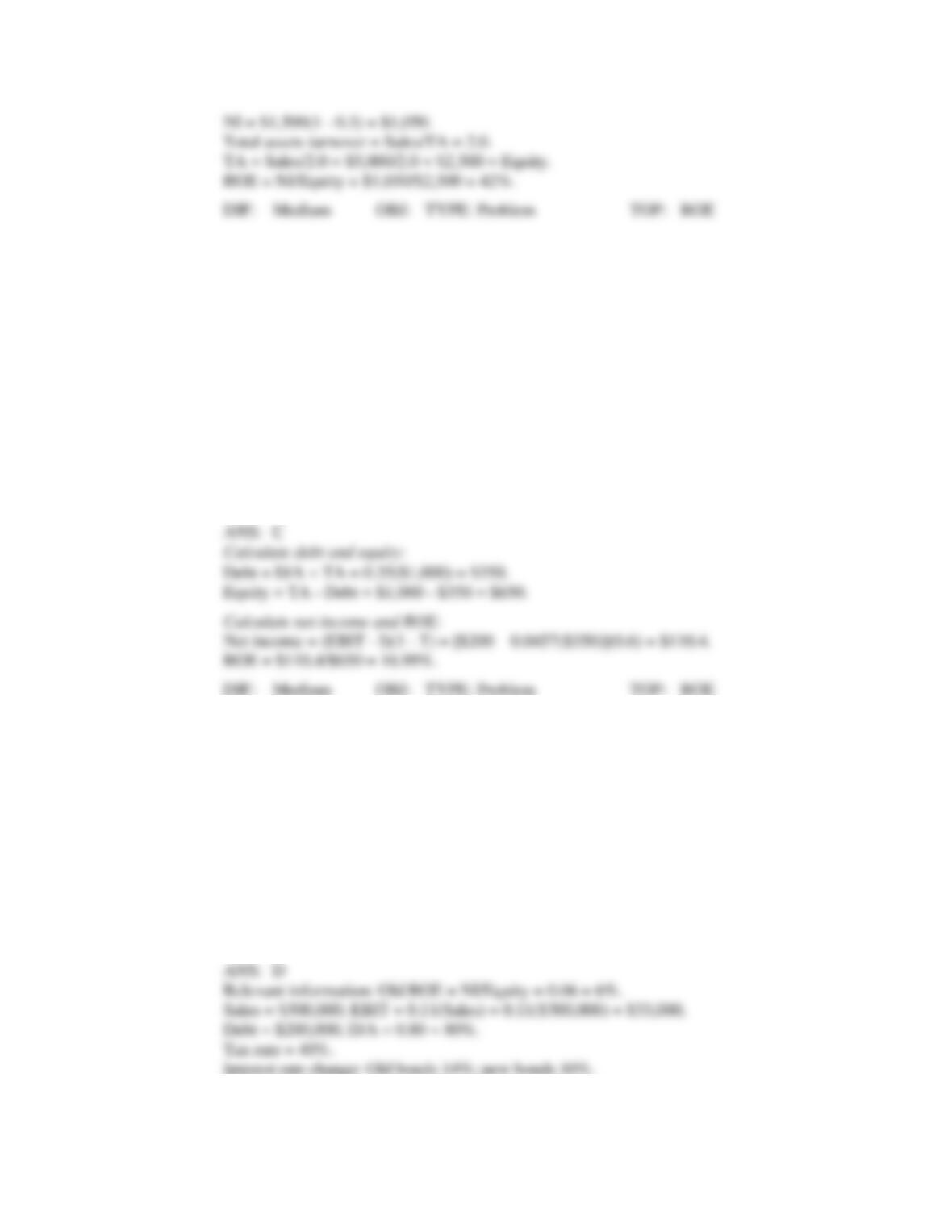
40. Assume Meyer Corporation is 100 percent equity financed. Calculate the return on equity, given
the following information:
(1)
Earnings before taxes = $1,500;
(2)
Sales = $5,000;
(3)
Dividend payout ratio = 60%;
(4)
Total assets turnover = 2.0;
(5)
Applicable tax rate = 30%.
a.
25%
b.
30%
c.
35%
d.
42%
e.
50%
Chapter 2 Analysis of Financial Statements 25
41. The Amer Company has the following characteristics:
Sales:
$1,000
Total Assets:
$1,000
Total Debt/Total Assets:
35%
EBIT:
$ 200
Tax rate:
40%
Interest rate on total debt:
4.57%
What is Amer’s ROE?
a.
11.04%
b.
12.31%
c.
16.99%
d.
28.31%
e.
30.77%
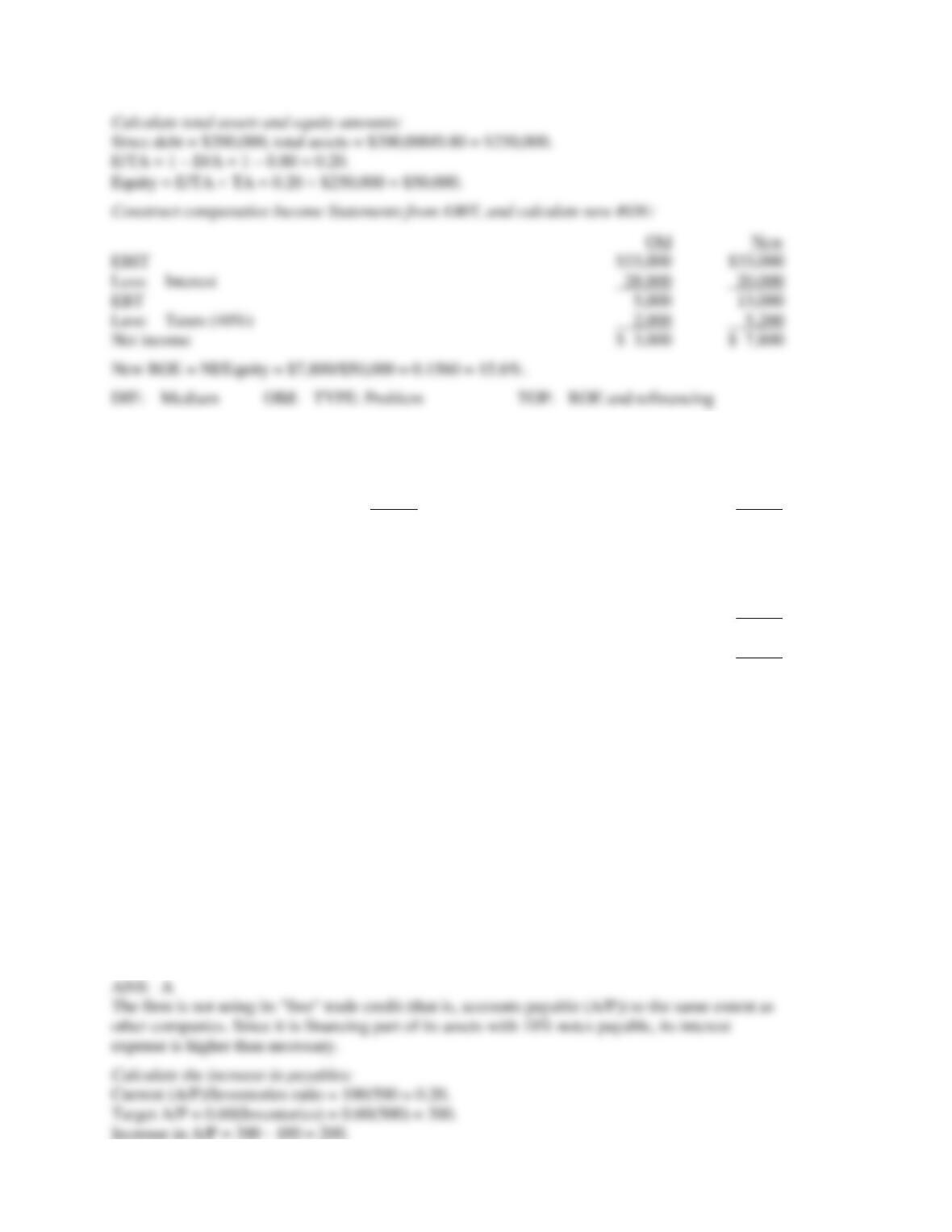
42. Aurillo Equipment Company (AEC) projected that its ROE for next year would be just 6%.
However, the financial staff has determined that the firm can increase its ROE by refinancing
some high interest bonds currently outstanding. The firm’s total debt will remain at $200,000 and
the debt ratio will hold constant at 80%, but the interest rate on the refinanced debt will be 10%.
The rate on the old debt is 14%. Refinancing will not affect sales which are projected to be
$300,000. EBIT will be 11% of sales, and the firm’s tax rate is 40%. If AEC refinances its high
interest bonds, what will be its projected new ROE?
a.
3.0%
b.
8.2%
c.
10.0%
d.
15.6%
e.
18.7%
26 Chapter 2 Analysis of Financial Statements
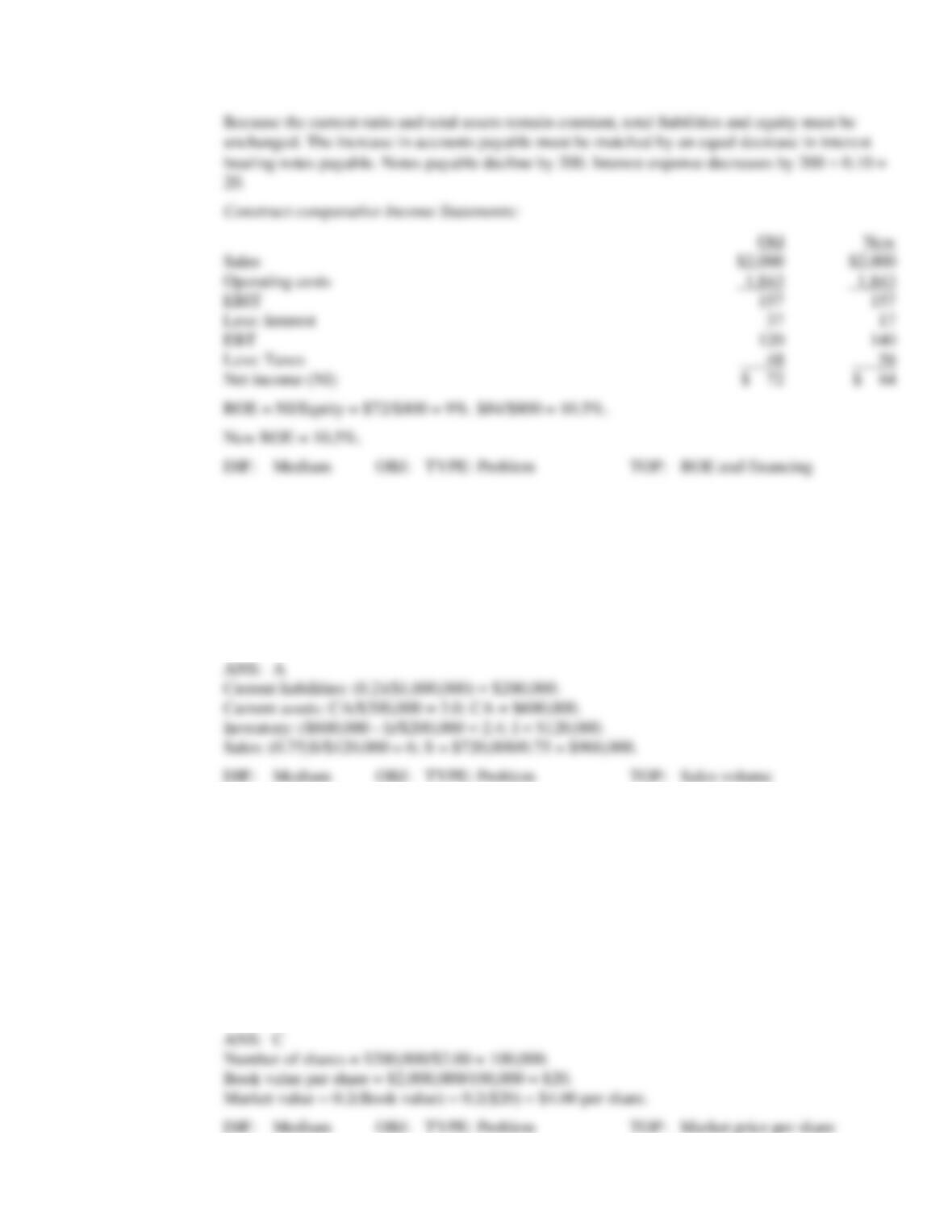
43. Savelots Stores’ current financial statements are shown below:
Inventories
$ 500
Accounts payable
$ 100
Other current assets
400
Short-term notes payable
370
Fixed assets
370
Common equity
800
Total assets
$1,270
Total liab. and equity
$1,270
Sales
$2,000
Operating costs
1,843
EBIT
157
Less: Interest
37
EBT
120
Less: Taxes (40%)
48
Net income
72
A recently released report indicates that Savelots’ current ratio of 1.9 is in line with the industry
average. However, its accounts payable, which have no interest cost and which are due entirely to
purchases of inventories, amount to only 20% of inventory versus an industry average of 60%.
Suppose Savelots took actions to increase its accounts payable to inventories ratio to the 60%
industry average, but it (1) kept all of its assets at their present levels (that is, the asset side of the
balance sheet remains constant) and (2) also held its current ratio constant at 1.9. Assume that
Savelots’ tax rate is 40%, that its cost of short-term debt is 10%, and that the change in payments
will not affect operations. In addition, common equity would not change. With the changes, what
would be Savelots’ new ROE?
a.
10.5%
b.
7.8%
c.
9.0%
d.
13.2%
e.
12.0%
EBIT
$33,000
$33,000
Less: Interest
EBT
13,000
Less: Taxes (40%)
Net income
Chapter 2 Analysis of Financial Statements 27
44. Harvey Supplies Inc. has a current ratio of 3.0, a quick ratio of 2.4, and an inventory turnover
ratio of 6. Harvey’s total assets are $1 million and its debt ratio is 0.20. The firm has no long-term
debt. What is Harvey’s sales figure if the total cost of goods sold is 75% of sales?
a.
$960,000
b.
$720,000
c.
$1,620,000
d.
$120,000
e.
$540,000
45. Given the following information, calculate the market price per share of WAM Inc.
Earnings after interest and taxes = $200,000
Earnings per share = $2.00
Stockholders’ equity = $2,000,000
Market/Book ratio = 0.20
a.
$20.00
b.
$8.00
c.
$4.00
d.
$2.00
e.
$1.00
28 Chapter 2 Analysis of Financial Statements
46. On its December 31st balance sheet, LCG Company reported gross fixed assets of $6,500,000
and net fixed assets of $5,000,000. Depreciation for the year was $500,000. Net fixed assets a
year earlier on December 31st, had been $4,700,000. What figure for “Cash Flows Associated
with Long-Term Investments (Fixed Assets)” should LCG report on its Statement of Cash Flows
for the current year?
a.
$500,000
b.
$600,000
c.
$700,000
d.
$800,000
e.
$900,000
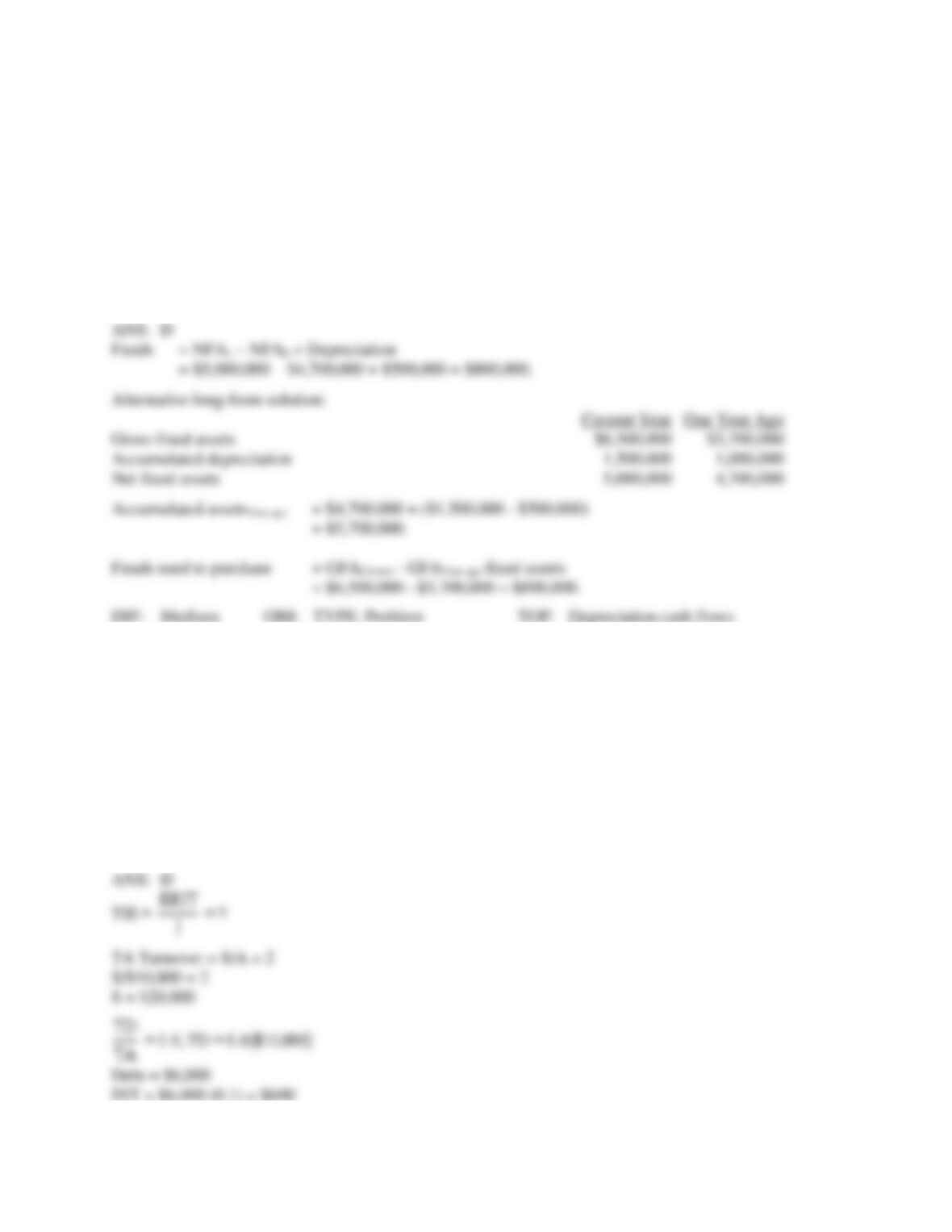
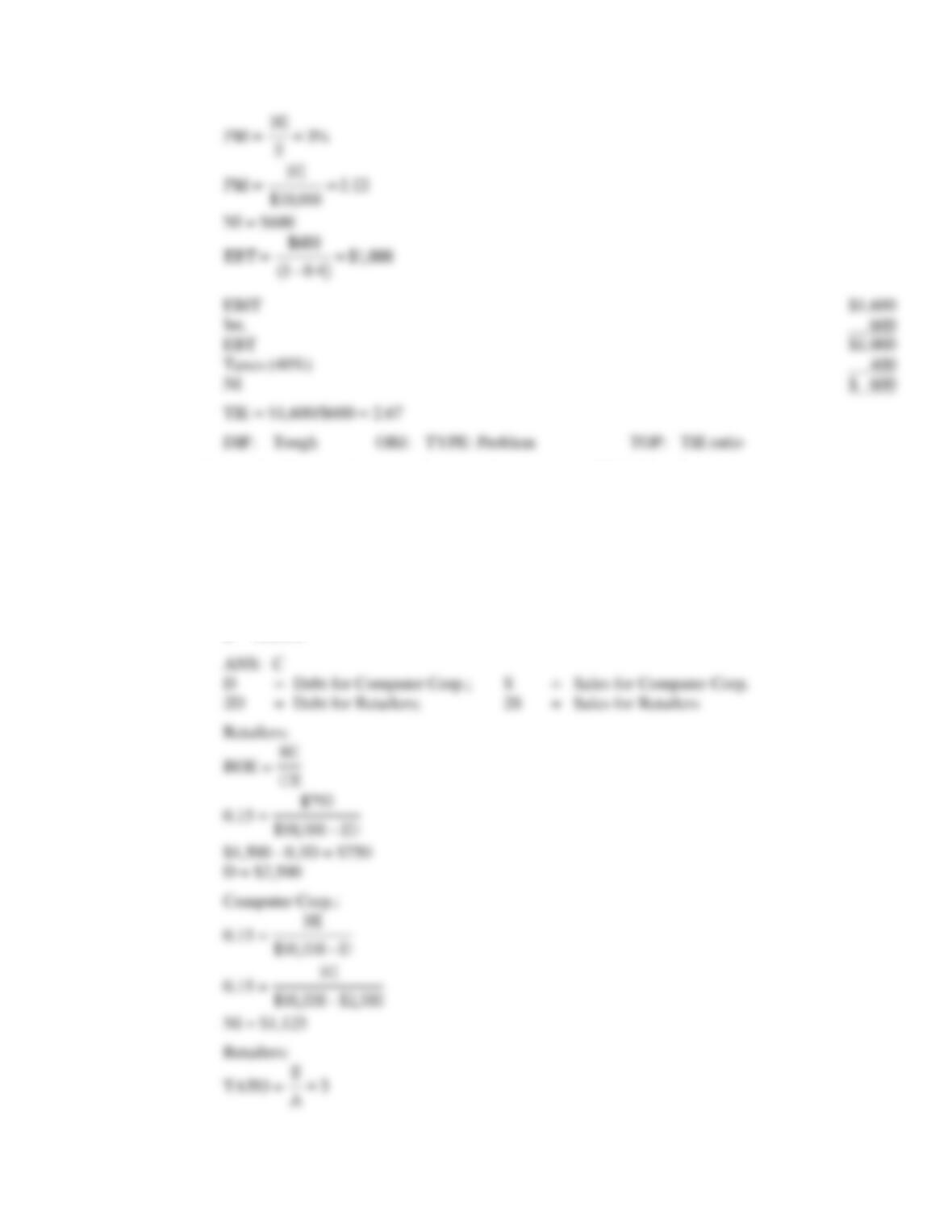
47. Lombardi Trucking Company has the following data:
Assets:
$10,000
Profit margin:
3.0%
Debt ratio:
60.0%
Interest rate:
10.0%
Tax rate:
40%
Total asset turnover:
2.0
What is Lombardi’s TIE ratio?
a.
0.95
b.
1.75
c.
2.10
d.
2.67
e.
3.45
Alternative long-form solution:
Gross fixed assets
Accumulated depreciation
Net fixed assets
Chapter 2 Analysis of Financial Statements 29
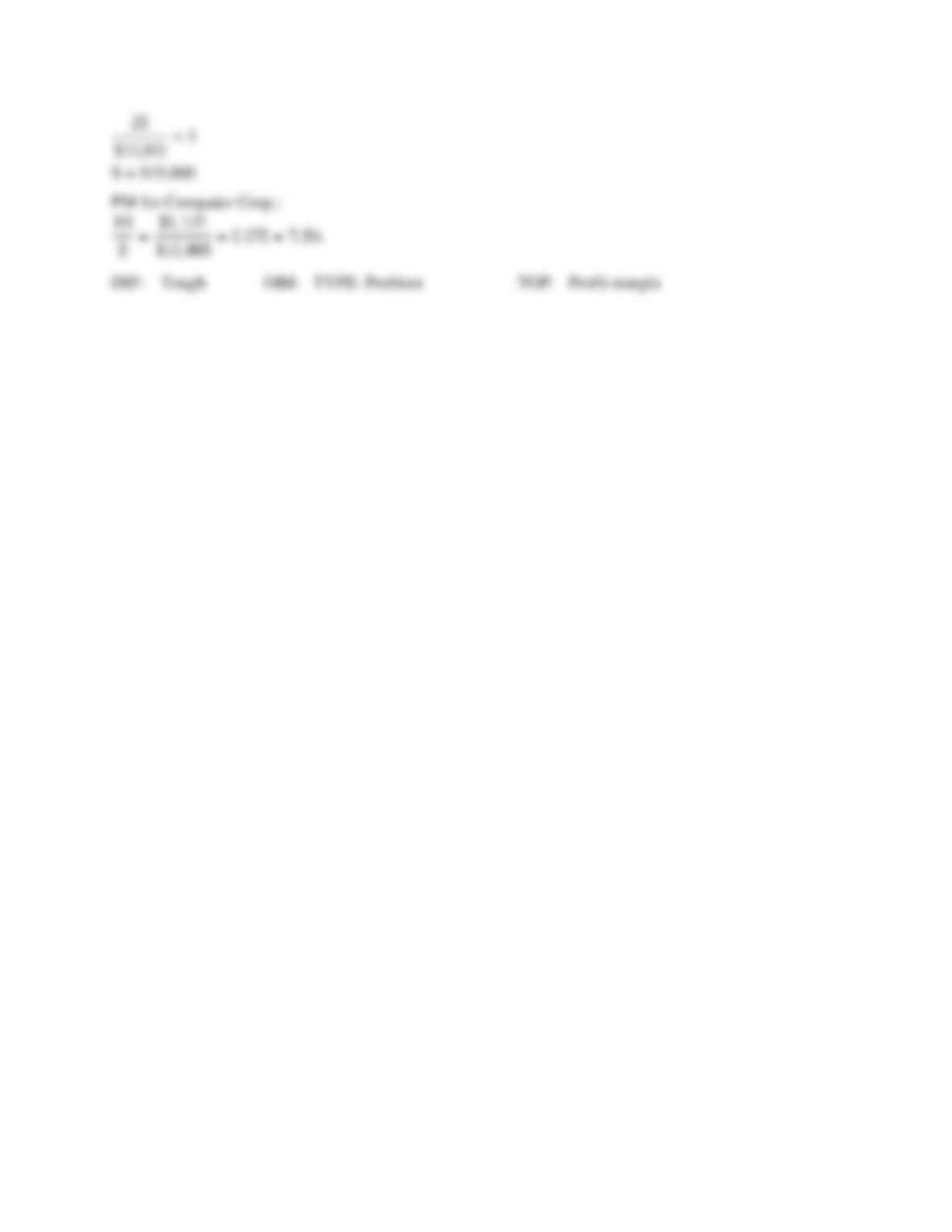
48. Retailers Inc. and Computer Corp. each have assets of $10,000 and a return on common equity
equal to 15%. Retailers has twice as much debt and twice as many sales relative to Computer
Corp. Retailers’ net income equals $750, and its total asset turnover is equal to 3. What is
Computer Corp.’s profit margin?
a.
2.50%
b.
5.00%
c.
7.50%
d.
10.00%
e.
12.50%
30 Chapter 2 Analysis of Financial Statements