Cost Accounting: A Managerial Emphasis, 6e
Chapter 2 – An Introduction to Cost Terms and Purposes
Chapter 2 An Introduction to Cost Terms and Purposes
2.1 Identify and distinguish between two manufacturing cost classification systems:
direct and indirect, prime and conversion.
1) “Cost” is defined by accountants as a resource sacrificed or foregone to achieve a specific objective.
2) Costs of Sales is another way of phrasing Cost of Goods Sold.
3) An actual cost is a predicted cost.
4) Nearly all accounting systems accumulate forecasted costs.
5) A cost object is anything for which a separate measurement of costs is desired.
6) Indirect costs cannot be economically traced directly to the cost objective.
Cost Accounting: A Managerial Emphasis, 6e
Chapter 2 – An Introduction to Cost Terms and Purposes
7) Delivery charges are typically considered to be an indirect cost because it cannot be traced to each
customer.
8) A cost is classified as a direct or indirect cost based on the applicable cost object.
9) Cost tracing assigns indirect costs to the chosen cost object.
10) Factors affecting direct/indirect cost classifications are the materiality of the cost in question, the
information-gathering technology used, and the operations.
11) A firm’s strategy and mission are usually the same.
12) Governance refers to a company’s relationship with all levels of government.
13) A value proposition is a distinct benefit for which customers will pay.
Cost Accounting: A Managerial Emphasis, 6e
Chapter 2 – An Introduction to Cost Terms and Purposes
14) Rent for the building that contains the manufacturing and engineering departments can all be charged
as manufacturing overhead costs.
15) The plant supervisor‘s salary is a direct labour cost.
16) Inventoriable costs are reported as an asset when incurred and expensed on the income statement
when the product is sold.
17) Period costs are never included as part of inventory.
18) Conversion costs include all direct manufacturing costs.
19) Overtime premium consists of wages paid to all workers in excess of their straight-time wage rates.
20) Prime costs consist of direct and indirect manufacturing labour.
Cost Accounting: A Managerial Emphasis, 6e
Chapter 2 – An Introduction to Cost Terms and Purposes
21) Conversion costs are all manufacturing costs other than direct materials.
22) Overtime premium is always a component of direct labour.
23) Products, services, departments, and customers may be cost objects.
24) Costs are accounted for in two basic stages: assignment followed by accumulation.
25) A cost object is always either a product or a service.
26) Assigning direct costs poses more problems than assigning indirect costs.
27) A department could be considered a cost object.
Cost Accounting: A Managerial Emphasis, 6e
Chapter 2 – An Introduction to Cost Terms and Purposes
28) Improvements in information-gathering technologies are making it possible to trace more costs as
direct.
29) Anything for which a separate measurement of costs is desired is known as
A) a cost item.
B) a cost object.
C) a fixed cost item.
D) a variable cost object.
E) a cost driver.
30) Which of the following is a cost object?
A) direct materials
B) customers
C) conversion costs
D) cost assignments
E) indirect labour
31) Which of the following is an indirect production cost?
A) materials placed into production
B) calibrating factory equipment
C) labour placed into production
D) cost of shipping a product to the customer
E) advertising
Cost Accounting: A Managerial Emphasis, 6e
Chapter 2 – An Introduction to Cost Terms and Purposes
32) Actual costs are defined as
A) costs incurred.
B) direct costs.
C) indirect costs.
D) predicted costs.
E) sunk costs.
33) Whether a company traces costs directly to an output unit or not depends upon
A) the materiality of the contribution a cost makes to the total cost per output unit.
B) the amount of similar costs in the cost assignment.
C) the effect of cost tracing on overhead.
D) the employment of cost management.
E) the amount of customer satisfaction.
34) Which one of the following items is typically an example of an indirect cost of a cost object?
A) courier charges for shipment delivery
B) manufacturing plant electricity
C) direct manufacturing labour
D) wood used for furniture manufacture
E) refundable sales tax on direct materials
35) Prime costs can include
A) conversion costs.
B) direct material costs.
C) indirect manufacturing labour.
D) machine set up costs.
E) advertizing costs.
Cost Accounting: A Managerial Emphasis, 6e
Chapter 2 – An Introduction to Cost Terms and Purposes
36) Which one of the following examples could be classified as a direct cost?
A) The costs of an entire factory’s electricity related to a product; the product line is the cost object.
B) The printing costs incurred for payroll cheque processing; the payroll cheque processing is the cost
object.
C) The salary of a maintenance supervisor in the manufacturing plant; Product A is the cost object.
D) The costs incurred for electricity in the office; the accounting office is the cost object.
E) The cost of advertising the products.
37) The determination of a cost as being either direct or indirect depends upon
A) the accounting system.
B) the allocation system.
C) the cost tracing system.
D) only the cost object chosen to determine its individual costs.
E) the choice of the cost object, and the materiality of the cost in question.
38) Cost assignment is
A) always arbitrary.
B) linking actual costs to cost objects.
C) the same as cost accumulation.
D) finding the difference between budgeted and actual costs.
E) the same as cost conversion.
39) Wages paid to machine operators on an assembly line are an example of which type of cost?
A) direct manufacturing labour costs
B) direct manufacturing overhead costs
C) direct materials costs
D) indirect manufacturing overhead costs
E) indirect material costs
Cost Accounting: A Managerial Emphasis, 6e
Chapter 2 – An Introduction to Cost Terms and Purposes
40) Which of the following is true concerning prime costs?
A) Prime costs are direct manufacturing costs.
B) They include indirect direct manufacturing labour.
C) They equal the sum of direct manufacturing costs plus conversion costs.
D) They equal the sum of fixed manufacturing costs plus conversion costs.
E) They are indirect manufacturing costs.
41) Which statement about conversion costs is correct, using the three-part classification of costs?
A) They include only direct manufacturing labour costs.
B) They include only indirect manufacturing costs.
C) They include both direct manufacturing labour costs and manufacturing overhead costs.
D) They include indirect manufacturing labour costs but not manufacturing overhead costs.
E) They include indirect manufacturing costs and direct manufacturing labour costs.
42) Cost tracing is
A) the assignment of direct costs to the chosen cost object.
B) a function of cost allocation.
C) the process of tracking both direct and indirect costs associated with a cost object.
D) the process of determining the actual cost of the cost object.
E) the assignment of both direct and indirect costs associated with a cost object.
43) Cost allocation is
A) the process of tracking both direct and indirect costs associated to a cost object.
B) the process of determining the actual cost of the cost object.
C) the assignment of indirect costs to the chosen cost object.
D) a function of cost tracing.
E) the assignment of direct costs to the chosen cost object.
Cost Accounting: A Managerial Emphasis, 6e
Chapter 2 – An Introduction to Cost Terms and Purposes
44) The components of prime costs in the three-part classification include
A) only direct materials costs.
B) only direct manufacturing labour costs.
C) both direct materials and direct manufacturing labour costs.
D) only conversion costs.
E) direct materials, direct manufacturing labour and conversion costs.
45) Classifying a cost as either direct or indirect depends upon
A) the behaviour of the cost in response to volume changes.
B) whether the cost is expensed in the period in which it is incurred.
C) whether the cost can be identified with the cost object.
D) whether an expenditure is avoidable or not in the future.
E) the inventory classification system.
46) A manufacturing plant produces two product lines: football equipment and hockey equipment. Direct
costs for the football equipment line are the
A) beverages provided daily in the plant break room.
B) monthly lease payments for a specialized piece of equipment needed to manufacture the football
helmet.
C) salaries of the clerical staff that work in the company administrative offices.
D) utilities paid for the manufacturing plant.
E) advertising costs.
47) A manufacturing plant produces two product lines: football equipment and hockey equipment. An
indirect cost for the hockey equipment line is the
A) material used to make the hockey sticks.
B) labour to bind the shaft to the blade of the hockey stick.
C) shift supervisor for the hockey line.
D) plant supervisor.
E) salesperson travelling expenses.
Cost Accounting: A Managerial Emphasis, 6e
Chapter 2 – An Introduction to Cost Terms and Purposes
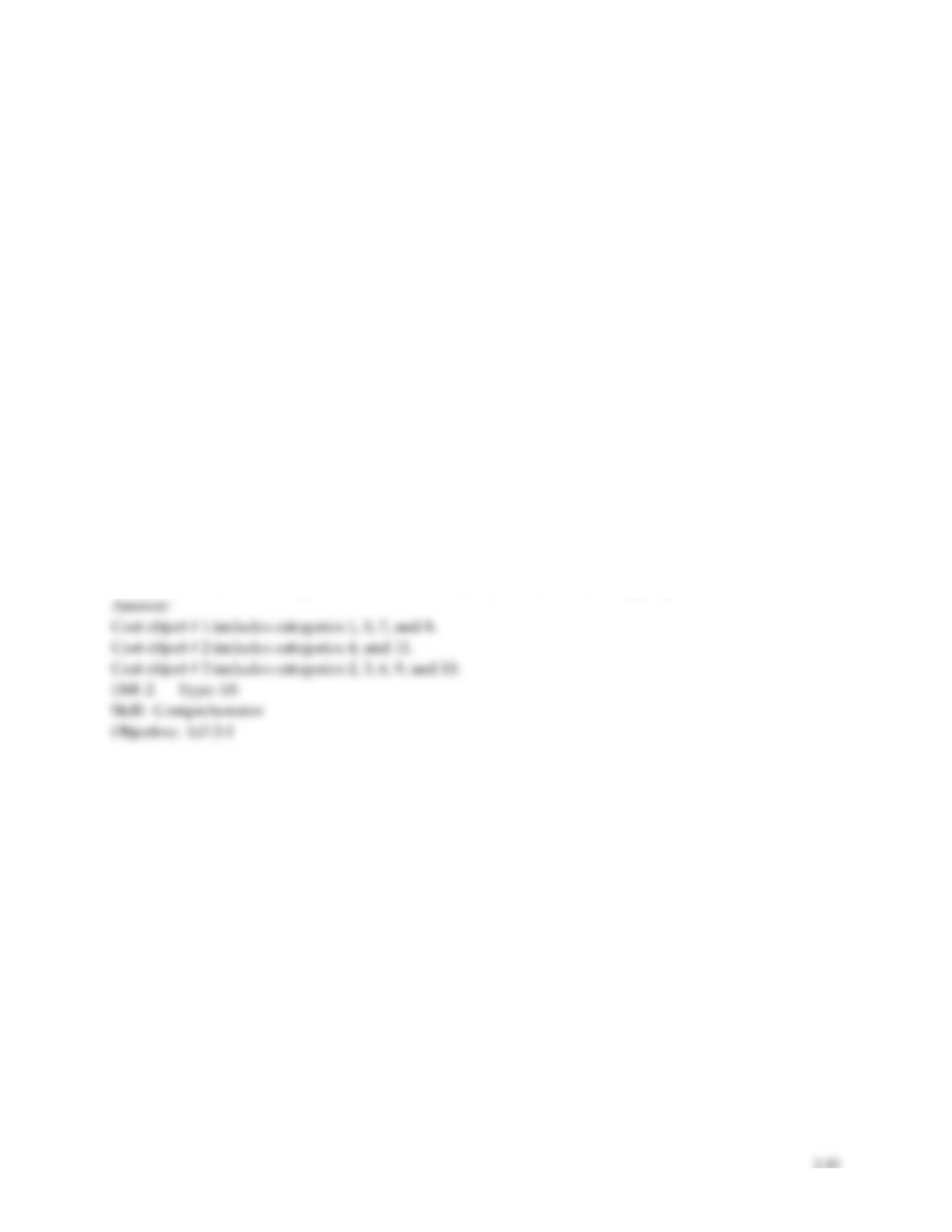
48) Sheen Manufacturing has three cost objects that it uses to assign costs in its manufacturing plants.
They are:
Cost object #1 The existence of buildings and equipment
Cost object #2 The use of buildings and equipment
Cost object #3 The availability and use of manufacturing labour
The following manufacturing overhead costs categories are found in the accounting records:
1. Amortization on buildings and equipment
2. Fringe benefits
3. Idle time wages
4. Lubricants for machines
5. Night security
6. Overtime premiums
7. Property insurance
8. Property taxes
9. Safety hats and shoes
10. Supervisor’s salaries
11. Utilities
Required:
Assign each of the cost categories to the one cost object you consider most appropriate.
Cost Accounting: A Managerial Emphasis, 6e
Chapter 2 – An Introduction to Cost Terms and Purposes
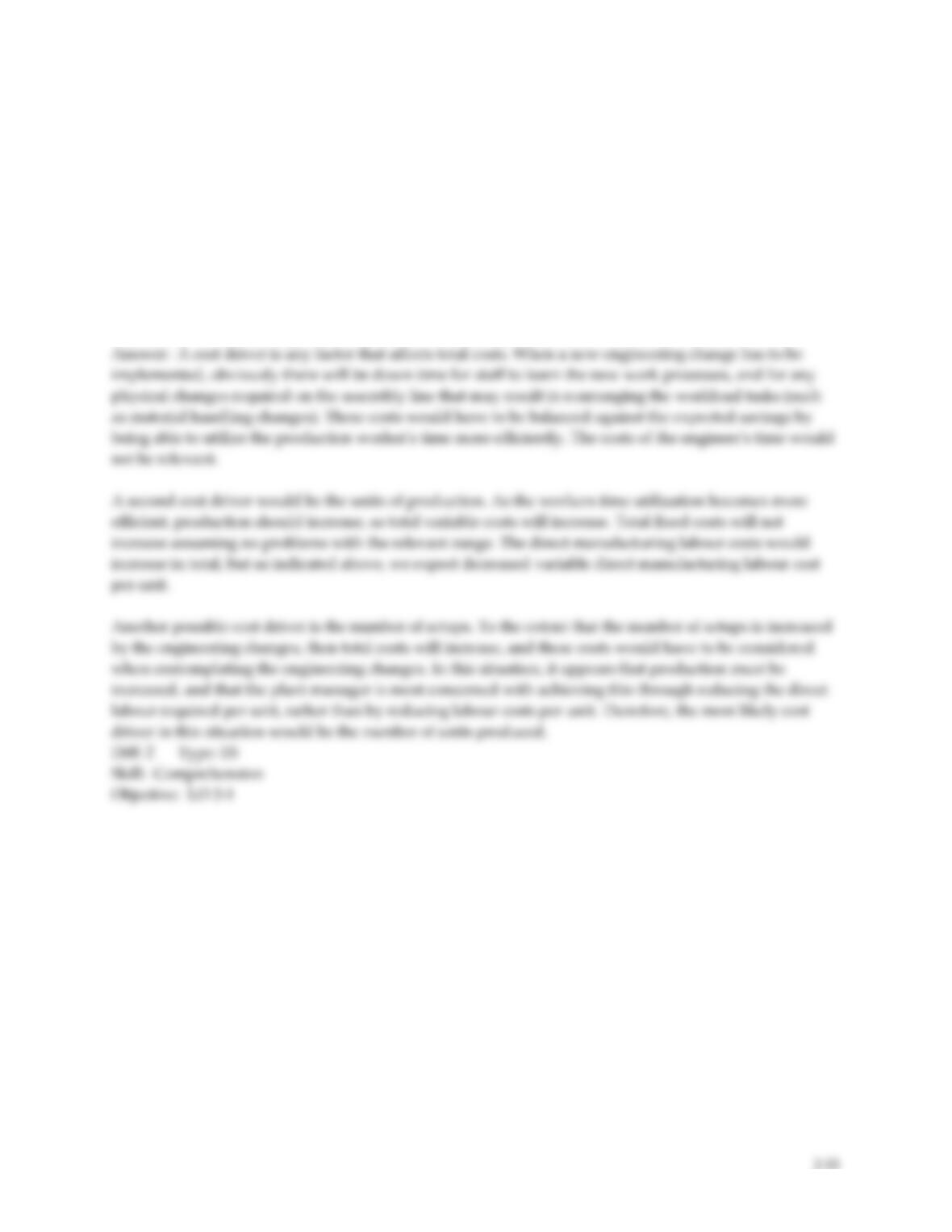
49) Eichhorn Company’s Process Engineering department has the responsibility of rearranging the
individual work tasks for each assembly line worker, with the goal of utilizing each worker as much as
possible. Currently, on average, each assembly line worker only has tasks that require 47 minutes per
hour, and the plant manager wants this increased by at least 10 %. The company builds the Eichhorn
Rocket Roadster, which is selling out of dealers’ showrooms faster than the company’s assembly plants
can produce them. If production can’t be increased, then sales will soon suffer.
Required:
Explain the effect on total costs of production, using the number of engineering changes (from Process
Engineering) and at least two other cost drivers. Choose the cost driver that you think is most logical in
the circumstances, and begin your answer with a brief explanation of a cost driver.
Cost Accounting: A Managerial Emphasis, 6e
Chapter 2 – An Introduction to Cost Terms and Purposes
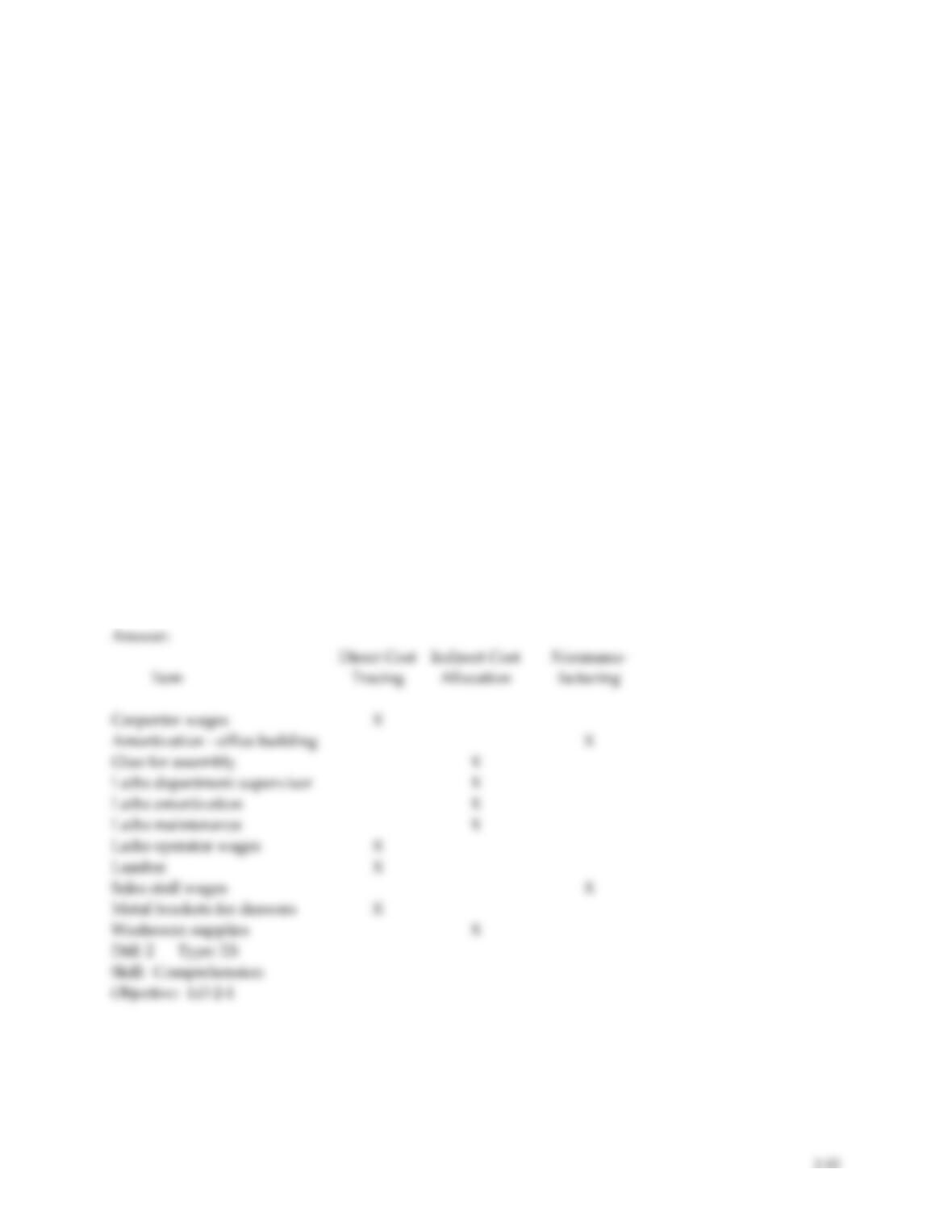
50) Office Supply Company manufactures office furniture. Recently the company decided to develop a
formal cost accounting system. The company is currently converting all costs into classifications as
related to its manufacturing processes.
Required:
For the following items, label each as being appropriate for
• direct cost tracing of the finished furniture,
• indirect cost allocation of an indirect manufacturing cost to the finished furniture, or
• as a nonmanufacturing item.
Direct Cost Indirect Cost Nonmanu-
Item Tracing Allocation facturing
Carpenter wages ________ ________ ________
Amortization – office building ________ ________ ________
Glue for assembly ________ ________ ________
Lathe department supervisor ________ ________ ________
Lathe amortization ________ ________ ________
Lathe maintenance ________ ________ ________
Lathe operator wages ________ ________ ________
Lumber ________ ________ ________
Sales staff wages ________ ________ ________
Metal brackets for drawers ________ ________ ________
Washroom supplies ________ ________ ________
Cost Accounting: A Managerial Emphasis, 6e
Chapter 2 – An Introduction to Cost Terms and Purposes
51) Lucas Manufacturing has three cost objects that it uses to accumulate costs for its manufacturing
plants. They are:
Cost object #1: The physical buildings and equipment
Cost object #2: The use of buildings and equipment
Cost object #3: The availability and use of manufacturing labour
The following manufacturing overhead cost categories are found in the accounting records:
a. Depreciation on buildings and equipment
b. Lubricants for machines
c. Property insurance
d. Supervisors’ salaries
e. Fringe benefits
f. Property taxes
g. Utilities
Required:
Assign each of the above costs to the most appropriate cost object.
2.2 Differentiate fixed from variable cost behaviour and explain the relationship of cost
behaviour to direct and indirect cost classifications.
1) A relevant range is the range of the cost driver in which a specific relationship between cost and driver
is valid.
2) Changes in particular cost drivers automatically result in decreases in overall costs.
3) A fixed cost is a cost that changes per unit as a cost driver changes.
Cost Accounting: A Managerial Emphasis, 6e
Chapter 2 – An Introduction to Cost Terms and Purposes
4) Total variable costs change in direct proportion to changes in cost drivers.
5) When defining variable and fixed costs, it is assumed that there is only one cost driver.
6) The variable cost per unit of a product should stay the same throughout the relevant range of
production.
7) An appropriate cost driver for shipping costs might be the number of units shipped.
8) Competition places an increased emphasis on cost reductions. For an organization to reduce costs it
must focus on
A) maximizing the cost allocation system.
B) reporting non-value added costs separately from value-added costs.
C) efficiently managing the use of the cost drivers in those value-added activities.
D) the cost allocation process.
E) reducing the number of cost drivers.
9) Which of the following statements about cost management is true?
A) It requires that managers actively strive to increase revenues.
B) It only focuses on inventoriable costs.
C) It is not affected by the organization’s customers.
D) It only applies to period costs.
E) It requires efficient management of the use of the cost drivers in the value-added activities.
Cost Accounting: A Managerial Emphasis, 6e
Chapter 2 – An Introduction to Cost Terms and Purposes
10) Which one of the following is a variable cost in a grocery store?
A) rent
B) president’s salary
C) inventory of vegetables
D) property taxes
E) administrative salaries
11) Which of the following statements is a fixed cost in a clothing store?
A) store manager’s salary
B) electricity
C) sales commissions
D) inventory
E) paper for the cash register
12) If each furnace required a hose that costs $20 and 2,000 furnaces are produced for the month, the
$40,000 total cost for hoses
A) is considered to be a direct fixed cost.
B) is considered to be a direct variable cost.
C) is considered to be an indirect fixed cost.
D) is considered to be an indirect variable cost.
E) is considered to be variable or fixed, depending on the relevant range.
Cost Accounting: A Managerial Emphasis, 6e
Chapter 2 – An Introduction to Cost Terms and Purposes
Use the information below to answer the following question(s).
Macadamia Co. produced and sold 40,000 units last year. Per unit revenue and costs were as follows:
Revenue
$100.00
Cost of Goods Sold:
Direct Materials
$15.00
Direct Labour
30.00
Variable Manufacturing Overhead
20.00
Fixed Manufacturing Overhead
10.00
Total Cost of Goods Sold
$75.00
Gross Margin
$25.00
Selling and Administrative Costs:
Sales Commissions (10% of Sales)
$10.00
Administrative Salaries
20.00
Total Selling and Administrative
$30.00
Operating Income <Loss>
<$5.00>
Fixed manufacturing overhead and administrative salaries are fixed costs. The per unit amounts are
based on last year’s production.
13) Calculate last year’s operating income when the company produced and sold 40,000 units.
A) $0
B) $<200,000>
C) $<500,000>
D) $<800,000>
E) $<1,000,000>
14) Calculate this year’s operating income if the company plans to produce and sell 50,000 units.
A) $50,000
B) $0
C) $<250,000>
D) $<550,000>
E) $250,000
Cost Accounting: A Managerial Emphasis, 6e
Chapter 2 – An Introduction to Cost Terms and Purposes
15) Calculate this year’s operating income if the company plans to produce and sell 60,000 units.
A) $150,000
B) $0
C) $<300,000>
D) $<650,000>
E) $300,000
16) Cost behaviour refers to
A) how costs react to a change in the level of activity.
B) whether a cost is incurred in a manufacturing, merchandising, or service company.
C) classifying costs as either inventoriable or period costs.
D) whether a particular expense has been ethically incurred.
E) how costs react to a change in selling price.
17) A mixed cost is
A) a fixed cost.
B) a cost with fixed and variable elements.
C) a variable cost.
D) always an indirect cost.
E) a cost with direct and indirect elements.
18) Variable costs
A) are always indirect costs.
B) increase in total when the actual level of activity increases.
C) include most personnel costs and depreciation on machinery.
D) can always be traced directly to the cost object.
E) change in relation to selling price.
Cost Accounting: A Managerial Emphasis, 6e
Chapter 2 – An Introduction to Cost Terms and Purposes
19) The relevant range is important because
A) it specifies which costs should be used for a given decision.
B) it provides a basis for determining a range of acceptable cost alternatives.
C) it is required to determine inventoriable costs under Canadian GAAP.
D) it specifies the limits beyond which the relationship of cost to cost drivers may not be valid.
E) it determines the time horizon.
20) Which of the following statements about the key features of cost accounting and cost management is
true?
A) When making decisions about what products to produce, managers need to know how revenue and
costs vary with changes in output levels.
B) Managers need to understand that period costs remain the same from one period to the next.
C) The costing system allocates direct costs and traces indirect costs to products.
D) When making decisions, managers must understand that all revenue and costs are relevant.
E) Cost accounting is used for managerial decision making, not for financial statements.
21) Fixed costs
A) may include either direct or indirect costs.
B) vary with production or sales volumes.
C) include parts and materials used to manufacture a product.
D) can be adjusted in the short run to meet actual demands.
E) remain fixed regardless of the relevant range of production.
22) Fixed costs depend on the
A) amount of resources used.
B) amount of resources acquired.
C) volume of production.
D) volume of sales.
E) allocation method.
Cost Accounting: A Managerial Emphasis, 6e
Chapter 2 – An Introduction to Cost Terms and Purposes
23) Which one of the following is a variable cost for an insurance company?
A) rent
B) president’s salary
C) sales commissions
D) property taxes
E) amortization on the office equipment
24) Which of the following is a fixed cost for an automobile manufacturing plant?
A) amortization on factory equipment
B) electricity used by assembly-line machines
C) sales commissions
D) windows for each car produced
E) labour cost of assembly line workers
Cost Accounting: A Managerial Emphasis, 6e
Chapter 2 – An Introduction to Cost Terms and Purposes
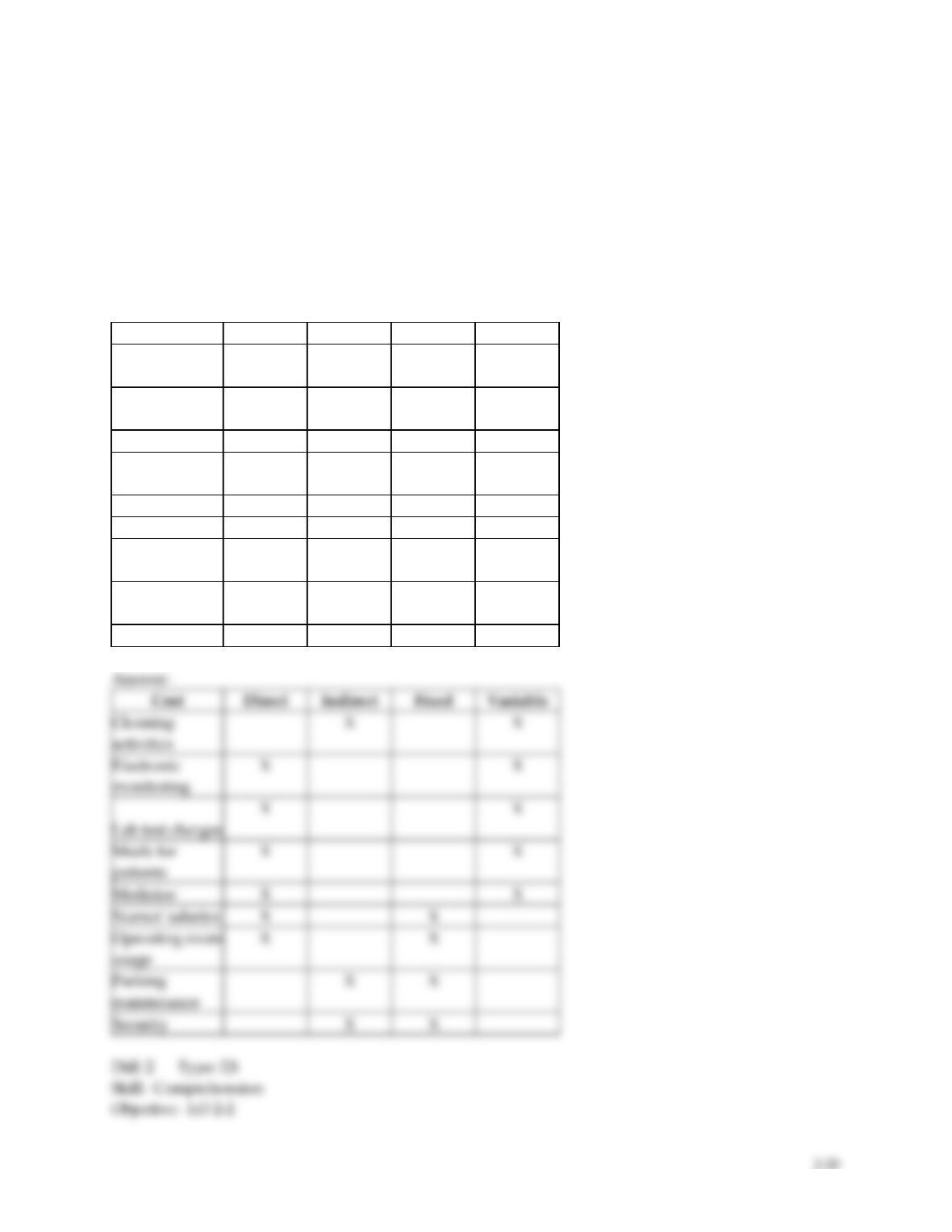
25) Boone Hospital wants to determine, to the extent possible, the actual cost for each patient stay. It is a
general health care facility with all basic services but does not perform specialized services such as organ
transplants.
Required:
Complete the following table by
a. Classifying each cost as a direct or indirect cost with respect to each patient.
b. Classifying each item as fixed or variable with respect to the number of patient days (sum of days
each patient was in hospital) the hospital incurs.
Cost
Direct
Indirect
Fixed
Variable
Cleaning
activities
Electronic
monitoring
Lab test charges
Meals for
patients
Medicine
Nurses’ salaries
Operating room
usage
Parking
maintenance
Security
Cleaning
activities
Electronic
monitoring
Lab test charges
Meals for
patients
Medicine
Nurses’ salaries
Operating room
usage
Parking
maintenance
Security