Chapter 02 – Cells and Cell Division
True / False
1. Mitotic divisions reduce the number of chromosomes found in daughter cells.
a.
True
b.
False
False
2. Cytokinesis usually occurs just prior to mitosis.
a.
True
b.
False
False
3. Autosomal chromosome pairs are identical, whereas the sex chromosome pair in males is not.
a.
True
b.
False
True
functions.
4. Crossing over is partially responsible for our genetic diversity.
a.
True
b.
False
True
of genes.
5. Random assortment occurs between chromatids of homologous chromosome pairs.
a.
True
b.
False
False
of genes.
6. A polar body, once formed, has no further function and dies.
a.
True
b.
False
True
7. One treatment for Gaucher disease is enzyme replacement therapy.
a.
True
b.
False
True
8. Primary oocytes and spermatogonia are both haploid cells.
a.
True
b.
False
False
9. The four macromolecules making up our cells allow for the same structure and function across all cells in the body.
a.
True
b.
False
False
10. Mitosis is a process that is unique to humans.
a.
True
b.
False
False
11. The process of meiosis results in ____.
a.
the production of four identical cells
b.
no change in the chromosome number from parental cells
c.
a doubling of the chromosome number
d.
a reduction in the chromosome number
e.
two diploid cells
d
Bloom’s: Understand
2-6 Cell Division by Meiosis: The Basis of Sex
occurs at each stage.
12. In the cell cycle, the G1 phase represents ____.
a.
the stage of DNA synthesis
b.
splitting of the chromosomes into chromatids
c.
a period of growth
d.
the stage of actual cell division
e.
the stage just prior to meiosis
Bloom’s: Understand
2-4 The Cell Cycle Describes the Life History of a Cell
13. Ribosomes are organelles that are involved in ____.
a.
plasma membrane selectivity
b.
cellular energy production
c.
protein synthesis
d.
transport of materials
e.
DNA replication
Bloom’s: Understand
2-3 Cell Structure Reflects Function
14. Which genetic diseases involve defects in DNA repair that affect cell division?
a.
Gaucher disease and Werner syndrome
b.
Kearns-Sayre syndrome and progeria
c.
progeria and Gaucher disease
d.
Gaucher disease and cystic fibrosis
e.
progeria and Werner syndrome
15. Autosomes represent ____.
a.
all chromosomes including the sex chromosomes
b.
the half of the chromosomes inherited from one parent
c.
all chromosomes other than the sex chromosomes
d.
chromosome pairs with unlike members
e.
those chromosomes found only in gametes
Bloom’s: Understand
2-3 Cell Structure Reflects Function
16. During meiosis in an organism where 2n = 8, how many chromatids will be present in a cell at the beginning of
meiosis II?
a.
2
b.
4
c.
6
d.
8
e.
12
d
Bloom’s: Understand
2-6 Cell Division by Meiosis: The Basis of Sex
occurs at each stage.
17. The Hayflick limit describes ____.
a.
the size limit to which a cell can grow
b.
the number of divisions a cultured cell can undergo
c.
the largest number of chromosomes an organism can possess
d.
the most cells an organism can have
e.
how rapidly DNA replication can occur
b
Bloom’s: Remember
2-5 Mitosis Is Essential for Growth and Cell Replacement
and identify possible consequences when cell cycle regulation is interrupted.
18. In meiosis, homologous chromosomes separate in ____.
a.
metaphase I
b.
anaphase I
Bloom’s: Remember
2-5 Mitosis Is Essential for Growth and Cell Replacement
and identify possible consequences when cell cycle regulation is interrupted.
Chapter 02 – Cells and Cell Division
c.
metaphase II
d.
anaphase II
e.
telophase
b
Bloom’s: Understand
2-4 The Cell Cycle Describes the Life History of a Cell
of each stage.
19. A cell that cannot form spindle fibers cannot ____.
a.
engage in energy production
b.
exchange gases across the plasma membrane
c.
perform mitosis nor meiosis
d.
perform DNA replication
e.
engage in protein synthesis
c
Bloom’s: Understand
Basis of Sex
of each stage.
20. A cell in G0 state ____.
a.
is actively growing before cell division begins
b.
has a cleavage furrow and the cytoplasm is beginning to divide
c.
is actively replicating chromosomes
d.
is in cytokinesis
e.
has entered a resting stage and is not actively dividing
e
Bloom’s: Understand
2-4 The Cell Cycle Describes the Life History of a Cell
and cytokinesis.
21. A centromere is least likely to ____.
a.
divide in anaphase of mitosis
b.
connect sister chromatids
c.
attach chromosomes to spindle fibers
d.
cross over during prophase I of meiosis
e.
be a component of DNA
d
Bloom’s: Understand
Basis of Sex
HUHE.CUMM.16.2-4-3 – Outline the four stages of mitosis and describe the characteristics
22. The underlying problem in Gaucher disease is ____.
a.
the spontaneous breakdown of red blood cells
b.
the accumulation of fat in white blood cells
c.
the breakdown of the myelin sheath around nerves
d.
a hypertrophied spleen
e.
the lack of critical liver enzymes
b
Bloom’s: Remember
2-1 Cellular Links to Genetic Disease
explain how structure and function are interrelated in each.
23. Which biomolecule is most associated with the structure and function of cell membranes?
a.
Polysaccharides
b.
steroids
c.
DNA
d.
phospholipids
e.
ATP
d
Bloom’s: Understand
2-2 The Chemistry of Cells
explain how structure and function are interrelated in each.
24. Proteins function ____.
a.
as energy carriers
b.
as the ‘backbone’ of the DNA molecule
c.
as component parts of enzymes
d.
in energy storage within the cell nucleus
e.
in transmission of genetic information
c
Bloom’s: Understand
2-3 Cell Structure Reflects Function
functions.
25. Ribosomes are most closely associated with ____.
a.
the Golgi complex
b.
lysosomes
c.
mitochondria
d.
smooth endoplasmic reticulum
of each stage.
Chapter 02 – Cells and Cell Division
e.
the cytoplasm and rough endoplasmic reticulum
e
Bloom’s: Understand
2-3 Cell Structure Reflects Function
functions.
26. In meiosis, cells become haploid ____.
a.
at the end of telophase I
b.
during metaphase I
c.
during anaphase I
d.
at the beginning of metaphase II
e.
at the end of prophase II
a
Bloom’s: Understand
2-6 Cell Division by Meiosis: The Basis of Sex
occurs at each stage.
27. In meiosis of oogenesis, how many mature eggs result?
a.
one
b.
two
c.
three
d.
four
e.
five
a
Bloom’s: Understand
2-7 Formation of Gametes
28. During spermatogenesis in meiosis II, ____ form(s).
a.
primary spermatocytes
b.
secondary spermatocytes
c.
spermatids
d.
mature sperm
e.
a zygote
c
Bloom’s: Understand
2-7 Formation of Gametes
29. A rare genetic disorder called Gaucher disease may strike as many as one in 450 people of ____ descent.
a.
Middle Eastern
Chapter 02 – Cells and Cell Division
b.
Western European
c.
African American
d.
British
e.
Eastern European
e
Bloom’s: Remember
2-1 Cellular Links to Genetic Disease
influenced by genetic information.
30. Macromolecules including sugars, glycogen, and starches composed of sugar monomers linked and cross-linked
together are known as ____.
a.
carbohydrates
b.
lipids
c.
proteins
d.
fatty acids
e.
nucleic acids
a
Bloom’s: Understand
2-2 The Chemistry of Cells
explain how structure and function are interrelated in each.
31. Carbohydrates ____.
a.
act as energy sources for cells
b.
include fats and oils
c.
are made of nucleic acids
d.
act as protein builders
e.
are also called steroids
a
Bloom’s: Understand
2-2 The Chemistry of Cells
explain how structure and function are interrelated in each.
32. Large cellular polymers assembled by chemically linking monomers together are called ____.
a.
carbohydrates
b.
lipids
c.
proteins
d.
nucleic acids
e.
macromolecules
e
Bloom’s: Remember
2-2 The Chemistry of Cells
HUHE.CUMM.16.2-2-1 – List the four classes of macromolecules that make up cells and
Chapter 02 – Cells and Cell Division
Completion
33. There are ____________________ autosomes present in a human sperm cell.
34. The chromosomal structure that anchors the spindle fiber to the chromosome is known as the
____________________.
35. In mitosis, chromatids separate and move to the center of the cell during ____________________.
36. In meiosis, sister chromatids separate and move to opposite poles of the spindle during ____________________.
37. In cell division, toward the end of nuclear division, the cytoplasm divides by a process called ____________________
to produce two identical cells.
38. The only cytoplasmic organelles in animal cells aside from nuclei that contain DNA are ____________________.
39. The series of flattened sacs and associated vesicles in the cytoplasm of a cell is the ____________________.
40. Cells are largely constructed from four classes of large molecules called ____________________.
41. The condition in which each chromosome is represented twice as a member of a homologous pair is called
____________________.
2n
42. ____________________ is a symptom of Gaucher disease (indicate any one).
43. ____________________ is used to diagnose and treat genetic disorders.
44. Lipids are a class of cellular macromolecules that are ____________________ in water.
Chapter 02 – Cells and Cell Division
45. In both progeria and Werner syndrome, cells are switched from a growth to a maintenance mode, halting
____________________.
46. Identical gene loci are located on ____________________.
47. The two types of nucleic acids are ____________________ and ____________________.
48. There are two cellular domains: the ____________________ and the ____________________.
49. The three parts of interphase, in order, are ____________________, ____________________, and
____________________.
50. Sister chromatids are joined by a common centromere and each carries identical ____________________.
Essay
51. Describe the two ways in which meiosis produces new combinations of genes.
52. Compare and contrast the events and results of oogenesis and spermatogenesis.
53. Should the cost of treatment for a genetic disorder be an important consideration for insurance companies when
deciding whether or not to cover the treatment? Justify your reasoning.
54. List the four macromolecules that make up cells and give a brief description of the structure and function of each.
55. Explain the structure and function of the cell nucleus. Include the terms nuclear envelope, nucleoli, chromatin,
chromosomes, autosomes, and sex chromosomes.
56. Briefly summarize the four phases of mitosis and cytokinesis.
57. Define interphase and describe its three stages.
58. Some cells retain the capacity to divide throughout their life cycle, whereas others do not divide in adulthood. Give
one example of each type.
59. Explain the major difference between daughter cells formed by mitosis and those formed by meiosis. What occurs
when two daughter cells formed during meiosis fuse?
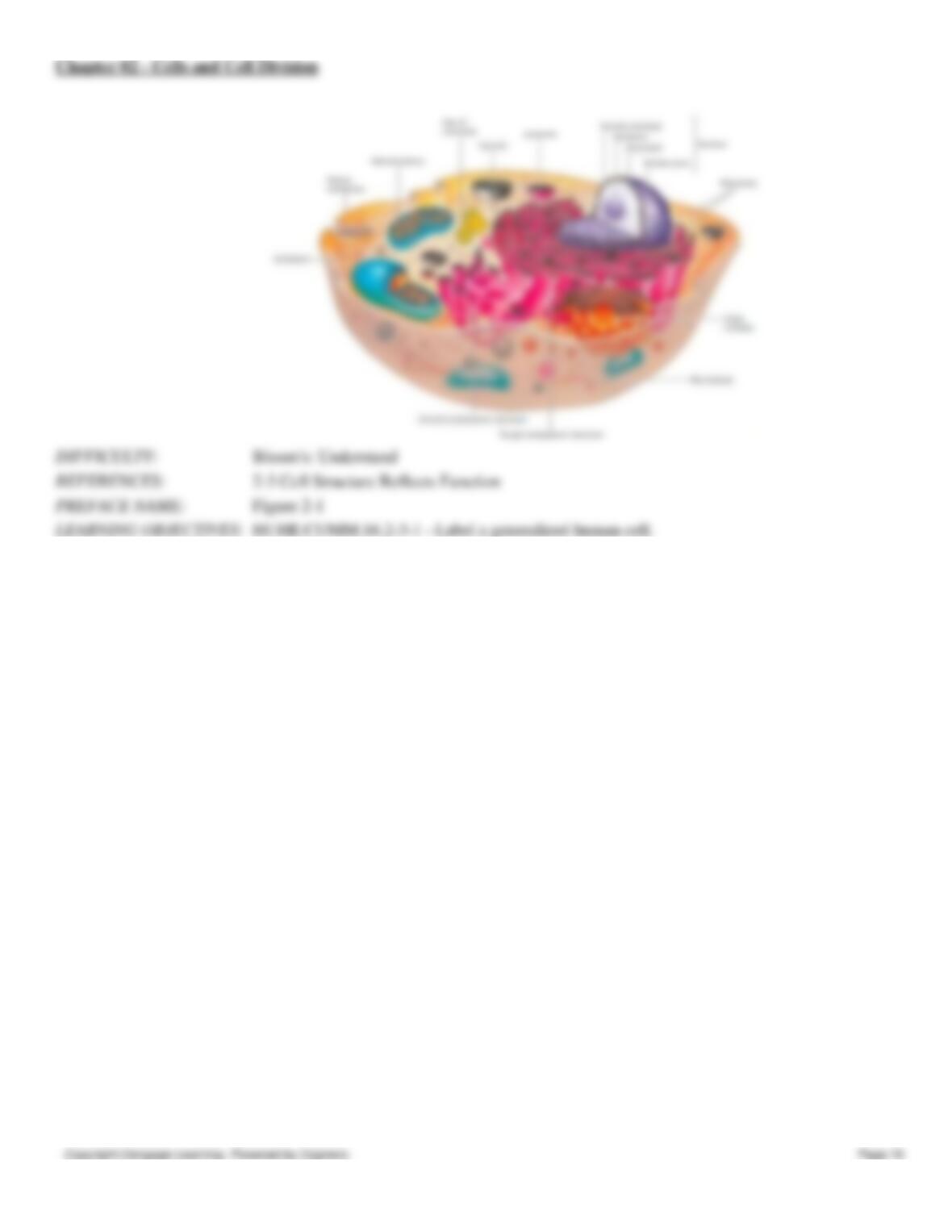
60. All cells are fundamentally similar at a structural level. Using the accompanying diagram of a generalized human cell,
name as many of the numbered labels as you can to illustrate this idea.