Chapter 2: Analyzing Transactions
167.
The accounts in the ledger of Monroe Entertainment Co. are listed below. All accounts have normal balances.
Accounts Payable
$1,500
Fees Earned
$3,600
Accounts Receivable
1,800
Insurance Expense
1,300
Prepaid Insurance
2,000
Land
3,000
Cash
3,200
Wages Expense
1,400
Drawing
1,200
Capital
8,800
Prepare a trial balance. The total of the debits is
a. $13,900
b. $11,200
c. $12,700
d. $9,700
168.
Of the following, which is an internal report that will determine if debit balances equal credit balances in
the
ledger?
a.
chart of accounts
b.
income statement
c.
trial balance
d.
account reconciliation
Chapter 2: Analyzing Transactions
169.
An overpayment error was discovered in computing and paying the wages of a Jamison Tree Trimming
employee. When Jamison receives cash from the employee for the amount of the overpayment, which of the
following entries will Jamison make?
a.
Cash, debit; Wages Expense, credit
b.
Wages Payable, debit; Wages Expense, credit
c.
Wages Expense, debit, Cash, credit
d.
Cash, debit; Wages Payable, credit
170.
If the two totals of a trial balance are not equal, it could be due to
a.
failure to record a transaction
b.
recording the same erroneous amount for both the debit and the credit parts of a transaction
c.
an error in determining the account balances, such as a balance being incorrectly computed
d.
recording the same transaction more than once
171.
When a transposition error is made on the trial balance, the difference between the debit and credit totals on
the
trial balance will be
a.
zero
b.
twice the amount of the transposition
c.
one-half the amount of the transposition
d.
divisible by 9
Chapter 2: Analyzing Transactions
172.
Which of the following errors, each considered individually, would cause the trial balance totals to be unequal?
a.
A transaction was not posted.
b.
A payment of $67 for insurance was posted as a debit of $76 to Prepaid Insurance and a credit of $76 to
Cash.
c.
A payment of $4,450 to a creditor was posted as a debit of $4,500 to Accounts Payable and a credit of
$450
to Cash.
d.
Cash received from customers on account was posted as a debit of $720 to Cash and a credit of $720 to
Accounts Payable.
173.
Which of the following errors will cause the trial balance totals to be unequal?
a.
posting the debit portion of a journal entry incorrectly when the credit portion of the entry is correctly posted
b.
failure to record a transaction or to post a transaction
c.
recording the same transaction more than once
d.
recording the same erroneous amount for both the debit and the credit parts of a transaction
Chapter 2: Analyzing Transactions
174.
The trial balance is out of balance and the accountant suspects that a transposition or slide error has
occurred. What will the accountant do to confirm this suspicion?
a.
Determine the amount of the error and look for that amount on the trial balance.
b.
Determine the amount of the error and divide by two, then look for that amount on the trial balance.
c.
Determine the amount of the error and refer to the journal entries for that amount.
d.
Determine the amount of the error and divide by nine. If the result is evenly divided, then this type of error
is
likely.
175.
The purchase of supplies on account was recorded and posted as a debit to Supplies for $500 and a credit to
Accounts Receivable for $500. The correcting entry would include a:
a.
credit to Accounts Receivable for $500 b. credit to Accounts Receivable for $1,000
c.
credit to Accounts Payable for $500 d. credit to Accounts Payable for $1,000
176.
Which of the following is not a useful step in finding errors on the trial balance?
a.
Determine the difference between debits and credits and look for the amount.
b.
Determine the difference between debits and credits and change any account to make the trial balance
correct.
c.
Determine the difference between debits and credits, divide the amount by 2, and look for the amount.
d.
Determine the difference between debits and credits, divide the amount by 9, and if it divides evenly, look
for
a transposition or slide error.
Chapter 2: Analyzing Transactions
177.
All of the following statements regarding a horizontal analysis are true except:
a.
A horizontal analysis is used to compare an item in a current statement with the same item in
prior
statements.
b.
A horizontal analysis can be performed on a balance sheet and income statement, but not on a statement of
cash flows.
c.
If fees earned in Year 1 are $125,000 and fees earned in Year 2 are $143,750, a horizontal analysis
will
indicate a 15% increase over this period.
d.
When two statement s are compared in horizontal analysis, the earlier statement is used as the base
for
computing the amount and the percent of change.
178.
McNally Industries has a condensed income statement as shown.
Year 2
Year 1
Sales
$198,000
$165,500
Total operating expenses
163,000
147,500
Net income
35,000
18,000
Using horizontal analysis, calculate the amount and percent change for sales. Round to one decimal
place.
a. $32,500, 19.6% b. $18,000, 10.9%
c. $35,000, 17.7% d. $17,000, 9.4%
Chapter 2: Analyzing Transactions
179.
Richardson Company has a condensed income statement as shown.
Year 2
Year 1
Sales
$150,000
$165,500
Total operating expenses
133,000
147,500
Net income
17,000
18,000
Using horizontal analysis, calculate the amount and percent change for sales. Round to one decimal
place.
a. $(17,000), (11.3%) b. $(15,500), (10.3%)
c. $(18,000), (10.9%) d. $(15,500), (9.4%)
180.
The chart of accounts classifies the accounts to make identification of the accounts easier. Describe the numbering
system businesses use in setting up the chart of accounts.
Chapter 2: Analyzing Transactions
181.
On January 1, Cassie Harris established a catering service. Listed below are accounts she would like to open in
the general ledger. List the accounts in the order in which they should appear in the ledger and propose a two
digit
account numbering scheme that is consistent with the rules of a proper chart of accounts.
1.
Cash
2.
Supplies
3.
Equipment
4.
Accounts Payable
5.
Cassie Harris, Capital
6.
Wages Expense
7.
Rent Expense
8.
Truck
9.
Utilities Expense
10.
Cassie Harris, Drawing
11.
Truck Expense
12.
Prepaid Insurance
13.
Fees Earned
14.
Miscellaneous Expense
15.
Insurance Expense
16.
Notes Payable
17.
Accounts Receivable
Chapter 2: Analyzing Transactions
182.
On January 31, the cash account balance was $96,750. During January, cash receipts totaled $305,000 and
cash
payments totaled was $375,880. Determine the cash balance on January 1.
183.
Organize the following accounts into the usual sequence of a chart of accounts.
Miscellaneous Expense
Accounts Payable
Accounts Receivable
Cash
Alecia Morris, Capital
Fees Earned
Prepaid Rent
Salaries Expense
Unearned Revenue
Alecia Morris, Drawing
Chapter 2: Analyzing Transactions
184.
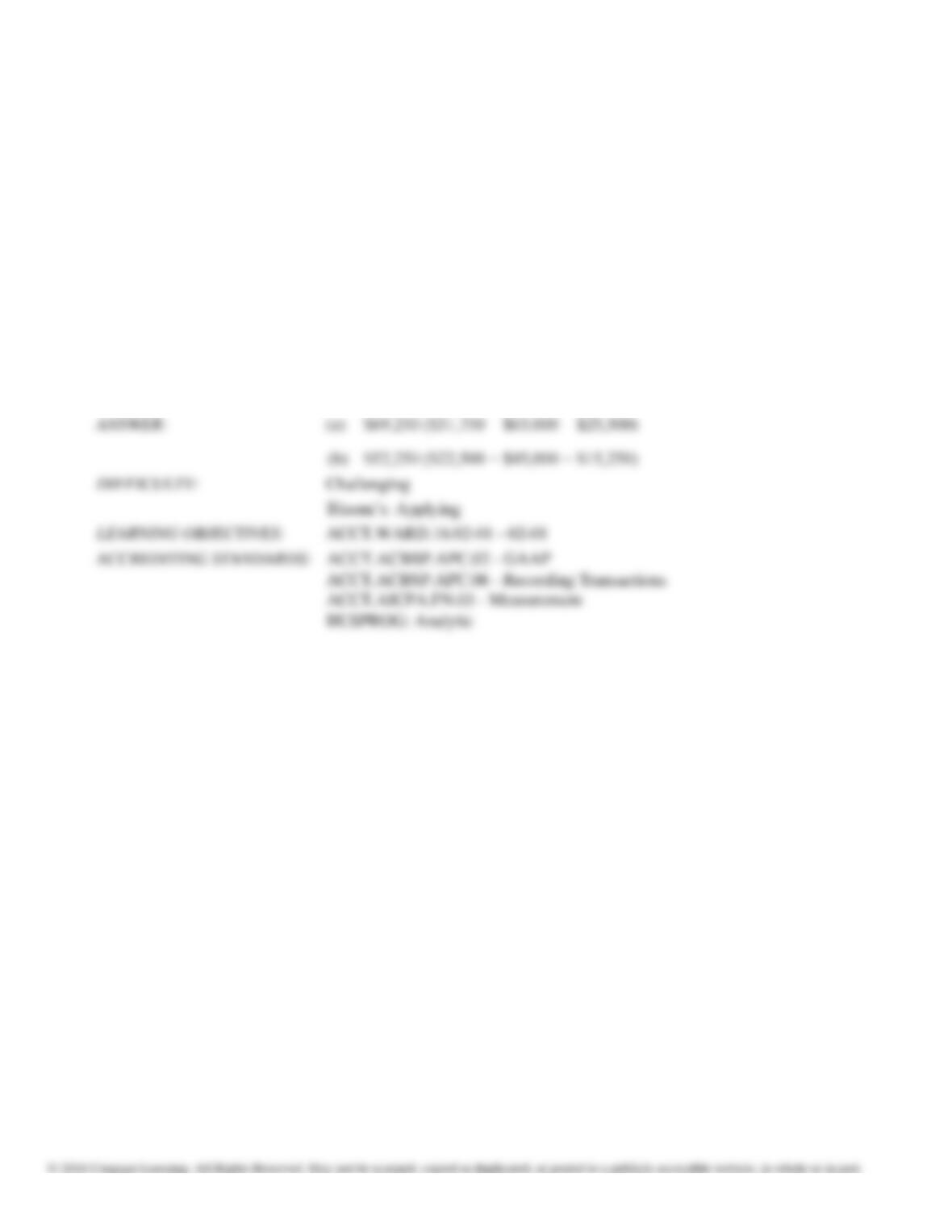
Calculate the following:
(a)
Determine the cash receipts for April based on the following data:
Cash payments during April
$63,000
Cash account balance, April 1
25,500
Cash account balance, April 30
31,750
(b)
Determine the cash received from customers on account during April based
on
the following data:
Accounts receivable account balance, April 1 $22,500
Accounts receivable account balance, April 30 15,250
Fees billed to customers during April 45,000
Chapter 2: Analyzing Transactions
185.
Selected accounts from the ledger of Garrison Company appear below. For each account, indicate the following:
(a)
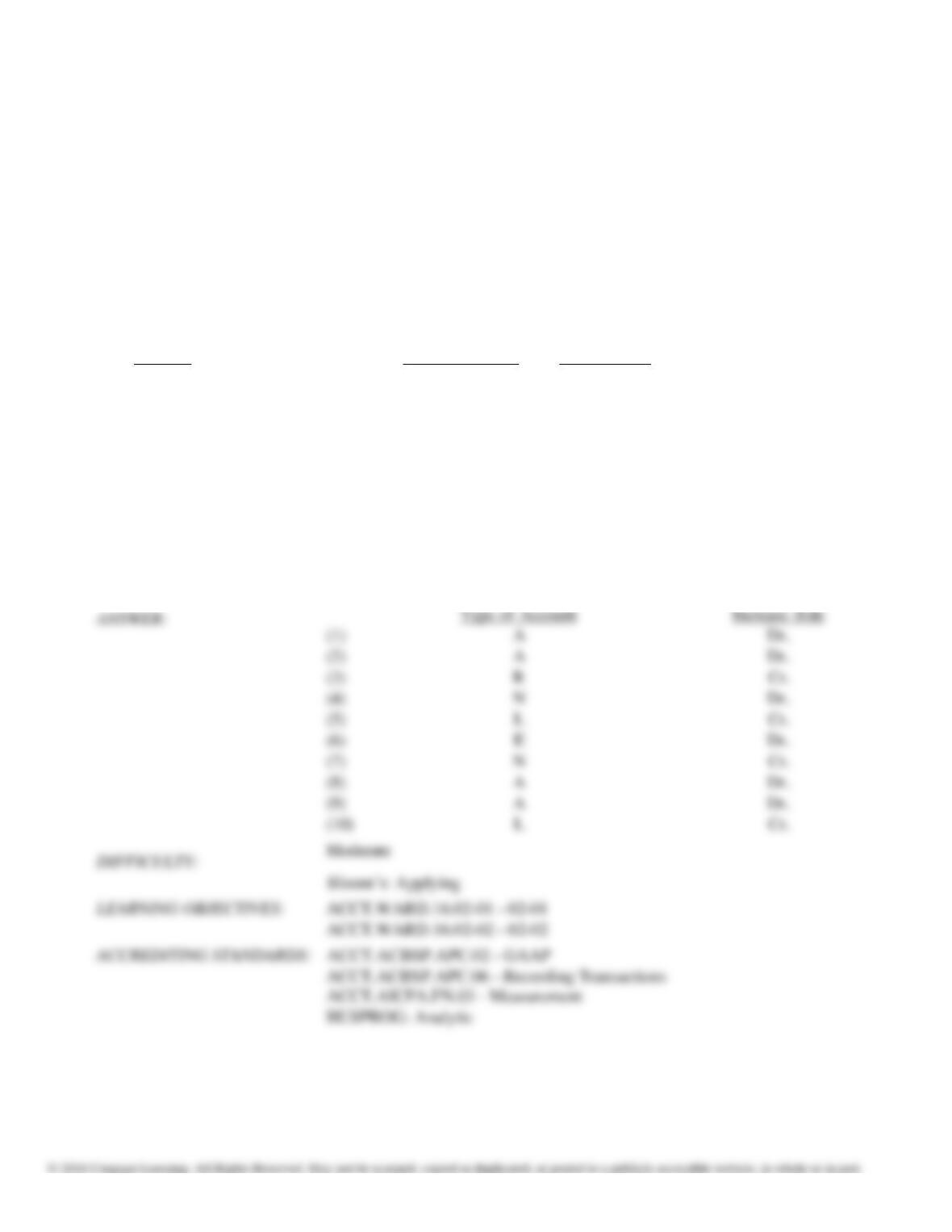
In the first column at the right, indicate the nature of each account, using the
following abbreviations:
Asset – A Revenue – R
Liability – L Expense – E
None of the above – N
(b)
In the second column, indicate the increase side of each account by
inserting
Dr. or Cr.
Account
Type of Account
Increase Side
(1)
Supplies
_______
________
(2)
Notes Receivable
_______
________
(3)
Fees Earned
_______
________
(4)
Garrison, Drawing
_______
________
(5)
Accounts Payable
_______
________
(6)
Salaries Expense
_______
________
(7)
Garrison, Capital
_______
________
(8)
Accounts Receivable
_______
________
(9)
Equipment
_______
________
(10)
Notes Payable
_______
________
Chapter 2: Analyzing Transactions
186.
All nine transactions for Dalton Survey Company for September, the first month of operations, are recorded in
the
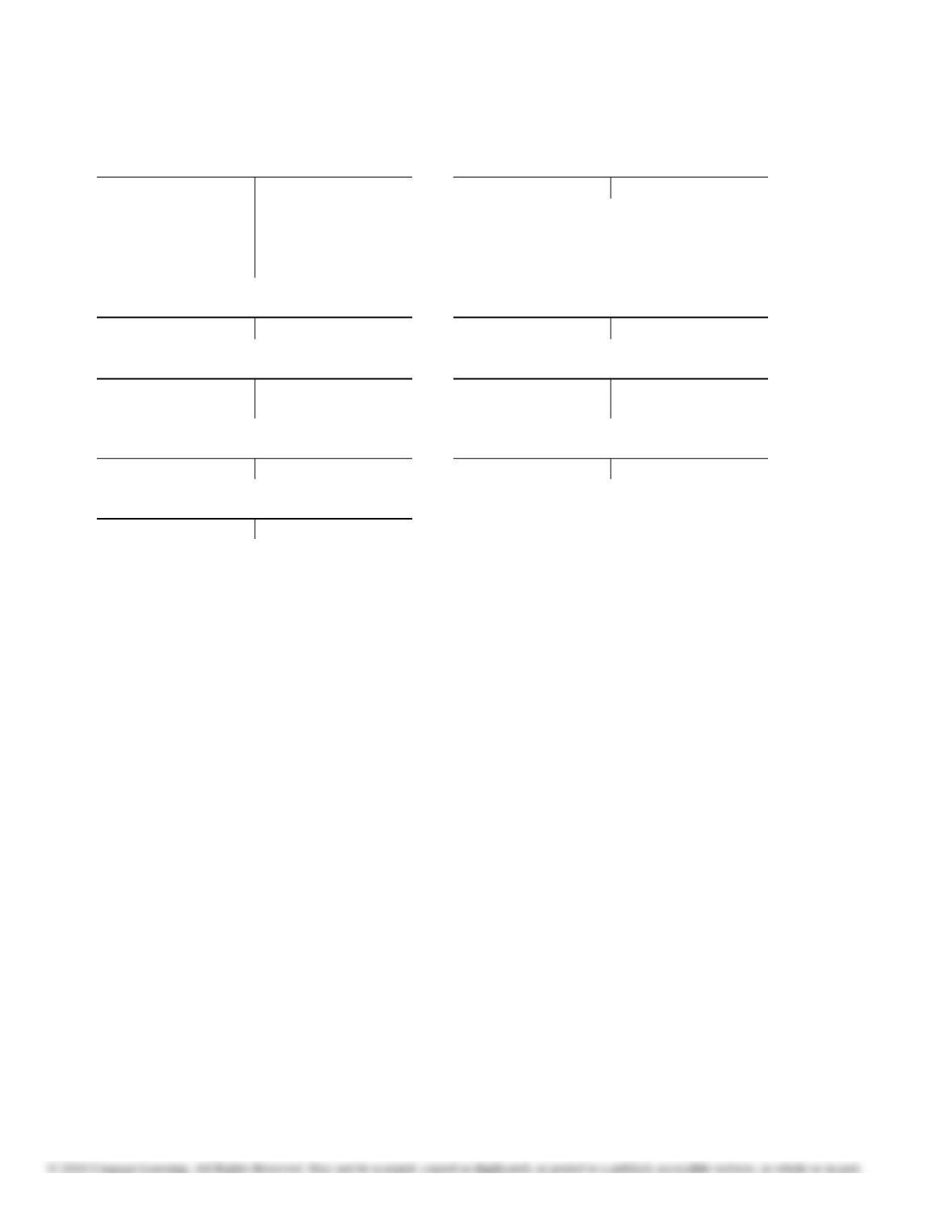
following T accounts:
Cash
Michael Dalton, Capital
(1)
20,000
(3)
7,500
(1)
20,000
(7)
6,900
(5)
2,600
(9)
4,700
(6)
5,500
(8)
2,000
Accounts Receivable
Michael Dalton, Drawing
(4)
4,900
(9)
4,700
(8)
2,000
Supplies
Fees Earned
(3)
7,500
(4)
4,900
(7)
6,900
Equipment
Operating Expense
(2)
4,500
(6)
5,500
Accounts Payable
(5)
2,600
(2)
4,500
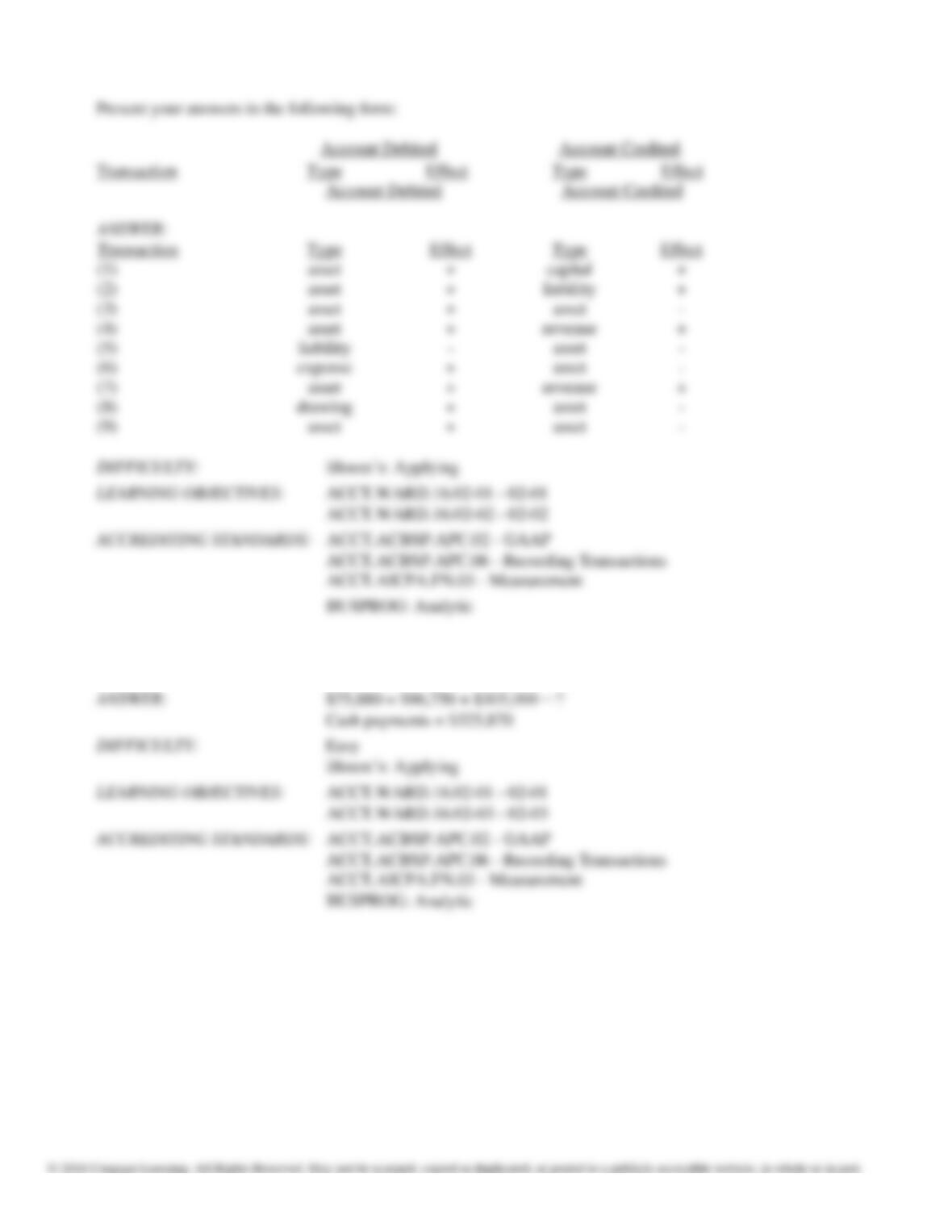
Indicate the following for each debit and each credit:
(a)
The type of account affected (asset, liability, capital, drawing, revenue,
or
expense).
(b)
The effect on the account, using “+” for increase and “−” for decrease.
Chapter 2: Analyzing Transactions
187.
On June 1, the cash account balance was $96,750. During June, cash receipts totaled $305,000 and the June 30
balance was $75,880. Determine the cash payments made during June.
Chapter 2: Analyzing Transactions
188.
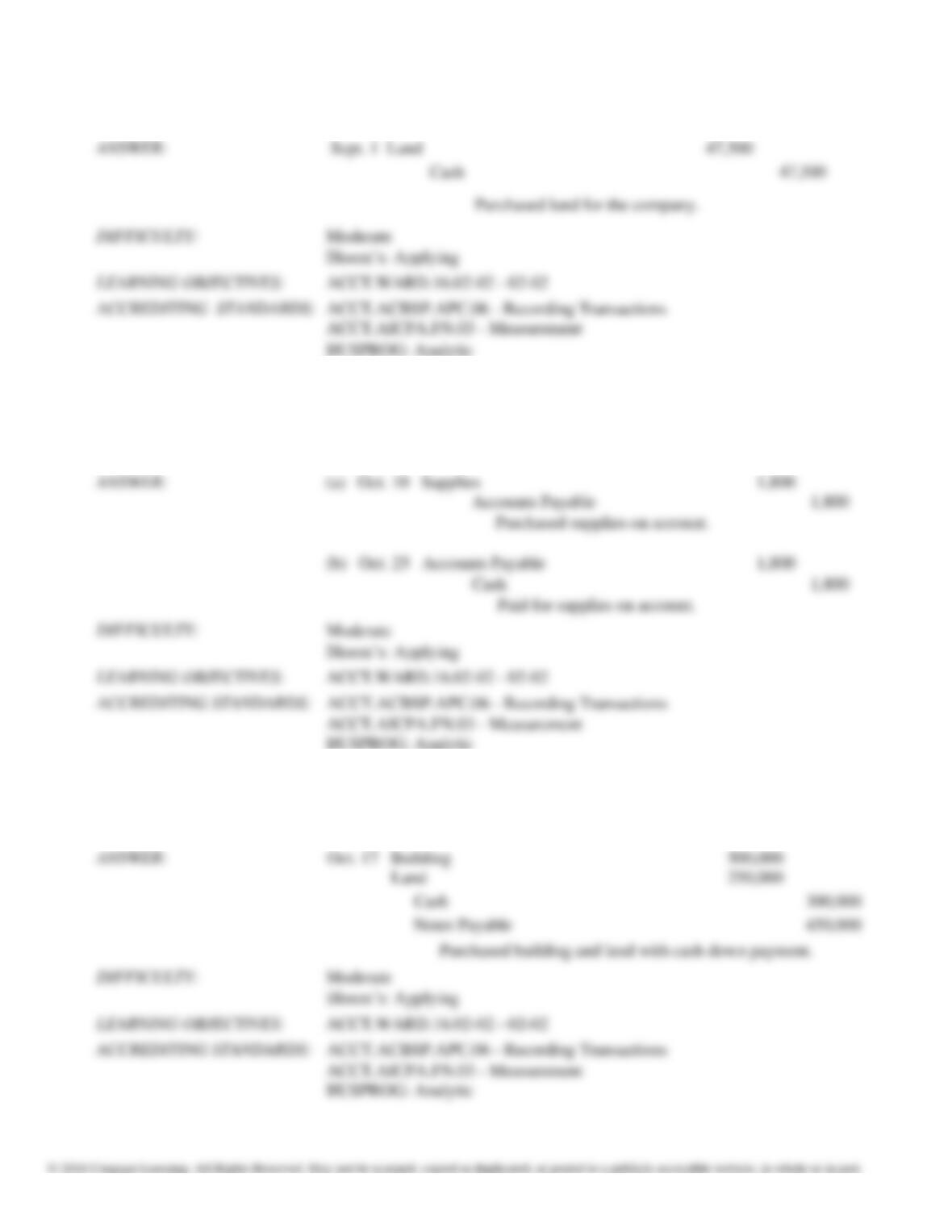
On September 1, Erika Company purchased land for $47,500 cash. Provide the journal entry for this transaction.
189.
On October 10, Nikle Company purchased supplies for $1,800 on account. On October 25, Nikle Company paid
the
invoice.
(a) Provide the journal entry for the purchase on account.
(b) Provide the journal entry for the payment of the invoice.
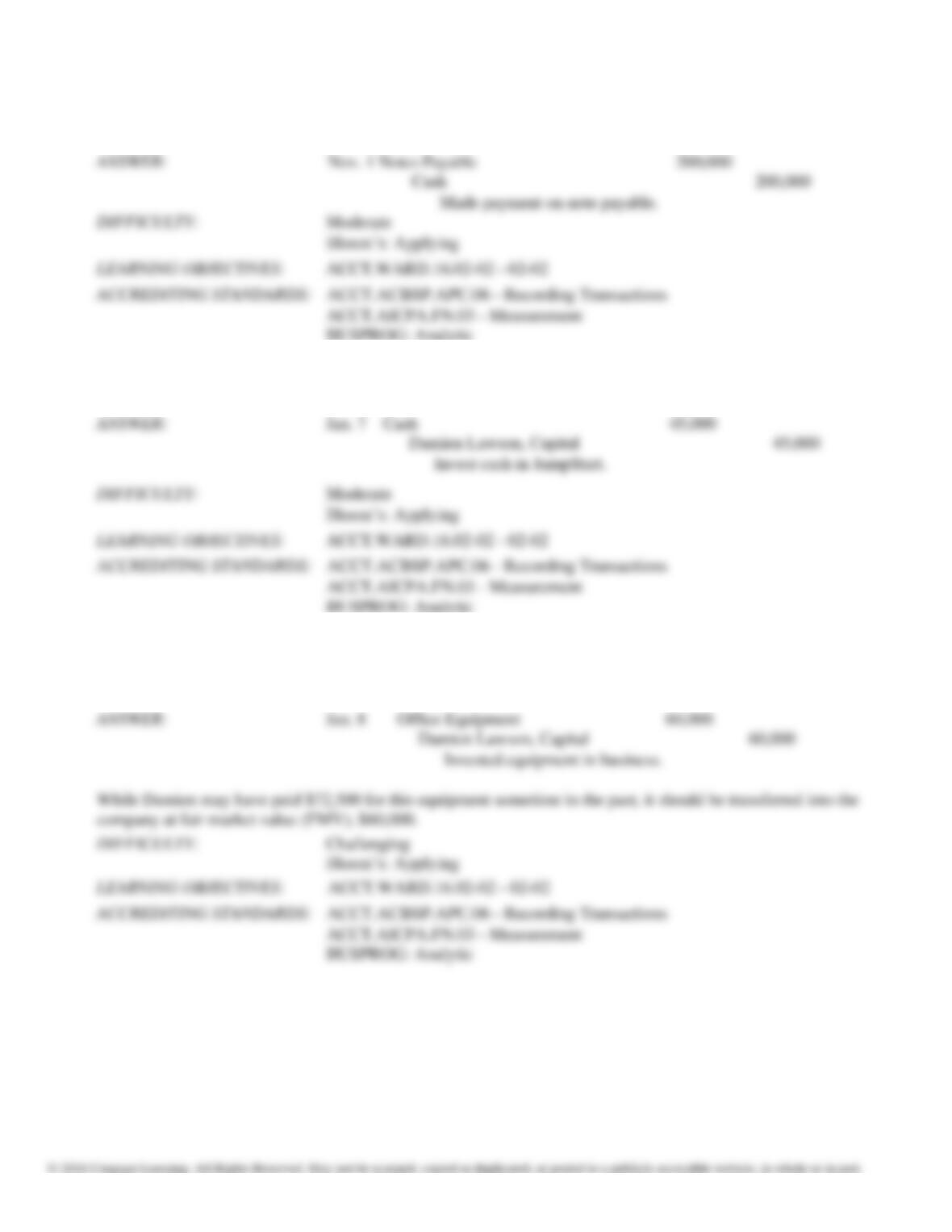
190.
On October 17, Nikle Company purchased a building and a plot of land for $750,000. The building was valued at
$500,000 while the land carried a value of $250,000. Nikle paid $300,000 down in cash and signed a note
payable
for the balance. Provide the journal entry for this transaction.
Chapter 2: Analyzing Transactions
191.
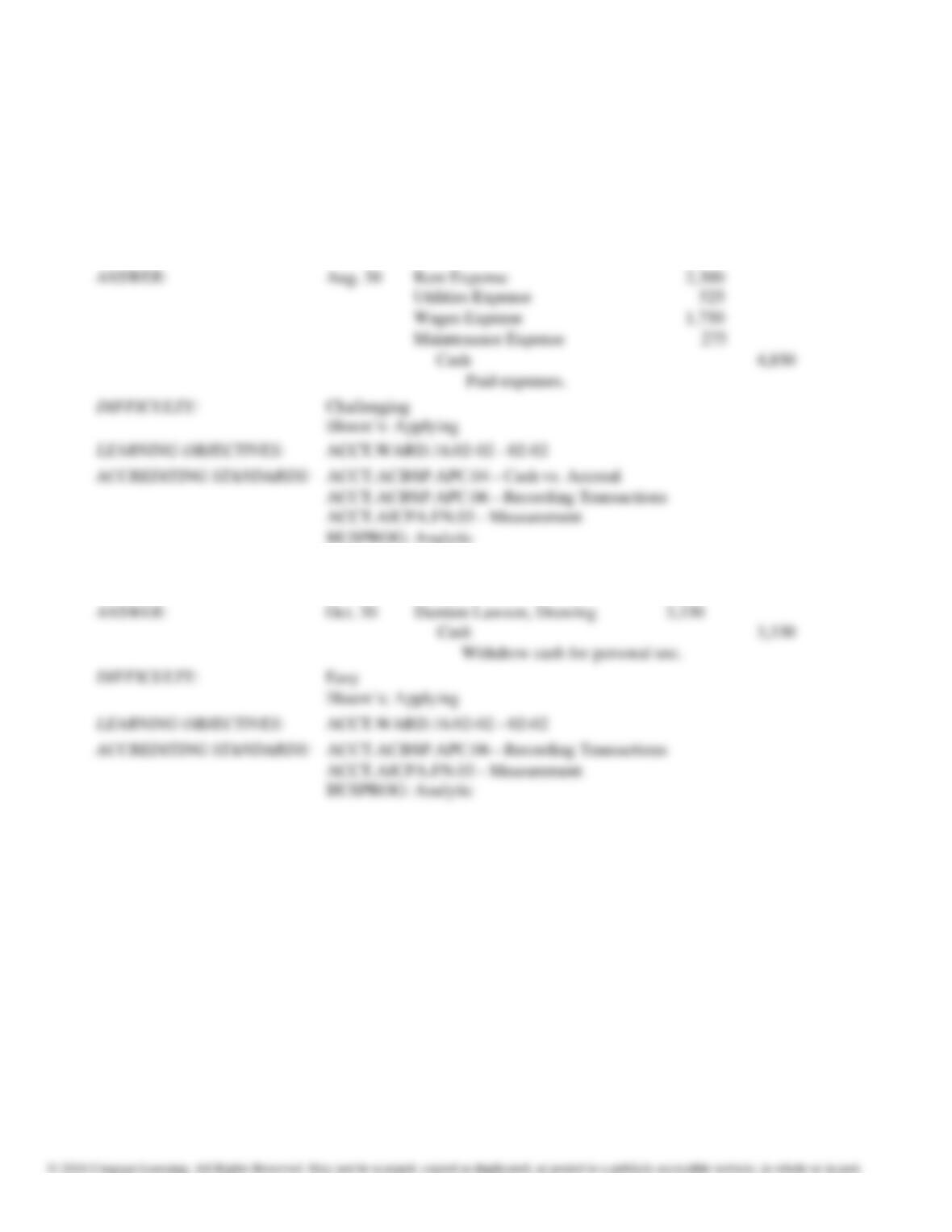
On November 1, Nikle Company made a cash payment of $200,000 on a note payable that was generated in
the
purchase of a building and land. Provide the journal entry for this transaction.
192.
On January 7, Damien Lawson invests $45,000 to initiate the operation of his business, JumpStart. Provide
the
journal entry for this transaction.
193.
On January 8, Damien Lawson transfers ownership of several pieces of office equipment to his new business,
JumpStart. When new, these items were worth $72,500. The fair market value of the equipment is $60,000.
Journalize this transfer.
Chapter 2: Analyzing Transactions
194.
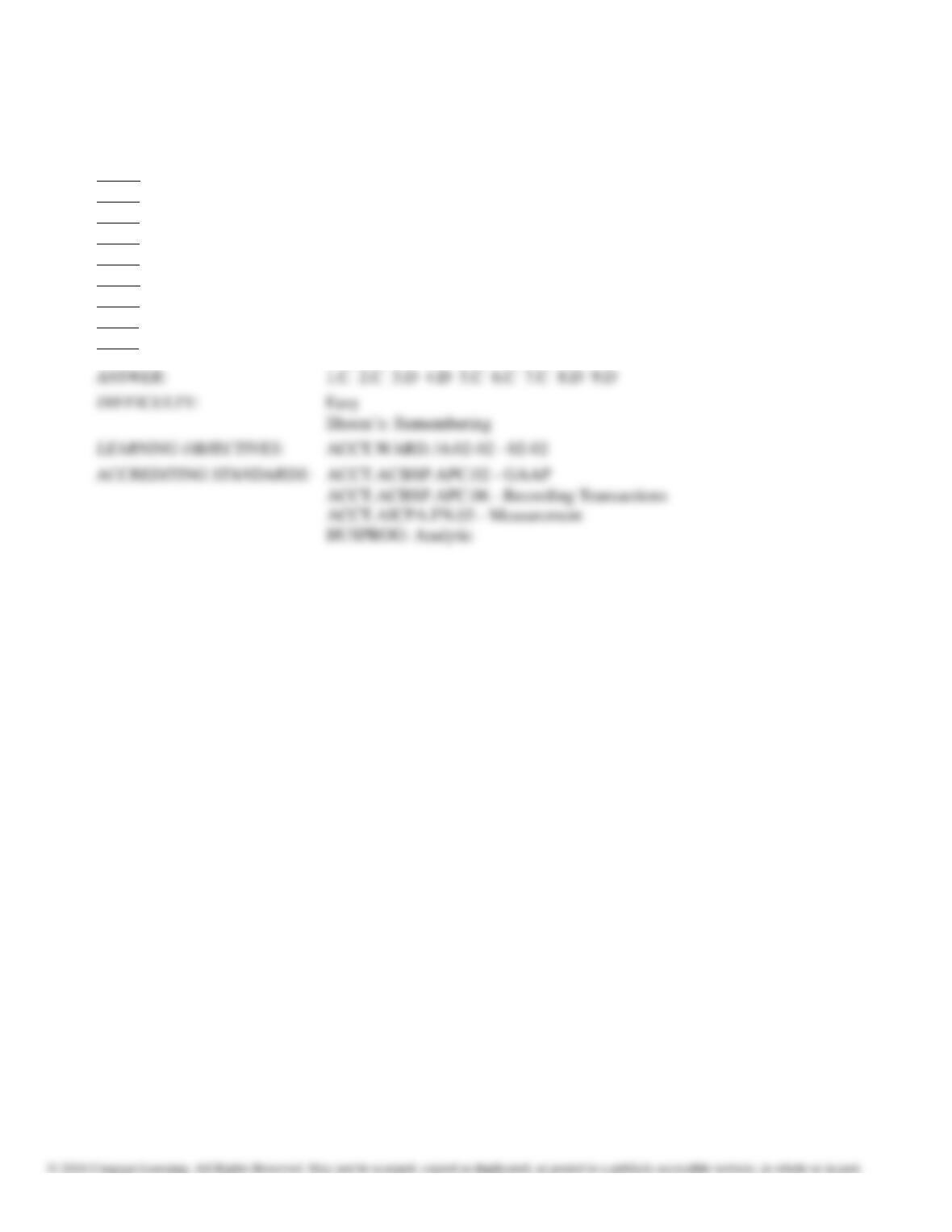
On August 30, JumpStart incurred the following expenses:
Payment to the landlord for August rent – $2,300
Payment to the Gas & Electric Company for August’s bill $525
Payment of employee wages for the last half of August – $1,750
Payment of shopping center’s parking lot cleaning fee $275
Journalize these payments as one compound journal entry.
195.
On October 30, Damien Lawson withdraws $3,330 from JumpStart for personal use. Journalize this event.
Chapter 2: Analyzing Transactions
196.
For the following, mark a “D” if the following account normally has a debit balance and mark a “C” if the following
account normally has a credit balance.
1. Notes Payable
2. Mortgage Payable
3. Drawing
4. Accounts Receivable
5. Capital
6. Rent Revenue
7. Unearned Income
8. Utility Expense
9. Automobiles

Chapter 2: Analyzing Transactions
197.
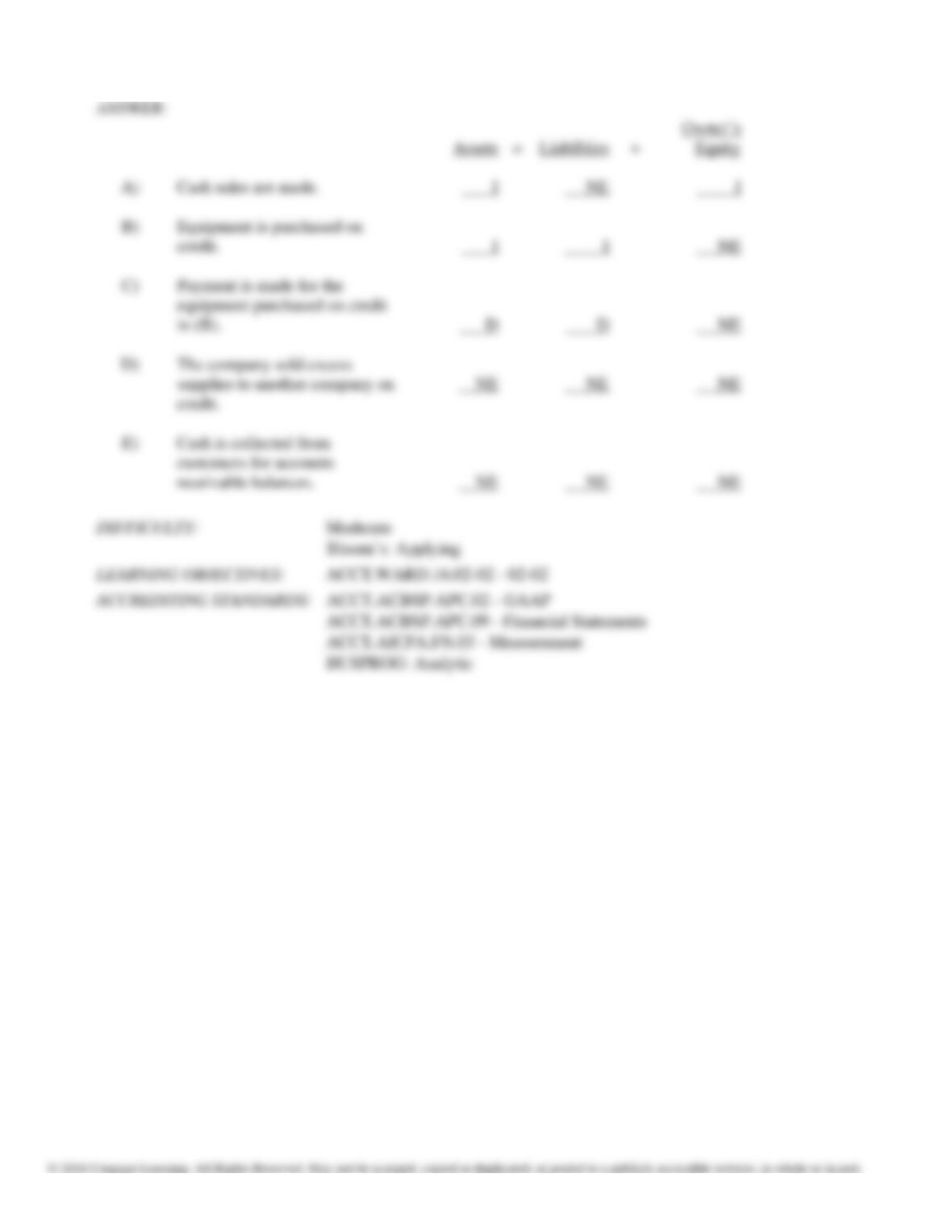
Several transactions are listed below, with the accounting equation stated to the right side of each. Use the
following identification codes to indicate the effects of each transaction on the accounting equation. Write your
answers in the space provided under the accounting equation. You need an identification code for each element
of
the accounting equation. An example is given before the first transaction.
I-Increase D-Decrease NE-No Effect
Assets
=
Liabilities
+
Owner’s
Equity
Example
John Smith invests in his new
business by giving it his
personal drill press valued at
$3,500.
I
NE
I
A)
Cash sales are made.
B)
Equipment is purchased on
credit.
C)
Payment is made for the
equipment purchased on credit
in (B).
D)
The company sold excess
supplies to another company
on credit.
E)
Cash is collected from
customers for accounts
receivable balances.
______
_____
______
Chapter 2: Analyzing Transactions
Chapter 2: Analyzing Transactions
198.
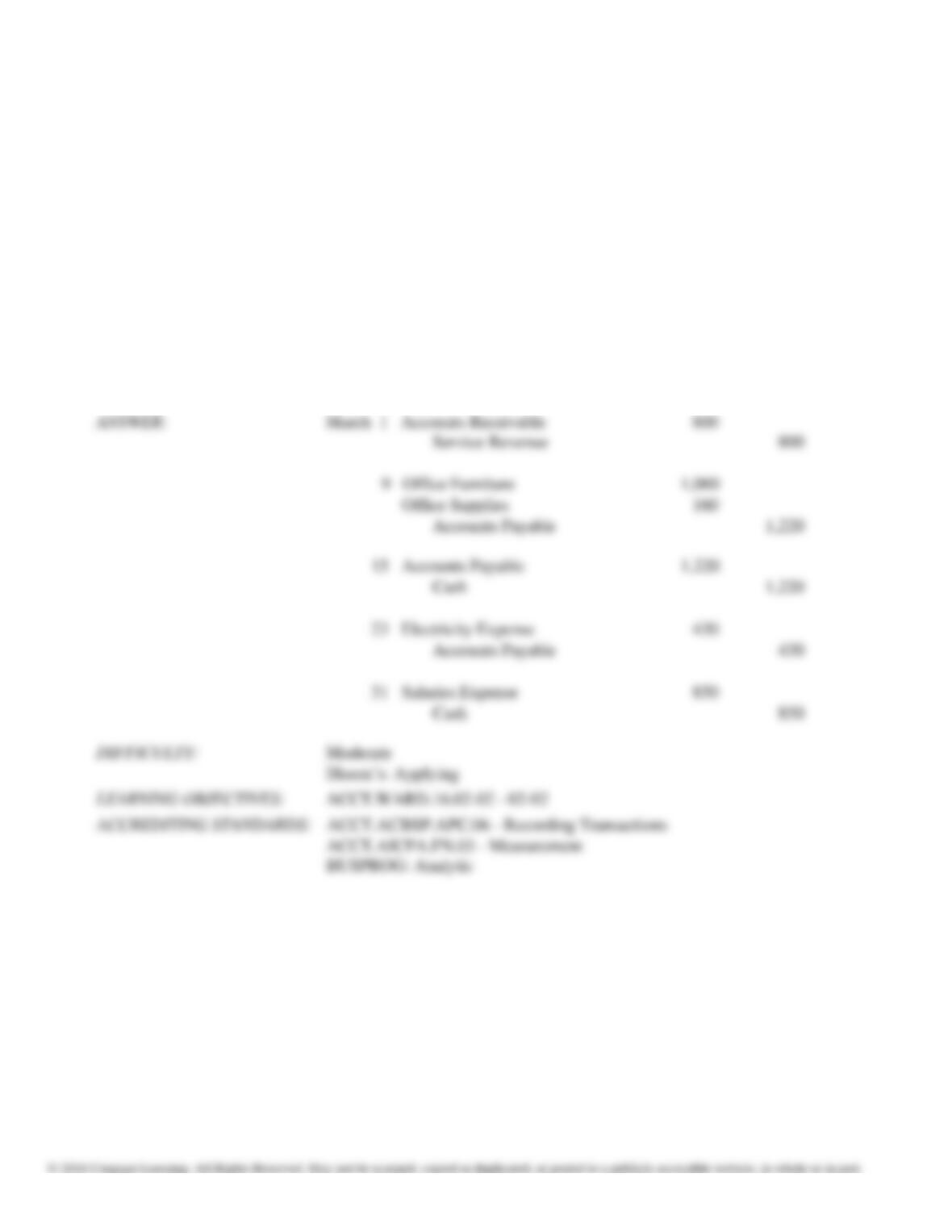
Journalize the following five transactions for Nexium & Associates, Inc. Omit explanations.
March 1 Bills are sent to clients for services provided in February in
the
amount of $800.
9 Corner Office, Inc. delivers office furniture ($1,060) and
office
supplies ($160) to Nexium leaving an invoice for
$1,220.
15 Payment is made to Corner Office, Inc. for the furniture and
office supplies delivered on March 9.
23 A bill for $430 for electricity for the month of March is
received
and will be paid on its due date in April.
31 Salaries of $850 are paid to employees.
Chapter 2: Analyzing Transactions
199.
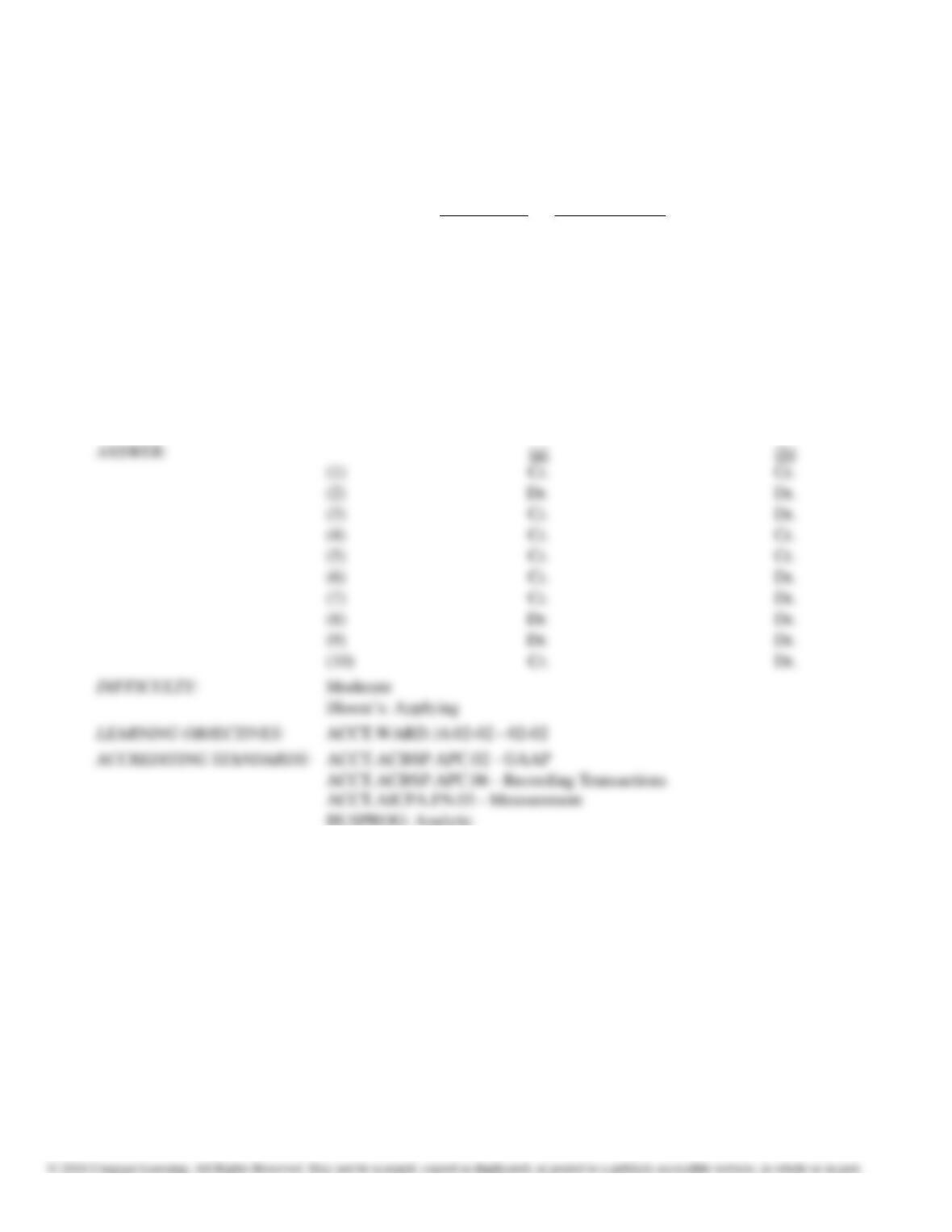
Increases and decreases in various types of accounts are listed below. In each case, indicate by “Dr.” or “Cr.” (a)
whether the change in the account would be recorded as a debit or a credit and (b) whether the normal balance of t
account is a debit or a credit.
(a) (b)
Recorded
As Normal
Balance
(1)
Increase in Denice Dickenson, Capital ________ _______
(2)
Increase in Denice Dickenson, Drawing ________ _______
(3)
Decrease in Accounts Receivable ________ _______
(4)
Increase in Note Payable ________ _______
(5)
Increase in Accounts Payable ________ _______
(6)
Decrease in Supplies ________ _______
(7)
Decrease in Salaries Expense ________ _______
(8)
Increase in Accounts Receivable ________ _______
(9) Increase in Cash ________ _______
(10) Decrease in Land ________ _______