Chapter 2: Analyzing Transactions
200.
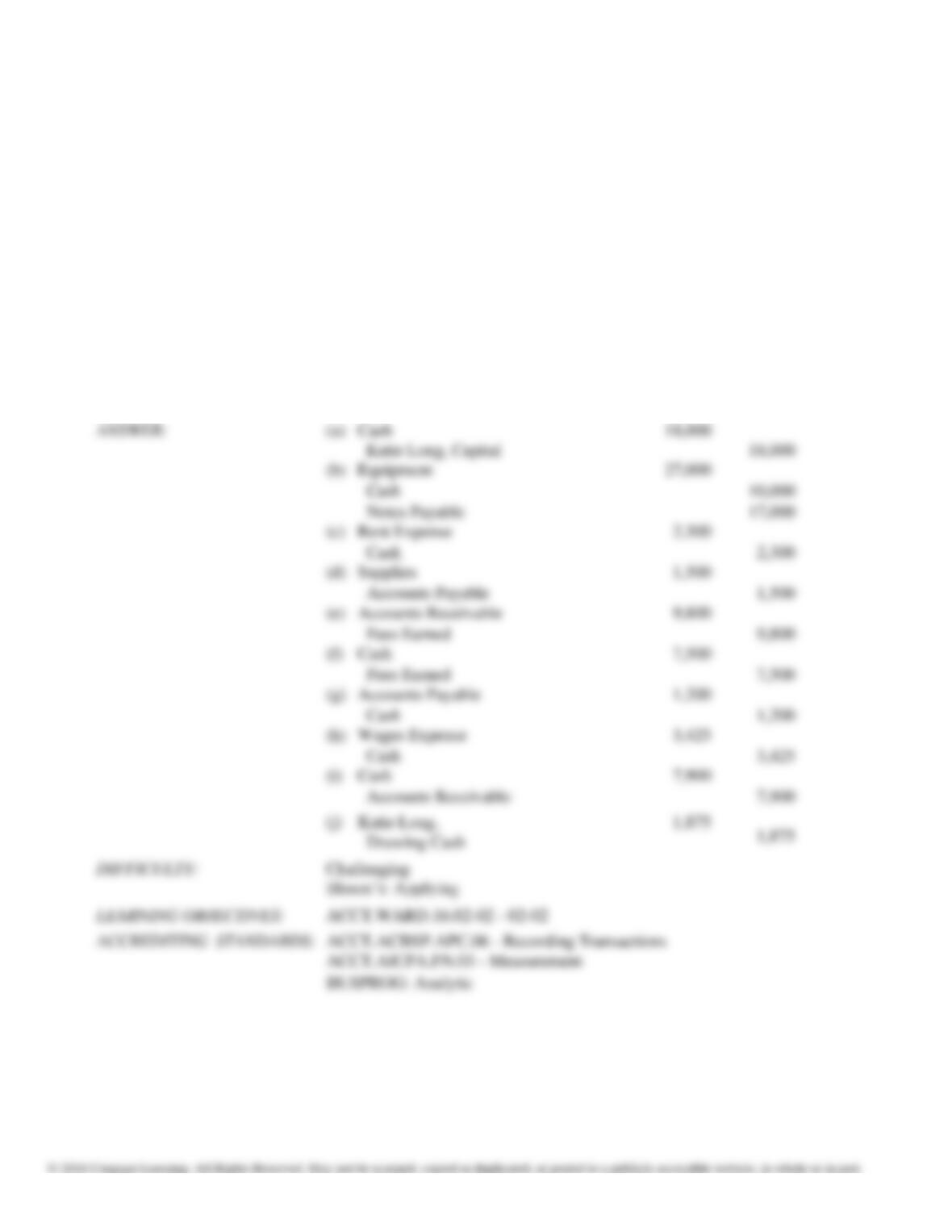
Record the following selected transactions for April in a two-column journal, identifying each entry by letter:
(a)
Received $18,000 from Katie Long, owner.
(b)
Purchased equipment for $27,000, paying $10,000 in cash and giving a
note
payable for the remainder.
(c)
Paid $2,300 for rent for April.
(d)
Purchased $1,500 of supplies on account.
(e)
Recorded $9,800 of fees earned on account.
(f)
Received $7,500 in cash for fees earned.
(g)
Paid $1,200 to creditors on account.
(h)
Paid wages of $3,425.
(i)
Received $7,900 from customers on account.
(j)
Recorded owner’s withdrawal of $1,875.
Chapter 2: Analyzing Transactions
201.
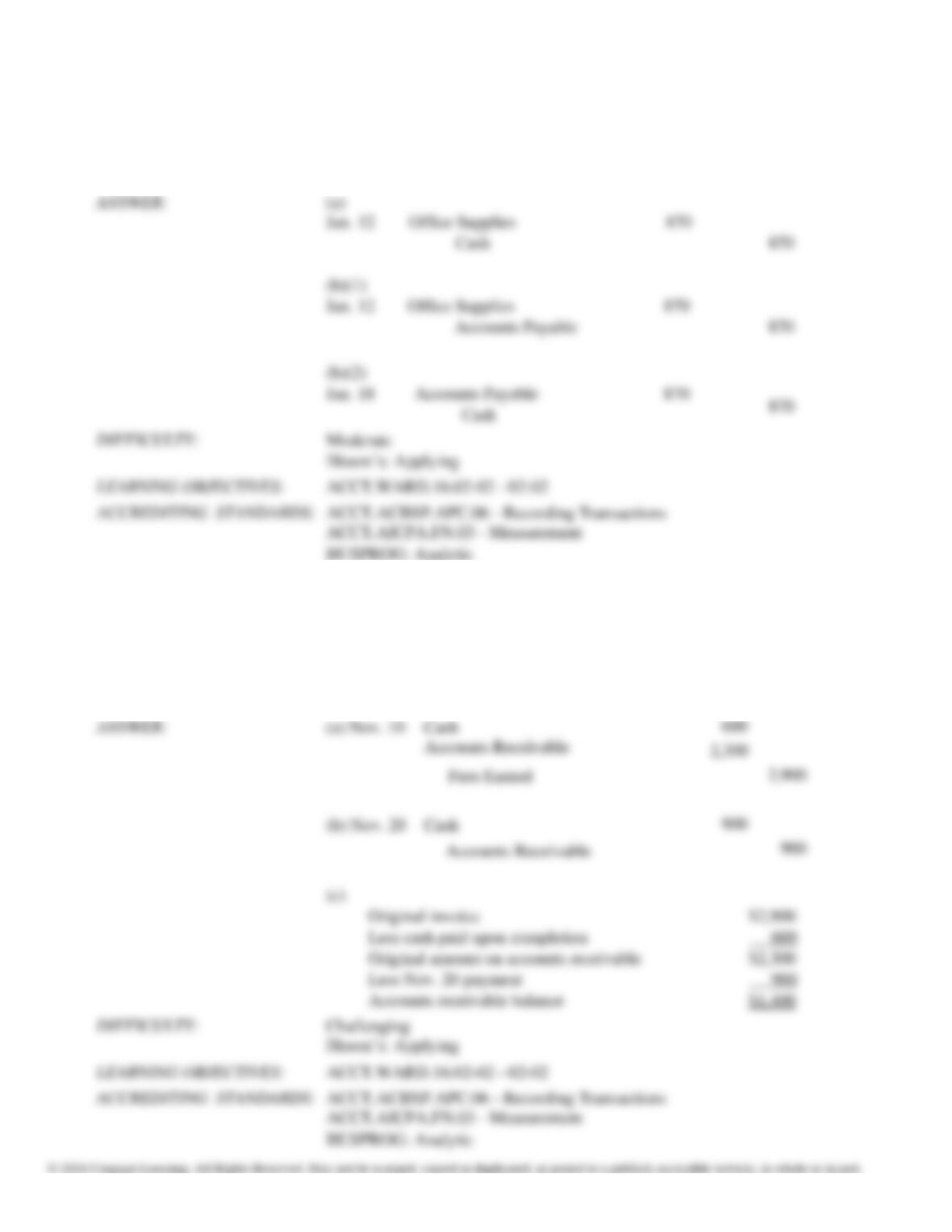
On January 12, JumpStart Co. purchased $870 in office supplies.
(a)
Journalize this transaction as if JumpStart paid cash.
(b)
(1) Journalize this transaction as if JumpStart placed it on account.
(b) (2) On January 18, JumpStart pays the amount due. Journalize this event.
202.
On November 10, JumpStart Co. provides $2,900 in services to clients. At the time of service, the clients paid
$600
in cash and put the balance on account.
(a)
Journalize this event.
(b)
On November 20, JumpStart Co. clients paid an additional $900 on their accounts due. Journalize this event.
(c)
Calculate the accounts receivable balance on November 30.
Chapter 2: Analyzing Transactions
203.
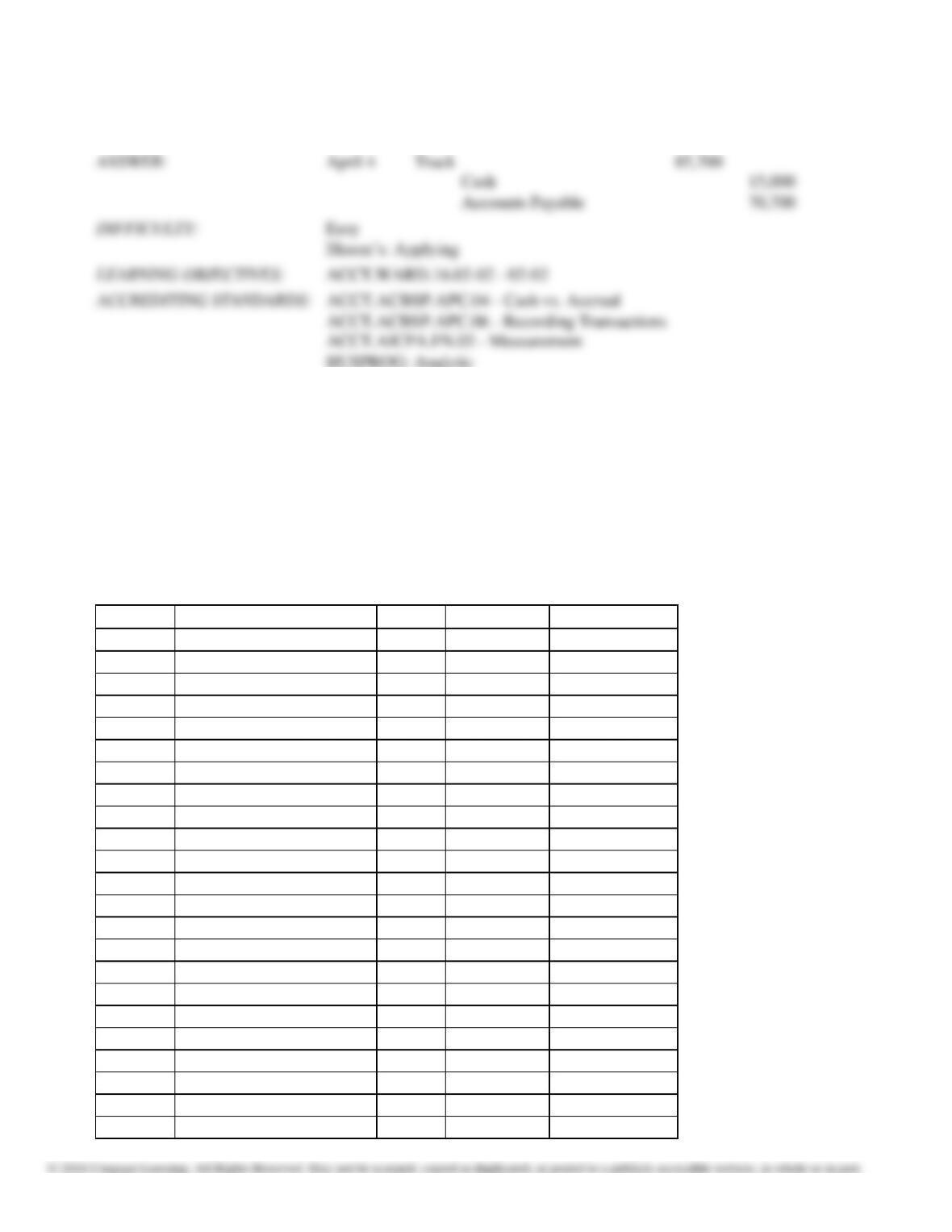
Prepare a journal entry for the purchase of a truck on April 4 for $85,700, paying $15,000 cash and the
remainder
on account. Omit explanation.
204.
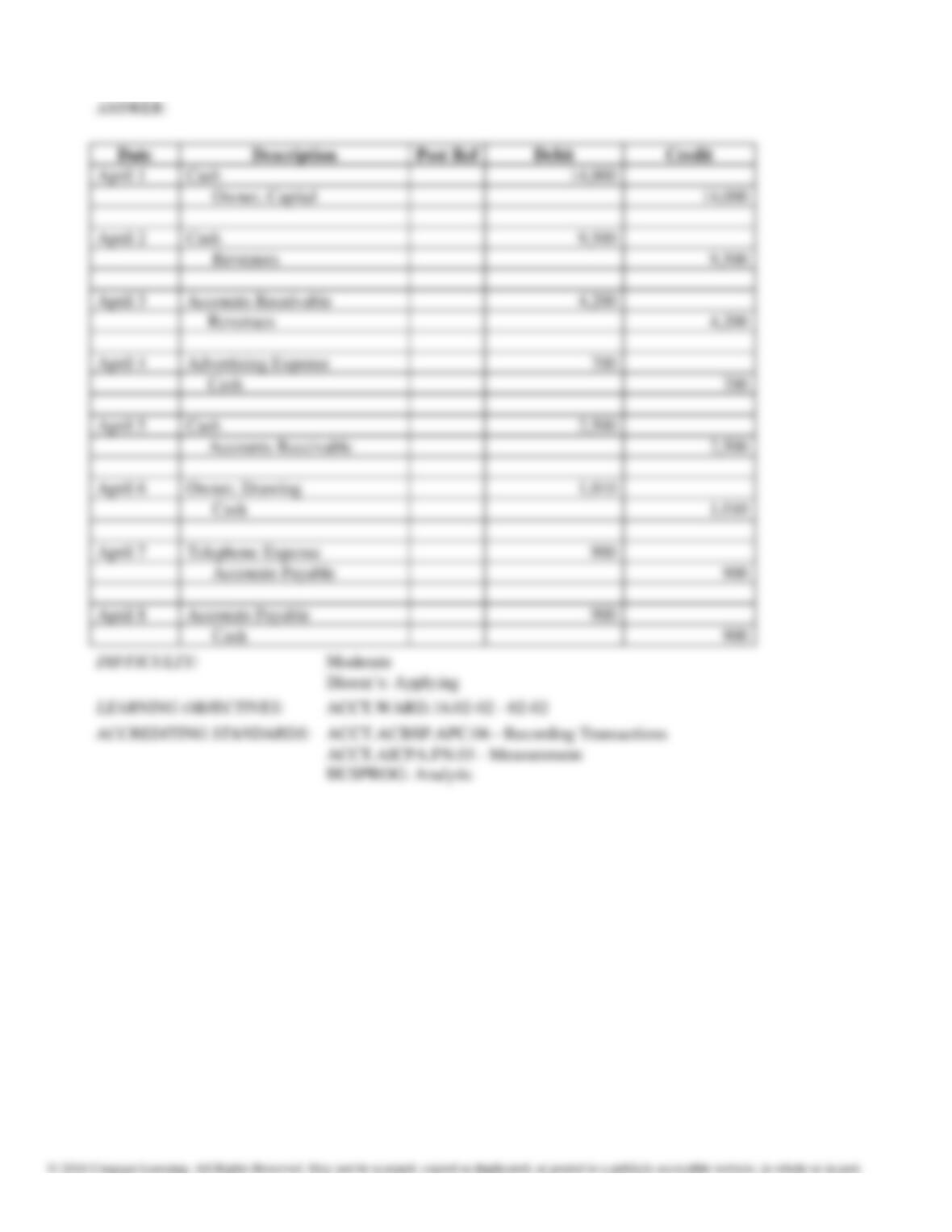
Journalize the following selected transactions for January. Explanations may be omitted.
Jan.
1
Received cash from the investment made by the owner, $14,000.
2
Received cash for providing accounting services, $9,500.
3
Billed customers on account for providing services, $4,200.
4
Paid advertising expense, $700.
5
Received cash from customers on account, $2,500.
6
Owner withdraws $1,010.
7
Received telephone bill, $900.
8
Paid telephone bill, $900.
Date
Description
Post Ref
Debit
Credit
Chapter 2: Analyzing Transactions
Chapter 2: Analyzing Transactions
205.
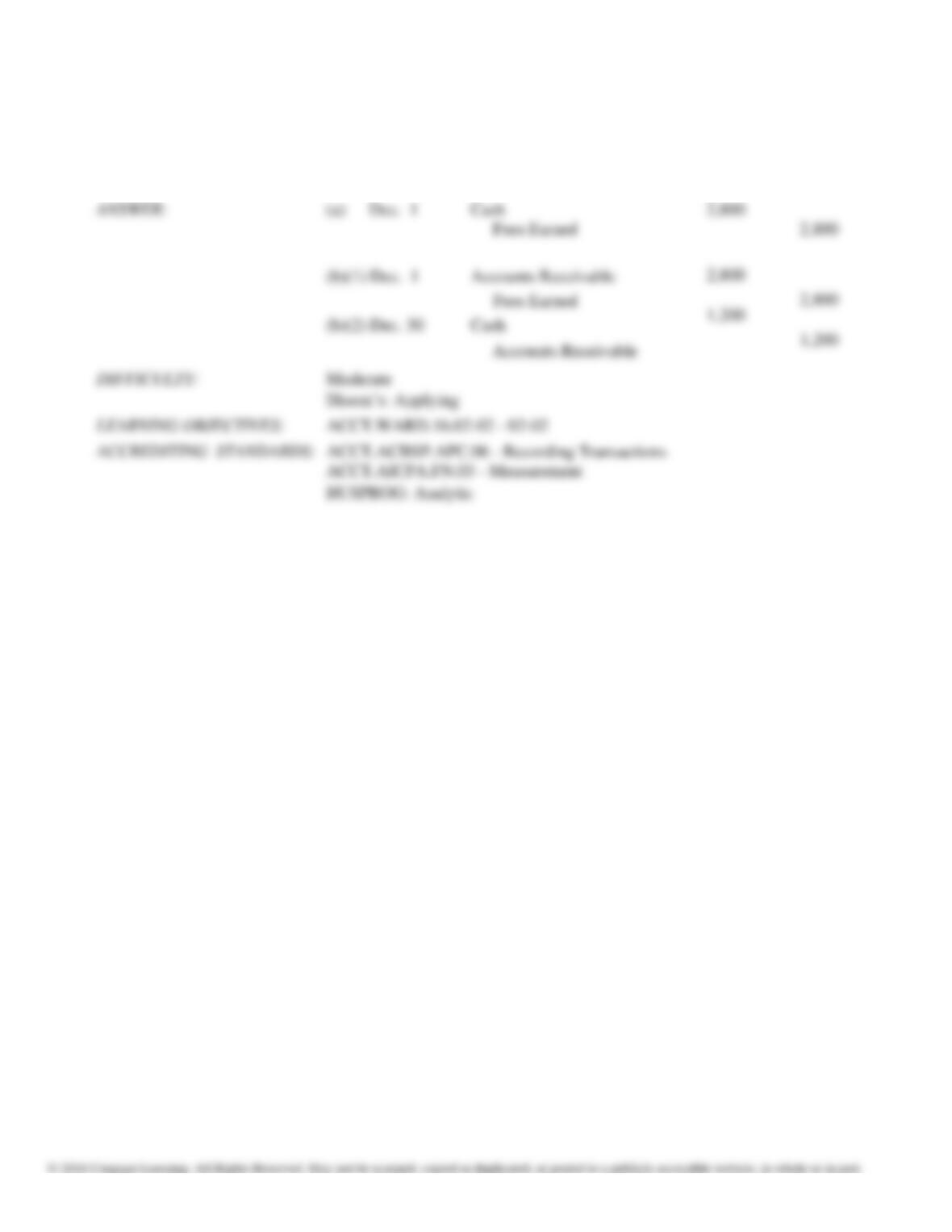
On December 1, JumpStart Company provides $2,800 in services to clients.
(a) Journalize this event as if the clients had paid cash at the time the services were rendered.
(b)(1) Journalize this event as if the clients had placed this on account.
(b)(2) Assume that the clients paid $1,200 of the amount on account on December 30. Journalize this transaction.
Chapter 2: Analyzing Transactions
206.
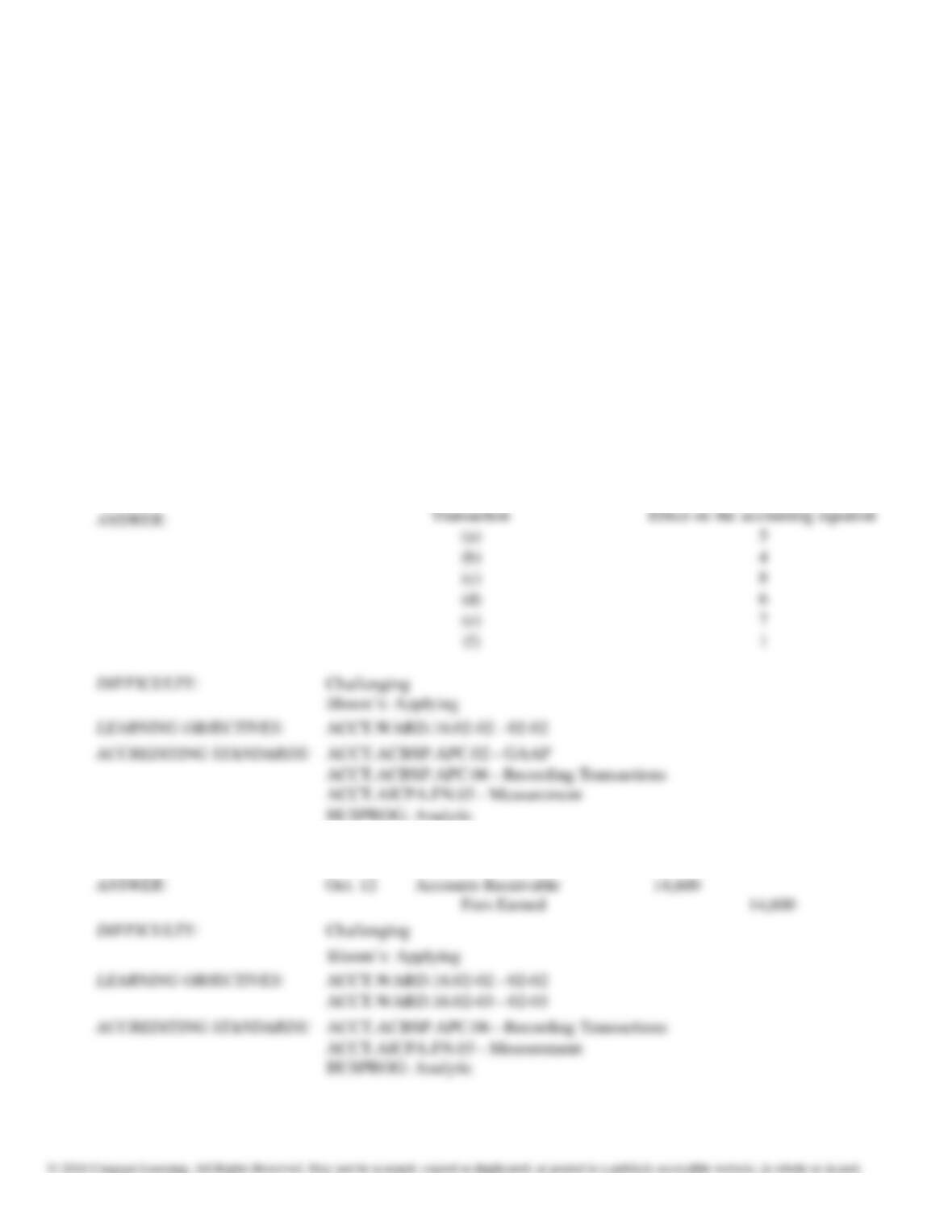
Analyze the following transactions as to their effect on the accounting equation.
(a)
The company paid $725 to a vendor for supplies purchased previously on account.
(b)
The company performed $850 of services and billed the customer.
(c)
The company received a utility bill for $395 and will pay it next month.
(d)
The owner of the company withdrew $145 of supplies for personal use.
(e)
The company paid $315 in salaries to its employees.
(f)
The company collected $730 of cash from its customers on account.
Some of the possible effects of a transaction on the accounting equation are listed below:
(1)
Assets, Dr.; Assets, Cr.
(2)
Assets, Dr.; Owner’s Equity, Cr.
(3)
Assets, Dr.; Liabilities, Cr.
(4)
Assets, Dr.; Revenue, Cr.
(5)
Liabilities, Dr.; Assets, Cr.
(6)
Drawing, Dr.; Assets, Cr.
(7)
Expense, Dr.; Assets, Cr.
(8)
Expense, Dr.; Liabilities, Cr.
Put the appropriate letter next to each transaction.
207.
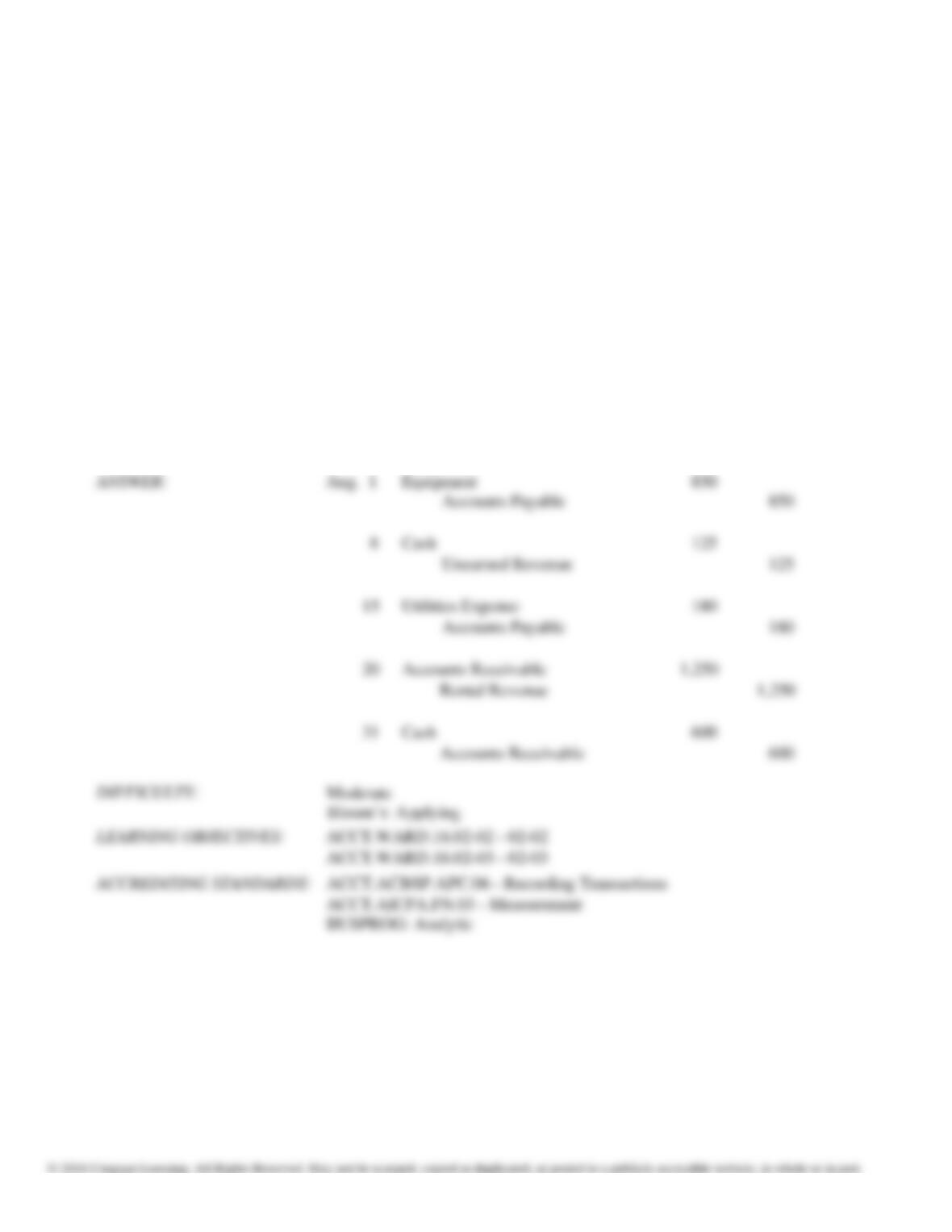
Prepare a journal entry on October 12 for the fees earned on account, $14,600. Omit explanation.
Chapter 2: Analyzing Transactions
208.
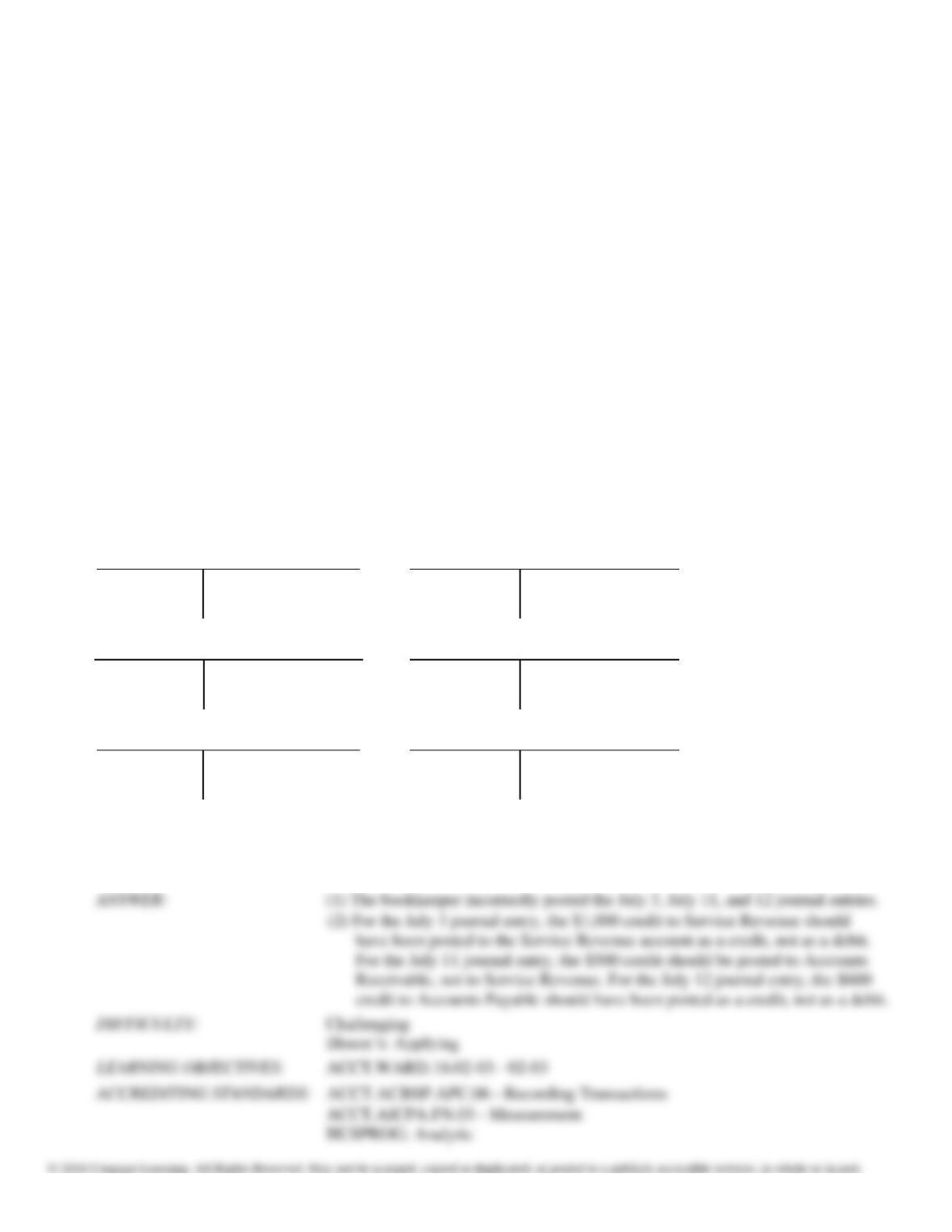
Journalize the five transactions for Mirmax Rentals described below.
August 1 Mirmax purchases two new saws on credit at $425 each. The
saws are added to Mirmax’s rental inventory. Payment is due
in 30 days.
8 Mirmax accepts advance deposits for tool rentals of $125
that
will be applied to the cash rental when the tools are
returned.
15 Mirmax receives a bill from Macon Utility Company for
$180. Payment is due in 30 days.
20 Customers are charged $1,250 by Mirmax for tool
rentals. Payment is due from the customers in 30 days.
31 Mirmax receives $600 in payments from the customers
that
were billed for rentals on August 20.
Chapter 2: Analyzing Transactions
209.
The bookkeeper for Brockton Industries prepared the following journal entries and posted the entries to the
general
ledger as indicated in the T accounts presented. Assume that the dollar amounts and the descriptions of
the entries
are correct.
July 3 Accounts Receivable 1,000
Service Revenue 1,000
Customers were billed for services
completed.
11
Cash 500
Accounts Receivable 500
Payment is received from a customer
billed for services on July 3.
12
Office Supplies 600
Accounts Payable 600
Purchased office supplies on credit;
payment is due in 30 days.
25 Office Furniture 700
Cash 700
Payment is made for office furniture
received on July 25.
ACCOUNTS RECEIVABLE SERVICE REVENUE
CASH ACCOUNTS PAYABLE
OFFICE SUPPLIES OFFICE FURNITURE
Required: If you assume that all journal entries have been recorded correctly, use the above information to:
(1)
Identify the postings to the general ledger that were made incorrectly.
(2)
Describe how the each incorrect posting should have been made.
7/3
1,000
7/3
1,000
7/11
500
7/12
600
7/11
500
7/25
700
7/12
600
7/25
700
Chapter 2: Analyzing Transactions
210.
State for each account whether it is likely to have (a) debit entries only, (b) credit entries only, or (c) both debit
and
credit entries when recording business transactions during the month. Also, indicate the normal balance of
each
account.
1.
Fees Earned
4.
Supplies
2.
Utilities Expense
5.
Cash
3.
Accounts Payable
6.
Accounts Receivable
Chapter 2: Analyzing Transactions
211.
On January 1, Merry Walker established a catering service. Listed below are accounts to use for transactions (a)
through (d), each identified by a number. Following this list are the transactions that occurred during the first
month
of operations. You are to indicate for each transaction the accounts that should be debited and credited by
placing
the account number(s) in the appropriate box.
1.
Cash
2.
Accounts Receivable
3.
Supplies
4.
Prepaid Insurance
5.
Equipment
6.
Truck
7.
Notes Payable
8.
Accounts Payable
9.
Merry Walker, Capital
10.
Merry Walker, Drawing
11.
Fees Earned
12.
Wages Expense
13.
Rent Expense
14.
Utilities Expense
15.
Truck Expense
16.
Miscellaneous Expense
Transactions
Account(s) Debited
Account(s) Credited
a. Merry transferred cash from
a
personal bank account to an
account to be used for the
business.
b. Paid rent for the period of January
3 to the end of the month.
c. Purchased truck for $30,000 with
a cash down payment of $5,000
and the remainder on a note.
d. Purchased equipment on account.
Chapter 2: Analyzing Transactions
212.
On January 1, Merry Walker established a catering service. Listed below are accounts to use for transactions (a)
through (e), each identified by a number. Following this list are the transactions that occurred in Walker’s first
month of operation. You are to indicate for each transaction the accounts that should be debited and credited by
placing the account number(s) in the appropriate box.
1.
Cash
2.
Accounts Receivable
3.
Supplies
4.
Prepaid Insurance
5.
Equipment
6.
Truck
7.
Notes Payable
8.
Accounts Payable
9.
Merry Walker, Capital
10.
Merry Walker, Drawing
11.
Fees Earned
12.
Wages Expense
13.
Rent Expense
14.
Utilities Expense
15.
Truck Expense
16.
Miscellaneous Expense
17.
Insurance Expense
Transactions
Account(s) Debited
Account(s) Credited
a. Purchased supplies for cash.
b. Paid the annual premiums on
property and casualty insurance.
c. Received cash for a job previously
recorded on account.
d. Paid a creditor a portion of the
amount owed for equipment
previously purchased on
e. Received cash for a completed
job.
Chapter 2: Analyzing Transactions
213.
On January 1, Merry Walker established a catering service. Listed below are accounts to use for transactions (a)
through (f), each identified by a number. Following this list are the transactions that occurred in Walker’s first
month of operations. You are to indicate for each transaction the accounts that should be debited and credited by
placing the account number(s) in the appropriate box.
1.
Cash
2.
Accounts Receivable
3.
Supplies
4.
Prepaid Insurance
5.
Equipment
6.
Truck
7.
Notes Payable
8.
Accounts Payable
9.
Merry Walker, Capital
10.
Merry Walker, Drawing
11.
Fees Earned
12.
Wages Expense
13.
Rent Expense
14.
Utilities Expense
15.
Truck Expense
16.
Miscellaneous Expense
17.
Insurance Expense
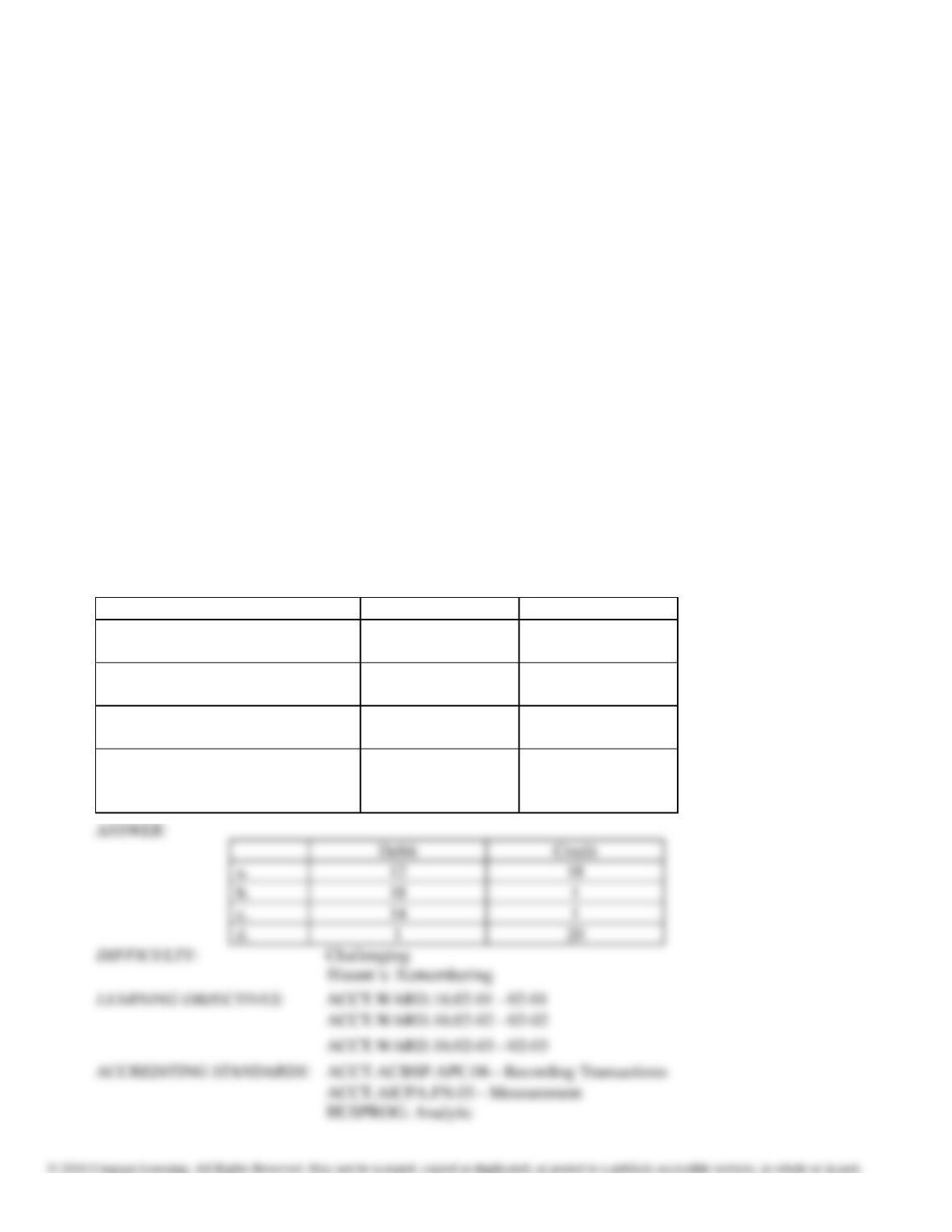
Transactions
Account(s) Debited
Account(s) Credited
a. Recorded jobs completed
on
account and sent
invoices to
customers.
b. Received an invoice for
truck
expenses to be paid in
c. Paid utilities expense
d. Received cash from customers
on
account.
e. Paid employee wages.
f. Withdrew cash for personal use.
Chapter 2: Analyzing Transactions
214.
Listed below are accounts to use for transactions (a) through (d), each identified by a number. Following this list
are the transactions. You are to indicate for each transaction the accounts that should be debited and credited by
placing the account number(s) in the appropriate box.
1.
Cash
2.
Accounts Receivable
3.
Office Supplies
4.
Land
5.
Interest Receivable
6.
Building
7.
Accumulated Depreciation – Building
8.
Depreciation Expense – Building
9.
Accounts Payable
10.
Interest Payable
11.
Insurance Payable
12.
Utilities Expense
13.
Notes Payable
14.
Prepaid Insurance
15.
Service Revenue
16.
Owner, Capital
17.
Insurance Expense
18.
Interest Expense
19.
Office Supplies Expense
20.
Unearned Service Revenue
21.
Owner, Drawing
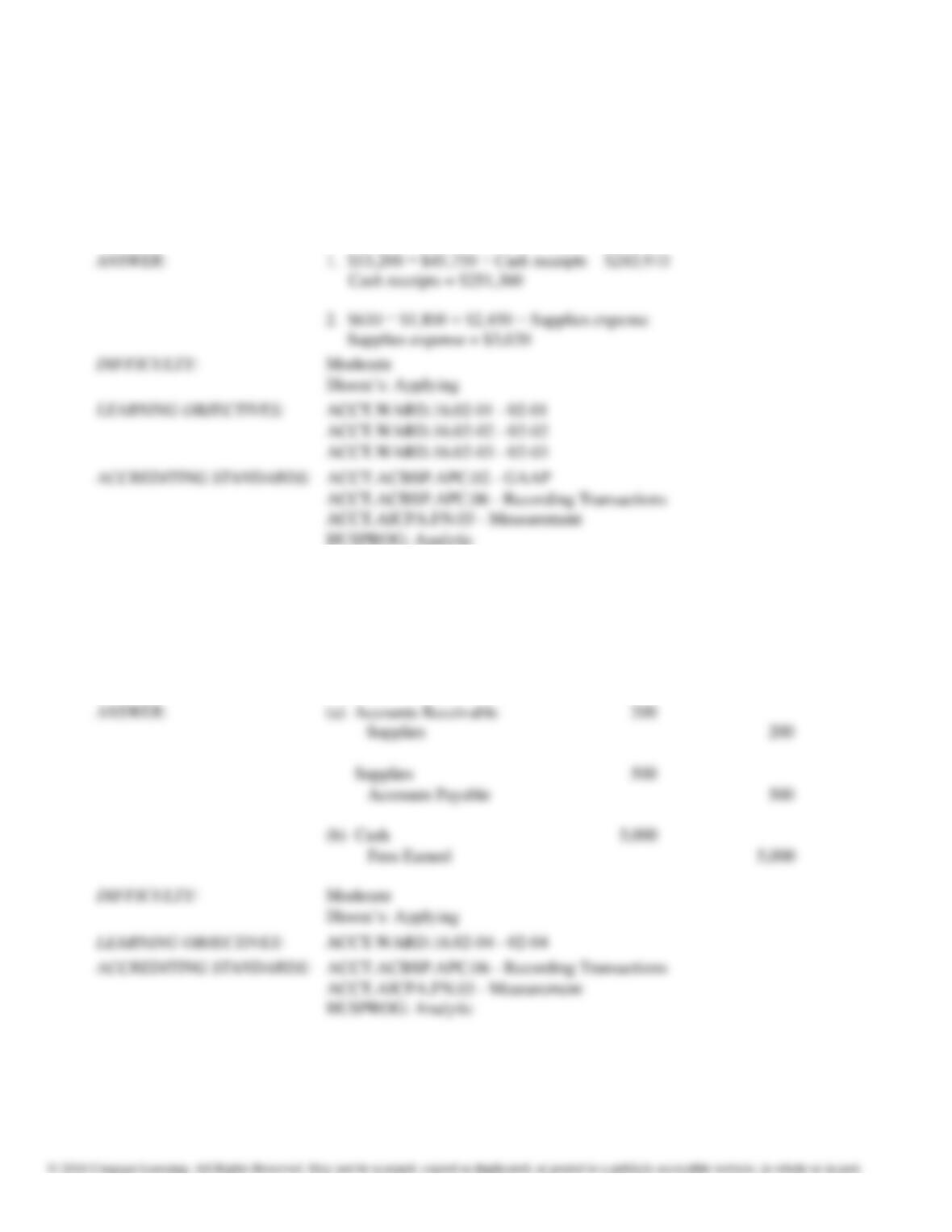
Transactions
Account(s) Debited
Account(s) Credited
a. Utility bill is received; payment
will
be made in 10 days.
b. Paid the utility bill
previously
recorded in
c. Bought a three-year
insurance
policy and paid in
d. Received $7,000 from a contract
to
perform accounting services
over the
next two years.
Chapter 2: Analyzing Transactions
215.
The following two situations are independent of each other.
1.
On June 1, the cash account balance was $45,750. During June, cash payments totaled $243,910, and the
June
30 balance was $53,200. Determine the cash receipts during June and show your calculation.
2.
On March 1, the supplies account balance was $1,800. During March, supplies of $2,450 were purchased, and
$630 of supplies were on hand as of March 31. Determine the supplies expense for March and show your
calculation.
216.
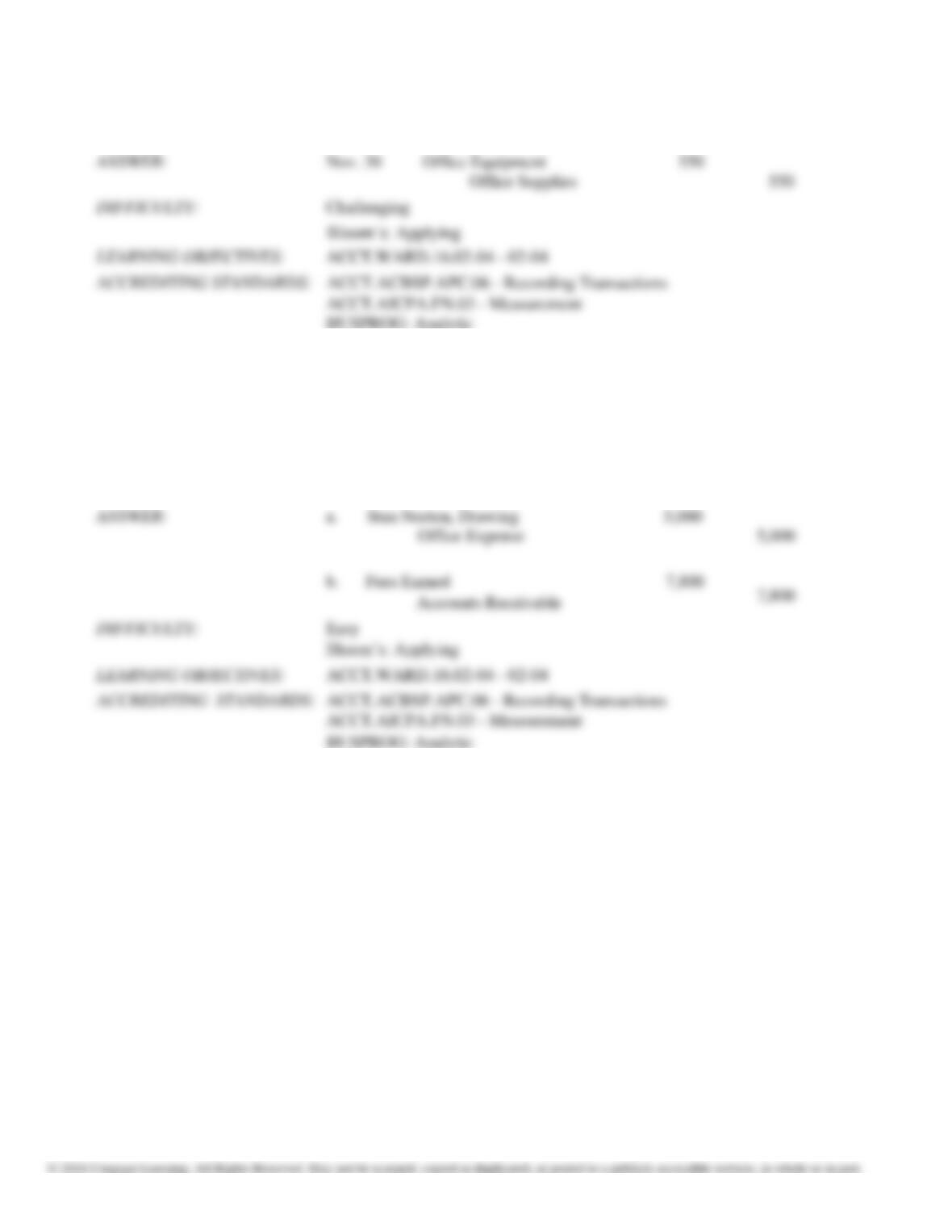
Journalize the entries to correct the following errors:
(a)
A purchase of supplies for $500 on account was recorded and posted as a debit to
Supplies for $200 and as a credit to Accounts Receivable for $200.
(b)
A receipt of $2,500 from Fees Earned was recorded and posted as a debit to Fees
Earned for $2,500 and a credit to Cash for $2,500.
Chapter 2: Analyzing Transactions
217.
On November 30, Damien Lawson is informed by his accountant that $550 of a transaction recording the
purchase
of office supplies was really office equipment. Prepare the journal entry to correct this situation.
218.
The following errors took place in journalizing and posting transactions:
a.
A withdrawal of $5,000 by Stan Norton, owner of the business, was
recorded
as a debit to Office Expense and a credit to Cash.
b.
Accounts receivable payment for $7,800 was recorded as a debit to Cash and a
credit to Fees Earned.
Journalize the entries to correct the errors. Omit the explanations.