Exam
Name___________________________________
1)
A = 4 0 1
2 –1–3
5 3 7 , B =–2 0 8 5
1 6 2 2
4 –1 0 3
1)
A)
–4–1 32 23
–17 –3 14 –1
21 11 46 52
B)
–4–1 32 23
–17 –3 14 –1
21 11 46 52
C)
–8 0 32 20
–5–6 14 8
–7 18 46 31
D)
–4–1 0 3
–12 –3 0 –9
28 –7 0 21
Find the matrix product AB, if it is defined.
2)
A =3–2
3 0 , B =0–2
3 6 .
2)
A)
0 4
9 0
B)
–6 0
27 –6
C)
–18 –6
–6 0
D)
–6–18
0–6
Find an LU factorization of the matrix A.
3)
A =2 4 5
411 5
4–124
3)
A)
A = 1 0 0
4 1 0
4–1 1
2 4 5
0 11 5
0 0 24
B)
A = 1 0 0
2 1 0
2 –3 1
3 4 5
0 –3 5
0 0 1
C)
A = 1 0 0
4 1 0
4–1 1
2 4 5
0 3 –5
0 0 –1
D)
A = 1 0 0
2 1 0
2 –3 1
2 4 5
0 3 –5
0 0 –1
Find the matrix product AB for the partitioned matrices.
4)
A =0 I
I F , B =W X
Y Z
4)
A)
0 Z
FY FZ
B)
Y Z
W + YF X + ZF
C)
X W + XF
Z Y + ZF
D)
Y Z
W + FY X + FZ
Decide whether or not the matrices are inverses of each other.
5)
–2 4
4–4 and
1
21
4
1
21
4
5)
A)
Yes
B)
No
Solve the system by using the inverse of the coefficient matrix.
6)
7x1– 2x2= 2
28x1– 8x2= 3
6)
A)
(4, 4)
B)
2
7–7
2x2, x2
C)
(2, 3)
D)
No solution
Find the matrix product AB, if it is defined.
7)
A =0–3
3 3 , B =–2 0
–1 1 .
7)
A)
–3 3
–3–9
B)
0 6
–3 3
C)
–6–6
3 6
D)
3–3
–9 3
Find the 3 × 3 matrix that produces the described transformation, using homogeneous coordinates.
8)
Reflect through the x–axis
8)
A)
–1 0 0
0 1 0
0 0 1
B)
1 0 0
0 1 0
0 0 1
C)
1 0 0
0–1 0
0 0 1
D)
–1 0 0
0 –1 0
0 0 1
Decide whether or not the matrices are inverses of each other.
9)
–5 1
–7 1 and
1
2–1
2
7
2–5
2
9)
A)
No
B)
Yes
Perform the matrix operation.
10)
Let C =2
–2
12 . Find (1/2) C.
10)
A)
1
–2
12
B)
4
–4
24
C)
1
–1
6
D)
2
–1
12
Find the inverse of the matrix A, if it exists.
11)
A =1 3 2
1 3 3
2 7 8
11)
A)
A–1=–1–3–2
–1–3–3
–2–7–8
B)
A–1=–3 10 –3
2–4 1
–1 1 0
C)
A–1=
11
31
2
11
31
3
1
21
71
8
D)
A–1 does not exist.
Find the matrix product AB, if it is defined.
12)
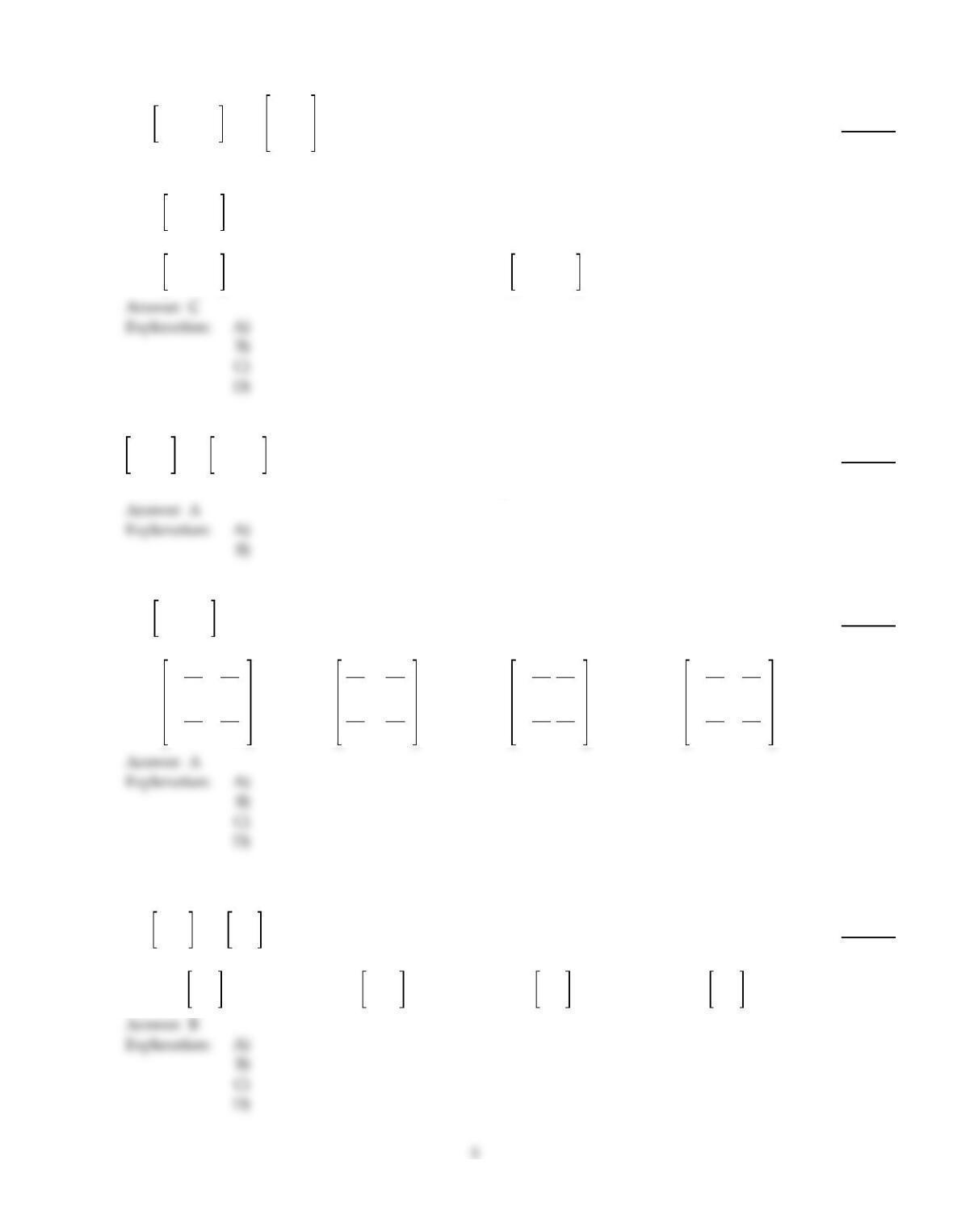
A =1 3 –2
2 0 3 , B =3 0
–2 1
0 3 .
12)
A)
–3–3
9 6
B)
AB is undefined.
C)
–3–3
6 9
D)
3–6 0
0 0 9
Decide whether or not the matrices are inverses of each other.
13)
10 1
–1 0 and 0 1
–110
13)
A)
No
B)
Yes
Find the inverse of the matrix, if it exists.
14)
A =–1–6
6 3
14)
A)
1
11 2
11
–2
11 –1
33
B)
1
11 –2
11
2
11 –1
33
C)
–1
33 2
11
–2
11 1
11
D)
–2
11 –1
33
1
11 2
11
Determine the production vector x that will satisfy demand in an economy with the given consumption matrix C and final
demand vector d. Round production levels to the nearest whole number.
15)
C =.4 .3
.1 .6 , d=52
76
15)
A)
x=44
51
B)
x=208
242
C)
x=3
25
D)
x=40
3
Find the inverse of the matrix A, if it exists.
16)
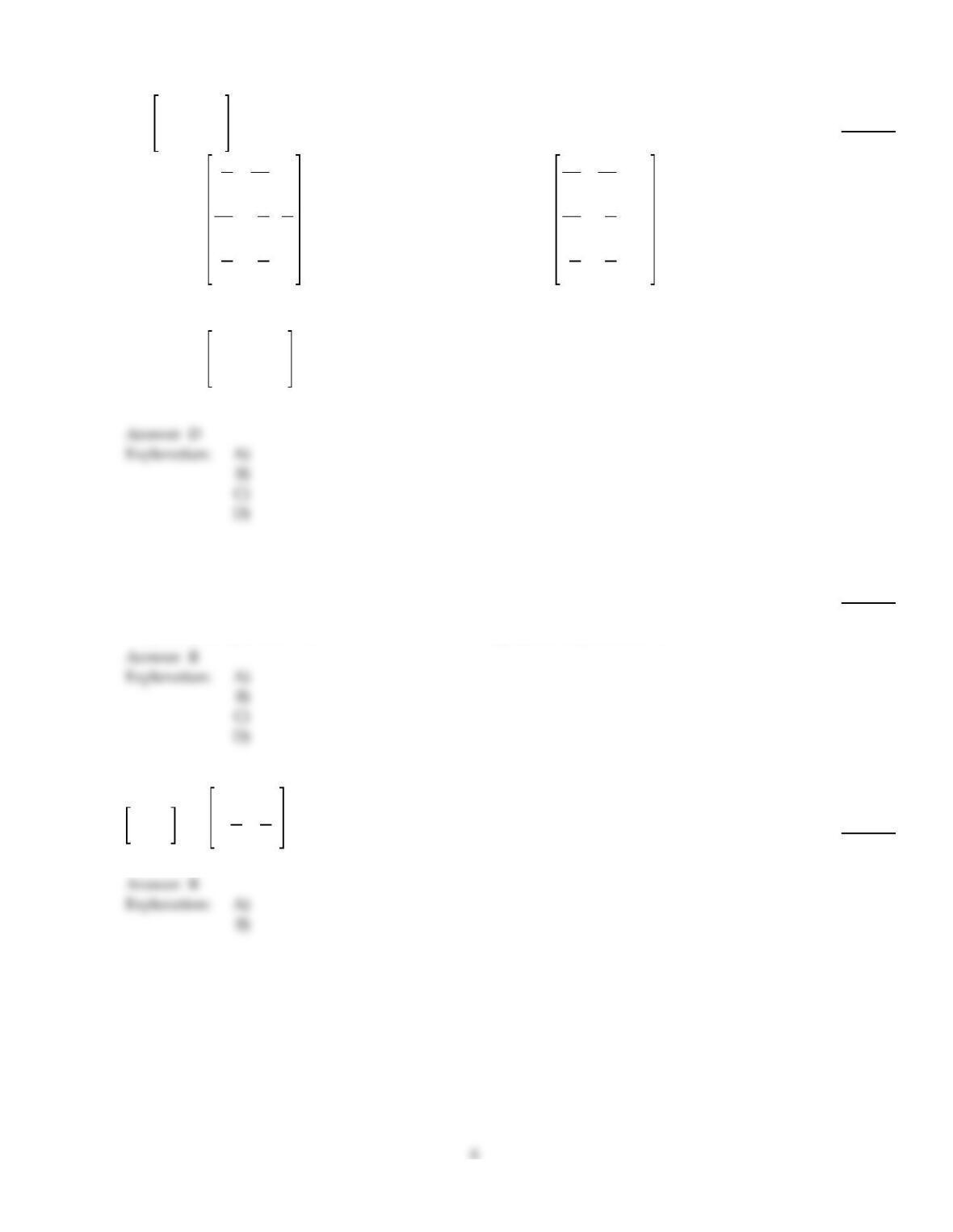
A =6–4 1
11 –7 2
5–3 1
16)
A)
A–1=
1
61
11 1
1
11 –1
71
2
1
5–1
31
B)
A–1=
1
11 2
11 – 4
5
11 8
73
6
5–1
31
C)
A–1=611 5
–4–7–3
1 2 1
D)
A–1 does not exist.
The sizes of two matrices A and B are given. Find the sizes of the product AB and the product BA, if the products are
defined.
17)
A is 4×4, B is 4×4.
17)
A)
AB is 1 × 1, BA is 1 × 1.
B)
AB is 4×4, BA is 4×4.
C)
AB is 4×8, BA is 4×8.
D)
AB is 8×4, BA is 8×4.
Decide whether or not the matrices are inverses of each other.
18)
9–2
7–2 and
0.5 0.5
–7
4–9
4
18)
A)
Yes
B)
No
Identify the indicated submatrix.
19)
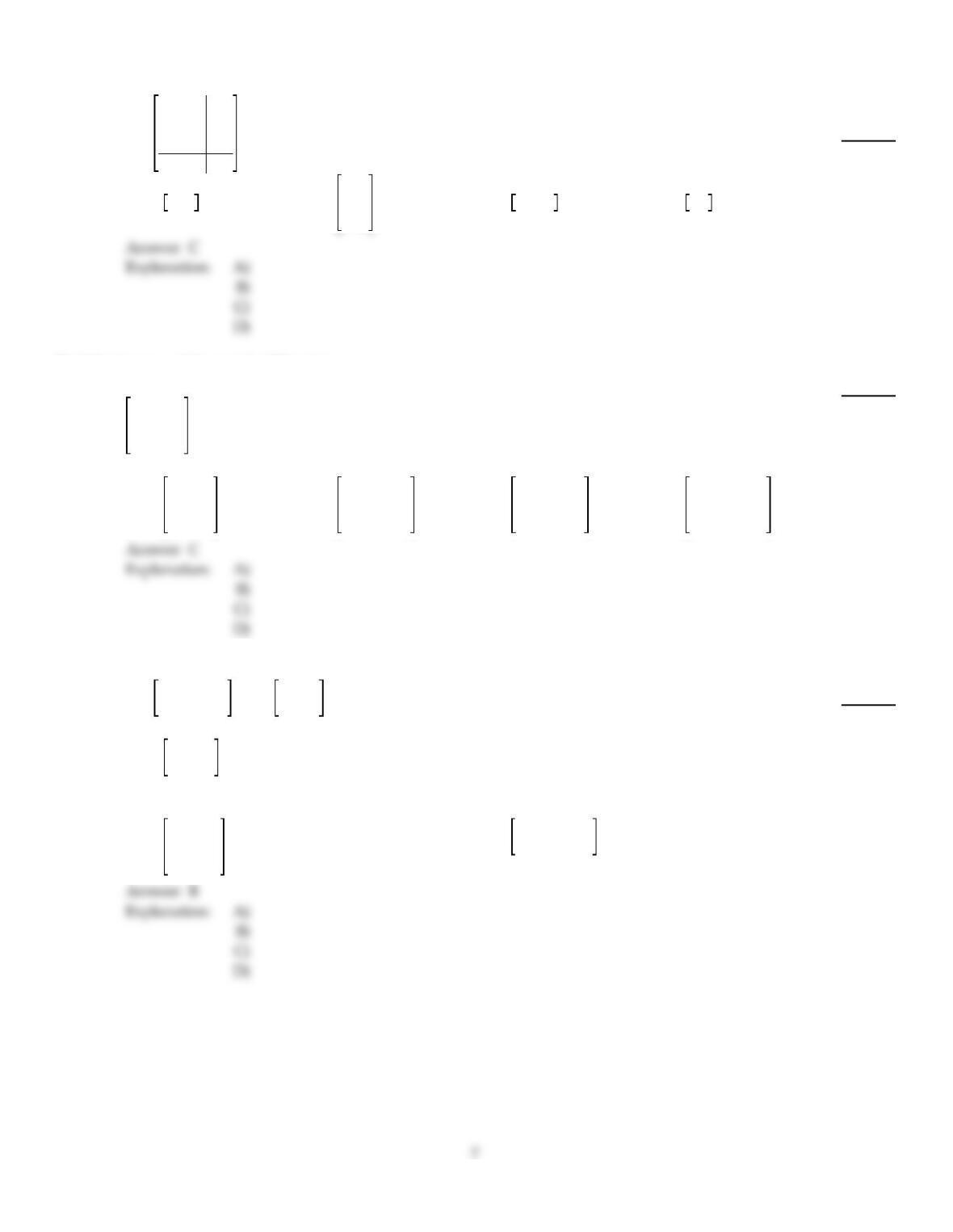
A =
6 4 1
–6 0 –1
0 7–4
7 4 7
. Find A21.
19)
A)
–6
B)
1
–1
–4
C)
7 4
D)
4
Find the inverse of the matrix, if it exists.
20)
1 0 0
–1 1 0
1 1 1
20)
A)
1 1 1
0 1 1
0 0 1
B)
1–1 1
0 1 –1
001
C)
1 0 0
1 1 0
–2–1 1
D)
–1 0 0
–1–1 0
–1–1–1
Find the matrix product AB, if it is defined.
21)
A =3–2 1
0 4 –2 , B =4 0
–2 3 .
21)
A)
12 0
012
B)
AB is undefined.
C)
12 –6
–816
4–8
D)
12 –8 4
–616 –8
Perform the matrix operation.
22)
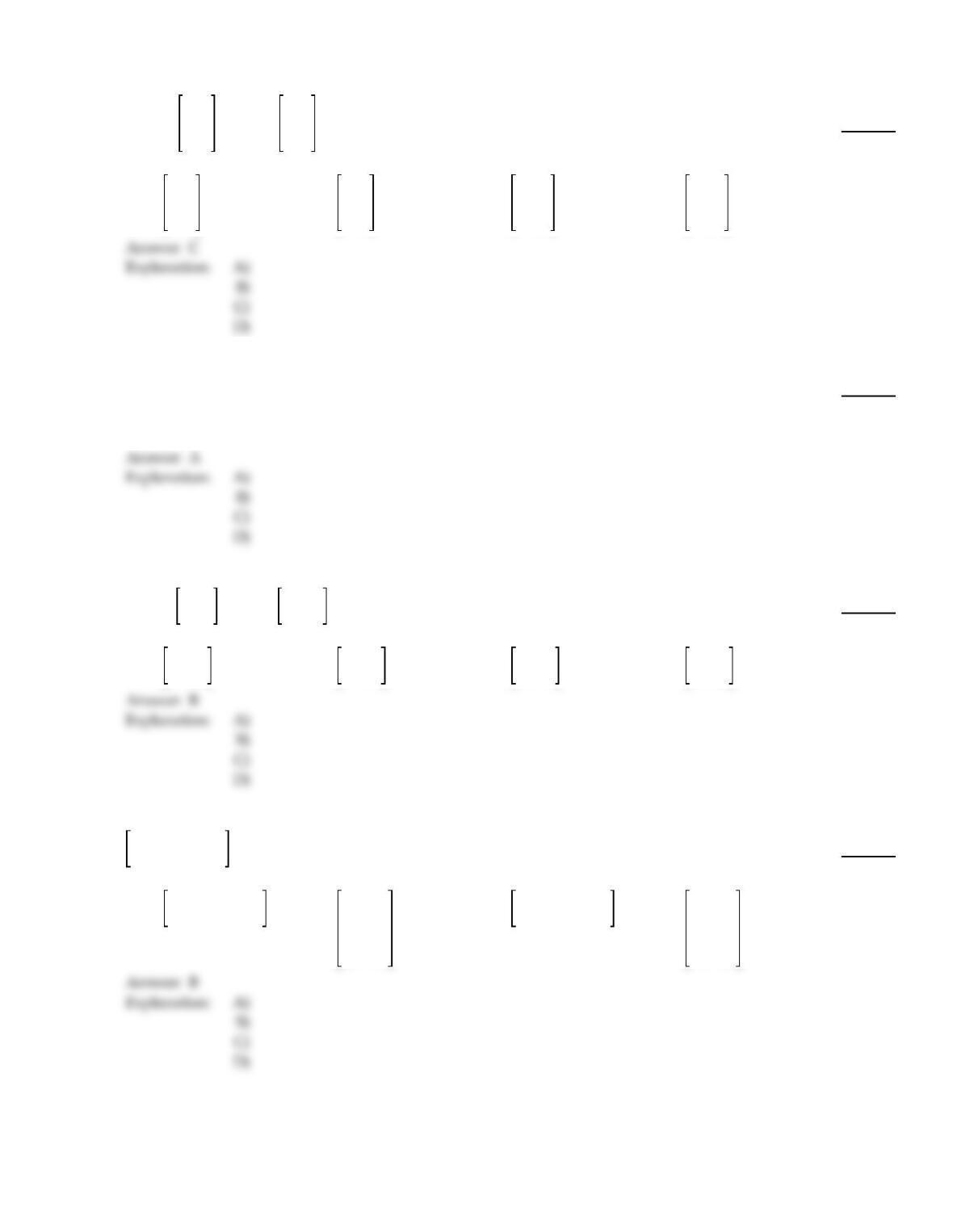
Let C =1
–3
2 and D =–1
3
–2 . Find C – 4D.
22)
A)
5
–6
4
B)
–3
9
–6
C)
5
–15
10
D)
–5
15
–10
Solve the system by using the inverse of the coefficient matrix.
23)
6x1+ 4x2= 4
3x1= –6
23)
A)
(–2, 4)
B)
No solution
C)
(4, –2)
D)
(–2, –4)
Perform the matrix operation.
24)
Let A =1 3
2 6 and B =0 4
–1 6 . Find 4A + B.
24)
A)
4 7
712
B)
416
730
C)
428
448
D)
416
112
Find the transpose of the matrix.
25)
9 8 9 8
0 –7 0 –7
25)
A)
0 –7 0 –7
9 8 9 8
B)
9 0
8–7
9 0
8–7
C)
8 9 8 9
–7 0 –7 0
D)
0 9
–7 8
0 9
–7 8
8
Perform the matrix operation.
26)
Let A =–3 1
0 2 . Find 2A.
26)
A)
–1 3
2 4
B)
–6 2
0 4
C)
–6 2
0 2
D)
–6 1
0 2
Identify the indicated submatrix.
27)
A =0 1 –7–5
7–102
2 5 –2 0 . Find A12.
27)
A)
7
B)
1
C)
2 5 –2
D)
–5
2
Perform the matrix operation.
28)
Let A =–2 7
–2–8 and B =2 6
–2 9 . Find A – B.
28)
A)
0 1
0–17
B)
0–1
–417
C)
–4 1
0–17
D)
4 1
–4 1
Determine the production vector x that will satisfy demand in an economy with the given consumption matrix C and final
demand vector d. Round production levels to the nearest whole number.
29)
C =.2 .1 .1
.3 .2 .3
.4 .1 .3 , d=213
322
296
29)
A)
x=104
217
206
B)
x=109
105
90
C)
x=481
892
825
D)
x=728
988
–312
Determine the rank of the matrix.
30)
1 –2 2 –4
2 –4 7 –4
–3 6 –612
30)
A)
4
B)
1
C)
3
D)
2
Find the inverse of the matrix, if it exists.
31)
A =–2–5
1 0
31)
A)
–2
51
–1
50
B)
0 1
–1
5–2
5
C)
–1
5–2
5
0 1
D)
0– 1
1
5–2
5
Find the 4 × 4 matrix that produces the described transformation, using homogeneous coordinates.
32)
Translation by the vector (4, –7, –9)
32)
A)
1 0 0 4
0 1 0 –7
0 0 1 –9
0 0 0 1
B)
1 0 0 –4
0 1 0 7
0 0 1 9
0 0 0 1
C)
0 0 0 4
0 0 0 –7
0 0 0 –9
0 0 0 1
D)
4 0 0 0
0–7 0 0
0 0 –9 0
0 0 0 1
10
Find an LU factorization of the matrix A.
33)
A =3–1
–18 9
33)
A)
A = 1 0
–6 1 3 1
0 –3
B)
A = 1 0
3 1 –6–1
0 3
C)
A = 1 0
–6 1 3–1
0 3
D)
A = 1 0
6 1 –3–1
0 –3
Determine whether the matrix is invertible.
34)
6 7
118
34)
A)
No
B)
Yes
Solve the system by using the inverse of the coefficient matrix.
35)
2x1+ 6x2=2
2x1–x2= –5
35)
A)
(–1, 2)
B)
(–2, 1)
C)
(2, –1)
D)
(1, –2)
Find the matrix product AB, if it is defined.
36)
A =0–2
2 3 , B =–1 3 2
0–3 1 .
36)
A)
0–2 6
–3–2 7
B)
0–6–12
0–9 3
C)
AB is undefined.
D)
0 6 –2
–2–3 7
11
Find a basis for the null space of the matrix.
37)
A =
1 0 –5 0 –2
0 1 3 0 3
0 0 0 1 1
0 0 0 0 0
37)
A)
1
0
–5
0
–2
,
0
1
3
0
3
B)
1
0
0
0
,
0
1
0
0
,
0
0
1
0
C)
–5
3
1
0
0
,
–2
3
0
–1
1
D)
5
–3
1
0
0
,
2
–3
0
–1
1
The vector x is in a subspace H with a basis = {b1, b2}. Find the –coordinate vector of x.
38)
b1= 1
–2, b2=–5
3 , x=17
–13
38)
A)
2
–3
B)
–3
2
C)
–4
1
D)
–2
3
Find the inverse of the matrix A, if it exists.
39)
A =5–1 5
5 0 4
10 –1 9
39)
A)
A–1=5 5 10
–1 0 –1
5 4 9
B)
A–1 does not exist.
C)
A–1=
1 0 4
5
0 1 –1
04
50
D)
A–1=1 0 4
5
0 1 –1
0 0 0
Find the transpose of the matrix.
40)
4 6
–6 0
–5 5
40)
A)
4–6–5
6 0 5
B)
–5 5
–6 0
4 6
C)
6 0 5
4–6–5
D)
6 4
0 –6
5–5
Decide whether or not the matrices are inverses of each other.
41)
2–1 0
–1 1 –2
1 0 –1 and 1–1 2
–3–2 4
–1 1 1
41)
A)
Yes
B)
No
Find the 3 × 3 matrix that produces the described composite 2D transformation, using homogeneous coordinates.
42)
Rotate points through 45° and then scale the x–coordinate by 0.2 and the y–coordinate by 0.4.
42)
A)
0.1 20.1 2 0
–0.2 20.2 2 0
0 0 1
B)
0 –0.2 0
0.4 0 0
0 0 1
C)
0.1 2–0.1 2 0
0.2 20.2 2 0
0 0 1
D)
0.1 –0.2 2 0
0.1 20.2 0
0 0 1
Find the matrix product AB, if it is defined.
43)
A =1 0
0 2 , B =1 2 –2
2–2 2 .
43)
A)
4–4 4
1 2 –2
B)
AB is undefined.
C)
1 2 –2
4–4 4
D)
1 0 0
0–4 4
Find the inverse of the matrix, if it exists.
44)
A =4–2
2–1
44)
A)
1
3–2
3
1
6–1
3
B)
A is not invertible
C)
1
6–1
3
1
3–2
3
D)
1
61
3
–1
3–2
3
The sizes of two matrices A and B are given. Find the sizes of the product AB and the product BA, if the products are
defined.
45)
A is 2×1, B is 1×1.
45)
A)
AB is 1×2, BA is 1×1.
B)
AB is 2×2, BA is 1×1.
C)
AB is undefined, BA is 1×2.
D)
AB is 2×1, BA is undefined.

Determine whether b is in the column space of A.
46)
A =–1 0 2
5 8 –10
–3–3 6 , b=–4
5
3
46)
A)
Yes
B)
No
Solve the equation Ax = b by using the LU factorization given for A.
47)
A = 3 –1 2
–6 4 –5
9 5 6 , b= 6
–3
2
A = 1 0 0
–2 1 0
3 4 1
3–1 2
0 2 –1
0 0 4
47)
A)
x= 22
–7
15
B)
x= 49
–38
32
C)
x= 25
–58
51
D)
x= 10
–2
–13
The vector x is in a subspace H with a basis = {b1, b2}. Find the –coordinate vector of x.
48)
b1= 2
–2
4 , b2= 6
1
–3, x=26
9
–23
48)
A)
5
–2
B)
–2
5
C)
–2
5
0
D)
2
–5
The sizes of two matrices A and B are given. Find the sizes of the product AB and the product BA, if the products are
defined.
49)
A is 2×3, B is 3×2.
49)
A)
AB is 3×3, BA is 2×2.
B)
AB is 2×2, BA is undefined.
C)
AB is 2×2, BA is 3×3.
D)
AB is undefined, BA is 3×3.
Decide whether or not the matrices are inverses of each other.
50)
6–5
–3 5 and
1
31
3
1
52
5
50)
A)
No
B)
Yes
Solve the system by using the inverse of the coefficient matrix.
51)
2x1– 4x2= –2
3x1+ 4x2= –23
51)
A)
(5, 2)
B)
(2, 5)
C)
(–2, 5)
D)
(–5, –2)
Decide whether or not the matrices are inverses of each other.
52)
5 3
3 2 and 2–3
–3 5
52)
A)
Yes
B)
No
53)
9 4
4 4 and –0.2 0.2
0.2 –0.45
53)
A)
No
B)
Yes
Solve the system by using the inverse of the coefficient matrix.
54)
–5x1+ 3x2= 8
2x1– 4x2= –20
54)
A)
(–2, –6)
B)
(2, 6)
C)
(6, 2)
D)
(–6, –2)
Determine whether b is in the column space of A.
55)
A = 1 2 –3
1 4 –6
–3–2 5 , b=3
2
–5
55)
A)
No
B)
Yes
Find the 3 × 3 matrix that produces the described composite 2D transformation, using homogeneous coordinates.
56)
Translate by (9, 7), and then reflect through the line y = x.
56)
A)
0 1 9
1 0 7
0 0 1
B)
–1 0 –9
0 –1–7
0 0 1
C)
0 7 1
9 0 0
0 0 1
D)
0 1 7
1 0 9
0 0 1
Solve the system by using the inverse of the coefficient matrix.
57)
2x1– 6x2= –6
3x1+ 2x2= 13
57)
A)
(2, 3)
B)
(–3, –2)
C)
(3, 2)
D)
(–2, –3)
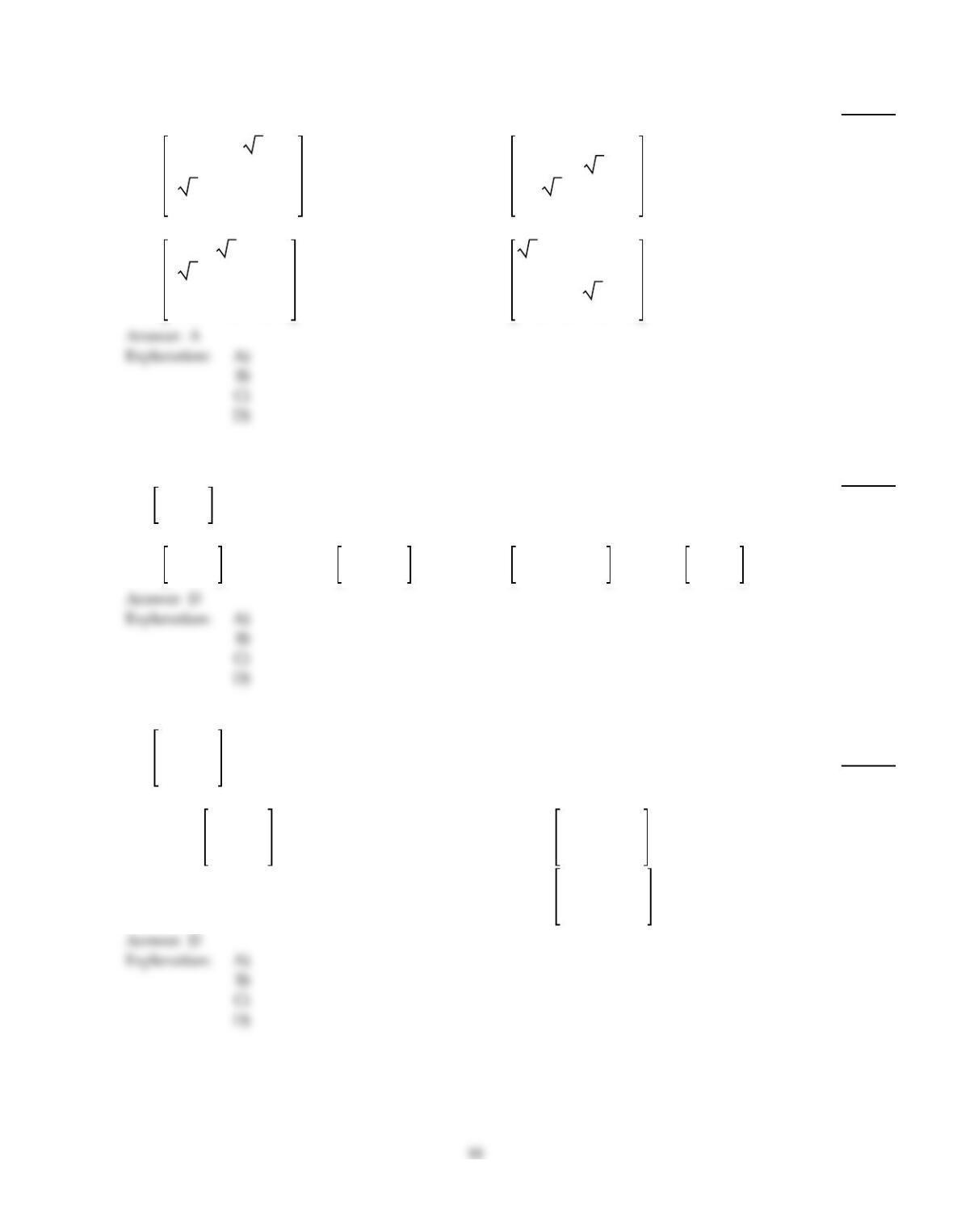
Find the 4 × 4 matrix that produces the described transformation, using homogeneous coordinates.
58)
Rotation about the y–axis through an angle of 60°
58)
A)
0.5 0 3/2 0
0 1 0 0
–3/2 0 0.5 0
0 0 0 1
B)
1 0 0 0
0 0.5 3/2 0
0–3/2 0.5 0
0 0 0 1
C)
0.5 3/2 0 0
–3/2 0.5 0 0
0 0 1 0
0 0 0 1
D)
3/2 0 0.5 0
0 1 0 0
–0.5 0 3/2 0
0 0 0 1
Solve the problem.
59)
Compute the matrix of the transformation that performs the shear transformation x
Ax for
A =10.17
0 1 and then scales all y–coordinates by a factor of 0.63.
59)
A)
20.17
01.63
B)
10.1071
00.63
C)
0.63 0.1071
0 1
D)
10.17
00.63
Find the inverse of the matrix A, if it exists.
60)
A =1 0 8
1 2 3
2 5 3
60)
A)
A–1=1 1 2
0 2 5
8 3 3
B)
A–1=–1 0 –8
–1–2–3
–2–5–3
C)
A–1 does not exist.
D)
A–1=9–40 16
–3 13 –5
–1 5 –2
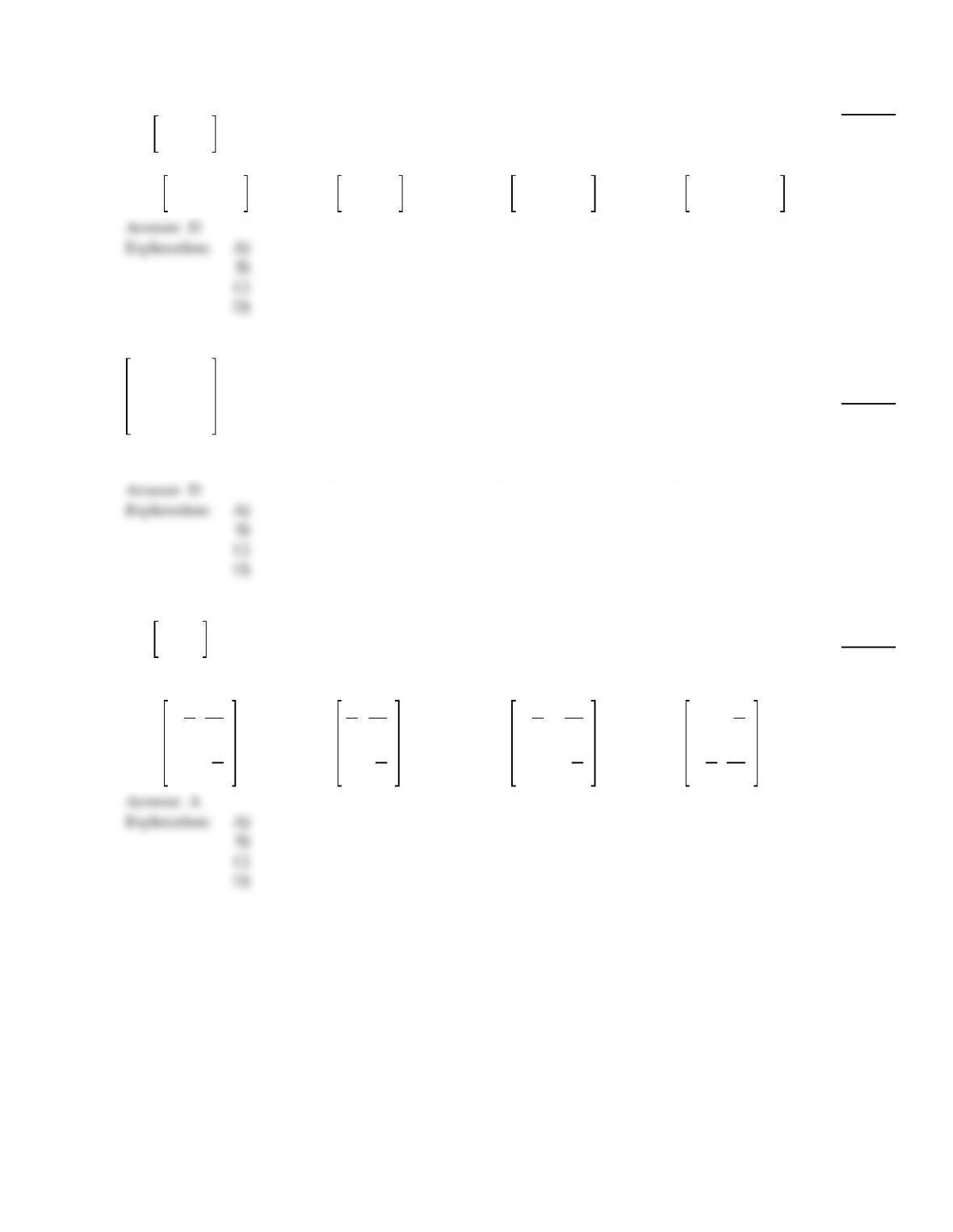
Solve the problem.
61)
Compute the matrix of the transformation that performs the shear transformation x
Ax for
A = 1 0.21
0 1 and then scales all x–coordinates by a factor of 0.68.
61)
A)
0.68 0.21
0 1
B)
1 0.21
0 0.68
C)
1.68 0.21
0 2
D)
0.68 0.1428
0 1
Determine the rank of the matrix.
62)
10–3 0 4
01–3 0 2
00 0 1 1
00 0 0 0
62)
A)
4
B)
2
C)
5
D)
3
Find the inverse of the matrix, if it exists.
63)
A =–3 1
0 6
63)
A)
–1
31
18
01
6
B)
1
61
18
0–1
3
C)
–1
3–1
18
01
6
D)
01
6
–1
31
18
19
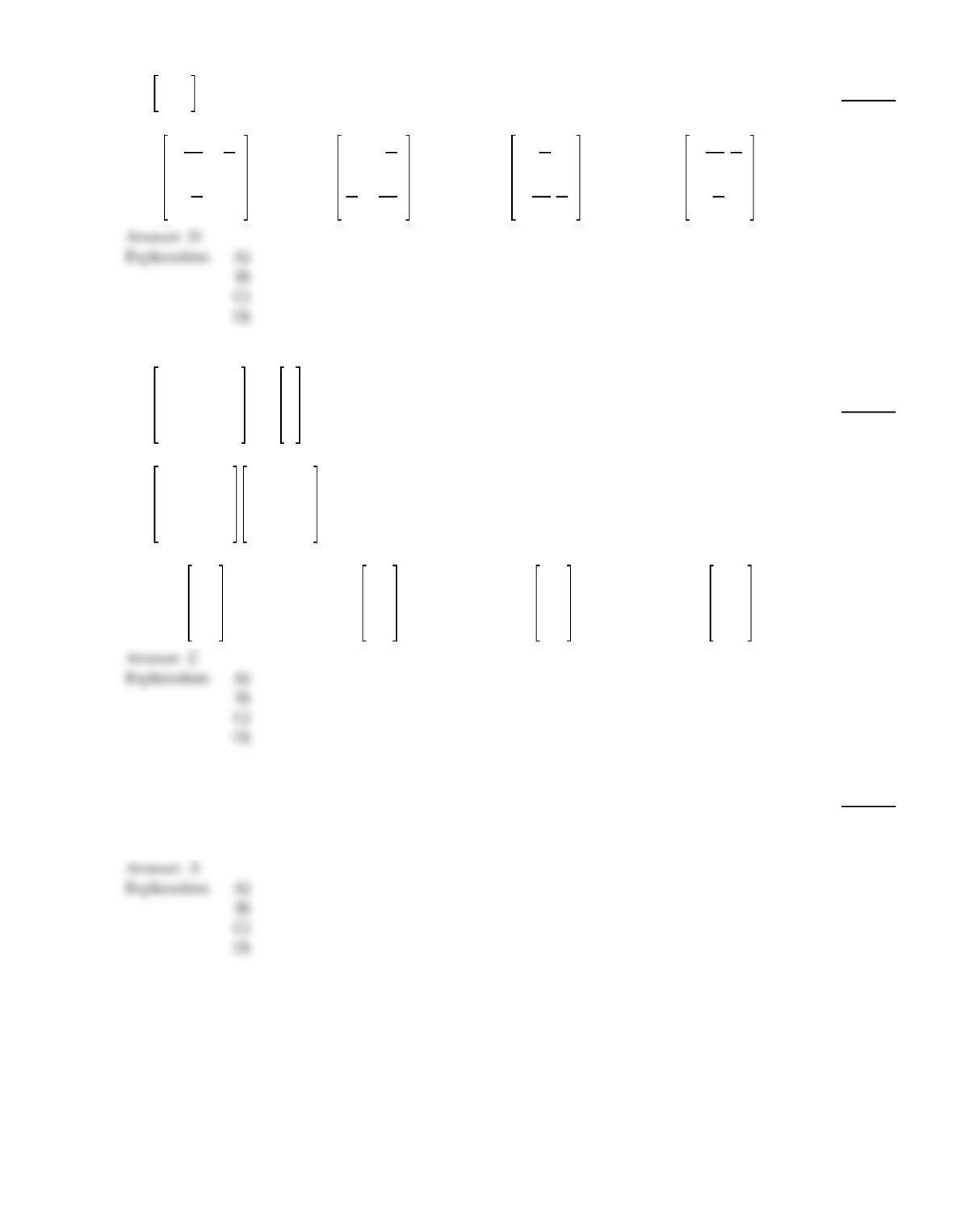
64)
A =0 5
6 3
64)
A)
–1
10 –1
6
–1
50
B)
01
6
1
5–1
10
C)
1
50
–1
10 1
6
D)
–1
10 1
6
1
50
Solve the equation Ax = b by using the LU factorization given for A.
65)
A =
1 2 4 3
–1–3–1–4
2 1 19 3
1 5 –9 7
, b=
2
0
4
3
A =
1 0 0 0
–1 1 0 0
2 3 1 0
1 –3–2 1
1 2 4 3
0–1 3 –1
0 0 2 0
0 0 0 1
65)
A)
x=
2
–2
8
–3
B)
x=
27
9
8
–3
C)
x=
41
–6
–3
–5
D)
x=
27
–18
89
–13
Solve the system by using the inverse of the coefficient matrix.
66)
5x1+ 3x2= 3
2x1+ 5x2= 24
66)
A)
(–3, 6)
B)
(–3, –6)
C)
No solution
D)
(6, –3)
20
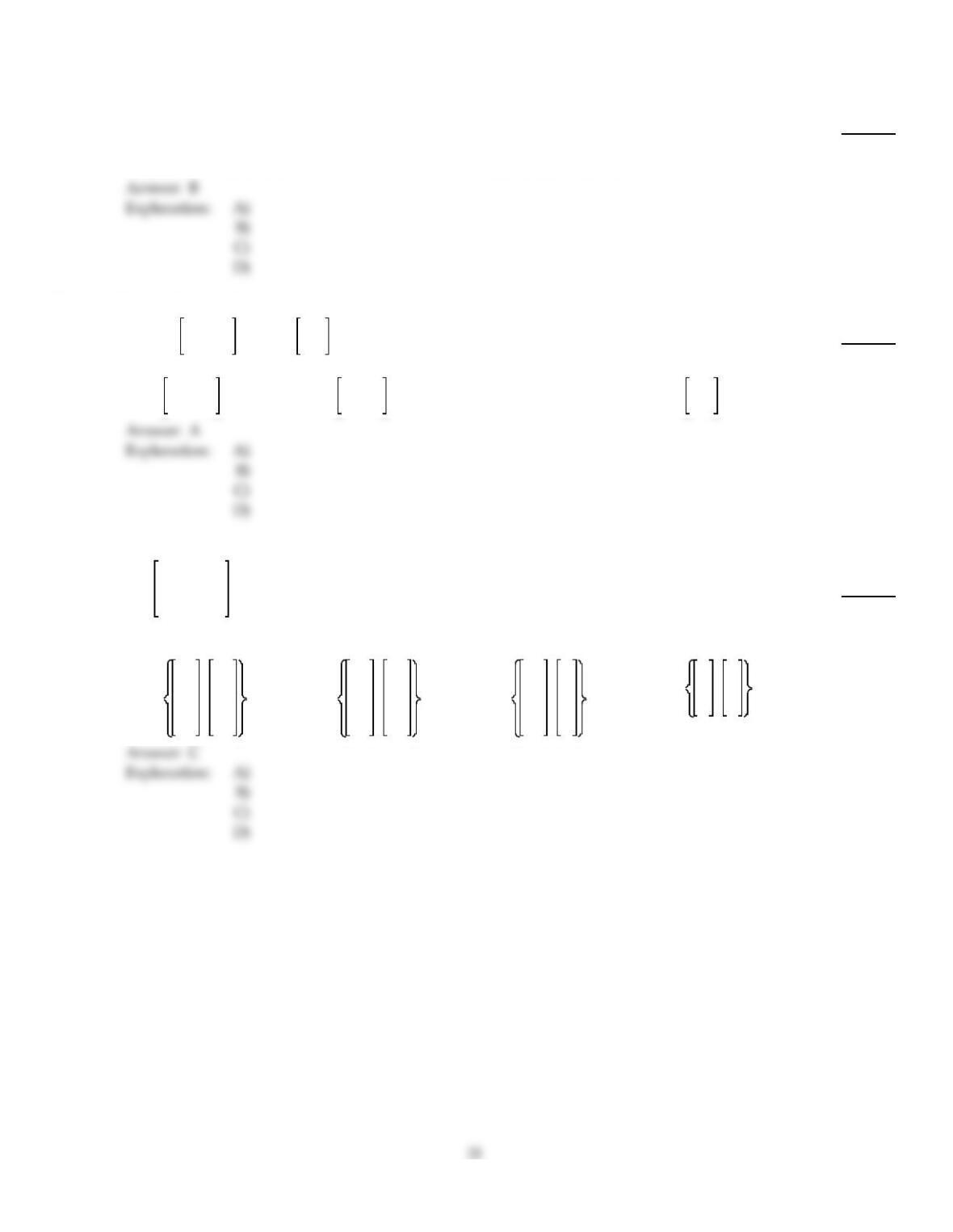
The sizes of two matrices A and B are given. Find the sizes of the product AB and the product BA, if the products are
defined.
67)
A is 2×1, B is 2×1.
67)
A)
AB is 2×2, BA is 1×1.
B)
AB is undefined, BA is undefined.
C)
AB is 1×2, BA is 2×1.
D)
AB is 2×1, BA is 1×2.
Perform the matrix operation.
68)
Let A =–10 3
7–9 and B =0 0
0 0 . Find A + B.
68)
A)
–10 3
7–9
B)
10 –3
–7 9
C)
Undefined
D)
0 0
0 0
Find a basis for the null space of the matrix.
69)
A =1 0 –5–2
0 1 7 –4
0 0 0 0
69)
A)
1
0
–5
–2
,
0
1
7
–4
B)
–5
7
1
0
,
–2
–4
0
1
C)
5
–7
1
0
,
2
4
0
1
D)
1
0
0, 0
1
0
Find the inverse of the matrix, if it exists.
70)
A =–4 0
–3–3
70)
A)
–1
40
1
4–1
3
B)
A is not invertible
C)
–1
30
1
4–1
4
D)
–1
40
–1
4–1
3
Perform the matrix operation.
71)
Let A =–1 2 and B =1 0 . Find 3A + 4B.
71)
A)
–3 4
B)
–1 4
C)
1 6
D)
2 2
22
Find the inverse of the matrix A, if it exists.
72)
A =022
–204
070
72)
A)
A–1=
1–1
2–2
7
0 0 1
7
1
20–1
7
B)
A–1=
– 1 –1
2–2
7
–1
701
7
1
20 0
C)
A–1 does not exist.
D)
A–1=
1 0 1
2
–1
20 0
–2
71
7–1
7
Find the matrix product AB, if it is defined.
73)
A =–1 3
2 2 , B =–2 0
–1 4 .
73)
A)
12 –1
8–6
B)
–112
–6 8
C)
2–6
–1 5
D)
2 0
–2 8
Perform the matrix operation.
74)
Let B =–1 4 7 –3. Find –4B.
74)
A)
4–16 –28 12
B)
–416 28 –12
C)
4 4 7 –3
D)
–3 2 5 –5

Solve the system by using the inverse of the coefficient matrix.
75)
10x1– 4x2= –6
6x1–x2= 2
75)
A)
(1, 4)
B)
(–4, –1)
C)
(4, 1)
D)
(–1, –4)
Find the matrix product AB, if it is defined.
76)
A =–1 3
1 6 , B =0–2 7
1–3 2 .
76)
A)
AB is undefined.
B)
0–6
21 1
–18 12
C)
3 6 –7
–20 –119
D)
3–7–1
6–20 19
Find a basis for the column space of the matrix.
77)
B =
1 0 –5 0 –5
0 1 5 0 4
0 0 0 1 1
0 0 0 0 0
77)
A)
1
0
0
0
,
0
1
0
0
B)
5
–5
1
0
0
,
5
–4
0
–1
1
C)
1
0
0
0
,
0
1
0
0
,
–5
5
0
0
D)
1
0
0
0
,
0
1
0
0
,
0
0
1
0
78)
B = 1 –2 2 –3
2 –4 9 –2
–3 6 –6 9
78)
A)
1
2
–3, –2
–4
6
B)
2
1
0
0
,
23
5
0
–4
5
1
C)
1
0
0, 0
1
0
D)
1
2
–3, 2
9
–6
Determine whether the matrix is invertible.
79)
5 5 –5
6 2 –6
–2 0 2
79)
A)
No
B)
Yes
Decide whether or not the matrices are inverses of each other.
80)
–5–1
6 0 and
01
6
–15
6
80)
A)
No
B)
Yes
Find the inverse of the matrix A, if it exists.
81)
A =1 1 1
2 1 1
2 2 3
81)
A)
A–1=–1–1–1
–2–1–1
–2–2–3
B)
A–1=–1 1 0
4–1–1
–2 0 1
C)
A–1=
1 1 1
1
21 1
1
21
21
3
D)
A–1 does not exist.
Perform the matrix operation.
82)
Let A =–1 7
–5 1
4 9 and B =5 6
–3–9
–5 7 . Find A + B.
82)
A)
413
–8–8
–116
B)
4 1
–8–8
–116
C)
413
8 1
–1–16
D)
–6 1
–2–2
9 0
Find the 3 × 3 matrix that produces the described transformation, using homogeneous coordinates.
83)
(x, y)
(x +5, y +4)
83)
A)
5 0 0
0 4 0
0 0 1
B)
1 0 4
0 1 5
0 0 1
C)
1 0 5
0 1 4
0 0 0
D)
1 0 5
0 1 4
0 0 1
26
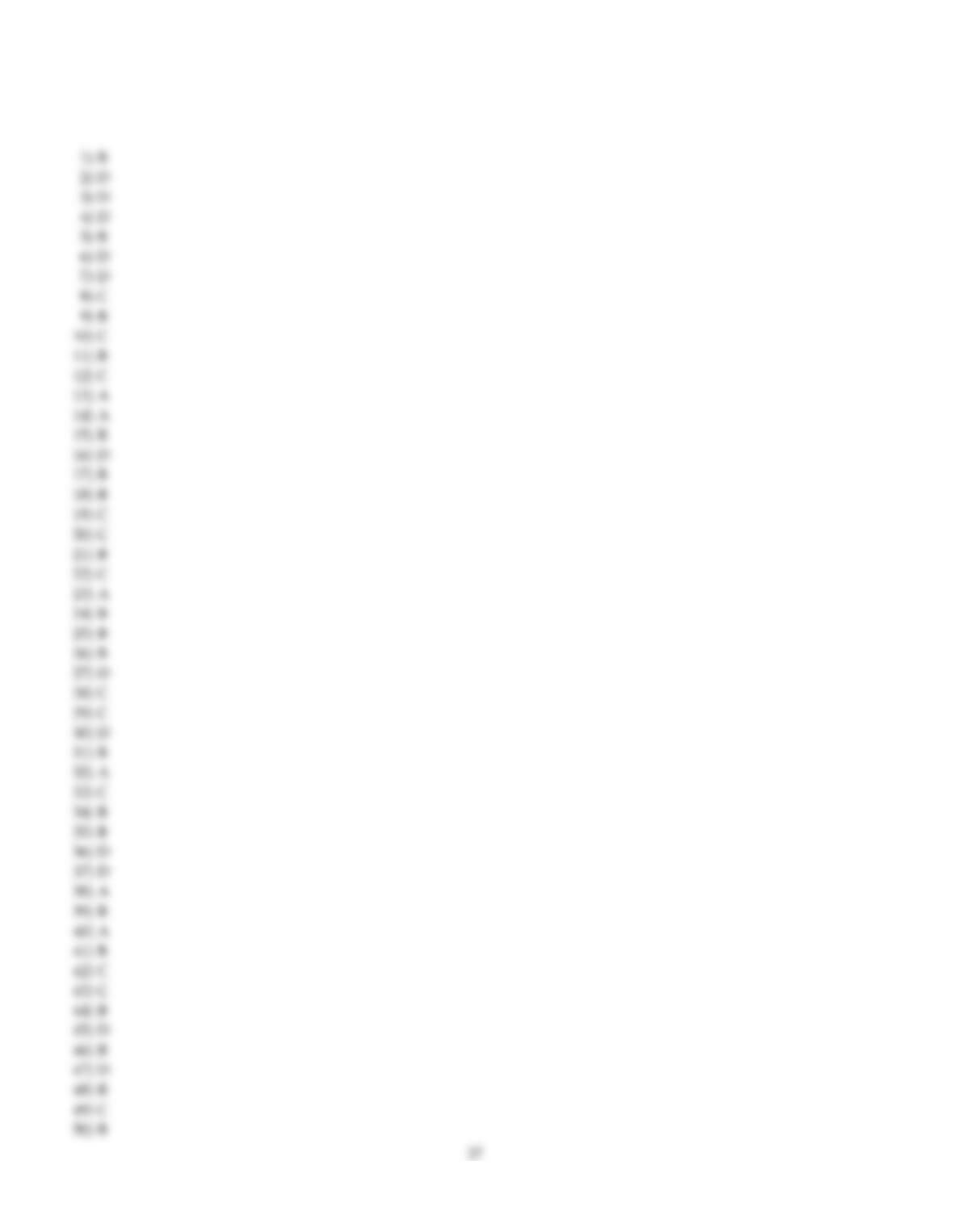
Answer Key
Testname: C2
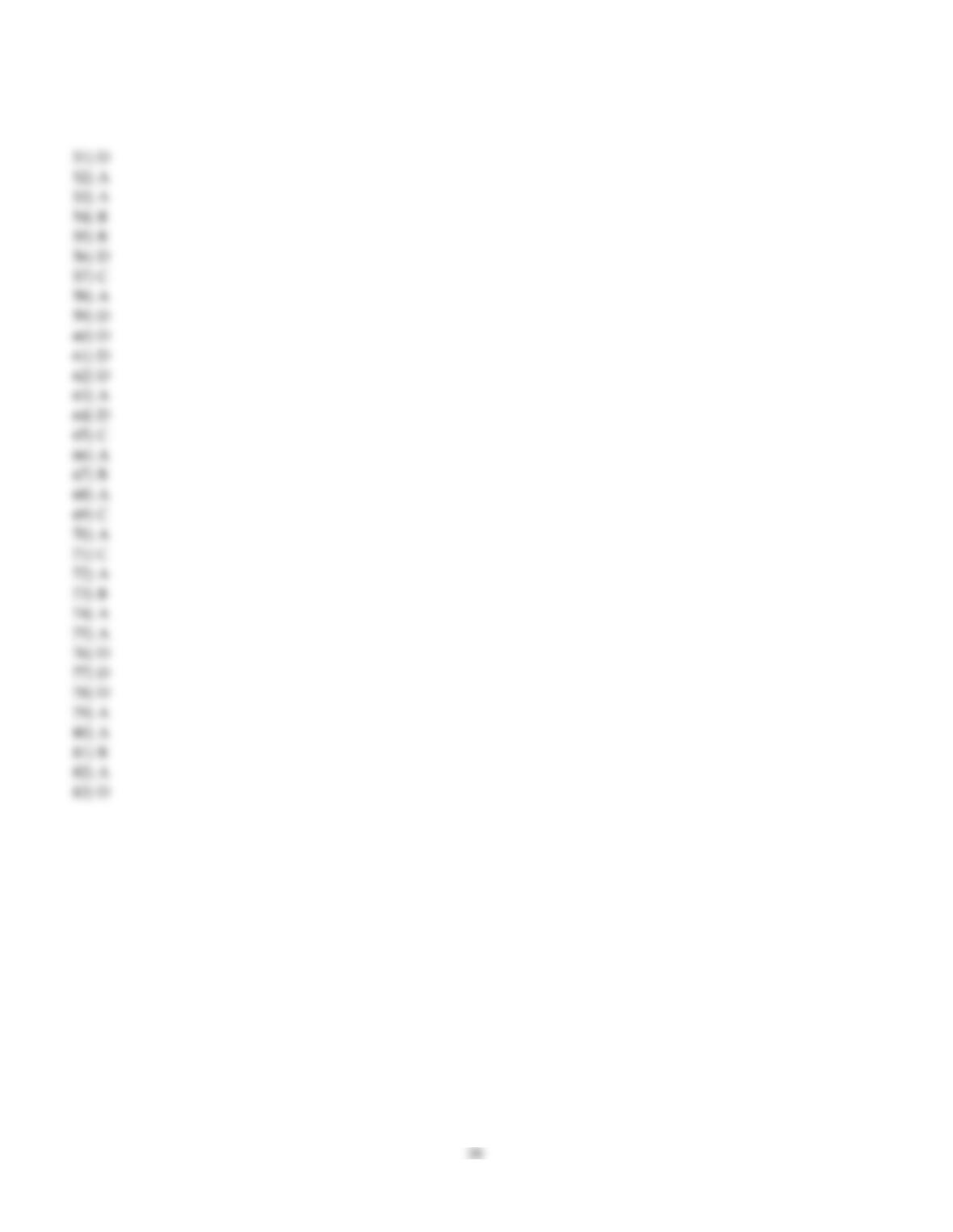
Answer Key
Testname: C2