Chapter 2 – Basic Managerial Accounting Concepts
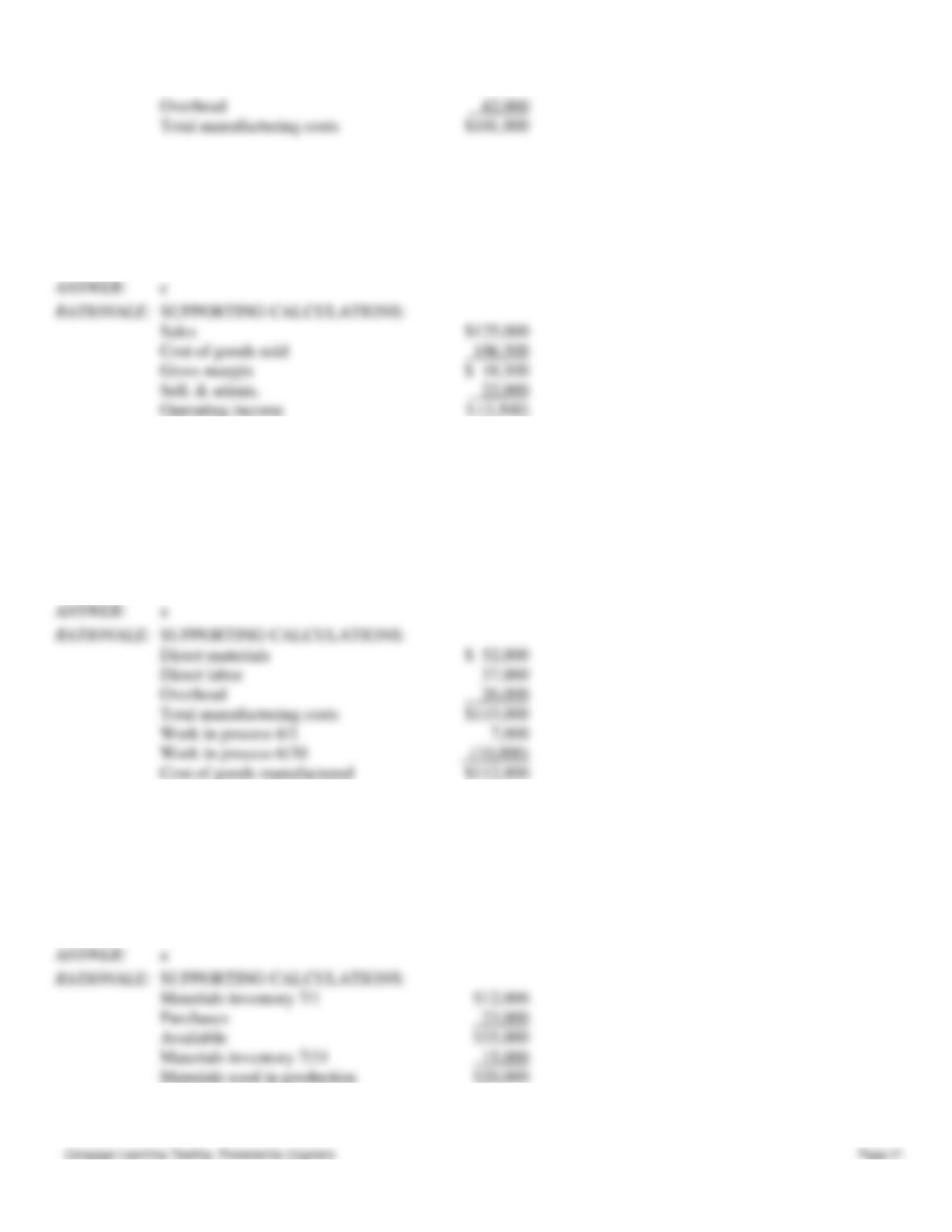
Overhead
131. Refer to Figure 2-2. What was Lonborg’s operating income (loss) for the year?
a.
$18,500
b.
$125,000
c.
$(3,500)
d.
$2,000
Sales
132. During the month of June, Telecom Inc. had cost of goods manufactured of $112,000, direct materials cost of
$52,000, direct labor cost of $37,000 and overhead cost of $26,000. The work in process balance at June 30 equaled
$10,000. What was the work in process balance on June 1?
a.
$7,000
b.
$13,000
c.
$10,000
d.
$115,000
Overhead
133. Talcum Inc. had materials inventory at July 1 of $12,000. The materials inventory at July 31 was $15,000 and the
cost of direct materials used in production was $20,000. What was the cost of materials purchased during the month?
a.
$23,000
b.
$17,000
c.
$35,000
d.
$20,000
Purchases
Available
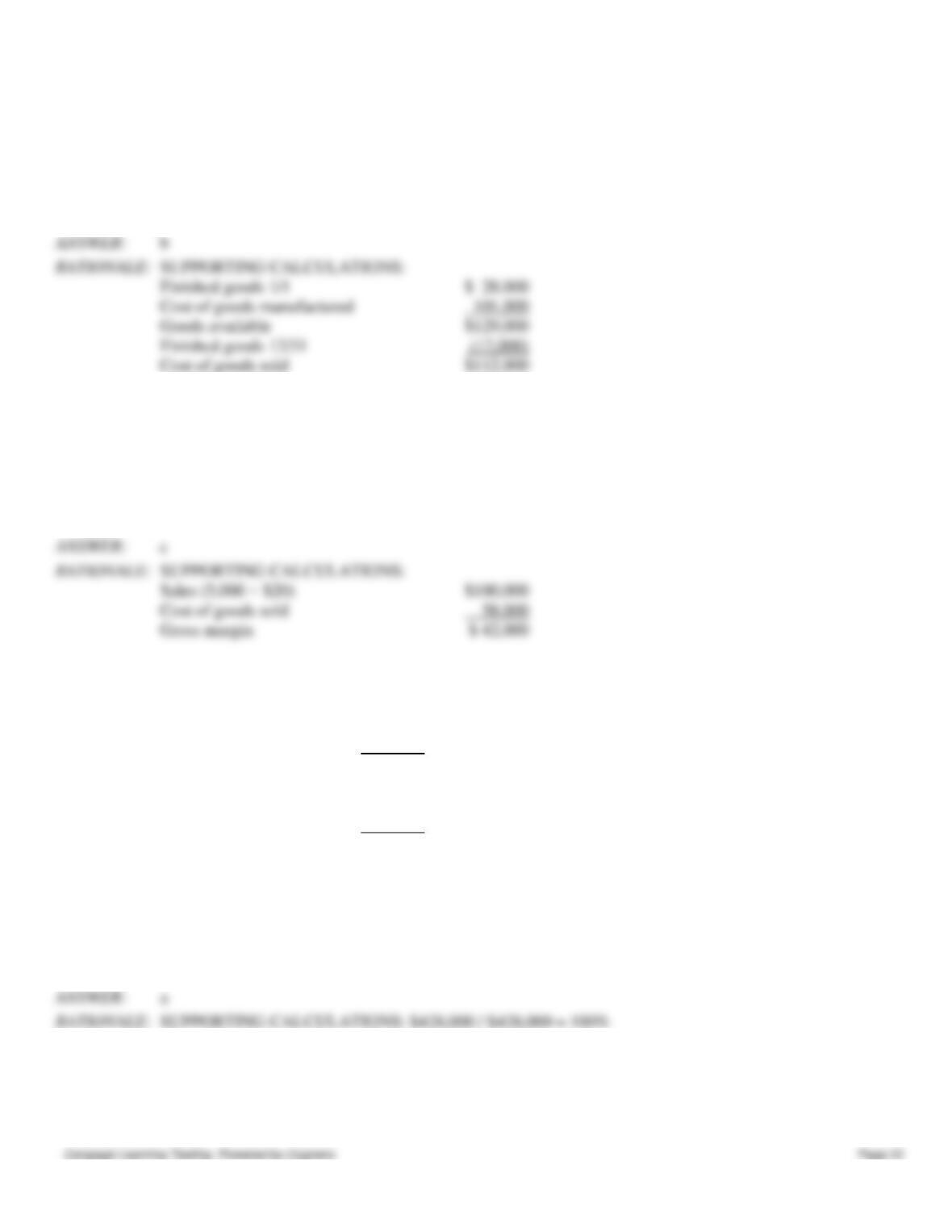
134. Kutlow Inc. had cost of goods sold of $112,000 for the current year ended December 31. The finished goods
Chapter 2 – Basic Managerial Accounting Concepts
inventory on January 1 was $28,000 and the finished goods inventory on December 31 was $17,000. What was the
amount of cost of goods manufactured for the year?
a.
$129,000
b.
$101,000
c.
$67,000
d.
$113,000
Finished goods 1/1
$ 28,000
Cost of goods manufactured
101,000
Goods available
$129,000
Finished goods 12/31
Cost of goods sold
$112,000
135. Andover Inc. had a gross margin for the month of February totaling $42,000. They sold 5,000 units during the month
at a sales price of $20 per unit. What was the amount of cost of goods sold for the month?
a.
$100,000
b.
$42,000
c.
$58,000
d.
none of these are correct
Sales (5,000 × $20)
$100,000
Cost of goods sold
58,000
Gross margin
Figure 2-3.
Bartlow, Inc. had the following income statement for the month of May.
Sales revenue
$428,000
Cost of goods sold
205,440
Gross margin
$222,560
Less:
Selling expenses
81,320
Administrative expenses
72,760
Operating income
$ 68,480
136. Refer to Figure 2-3. What was the sales revenue percent?
a.
100%
b.
48%
c.
52%
d.
16%
SUPPORTING CALCULATIONS: $428,000 / $428,000 = 100%
137. Refer to Figure 2-3. What was the cost of goods sold percent?
a.
100%
b.
19%
c.
52%
Chapter 2 – Basic Managerial Accounting Concepts
d.
48%
SUPPORTING CALCULATIONS: $205,440 / $428,000 = 48%
138. Refer to Figure 2-3. What was the gross margin percent?
a.
52%
b.
48%
c.
17%
d.
19%
SUPPORTING CALCULATIONS: $222,560 / $428,000 = 52%
139. Refer to Figure 2-3. What was the selling expense percent?
a.
17%
b.
19%
c.
16%
d.
no correct answer
SUPPORTING CALCULATIONS: $81,320 / $428,000 = 19%
140. Refer to Figure 2-3. What was the administrative expense percent?
a.
17%
b.
19%
c.
16%
d.
15%
SUPPORTING CALCULATIONS: $72,760 / $428,000 = 17%
141. Refer to Figure 2-3. What was the operating income percent?
a.
15%
b.
19%
c.
17%
d.
16%
SUPPORTING CALCULATIONS: $68,480 / $428,000 = 16%
Figure 2-4.
Junko Company makes financial calculators. During the year Junko manufactured 97,000 financial calculators. Finished
goods inventory had the following units on hand:
January 1
1,260
December 31
1,040
142. Refer to Figure 2-4. How many financial calculators did Junko sell during the year?
a.
96,780
b.
97,220
Chapter 2 – Basic Managerial Accounting Concepts
c.
97,000
d.
98,260
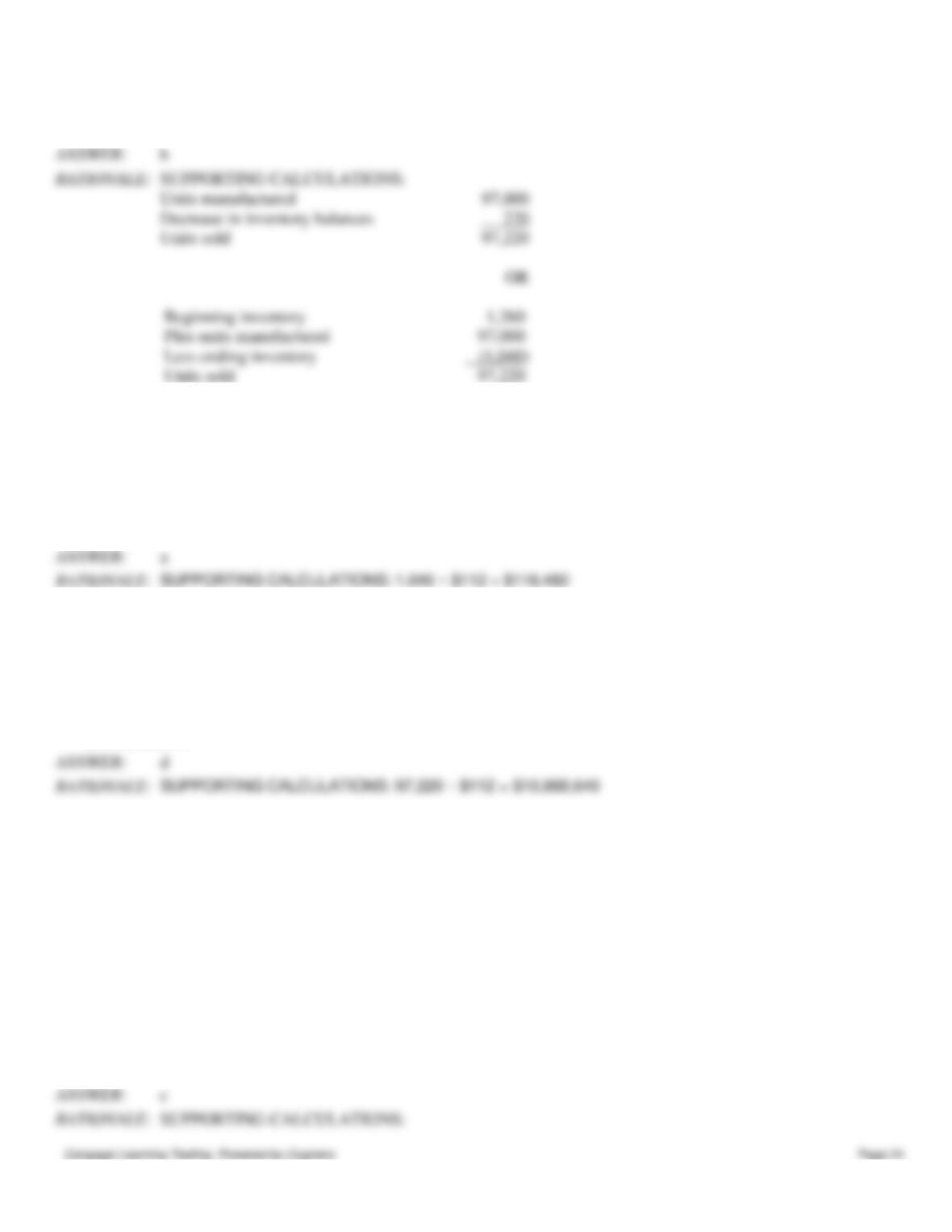
Units manufactured
Decrease in inventory balances
Units sold
Beginning inventory
Plus units manufactured
Less ending inventory
Units sold
143. Refer to Figure 2-4. If each financial calculator had a per-unit product cost of $112, what was the cost of Finished
goods inventory on December 31?
a.
$116,480
b.
$141,120
c.
$24,640
d.
none of these are correct
SUPPORTING CALCULATIONS: 1,040 × $112 = $116,480
144. Refer to Figure 2-4. If each financial calculator has a per-unit product cost of $112, what was the cost of goods sold
last year?
a.
$10,864,000
b.
$10,839,360
c.
$11,005,120
d.
$10,888,640
SUPPORTING CALCULATIONS: 97,220 × $112 = $10,888,640
Figure 2-6.
Seaview Company took the following data from their income statement at the end of the current year.
Per-unit product cost
$30
Gross margin percentage
40%
Selling and administrative expenses
$30,000
Operating income
$10,000
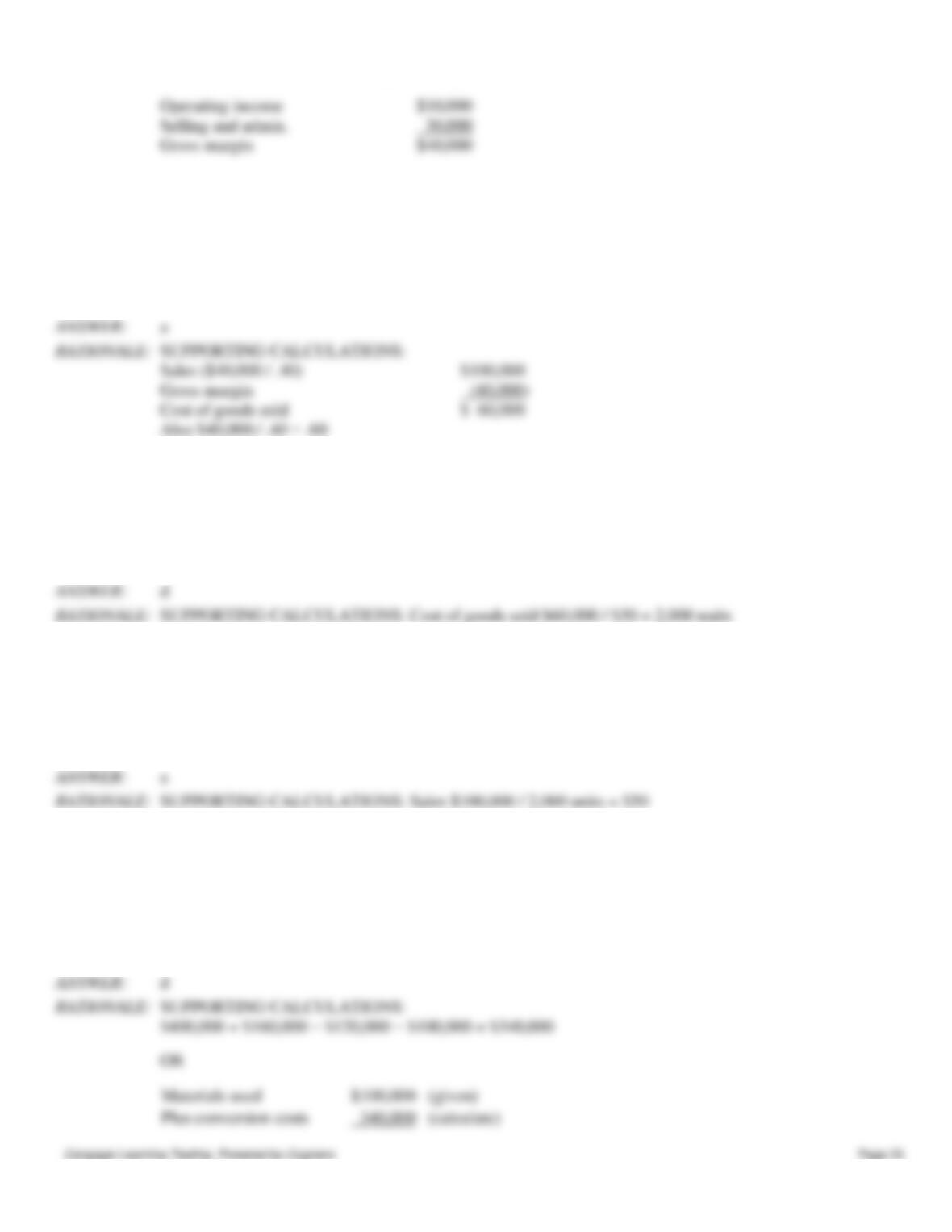
145. Refer to Figure 2-6. What was gross margin for the year?
a.
$60,000
b.
$100,000
c.
$40,000
d.
none of these
SUPPORTING CALCULATIONS:
Chapter 2 – Basic Managerial Accounting Concepts
146. Refer to Figure 2-6. What was cost of goods sold for the year?
a.
$60,000
b.
$40,000
c.
$100,000
d.
none of these
147. Refer to Figure 2-6. How many units were sold during the year?
a.
3,333
b.
1,000
c.
1,500
d.
2,000
148. Refer to Figure 2-6. What was the sales price per unit?
a.
$50
b.
$30
c.
$20
d.
$10
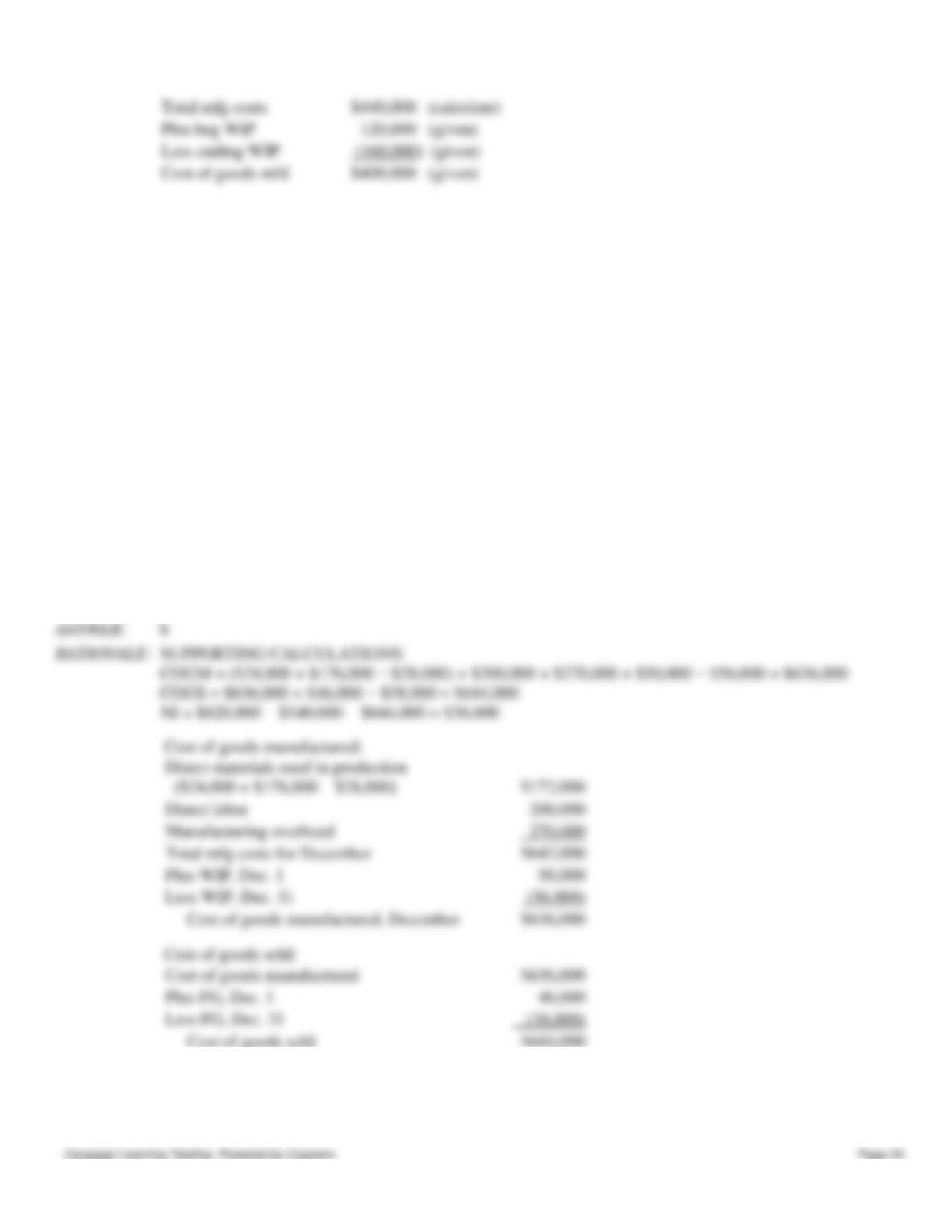
149. If beginning work-in-process inventory is $120,000, ending work-in-process inventory is $160,000, cost of goods
manufactured is $400,000 and direct materials used are $100,000, what are the conversion costs?
a.
$140,000
b.
$280,000
c.
$300,000
d.
$340,000
$10,000
$40,000
Chapter 2 – Basic Managerial Accounting Concepts
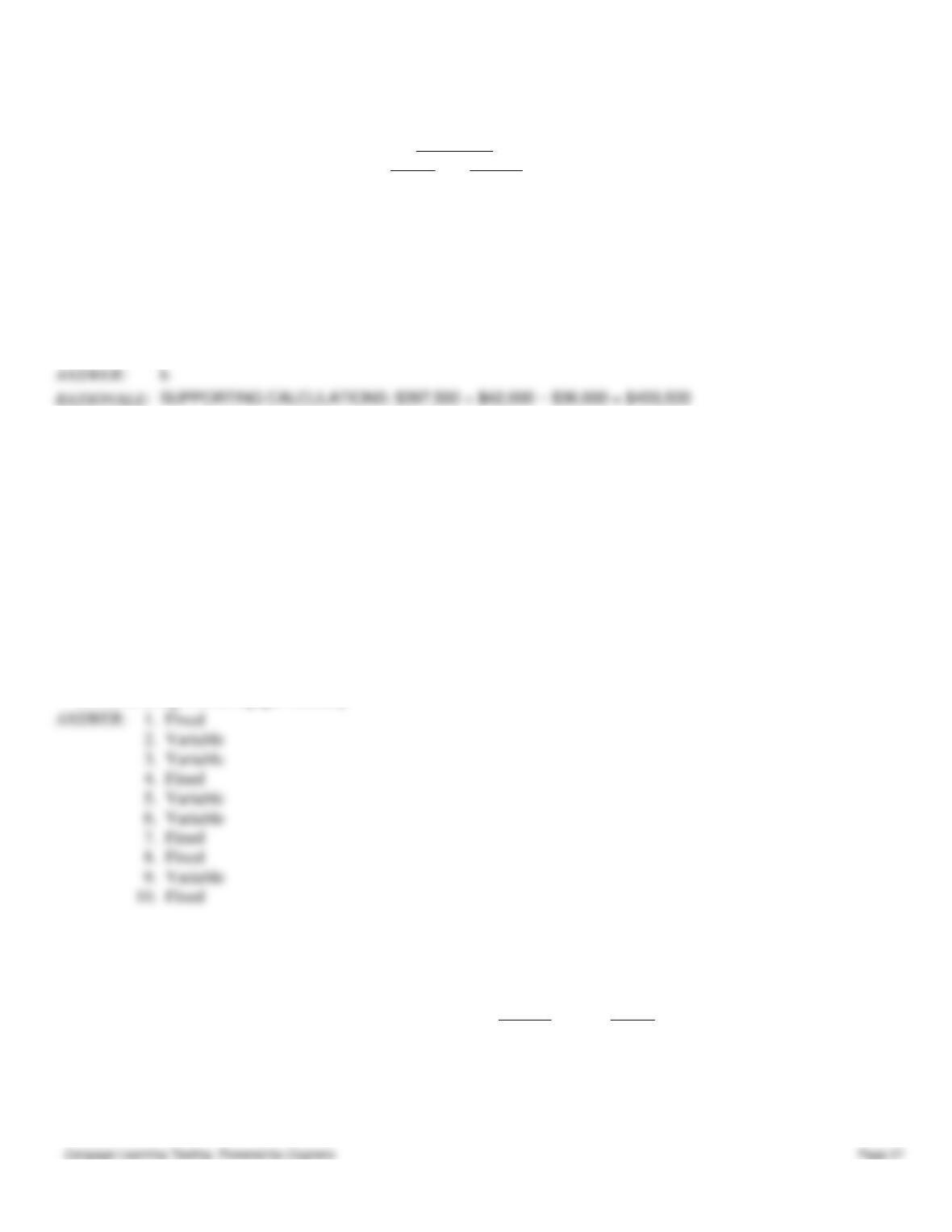
150. Information from the records of Place, Inc., for December is as follows:
Sales
$820,000
Selling and administrative expenses
140,000
Direct materials purchases
176,000
Direct labor
200,000
Factory overhead
270,000
Direct materials, December 1
24,000
Work in process, December 1
50,000
Finished goods, December 1
46,000
Direct materials, December 31
28,000
Work in process, December 31
56,000
Finished goods, December 31
38,000
Net income for the month of December is:
a.
$644,000.
b.
$36,000.
c.
$636,000.
d.
$180,000.
151. Selected data concerning the past year’s operations of the Burner Corporation are as follows:
Selling and administrative expenses
$225,000
Chapter 2 – Basic Managerial Accounting Concepts
Direct materials used
397,500
Direct labor
450,000
Inventories
Dec. 1
Dec. 31
Direct materials
$36,000
$42,000
Work in process
75,000
84,000
Finished goods
69,000
57,000
The cost of direct materials purchased is:
a.
$397,500.
b.
$403,500.
c.
$367,500.
d.
$405,000.
SUPPORTING CALCULATIONS: $397,500 + $42,000 − $36,000 = $403,500
152. Stone Company, maker of computers, incurred the following costs during the year:
Required: Classify each cost as either fixed or variable cost.
Fixed
Variable
1.
Salary of the factory supervisor
2.
Materials needed to assemble the computers
3.
Wages paid to an assembly line worker
4.
Depreciation on the factory
5.
Utility bill for the factory
6.
Grease used to lubricate the machine
7.
Rent paid for the factory
8.
Property taxes on the factory and corporate office
9.
Boxes used to package the completed computers
10.
Advertising in a newspaper monthly
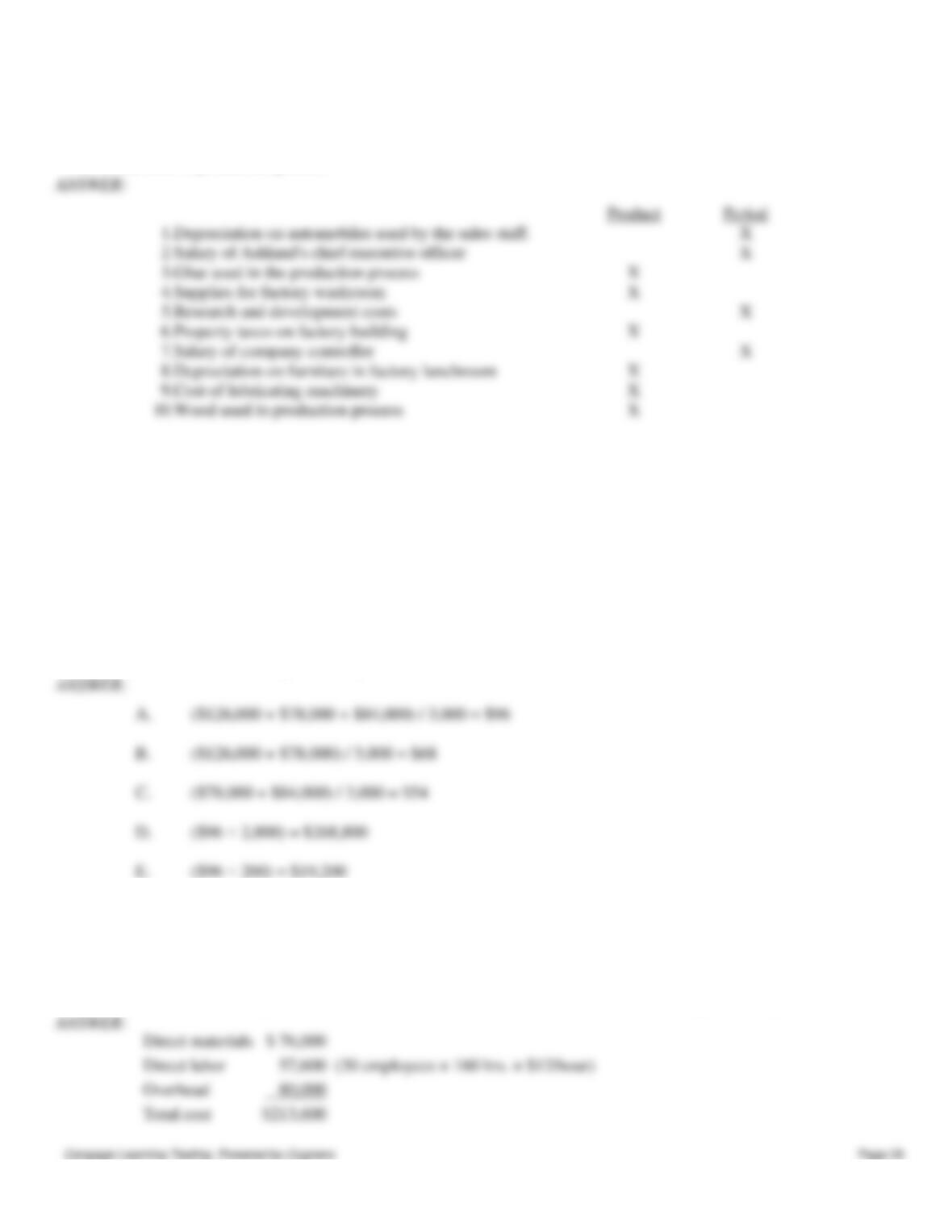
153. Ashland Company, maker of kitchen cabinets, incurred the following costs during the current year:
Required: Classify each cost as either a product or period cost.
Product
Period
1.
Depreciation on automobiles used by the sales staff.
2.
Salary of Ashland’s chief executive officer
3.
Glue used in the production process
4.
Supplies for factory washroom
5.
Research and development costs
6.
Property taxes on factory building
Chapter 2 – Basic Managerial Accounting Concepts
7.
Salary of company controller
8.
Depreciation on furniture in factory lunchroom
9.
Cost of lubricating machinery
10.
Wood used in production process
1.
Depreciation on automobiles used by the sales staff.
2.
Salary of Ashland’s chief executive officer
3.
Glue used in the production process
4.
Supplies for factory washroom
5.
Research and development costs
6.
Property taxes on factory building
7.
Salary of company controller
8.
Depreciation on furniture in factory lunchroom
9.
Cost of lubricating machinery
10.
Wood used in production process
154. The Bayou Company makes crab pots. During the current month, direct materials costing $126,000 were put into
production. Direct labor of $78,000 was incurred and overhead equaled $84,000. Selling and administrative expenses
totaled $66,000 for the month and the company manufactured 3,000 crab pots. Assume there was no beginning inventory
and that 2,800 crab pots were sold.
Required:
A.
Compute the per-unit product cost
B.
Compute the per-unit prime cost
C.
Compute the per-unit conversion cost
D.
What is cost of goods sold for the month?
E.
What is the cost of ending finished goods for the month?
A.
($126,000 + $78,000 + $84,000) / 3,000 = $96
B.
($126,000 + $78,000) / 3,000 = $68
C.
($78,000 + $84,000) / 3,000 = $54
D.
($96 × 2,800) = $268,800
E.
($96 × 200) = $19,200
155. Ross Company makes handbags. Last month direct materials (leather, thread, zippers, decorative accents) costing
$76,000 were put into production. Ross had 30 workers, each worked 160 hours this month and each are paid $12 per
hour. Overhead equaled $80,000 for the period. Ross Company produced 40,000 handbags as of the end of the month.
Required: Calculate the total product cost for the month and calculate the cost of one handbag that was produced.
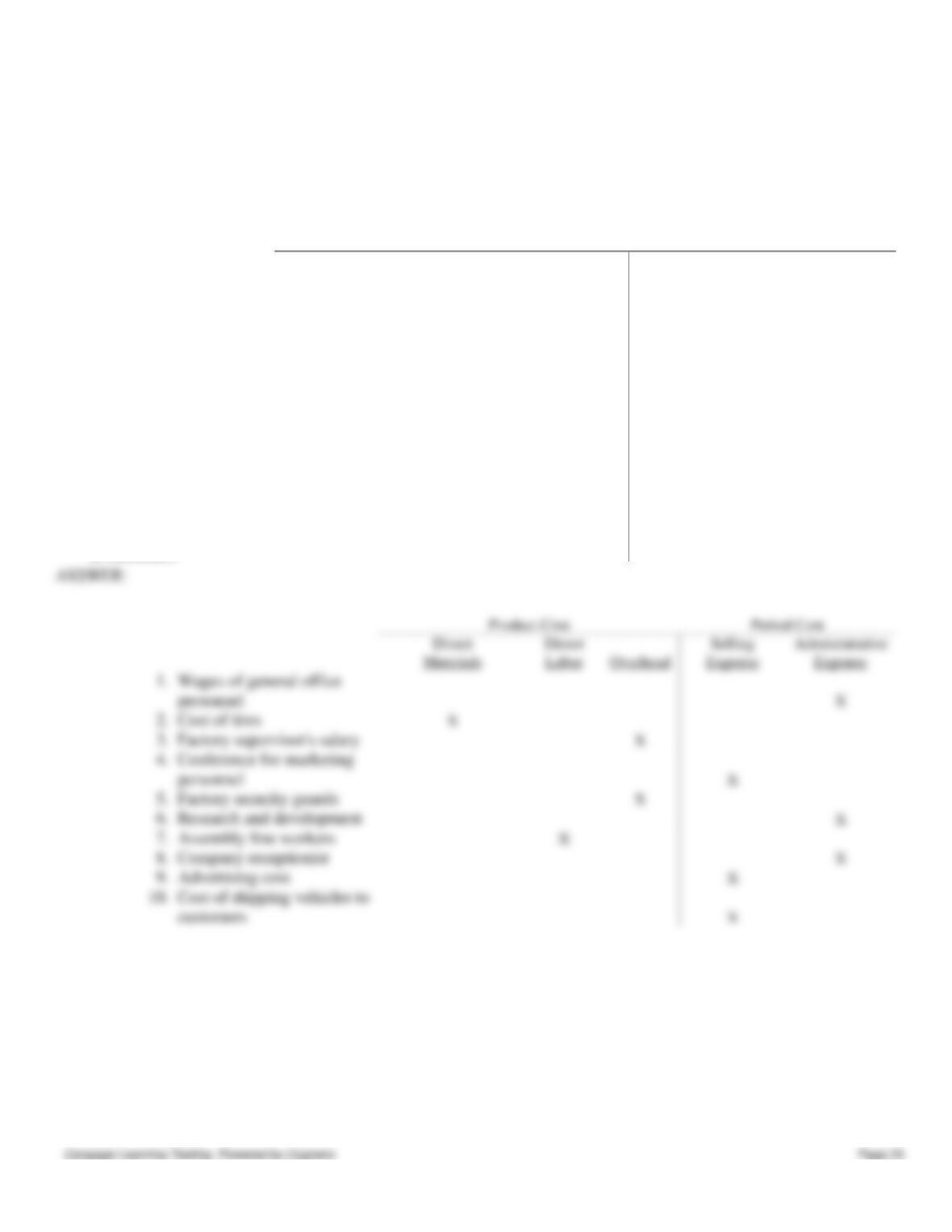
Chapter 2 – Basic Managerial Accounting Concepts
Cost of one handbag: $213,600 / 40,000 = $5.34
156. Arcadia Company manufactures recreational vehicles and incurred the following costs during the current year.
Required: Classify each cost using the table format given below:
Product Cost
Period Cost
Direct
Materials
Direct
Labor
Overhead
Selling
Expense
Administrative
Expense
1.
Wages of general office
personnel
2.
Cost of tires
3.
Factory supervisor’s salary
4.
Conference for marketing
personnel
5.
Factory security guards
6.
Research and
development
7.
Assembly line workers
8.
Company receptionist
9.
Advertising cost
10.
Cost of shipping vehicles
to customers
personnel
X
Cost of tires
Factory supervisor’s salary
Conference for marketing
Factory security guards
Research and development
X
Assembly line workers
Company receptionist
X
Advertising cost
customers
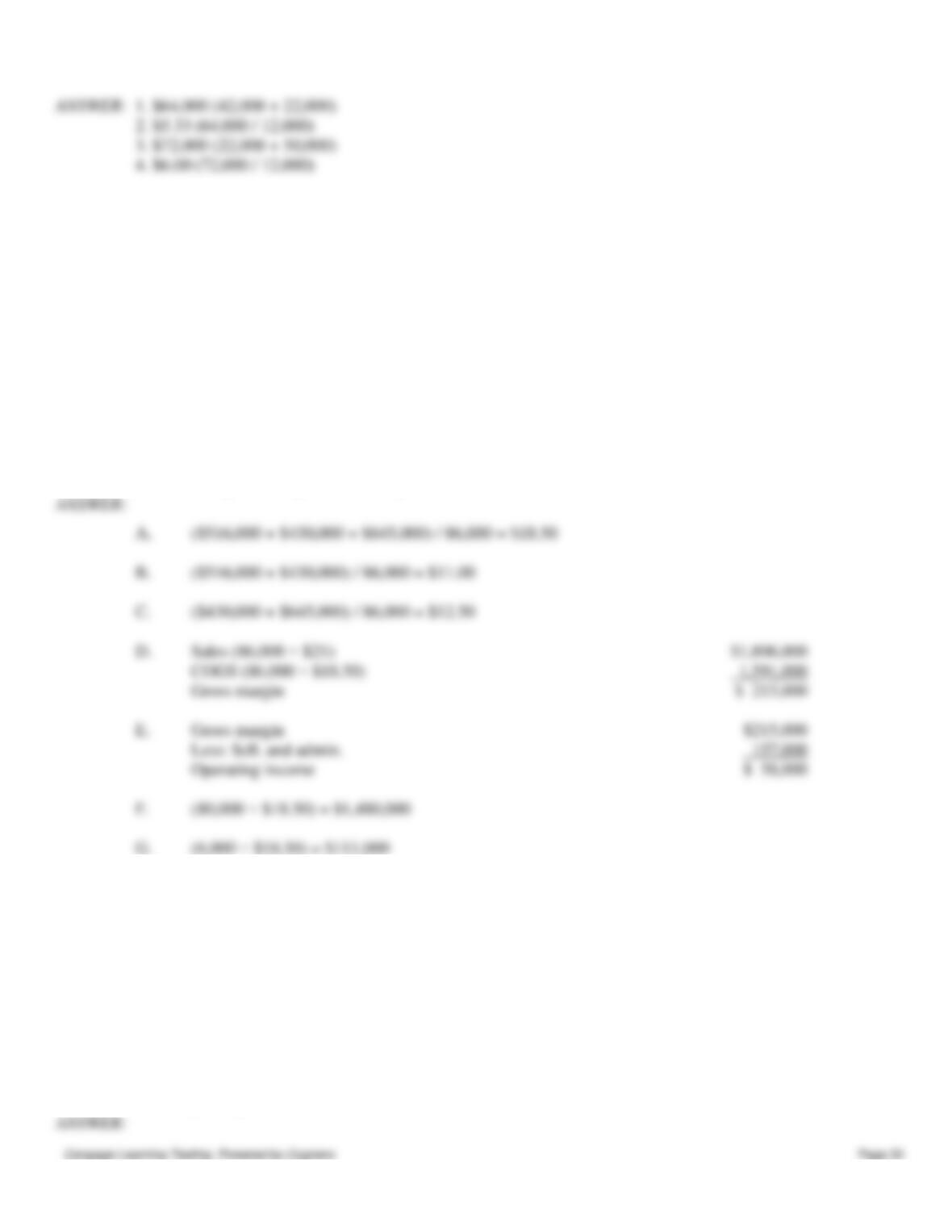
157. Room With A View Company manufactures curtains. Last week, direct materials costing $42,000 were put into
production. Direct labor of $22,000 was incurred and overhead totaled $50,000. By the end of the week, the company had
produced 12,000 curtains.
Required:
1. Calculate the total prime cost for the week.
2. Calculate the per-unit prime cost.
3. Calculate the total conversion cost for the week.
4. Calculate the per-unit conversion cost.
Chapter 2 – Basic Managerial Accounting Concepts
158. The Blanchett Company manufactures fishing rods. Last year, direct materials costing $516,000 were put into
production. Direct labor of $430,000 was incurred and overhead equaled $645,000. The company had operating income
for the year of $58,000 and manufactured and sold 86,000 fishing rods at a sales price of $21 per unit. Assume that there
were no beginning or ending inventory balances in the work in process and finished goods inventory accounts.
Required:
A.
Compute the per-unit product cost
B.
Compute the per-unit prime cost
C.
Compute the per-unit conversion cost
D.
Compute the gross margin for the year
E.
Compute the selling and administrative expenses for the year
F.
Assume production amounted to 86,000 fishing rods and 80,000 were sold. Compute cost
of goods sold.
G.
Assume production amounted to 86,000 fishing rods and 80,000 were sold. Compute the
balance in ending finished goods inventory.
A.
($516,000 + $430,000 + $645,000) / 86,000 = $18.50
B.
($516,000 + $430,000) / 86,000 = $11.00
C.
($430,000 + $645,000) / 86,000 = $12.50
D.
Sales (86,000 × $21)
COGS (86,000 × $18.50)
Gross margin
E.
Gross margin
Less: Sell. and admin.
Operating income
(80,000 × $18.50) = $1,480,000
G.
(6,000 × $18.50) = $111,000
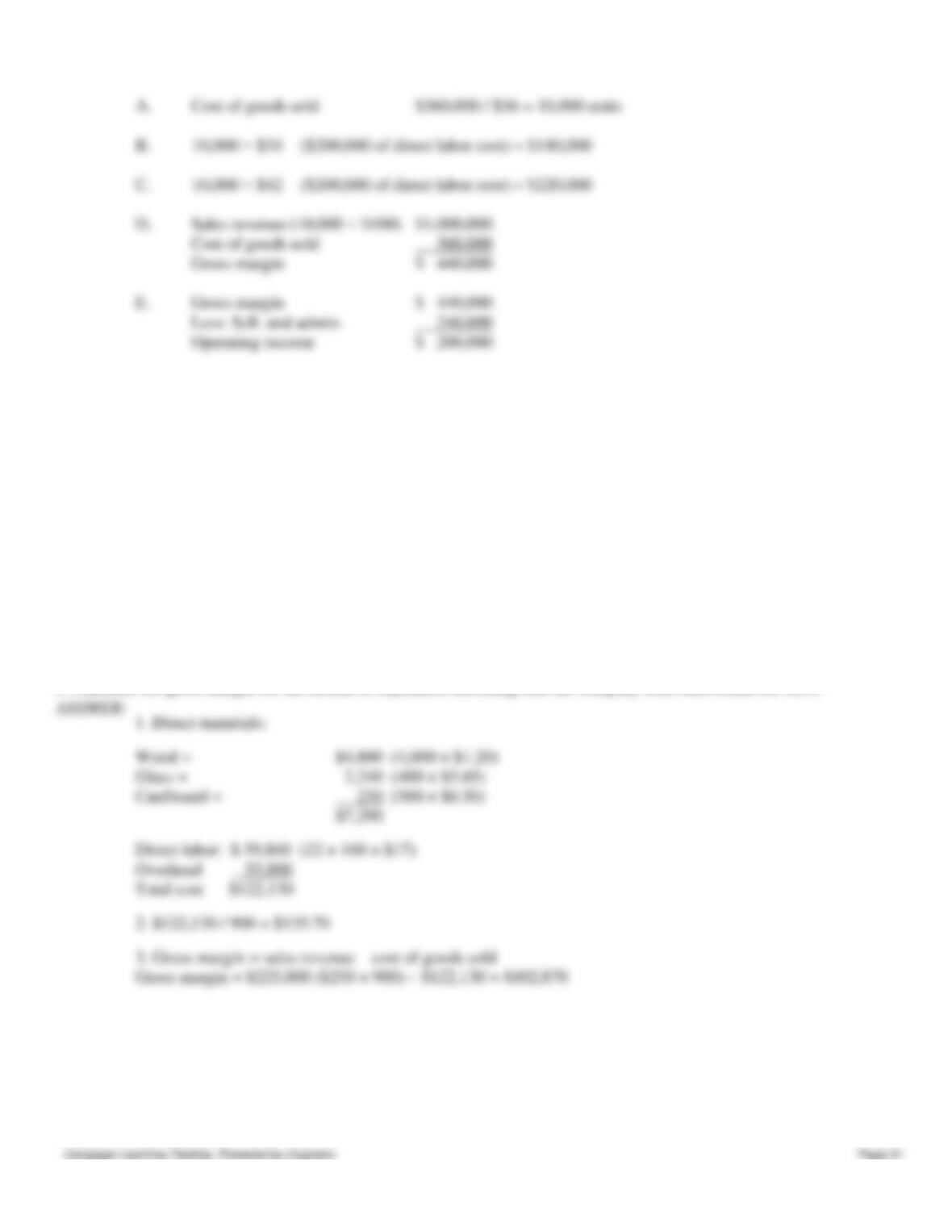
159. The Butchart Company manufactures microwave ovens. Last year, the per-unit product cost was $56, the per-unit
prime cost was $34, and the per-unit conversion cost was $42. Cost of goods sold for the year was $560,000 and the sale
price per unit was $100. In addition, direct labor costs of $200,000 and selling and administrative expenses of $240,000
were incurred.
Required:
A.
Calculate how many units were sold last year
B.
Compute the cost of direct materials used
C.
Compute the cost of overhead
D.
Compute the gross margin for the year
E.
Calculate operating income
Chapter 2 – Basic Managerial Accounting Concepts
160. Picture It Inc. manufactures customized wooden frames. The direct materials needed to construct the frames are
wood, glass and cardboard. Picture It has 22 employees who work a 40-hour work week and are each paid $17 per hour.
The company produced and sold 900 frames in the month of September.
During the month of September the following purchases were made to produce the 900 frames:
Wood—4000 ft. at $1.20/ft.
Glass—400 pieces at $5.60/piece
Cardboard—500 pieces at $0.50/piece
Required:
1. Calculate the total product cost for the month. Assume that all employees worked four full weeks in September and that
the company incurred $55,000 in overhead costs.
2. Calculate the per-unit cost.
3. Calculate the gross margin for the month of September assuming that the company sells each frame for $250.
Wood =
$4,800
Glass =
2,240
(400 × $5.65)
Cardboard =
(500 × $0.50)
$7,290
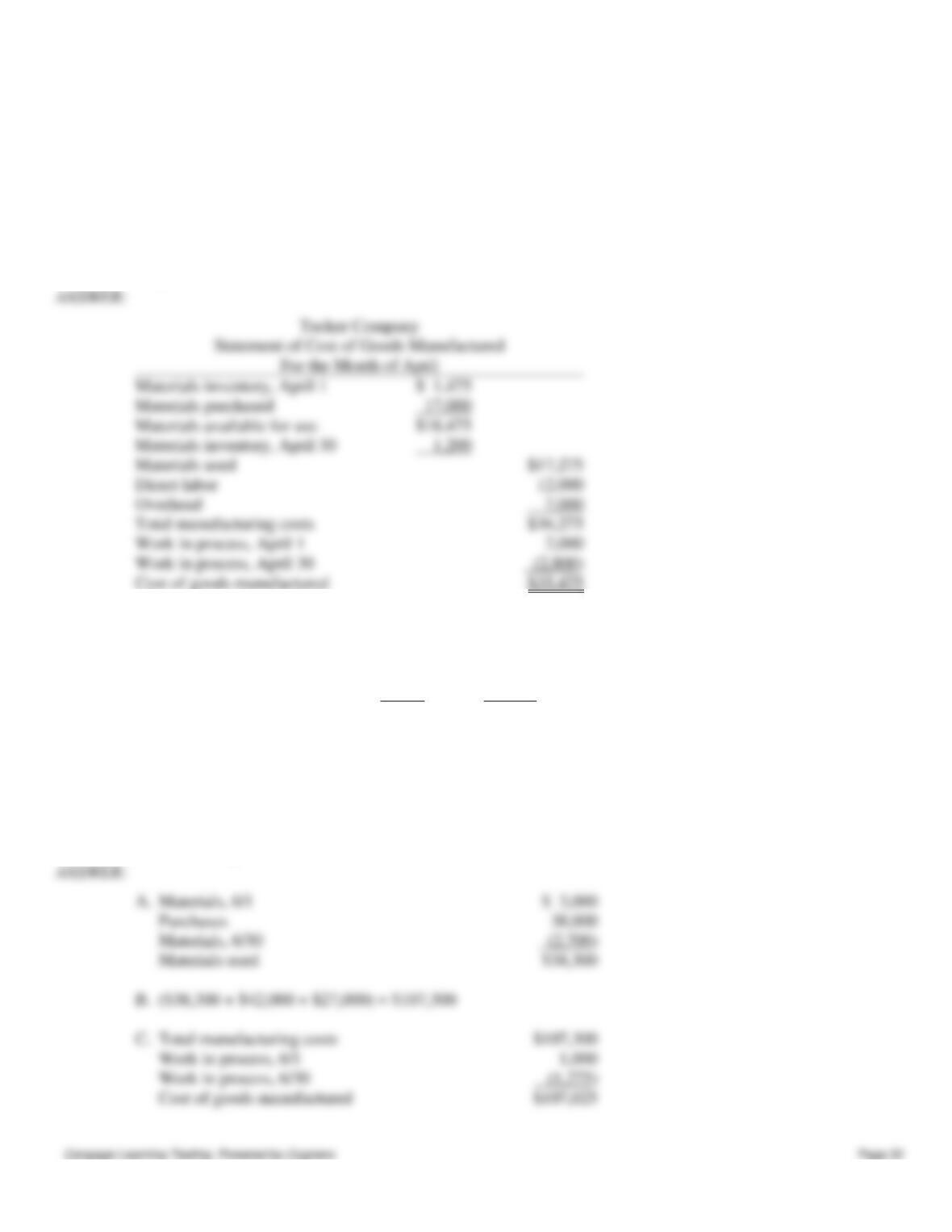
161. Tucker Company, a manufacturing firm, has supplied the following information from its accounting records for the
month of April.
Direct labor cost
$12,000
Purchases of raw materials
17,000
Factory insurance
4,000
Research and development
7,500
Cost of goods sold
$560,000 / $56 = 10,000 units
10,000 × $34 − ($200,000 of direct labor cost) = $140,000
10,000 × $42 − ($200,000 of direct labor cost) = $220,000
Sales revenue (10,000 × $100)
Cost of goods sold
560,000
Gross margin
$ 440,000
Gross margin
$ 440,000
Less: Sell. and admin.
240,000
Operating income
$ 200,000
Chapter 2 – Basic Managerial Accounting Concepts
Factory property taxes
3,000
Sales commissions paid
4,500
Work in process, April 1
2,000
Work in process, April 30
2,800
Materials inventory, April 1
1,475
Materials inventory, April 30
1,200
Finished goods inventory, April 1
2,250
Finished goods inventory, April 30
750
Required: Prepare a Statement of Cost of Goods Manufactured.
Materials inventory, April 1
Materials purchased
Materials available for use
Materials inventory, April 30
Materials used
Direct labor
12,000
Overhead
Total manufacturing costs
Work in process, April 1
2,000
Work in process, April 30
Cost of goods manufactured
162. In June, Olympic Company purchased materials costing $38,000, and incurred direct labor cost of $42,000.
Overhead totaled $27,000 for the month. Information on inventories was as follows:
June 1
June 30
Materials
$3,000
$2,700
Work in process
1,000
1,275
Finished goods
2,500
1,775
Required:
A.
Calculate the cost of direct materials used during June.
B.
Calculate the total manufacturing cost for June.
C.
Calculate the cost of goods manufactured for June.
D.
Calculate cost of goods sold for June.
A.
Materials, 6/1
Purchases
38,000
Materials, 6/30
Materials used
B.
($38,300 + $42,000 + $27,000) = $107,300
C.
Total manufacturing costs
Work in process, 6/1
1,000
Cost of goods manufactured
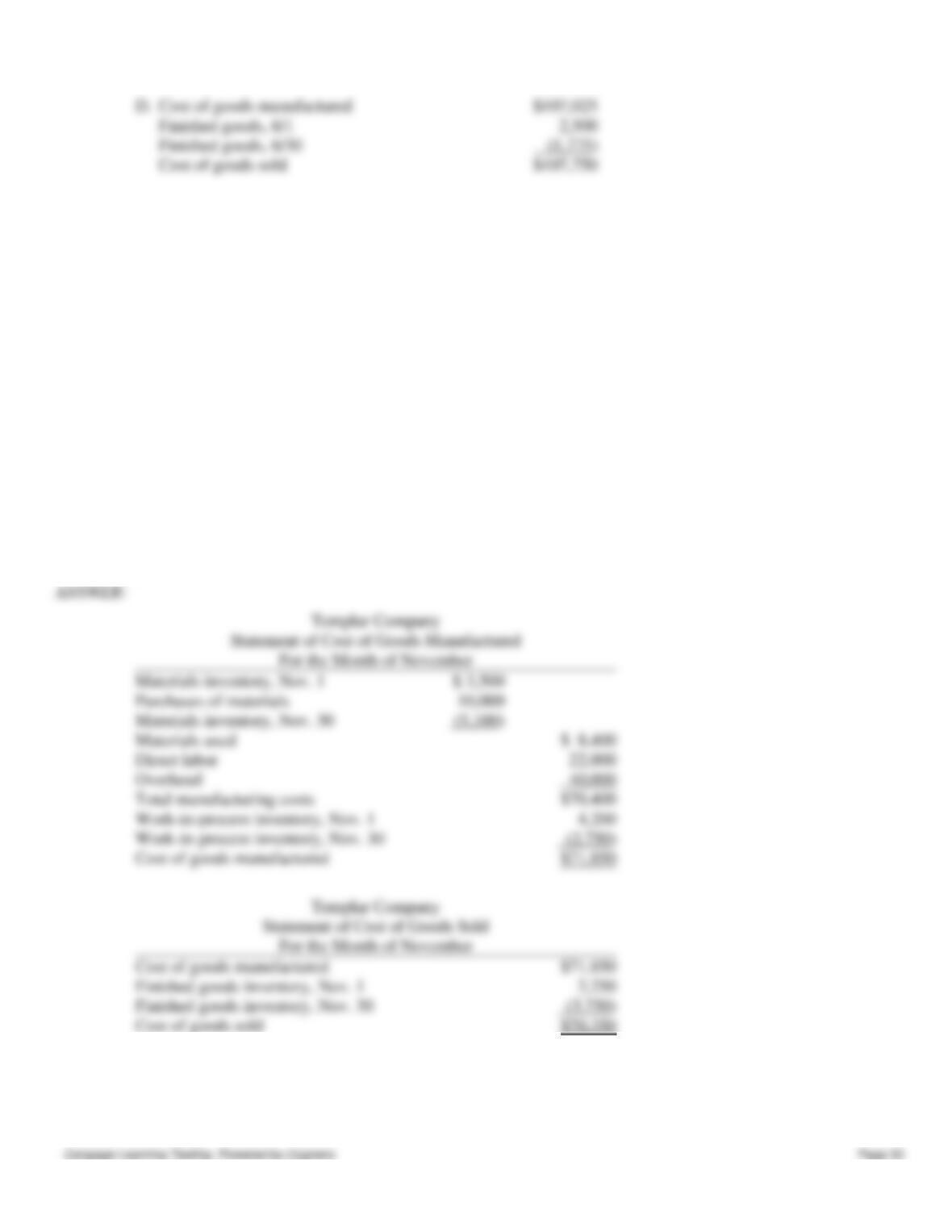
Chapter 2 – Basic Managerial Accounting Concepts
D.
Cost of goods manufactured
Finished goods, 6/1
2,500
Finished goods, 6/30
Cost of goods sold
163. Templar Company, a manufacturing firm, has supplied the following information from its accounting records for the
month of November:
Factory supplies used
$18,000
Depreciation on factory building
17,000
Salary of company controller
6,000
Factory janitorial costs
5,000
Marketing and promotion
4,500
Direct labor cost
22,000
Purchases of raw materials
10,000
Finished goods inventory, Nov. 1
2,250
Finished goods inventory, Nov. 30
3,750
Work-in-process inventory, Nov. 1
4,200
Work-in-process inventory, Nov. 30
2,750
Materials inventory, Nov. 1
3,500
Materials inventory, Nov. 30
5,100
Required:
A.
Prepare a Statement of Cost of Goods Manufactured
B.
Prepare a Statement of Cost of Goods Sold
Materials inventory, Nov. 1
Purchases of materials
10,000
Materials inventory, Nov. 30
Materials used
Direct labor
22,000
Overhead
Total manufacturing costs
$70,400
Work-in-process inventory, Nov. 1
4,200
Work-in-process inventory, Nov. 30
Cost of goods manufactured
$71,850
Cost of goods manufactured
$71,850
Finished goods inventory, Nov. 1
2,250
Finished goods inventory, Nov. 30
Cost of goods sold
$70,350
164. Fidalgo Company makes stereos. During the year, Fidalgo manufactured and sold 75,000 stereos at a sales price of
$575 per unit. Fidalgo’s per-unit product cost was $540 and selling and administrative expenses totaled $2,000,000.
Chapter 2 – Basic Managerial Accounting Concepts
Required:
A.
Compute the total sales revenue
B.
Compute the gross margin
C.
Compute the operating income
D.
Compute the operating income if 75,000 stereos were produced and 69,000 were sold.
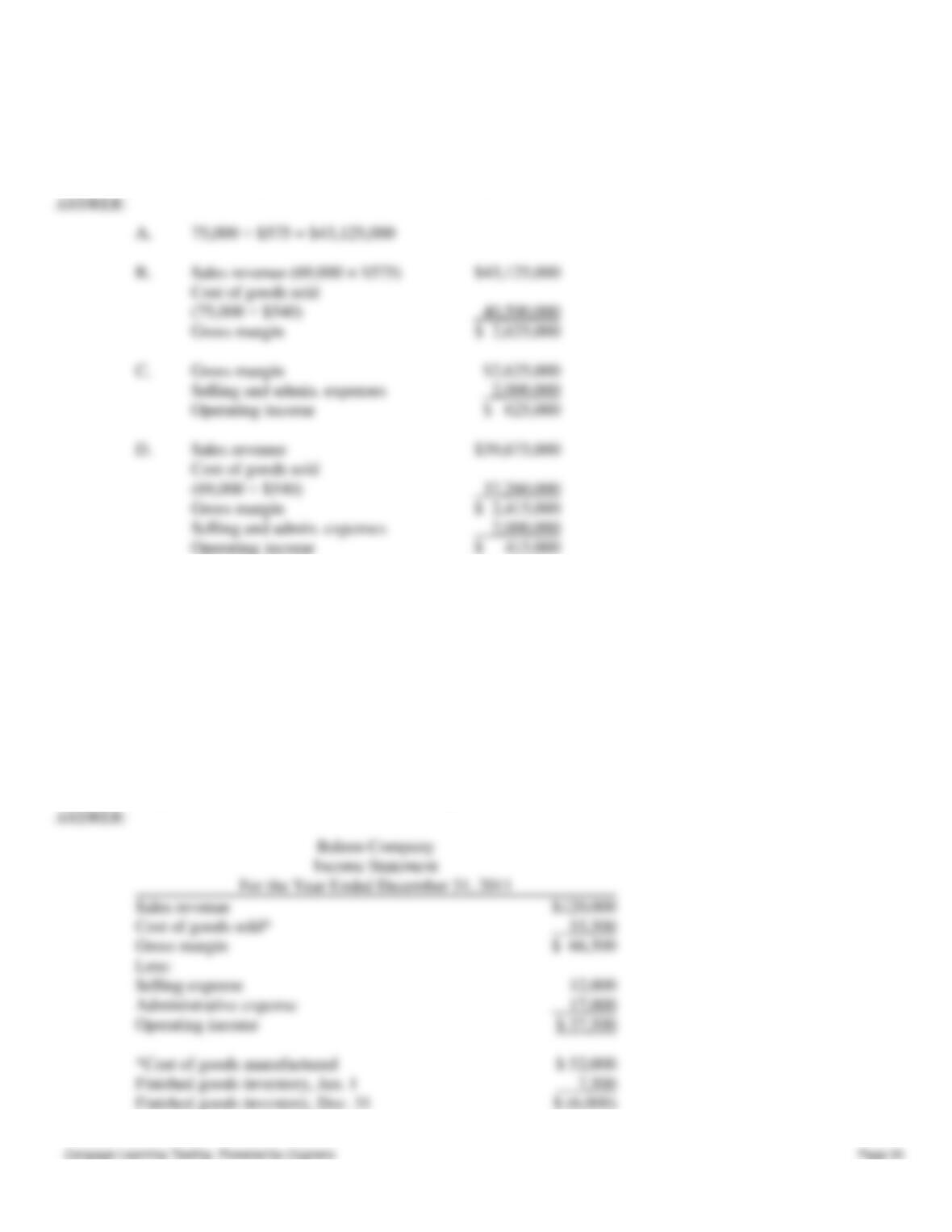
A.
75,000 × $575 = $43,125,000
B.
Sales revenue (69,000 × $575)
Cost of goods sold
(75,000 × $540)
Gross margin
C.
Gross margin
Selling and admin. expenses
Operating income
D.
Sales revenue
Cost of goods sold
(69,000 × $540)
Gross margin
Selling and admin. expenses
Operating income
165. Baleen Company supplied the following data at the end of the current year:
Sales commissions
$ 12,000
Sales revenue
120,000
Research and development
17,000
Finished goods inventory, Jan. 1
7,500
Work in process inventory, Jan 1
9,000
Finished goods inventory, Dec. 31
6,000
Work in process inventory, Dec. 31
11,000
Cost of goods manufactured
52,000
Required: Prepare an income statement for Baleen Company.
Sales revenue
Cost of goods sold*
53,500
Gross margin
$ 66,500
Selling expense
12,000
Administrative expense
17,000
Operating income
*Cost of goods manufactured
Finished goods inventory, Jan. 1
Finished goods inventory, Dec. 31