Chapter 2 – Analyzing Transactions
Present your answers in the following form:
Account Debited
Account Credited
Transaction
Type
Effect
Type
Effect
Transaction
(1)
(2)
(3)
(4)
(5)
(6)
(7)
(8)
(9)
Chapter 2 – Analyzing Transactions
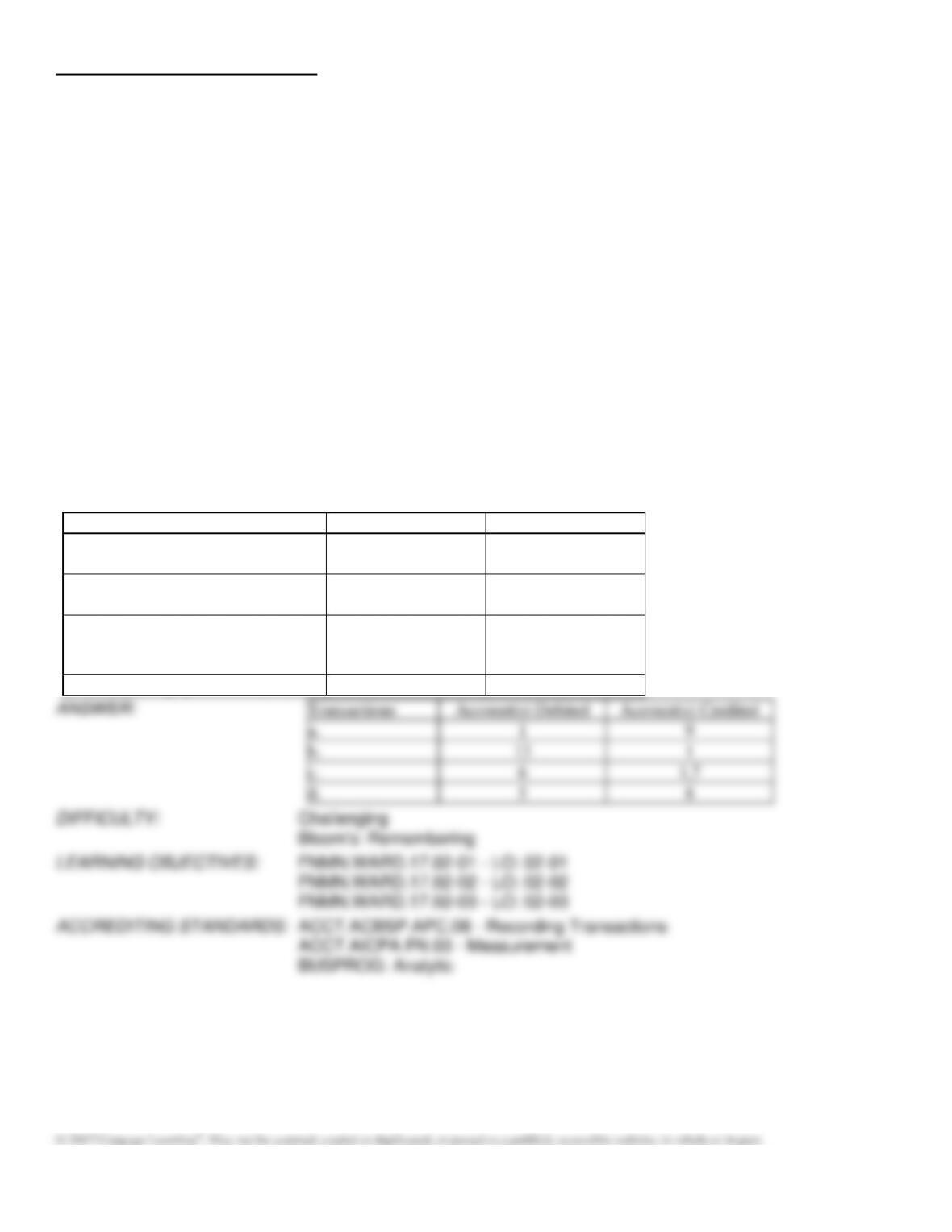
184. On January 1, Merry Walker and other stockholders established a catering service. Listed below are accounts to use
for transactions (a) through (d), each identified by a number. Following this list are the transactions that occurred during
the first month of operations. You are to indicate for each transaction the accounts that should be debited and credited by
placing the account number(s) in the appropriate box.
1.
Cash
2.
Accounts Receivable
3.
Supplies
4.
Prepaid Insurance
5.
Equipment
6.
Truck
7.
Notes Payable
8.
Accounts Payable
9.
Common Stock
10.
Dividends
11.
Fees Earned
12.
Wages Expense
13.
Rent Expense
14.
Utilities Expense
15.
Truck Expense
16.
Miscellaneous Expense
Transactions
Account(s) Debited
Account(s) Credited
a. Stockholders purchased shares of
common stock.
b. Paid rent for the period of
January 3 to the end of the month.
c. Purchased truck for $30,000 with
a cash down payment of $5,000
and the remainder on a note.
d. Purchased equipment on account.
Transactions
b.
d.
Chapter 2 – Analyzing Transactions
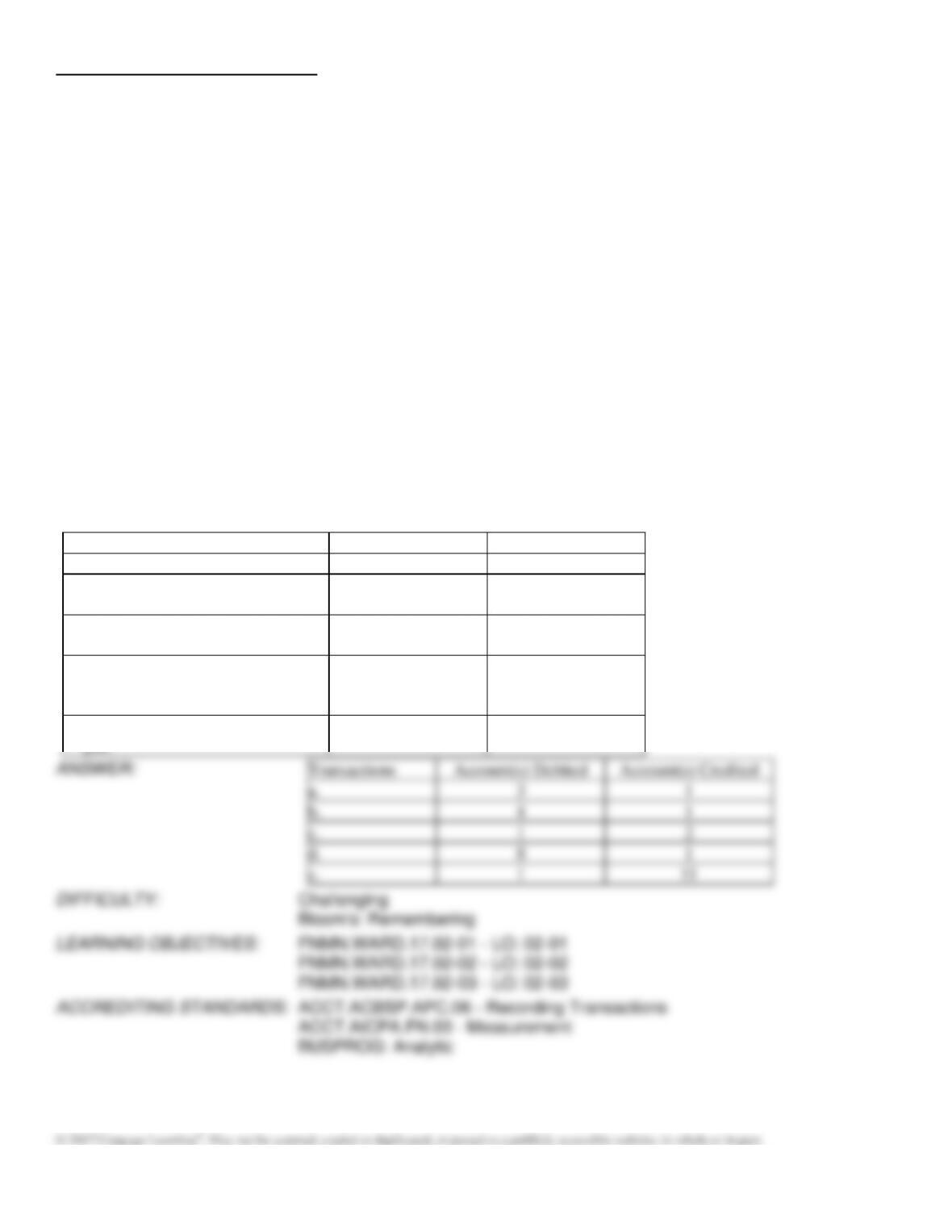
185. On January 1, Merry Walker and other stockholders established a catering service. Listed below are accounts to use
for transactions (a) through (e), each identified by a number. Following this list are the transactions that occurred in
Walker’s first month of operation. You are to indicate for each transaction the accounts that should be debited and
credited by placing the account number(s) in the appropriate box.
1.
Cash
2.
Accounts Receivable
3.
Supplies
4.
Prepaid Insurance
5.
Equipment
6.
Truck
7.
Notes Payable
8.
Accounts Payable
9.
Common Stock
10.
Dividends
11.
Fees Earned
12.
Wages Expense
13.
Rent Expense
14.
Utilities Expense
15.
Truck Expense
16.
Miscellaneous Expense
17.
Insurance Expense
Transactions
Account(s) Debited
Account(s) Credited
a. Purchased supplies for cash.
b. Paid the annual premiums on
property and casualty insurance.
c. Received cash for a job previously
recorded on account.
d. Paid a creditor a portion of the
amount owed for equipment
previously purchased on account.
e. Received cash for a completed
job.
Transactions
a.
b.
c.
d.
e.
Chapter 2 – Analyzing Transactions
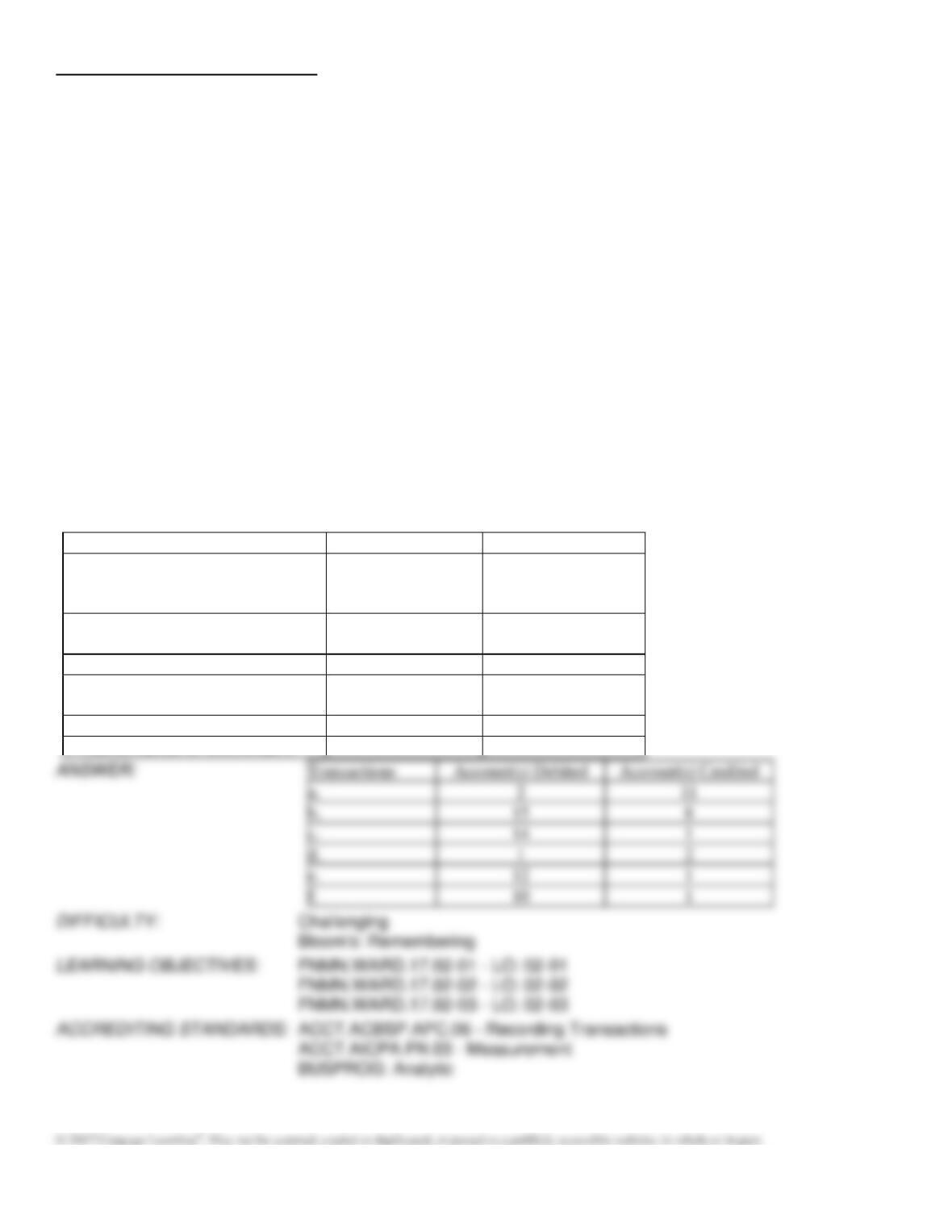
186. On January 1, Merry Walker and other stockholders established a catering service. Listed below are accounts to use
for transactions (a) through (f), each identified by a number. Following this list are the transactions that occurred in
Walker’s first month of operations. You are to indicate for each transaction the accounts that should be debited and
credited by placing the account number(s) in the appropriate box.
1.
Cash
2.
Accounts Receivable
3.
Supplies
4.
Prepaid Insurance
5.
Equipment
6.
Truck
7.
Notes Payable
8.
Accounts Payable
9.
Common Stock
10.
Dividends
11.
Fees Earned
12.
Wages Expense
13.
Rent Expense
14.
Utilities Expense
15.
Truck Expense
16.
Miscellaneous Expense
17.
Insurance Expense
Transactions
Account(s) Debited
Account(s) Credited
a. Recorded jobs completed on
account and sent invoices to
customers.
b. Received an invoice for truck
expenses to be paid in February.
c. Paid utilities expense
d. Received cash from customers on
account.
e. Paid employee wages.
f. Paid dividends to stockholders.
Transactions
a.
b.
c.
d.
e.
f.
Chapter 2 – Analyzing Transactions
187. Listed below are accounts to use for transactions (a) through (d), each identified by a number. Following this list are
the transactions. You are to indicate for each transaction the accounts that should be debited and credited by placing the
account number(s) in the appropriate box.
1.
Cash
2.
Accounts Receivable
3.
Office Supplies
4.
Land
5.
Interest Receivable
6.
Building
7.
Truck
8.
Equipment
9.
Accounts Payable
10.
Interest Payable
11.
Insurance Payable
12.
Utilities Expense
13.
Notes Payable
14.
Prepaid Insurance
15.
Service Revenue
16.
Common Stock
17.
Insurance Expense
18.
Interest Expense
19.
Office Supplies Expense
20.
Unearned Service Revenue
21.
Dividends
Transactions
Account(s) Debited
Account(s) Credited
a. Utility bill is received; payment
will be made in 10 days.
b. Paid the utility bill previously
recorded in transaction (a).
c. Bought a three-year insurance
policy and paid in full.
d. Received $7,000 from a contract
to perform accounting services
over the next two years.
b.
d.
Chapter 2 – Analyzing Transactions
Supplies expense = $3,620
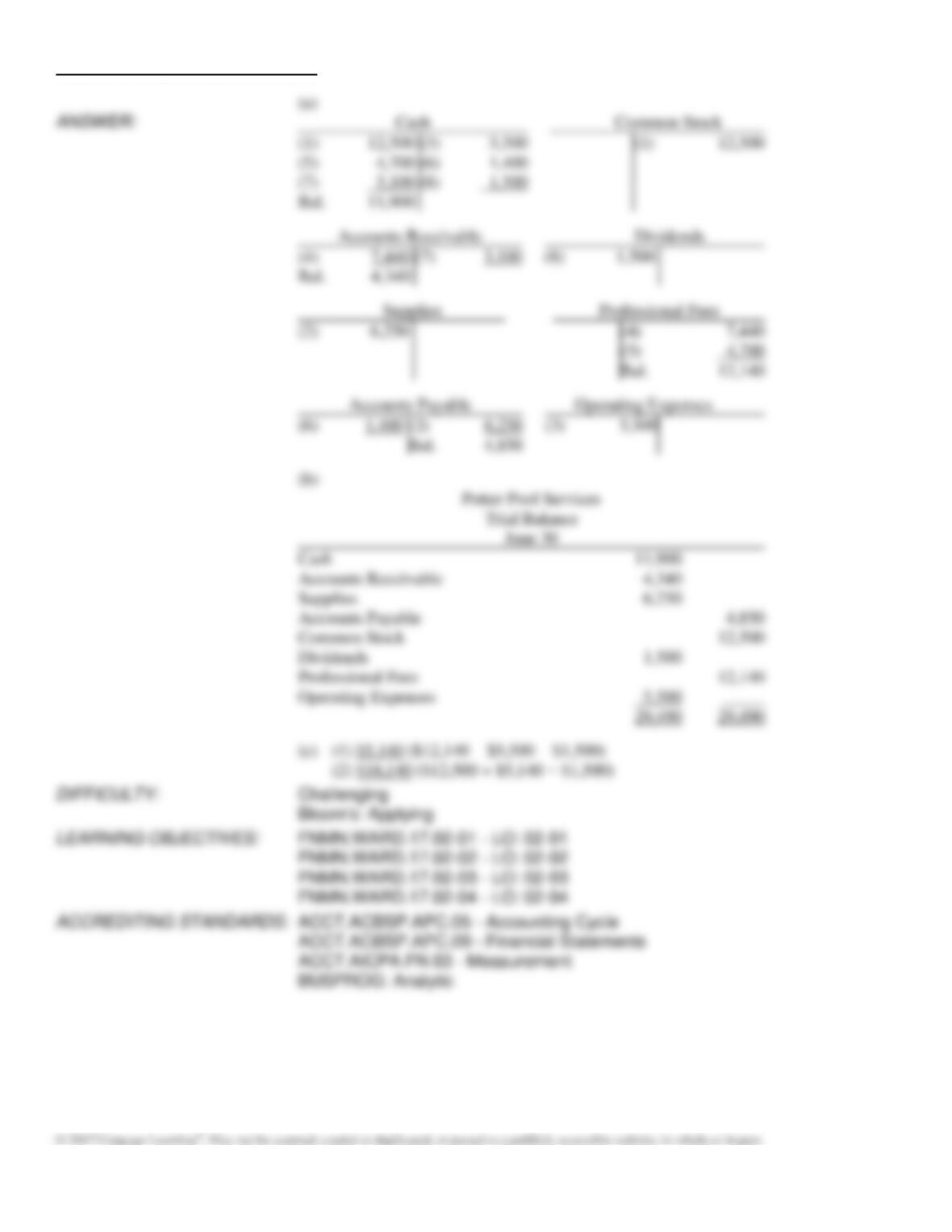
189. Set up T accounts for Cash; Accounts Receivable; Supplies; Accounts Payable; Common Stock; Dividends;
Professional Fees; and Operating Expenses.
(a)
In the T accounts, record the following transactions of Potter Pool Services for June,
identifying each entry by number:
(1)
Shareholders invested $12,500 cash in the business by purchasing common
stock.
(2)
Purchased supplies on account, $6,250.
(3)
Paid operating expenses, $5,500.
(4)
Billed clients for fees, $7,440.
(5)
Received cash from cash clients, $4,700.
(6)
Paid creditors on account, $1,400.
(7)
Received $3,100 from clients on account.
(8)
Paid $1,500 cash dividends.
(b)
Prepare a trial balance as of June 30 for Potter Pool Services.
(c)
Assuming that supplies expense (which has not been recorded) amounts to $1,500 for
June, determine the following:
(1)
Net income for the month.
(2)
Stockholders’ equity as of June 30.
Chapter 2 – Analyzing Transactions
Chapter 2 – Analyzing Transactions
190. On September 1, Erika Company purchased land for $47,500 cash. Provide the journal entry for this transaction.
191. On October 10, Nikle Company purchased supplies for $1,800 on account. On October 25, Nikle Company paid the
invoice.
(a) Provide the journal entry for the purchase on account.
(b) Provide the journal entry for the payment of the invoice.
192. On October 17, Nikle Company purchased a building and a plot of land for $750,000. The building was valued at
$500,000 while the land carried a value of $250,000. Nikle paid $300,000 down in cash and signed a note payable for the
balance. Provide the journal entry for this transaction.
Chapter 2 – Analyzing Transactions
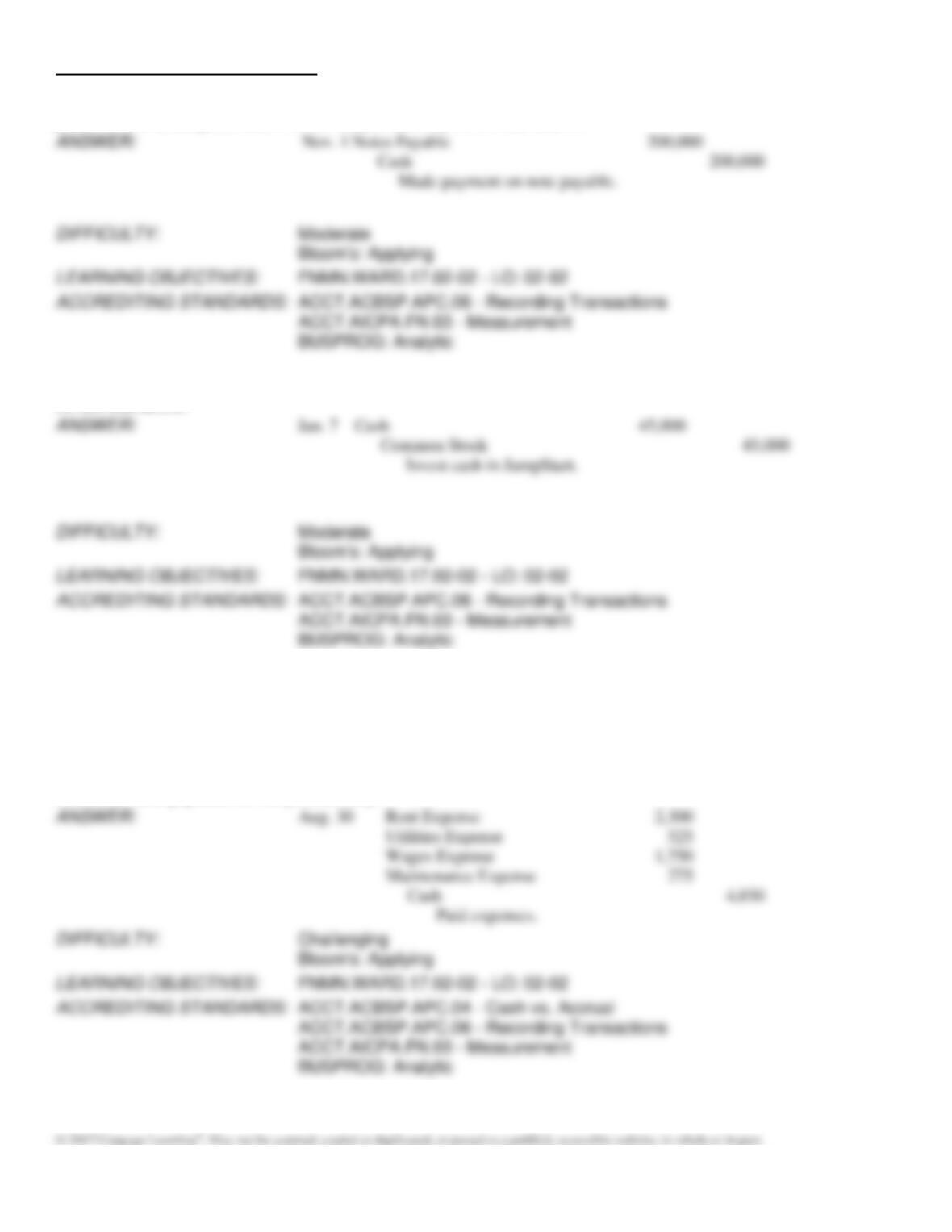
193. On November 1, Nikle Company made a cash payment of $200,000 on a note payable that was generated in the
purchase of a building and land. Provide the journal entry for this transaction.
194. On January 7, stockholders invest $45,000 to initiate the operation of a business, JumpStart. Provide the journal entry
for this transaction.
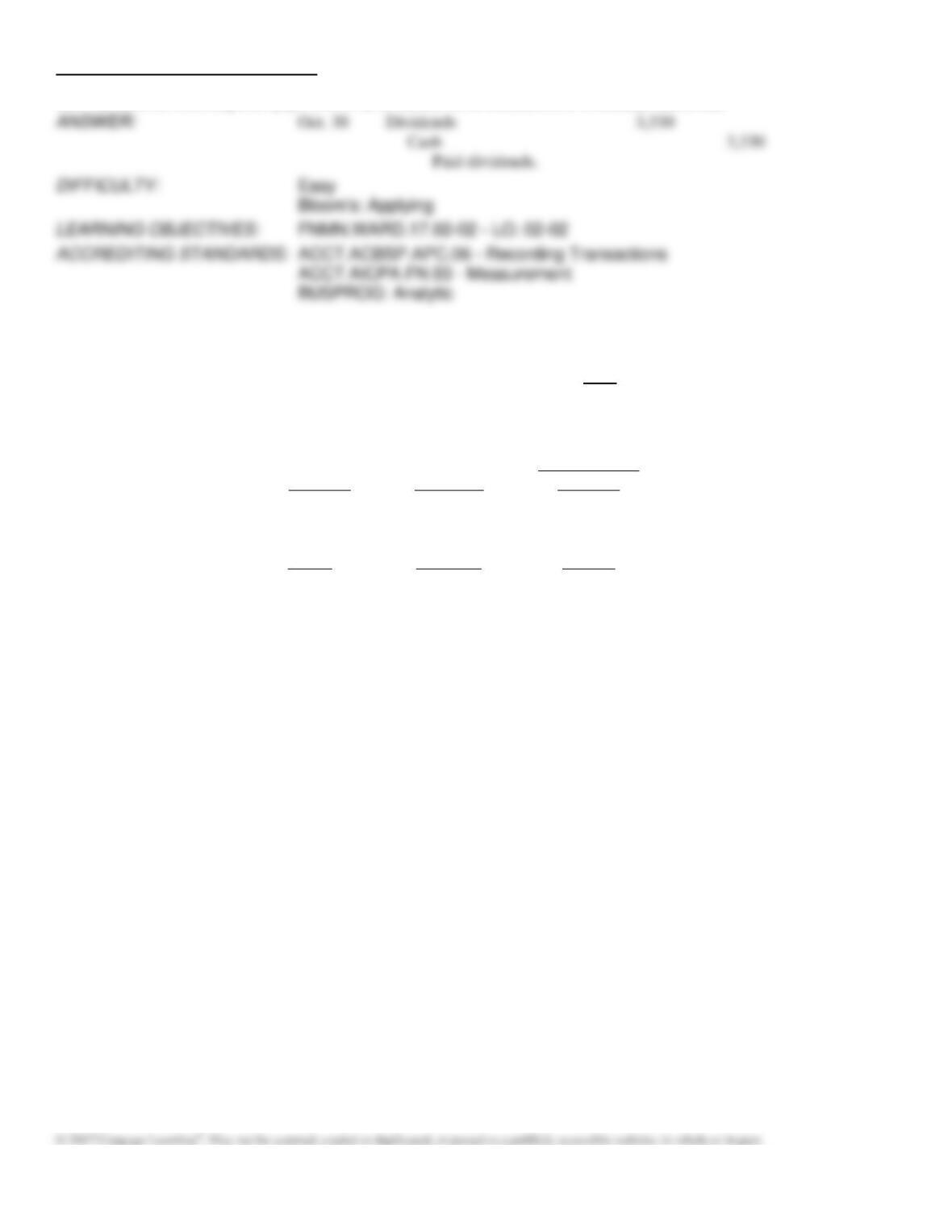
195. On August 30, JumpStart incurred the following expenses:
Payment to the landlord for August rent, $2,300
Payment to the Gas & Electric Company for August’s bill, $525
Payment of employee wages for the last half of August, $1,750
Payment of shopping center’s parking lot cleaning fee, $275
Journalize these payments as one journal entry.
Chapter 2 – Analyzing Transactions
196. On October 30, JumpStart pays $3,330 in dividends to its stockholders. Journalize this event.
Oct. 30
Dividends
Cash
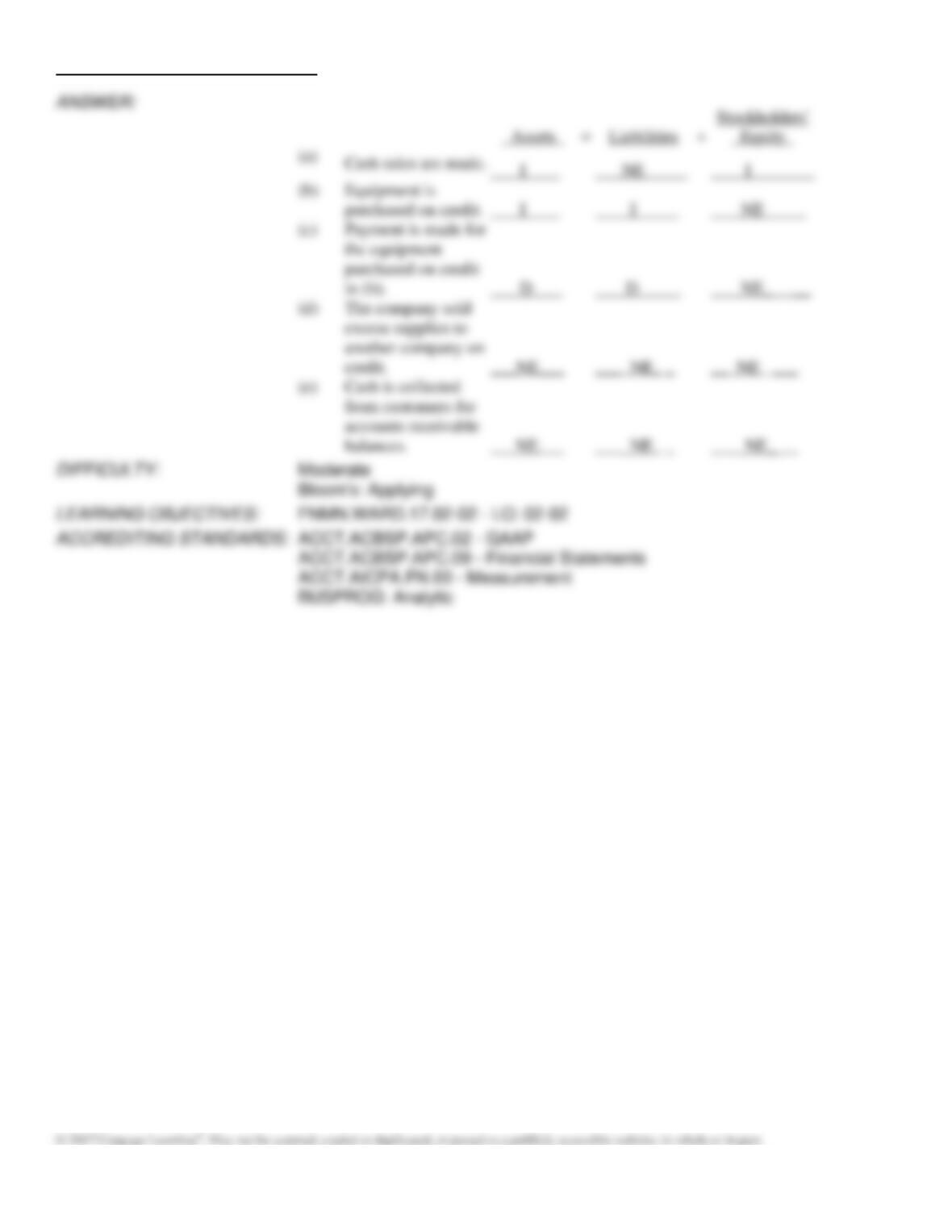
197. Several transactions are listed below, with the accounting equation stated to the right side of each. Use the following
identification codes to indicate the effects of each transaction on the accounting equation. Write your answers in the space
provided under the accounting equation. You need an identification code for each element of the accounting equation. An
example is given before the first transaction.
I-Increase
D-Decrease
NE–No Effect
Assets
=
Liabilities
+
Stockholders’
Equity
Example
A stockholder invests
in his new business
by giving equipment
valued at $3,500.
I
NE
I
(a)
Cash sales are made.
_____
_____
_____
(b)
Equipment is
purchased on credit.
_____
_____
_____
(c)
Payment is made for
the equipment
purchased on credit
in (b).
_____
_____
_____
(d)
The company sold
excess supplies to
another company on
credit.
_____
_____
_____
(e)
Cash is collected
from customers for
accounts receivable
balances.
_____
_____
_____
Chapter 2 – Analyzing Transactions
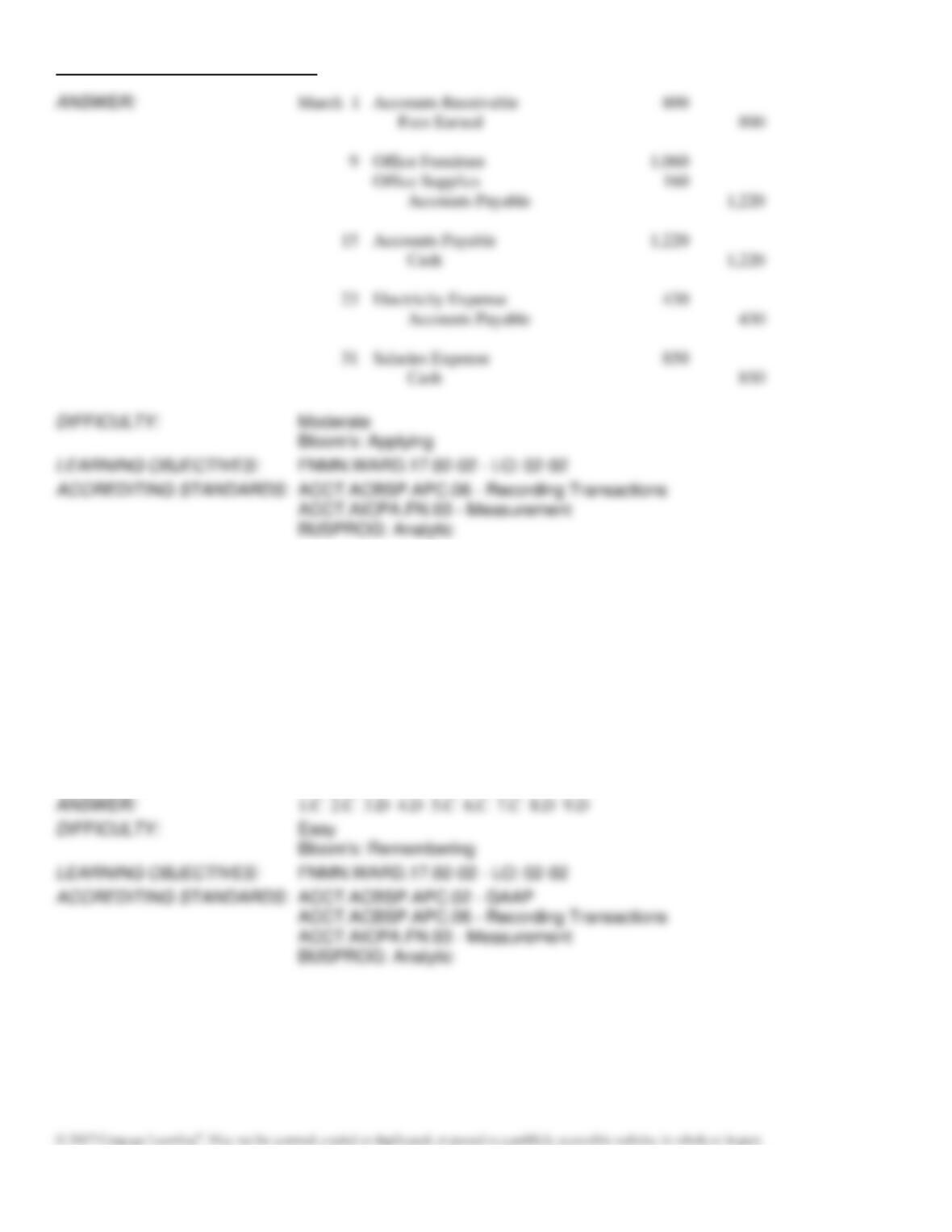
198. Journalize the following five transactions for Newman & Associates, Inc. Omit explanations.
March
1
Bills are sent to clients for services provided in February in the
amount of $800.
9
Corner Office, Inc. delivers office furniture ($1,060) and office
supplies ($160) to Newman, leaving an invoice for $1,220.
15
Payment is made to Corner Office, Inc. for the furniture and
office supplies delivered on March 9.
23
A bill for $430 for electricity for the month of March is received
and will be paid on its due date in April.
31
Salaries of $850 are paid to employees.
Chapter 2 – Analyzing Transactions
199. For the following, mark a “D” if the following account normally has a debit balance and mark a “C” if the following
account normally has a credit balance.
_____1. Notes Payable
_____2. Mortgage Payable
_____3. Dividends
_____4. Accounts Receivable
_____5. Common Stock
_____6. Rent Revenue
_____7. Unearned Revenue
_____8. Utility Expense
_____9. Automobiles
Chapter 2 – Analyzing Transactions
200. Increases and decreases in various types of accounts are listed below. In each case, indicate by “Dr.” or “Cr.” (a)
whether the change in the account would be recorded as a debit or a credit and (b) whether the normal balance of the
account is a debit or a credit.
(a)
(b)
Recorded
As
Normal
Balance
(1)
Increase in Common Stock
________
_______
(2)
Increase in Dividends
________
_______
(3)
Decrease in Accounts Receivable
________
_______
(4)
Increase in Note Payable
________
_______
(5)
Increase in Accounts Payable
________
_______
(6)
Decrease in Supplies
________
_______
(7)
Decrease in Salaries Expense
________
_______
(8)
Increase in Accounts Receivable
________
_______
(9)
Increase in Cash
________
_______
(10)
Decrease in Land
________
_______
(1)
(2)
(3)
(4)
(5)
(6)
(7)
(8)
(9)
(10)
201. Record the following selected transactions for April in a two-column journal, identifying each entry by letter:
(a)
Received $18,000 from sale of common stock.
(b)
Purchased equipment for $27,000, paying $10,000 in cash and giving a note
payable for the remainder.
(c)
Paid $2,300 for rent for April.
(d)
Purchased $1,500 of supplies on account.
(e)
Recorded $9,800 of fees earned on account.
(f)
Received $7,500 in cash for fees earned.
(g)
Paid $1,200 to creditors on account.
(h)
Paid wages of $3,425.
(i)
Received $7,900 from customers on account.
(j)
Recorded dividends of $1,875.
Chapter 2 – Analyzing Transactions
202. On January 12, JumpStart Co. purchased $870 in office supplies.
(a) Journalize this transaction as if JumpStart paid cash.
(b) (1) Journalize this transaction as if JumpStart purchased the supplies on account.
(b) (2) On January 18, JumpStart pays the amount due. Journalize this event.
Chapter 2 – Analyzing Transactions
203. On November 10, JumpStart Co. provides $2,900 in services to clients. At the time of service, the clients paid $600
in cash and put the balance on account.
(a) Journalize this event.
(b) On November 20, JumpStart Co. clients paid an additional $900 on their accounts due. Journalize this event.
(c) Calculate the accounts receivable balance on November 30.
Chapter 2 – Analyzing Transactions
204. Prepare a journal entry for the purchase of a truck on April 4 for $85,700, paying $15,000 cash and the remainder on
account. Omit explanation.
April 4
205. Journalize the following selected transactions for January. Explanations may be omitted.
Jan.
1
Received cash from the sale of common stock, $14,000.
2
Received cash for providing accounting services, $9,500.
3
Billed customers on account for providing services, $4,200.
4
Paid advertising expense, $700.
5
Received cash from customers on account, $2,500.
6
Paid dividends, $1,010.
7
Received telephone bill, $900.
8
Paid telephone bill, $900.
Date
Description
Post.
Ref.
Debit
Credit