
Exam
Name___________________________________
MULTIPLE CHOICE. Choose the one alternative that best completes the statement or answers the question.
1)
At all times during the year, the circle of illumination
1)
A)
divides Earth between equal halves of lightness and darkness.
B)
divides Earth between Northern and Southern Hemispheres.
C)
divides Earth into eastern and western halves.
D)
separates winter from summer.
2)
Air consists of
2)
A)
a mixture of gases that behaves as if it were a single gas.
B)
oxygen only.
C)
mostly carbon dioxide and water vapor.
D)
gases that are not well mixed.
A
3)
The solar constant is measured at
3)
A)
the edge of the Sun’s atmosphere.
B)
the thermopause.
C)
the Sun’s surface.
D)
sea level.
B
4)
Photochemical reactions produce
4)
A)
carbon monoxide.
B)
principally sulfur dioxides.
C)
particulates such as dust, dirt, soot, and ash.
D)
ozone and peroxyacetyl nitrates (PAN).
D
A

5)
According to findings from the Kepler telescope, the estimated number of planets in the Milky Way
is ________with some ________ in habitable zones.
5)
A)
1 billion; 25 million
B)
25 million; 3 million
C)
50 billion; 500 million
D)
300 billion; 125 billion
6)
Why are temperature inversion noteworthy regarding air pollution?
6)
A)
Air pollution is completely inhibited from forming.
B)
Mesospheric conditions are replicated in the troposphere.
C)
Vertical mixing of pollutants is halted, trapping the pollutants under the inversion layer.
D)
Surface pollution is moderated by allowing surface air to mix with the air above.
C
7)
Why are humans and other living things NOT crushed by the pressure of the atmosphere?
7)
A)
The tropopause serves as a buffer against the pressure exerted by the atmosphere.
B)
While the atmosphere exerts pressure, it is a negligible amount.
C)
Atmospheric pressure increases with altitude and is, therefore, lowest near Earth’s surface.
D)
Humans and other living things exert pressure outward, counterbalancing atmospheric
pressure.
D
8)
The dominant wavelength of energy emitted by the Sun is
8)
A)
the same length as that emitted by Earth.
B)
shorter than that emitted by Earth.
C)
longer than that emitted by Earth.
B
C

9)
Which of the following is TRUE regarding the depletion of ozone in the ozonosphere?
9)
A)
It results from chemical reactions with chlorine derived from CFCs.
B)
It results from the burning of fossil fuels.
C)
The notion that ozone is being depleted as a result of human activity has little scientific
evidence to support it.
D)
The depletion is restricted to the arctic and antarctic regions.
10)
The thermopause is located
10)
A)
between the mesosphere and the thermosphere.
B)
wherever –90°C (–130°F) is recorded.
C)
at the bottom of the homosphere.
D)
approximately 480 km (300 mi.) above Earth’s surface.
11)
Why is normal precipitation always slightly acidic?
11)
A)
Sulfur dioxide from volcanic explosions combines with water to form sulfuric acid.
B)
Chlorine, in the presence of sunlight and hydrogen, is converted to hydrochloric acid.
C)
Nitrogen fixing bacteria form nitric acids which evaporate into the atmosphere.
D)
Precipitation dissolved carbon dioxide to form carbonic acid.
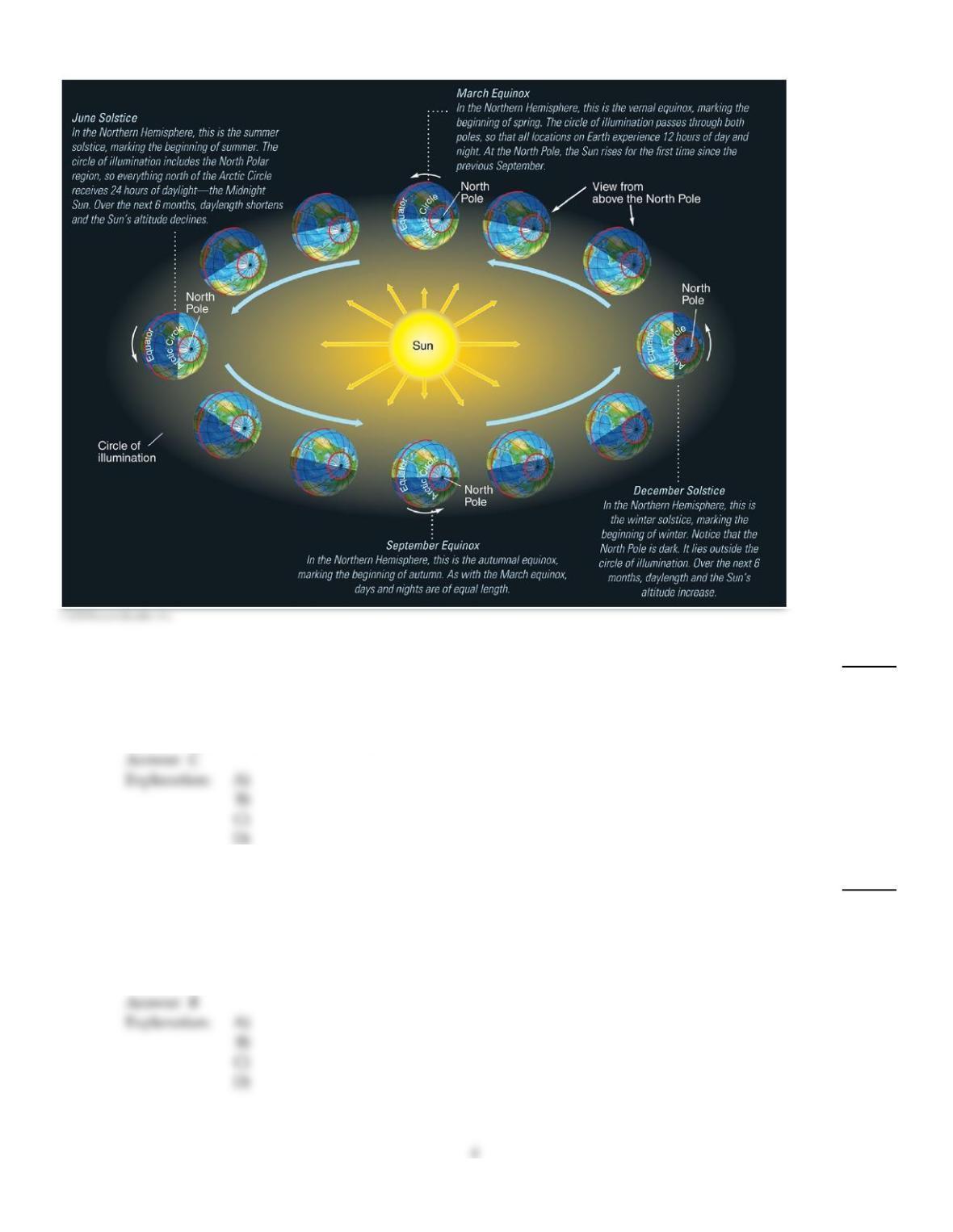
12)
Which of the following is TRUE for the March Equinox?
12)
A)
The subsolar point is at the Tropic of Capricorn (23.5° S).
B)
The subsolar point is at the Prime Meridian.
C)
The subsolar point is at the equator.
D)
The subsolar point is at the Tropic of Cancer (23.5° N).
13)
Why does temperature increase with altitude in the stratosphere?
13)
A)
Due to the effects of the normal lapse rate effect
B)
Ozone absorbs ultraviolet radiation from the Sun and then reradiates it at infrared
wavelengths.
C)
Ozone acts as a greenhouse gas which traps ultraviolet energy radiated by Earth’s surface.
D)
Chlorofluorocarbons increase ozone concentrations, which enhance temperature.

14)
Changes in daylength, the Sun’s altitude above the horizon, and the Sun’s declination over the
course of the year
14)
A)
are factors that follow an irregular, random cycle.
B)
are phenomena that occur only at the equator.
C)
are responsible for the seasons.
D)
produce Earth‘s rotation.
15)
Our planet and our lives are powered by
15)
A)
radiant energy from the Sun.
B)
utilities and oil companies.
C)
shorter wavelengths of gamma rays, X–rays, and ultraviolet.
D)
energy derived from inside Earth.
16)
On its way to Earth, the solar wind first encounters
16)
A)
the magnetosphere.
B)
Earth’s surface.
C)
the lower atmosphere.
D)
the atmosphere.
17)
In 1974, Dr. Rowland and Dr. Molina made what observation regarding ozone (O3)?
17)
A)
Anthropogenic O3 releases were a major culprit in global warming.
B)
Automobile exhaust and sunlight were producing photochemical smog.
C)
Ground–level O3 irritates human eyes and respiratory systems.
D)
The photochemical interactions of chlorofluorocarbons and O3.

18)
Which of the following is CORRECT regarding daylength?
18)
A)
Daylength is uniform at all latitudes throughout the year.
B)
The equator always receives equal hours of day and night.
C)
The range of daylength is shortest in the polar regions.
D)
The equator experiences six hours difference in daylength between the summer and winter.
19)
The Montreal Protocol
19)
A)
is ineffective because so few countries have ratified it.
B)
created the Intergovernmental Panel on Climate Change.
C)
only addresses CFCs.
D)
aims to reduce and eliminate all ozone depleting substances.
E)
established a framework to address acid precipitation.
20)
The auroras in the upper atmosphere are caused by
20)
A)
the interaction of the solar wind and upper layers of Earth’s atmosphere.
B)
various weather phenomena.
C)
visible light interaction with the asthenosphere.
D)
AM radio broadcasts.
21)
The elapsed time between two crossings of the equator by the Sun is known as the ________.
21)
A)
summer.
B)
tropical year.
C)
parallelism.
D)
inter–equinox.
22)
Carbon monoxide is potentially dangerous because it
22)
A)
causes genetic mutations.
B)
replaces oxygen on red blood cells.
C)
causes cancer.
D)
causes birth defects.

23)
Which of the following is TRUE?
23)
A)
The Sun is the largest star in the Milky Way Galaxy.
B)
The Milky Way is part of our Solar System.
C)
The Sun is also a planet.
D)
The Sun produces energy through fusion processes.
24)
Which of the following is TRUE of the ionosphere?
24)
A)
The region principally absorbs gamma rays, X–rays, and interacts with the solar wind.
B)
All radio signals pass through this region virtually unaffected.
C)
It primarily absorbs harmful infrared wavelengths.
D)
It is being depleted through interactions with human–produced chlorofluorocarbons.
A
25)
Based on function, the atmosphere has
25)
A)
five regions beginning with the outermost thermosphere.
B)
the troposphere and the stratosphere.
C)
two areas that absorb radiation from the Sun.
D)
one continuous region.
C
26)
Despite its high temperatures, why would the thermosphere feel cold to humans?
26)
A)
Humans would die due to pressure changes before they could experience the intense heat.
B)
The atmosphere is denser in the thermosphere and this pressure reduces heat transfer.
C)
The number of molecules is not high enough to transfer heat to human’s skin.
D)
The average kinetic energy is actually less in the thermosphere than the troposphere.
C
D

27)
Light travels at a speed of approximately
27)
A)
80,500 kilometers per hour (50,000 mph).
B)
300,000 kilometers per second (186,333 miles per second).
C)
1,000,000,000 kilometers per second (621,118,012 miles per second).
D)
300,000 kilometers per hour (186,336 mph).
28)
The reaction of automobile exhaust and ultraviolet light
28)
A)
forms smoke and fog.
B)
produces photochemical smog.
C)
produces industrial smog.
D)
is affecting the stratospheric ozone concentration.
29)
The Clean Air Act
29)
A)
is no longer in effect.
B)
was made stronger during the Reagan administration.
C)
did not result in significant reductions of any major air pollutants.
D)
has saved the country several trillion dollars.
30)
Which of the following statements about ozone is FALSE?
30)
A)
Ozone in the stratosphere protects human health.
B)
Tropospheric ozone is a component of photochemical smog.
C)
Stratospheric ozone absorbs harmful radiation.
D)
Ozone in the lower atmosphere protects human health.

31)
The three stable (i.e., nonvariable) gases in the atmosphere, in order of abundance from most to
least, are
31)
A)
oxygen, carbon dioxide, argon.
B)
oxygen, argon, nitrogen.
C)
nitrogen, oxygen, argon.
D)
carbon dioxide, argon, oxygen.
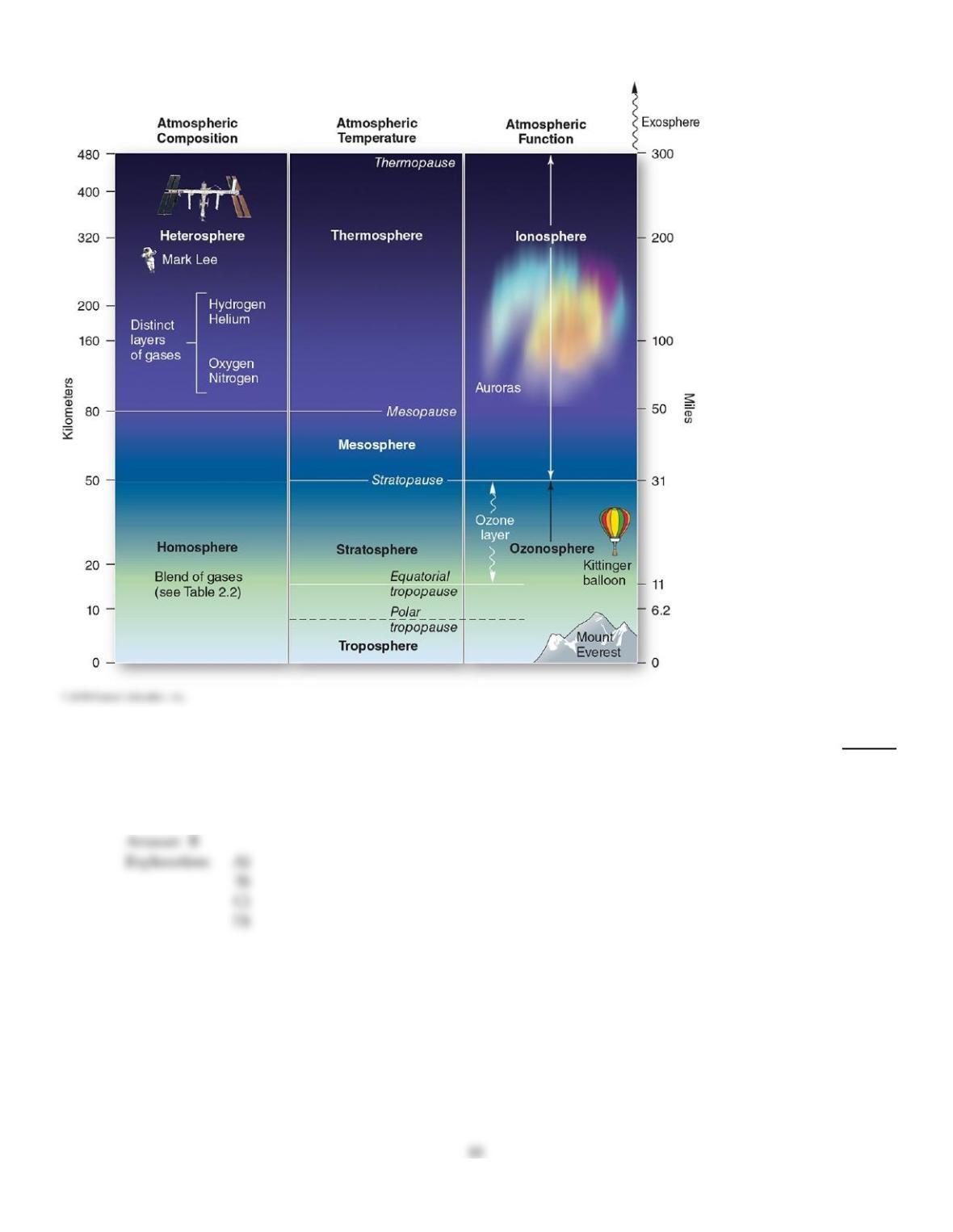
32)
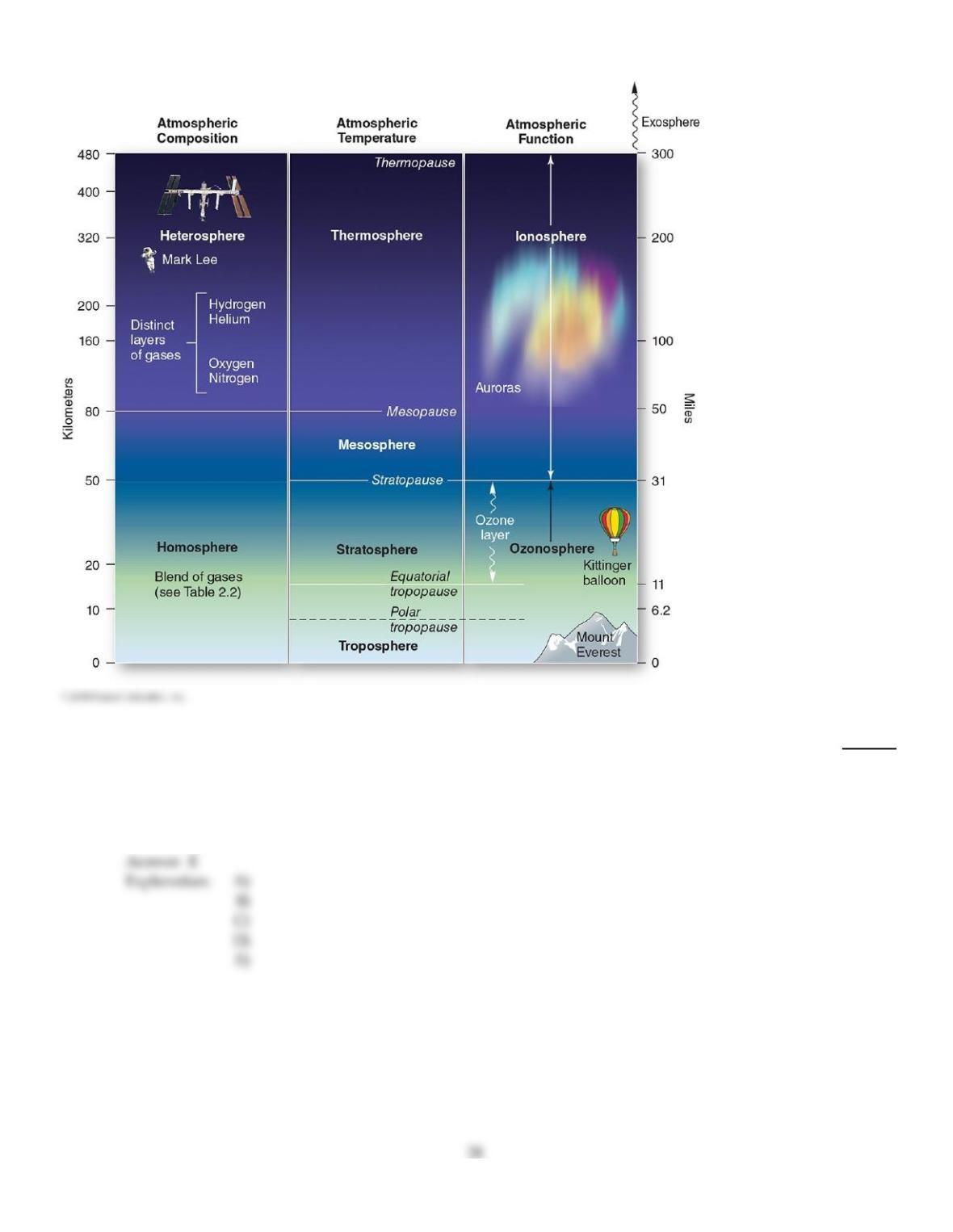
Based on the image, which of the following must be TRUE?
32)
A)
The ozonosphere stretches from Earth’s surface to approximately 50 km (30 mi.)
B)
The ozonosphere corresponds with the stratosphere.
C)
All but 0.001 percent of the atmosphere is accounted for within the troposphere.
D)
Hydrogen has a higher atomic weight than oxygen.

33)
Which of the following is an example of humans influencing solar energy or seasonality?
33)
A)
Seasonal change determines the rhythm of life and food resources.
B)
Longer summers due to climate change have altered migration patterns of some animals.
C)
Solar energy drives ecosystem processes that benefit humans.
D)
Solar winds affect communication systems on Earth.
34)
Which atmospheric zone supports the biosphere and is the region of principle weather activity?
34)
A)
mesosphere
B)
thermosphere
C)
stratosphere
D)
troposphere
35)
Earth’s magnetosphere is generated by
35)
A)
nuclear fusion in Earth’s core.
B)
gravitational accretion.
C)
dynamo–like motions in Earth’s interior.
D)
nuclear fission in Earth’s core.
36)
On the Northern Hemisphere’s summer solstice, the north polar region receives ________ daily
insolation than areas nearer the equator because ________.
36)
A)
less; the Sun does not rise
B)
more; the Sun is higher in the sky
C)
less; the Sun is lower in the sky
D)
more; the Sun does not set
37)
Which of the following is NOT a reason for the seasons?
37)
A)
The timing of Earth’s perihelion and aphelion
B)
The shape of Earth
C)
Earth’s axial tilt
D)
The revolution of Earth around the Sun

38)
The term “net radiation” refers to
38)
A)
the total amount of energy received by Earth.
B)
the difference in amount of incoming and outgoing radiation.
C)
the total amount of energy radiated by Earth.
D)
radiation emitted by satellite networks.
39)
Which of the following is NOT true of carbon dioxide?
39)
A)
It occurs in large amounts in the atmosphere relative to nitrogen and oxygen.
B)
It is critically important in regulating the temperature of the planet.
C)
Overall, atmospheric CO2 has increased by 16% from 1992 to 2012.
D)
Today, it far exceeds its natural range of 180 to 300 pp.
40)
Earth and the Sun formed specifically from
40)
A)
the galaxy.
B)
other planets.
C)
unknown origins.
D)
a nebula of dust and gases.
41)
Which of the following is TRUE regarding Earth’s axis?
41)
A)
Axial tilt is unrelated to the phenomenon of seasonal change.
B)
The axis is tilted 23.5° from a perpendicular to the plane of the ecliptic.
C)
The amount of axial tilt fluctuates during the year and forms the basis for seasonal changes.
D)
The axis remains parallel to the plane of the ecliptic.

42)
Which of the following is TRUE relative to insolation at the thermopause relative to latitude?
42)
A)
Annually, lower latitudes receive more insolation than the higher latitudes.
B)
Annually, insolation is evenly distributed with little change by latitude.
C)
Insolation can only be measured longitudinally, not latitudinally.
D)
Annually, higher latitudes receive more insolation than lower latitudes.
43)
The main ingredients in photochemical smog are
43)
A)
ozone, PAN, and nitric acid.
B)
PAN, carbon monoxide, and particulate matter.
C)
PAN, nitric acid, and carbon monoxide.
D)
ozone, particulate matter, and carbon monoxide.
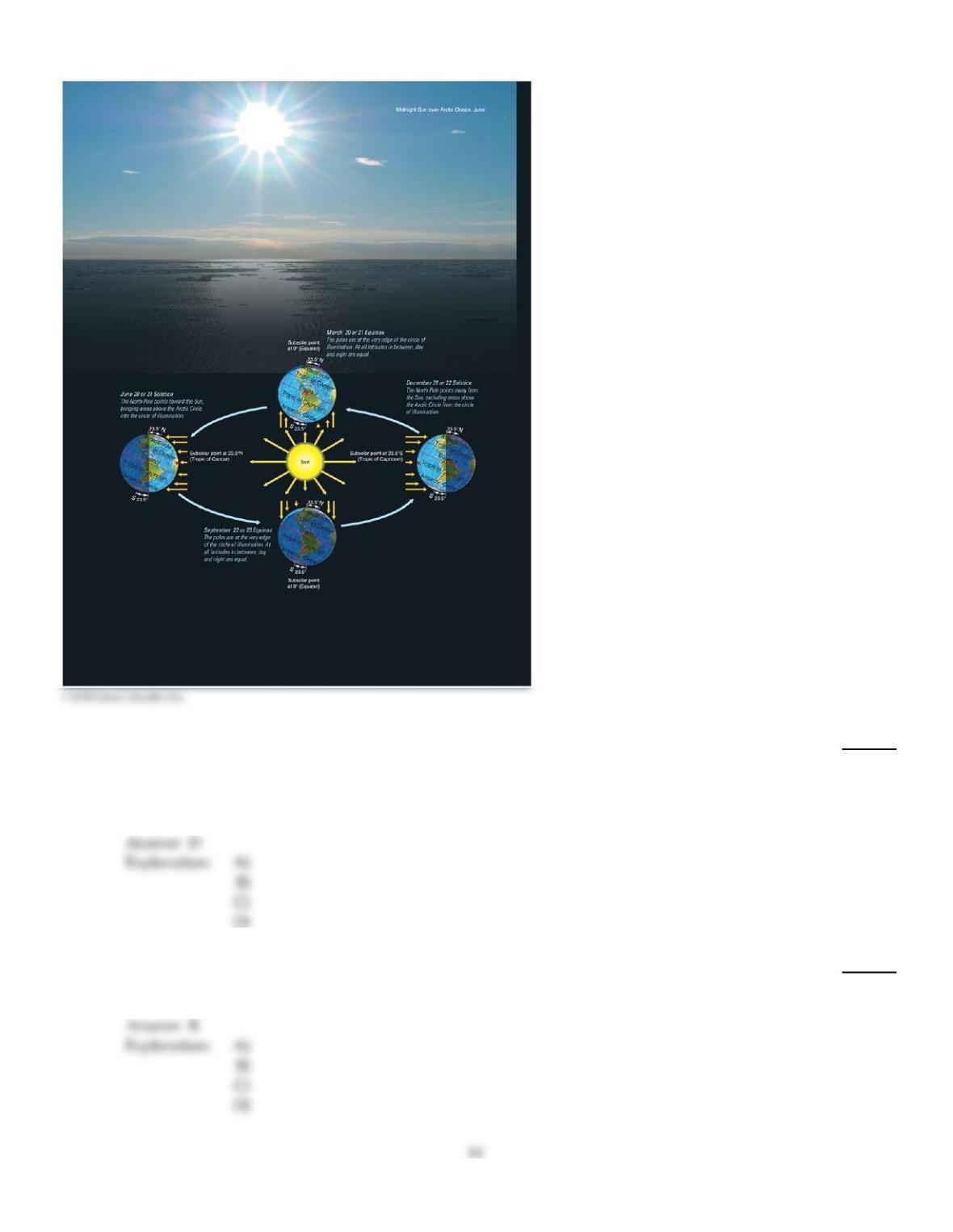
44)
Which of the following is TRUE for the June Solstice?
44)
A)
The subsolar point is at the Tropic of Capricorn (23.5° S).
B)
The Antarctic Circle is completely within the circle of illumination.
C)
The subsolar point is at the equator.
D)
The Arctic Circle is completely within the circle of illumination.
45)
Three criteria used for classification of the atmosphere are
45)
A)
structure, origin, temperature.
B)
composition, temperature, and function.
C)
composition, origin, evolution.
D)
structure, origin, evolution.

46)
In 2010, the Clean Air Act
46)
A)
resulted in some 4 million lost works days.
B)
was repealed.
C)
was severely weakened by the Congress in a new bill that was ultimately vetoed by the
President.
D)
cost $27 billion to implement, but saved an estimated $110 billion.
47)
Which of the following lists the CORRECT sequence of gases, from most to least concentration, in
terms of percentage within the homosphere?
47)
A)
Oxygen, nitrogen, neon, hydrocarbons, carbon dioxide
B)
Oxygen, ozone, nitrogen, PAN, carbon dioxide
C)
Nitrogen, argon, oxygen, xenon, carbon dioxide
D)
Nitrogen, oxygen, argon, carbon dioxide, trace gases
Explanation:
48)
The Sun gives off electromagnetic radiation because
48)
A)
energy is converted into matter.
B)
kinetic energy is converted into potential energy.
C)
matter is converted into energy.
D)
matter and energy totally annihilate one another in matter–antimatter reactions.
Explanation:
49)
Which of the following is TRUE of the subsolar point?
49)
A)
It only occurs at latitudes between the tropics (23.5° N/S).
B)
The highest latitude at which it occurs is 60° N/S.
C)
It never occurs beyond a few degrees of the equator.
D)
It occurs at all latitudes at least once throughout the year.
Explanation:
Explanation:

50)
The ozonosphere is critical to life because it
50)
A)
absorbs most ultraviolet wavelengths.
B)
produces the auroras.
C)
absorbs visible light wavelengths.
D)
affects temperatures.
51)
Which is TRUE of the level of CO2 in our atmosphere?
51)
A)
The level of CO2 is decreasing at 3.1% per year.
B)
The rate of increase leveled out in 1976.
C)
The level of CO2 was much higher in 1955 than today.
D)
It is reached 400 ppm in 2013.
52)
Which of the following is TRUE regarding ozone depletion in Antarctica?
52)
A)
There has actually been a decrease in ultraviolet levels measured at the surfacewhich is
contrary to what is predicted by ozone depletion models.
B)
Maximum ozone depletion occurs during the Antarctic spring, following the development of
polar stratospheric clouds in winter.
C)
The atmosphere above Antarctica has experienced a complete loss of protective ozone.
D)
Increasing levels of ultraviolet radiation have not actually been measured at this time.
53)
Particulate matter
53)
A)
is, by definition, larger than 100 microns.
B)
has not yet been studied by scientists.
C)
can include material in smoke.
D)
has not been associated with health risks.

54)
Which is TRUE of the amount of CO2 in our atmosphere?
54)
A)
CO2 is the most abundant gas in the atmosphere.
B)
The level of CO2 has been much higher during the past 800,000 years than it is now.
C)
The level of CO2 has been decreasing at the rate of 3.1% per year since 2000.
D)
The level of CO2 increased at the rate of 1.1% per year from 1990 to 1999.
55)
The homosphere is so called because
55)
A)
the blend of gases is nearly uniform throughout.
B)
it is the habitable sphere for humans (Homo sapiens).
C)
scientists have been unable to determine its composition and assume it is homogeneous.
D)
it contains only one gas, nitrogen.
A
56)
Which of the following is NOT true about the troposphere?
56)
A)
The altitude of the upper limits of the troposphere (the tropopause) varies with season and
latitude.
B)
The bulk of all water vapor occurs in the troposphere.
C)
Approximately 90% of the total mass of the atmosphere is within the troposphere.
D)
Temperatures increase with altitude in the troposphere because the higher in altitude, the
closer to the sun.
D
57)
At CO levels of 100 ppm or less in the bloodstream
57)
A)
the human bloodstream is unaffected.
B)
there is no noticeable health effect.
C)
carbon monoxide can contribute to acid rain.
D)
humans might develop headaches and suffer from impaired vision and judgment.
D
D

58)
Temperatures within the stratosphere
58)
A)
remain about the same from the tropopause to the stratopause.
B)
decrease with altitude according to the normal lapse rate.
C)
increase with altitude because of the absorption of ultraviolet radiation.
D)
decrease with altitude due to radiation losses.
59)
Nitrogen (N2) is
59)
A)
cycled through the environment via the activity of bacteria.
B)
now measured at 20.946% by volume in the homosphere.
C)
a key component of life, integrated into our bodies directly from the air.
D)
a product of the radioactive decay of a form of potassium in the crust.
A
60)
Acid deposition results from
60)
A)
hydrochloric acid, formed from the combination of hydrogen chloride and water.
B)
nitric acid and sulfuric acid, formed from nitrogen oxides and sulfur dioxide.
C)
hydrocarbons, nitrogen dioxide, and carbon monoxide.
D)
carbonic acids dissolved from atmospheric carbon dioxide.
B
61)
O3 in the lower troposphere
61)
A)
has not been found to cause any damage to crops and plants.
B)
is not associated with transportation.
C)
causes lung irritation, asthma, and susceptibility to respiratory illness in humans.
D)
forms acid rain.
C
C

62)
The longest days of the year in the Northern Hemisphere are experienced at the
62)
A)
time of 24–hour days at the South Pole.
B)
autumnal equinox.
C)
winter solstice.
D)
time that the Sun is directly overhead at the Tropic of Cancer.
E)
vernal equinox.
63)
The high temperature in the upper thermosphere
63)
A)
is more a measure of kinetic energy than sensible temperature.
B)
is more a measure of sensible temperature than kinetic energy.
C)
produces a tremendous amount of heat transfer.
D)
is produced by the absorption of UV radiation.
A
64)
The atmospheric portion of the biosphere occurs in the
64)
A)
lithosphere.
B)
troposphere.
C)
heterosphere.
D)
ozonosphere.
B
65)
Which of the following is TRUE of gases in the heterosphere?
65)
A)
The hydrogen, helium, oxygen and nitrogen are well mixed.
B)
The nitrogen and oxygen occur at the top of the heterosphere and the hydrogen and helium at
the bottom.
C)
The hydrogen and helium occur at the top of the heterosphere, and the nitrogen and oxygen
at the bottom.
D)
Nitrogen occurs at the top, followedin descending orderby helium, oxygen and hydrogen.
C
D

66)
Which of the following is FALSE?
66)
A)
Compared with other stars in the Galaxy, the Sun is average in temperature, size, and color.
B)
The Sun and Solar System are part of the Milky Way Galaxy.
C)
The Sun produces energy through fusion.
D)
The Sun is by far the largest star in the Milky Way Galaxy.
67)
Which of the following is TRUE about Earth’s atmosphere?
67)
A)
It allows gamma rays and X–rays reach the surface.
B)
Variable gases are the dominant gases in the atmosphere.
C)
The ozonosphere and ionosphere shield the surface from harmful radiation.
D)
It is denser at higher altitudes.
C
68)
Which of the following is TRUE regarding acid deposition?
68)
A)
Acid precipitation is precipitation that measures more than 7.0 on a pH scale.
B)
Acids have been causally linked to fish kills in the northeastern United States.
C)
Soil processes generally are not affected by acid precipitation.
D)
No lakes or streams have been damaged by acid precipitation.
B
D
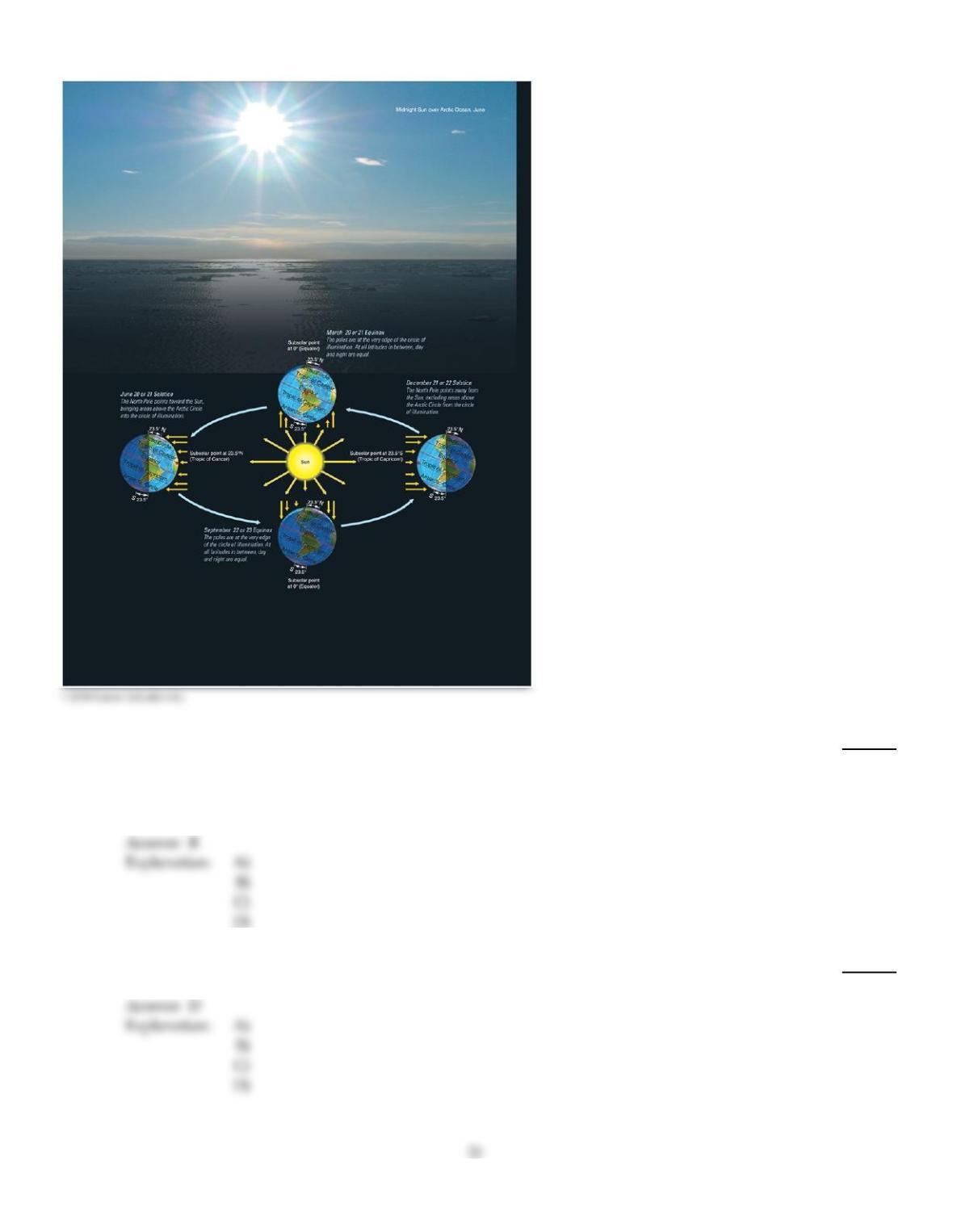
69)
Which of the following is TRUE for the December Solstice?
69)
A)
The Arctic Circle is completely within the circle of illumination.
B)
The Antarctic Circle is completely within the circle of illumination.
C)
The subsolar point is at the equator.
D)
The subsolar point is at the Tropic of Cancer (23.5° N).
70)
According to the EPA, the direct benefits of the Clean Air Act are worth
70)
A)
$500 million.
B)
$500 billion.
C)
$2 trillion.
D)
$22 trillion.

71)
The Sun produces which of the following?
71)
A)
Only radiant energy that is beneficial to life
B)
Only solar wind
C)
Mainly visible light and infrared energy
D)
Mainly ultraviolet and X–rays
72)
Which of the following best describe conditions in the mesosphere?
72)
A)
The mesosphere is located between the troposphere and the stratosphere.
B)
The mesosphere is completely within the heterosphere.
C)
High altitude noctilucent clouds form in the mesosphere.
D)
Temperatures rapidly increase with altitude in the mesosphere.
73)
Temperature inversions occur
73)
A)
when surface temperatures are cooler than overlying air.
B)
when surface temperatures are higher than overlying layers of air.
C)
when there is good air drainage and ventilation of the surface air.
D)
during episodes of reduced air pollution.
74)
Which of the following is TRUE of nitrogen?
74)
A)
Nitrogen is a variable gas.
B)
The nitrogen that the human body needs is derived from foodnot the air.
C)
There is very little nitrogen in the atmosphere.
D)
The human body obtains the nitrogen it needs from the air.

75)
Based on temperature, the atmosphere is divided into
75)
A)
two functional areas that absorb radiation from the Sun.
B)
nitrogen, oxygen, argon.
C)
two broad regions.
D)
four regions: ranging from the troposphere to the thermosphere.
76)
About half of Earth’s crust consists of compounds containing
76)
A)
oxygen.
B)
carbon dioxide.
C)
nitrogen.
D)
argon.
E)
ozone.
A
Explanation:
77)
Incoming solar radiation is called
77)
A)
insolation.
B)
thermosphere.
C)
solar constant.
D)
solar wind.
A
Explanation:
78)
Radio waves have a ________ wavelength than visible light and are therefore ________ energetic.
78)
A)
shorter; less
B)
longer; more
C)
shorter; more
D)
longer; less
D
Explanation:
79)
Which of the following is FALSE?
79)
A)
Air pressure decreases with increasing altitude.
B)
Air pressure decreases through the troposphere then increases in the stratosphere.
C)
Air molecules exert air pressure through their motion, size, and number.
D)
The atmosphere exerts a force of 1 kg/cm2; i.e., 14.7 ln/in2.
B
Explanation:
D
Explanation:

80)
The sun’s declination migrates through ________ of latitude annually.
80)
A)
47°.
B)
23.5°.
C)
30°.
D)
66.5°.
E)
133°.
81)
For observers in the Northern Hemisphere, which of the following is TRUE?
81)
A)
Daylength decreases from the winter solstice until the vernal equinox, when it begins to
increase.
B)
Daylength is longest on the summer solstice and is shortest on the winter solstice.
C)
Daylength variations are negligible for all locations throughout the year except above the
Arctic Circle.
D)
Daylength becomes increasingly longer during the period from the summer solstice until the
winter solstice.
82)
The two most abundant gases in the atmosphere are
82)
A)
nitrogen and water vapor.
B)
nitrogen and oxygen.
C)
water vapor and carbon dioxide.
D)
oxygen and carbon dioxide.
83)
The highest temperatures in the atmosphere occur in the
83)
A)
stratosphere.
B)
thermosphere.
C)
troposphere
D)
mesosphere.

84)
In which two atmospheric zones does temperature decrease with altitude?
84)
A)
Troposphere and stratosphere
B)
Stratosphere and thermosphere
C)
Troposphere and mesosphere
D)
Stratosphere and mesosphere
E)
None of the abovetemperature decreases with increasing altitude in all layers of the
atmosphere.
85)
Based on composition, the atmosphere is divided into
85)
A)
one continuous region.
B)
two functional areas that absorb radiation from the Sun.
C)
the troposphere and the stratosphere.
D)
two broad classifications: homosphere and heterosphere.
86)
Which of the following is TRUE of the number of hours of daylight?
86)
A)
The number of hours of daylight varies the most along the equator.
B)
The number of hours of daylight includes the hours between dawn and twilight, not just the
hours from sunrise to sunset.
C)
The number of hours of daylight varies depending on the latitude of the observer.
D)
The number of hours of daylight varies the least at higher latitudes.
87)
Which of the following is NOT a result of acid deposition?
87)
A)
Formation of highly toxic methylmercury in acidified lake waters
B)
Increase in nutrients in forest ecosystems
C)
Acidification of lakes
D)
Release of aluminum and magnesium from clay mineral in soils

88)
Which of the following is CORRECT regarding lapse rates in the troposphere?
88)
A)
The environmental lapse rate refers to the actual lapse rate at any particular time and may
differ substantially from the normal lapse rate.
B)
The term “normal (average) lapse rate” refers to the actual lapse rate in effect at any particular
time
C)
Temperatures generally increase with altitude in the troposphere.
D)
The normal lapse rate is always the same as the dry adiabatic rate (DAR).
89)
The Sun’s declination refers to
89)
A)
how far the Sun is from Earth.
B)
its altitude, in thousands of feet, above the horizon.
C)
the latitude of the subsolar point.
D)
the angular height of the Sun above the horizon.
90)
Which of the following is NOT true?
90)
A)
During the winter months, Earth’s axis is aligned towards Southern Cross.
B)
Earth‘s axis is titled 23.5° relative to the plane of the ecliptic.
C)
Throughout the year, Earth’s axis maintains the same alignment relative to the plane of the
ecliptic.
D)
The axis through Earth’s two poles points just slightly off Polaris.
91)
Which of the following is TRUE of the September equinox?
91)
A)
All latitudes on Earth, except the Equator, experience unequal daylengths.
B)
The Northern Hemisphere spring officially begins.
C)
The sun rises at the South Pole, where it will remain over the horizon for the following six
months.
D)
The subsolar point is at the Tropic of Cancer (23.5° N).
E)
The subsolar point is at the Tropic of Capricorn (23.5° S).

92)
Photochemical smog developed with the advent of
92)
A)
the industrial revolution.
B)
coal burning stoves.
C)
automobiles.
D)
smelting of ores.
93)
The ________ emits mainly ________ which is also called ________.
93)
A)
Earthlongwave radiationultraviolet
B)
Earthshortwave radiationinfrared
C)
Sunshortwave radiationradio waves
D)
Sunlongwave radiationinfrared
E)
Earthlongwave radiationthermal infrared
94)
The thermosphere closely corresponds to
94)
A)
the homosphere.
B)
the ionosphere.
C)
the exosphere.
D)
the heterosphere.
E)
both the ionosphere and the heterosphere.

95)
With regards to carbon monoxide (CO), which of the following is FALSE?
95)
A)
Natural CO is produced by decaying organic debris, forest fires, or organic matter
decomposition.
B)
Few effects of CO on humans have been identified.
C)
It is a colorless, odorless and tasteless gas.
D)
Anthropogenic CO is principally produced by automobiles.
96)
What percent age of the U.S. population lives with unhealthy levels of air pollution?
96)
A)
62%
B)
41%
C)
59%
D)
33%
97)
Earth’s rotation is described as
97)
A)
clockwise when viewed from above the North Pole.
B)
north to south.
C)
west to east.
D)
east to west.
98)
In 2012, Felix Baumgartner became famous for
98)
A)
completing the longest spacewalk from a Space Shuttle.
B)
becoming the first individual to complete a free–fall from the stratosphere.
C)
breaking Joseph Kittinger’s long–held height and speed free–fall record.
D)
discovering the true composition of the stratospheric ozone layer.
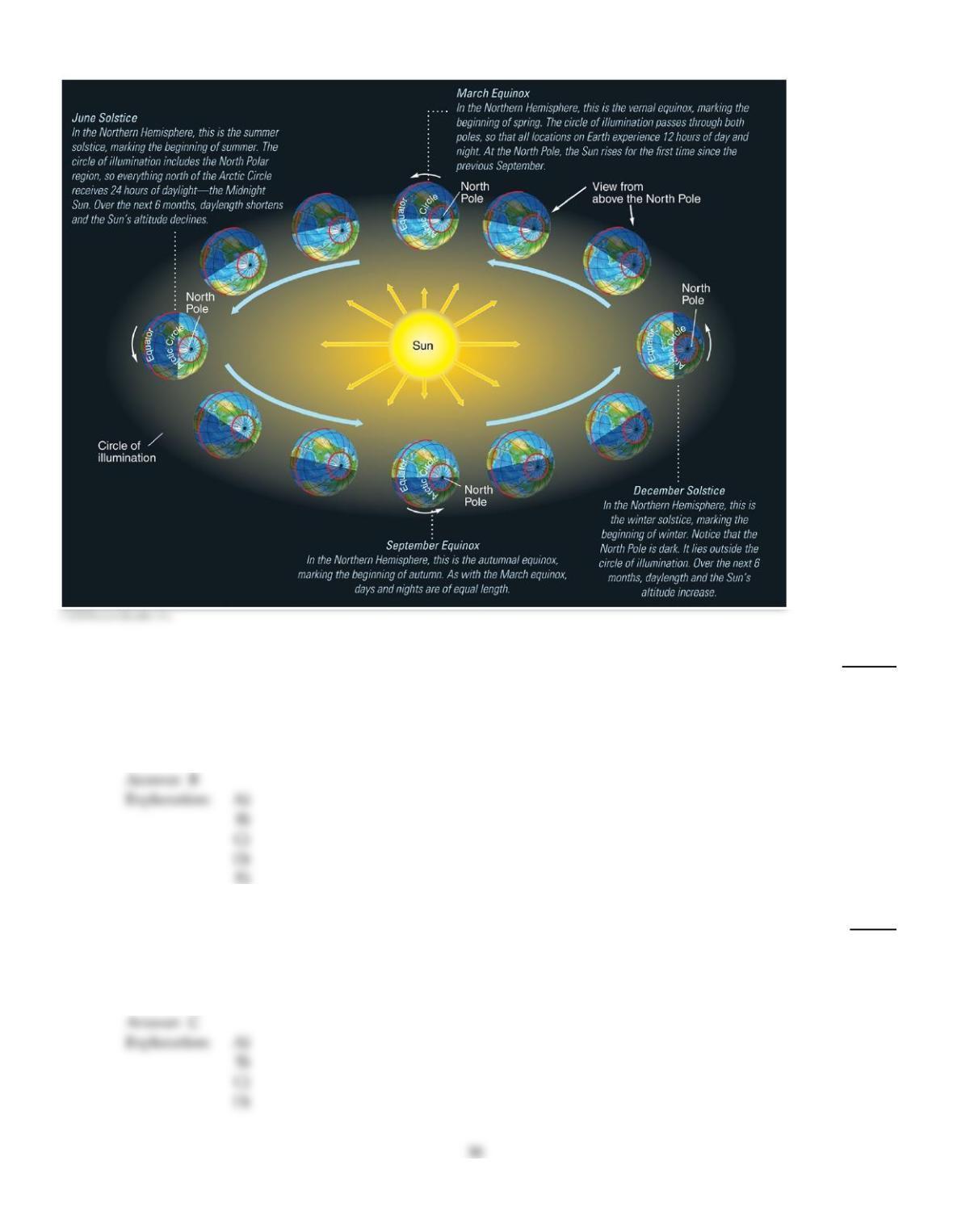
99)
Which of the following is TRUE for the September Equinox?
99)
A)
There is 24 hours of daylight at the North Pole.
B)
The circle of illumination passes through both the poles.
C)
The Arctic Circle is completely within the circle of illumination.
D)
There is 24 hours of daylight at the South Pole.
E)
The Antarctic Circle is completely within the circle of illumination.
100)
Which of the following is TRUE?
100)
A)
Because the Sun is so far away, it is impossible to measure the wavelengths of its radiation.1
B)
The radiation emitted by the Sun and the are roughly the same wavelength.
C)
The Sun emits shortwave radiation, whereas Earth emits longwave radiation.
D)
The Sun emits longwave radiation, whereas Earth emits shortwave radiation.

TRUE/FALSE. Write ‘T’ if the statement is true and ‘F’ if the statement is false.
101)
Air pressure is produced through the motion, size, and number of air molecules.
101)
102)
The correct order for wavelengths of electromagnetic radiation from shortest to longest is: X–rays,
infrared, radio waves, visible light, and ultraviolet.
102)
103)
Our solar system is located towards the middle of the Milky Way galaxy.
103)
104)
Lower latitudes experience the greatest seasonal variation throughout an average year.
104)
105)
The amount of CO2 in the atmosphere is higher now than any time in the last 800,000 years.
105)
106)
Ground–level ozone is the principal ingredient of photochemical smog.
106)
107)
The ionosphere resides principally within the thermosphere, and the ozonosphere resides within
the stratosphere.
107)
108)
The electromagnetic spectrum of radiant energy travels in waves at the speed of light in all
directions from the Sun.
108)
109)
The atmosphere exerts an average force of approximately 1 kg/cm2 (14.7 lbs/in2) at sea level.
109)
110)
The speed of Earth’s rotation is fasted at the poles.
110)
111)
Depletion of the ozone layer is happening principally because of natural circulation dynamics in
the upper atmosphere, not chemical reactions.
111)

112)
The Sun’s height in the sky above the horizon is termed its altitude.
112)
113)
The magnetosphere deflects the solar wind toward Earth’s two poles.
113)
114)
The sun rises at the North Pole on the March equinox and remains over the horizon for the
following six months.
114)
115)
Earth radiates energy primarily in the ultraviolet wavelengths.
115)
116)
A light–year is an astronomical unit of length equal to approximately 9.5 trillion kilometers.
116)
117)
Normal rainfall has a neutral pH.
117)
118)
The role of CFCs in the depletion of stratospheric ozone was first hypothesized in the 1970s.
118)
119)
On the Northern Hemisphere’s summer solstice, areas above Arctic Circle are completely within
the circle of illumination.
119)
120)
By volume, nitrogen is the most abundant gas in the modern homosphere.
120)
121)
Earth is closest to the Sun in early July.
121)
122)
The Clean Air Act actually saves fewer than 1000 lives per year.
122)
123)
Earth rotates east to west, or clockwise, when viewed from above the North Pole.
123)

124)
Pollution generated in one country can cause problems in other countries.
124)
125)
The subsolar point is at the Tropic of Cancer on or about December 21.
125)
126)
Scientists predict that air quality will continue to improve even without emission regulations.
126)
127)
Shorter wavelengths tend to have a lower frequency.
127)
128)
The ozone hole has almost completely recovered.
128)
129)
The ozone layer protects Earth’s surface from most of the incoming ultraviolet radiation.
129)
130)
Despite the thermosphere’s high temperature, the density of molecules is so low little actual heat is
produced.
130)
131)
Increased fuel efficiency may help mitigate urban pollution.
131)
132)
The seasons are caused by the changing amounts of energy received at Earth as a result of Earth’s
elliptical orbit.
132)
133)
Based on the criteria of composition, the atmosphere is divided into two broad regions: the
ionosphere and the ozonosphere.
133)
134)
When the Sun is active (e.g. more sunspots and eruptions), the thermosphere increases in altitude.
134)

135)
The Sun emits radiant energy composed almost entirely of ultraviolet and gamma–ray
wavelengths.
135)
136)
A solar maximum is a period during which sunspots are numerous.
136)
137)
According to the planetesimal hypothesis, solar systems condense from nebular dust and gas.
137)
138)
Temperature inversions have little effect on air pollution.
138)
139)
Rainfall is naturally acidic due to the presence of carbonic acids.
139)
140)
The Sun’s radiant energy is composed primarily of visible light and infrared wavelengths.
140)
141)
The June solstice marks the beginning of the Southern Hemisphere’s winter.
141)
142)
Seasonality involves the variability of both daylength and the altitude of the Sun.
142)
143)
Of the atmosphere‘s thermal layers, the stratosphere is the hottest.
143)
144)
The subsolar point’s maximum latitude is 47° N/S.
144)
145)
Earth’s axis is titled 19.5° relative to the plane of the ecliptic.
145)
146)
Earth’s axial alignment varies throughout the year.
146)
147)
Photochemical smog results from the interaction of sunlight with the combustion products of
automobiles.
147)
148)
The Solar System, Sun, and Earth formed about 4.6 billion years ago.
148)
149)
Oxygen is a byproduct of photosynthesis.
149)
150)
The uneven distribution of insolation at the thermopause is caused by Earth’s curvature, with only
the subsolar point receiving sunlight from directly overhead.
150)
ESSAY. Write your answer in the space provided or on a separate sheet of paper.
151)
Why are seasonal changes less noticeable near the equator than at midlatitudes?
152)
What is the circle of illumination and its importance?
153)
For where you live, how do daylength and the Sun’s altitude vary throughout the year?
154)
Why is the light year a useful unit of measurement for astronomical distances?
155)
List and describe the four main gases of the homosphere. Which is least important to life?
156)
Discuss ways in which anthropogenic climate change affects seasonality.
157)
What is the role of ozone in the ozonosphere? Discuss and explain the chemical reactions that lead to its
destruction.
158)
How does the daily insolation received at the top of the atmosphere vary annual from lower to higher latitudes.
159)
Ozone is found in both the ozonosphere and as a component of smog. Discuss its properties and function in the
ozonosphere, and also its destruction by anthropogenic chemicals and the international efforts undertaken to
ameliorate the destruction. Also examine ozone’s production and effects at ground level.
160)
Define these terms: thermopause, insolation, solar constant, subsolar point.
161)
Describe the causes and consequences of the uneven distribution of insolation.
162)
What have been some of the significant achievements of the Clean Air Act?
163)
The atmosphere can be studied using three basic criteria: composition, temperature, and function. Discuss these
three classifications, giving relevant details of each.
164)
Draw and label a diagram of the Earth–Sun relationship for the four seasons. Include the average distance from
Earth to the Sun, the location of the subsolar point for each seasonal event, and the name and date for each of
the solstices and equinoxes.
165)
Trace the changing temperature of the atmosphere from Earth’s surface to the top of the thermosphere.
166)
What the the primary factors to contribute to seasonality on Earth.
167)
List and describe at least five natural sources of air pollution, as well as the source and effects of at least eight
human–generated air pollutants.
168)
Describe how anthropogenic activity may influence both the troposphere and the stratosphere.
169)
Describe the radiation emitted from both the Sun and Earth in terms of the electromagnetic spectrum.
170)
Explain the significance of each of the equinoxes and solstices.

Answer Key
Testname: C2

Answer Key
Testname: C2
39

Answer Key
Testname: C2
40
Answer Key
Testname: C2
41