Name:
Class:
Date:
Excel 2013 Chapter 02: Formulas, Functions, and Formatting
1. A ____ is a prewritten formula that is built into Excel.
a.
function
b.
feature
c.
task
d.
calculation
1
2. To start a new line in a cell, press the ____ keys.
a.
CTRL+ENTER
b.
TAB+ENTER
c.
ALT+ENTER
d.
SHIFT+ENTER
c
1
3. When you enter a two-digit year that is less than 30, Excel changes the year to ____.
a.
20xx
b.
30xx
c.
18xx
d.
19xx
a
1
4. A(n) ____ circular reference occurs when a formula in a cell refers to another cell or cells that include a formula that
refers back to the original cell.
a.
contiguous
b.
indexed
c.
direct
d.
indirect
d
1
5. All of the following are valid Excel arithmetic operators EXCEPT ____.
a.
^
b.
*
c.
%
d.
>
d
1
6. Which of the following calculations multiplies 23 by 0.01?
a.
=23%
b.
=23
c.
=23+.01
d.
=24-.01
a
1
7. When more than one arithmetic operator is involved in a formula, Excel follows the same basic order of ____ that you
Name:
Class:
Date:
Excel 2013 Chapter 02: Formulas, Functions, and Formatting
use in algebra.
a.
placement
b.
operations
c.
positioning
d.
selections
1
8. When Excel follows the order of operations, the formula, 8 * 3 + 2, equals ____.
a.
40
b.
26
c.
48
d.
13
b
1
9. Which of the following happens when you enter the formula =G15 into a cell?
a.
Excel recalculates all formulas in the worksheet
b.
Excel assigns the sum of the values in the previous 15 cells to the active cell
c.
Excel assigns the value in cell G15 to the active cell
d.
Nothing; =G15 is an invalid formula
c
1
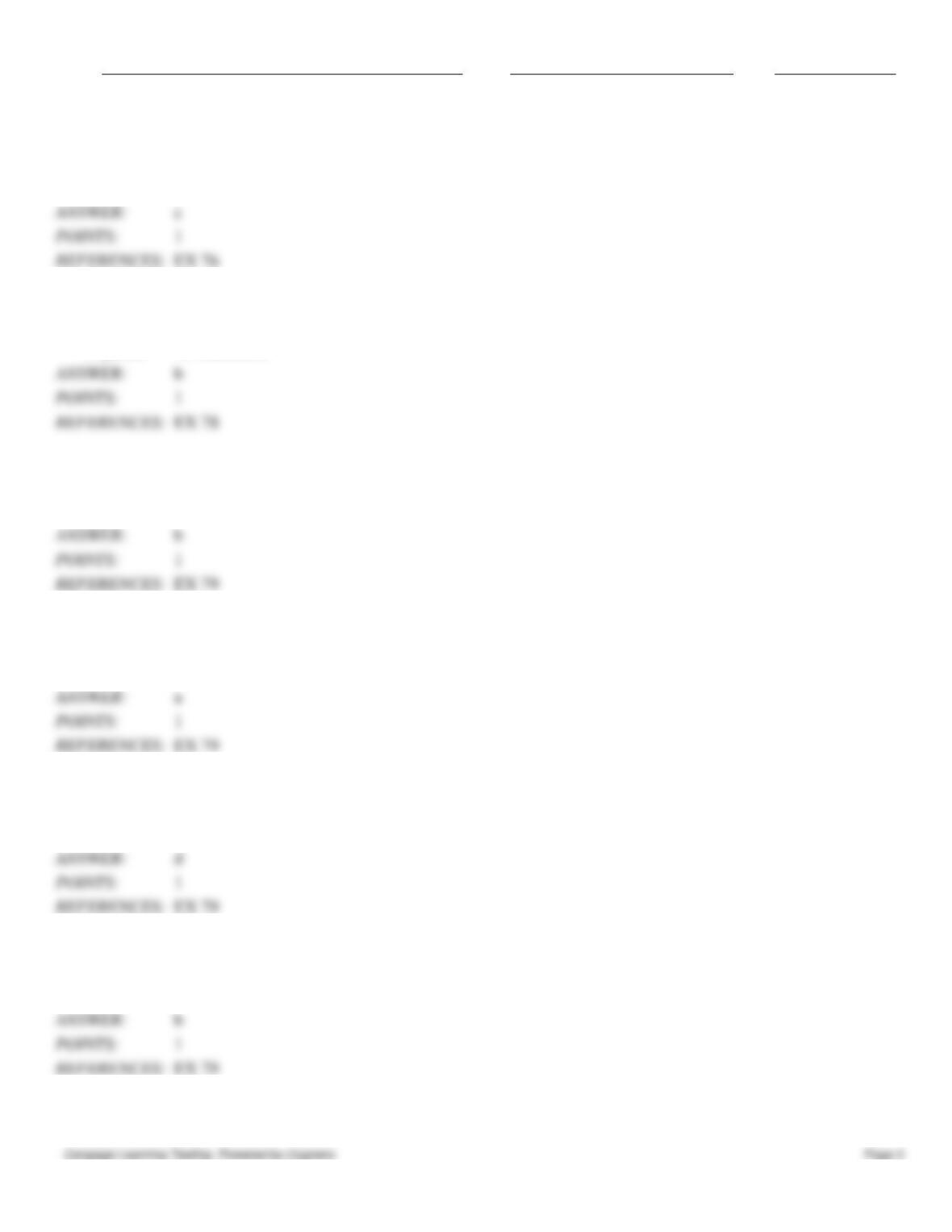
10. Point mode allows you to ____, as shown in the accompanying figure.
a.
select cells for use in a formula using the keyboard
Name:
Class:
Date:
Excel 2013 Chapter 02: Formulas, Functions, and Formatting
b.
select a function from the Sum button list
c.
select cells for use in a formula using the mouse pointer
d.
edit cell contents directly in the cell
c
1
11. The adjusted cell references in a copied and pasted formula are called ____ cell references.
a.
related
b.
relative
c.
pasted
d.
alternative
b
1
12. You can click the ____ button to undo an automatic correction.
a.
Auto Fill Options
b.
AutoCorrect Options
c.
Paste Options
d.
Trace Error
b
1
13. Which of the following Option buttons gives options for filling cells following a fill operation?
a.
Auto Fill Options
b.
AutoCorrect Options
c.
Insert Options
d.
Paste Options
a
1
14. The ____ button lists error-checking options following the assignment of an invalid formula to a cell.
a.
Find Error
b.
Explain Error
c.
Fix Error
d.
Trace Error
d
1
15. The ____ Option button lists formatting options following an insertion of cells, rows, or columns.
a.
AutoCorrect
b.
Insert
c.
Auto Fill
d.
Paste
b
1
16. The ____ function displays the highest value in a range.
a.
MIN
b.
SUM
Name:
Class:
Date:
Excel 2013 Chapter 02: Formulas, Functions, and Formatting
c.
MAX
d.
AVERAGE
c
1
17. Clicking the ____ opens the Insert Function dialog box.
a.
Insert Function box in the formula bar
b.
Function dialog box launcher (HOME tab | Calculations group)
c.
Function button (HOME tab | Function group)
d.
Functions & Formulas button on the status bar
a
1
18. The ____ function determines the lowest number in a range.
a.
LOW
b.
BASE
c.
LEAST
d.
MIN
d
1
19. The ____ function sums the numbers in the specified range and then divides the sum by the number of cells with
numeric values in the range.
a.
DIVSUM
b.
RANGEAVG
c.
AVERAGE
d.
MAX
c
1
20. The ____ AutoComplete list contains those functions that alphabetically match the letters you type following the equal
sign.
a.
Function
b.
Formula
c.
Equal
d.
Calculate
b
1
21. You should ____ a function name in the Formula AutoComplete list to select the function.
a.
double-click or double-tap
b.
click or tap
c.
right-click or triple-tap
d.
none of the above
a
1
Name:
Class:
Date:
Excel 2013 Chapter 02: Formulas, Functions, and Formatting
22. Excel automatically appends the ____ to complete the AVERAGE function when you click the Enter box or press the
ENTER key.
a.
left parenthesis
b.
right bracket
c.
right parenthesis
d.
left bracket
c
1
23. Which of the following is the path to the Sum arrow?
a.
(EDITING tab | Home group)
b.
(HOME tab | Editing group)
c.
(HOME tab | Clipboard group)
d.
(CALCULATION tab | Editing group)
b
1
24. Which of the following is the path to the Copy and Paste buttons?
a.
(HOME tab | Copy group)
b.
(HOME tab | Paste group)
c.
(HOME tab | Clipboard group)
d.
(HOME tab | Formulas group)
c
1
25. To copy cell contents, you can select the cell and then press the ____ keys.
a.
CTRL+V
b.
CTRL+X
c.
CTRL+B
d.
CTRL+C
d
1
26. To paste copied cell contents, you can press the ____ keys.
a.
CTRL+C
b.
CTRL+P
c.
CTRL+V
d.
CTRL+X
c
1
27. You can use the ____ to check which cells are referenced in the formula assigned to the active cell.
a.
Formula Finder
b.
Range Finder
c.
Calculation Finder
d.
Function Finder
b
1
28. A company or department may standardize with a specific ____ so that all of their documents have a similar
Name:
Class:
Date:
Excel 2013 Chapter 02: Formulas, Functions, and Formatting
appearance.
a.
scheme
b.
gallery
c.
theme
d.
style
1
29. You can open the Format Cells dialog box by pressing the ____ keys.
a.
SHIFT+TAB
b.
CTRL+1
c.
ALT+1
d.
SHIFT+F1
b
1
30. The ____ button assigns a fixed dollar sign to the numbers in a selected range, with the dollar sign to the far left with
spaces between it and the first digit in the cell.
a.
Comma style format
b.
Accounting number format
c.
Percent style format
d.
Currency style format
b
1
31. Which of the following is the path to the Comma Style button?
a.
(HOME tab | Alignment group)
b.
(HOME tab | Font group)
c.
(HOME tab | Cells group)
d.
(HOME tab | Number group)
d
1
32. Which of the following is the path to the Conditional Formatting button?
a.
(HOME tab | Editing group)
b.
(STYLES tab | Formatting group)
c.
(FORMATTING tab | Styles group)
d.
(HOME tab | Styles group)
d
1
33. If you do not assign a format to a cell or cells in a column, the column width will remain ____ characters.
a.
8.43
b.
7.52
c.
11.65
d.
9.43
a
1
34. When you decrease the row height to ____, the row is hidden.
Name:
Class:
Date:
Excel 2013 Chapter 02: Formulas, Functions, and Formatting
a.
0
b.
1
c.
2
d.
3
a
1
35. Which of the following is the path to the Spelling button?
a.
(HOME tab | Proofing group)
b.
(PROOFING tab | Spelling group)
c.
(REVIEW tab | Proofing group)
d.
(REVIEW tab | Checking group)
c
1
36. A ____ is text and graphics that print at the top of each page.
a.
header
b.
topper
c.
margin
d.
crown
a
1
37. A ____ is text and graphics that print at the bottom of every page.
a.
footer
b.
toe
c.
margin
d.
stopper
a
1
38. The default view in Excel is called ____ view.
a.
Normal
b.
Standard
c.
Basic
d.
Values
a
1
39. ____ view allows you to create or modify a worksheet while viewing how it will look in printed format.
a.
Normal
b.
Page Layout
c.
Page Break Preview
d.
Full Screen
b
1
40. To print a range of cells in the active worksheet, click ____ in the Settings area in the Print gallery.
a.
Print Active Sheets
b.
Print Selection
c.
Print Entire Workbook
d.
none of the above
Name:
Class:
Date:
Excel 2013 Chapter 02: Formulas, Functions, and Formatting
Modified Multiple Choice
41. When designing a worksheet, which steps should be taken to ensure that functional considerations supersede visual
aesthetics?
a.
Identification of how to format various
elements of the worksheet
b.
Avoiding the temptation to use flashy or confusing visual
elements within the worksheet
a
1
42. Which of the following are valid formulas?
a.
=3 ^ 4
b.
=H3/H11
c.
=11+9
d.
=22-F15
a, b, c, d
1
43. Which of the following actions are provided by the Paste Options button?
a.
Pastes synonyms or acronyms
b.
Copy just formulas
a
1
44. Which of the following is a method of entering functions?
a.
keyboard, touch gesture, or pointer
b.
the Sum menu
c.
the Insert Function box in the formula bar
d.
the Name box area in the formula bar
a, b, c, d
1
45. Using the Excel spell checker, you can ____.
a.
check the spelling of words in a selected range
b.
add words to the dictionary
a, b
1
46. The equal sign (=) precedes a formula.
a.
True
b.
False
True
1
b
1
Name:
Class:
Date:
Excel 2013 Chapter 02: Formulas, Functions, and Formatting
47. The most common error when entering a formula is to reference the wrong cell in the formula.
a.
True
b.
False
True
1
48. An asterisk (*) following a cell reference in a formula is the arithmetic operator that directs Excel to perform the
division operation.
a.
True
b.
False
False
1
49. The arithmetic operator, ^, directs Excel to perform the division operation.
a.
True
b.
False
False
1
50. As in algebra, you can use brackets to override the order of operations Excel follows to perform formula calculations.
a.
True
b.
False
False
1
51. Moving from left to right, the first calculation in the order of operations is negation (-).
a.
True
b.
False
True
1
52. Point mode allows you to select cells for use in a formula by using your finger or the pointer.
a.
True
b.
False
True
1
Name:
Class:
Date:
Excel 2013 Chapter 02: Formulas, Functions, and Formatting
53. Using Point mode to enter formulas often is faster and more accurate than using the keyboard to type the entire
formula.
a.
True
b.
False
True
1
54. The Insert Options button lists formatting options.
a.
True
b.
False
True
1
55. Excel has more than 400 functions that perform just about every type of calculation you can imagine.
a.
True
b.
False
True
1
56. Clicking the Create Function box opens the Function Arguments dialog box.
a.
True
b.
False
False
1
57. The Sum button menu allows you to enter one of five often-used functions easily into a cell.
a.
True
b.
False
True
1
58. Excel attempts to guess which cells you want to include in the function by looking for ranges that are adjacent to the
selected cell and that contain numeric data.
a.
True
b.
False
1
Name:
Class:
Date:
Excel 2013 Chapter 02: Formulas, Functions, and Formatting
59. The range automatically selected by Excel is always correct.
a.
True
b.
False
False
1
60. You can use the arrow keys to complete an entry in Point mode.
a.
True
b.
False
False
1
61. The AVERAGE function requires that the argument be included within parentheses following the function name.
a.
True
b.
False
True
1
62. To use Range Finder to verify that a formula contains the intended cell references, click or tap the cell with the
formula you want to check.
a.
True
b.
False
False
1
63. When you click the Decrease Font Size button, Excel assigns the next highest font size in the Font Size gallery.
a.
True
b.
False
False
1
64. The default font for the Basis theme is different than the default font for the Office theme.
a.
True
b.
False
True
1
Name:
Class:
Date:
Excel 2013 Chapter 02: Formulas, Functions, and Formatting
65. You can click the Format Cells Dialog Box Launcher to open the Format Cells dialog box.
a.
True
b.
False
1
66. You cannot format an entire column at once.
a.
True
b.
False
False
1
67. To select a number format, you can choose a category in the Number tab in the Format Cells dialog box and then
select the number of decimal places, whether or not a dollar sign should be displayed, and how negative numbers should
appear.
a.
True
b.
False
True
1
68. With the accounting number style, a floating dollar sign appears immediately to the left of the first digit in a dollar
value with no spaces.
a.
True
b.
False
False
1
69. The Percent Style button instructs Excel to display a value as a percentage, determined by multiplying the cell entry
by 100, rounding the result to the nearest percent, and adding a percent sign.
a.
True
b.
False
True
1
70. Best fit means that the width of the column will be increased or decreased by a percentage you specify.
a.
True
b.
False
False
1
Name:
Class:
Date:
Excel 2013 Chapter 02: Formulas, Functions, and Formatting
71. The function, or ____________________, of a worksheet is to provide a user with direct ways to accomplish tasks.
72. When Excel recognizes that you entered a date in mm/dd/yy format, it automatically formats the date as
____________________.
73. One of the reasons Excel is such a valuable tool is that you can assign a(n) ____________________ to a cell, and
Excel will calculate the result.
74. A formula in a cell that contains a reference back to itself is called a(n) ____________________.
75. The / arithmetic operator indicates ____________________.
76. In the order of operations, the last operation Excel performs is ____________________.
77. The ____________________ is a small black square in the lower-right corner of the active cell or active range.
Name:
Class:
Date:
Excel 2013 Chapter 02: Formulas, Functions, and Formatting
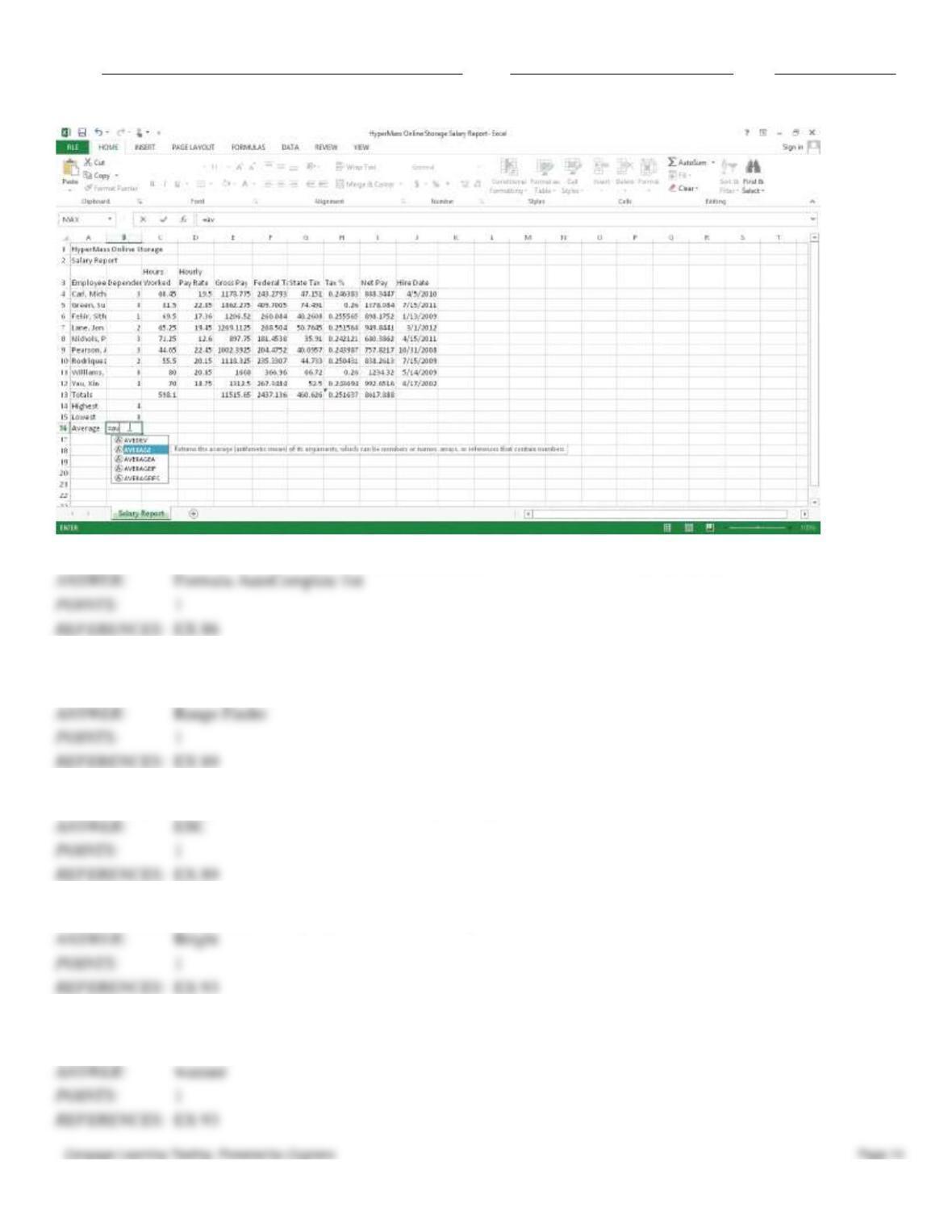
78. Typing =av in a cell displays the ____________________, as shown in the accompanying figure.
79. To use ____________________ to verify that a formula contains the intended cell references, double-tap or double-
click the cell with the formula you want to check.
80. You can press the ____________________ key to quit Range Finder.
81. ____________________ colors jump out of a dark background and are easiest to see.
82. Of warmer and cooler colors, the kind of colors that tend to reach toward the reader are ____________________
colors.
Name:
Class:
Date:
Excel 2013 Chapter 02: Formulas, Functions, and Formatting
83. A(n) ____________________ is a dot on the screen that contains a color.
84. ____________________ means that the width of a column will be increased or decreased so the widest entry will fit
in the column.
85. ____________________ is a technique that can be used to conceal data that might not be relevant to a particular
report or sensitive data that others should not see.
86. To set row height to best fit, ____________________ the bottom boundary of the row heading.
87. Excel includes a(n) ____________________ you can use to check a worksheet for spelling errors.
88. You can click the Page Layout button on the status bar to switch to ____________________ view.
89. ____________________ are those portions of a printed page outside the main body of the printed document and
always are blank when printed.
90. ____________________ view shows the worksheet divided into pages.
Name:
Class:
Date:
Excel 2013 Chapter 02: Formulas, Functions, and Formatting
91. In designing a worksheet, visual aesthetics should come first. _________________________
92. Cooler colors tend to pull away from the reader. _________________________
93. While holding down the ALT key, you can select nonadjacent ranges and cells. _________________________
94. The Accounting number format assigns a floating dollar sign. _________________________
95. You can choose from 12 categories of formats in the Format Cells dialog box. _________________________
96. Explain what circular references, direct circular references, and indirect circular references are.
97. Briefly discuss the order of operations.
Name:
Class:
Date:
Excel 2013 Chapter 02: Formulas, Functions, and Formatting
98. Briefly discuss displaying the formulas version of a worksheet.
1
Critical Thinking
Critical Thinking Questions
Case 2-1
Leo, owner of Leo’s Bread Company, recently installed Excel 2013 and created a new workbook to track sales of different
types of bread. He wants to determine which types of bread are the most popular among his customers. He is particularly
interested in sales of rye bread, onion rolls, and bagels. Leo has formatted the sales numbers with the Accounting number
format.
99. After Leo enters the sales numbers into the cells, he decides he does not want the fixed dollar sign to appear on the far
left of the cell, separated by spaces from the actual value. He would prefer that the dollar sign appear immediately to the
left of the first digit of the value. To specify a floating dollar sign, which of the following formats should Leo apply?
a.
Comma style
c.
Currency style
b.
Percent style
d.
General number
C
1
Critical Thinking
100. Leo wants the sales numbers for rye bread, onion rolls, and bagels to look different each time the sales for each
exceeds $500. What Excel feature can Leo use to accomplish this?
a.
Spell checker
c.
Point mode
b.
Conditional formatting
d.
Formulas version
B
1
Critical Thinking
Critical Thinking Questions
Case 2-2
Critical Thinking
Name:
Class:
Date:
Excel 2013 Chapter 02: Formulas, Functions, and Formatting
Anna is a competitive runner. She wants to improve her performance and decides to keep track of data for six months to
determine if the time of day or year she runs affects her performance. Her worksheet contains the following data: start and
end time, total time, and distance.
101. After three months, Anna wants to the know the average distance she runs. What should she do to calculate the
average distance?
a.
Enter the text =av in a cell at the end of
the distance data; then select the
AVERAGE function from the Formula
AutoComplete list and then enter the
function’s argument.
c.
Enter the text =function in a cell at the
end of the distance data; then select the
AVERAGE function from the
AutoFunction list and then enter the
function’s argument.
b.
Enter the text =ms in a cell at the end of
the distance data; then select the MAX
function from the Formula
AutoComplete list and then enter the
function’s argument.
d.
Enter the text =su at the end of the data
in the Distance column; then select the
SUM function from the Select Function
list and then enter the function’s
argument.
A
1
Critical Thinking
102. Now Anna wants to know the longest total time she has run. By looking at the total time values, she finds the longest
total time to be 54 minutes. Instead of manually entering that value in a cell below the total time data, Anna decides to use
the MAX function to determine the longest total time. Why did Anna prefer to use the MAX function?
a.
She believes that 54 minutes is her best
running time.
c.
She believes that 54 minutes is not her
best running time.
b.
The MAX function recalculates the
highest value each time a new value is
entered into the worksheet.
d.
worksheet.
B
1
Critical Thinking
The MAX function provides a constant
value that will not change for this cell
when a new value is entered into the
Identify the letter of the choice that best matches the phrase or definition.
a.
ALT+ENTER
b.
order of operations
c.
circular reference
d.
MAX
e.
CTRL+C
f.
CTRL+1
g.
function
h.
F7
i.
CTRL+ACCENT MARK (`)
Name:
Class:
Date:
Excel 2013 Chapter 02: Formulas, Functions, and Formatting
103. A function that displays the highest value in a range.
104. Copies a formula.
105. A prewritten formula built into Excel.
106. Wraps text in a cell.
107. Spell-checking a worksheet.
108. A formula in a cell that contains a reference back to itself.
109. Pastes a formula.
110. Opens the Format Cells dialog box.
111. Negation comes first in this.

Name:
Class:
Date:
Excel 2013 Chapter 02: Formulas, Functions, and Formatting
112. Displays the worksheet with formulas.