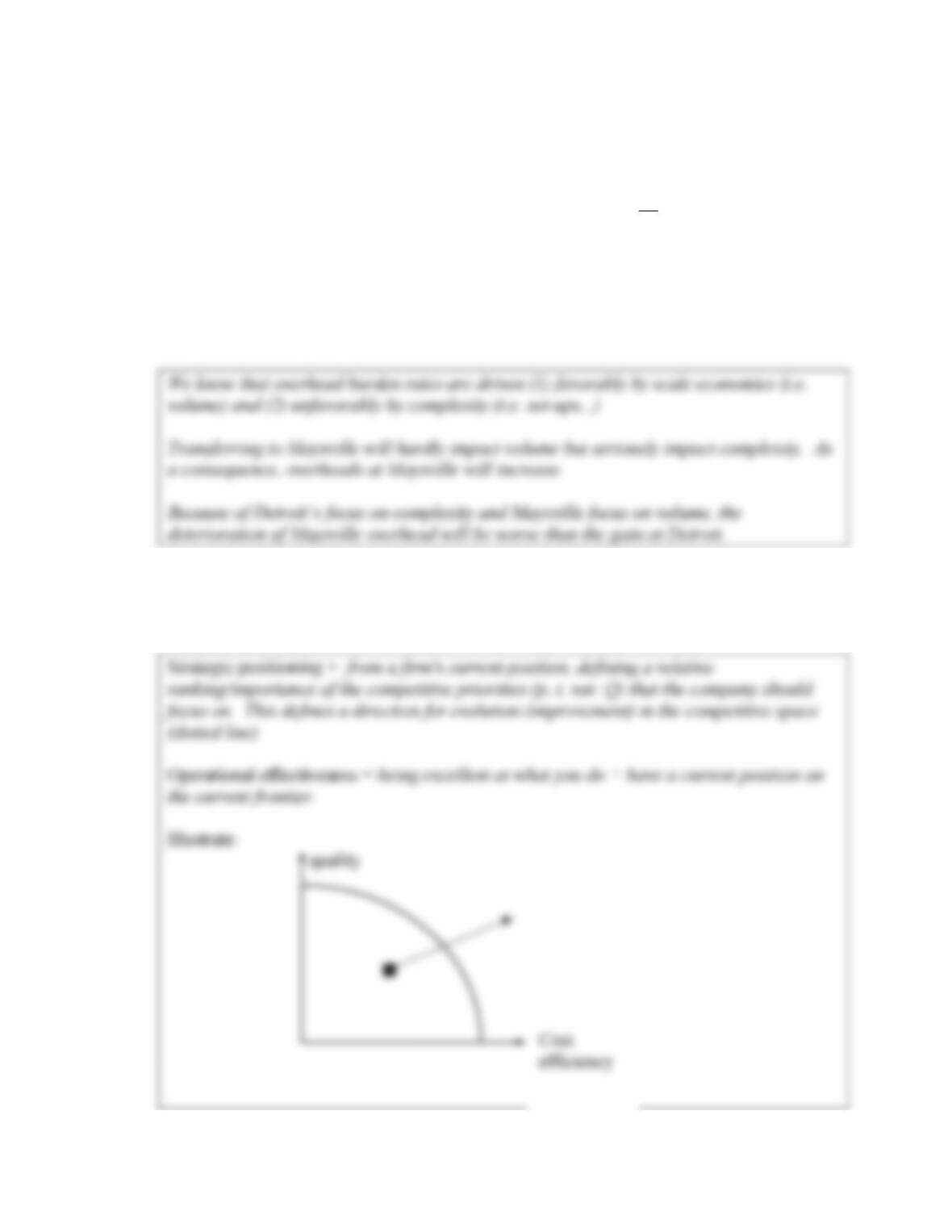
Chapter 2 Test Questions
2.3.1 Wriston Manufacturing Corporation operates several plants with large differences in
overhead rates. The Detroit plant has the highest overhead rate more than twice the rate
of the lowest overhead plant, Maysville. As a result, the corporation is considering
closing down Detroit and transferring its production to a lower overhead facility such as
Maysville.
What will be the effect of transferring the entire production of Detroit to Maysville and
why? (Assume capacity is not an issue)
2.3.2 Sustaining competitive advantage requires strategic positioning and operational
effectiveness. Define both concepts and graphically illustrate their difference using the
competitive space graph.
2.3.3 The Lancaster &York Distribution Company is a regional, full line, distributor of parts,
tools and supplies used by maintenance personnel. The company maintains a catalogue
of 75,000 odd active SKUs (items). Orders are taken over the phone and shipped by UPS
out of the warehouse within a day. The company carries a full line of products
everything a maintenance operation may require. I
maintenance is only a phone call away within a day.”
The company considers the individual maintenance supervisor, rather than the corporate
you can get
almost anything they sell as much as 30% lower if you shopped around. They do not
give any discounts from published list price. Their largest customer accounts for less
than one tenth of one percent of their total business. L & Y has not been certified as a
preferred supplier by any of its customers and it typically is not the primary supplier of a
given item to a given company. The typical order is for two to six items, at a combined
order value of $20 to $350. Many orders involve either an emergency situation where a
particular item is needed right away, or a small $-value order where the major factor is
the convenience of the maintenance supervisor who can get a complete order taken care
of by just one telephone call.
The annual volume of an average item carried by L&Y is about 200 units, with some
slow moving items selling as few as 10 units a year. The company enjoys a superior
reputation for service, product quality and delivery (99% of all orders are sent complete
within a day). The company has been consistently very profitable, but growth has been
modest. The company is privately held.
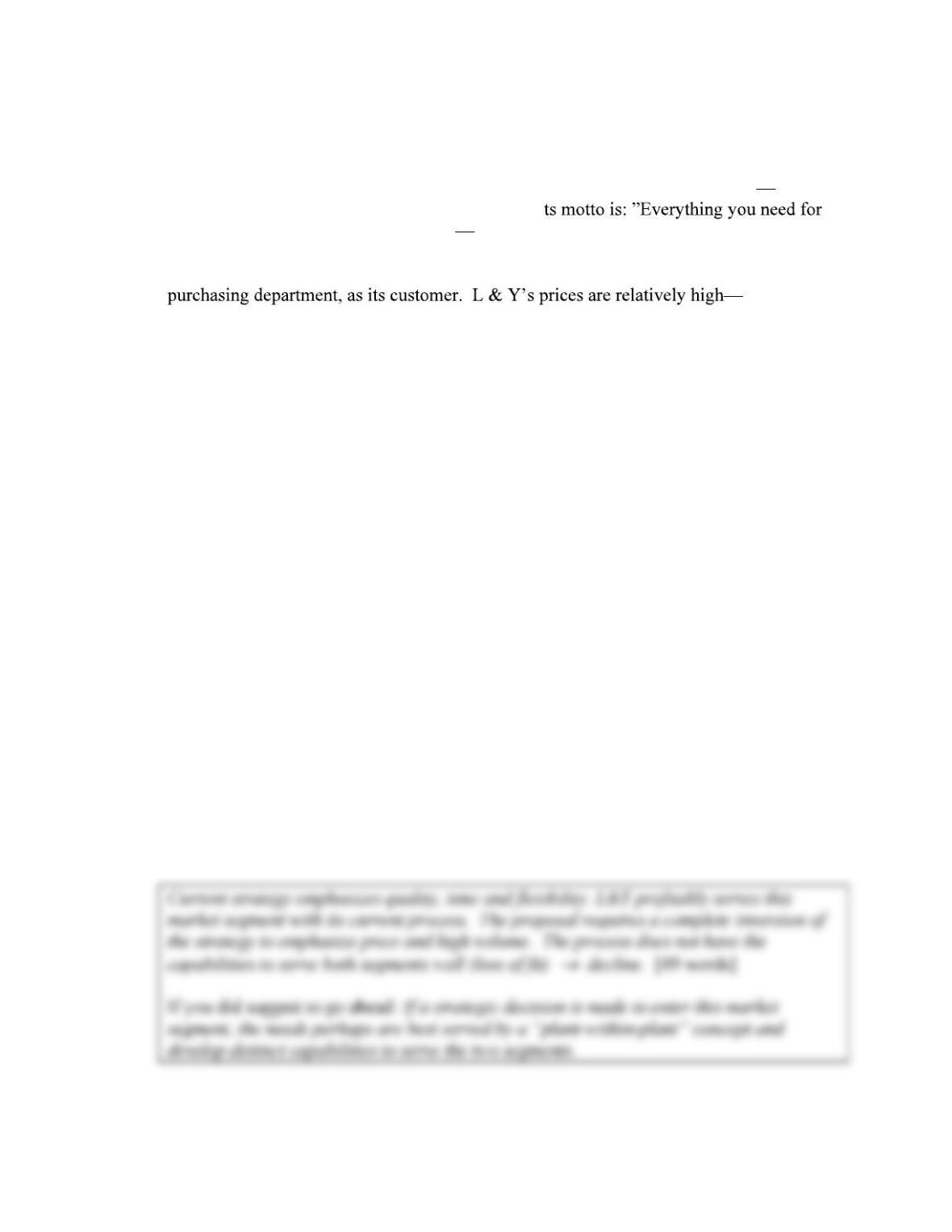
L & Y has been approached by the purchasing department of a large industrial customer
suggesting L & Y becomes their sole supplier for maintenance products. This would
increase the sales volume to this single customer by more than one hundred fold. It
would also result in a noticeable increase in the predictability of demand for many of the
items carried by L & Y. In return, the customer requests an immediate 25% discount
from list prices, and significant financial penalties for late shipments by L&Y.
Because of your expertise in managing operations, the CEO of L & Y is seeking your
advice: Should L & Y accept the offer? Why? Present your answer (together with any
assumptions you deem necessary) in 50 words or less in the area below.
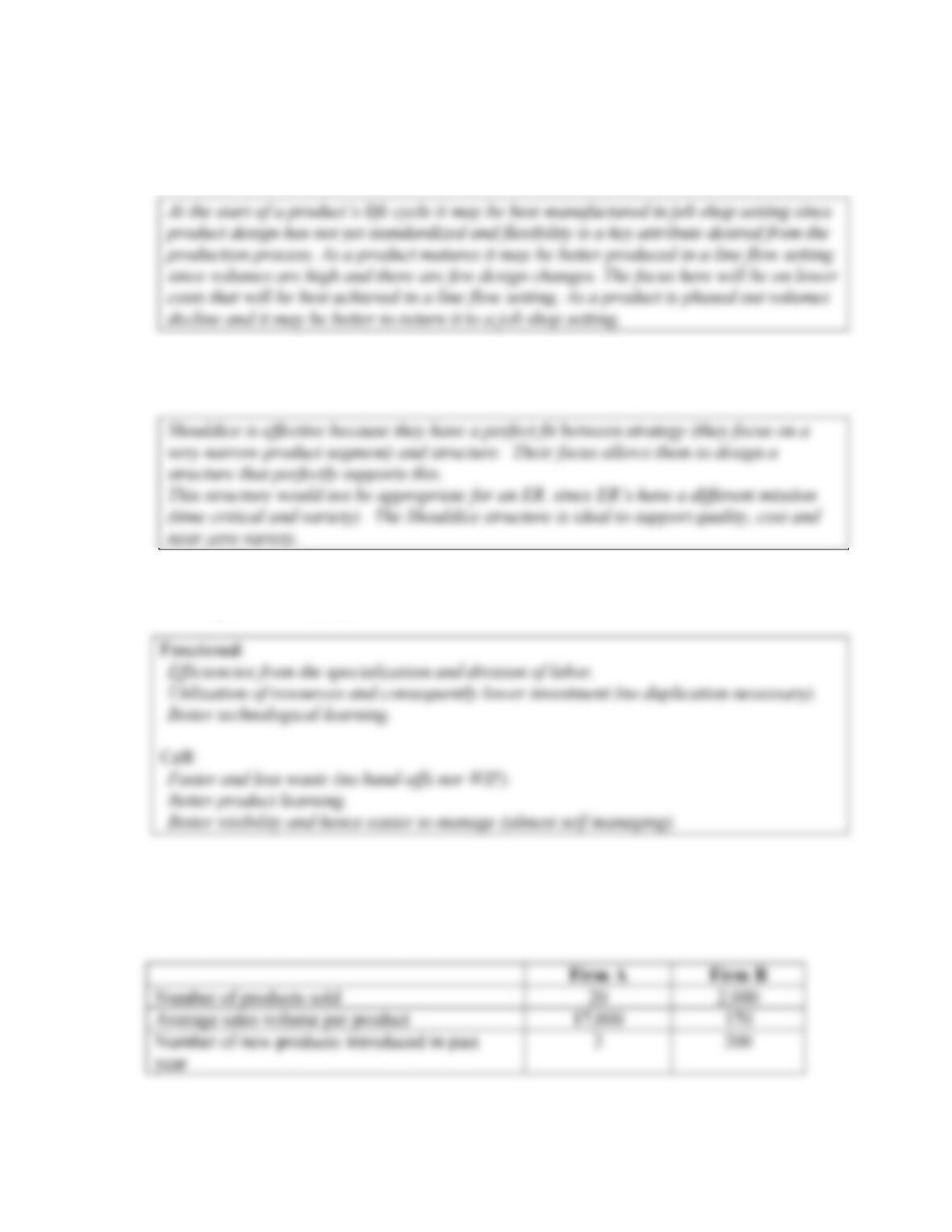
2.3.4 As a product moves through its life cycle from introduction to growth to maturity and
phase out, which process type (job shop, batch, line flow or continuous flow) is most
appropriate at each stage?
2.3.5 Argue why Shouldice Hospital runs an effective operation. Would it be appropriate for a
hospital emergency room to be structured like Shouldice? Why?
2.3.6 Give two major benefits of a functional (process focus) layout and two major benefits of
a cell (product focus) layout.
2.3.7 Two companies A and B have invested in expensive flexible manufacturing systems that
allow the changeover time between products to be reduced to seconds. The annual reports of the
two companies contain the following information:
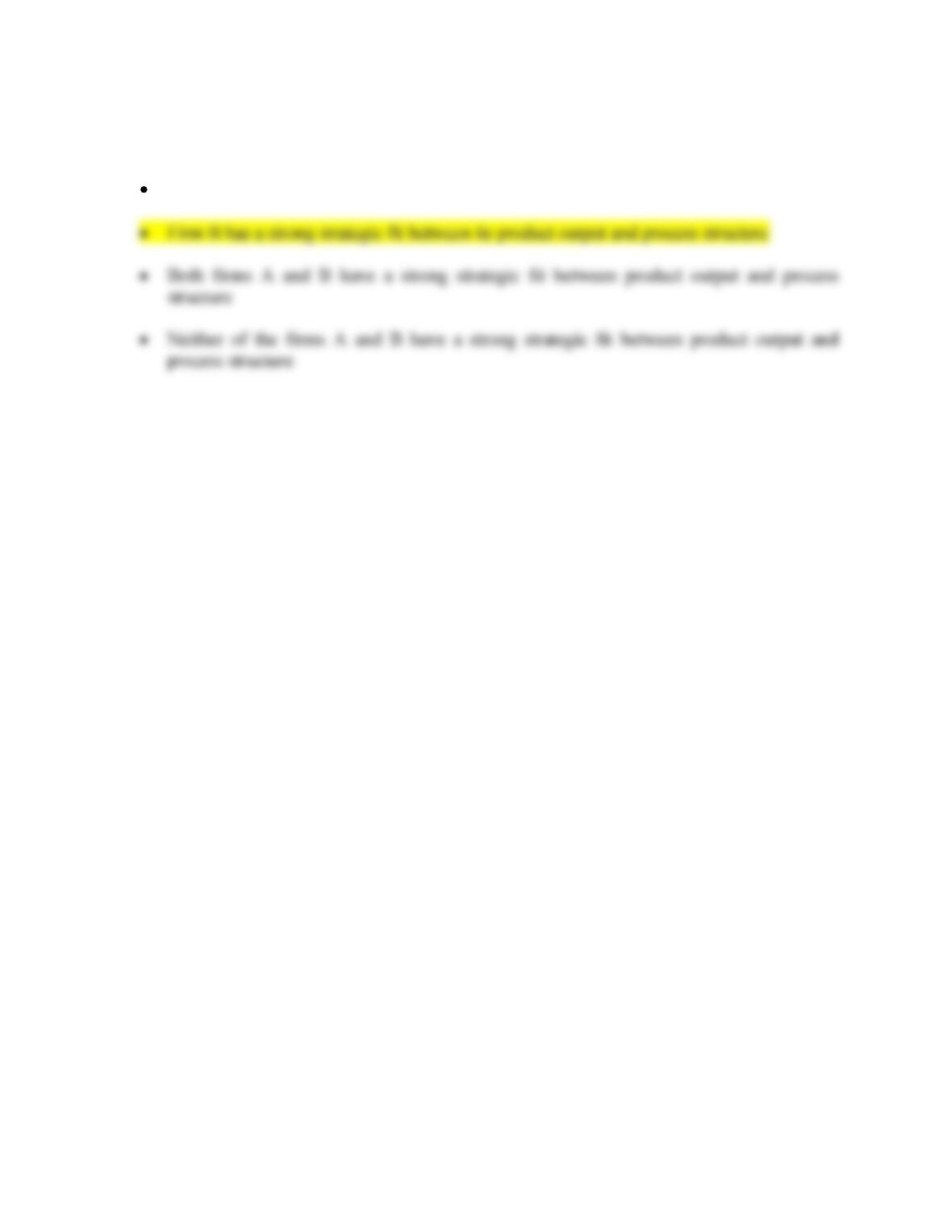
Circle the statement you most agree with:
Firm A has a strong strategic fit between its product output and process structure