Exam
Name___________________________________
SHORT ANSWER. Write the word or phrase that best completes each statement or answers the question.
Draw a graph to match the description. Answers will vary.
1)
G(x) is decreasing over ( , –2] and [6, ) and increasing over [–2, 6]
1)
2)
g(x) is concave up at (–6, 12), concave down at (6, –15), and has an inflection point at (2,
–3).
2)
3)
f(x) has a negative derivative over ( , –3) and a positive derivative over (–3, ).
3)
Sketch the graph of the function. Indicate where it is increasing and where it is decreasing. Indicate where any relative
extrema occur, where asymptotes occur, where the graph is concave up and where is it concave down, where any points of
inflection occur, and where any intercepts occur.
4)
f(x) =x2–9
x –3
4)
5)
f(x) is decreasing and concave down on ( , 10); f(x) is decreasing and concave up on (10,
).
5)
6)
f(x) =x2–49
x – 1
6)
3
7)
f(x) has a positive derivative over ( , –7) and a negative derivative over (–7, –2) and (–2,
), and a derivative equal to 0 at x = –2.
7)
8)
f(x) has a positive derivative over ( , 6) and a negative derivative over (6, ).
8)
9)
G(x) has a positive derivative over ( , –7) and (–3, 7) and a negative derivative over (–7, –
3) and (7, ).
9)
10)
f(x) =2x + 1
x
10)
6
11)
f(x) is increasing over ( , –5] and [–3, ) and decreasing over [–5, –3].
11)
12)
f(x) is decreasing and concave up on ( , –7); f(x) is decreasing and concave down on (–7,
).
12)
13)
g(x) is concave down at (–5, –3), concave up at (5, 10), and has an inflection point at (3, 4).
13)
14)
g(x) has a negative derivative over ( , –5) and (2, 5) and a positive derivative over (–5, 2)
and (5, ).
14)
15)
f(x) is increasing and concave down on ( , 3); f(x) is increasing and concave up on (3, ).
15)
16)
f(x) =x +8
x2–64
16)
9
17)
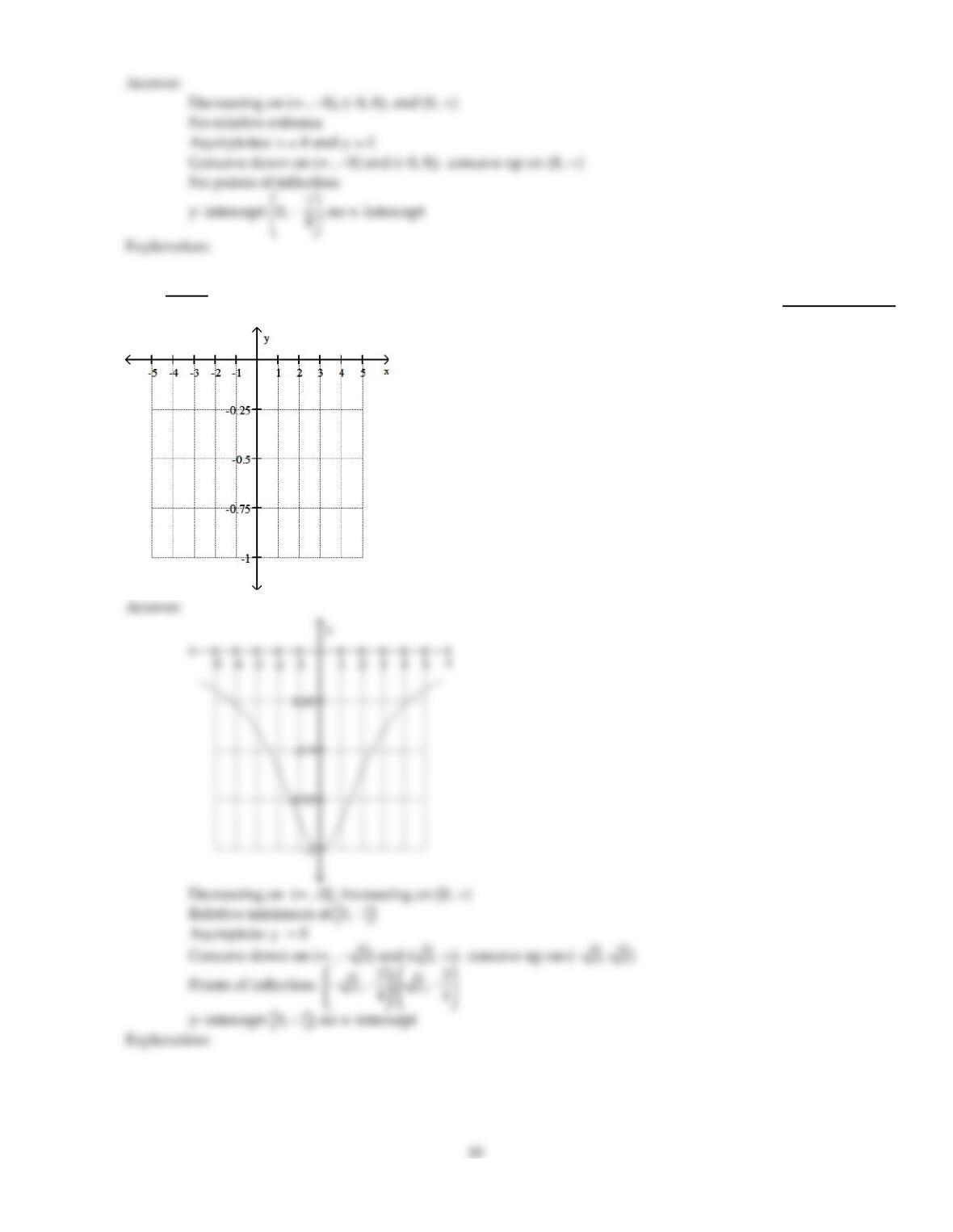
f(x) =–6
x2+6
17)
18)
f(x) =1
x –8
18)
19)
f(x) = x +7
x
19)
12
20)
f(x) is increasing and concave up on ( , –4); f(x) is increasing and concave down on (–4,
).
20)
21)
f(x) is decreasing over ( , 2] and increasing over [2, ).
21)
22)
f (–7) = 0, f (–7) < 0, f(–7) = 17, f (7) = 0, f (7) > 0, f(7) = –3, f (3) = 0 and f(3) = 3.
22)
23)
f(x) =–2
x + 6
23)
24)
f (–5) = 0, f (–5) > 0, f(–5) = –13, f (5) = 0, f (5) < 0, f(5) = 25, f (–3) = 0 and f(3) = 13.
24)
25)
F(x) has a positive derivative over ( , –6) and (–6, 2) and a negative derivative over (2, ),
and a derivative equal to 0 at x = –6.
25)
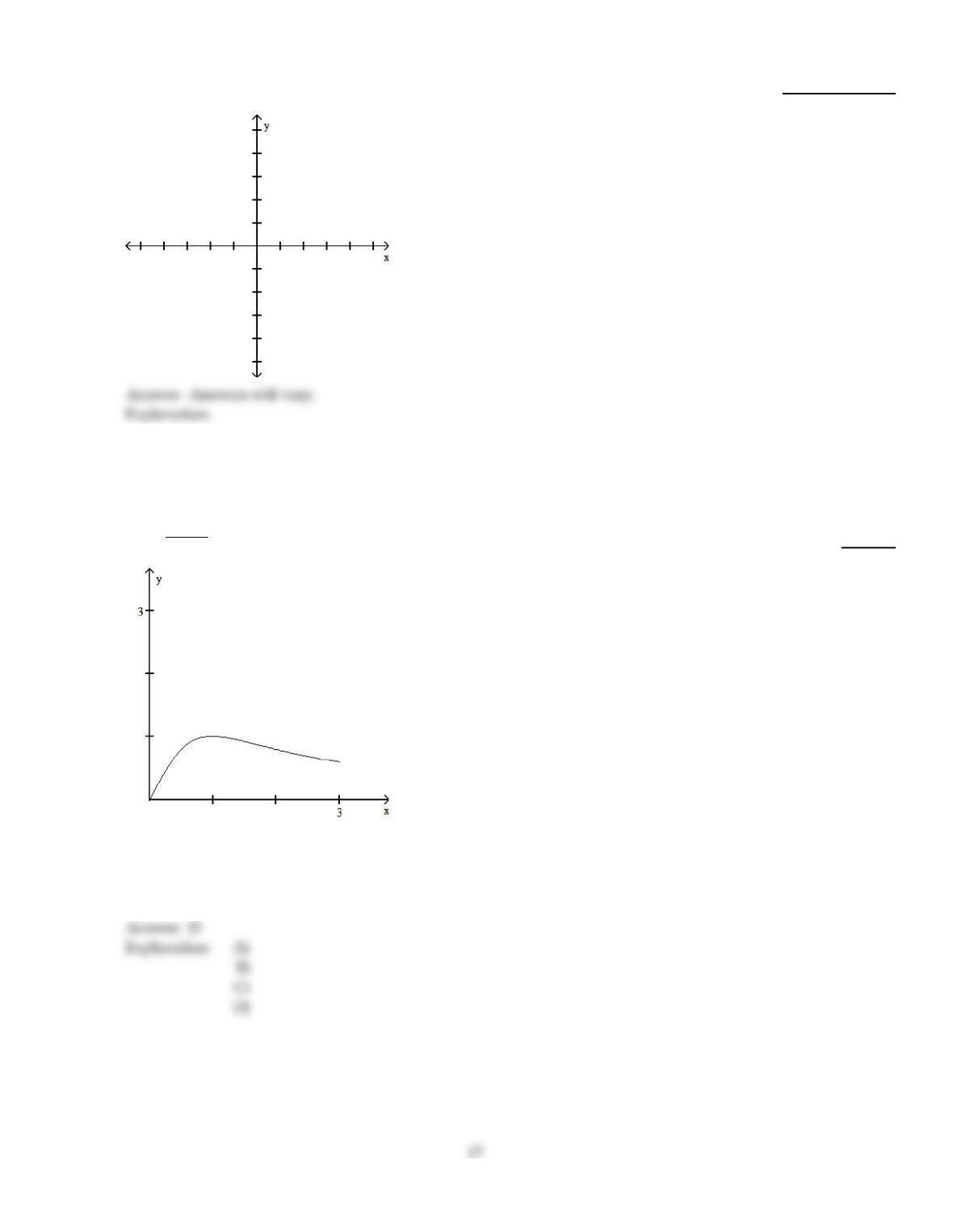
26)
g(x) is increasing over ( , –2] and decreasing over [–2, ).
26)
MULTIPLE CHOICE. Choose the one alternative that best completes the statement or answers the question.
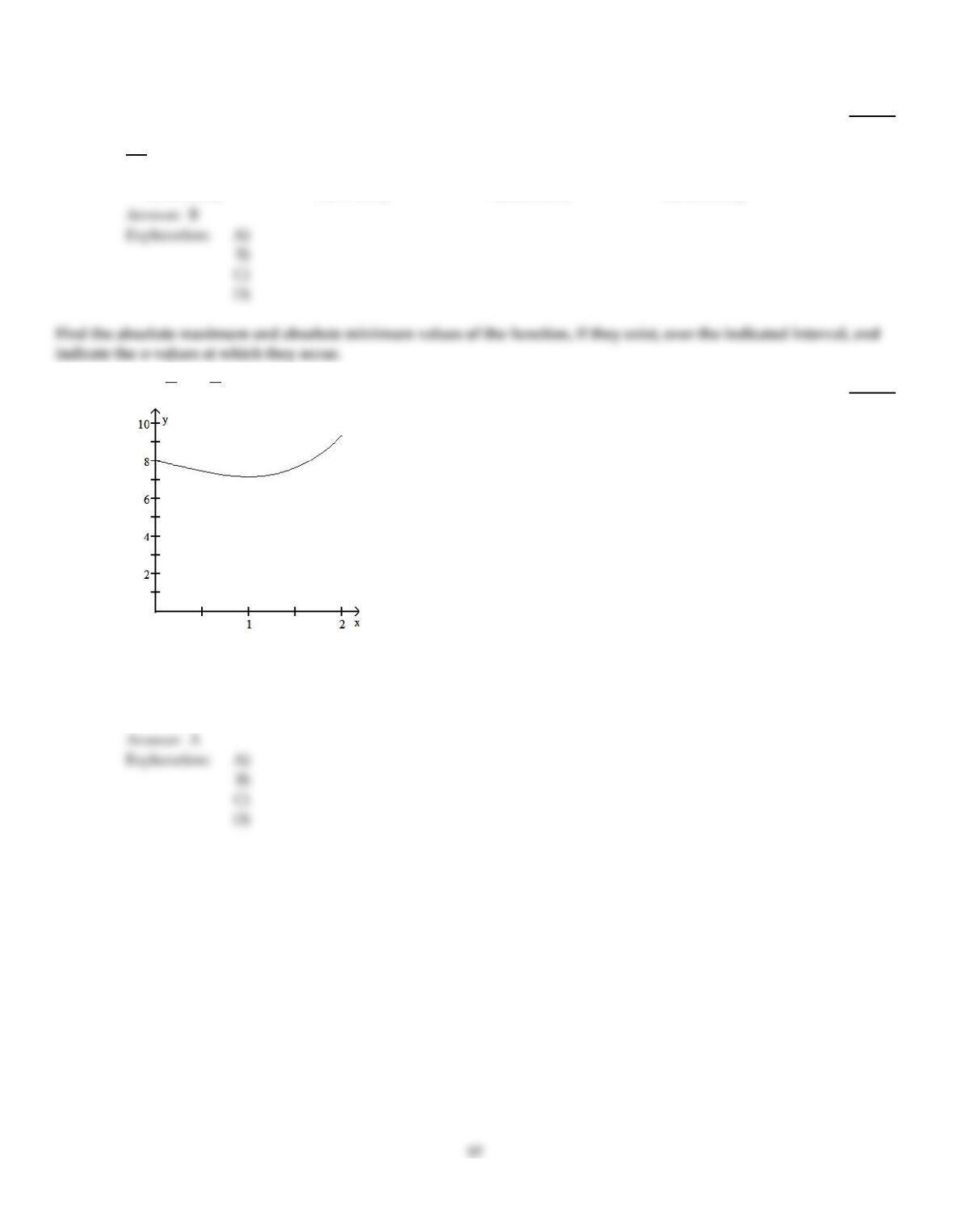
Find the absolute maximum and absolute minimum values of the function, if they exist, over the indicated interval, and
indicate the x–values at which they occur.
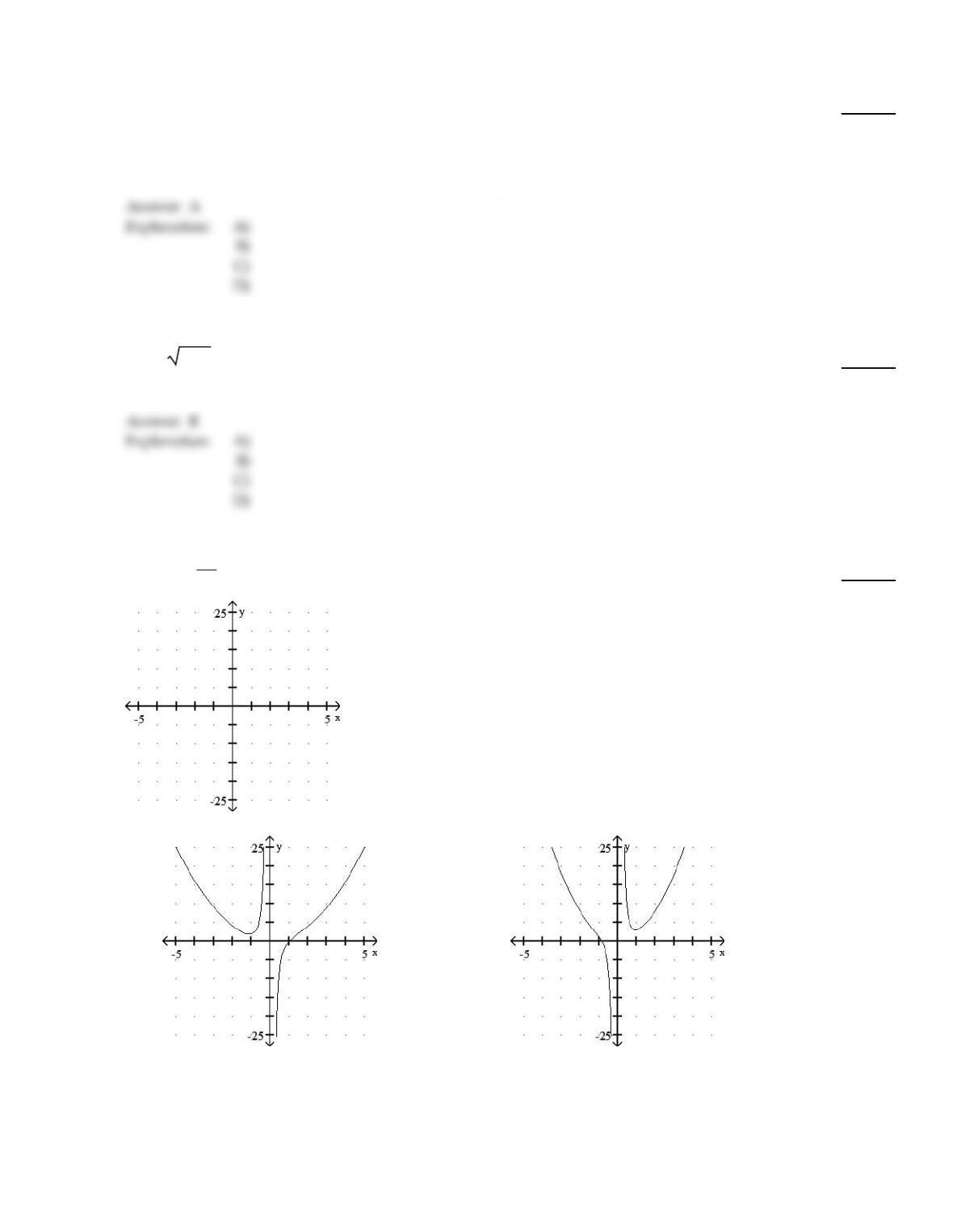
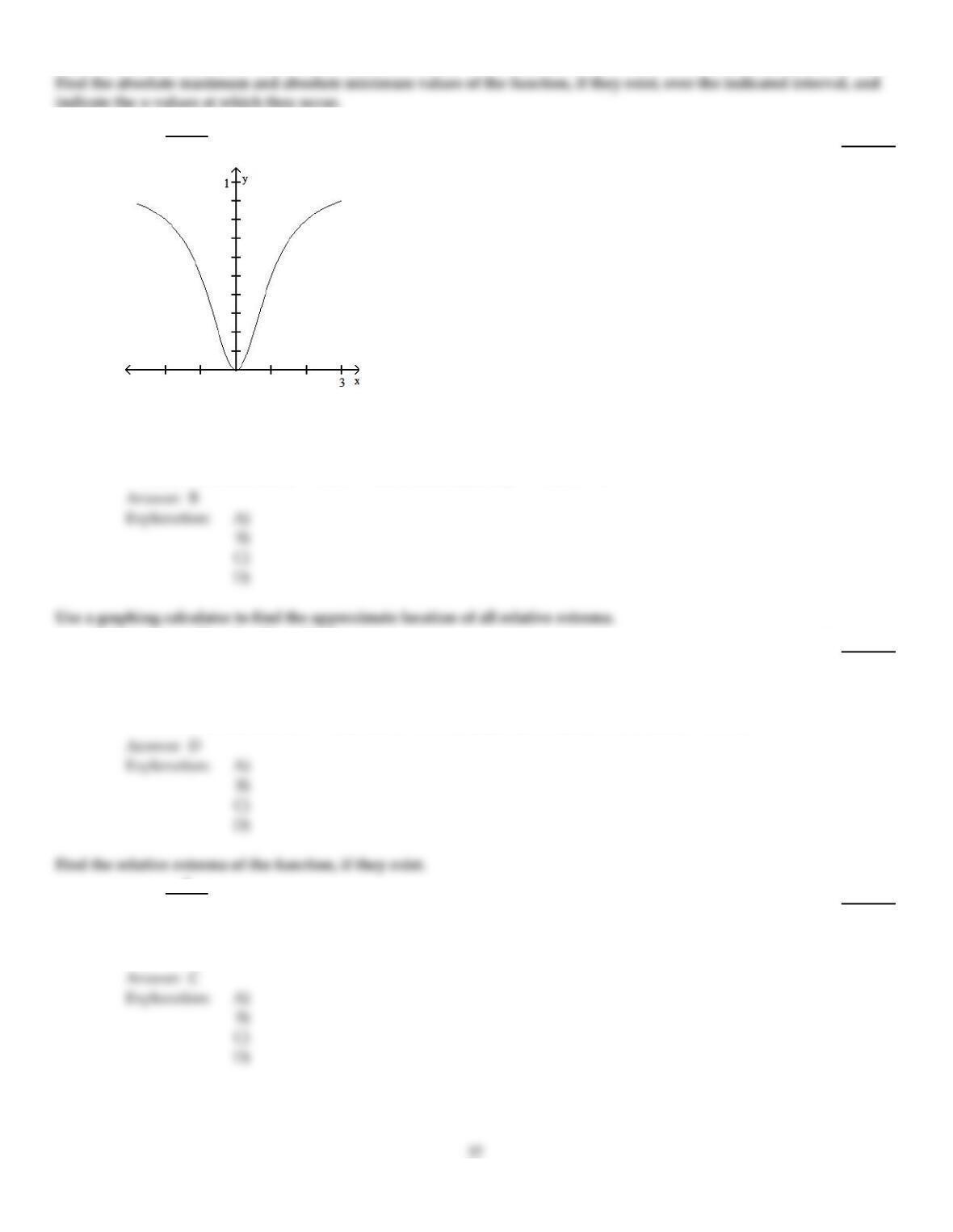
27)
f(x) =2x
x2+ 1; [0, 3]
27)
A)
Absolute maximum = 0 at x = 0; absolute minimum = –0.6 at x = 1
B)
Absolute maximum =0.6 at x = 1; absolute minimum = 0 at x = 0
C)
Absolute maximum =1 at x = 1; absolute minimum = –1 at x = 0
D)
Absolute maximum =1 at x = 1; absolute minimum = 0 at x = 0
Solve the problem.
28)
The stadium vending company finds that sales of hot dogs average 34,000 hot dogs per game when
the hot dogs sell for $2.50 each. For each 50 cent increase in the price, the sales per game drop by
5000 hot dogs. What price per hot dog should the vending company charge to realize the maximum
revenue?
28)
A)
$2.95
B)
$3.40
C)
$0.90
D)
$3.20
Find the relative extrema of the function, if they exist.
29)
f(x) =3x + 1
29)
A)
Relative minimum at (1, 0)
B)
No relative extrema exist
C)
Relative maximum at (–1, 0)
D)
Relative minimum at (–1, 0)
Use a graphing calculator to graph the function.
30)
f(x) =x2+1
x3
30)
A)
B)
18
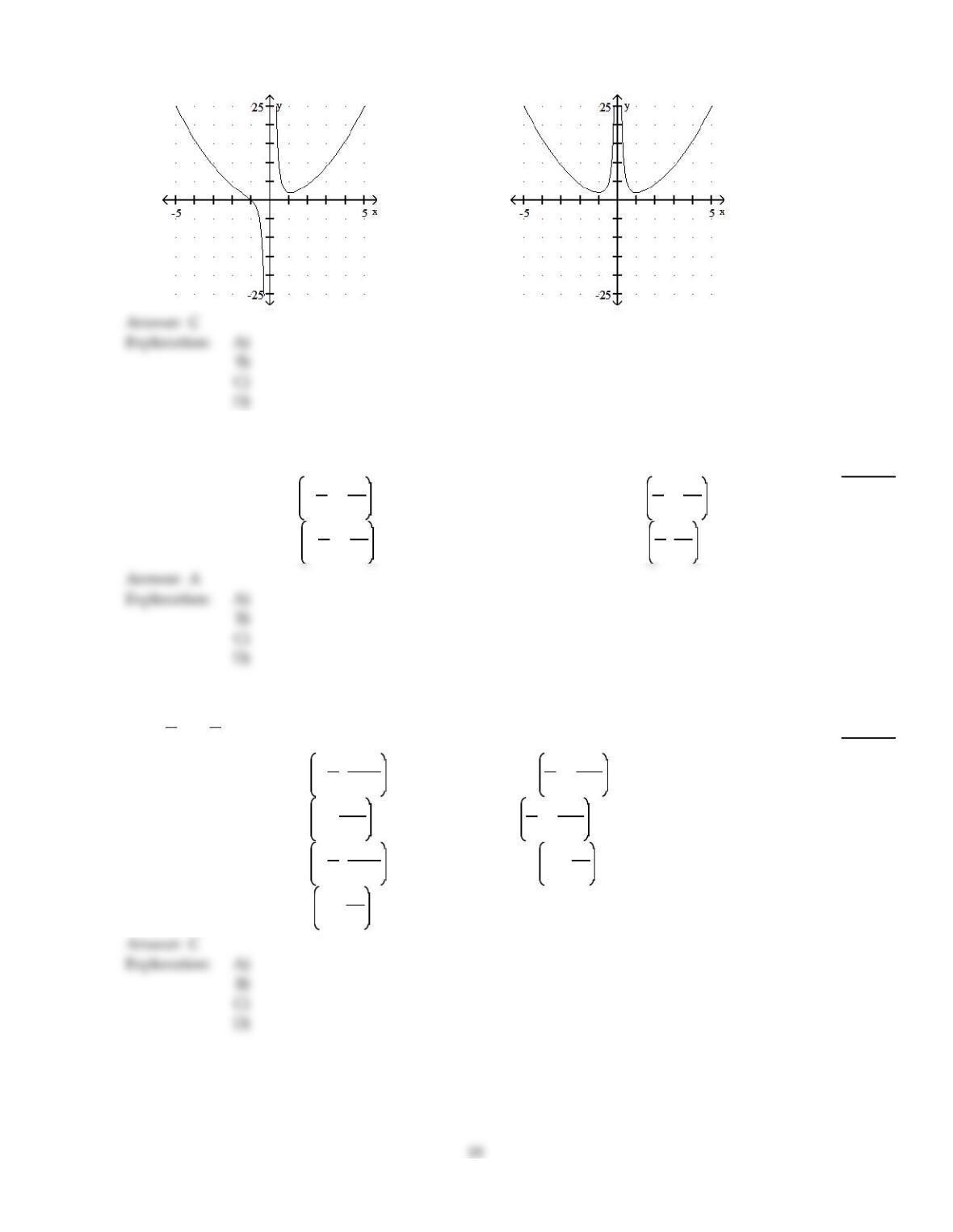
C)
D)
Find the relative extrema of the function and classify each as a maximum or minimum.
31)
f(x) =x2+7x –6
31)
A)
Relative minimum: –7
2, –73
4
B)
Relative minimum: 7
2, –25
4
C)
Relative maximum: –7
2, –73
4
D)
Relative maximum: 7
2, 73
4
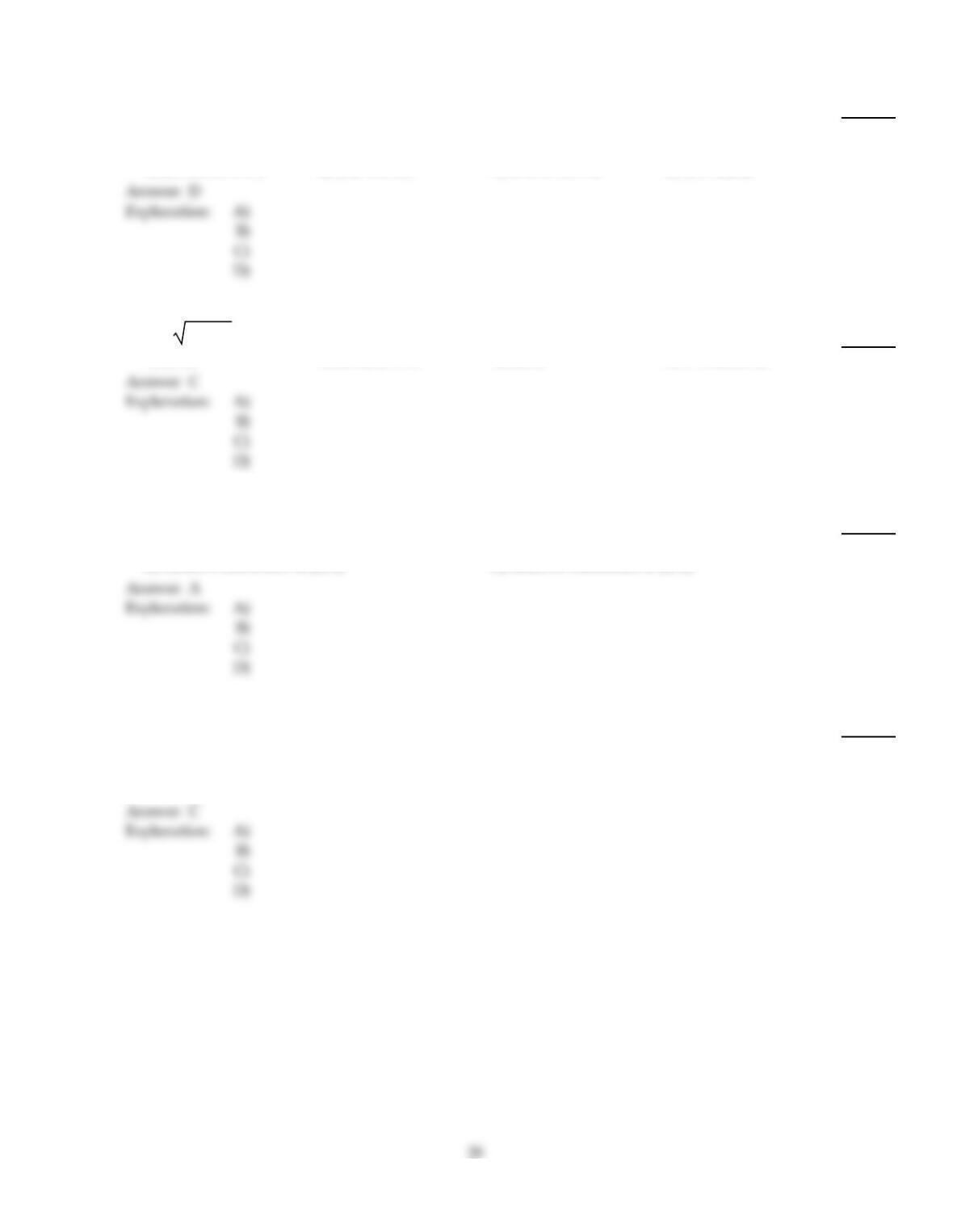
Find the relative extrema of the function, if they exist.
32)
f(x) =2
3x3+1
2x2–21x + 2
32)
A)
Relative maximum at –7
2, 1273
24 ; relative minimum at 7
2, –883
24
B)
Relative maximum at –3, 103
2; relative minimum at 7
2, –883
24
C)
Relative maximum at –7
2, 1273
24 ; relative minimum at 3, –77
2
D)
Relative maximum at 3, –77
2
Solve the problem.
33)
The function R(x) =12,000 –x3+24x2+400x, 0
x
20, represents revenue in thousands of dollars
where x represents the amount spent on advertising in tens of thousands of dollars. Find the
inflection point for the function to determine the point of diminishing returns.
33)
A)
(38.05, 6878.37)
B)
(14, 19,560)
C)
(9.6, 17,167.1)
D)
(8, 16,224)
Find the points of inflection.
34)
f(x) = x 81 –x2
34)
A)
(9, 0)
B)
(0, 0), (81, 0)
C)
(0, 0)
D)
(–9, 0), (9, 0)
Find the relative extrema of the function, if they exist.
35)
f(x) = x2– 8x + 18
35)
A)
Relative minimum at (4, 2)
B)
Relative minimum at (2, 4)
C)
Relative maximum at (4, 2)
D)
Relative maximum at (2, 4)
Solve the problem.
36)
A man flies a kite at a height of 50 m. The wind carries the kite horizontally away from him at a rate
of 7 m/sec. How fast is the distance between the man and the kite changing when the kite is 130 m
away from him?
36)
A)
7.6 m/sec
B)
50.5 m/sec
C)
6.5 m/sec
D)
7 m/sec
37)
Suppose that the daily cost, in dollars, of producing x televisions is
C(x) =0.003x3+0.1x2+68x +620,
and currently 60 televisions are produced daily. Use C(60) and the marginal cost to estimate the
daily cost of increasing production to 63 televisions daily. Round to the nearest dollar.
37)
A)
$5841
B)
$5978
C)
$6051
D)
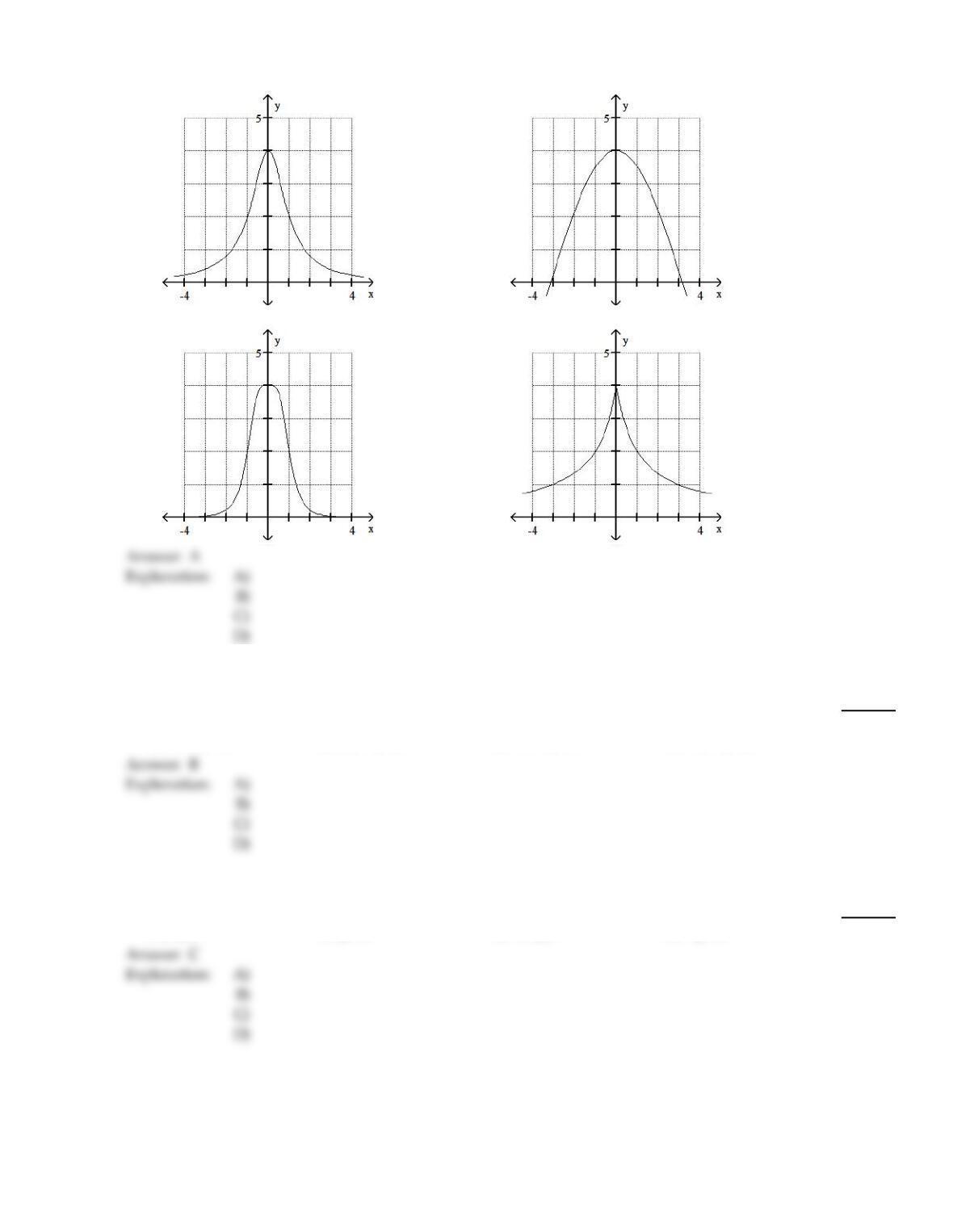
$6045
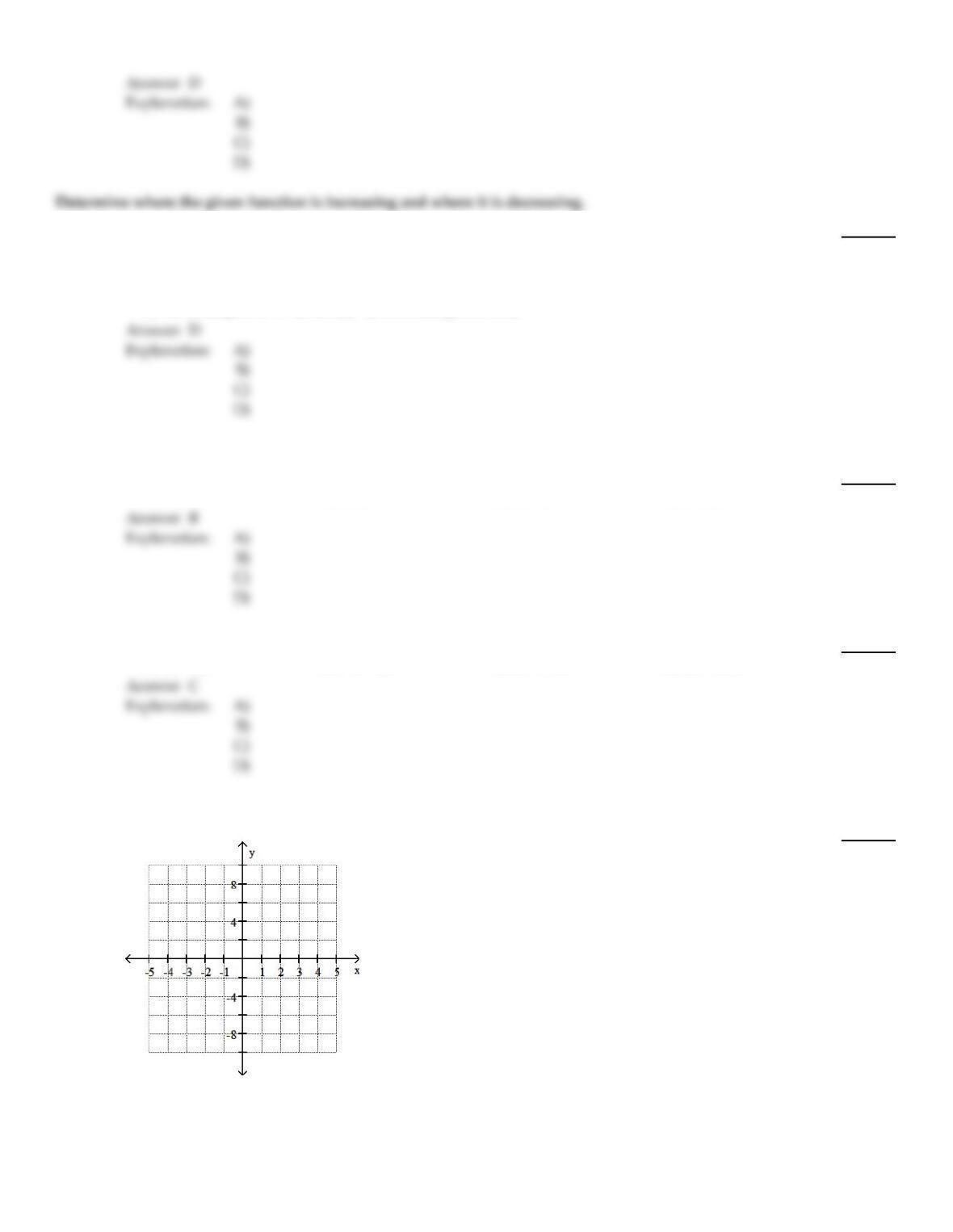
Graph the rational function.
38)
f(x) =6
x2+2
38)
A)
B)
C)
D)
21
39)
f(x) =x3– 12x – 2
39)
A)
Decreasing on ( , –2) and (2, ), increasing on (–2, 2)
B)
Increasing on ( , –4) and (4, ), decreasing on (–4, 4)
C)
Decreasing on ( , –2), increasing on (–2, )
D)
Increasing on ( , –2) and (2, ), decreasing on (–2, 2)
D
Find the points of inflection.
40)
f(x) = –x3+9x +3
40)
A)
(0, 9)
B)
(0, 3)
C)
(3, –3)
D)
(–3, 9)
B
41)
f(x) =x3–12x2+ 2x + 15
41)
A)
(4, –46)
B)
(–4, –48)
C)
(4, –105)
D)
(4, –252)
C
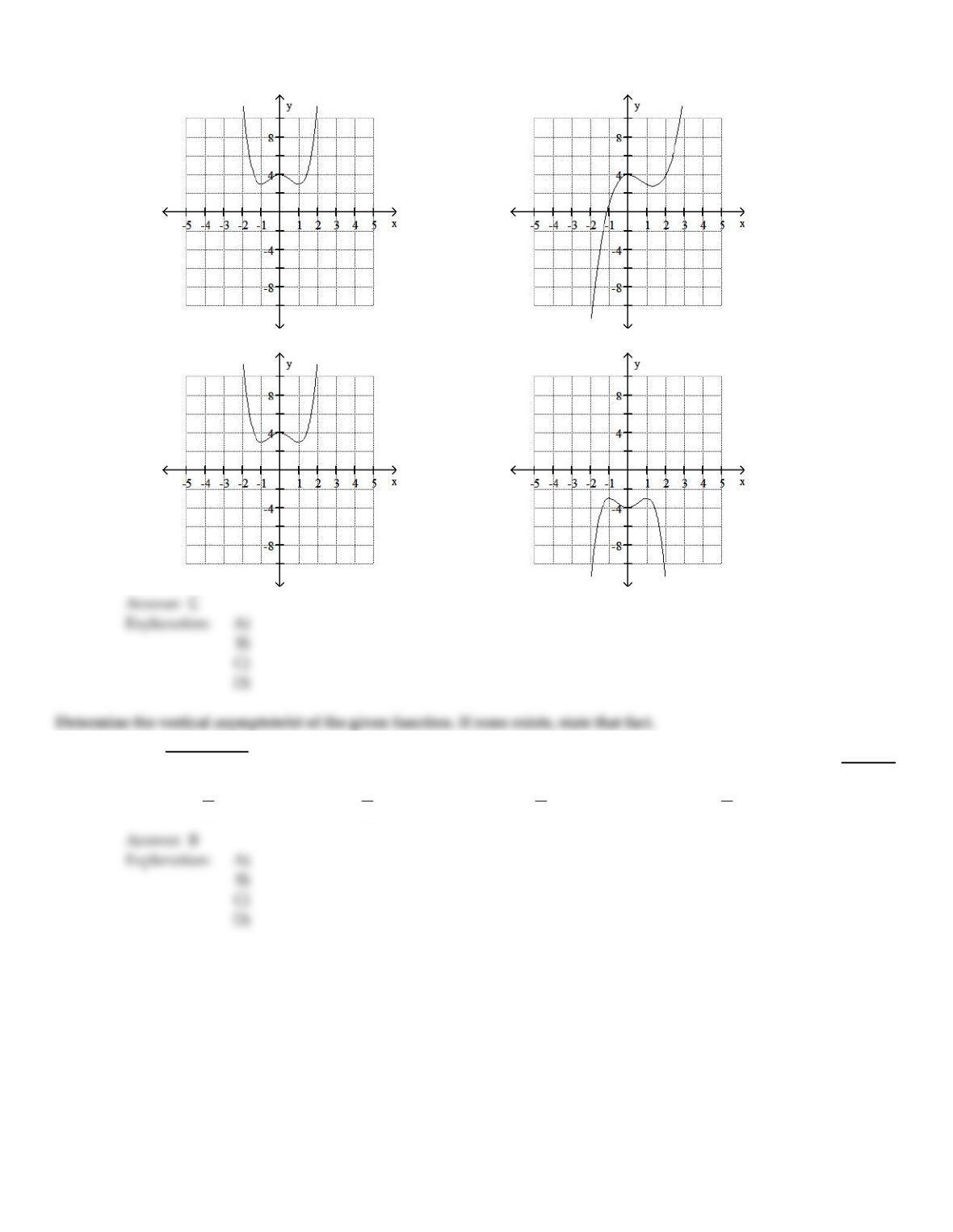
Graph the function by first finding the relative extrema.
42)
h(x) =x4– 2x2+4
42)
22
D
A)
B)
C)
D)
43)
f(x) =–2x(x + 2)
4x2– 3x – 7
43)
A)
x = – 7
4, x = 1
B)
x =7
4, x = –1
C)
x =4
7, x = –1
D)
x = – 4
7, x = 1
23
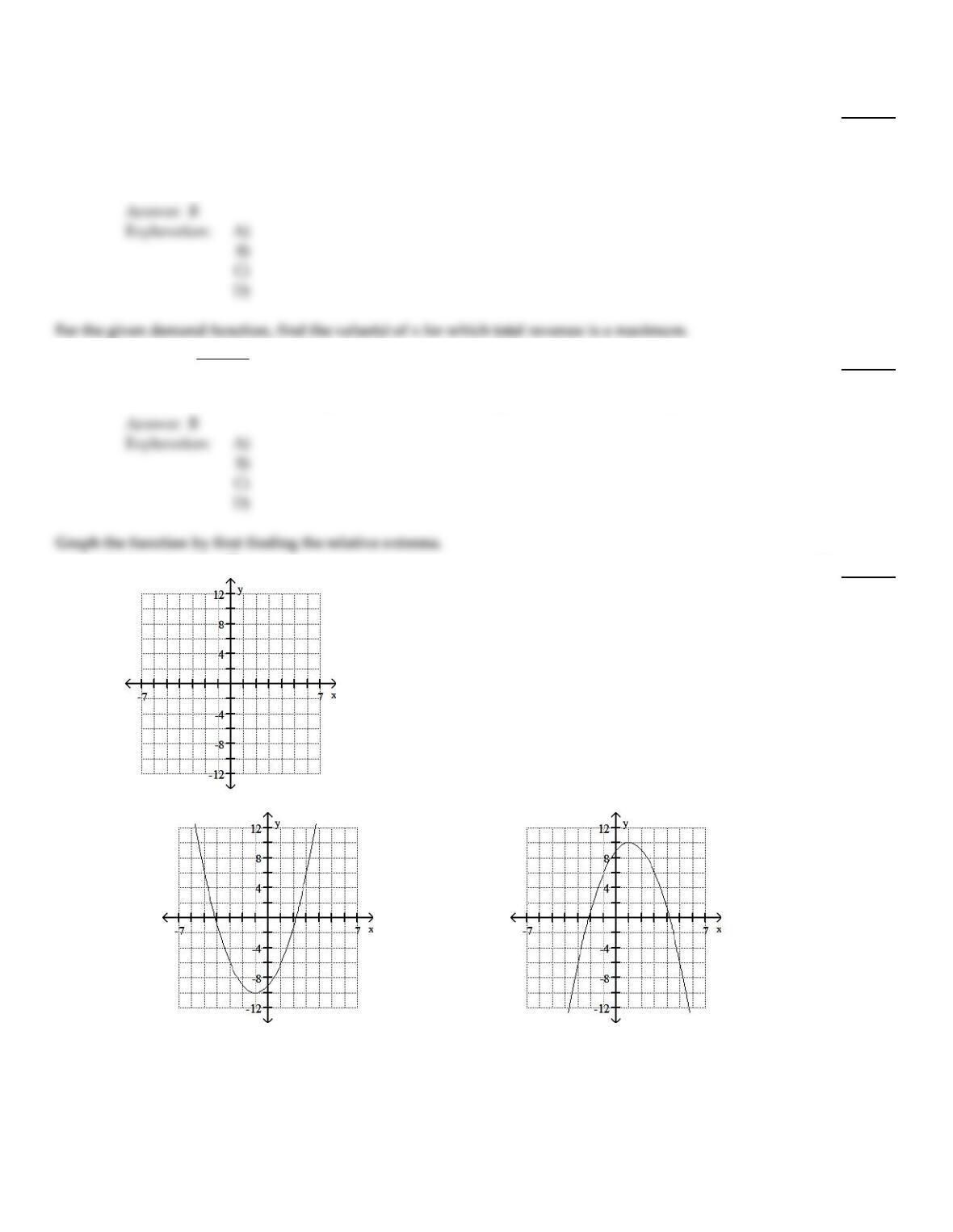
Use a graphing calculator to find the approximate location of all relative extrema.
44)
f(x) = 0.1x3–15x2+ 27x – 82
44)
A)
Relative minimum at x =0.908; relative maximum at x =99.092
B)
Relative maximum at x =0.908; relative minimum at x =99.092
C)
Relative maximum at x = –99.092; relative minimum at x = –0.908
D)
Relative minimum at x = –99.092; relative maximum at x = –0.908
45)
x = D(x) =400
(x +3)2
45)
A)
6
B)
3
C)
400
D)
4
46)
f(x) =9+2x –x2
46)
A)
B)
24
C)
D)
47)
x = D(x) =1000
x
47)
A)
1000
B)
2000
C)
10
D)
All values of x.
Solve the problem.
48)
An electronics store determines the following demand function for phones of a particular type
q = D(x) =3x +320
14x +15 ,
where q = the number of phones sold per day when the price per phone is x dollars. Find the
elasticity.
48)
A)
E(x) =x
42x2+4525x +4800
B)
E(x) =4435x
42x2+4525x +4800
C)
E(x) =4525x
42x2+4480x +4800
D)
E(x) =4435
42x2+4480x +4800
49)
An appliance company determines that in order to sell x dishwashers, the price per dishwasher
must be
p =420–0.3x.
It also determines that the total cost of producing x dishwashers is given by
C(x) =5000 +0.3x2.
How many dishwashers must the company produce and sell in order to maximize profit?
49)
A)
700
B)
400
C)
350
D)
300
Find the points of inflection.
50)
f(x) =7x3+ 2x +7
50)
A)
(0, 2)
B)
(0, 7)
C)
(7, 0)
D)
(2, 0)
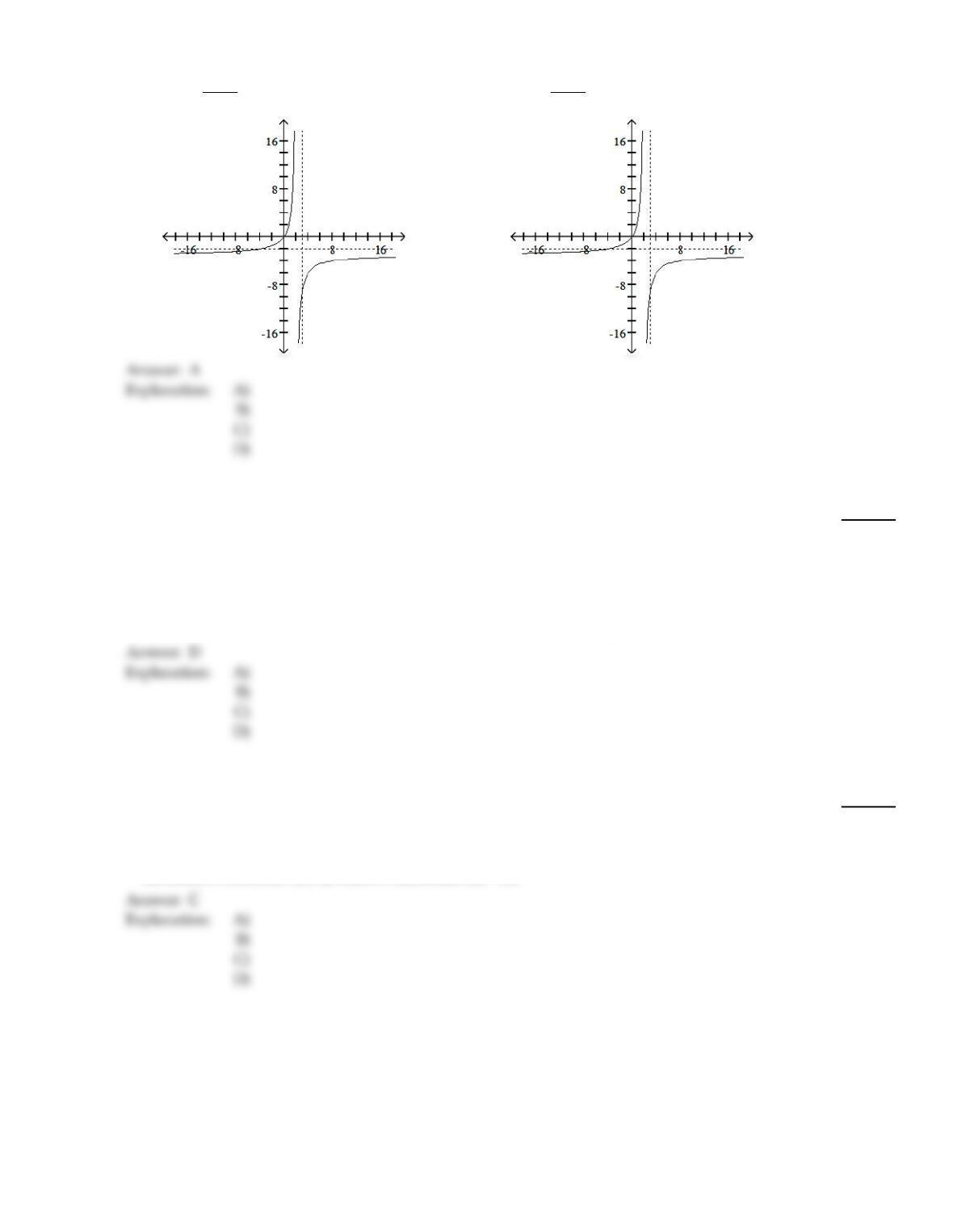
Determine a rational function that meets the given conditions, and sketch its graph.
51)
The function f has a vertical asymptote at x = –3, a horizontal asymptote at y =2, and f(0) = 0.
51)
A)
f(x) =2x
x +3
B)
f(x) =2x
x –3
26
C)
f(x) =–3x
x –2
D)
f(x) =–3x
x +2
Solve the problem.
52)
For the total–revenue function
R(x) =3x,
find R and R'(x) when x =50 and x = 1.
52)
A)
R = $1.50; R'(50) = $1.50
B)
R = $6.00; R'(50) = $3.00
C)
R = $6.00; R'(50) = $6.00
D)
R = $3.00; R'(50) = $3.00
Find the relative extrema of the function and classify each as a maximum or minimum.
53)
f(x) =x3–6x2+5
53)
A)
Relative maximum: (0, 5)
B)
Relative maximum: (–2, 37); relative minimum (2, –11)
C)
Relative maximum: (0, 5); relative minimum (4, –27)
D)
Relative minimum: (0, 5); relative maximum: (4, –11)
27
Determine where the given function is concave up and where it is concave down.
54)
f(x) =x3+12x2– x – 24
54)
A)
Concave up on (–, –4), concave down on (–4, )
B)
Concave up on (–4, ), concave down on (–, –4)
C)
Concave down on (–, –4) and (4, ), concave up on (–4, 4)
D)
Concave down for all x
Find the absolute maximum and absolute minimum values of the function, if they exist, on the indicated interval.
55)
f(x) =2–x2/3; [–64, 64]
55)
A)
Absolute maximum: 2, absolute minimum: –14
B)
There are no absolute extrema.
C)
Absolute maximum: 2
D)
Absolute maximum: 64, absolute minimum: –64
A
Determine the horizontal asymptote of the given function. If none exists, state that fact.
56)
f(x) =25x4+x2–5
x – x3
56)
A)
y = 0
B)
y = –1, y = 1
C)
no horizontal asymptotes
D)
y = –25
C
Graph the rational function.
57)
f(x) =x –2
x2–4
57)
28
B
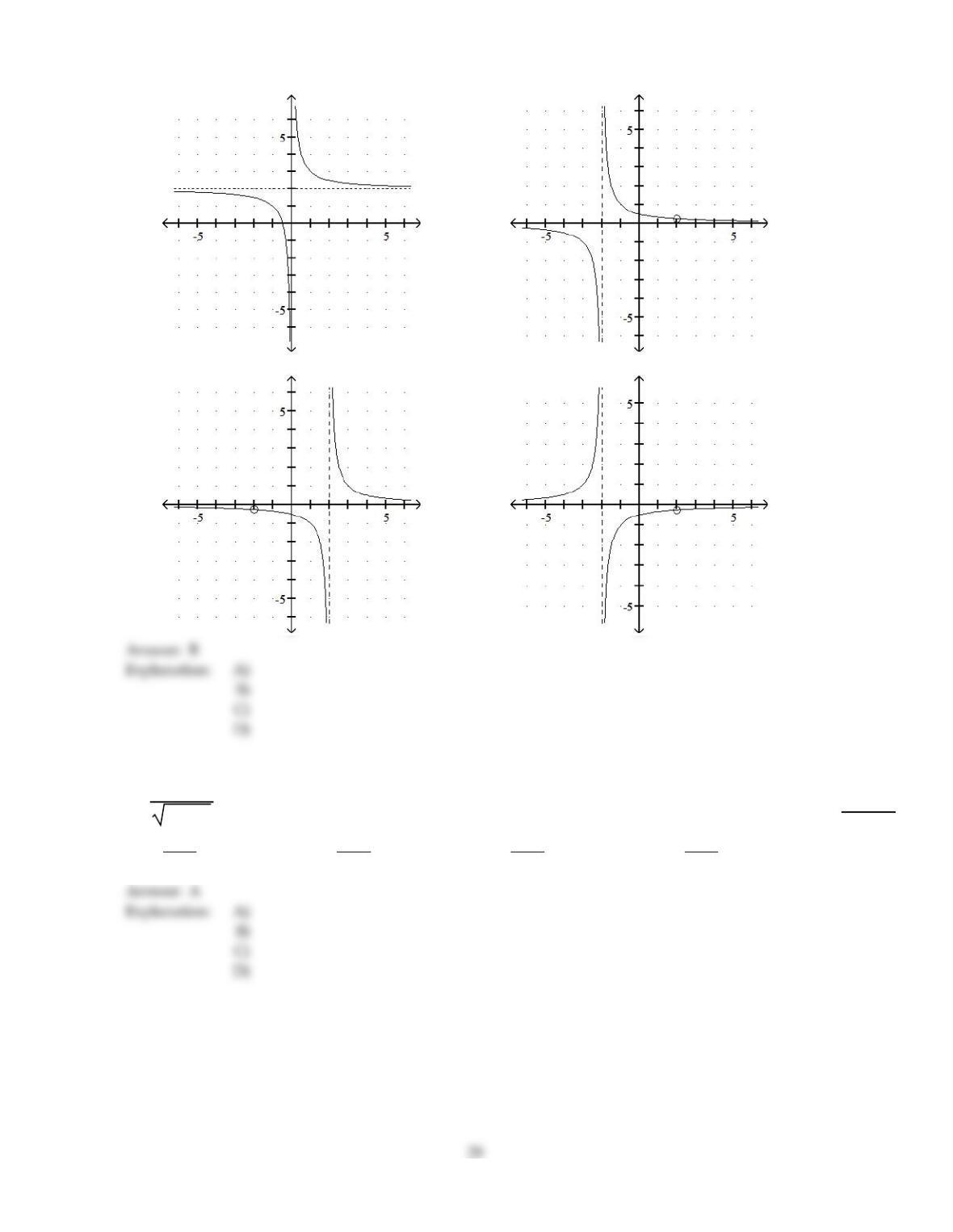
A)
B)
C)
D)
Find dy for the given values of x and dx.
58)
y =x2
x2+ 21; x = 10, dx = 0.1
58)
A)
142
1331
B)
148
1331
C)
144
1331
D)
146
1331
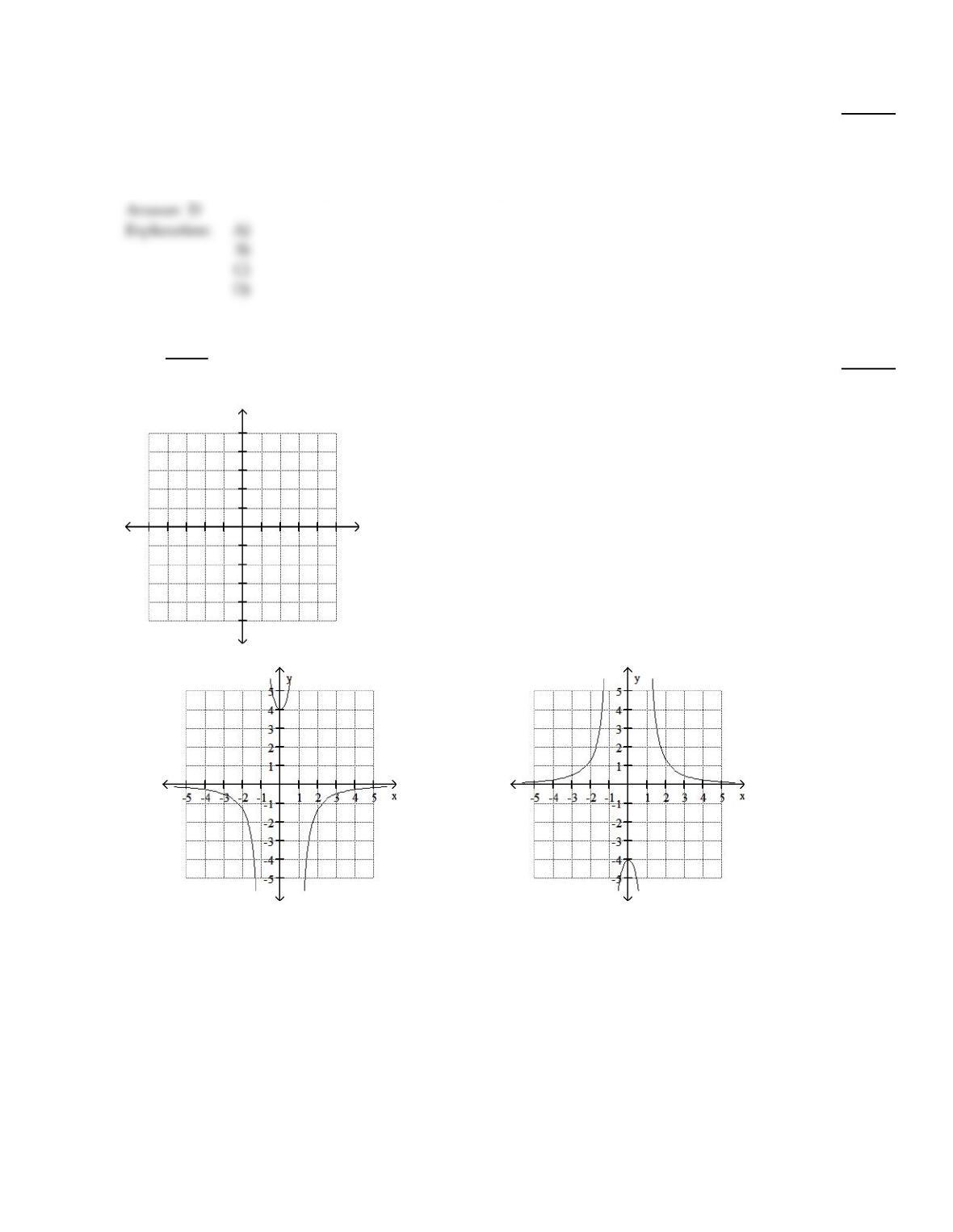
Solve the problem.
59)
A company estimates that the daily cost (in dollars) of producing x chocolate bars is given by
C(x) =1035 + 0.03x + 0.0003x2.
Currently, the company produces 510 chocolate bars per day. Use marginal cost to estimate the
increase in the daily cost if one additional chocolate bar is produced per day.
59)
A)
$54.00
B)
$0.54
C)
$33.60
D)
$0.34
Graph the rational function.
60)
f(x) =–4
x2+ 1
60)
A)
B)
30
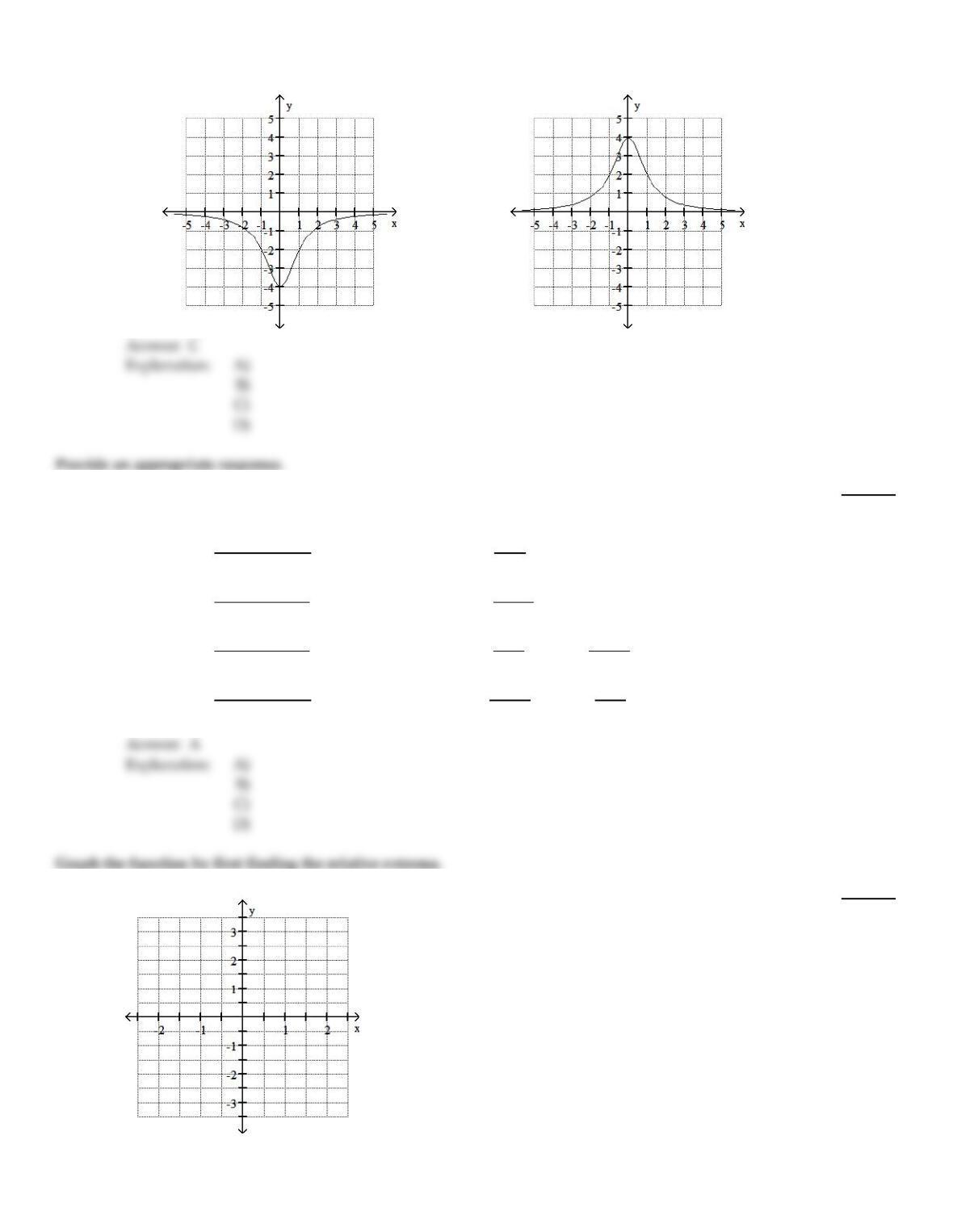
C)
D)
61)
Given that A(x) = C(x)/x , where A(x) is the average–cost function and C(x) is the total–cost
function, find an expression for A(x) and solve the equation A(x) = 0 to find the minimum average
cost.
61)
A)
A(x) =xC (x) – C(x)
x2= 0
xC(x) – C(x) = 0 C(x)
x=A(x) =C(x)
B)
A(x) =xC(x) –C(x)
x2= 0
xC(x) –C(x) = 0 C(x)
x=A(x) = C(x)
C)
A(x) =xC(x) –C(x)
x2= 0
xC(x) –C(x) = 0 C(x)
x=A(x) =C(x)
x2
D)
A(x) =xC (x) – C(x)
x2= 0
xC(x) –C(x) = 0 C(x)
x=A(x) =C(x)
x2
62)
f(x) =x3–1
62)
31
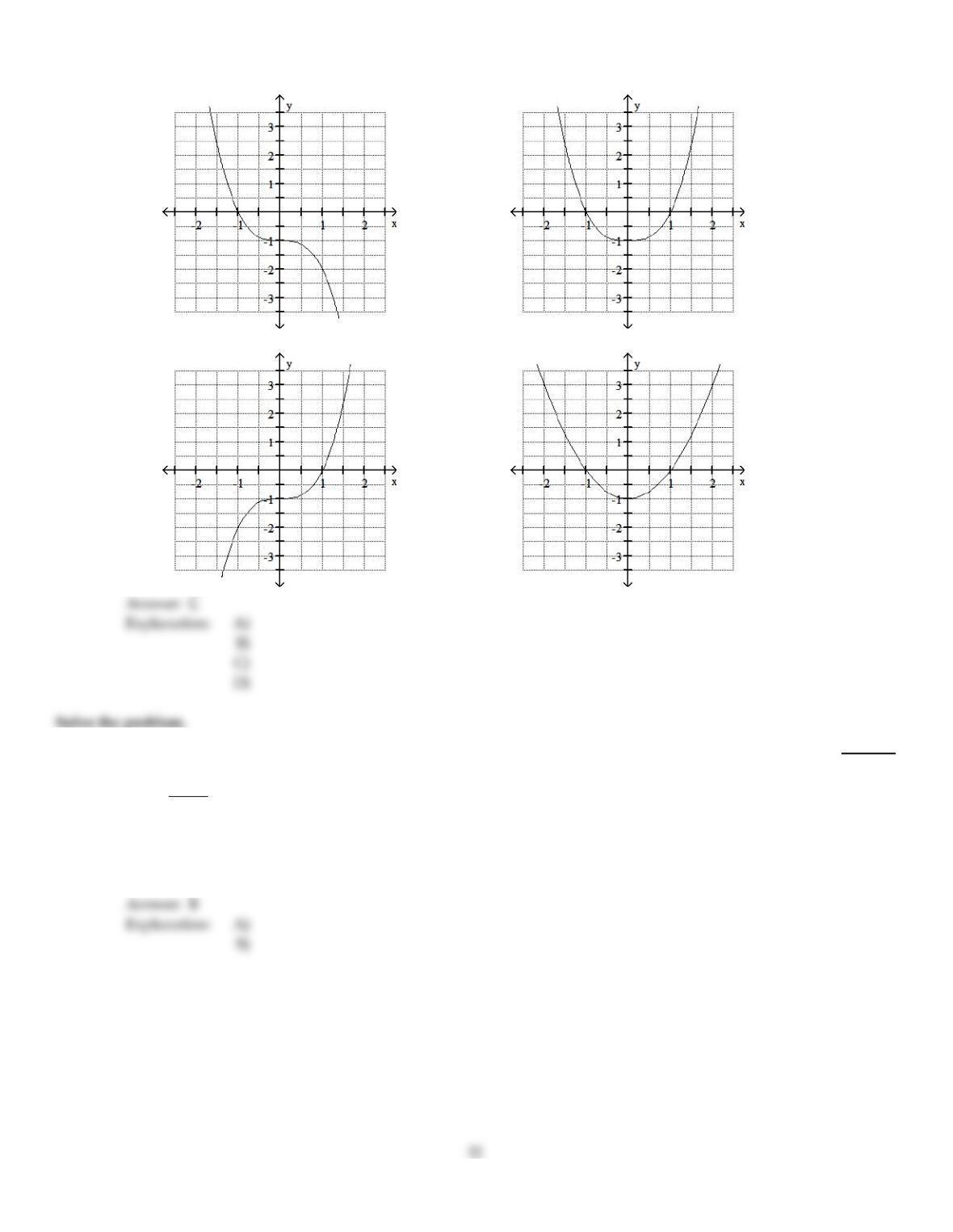
A)
B)
C)
D)
63)
After an injection, the amount of a medication A in the bloodstream decreases with time t, in hours.
Suppose that under certain conditions A is given by
A(t) =Ao
t2+ 1,
where Ao is the initial amount of the medication given. Assume that an initial amount of 20.0 cc is
injected. According to this function, does the medication ever completely leave the bloodstream?
63)
A)
Yes
B)
No
64)
An outdoor sports company sells 896 kayaks per year. It costs $14 to store one kayak for a year.
Each reorder costs $8, plus an additional $6 for each kayak ordered. In what lot size should the
store order kayaks in order to minimize inventory costs?
64)
A)
30
B)
36
C)
32
D)
34
65)
9p2+ x2=1500
65)
A)
dp
dx =–9p
x
B)
dp
dx =–p
9x
C)
dp
dx =–9x
p
D)
dp
dx =– x
9p
66)
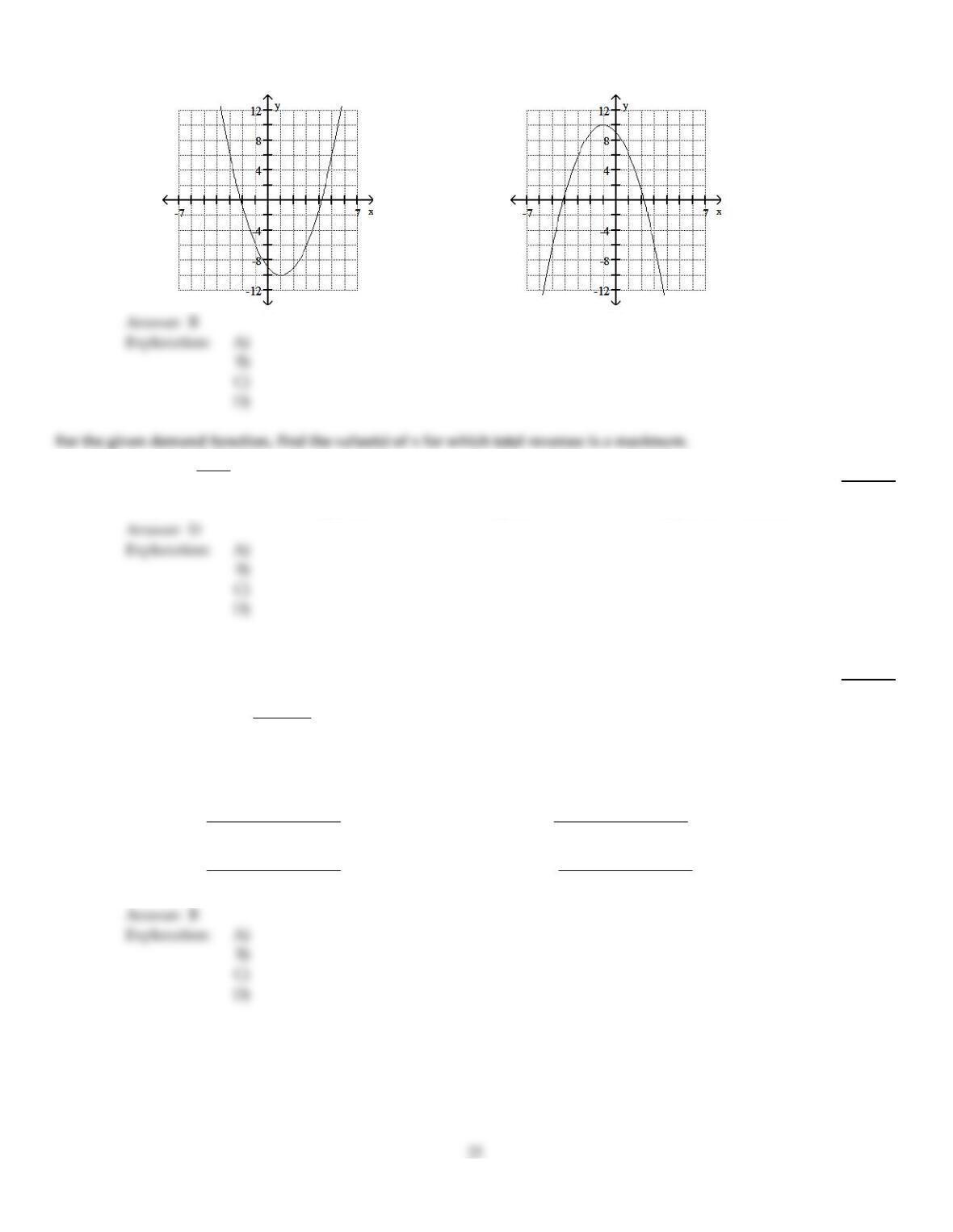
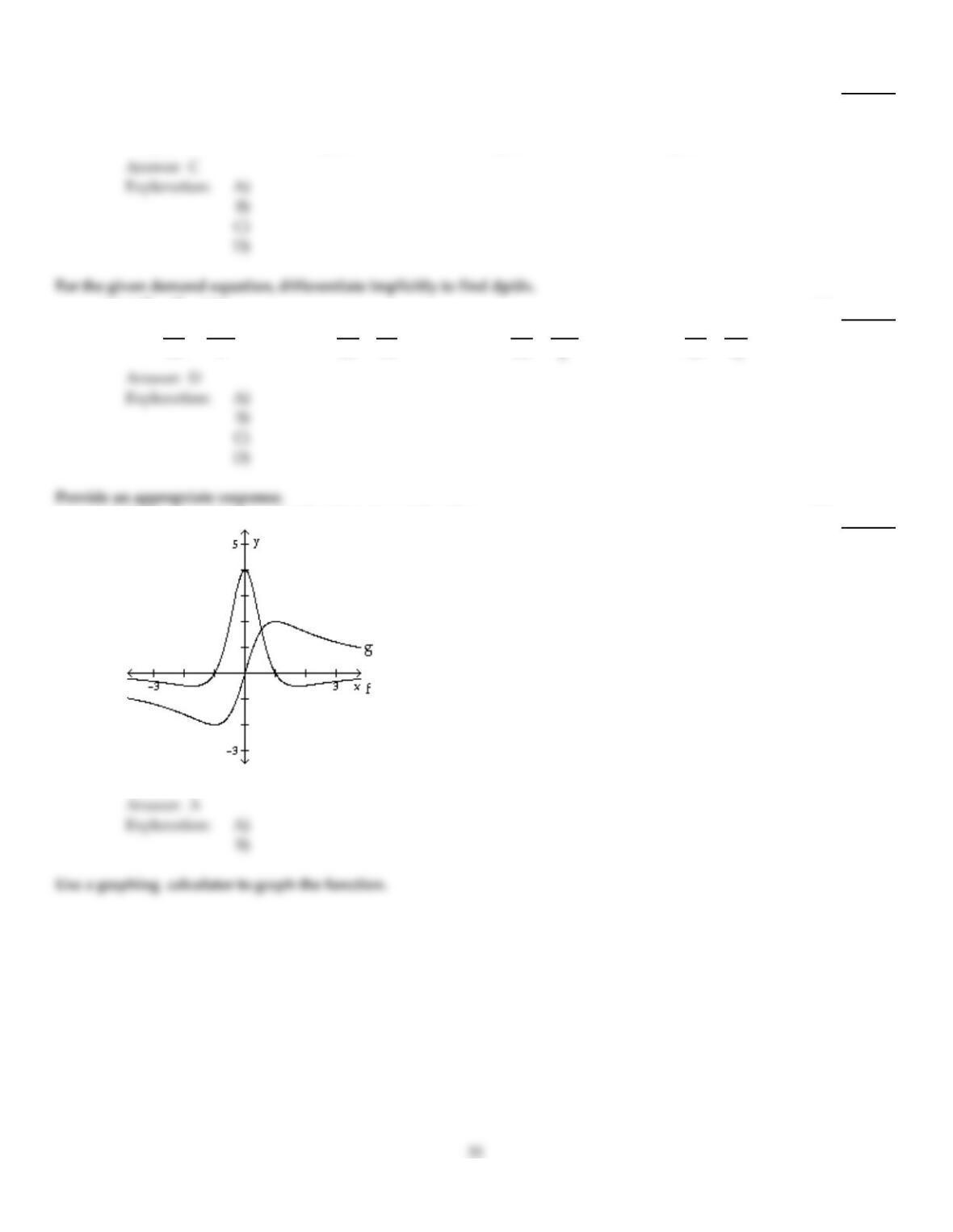
Determine which graph is the derivative of the other.
66)
A)
f’ = g
B)
g’ = f
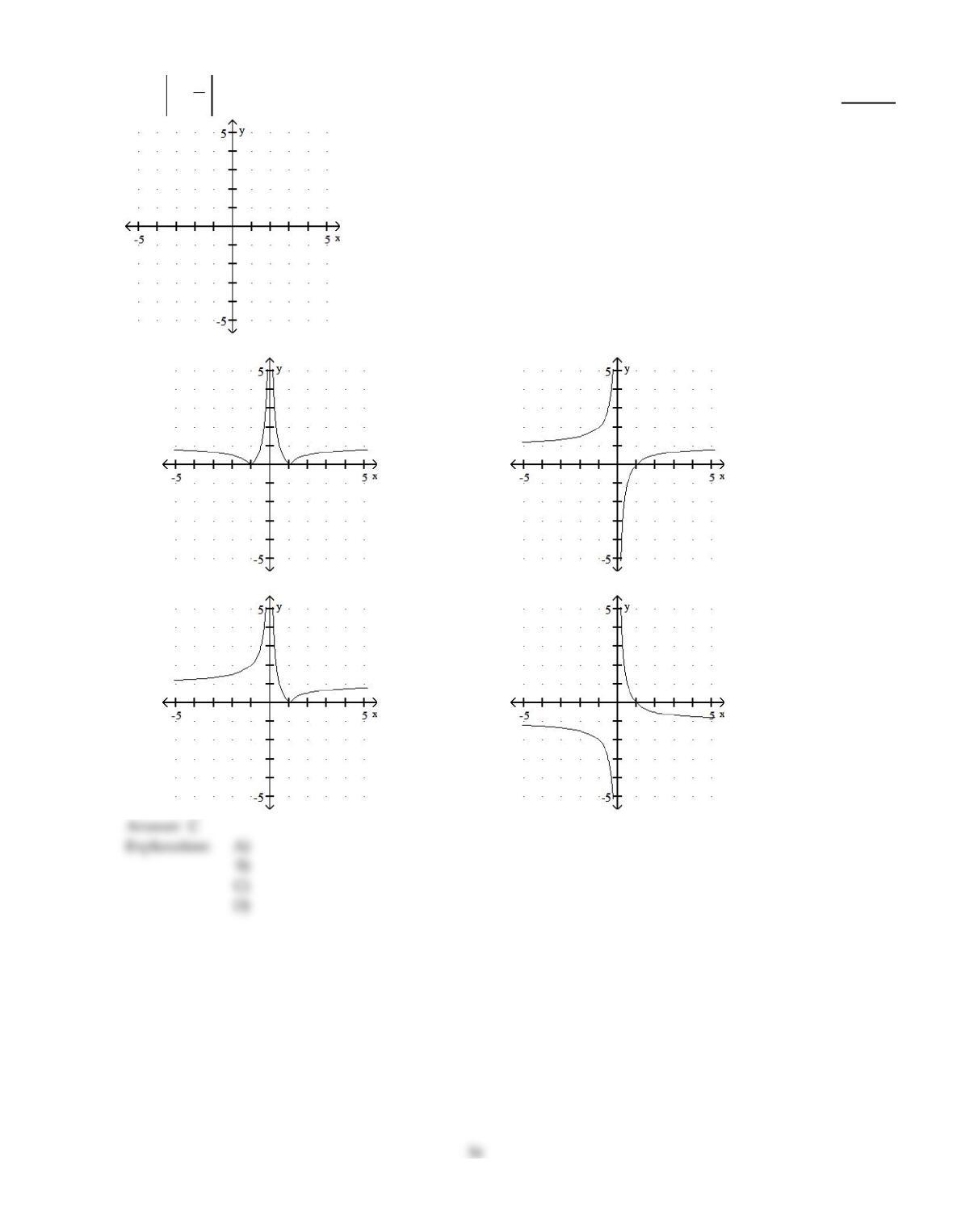
67)
f(x) =1 –1
x
67)
A)
B)
C)
D)
Solve the problem.
68)
A zoom lens in a camera makes a rectangular image on the film that is 9 cm length by 8 cm width.
As the lens zooms in and out, the size of the image changes. Find the rate at which the area of the
image begins to change (dA/df) if the length of the frame changes at 0.8 cm/sec and the width of the
frame changes at 0.4 cm/sec.
68)
A)
9
8 cm2/sec
B)
10.4 cm2/sec
C)
1.25 cm2/sec
D)
10 cm2/sec
69)
f(x) = –x3–x2+ 5x –9; (0, )
69)
A)
Absolute maximum: –6; no absolute minimum
B)
Absolute maximum: –9; absolute minimum: –14
C)
No absolute maximum; absolute minimum: –14
D)
No absolute extrema
A
Solve the problem.
70)
Assume that the temperature of a person during an illness is given by
T(t) = –0.1t2+1.4t + 98.6, 0
t 14,
where T = the temperature (°F) at time t, in days. Find the relative extrema of the function.
70)
A)
relative minimum at (7, 102.5)
B)
relative maximum at (7, 104.5)
C)
relative minimum at (7, 103.5)
D)
relative maximum at (7, 103.5)
D
Find the points of inflection.
71)
f(x) =4
3x3– 12x2+ 10x +45
71)
A)
(3, –26)
B)
(0, 3)
C)
(3, 3)
D)
(3, 0)
C
D
72)
If q = D(x) =k
xn and n < 1, revenue is decreasing for all values of x.
72)
A)
True
B)
False
B
73)
f(x) =6x – 3; [–3, 3]
73)
A)
Absolute maximum: –3, absolute minimum: 3
B)
Absolute maximum: 18, absolute minimum: –18
C)
There are no absolute extrema.
D)
Absolute maximum: 15, absolute minimum: –21
D
74)
h(x) =5x4– 7x2– 6
3x5– 5x + 2
74)
A)
y =5
3
B)
y =7
5
C)
y = 0
D)
no horizontal asymptotes
C
75)
f(x) =x2
x2+ 1; [–3, 1]
75)
A)
Absolute maximum =0.5 at x = –3; absolute minimum = 0 at x = 0
B)
Absolute maximum = 0.9 at x = –3; absolute minimum = 0 at x = 0
C)
Absolute maximum = 0.9 at x = 2; absolute minimum = –3 at x = 0
D)
Absolute maximum =1 at x = –3; absolute minimum = –3 at x = 2
76)
f(x) = 0.01x5–x4+x3+ 8x2– 7x + 61
76)
A)
Relative maxima at x = –1.861 and x = 2.247; relative minimum at x = 0.423
B)
Relative maxima at x = –1.841 and x =2.304; relative minima at x =0.363 and x =79.172
C)
Relative maxima at x = –1.927 and x =2.267; relative minima at x =0.514 and x =79.212
D)
Relative maxima at x = –1.861 and x = 2.247; relative minima at x = 0.423 and x = 79.192
77)
f(x) =4
x2– 1
77)
A)
Relative maximum at (0, 4)
B)
No relative extrema exist
C)
Relative maximum at (0, –4)
D)
Relative minimum at (0, –4)
78)
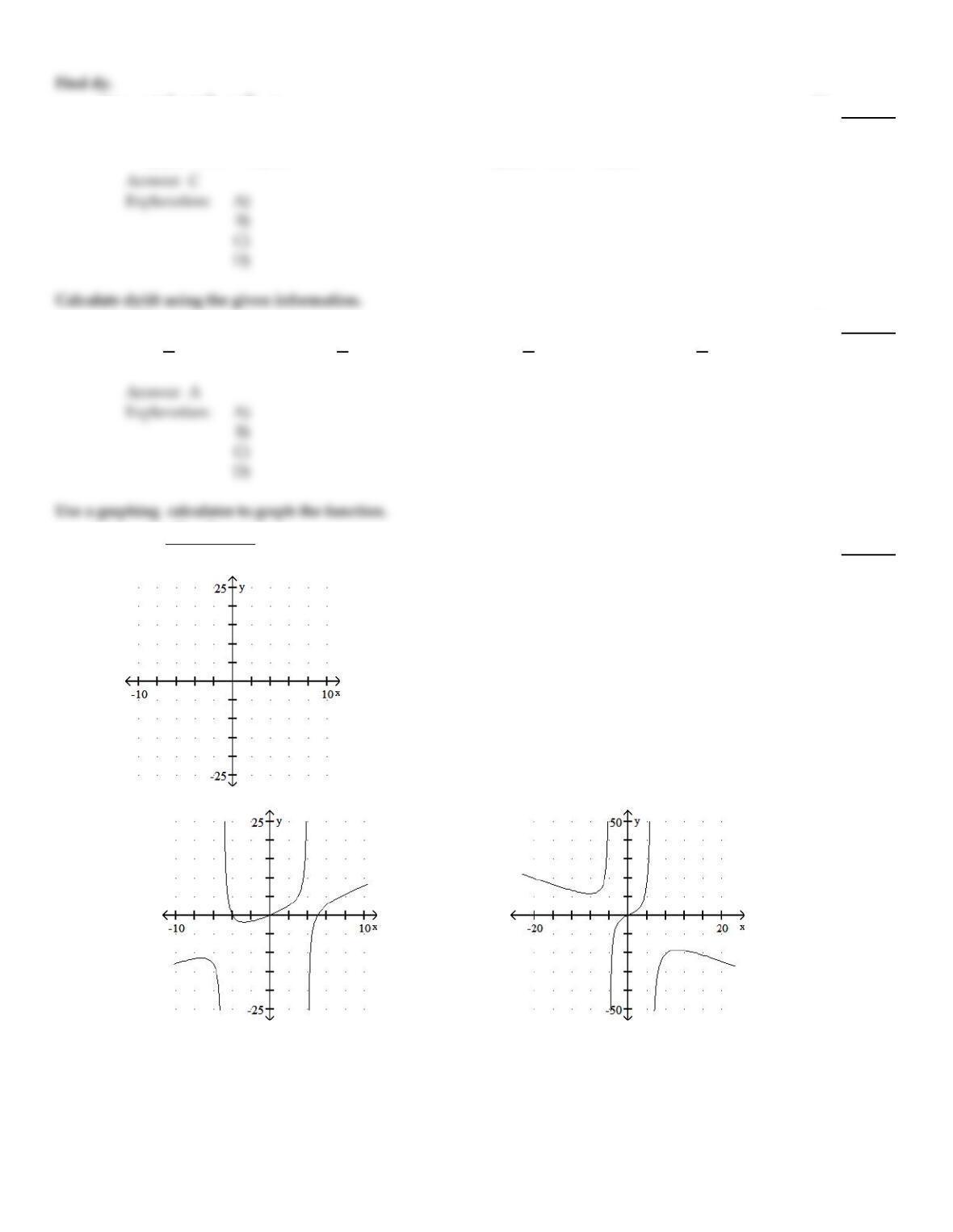
y = 2x4+2x3–4x2+ 3
78)
A)
(2x3+2x2–4x) dx
B)
(8x3+6x2– 2x) dx
C)
(8x3+6x2–8x) dx
D)
(4x3+ 3x2–8x) dx
79)
xy2= 4; dx/dt = –5, x = 4, y = 1
79)
A)
5
8
B)
8
5
C)
–8
5
D)
–5
8
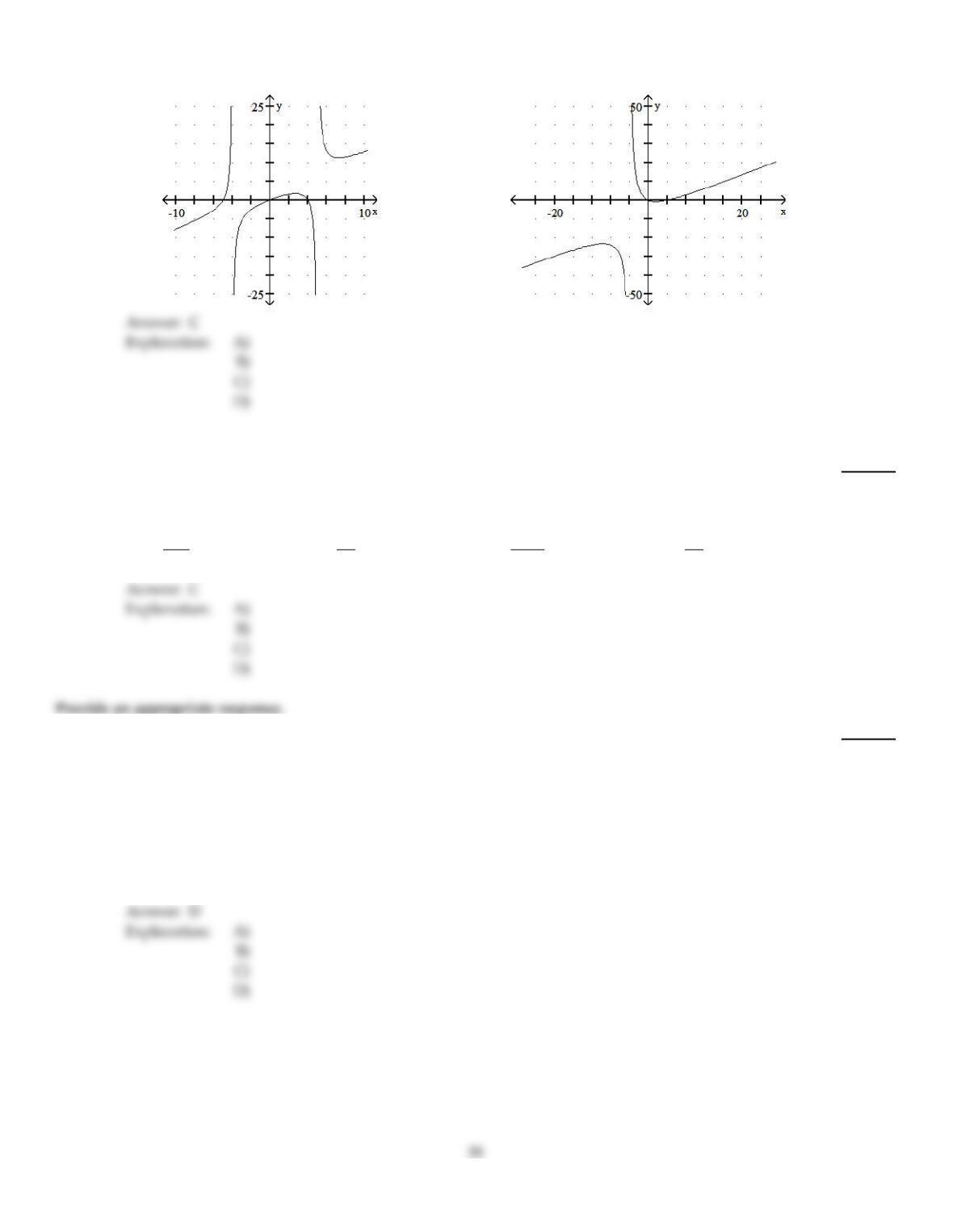
80)
f(x) =x3+x2–20x
x2– x –20
80)
A)
B)
38
C)
D)
Solve the problem.
81)
Electrical systems are governed by Ohm’s law, which states the
V = IR, where V = voltage, I = current, and R = resistance. If the current in an electrical system is
decreasing at a rate of 5 A/s while the voltage remains constant at 26 V, at what rate is the resistance
increasing when the current is 48 A?
81)
A)
325
24 ohms/s
B)
65
24 ohms/s
C)
65
1152 ohms/s
D)
24
65 ohms/s
82)
When is it advantageous to use implicit differentiation to find an expression for dy/dx?
82)
A)
When the relationship between x and y is not given in the implicit form f(x,y) = 0, and it is
difficult to put the equation in this form.
B)
When the relationship between x and y can be expressed in the implicit form y = f(x), and it is
difficult to express it any other way.
C)
When the relationship between x and y can be expressed in the explicit form y = f(x), and it is
difficult to express it any other way.
D)
When the relationship between x and y is not given in the explicit form y = f(x), and it is
difficult to put the equation in this form.
83)
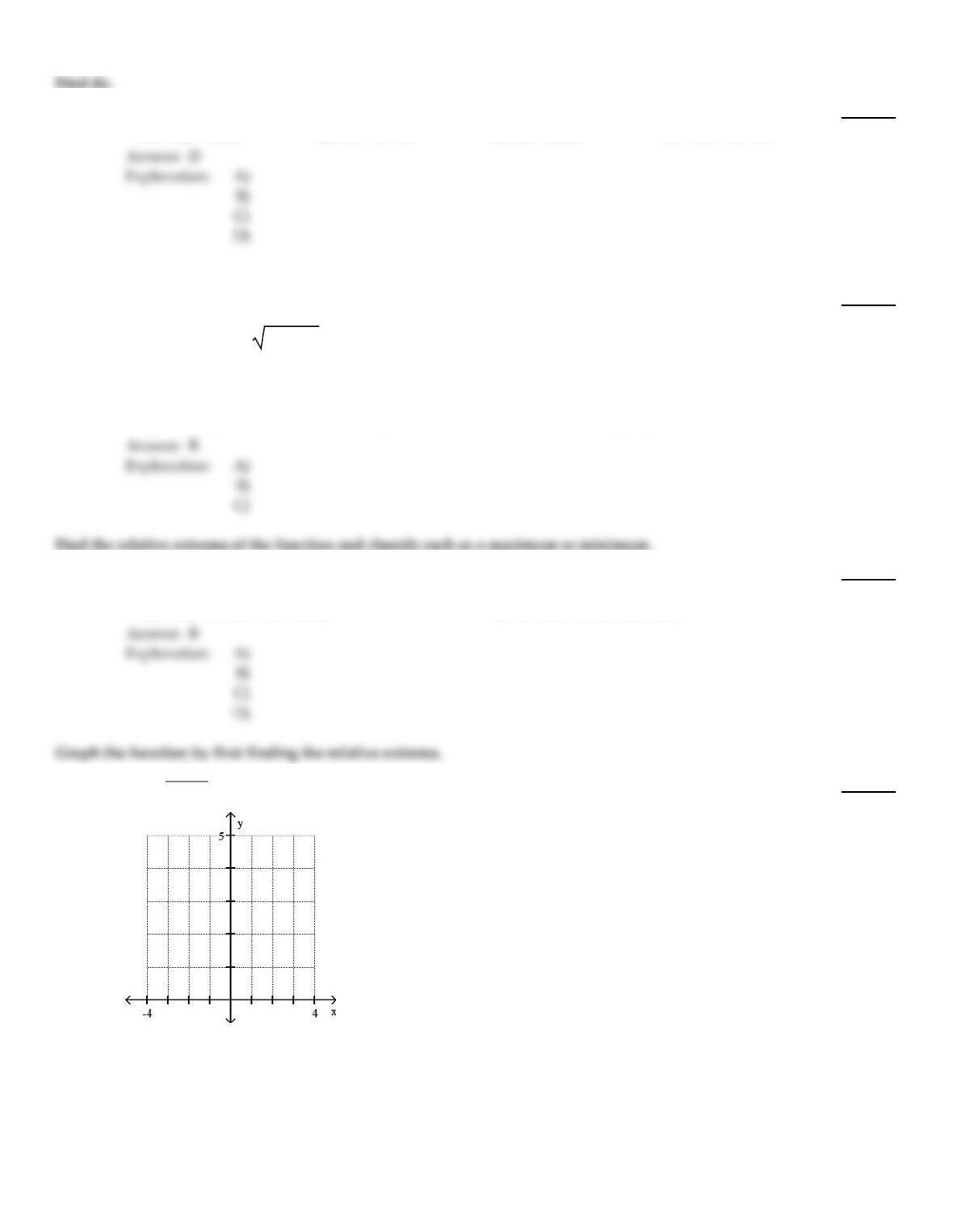
y =(4 – x)5
83)
A)
–5(4 – x) dx
B)
5(4 – x)4 dx
C)
5(4 – x) dx
D)
–5(4 – x)4 dx
Solve the problem.
84)
A CD store determines the following demand function for a particular CD
q = D(x) =490–x2,
where q = the number of CDs sold per day when the price per CD is x dollars. At a price of $9 per
CD will a small increase in price cause the total revenue to increase, decrease, or stay the same?
84)
A)
Decrease
B)
Increase
C)
Stay the same
85)
f(x) =(x + 4)4
85)
A)
Relative maximum: (–4, 0)
B)
Relative minimum: (–4, 0)
C)
Relative maximum: (4, 0)
D)
No relative extrema exist
86)
f(x) =4
x2+ 1
86)
40
A)
B)
C)
D)
Solve the problem.
87)
A spherical balloon is inflated with helium at a rate of 110 ft3/min. How fast is the balloon’s
radius increasing when the radius is 3 ft?
87)
A)
4.58 ft/min
B)
3.06 ft/min
C)
9.17 ft/min
D)
1.02 ft/min
Find dy/dx by implicit differentiation.
88)
x4/3 + y4/3 = 1
88)
A)
(x/y)1/3
B)
(y/x)1/3
C)
–(x/y)1/3
D)
–(y/x)1/3
41
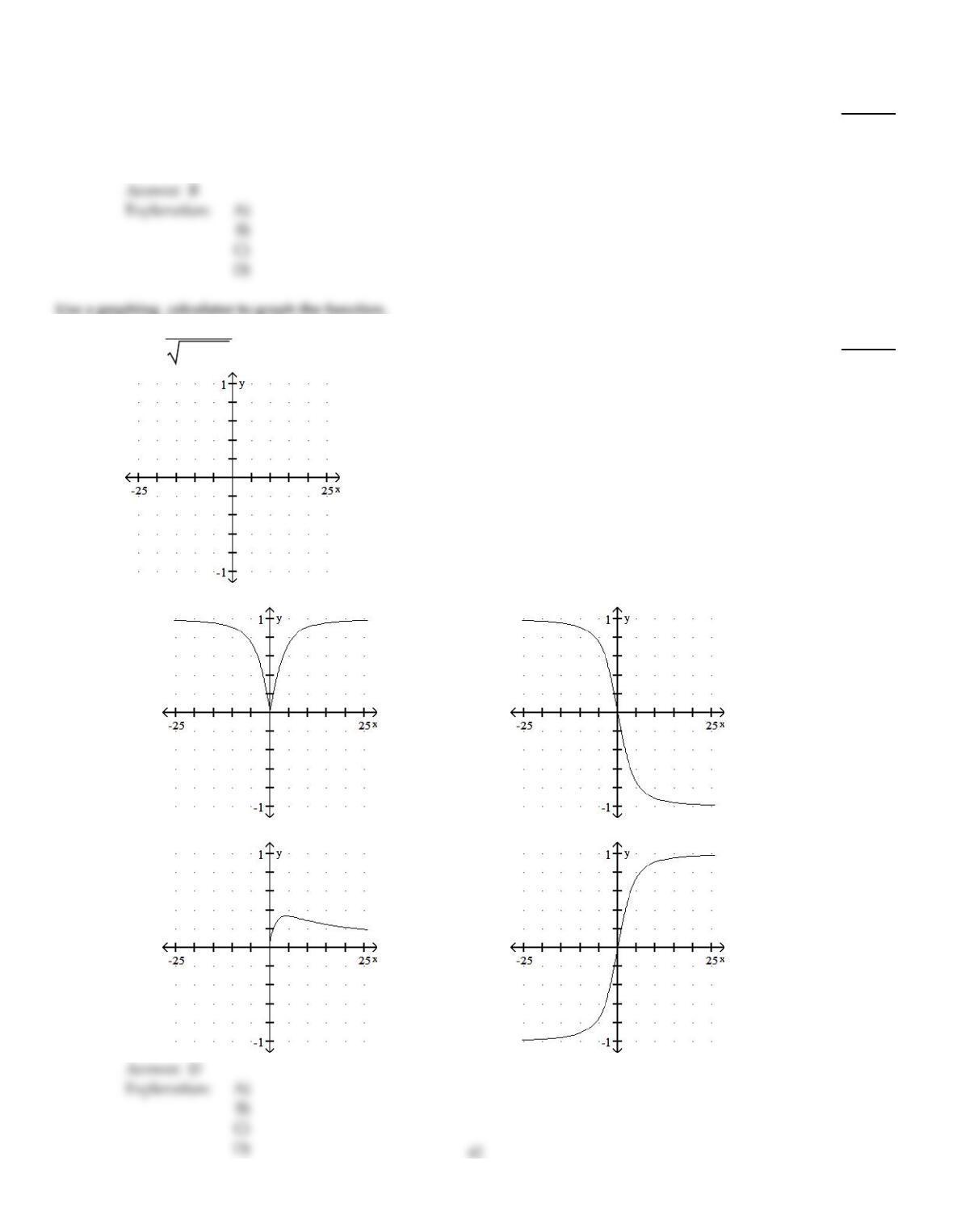
Solve the problem.
89)
A storage tank used to hold sand is leaking. The sand forms a conical pile whose height is twice the
radius of the base. The radius of the pile increases at the rate of 3 inches per minute. Find the rate of
change of volume when the radius is 4 inches.
89)
A)
192 in.3/min
B)
96 in.3/min
C)
24 in.3/min
D)
48 in.3/min
90)
f(x) =x
x2+20
90)
A)
B)
C)
D)
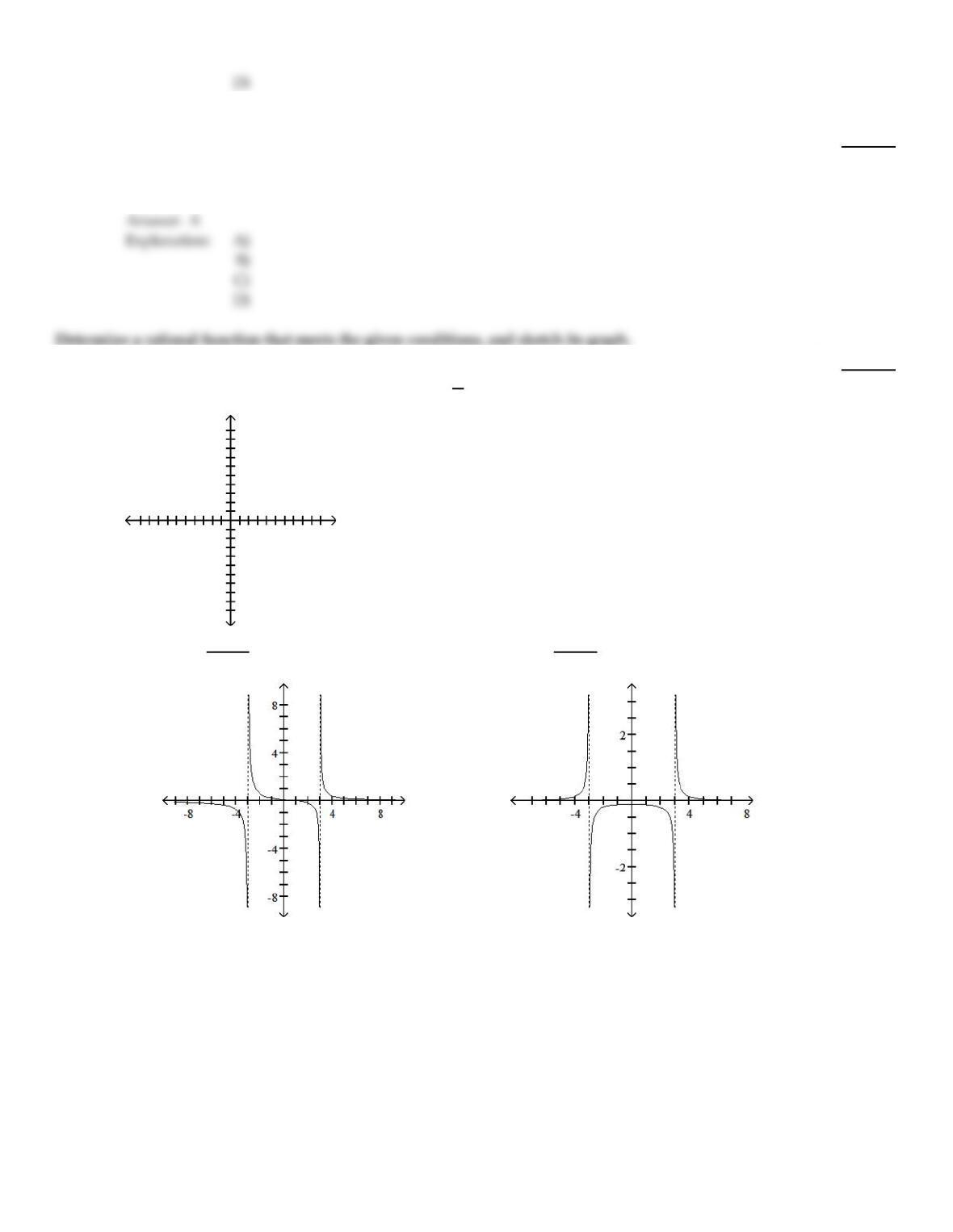
Solve the problem.
91)
A bookstore has an annual demand for 28,000 copies of a best–selling book. It costs $0.50 to store
one copy for one year, and it costs $65 to place an order. Find the optimum number of copies per
order.
91)
A)
2698 copies
B)
2428 copies
C)
3257 copies
D)
3816 copies
92)
The function g has vertical asymptotes at x = –3 and x =3, a horizontal asymptote at
y = 1, x–intercepts at x = –1 and x = 1, and g(0) =1
9.
92)
A)
g(x) =x – 1
x2–9
B)
g(x) = 1
x2–9
43
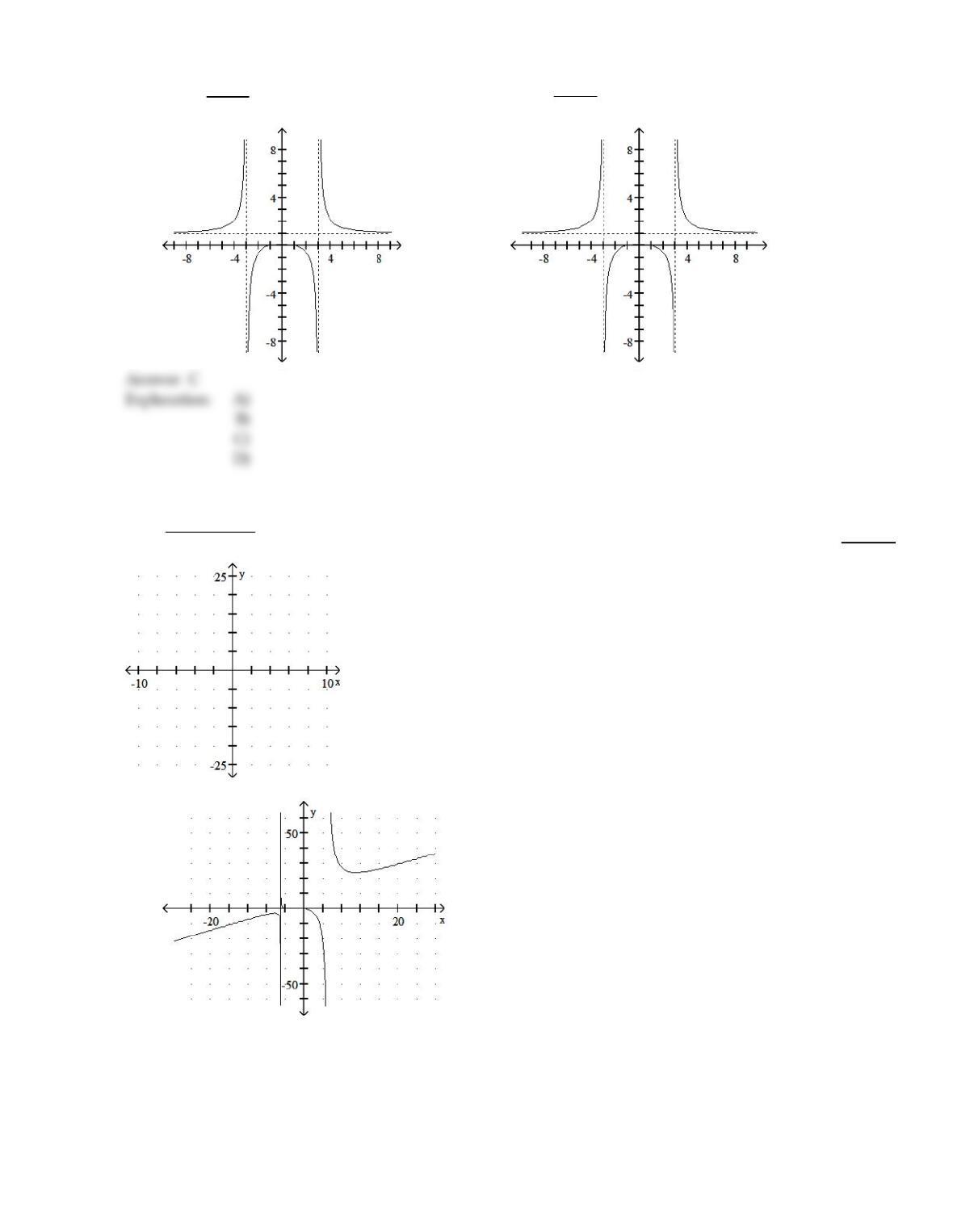
C)
g(x) =x2– 1
x2–9
D)
g(x) =x – 1
x2–9
Use a graphing calculator to graph the function.
93)
f(x) =x3+x2–12x
x2–25
93)
A)
44
B)
C)
D)
45
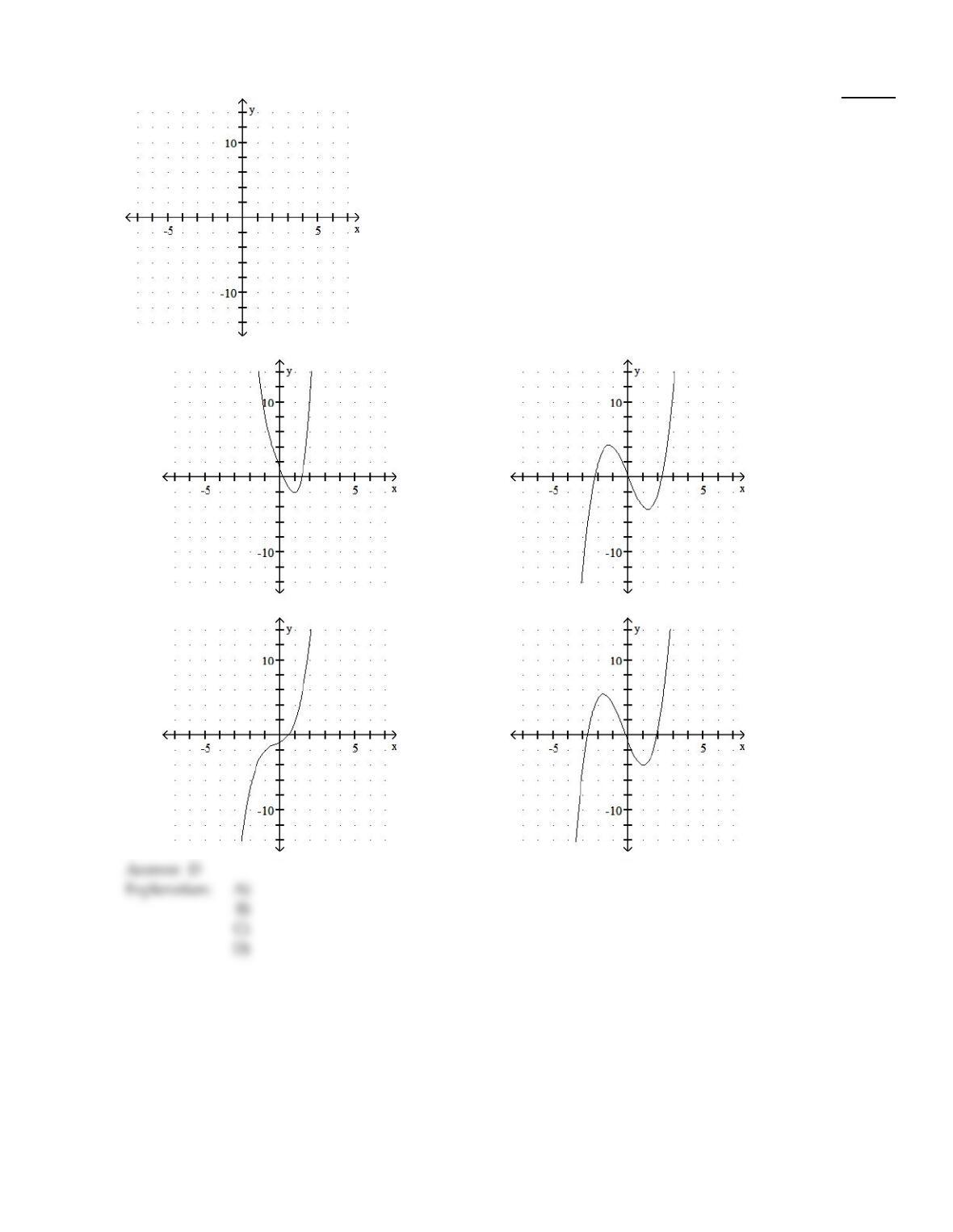
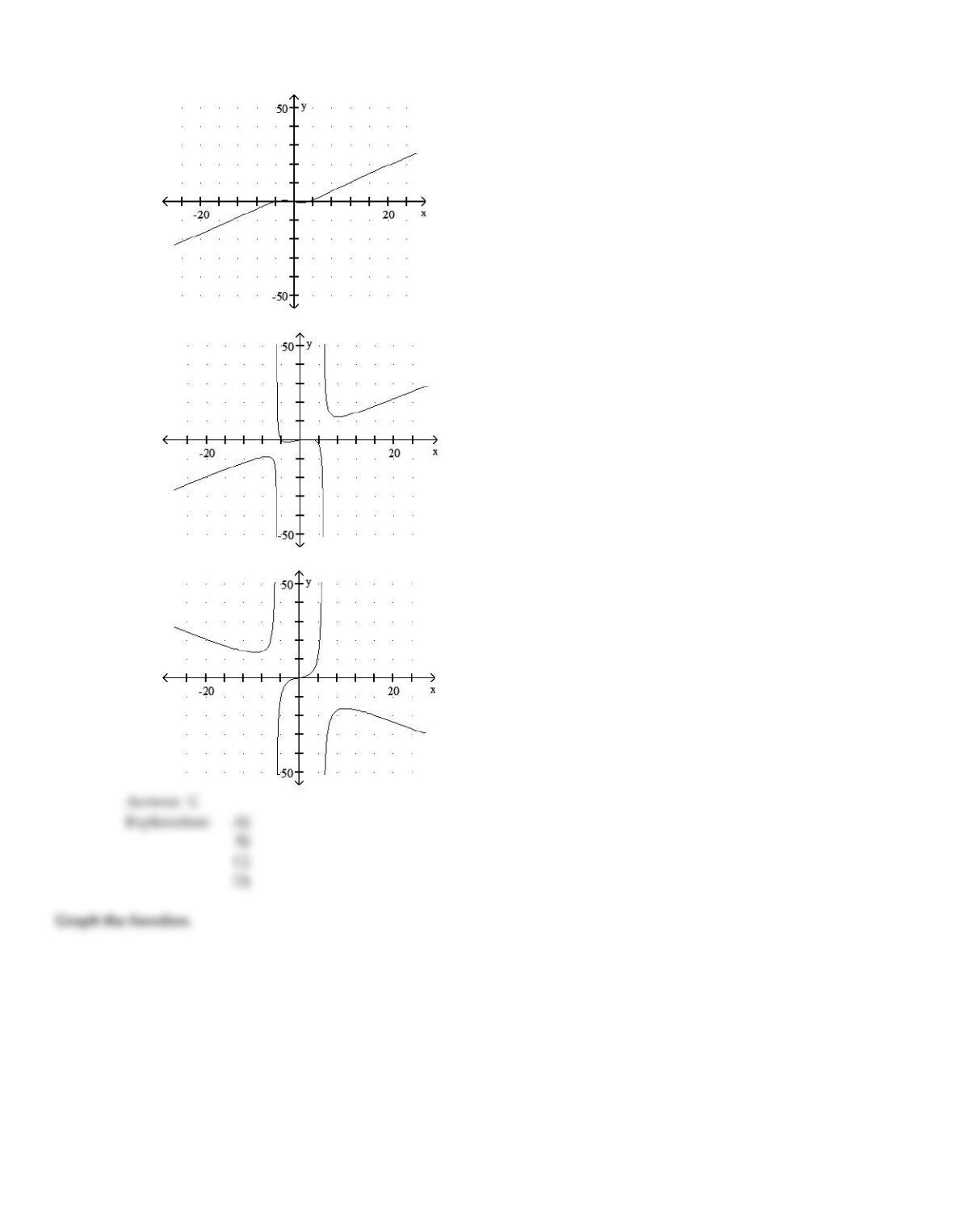
94)
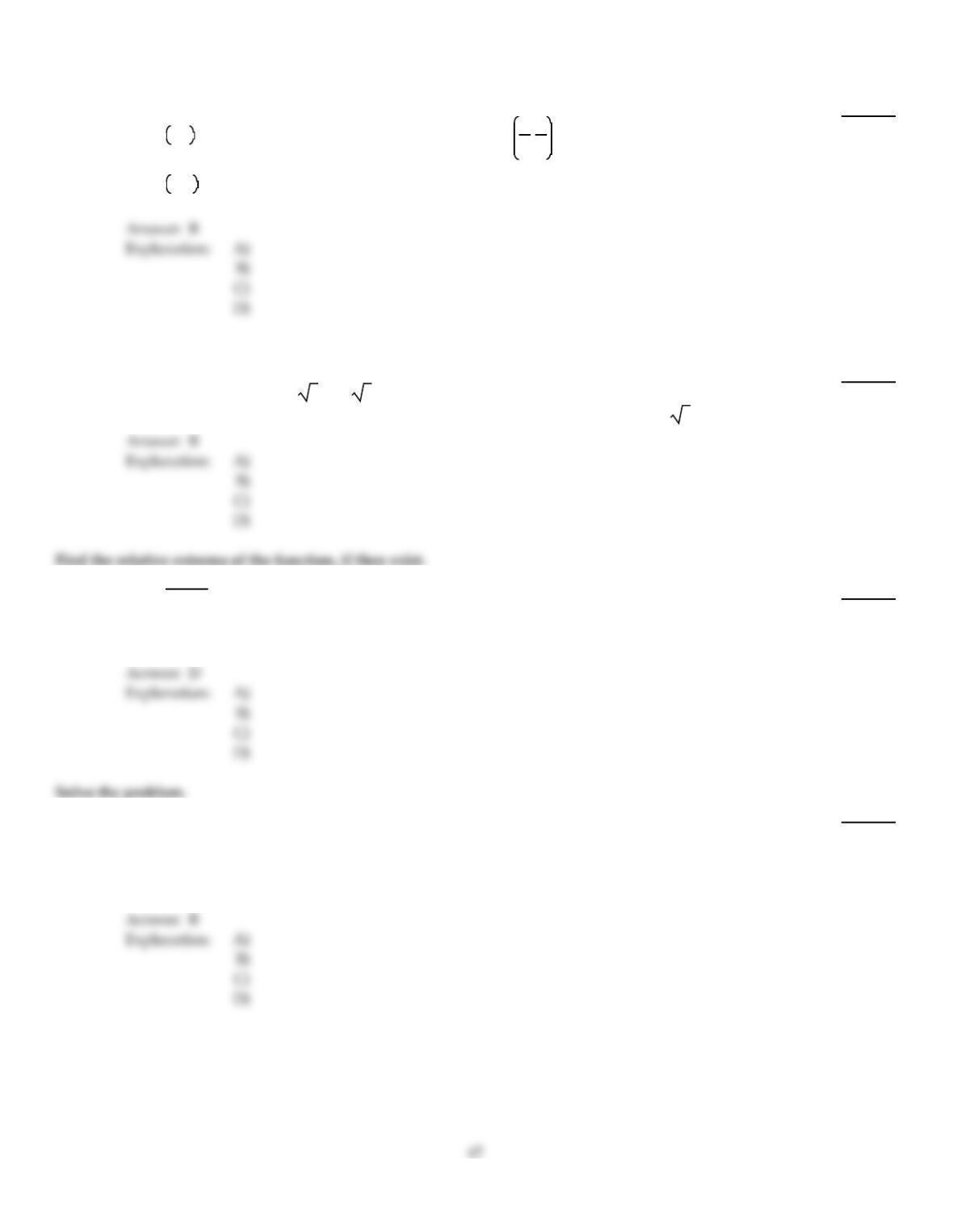
f(x) =x3+x2– 5x – 1
94)
A)
B)
C)
D)
46
Find the points of inflection.
95)
f(x) = 2x3– 9x2+ 12x
95)
A)
0,0
B)
3
2,9
2
C)
0, 0
D)
No points of inflection exist
Find the relative extrema of the function and classify each as a maximum or minimum.
96)
f(x) =5–x2
96)
A)
Relative minima: (–5, 0), ( 5, 0)
B)
Relative maximum: (0, 5)
C)
Relative minimum: (0, 5)
D)
Relative maximum: (5, 5)
97)
f(x) =–6
x2+ 1
97)
A)
Relative maximum at (0, –6)
B)
Relative maximum at (0, 6)
C)
No relative extrema exist
D)
Relative minimum at (0, –6)
98)
Suppose the demand for a certain item is given by
D(p) = –4p2+ 8p + 8,
where p represents the price of the item in dollars. Currently the price of the item is $19. Use
marginal demand to estimate the change in demand when the price is increased by one dollar.
98)
A)
–136
B)
–144
C)
0
D)
8
99)
y = f(x) =1
x, x =3, and x =0.6
99)
A)
0.22222; –0.13333
B)
–0.05556; –0.2
C)
–0.05556; –0.06667
D)
0.05556; –0.13333
C
Solve the problem.
100)
A company wishes to manufacture a box with a volume of 16 cubic feet that is open on top and is
twice as long as it is wide. Find the width of the box that can be produced using the minimum
amount of material. Round to the nearest tenth, if necessary.
100)
A)
5.8 ft
B)
2.9 ft
C)
4.2 ft
D)
2.1 ft
D
101)
f(x) = 10x3– 3x5
101)
A)
Concave up on ( , –2) and (0, 2), concave down on (–2, 0) and ( 2, )
B)
Concave up on ( , –1) and (1, ), concave down on (–1, 1)
C)
Concave up on ( , –1) and (0, 1), concave down on (–1, 0) and (1, )
D)
Concave down on ( , –1) and (0, 1), concave up on (–1, 0) and (1, )
C
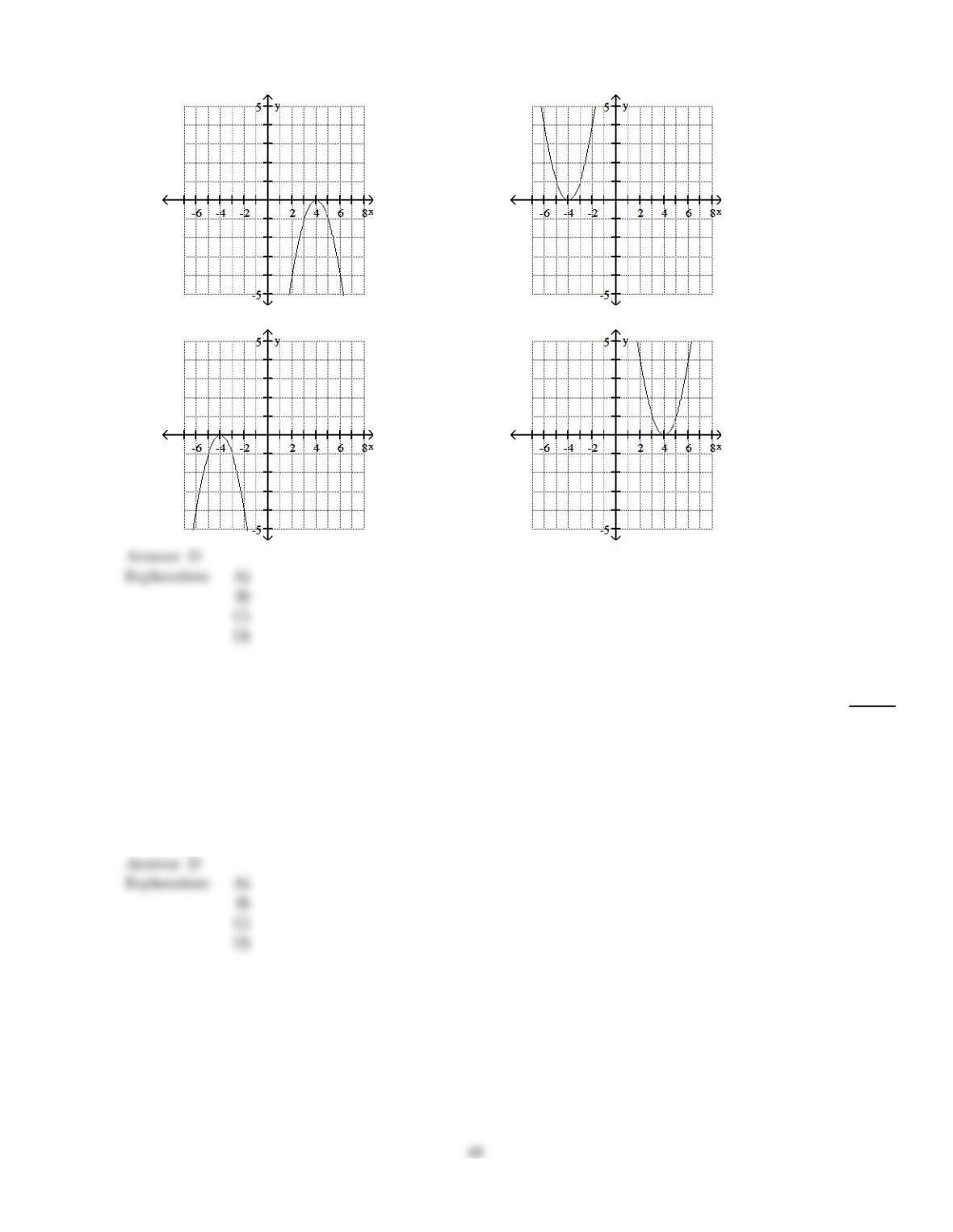
102)
f(x) =x2–8x +16
102)
48
A)
B)
C)
D)
Solve the problem.
103)
A person coughs when a foreign object is in the windpipe. The velocity of the cough depends on
the size of the object. Suppose a person has a windpipe with a 18–mm radius. If a foreign object
has a radius r, in mm, assume that the velocity V, in mm/second, needed to remove the object by a
cough is given by
V(r) = k(18r2–r3), 0 r 18,
where k is some positive constant. For what size object is the maximum velocity needed to remove
the object? Round answer to the nearest tenth, if necessary.
103)
A)
13
B)
6
C)
9
D)
12
104)
f(x) =(x +3)2/3 –7
104)
A)
Increasing on ( , –3), decreasing on (–3, )
B)
Decreasing on ( , –3) and (0, ), increasing on (–3, 0)
C)
Decreasing on ( ,)
D)
Decreasing on ( , –3), increasing on (–3, )
D
105)
h(x) =4
3x3– 12x2+ 10x +45
105)
A)
Concave up on (–, 3), concave down on (3, )
B)
Concave down for all x
C)
Concave up on (–, 0) and (3, ), concave down on (0, 3)
D)
Concave up on (3, ), concave down on (–, 3)
D
106)
1
3x3–4y2=11
106)
A)
x2
8y
B)
x2
4y
C)
8y
x2
D)
8y
x2+11
A
107)
f(x) =x3+x2– 5x +6; (0, )
107)
A)
No absolute maximum; absolute minimum: 3
B)
Absolute maximum: 6; no absolute minimum
C)
Absolute maximum: 11; absolute minimum: 3
D)
No absolute extrema
A
50
Find dy/dx by implicit differentiation.
108)
2y – x + xy =3
108)
A)
–1 + y
x + 2
B)
1 – y
2 + x
C)
–1 – y
x + 2
D)
y + 1
x + 2
109)
h(x) =6–5
x
109)
A)
x = 0
B)
y =6
C)
y =5
D)
no horizontal asymptotes
110)
f(x) =3+ 2x –x2; [0, 3]
110)
A)
Absolute maximum =5 at x = 1; absolute minimum =0 at x = 3
B)
Absolute maximum =2 at x = 2; absolute minimum =0 at x = 0
C)
Absolute maximum =4 at x = 1; absolute minimum =0 at x = 3
D)
Absolute maximum =4 at x = 1; absolute minimum =3 at x = 0
51
Solve the problem.
111)
Suppose that the weekly profit, in dollars, of producing and selling x cars is
P(x) = –0.005x3–0.3x2+980x –1100,
and currently 60 cars are produced and sold weekly. Use P(60) and the marginal profit when
x =60(P (60)) to estimate the weekly profit of producing and selling 63 cars. Round to the nearest
dollar.
111)
A)
$57,943
B)
$58,210
C)
$59,310
D)
$58,199
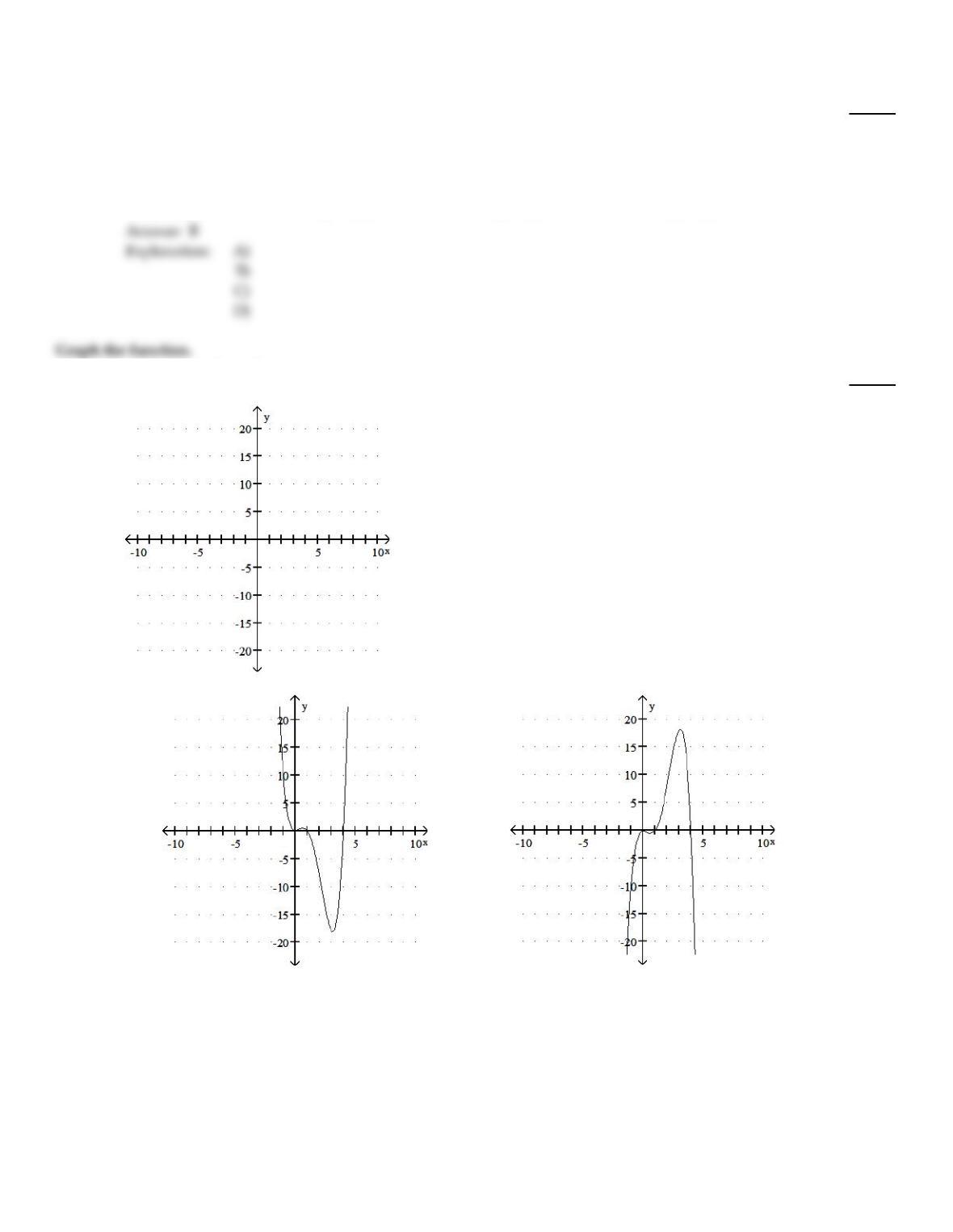
112)
f(x) =x4–5x3+4x2
112)
A)
B)
52
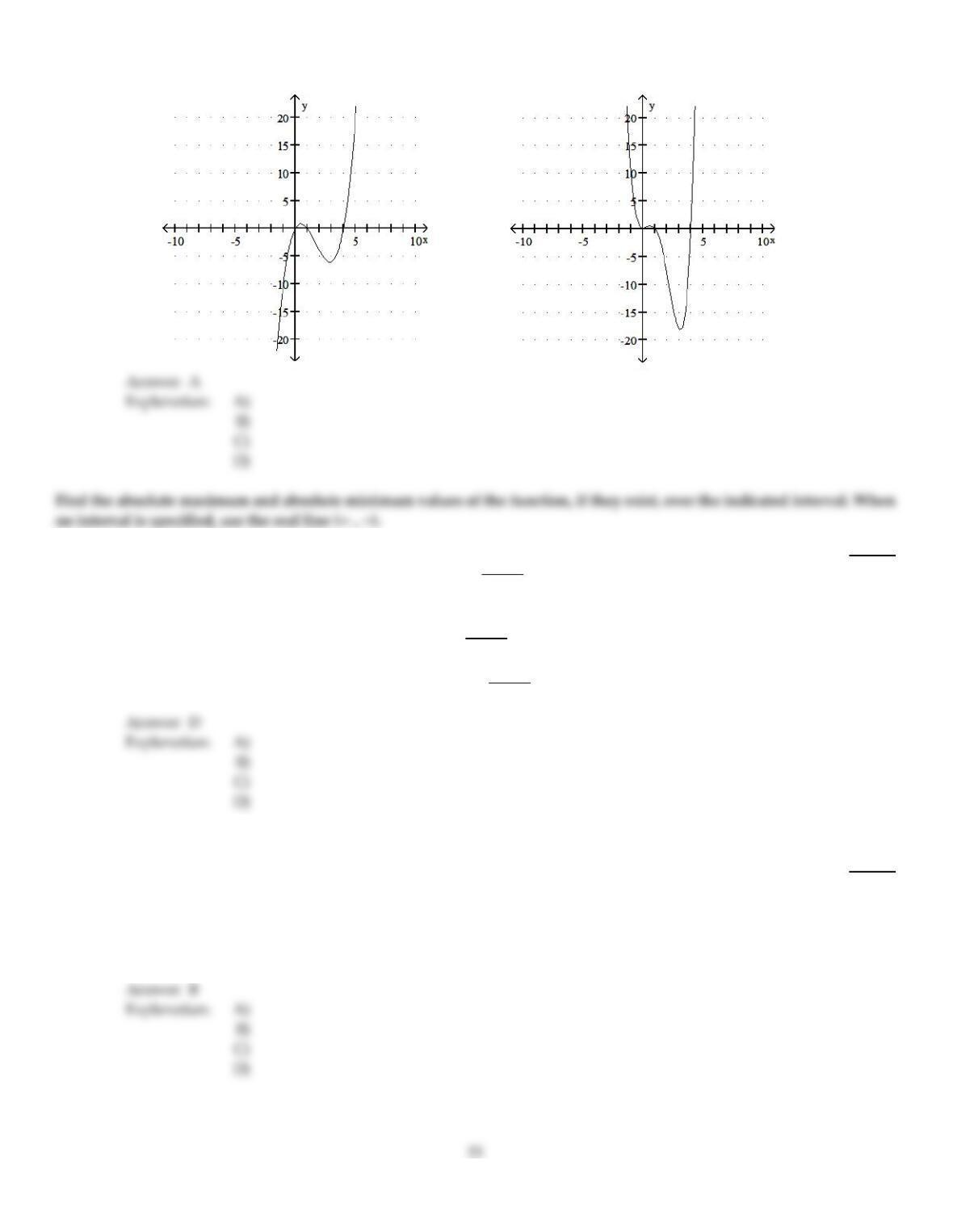
C)
D)
113)
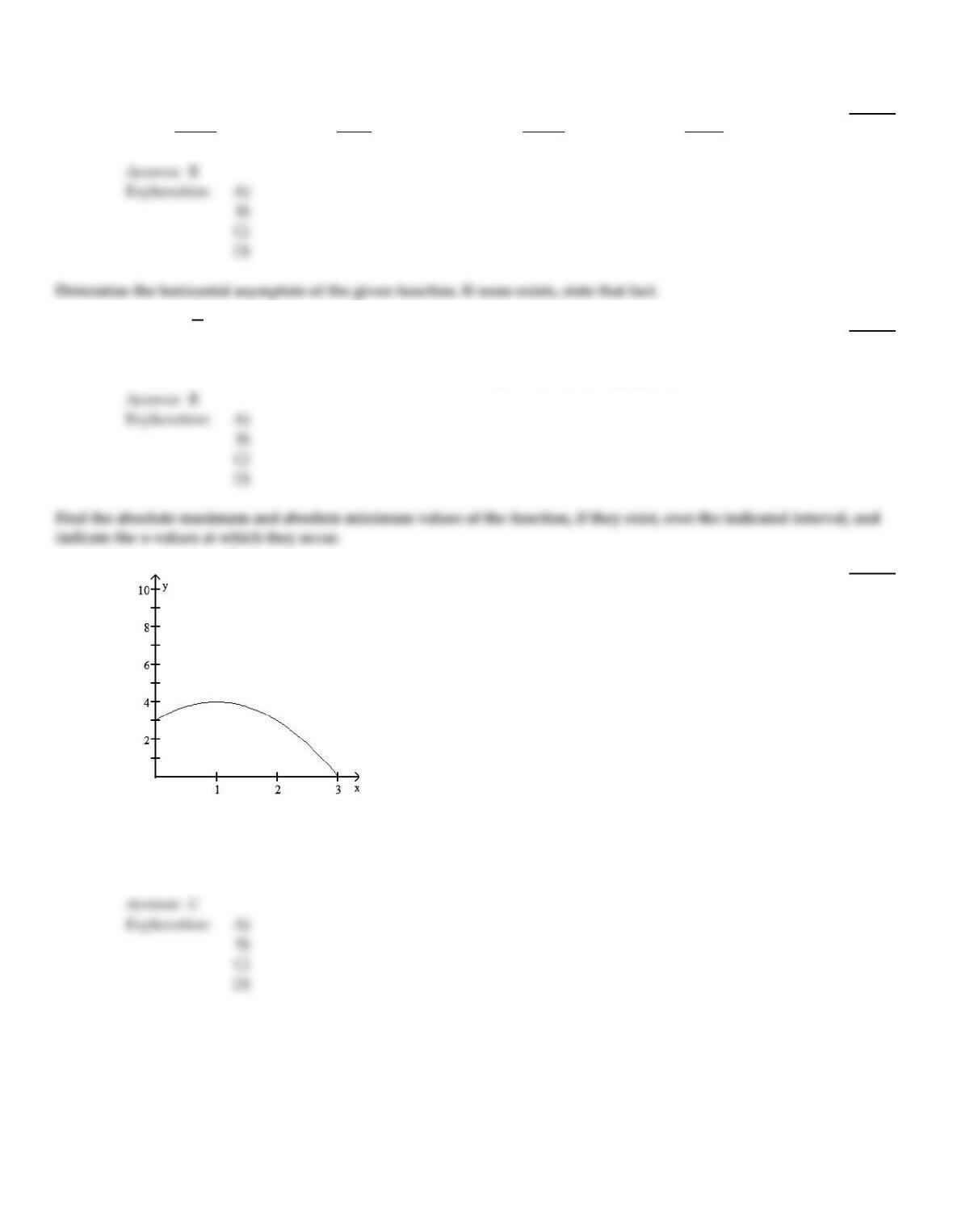
f(x) =x4–5x3; [–5, 5]
113)
A)
Absolute maximum: 625, absolute minimum: –16875
64
B)
Absolute maximum: 1250, absolute minimum: 0
C)
Absolute maximum: 0, absolute minimum: –16875
256
D)
Absolute maximum: 1250, absolute minimum: –16875
256
Solve the problem.
114)
Suppose that the temperature T, in degrees Fahrenheit, during a 24–hr period in winter is given by
T(x) =0.0023(x3–39x + 240), 0 x
24,
where x = the number of hours since midnight. Estimate the relative minimum temperature and
when it occurs. Round answers to the nearest hundredth, if necessary.
114)
A)
0.33° F at 0.33 hours after midnight
B)
0.34° F at 3.61 hours after midnight
C)
0.35° F at 3.61 hours after midnight
D)
0.37° F at 0.37 hours after midnight
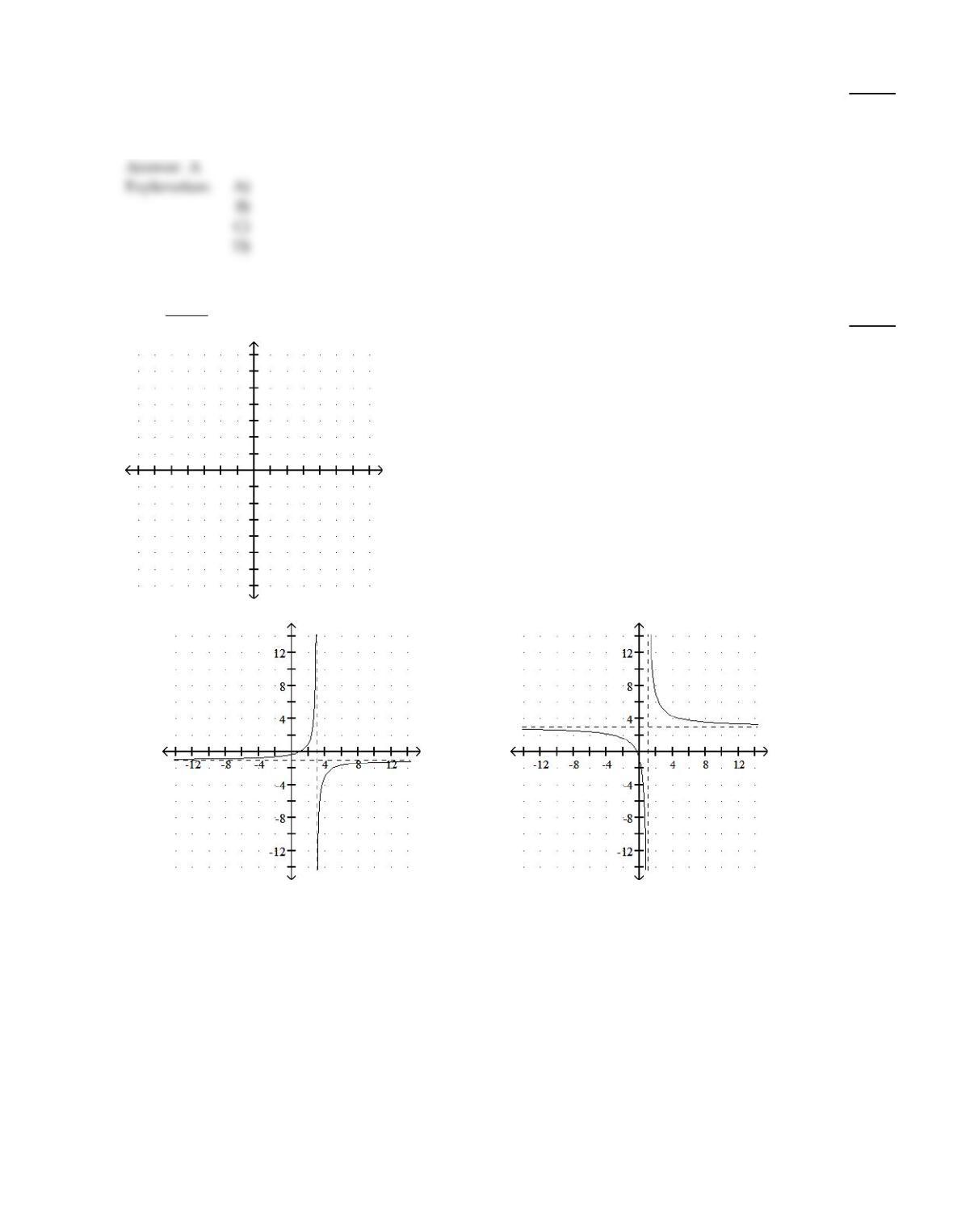
115)
A certain company produces potting soil and sells it in 50 lb bags. Suppose that 300,000 bags are to
be produced each year. It costs $12 per year to store a bag of potting soil, and it costs $2000 to set up
the facility to produce a batch of bags. Find the number of bags per batch that should be produced.
115)
A)
10,000
B)
100,000
C)
14,121
D)
9574
Graph the rational function.
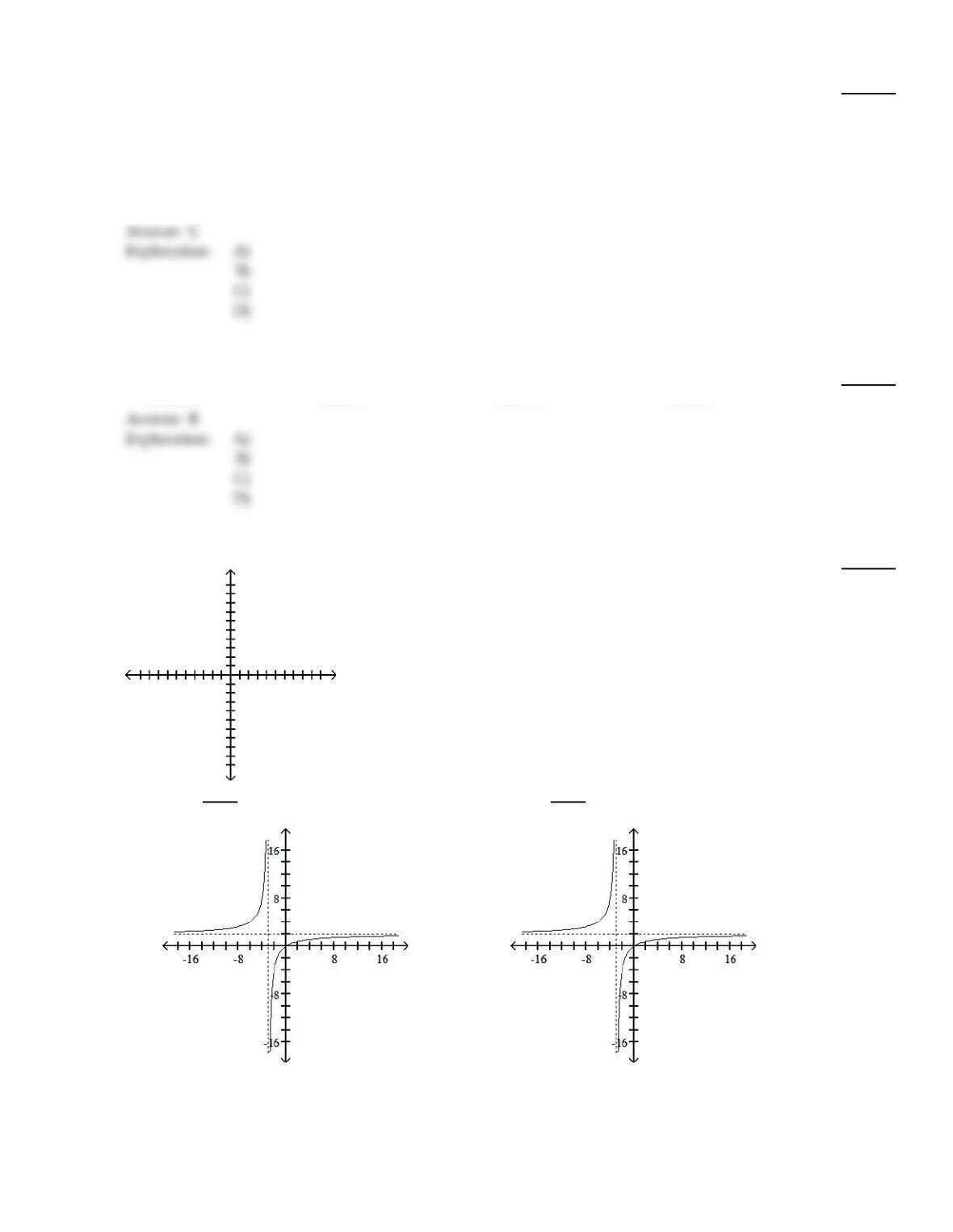
116)
f(x) =3x + 1
x – 1
116)
A)
B)
54
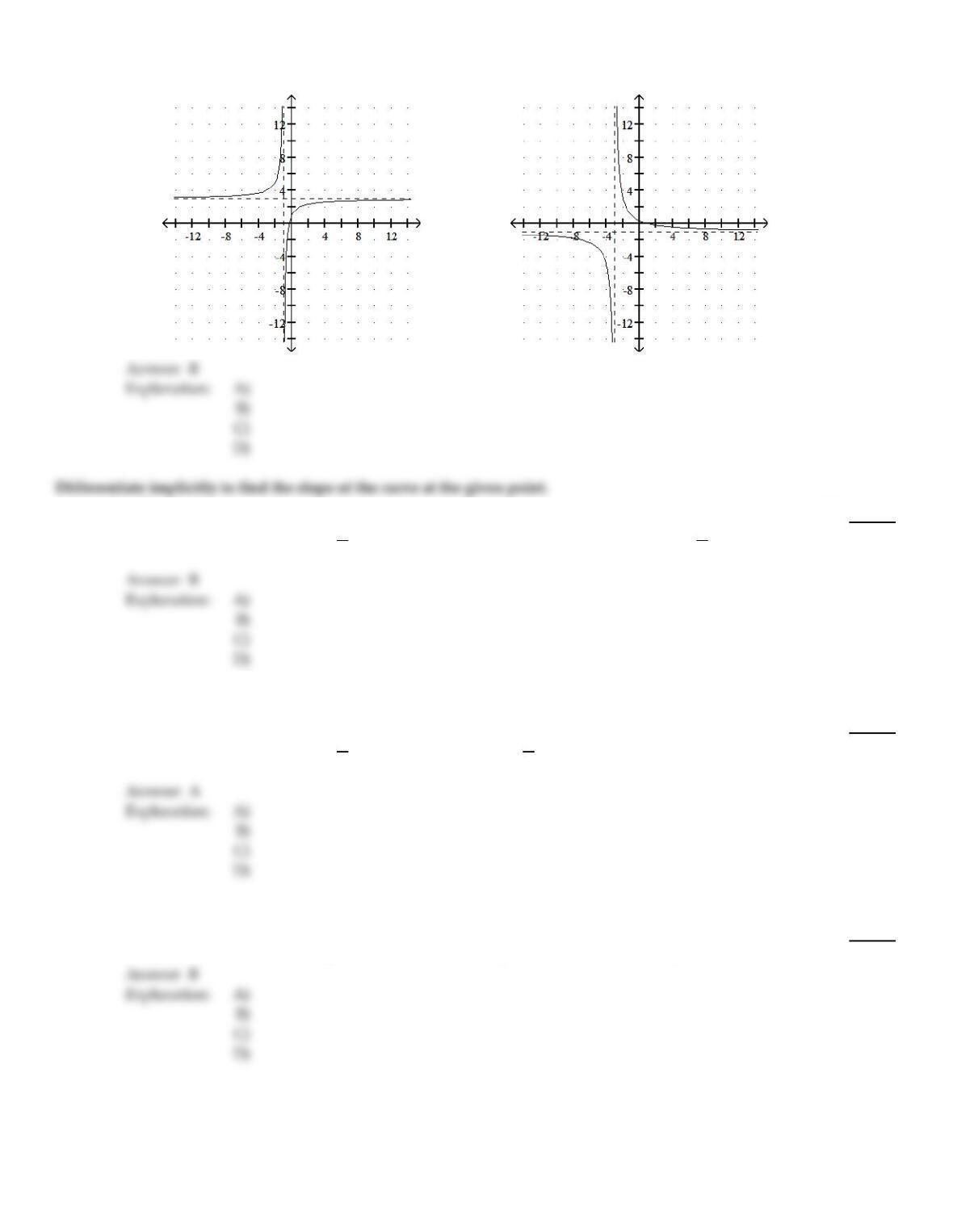
C)
D)
117)
xy2= 12; (3, –2)
117)
A)
–3
B)
1
3
C)
3
D)
–1
3
Calculate dy/dt using the given information.
118)
x4/3 + y4/3 = 2; dx/dt = 6, x = 1, y = 1
118)
A)
–6
B)
1
6
C)
–1
6
D)
6
Find y and f(x) x for the given function.
119)
y = f(x) = 3x + 2, x =9, and x =2
119)
A)
8; 6
B)
6; 6
C)
10; 6
D)
10; 10
55
Solve the problem.
120)
Because of material shortages, it is increasingly expensive to produce 6.0L diesel engines. In fact,
the profit in millions of dollars from producing x hundred thousand engines is approximated by
P(x) = –x3+11x2+15x –39, where 0
x 20. Find the inflection point of this function to determine
the point of diminishing returns.
120)
A)
(3.67, 114.59)
B)
(2.75, 114.59)
C)
(3.67, 24.96)
D)
(3.67, 63.26)
121)
A company estimates that the daily revenue (in dollars) from the sale of x cookies is given by
R(x) =790+ 0.02x + 0.0006x2.
Currently, the company sells 390 cookies per day. Use marginal revenue to estimate the increase in
revenue if the company increases sales by one cookie per day.
121)
A)
$41.00
B)
$0.41
C)
$0.49
D)
$48.80
Use a graphing calculator to find the approximate location of all relative extrema.
122)
f(x) =x4–3x3– 21x2+ 74x + 79
122)
A)
Relative maximum at x =1.668; Relative minima at x = –3.169 and x =3.82
B)
Relative maximum at x = 1.604; Relative minima at x = –3.089 and x = 3.735
C)
Relative maximum at x =1.535; Relative minima at x = –3.013 and x =3.776
D)
Relative maximum at x =1.56; Relative minima at x = –3.011 and x =3.816
Find the elasticity.
123)
q = D(x) =200– x
123)
A)
E(x) =1
400– 2x
B)
E(x) =x
200– x
C)
E(x) =x
400– 2x
D)
E(x) =x
2x –400
Determine the horizontal asymptote of the given function. If none exists, state that fact.
124)
h(x) =9x – 4
x –8
124)
A)
y =9
B)
y =8
C)
y = 0
D)
no horizontal asymptotes
Solve the problem.
125)
After an injection, the amount of a medication A in the bloodstream decreases with time t, in hours.
Suppose that under certain conditions A is given by
A(t) =A0
0.5t2+ 1 ,
where A0 is the initial amount of the medication given. Assume that an initial amount of 54.0 cc is
injected.
Find lim
t A(t).
125)
A)
0
B)
A(t) increases without bound
C)
2A0
D)
A0
A
126)
48
126)
A)
6.0000
B)
6.9286
C)
6.8571
D)
7.0714
B
A
127)
Of all numbers whose difference is 8, find the two that have the minimum product. Is there a
maximum product? Explain.
127)
A)
4 and 12; There is not a maximum product since the function that represents the product has
just one critical point, and that critical point is a minimum. The domain is the real line, and on
either side of the minimum the function increases without bound.
B)
4 and –4; The maximum product is 48.
C)
4 and 12; The maximum product is 48.
D)
4 and –4; There is not a maximum product since the function that represents the product has
just one critical point, and that critical point is a minimum. The domain is the real line, and on
either side of the minimum the function increases without bound.
128)
Compare and contrast the meaning of dy/dx versus the meaning of y/x.
128)
A)
y/x is the instantaneous rate of change of y with respect to x, expressed as a function of x,
whereas dy/dx is the average rate of change of y over a specific interval x to x +dx.
B)
dy/dx is the instantaneous rate of change of y with respect to x at a point on the curve y = f x
at the beginning of an interval x to x +x, whereas y/x is the instantaneous rate of change
of y at the end of the interval x to x +x.
C)
dy/dx is the derivative of y with respect to x, whereas y/x is the derivative of y with
respect to x.
D)
dy/dx is the instantaneous rate of change of y with respect to x, expressed as a function of x,
whereas y/x is the average rate of change of y over a specific interval x to x +x.
129)
Compare the behavior of the first derivative of a function around a point of inflection with its
behavior around a maximum or minimum.
129)
A)
The first derivative changes sign as x is followed from one side of a maximum or minimum to
the other, but the first derivative maintains the same sign as x is followed from one side of a
point of inflection to the other.
B)
The first derivative maintains the same sign as x is followed from one side of a maximum,
minimum, or point of inflection to the other.
C)
The first derivative changes sign as x is followed from one side of a maximum, minimum, or
point of inflection to the other.
D)
The first derivative maintains the same sign as x is followed from one side of a maximum or
minimum to the other, but the first derivative changes sign as x is followed from one side of a
point of inflection to the other.
130)
f(x) =x4–2x2– 9
130)
A)
Decreasing on ( , –1) and (1, ), increasing on (–1, 1)
B)
Decreasing on ( , –1) and (0, 1), increasing on (–1, 0) and (1, )
C)
Increasing on ( , –1) and (0, 1), decreasing on (–1, 0) and (1, )
D)
Increasing on ( , –1) and (1, ), decreasing on (–1, 1)
B
131)
f(x) =6x
x2+ 1
131)
A)
Relative maximum at (0, 0)
B)
Relative maximum at –1, –3; relative minimum at 1, 3
C)
Relative minimum at –1, –3; relative maximum at (0, 0)
D)
Relative minimum at –1, –3; relative maximum at 1, 3
D
132)
A product sells by word of mouth. The company that produces the product has noticed that
revenue from sales is given by R(x) =5 x, where x is the number of units produced and sold. If the
revenue keeps changing at a rate of $400 per month, how fast is the rate of sales changing when
1900 units have been made and sold? (Round to the nearest dollar per month.)
132)
A)
$3487/month
B)
$6974/month
C)
$4/month
D)
$174,356/month
B
133)
q = D(x) =720– x; x =540
133)
A)
3
2; inelastic
B)
3; elastic
C)
1; unit elasticity
D)
3
2; elastic
D
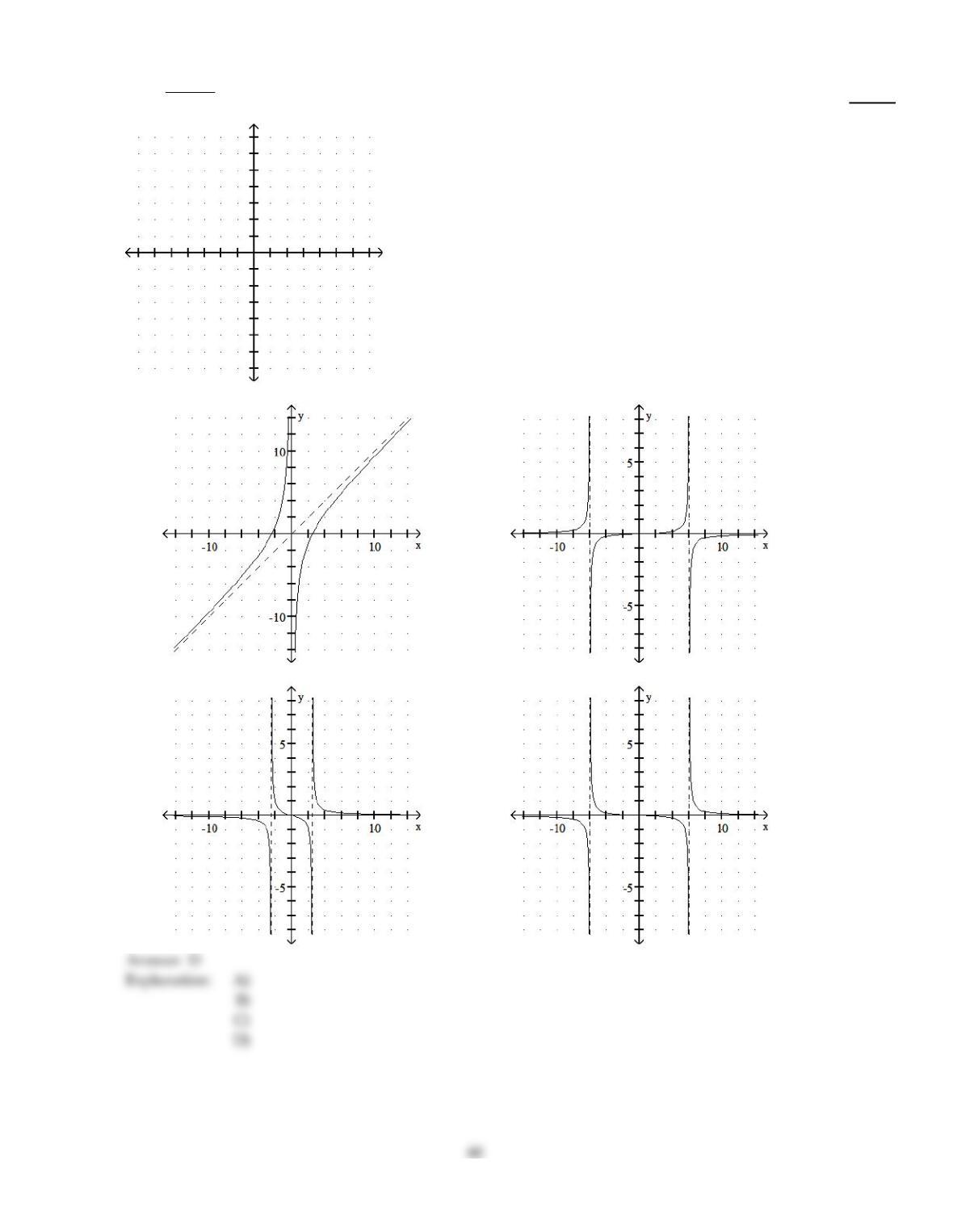
134)
f(x) =x
x2–36
134)
A)
B)
C)
D)
135)
x6y6=64; (2, 1)
135)
A)
–1
4
B)
2
C)
–32
D)
–1
2
136)
x + y
x – y = x2+ y2
136)
A)
x(x – y)2+ y
x + y(x – y)2
B)
x(x – y)2– y
x + y(x – y)2
C)
x(x – y)2+ y
x – y(x – y)2
D)
x(x – y)2– y
x – y(x – y)2
137)
y =(6x2+8) 3/2
137)
A)
12x (6x2+8) 3/2 dx
B)
3
26x2+8 dx
C)
3x 6x2+8 dx
D)
18x 6x2+8 dx
138)
Find all of the asymptotes of the function
f(x) =x2– 3
x – 4 .
138)
A)
Vertical asymptote: x = –4 , oblique asymptote: y = x + 4
B)
Vertical asymptote: x = –4 , oblique asymptote: y = x
C)
Vertical asymptote: x = 4 , oblique asymptote: y = x
D)
Vertical asymptote: x = 4 , oblique asymptote: y = x + 4
139)
R(x) =x – 1
x3+ 8x2– 48x
139)
A)
x = –4, x = 0, x =12
B)
x = –12, x =4
C)
x = –12, x = 0, x =4
D)
x = –4, x = –30, x =12
C
140)
y =x3– 3x2+4x –4
140)
A)
Increasing on ( , 1), decreasing on (1, )
B)
Increasing on ( , –1) and (1, ), decreasing on (–1, 1)
C)
Decreasing on ( , –1) and (1, ), increasing on (–1, 1)
D)
Increasing on ( , )
D
141)
332
141)
A)
3.2852
B)
3.3852
C)
3.0852
D)
3.1852
D
142)
f(x) =9x –x3
142)
A)
Concave up on (–, 0) and (1, ), concave down on (0, 1)
B)
Concave up on (0, ), concave down on (–, 0)
C)
Concave up on (–, 0), concave down on (0, )
D)
Concave down for all t
C
143)
f(x) = –7x2– 2x –2
143)
A)
Relative maximum: –1
7, –13
7
B)
Relative maximum: –7, –13
7
C)
Relative minimum: 1
7, 13
7
D)
Relative maximum: 1
7, 13
7
144)
Find the absolute maximum value for the function f(x) = x(x – 8)2/3 over the interval [–1, 7].
144)
A)
10.4
B)
8.2
C)
6.9
D)
7.7
145)
y = 2x5– 3x2+ x – 1; x = –1, dx =1
3
145)
A)
19
3
B)
17
3
C)
22
3
D)
25
3
146)
lim
x
5 –3x
10 –7x2
146)
A)
3
7
B)
1
2
C)
0
D)
Does not exist
147)
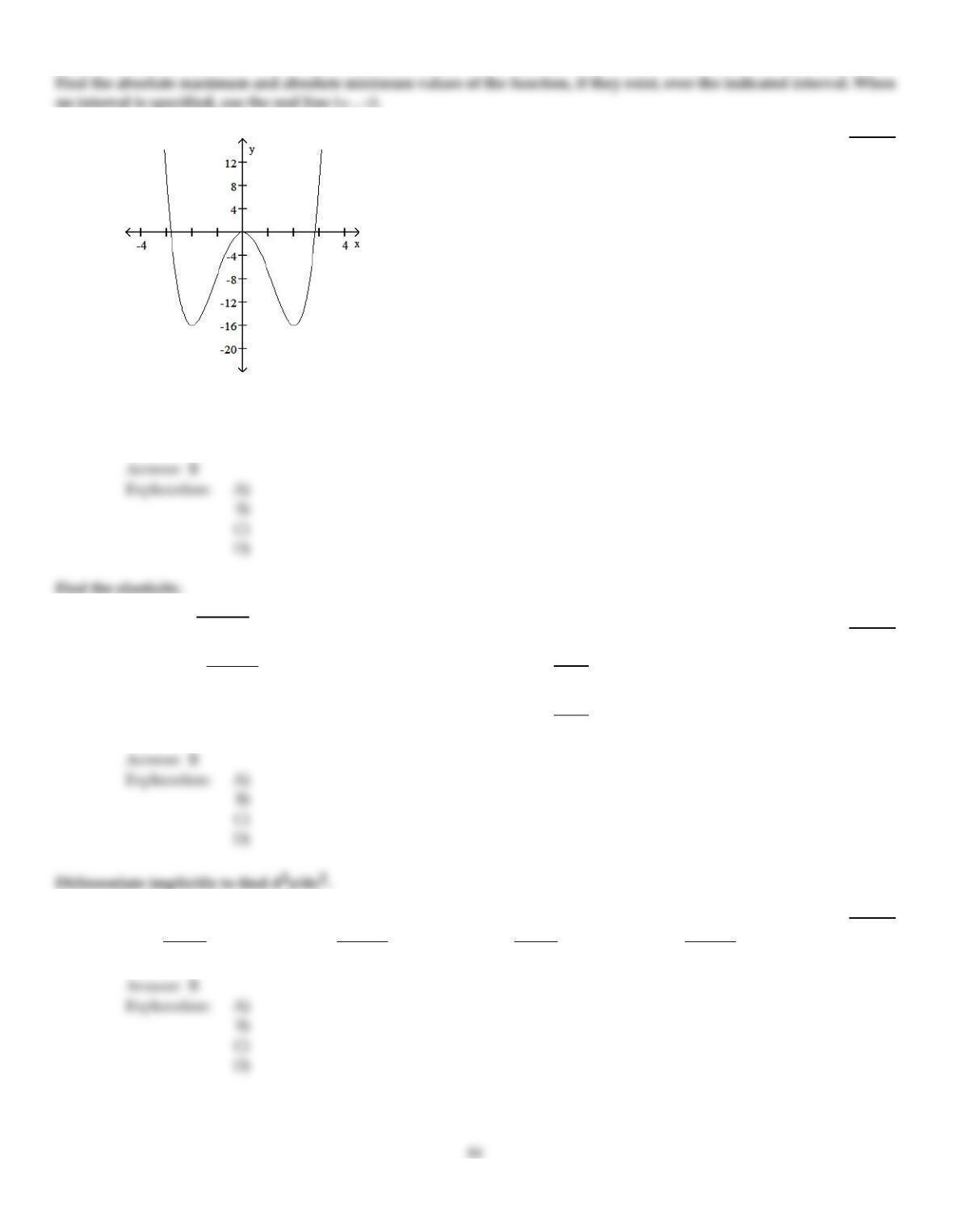
f(x) =x4–8x2
147)
A)
Absolute maximum: 0; no absolute minimum
B)
No absolute maximum; absolute minimum: –16
C)
Absolute maximum: 0; absolute minimum: –16
D)
No absolute extrema
B
148)
q = D(x) =900
(x +7)2
148)
A)
E(x) =1800x
(x +7)3
B)
E(x) =2x
x +7
C)
E(x) =1800x(x +7)
D)
E(x) =2
x +7
B
149)
y2–x2=3
149)
A)
y –x2
y2
B)
y2–x2
y3
C)
y –x2
y3
D)
y2–x2
y2
B
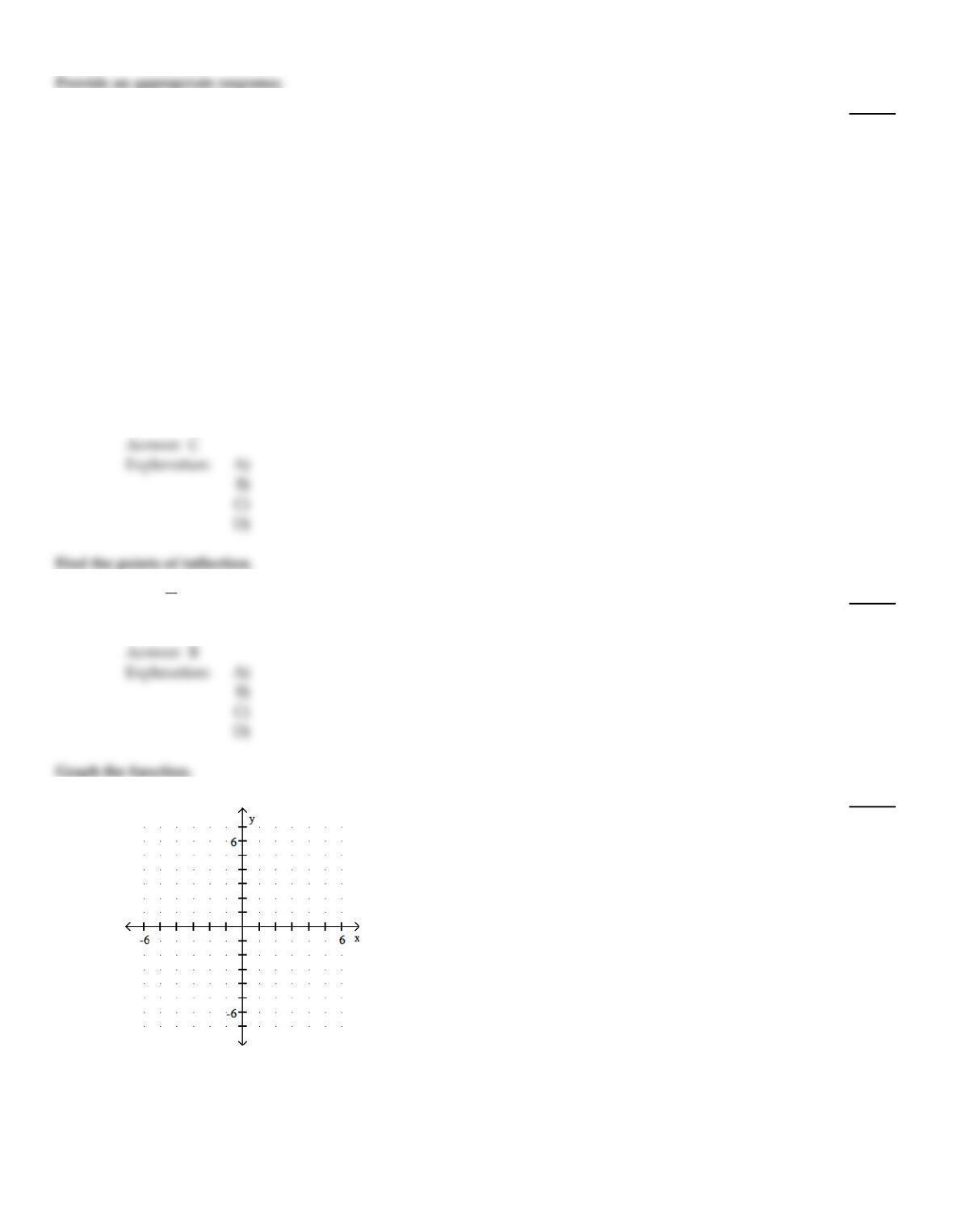
150)
What is an oblique asymptote? How can one identify functions that have oblique asymptotes? Can
a graph cross an oblique asymptote?
150)
A)
An oblique asymptote is a nonhorizontal, nonvertical boundary that a function might
approach increasingly closely, but never reach over some extended interval. Oblique
asymptotes occur in rational functions when the degree of the numerator is equal to the
degree of the denominator. A graph cannot cross an oblique asymptote.
B)
An oblique asymptote is the same thing as a horizontal asymptote. Oblique asymptotes occur
in rational functions when the degree of the numerator is less than or equal to the degree of
the denominator. A graph can cross an oblique asymptote.
C)
An oblique asymptote is a nonhorizontal, nonvertical boundary that a function might
approach increasingly closely, but never reach over some extended interval. Oblique
asymptotes occur in rational functions when the degree of the numerator is exactly one more
than the degree of the denominator. A graph can cross an oblique asymptote.
D)
An oblique asymptote is a nonhorizontal, nonvertical boundary that a function might
approach increasingly closely, but never reach over some extended interval. Oblique
asymptotes occur in rational functions when the degree of the numerator is less than or equal
to the degree of the denominator. A graph can cross an oblique asymptote.
151)
f(x) =1
2x4–2x3+ 12
151)
A)
(2, 4)
B)
(0, 12), (2, 4)
C)
(2, 0)
D)
(0, 12), (2, –8)
152)
f(x) = –x3– 4x – 1
152)
65
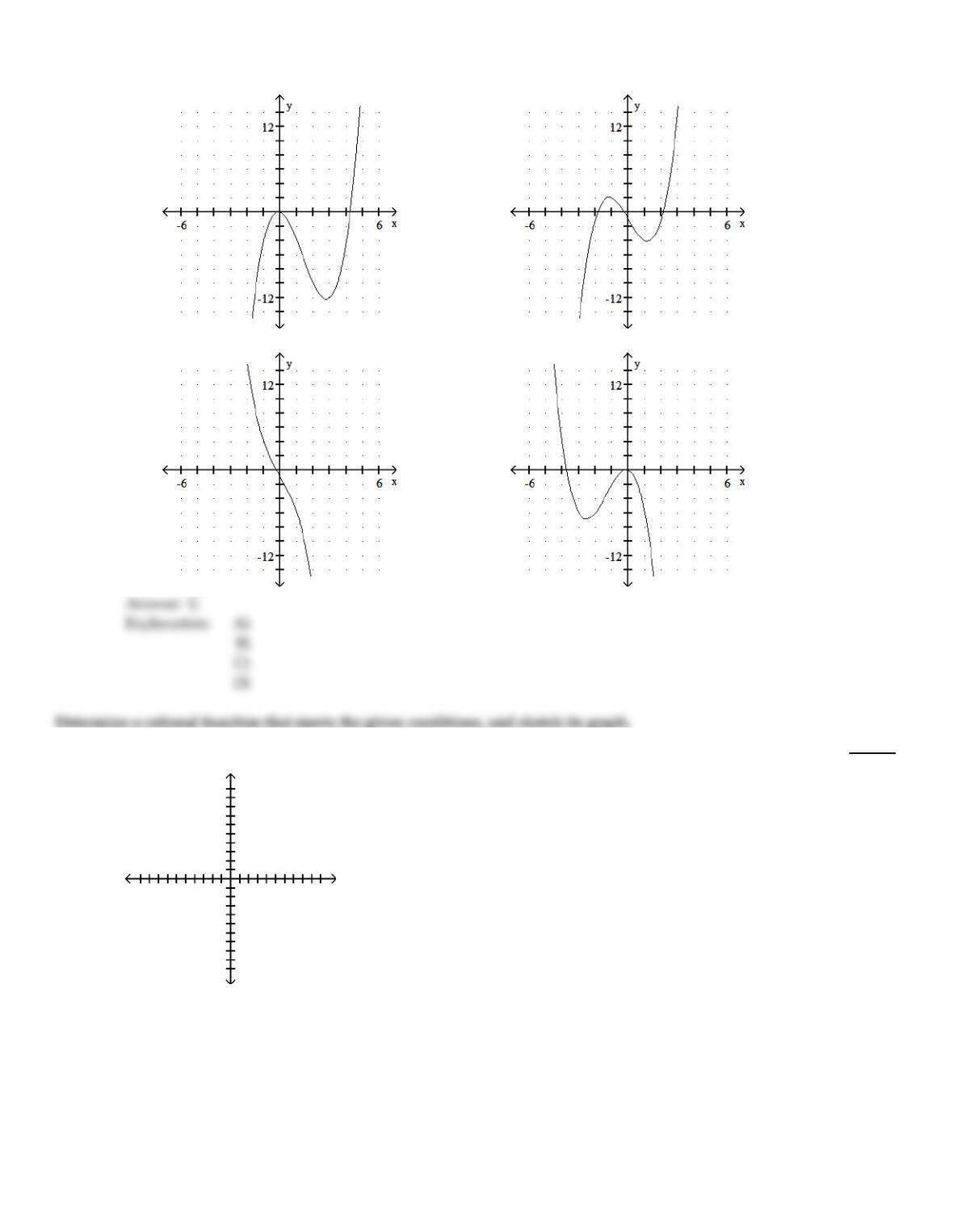
A)
B)
C)
D)
153)
The function f has vertical asymptotes at x = – 4 and x = 0, a horizontal asymptote at y = –5, and f(1)
= 0.
153)
66
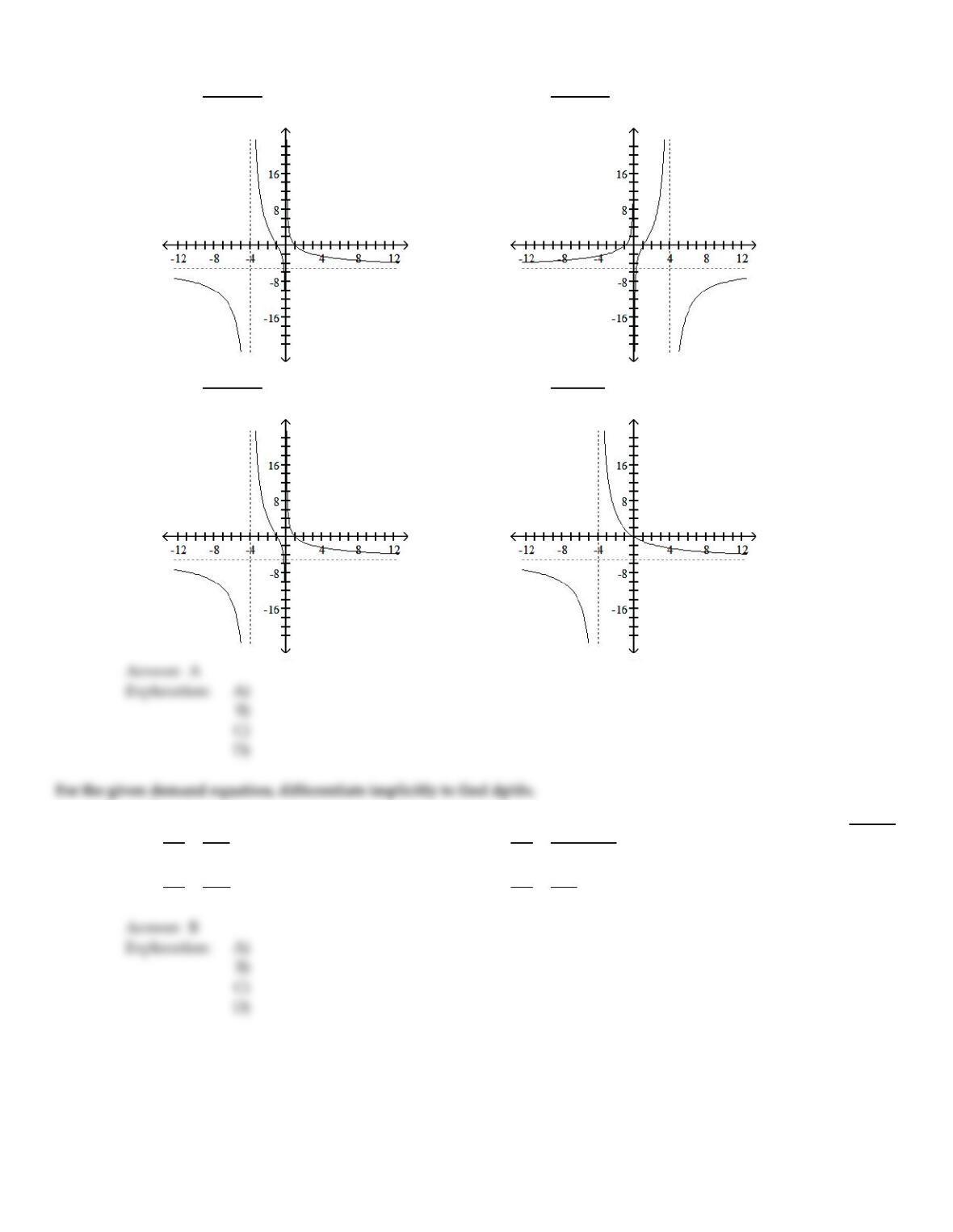
A)
f(x) =–5x2+5
x2+4x
B)
f(x) =–5x2+5
x2+4x
C)
f(x) =–5x2+5
x2–4x
D)
f(x) =–5x2
x2+4x
154)
20p2–400p +608= x
154)
A)
dp
dx =40
401
B)
dp
dx =1
40p –400
C)
dp
dx =40p
401
D)
dp
dx =401
40
67
Solve the problem.
155)
Given the total–revenue function
R(x) = 7600x,
and the total–cost function
C(x) =x3– 2x2+ 5x + 100,
if P(x) is the total profit function, find P and P(x) when x = 50 and x = 1.
155)
A)
P = $141; P‘(50) = $295
B)
P = $146; P‘(50) = $295
C)
P = $146; P‘(50) = $290
D)
P = $149; P‘(50) = $141
156)
An outdoor sports company sells 250 kayaks per year. It costs $8 to store one kayak for a year. Each
reorder costs $10, plus an additional $8 for each kayak ordered. How many times per year should
the store order kayaks in order to minimize inventory costs?
156)
A)
14
B)
10
C)
7
D)
15
Find the relative extrema of the function and classify each as a maximum or minimum.
157)
s(x) = –x2–14x + 32
157)
A)
Relative minimum: (14, 32)
B)
Relative maximum: (7, 81)
C)
Relative maximum: (–14, 32)
D)
Relative maximum: (–7, 81)
Provide an appropriate response.
158)
When is dy equal to y for all x?
158)
A)
When x is small
B)
Always
C)
When f(x) is a linear function
D)
Never
Determine where the given function is concave up and where it is concave down.
159)
G(x) =1
4x4–x3+6
159)
A)
Concave up on (0, 2), concave down on (–, 0) and (2, )
B)
Concave up for (–, 0), concave down for (0, )
C)
Concave up on (–, 0) and (2, ), concave down on (0, 2)
D)
Concave up for (2, ), concave down on (–, 2)
Determine the vertical asymptote(s) of the given function. If none exists, state that fact.
160)
f(x) =–x2+ 16
x2+ 5x + 4
160)
A)
x = –1, x = 4
B)
x = 1, x = –4
C)
x = –1, x = –4
D)
x = –1
D
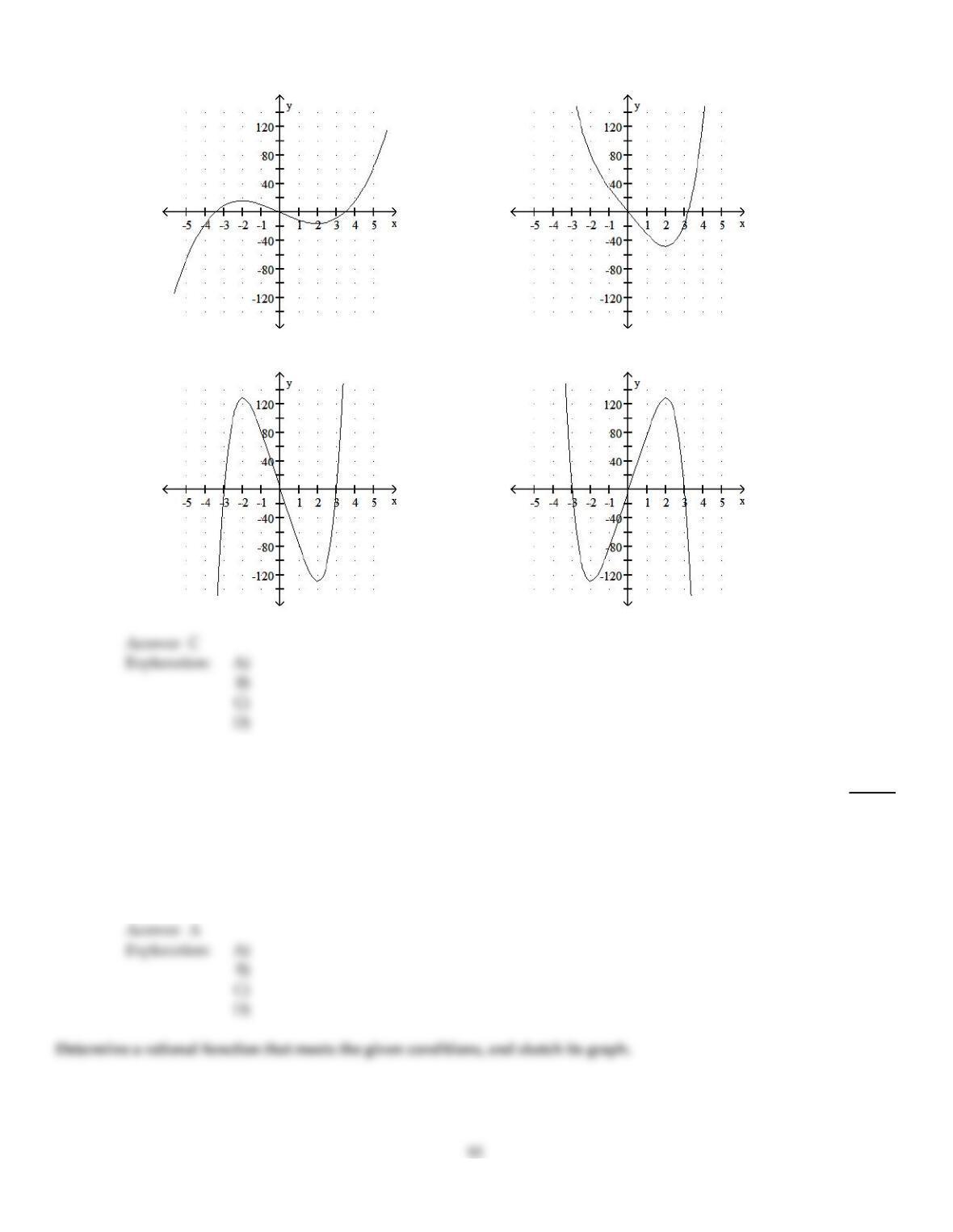
Determine whether the statement is true or false.
161)
If q = D(x) =k
xn and n > 1, demand is elastic for all values of x.
161)
A)
True
B)
False
A
162)
y =6x +4
162)
A)
6
6x +4 dx
B)
3
6x +4 dx
C)
3 6x +4 dx
D)
1
2 6x +4 dx
B
69
C
Solve the problem.
163)
An appliance company determines that in order to sell x dishwashers, the price per dishwasher
must be
p =600–0.3x.
It also determines that the total cost of producing x dishwashers is given by
C(x) =5000 +0.7x2.
What price must be charged per dishwasher in order to maximize profit?
163)
A)
$510
B)
$490
C)
$1020
D)
$480
164)
x = D(x) =800– x
164)
A)
800
B)
320
C)
400
D)
1600
165)
f(x) =x4–8x2+ 6
165)
A)
Relative minimum at (0, 6); relative maxima at (2, –10), (–2, –22)
B)
Relative maximum at (0, 6); relative minimum at (2, –10)
C)
Relative maximum at (2, –10); relative minimum at (–2, –10)
D)
Relative maximum at (0, 6); relative minima at (2, –10), (–2, –10)
Solve the problem.
166)
If the price charged for a candy bar is p(x) cents, then x thousand candy bars will be sold in a
certain city, where p(x) =124–x
16. How many candy bars must be sold to maximize revenue?
166)
A)
1984 candy bars
B)
992 candy bars
C)
992 thousand candy bars
D)
1984 thousand candy bars
Determine where the given function is increasing and where it is decreasing.
167)
f(x) = 2x3– 15x2+ 24x
167)
A)
Decreasing on ( , 0) and (4, ), increasing on (0, 4)
B)
Increasing on ( , 1), decreasing on (1, )
C)
Decreasing on ( , 1) and (4, ), increasing on (1, 4)
D)
Increasing on ( , 1) and (4, ), decreasing on (1, 4)
Find dy/dx by implicit differentiation.
168)
7x3–x2y3= 7
168)
A)
21x2– 2xy3
3xy2
B)
21x2– 2xy2
xy2
C)
21x2– 2xy2
3x2y2
D)
21x2– 2xy3
3x2y2
D
169)
x1/3 – y1/3 = 1
169)
A)
(y/x)2/3
B)
–(y/x)2/3
C)
–(x/y)2/3
D)
(x/y)2/3
A
Use a graphing calculator to find the approximate location of all relative extrema.
170)
f(x) = 0.1x5+ 5x4–8x3– 15x2– 6x – 46
170)
A)
Relative maxima at x = –41.159 and x = –0.186; relative minima at x = –0.548 and x =1.979
B)
Relative maxima at x = –41.132 and x = –0.273; relative minima at x = –0.547 and x = 1.952
C)
Relative maxima at x = –41.036 and x = –0.193; relative minima at x = –0.61 and x=2.015
D)
Relative maxima at x = –41.212 and x = –0.219; relative minima at x = –0.593 and x =2.006
B
71
D
171)
f(x) = –5– 4x –2x2; [–2, 1]
171)
A)
Absolute maximum: –3; absolute minimum: –11
B)
Absolute maximum: –5, absolute minimum: –11
C)
Absolute maximum: 7
D)
Absolute maximum: 7; absolute minimum: –5
Find the relative extrema of the function, if they exist.
172)
f(x) =x2+ 1
x2
172)
A)
Relative minimum at (0, 1)
B)
Relative maximum at (0, 1)
C)
No relative extrema exist
D)
Relative maximum at (–1, 2); relative minimum at (1, 2)
Graph the rational function.
173)
f(x) =3x
x – 5
173)
72
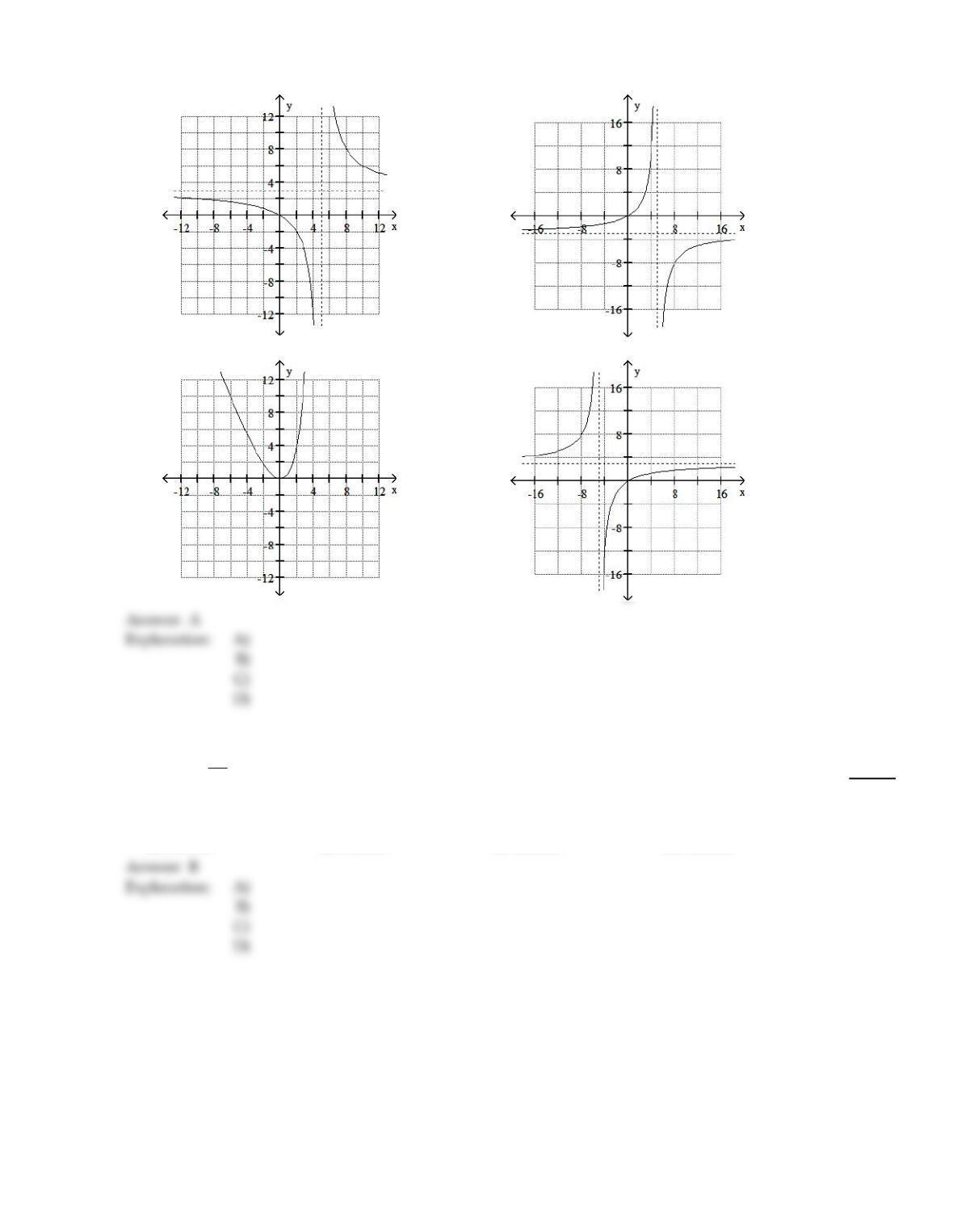
A)
B)
C)
D)
Solve the problem.
174)
P(x) = –x3+27
2x2– 60x + 100, x
5 is an approximation to the total profit (in thousands of dollars)
from the sale of x hundred thousand tires. Find the number of tires that must be sold to maximize
profit.
174)
A)
550,000
B)
500,000
C)
450,000
D)
500,000
73
Find the relative extrema of the function, if they exist.
175)
f(x) =x2+2x +2
175)
A)
Relative minimum at (–1, 1)
B)
Relative maximum at (–1, 1)
C)
No relative extrema exist
D)
Relative minimum at (–1, 1); relative maximum at (1, –1)
Solve the problem.
176)
For what positive number is the sum of its reciprocal and three times its square a minimum?
176)
A)
1
6
B)
3 1
3
C)
3 1
6
D)
36
177)
If demand is inelastic for a particular value of p, an increase in price will bring an increase in
revenue.
177)
A)
True
B)
False
178)
f(x) =3x
x2+ 25
178)
A)
±13, 21
4
B)
(0, 0), 75, 3
100 75 , –75, –3
100 75
C)
±53, 9
100
D)
(0, 0), 75, –3
100 75 , –75, 3
100 75
Solve the problem.
179)
Of all numbers whose sum is 270, find the two that have the maximum product. That is, maximize
Q = xy, where x + y =270.
179)
A)
10 and 260
B)
1 and 269
C)
134 and 136
D)
135 and 135
180)
h(x) =x +9
x2+64
180)
A)
x = –8, x = –9
B)
none
C)
x = –8, x =8, x = –9
D)
x = –8, x =8
Solve the problem.
181)
A carpenter is building a rectangular room with a fixed perimeter of 120 ft. What are the
dimensions of the largest room that can be built? What is its area?
181)
A)
12 ft by 108ft; 1296 ft2
B)
60 ft by 60 ft; 3600 ft2
C)
30 ft by 30 ft; 900ft2
D)
30 ft by 90 ft; 2700 ft2
182)
f(x) =x3– 12x + 4
182)
A)
Relative maximum at (5, 69); relative minimum at (–3, 13)
B)
Relative maximum at (5, 69); relative minimum at (2, –12)
C)
Relative maximum at (–2, 20); relative minimum at (2, –12)
D)
Relative minimum at (–2, 20); relative maximum at (2, –12)
75
183)
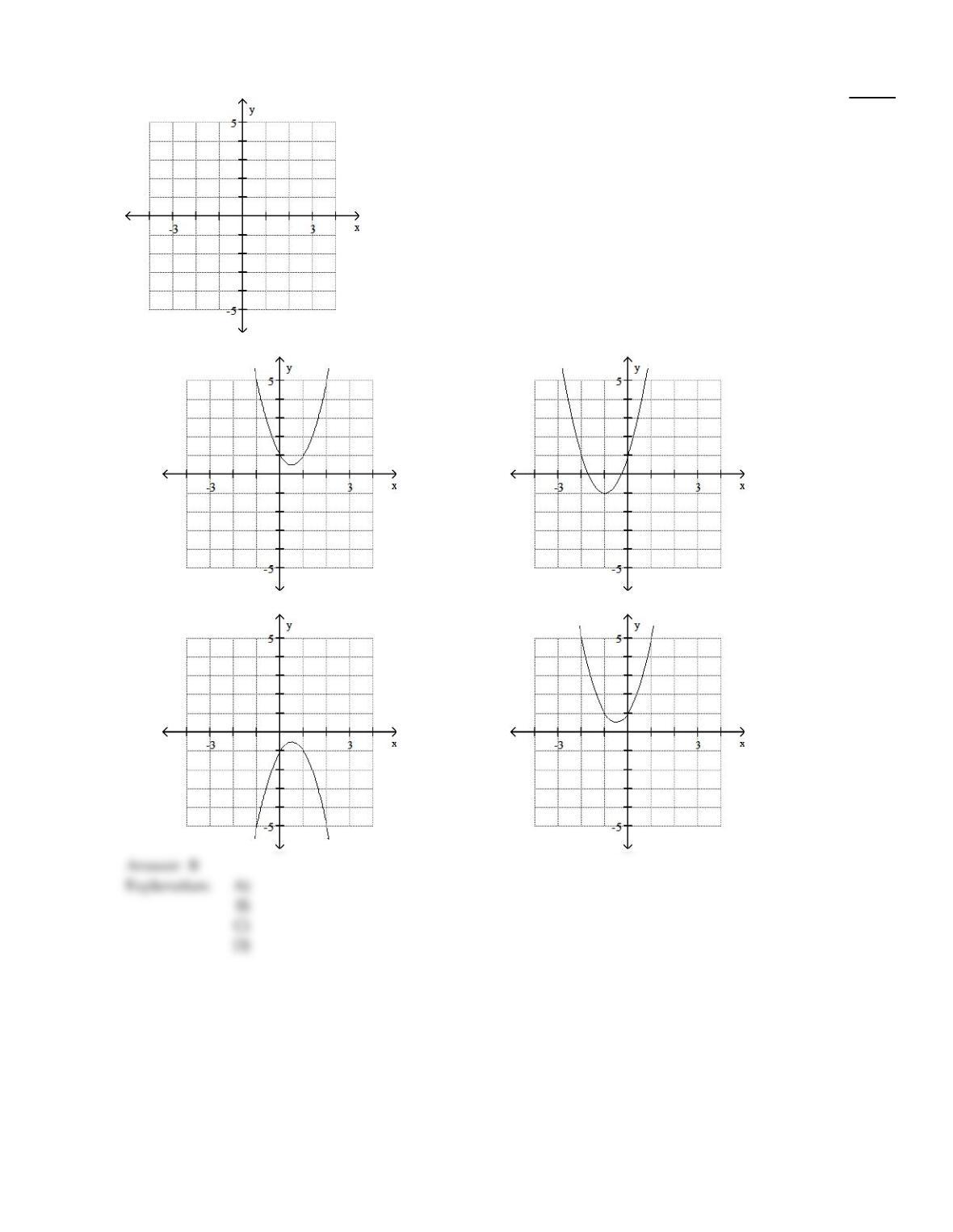
f(x) =2x2+4x + 1
183)
A)
B)
C)
D)
76
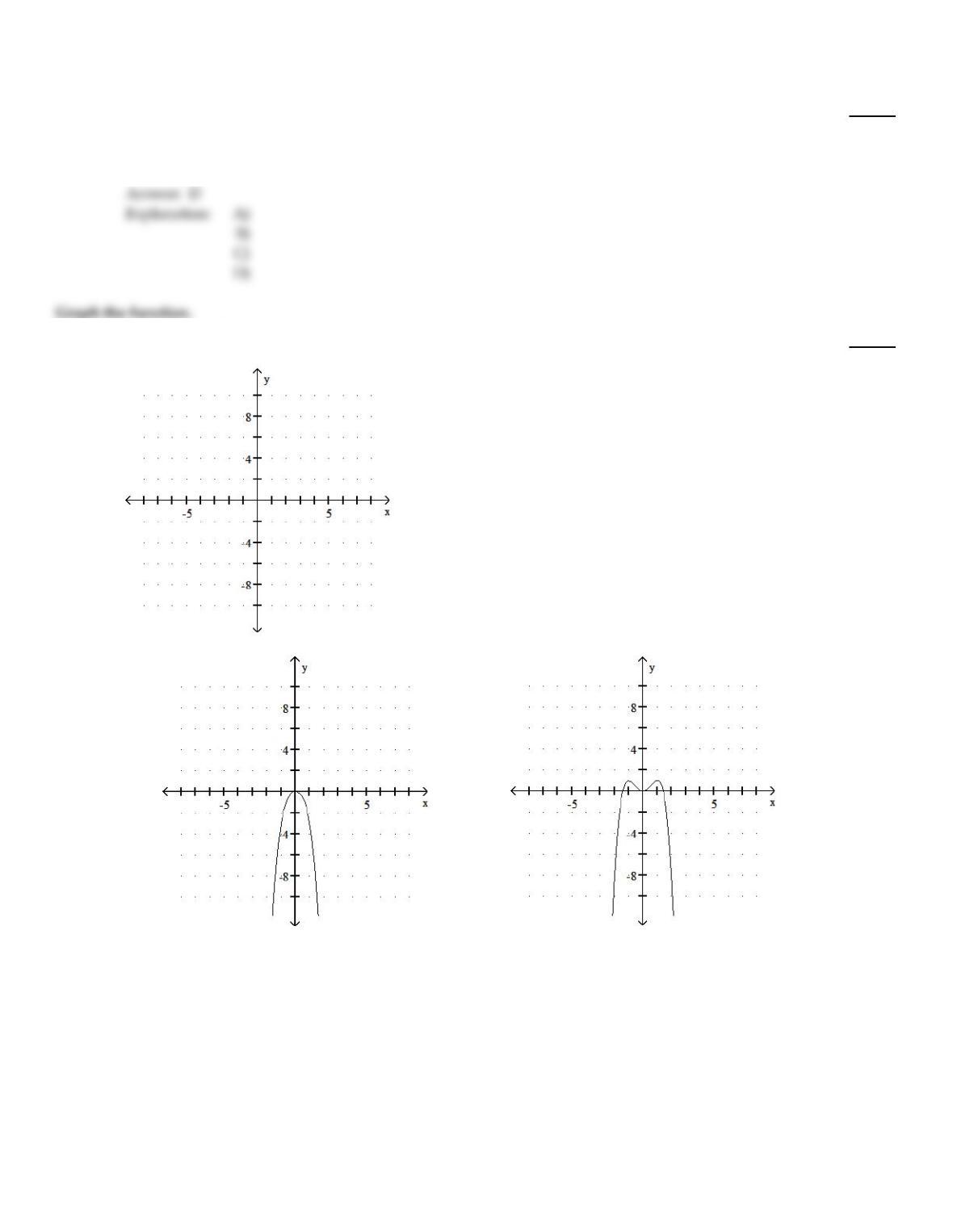
Solve the problem.
184)
Water is discharged from a pipeline at a velocity v given by v =1602p(1/2), where p is the pressure
(in psi). If the water pressure is changing at a rate of 0.447 psi/second, find the acceleration (dv/dt)
of the water when p =37 psi.
184)
A)
131.68 ft/sec2
B)
2177.91 ft/sec2
C)
48.72 ft/sec2
D)
58.86 ft/sec2
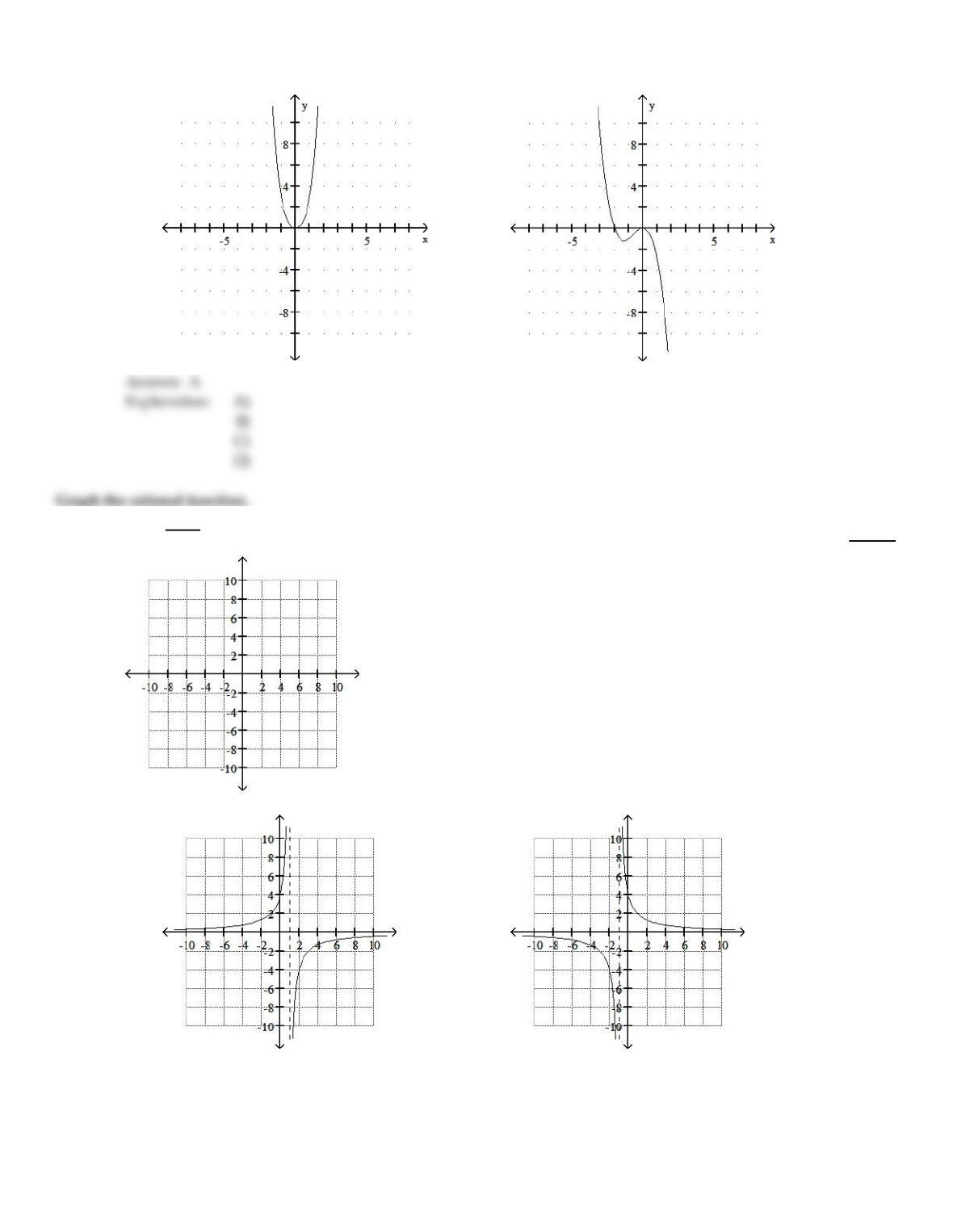
185)
f(x) = –x4–2x2
185)
A)
B)
77
C)
D)
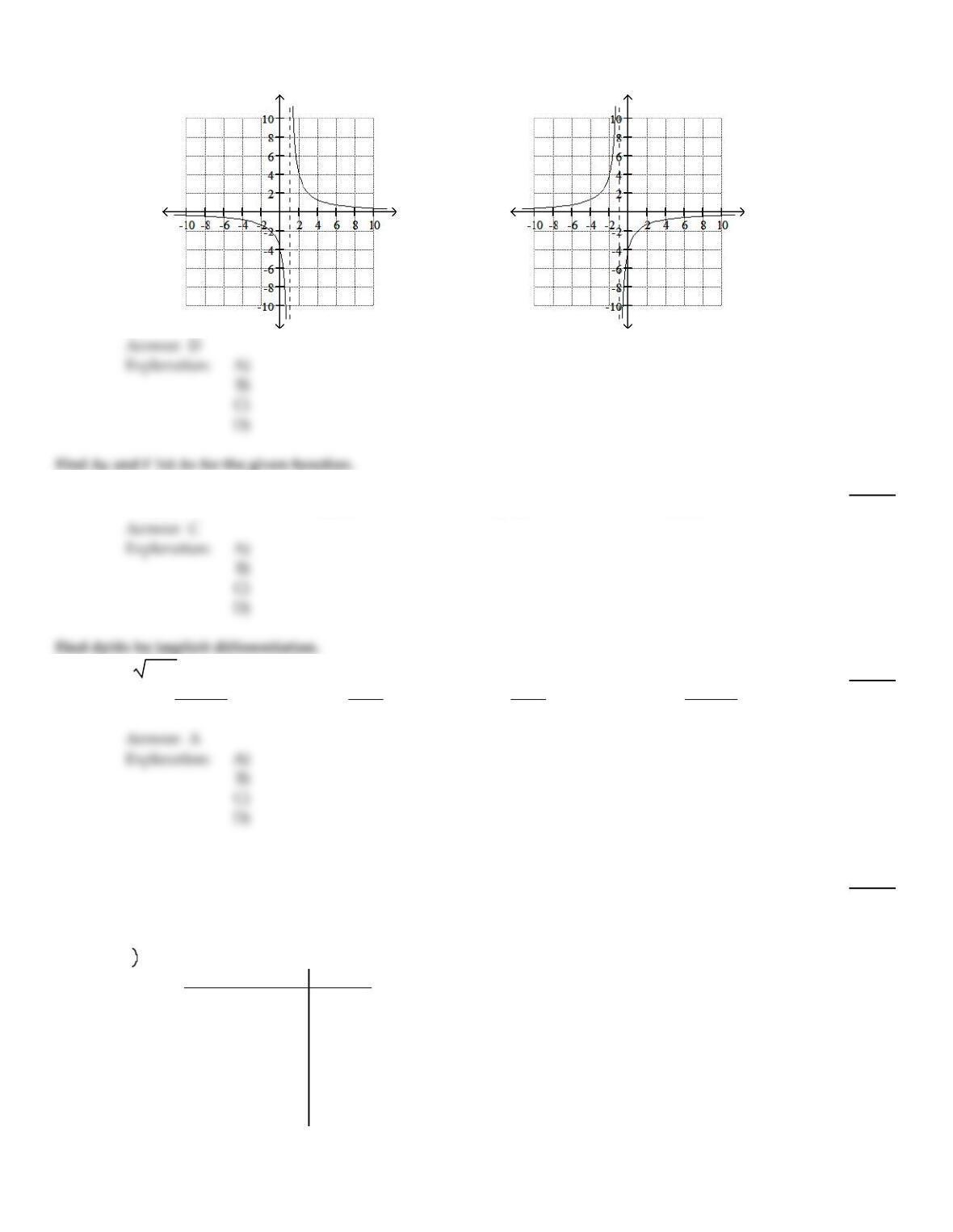
186)
f(x) =–4
x + 1
186)
A)
B)
78
C)
D)
187)
y = f(x) = 2x – 1, x =3, and x =3
187)
A)
7; 6
B)
8; 6
C)
6; 6
D)
5; 6
188)
yx + 1 = 4
188)
A)
–y
2(x + 1)
B)
–2y
x + 1
C)
2y
x + 1
D)
y
2(x + 1)
Solve the problem.
189)
In baseball, a pitcher’s earned–run average (the average number of runs given up every 9 innings,
or 1 game) is given by E = 9 (n/i) , where n is the number of earned runs allowed and i is the
number of innings pitched. Suppose we fix the number of earned runs allowed at 6 and let i vary.
a Complete the following table, rounding to two decimal places.
Innings pitched (i) ERA (E)
18
14
10
6
2
2/3
1/3
189)
79
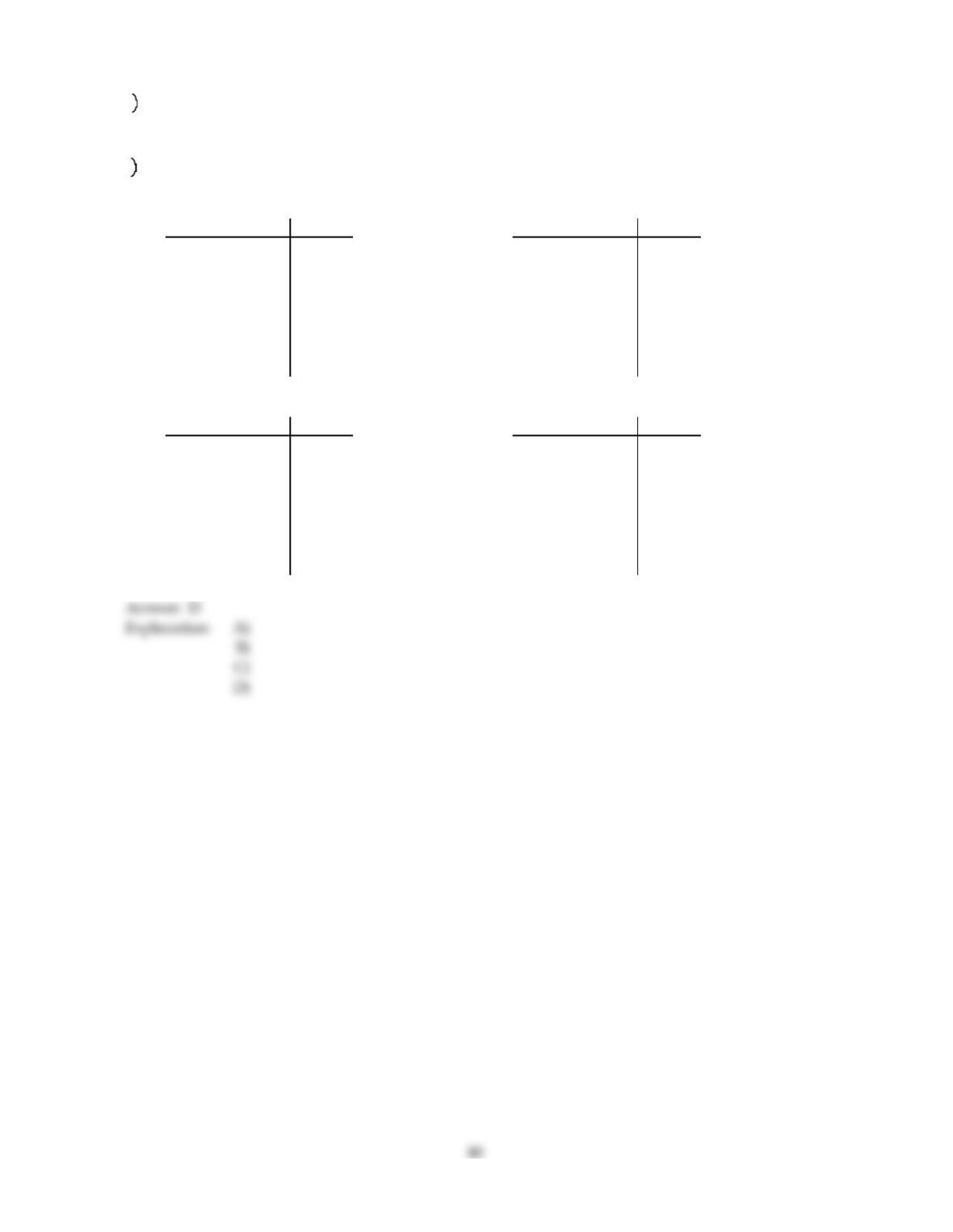
b Find lim
i
0+E(i).
c On the basis of Parts (a) and (b), determine a pitcher’s earned–run average if 6 runs were
allowed and there were 0 outs.
A)
Innings pitched (i) ERA (E)
18
14
10
6
2
3
3.86
5.4
9
27
2/3 81
1/3 162
162; 324
B)
Innings pitched (i) ERA (E)
18
14
10
6
2
3
3.86
5.4
9
27
2/3 81
1/3 162
–; –
C)
Innings pitched (i) ERA (E)
18
14
10
6
2
3
3.86
5.4
9
27
2/3 81
1/3 162
; 0
D)
Innings pitched (i) ERA (E)
18
14
10
6
2
3
3.86
5.4
9
27
2/3 81
1/3 162
;
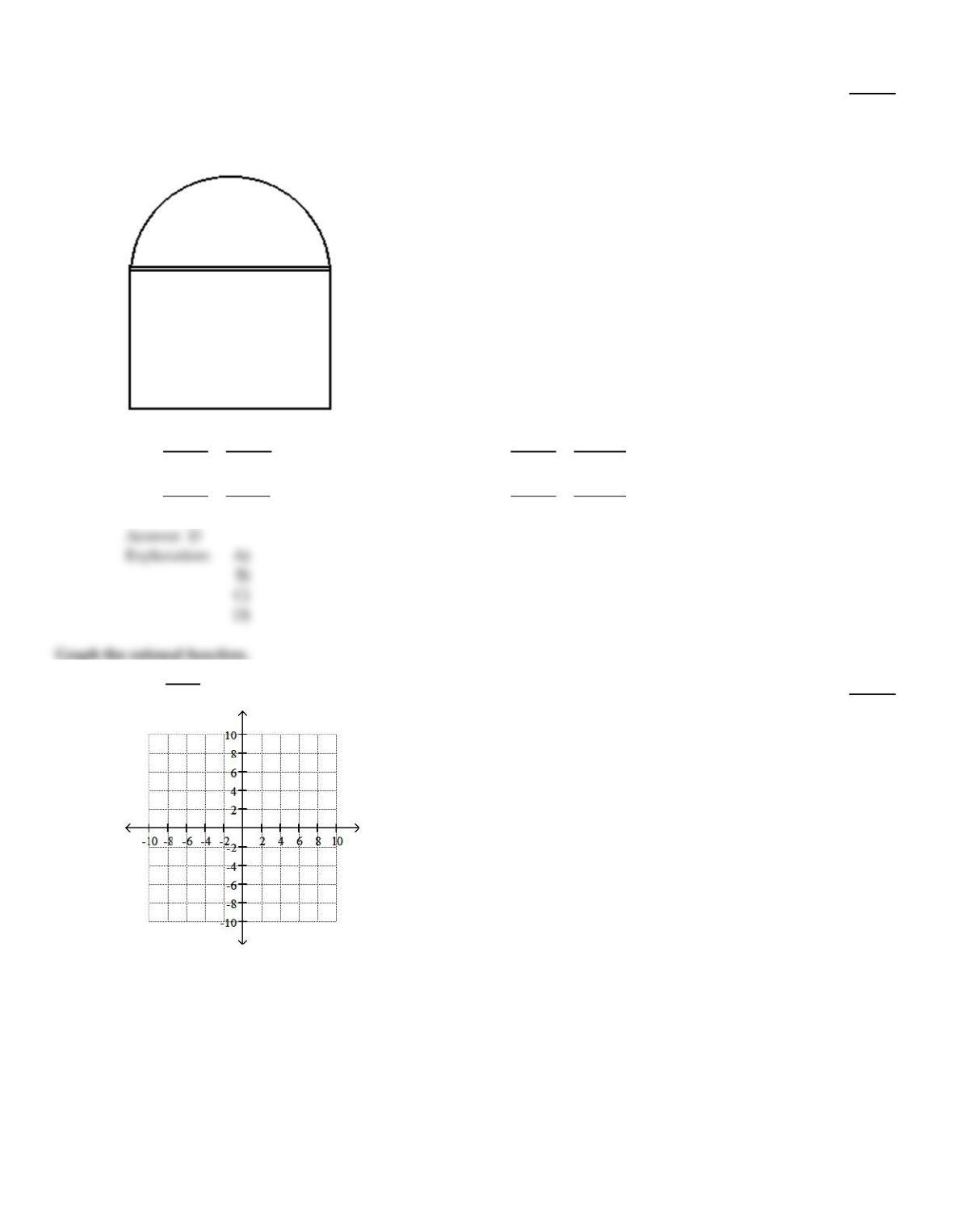
190)
A window is in the form of a rectangle surmounted by a semicircle. The rectangle is of clear glass,
whereas the semicircle is of tinted glass that transmits only one–fifth as much light per unit area as
clear glass does. The total perimeter is fixed. Find the proportions of the window that will admit
the most light. Neglect the thickness of the frame.
190)
A)
width
height =20
5+4
B)
width
height =5
10 +4
C)
width
height =20
10 +
D)
width
height =20
10 +4
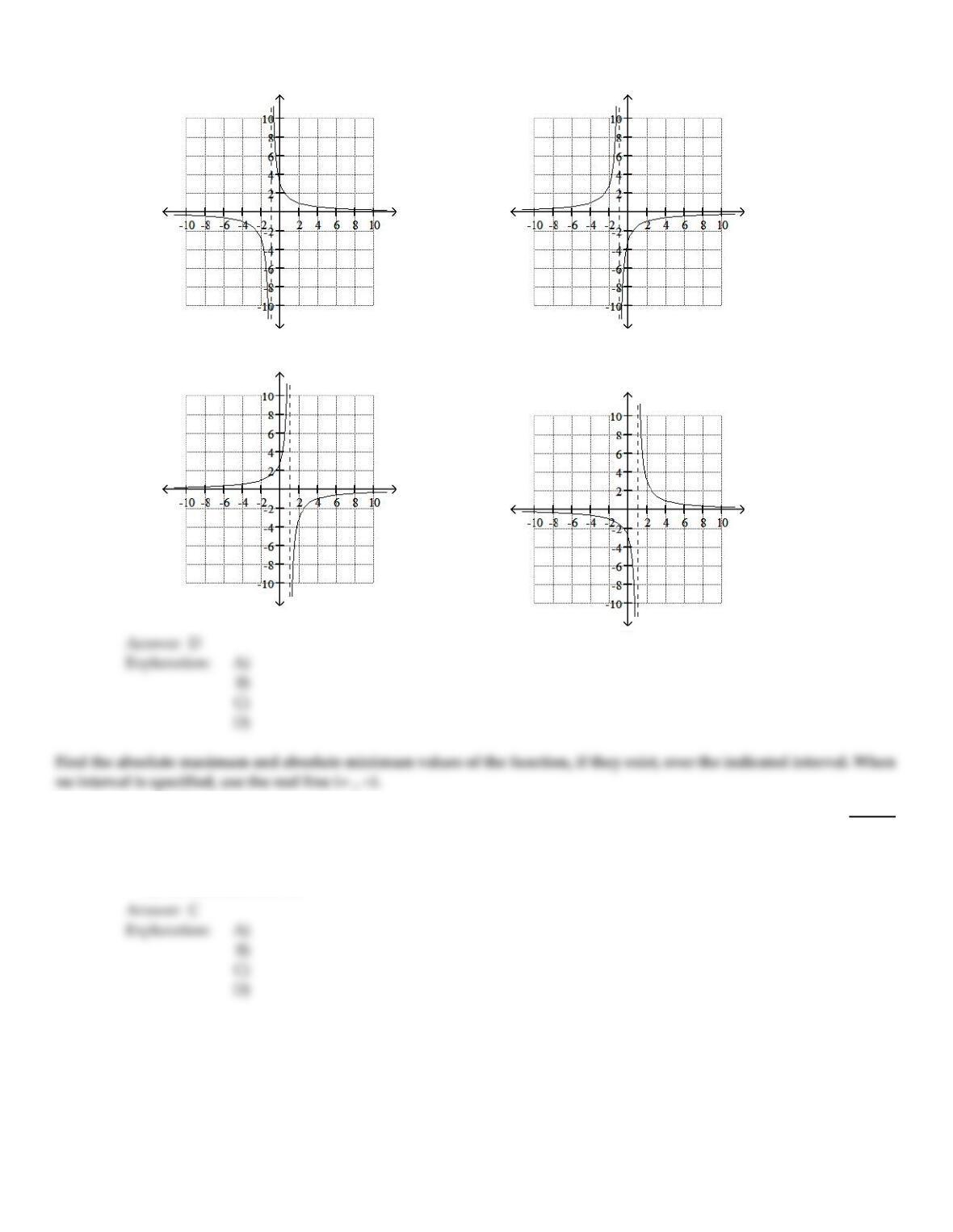
191)
f(x) =3
x – 1
191)
81
A)
B)
C)
D)
192)
f(x) = 2x2–12x +75
192)
A)
Absolute maximum: 129; absolute minimum: 57
B)
Absolute maximum: 57; no absolute minimum
C)
No absolute maximum; absolute minimum: 57;
D)
No absolute extrema
82
Find the relative extrema of the function, if they exist.
193)
f(x) =x + 1
x2+3x +3
193)
A)
Relative maximum at 0, 1
3; relative minimum at –2, –1
B)
Relative minimum at 0, 1
3; relative maximum at –2, 1
3
C)
No relative extrema exist
D)
Relative maximum at (0, 3); relative minimum at –2, 1
3
Solve the problem.
194)
Maximize Q =x2y, where x and y are positive numbers, such that x + y =480.
194)
A)
x =120, y =360
B)
x =160, y =320
C)
x =360, y =120
D)
x =320, y =160
Find y and f(x) x for the given function.
195)
y = f(x) = x –x2, x =5, and x =0.05
195)
A)
–0.4525; –0.36
B)
–0.45; –0.36
C)
–0.4525; –0.45
D)
–0.4525; –0.543
Determine whether the statement is true or false.
196)
If E(x) < 1 for a particular value of x, an increase in price will bring a decrease in revenue.
196)
A)
True
B)
False
Solve the problem.
197)
Of all numbers whose difference is 2, find the two that have the minimum product.
197)
A)
1 and –1
B)
1 and 3
C)
0 and 2
D)
4 and 2
Determine whether the statement is true or false.
198)
If demand is elastic for a particular value of p, an increase in price will bring an increase in
revenue.
198)
A)
True
B)
False
Solve the problem.
199)
A truck burns fuel at the rate (gallons per mile) of G(x) =1
31 81
x+x
25 while traveling at x mph. If
fuel costs $1.3 per gallon, find the speed that minimizes fuel cost for a 200–mile trip.
199)
A)
32.5 mph
B)
45 mph
C)
53 mph
D)
56 mph
200)
f(x) =7
x2
200)
A)
B)
84
C)
D)
201)
lim
x–
5 –3x2
12 –5x
201)
A)
3
5
B)
5
12
C)
D)
Solve the problem.
202)
Minimize Q =3x2+5y2, where x + y =8.
202)
A)
x =5; y =3
B)
x = 0; y =8
C)
x =3; y =5
D)
x =8; y = 0
203)
lim
x
7x5–6x2+10
3 – 2x –x4
203)
A)
7
B)
–7
C)
D)
–
204)
f(x) =7x –x3
204)
A)
(0, 0)
B)
(1, 7)
C)
(0, 0), (1, 7)
D)
No points of inflection exist
205)
f(x) =x + 3
x2+ 7x + 12
205)
A)
86
B)
C)
D)
87
206)
f(x) = x 25 –x2
206)
A)
Concave up on (–5, 0), concave down on (0, 5)
B)
Concave up on (–, 0), concave down on (0, )
C)
Concave down on (–5, 0), concave up on (0, 5)
D)
Concave up on (–, )
A
207)
y = x –x2, x =2, dx =0.05
207)
A)
–0.15
B)
–0.1525
C)
–0.12
D)
–0.183
A
208)
lim
x
3x – 5
16x
208)
A)
–5
B)
1
8
C)
–4
D)
3
16
D
Differentiate implicitly to find the slope of the curve at the given point.
209)
xy + x = 2; (1, 1)
209)
A)
2
B)
2
D
–1
C)
1
D)
– 2
88
Solve the problem.
210)
In baseball, a pitcher’s earned–run average (the average number of runs given up every 9 innings,
or 1 game) is given by
E = 9 ·n
i ,
where n is the number of earned runs allowed and i is the number of innings pitched. Suppose we
fix the number of earned runs allowed at 3 and let i vary.
Find lim
i
0+E(i).
210)
A)
0
B)
9
C)
3
D)
211)
y = f(x) = x , x =2, and x =0.05
211)
A)
0.01768; 0.01768
B)
0.01757; 0.01768
C)
0.01757; 0.01757
D)
0.01757; 0.03536
212)
f(x) =x3–5x4
212)
A)
Increasing on , 3
20 , decreasing on 3
20,
B)
Increasing on , –3
20 and 0, 3
20 , decreasing on –3
20, 0 and 3
20,
C)
Decreasing on , 3
20 , increasing on 3
20,
D)
Decreasing on , –3
20 and 0, 3
20 , increasing on –3
20, 0 and 3
20,
213)
q = D(x) =335
(4x +5)2
213)
A)
E(x) =8
4x +5
B)
E(x) =2x
4x+5
C)
E(x) =8x(4x +5)
D)
E(x) =8x
4x +5
214)
y2+ xy +x2=8
214)
A)
–36
(x – 2y)3
B)
36
(x + 2y)3
C)
–36
(x + 2y)3
D)
36
(x – 2y)3
215)
f(x) =6x + 5; [–3, 2)
215)
A)
No absolute maximum, absolute minimum: –13
B)
Absolute maximum: 17, absolute minimum: –13
C)
Absolute maximum: 17, no absolute minimum
D)
No absolute extrema.
216)
f(x) =x2(4 – x)2
216)
A)
Relative minimum: (0,0), relative minimum: (4, 0)
B)
Relative minimum: (0,0), relative maximum: 2, 16 , relative minimum: (4, 0)
C)
Relative maximum: (0,0), relative minimum: 2, 16
D)
Relative maximum: (0,0), relative minimum: 2, 16 , relative maximum: (4, 0)
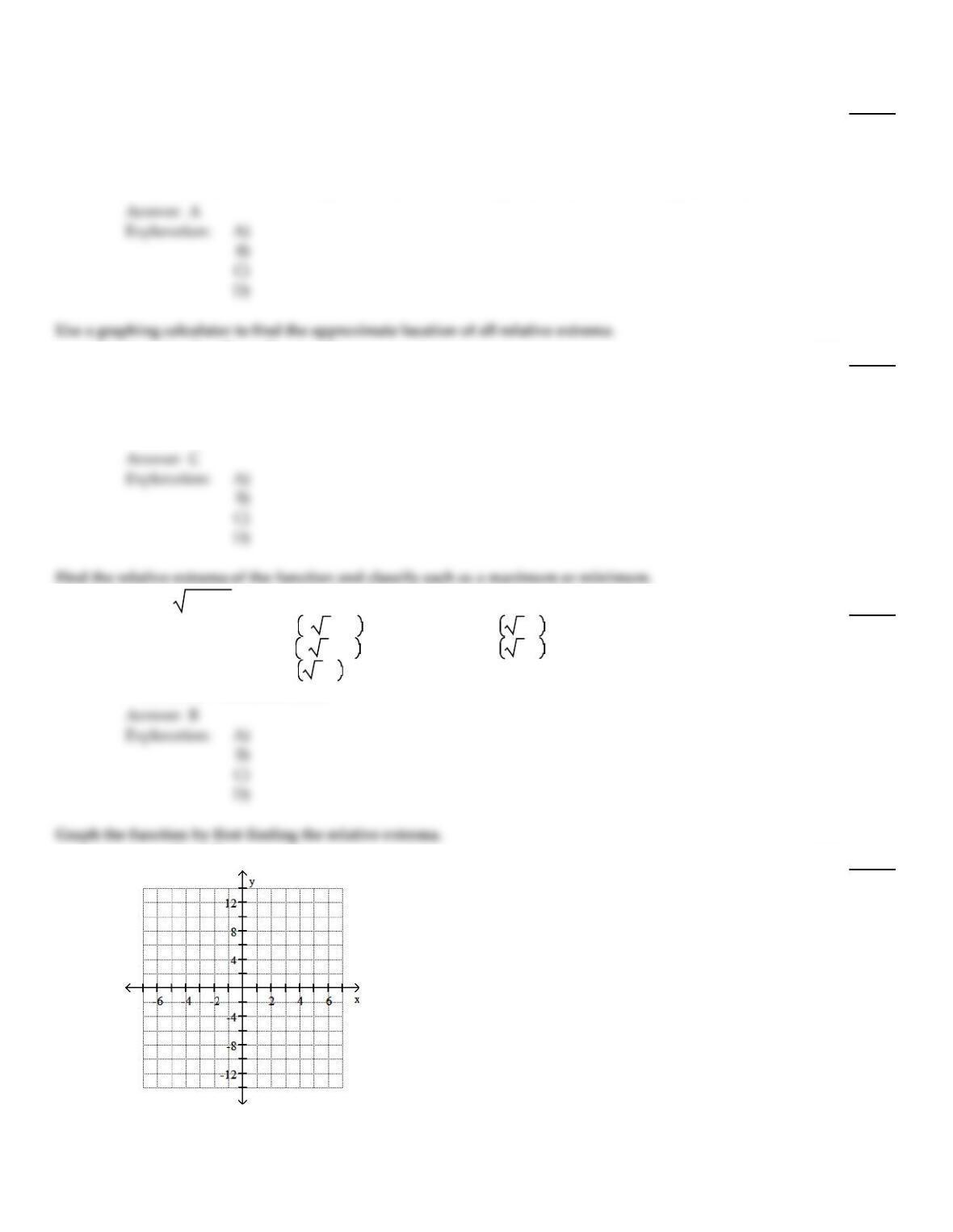
Solve the problem.
217)
Find the number of units that must be produced and sold in order to yield the maximum profit,
given the following equations for revenue and cost:
R(x) =3x
C(x) =0.001x2+0.7x +10.
217)
A)
1150 units
B)
3700 units
C)
2300 units
D)
1850 units
218)
f(x) =0.1x4–x3– 15x2+ 59x + 14
218)
A)
Relative maximum at x =1.764; relative minima at x = –6.783 and x =12.64
B)
Relative maximum at x =1.702; relative minima at x = –6.681 and x =12.491
C)
Relative maximum at x = 1.735; relative minima at x = –6.777 and x = 12.542
D)
Relative maximum at x =1.792; relative minima at x = –6.694 and x =12.455
219)
f(x) = x 16 –x2
219)
A)
Relative maximum: –8, –8, relative minimum: 8, 8
B)
Relative minimum: –8, –8, relative maximum: 8, 8
C)
Relative maximum: 8, 8
D)
Relative minimum: (0,0)
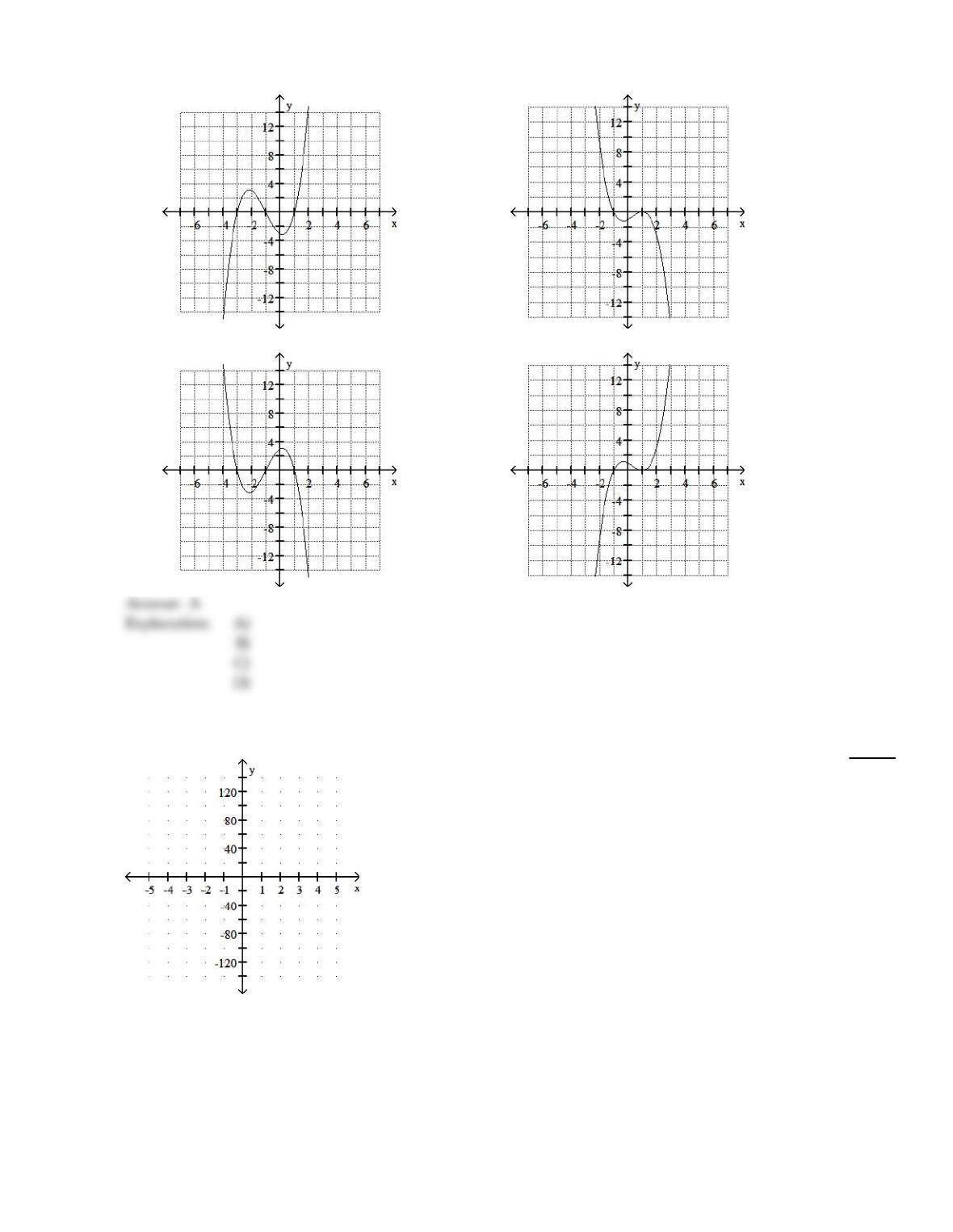
220)
f(x) =x3+3x2– x –3
220)
91
A)
B)
C)
D)
Graph the function.
221)
h(x) =x5– 80x
221)
92
A)
B)
C)
D)
Solve the problem.
222)
The Olympic flame at the 1992 Summer Olympics was lit by a flaming arrow. As the arrow moved
d feet horizontally from the archer, assume that its height h, in feet, was approximated by the
function
h = –0.002d2+0.7d +6.7.
Find the relative maximum of the function.
222)
A)
relative maximum at (175, 67.95)
B)
relative maximum at (175, 61.25)
C)
relative maximum at (0, 6.7)
D)
relative maximum at (350, 129.2)
A
C
223)
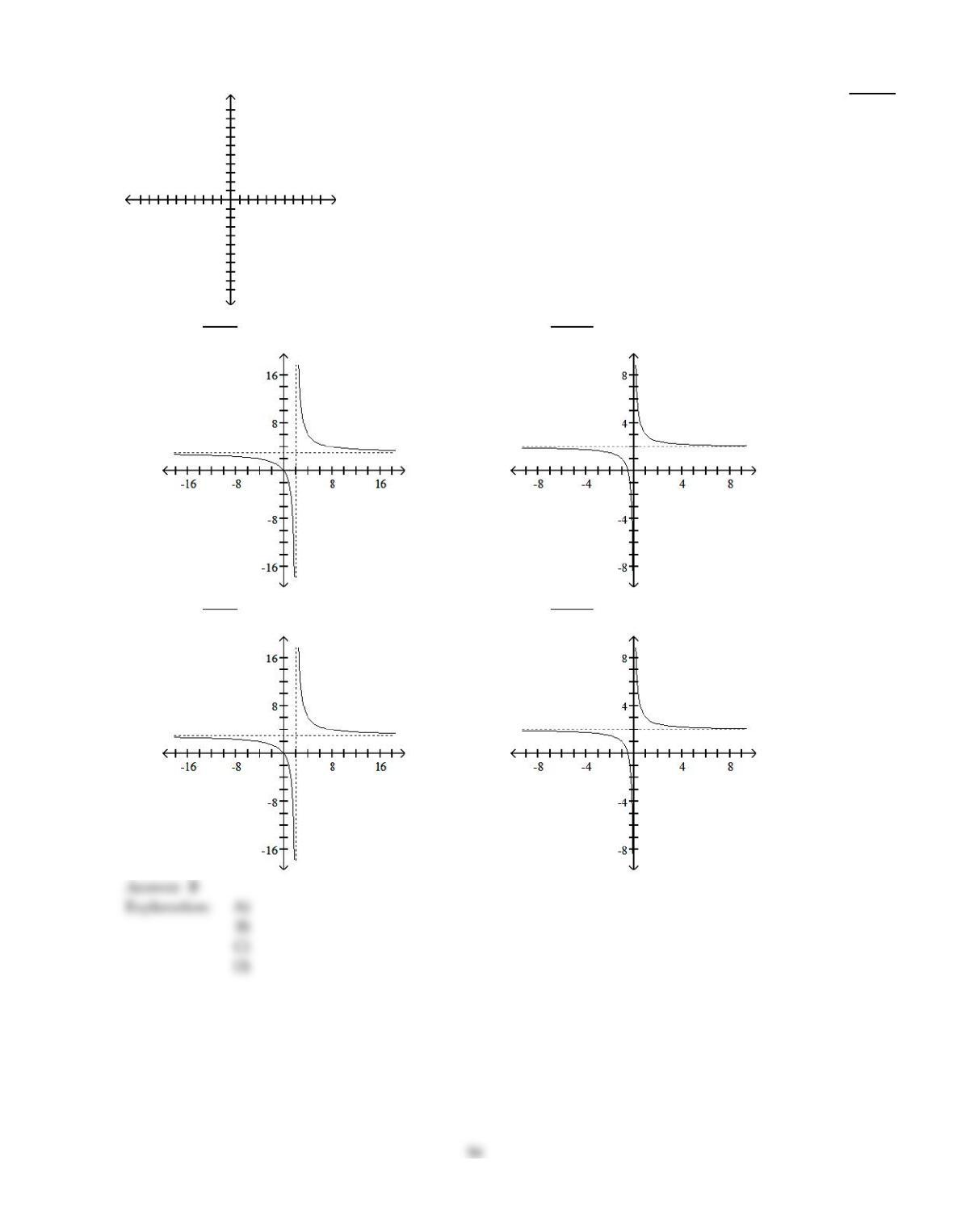
The function f has a vertical asymptote at x = 0, a horizontal asymptote at y =2, and f(1) =3.
223)
A)
f(x) =3x
x +2
B)
f(x) =2x + 1
x
C)
f(x) =3x
x –2
D)
f(x) =2x – 1
x
224)
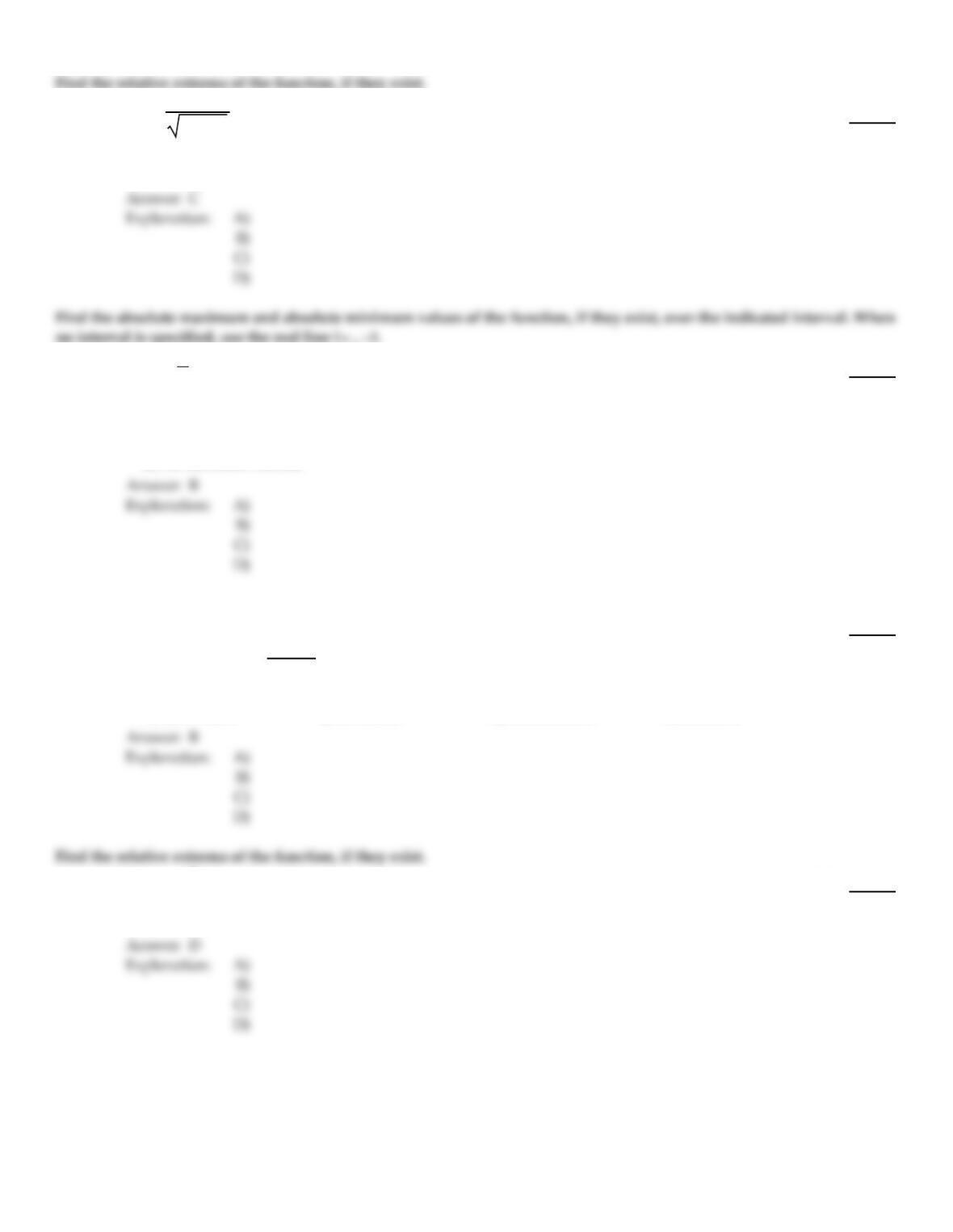
f(x) =8
1 –6x2
224)
A)
No relative extrema exist
B)
Relative minimum at (2, 8)
C)
Relative minimum at (0, 8)
D)
Relative maximum at (0, 8)
225)
f(x) = – 1
3x3+4x – 1; ( , 0)
225)
A)
Absolute minimum: –4.3; absolute maximum: 6.3
B)
No absolute maximum; absolute minimum: –6.3
C)
Absolute maximum: 2; absolute minimum: –2
D)
No absolute extrema
Solve the problem.
226)
A company knows that unit cost C(x) and unit revenue R(x) from the production and sale of x units
are related by C(x) =[R(x)]2
96,000 + 6977. Find the rate of change of revenue per unit when the cost per
unit is changing by $9 and the revenue is $2000.
226)
A)
$697.7/unit
B)
$216/unit
C)
$456.85/unit
D)
$90/unit
227)
f(x) = –4x3+4
227)
A)
Relative maximum at (0, –4)
B)
Relative minimum at (0, 4)
C)
Relative maximum at (0, 4)
D)
No relative extrema exist
95
Solve the problem.
228)
The velocity of a particle (in ft
s) is given by v = t2– 6t + 2, where t is the time (in seconds) for which
it has traveled. Find the time at which the velocity is at a minimum.
228)
A)
2 s
B)
1 s
C)
6 s
D)
3 s
229)
If demand is inelastic for a particular value of x, a small increase in price will cause a percentage
decrease in the quantity sold that is smaller than the percentage change in price.
229)
A)
True
B)
False
230)
x = D(x) =500– x
230)
A)
250
B)
1000
C)
500
D)
1000
3
231)
f(x) =x(x – 1)
x3+9x
231)
A)
x = 0
B)
x = 0, x = –3, x =3
C)
x = 0, x = –9
D)
x = –3, x =3
232)
x2+ 3y2= 13; (1, 2)
232)
A)
–1
6
B)
– 6
C)
1
6
D)
6
96
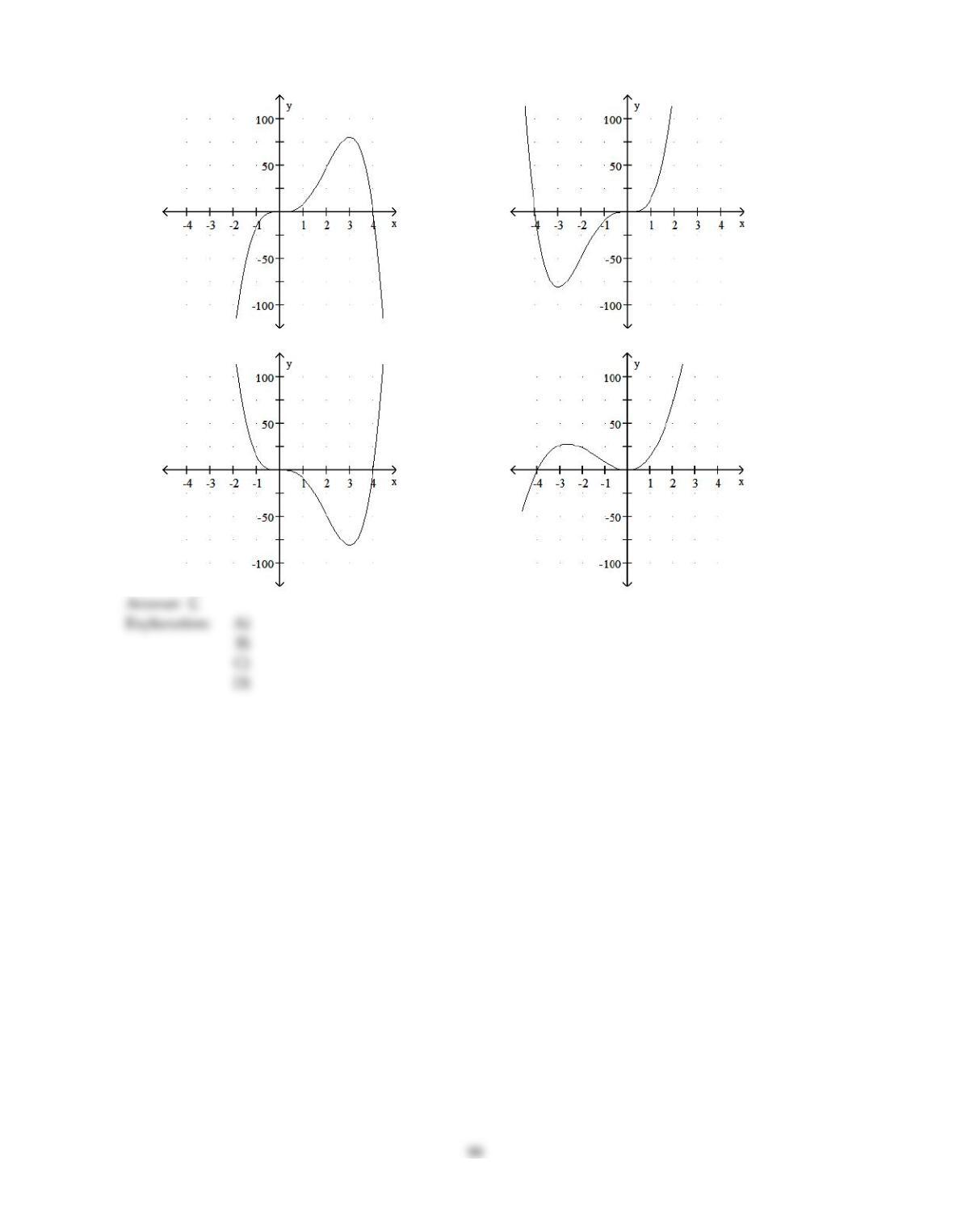
Solve the problem.
233)
Given the revenue and cost functions R(x) =32x – 0.4x2 and C(x) =6x + 14, where x is the daily
production, find the rate of change of profit with respect to time when x =10 units and
dx
dt =5 units per day.
233)
A)
$120/day
B)
$90/day
C)
$126/day
D)
$122/day
234)
f(x) =2
3x3–1
2x2– x +8; [0, 2]
234)
A)
Absolute maximum =9.33 at x = 2; absolute minimum =7.17 at x = 1
B)
Absolute maximum =9.33 at x = 2; absolute minimum =8.29 at x = 0
C)
Absolute maximum =8 at x = 2; absolute minimum =7.17 at x = 1
D)
Absolute maximum =8.29 at x = 0; absolute minimum =7.17 at x = 1
235)
f(x) =3x
x2+ 1
235)
A)
Relative minimum: (0, 0)
B)
Relative minimum: (1, 0), relative maximum: (–1, 0)
C)
Relative maximum: (0, 0)
D)
Relative minimum: –1, –3
2, relative maximum: 1 ,3
2
D
236)
f(x) =45x3– 3x5
236)
A)
Increasing on ( , –3) and (3, ), decreasing on (–3, 3)
B)
Decreasing on ( , –3) and (3, ), increasing on (–3, 3)
C)
Increasing on ( , –3) and (0, 3), decreasing on (–3, 0) and (3, )
D)
Decreasing on ( , –3) and (0, 3), increasing on (–3, 0) and (3, )
B
237)
g(x) = 3x4–12x3
237)
98
A)
B)
C)
D)
238)
Explain the idea of a related rate.
238)
A)
A function x = f(t) is a function of t, but x can generally be related to y if y is also a function of
t; that is, dx/dt
dx/dy.
B)
A function y = f(x) is a function of x, but if x can be expressed as a function of some other
variable, such as time, t, then y is also a function of t, and the dependence of y on t is related
to the dependence of x on t, which means, in turn, that the rate of change of y, dy/dt, is related
to the rate of change of x, dx/dt, by the relation dy
dt =dx
dy ·dt
dx .
C)
A function y = f(t) is a function of t, but y can generally be related to x if x is also a function of
t; that is, dy/dt
dx/dt.
D)
A function y = f(x) is a function of x, but if x can be expressed as a function of some other
variable, such as time, t, then y is also a function of t, and the dependence of y on t is related
to the dependence of x on t, which means, in turn, that the rate of change of y, dy/dt, is related
to the rate of change of x, dx/dt, by the relation dy
dt =dy
dx ·dx
dt .
Solve the problem.
239)
The cost of a computer system increases with increased processor speeds. The cost C of a system as
a function of processor speed is estimated as C =13S2– 7S + 1500, where S is the processor speed in
MHz. Find the processor speed for which cost is at a minimum.
239)
A)
2.2 MHz
B)
5.4 MHz
C)
0.4 MHz
D)
0.3 MHz
240)
A rectangular swimming pool 18 m by 10 m is being filled at the rate of 0.6 m3/min. How fast is the
height h of the water rising?
240)
A)
0.0033 m/min
B)
0.20 m/min
C)
108 m/min
D)
0.84 m/min
241)
f(x) = x +16
x; [–6, –1]
241)
A)
Absolute maximum: –8, absolute minimum: –26
3
B)
Absolute maximum: –8, absolute minimum: –15
C)
Absolute maximum: –26
3, absolute minimum: –17
D)
Absolute maximum: –8, absolute minimum: –17
242)
y = f(x) =x2, x =9, and x =0.03
242)
A)
0.5409; 0.03
B)
0.5409; 0.27
C)
0.5409; 0.54
D)
0.27; 0.27
243)
x3+y3=8
243)
A)
–2xy3+ 2x4
y5
B)
–2xy3+ 2x4
y6
C)
2xy3– 2x4
y5
D)
xy3–x4
y6
244)
f(x) =3x +5
244)
A)
Absolute maximum: 3; no absolute minimum
B)
No absolute maximum; absolute minimum: 3
C)
Absolute maximum: 5; no absolute minimum
D)
No absolute extrema
101
245)
q = D(x) =300–4x; x =62
245)
A)
1
13; inelastic
B)
62
13; elastic
C)
52; elastic
D)
13
62; inelastic
246)
f(x) =(x –2)1/3 +6
246)
A)
Increasing on ( , 2), decreasing on (2, )
B)
Decreasing on ( , 2), increasing on (2, )
C)
Increasing on ( , )
D)
Decreasing on ( , )
102
Answer Key
Testname: C2
Answer Key
Testname: C2
104
Answer Key
Testname: C2
105
Answer Key
Testname: C2
106
Answer Key
Testname: C2
Answer Key
Testname: C2
Answer Key
Testname: C2
Answer Key
Testname: C2
Answer Key
Testname: C2