161. Holiday Marina
The bookkeeper prepared the following journal entries during May. Assume that the descriptions of the entries
are correct.
Journal (partial):
Date
Accounts and Descriptions
Debit
Credit
May 5
Accounts Receivable
1,600
Service Revenue
1,600
Billed customers for services completed
May 11
Cash
500
Service Revenue
500
Collected from a customer billed on May 5 for services rendered
May 15
Office Supplies
700
Accounts Payable
700
Purchased furniture on credit; payment due in 30 days
May 25
Office Furniture
700
Cash
500
Paid the $700 furniture bill received on May 15
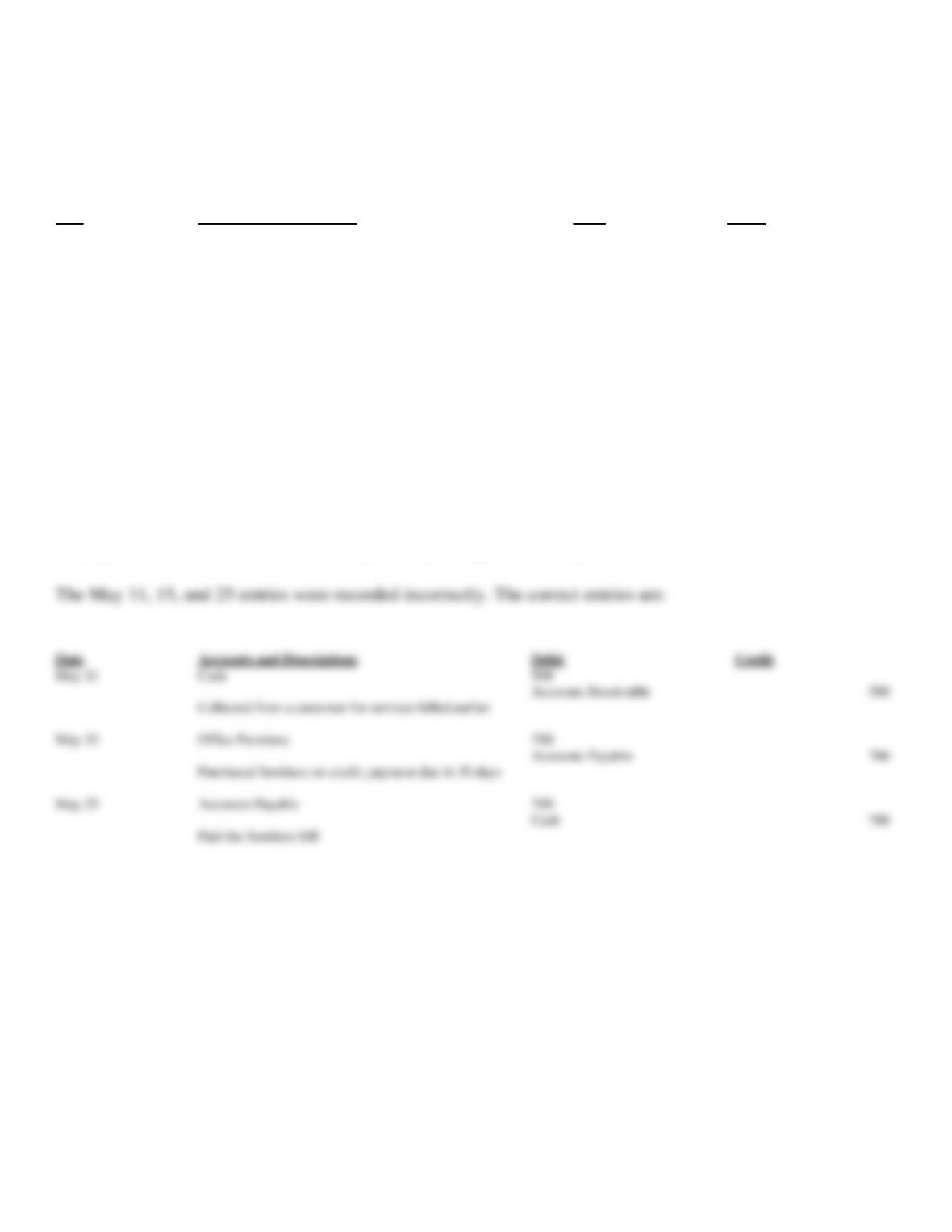
Refer to Holiday Marina. Identify the transactions that the bookkeeper recorded incorrectly in the journal. Prepare the journal entry that the
bookkeeper should have made for each transaction that you identify as being made incorrectly.
May 11
Cash
500
Accounts Receivable
Collected from a customer for services billed earlier
May 15
Office Furniture
Accounts Payable
Purchased furniture on credit; payment due in 30 days
May 25
Accounts Payable
Cash
Paid the furniture bill
162. Holiday Marina
The bookkeeper prepared the following journal entries during May. Assume that the descriptions of the entries
are correct.
Journal (partial):
Date
Accounts and Descriptions
Debit
Credit
May 5
Accounts Receivable
1,600
Service Revenue
1,600
Billed customers for services completed
May 11
Cash
500
Service Revenue
500
Collected from a customer billed on May 5 for services
rendered
May 15
Office Supplies
700
Accounts Payable
700
Purchased furniture on credit; payment due in 30 days
May 25
Office Furniture
700
Cash
500
Paid the $700 furniture bill received on May 15
Refer to Holiday Marina. Assume that the incorrect journal entries have been posted to the general ledger. For each incorrect journal entry, explain
why the error would or would not be discovered by preparing a trial balance.
163. Hatcher Tool Service
The following transactions occurred during June 2013:
June 1
Purchased a service truck for $25,500, paying $5,500 now and issuing a note payable for the balance; the note is due in
monthly installments of $500 plus 10% interest on the unpaid principal balance.
June 8
Performed services of $30,400. Received $6,400 cash from customers and $24,000 for customers billed for completed
services.
June 22
Issued common stock in exchange for land having a fair value of $70,000.
June 30
Received an invoice for $2,400 from the company’s advertising agency for radio and television ads which were run
during the month; the invoice is due in 30 days.
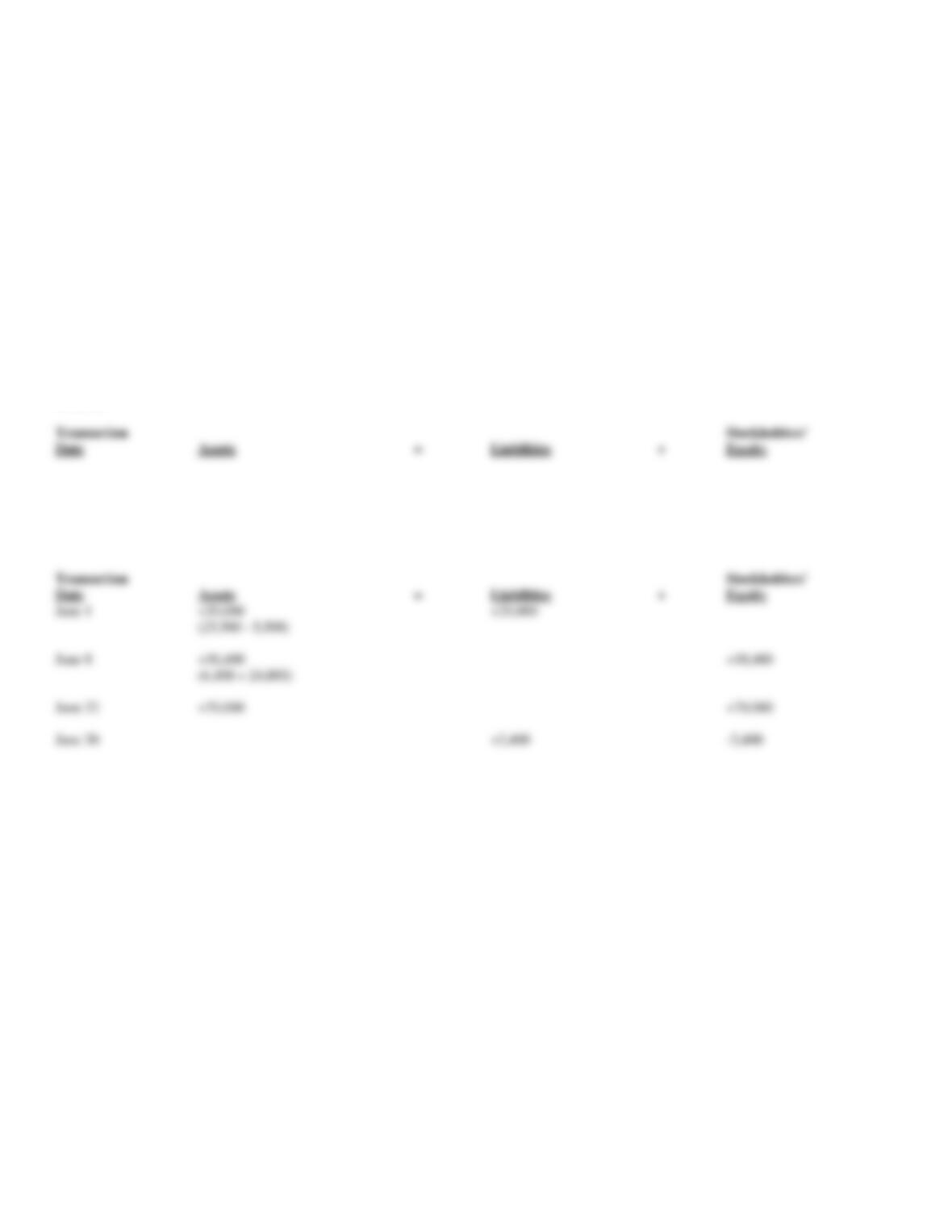
Refer to Hatcher Tool Service. Indicate the economic effects of each transaction above on the accounting equation. Use the following format for
your answers. Show the dollar amounts in the appropriate columns and use a plus (+) sign to indicate an increase and a minus (-) sign to indicate a
decrease.
June 1
+20,000
+20,000
(25,500 – 5,500)
June 8
+30,400
+30,400
(6,400 + 24,000)
June 22
+70,000
+70,000
June 30
+2,400
-2,400
164. Hatcher Tool Service
The following transactions occurred during June 2013:
June 1
Purchased a service truck for $25,500, paying $5,500 now and issuing a note payable for the balance; the note is due in
monthly installments of $500 plus 10% interest on the unpaid principal balance.
June 8
Performed services of $30,400. Received $6,400 cash from customers and $24,000 for customers billed for completed
services.
June 22
Issued common stock in exchange for land having a fair value of $70,000.
June 30
Received an invoice for $2,400 from the company’s advertising agency for radio and television ads which were run
during the month; the invoice is due in 30 days.
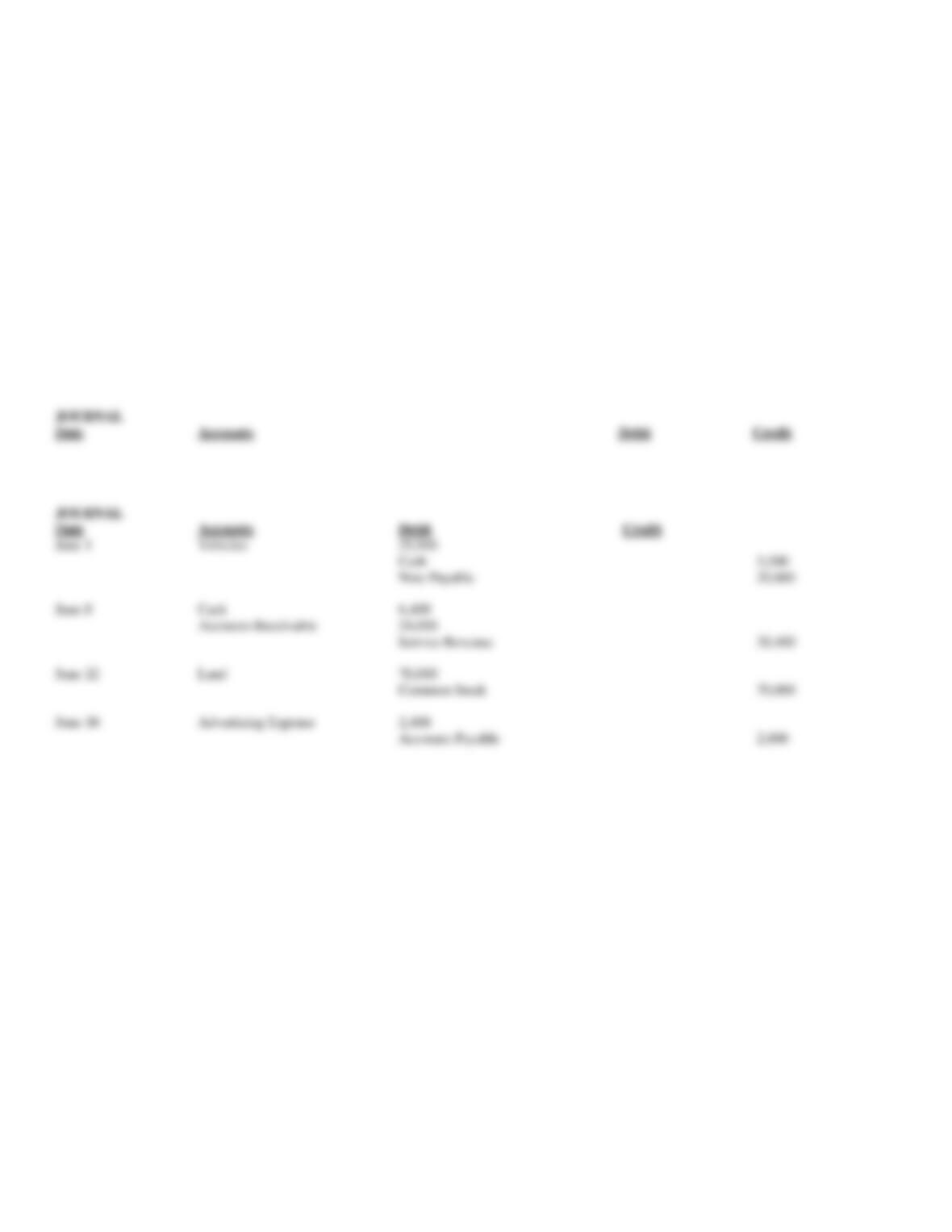
Refer to Hatcher Tool Service. Record each transaction in proper journal entry format in the journal provided. A written explanation for each journal
entry is not required.
June 1
Vehicles
25,500
Cash
5,500
Note Payable
20,000
June 8
Cash
6,400
Accounts Receivable
24,000
Service Revenue
30,400
June 22
Land
70,000
Common Stock
70,000
June 30
Advertising Expense
2,400
Accounts Payable
2,400
165. Hatcher Tool Service
The following transactions occurred during June 2013:
June 1
Purchased a service truck for $25,500, paying $5,500 now and issuing a note payable for the balance; the note is due in
monthly installments of $500 plus 10% interest on the unpaid principal balance.
June 8
Performed services of $30,400. Received $6,400 cash from customers and $24,000 for customers billed for completed
services.
June 22
Issued common stock in exchange for land having a fair value of $70,000.
June 30
Received an invoice for $2,400 from the company’s advertising agency for radio and television ads which were run
during the month; the invoice is due in 30 days.
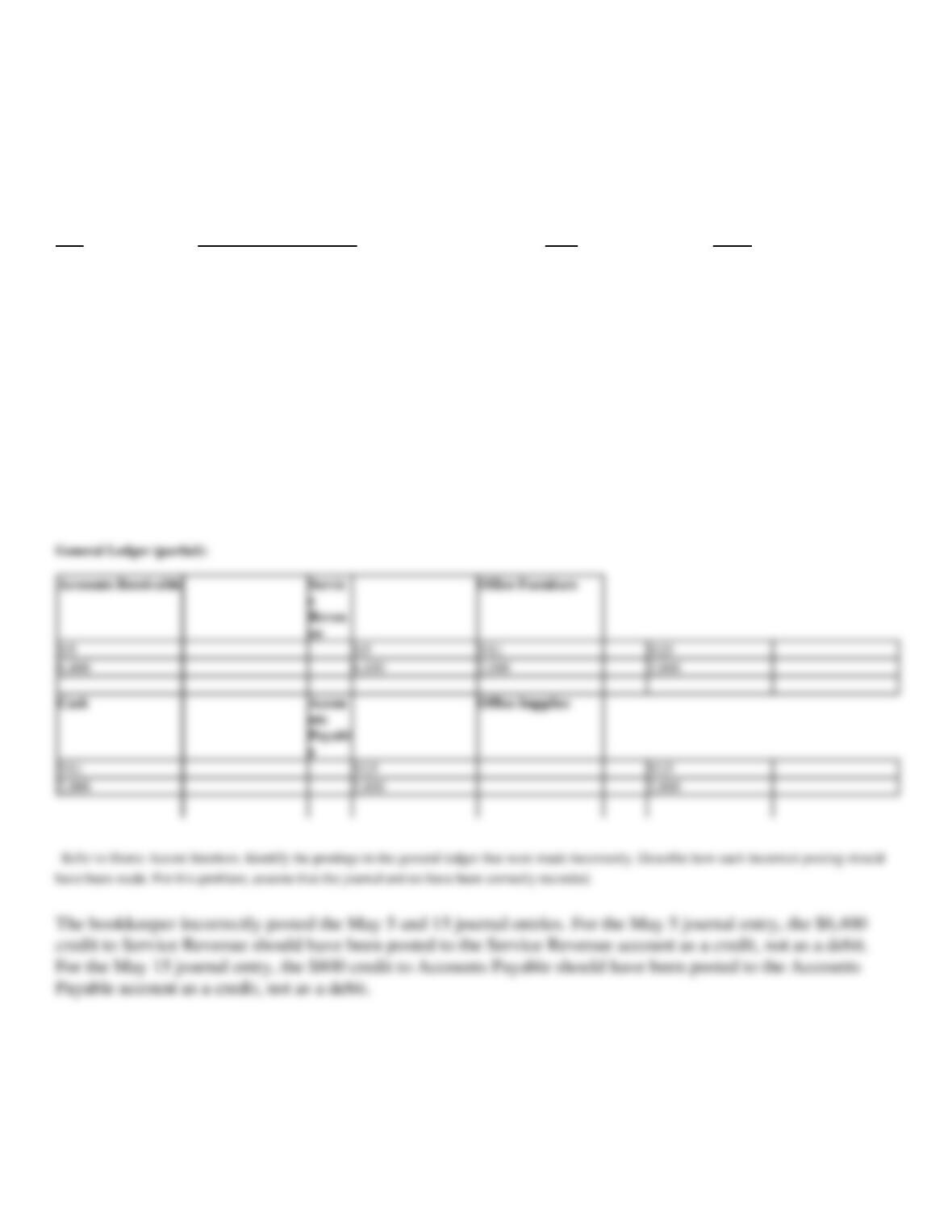
Refer to Hatcher Tool Service. Set up T-accounts and post each transaction to the T-accounts.
6/1
6/8
6/1
6/1
25,500
6,400
5,500
20,000
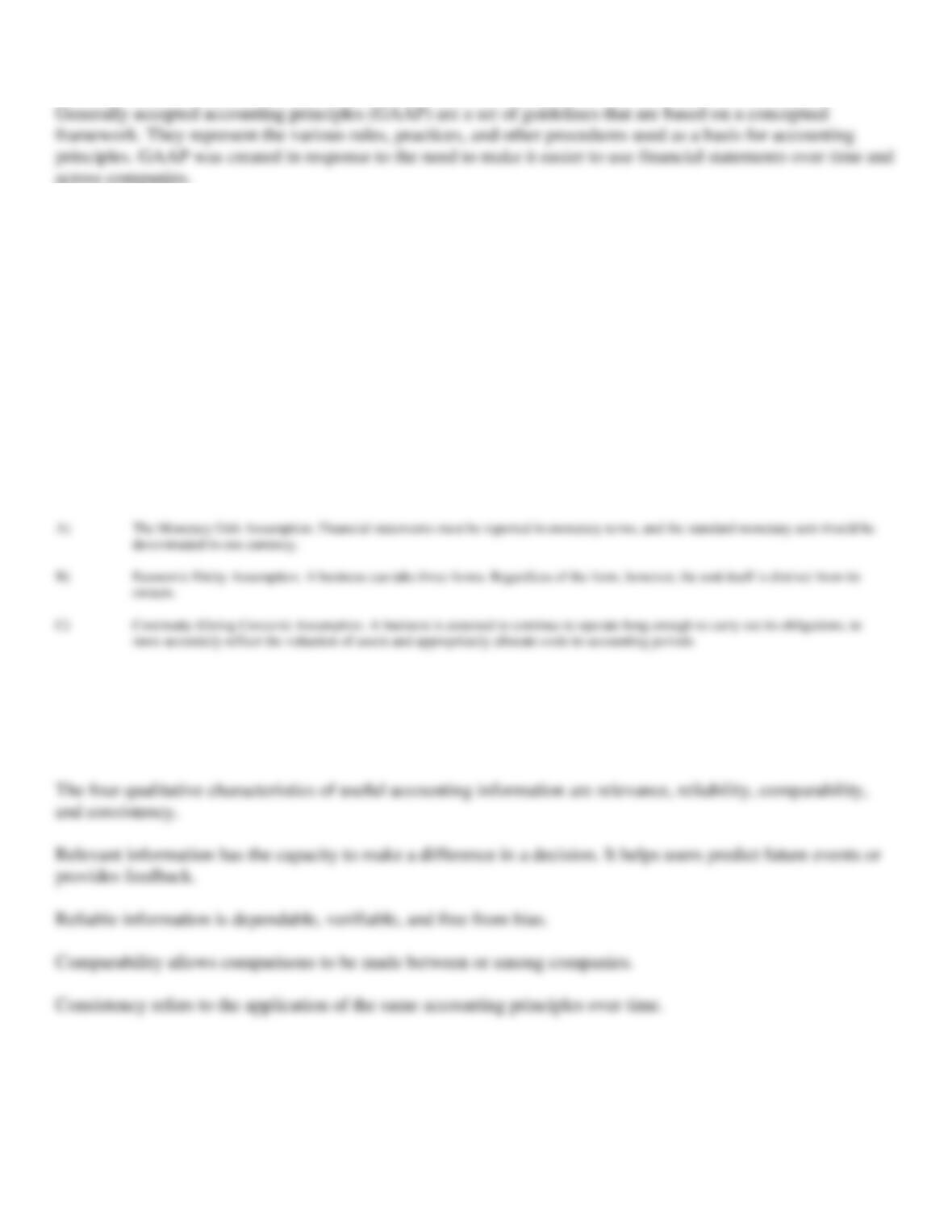
6/8
6/8
6/22
24,000
30,400
70,000
6/22
6/30
6/30
70,000
2,400
2,400
166. Hatcher Tool Service
The following transactions occurred during June 2013:
June 1
Purchased a service truck for $25,500, paying $5,500 now and issuing a note payable for the balance; the note is due in
monthly installments of $500 plus 10% interest on the unpaid principal balance.
June 8
Performed services of $30,400. Received $6,400 cash from customers and $24,000 for customers billed for completed
services.
June 22
Issued common stock in exchange for land having a fair value of $70,000.
June 30
Received an invoice for $2,400 from the company’s advertising agency for radio and television ads which were run
during the month; the invoice is due in 30 days.
Refer to Hatcher Tool Service. Prepare a trial balance in proper format. Assume that there are no additional accounts or balances other than those
created from the June transactions.
Trial Balance
June 30, 2013
Cash
$ 900
Accounts Receivable
24,000
Land
70,000
Vehicles
25,500
Accounts Payable
$ 2,400
Notes Payable
20,000
Common Stock
70,000
Service Revenue
30,400
Advertising Expense
2,400
$122,800
$122,800

167. The T-accounts presented below are taken from the general ledger of Health Force Corporation on March
31, 2012. Determine the balance of each account and present them in proper trial balance format.
Cash
Accounts Payable
Common Stock
5,000
12,000
3,200
4,200
30,000
9,000
650
24,000
44,000
15,200
36,000
650
8,000
16,100
Salaries Payable
Service
Revenue
3,000
650
5,000
21,000
24,000
16,400
9,000
10,000
3,200
22,000
750
36,000
Accounts Receivable
Unearned Revenue
Advertising Expense
21,000
8,000
22,000
44,000
4,200
3,000
Prepaid Insurance
Notes Payable
Salaries Expense
1,200
100
16,500
15,200
100
16,100
100
16,400
5,000
Equipment
Rent Expense
35,300
650
650
650
Insurance
Expense
100
100
100
Dividends
7,750
168. The list of accounts presented below are from the accounting records of Hoosier Momma Promotions on
September 30, 2012. Assume that each account balance is normal, and present them in proper trial balance
format.
Cash
$ 4,200
Short-term Investments
13,000
Accounts Receivable
4,500
Inventory
23,000
Land
90,000
Building
700,000
Furniture
450,000
Equipment
281,700
Accounts Payable
7,200
Salaries Payable
4,100
Unearned Revenue
17,000
Interest Payable
2,000
Notes Payable
70,000
Common Stock
460,000
Retained Earnings
977,000
Sales
158,000
Cost of Goods Sold
78,000
Salaries Expense
24,000
Rent Expense
6,000
Insurance Expense
1,000
Depreciation Expense
11,000
Utility Expense
900
Dividends
8,000
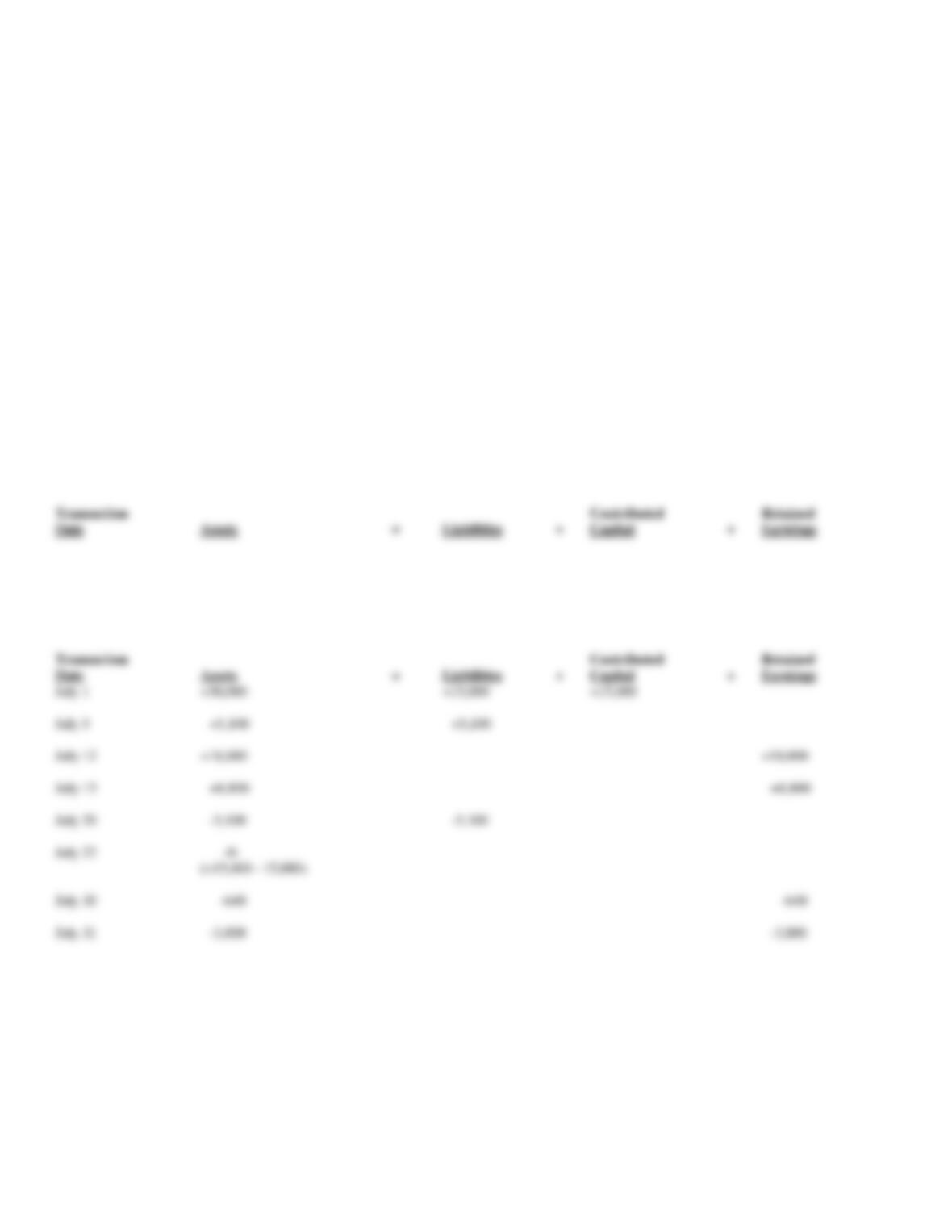
Trial Balance
Cash
$ 4,200
Short-term investments
13,000
Accounts Receivable
4,500
Inventory
23,000
Land
90,000
Building
700,000
Furniture
450,000
Equipment
281,700
Accounts Payable
$ 7,200
Salaries Payable
4,100
Unearned Revenue
17,000
Interest Payable
2,000
Notes Payable
70,000
Common Stock
460,000
Retained Earnings
977,000
Sales
158,000
Cost of Goods Sold
78,000
Salaries Expense
24,000
Rent Expense
6,000
Insurance Expense
1,000
Depreciation Expense
11,000
Utility Expense
900
169. H&R Clock Company
The following transactions were incurred during July 2014:
July 1
Raised $30,000 by issuing a note to the bank for $15,000 and issuing $15,000 of common stock.
July 5
Purchased $5,100 of office supplies on credit; payment is due in 30 days.
July 12
Performed $18,000 of services for customers on credit; collection is due in 30 days.
July 13
Performed services for customers and collected $8,800.
July 20
Paid for the supplies purchased on July 5.
July 22
Collected $15,000 of the amounts due from customers.
July 30
Received and paid the utility bill for the month of July, $640.
July 31
Paid employee salaries of $3,800.
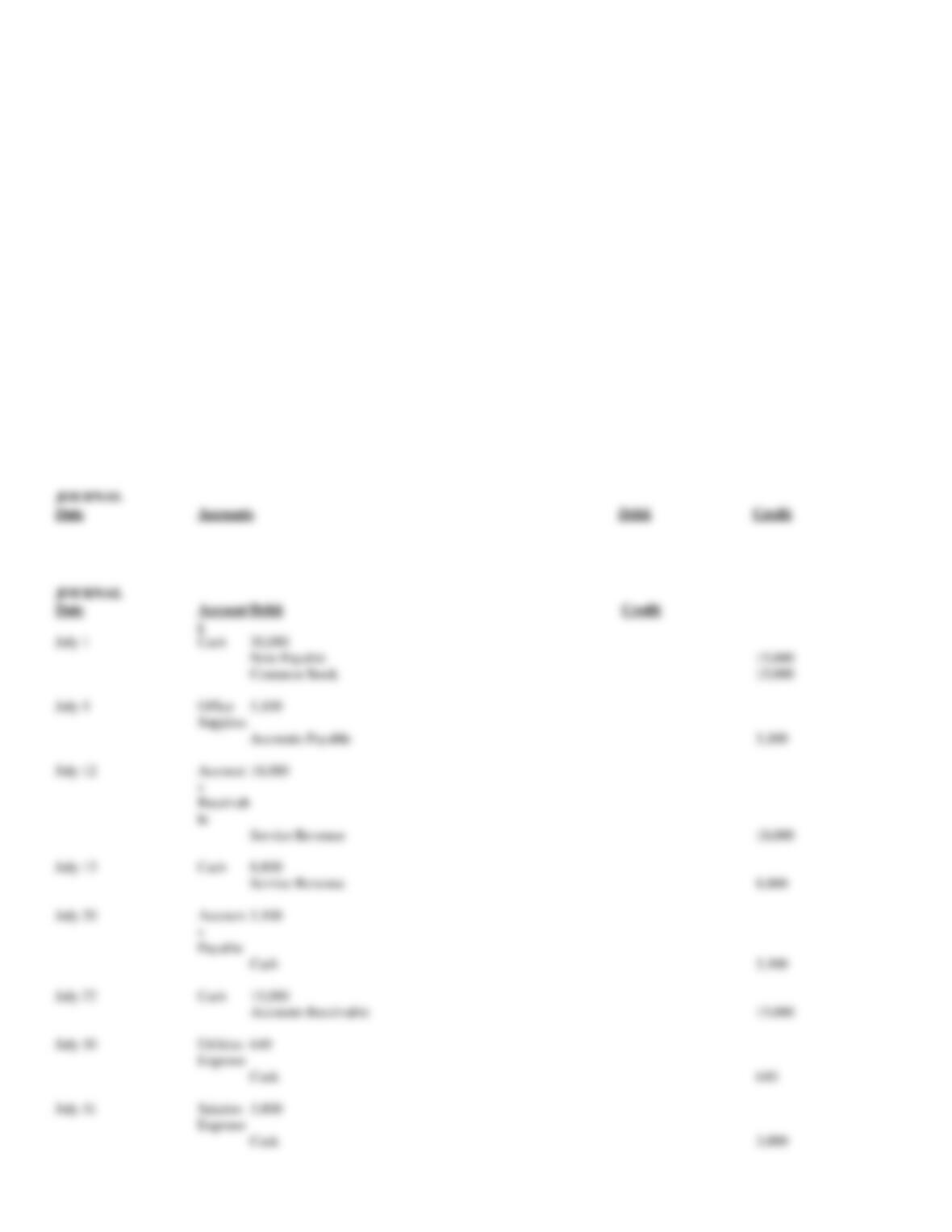
Refer to H&R Clock Company. Use the following format to indicate the economic effects of each transaction above on the expanded accounting
equation. Show the dollar amounts in the appropriate columns and use a plus (+) sign to indicate an increase and a minus (-) sign to indicate a
decrease.
July 1
+30,000
+15,000
+15,000
July 5
+5,100
+5,100
July 12
+18,000
+18,000
July 13
+8,800
+8,800
July 20
-5,100
-5,100
July 22
-0-
(+15,000 – 15,000)
July 30
-640
-640
July 31
-3,800
-3,800
170. H&R Clock Company
The following transactions were incurred during July 2014:
July 1
Raised $30,000 by issuing a note to the bank for $15,000 and issuing $15,000 of common stock.
July 5
Purchased $5,100 of office supplies on credit; payment is due in 30 days.
July 12
Performed $18,000 of services for customers on credit; collection is due in 30 days.
July 13
Performed services for customers and collected $8,800.
July 20
Paid for the supplies purchased on July 5.
July 22
Collected $15,000 of the amounts due from customers.
July 30
Received and paid the utility bill for the month of July, $640.
July 31
Paid employee salaries of $3,800.
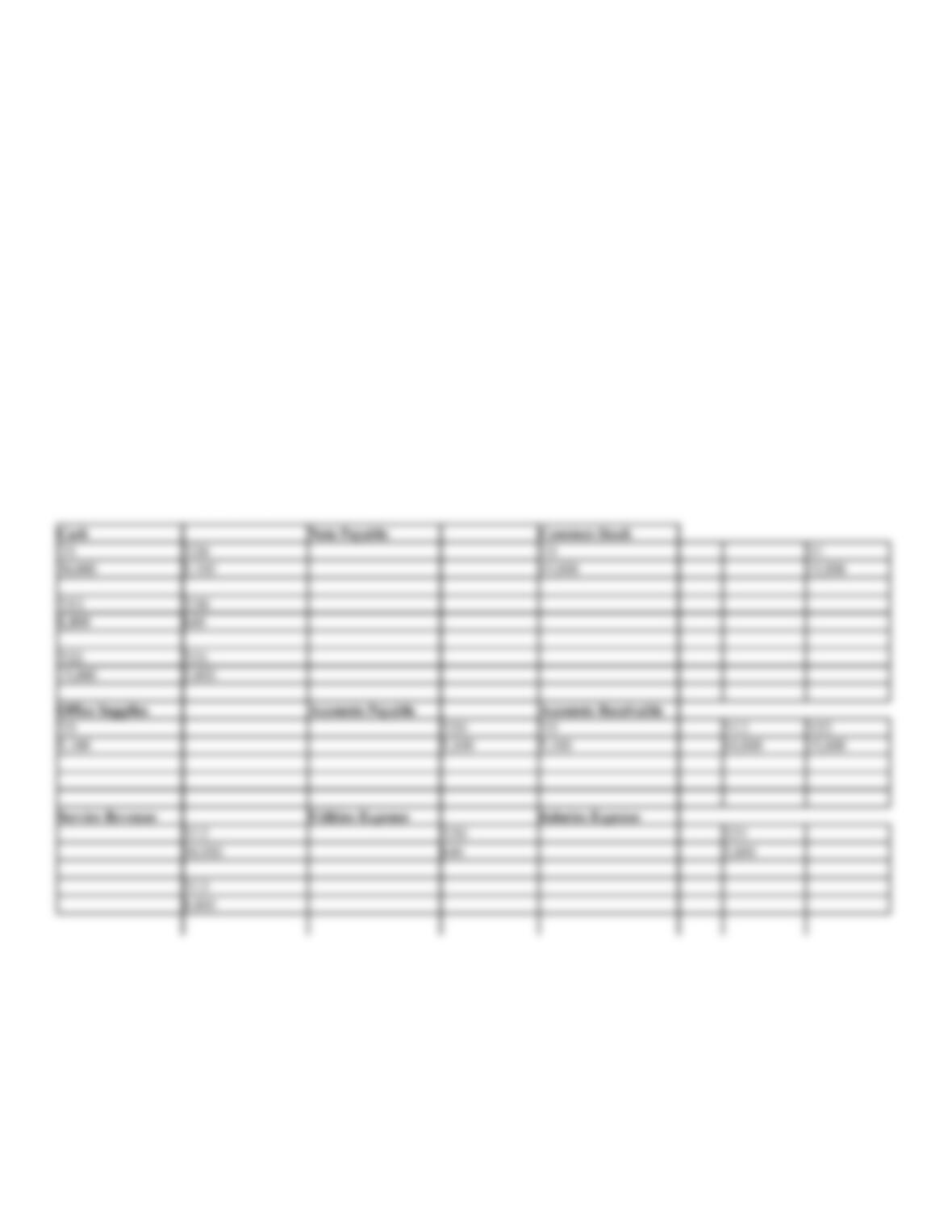
Refer to H&R Clock Company. Record each transaction in proper journal entry format in the journal provided. A written explanation for each
journal entry is not required.
July 1
Cash
30,000
Note Payable
15,000
Common Stock
15,000
Accounts Payable
5,100
Service Revenue
18,000
July 13
Cash
8,800
Service Revenue
8,800
Cash
5,100
July 22
Cash
15,000
Accounts Receivable
15,000
171. H&R Clock Company
The following transactions were incurred during July 2014:
July 1
Raised $30,000 by issuing a note to the bank for $15,000 and issuing $15,000 of common stock.
July 5
Purchased $5,100 of office supplies on credit; payment is due in 30 days.
July 12
Performed $18,000 of services for customers on credit; collection is due in 30 days.
July 13
Performed services for customers and collected $8,800.
July 20
Paid for the supplies purchased on July 5.
July 22
Collected $15,000 of the amounts due from customers.
July 30
Received and paid the utility bill for the month of July, $640.
July 31
Paid employee salaries of $3,800.
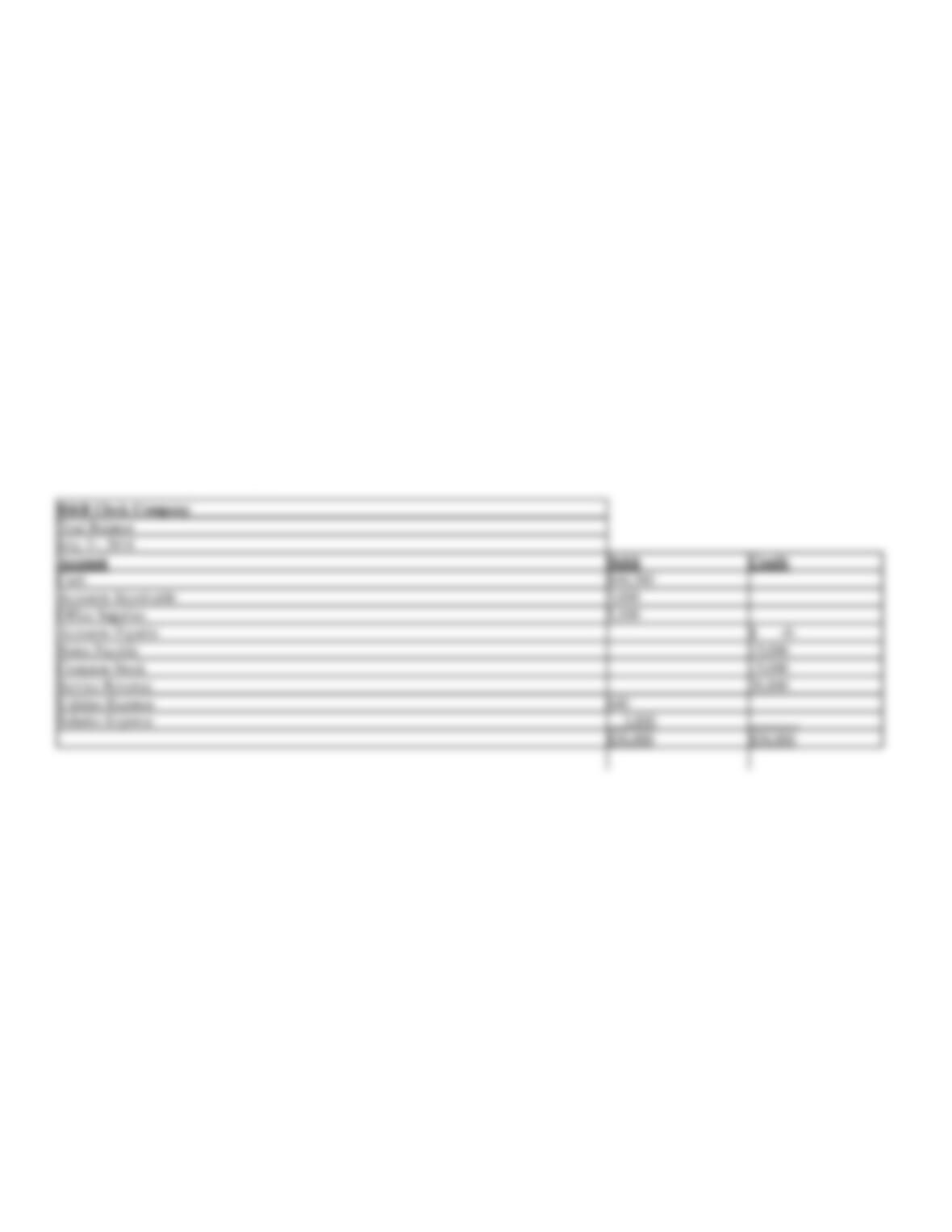
Refer to H&R Clock Company. Set up T-accounts and post each transaction to the T-accounts.
7/1
7/20
7/1
7/1
30,000
5,100
15,000
15,000
7/13
7/30
8,800
7/22
7/31
15,000
3,800
7/5
7/20
7/5
7/12
7/22
5,100
5,100
5,100
18,000
15,000
7/12
7/30
7/31
18,000
3,800
7/13
8,800
172. H&R Clock Company
The following transactions were incurred during July 2014:
July 1
Raised $30,000 by issuing a note to the bank for $15,000 and issuing $15,000 of common stock.
July 5
Purchased $5,100 of office supplies on credit; payment is due in 30 days.
July 12
Performed $18,000 of services for customers on credit; collection is due in 30 days.
July 13
Performed services for customers and collected $8,800.
July 20
Paid for the supplies purchased on July 5.
July 22
Collected $15,000 of the amounts due from customers.
July 30
Received and paid the utility bill for the month of July, $640.
July 31
Paid employee salaries of $3,800.
Refer to H&R Clock Company. Prepare a trial balance in proper format. Assume that the company had no additional accounts or balances other than
those created from the July transactions.
Trial Balance
July 31, 2014
Cash
$44,260
Accounts Receivable
3,000
Office Supplies
5,100
Accounts Payable
$ -0-
Notes Payable
15,000
Common Stock
15,000
Service Revenue
26,800
Utilities Expense
Salaries Expense
3,800
$56,800
$56,800
173. Home Accent Interiors
The company’s bookkeeper prepared the following journal entries and posted them to the general ledger as
indicated in the T-accounts presented. Assume that the dollar amounts and descriptions of the entries are
correct.
Journal (partial):
Date
Accounts and Descriptions
Debit
Credit
May 5
Accounts Receivable
6,400
Service Revenue
6,400
Billed customers for services completed
May 11
Cash
2,000
Service Revenue
2,000
Received payment from a customer for services
rendered in a prior month
May 15
Supplies
2,800
Accounts Payable
2,800
Purchased furniture on account; payment due in 30 days
May 25
Office Furniture
2,800
Cash
2,800
Paid for the office furniture purchased earlier
5/5
5/5
5/11
5/25
6,400
6,400
2,000
2,800
e
5/11
5/15
5/15
2,000
2,800
2,800
174. What is meant by “generally accepted accounting principles”?
175. Each of the situations in A through C below applies to one of the assumptions or principles included in the
conceptual framework of accounting. Identify which assumption or principles applies and explain why that
assumption or principle applies.
A)
High Collectibles is a U.S. company that has divisions in several countries around the world. Each country has a currency different
that the U.S. dollar. The company must include the financial data of its worldwide divisions in its financial statements.
B)
Howell Trucking operate as a partnership. The partners are considering a change to the corporate form of business organization.
C)
Holly Company is a local company. The owners have decided to expand into nearby cities. Expansion will require more capital, but
management does not expect it will stay in business for more than one year or so regardless of its expansion plans.
The Monetary Unit Assumption. Financial statements must be reported in monetary terms, and the standard monetary unit should be
B)
Economic Entity Assumption. A business can take three forms. Regardless of the form, however, the unit itself is distinct from its
owners.
176. For a company’s reported financial information to be useful, what four qualities must be present? Explain
these four qualities.
177. What is the difference between comparability and consistency?
178. What is conservatism and why is it important in accounting?
179. Several terms which represent components of an accounting system are listed below. For each term, write a
brief explanation of how that component is used in the accounting cycle.
A)
Accounts
B)
Chart of Accounts
C)
Double-entry system with debits and credits
D)
Journal
E)
General Ledger
F)
Trial Balance
some accounts increase by debits and decrease by credits and that other accounts increase by credits and decrease by debits.
posting reference column of the journal.
180. Four journal entries are presented below. Write an explanation for each entry.
A)
Cash
12,200
Service Revenue
12,200
B)
Accounts Receivable
17,500
Service Revenue
17,500
C)
Cash
16,900
Accounts Receivable
16,900
D)
Cash
1,830
Unearned Revenue
1,830
Cash was received for services provided to customers.
B)
Customers were billed for services provided.
C)
Cash was collected from customers who had been billed previously.
D)
Cash was collected from customers for services to be provided later.
181. The bookkeeper made the following errors while recording transactions for the period:
A)
A purchase of equipment for $450 cash was recorded as a debit to Equipment for $540 and a credit to Cash for $540.
B)
The sale of services for cash in the amount of $4,134 was recorded as a debit to Cash for $4,134 and a credit to Service Revenue for
$4,314.
C)
A purchase of supplies for $200 cash was recorded correctly in the journal but was omitted from the general ledger.
D)
The sale of services for credit in the amount of $3,800 was recorded correctly in the journal but was posted twice to the general
ledger.
E)
$5,500 cash paid for salaries was recorded in the journal as a $5,500 debit to Cash and a $5,500 credit to Salaries Expense.
Indicate whether or not the debit and credit columns of the trial balance will be equal after recording each of these erroneous entries. Then identify
the account(s) that will be misstated as a result of these errors and the direction of the misstatement (i.e., understatement or overstatement).
182. “You Decide” Essay
You are the accounting manager for a small machine shop. Your bookkeeper has asked you to review a journal
entry that she made:
Date
Account and Explanation
Debit
Credit
May 5
Cash
2,500
Service Revenue
(For services to be rendered)
2,500
Is this journal entry correct? Why or why not?
A)
The trial balance will still balance, but both of the accounts will be overstated by $90.
The trial balance will be out of balance, as Service Revenues will be overstated by $180.
The trial balance will still balance, but the Supplies account will be understated by $200 and the Cash account will be overstated by
$200.
D)
The trial balance will still balance, but the Accounts Receivable and Service Revenue accounts will both be overstated by $3,800.
The trial balance will still balance, but the Cash account will be overstated by $11,000 and the Salaries Expense account will be
183. “You Decide” Essay