Cost Accounting: A Managerial Emphasis, 6e
Chapter 2 – An Introduction to Cost Terms and Purposes
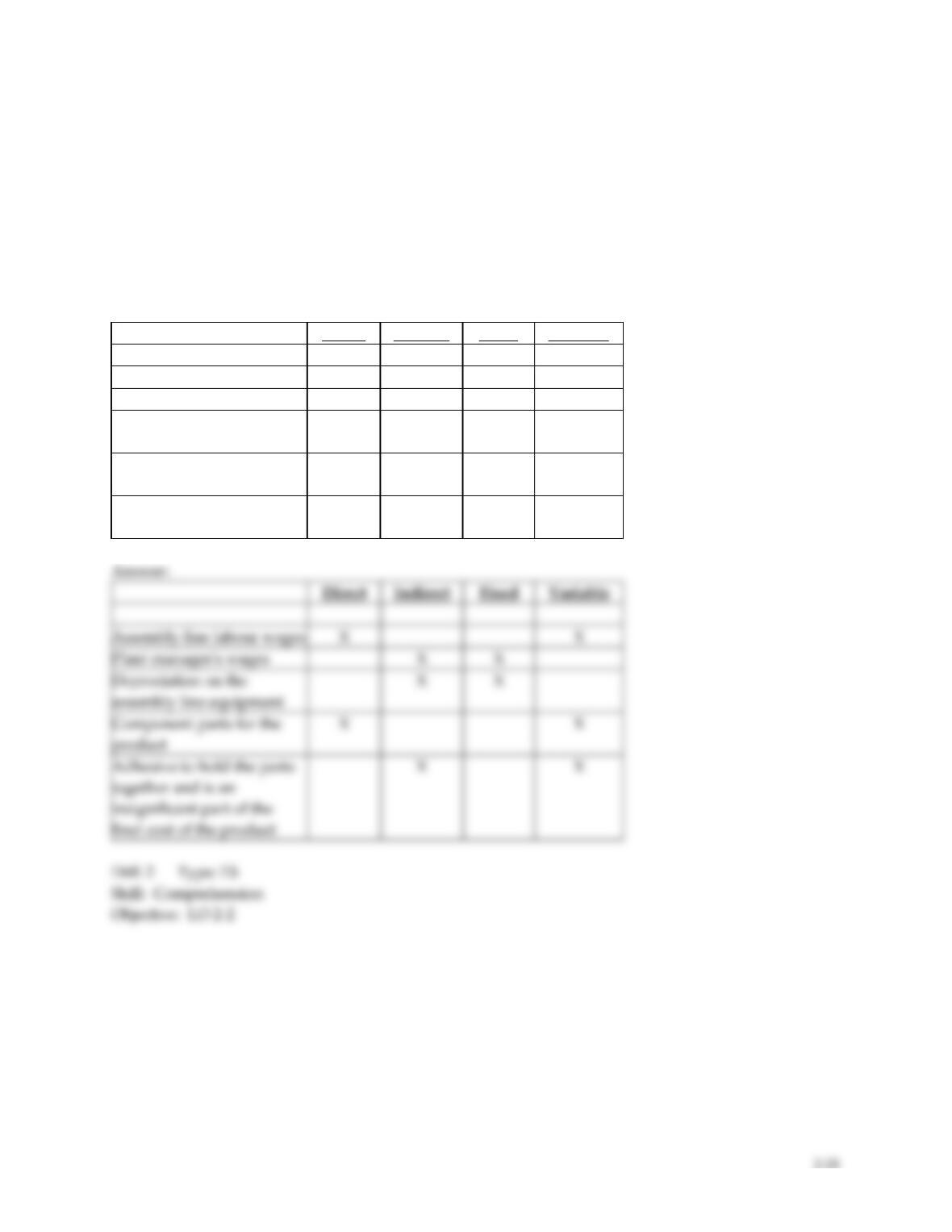
26) Whippany manufacturing wants to estimate costs for each product they produce at its Troy plant. The
Troy plant produces three products at this plant, and runs two flexible assembly lines. Each assembly
line can produce all three products.
Required:
a. Classify each of the following costs as either direct or indirect for each product.
b. Classify each of the following costs as either fixed or variable with respect to the number of units
produced of each product.
Direct
Indirect
Fixed
Variable
Assembly line labour wages
Plant manager’s wages
Depreciation on the
assembly line equipment
Component parts for the
product
Wages of security personnel
for the factory
Indirect
Fixed
Variable
Assembly line labour wages
Plant manager’s wages
Depreciation on the
Component parts for the
product
insignificant part of the
final cost of the product
Cost Accounting: A Managerial Emphasis, 6e
Chapter 2 – An Introduction to Cost Terms and Purposes
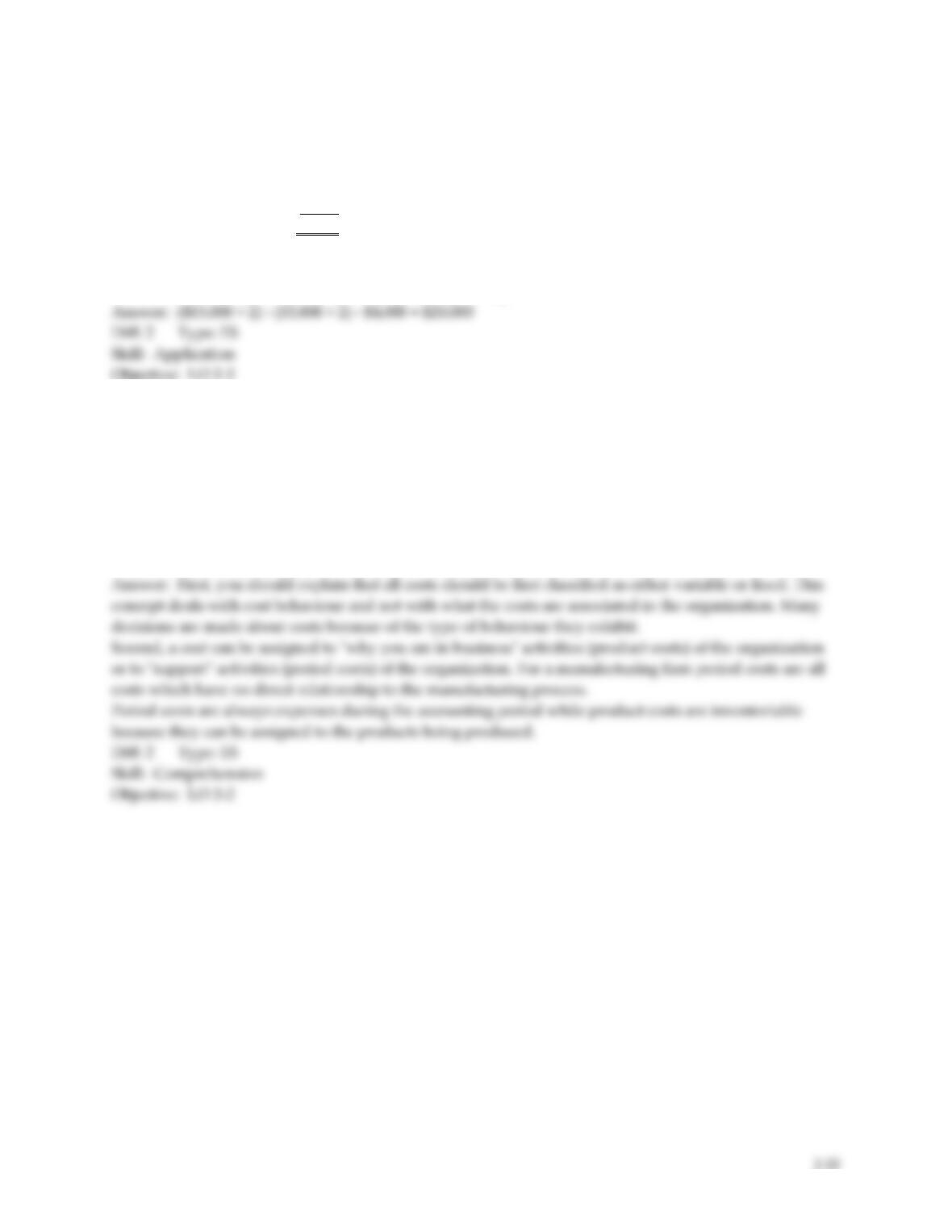
27) Combs, Inc., reports the following information for September sales:
Sales $15,000
Variable costs 3,000
Fixed costs 4,000
Operating income $8,000
Required:
If sales double in October, what is the projected operating income?
28) A new employee in the accounting department is having difficulty understanding two sets of
accounting terms—variable and fixed costs as opposed to period and product costs. He understands that
variable costs change during an accounting period while fixed costs do not. However, he explains that a
period cost implies that it is for a period of time and is, therefore, also fixed. Does his assumption imply
that all product costs are then variable?
Required:
As part of your responsibility to train new staff, explain the difference between these terms.
Cost Accounting: A Managerial Emphasis, 6e
Chapter 2 – An Introduction to Cost Terms and Purposes
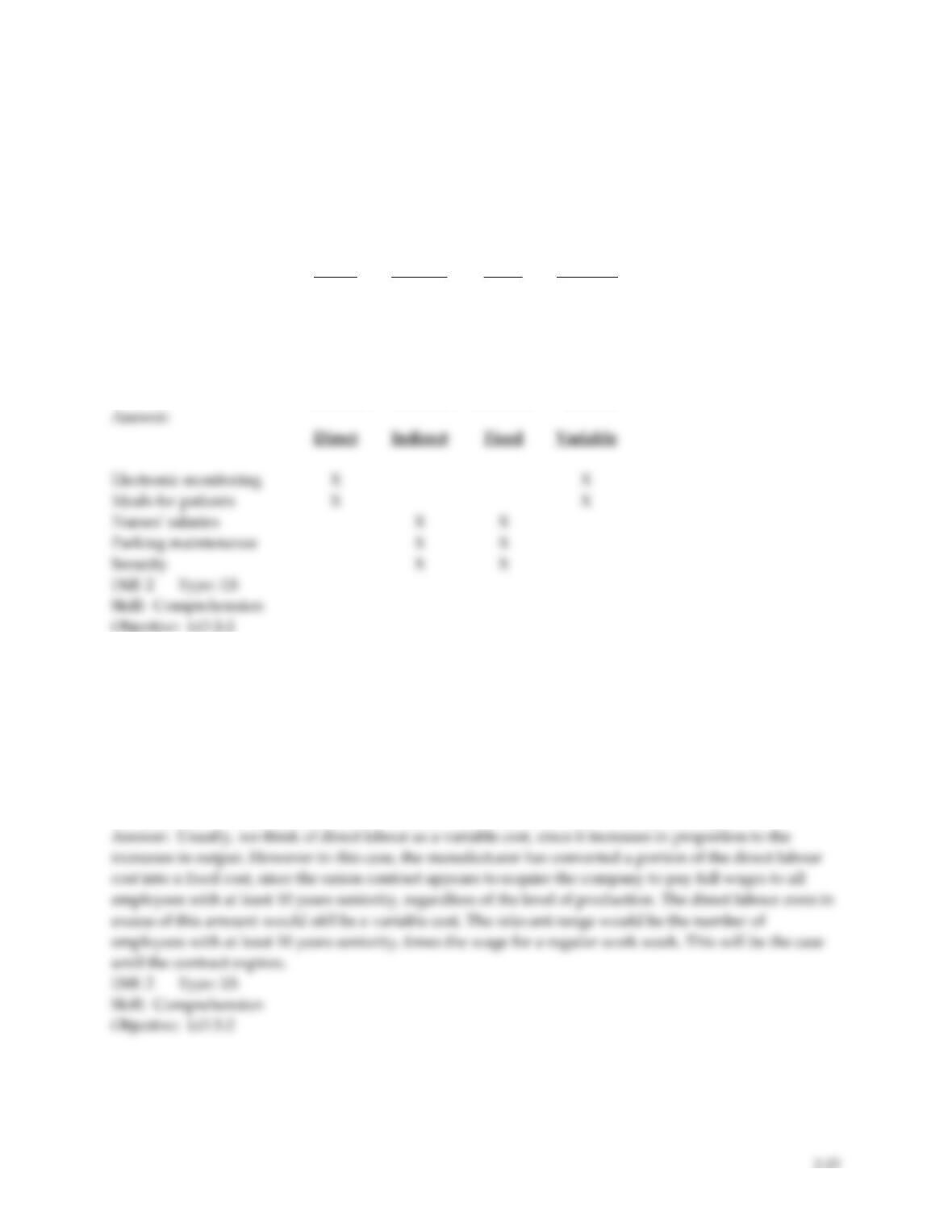
29) Butler Hospital wants to estimate the cost for each patient stay. It is a general health care facility
offering only basic services and not specialized services such as organ transplants.
Required:
a. Classify each of the following costs as either direct or indirect with respect to each patient.
b. Classify each of the following costs as either fixed or variable with respect to hospital costs per day.
Direct Indirect Fixed Variable
Electronic monitoring ________ ________ ________ ________
Meals for patients ________ ________ ________ ________
Nurses’ salaries ________ ________ ________ ________
Parking maintenance ________ ________ ________ ________
Security ________ ________ ________ ________
30) A manufacturing company contracts with the labour union to guarantee full employment for all
employees with at least 10 years seniority. The Company expects to be working at capacity for the next 2
years (the life of the contract), so this was seen as a bargaining concession without any cost to the
company. On average, an employee earns $30 per hour, including benefits. The work force consists of 800
employees, with seniority ranging from 1 year to 18 years.
Required:
Analyze the direct labour cost in term of variable costs, fixed costs, and the relevant range.
Cost Accounting: A Managerial Emphasis, 6e
Chapter 2 – An Introduction to Cost Terms and Purposes
31) What is the meaning of the term “cost object”? Give an example of a cost object that would be used in
a manufacturing company, a merchandising company, and a service sector company?
32) What are the differences between direct costs and indirect costs? Give an example of each.
33) Describe a variable cost. Describe a fixed cost. Explain why the distinction between variable and fixed
costs is important in cost accounting.
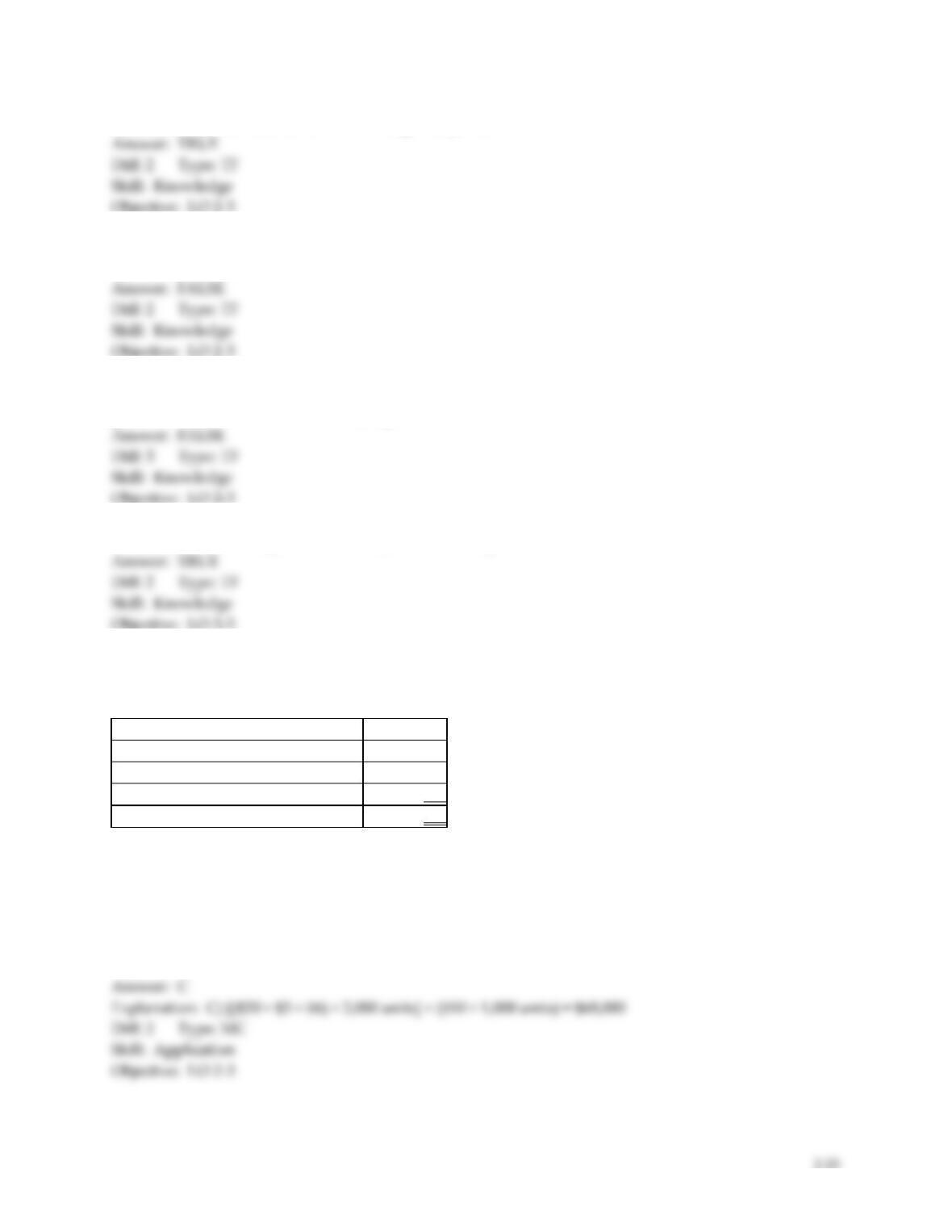
1) A unit cost is computed by dividing a total cost by some number of units.
Cost Accounting: A Managerial Emphasis, 6e
Chapter 2 – An Introduction to Cost Terms and Purposes
2) Unit costs are considered to be an average cost per unit.
3) When a manager is making a decision based on cost figures, it is preferable that he (she) thinks in
terms of unit costs.
4) When 50,000 units are produced the fixed costs are $10 per unit. Therefore when 100,000 units are
produced fixed costs will remain at $10 per unit.
5) Unit costs and average costs are really the same thing.
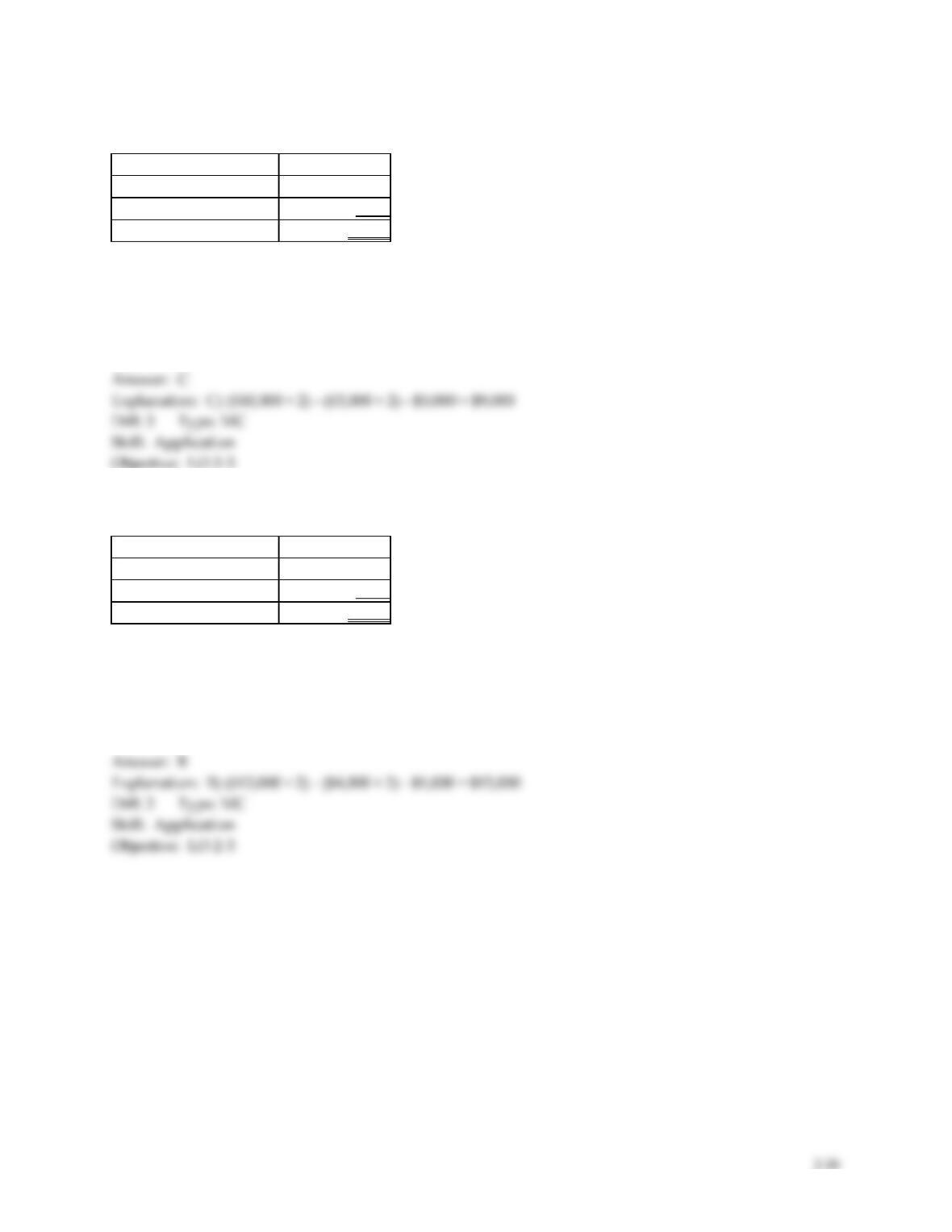
6) Wheel and Tire Manufacturing currently produces 1,000 tires per month. The following per unit data
apply for sales to regular customers:
Direct materials
$20
Direct manufacturing labour
3
Variable manufacturing overhead
6
Fixed manufacturing overhead
10
Total manufacturing costs
$39
The plant has capacity for 3,000 tires and is considering expanding production to 2,000 tires. What is the
total cost of producing 2,000 tires?
A) $39,000
B) $78,000
C) $68,000
D) $62,000
Cost Accounting: A Managerial Emphasis, 6e
Chapter 2 – An Introduction to Cost Terms and Purposes
7) Christi Manufacturing provided the following information for last month:
Sales
$10,000
Variable costs
3,000
Fixed costs
5,000
Operating income
$2,000
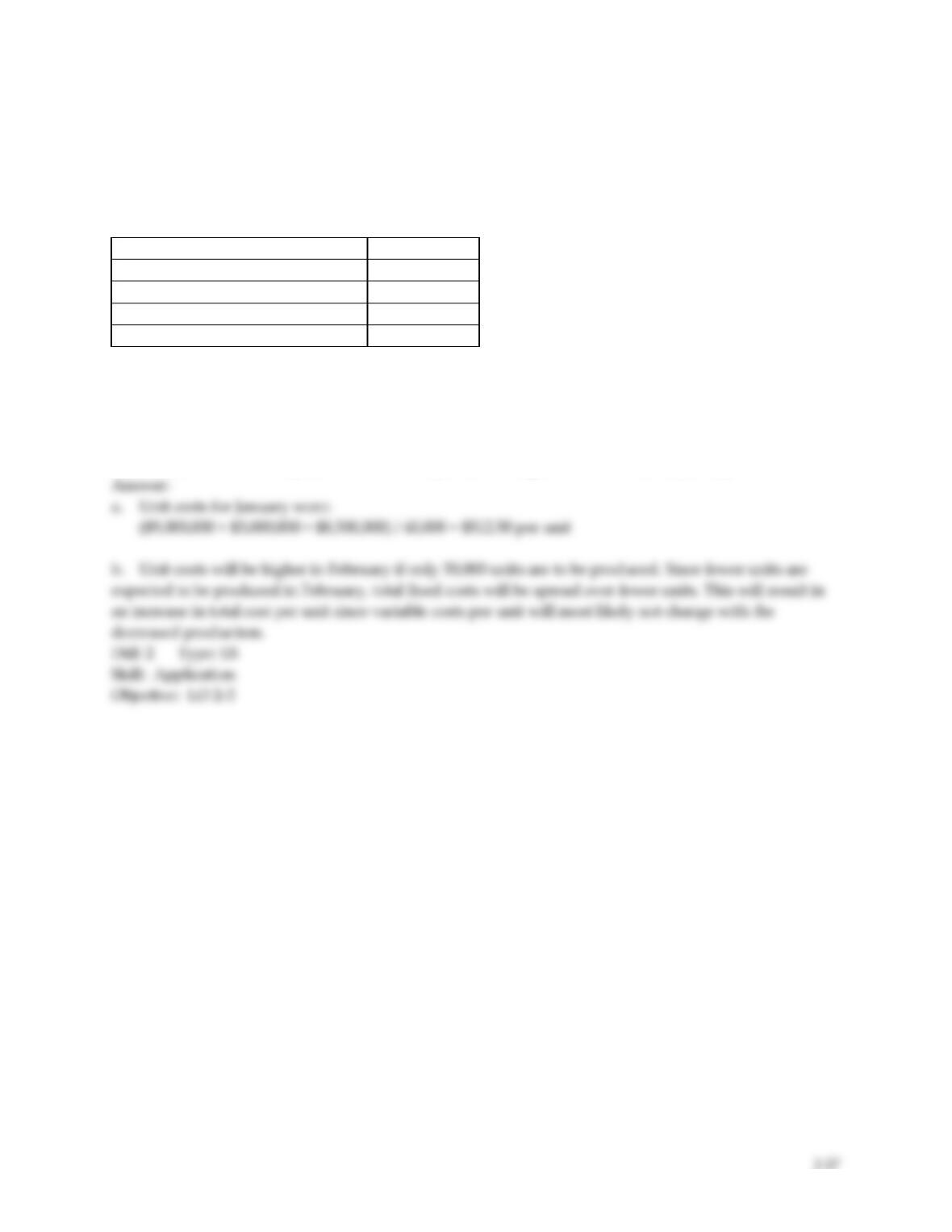
If sales double next month, what is the projected operating income?
A) $4,000
B) $7,000
C) $9,000
D) $12,000
8) Kym Manufacturing provided the following information for last month:
Sales
$12,000
Variable costs
4,000
Fixed costs
1,000
Operating income
$7,000
If sales double next month, what is the projected operating income?
A) $14,000
B) $15,000
C) $18,000
D) $19,000
Cost Accounting: A Managerial Emphasis, 6e
Chapter 2 – An Introduction to Cost Terms and Purposes
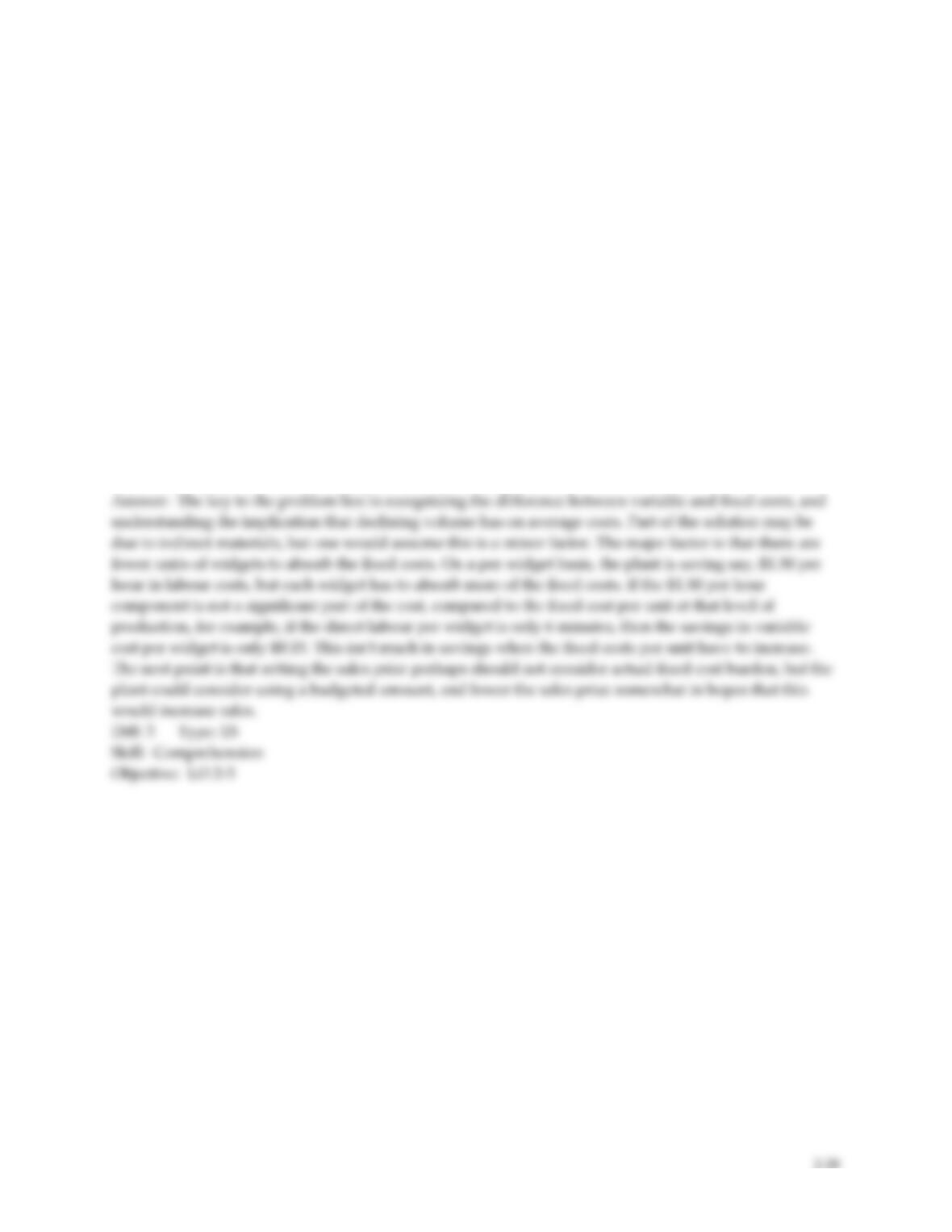
9) Springfield Manufacturing produces electronic storage devices, and uses the following three-part
classification for its manufacturing costs: direct materials, direct manufacturing labour, and indirect
manufacturing costs. Total indirect manufacturing costs for January were $300 million, and were
allocated to each product on the basis of direct manufacturing labour costs of each line. Summary data for
January for the most popular electronic storage device, the Big Bertha, was:
Big Bertha
Direct manufacturing costs
$9,000,000
Direct manufacturing labour costs
$3,000,000
Indirect manufacturing costs
$8,500,000
Units produced
40,000
Required:
a. Compute the total manufacturing cost per unit for each product produced in January.
b. Suppose production will be reduced to 30,000 units in February. If indirect manufacturing costs
include fixed costs then explain if the total cost per unit be higher or lower than in January.
Cost Accounting: A Managerial Emphasis, 6e
Chapter 2 – An Introduction to Cost Terms and Purposes
10) Things are not going well for the widget industry this year. The well-known cyclical nature of widget
sales is in a downturn and your plant has been ordered to cut costs by its American parent corporation.
The plant manager explains that he has shown the lead by negotiating a $1.50 hourly wage decrease with
the production workers, based on a formula that pegs a $1.50 per hour wage increase/decrease to sales
volume, and since sales are down this year, so are hourly wage costs. In the quarterly management
meeting, the sales manager complained that sales could have been higher, but that somehow costs had
increased, at least that’s what the reports out of your office in management accounting, indicated. The
Purchasing manager assured everyone that she was able to obtain raw materials at the same price as last
year, and unfortunately, you as the management accountant, were not in attendance at the meeting. Your
assistant, a new employee attended in your place, and promised at the meeting to redo the reports and
find the errors. Your assistant has come to you as he cannot find any errors in the reports. Consequently,
the plant manager wants you to redo the reports, find the error reports produced by your department for
the last quarter and to explain to your boss, the plant manager, why average costs have increased.
Required:
Assuming there are no errors in the cost reports, explain to the plant manager how direct labour costs
could be decreased and direct materials costs could be the same as last year, and yet the selling price
cannot be lowered without sacrificing net income for the plant.
Cost Accounting: A Managerial Emphasis, 6e
Chapter 2 – An Introduction to Cost Terms and Purposes
11) The vice president of production has just completed the January meeting with all production
department heads. Everyone is upset that the production variances for the month were unfavourable.
They do not understand why everything was unfavourable. January is typically the company’s lowest
production month of the year.
The company uses annual average unit costs for production evaluation purposes. The average costs are
based on the prior year’s actual performance with adjustments for any predicted changes in the coming
year. Both production and economic items are considered in setting the averages for each new year.
Required:
Explain the problems with using average costs in evaluating production.
2.4 Apply cost information to produce a GAAP-compliant income statement showing
proper cost of goods sold and a balance sheet showing proper inventory valuation.
1) Manufacturing-sector companies purchase materials and other resources for conversion into various
finished goods.
2) Manufacturing firms have three types of inventory: direct materials, work in process, and
merchandise.
3) Direct materials inventory is products held for resale.
4) Work-in-process consists of partially completed goods not yet ready for sale.
Cost Accounting: A Managerial Emphasis, 6e
Chapter 2 – An Introduction to Cost Terms and Purposes
5) Operating income does not include interest expense and income taxes.
6) Service-sector companies provide services or intangible products to their customers.
7) Merchandising companies purchase products and sell them to customers without changing their basic
form.
8) Manufacturing sector firms normally hold three types of inventory: direct materials inventory, work–
in-process inventory, and finished goods inventory.
Cost Accounting: A Managerial Emphasis, 6e
Chapter 2 – An Introduction to Cost Terms and Purposes
Use the information below to answer the following question(s).
Consider the following data of the Vancouver Company for the year 20X4:
Sandpaper-Plant
$10,000
Leasing costs – plant
$120,000
Materials handling-Plant
100,000
Amortization- equip.
70,000
Coolants-Plant
7,000
Property taxes – equip.
10,000
Indirect manufacturing labour
86,000
Fire insurance – equip.
5,000
Direct manufacturing labour
680,000
Direct material purchases
980,000
Direct materials, 1/1/X4
120,000
Direct materials 12/31/X4
86,000
Finished goods, 1/1/X4
210,000
Sales
4,000,000
Finished goods, 12/31/X4
400,000
Sales commissions
200,000
WIP, 1/1/X4
30,000
Sales salaries
180,000
WIP, 12/31/X4
20,000
Advertising costs
150,000
Administration costs
250,000
9) What is the unit cost for the direct materials for 20X4 assuming direct materials costs are for the
production of 1,014,000 units?
A) $0.80
B) $0.95
C) $1.00
D) $1.08
E) $1.11
10) What is the unit cost for the plant leasing costs for 20x4 assuming plant leasing costs are for the
production of 1,014,000 units?
A) $0.119
B) $0.118
C) $0.110
D) $0.900
E) $0.943
Cost Accounting: A Managerial Emphasis, 6e
Chapter 2 – An Introduction to Cost Terms and Purposes
11) What is the unit cost for the direct materials for 20X4 assuming direct materials are for the production
of 507,000 units?
A) $0.80
B) $0.95
C) $2.00
D) $1.08
E) $1.10
12) What is the unit cost for the plant leasing cost for 20×4 assuming plant leasing costs are for the
production of 2,000,000 units?
A) 0.35
B) 0.18
C) 0.12
D) 0.06
E) 0.04
Use the information below to answer the following question(s).
The following information pertains to Payton’s Shoe Manufacturing:
Manufacturing costs
$1,000,000
Shoes manufactured
100,000
Beginning inventory
0 pairs
99,500 pairs of shoes are sold during the year for $18.
13) What is Payton’s manufacturing cost per pair of shoes?
A) $10.00
B) $10.05
C) $100.00
D) $18.00
E) $9.95
Cost Accounting: A Managerial Emphasis, 6e
Chapter 2 – An Introduction to Cost Terms and Purposes
14) What is the amount of Payton’s ending finished goods inventory?
A) $99,500
B) $8,000
C) $5,000
D) $500
E) $0
15) What is the amount of Payton’s gross profit?
A) $995,000
B) $1,000,000
C) $1,791,000
D) $796,000
E) $896,000
16) The following information pertains to the Stratford Company:
Beginning finished goods inventory
$60,000
Cost of goods manufactured
410,000
Ending finished goods inventory
34,000
What is the cost of goods sold?
A) $436,000
B) $384,000
C) $376,000
D) $316,000
E) $444,000
Cost Accounting: A Managerial Emphasis, 6e
Chapter 2 – An Introduction to Cost Terms and Purposes
Use the information below to answer the following question(s).
Montreal Industries Inc. had the following activities during the year::
Direct materials:
Beginning inventory
$50,000
Purchases
154,000
Ending inventory
26,000
Direct manufacturing labour
40,000
Manufacturing overhead
30,000
Ending work-in-process inventory
10,000
Beginning work-in-process inventory
2,000
Ending finished goods inventory
40,000
Beginning finished goods inventory
60,000
17) What is Montreal’s cost of direct materials used during the year?
A) $204,000
B) $178,000
C) $128,000
D) $24,000
E) $218,000
18) What is Montreal’s cost of goods manufactured during the year?
A) $268,000
B) $248,000
C) $240,000
D) $238,000
E) $260,000
Cost Accounting: A Managerial Emphasis, 6e
Chapter 2 – An Introduction to Cost Terms and Purposes
19) What is Montreal’s cost of goods sold during the year?
A) $260,000
B) $232,000
C) $220,000
D) $200,000
E) $240,000
20) Manufacturing-sector companies
A) purchase materials and convert them to finished goods.
B) buy goods and resell them.
C) provide services or intangible products.
D) have only period costs.
E) have one classification of inventory.
21) Merchandising-sector companies
A) purchase materials and convert them to finished goods.
B) buy goods and resell them.
C) provide services or intangible products.
D) have only variable costs.
E) have period and some manufacturing costs.
22) Manufacturing-sector companies report on the balance sheet
A) only merchandise inventory.
B) only finished goods inventory.
C) direct materials inventory, work-in-process inventory, and finished goods inventory accounts.
D) no inventory accounts.
E) only work in progress inventory.
Cost Accounting: A Managerial Emphasis, 6e
Chapter 2 – An Introduction to Cost Terms and Purposes
23) For a manufacturing company, direct material costs may be included in
A) direct materials inventory only.
B) merchandise inventory only.
C) both work-in-process inventory and finished goods inventory.
D) direct materials inventory, work–in-process inventory, and finished goods inventory accounts.
E) period costs.
24) Which of the following statements would be correct in a manufacturing business?
A) Completed goods are not normally included in the finished goods inventory.
B) Completed goods are part of the work in process category.
C) Work-in-process inventory, at the end of the accounting period, includes direct materials but not direct
labour.
D) Materials put into production are classified as work–in–process inventory.
E) There can be no beginning finished goods inventory.
25) Goods available for sale that are not in ending inventory
A) are included in goods available for sale in the next year.
B) are included in the work-in-process inventory at the end of the year.
C) are not accounted for until the next year.
D) are incorporated in the cost of goods sold amount.
E) are included in beginning inventory.
Cost Accounting: A Managerial Emphasis, 6e
Chapter 2 – An Introduction to Cost Terms and Purposes
Answer the following question using the information below.
Pederson Company reported the following:
Manufacturing costs
$2,000,000
Units manufactured
50,000
Units sold
47,000 units sold for $75 per unit
Beginning inventory
0 units
26) What is the amount of gross margin?
A) $1,750,000
B) $3,525,000
C) $3,405,000
D) $1,645,000
E) $1,525,000
Answer the following question(s) using the information below.
The following information pertains to Alleigh’s Mannequins:
Manufacturing costs
$1,500,000
Units manufactured
30,000
Units sold
29,500 units sold for $85 per unit
Beginning inventory
0 units
27) What is the average manufacturing cost per unit?
A) $50.00
B) $50.85
C) $17.65
D) $85.00
E) $49.50
Cost Accounting: A Managerial Emphasis, 6e
Chapter 2 – An Introduction to Cost Terms and Purposes
28) What is the amount of ending finished goods inventory?
A) $42,500
B) $24,750
C) $25,000
D) $25,425
E) $42,500
29) What is the amount of gross margin?
A) $1,475,000
B) $1,500,000
C) $1,047,250
D) $1,032,500
E) $1,007,425
Cost Accounting: A Managerial Emphasis, 6e
Chapter 2 – An Introduction to Cost Terms and Purposes
Use the information below to answer the following question(s).
Frazer Inc. had the following activities in the year:
Direct materials:
Beginning inventory
$100,000
Purchases
308,000
Ending inventory
52,000
Direct manufacturing labour
80,000
Manufacturing overhead
60,000
Ending work in process inventory
20,000
Beginning work in process inventory
4,000
Ending finished goods inventory
80,000
Beginning finished goods inventory
120,000
30) What is Frazer’s cost of goods manufactured?
A) $536,000
B) $496,000
C) $480,000
D) $476,000
E) $512,000
31) What is Frazer’s cost of goods sold?
A) $520,000
B) $464,000
C) $440,000
D) $400,000
E) $516,000
Cost Accounting: A Managerial Emphasis, 6e
Chapter 2 – An Introduction to Cost Terms and Purposes
32) Which of the following formulae would determine costs of goods sold in a merchandising entity?
A) Purchases – Ending inventory
B) Beginning inventory + Purchases – Ending inventory
C) Beginning inventory – Purchases + Ending inventory
D) Beginning inventory – Ending inventory – Purchases
E) Ending Inventory – Beginning inventory – Purchases
33) Which of the following formulae would determine cost of goods sold in a manufacturing entity?
A) Beginning inventory + Ending inventory – Cost of goods manufactured
B) Cost of goods manufactured + Ending inventory + Beginning inventory
C) Beginning inventory – Ending inventory – Cost of goods manufactured.
D) Cost of goods manufactured – Ending inventory + Beginning inventory
E) Ending inventory – Beginning inventory – Cost of goods manufactured
34) The following information pertains to Tom’s Country Wood Shop:
Beginning finished goods, 1/1/X4
$15,000
Ending finished goods, 12/31/X4
9,500
Cost of goods sold
56,000
Sales
112,500
Operating expenses
25,000
What is the cost of goods manufactured for 20X4?
A) $56,500
B) $31,500
C) $50,500
D) $61,500
E) $66,500