Chapter 02 Cognitive Processes and Ethical Decision Making in
Accounting Answer Key
Multiple Choice Questions
1.
When Sally is asked why she should share her toys with her sister, she responds by saying
“Because my mom says I have to and if I don’t I’ll go to time-out.” In which stage of moral
development is Sally?
2.
In reference to Rest’s four-component Model of Morality, which component reflects an
individual’s willingness to place ethical values ahead of non-ethical values that relate to
self-interest?
3.
The cognitive development approach refers to:
4.
Kohlberg’s model can best be described as:
5.
In the “Heinz and the Drug” case described in the chapter, if Heinz was reasoning at stage
5 he might decide to steal the drug based on which of the following reasoning?
6.
Which of the following might NOT describe Heinz’s thought process in deciding whether to
steal the drug if he were at stage 6?
7.
In stage 1 of Kohlberg’s model, ethical reasoning is motivated by:
8.
In stage 3 of Kohlberg’s model, ethical reasoning is motivated by:
9.
In stage 5 of Kohlberg’s model, ethical reasoning is motivated by:
10.
Individuals who reason at stage 6 incorporate ethical reasoning based on:
11.
A client asks his accountant to ignore a mistake which overstated the accounts receivable
account. The accountant decides that the accounts receivable account has to be corrected
to state the correct amount. Which stage of Kohlberg’ Stages of Moral Development is the
accounting reasoning?
12.
The ethical domain in accounting and auditing refers to:
13.
The results of studies indicate that CPAs reason primarily at:
14.
Rest’s “Four Component Model of Morality” can best be described as:
15.
Assume you were assigned a term paper and decided to surf the web to identify a provider
of papers for a fee. You chose what you thought was the best paper available. With
respect to Rest’s model of morality it can be said that:
16.
Yvonne is preparing a tax return for Jack. Jack wants to claim his nephew as a dependent
even though he does not meet the criteria. Jack says if Yvonne does not list his nephew as
a dependent, he will fire her and find a new tax accountant. Yvonne refuses because it is
illegal to claim a dependent that does not meet the qualifications. Based on Yvonne’s
decision, she is likely reasoning at which stage of Kohlberg’s moral development model?
17.
James Rest’s model of ethical action involves four components inherent to the ethical
decision-making process. Which of the following relates to a person’s moral judgment?
18.
Thorne’s “Integrated Model of Ethical Decision Making” can best be described as:
19.
In Thorne’s model of ethical decision making, the instrumental virtues relate to:
20.
A criticism of the Kohlberg model is that it:
21.
How does Gilligan evaluate the solution to Heinz’s dilemma?
22.
Thomas Jones’s research looked at the characteristics of a moral issue to develop the
moral intensity model. The model includes six dimensions. Which of the following are NOT
included in those dimensions?
23.
In Thomas Jones’ model of moral intensity it can be said about accounting that:
24.
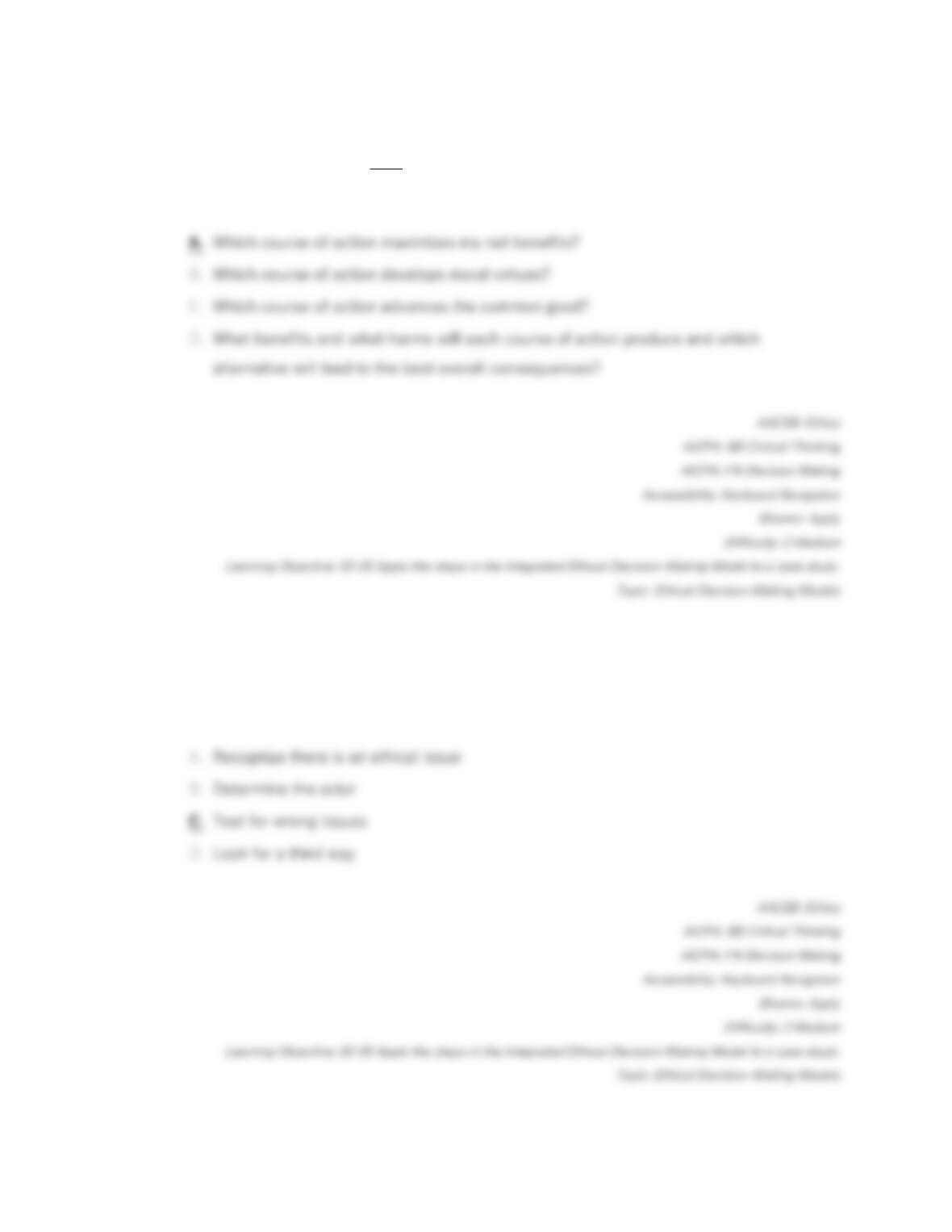
The philosophical methods of moral reasoning suggest that once we have ascertained the
facts, we should ask ourselves certain questions when trying to resolve a moral issue.
Which of the following is NOT one of those questions?
25.
Which of the following is least likely to be a step or checkpoint in ethical decision-making
guidelines?
26.
What is an important part in making an ethical choice, according to Kidder?
27.
In his evaluation of Kidder’s model, Johnson points out that:
28.
Which of the following connect the integrated ethical decision-making process with Rest’s
framework?
29.
Wanda is faced with an ethical dilemma. She knows her supervisor, the CFO, wants to
accelerate the recoding of revenue to an earlier period to “make the numbers,” but Wanda
is convinced this would violate GAAP. If Wanda reasons at stage 4 of Kohlberg‘s model
she is most likely to:

30.
Keesha is the CEO of a publicly-owned company. She was informed by the CFO that the
company’s earnings were down 30 percent from the prior year due to the recession. The
company’s stock price has declined by 20 percent. The CFO comes up with a scheme to
hide debt and inflate revenues by selling underperforming assets to a special purpose
entity affiliated with the company. Keesha is concerned about possible effects on the
creditors but ultimately she agrees to the accounting. Keesha is reasoning at:

31.
Rosie is the external auditor of Texas Two Steps, a privately-owned dance company in
Texas. Rosie believes the owner of the company is skimming cash off the top. She
approaches the owner who explains that the money will be replaced in the following
month after he refinances his house. Rosie accepts the owner’s explanation but
reclassifies the expenditure as a receivable of the company from the owner. Rosie’s
reasoning best reflects:
32.
Steve is in charge of accounting for the purchase of equipment at Cal Works, Inc. The
company has a policy that all expenditures greater than $1,000 (1% of total expenditures)
have to be capitalized; less than $1,000 expensed. Steve is under pressure to report high
earnings. He takes one $600 and $900 expenditure, adds them together, and records a
capital expenditure for $1,500. Which of the following reasons and rationalizations might
Steve use for his action:
33.
Role expectation or approval from others is a motive for doing right in which stage of
Kohlberg’s moral reasoning?
34.
Carpendale suggests that moral reasoning is viewed as a process of coordinating all
perspectives involved in a moral dilemma. Moral reasoning takes place in which of the
following steps in Rest’s Model?
35.
What should be the first step in decision making when faced with an ethical dilemma?
36.
Daniel Kahneman’s System 1 thinking is described by all of the following except for:
Topic: Behavioral Ethics
37.
Which of the following statements best describes System 2 thinking?
38.
Cognitive dissonance creates a problem that can be described as: