Chapter 02 – Cell Physiology
a.
True
b.
False
True
51. About one-third of the proteome is typically synthesized in the endoplasmic reticulum.
a.
True
b.
False
True
52. Smooth endoplasmic reticulum is abundant in cells that specialize in protein synthesis.
a.
True
b.
False
False
53. The sacs within each Golgi stack are in close physical contact with each other.
a.
True
b.
False
False
54. A vesicle can “dock” lock-and-key fashion and “unload” its selected cargo only at the appropriate docking-marker
acceptor in the Golgi complex.
a.
True
b.
False
True
55. A lysosome contains about 500 different powerful hydrolytic enzymes that are synthesized in the ER.
a.
True
b.
False
False
56. Lysosomal enzymes degrade dysfunctional organelles by selective self-digestion known as autophagy.
a.
True
b.
False
True
57. As part of their separate heritage, mitochondria possess their own DNA.
a.
True
b.
False
True
58. In skeletal muscle and many other cell types, mitochondria exist separately.
a.
True
b.
False
False
59. Cellular respiration refers collectively to the intracellular reactions in which energy-rich molecules are broken down to
form O2.
a.
True
b.
False
False
60. Cells with a high rate of secretion use up to 75% of the ATP they generate just to synthesize new chemical
compounds.
a.
True
b.
False
True
ATP
61. Every cell has a built-in biochemical pathway that, if triggered, causes the cell to execute itself as a result of
mitochondrial leakage of hydrogen peroxide.
a.
True
b.
False
False
62. Ongoing research supports the role of vaults in nucleus-to-cytoplasm transport, but their cargo has not been
determined.
a.
True
b.
False
True
63. Occupying about 85% of the total cell volume, the cytosol is the semi-liquid portion of the cytoplasm that surrounds
the organelles.
a.
True
b.
False
False
64. Centrioles are pairs of cylindrical structures at right angles to each other.
a.
True
b.
False
True
65. Cilia are short, tiny, hair-like protrusions usually found in large numbers on the surface of some cells.
a.
True
b.
False
True
66. Cells are the highly ____________________, living building blocks of the body.
Chapter 02 – Cell Physiology
67. The ____________________ is a gel-like liquid that suspends the cellular organelles and cytoskeleton.
68. Larger species have more cells, not ____________________ cells.
69. The trillions of cells in a human body are classified into about ____________________ types based on specific
variations in structure and function.
200
70. The ____________________ is a thin membranous structure that encloses each cell and is composed mostly of lipid
molecules and studded with proteins.
71. The plasma membrane keeps the ____________________ fluid within the cells from mingling with the extracellular
fluid.
72. DNA and associated nuclear proteins are organized into ____________________.
73. ____________________ delivers the appropriate amino acids within the cytoplasm to their designated site in the
Chapter 02 – Cell Physiology
protein under construction at the ribosome.
74. On average, nearly half of the total cell volume is occupied by two categories of organelles: ____________________
organelles and ____________________ organelles.
75. The ____________________ endoplasmic reticulum (ER) consists of stacks of relatively flattened interconnected
sacs, while the ____________________ ER is a meshwork of tiny interconnected tubules.
76. Secretory vesicles containing the finished protein products bud off the ____________________ and remain in the
cytosol, storing the products until signaled to empty.
77. Releasing to the exterior of substances originating within the cell is referred to as ____________________.
78. The v-SNAREs bind only with the ____________________ docking-marker acceptors of the targeted plasma
membrane.
79. Lysosomes fuse with aged or damaged ____________________ to remove them from the cell.
Chapter 02 – Cell Physiology
80. Tay-Sachs disease is an example of a(n) ____________________ storage disease.
81. Mitochondria generate about ____________________% of the energy that cells need to survive and function.
82. The cell generates more energy in ____________________ than in ____________________ conditions.
83. Fatty acids are sequentially broken down in the mitochondrial matrix through the process of ____________________.
84. High demands for ATP make ____________________ alone an insufficient and inefficient supplier of power for most
cells.
ATP
85. Mitochondria play a key role in deliberate cell suicide, a process called ____________________.
86. The cytosol is important in intermediary metabolism, ____________________ protein synthesis and nutrient storage.
87. Peroxisomes are membranous sacs containing ____________________ enzymes.
88. ____________________ are long, slender, hollow tubes composed of tubulin molecules.
89. ____________________ are intertwined helical chains of actin or myosin molecules.
90. ____________________ are irregular, threadlike proteins.
Chapter 02 – Cell Physiology
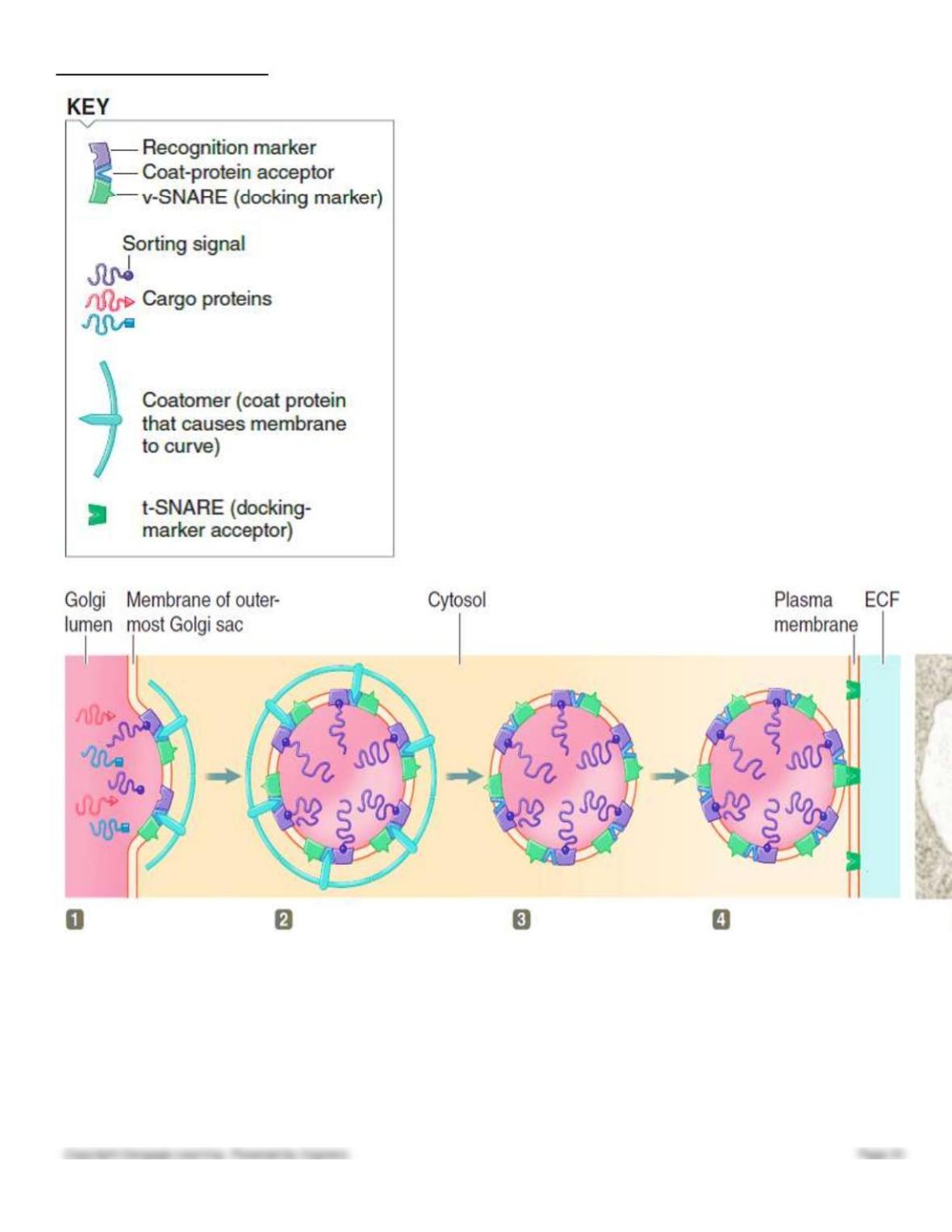
Figure 2-7
Answer the corresponding questions using the accompanying figure.
91. At what numbered stage in the accompanying figure does the vesicle lose its coating, which exposes v-SNARE
docking markers on the vesicle surface?
a.
1
b.
2
c.
3
d.
4
Chapter 02 – Cell Physiology
e.
5
92. At what numbered stage in the accompanying figure do v-SNAREs bind only with the t-SNARE docking-marker
acceptors?
a.
1
b.
2
c.
3
d.
4
e.
5
d
93. At what numbered stage in the accompanying figure does the membrane close beneath the bud and pinch off the
secretory vesicle?
a.
1
b.
2
c.
3
d.
4
e.
5
b
94. At what numbered stage in the accompanying figure do the secretory vesicles get released?
a.
1
b.
2
c.
3
d.
4
e.
5
95. At what numbered stage in the accompanying figure does the Golgi complex membrane curve and form a bud?
Chapter 02 – Cell Physiology
a.
1
b.
2
c.
3
d.
4
e.
5
96. Outline the six main principles of cell theory.
97. Describe the human genome.
98. Describe the use of ATP molecules for energy.
99. Compare and contrast aerobic exercise and anaerobic exercise in terms of energy production.
100. Discuss the three components of the cytoskeleton.