CHAPTER 2
JOB ORDER COSTING
SUMMARY OF QUESTIONS BY LEARNING OBJECTIVES AND BLOOM’S
TAXONOMY
Item
LO
BT
Item
LO
BT
Item
LO
BT
Item
LO
BT
Item
LO
BT
True-False Statements
1.
1
K
8.
1
K
15.
1
K
22.
3
C
29.
5
C
2.
1
C
9.
1
C
16.
1
K
23.
3
K
30.
5
C
3.
1
C
10.
1
C
17.
2
K
24.
3
C
31.
1
C
4.
1
C
11.
1
C
18.
2
K
25.
4
C
32.
1
K
5.
1
C
12.
1
C
19.
2
C
26.
4
K
33.
2
K
6.
1
K
13.
1
K
20.
2
C
27.
4
K
34.
3
K
7.
1
C
14.
1
C
21.
2
K
28.
4
K
35.
5
K
Multiple Choice Questions
36.
1
K
59.
2
C
82.
3
AP
105.
4
C
128.
5
C
37.
1
K
60.
1
C
83.
3
AP
106.
4
AP
129.
5
C
38.
1
K
61.
2
K
84.
3
AP
107.
4
C
130.
5
K
39.
1
C
62.
2
K
85.
3
AP
108.
4
C
131.
5
C
40.
1
C
63.
2
AP
86.
3
AP
109.
4
C
132.
5
AP
41.
1
C
64.
2
K
87.
3
AP
110.
4
C
133.
5
C
42.
1
C
65.
2
C
88.
3
AP
111.
4
AP
134.
5
C
43.
1
C
66.
2
K
89.
3
C
112.
4
AP
135.
5
C
44.
1
AP
67.
2
K
90.
3
K
113.
4
AP
136.
5
C
45.
1
K
68.
2
K
91.
3
C
114.
4
C
137.
5
C
46.
1
K
69.
2
C
92.
3
C
115.
4
C
138.
5
C
47.
1
C
70.
2
C
93.
3
K
116.
4
AP
139.
5
C
48.
1
K
71.
2
K
94.
3
AP
117.
4
AP
140.
5
C
49.
1
C
72.
2
K
95.
3
C
118.
4
AP
st141.
1
K
50.
1
C
73.
2
C
96.
3
K
119.
4
AP
142.
1
K
51.
1
C
74.
2
C
97.
3
AP
120.
4
AP
st143.
1
K
52.
1
K
75.
2
K
98.
3
AP
121.
4
AP
144.
2
K
53.
1
C
76.
2
AP
99.
3
AP
122.
4
AP
st145.
2
K
54.
1
K
77.
2
AP
100.
3
AP
123.
4
AP
146.
3
AP
55.
1
K
78.
2
AP
101.
3
AP
124.
5
AP
st147.
3
K
56.
1
AP
79.
2
AP
102.
4
AP
125.
5
AP
148.
5
C
57.
1
K
80.
2
AP
103.
4
C
126.
5
AP
st149.
5
K
58.
2
K
81.
3
AP
104.
4
C
127.
5
C
150.
5
K
Brief Exercises
151 .
1
AP
153.
2
AP
155.
3,5
AP
157.
4
AP
159.
5
AP
152 .
1
AP
154.
2
AP
156.
3
AP
158.
5
AP
160.
5
AP
st This question also appears in a self-test at the student companion website.
Test Bank for Managerial Accounting, Seventh Edition
2 – 2
SUMMARY OF QUESTIONS BY LEARNING OBJECTIVES AND BLOOM’S
TAXONOMY
Exercises
161.
1
AP
167.
1–4
AP
173.
1–5
AP
179.
2,4
AP
185.
4,6
AP
162.
1–3
C
168.
1–4
AN
174.
1,2,5
,6
AP
180.
2,4,5
AP
186.
4,6
AP
163.
1–3
AP
169.
1–4
AP
175.
1–5
AP
181.
3,5
AP
187.
4
AP
164.
1–3
C
170.
1,2
AP
176.
2
AP
182.
3,5
AP
188.
4
AP
165.
1,2
AP
171.
1–4
AP
177.
2–4
AN
183.
3
AP
166.
1–4
AP
172.
1,4
AP
178.
2,4
AP
184.
3,5
AP
Completion Statements
189.
1
K
191.
1
K
193.
1
K
195.
2
K
197.
5
K
190.
1
K
192.
1
K
194.
2
AP
196.
3
K
198.
5
K
Matching Statements
199.
1
K
Short-Answer Essay
200.
1
S
202.
3
S
204.
2
S
201.
1
S
203.
3
S
205.
3
S
SUMMARY OF LEARNING OBJECTIVES BY QUESTION TYPE
Item
Type
Item
Type
Item
Type
Item
Type
Item
Type
Item
Type
Item
Type
Learning Objective 1
1.
TF
11.
TF
38.
MC
48.
MC
58.
MC
163.
Ex
173.
Ex
2.
TF
12.
TF
39.
MC
49.
MC
59.
MC
164.
Ex
175.
Ex
3.
TF
13.
TF
40.
MC
50.
MC
60.
MC
165.
Ex
189.
C
4.
TF
14.
TF
41.
MC
51.
MC
141.
MC
166.
Ex
190.
C
5.
TF
15.
TF
42.
MC
52.
MC
142.
MC
167.
Ex
191.
C
6.
TF
16.
TF
43.
MC
53.
MC
143.
MC
168.
Ex
192.
C
7.
TF
31.
TF
44.
MC
54.
MC
151.
BE
169.
Ex
193.
C
8.
TF
32.
TF
45.
MC
55.
MC
152.
BE
170.
Ex
199.
MA
9.
TF
36.
MC
46.
MC
56.
MC
161.
Ex
171.
Ex
200.
SA
10.
TF
37.
MC
47.
MC
57.
MC
162.
Ex
172.
Ex
201.
SA
Learning Objective 2
17.
TF
61.
MC
69.
MC
77.
MC
162.
Ex
170.
Ex
179.
Ex
18.
TF
62.
MC
70.
MC
78.
MC
163.
Ex
171.
Ex
180.
Ex
19.
TF
63.
MC
71.
MC
79.
MC
164.
Ex
173.
Ex
194.
C
20.
TF
64.
MC
72.
MC
80.
MC
165.
Ex
174.
Ex
195.
C
21.
TF
65.
MC
73.
MC
144.
MC
166.
Ex
175.
Ex
204.
SA
33.
TF
66.
MC
74.
MC
145.
MC
167.
Ex
176.
Ex
58.
MC
67.
MC
75.
MC
153.
BE
168.
Ex
177.
Ex
59.
MC
68.
MC
76.
MC
154.
BE
169.
Ex
178.
Ex
Job Order Costing
2 – 3
Learning Objective 3
22.
TF
85.
MC
93.
MC
101.
MC
166.
Ex
180.
Ex
202.
SA
23.
TF
86.
MC
94.
MC
146.
MC
167.
Ex
181.
Ex
203.
SA
24.
TF
87.
MC
95.
MC
147.
MC
168.
Ex
182.
Ex
205.
SA
34.
TF
88.
MC
96.
MC
155.
BE
169.
Ex
183.
Ex
81.
MC
89.
MC
97.
MC
156.
BE
171.
Ex
184.
Ex
82.
MC
90.
MC
98.
MC
162.
Ex
173.
Ex
185.
Ex
83.
MC
91.
MC
99.
MC
163.
Ex
175.
Ex
186.
Ex
84.
MC
92.
MC
100.
MC
164.
Ex
177.
Ex
196.
C
Learning Objective 4
25.
TF
104.
MC
110.
MC
116.
MC
122.
MC
169.
Ex
178.
Ex
26.
TF
105.
MC
111.
MC
117.
MC
123.
MC
171.
Ex
179.
Ex
27.
TF
106.
MC
112.
MC
118.
MC
157.
BE
172.
Ex
187.
Ex
28.
TF
107.
MC
113.
MC
119.
MC
166.
Ex
173.
Ex
188.
Ex
102.
MC
108.
MC
114.
MC
120.
MC
167.
Ex
175.
Ex
103.
MC
109.
MC
115.
MC
121.
MC
168.
Ex
177.
Ex
Learning Objective 5
29.
TF
127.
MC
133.
MC
139.
MC
159.
BE
182.
Ex
30.
TF
128.
MC
134.
MC
140.
MC
160.
BE
184.
Ex
35.
TF
129.
MC
135.
MC
148.
MC
173.
Ex
185.
Ex
124.
MC
130.
MC
136.
MC
149.
MC
175.
Ex
186.
Ex
125.
MC
131.
MC
137.
MC
150.
MC
180.
Ex
197.
C
126.
MC
132.
MC
138.
MC
158.
BE
181.
Ex
198.
C
Note: TF = True-False BE = Brief Exercise C = Completion
MC = Multiple Choice Ex = Exercise MA = Matching
SA = Short-Answer Essay
CHAPTER LEARNING OBJECTIVES
1. Describe cost systems and the flow of costs in job order system. Cost accounting
involves the procedures for measuring, recording, and reporting product costs. From the data
2. Use a job cost sheet to assign costs to work in process. A job cost sheet is a form used
to record the costs chargeable to a specific job and to determine the total and unit costs of the
3. Demonstrate how to determine and use the predetermined overhead rate. The
predetermined overhead rate is based on the relationship between estimated annual
Test Bank for Managerial Accounting, Seventh Edition
2 – 4
4. Prepare entries for manufacturing and service jobs completed and sold. When jobs are
completed, companies debit the cost to Finished Goods Inventory and credit it to Work in
5. Distinguish between under- or overapplied manufacturing overhead. Underapplied
manufacturing overhead indicates that the overhead assigned to work in process is less than
1. Cost accounting is primarily concerned with accumulating information about product costs.
2. A job order cost system is most appropriate when a large volume of uniform products are
produced.
3. A process cost accounting system is appropriate for similar products that are continuously
mass produced.
4. The perpetual inventory method cannot be used in a job order cost system.
5. A job order cost system and a process cost system are two alternative methods for
valuing inventories.
6. A job order cost system identifies costs with a particular job rather than with a set time
period.
7. A company may use either a job order cost system or a process cost system, but not both.
8. Raw Materials Inventory, Factory Labor, and Manufacturing Overhead are all control
accounts in the general ledger when a job order cost accounting system is used.
9. Accumulating and assigning manufacturing costs are two important activities in a job order
cost system.
Job Order Costing
2 – 5
10. Recording the acquisition of raw materials is a part of accumulating manufacturing costs.
11. Manufacturing costs are generally incurred in one period and recorded in a subsequent
period.
12. The Purchases account is credited for all raw materials purchase returns and allowances.
13. When raw materials are received, there is no effort at this point to associate the cost of
materials with specific jobs.
14. When raw materials are purchased, the Work in Process Inventory account is debited.
15. Factory labor should be assigned to selling and administrative expenses on a
proportionate basis.
16. Fringe benefits and payroll taxes associated with factory workers should be accumulated
as a part of Factory Labor.
17. Job order cost sheets constitute the subsidiary ledger of the control account Work In
Process Inventory.
18. In a job order cost system, each entry to the Work In Process Inventory account should be
accompanied by a posting to one or more job cost sheets.
19. Direct materials requisitioned from the storeroom should be charged to the Work In
Process Inventory account and the job cost sheets for the individual jobs on which the
materials were used.
20. Manufacturing overhead is the only product cost that can be assigned to jobs as soon as
the costs are incurred.
21. There should be a separate job cost sheet for each job.
Test Bank for Managerial Accounting, Seventh Edition
2 – 6
22. Actual manufacturing overhead costs are assigned to each job by tracing each overhead
cost to a specific job.
FSA
23. The formula for the predetermined overhead rate is estimated annual overhead costs
divided by an expected annual operating activity.
24. Actual manufacturing overhead costs should be charged to the Work in Process Inventory
account as they are incurred.
25. A good system of internal control requires that the job order cost sheet be destroyed as
soon as the job is complete.
26. Finished Goods Inventory is charged for the cost of jobs completed during a period.
27. When goods are sold, the Cost of Goods Sold account is debited and Work in Process
Inventory account is credited.
FSA
28. Total manufacturing costs for a period consists of the costs of direct materials used, the
cost of direct labor incurred, and the manufacturing overhead applied during the period.
29. Overapplied overhead means that actual manufacturing overhead costs were greater than
the manufacturing overhead costs applied to jobs.
30. At the end of the year, the accountant credits the amount of the overapplied overhead to
Cost of Goods Sold.
31. A cost accounting system consists of manufacturing cost accounts that are fully integrated
into the general ledger of a company.
32. The cost of raw materials purchased is credited to Raw Materials Inventory when
materials are received.
33. Requisitions for direct materials are posted daily to the individual job cost sheets.
Job Order Costing
2 – 7
34. The predetermined overhead rate is based on the relationship between estimated annual
overhead costs and expected annual operating activity expressed in terms of a common
activity base.
35. At the end of the year, underapplied overhead is usually credited to Cost of Goods Sold.
Answers to True-False Statements
Item
Ans.
Item
Ans.
Item
Ans.
Item
Ans.
Item
Ans.
Item
Ans.
Item
Ans.
MULTIPLE CHOICE QUESTIONS
36. Which of the following is one of the components of cost accounting?
a. It involves measuring product costs.
b. It involves the determination of company profits.
c. It requires GAAP to be applied.
d. It requires cost minimizing principles.
37. A major purpose of cost accounting is to
a. classify all costs as operating or nonoperating.
b. measure, record, and report period costs.
c. provide information to stockholders for investment decisions.
d. measure, record, and report product costs.
38. The two basic types of cost accounting systems are
a. job order and job accumulation systems.
b. job order and process cost systems.
c. process cost and batch systems.
d. job order and batch systems.
39. A process cost system would most likely be used by a company that makes
a. motion pictures.
b. repairs to automobiles.
c. breakfast cereal.
d. college graduation announcements.
Test Bank for Managerial Accounting, Seventh Edition
2 – 8
40. Which of the following would be accounted for using a job order cost system?
a. The production of personal computers.
b. The production of automobiles.
c. The refining of petroleum.
d. The construction of a new campus building.
41. Process costing is used when
a. the production process is continuous.
b. production is aimed at filling a specific customer order.
c. dissimilar products are involved.
d. costs are to be assigned to specific jobs.
42. Process costing is not used when
a. similar goods are being produced.
b. large volumes are produced.
c. jobs have distinguishing characteristics.
d. a series of connected manufacturing processes is necessary.
43. An important feature of a job order cost system is that each job
a. must be similar to previous jobs completed.
b. has its own distinguishing characteristics.
c. must be completed before a new job is accepted.
d. consists of one unit of output.
44. As of December 31, 2017, Stand Still Industries had $2,500 of raw materials inventory. At
the beginning of 2017, there was $2,000 of materials on hand. During the year, the
company purchased $375,000 of materials; however, it paid for only $312,500. How much
inventory was requisitioned for use on jobs during 2017?
a. $362,000
b. $374,500
c. $375,500
d. $363,000
45. The flow of costs in a job order cost system
a. involves accumulating manufacturing costs incurred and assigning the accumulated
costs to work done.
b. cannot be measured until all jobs are complete.
c. measures product costs for a set time period.
d. generally follows a LIFO cost flow assumption.

Job Order Costing
2 – 9
46. In a job order cost accounting system, the Raw Materials Inventory account is
a. an expense.
b. a control account.
c. not used.
d. a period cost.
47. When a job is completed and all costs have been accumulated on a job cost sheet, the
journal entry that should be made is
a. Finished Goods Inventory
Direct Materials
Direct Labor
Manufacturing Overhead
b. Work In Process Inventory
Direct Materials
Direct Labor
Manufacturing Overhead
c. Raw Materials Inventory
Work In Process Inventory
d. Finished Goods Inventory
Work In Process Inventory
48. The two major steps in the flow of costs are
a. allocating and assigning.
b. acquiring and accumulating.
c. accumulating and assigning.
d. accumulating and amortizing.
49. The Raw Materials Inventory account is
a. a subsidiary account.
b. debited for invoice costs and freight costs chargeable to the purchaser.
c. debited for purchase discounts taken.
d. debited for purchase returns and allowances.
50. Records of individual items of raw materials would not be maintained
a. electronically.
b. manually.
c. on stores ledger cards.
d. in the Raw Materials Inventory account.
Test Bank for Managerial Accounting, Seventh Edition
2 – 10
51. Cost of raw materials is debited to Raw Materials Inventory when the
a. materials are ordered.
b. materials are received.
c. materials are put into production.
d. bill for the materials is paid.
52. Which of the following is not included in factory labor costs?
a. Gross earnings.
b. Employer payroll taxes.
c. Fringe benefits.
d. All of these are included.
53. All of the following would be entries in assigning accumulated costs to the Work In
Process Inventory except:
a. the purchase of raw materials.
b. raw materials are used.
c. overhead is applied.
d. factory labor is used.
54. Factory labor costs
a. are accumulated in a control account.
b. do not include pension costs.
c. include vacation pay.
d. are based on workers’ net pay.
55. Factory Labor is a(n)
a. expense account.
b. control account.
c. subsidiary account.
d. temporary account.
56. Kline Manufacturing has the following labor costs:
Factory—Gross wages $500,000
Factory—Net wages 420,000
Employer Payroll Taxes Payable 50,000
The entry to record the cost of factory labor and the associated payroll tax expense will
include a debit to Factory Labor for
a. $550,000.
b. $500,000.
c. $470,000.
d. $450,000.

Job Order Costing
2 – 11
57. Factory labor costs
a. accumulate in advance of utilization.
b. accumulate in a control account.
c. include sick pay earned by factory workers.
d. accumulate in the Factory Labor Expense account.
58. Which of the following is not a control account?
a. Manufacturing Overhead
b. Raw materials inventory
c. Accounts Receivable
d. All fo these are control accounts
59. Manufacturing Overhead would not have a subsidiary account for
a. utilities.
b. property taxes.
c. insurance.
d. raw materials inventory.
60. The entry to record the acquisition of raw materials on account is
a. Work in Process Inventory
Accounts Payable
b. Manufacturing Overhead
Raw Materials Inventory
Accounts Payable
c. Accounts Payable
Raw Materials Inventory
d. Raw Materials Inventory
Accounts Payable
61. Which one of the following best describes a job cost sheet?
a. It is a form used to record the costs chargeable to a specific job and to determine the
total and unit costs of the completed job.
b. It is used to track manufacturing overhead costs to specific jobs.
c. It is used by management to understand how direct costs affect profitability.
d. It is a daily form that management uses for tracking worker productivity on which
employee raises are based.
62. Job cost sheets constitute the subsidiary ledger for the
a. Finished Goods Inventory account.
b. Cost of Goods Sold account.
c. Work In Process Inventory account.
d. Cost of Goods Manufactured account.
Test Bank for Managerial Accounting, Seventh Edition
2 – 12
63. A materials requisition slip showed that direct materials requested were $66,000 and
indirect materials requested were $9,000. The entry to record the transfer of materials
from the storeroom is
a. Work In Process Inventory ………………………………………….. 66,000
Raw Materials Inventory ……………………………………… 66,000
b. Direct Materials …………………………………………………………. 66,000
Indirect Materials ……………………………………………………….. 9,000
Work in Process Inventory …………………………………… 75,000
c. Manufacturing Overhead …………………………………………….. 75,000
Raw Materials Inventory ……………………………………… 75,000
d. Work In Process Inventory ………………………………………….. 66,000
Manufacturing Overhead …………………………………………….. 9,000
Raw Materials Inventory ……………………………………… 75,000
64. The job cost sheet does not show
a. costs chargeable to a specific job.
b. the total costs of a completed job.
c. the unit cost of a completed job.
d. the cost of goods sold.
65. Under an effective system of internal control, the authorization for issuing materials is
made
a. orally.
b. on a prenumbered materials requisition slip.
c. by the accounting department.
d. by anyone on the production line.
66. A copy of the materials requisition slip would not include the:
a. quantity.
b. stock number.
c. cost per unit.
d. name of the supplier.
67. Materials requisition slips are costed
a. by production supervisors.
b. by factory personnel who work on the production line.
c. after the goods have been sold.
d. using any of the inventory costing methods.
Job Order Costing
2 – 13
68. Postings to control accounts in a costing system are made
a. monthly.
b. daily.
c. annually.
d. semi-annually.
69. Which one of the following should be equal to the balance of the Work In Process
Inventory account at the end of the period?
a. The total of the amounts transferred from raw materials for the current period
b. The sum of the costs shown on the job cost sheets of unfinished jobs
c. The total of manufacturing overhead applied to work in process for the period
d. The total manufacturing costs for the period
70. Which of the following shows entries only to control accounts?
a. Factory Labor
Factory Wages Payable
b. Work in Process
Factory Labor
Raw Materials Inventory
Factory Wages Payable
c. Work in Process
Manufacturing Overhead
Raw Materials Inventory
d. Factory Labor
Raw Materials Inventory
Accounts Payable
Factory Wages Payable
71. A time ticket does not indicate the
a. employee’s name.
b. account to be charged.
c. number of personal exemptions claimed by the employee.
d. job number.
72. Which one of the following is a source document that impacts the job cost sheet?
a. Raw materials receiving slips.
b. Materials purchase orders.
c. Labor time tickets.
d. Finished goods shipping documents.

Test Bank for Managerial Accounting, Seventh Edition
2 – 14
73. Time tickets should be approved by
a. the audit committee.
b. co-workers.
c. the employee’s supervisor.
d. the payroll department.
74. If the entry to assign factory labor showed only a debit to Work In Process Inventory, then
all labor costs were
a. direct labor.
b. indirect labor.
c. overtime related.
d. regular hours.
75. The principal accounting record used in assigning costs to jobs is
a. a job cost sheet.
b. the cost of goods manufactured schedule.
c. the Manufacturing Overhead control account.
d. the stores ledger cards.
76. The following information is available for completed Job No. 402: Direct materials,
$120,000; direct labor, $180,000; manufacturing overhead applied, $90,000; units
produced, 5,000 units; units sold, 4,000 units. The cost of the finished goods on hand from
this job is
a. $60,000.
b. $390,000.
c. $78,000.
d. $312,000.
77. Sportly, Inc. completed Job No. B14 during 2017. The job cost sheet listed the following:
Direct materials $110,000
Direct labor $60,000
Manufacturing overhead applied $40,000
Units produced 3,000 units
Units sold 1,800 units
How much is the cost of the finished goods on hand from this job?
a. $210,000
b. $126,000
c. $ 84,000
d. $102,000

Job Order Costing
2 – 15
78. Madison Inc. uses job order costing for its brand new line of sewing machines. The cost
incurred for production during 2017 totaled $18,000 of materials, $9,000 of direct labor
costs, and $6,000 of manufacturing overhead applied. The company ships all goods as
soon as they are completed which results in no finished goods inventory on hand at the
end of any year. Beginning work in process totaled $15,000, and the ending balance is
$9,000. During the year, the company completed 25 machines. How much is the cost per
machine?
a. $1,080
b. $1,560
c. $1,320
d. $1,920
79. As of December 31, 2017, Nilsen Industries had $2,000 of raw materials inventory. At the
beginning of 2017, there was $1,600 of materials on hand. During the year, the company
purchased $354,000 of materials; however it paid for only $314,000. How much inventory
was requisitioned for use on jobs during 2017?
a. $354,400
b. $344,400
c. $343,600
d. $353,600
80. Cost of goods manufactured equals $85,000 for 2017. Finished goods inventory is $2,000
at the beginning of the year and $5,500 at the end of the year. Beginning and ending work
in process for 2017 are $4,000 and $5,000, respectively. How much is cost of goods sold
for the year?
a. $87,500
b. $83,000
c. $81,500
d. $88,500
81. A company expected its annual overhead costs to be $1,500,000 and direct labor costs to
be $1,000,000. Actual overhead was $1,450,000, and actual labor costs totaled
$1,100,000. How much is the company’s predetermined overhead rate to the nearest
cent?
a. $1.45
b. $1.31
c. $1.50
d. $1.37
Test Bank for Managerial Accounting, Seventh Edition
2 – 16
82. Vektek, Inc. thinks machine hours is the best activity base for its manufacturing overhead.
The estimate of annual overhead costs for its jobs was $2,050,000. The company used
1,000 hours of processing on Job No. B12 during the period and incurred overhead costs
totaling $2,100,000. The budgeted machine hours for the year totaled 20,000. How much
overhead should be applied to Job No. B12?
a. $2,100
b. $102,500
c. $105,000
d. $2,050
83. Barr Mfg. provided the following information from its accounting records for 2017:
Expected production 60,000 labor hours
Actual production 56,000 labor hours
Budgeted overhead $900,000
Actual overhead $870,000
How much is the overhead application rate if Barr bases the rate on direct labor hours?
a. $16.07 per hour
b. $15.00 per hour
c. $14.50 per hour
d. $15.54 per hour
84. Kinney Company applies overhead on the basis of 150% of direct labor cost. Job No. 176
is charged with $150,000 of direct materials costs and $180,000 of manufacturing
overhead. The total manufacturing costs for Job No. 176 is
a. $330,000.
b. $600,000.
c. $450,000.
d. $405,000.
85. Redman Company manufactures customized desks. The following pertains to Job No.
978:
Direct materials used $15,450
Direct labor hours worked 360
Direct labor rate per hour $15.00
Machine hours used 300
Applied factory overhead rate per machine hour $22.00
What is the total manufacturing cost for Job No. 978?
a. $25,650
b. $27,450
c. $28,950
d. $30,750
Job Order Costing
2 – 17
86. Henson Company applies overhead on the basis of 120% of direct labor cost. Job No. 190 is
charged with $140,000 of direct materials costs and $180,000 of manufacturing overhead. The
total manufacturing costs for Job No. 190 is
a. $320,000.
b. $536,000.
c. $348,000.
d. $470,000.
87. Norman Company manufactures customized desks. The following pertains to Job No. 953:
Direct materials used $22,800
Direct labor hours worked 600
Direct labor rate per hour $16.00
Machine hours used 400
Applied factory overhead rate per machine hour $30.00
What is the total manufacturing cost for Job No. 953?
a. $41,200
b. $44,400
c. $47,200
d. $50,400
88. Minton Company provided the following information from its accounting records for 2017:
Expected production 60,000 labor hours
Actual production 56,000 labor hours
Budgeted overhead $1,800,000
Actual overhead $1,740,000
How much is the overhead application rate if Minton Company bases it on direct labor hours?
a. $30.00 per hour
b. $29.00 per hour
c. $32.14 per hour
d. $31.07 per hour
89. The labor costs that have been identified as indirect labor should be charged to
a. manufacturing overhead.
b. direct labor.
c. the individual jobs worked on.
d. salary expense.
90. Manufacturing overhead is applied to each job
a. at the time when the overhead cost is incurred.
b. by means of a predetermined overhead rate.
c. at the end of the year when actual costs are known.
d. only if the overhead costs can be directly traced to that job.

Test Bank for Managerial Accounting, Seventh Edition
2 – 18
91. The predetermined overhead rate is based on the relationship between
a. estimated annual costs and actual activity.
b. estimated annual costs and expected annual activity.
c. actual monthly costs and actual annual activity.
d. estimated monthly costs and actual monthly activity.
92. The predetermined overhead rate is
a. determined on a moving average basis throughout the year.
b. not calculated until actual overhead costs are incurred.
c. determined at the beginning of the year.
d. determined at the end of the current year.
93. In calculating a predetermined overhead rate, a recent trend in automated manufacturing
operations is to choose an activity base related to
a. direct labor hours.
b. indirect labor dollars.
c. machine hours.
d. raw materials dollars.
94. If annual overhead costs are expected to be $750,000 and direct labor costs are expected
to be $1,000,000, then if the activity base is direct labor costs:
a. $1.33 is the predetermined overhead rate.
b. for every dollar of manufacturing overhead, 75 cents of direct labor will be assigned.
c. for every dollar of direct labor, 75 cents of manufacturing overhead will be assigned.
d. a predetermined overhead rate cannot be determined.
95. Overhead application is recorded with a
a. credit to Work in Process Inventory.
b. credit to Manufacturing Overhead.
c. debit to Manufacturing Overhead.
d. credit to job cost sheets.
96. Manufacturing overhead applied is added to direct labor incurred and to what other item to
equal total manufacturing costs for the period?
a. Goods available for sale.
b. Raw materials purchased.
c. Work in process.
d. Direct materials used.
Job Order Costing
2 – 19
97. Simmons Inc. applies overhead to production at a predetermined rate of 90% based on
direct labor cost. Job No. 250, the only job still in process at the end of August, has been
charged with manufacturing overhead of $8,100. What was the amount of direct materials
charged to Job 250 assuming the balance in Work in Process inventory is $30,000?
a. $ 8,100.
b. $ 9,000.
c. $12,900.
d. $30,000.
98. Spencer Inc. applies overhead to production at a predetermined rate of 80% based on
direct labor cost. Job No. 130, the only job still in process at the end of August, has been
charged with manufacturing overhead of $6,400. What was the amount of direct materials
charged to Job 130 assuming the balance in Work in Process inventory is $20,000?
a. $7,000.
b. $6,400.
c. $5,600.
d. $20,000.
99. For Jacobs Company, the predetermined overhead rate is 70% of direct labor cost. During
the month, $600,000 of factory labor costs are incurred of which $140,000 is indirect
labor. Actual overhead incurred was $320,000. The amount of overhead debited to Work
in Process Inventory should be:
a. $322,000
b. $320,000
c. $420,000
d. $460,000
100. Simpson Company applies overhead on the basis of 200% of direct labor cost. Job No.
305 is charged with $180,000 of direct materials costs and $200,000 of manufacturing
overhead. The total manufacturing costs for Job No. 305 is:
a. $380,000
b. $480,000
c. $560,000
d. $580,000
101. For Wilton Company, the predetermined overhead rate is 70% of direct labor cost. During
the month, $720,000 of factory labor costs are incurred of which $200,000 is indirect
labor. Actual overhead incurred was $360,000. The amount of overhead debited to Work
in Process Inventory should be:
a. $364,000
b. $360,000
c. $504,000
d. $520,000
Test Bank for Managerial Accounting, Seventh Edition
2 – 20
102. At the beginning of the year, Monroe Company estimates annual overhead costs to be
$2,400,000 and that 300,000 machine hours will be operated. Using machine hours as a base,
the amount of overhead applied during the year if actual machine hours for the year was
315,000 hours is
a. $2,400,000.
b. $2,285,714.
c. $1,680,000.
d. $2,520,000.
103. Cost of goods sold is obtained from
a. analysis of all the control accounts in the cost system.
b. the finished goods inventory records.
c. the work in process inventory records.
d. the Raw Materials Inventory control account.
104. When determining costs of jobs, how does a company account for indirect materials?
a. It is added to work in process as used.
b. It remains part of raw materials inventory.
c. It is transferred out of raw materials into manufacturing overhead when used.
d. It is transferred out of raw materials into work in process as used.
105. In a job order cost system, a credit to Manufacturing Overhead will be accompanied by a debit
to
a. Cost of Goods Manufactured.
b. Finished Goods Inventory.
c. Work in Process Inventory.
d. Raw Materials Inventory.
106. During 2017, Tanner Manufacturing expected Job No. 26 to cost $300,000 of overhead,
$500,000 of materials, and $200,000 in labor. Tanner applied overhead based on direct labor
cost. Actual production required an overhead cost of $290,000, $550,000 in materials used,
and $220,000 in labor. All of the goods were completed. What amount was transferred to
Finished Goods?
a. $1,000,000
b. $1,060,000
c. $1,070,000
d. $1,100,000
107. Debits to Work in Process Inventory are accompanied by a credit to all but which one of the
following accounts?
a. Raw Materials Inventory
b. Factory Labor
c. Manufacturing Overhead
d. Cost of Goods Sold
Job Order Costing
2 – 21
108. Which of the following is not viewed as part of accumulating manufacturing costs in a job
order cost system?
a. Cost of goods sold is recognized
b. Raw materials are purchased
c. Factory labor is incurred
d. Manufacturing overhead is incurred
109. Which of the following is not viewed as part of assigning manufacturing costs in a job
order cost system?
a. Manufacturing overhead is applied
b. Raw materials are used
c. Manufacturing overhead is incurred
d. Completed goods are recognized
110. In determining total manufacturing costs on the cost of goods manufactured schedule,
a. beginning work in process inventory should have a zero balance.
b. actual manufacturing overhead costs appear as a deduction.
c. manufacturing overhead applied is added to direct materials and direct labor.
d. ending work in process inventory is deducted from beginning work in process
inventory.
111. Gulick Company developed the following data for the current year:
Beginning work in process inventory $240,000
Direct materials used 144,000
Actual overhead 288,000
Overhead applied 216,000
Cost of goods manufactured 264,000
Total manufacturing costs 720,000
Gulick Company’s direct labor cost for the year is
a. $72,000.
b. $360,000.
c. $216,000.
d. $288,000.

Test Bank for Managerial Accounting, Seventh Edition
2 – 22
112. Gulick Company developed the following data for the current year:
Beginning work in process inventory $240,000
Direct materials used 144,000
Actual overhead 288,000
Overhead applied 216,000
Cost of goods manufactured 264,000
Total manufacturing costs 720,000
Gulick Company’s ending work in process inventory is
a. $696,000.
b. $480,000.
c. $456,000.
d. $216,000.
113. Hayward Manufacturing Company developed the following data:
Beginning work in process inventory $900,000
Direct materials used 700,000
Actual overhead 1,100,000
Overhead applied 800,000
Cost of goods manufactured 1,200,000
Ending work in process 1,500,000
Hayward Manufacturing Company’s total manufacturing costs for the period is
a. $1,900,000.
b. $1,800,000.
c. $1,300,000.
d. cannot be determined from the data provided.
114. Which of the following is not used in assigning manufacturing costs to work in process
inventory?
a. Actual manufacturing overhead
b. Time tickets
c. Materials requisitions
d. Predetermined overhead rate
115. On the cost of goods manufactured schedule, the cost of goods manufactured agrees with
the
a. balance of Finished Goods Inventory at the end of the period.
b. total debits to Work in Process Inventory during the period.
c. amount transferred from Work in Process Inventory to Finished Goods during the
period.
d. debits to Cost of Goods Sold during the period.

Job Order Costing
2 – 23
116. Gannon Company had the following information at December 31:
Finished goods inventory, January 1 $ 50,000
Finished goods inventory, December 31 150,000
If the cost of goods manufactured during the year amounted to $2,200,000 and annual sales
were $2,750,000, the amount of gross profit for the year is
a. $550,000.
b. $2,100,000.
c. $650,000.
d. $450,000.
117. Haight Company incurred direct materials costs of $2,500,000 during the year. Manu-facturing
overhead applied was $450,000 and is applied at the rate of 60% of direct labor costs. Haight
Company’s total manufacturing costs for the year was
a. $3,700,000.
b. $3,220,000.
c. $2,950,000.
d. $4,720,000.
118. Greer Company developed the following data for the current year:
Beginning work in process inventory $ 136,000
Direct materials used 208,000
Actual overhead 176,000
Overhead applied 184,000
Cost of goods manufactured 900,000
Total manufacturing costs 856,000
How much is Greer Company’s direct labor cost for the year?
a. $508,000
b. $600,000
c. $464,000
d. $328,000
119. Greer Company developed the following data for the current year:
Beginning work in process inventory $ 136,000
Direct materials used 208,000
Actual overhead 176,000
Overhead applied 184,000
Cost of goods manufactured 900,000
Total manufacturing costs 856,000
How much is Greer Company’s ending work in process inventory for the year?
a. $92,000
b. $484,000
c. $84,000
d. $372,000

Test Bank for Managerial Accounting, Seventh Edition
2 – 24
120. Chmelar Manufacturing Company developed the following data:
Beginning work in process inventory $ 120,000
Direct materials used 720,000
Actual overhead 840,000
Overhead applied 810,000
Cost of goods manufactured 1,920,000
Ending work in process 90,000
How much are total manufacturing costs for the period?
a. $2,370,000
b. $1,890,000
c. $1,650,000
d. $1,830,000
121. Barger Company had the following information at December 31:
Finished goods inventory, January 1 $ 90,000
Finished goods inventory, December 31 126,000
If the cost of goods manufactured during the year amounted to $1,895,000 and annual
sales were $2,994,000, how much is the amount of gross profit for the year?
a. $1,099,000
b. $1,009,000
c. $1,859,000
d. $1,135,000
122. Emley Company incurred direct materials costs of $750,000 during the year.
Manufacturing overhead applied was $700,000 and is applied based on direct labor costs.
The predetermined overhead rate is 70%. How much are Emley Company’s total
manufacturing costs for the year?
a. $1,940,000
b. $1,750,000
c. $1,450,000
d. $2,450,000
123. During 2017, Durham Manufacturing expected Job No. 51 to cost $300,000 of overhead,
$500,000 of materials, and $200,000 in labor. Durham applied overhead based on direct
labor cost. Actual production required an overhead cost of $295,000, $570,000 in
materials used, and $220,000 in labor. All of the goods were completed. What amount
was transferred to Finished Goods?
a. $1,090,000
b. $1,120,000
c. $1,000,000
d. $1,085,000

Job Order Costing
2 – 25
124. During 2017, Cotte Manufacturing expected Job No. 59 to cost $300,000 of overhead,
$500,000 of materials, and $200,000 in labor. Cotte applied overhead based on direct
labor cost. Actual production required an overhead cost of $295,000, $570,000 in
materials used, and $220,000 in labor. All of the goods were completed. How much is the
amount of over- or underapplied overhead?
a. $5,000 underapplied
b. $5,000 overapplied
c. $35,000 underapplied
d. $35,000 overapplied
125. Kimble Company applies overhead on the basis of machine hours. Given the following
data, compute overhead applied and the under- or overapplication of overhead for the
period:
Estimated annual overhead cost $1,600,000
Actual annual overhead cost $1,575,000
Estimated machine hours 400,000
Actual machine hours 390,000
a. $1,560,000 applied and $15,000 overapplied
b. $1,600,000 applied and $15,000 overapplied
c. $1,560,000 applied and $15,000 underapplied
d. $1,575,000 applied and neither under-nor overapplied
126. Barnes Company applies overhead on the basis of machine hours. Given the following
data, compute overhead applied and the under- or overapplication of overhead for the
period:
Estimated annual overhead cost $3,000,000
Actual annual overhead cost $2,970,000
Estimated machine hours 300,000
Actual machine hours 295,000
a. $2,950,000 applied and $20,000 overapplied
b. $3,000,000 applied and $20,000 overapplied
c. $2,950,000 applied and $20,000 underapplied
d. $2,970,000 applied and neither under- nor overapplied
127. A company assigned overhead to work in process. At year end, what does the amount of
overapplied overhead mean?
a. The overhead assigned to work in process is greater than the estimated overhead
costs.
b. The overhead assigned to work in process is less than the estimated overhead costs.
c. The overhead assigned to work in process is less than the actual overhead.
d. The overhead assigned to work in process is greater than the overhead incurred.

Test Bank for Managerial Accounting, Seventh Edition
2 – 26
128. If the Manufacturing Overhead account has a debit balance at the end of a period, it
means that
a. actual overhead costs were less than overhead costs applied to jobs.
b. actual overhead costs were greater than overhead costs applied to jobs.
c. actual overhead costs were equal to overhead costs applied to jobs.
d. no jobs have been completed.
129. If the manufacturing overhead costs applied to jobs worked on were greater than the
actual manufacturing costs incurred during a period, overhead is said to be
a. underapplied.
b. overapplied.
c. in error.
d. prepaid.
130. At the end of the year, any balance in the Manufacturing Overhead account is generally
eliminated by adjusting
a. Work In Process Inventory.
b. Finished Goods Inventory.
c. Cost of Goods Sold.
d. Raw Materials Inventory.
131. If Manufacturing Overhead has a credit balance at the end of the period, then
a. overhead has been underapplied.
b. the overhead assigned to Work in Process Inventory is less than the overhead incurred.
c. overhead has been overapplied.
d. management must take corrective action.
132. The Manufacturing Overhead account shows debits of $30,000, $24,000, and $28,000
and one credit for $86,000. Based on this information, manufacturing overhead
a. has been overapplied.
b. has been underapplied.
c. has not been applied.
d. shows a zero balance.
133. If Manufacturing Overhead has a debit balance at the end of the period, then
a. overhead has been underapplied.
b. the overhead assigned to Work in Process Inventory is more than the overhead
incurred.
c. overhead has been overapplied.
d. management must take corrective action.

Job Order Costing
2 – 27
134. If actual overhead is greater than applied manufacturing overhead, then manufacturing
overhead is:
a. underapplied.
b. overapplied.
c. a loss on the income statement under “Other Expenses and Losses.”
d. considered a miscellaneous expense.
135. If actual overhead is less than applied manufacturing overhead, then manufacturing
overhead is:
a. underapplied.
b. overapplied.
c. a loss on the income statement under “Other Expenses and Losses.”
d. considered a miscellaneous expense.
136. If manufacturing overhead has been underapplied during the year, the adjusting entry at
the end of the year will show a
a. debit to Manufacturing Overhead.
b. credit to Cost of Goods Sold.
c. debit to Work in Process Inventory.
d. debit to Cost of Goods Sold.
137. If manufacturing overhead has been overapplied during the year, the adjusting entry at the
end of the year will show a
a. debit to Manufacturing Overhead.
b. credit to Finished Goods Inventory
c. debit to Cost of Goods Sold.
d. credit to Work in Process Inventory.
138. The existence of under- or overapplied overhead at the end of the year:
a. requires an adjustment to Cost of Goods Sold.
b. indicates that an error has been made.
c. requires a retroactive adjustment to the cost of all jobs completed.
d. is written off as a bad estimate expense.
139. Conceptually, any under- or overapplied overhead at the end of the year should be
allocated among all of the following except
a. cost of goods sold.
b. ending work in process inventory.
c. ending raw materials inventory.
d. ending finished goods inventory.
Test Bank for Managerial Accounting, Seventh Edition
2 – 28
140. If, at the end of the year, Manufacturing Overhead has been overapplied, it means that
a. actual overhead costs were greater than the overhead assigned to jobs.
b. actual overhead costs were less than the overhead assigned to jobs.
c. overhead has not been applied to jobs still in process.
d. cost of goods will have to be increased by the amount of the overapplied overhead.
141. A process cost system would be used for all of the following except the
a. manufacture of cereal.
b. refining of petroleum.
c. printing of wedding invitations.
d. production of automobiles.
142. In a job order cost system, it would be correct in recording the purchase of raw materials
to debit
a. Work in Process Inventory.
b. Work in Process and Manufacturing Overhead.
c. Raw Materials Inventory.
d. Finished Goods Inventory.
143. In a manufacturing company, the cost of factory labor consists of all of the following
except
a. employer payroll taxes.
b. fringe benefits incurred by the employer.
c. net earnings of factory workers.
d. gross earnings of factory workers.
144. Which of the following is not a control account?
a. Raw Materials Inventory
b. Factory Labor
c. Manufacturing Overhead
d. All of these are control accounts.
145. When the company assigns factory labor costs to jobs, the direct labor cost is debited to
a. Direct Labor.
b. Factory Labor.
c. Manufacturing Overhead.
d. Work in Process Inventory.

Job Order Costing
2 – 29
146. Jinnah Company applies overhead on the basis of 200% of direct labor cost. Job No. 501
is charged with $240,000 of direct materials costs and $320,000 of manufacturing
overhead. The total manufacturing costs for Job No. 501 is
a. $560,000.
b. $880,000.
c. $720,000.
d. $800,000.
147. Companies assign manufacturing overhead to work in process on an estimated basis
through the use of a(n)
a. actual overhead rate.
b. estimated overhead rate.
c. assigned overhead rate.
d. predetermined overhead rate.
148. Overapplied manufacturing overhead exists when overhead assigned to work in process is
a. more than overhead incurred and there is a debit balance in Manufacturing Overhead
at the end of a period.
b. less than overhead incurred and there is a debit balance in Manufacturing Overhead
at the end of a period.
c. more than overhead incurred and there is a credit balance in Manufacturing Overhead
at the end of a period.
d. less than overhead incurred and there is a credit balance in Manufacturing Overhead
at the end of a period.
149. Usually, under- or overapplied overhead is considered to be an adjustment to
a. work in process.
b. finished goods.
c. finished goods and cost of goods sold.
d. cost of goods sold.
150. Which of the following statements about under- or overapplied manufacturing overhead is
correct?
a. After the entry to transfer over- or underapplied overhead to Cost of Goods Sold is
posted, Manufacturing Overhead will have a zero balance.
b. When Manufacturing Overhead has a credit balance, overhead is said to be under–
applied.
c. At the end of the year, under- or overapplied overhead is eliminated by a closing entry.
d. When annual financial statements are prepared, overapplied overhead is reported in
current liabilities.
Test Bank for Managerial Accounting, Seventh Edition
2 – 30
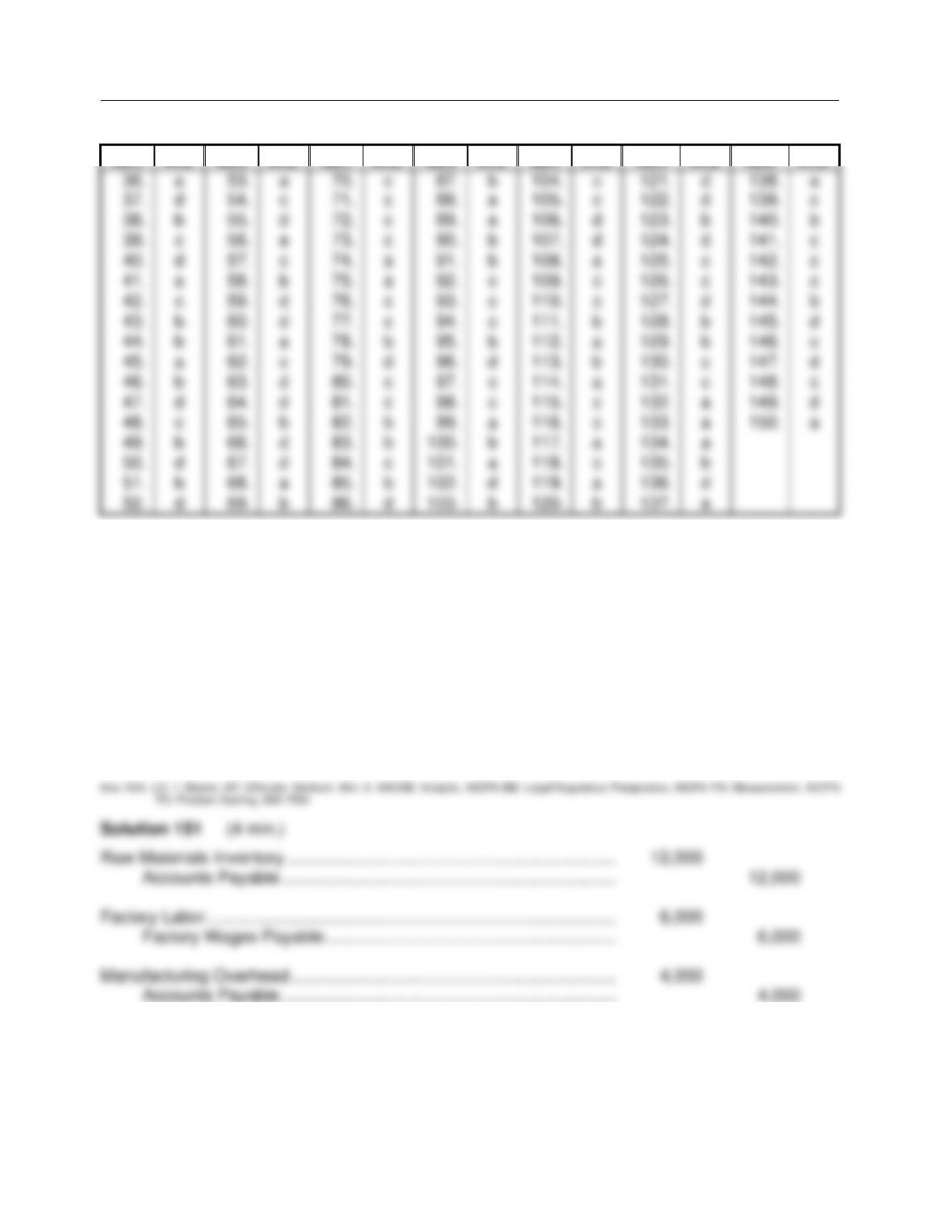
Answers to Multiple Choice Questions
BRIEF EXERCISES
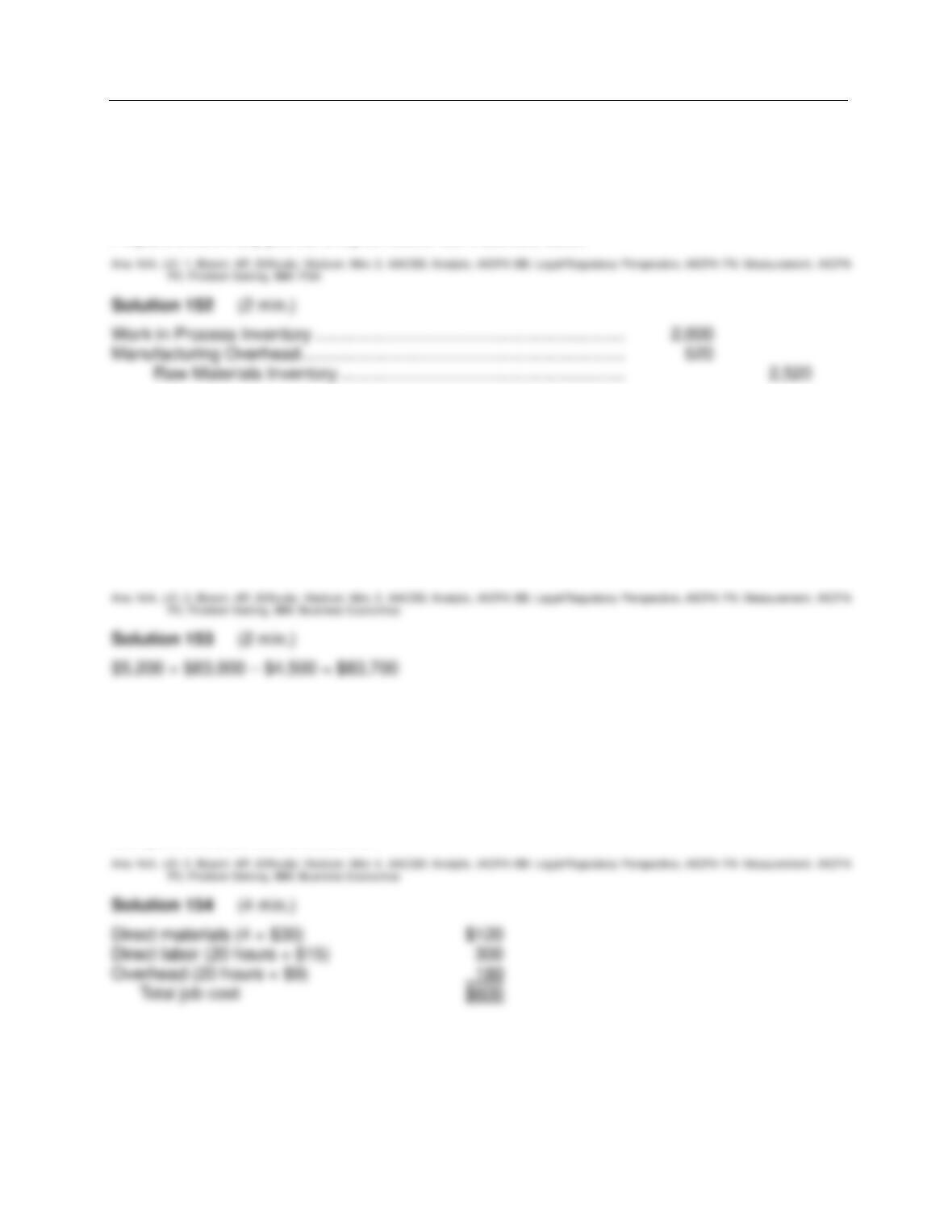
BE 151
During the first year of operations, Shapiro Tool accumulated the following manufacturing costs:
Raw materials purchased on account $12,000
Factory labor accrued 6,000
Incurred manufacturing overhead on account 4,000
Instructions
Prepare separate journal entries for each manufacturing cost.
Job Order Costing
2 – 31
BE 152
In January, Harlan, Inc. production supervisor requisitioned raw materials for production as
follows: Job 1 $700, Job 2 $900, Job 3 $400, and general factory use, $520.
Instructions
Prepare a summary journal entry to record raw materials used.
BE 153
Lando Company reported the following amounts for 2016:
Raw materials purchased $83,000 Ending work in process inventory $ 6,300
Beginning raw materials inventory 5,200 Manufacturing overhead costs applied 36,000
Ending raw materials inventory 4,500 Beginning work in process inventory 6,100
Instructions
Calculate the cost of materials used in production
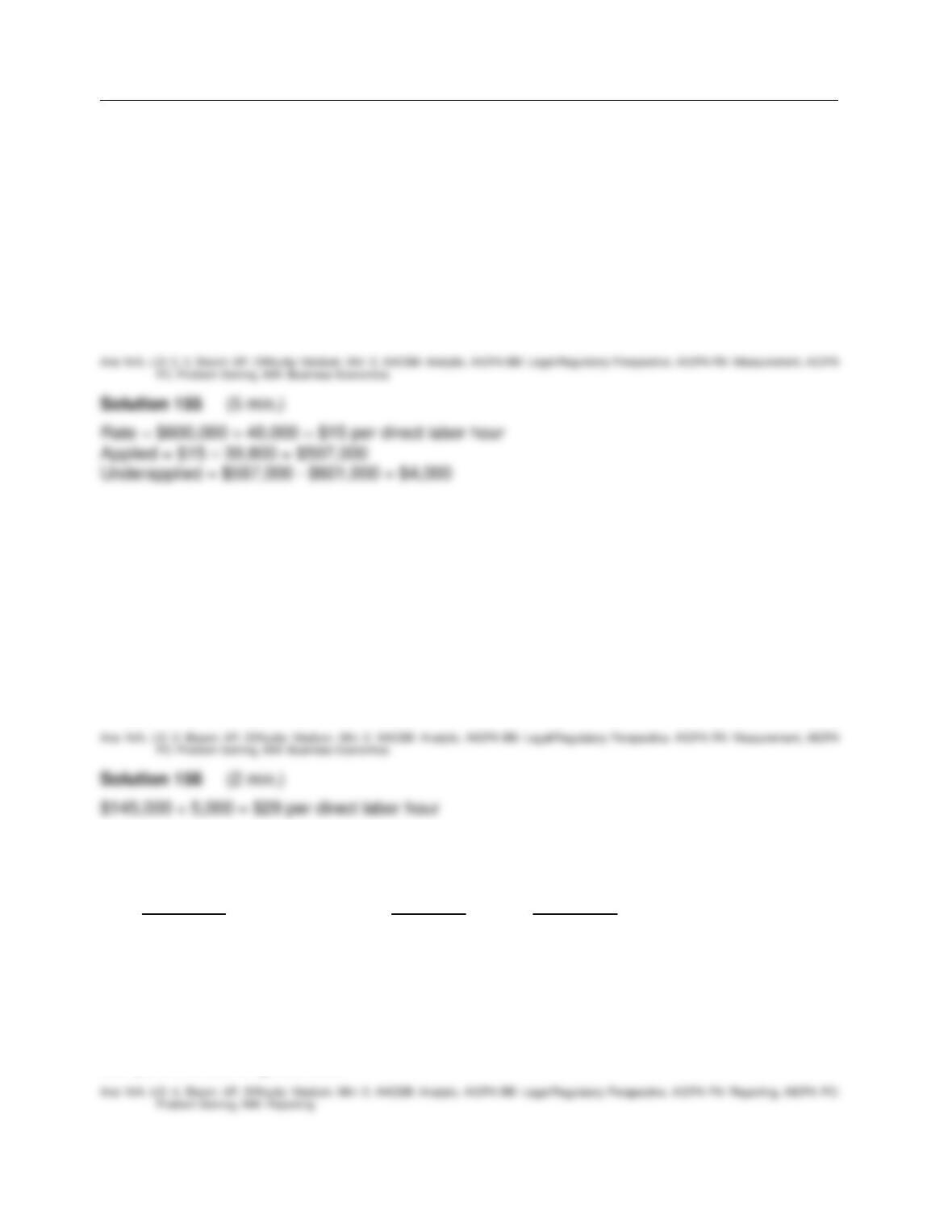
BE 154
Builder Bug Company allocates overhead at $9 per direct labor hour. Job A45 required 4 boxes of
direct materials at a cost of $30 per box and took employees 20 hours to complete. Employees
earn $15 per hour.
Instructions
Compute the total cost of Job A45.
Test Bank for Managerial Accounting, Seventh Edition
2 – 32
BE 155
Colby Company estimates that annual manufacturing overhead costs will be $600,000.
Estimated annual operating activity bases are: direct labor cost $460,000, direct labor hours
40,000 and machine hours 80,000. The actual manufacturing overhead cost for the year was
$601,000 and the actual direct labor cost for the year was $456,000. Actual direct labor hours
totaled 39,800 and machine hours totaled 79,000. Colby applies overhead based on direct labor
hours.
Instructions
Compute the predetermined overhead rate and determine the amount of manufacturing overhead
applied. Determine if overhead is over– or underapplied and the amount.
BE 156
Martin Company applies manufacturing overhead based on direct labor hours. Information
concerning manufacturing overhead and labor for the year follows:
Actual manufacturing overhead $150,000
Estimated manufacturing overhead $145,000
Direct labor hours incurred 4,800
Direct labor hours estimated 5,000
Instructions
Compute the predetermined overhead rate.
BE 157
The manufacturing operations of Bryant, Inc. had the following balances for the month of January:
Inventories January 1 January 31
Raw materials $12,000 $13,000
Work in process 21,000 23,000
Finished goods 14,000 16,000
Bryant transferred $290,000 of completed goods out of work in process during January.
Instructions
Compute the cost of goods sold.
Job Order Costing
2 – 33
Solution 157 (2 min.)
BE 158
The following amounts were reported by Burke Company before adjusting its immaterial
overapplied manufacturing overhead of $8,000.
Raw Materials Inventory $ 40,000
Finished Goods Inventory 60,000
Work in Process Inventory 100,000
Cost of Goods Sold 730,000
Instructions
Compute what amount Burke will report as cost of goods sold after it disposes of its overapplied
overhead.
BE 159
During 2016, Arb Company incurred the following direct labor costs: January $20,000 and
February $30,000. Arb uses a predetermined overhead rate of 120% of direct labor cost.
Estimated overhead for the 2 months, respectively, totaled $19,500 and $35,700. Actual overhead
for the 2 months, respectively, totaled $25,000 and $33,500.
Instructions
Determine if overhead is over- or underapplied for each of the two months and the respective
amounts.
Test Bank for Managerial Accounting, Seventh Edition
2 – 34
BE 160
At December 31, Ding Company reported the following balances in its accounts:
Cost of Goods Sold $210,000
Finished Goods Inventory 30,000
The company’s balance in its Manufacturing Overhead account at the same date was a debit of
$2,800.
Instructions
Prepare the entry to adjust the over- or underapplied overhead amount at December 31.
EXERCISES
Ex. 161
The manufacturing operations of Beatly, Inc. had the following balances for the month of January:
January 1 January 31
Raw materials $12,000 $13,000
Work in process 21,000 23,000
Finished goods 14,000 12,000
Beatly transferred $270,000 of completed goods out of work in process during January.
Instructions
Compute the cost of goods sold for January.
Ex. 162
A selected list of accounts used by Cline Manufacturing Company follows:
Code Code
A Cash F Accounts Payable
B Accounts Receivable G Factory Labor
C Raw Materials Inventory H Manufacturing Overhead
D Work In Process Inventory I Cost of Goods Sold
E Finished Goods Inventory J Sales Revenue
Cline Manufacturing Company uses a job order system and maintains perpetual inventory
records.

Job Order Costing
2 – 35
Ex. 162 (Cont.)
Instructions
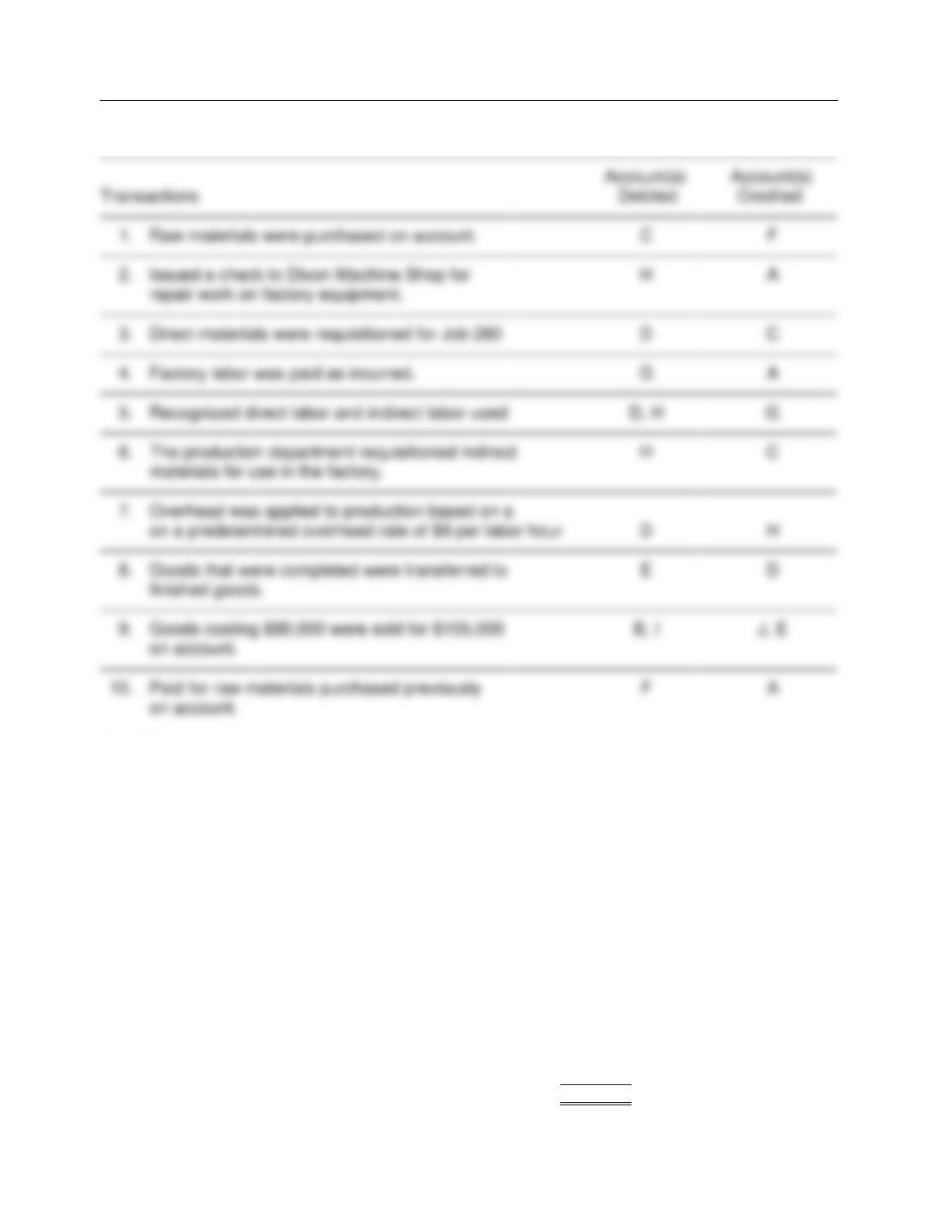
Place the appropriate code letter in the columns indicating the appropriate account(s) to be
debited and credited for the transactions listed below.
———————————————————————————————————————————
Account(s) Account(s)
Transactions Debited Credited
———————————————————————————————————————————
1. Raw materials were purchased on account.
———————————————————————————————————————————
2. Issued a check to Dixon Machine Shop for
repair work on factory equipment.
———————————————————————————————————————————
3. Direct materials were requisitioned for Job 280.
———————————————————————————————————————————
4. Factory labor was paid as incurred.
———————————————————————————————————————————
5. Recognized direct labor and indirect labor used.
———————————————————————————————————————————
6. The production department requisitioned indirect
materials for use in the factory.
———————————————————————————————————————————
7. Overhead was applied to production based on a
predetermined overhead rate of $8 per labor hour.
———————————————————————————————————————————
8. Goods that were completed were transferred to
finished goods.
———————————————————————————————————————————
9. Goods costing $80,000 were sold for $105,000
on account.
———————————————————————————————————————————
10. Paid for raw materials purchased previously
on account.
———————————————————————————————————————————
Test Bank for Managerial Accounting, Seventh Edition
2 – 36
Solution 162 (10–15 min.)
Ex. 163
Finn Manufacturing Company uses a job order cost accounting system and keeps perpetual
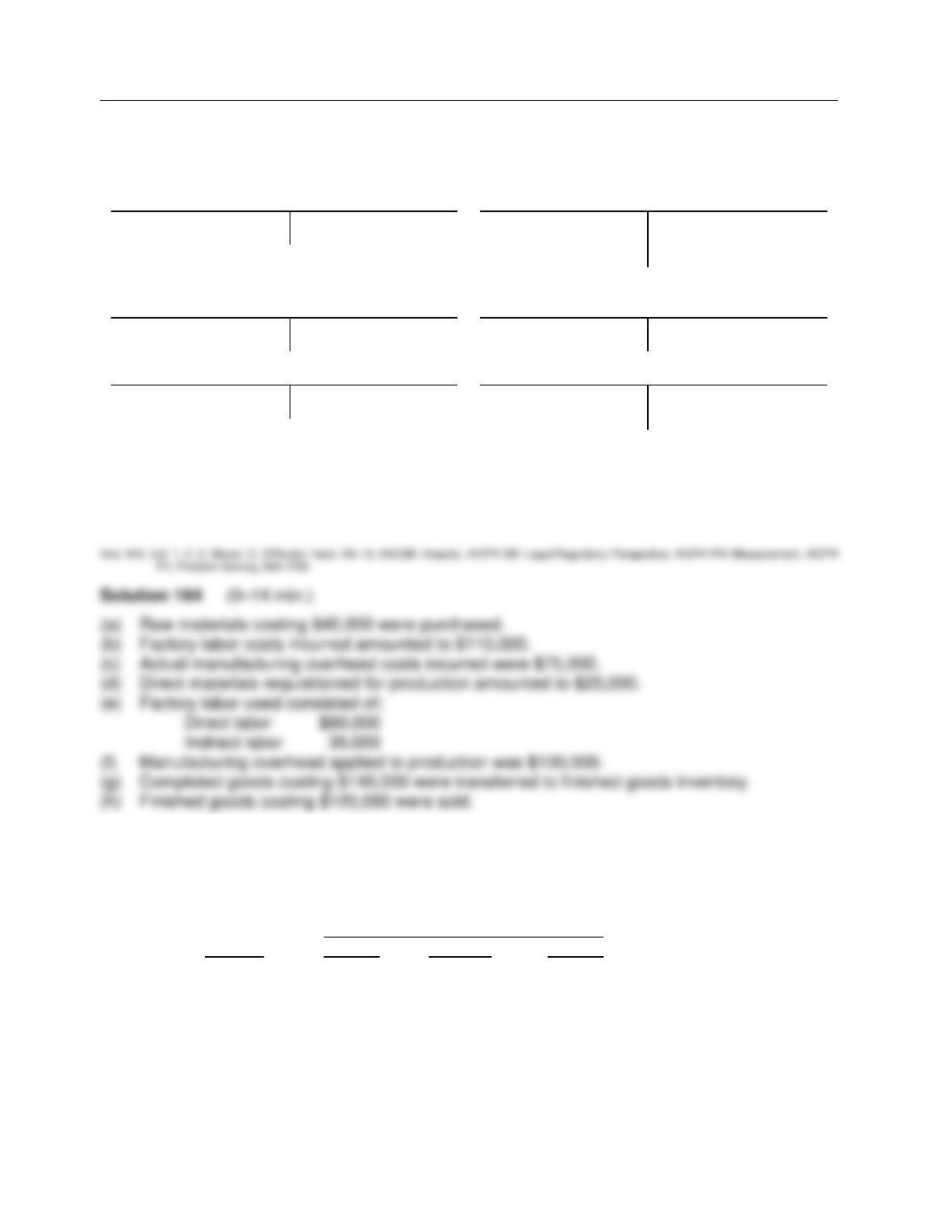
inventory records. Prepare journal entries to record the following transactions during the month of
June.
June 1 Purchased raw materials for $20,000 on account.
8 Raw materials requisitioned by production:
Direct materials $8,000
Indirect materials 1,000
15 Paid factory utilities, $2,100 and repairs for factory equipment, $8,000.
25 Incurred $108,000 of factory labor.
25 Time tickets indicated the following:
Direct Labor (7,000 hrs × $12 per hr) = $84,000
Indirect Labor (3,000 hrs × $8 per hr) = 24,000
$108,000
Job Order Costing
2 – 37
Ex. 163 (Cont.)
25 Applied manufacturing overhead to production based on a predetermined overhead
rate of $7 per direct labor hour worked.
28 Goods costing $18,000 were completed in the factory and were transferred to finished
goods.
30 Goods costing $15,000 were sold for $20,000 on account.
Test Bank for Managerial Accounting, Seventh Edition
2 – 38
Ex. 164
Selected accounts of Kosar Manufacturing Company at year end appear below:
RAW MATERIALS INVENTORY WORK IN PROCESS INVENTORY
(a) 40,000 (d) 25,000 (d) 25,000 (g) 140,000
(e) 80,000
(f) 100,000
FINISHED GOODS INVENTORY COST OF GOODS SOLD
(g) 140,000 (h) 120,000 (h) 120,000
FACTORY LABOR MANUFACTURING OVERHEAD
(b) 110,000 (e) 110,000 (c) 75,000 (f) 100,000
(e) 30,000
Instructions
Explain the probable transaction that took place for each of the items identified by letters in the
accounts. For example:
(a) Raw materials costing $40,000 were purchased.
Ex. 165
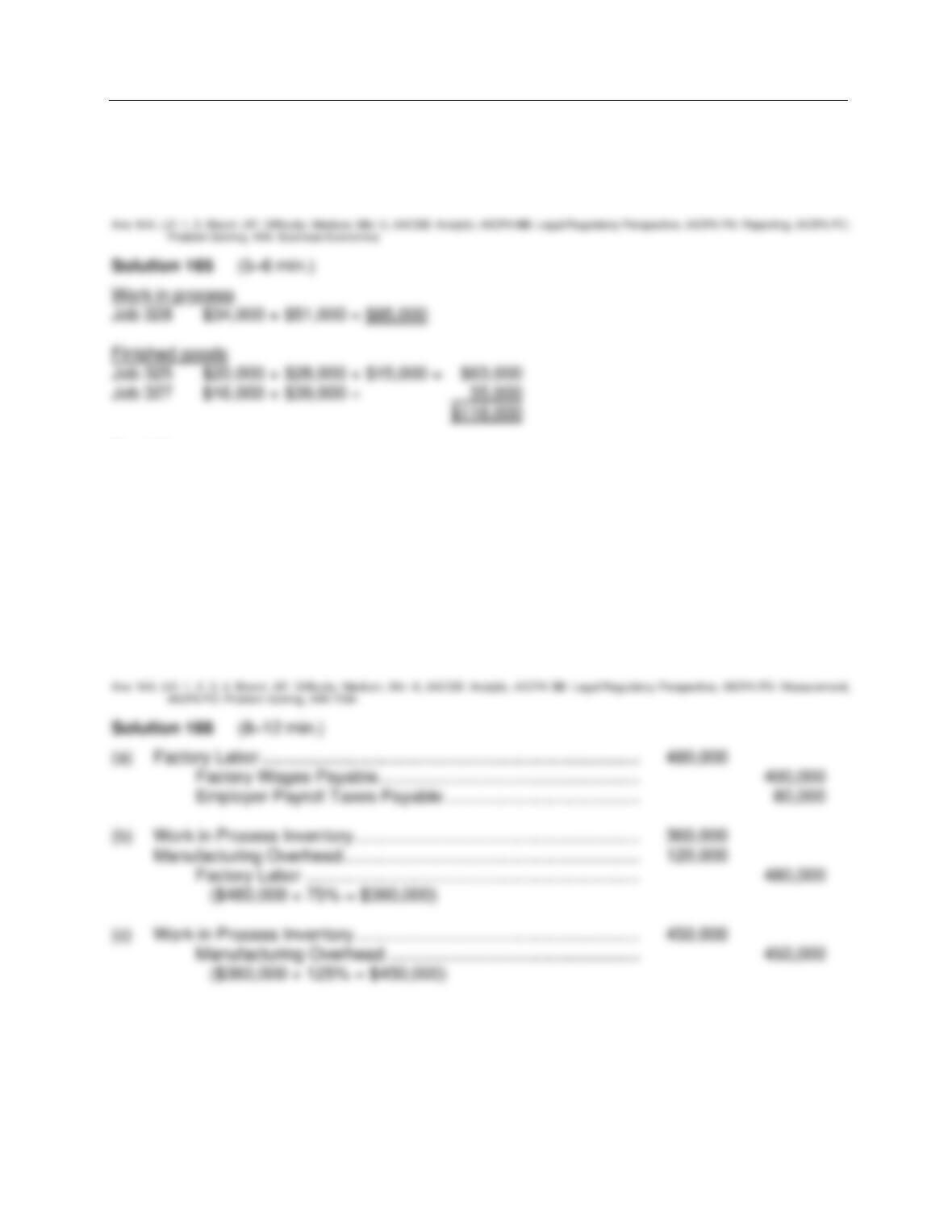
Sardin Company begins the month of March with $17,000 of work in process costs from Job 324.
Information from job cost sheets shows the following additional costs assigned during March,
April, and May of 2013:
Manufacturing Costs Assigned
Job No. March April May
324 $26,000
325 20,000 $28,000 $15,000
326 41,000 11,000
327 16,000 39,000
328 34,000 51,000
Job 324 was completed in March. Jobs 325 and 327 were completed in May, and Job 326 was
completed in April. Jobs are sold during the month after completion. Total revenue for jobs sold
during the 3-month period is $145,000.
Job Order Costing
2 – 39
Ex. 165 (Cont.)
Instructions
Calculate the balances of the work in process and finished goods inventory accounts at the end
of May.
Ex. 166
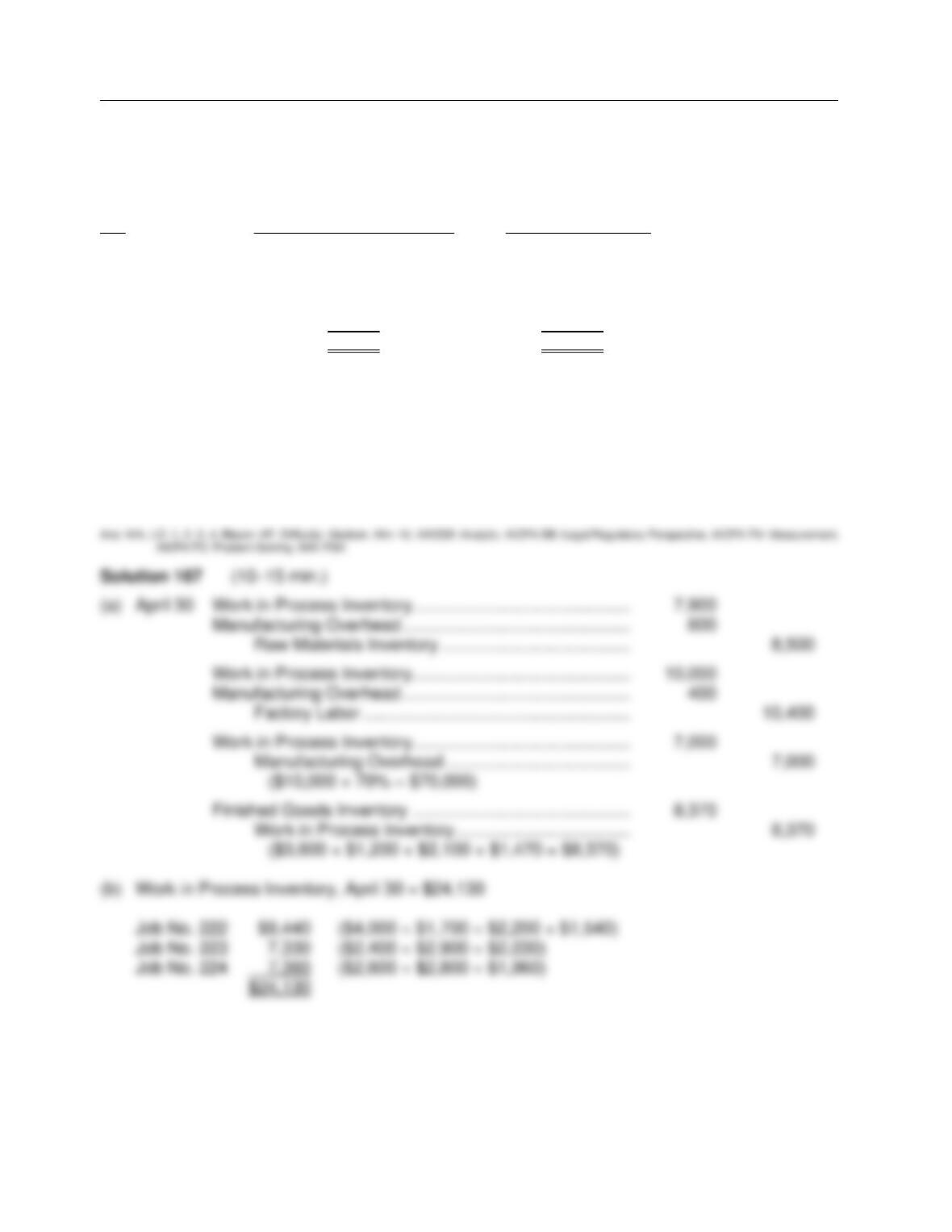
The gross earnings of factory workers for Dinkel Company during the month of January are
$400,000. The employer’s payroll taxes for the factory payroll are $80,000. Of the total
accumulated cost of factory labor, 75% is related to direct labor and 25% is attributable to indirect
labor.
Instructions
(a) Prepare the entry to record the factory labor costs for the month of January.
(b) Prepare the entry to assign factory labor to production.
(c) Prepare the entry to assign manufacturing overhead to production, assuming the
predetermined overhead rate is 125% of direct labor cost.
Test Bank for Managerial Accounting, Seventh Edition
2 – 40
Ex. 167
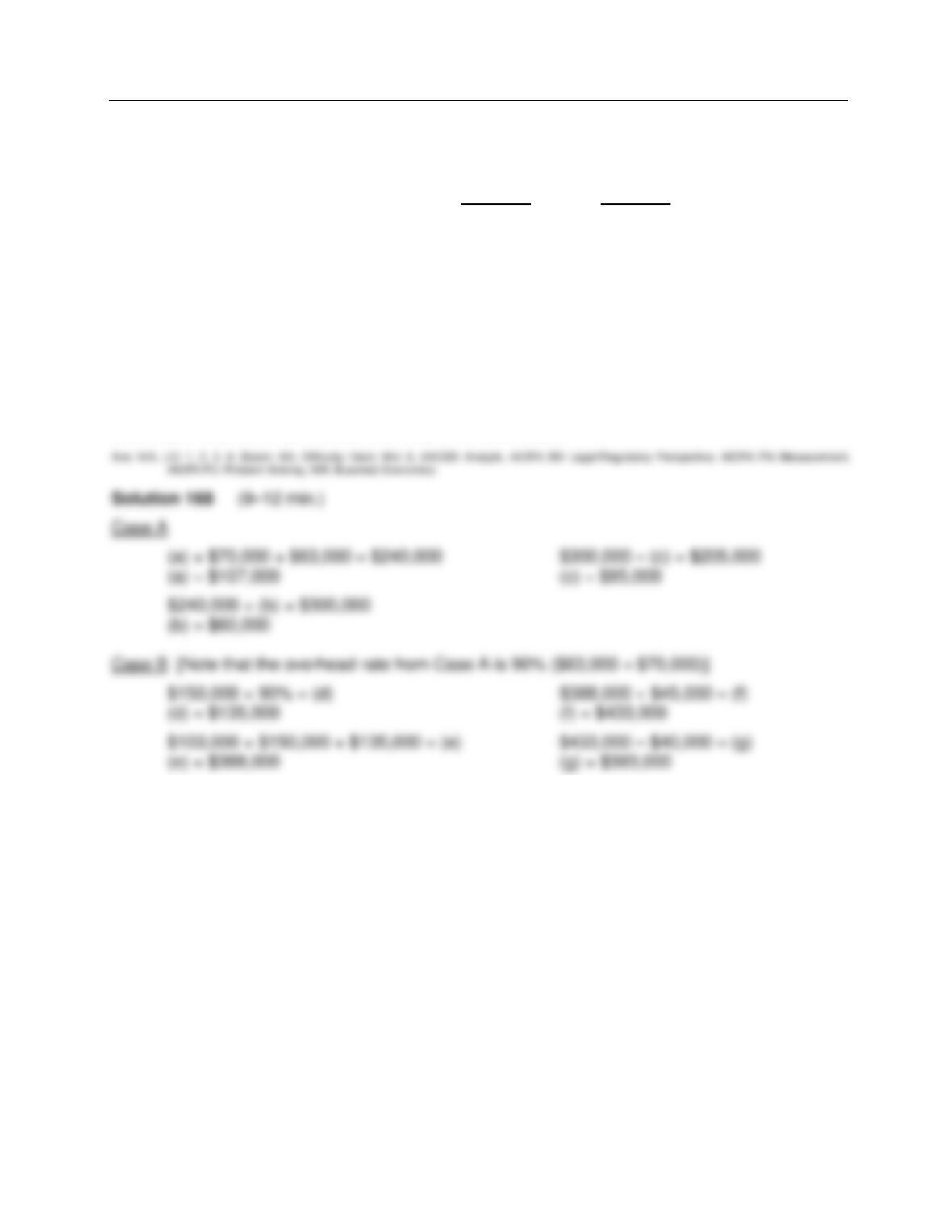
Foster Manufacturing uses a job order cost accounting system. On April 1, the company has
Work in Process Inventory of $7,600 and two jobs in process: Job No. 221, $3,600, and Job No.
222, $4,000. During April, a summary of source documents reveals the following:
For Materials Requisition Slips Labor Time Tickets
Job No. 221 $1,200 $2,100
222 1,700 2,200
223 2,400 2,900
224 2,600 2,800
General use 600 400
Totals $8,500 $10,400
Foster applies manufacturing overhead to jobs at an overhead rate of 70% of direct labor cost.
Job No. 221 is completed during the month.
Instructions
(a) Prepare summary journal entries to record the raw materials requisitioned, factory labor
used, the assignment of manufacturing overhead to jobs, and the completion of Job No. 221.
(b) Calculate the balance of the Work in Process Inventory account at April 30.
Job Order Costing
2 – 41
Ex. 168
Manufacturing cost data for Dolan Company, which uses a job order cost system, are presented
below:
Case A Case B
Direct Materials Used (a) $103,000
Direct Labor $ 70,000 150,000
Manufacturing Overhead Applied 63,000 (d)
Total Manufacturing Costs 240,000 (e)
Work in Process, 1/1/17 (b) 45,000
Total Cost of Work in Process 300,000 (f)
Work in Process, 12/31/17 (c) 40,000
Cost of Goods Manufactured 205,000 (g)
Instructions
Indicate the missing amount for each letter. Assume that overhead is applied on the basis of
direct labor cost and that the rate is the same for both cases.
Ex. 169
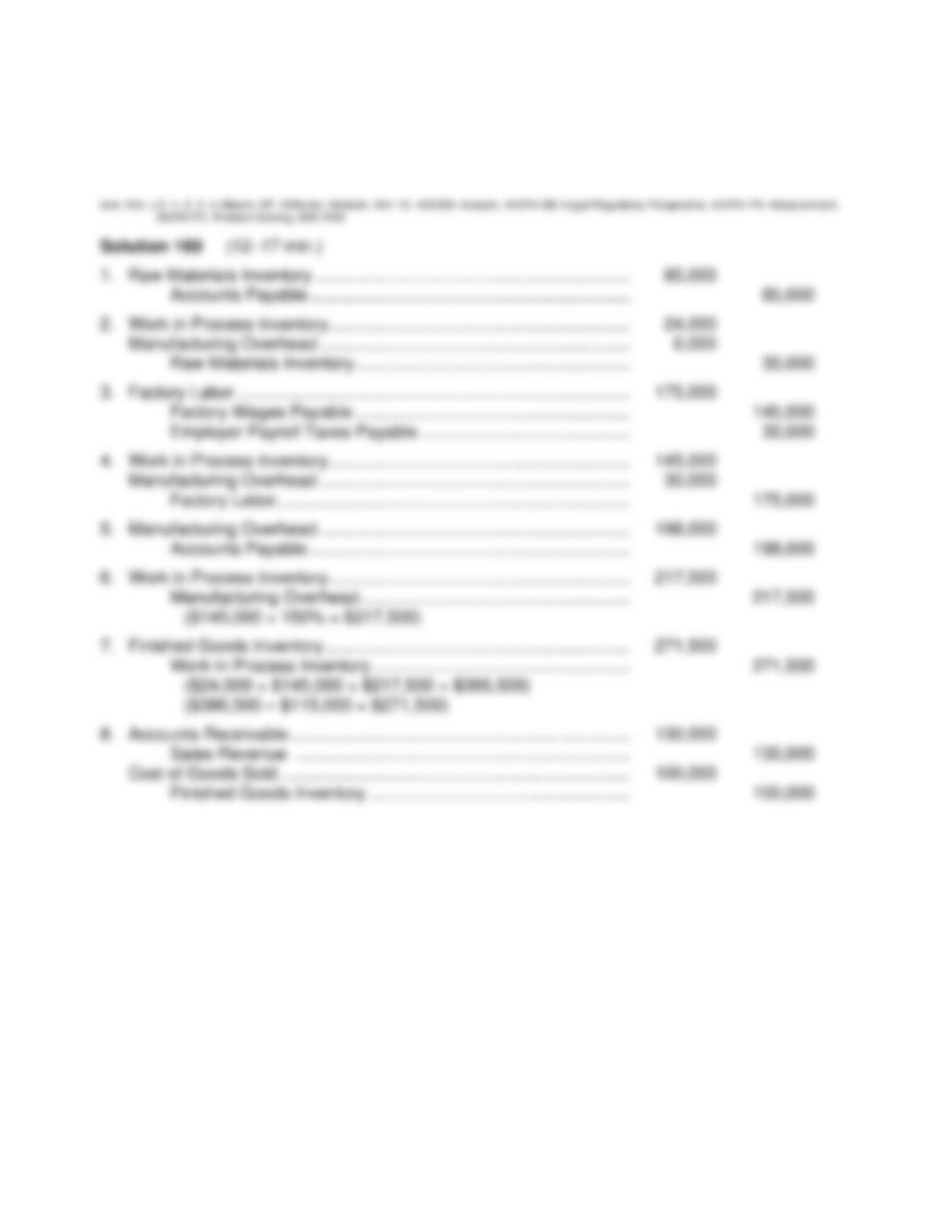
Fort Corporation had the following transactions during its first month of operations:
1. Purchased raw materials on account, $85,000.
2. Raw Materials of $30,000 were requisitioned to the factory. An analysis of the materials
requisition slips indicated that $6,000 was classified as indirect materials.
3. Factory labor costs incurred were $175,000 of which $145,000 pertained to factory wages
payable and $30,000 pertained to employer payroll taxes payable.
4. Time tickets indicated that $145,000 was direct labor and $30,000 was indirect labor.
5. Overhead costs incurred on account were $198,000.
6. Manufacturing overhead was applied at the rate of 150% of direct labor cost.
7. Goods costing $115,000 are still incomplete at the end of the month; the other goods were
completed and transferred to finished goods.
8. Finished goods costing $100,000 to manufacture were sold on account for $130,000.
Test Bank for Managerial Accounting, Seventh Edition
2 – 42
Ex. 169 (Cont.)
Instructions
Journalize the above transactions for Fort Corporation.
Ex. 170
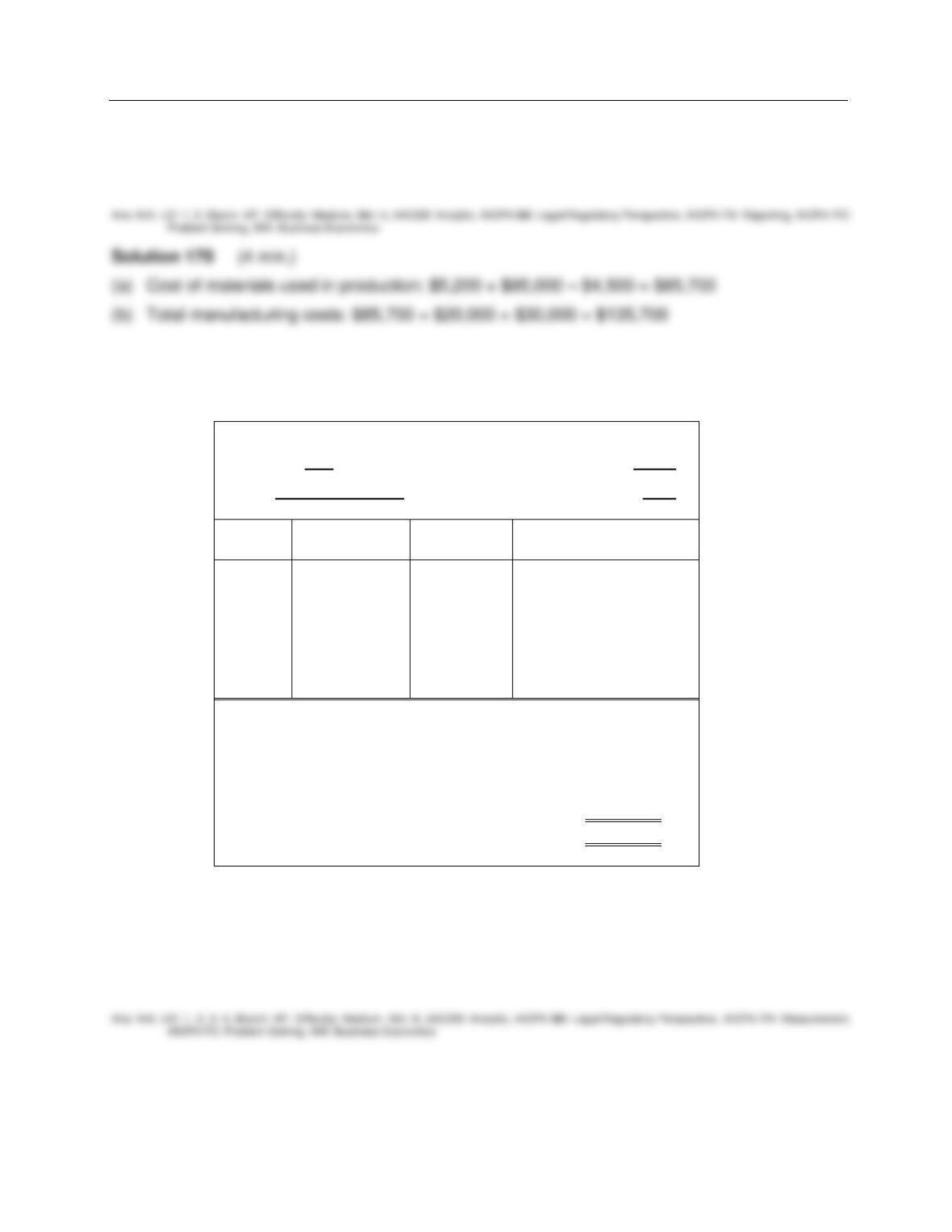
Lando Company reported the following amounts for 2017:
Raw materials purchased $85,000
Beginning raw materials inventory 5,200
Ending raw materials inventory 4,500
Beginning finished goods inventory 7,600
Ending finished goods inventory 8,000
Direct labor used 20,000
Manufacturing overhead costs applied 30,000
Beginning work in process inventory 6,100
Ending work in process inventory 6,300
Job Order Costing
2 – 43
Ex. 170 (Cont.)
Instructions
Calculate (a) the cost of materials used in production and (b) total manufacturing costs.
Ex. 171
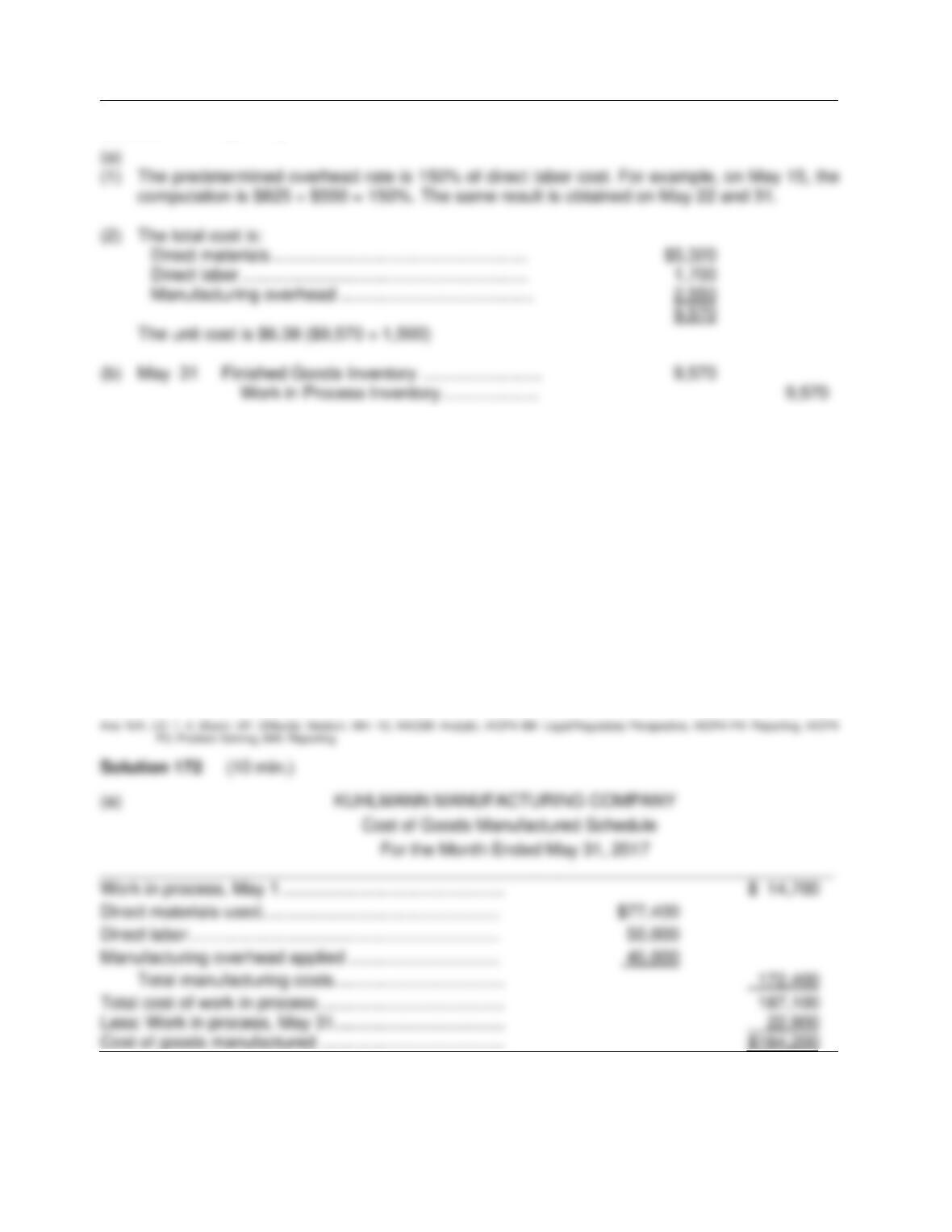
A job cost sheet of Fugate Company is given below.
Job Cost Sheet
JOB NO. 172 Quantity 1,500
FOR James Company Date Completed 5/31
Date
Direct
Materials
Direct
Labor
Manufacturing
Overhead
5/10
12
15
22
24
27
31
1,330
1,120
1,000
1,870
550
480
670
825
720
1,005
Cost of completed job:
Direct materials ________
Direct labor ________
Manufacturing Overhead ________
Total cost ________
Unit cost ________
Instructions
(a) Answer the following questions.
(1) What is the predetermined manufacturing overhead rate?
(2) What are the total cost and the unit cost of the completed job?
(b) Prepare the entry to record the completion of the job.
Test Bank for Managerial Accounting, Seventh Edition
2 – 44
Solution 171 (8 min.)
Ex. 172
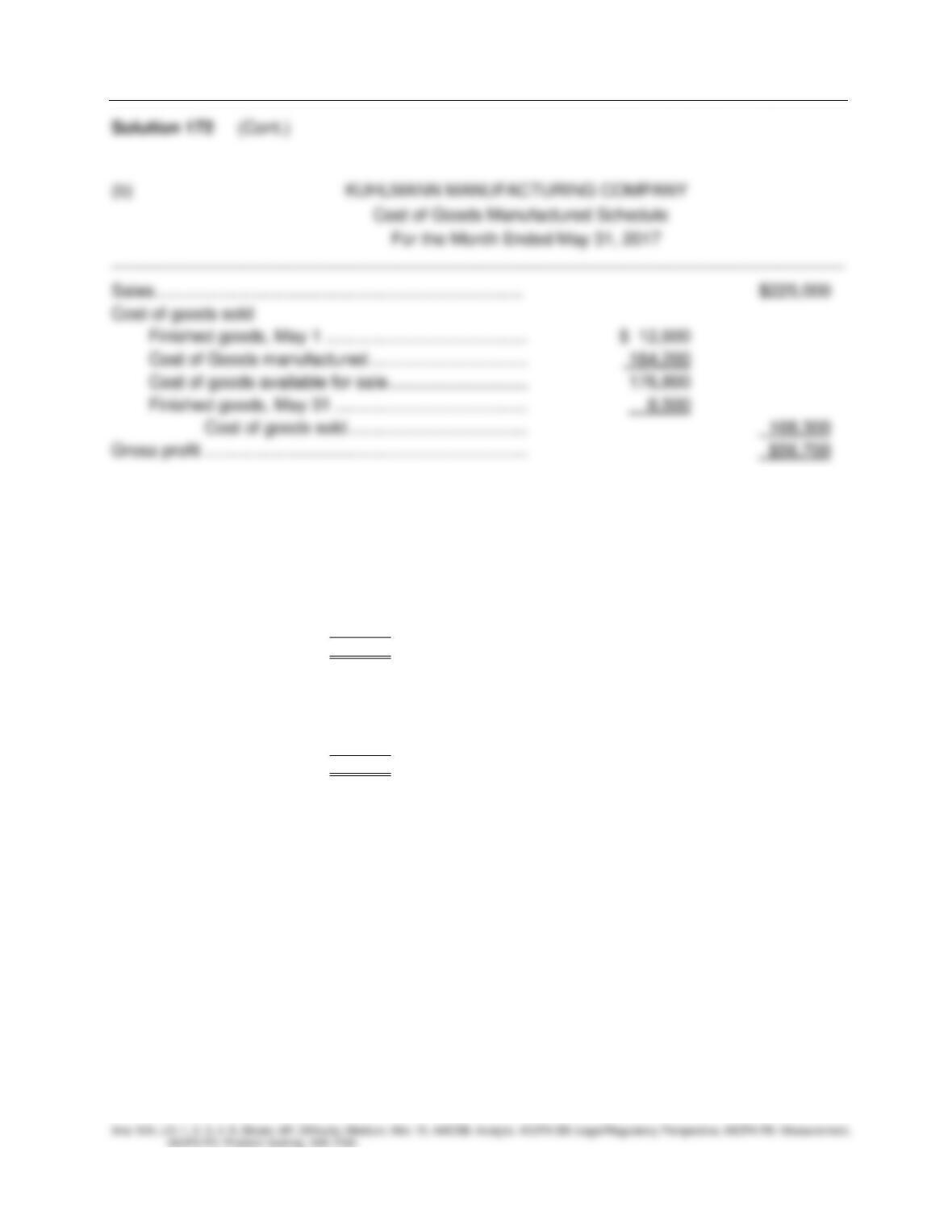
At May 31, 2017, the accounts of Kuhlmann Manufacturing Company show the following.
1. May 1 inventories—finished goods $12,600, work in process $14,700, and raw materials
$8,200.
2. May 31 inventories—finished goods $8,500, work in process $22,900, and raw materials
$7,100.
3. Debit postings to work in process were: direct materials $77,400, direct labor $50,000, and
manufacturing overhead applied $45,000.
4. Sales totaled $225,000.
Instructions
(a) Prepare a condensed cost of goods manufactured schedule.
(b) Prepare an income statement for May through gross profit.
Job Order Costing
2 – 45
Ex. 173
Watson Manufacturing Company employs a job order cost accounting system and keeps
perpetual inventory records. The following transactions occurred in the first month of operations:
1. Direct materials requisitioned during the month:
Job 101 $20,000
Job 102 16,000
Job 103 24,000
$60,000
2. Direct labor incurred and charged to jobs during the month was:
Job 101 $32,000
Job 102 28,000
Job 103 20,000
$80,000
3. Manufacturing overhead was applied to jobs worked on using a predetermined overhead rate
based on 75% of direct labor costs.
4. Actual manufacturing overhead costs incurred during the month amounted to $66,000.
5. Job 101 consisting of 1,000 units and Job 103 consisting of 200 units were completed during
the month.
Instructions
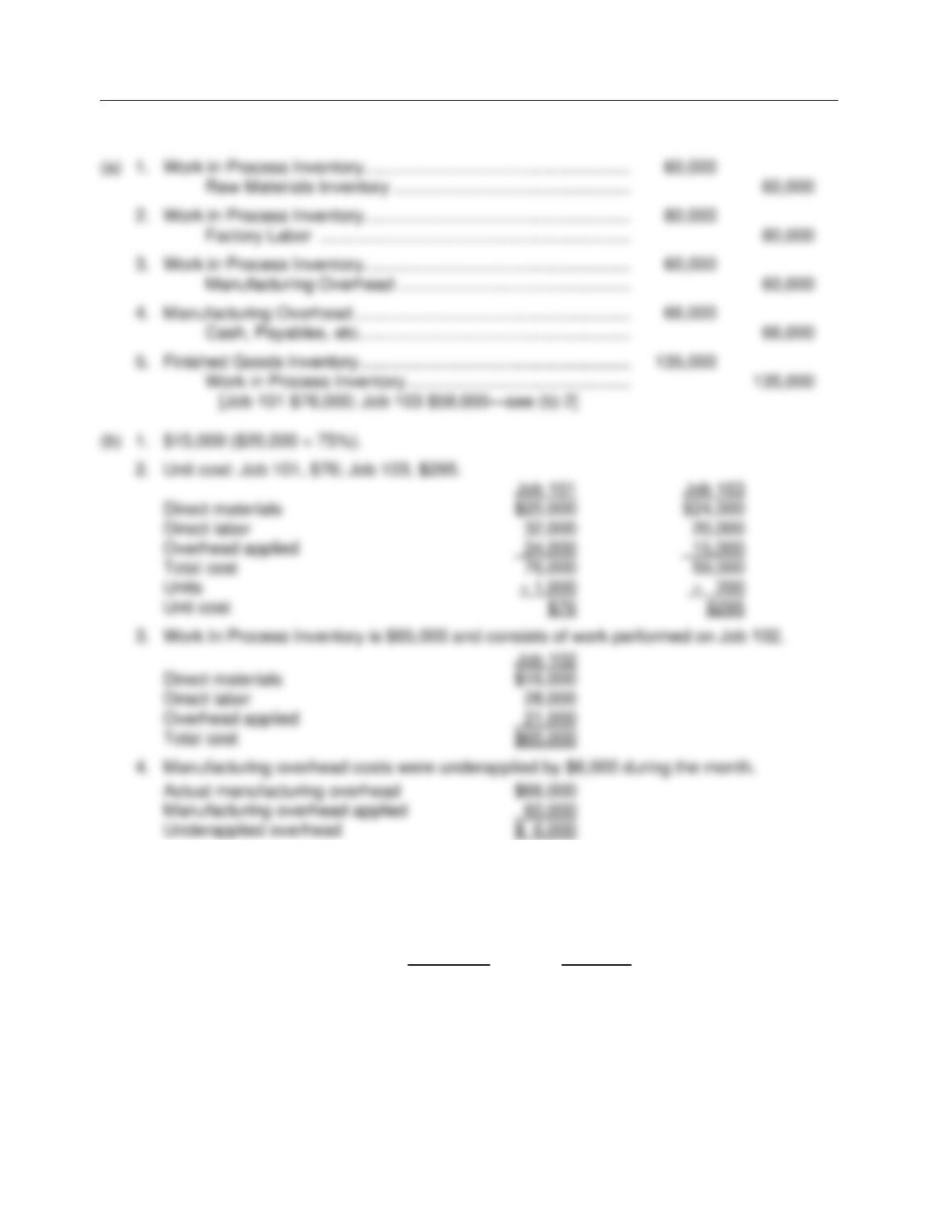
(a) Prepare journal entries to record the above transactions.
(b) Answer the following questions:
1. How much manufacturing overhead was applied to Job 103 during the month?
2. Compute the unit cost of Jobs 101 and 103.
3. What is the balance in Work In Process Inventory at the end of the month?
4. Determine if manufacturing overhead was under- or overapplied during the month. How
much?
Test Bank for Managerial Accounting, Seventh Edition
2 – 46
Solution 173 (15–20 min.)
Ex. 174
Graham Manufacturing is a small manufacturer that uses machine-hours as its activity base for
assigned overhead costs to jobs. The company estimated the following amounts for 2017 for the
company and for Job 62:
Company Job 62
Direct materials $60,000 $4,500
Direct labor $25,000 $2,500
Manufacturing overhead costs $72,000
Machine hours 90,000 1,350
During 2017, the actual machine-hours totaled 95,000, and actual overhead costs were $71,000.
Job Order Costing
2 – 47
Ex. 174 (Cont.)
Instructions
(a) Compute the predetermined overhead rate.
(b) Compute the total manufacturing costs for Job 62.
(c) How much overhead is over or underapplied for the year for the company? State amount and
whether it is over– or underapplied.
(d) If Graham Manufacturing sells Job 62 for $14,000, compute the gross profit.
Ex. 175
The following inventory information is available for Ricci Manufacturing Corporation for the year
ended December 31, 2017:
Beginning Ending
Inventories:
Raw materials $17,000 $19,000
Work in process 9,000 14,000
Finished goods 11,000 8,000
Total $37,000 $41,000
In addition, the following transactions occurred in 2017:
1. Raw materials purchased on account, $75,000.
2. Incurred factory labor, $80,000, all is direct labor. (Credit Factory Wages Payable).
3. Incurred the following overhead costs during the year: Utilities $6,800, Depreciation on
manufacturing machinery $8,000, Manufacturing machinery repairs $9,200, Factory insurance
$9,000 (Credit Accounts Payable and Accumulated Depreciation).
4. Assigned $80,000 of factory labor to jobs.
5. Applied $36,000 of overhead to jobs.
Instructions
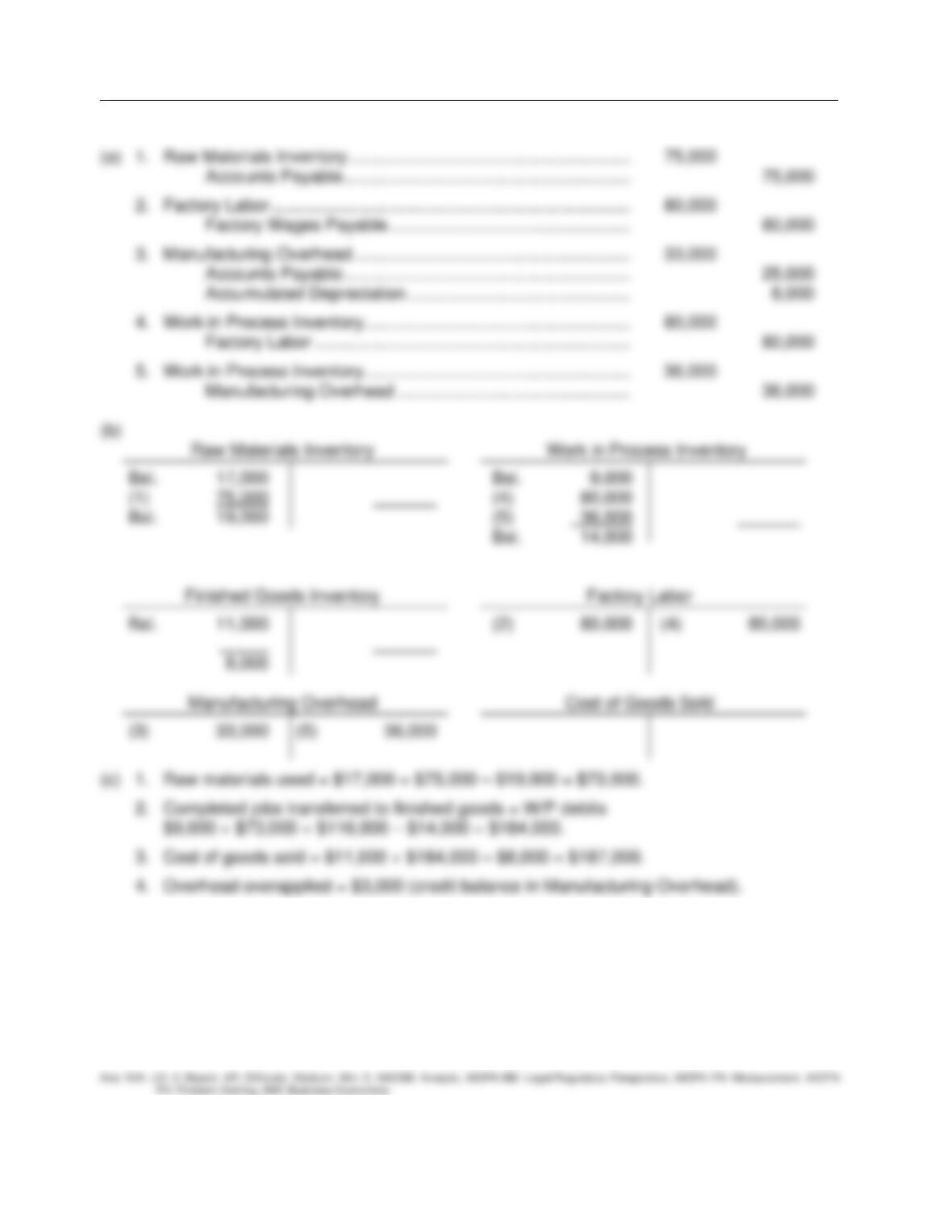
(a) Journalize the above transactions.
(b) Reproduce the manufacturing cost and inventory accounts. Use T-accounts.
(c) From an analysis of the accounts, compute the following:
1. Raw materials used.
2. Completed jobs transferred to finished goods.
3. Cost of goods sold.
4. Under- or overapplied overhead.
Test Bank for Managerial Accounting, Seventh Edition
2 – 48
Solution 175 (16–22 min.)
Ex. 176
Builder Bug Company allocates manufacturing overhead at $9 per direct labor hour. Job A45
required 4 boxes of direct materials at a cost of $30 per box and took employees 14 hours to
complete. Employees earn $15 per hour.
Instructions
Compute the total cost of Job A45.
Job Order Costing
2 – 49
Solution 176 (5 min.)
Ex. 177
Job cost sheets for Howard Manufacturing are as follows:
Job No 210 Quantity 1,500
Manufacturing
Date Direct Materials Direct Labor Overhead
July 1 9,000 8,000 12,000
8 8,500
10 10,000
15 5,500
25 20,000
Job No 211 Quantity 1,200
Manufacturing
Date Direct Materials Direct Labor Overhead
July 1 5,000 6,000 9,000
10 9,000
15 8,000
20 7,000
27 12,000
Instructions
(a) Answer the following questions.
1. What was the balance in Work in Process Inventory on July 1 if these were the only
unfinished jobs?
2. What was the predetermined overhead rate in June if overhead was applied on the basis
of direct labor cost?
3. If July is the start of a new fiscal year and the overhead rate is 20% higher than in the
preceding year, how much overhead should be applied to Job 210 in July?
4. Assuming Job 210 is complete, what is the total and unit cost of the job?
5. Assuming Job 211 is the only unfinished job at July 31, what is the balance in Work in
Process Inventory on this date?
(b) Journalize the summary entries to record the assignment of costs to the jobs in July.
(Note: Make one entry in total for each manufacturing cost element.)
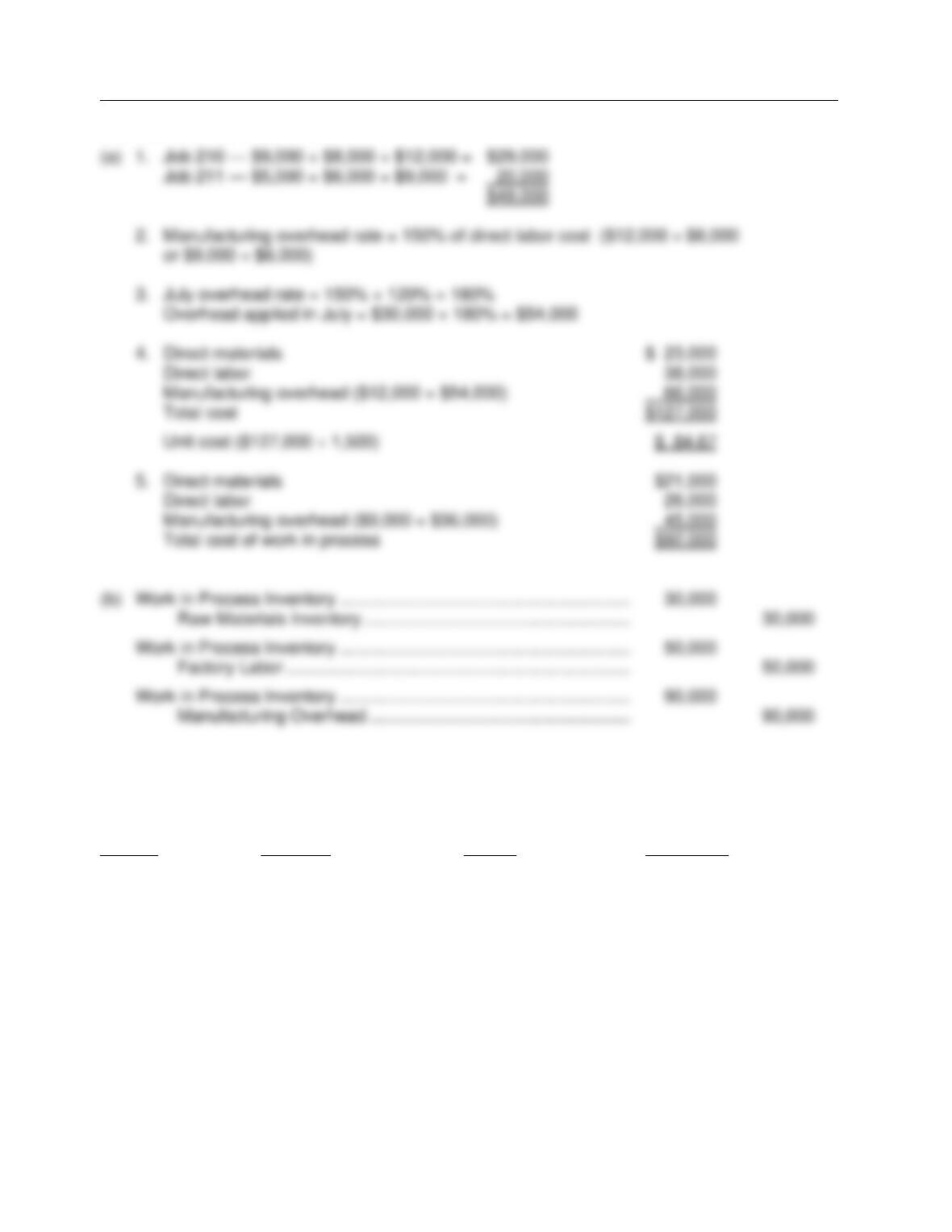
Test Bank for Managerial Accounting, Seventh Edition
2 – 50
Solution 177 (15–20 min.)
Ex. 178
Garner Company begins operations on July 1, 2017. Information from job cost sheets shows the
following: Manufacturing Costs Assigned
Job No. July August September
100 $12,000 $8,800
101 10,800 9,700 $12,000
102 5,000
103 11,800 6,000
104 5,800 7,000
Job 102 was completed in July. Job 100 was completed in August, and Jobs 101 and 103 were
completed in September. Each job was sold for 60% above its cost in the month following
completion.
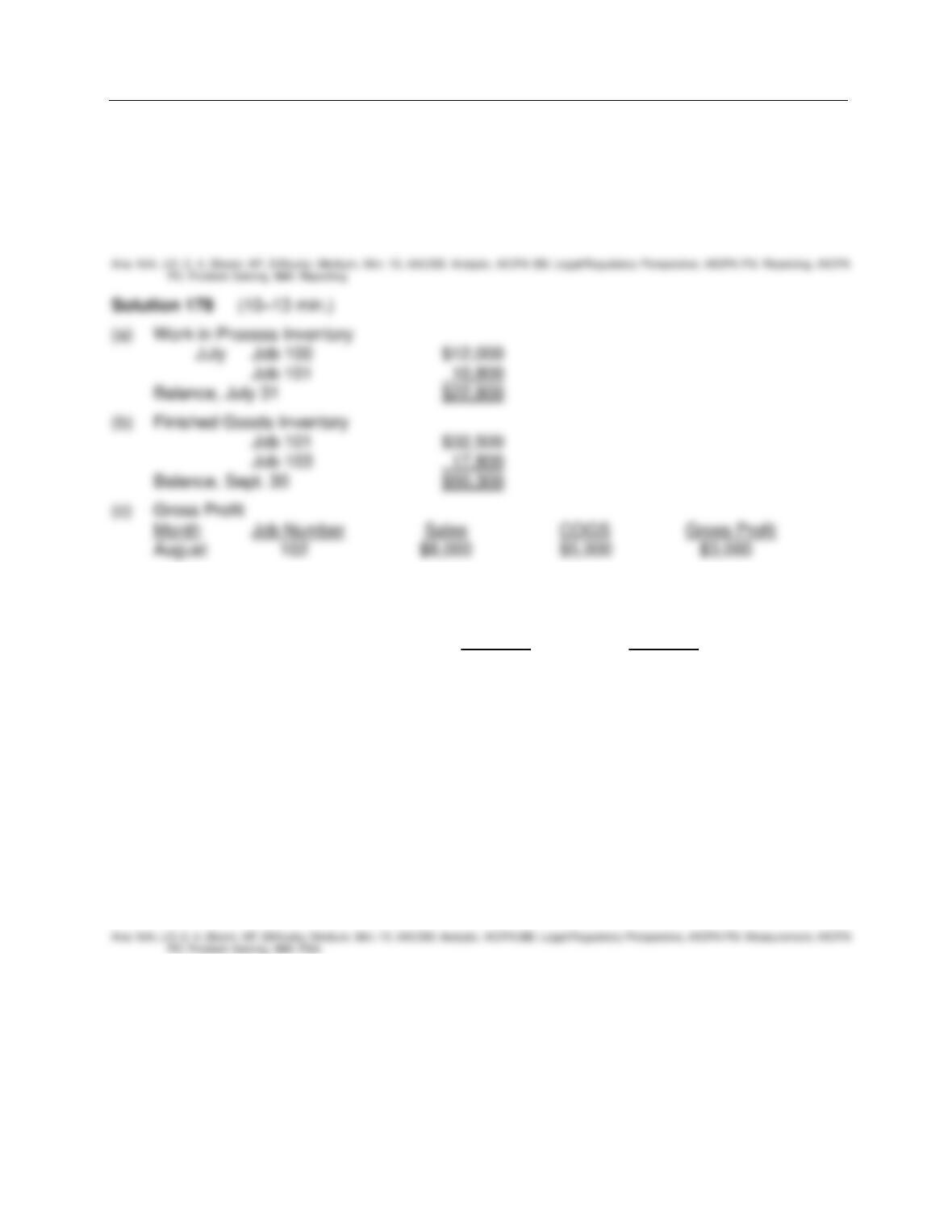
Job Order Costing
2 – 51
Ex. 178 (Cont.)
Instructions
(a) Compute the balance in Work in Process Inventory at the end of July.
(b) Compute the balance in Finished Goods Inventory at the end of September.
(c) Compute the gross profit for August.
Ex. 179
The accounting records of Roland Manufacturing Company include the following information:
Dec. 31 Jan. 1
Work in process inventory $ 20,000 $ 50,000
Finished goods inventory 120,000 150,000
Direct materials used 350,000
Direct labor 160,000
Selling expenses 125,000
Manufacturing overhead is applied at a rate of 150% of direct labor cost.
Instructions
Answer the following questions:
1. What is the total of the debits to Work in Process Inventory during the year?
2. What is the amount transferred to Finished Goods Inventory during the year?
3. What is the cost of goods sold?
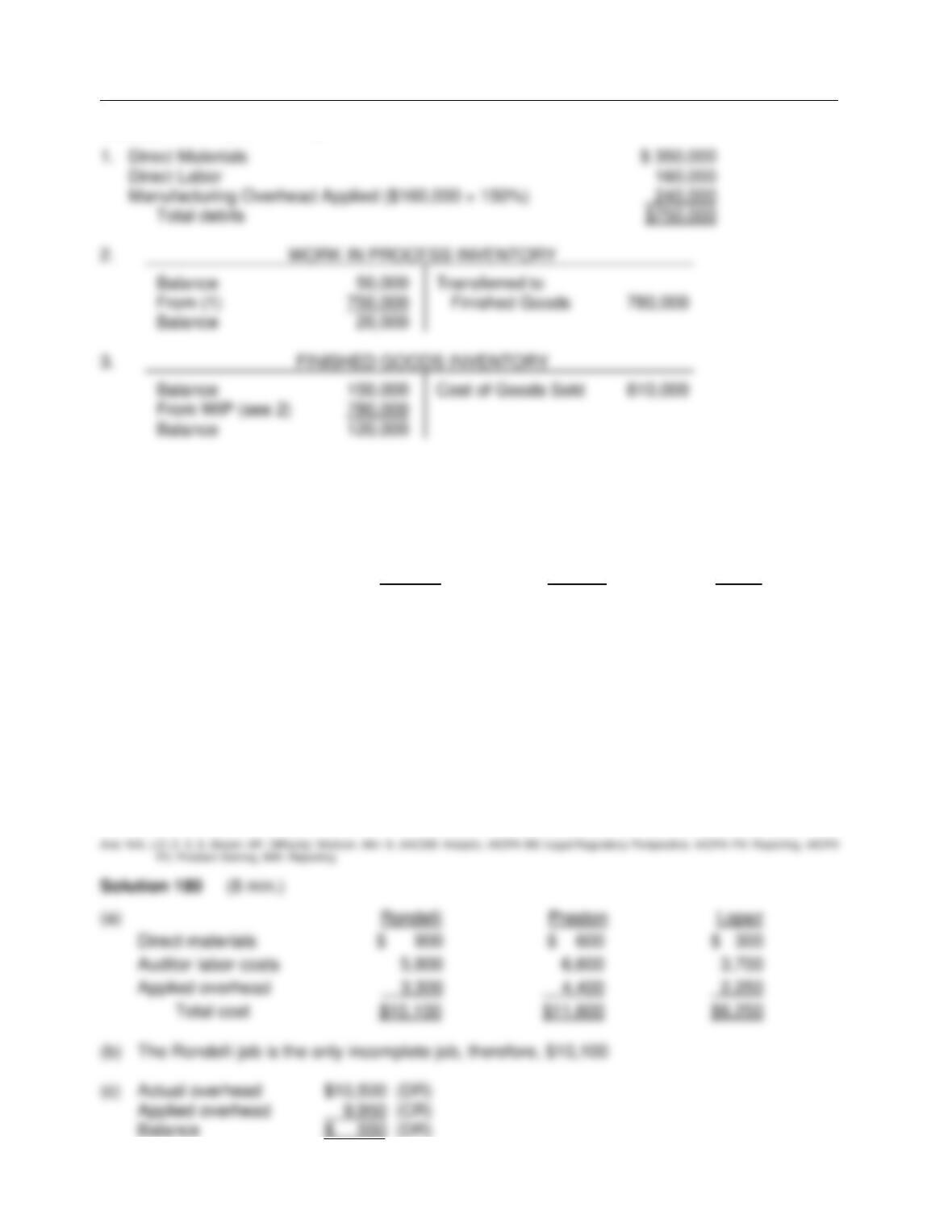
Test Bank for Managerial Accounting, Seventh Edition
2 – 52
Solution 179 (10–14 min.)
Ex. 180
Grant Marwick and Associates, a CPA firm, uses job order costing to capture the costs of its audit
jobs. There were no audit jobs in process at the beginning of November. Listed below are data
concerning the three audit jobs conducted during November.
Rondelli Preston Lopez
Direct materials $900 $600 $300
Auditor labor costs $5,900 $6,600 $3,700
Auditor hours 66 88 45
Overhead costs are applied to jobs on the basis of auditor hours, and the predetermined
overhead rate is $50 per auditor hour. The Rondelli job is the only incomplete job at the end of
November. Actual overhead for the month was $10,500.
Instructions
(a) Determine the cost of each job.
(b) Indicate the balance of the Work in Process account at the end of November.
(c) Calculate the ending balance of the Manufacturing Overhead account for November.
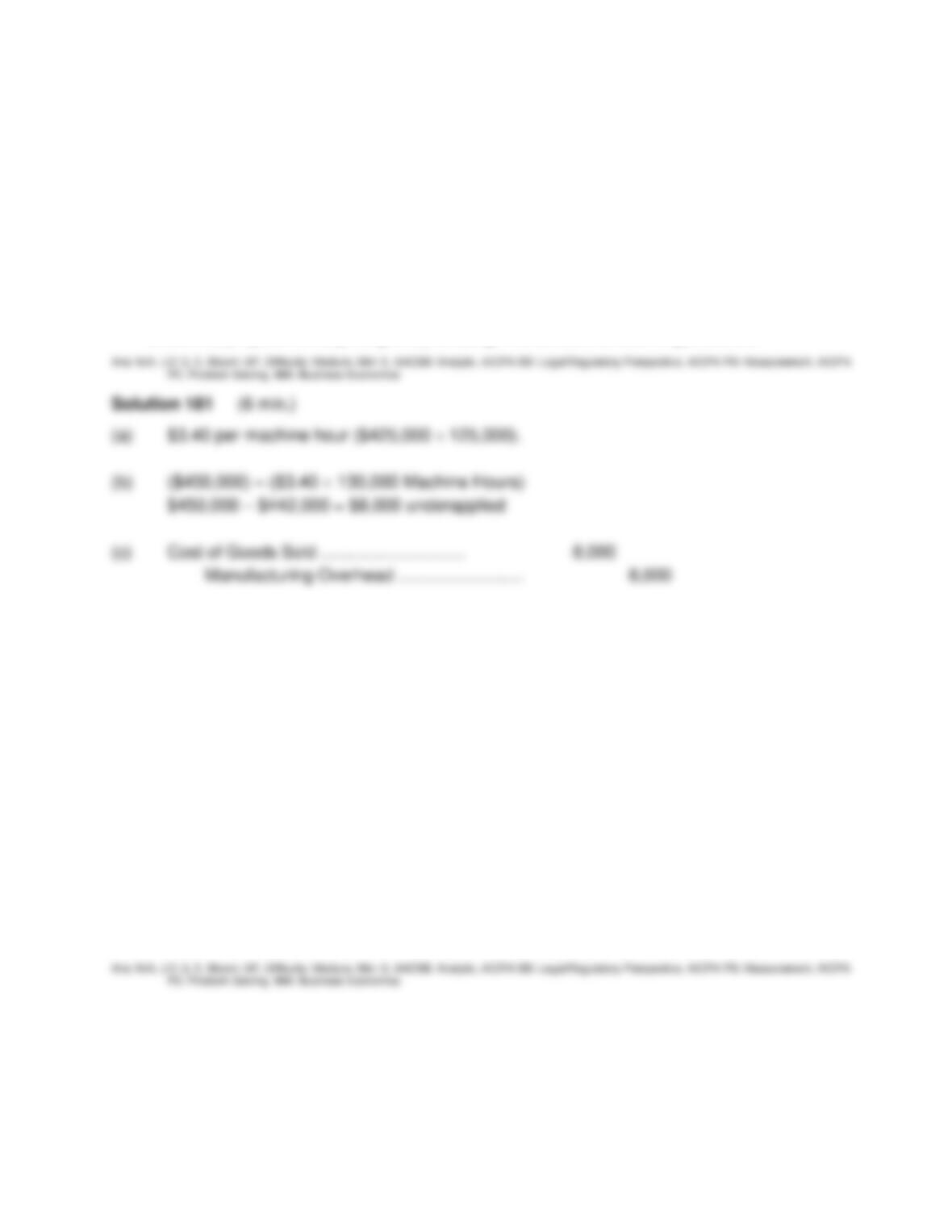
Job Order Costing
2 – 53
Ex. 181
Gallagher Company applies manufacturing overhead to jobs on the basis of machine hours used.
Overhead costs are expected to total $425,000 for the year, and machine usage is estimated at
125,000 hours.
For the year, $450,000 of overhead costs are incurred and 130,000 hours are used.
Instructions
(a) Compute the manufacturing overhead rate for the year.
(b) What is the amount of under – or overapplied overhead at December 31?
(c) Assuming the under – or overapplied overhead for the year is not allocated to inventory
accounts, prepare the adjusting entry to assign the amount to cost of goods sold
Ex. 182
Fancy Decorating uses a job order costing system to collect the costs of its interior decorating
business. Each client’s consultation is treated as a separate job. Overhead is applied to each job
based on the number of decorator hours incurred. Listed below are data for the current year.
Budgeted overhead $880,000
Actual overhead $910,000
Budgeted decorator hours 40,000
Actual decorator hours 41,000
The company uses Operating Overhead in place of Manufacturing Overhead.
Instructions
(a) Compute the predetermined overhead rate.
(b) Prepare the entry to apply the overhead for the year.
(c) Determine whether the overhead was under – or overapplied and by how much.
Test Bank for Managerial Accounting, Seventh Edition
2 – 54
Solution 182 (6 min.)
Ex. 183
Martin Company applies manufacturing overhead based on direct labor hours. Information
concerning manufacturing overhead and labor for the year follows:
Actual manufacturing overhead $80,000
Estimated manufacturing overhead $75,000
Direct labor hours incurred 4,800
Direct labor hours estimated 5,000
Instructions
Compute (a) the predetermined overhead rate and (b) the amount of applied manufacturing
overhead.
Ex. 184
Landis Company uses a job order cost system in each of its two manufacturing departments.
Manufacturing overhead is applied to jobs on the basis of direct labor cost in Department A and
machine hours in Department B. In establishing the predetermined overhead rates for 2017, the
following estimates were made for the year:
Department
A B
Manufacturing overhead $2,100,000 $1,400,000
Direct labor cost 1,500,000 1,200,000
Direct labor hours 100,000 100,000
Machine hours 200,000 400,000
Job Order Costing
2 – 55
Ex. 184 (Cont.)
During January, the job cost sheet showed the following costs and production data:
Department
A B
Direct materials used $195,000 $128,000
Direct labor cost 100,000 110,000
Manufacturing overhead incurred 130,000 135,000
Direct labor hours 8,000 8,400
Machine hours 16,000 34,000
Instructions
(a) Compute the predetermined overhead rate for each department.
(b) Compute the total manufacturing cost assigned to jobs in January in each department.
(c) Compute the balance in the Manufacturing Overhead account at the end of January and
indicate whether overhead is over- or underapplied.
Test Bank for Managerial Accounting, Seventh Edition
2 – 56
Ex. 185
Edwards Company applies manufacturing overhead to jobs on the basis of machine hours used.
Overhead costs are expected to total $1,800,000 for the year, and machine usage is estimated at
200,000 hours.
In January, $186,000 of overhead costs are incurred and 22,000 machine hours are used. For the
remainder of the year, $1,940,000 of additional overhead costs are incurred and 214,000
additional machine hours are worked.
Instructions
(a) Compute the manufacturing overhead rate for the year.
(b) What is the amount of over- or underapplied overhead at January 31?
(c) What is the amount of over- or underapplied overhead at December 31?
Ex. 186
Klinger Company estimates that annual manufacturing overhead costs will be $4,800,000 for
2017. The actual overhead costs at the end of 2017 are $4,980,000. Activity base information for
2017 follows:
Activity Base Estimated Actual
Direct Labor Cost $3,000,000 $3,150,000
Direct Labor Hours 200,000 212,000
Machine Hours 150,000 152,000
Instructions
(a) Compute the predetermined overhead rate for each activity base.
(b) Compute the amount of overhead applied in 2017 for each activity base.
(c) Compute the amount of under- or overapplied overhead for 2017 for each activity base.
Job Order Costing
2 – 57
Solution 186 (12–16 min.)
Ex. 187
Jensen Manufacturing Company makes specialty tools. In January, Jensen incurs manufacturing
costs of $13,000,000 for direct materials, direct labor, and overhead. 20% of the total costs
represents overhead applied. The overhead rate is $1 for every $2 of direct labor costs incurred.
Inventory balances were:
January 1 January 31
Raw materials $300,000 $500,000
Work in process 600,000 400,000
Finished goods 400,000 200,000
At the end of January, there was $1,000 of overapplied overhead.
Instructions
(a) Determine the cost of raw materials purchased in January.
(b) Prepare a cost of goods manufactured schedule for January 2017.
(c) Compute the cost of goods sold for January.
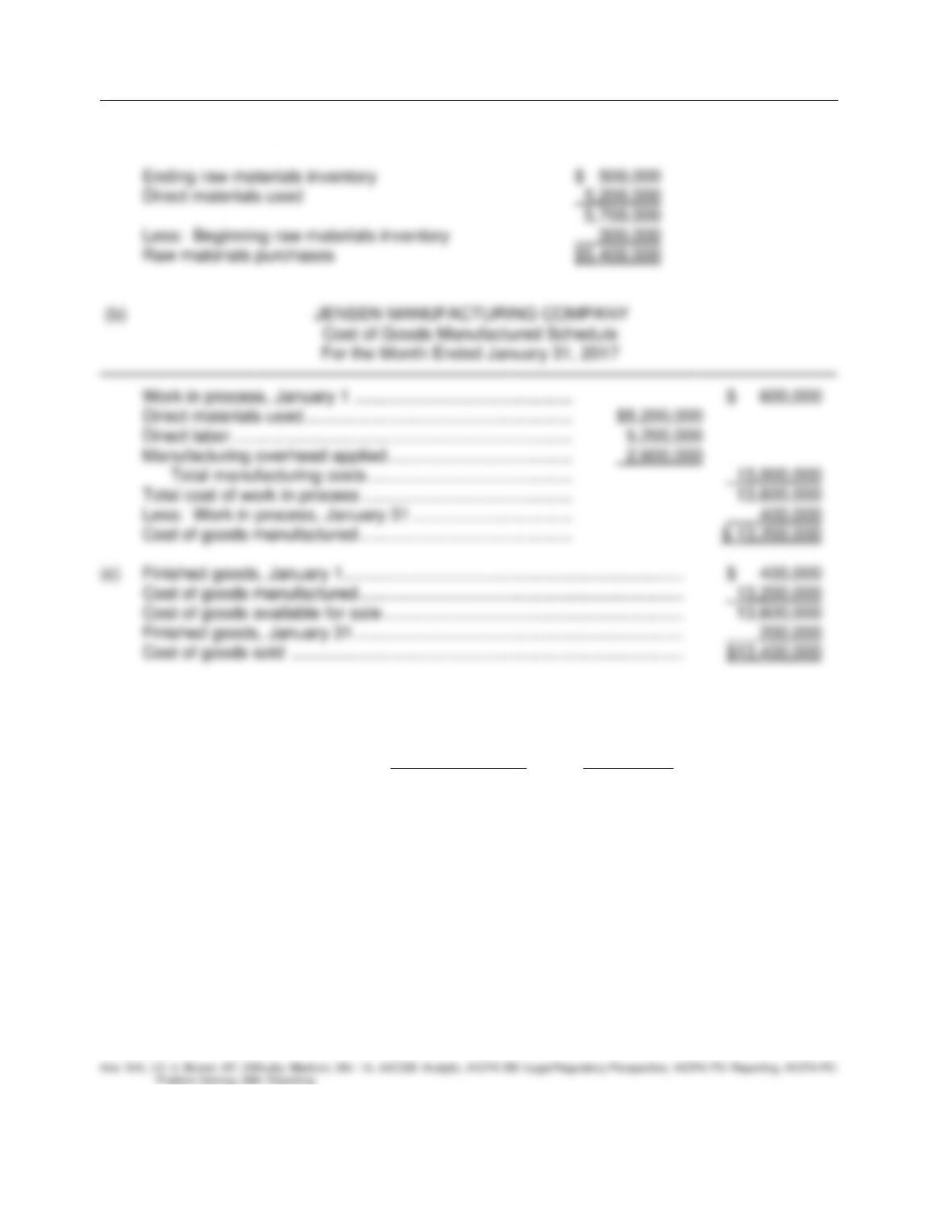
Test Bank for Managerial Accounting, Seventh Edition
2 – 58
Solution 187 (Cont.)
Ex. 188
The following information is available for Marks Company at December 31, 2017:
1. Inventory balance Beginning of Year End of Year
Finished Goods $14,000 $10,000
Work in Process 6,000 12,000
Raw Materials 10,300 6,500
2. Debit postings to Work in Process Inventory during the year were:
Direct materials $90,000
Direct labor 60,000
Manufacturing overhead applied 75,000
3. Sales totaled $310,000 for the year.
Instructions
(a) Prepare a condensed cost of goods manufactured schedule.
(b) Prepare an income statement for the year through gross profit.
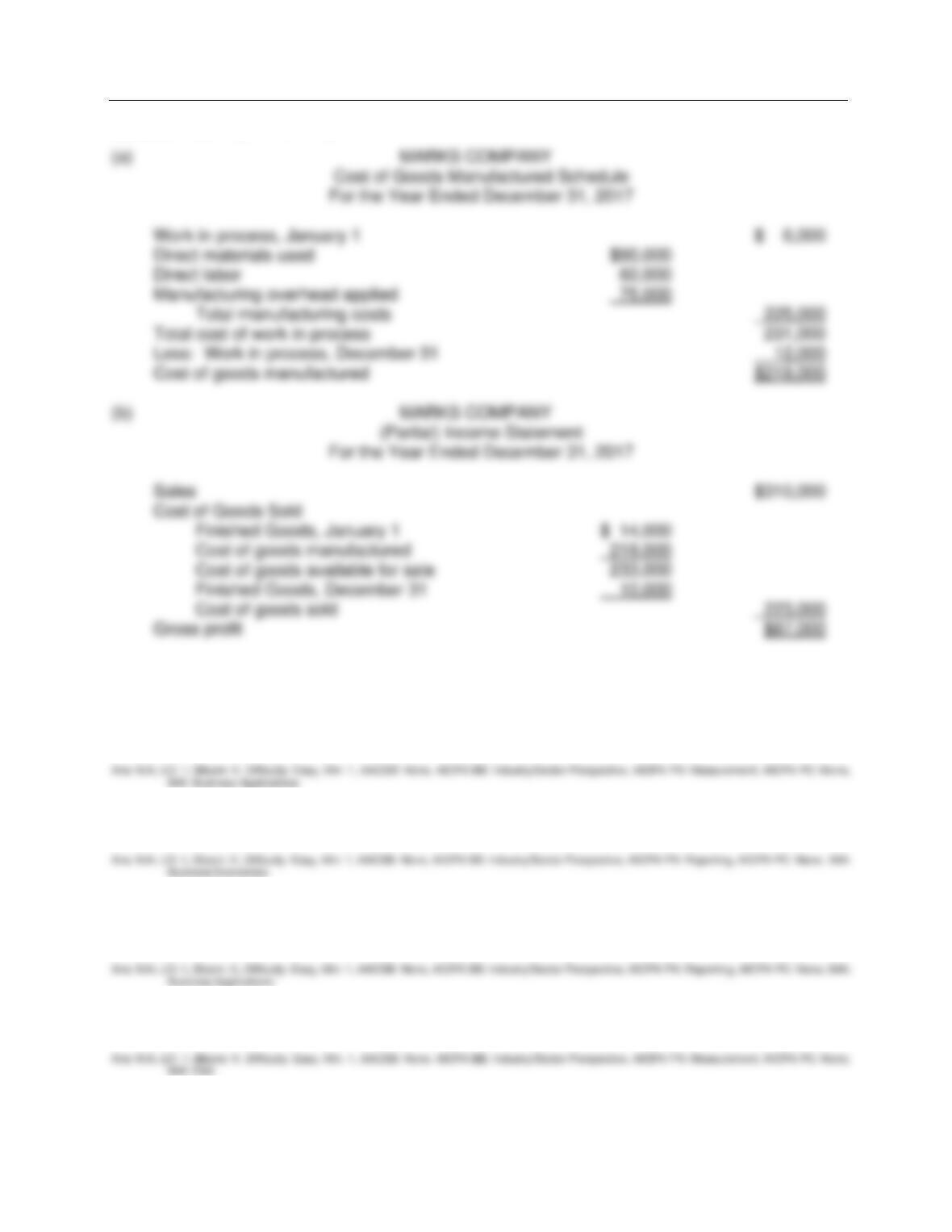
Job Order Costing
2 – 59
Solution 188 (14–18 min.)
COMPLETION STATEMENTS
189. Cost accounting involves the measuring, recording, and reporting of ______________
costs.
190. There are two basic types of cost accounting systems: (1)__________________ system,
and (2)__________________ system.
191. A ______________ cost system is appropriate when similar products are continuously
produced, whereas a ______________ cost system would be more appropriate if the
product is custom-made.
192. In a job order system, raw materials purchased are charged to the ______________
account.
Test Bank for Managerial Accounting, Seventh Edition
2 – 60
193. Of these three accounts; Raw Materials Inventory, Factory Labor, and Manufacturing
Overhead, ______________ is not a control account.
194. If $20,000 direct materials are requisitioned for a job and $7,000 of indirect materials are
requisitioned for general use, the debit to Work In Process Inventory should be for
$______________.
195. The cost of producing a particular job under a job cost system is accumulated on a record
called a ___________________.
196. Manufacturing overhead is applied to jobs by means of a ___________________ rate.
197. If actual manufacturing overhead was greater than the amount of manufacturing overhead
applied to jobs, the Manufacturing Overhead account will have a ___________ balance
and overhead is said to be ______________.
198. At the end of the year, any balance in the Manufacturing Overhead account should be
eliminated as an adjustment to ___________________.
Answers to Completion Statements
Job Order Costing
2 – 61
MATCHING
199. Match the items in the two columns below by entering the appropriate code letter in the
space provided.
A. Cost accounting F. Process cost system
B. Materials requisition slip G. Job cost sheets
C. Time ticket H. Predetermined overhead rate
D. Cost accounting system I. Overapplied overhead
E. Job order cost system J. Underapplied overhead
_____ 1. Used to apply manufacturing overhead to jobs.
_____ 2. Measures, records, and reports product costs.
_____ 3. When actual manufacturing overhead costs are greater than the overhead applied to
products.
_____ 4. Manufacturing cost accounts are fully integrated into the general ledger.
_____ 5. Source document which authorizes issuance of raw materials to production.
_____ 6. Appropriate when products have distinguishing and heterogeneous characteristics.
_____ 7. Constitute a subsidiary ledger for Work in Process Inventory.
_____ 8. Indicates number of hours that employees work and the account to be charged.
_____ 9. Appropriate when products are similar and are produced continuously.
_____ 10. When actual manufacturing overhead costs are less than the overhead applied to
products.
Answers to Matching
Test Bank for Managerial Accounting, Seventh Edition
2 – 62
SHORT-ANSWER ESSAY QUESTIONS
S-A E 200
(a) Distinguish between the two types of cost accounting systems. (b) May a company use both
types of cost accounting systems?
S-A E 201
A job order cost accounting system is fully integrated into the general ledger of a company.
Identify the major general ledger accounts used in a job order cost system. Explain how
manufacturing costs flow through these accounts so that inventories may be costed and income
determined when goods are sold.
S-A E 202
Manufacturing overhead items are indirect product costs that cannot be traced to individual
products. Explain how manufacturing overhead costs are accumulated and how they are
assigned to products in a job order cost system.
Job Order Costing
2 – 63
Solution 202
S-A E 203
Mike Hilyer is confused about under and overapplied manufacturing overhead. Define the terms
for Mike and indicate the balance in the manufacturing overhead account applicable to each term.
S-A E 204 (Ethics)
People Carrier Systems, Inc. (PCS) modifies vans that seat 15–20 people by adding additional
safety features or wheelchair ramps. Most of its customers are cities and counties, who use the
vans to transport school children, the elderly, or the handicapped. The company has specialized
in a no-frills approach, emphasizing safety, high quality, and low cost. The company’s president
was quoted as saying, “Let the other guys make a van pretty. We get people where they need to
go—faster, better, and cheaper than anybody else.”
The company obtains jobs by being the lowest bidder in a sealed bidding process. Recently, the
company was solicited by a top-10 college to submit a bid for a van to be used by its athletic
team. Some specialized items were required, such as the school’s logo on the outside of the van,
and the vinyl seats had to be covered in school colors. The company submitted a bid, and was
very surprised to obtain it.
When the job was being prepared, the job manager pointed out that several extra costs could
result in this job showing a loss. The boss, an ardent supporter of sports in general and this team
in particular, told the manager to just record the standard labor and overhead cost for this job. He
says that they could use the preset rate for specialized jobs, and increase the overhead
application rate (used in submitting bids) by 5% for future routine jobs. “After all,” he says,
“nobody else comes close to our price anyway. This could start a whole new line of business for
us.”
Required:
1. Who are the stakeholders in the decision to increase overhead for routine jobs?
2. Is the decision to subsidize special jobs by increasing the overhead rate on routine jobs
ethical? Briefly explain.
Test Bank for Managerial Accounting, Seventh Edition
2 – 64
Solution 204
S-A E 205 (Communication)
Bridal Treasures, Inc. makes customized wedding gowns. The customer selects a pattern for the
basic gown, and then selects fabric and trim. Once the design and the materials have been
agreed upon, a Statement of Estimated Cost is signed by the company and by the customer.
Overhead is applied based on the number of days a gown is in process. Usually, five gowns are
being worked on at a time. Therefore, each gown is charged 1/5 of a daily estimated overhead
amount.
Customer Mary Landon’s wedding dress took four days to complete. However, after the first three
days had elapsed, Hanna Hunt, a movie personality, suddenly decided to get married, and
ordered a very lavish gown. All other work was suspended, and the work on Ms. Landon’s dress
was delayed six days. The final day of its construction was on the tenth day after it had been
begun.
Required:
You are the accounting manager for Bridal Treasures. Write a memo to the billing department.
Instruct them as to the appropriate number of overhead days to charge to Ms. Landon’s account.
Job Order Costing
2 – 65
Solution 205