Chapter 1: Educational Psychology: Understanding Learning and Teaching
CHAPTER TWO
COGNITIVE AND LANGUAGE DEVELOPMENT
What Is Development?
* 1. Of the following, what is the best definition of development?
a. Changes that occur in human beings as they grow from infancy to adulthood
b. The process of adjusting schemes to maintain a state of equilibrium
c. Modifying environmental experience to fit existing schemes
d. Physiological changes in an individual that result from genetic makeup
* 2. Which of the following is a principle of development?
a. Development proceeds in discrete steps, like walking up a stairway.
b. Development and learning are relatively independent.
c. Children develop at about the same rate until they reach school age.
d. Development depends on both heredity and the environment.
** 3. One eighth grader is a young woman, physically and emotionally mature, whereas her classmate is still a
“little girl,” both physically and emotionally. Which of the following principles of development does this
example best illustrate?
a. Development is continuous and relatively orderly.
b. Experience enhances development.
c. Learning contributes to development.
d. Individuals develop at different rates.
* 4. At the center of Bronfenbrenner’s model is/are:
a. the individual.
b. parents.
c. the microsystem.
d. the mesosytem.
* 5. In Bronfenbrenner’s model, the people and activities in the child’s immediate surroundings, which include
parents, peers, school, and other influences such as television and the Internet, make up the:
a. environment.
b. microsystem.
c. chronosystem.
d. exosystem.
* 6. In Bronfenbrenner’s model, interactions between people and activities in the child’s immediate
surroundings, such as interactions between peers, school, and the immediate neighborhood, make up the:
a. microsystem.
b. mesosystem.
c. exosystem.
d. macrosystem.
** 7. Mr. Gomez strongly promotes parental involvement in his students’ activities. He calls parents and other
caregivers, has his students create a class newsletter that goes to parents every month, and sends packets of
work home to be signed and returned. In Bronfenbrenner’s model, this successful interaction between
school and the home would be classified as part of the:
a. microsystem.
b. mesosystem.
c. exosystem.
d. macrosystem.
Chapter 1: Educational Psychology: Understanding Learning and Teaching
** 8. Daniel’s cultural background emphasizes individualism, autonomy, and self-reliance, whereas Chu’s
culture emphasizes group cooperation and respect for authority. In Bronfenbrenner’s model, these
influences on personal development would be classified as part of the:
a. microsystem.
b. mesosystem.
c. macrosystem.
d. exosystem.
** 9. Angela is fortunate enough to go to a school that has a full-time school psychologist, school nurse, and
small class sizes. Gabrielle’s school, however, is overcrowded, and the school psychologist only comes
twice a week, because he has two other schools for which he is responsible. These influences on personal
development would be classified in Bronfenbrenner’s model as part of the:
a. microsystem.
b. mesosystem.
c. exosystem.
d. macrosystem.
** 10. As a result of technology, we live in a world today that is very different from the world as it existed even
20 to 30 years ago. Bronfenbrenner would suggest that these changes over time illustrate which of the
following systems?
a. The mesosystem
b. The exosystem
c. The macrosystem
d. The chronosystem
* 11. Brain nerve cells are called:
a. neurons.
b. dendrites.
c. synapses.
d. lobes.
* 12. The components of neurons that transmit outgoing messages to other neurons are called:
a. dendrites.
b. lobes.
c. synapses.
d. axons.
* 13. Research has uncovered a number of characteristics of neurosystem. Of the following, which is not one of
those characteristics?
a. The brain is our body’s most complex organ.
b. The brain instinctively looks for patterns in the way the world works.
c. The structure of the brain develops during childhood and remains largely unchanged after that time.
d. Genetically determined electric circuits are the foundation of the nervous system.
* 14. Research on critical periods in brain research most nearly suggests which of the following?
a. Critical periods exist for humans but are flexible.
b. The best time for the introduction of reading and math is 6 to 8 years.
c. Critical periods provide critical “windows of opportunities” for developmental growth.
d. Preschool should be a time of exploration and free play.
* 15. The finding that people who learn a foreign language later in life often speak with an accent is best
explained by:
a. the importance of optimal environments.
b. the existence of critical periods.
c. increased neural activity during language development.
d. the effects of enriched environments.
Chapter 1: Educational Psychology: Understanding Learning and Teaching
* 16. Of the following, the part of the brain most nearly responsible for much of human problem solving and
language is the:
a. neural connection.
b. dendrite branch.
c. synaptic center.
d. cerebral cortex.
** 17. Neuroscientists, psychologists, and educators generally believe that teenagers need firm and consistent
home and school environments that support learning and development. Which of the following components
of the physiology of our brains and nervous systems is most closely related to this conclusion?
a. The neuron
b. The cerebral cortex
c. The prefrontal cortex
d. The dendrite
* 18. Which of the following best describes the concept of neuroplasticity?
a. The ability of the brain to rewire itself in response to experience
b. The tendency of people to be left-brained or right-brained
c. The tendency of the brain to look for patterns in the way the world works
d. The ability of the brain to govern and determine a range of behaviors
Use the following example for Items 19–21.
A first-grade teacher demonstrates that air takes up space by pushing an inverted drink cup into a fish bowl of water.
The students see that the cup doesn’t fill with water. Natalie explains that water doesn’t go into the cup because “the
cup is tipped over.” Euchica says, “My dad and I were in the swimming pool, and when he tipped the cup, some air
got out and water got in, but if he didn’t tip the cup, no water could get in.”
** 19. Which of the following conclusions is most valid?
a. Natalie is more “developed” than is Euchica, because she made a comment based on observation.
b. Euchica is more “developed” than is Natalie, because she applied understanding in the context of the
learning activity based on her background experience.
c. Euchica is more “developed” than Natalie, because she is more mature.
d. Both of the children are about equally developed, because they are both in the first grade, and
children of the same age tend to be at about the same developmental level.
** 20. Which of the following principles of development does this example best illustrate?
a. Development proceeds in relatively orderly and predictable patterns.
b. Development depends on both heredity and the environment.
c. Physical, social, and intellectual development are independent of each other.
d. Development occurs in a variety of domains.
** 21. With respect to the experience with air taking up space and the learning physiology of the brain, which of
the following conclusions is most valid?
a. Natalie will have more synaptic connections related to air taking up space than will Euchica.
b. Both of the children will have about the same number of synaptic connections.
c. Euchica will have more synaptic connections than will Natalie.
d. The experience will result in more synaptic pruning for Euchica than it will for Natalie.
** 22. Jerardo is struggling with a word problem in math. The part of his brain that is most directly involved in his
attempts is the:
a. medulla oblongata.
b. cerebellum.
c. mesencephelon.
d. cerebral cortex.
Chapter 1: Educational Psychology: Understanding Learning and Teaching
** 23. Ryan, a second grader, is creating a story map that identifies the feelings of the character in the story. His
teacher’s goal is for all of her students to be able to draw inferences about characters’ feelings based on
clues in the stories they read.
The part of the learning physiology of Ryan’s brain that will be most strongly influenced by these
experiences are the:
a. dendrites.
b. synapses.
c. axons.
d. neurons.
** 24. Several controversies exist with respect to neuroscience. Which of the following is not one of those
controversies?
a. The influence of experience on the physiology of the brain.
b. The tendency of people to to use neuroscience to explain behaviors and events it is incapable of
explaining.
c. The benefits or lack of benefits of added stimulation for cognitive development in young children
d. The role of critical periods for development
Essay Items
* 25. Describe the three general principles of development, and provide an example of each.
* 26. Describe each of the systems in Bronfenbrenner’s bioecological model of personal development.
** 27. Explain the learning physiology of the brain and explain how it is related to cognitive development.
Piaget’s Theory of Cognitive Development
* 28. According to Piaget, people’s need for order, structure, and predictability is called:
a. development.
b. learning.
c. maturation.
d. equilibrium.
* 29. Of the following, the best definition of a scheme is:
a. the knowledge, procedures, and relationships that we use to understand the world.
b. the orderly durable changes in a learner resulting from learning, experience, and maturation.
c. a state of conceptual balance and order.
d. the process of modifying environmental experience to fit present understanding.
* 30. The process of changing existing schemes in response to new experiences is called:
a. assimilation.
b. accommodation.
c. equilibration.
d. maturation.
* 31. The ability to mentally trace a line of reasoning back to its beginning is referred to as:
a. systematic reasoning.
b. reversibility.
c. centration.
d. transformation.
Chapter 1: Educational Psychology: Understanding Learning and Teaching
* 32. The process of using logical thought to reach a conclusion is referred to as:
a. systematic reasoning.
b. reversibility.
c. centration.
d. transformation.
* 33. A form of adaptation in which an experience in the environment is modified to fit an existing scheme is
called:
a. organization.
b. accommodation.
c. assimilation.
d. maturation.
* 34. The stage in which children are unable to remember physical objects that are no longer visible is called the:
a. sensorimotor stage.
b. preoperational stage.
c. concrete operational stage.
d. formal operational stage.
* 35. The biological changes we see in individuals that exist primarily a result of their genetic makeup is called:
a. learning.
b. maturation.
c. development.
d. experience.
* 36. The inability to interpret an event from another person’s point of view is called:
a. irreversibility.
b. centration.
c. egocentrism.
d. assimilation.
* 37. The tendency to focus on one perceptual aspect of an event to the exclusion of all others is called:
a. centration.
b. egocentrism.
c. irreversibility.
d. transformation.
* 38. The ability to mentally record the process of change from one state to another–such as mentally recording a
clay ball being flattened–is called:
a. centration.
b. reversibility.
c. transformation.
d. conservation.
* 39. The idea that the “amount” of some substance stays the same regardless of its shape or the number of pieces
into which it is divided is called:
a. centration.
b. equilibrium.
c. transformation.
d. conservation.
* 40. The process of ordering of objects according to increasing length, weight, or volume is called:
a. seriation.
b. transformation.
c. conservation.
d. centration.
Chapter 1: Educational Psychology: Understanding Learning and Teaching
* 41. When teachers work with children, Piaget would most strongly advocate which of the following?
a. Hands-on experience
b. Video and vicarious experience
c. Texts with logical systematic teacher presentations
d. Lectures and explanations of content to be learned.
* 42. Of the following, which is the best description of the state of typical kindergartners’ cognitive
development?
a. Their thinking is limited to the motor processing of information.
b. Their thinking is dominated by their perception of concrete objects.
c. Their thinking is logical if they are presented with concrete experiences.
d. Their thinking is logical if they are able to work together in pairs or small groups.
* 43. Most students during kindergarten and first grade are at what stage of cognitive development?
a. Sensorimotor
b. Preoperational
c. Concrete operational
d. Formal operational
* 44. According to Piaget, the typical 8–year-old is in which stage of development?
a. Sensorimotor
b. Preoperational
c. Concrete operational
d. Formal operational
* 45. According to Piaget, at which stage does symbolic thought emerge?
a. Sensorimotor
b. Preoperational
c. Concrete operational
d. Formal operational
* 46. The ability to infer a relationship between two objects based on knowledge of their relationship with a third
object is defined as:
a. conservation.
b. seriation.
c. transitivity.
d. centration.
* 47. Which of the following is not a characteristic of formal thought?
a. Thinking abstractly
b. Thinking concretely
c. Thinking systematically
d. Thinking hypothetically
* 48. According to Piaget, which of the following best describes the role of social interaction in cognitive
development?
a. Social interaction does not play a role in development.
b. Social interaction provides a mechanism for learners to test their schemes against the schemes of
others.
c. Social interaction directly causes development by helping learners remain at equilibrium.
d. Social interaction allows learners to work within their zones of proximal development.
Chapter 1: Educational Psychology: Understanding Learning and Teaching
* 49. According to Piaget’s theory together with research examining the theory, which of the following best
describes the thinking of adolescents?
a. They are formal operational in their thinking in all areas except higher-level mathematics.
b. They are concrete operational in their thinking in all areas.
c. They are formal operational in their thinking, but research indicates that a majority remain concrete
operational outside their areas of expertise.
d. They should be concrete operational in their thinking, but research indicates that the majority can be
formal operational if they have been given the appropriate prerequisite experiences to advance their
development.
** 50. Kerry has an understanding of how the western United States was settled. He knows that large numbers of
settlers came from Europe and tried to make a new life in the American West. His teacher, Mr. Rudy,
notes in class that the settlers included some from Mexico and also some former slaves. Kerry now
questions his own understanding. Which of the following Piagetian concepts is Kerry most clearly is
displaying?
a. Transformation
b. Maturation
c. Assimilation
d. Disequilibrium
** 51. Molina understands a lot about the solar system. She has been told that there are nine planets. Now
scientists suggest that a new planet may exist beyond Pluto and that Pluto itself is no longer considered a
planet. Molina considers the potential of this new information and during discussion in class suggests that
“If there is another planet out there, the surface temperature would be very cold!” Piaget would say she:
a. went through a process of transformation, seeing the process move from one point to another.
b. illustrated seriation by adding an additional planet to her understanding.
c. reached equilibrium through the process of accommodation.
d. assimilated new information into an already existing scheme.
** 52. Ms. Ramsay is discussing the Civil War with her students. She poses the question, “What would life have
been like as a child during this time?” Her students are able to generate some plausible explanations. At
which stage of development, according to Piaget, are her students engaged?
a. Sensorimotor
b. Preoperational
c. Concrete operational
d. Formal operational
** 53. Joe has just learned the characteristics of a circle and looks at his family as a circle, his friends as a circle,
the loop around the city as a circle. This best illustrates Piaget’s concept of:
a. scheme.
b. logical thought.
c. transformation.
d. discrimination.
** 54. Brad always takes the same route to work each morning, parks in the same place, and returns home again
the same way. I like it this way,” he says. “I don’t have to think about anything. I just go.” The Piagetian
concept most closely related to this illustration is:
a. transformation.
b. maturation.
c. accommodation.
d. equilibrium.
Chapter 1: Educational Psychology: Understanding Learning and Teaching
** 55. Mrs. Ortega dresses very professionally for school each day, and the students even notice how nice she
always looks. She is planning a unit on poverty in America, so on Monday, the day she begins the unit, she
dresses in old, torn, and soiled clothes and marches into her classroom to the astonishment of her students.
Of the following, the Piagetian concept most closely related to the students’ reaction is:
a. transformation.
b. maturation.
c. assimilation.
d. disequilibrium.
** 56. Sally concludes that a Persian cat and a mountain lion are both felines even though they are markedly
different in size. This best illustrates Piaget‘s concept of:
a. assimilation.
b. accommodation.
c. generalization.
d. centration.
** 57. An economics professor once said, “The world is governed by economics.” Later the faculty was told in a
meeting about university enrollment problems and what effect these had on funding. The professor then
nodded knowingly and mumbled, “Yes, economics rules the world.” Piaget would say she:
a. went through a process of transformation seeing the process move from one point to another.
b. accommodated a scheme to include an additional example.
c. reached equilibrium through the process of accommodation.
d. assimilated an example into an already existing scheme.
Items 58-60 are related to each other.
** 58. Tanya is 16 and is learning word processing in a class in her high school. In Piagetian terms the best
description of her ability to use the word processor would be called:
a. a concrete operational stage of development.
b. a formal operational stage of development.
c. maturation.
d. a type of scheme.
** 59. Tanya was using the Mac, and the school switched to the Windows operating system. She commented that
it was really different, and much of what she did before had different commands, but she has now made the
switch to Windows successfully. After Tanya changed her thinking, which of the following is the most
accurate statement?
a. Tanya developed through the process of maturation.
b. Tanya learned through a form of social experience.
c. Tanya adapted through the process of assimilation.
d. Tanya adapted through the process of accommodation.
** 60. Tanya was used to using the word processing program Word, and she did some work for her brother Mike,
who was using WordPerfect, a different word processing program. Tanya was quickly able to use
WordPerfect for Windows with little difficulty, since many of the commands for it were the same as the
commands for Word. Tanya’s ability to use WordPerfect best illustrates:
a. cognitive development as a result of maturation.
b. learning as a result of social experience.
c. the process of assimilation.
d. the process of accommodation.
Chapter 1: Educational Psychology: Understanding Learning and Teaching
** 61. Teachers often comment that they can easily tell which students in their classes have had parents who have
worked with them, in comparison with other students whose parents have been less involved. Of the
following, the Piagetian concept most closely related to this description is:
a. maturation.
b. experience.
c. equilibrium.
d. adaptation.
** 62. People sometimes argue that students shouldn’t take education courses as undergraduates, because they
aren’t “meaningful.” Colleges of education have responded to this criticism by providing field experiences
for the undergraduates. This can be viewed as a step in the process of developing preservice teachers’
abilities to teach. Of the following, the best explanation for the value of field experience according to
Piaget would be that it:
a. helps preservice teachers begin to deal with abstract concepts.
b. provides a form of concrete experience for the abstract concepts preservice teachers must
understand.
c. enhances preservice teachers’ maturation.
d. provides the necessary social interaction to improve preservice teachers’ communication skills.
** 63. We don’t try to teach algebra to second graders. Based on Piagetian theory, which of the following best
explains why we don’t?
a. Experience: Second graders are qualitatively capable of dealing with algebra, but lack the
prerequisite experiences.
b. Maturation: Students’ thinking isn’t mature enough to cope with the abstraction in algebra.
c. Symbolism: Second graders have not yet developed symbolic thought.
d. Initiative: Second graders typically lack the initiative to study a topic such as algebra.
** 64. Piaget’s theory suggests that children are totally egocentric when they‘re born and their egocentricity
gradually declines as they develop. Of the following, the factor most influential in helping to reduce
egocentricity would most likely be:
a. social interaction.
b. experience with the physical world.
c. equilibrium.
d. maturation.
** 65. In the children’s story Bambi, Thumper the rabbit is teaching Bambi about the forest, and Bambi has
learned about flowers.
They then encounter the skunk. “Flower,” Bambi says, because the skunk somehow reminds him of a
flower.
“No, Bambi,” Thumper laughs, “Skunk.”
“Flower!” Bambi insists.
The Piagetian concept that most closely relates to Bambi‘s reaction is:
a. adaptation.
b. assimilation.
c. accommodation.
d. transformation.
** 66. Which of the following best illustrates qualitative differences in thinking?
a. Dennis used to be able to solve only one algebraic equation but can now solve two simultaneous
algebraic equations.
b. Jennifer used to think that food disappeared when we ate it but now knows that our body changes it
through digestion.
c. Ann used to be able to find the longitude and latitude of points only on a plane map, but she now can
find longitudes and latitudes on a globe.
d. Al knows that force is a push or a pull, so he now concludes that magnets exert a force on some
metal objects even though the magnet isn’t touching the object.
Chapter 1: Educational Psychology: Understanding Learning and Teaching
** 67. Charles is shown two rows of coins having the same number of coins in each. He concludes that the rows
have the same numbers of coins. The coins in the second row are then spread apart as Charles watches.
Charles then concludes that there are more coins in the second row. Which of the following Piagetian
concepts does Charles’ behavior best illustrate?
a. Centration
b. Accommodation
c. Adaptation
d. Transformation
** 68. At what stage of cognitive development does the child tend to have a scheme for tree but not for
electricity?
a. Sensorimotor
b. Preoperational
c. Concrete operational
d. Formal operational
** 69. The child is able to arrange three objects in decreasing length. Piaget calls this concept:
a. accommodation.
b. centration.
c. classification.
d. seriation.
** 70. Jerry sorts all the nuts into one pile, the bolts into another, and the washers into a third. Piaget found this
operation to be characteristic of what stage of development?
a. Sensorimotor
b. Preoperational
c. Concrete operational
d. Formal operational
** 71. A student was asked to conjecture as to what conditions would result in more girls choosing to take
advanced science and mathematics courses. According to Piaget, students are able to handle this type of
question at what stage of development?
a. Sensorimotor
b. Preoperational
c. Concrete operational
d. Formal operational
** 72. Carrie’s mother gave her three cookies as a snack. “I have only three cookies,” Carrie protested. “I want
more cookies.” Her mother then broke the three in half, they counted the six pieces together, and Carrie
stopped protesting. Which stage of development is best illustrated by the fact that Carrie stopped
protesting?
a. Sensorimotor
b. Preoperational
c. Concrete operational
d. Formal operational
** 73. A student is able to simplify mathematical expressions that include negative numbers. Which stage of
development is best illustrated by the student’s ability?
a. Sensorimotor
b. Preoperational
c. Concrete operational
d. Formal operational
Chapter 1: Educational Psychology: Understanding Learning and Teaching
** 74. Mr. Smith is discussing the question, “What would life be like for us if we were living 100 years from
now?” His students deal with the question effectively. Which stage of development is best illustrated by
the students’ ability to deal with the question effectively?
a. Sensorimotor
b. Preoperational
c. Concrete operational
d. Formal operational
** 75. You’re teaching the concept arthropod (insects, spiders, lobsters, crabs, shrimp, etc.) to your fifth graders.
Using Piaget’s work as a basis for your decision, which of the following would be the best example for
teaching the concept?
a. A lobster from a fish store
b. A movie showing a “crabber” catching crabs in a crab pot
c. A color picture of a shrimp swimming in the water
d. A picture showing insects and their body parts
** 76. Mrs. Wells is teaching her fifth graders to find the volume of rectangular solids using the formula V = l x w
x h (length times width times height). They had difficulty with the problems, and they couldn’t seem to
visualize the boxes when shown pictures of them in their textbooks. According to Piaget, which of the
following would be the best solution to this dilemma?
a. Wait until they are developmentally ready to deal with the abstraction in finding volume. (Wait and
teach it in the sixth grade.)
b. Show them an empty box, and put cubes in it until it is full to illustrate volume and the cubic
dimension.
c. “Walk them through” several problems taken from their textbooks, being certain that they are
successful at each step in the calculation.
d. Give them pictures of boxes to help them better visualize the problem.
** 77. Mr. Garvey is working on finding the volume of pyramids with his seventh–grade math class. His students
have trouble distinguishing between the altitude of a face of the pyramid and the altitude of the pyramid
itself. He then makes a pyramid out of cardboard, sticks a toothpick down the middle, and says, “Now this
is the altitude of the pyramid itself.” They then deal effectively with the problem.
Based on this information, the best description of the stage of thinking Mr. Garvey’s students are using
is:
a. preoperational, since they cannot correctly perceive the difference between the two altitudes.
b. concrete operational, since they can solve the problem with concrete materials.
c. formal operational, since they are in the seventh grade, which typically makes them 12 years old.
d. formal operational, since finding volumes requires the use of symbols, which is abstract.
Use the following information for items 78 and 79.
Mrs. Green teaches an eighth-grade physical science class with students of average to above-average ability. The
students are having a difficult time understanding the idea that ice melts at 32 degrees Fahrenheit and water freezes
at the same temperature. They can’t understand how a solid and a liquid can be at the same temperature when the
material is the same.
Mrs. Green explains, “Heat is required to change ice from the solid state to the liquid state. The energy is
needed to break down the orderly arrangement of the molecules in the ice, even though the molecules don‘t move
any faster.”
Her students still don‘t get it.
** 78. Which of the following would be the most likely explanation Piaget would offer for the students’ difficulty?
a. The students are not yet chronologically at the age of formal operations, and this is a formal
operational task.
b. The students’ maturation isn‘t to the point where they are ready to handle this topic.
c. The students lack the ability to understand topics as sophisticated as Mrs. Green is trying to teach.
d. The students lack the concrete experiences needed to understand the ideas involved.
Chapter 1: Educational Psychology: Understanding Learning and Teaching
** 79. According to Piaget, which of the following would be the best solution to Mrs. Green‘s problem?
a. Describe the process of the change in molecular motion between a liquid and solid in more detail, so
they see the difference.
b. As a classroom activity, have the students observe some ice cubes as they’re allowed to melt, and
then describe what they see.
c. Have them carefully read the explanation in their texts and then discuss the meaning of the text
description.
d. Have the students observe ice cubes as they’re allowed to melt, and show them a model illustrating
the molecular motion of the substance in each state.
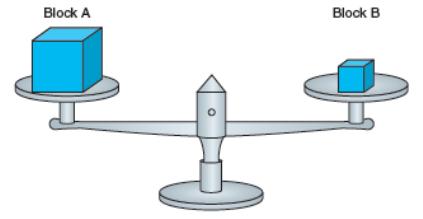
Use the following information for items 80-83.
A teacher brings a balance into the classroom and places it in front of the students as you see here. The balance has
two blocks of different sizes on it. Block A is bigger than block B, but the balance is balanced. The blocks are solid
cubes, and they cannot be compressed.
The teacher then presents the students with the following quiz questions.
a. Block A is heavier than block B. T F
b. Block A is more dense than block B. T F
c. Suppose you have a fluid equal in density to block A and
another equal in density to block B. The first fluid will float
on the second fluid. T F
d. Block A takes up more space than block B. T F
Consider each of the quiz questions (a, b, c, and d), and decide at what level of development a student must be in
order to answer correctly.
** 80. Item a:
a. preoperational
b. concrete operational
c. formal operational
** 81. Item b:
a. preoperational
b. concrete operational
c. formal operational
** 82. Item c:
a. preoperational
b. concrete operational
c. formal operational
Chapter 1: Educational Psychology: Understanding Learning and Teaching
** 83. Item d:
a. preoperational
b. concrete operational
c. formal operational
** 84. Mrs. Solomon gives each of her third graders four wooden squares (each 1″ by 1″) and a piece of poster
paper. They identify the wooden pieces as squares and conclude that they’re all the same size. She has
them put the squares together to form a larger square (2″ x 2″) and to draw a line around the larger square.
They remove the wooden squares, and she asks them how much space the wooden pieces covered and leads
them to conclude, “four squares.” She asks them what they call the space and introduces the term area.
She then tells them they have an area of “four squares.” To reinforce the idea, she then asks them what the
area of two blocks is and helps them to conclude, “two squares.”
Based on this information, which of the following is the best assessment of the developmental
appropriateness of Mrs. Solomon’s teaching of the concept area?
a. Her instruction was developmentally inappropriate, because she shouldn’t have told them they had
an area of four squares.
b. Her instruction was developmentally inappropriate, because she should have also used a wooden
space to put the squares on instead of poster paper.
c. Her instruction was developmentally appropriate, because the students had concrete illustrations of
both area and square.
d. Her instruction was developmentally appropriate, because she reinforced the concept through
teacher direction.
Essay Items
* 85. Describe two characteristics each of preoperational thought, concrete operational thought, and formal
operational thought.
** 86. You’re an eleventh-grade physics teacher. Based on research examining Piaget’s theory, identify one of the
most important implications of his theory for your teaching.
** 87. Gary is a fourth grader in school, early in the school year. He has above-average ability according to
intelligence tests. One day Mrs. Winton, Gary’s teacher gave the class a math test, and Gary did quite
poorly on it. Gary was devastated but resolved to try harder on the next test.
Given the information in the example, what would be the best explanation for Gary‘s performance on
the test, according to Piagetian theory?
** 88. Children typically are not allowed to start school if their birthday falls past a certain date (e.g., turning 5 by
the first of September). Historically, this hasn’t always been the case. Explain how this policy could be the
result of Piaget’s influence.
** 89. Two kindergarten teachers were joking about their ages. Patti is older than Jeanna. Jeanna, however, is
taller. The children consistently conclude that Jeanna is older than Patti. On the basis of Piagetian theory,
explain why the children would conclude that Jeanna is the older of the two.
** 90. Explain how neo-Piagetian views of development differ from Piaget’s original descriptions of
development.
** 91. Describe four guidelines that teachers can use when applying Piaget’s theory with their students, and
provide a classroom example of each.
Chapter 1: Educational Psychology: Understanding Learning and Teaching
Vygotsky’s Sociocultural Theory of Cognitive Development
* 92. Of the following, which description best outlines the characteristics of a sociocultural view of development?
a. Emphasis in experience and the need for equilibrium embedded in a cultural context in influencing
development
b. Emphasis on social interaction, language, and cultural context in influencing development
c. Emphasis on culture, transformation, and conservation in influencing development
d. Emphasis on assimilation, culture, and language in influencing development
* 93. Of the following, which theorist most stresses the importance of social support and language in cognitive
developmental growth?
a. Chomsky
b. Bandura
c. Piaget
d. Vygotsky
* 94. Which of the following concepts undergirds Vygotsky’s perspective on learning?
a. Culture and language
b. Adaptation and accommodation
c. Assimilation and proximity
d. Adaptation and equilibrium
* 95. Which of the following are essential to Vygotsky’s view of development?
a. Social interaction and activity
b. Close emotional relationships with adults and peers
c. Adaptation through experimentation
d. Individual trial and error and experimentation
* 96. The concepts and symbols, such as numbers and language, that allow people to think, solve problems, and
function in a culture are best described as:
a. forms of internalization.
b. types of scaffolding.
c. examples of private speech.
d. types of cognitive tools.
* 97. The process through which learners incorporate external, society–based activities into internal cognitive
processes is best described as:
a. assimilation.
b. accommodation.
c. internalization.
d. transformation.
* 98. Private speech is most likely to occur when:
a. the task is difficult.
b. the task requires a verbal answer.
c. the task is familiar.
d. the task is simple.
* 99. Of the following, private speech is most likely to increase when:
a. the learner is bored.
b. the learner feels isolated.
c. the learner is confident.
d. the learner is challenged.
Chapter 1: Educational Psychology: Understanding Learning and Teaching
* 100. The process of an individual using language to describe the steps needed to reach a goal is called:
a. social interaction.
b. private speech.
c. maturation.
d. equilibrium.
* 101. Of the following, which best describes Vygotsky’s concept of zone of proximal development?
a. Tasks learners can complete if they’re given help
b. Children’s awareness of how much they understand
c. Tasks learners can complete on their own
d. The extent to which learners are able to internalize the knowledge of others
* 102. Which of the following is the best definition of scaffolding?
a. Providing assessment to identify the students’ zones of proximal development
b. Assisting the development of disadvantaged learners with early intervention experiences
c. Providing social experiences for youngsters that reduces egocentricity
d. Providing instructional assistance that allows a learner to proceed through the zone of proximal
development
* 103. According to Vygotsky, students can benefit from help if:
a. they are at the stage of concrete operational or higher.
b. their inner speech is developed past preoperational.
c. tasks are in their zones of proximal development.
d. they are capable of transformation and reversibility.
* 104. The name given to the instructional assistance that allows the learner to progress through the zone of
proximal development is:
a. accommodation.
b. assimilation.
c. maturation.
d. scaffolding.
* 105. Which of the following is the best description of an important difference between Piaget’s and Vygotsky’s
views of development?
a. Piaget believed that development is innate, whereas Vygotsky believed it resulted from interactions
with the environment.
b. Piaget believed language merely aided in disrupting equilibrium, whereas Vygotsky felt it directly
caused an advance in development.
c. Vygotsky considered social interaction a means for testing schemes, whereas Piaget felt it was the
means for acquiring language and culture.
d. Vygotsky’s notion of active experimentation is absent from Piaget’s framework for learning and
development.
** 106. Jonas was employing a strategy for solving problems while doing his homework. He thought as he was
solving the first problem, “Let’s see. The first step is to determine what I already know from the problem.
I need to write that down. Next, I will write down what it is I need to know.” The statement in quotes best
illustrates which of Vygotsky’s concepts?
a. Private speech
b. Internalization
c. Scaffolding
d. Enculturation

Chapter 1: Educational Psychology: Understanding Learning and Teaching
Use the following information for items 107–109.
Steve, Norma, and Dawn, all second graders, are working with subtraction when regrouping is involved, such as
34 25
– 7 – 8
Mrs. Newton, the children’s teacher, provides them with help. As she tries to guide the students through the
problems, Steve still has difficulty. Norma is able to solve the problems with Mrs. Newton’s guidance but is still
unable to do them on her own. Dawn is able to do problems with regrouping without assistance.
** 107. Based on Vygotsky’s work, the task is in which student’s (or students’) zone of proximal development?
a. Steve
b. Norma
c. Dawn
d. Steve and Norma
** 108. The task is still beyond which student’s (or students’) zone of proximal development?
a. Steve
b. Norma
c. Dawn
d. Norma and Dawn
** 109. The task is below which student’s (or students’) zone of proximal development?
a. Steve
b. Norma
c. Dawn
d. Steve and Norma
** 110. “Let’s see. The first step is that I turn on the computer. When the screen comes on, I click the mouse to
Word, my word processing program.” The statement in quotes best illustrates which of Vygotsky’s
concepts?
a. Private speech
b. Repetition in learning
c. Social interaction
d. Rehearsal
** 111. Natalie can do her math problems when her mother helps her but becomes frustrated when she has to work
alone. Which best describes her?
a. The task is below her zone of proximal development because she needs help to be able to solve
them.
b. The task is beyond her zone of proximal development because she becomes frustrated.
c. The task is within her zone of proximal development because her mother’s help is beneficial.
d. The task is beyond her zone of proximal development because external aid is necessary.
Chapter 1: Educational Psychology: Understanding Learning and Teaching
Use the following vignette for items 112-117.
Esteban and Pepe work with their father on their vegetable farm in south Texas. “We are very careful,” their father
emphasizes, as he shows Esteban and Pepe how to stack tomatoes in crates so they won’t bruise. “We call it
primacita,” he says. “It’s what we mean when we first put a layer of the large, not-yet-ripened ones on the bottom,
and we work our way to the top.” He then guides the boys as they stack several crates of tomatoes.
A few weeks later, Esteban cautions Pepe, “Don’t stack the tomatoes that way. They’ll get bruised,” when he
sees Pepe putting riper tomatoes on the bottom of the crate. Pepe then changes the way he stacks the tomatoes and
follows the procedure their father demonstrated.
** 112. Which of the following is the best description of the way Vygotsky would interpret this event?
a. Esteban individually constructed his knowledge, whereas Pepe’s knowledge was socially
constructed.
b. Learning for both Esteban and Pepe occurred within the context of a social situation.
c. Esteban was at equilibrium, but Pepe’s equilibrium was disrupted when Esteban told him he was
stacking the tomatoes incorrectly.
d. Esteban was guided by a more knowledgeable other—his father—but Pepe didn’t receive guidance
from a more knowledgeable other.
** 113. Which of the following conclusions is most valid with respect to initially learning to stack tomatoes from
their father and Esteban’s and Pepe’s zones of proximal development?
a. The task was within Esteban’s zone of proximal development, but it was beyond Pepe’s zone.
b. The task was within Pepe’s zone of proximal development, but it was below Esteban’s zone.
c. The task was below both boys’ zones of proximal development.
d. The task was within both boys’ zones of proximal development.
** 114. According to Vygotsky, of the following, the best description of what occurred when the boys ultimately
incorporated their understanding of how to stack tomatoes is:
a. internalization.
b. enculturation.
c. transformation.
d. accommodation.
** 115. The term primacita, which the boys’ father used to represent the process of correctly stacking the tomatoes,
is best described as:
a. an internal structure.
b. a form of scaffolding.
c. an example of development.
d. a cognitive tool.
** 116. Of the following, which would Vygotsky interpret is the best example of development?
a. Esteban and Pepe learning the meaning of the term primacita
b. The boys watching their father show them how to correctly stack tomatoes
c. Esteban showing Pepe how to correctly stack tomatoes
d. The boys’ father emphasizing that they needed to be careful
** 117. Which of the following best describes the scaffolding provided in the event?
a. Esteban’s father provided scaffolding for both boys, but Esteban didn’t initially benefit from the
scaffolding.
b. Esteban’s father provided scaffolding for both boys and they both initially benefited from the
scaffolding.
c. Esteban received no scaffolding, but Esteban’s father provided scaffolding for Pepe.
d. Esteban’s father provided scaffolding for both boys, but only Esteban initially benefited from it.
Chapter 1: Educational Psychology: Understanding Learning and Teaching
** 118. After helping her students understand the concept equivalent fraction, a fourth-grade teacher shows her
students how they can use that knowledge to determine how they can share the cost of a pizza that is cut
into different-sized slices. Which one of the following ideas from Vygotsky’s theory does this scenario best
illustrate?
a. Acquiring cognitive tools helps people function effectively in a culture.
b. Self-talk gradually evolves into inner speech over time.
c Thought and language become interdependent as development advances.
d. Children develop more fully when tasks are in their zones of proximal development.
** 119. Of the following, which teacher is best applying the idea that cognitive tools help people think, solve
problems, and function effectively in a culture?
a. Mr. Lincoln tells his students that they have done so well that they can talk quietly among
themselves for the last 10 minutes of the period.
b. Mrs. Sanchez shows her second graders how they can represent their favorite color of jellybean on a
bar graph so they can understand practical uses of bar graphing.
c. Mr. Brush demonstrates a corner kick in soccer.
d. Ms. Yudin begins each of her lessons with a demonstration that arouses the students’ curiosity, so
they will pay better attention during the lesson.
** 120. Alana is having trouble learning how to follow the steps involved in creating macros to make her word
processing more efficient. Of the following, which suggestion is most nearly consistent with what
Vygotsky would suggest when people are working on difficult tasks?
a. Have someone explain why each step is important.
b. Talk herself through each of the steps.
c. Write the steps down.
d. Reread the manual that describes how to create macros.
** 121. Which one of the following best illustrates a student working in his or her zone of proximal development?
a. Logan, a ninth grader, uses correct grammar and punctuation when he writes persuasive essays.
b. Maya is practicing her serve in tennis. She watched a video that illustrated the correct technique, and
she is now attempting to perfect the technique so it will be more effective when she plays.
c. Seth has trouble balancing chemical equations. His teacher sat with him and offered assistance, but
he was still unable to do it. “I just don’t get it,” he comments.
d. Sophie is learning to create certain effects with her PowerPoint slides. She can create the effects she
wants when her instructor sits with her, but she has trouble on her own.
** 122. Of the following, which teacher is providing the least amount of scaffolding?
a. Ms. Page takes her kindergarteners on a field trip to the zoo, and when they return, she asks them to
describe some of the animals they saw.
b. Mr. Evans demonstrates how to shoot a jump shot in basketball, and he then critiques his players’
shooting techniques as they practice.
c. Ms. Williams gives her students a set of questions to ask themselves as they work on word problems
in math and then asks them to describe which step they are on as they solve word problems during
seat work.
d. Mrs. Reynolds gives her students a graphic organizer to use when they analyze a story.
Essay Items
** 123. Explain and give an example of how language, social interaction, and culture interact in Vygotsky’s
sociocultural theory of development.
Chapter 1: Educational Psychology: Understanding Learning and Teaching
Use the following information for items 124–127.
A kindergarten teacher is working with her students on basic skills. She has written the following information on the
board:
it _________ a wonderful p __ t _ filled with g ___d t _ m _ s and good friends at thu animal h __ se
She had the children turn to their partners, confer for a minute, and then called on individuals to offer corrections for
parts of the sentence, such as capitalizing the first word, correctly spelling “the,” and putting a period at the end of
the sentence. She then called different children to the board to fill in the missing letters, so the sentence read as
follows:
It was a wonderful party filled with good times and good friends at the animal house.
In the process she used questioning to help the students understand blends, such as ou in house, and other rules such
as silent e in times. When the children struggled, she provided cues that helped them continue to make progress.
** 124. Identify two types of scaffolding in the example.
** 125. Was the task in the children’s zones of proximal development? Explain why it was or was not.
** 126. What evidence would be necessary to determine if internalization occurred?
** 127. Explain how the activity illustrated the basic relationships between language, social interaction, and
culture.
** 128. Describe four guidelines teachers can use when attempting to apply Vygotsky’s work with their students.
Language Development
* 129. Virtually all people learn to speak, and despite wide diversity, all languages have similar forms, such as
subject-verb structure. The theory of language acquisition best able to explain these similarities is:
a. behaviorist theory.
b. social learning theory.
c. nativist theory.
d. constructivist theory .
* 130. The theoretical view suggesting that children learn language by practicing it in their day–to-day
interactions—apparently without effort because their learning is embedded in everyday activities—is best
described as:
a. nativist theory.
b. social cognitive theory.
c. behaviorist theory.
d. sociocultural theory.
* 131. Chomsky’s view of language development would best be categorized as:
a. sociocultural.
b. behaviorist.
c. nativist.
d. cognitive.
* 132. According to Chomsky’s theory, the term LAD refers to:
a. language assistance device.
b. learning adaptation device.
c. learning adaptation dilemma.
d. language acquisition device.
Chapter 1: Educational Psychology: Understanding Learning and Teaching
* 133. The basic assumption in nativist theories of child language development is:
a. language acquisition requires no input from parents or other adults.
b. language acquisition is primarily the result of experiences combined with modeling from parents.
c. language acquisition is the result of verbal behaviors that are systematically reinforced and
encouraged.
d. language acquisition is primarily the result of an innate predisposition to learn language.
* 134. According to the social cognitive theory of language acquisition, children learn language primarily through:
a. the demonstration of language behaviors that are reinforced by the environment.
b. imitation of language displayed by others, together with corrective feedback.
c. instinctive tendencies that predispose children to learn speech.
d. instinctive tendencies to learn speech together with adult modeling and feedback.
* 135. Of the prominent theories of language development, the one that attributes the smallest role to parental
influence is:
a. behaviorist theory.
b. social cognitive theory.
c. nativist theory.
d. constructivist theory.
* 136. The use of one-word utterances that carry as much meaning for a child as a complete sentence is called:
a. holophrasic language.
b. “fine-tuned” language.
c. overgeneralized language.
d. undergeneralized language.
* 137. At which of the following ages would we be most likely to hear a child using holophrases?
a. Two years of age
b. Three years of age
c. Four years of age
d. Five years of age
* 138. A child using a word to refer to a broader class of objects than is appropriate is best described as:
a. holophrasic speech.
b. overgeneralization.
c. semantics.
d. syntax.
* 139. A central component of language development that deals with the meanings of words and word
combinations is called:
a. inner speech.
b. syntax.
c. language tuning.
d. semantics.
* 140. The rules of language that we use to put words together into meaningful sentences are best described as:
a. syntax.
b. semantics.
c. grammar.
d. inner speech.
* 141. The shift from “learning to read” to “reading to learn” occurs in about which grade?
a. First grade
b. Third grade
c. Fifth grade
d. Seventh grade
Chapter 1: Educational Psychology: Understanding Learning and Teaching
** 142. A child saying “Banana” to mean, “That’s a banana.” best illustrates which of the following?
a. A simile
b. An overgeneralization
c. A holophrase
d. An undergeneralization
** 143. A child says, “Park!” meaning, “I want to go to the park.” This language behavior best illustrates:
a. overgeneralized speech.
b. undergeneralized speech.
c. “fine-tuned” speech.
d. holophrasic speech.
** 144. Noah, a two-year-old, sees a cow in a field and says “doggie.” Noah is illustrating:
a. a holophrase used in early language.
b. overgeneralization of the word doggie.
c. a semantic description of the word doggie.
d. egocentric language development.
** 145. Mom is amused as she listens to Joseph say “Dumptuck” to every moving vehicle he sees. Joseph’s
language pattern best illustrates:
a. undergeneralization.
b. overgeneralization.
c. reinforcement.
d. corrective feedback.
** 146. Pia says, “Here kitty,” when she wants her kitty to come to be fed. Then, seeing a cat walk across a
sidewalk, her mother says, “What’s that?” Pia, not being sure, says nothing. Of the following, which best
describes Pia’s language pattern?
a. Overgeneralized speech
b. Undergeneralized speech
c. Semantic speech
d. Syntactical speech
** 147. From Piaget’s developmental point of view, overgeneralization in language occurs when:
a. a preoperational child is reinforced for “cute” behaviors that are grammatically incorrect or invalid.
b. a child inappropriately assimilates information into an already existing structure.
c. a child creates a new scheme when an existing scheme is already valid.
d. a child uses one or two words to communicate an idea that adults would communicate with an entire
sentence.
** 148. Mrs. Almagro’s third graders are learning a great many new ideas and the terms that go with them, such as
living thing, plot, fraction, and community. This important component of language development is best
described as:
a. generalization.
b. syntax.
c. synapse.
d. semantics.
** 149. In about the first grade, children begin to learn rules of grammar, such as understanding that “He went to
the store,” is correct, whereas, “He goed to the store,” is not. Which of the following best describes the
aspect of language development involved in understanding that the first sentence is the correct grammatical
form?
a. Syntax
b. Generalization
c. Semantics
d. Transformation
Chapter 1: Educational Psychology: Understanding Learning and Teaching
Use the following case study to respond to items 150-152.
Four first-grade teachers are attempting to promote language development in their children.
Mrs. Edenfield has her children read a story about fish aloud in their reading groups, and she then has them tell
her everything they can about the story, including what they see in the pictures.
Mrs. Hester brings a snake to class, has the students look at and touch the snake, and she tells them all about
snakes, pointing out its various parts and telling them how snakes eat, lose their skin, and move.
Mrs. Gonzalez shows the students a video recording about hawks and eagles that shows the birds soaring,
catching prey, and feeding their young. She asks the students to tell her what they see in the recording, and asks
them to compare birds of prey to other birds.
Mr. Briggs has Cynthia bring her hamsters to school, and the students feel and pet the hamsters and describe
what they see and feel. They then create and read a story about a hamster named Henry.
** 150. Based on this case study, the teacher probably most effective in promoting language development is:
a. Mrs. Edenfield.
b. Mrs. Hester.
c. Mrs. Gonzalez.
d. Mr. Briggs.
** 151. The teacher probably least effective in promoting language development was:
a. Mrs. Edenfield.
b. Mrs. Hester.
c. Mrs. Gonzalez.
d. Mr. Briggs.
** 152. Suppose the teachers in the vignette each have a large number of students in their classes for whom English
is not their first language. Which teacher is probably most effective for promoting language development
with these children?
a. Mrs. Edenfield.
b. Mrs. Hester.
c. Mrs. Gonzalez.
d. Mr. Briggs.
Essay Items
* 153. Describe holophrases, overgeneralization, and undergeneralization, and explain how they relate to language
development.
* 154. Explain semantics and syntax, and explain how they relate to language development.
** 155. Several factors contribute to language development, but one is essential for all forms of language
development. Identify this factor and explain why it is so important.
Chapter 1: Educational Psychology: Understanding Learning and Teaching
CHAPTER TWO ANSWERS
What Is Development?
Piaget’s Theory of Cognitive Development
Chapter 1: Educational Psychology: Understanding Learning and Teaching
Chapter 1: Educational Psychology: Understanding Learning and Teaching
Vygotsky’s Sociocultural Theory of Cognitive Development
Chapter 1: Educational Psychology: Understanding Learning and Teaching
Language Development