Name:
Class:
Date:
Chapter 02: Economic Tools and Economic Systems
c. h.
d. i.
e. e.
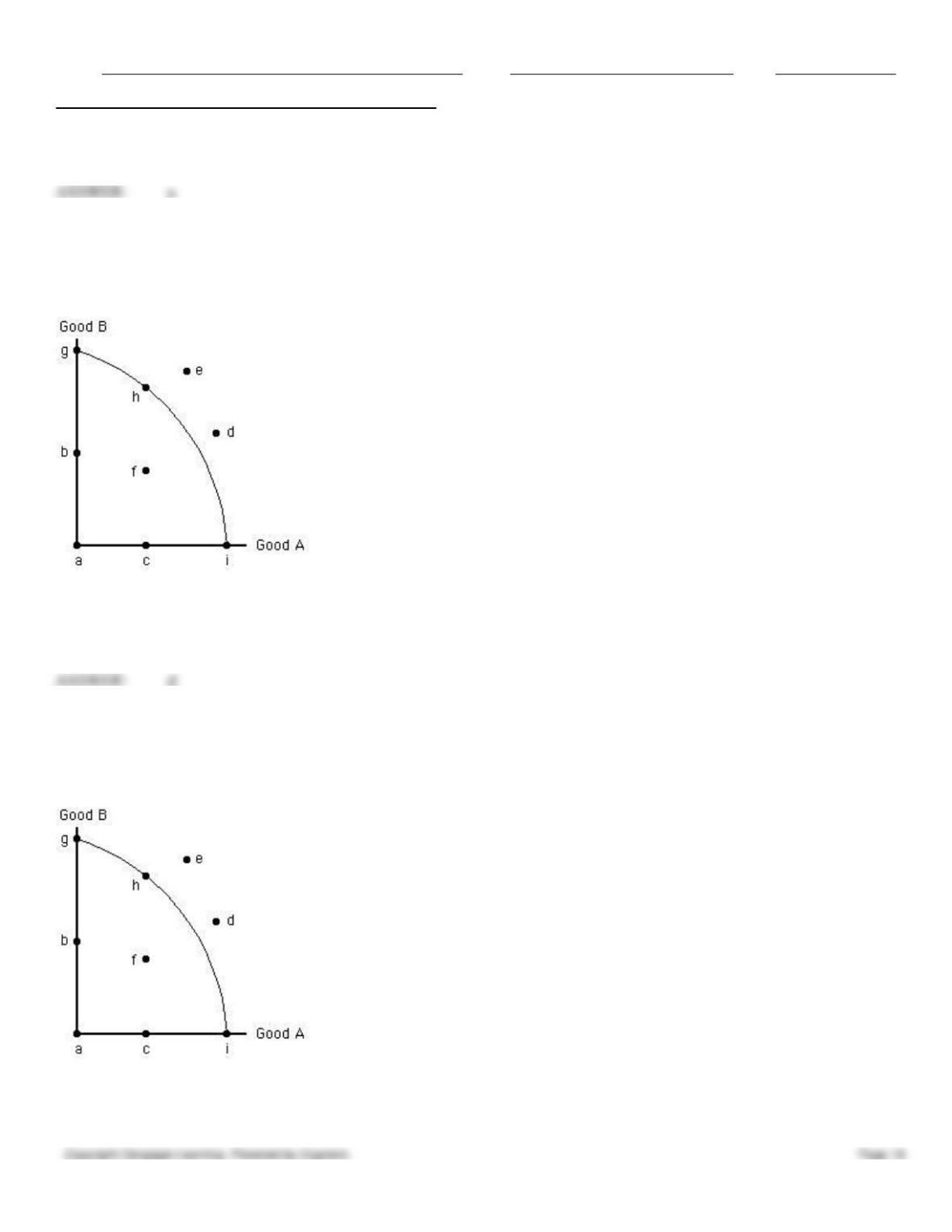
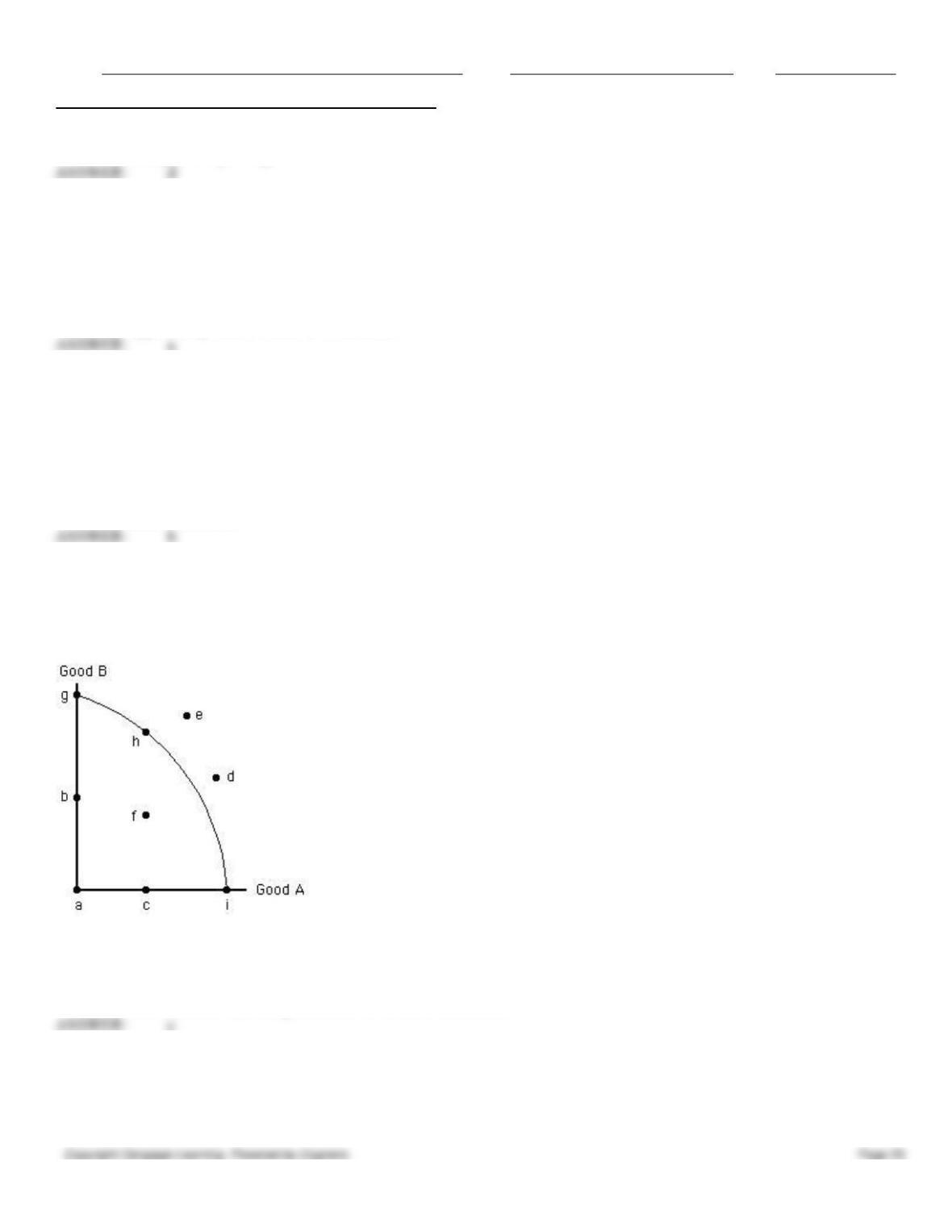
103. The figure below shows the production possibilities frontier for Good A and Good B. In the figure below, if all the
economy’s resources are used efficiently to produce only good A, then the economy will be at point:
Figure 2.2
a. g.
b. b.
c. h.
d. i.
e. e.
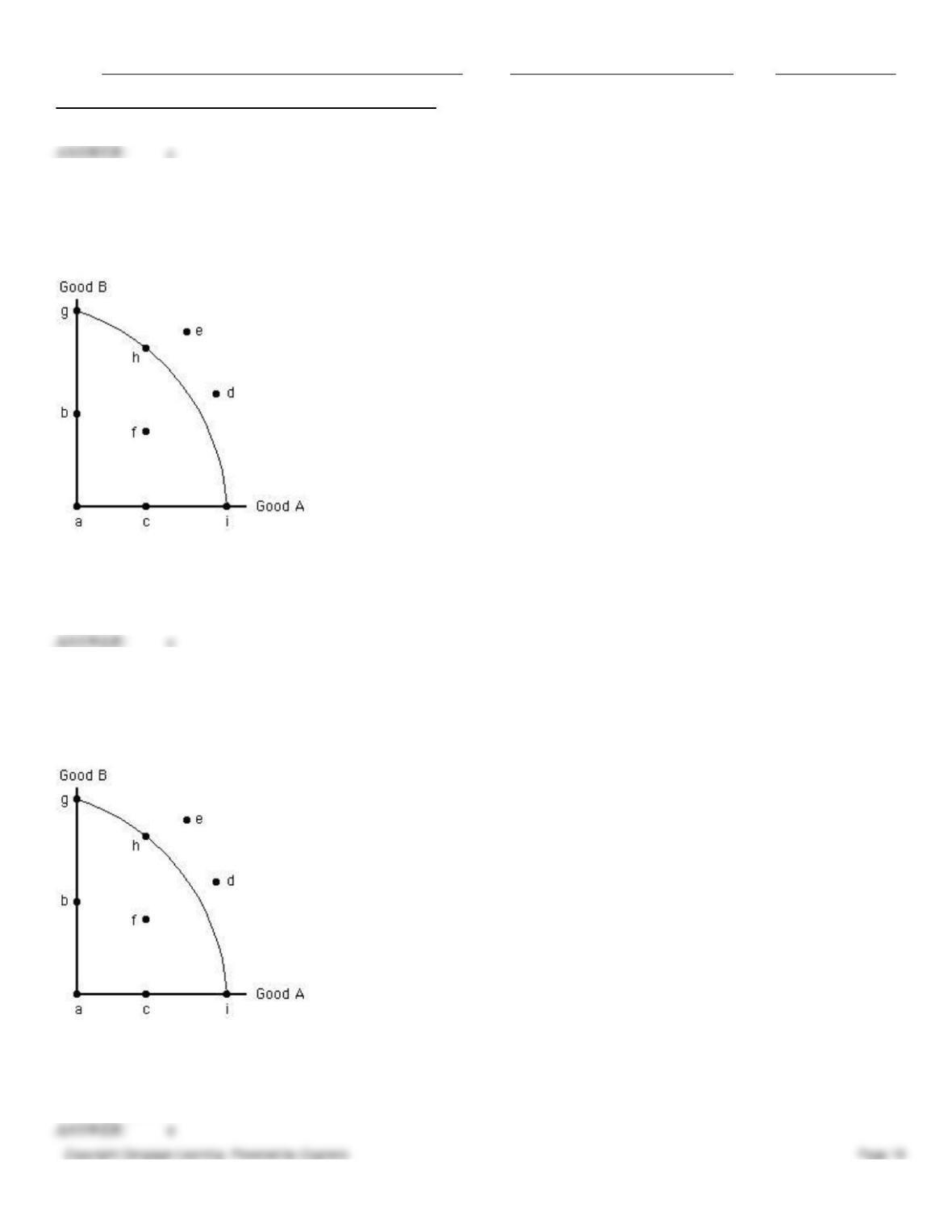
104. The figure below shows the production possibilities frontier for Good A and Good B. In the figure below, given the
quantity of resources and level of technology, which of the following points is unattainable?
Figure 2.2
a. g
b. b
c. h
d. i
Name:
Class:
Date:
Chapter 02: Economic Tools and Economic Systems
e. e
105. The figure below shows the production possibilities frontier for Good A and Good B. In the figure below, which of
the following points represents an inefficient use of the economy’s resources?
Figure 2.2
a. h
b. d
c. f
d. i
e. e
106. The figure below shows the production possibilities frontier for Good A and Good B. In the figure below, if
resources are used fully and efficiently, then the economy can produce at point(s):
Figure 2.2
a. f.
b. a or b.
c. c.
d. d or e.
e. g, h, or i.
Name:
Class:
Date:
Chapter 02: Economic Tools and Economic Systems
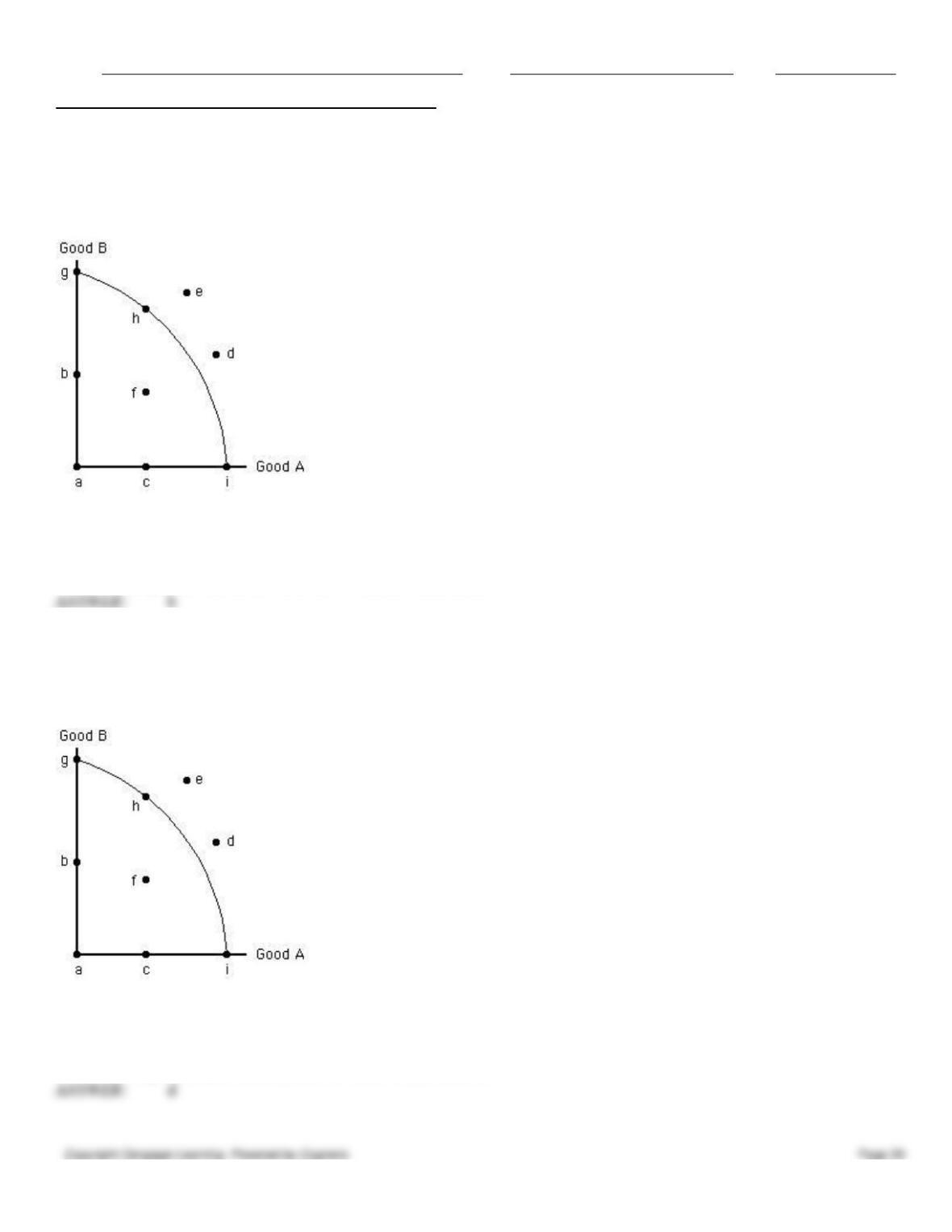
107. The following figure shows the production possibilities frontier for Good A and Good B. In the figure below, point e
represents:
Figure 2.2
a. an attainable combination of Good A and Good B.
b. an unattainable combination of Good A and Good B.
c. the combination of Good A and Good B that the economy will produce.
d. one possible efficient combination of Good A and Good B.
e. the only unattainable combination of Good A and Good B.
108. The following figure shows the production possibilities frontier for Good A and Good B. In the figure below, point f
represents:
Figure 2.2
a. an efficient combination of Good A and Good B.
b. the only efficient combination of Good A and Good B.
c. the combination of Good A and Good B that the economy will produce.
d. an inefficient combination of Good A and Good B.
e. the only inefficient combination of Good A and Good B.
Name:
Class:
Date:
Chapter 02: Economic Tools and Economic Systems
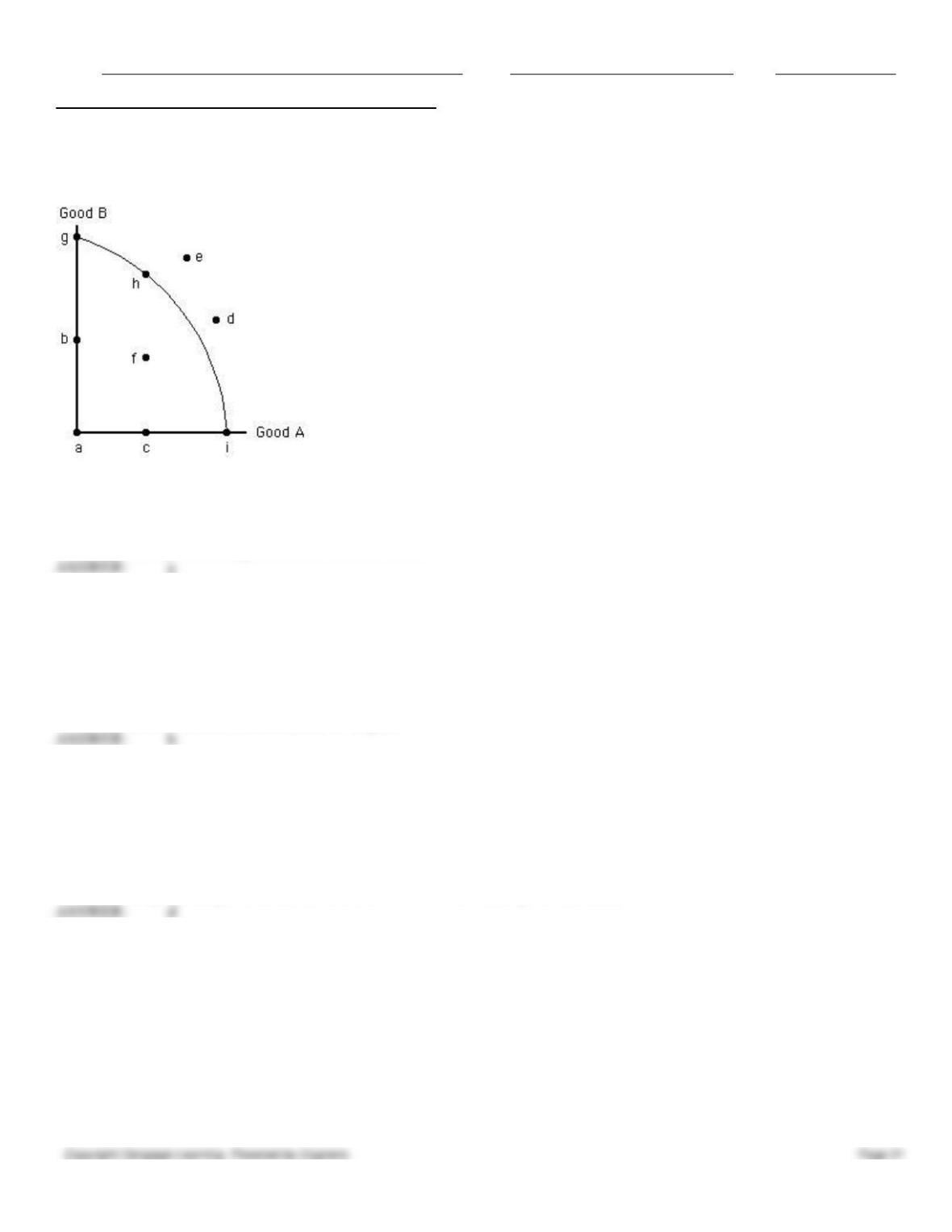
109. The following figure shows the production possibilities frontier for Good A and Good B. In the figure below, point g
is efficient because:
Figure 2.2
a. the only way to increase production of Good A is by decreasing production of Good B.
b. the economy can increase production of both Good A and Good B from point g.
c. it is impossible to move to any other point along the production possibilities frontier.
d. it is impossible to move to any other point inside the production possibilities frontier.
e. no other production possibilities frontier exists.
110. Points inside the production possibilities frontier represent:
a. full and efficient use of all resources.
b. inefficiency or unemployment.
c. currently unattainable combinations of outputs.
d. currently unattainable combinations of resources.
e. the most desirable combinations of outputs.
111. Points outside the production possibilities frontier represent:
a. unemployment of resources.
b. inefficient use of resources.
c. combinations that are attainable only if all resources are used fully and efficiently.
d. currently unattainable combinations of outputs.
e. the only currently attainable combinations from which society must choose.
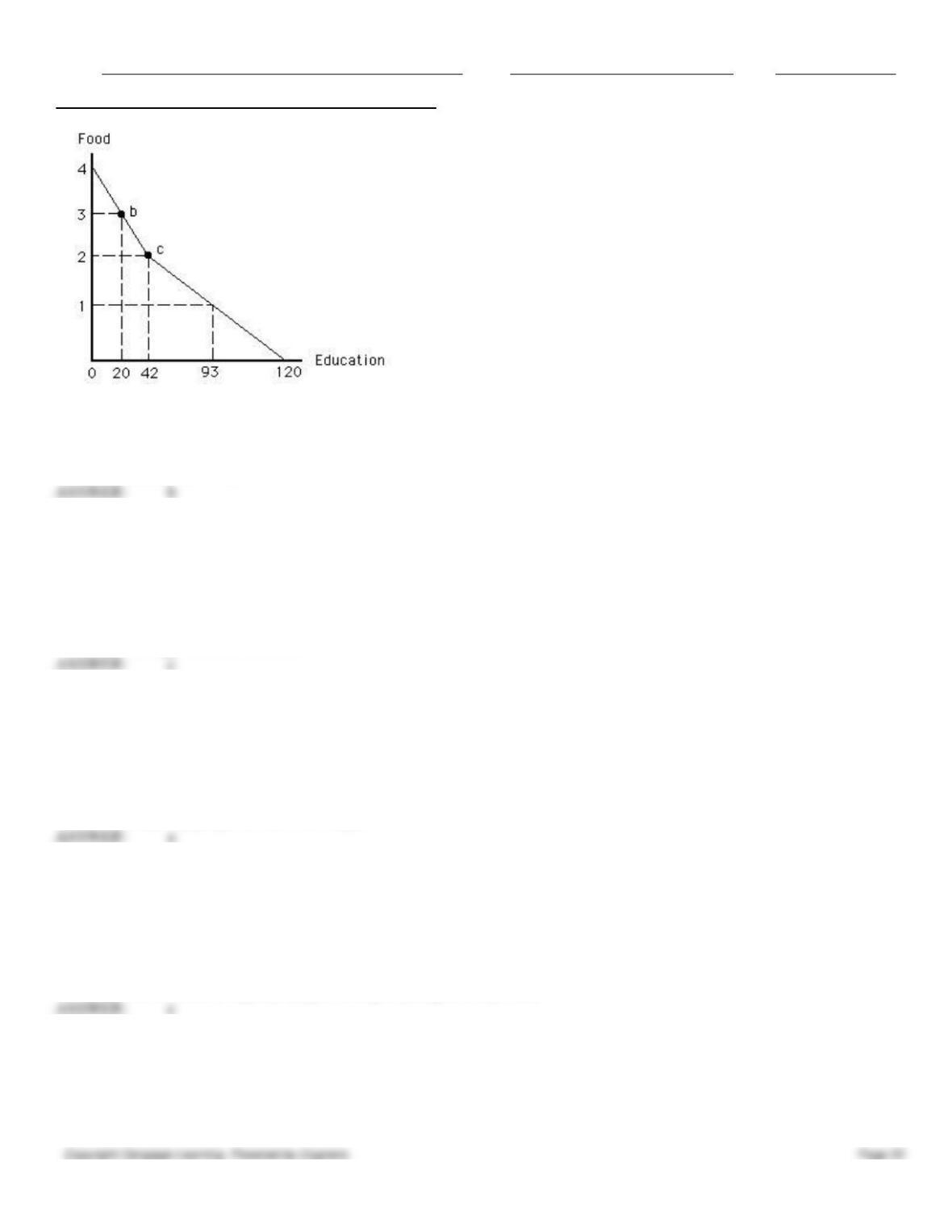
112. The figure given below shows the production possibilities frontier for education and food. In The opportunity cost of
moving from point c to point b is _____.
Figure 2.3
Name:
Class:
Date:
Chapter 02: Economic Tools and Economic Systems
a. 3 units of food
b. 22 units of education
c. 1 unit of food
d. 12 units of education
e. 62 units of education
113. Along a bowed-out production possibilities frontier, as more of one good is produced, _____.
a. the opportunity cost of producing that good remains constant
b. the opportunity cost of producing that good decreases
c. efficiency decreases
d. the opportunity cost of producing both goods must remain constant
e. technology remains constant
114. If an economy is operating at a point inside the production possibilities frontier, then:
a. some of the nation’s resources are unemployed.
b. the production decisions are made by the government.
c. unlimited resources must satisfy scarce desires.
d. using the existing resources efficiently will shift the production possibilities frontier outward.
e. society is paying too much for wages.
115. If the production possibilities frontier is a straight line, _____.
a. its slope will equal −1
b. resources must not be used efficiently
c. resources must be unemployed
d. society must not be using the latest technology
e. resources must be equally adaptable at producing either product
116. A production possibilities frontier will be bowed out if:
a. there is scarcity.
b. resources are used efficiently.
c. production of one good involves an opportunity cost.
Name:
Class:
Date:
Chapter 02: Economic Tools and Economic Systems
d. resources are not perfectly adaptable to making each good.
e. technology is improving.
117. As resources are not perfectly adaptable to the production of both Good A and Good B, _____.
a. the opportunity cost of Good A increases as the production of Good A increases.
b. the opportunity cost of Good A decreases as the production of Good A increases.
c. it is impossible for the economy to produce both Good A and Good B.
d. the opportunity cost of Good A is constant.
e. the opportunity cost of Good B is constant.
118. On a bowed-out production possibilities frontier showing possible output levels of Good A and good B, the
opportunity cost of producing the first 10 units of Good A will usually be:
a. the same as the opportunity cost of producing the next 10 units of Good A.
b. lower than the opportunity cost of producing the next 10 units of Good A.
c. greater than the opportunity cost of making the next 10 units of Good A.
d. 10 units of Good A.
e. 10 units of Good B.
119. The figure given below shows the production possibilities frontier for Good A and Good B. In the figure below,
when moving from point f to point g, the production of:
Figure 2.2
a. Good B increases without a change in the production of Good A.
b. Good A increases without a change in the production of Good B.
c. both Good A and Good B increase.
d. both Good A and Good B decrease.
e. Good B increases and the production of Good A decreases.
120. A downward-sloping straight-line production possibilities frontier indicates:
a. that society cannot decide which good it prefers.
b. an absence of scarcity.

Name:
Class:
Date:
Chapter 02: Economic Tools and Economic Systems
c. constant opportunity cost.
d. inefficiency.
e. specialization.
121. The law of increasing opportunity cost explains why:
a. opportunity cost is constant along the production possibilities frontier.
b. the production possibilities frontier is downward sloping.
c. the production possibilities frontier is curved.
d. efficient points lie along the production possibilities frontier.
e. technology remains constant along a production possibilities frontier.
122. The law of increasing opportunity cost reflects the fact that:
a. the production possibilities frontier is bowed inward.
b. resources are not perfectly substitutable.
c. resources cannot always be used efficiently.
d. an economy will operate at a point inside its production possibilities frontier.
e. an economy will operate at a point along its production possibilities frontier.
123. On a straight-line production possibilities frontier, which of the following is true?
a. The problem of scarcity does not exist.
b. Resources are imperfect substitutes.
c. Opportunity costs are constant.
d. Technology is rapidly expanding.
e. Some resources are not being used efficiently.
124. Any movement along a bowed-out production possibilities frontier involves the production of:
a. more of both goods.
b. more of one good and less of the other.
c. less of both goods.
d. more resources.
e. better technology.
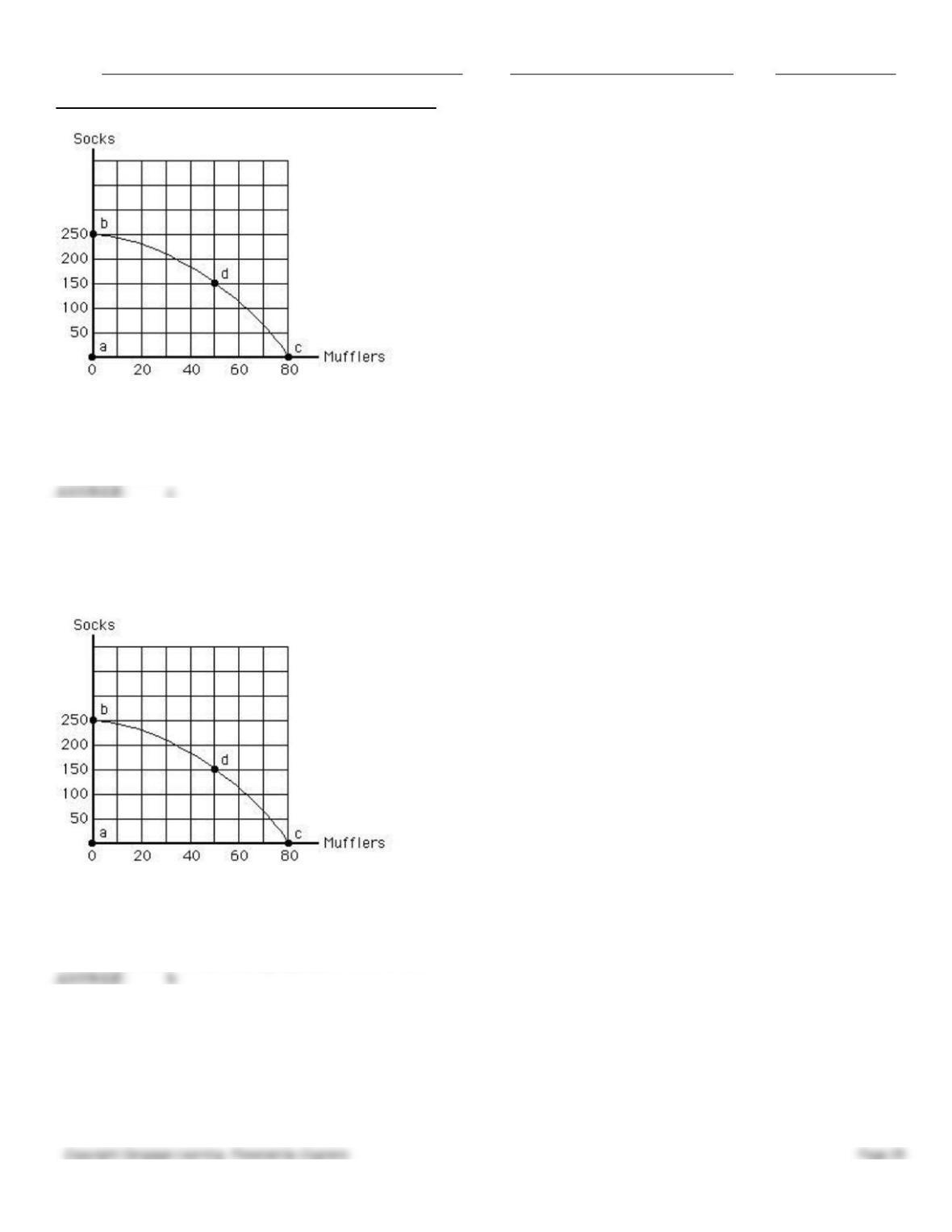
125. The figure given below shows the production possibilities frontier for mufflers and socks. The opportunity cost of
moving from point b to d is:
Figure 2.4
Name:
Class:
Date:
Chapter 02: Economic Tools and Economic Systems
a. 30 mufflers.
b. 50 mufflers.
c. 100 socks.
d. 150 socks.
e. 250 socks.
126. The figure given below shows the production possibilities frontier for mufflers and socks. If society moves from
point c to point d, then society:
Figure 2.4
a. gains 100 socks.
b. loses 30 mufflers.
c. is worse off after the change in production.
d. is not operating efficiently.
e. experiences some unemployment of resources.
127. On a production possibilities frontier, the opportunity cost of one more unit of a commodity per time period is
measured by the:
a. monetary price of the commodity.
b. amount of the other commodity that must be sacrificed.
c. amount of unemployed resources that must be used.
d. amount of satisfaction it gives consumers.

Name:
Class:
Date:
Chapter 02: Economic Tools and Economic Systems
e. amount of tax paid to government for production, sale, and use of the commodity.
128. Which of the following would shift the production possibilities frontier outward?
a. An increase in the size of the labor force
b. More efficient use of existing resources and technology
c. The government prints more money
d. The end of a strike by a labor union
e. Society’s desire to produce more of one of the goods
129. Which of the following would not shift the production possibilities frontier?
a. An increase in capital stock
b. A war that destroyed many buildings
c. A technological improvement that improved fuel efficiency in cars
d. A decrease in the size of the labor force
e. A change to a more inefficient production process
130. Which of the following would shift the production possibilities frontier outward?
a. A reduction in inefficiency
b. A reduction in the size of the labor force
c. An improvement in technology
d. A change in the combination of goods produced
e. Increasing opportunity costs
131. An improvement in technology:
a. will always result in a parallel shift of the production possibilities frontier.
b. will never result in a parallel shift of the production possibilities frontier.
c. will be indicated as a movement along the production possibilities frontier.
d. will shift the production possibilities frontier outward but not necessarily to a parallel position.
e. may not shift the production possibilities frontier.
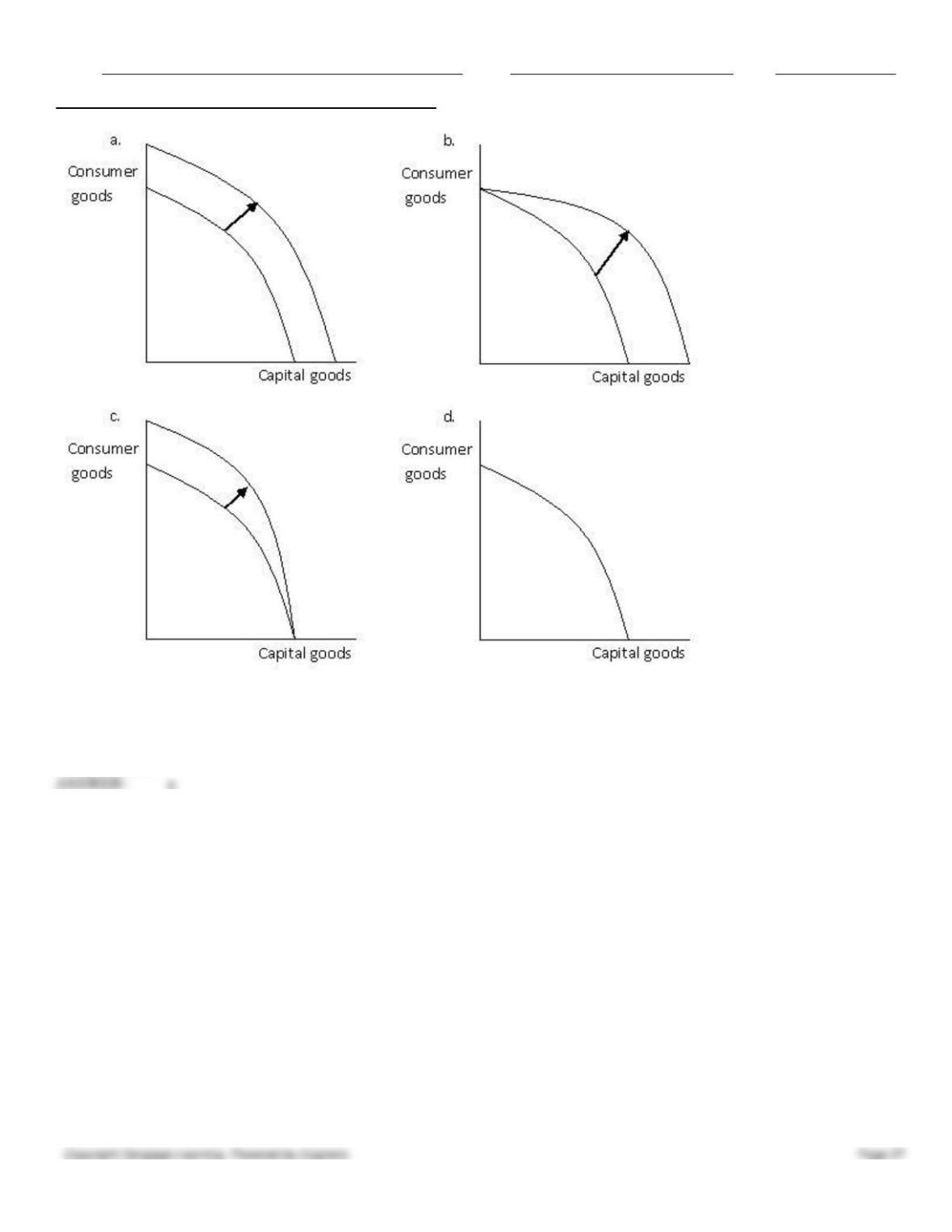
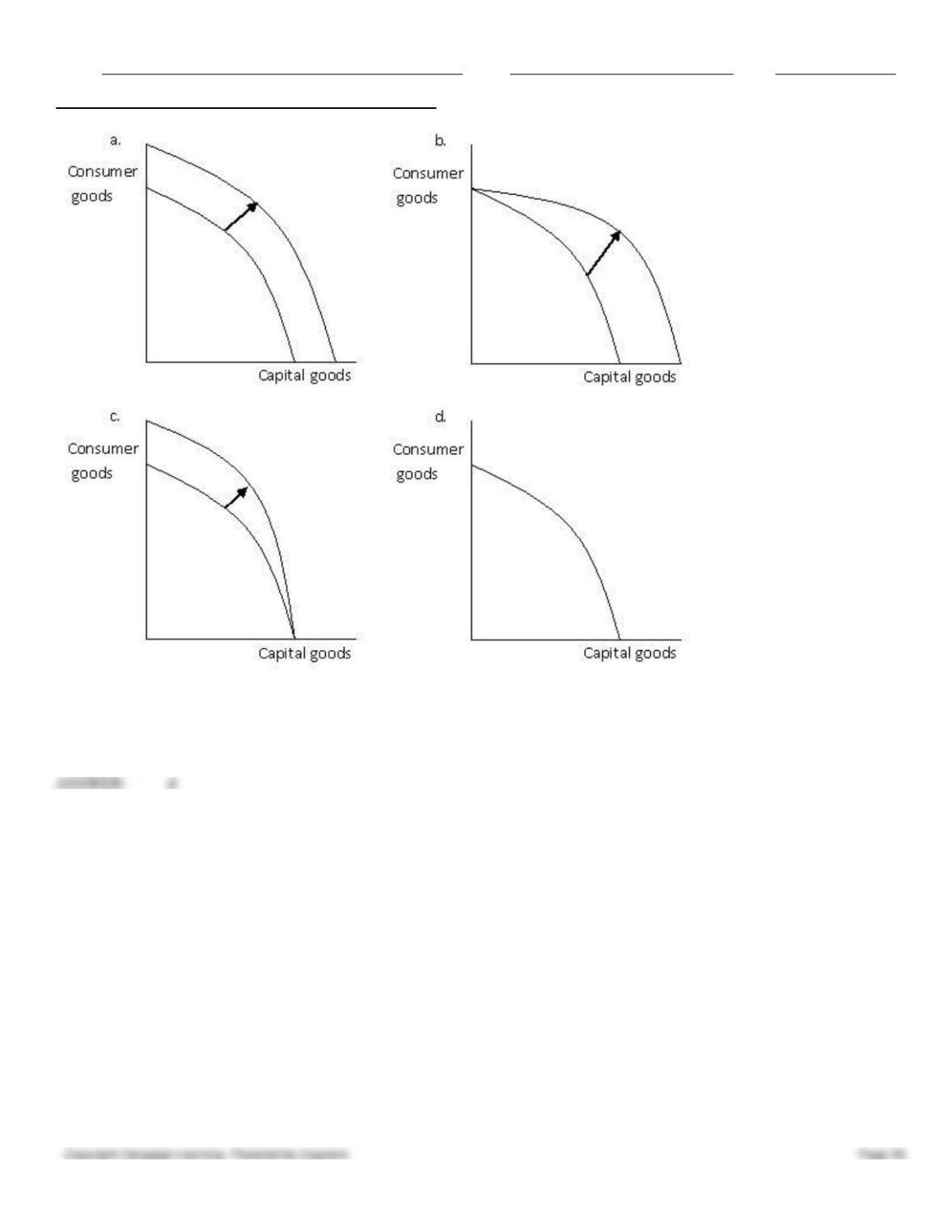
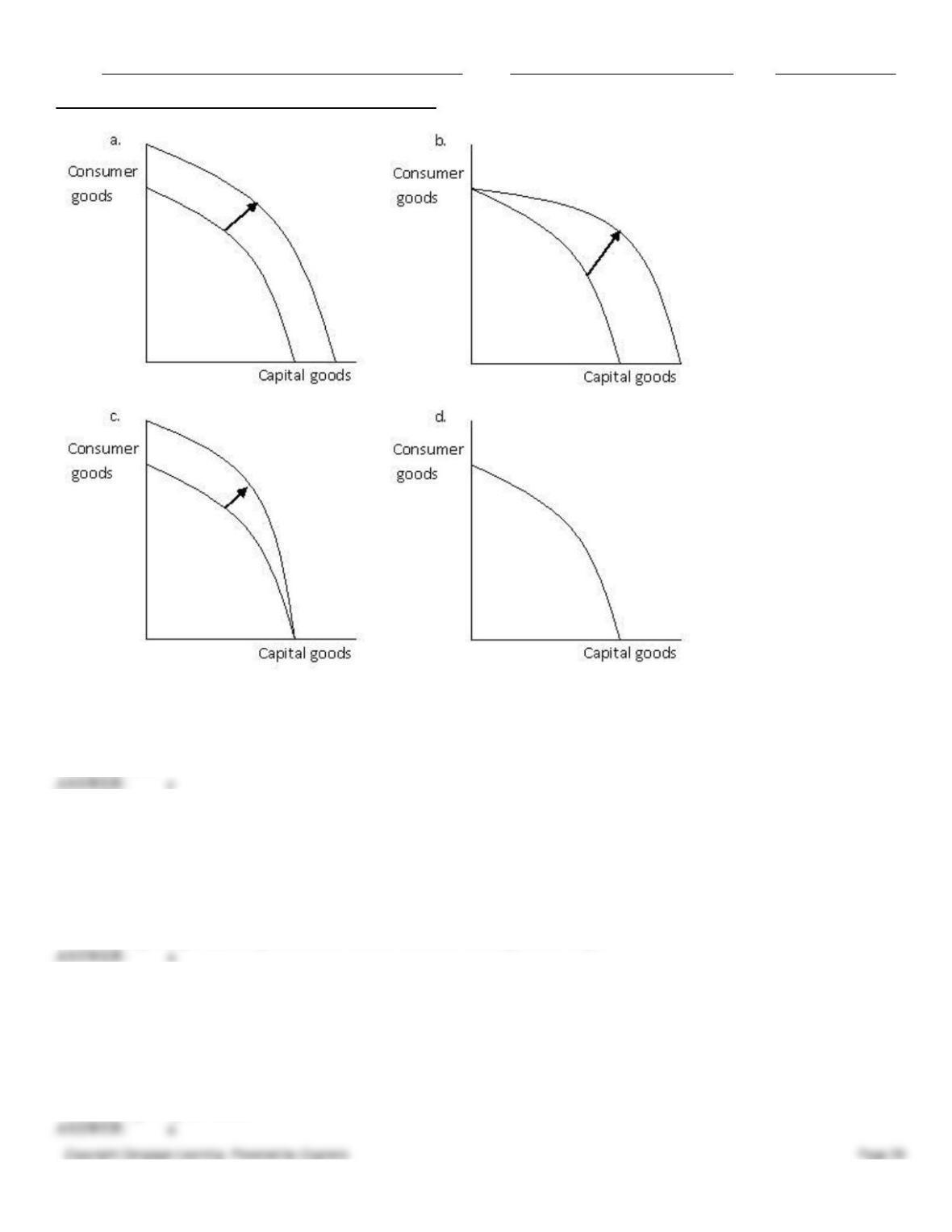
132. The following figure has four graphs showing the production possibilities frontier for capital goods and consumer
goods. Assuming an influx of immigrants benefits the production of both consumer and capital goods, which of the graphs
below best illustrates the impact on the production possibilities frontier?
Figure 2.5
Name:
Class:
Date:
Chapter 02: Economic Tools and Economic Systems
a. a.
b. b.
c. c.
d. d.
e. b and d.
133. The figure given below has four graphs showing the production possibilities frontier for capital goods and consumer
goods. Which of the graphs below best illustrates the impact on the production possibilities frontier of a decrease in
unemployment?
Figure 2.5
Name:
Class:
Date:
Chapter 02: Economic Tools and Economic Systems
a. a.
b. b.
c. c.
d. d.
e. b and d.
134. The following figure has four graphs showing the production possibilities frontier for capital goods and consumer
goods. Which of the graphs below best illustrates the impact on the production possibilities frontier of a technological
improvement that will make the resources used to produce consumer goods more efficient?
Figure 2.5
Name:
Class:
Date:
Chapter 02: Economic Tools and Economic Systems
a. a.
b. b.
c. c.
d. d.
e. b and d.
135. An improvement in technology used to produce goods would:
a. enable an economy to produce outside its original production possibilities frontier.
b. enable an economy to move along its original production possibilities frontier.
c. eliminate scarcity and the production possibilities frontier would no longer exist.
d. have no effect on the production possibilities frontier.
e. change the production possibilities frontier to a line with a positive slope.
136. A production possibilities frontier can shift outward for all of the following reasons except:
a. a decrease in the size of the labor force.
b. an increase in the skills of the labor force.
c. an improvement in technology.
d. a larger work force.
e. a larger capital stock.
Name:
Class:
Date:
Chapter 02: Economic Tools and Economic Systems
137. A production possibilities frontier can shift inward if there is:
a. an increase in the unemployment rate.
b. a stable political environment.
c. an improvement in technology.
d. a larger work force.
e. a larger capital stock.
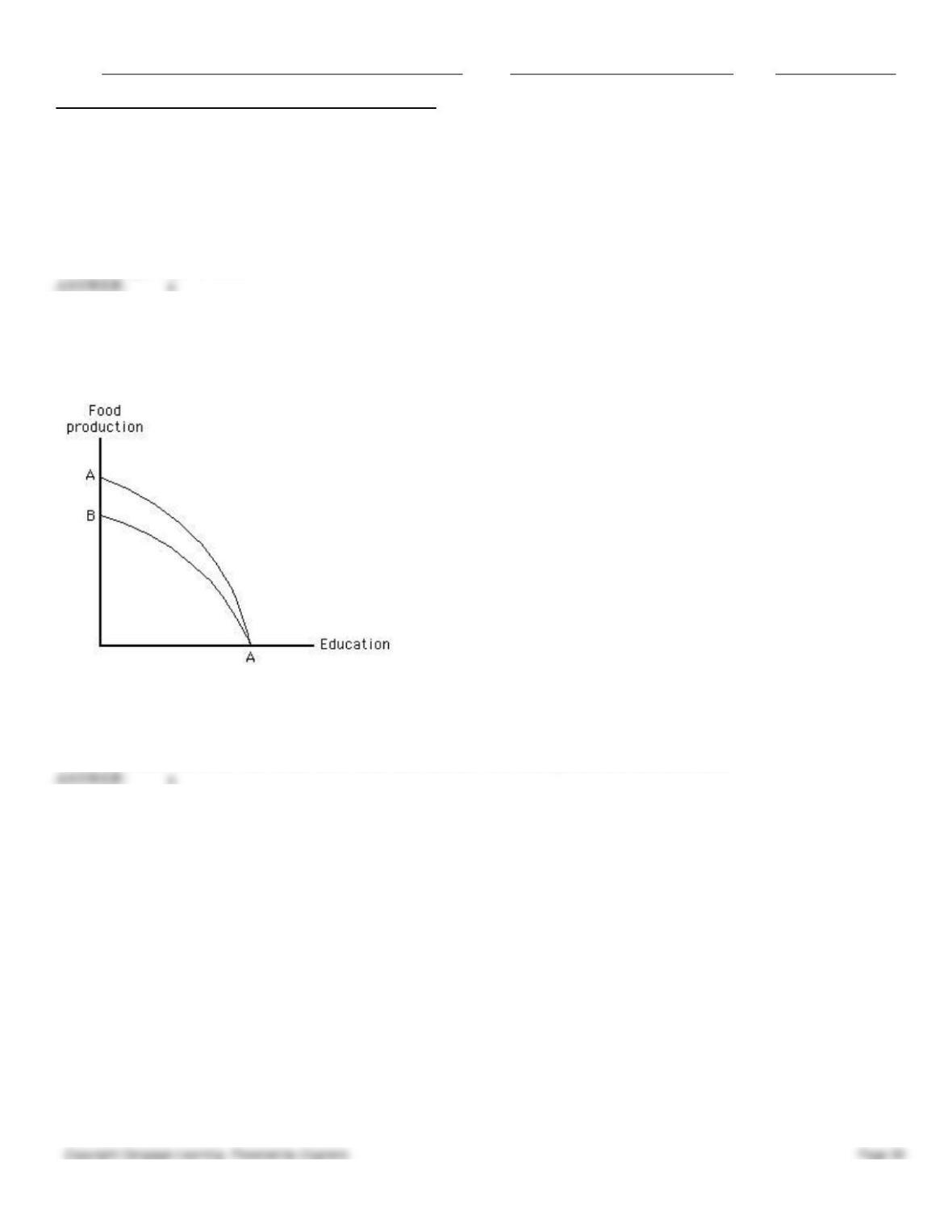
138. The figure below shows the production possibilities frontier for education and food production. Which of the
following would cause the production possibilities frontier to shift from AA to BA?
Figure 2.6
a. A drought that affected food production but had no effect on education.
b. A technological improvement in education that had no effect on food production.
c. A technological improvement in food production that had no effect on education.
d. A disease that affected students’ ability to learn (and therefore education) but not food production.
e. An increase in the size of the labor force that affected both food production and education.
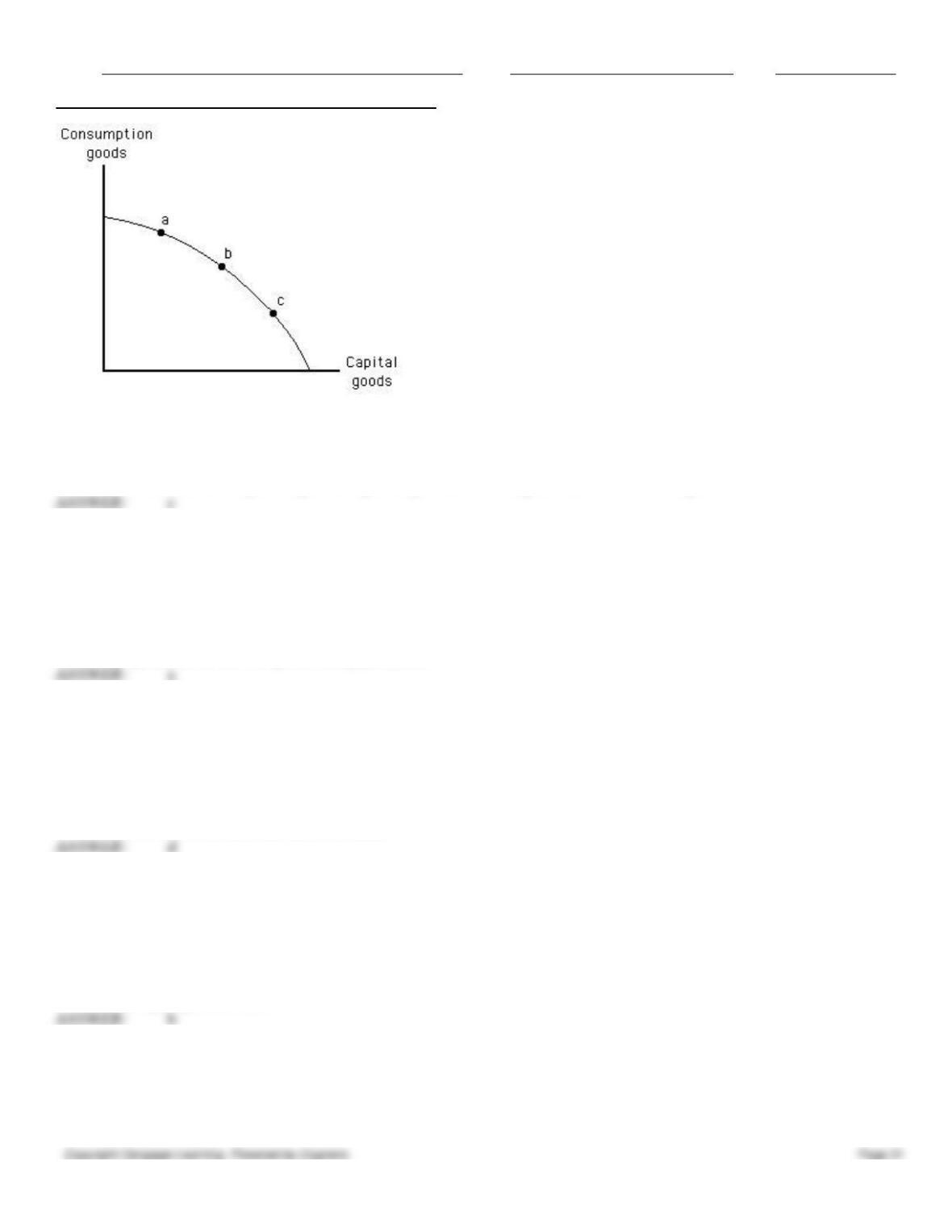
139. The figure below shows the production possibilities frontier for capital goods and consumption goods. Current
production at _____ would lead to the largest outward shift in the production possibilities frontier in a later year _____.
Figure 2.7
Name:
Class:
Date:
Chapter 02: Economic Tools and Economic Systems
a. Point a; because this point represents a greater consumption level than point b
b. Point b; because this point represents greater total production than the other two points
c. Point c; because this point represents a greater consumption level than the other two points
d. Point b; because this point represents greater production of capital than point c
e. Point c; because this point represents greater production of capital than the other two points
140. The production possibilities frontier will shift if there is a change in:
a. technology.
b. unemployment.
c. product prices.
d. society’s preferences for commodities.
e. the quantities of the two goods being produced.
141. The reason that the production possibilities frontier is usually a bow-shaped curve instead of a straight line is that:
a. a curve makes it easier to illustrate the concepts of scarcity and prices than a straight line.
b. early economists began drawing them in this way and the convention has continued throughout the years.
c. output eventually reaches a maximum and then declines.
d. resources are not perfectly adaptable to the production of all goods.
e. the frontier will shift outward over time.
142. An outward shift of the production possibilities frontier:
a. reflects economic stability.
b. reflects economic growth.
c. reflects economic decline.
d. does not relate to the state of the economy.
e. is always a parallel shift.
143. Which economic question does the decision to produce butter instead of guns answer?
a. What to produce?
b. How to produce?
c. For whom to produce?

Name:
Class:
Date:
Chapter 02: Economic Tools and Economic Systems
d. Who has a comparative advantage in gun production?
e. Who has an absolute advantage in butter production?
144. If dairy farmers use automatic milking machines instead of milking by hand, which economic question does their
decision answer?
a. What to produce?
b. How to produce?
c. For whom to produce?
d. Who has a comparative advantage in milking?
e. What is the price of milk?
145. Which economic question does the decision to give all of the butter an economy produces to the homeless answer?
a. What to produce?
b. How to produce?
c. For whom to produce?
d. Who has a comparative advantage in butter production?
e. Who has an absolute advantage in butter production?
146. Every economy must answer each of the following questions except one. Which is the exception?
a. Which goods will be produced?
b. Why are these particular goods produced?
c. Which resources should be used?
d. How should resources be combined to produce each product?
e. Who will actually consume the goods produced?
147. The economic question of what will be produced is:
a. primarily answered by the government in a system of pure capitalism.
b. primarily answered by markets in a command economy.
c. faced by all economies regardless of their wealth.
d. does not have to be answered by economies possessing great wealth.
e. cannot be illustrated by the economic concept of the production possibilities frontier.
148. The set of mechanisms and institutions that resolve the basic economic questions is called the:
a. economic system.
b. production possibilities dilemma.
c. business resolution device.
d. absolute advantage determination.
e. comparative advantage determination.
149. An economic system:
a. must answer the three economic questions to the satisfaction of everyone in society.

Name:
Class:
Date:
Chapter 02: Economic Tools and Economic Systems
b. must not allow some members of society to gain an unfair advantage when answering the three economic
questions.
c. must choose pure capitalism to adequately answer the three economic questions.
d. is a set of social institutions and mechanisms organized to answer society’s three primary economic questions.
e. can address problems of scarcity only by embracing the social institution of private property.
150. Which of the following is not a characteristic of pure capitalism?
a. Private property rights
b. Competitive markets
c. Laissez-faire policies
d. Central planning
e. A reliance on prices to direct resources to their best uses
151. Adam Smith’s term “the invisible hand” refers to:
a. the hidden role of government in setting regulations that govern trading in markets.
b. the most capable entrepreneurs in the economy.
c. market forces.
d. the unseen work of the financial markets that facilitates trade.
e. the role of technological change and random events in the economy.
152. A major distinguishing feature between capitalist and socialist (or command) economies is that:
a. the average citizen is always wealthier in capitalist economies than in socialist economies.
b. decision making is typically decentralized in socialist economies and is centralized in capitalist economies.
c. resources are privately owned in capitalist economies and private property rights are enforced by a dictator in
command economies.
d. resources are publicly owned in capitalist economies.
e. decision making is typically decentralized under capitalism, while it is centralized in command economies.
153. Adam Smith believed that people’s pursuit of their own self-interests:
a. tended to promote general welfare.
b. required the government’s “invisible hand” to keep the economy running smoothly.
c. might cause aggregate demand to be greater than aggregate supply.
d. would increase the wealth of a nation, which was the quantity of gold and silver it owned.
e. would decrease the wealth of a nation, which was its ability to produce goods and services.
154. Pure capitalism and a pure command system represent:
a. two different ways of answering the basic economic questions.
b. two names describing the same method of answering the basic economic questions.
c. the only two ways of answering the basic economic questions.
d. the most efficient ways to answer the basic economic questions.
e. two market systems of resource distribution.

Name:
Class:
Date:
Chapter 02: Economic Tools and Economic Systems
155. In a command economy, _____.
a. a dictator makes every economic decision
b. owners can sell their resources to the highest bidder
c. no individual or group coordinates the economy
d. in theory, individual choices are reflected in collective decisions and decisions are made by central planners.
e. public ownership of resources is combined with free markets to direct economic activity
156. Which of the following is a characteristic of a pure command economy?
a. All resources are privately owned.
b. Economic activity is coordinated by the price system.
c. Competitive markets guide resources to their highest-valued uses.
d. Centralized economic planning is used to answer the basic economic questions.
e. Economic choices are voluntary and are based on rational self-interest.
157. The U.S. economy is best characterized as a:
a. barter economy.
b. command economy.
c. mercantile economy.
d. mixed economy.
e. traditional economy.
158. A mixed economy is one in which:
a. decisions are based primarily on religion or custom.
b. all resources are publicly owned and economic planning is centralized.
c. all resources are privately owned and prices are used to coordinate economic activity.
d. resources are both publicly and privately owned and some markets are regulated.
e. all resources are publicly owned and prices are used to coordinate economic activity.
159. Recognizing the incentive power of property rights and markets, some of the most die-hard central planners are now
allowing:
a. more influence from custom or religion.
b. family relations to play significant roles.
c. a role for markets.
d. communal ownership of property.
e. inefficient use of resources.