
Cost Accounting: A Managerial Emphasis, 6e
Chapter 2 – An Introduction to Cost Terms and Purposes
2-52
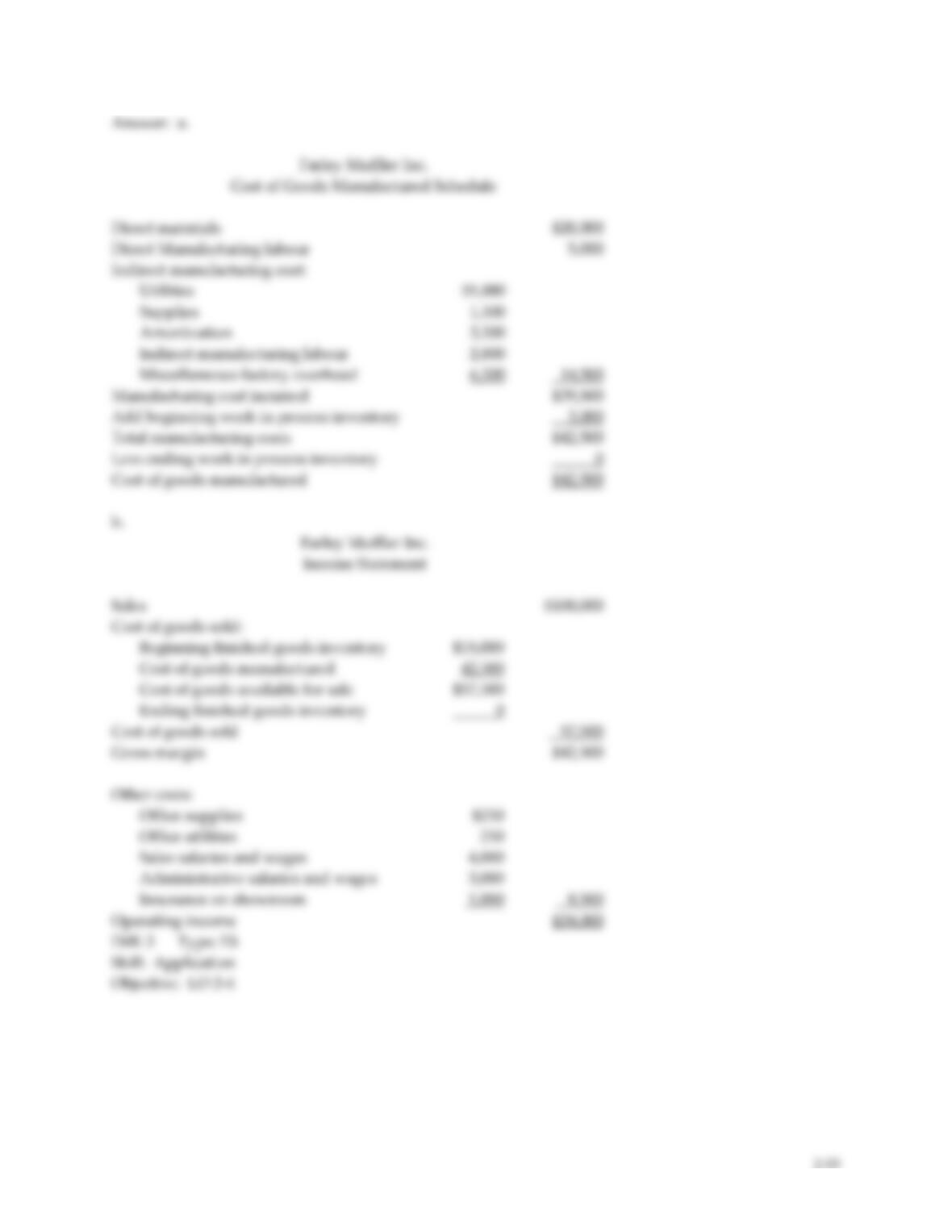
52) Farley Muffler Inc. received the following monthly report from its newly hired accountant, who quit
after only a week on the job.
Farley Muffler Inc.
Cost of Goods Sold Schedule
Finished Goods Inventory (beginning) $15,000
Work-in-Process Inventory (beginning) 3,000
Total $18,000
Current Manufacturing Costs:
Salaries and wages:
Direct manufacturing labour $5,000
Indirect manufacturing labour 2,000
Sales salaries 4,000
Administrative 3,000 $14,000
Other:
Manufacturing supplies $1,500
Manufacturing amortization 3,500
Insurance on showroom 1,000
Miscellaneous factory overhead 6,500 12,500 26,500
Total Work in Process $44,500
Ending Work-in-Process and Finished Goods Inventory 0
Cost of Goods Sold $44,500
Farley Muffler, Inc.
Income Statement
Sales $100,000
Less direct materials 20,000
Gross profit $80,000
Less other expenses:
Cost of goods sold $44,500
Office supplies 250
Manufacturing utilities 1,000
Office utilities 250 46,000
Net Income $34,000
Required:
a. Prepare a cost of goods manufactured schedule.
b. Prepare an income statement in good form.
Cost Accounting: A Managerial Emphasis, 6e
Chapter 2 – An Introduction to Cost Terms and Purposes
Cost Accounting: A Managerial Emphasis, 6e
Chapter 2 – An Introduction to Cost Terms and Purposes
53) Find the required amounts, assuming each is an independent case.
a. Direct Materials Beginning balance $14,000
Ending balance 28,000
Purchases 96,000
Direct materials used ?
b. Finished Goods Inventory Cost of goods manufactured 124,000
Ending balance 40,000
Cost of goods sold 122,000
Beginning balance ?
c. Work in Process Inventory Ending Balance 44,000
Cost of goods manufactured 42,000
Beginning balance 16,000
Current manufacturing costs ?
d. Merchandise Inventory Purchases 420,000
Cost of goods sold 446,000
Beginning balance 82,000
Ending balance ?
Cost Accounting: A Managerial Emphasis, 6e
Chapter 2 – An Introduction to Cost Terms and Purposes
54) Evans Inc., had the following activities during 2012:
Direct materials:
Beginning inventory $40,000
Purchases 123,200
Ending inventory 20,800
Direct manufacturing labour 32,000
Manufacturing overhead 24,000
Beginning work-in-process inventory 1,600
Ending work-in-process inventory 8,000
Beginning finished goods inventory 48,000
Ending finished goods inventory 32,000
Required:
a. What is the cost of direct materials used during 2012?
b. What is cost of goods manufactured for 2012?
c. What is cost of goods sold for 2012?
Assume that Evans uses a two-part classification system for prime and conversion costs.
d. What amount of prime costs was added to production during 2012?
e. What amount of conversion costs was added to production during 2012?
Cost Accounting: A Managerial Emphasis, 6e
Chapter 2 – An Introduction to Cost Terms and Purposes
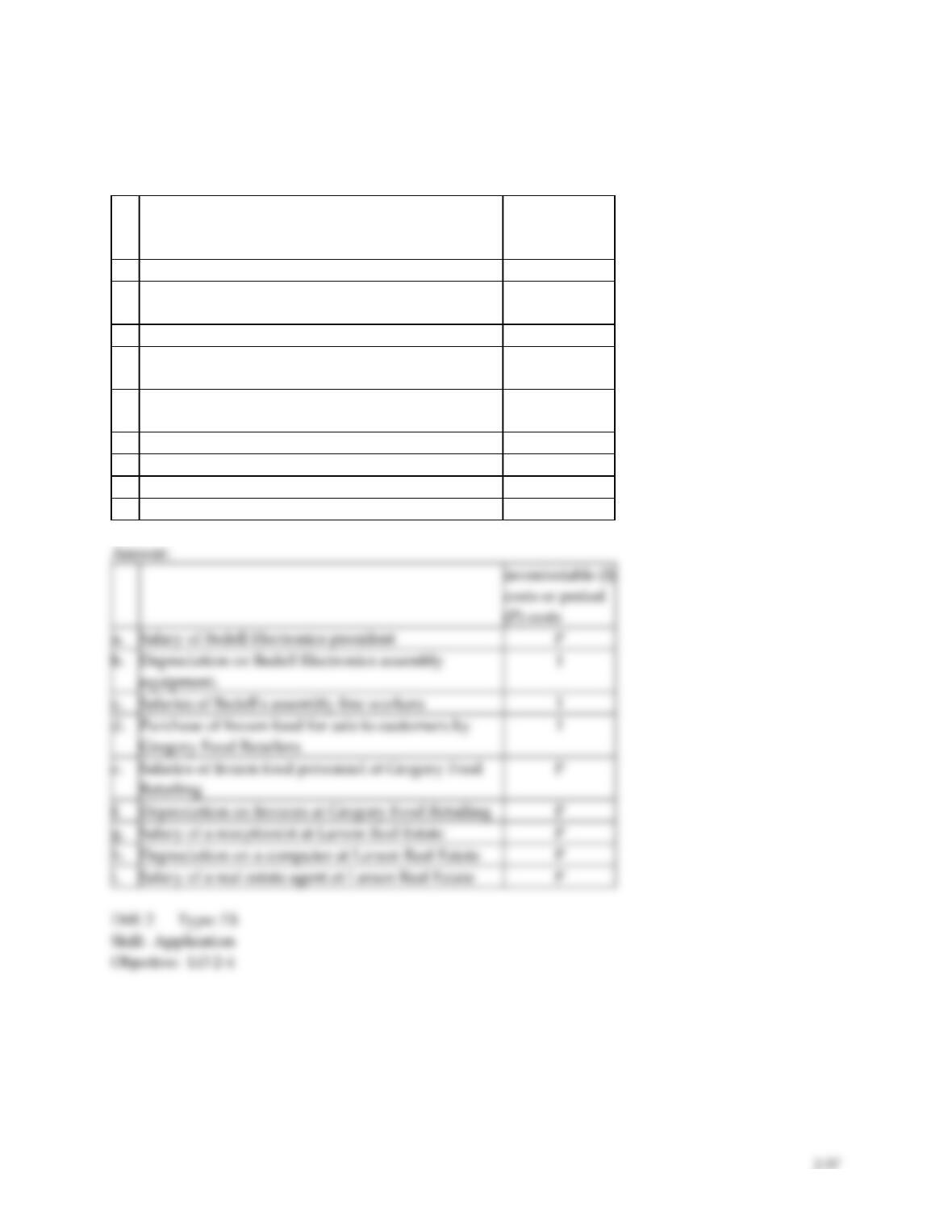
55) Explain the difference between an inventoriable cost and a period cost. What potential problems does
an inaccurate classification of product and period costs cause?
Cost Accounting: A Managerial Emphasis, 6e
Chapter 2 – An Introduction to Cost Terms and Purposes
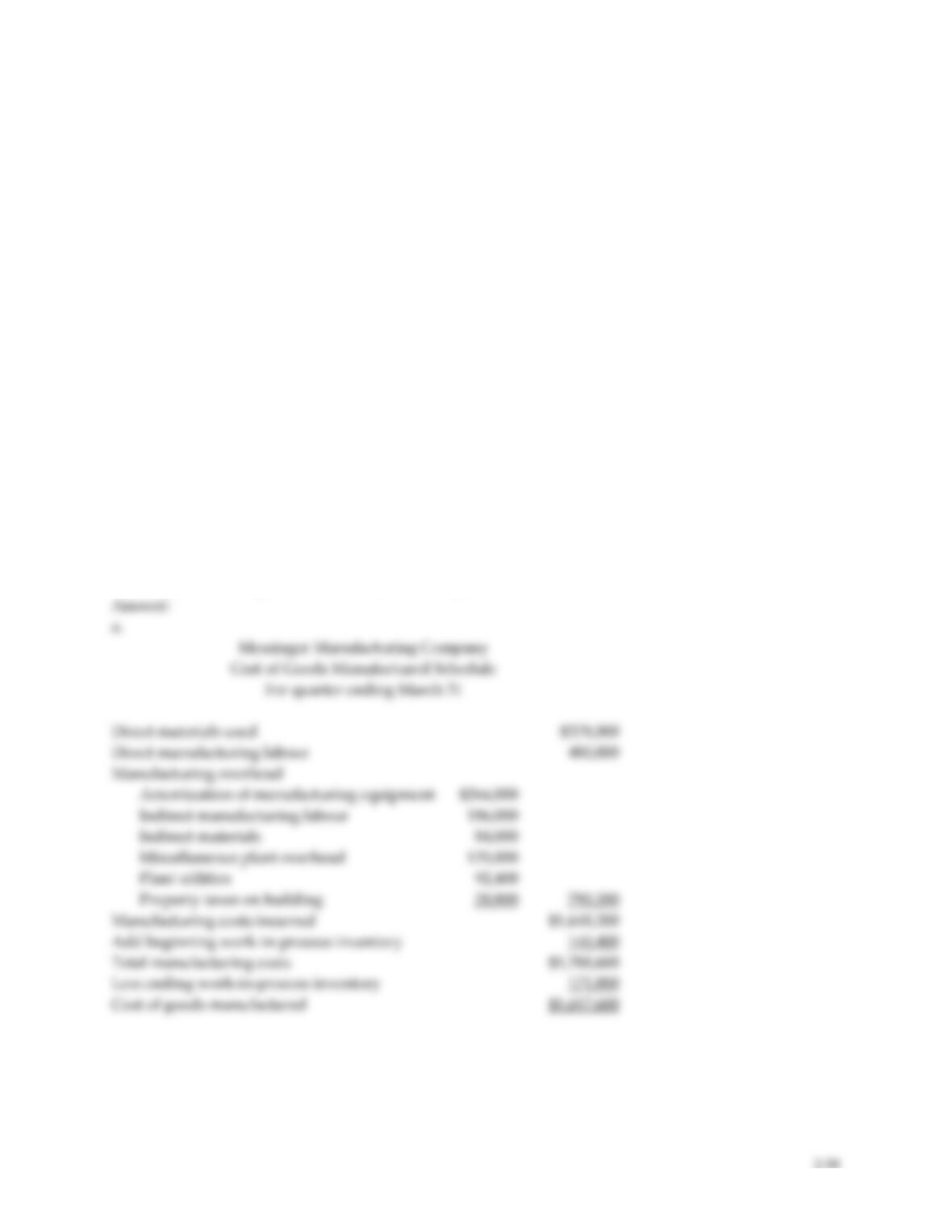
56) Each of the following items pertains to one of these companies: Bedell Electronics (a manufacturing
company), Gregory Food Retailers (a merchandising company), and Larson Real Estate (a service sector
company). Classify each item as either inventoriable (I) costs or period (P) costs.
inventoriable (I)
costs or period
(P) costs
a.
Salary of Bedell Electronics president
b.
Depreciation on Bedell Electronics assembly
equipment.
c.
Salaries of Bedell’s assembly line workers
d.
Purchase of frozen food for sale to customers by
Gregory Food Retailers
e.
Salaries of frozen food personnel at Gregory Food
Retailing
f.
Depreciation on freezers at Gregory Food Retailing
g.
Salary of a receptionist at Larson Real Estate
h.
Depreciation on a computer at Larson Real Estate
i.
Salary of a real estate agent at Larson Real Estate
inventoriable (I)
costs or period
(P) costs
Salary of Bedell Electronics president
b.
Depreciation on Bedell Electronics assembly
equipment.
Salaries of Bedell’s assembly line workers
d.
Purchase of frozen food for sale to customers by
Gregory Food Retailers
Salaries of frozen food personnel at Gregory Food
Retailing
Depreciation on freezers at Gregory Food Retailing
Salary of a receptionist at Larson Real Estate
Depreciation on a computer at Larson Real Estate
i.
Salary of a real estate agent at Larson Real Estate
Cost Accounting: A Managerial Emphasis, 6e
Chapter 2 – An Introduction to Cost Terms and Purposes
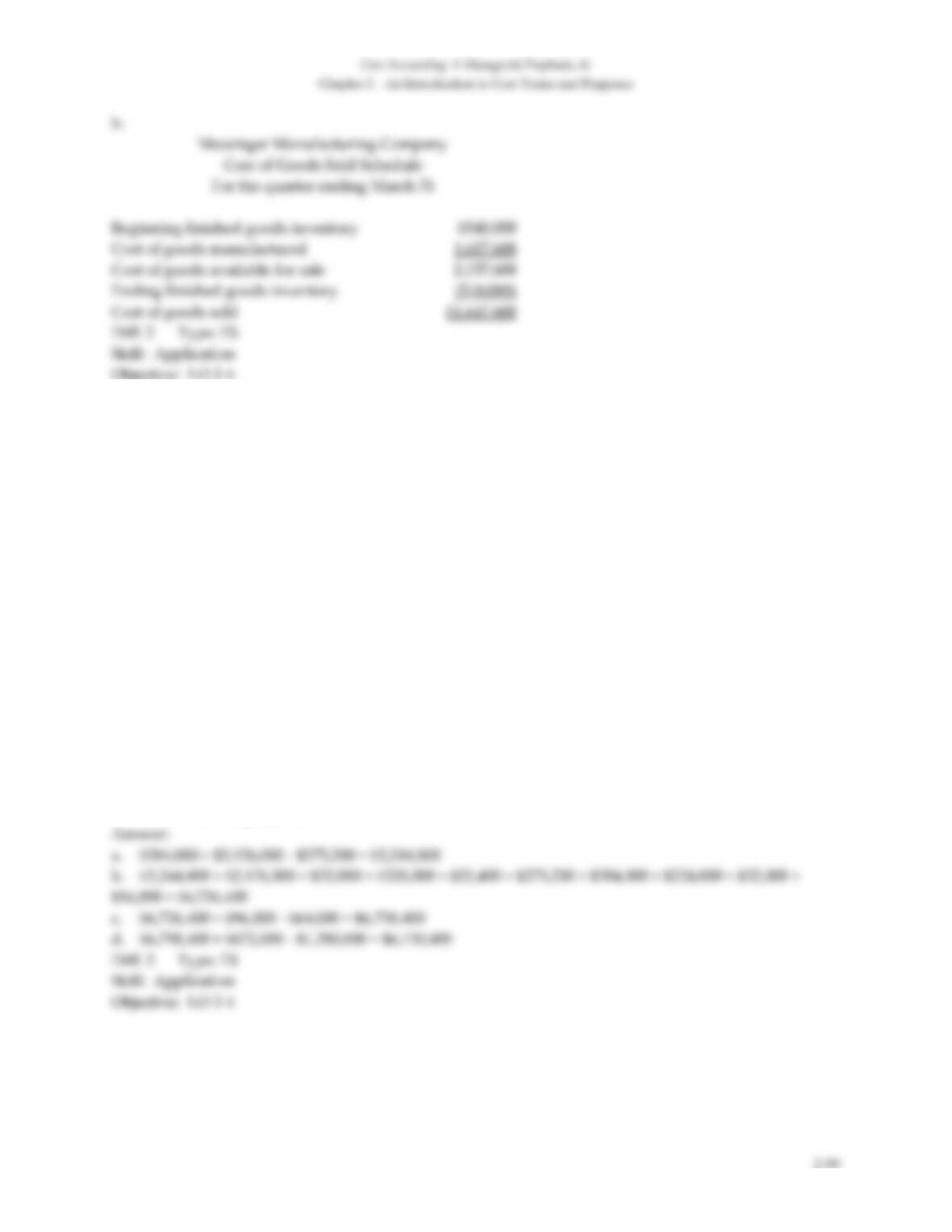
57) Messinger Manufacturing Company had the following account balances for the quarter ending March
31, unless otherwise noted:
Work-in-process inventory (January 1) $140,400
Work-in-process inventory (March 31) 171,000
Finished goods inventory (January 1) 540,000
Finished goods inventory (March 31) 510,000
Direct materials used 378,000
Indirect materials used 84,000
Direct manufacturing labour 480,000
Indirect manufacturing labour 186,000
Property taxes on manufacturing plant building 28,800
Salespersons’ company vehicle costs 12,000
Amortization of manufacturing equipment 264,000
Amortization of office equipment 123,600
Miscellaneous plant overhead 135,000
Plant utilities 92,400
General office expenses 305,400
Marketing distribution costs 30,000
Required:
a. Prepare a cost of goods manufactured schedule for the quarter.
b. Prepare a cost of goods sold schedule for the quarter.
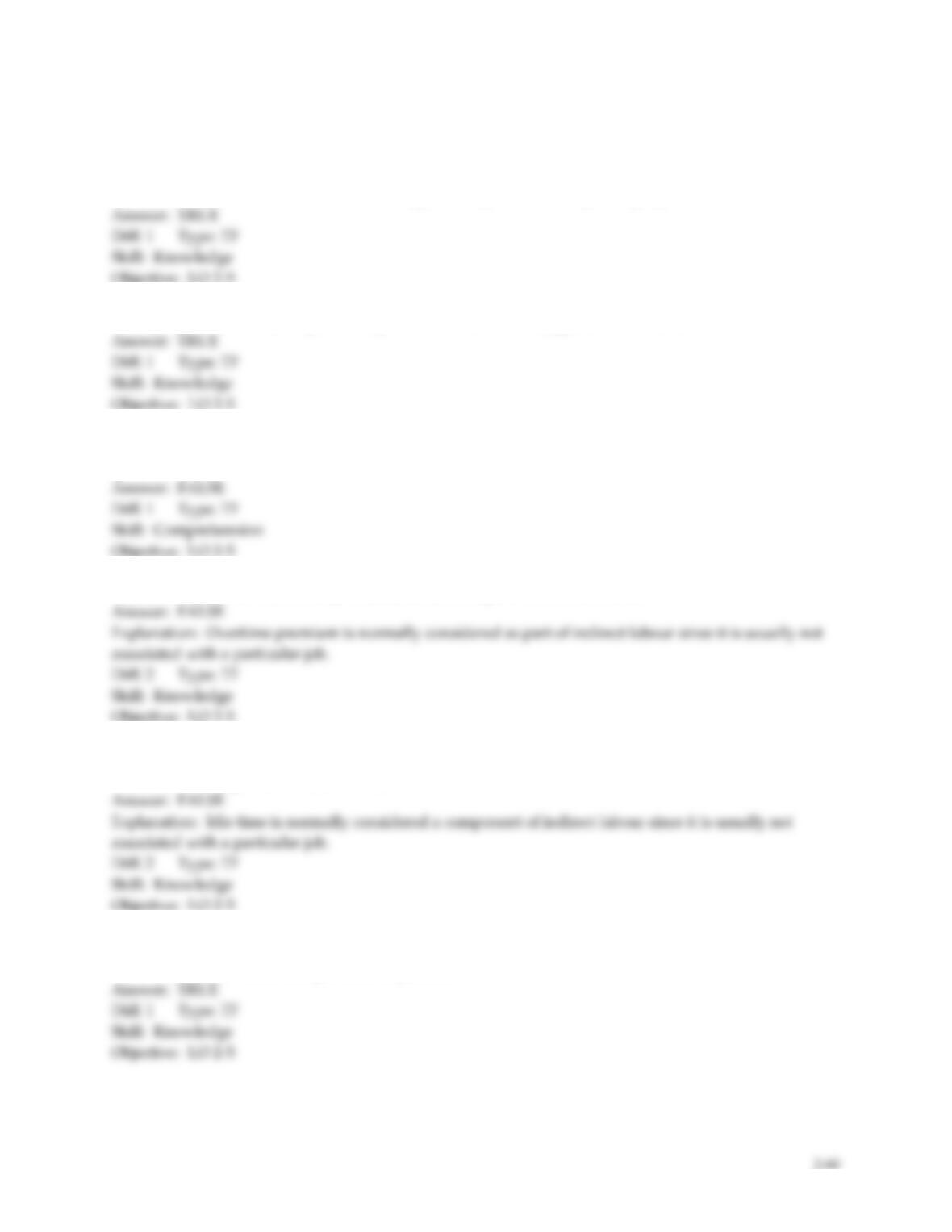
58) Helmer Sporting Goods Company manufactured 100,000 units in 20X5 and reported the following
costs:
Sandpaper $32,000 Leasing costs-plant $384,000
Materials handling 320,000 Amortization-equipment 224,000
Coolants & lubricants 22,400 Property taxes-equipment 32,000
Indirect manufacturing labour 275,200 Fire insurance-equipment 16,000
Direct manufacturing labour 2,176,000 Direct material purchases 3,136,000
Direct materials, 1/1/X5 384,000 Direct materials, 12/31/X5 275,200
Finished goods, 1/1/X5 672,000 Sales revenue 12,800,000
Finished goods, 12/31/X5 1,280,000 Sales commissions 640,000
Work-in-process, 1/1/X5 96,000 Sales salaries 576,000
Work-in-process, 12/31/X5 64,000 Advertising costs 480,000
Administration costs 800,000
Required:
a. What is the cost of direct materials used during 20X5?
b. What manufacturing costs were added to WIP during 20X5?
c. What is cost of goods manufactured for 20X5?
d. What is cost of goods sold for 20X5?
Cost Accounting: A Managerial Emphasis, 6e
Chapter 2 – An Introduction to Cost Terms and Purposes
2.5 Explain cost identification, classification, and management systems and their use
within the decision framework.
1) Product costs are the sum of the costs assigned to a product for a specific purpose.
2) For purposes of calculating inventory costs under GAAP, only production costs can be used.
3) When producing for a government contract, all costs allowed by the producer will be paid by the
government.
4) Overtime premium is normally considered as a component of direct labour.
5) If a worker is paid for 8 hours, but is idle for 1 of those 8 hours, the 1 hour of idle time would be
considered a component of direct labour.
6) Overtime premium consists of the wages paid to all workers (for both direct labour and indirect
labour) in excess of their straight-time wage rates.
Cost Accounting: A Managerial Emphasis, 6e
Chapter 2 – An Introduction to Cost Terms and Purposes
7) The total of the costs assigned to a particular product for a specific purpose is called
A) direct cost.
B) inventoriable cost.
C) marketing cost.
D) product cost.
E) prime cost.
8) Which of the following statements is true?
A) Product costs and period costs are the same.
B) Inventoriable costs are expensed as incurred according to GAAP.
C) Inventoriable costs are costs that remain in inventory after the product is sold.
D) “Product costs” refers to the particular costs allocated to a product to make a specific decision.
E) Conversion costs are non-manufacturing costs.
9) Product costs used for pricing and product-mix decisions generally include
A) manufacturing costs only.
B) design costs plus manufacturing costs.
C) all costs incurred along the value chain.
D) distribution costs only.
E) prime costs but not conversion costs.
10) Product costs used for external reporting under GAAP include
A) manufacturing costs only.
B) design costs plus manufacturing costs.
C) all costs incurred along the value chain.
D) prime costs but not conversion costs.
E) only conversion costs.
Cost Accounting: A Managerial Emphasis, 6e
Chapter 2 – An Introduction to Cost Terms and Purposes
11) Why is it possible that a raw material such as glue might be considered as an indirect material for one
furniture manufacturer and as a direct material for another furniture manufacture?
12) When should the overtime premium of direct manufacturing labour be considered an indirect
manufacturing cost? A direct manufacturing cost?