Larson_Calculus_10e ch02sec02
MULTIPLE CHOICE
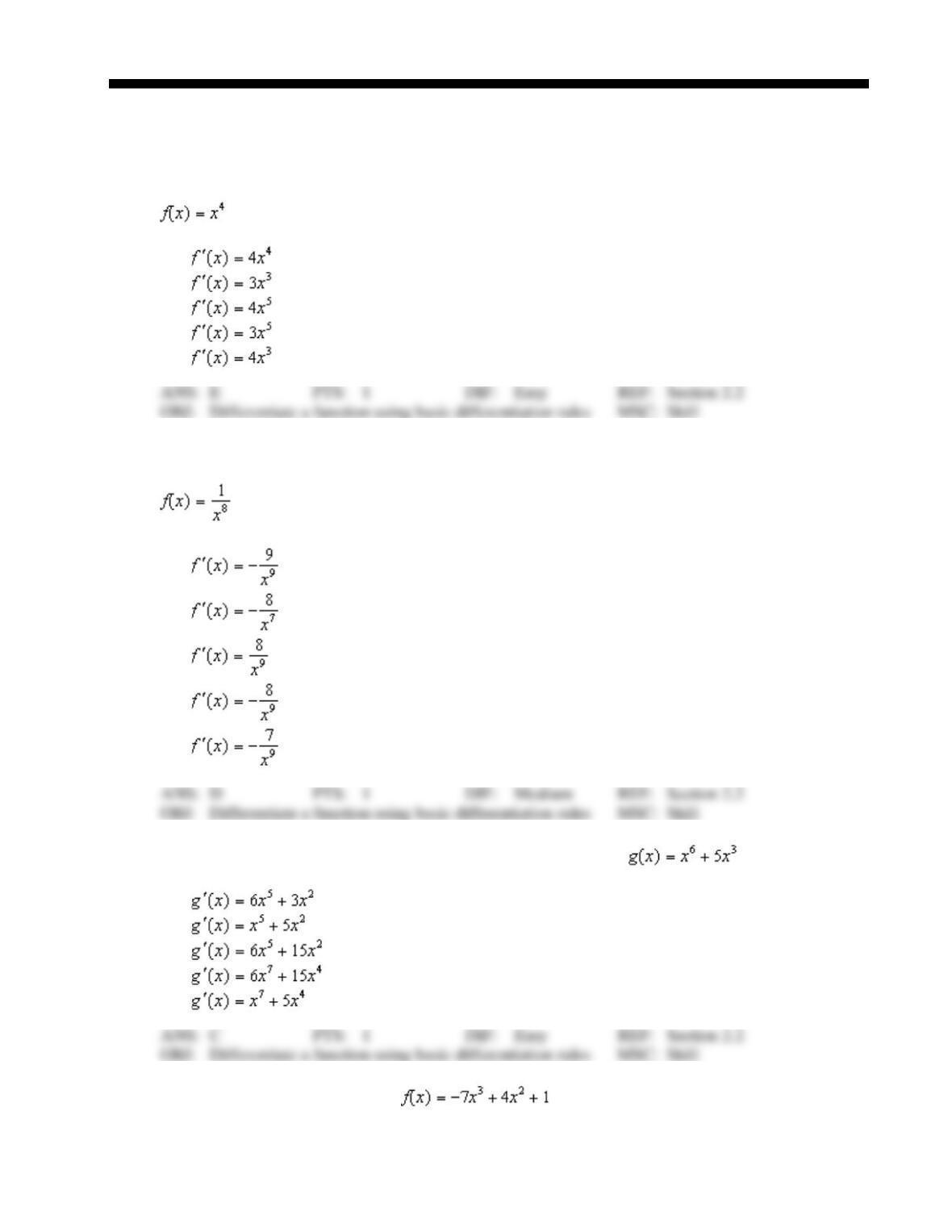
1. Find the derivative of the function.
a.
b.
c.
d.
e.
2. Find the derivative of the function.
a.
b.
c.
d.
e.
3. Use the rules of differentiation to find the derivative of the function .
a.
b.
c.
d.
e.
4. Find the derivative of the function .
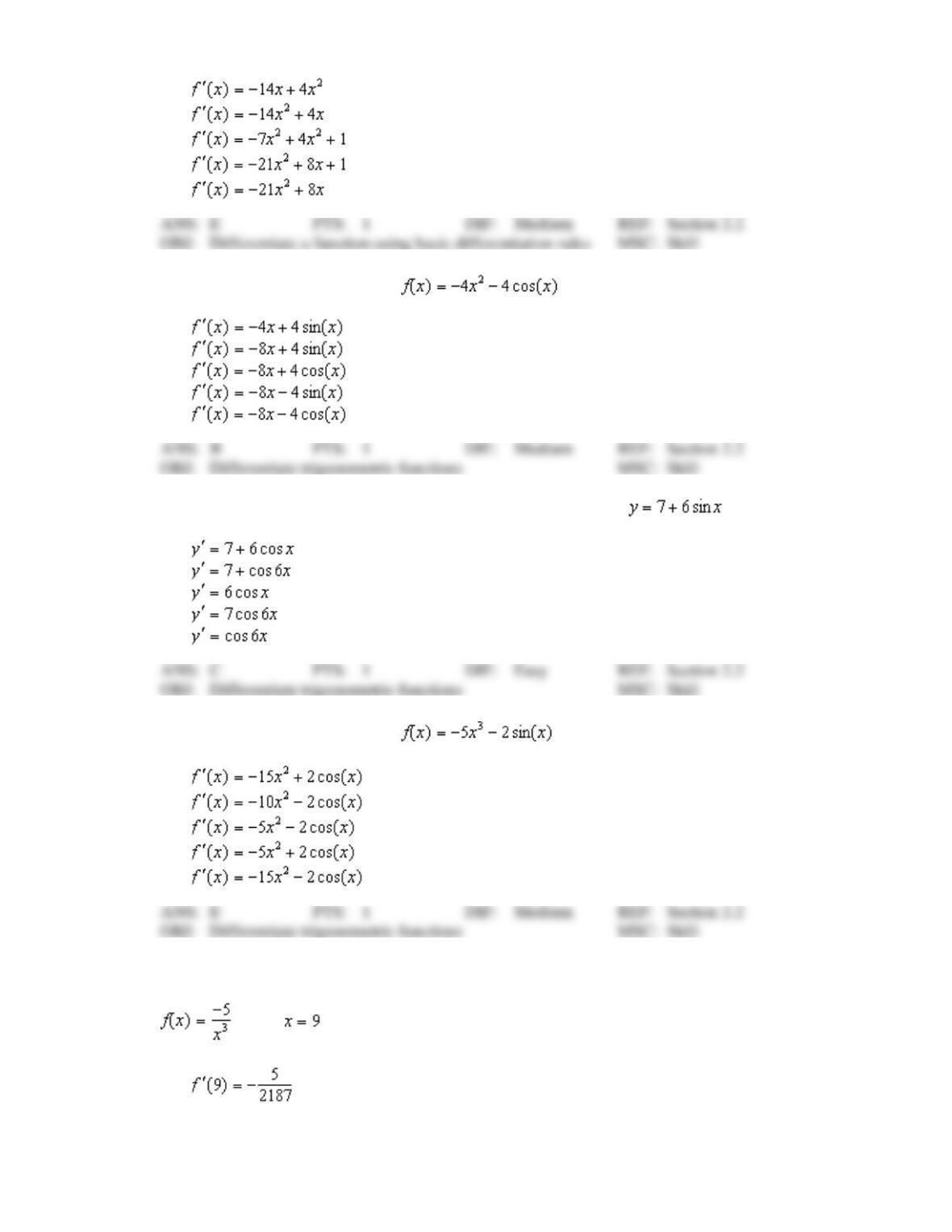
a.
b.
c.
d.
e.
5. Find the derivative of the function .
a.
b.
c.
d.
e.
6. Use the rules of differentiation to find the derivative of the function .
a.
b.
c.
d.
e.
7. Find the derivative of the function .
a.
b.
c.
d.
e.
8. Find the slope of the graph of the function at the given value.
when
a.
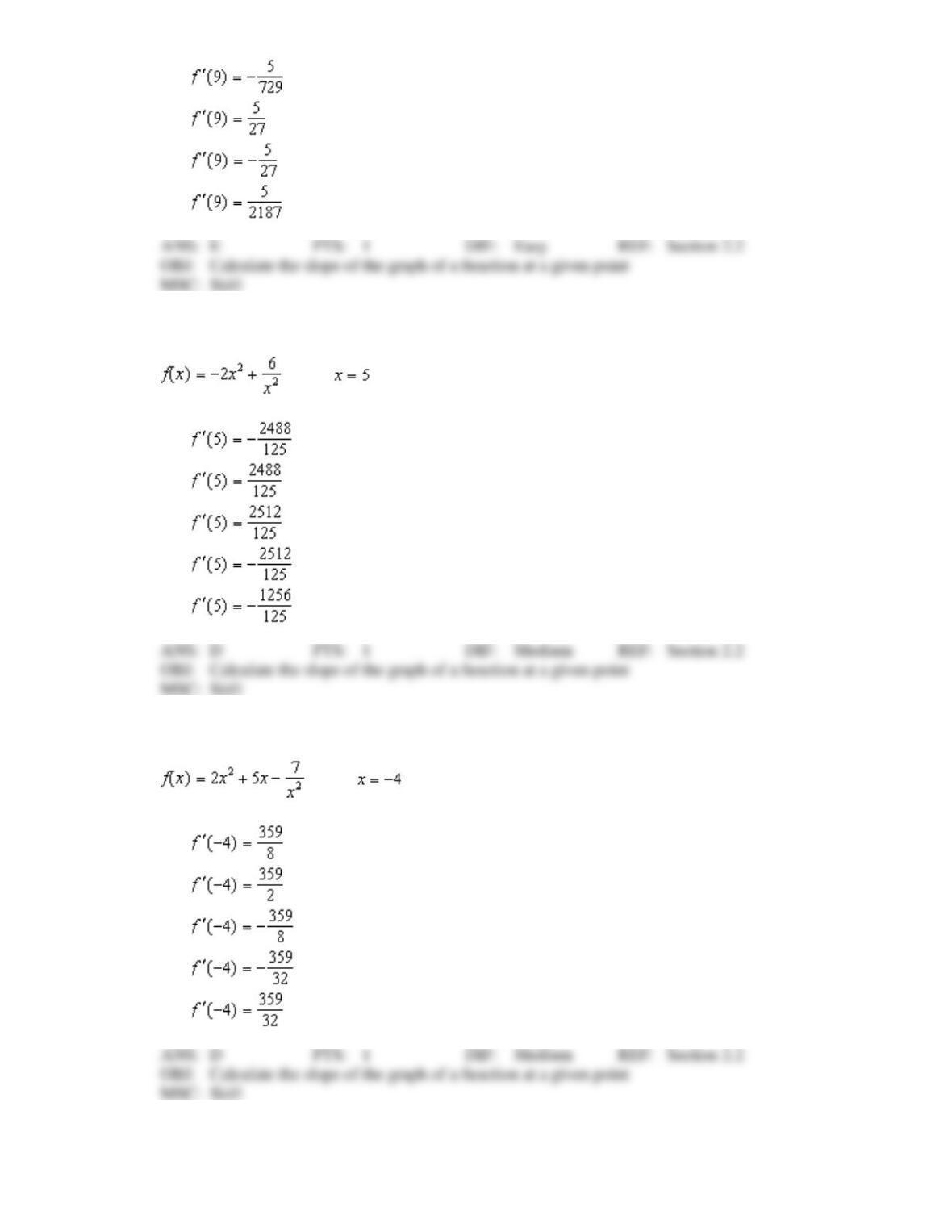
b.
c.
d.
e.
9. Find the slope of the graph of the function at the given value.
when
a.
b.
c.
d.
e.
10. Find the slope of the graph of the function at the given value.
when
a.
b.
c.
d.
e.
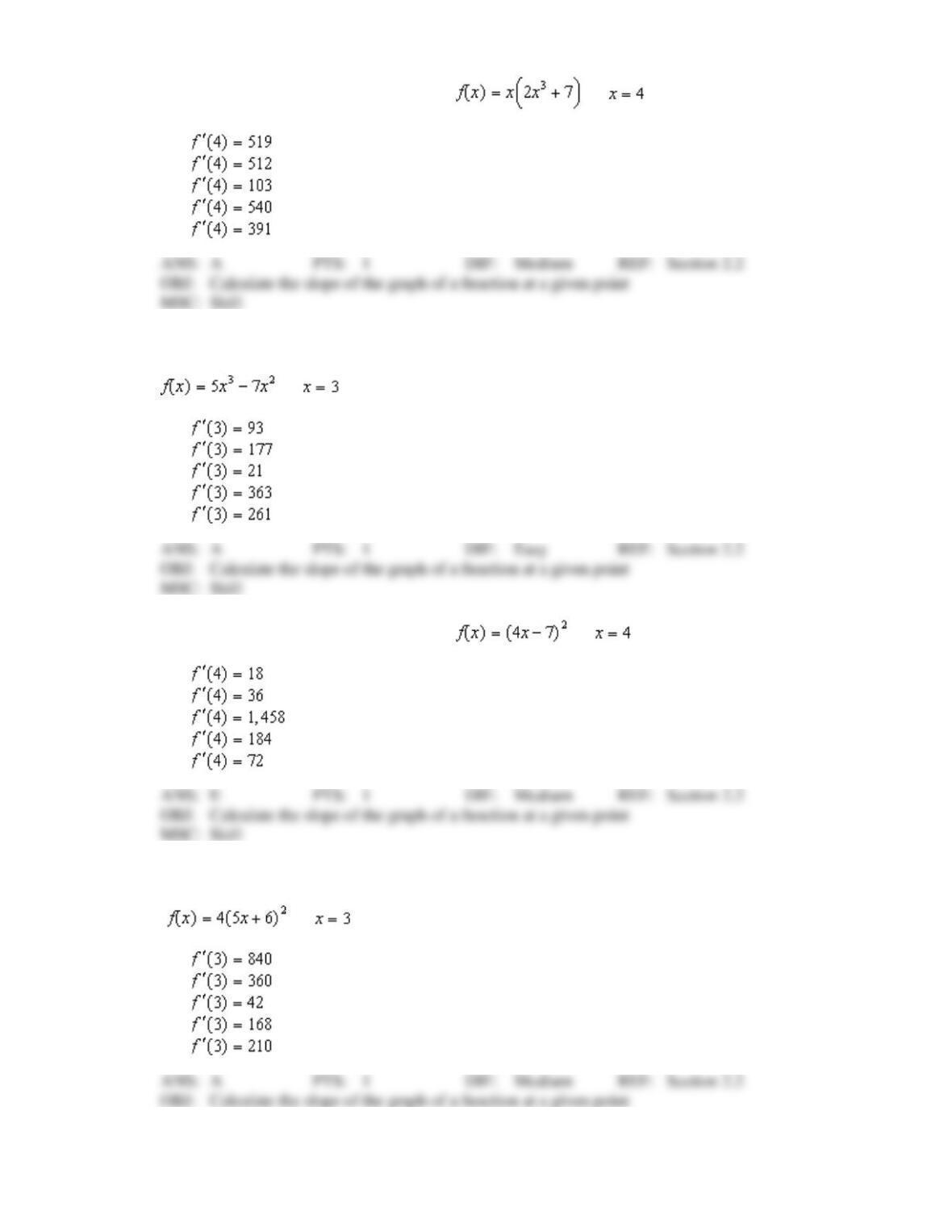
11. Find the slope of the graph of the function at .
a.
b.
c.
d.
e.
12. Find the slope of the graph of the function at the given value.
at
a.
b.
c.
d.
e.
13. Find the slope of the graph of the function at .
a.
b.
c.
d.
e.
14. Find the slope of the graph of the function at the given value.
at
a.
b.
c.
d.
e.
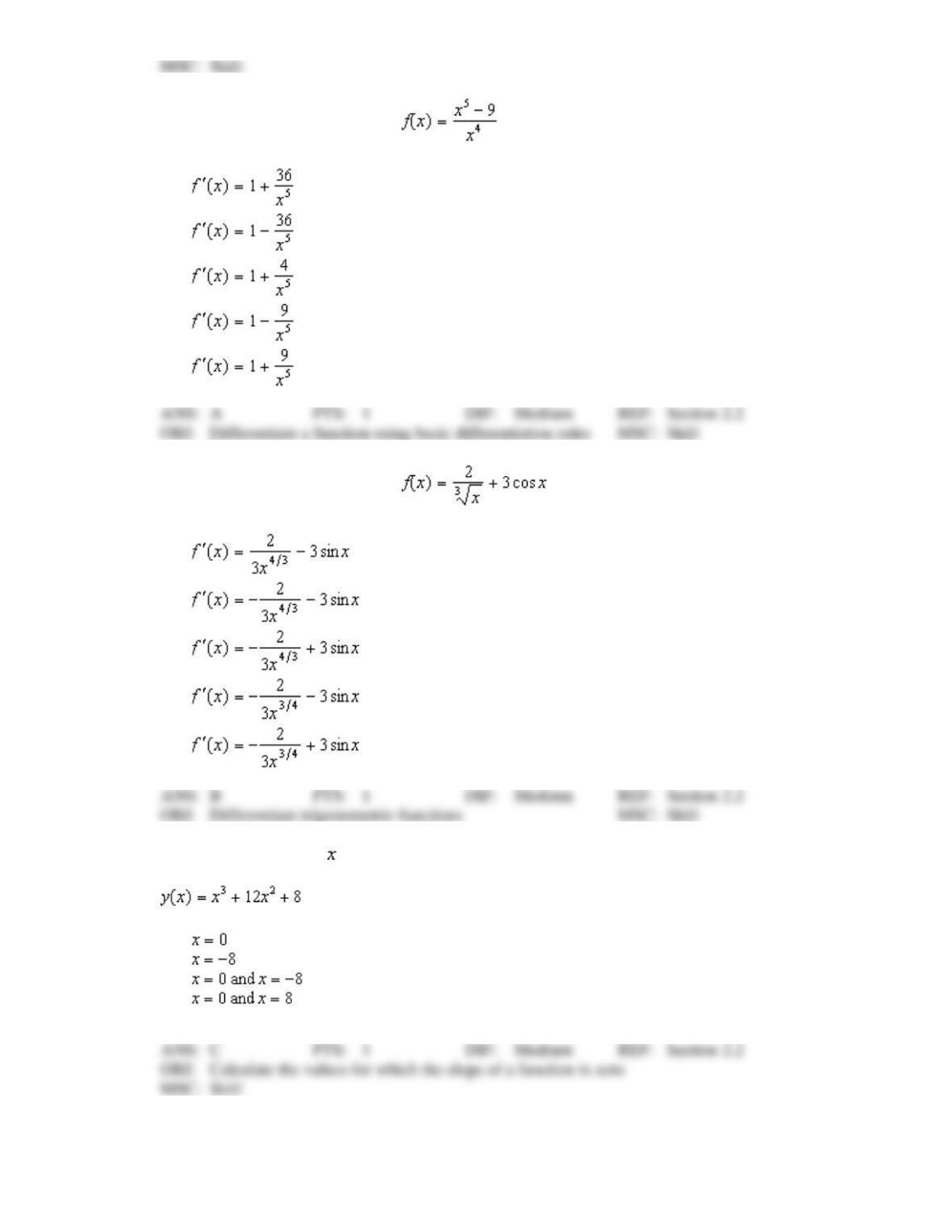
15. Find the derivative of the function .
a.
b.
c.
d.
e.
16. Find the derivative of the function .
a.
b.
c.
d.
e.
17. Determine all values of , (if any), at which the graph of the function has a horizontal tangent.
a.
b.
c.
d.
e.
The graph has no horizontal tangents.
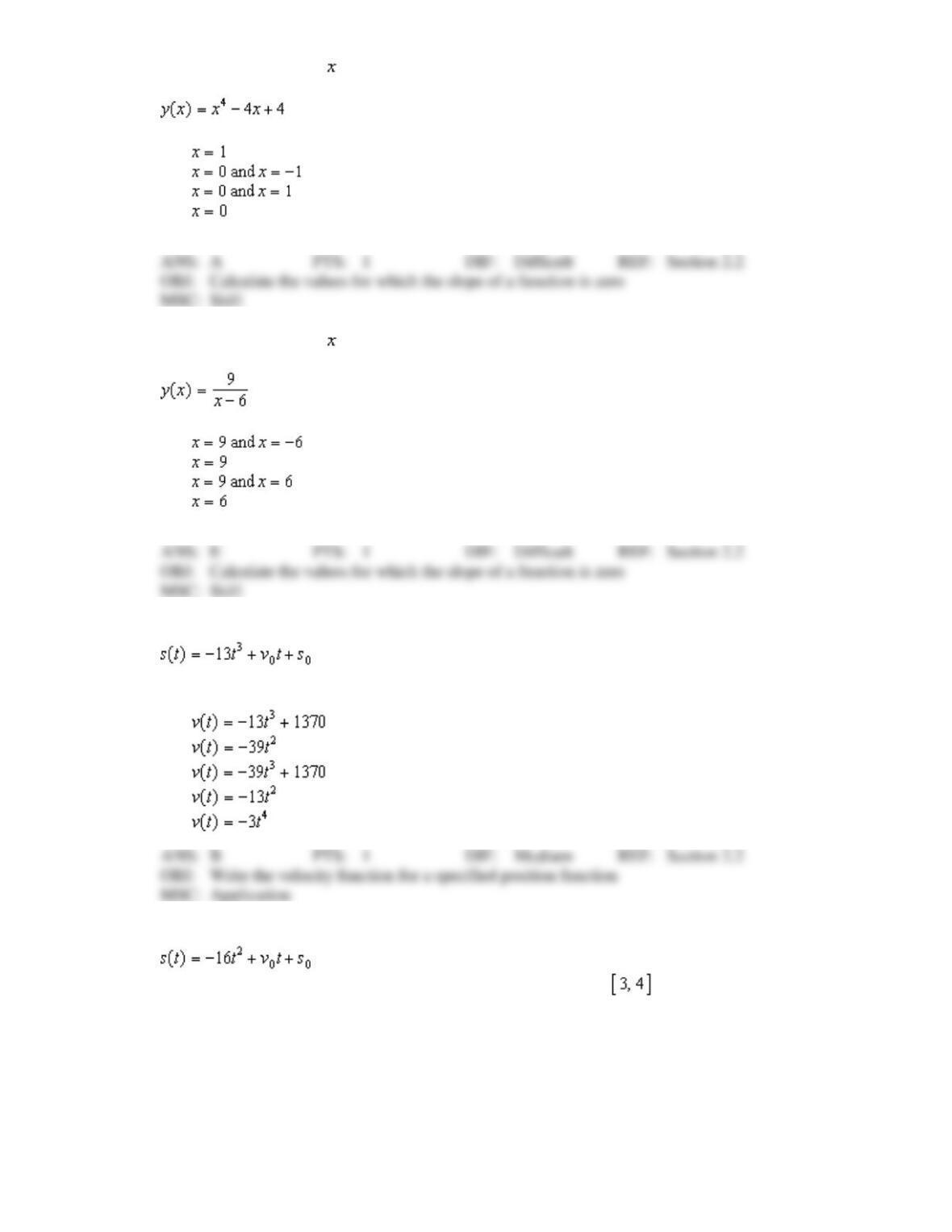
18. Determine all values of , (if any), at which the graph of the function has a horizontal tangent.
a.
b.
c.
d.
e.
The graph has no horizontal tangents.
19. Determine all values of , (if any), at which the graph of the function has a horizontal tangent.
a.
b.
c.
d.
e.
The graph has no horizontal tangents.
20. Suppose the position function for a free-falling object on a certain planet is given by
. A silver coin is dropped from the top of a building that is 1370 feet tall.
Determine the velocity function for the coin.
a.
b.
c.
d.
e.
21. Suppose the position function for a free-falling object on a certain planet is given by
. A silver coin is dropped from the top of a building that is 1372 feet tall.
Determine the average velocity of the coin over the time interval .
a.
–113 ft/sec
b.
80 ft/sec
c.
112 ft/sec
d.
–112 ft/sec
e.
–80 ft/sec
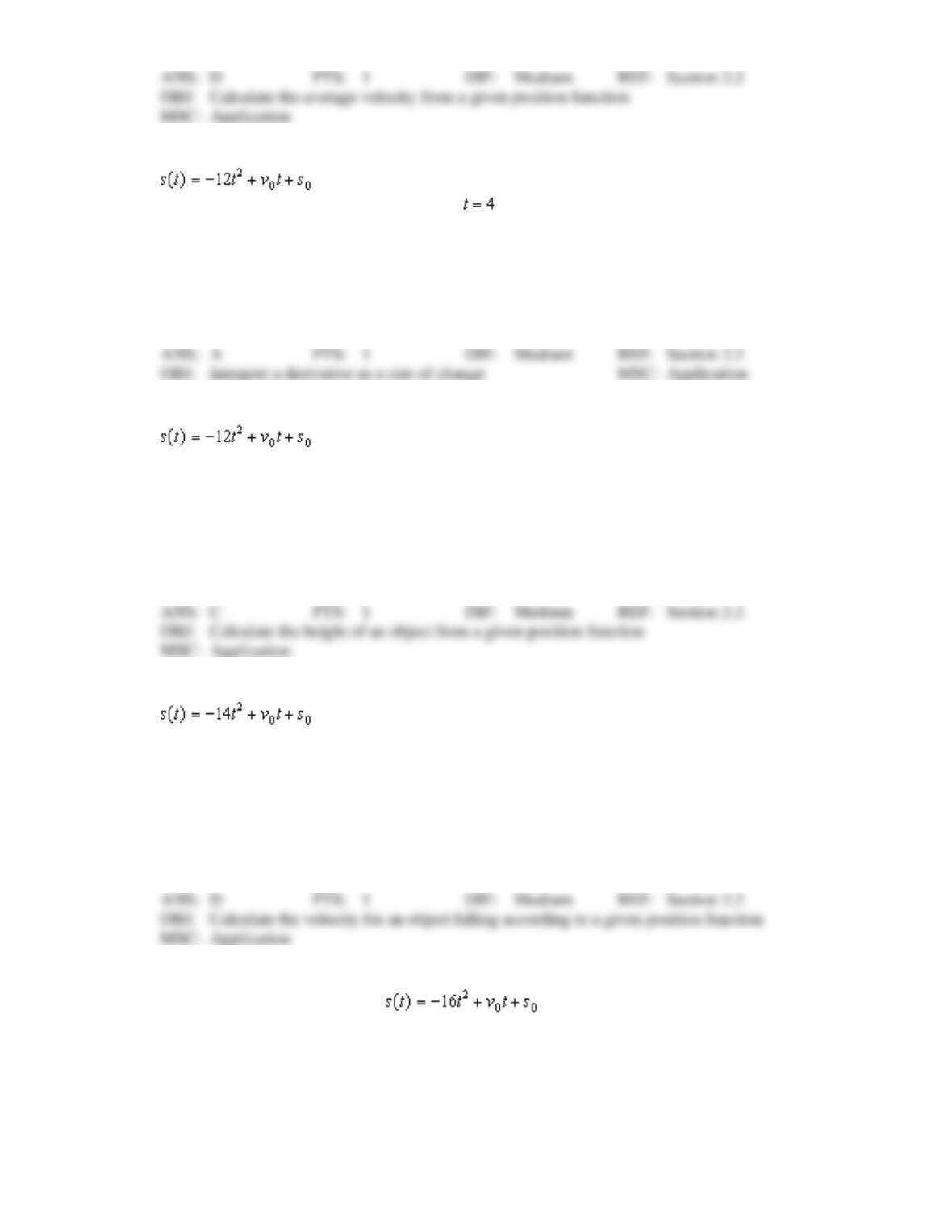
22. Suppose the position function for a free-falling object on a certain planet is given by
. A silver coin is dropped from the top of a building that is 1372 feet tall. Find
the instantaneous velocity of the coin when .
a.
–96 ft/sec
b.
–32 ft/sec
c.
–20 ft/sec
d.
–144 ft/sec
e.
–48 ft/sec
23. Suppose the position function for a free-falling object on a certain planet is given by
. A silver coin is dropped from the top of a building that is 1372 feet tall. Find
the time required for the coin to reach ground level. Round your answer to the three decimal places.
a.
2.849 sec
b.
10.273 sec
c.
10.693 sec
d.
3.087 sec
e.
10.091 sec
24. Suppose the position function for a free-falling object on a certain planet is given by
. A silver coin is dropped from the top of a building that is 1370 feet tall. Find
velocity of the coin at impact. Round your answer to the three decimal places.
a.
–286.705 ft/sec
b.
–138.492 ft/sec
c.
–111.041 ft/sec
d.
–276.984 ft/sec
e.
–261.984 ft/sec
25. A ball is thrown straight down from the top of a 300-ft building with an initial velocity of –12 ft per
second. The position function is . What is the velocity of the ball after 4
seconds?
a.
The velocity after 4 seconds is –76 ft per second.
b.
The velocity after 4 seconds is –116 ft per second.
c.
The velocity after 4 seconds is –140 ft per second.
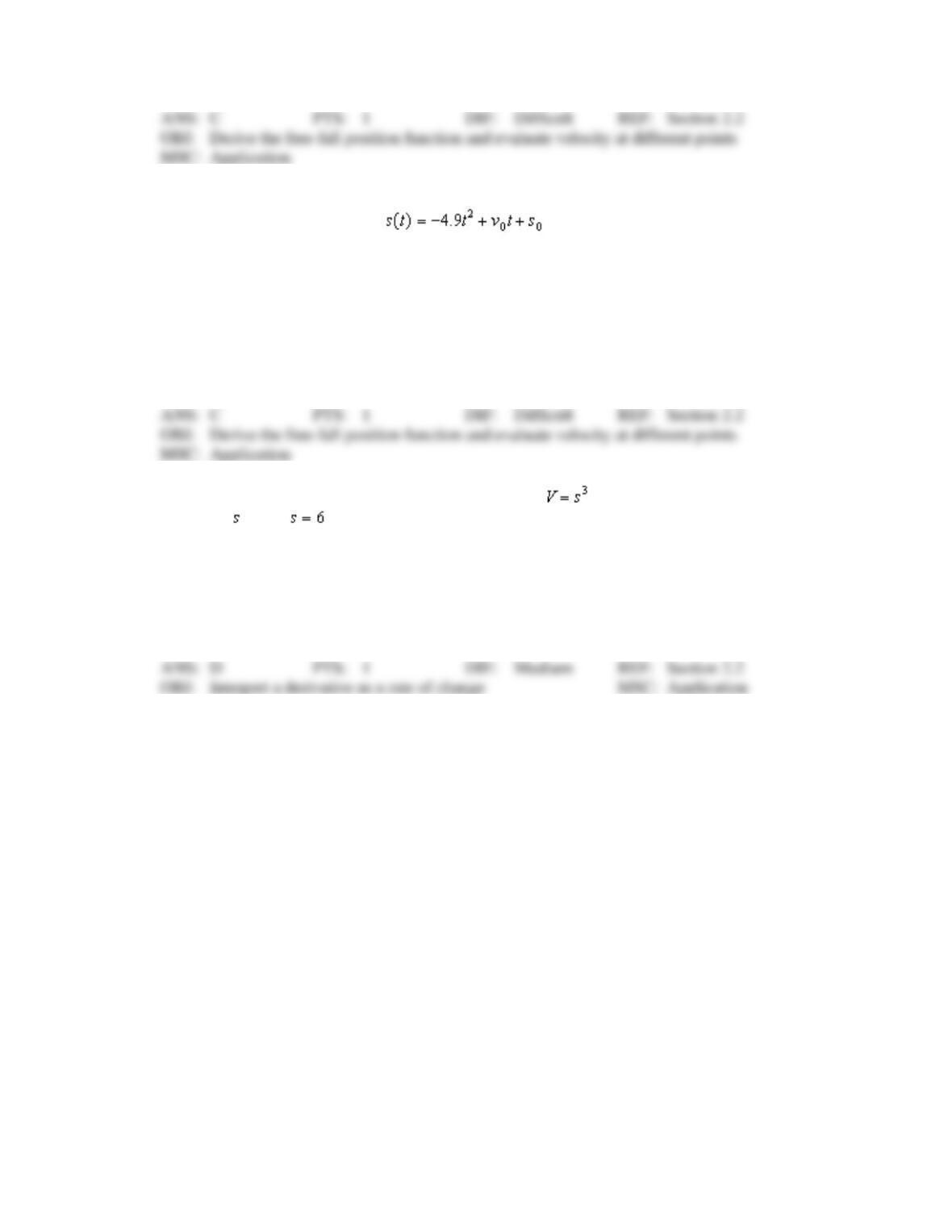
d.
The velocity after 4 seconds is –52 ft per second.
e.
The velocity after 4 seconds is –280 ft per second.
26. A projectile is shot upwards from the surface of the earth with an initial velocity of 108 meters per
second. The position function is .
What is its velocity after 7 seconds?
a.
The velocity after 7 seconds is 181.7 meters per second.
b.
The velocity after 7 seconds is –142.3 meters per second.
c.
The velocity after 7 seconds is 39.4 meters per second.
d.
The velocity after 7 seconds is 73.7 meters per second.
e.
The velocity after 7 seconds is –176.6 meters per second.
27. The volume of a cube with sides of length s is given by . Find the rate of change of volume with
respect to when centimeters.
a.
648 cm2
b.
216 cm2
c.
36 cm2
d.
108 cm2
e.
72 cm2