Exam
Name___________________________________
MULTIPLE CHOICE. Choose the one alternative that best completes the statement or answers the question.
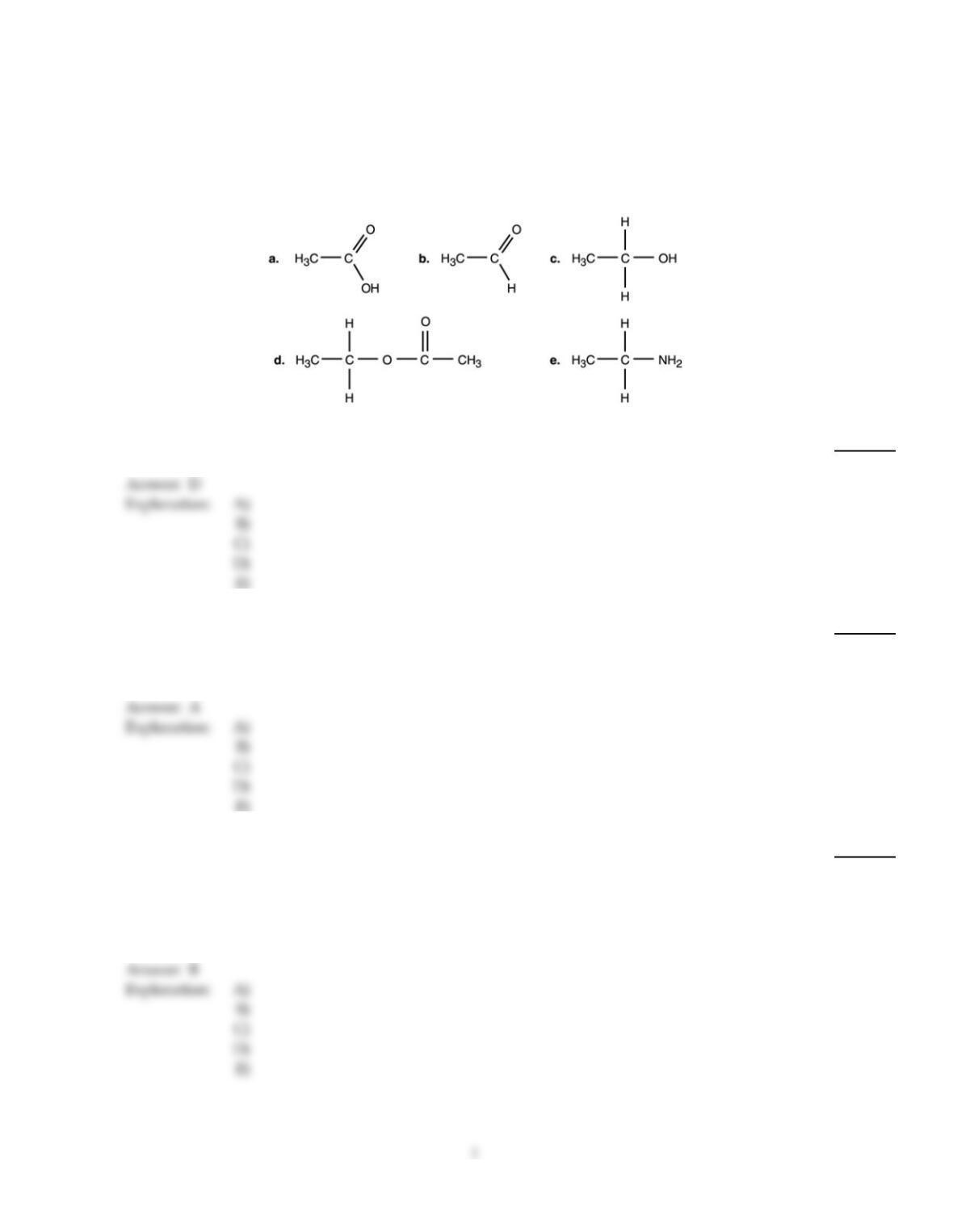
Figure 2.1
1)
Which compound in Figure 2.1 is an ester?
1)
A)
a
B)
b
C)
c
D)
d
E)
e
2)
A scientist wants to perform a test that will indicate whether a nucleic acid sample is composed of
RNA or DNA. Testing for the presence of which of the following is most appropriate in this
situation?
2)
A)
uracil
B)
nitrogen
C)
thymine
D)
guanine
E)
phosphate
3)
The antimicrobial drug imidazole inhibits sterol synthesis. This would most likely interfere with
3)
A)
prokaryotic plasma membranes.
B)
eukaryotic plasma membranes.
C)
bacterial cell walls.
D)
genes.
E)
fungal cell walls.
4)
Radioisotopes are frequently used to label molecules in a cell. The fate of atoms and molecules in a
cell can then be followed. Assume Saccharomyces cerevisiae is grown in a nutrient medium
containing the radioisotope 35S. After a 48–hour incubation, the 35S would most likely be found in
the S. cerevisiae’s
4)
A)
water.
B)
nucleic acids.
C)
proteins.
D)
carbohydrates.
E)
lipids.
5)
What is the type of bond between ions in salt?
5)
A)
covalent bond
B)
hydrogen bond
C)
ionic bond
Explanation:
6)
Antacids neutralize acid by the following reaction. Identify the salt in the following equation:
Mg(OH)2+ 2HCl
MgCl2+ H2O
6)
A)
HCl
B)
H2O
C)
MgCl2
D)
Mg(OH)2
E)
None of the answers is correct.
Explanation:
7)
Structurally, ATP is most like which type of molecule?
7)
A)
carbohydrate
B)
lipid
C)
nucleic acid
D)
protein
Explanation:
Explanation:
8)
Identify the following reaction: HCl + NaHCO3
NaCl + H2CO3
8)
A)
dehydration synthesis reaction
B)
hydrolysis reaction
C)
reversible reaction
D)
ionic reaction
E)
exchange reaction
9)
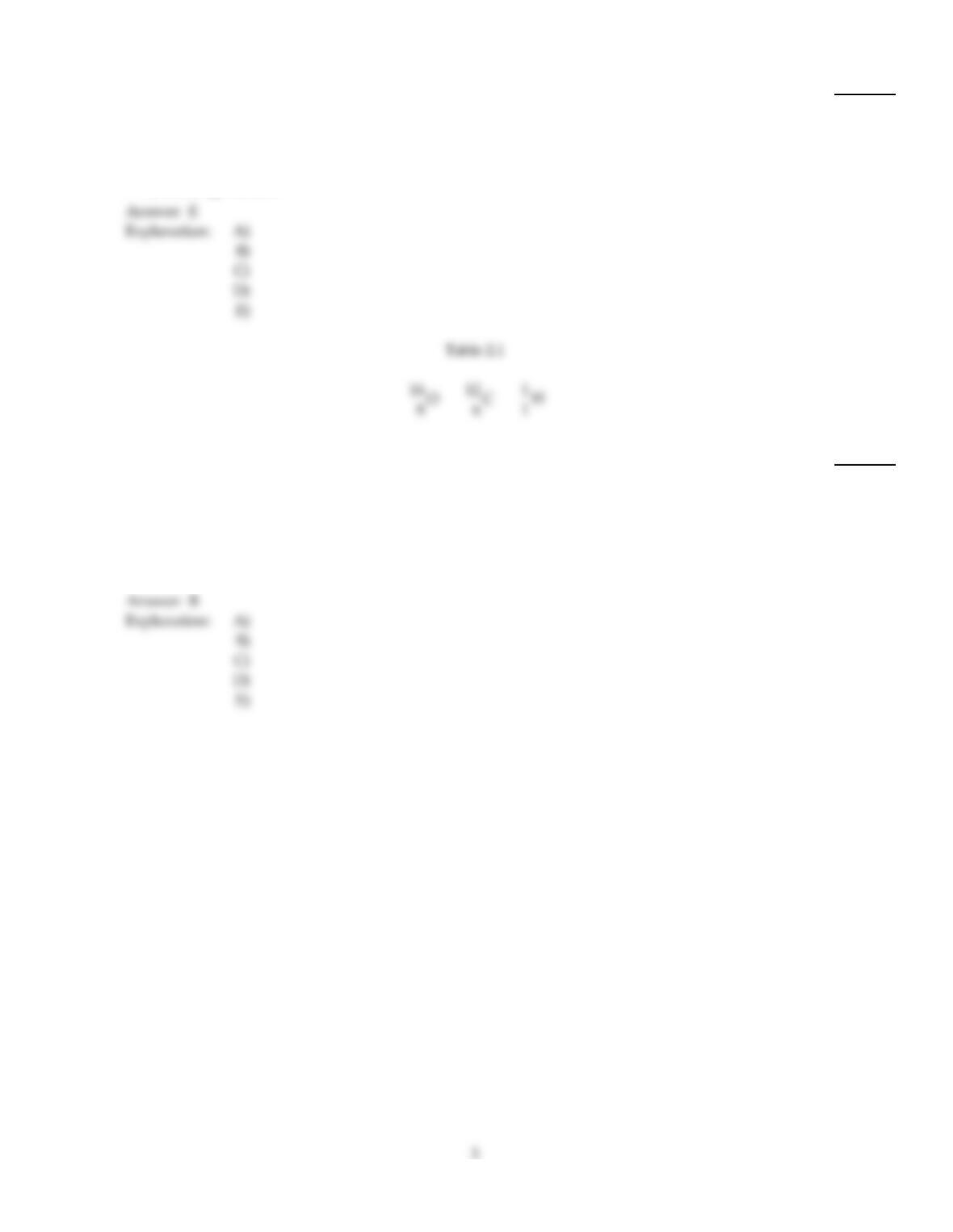
Using the information in Table 2.1, calculate the number of moles in 92 grams of ethanol,
C2H5OH.
9)
A)
1
B)
2
C)
3
D)
4
E)
The answer cannot be determined.
B
E
10)
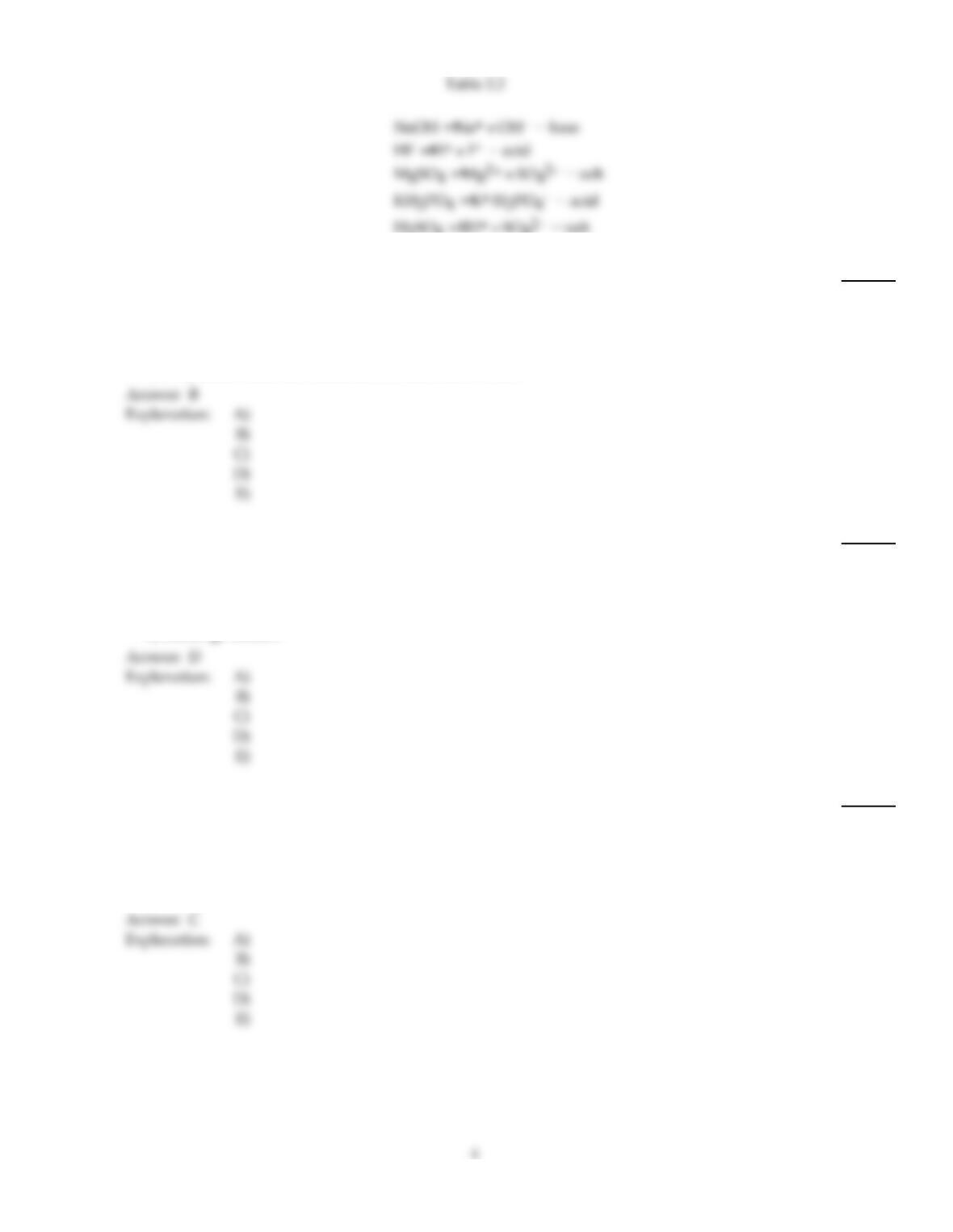
Which of the following statements about the reactions in Table 2.2 is FALSE?
10)
A)
They are dissociation reactions.
B)
They are exchange reactions.
C)
They are reversible reactions.
D)
They are ionization reactions.
E)
They occur when the reactants are dissolved in water.
B
11)
Identify the following reaction: Glucose + Fructose
Sucrose + Water
11)
A)
hydrolysis reaction
B)
reversible reaction
C)
ionic reaction
D)
dehydration synthesis reaction
E)
exchange reaction
D
12)
Most amino acids found in cells demonstrate what type of chirality?
12)
A)
D–isomers
B)
A–isomers
C)
L–iosmers
D)
B–isomers
E)
C–isomers
C
13)
Which of the following is a base?
13)
A)
C2H5OCOOH
H++ C2H5OCOO–
B)
NaOH
Na++ OH–
C)
C2H5OH
D)
H2O
H++ OH–
E)
H2CO
14)
What kind of bond is at the arrow in Figure 2.3?
14)
A)
double covalent bond
B)
hydrogen bond
C)
peptide bond
D)
disulfide bridge
E)
ionic bond
15)
What is the type of bond holding hydrogen and oxygen atoms in the H2O molecule?
15)
A)
ionic bond
B)
hydrogen bond
C)
covalent bond
16)
Identify the following reaction: NH4OH
NH3+ H2O
16)
A)
dehydration synthesis reaction
B)
exchange reaction
C)
reversible reaction
D)
hydrolysis reaction
E)
ionic reaction
17)
What do genes consist of?
17)
A)
nucleic acids
B)
proteins
C)
carbohydrates
D)
lipids
18)
An E. coli culture that has been growing at 37°C is moved to 25°C. Which of the following changes
must be made in its plasma membrane?
18)
A)
The number of saturated chains must increase.
B)
The number of phosphate groups must increase.
C)
The viscosity must increase.
D)
The number of unsaturated chains must increase.
E)
No changes are necessary.
19)
Two antiparallel strands of DNA combine to form a double helix. The specific interactions that
permit this phenomenon occur by way of ________ bonds between ________.
19)
A)
ionic; deoxyriboses
B)
hydrogen; deoxyriboses
C)
ionic; phosphate groups
D)
hydrogen; nitrogenous bases
E)
ionic; nitrogenous bases
20)
Using the information in Table 2.1, calculate the molecular weight of ethanol, C2H5OH.
20)
A)
33
B)
34
C)
96
D)
46
E)
The answer cannot be determined.
21)
What is the type of bond between carbon, hydrogen, and oxygen atoms in organic molecules?
21)
A)
ionic bond
B)
hydrogen bond
C)
covalent bond
22)
Which of the following statements is FALSE?
22)
A)
Water molecules are formed by hydrolysis.
B)
Salts readily dissolve in water.
C)
Water freezes from the top down.
D)
Water is a polar molecule.
E)
Water is a part of a dehydration synthesis reaction.
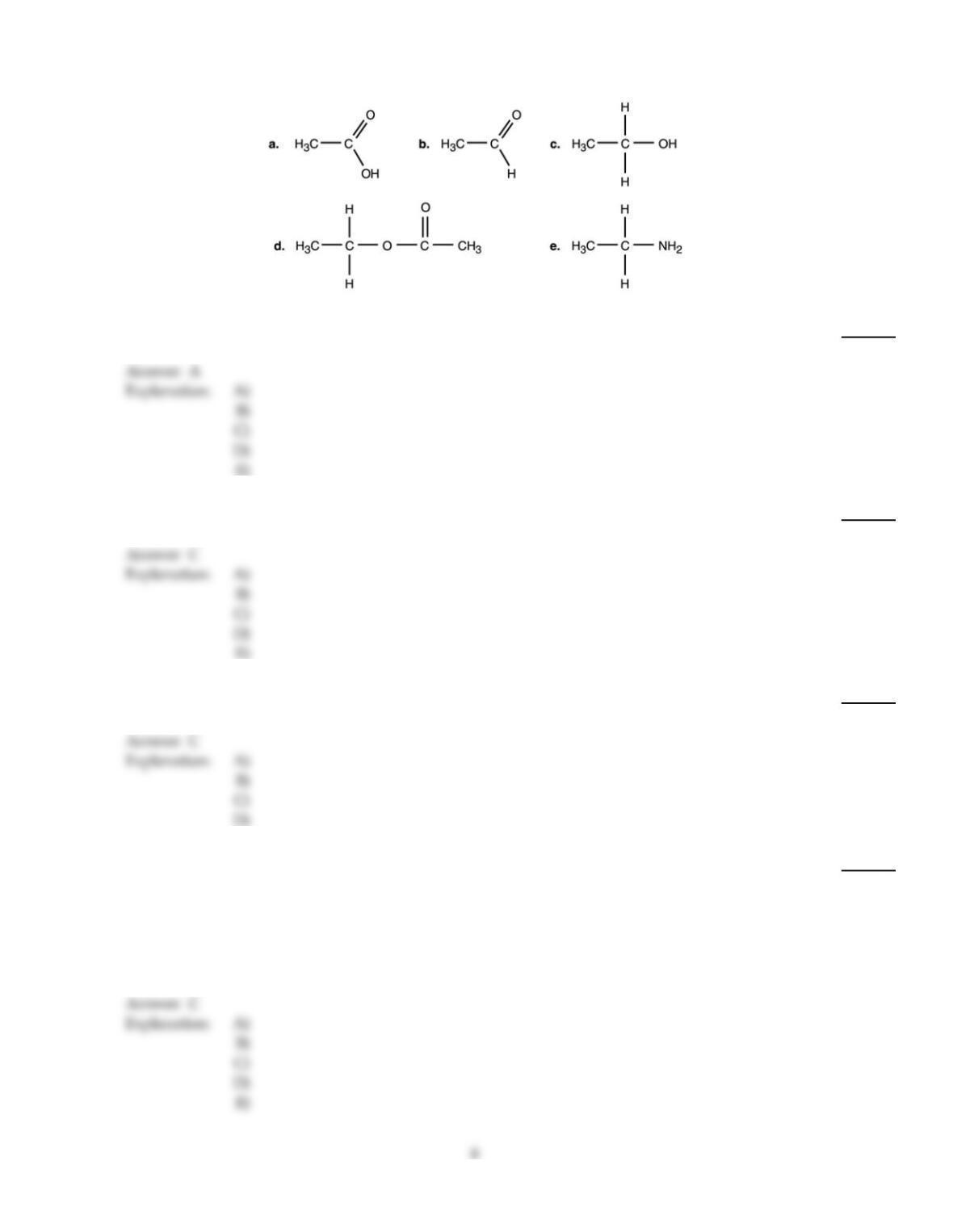
Figure 2.1
23)
Which compound in Figure 2.1 is an organic acid?
23)
A)
a
B)
b
C)
c
D)
d
E)
e
24)
In Figure 2.1, which is an alcohol?
24)
A)
a
B)
b
C)
c
D)
d
E)
e
25)
Which type of molecule is composed of (CH2O) units?
25)
A)
lipid
B)
protein
C)
carbohydrate
D)
nucleic acid
26)
What is the type of bond between the hydrogen of one molecule and the nitrogen of another
molecule?
26)
A)
ionic bond
B)
hydrophobic bond
C)
hydrogen bond
D)
disulfide bond
E)
covalent bond

27)
Which type of molecule NEVER contains a phosphate group?
27)
A)
nucleic acid
B)
triglycerides
C)
lipid
D)
ATP
28)
Which of the following statements regarding protein structure is FALSE?
28)
A)
Secondary structures are formed only from hydrogen bonds.
B)
Tertiary structures are formed only from covalent bonds.
C)
Quaternary structures involved multiple polypeptides.
D)
The primary structure is formed by covalent bonding between amino acid subunits.
29)
Which of the following pairs is mismatched?
29)
A)
H2SO4
2H++ SO42– — acid
B)
MgSO4
Mg2++ SO42– — salt
C)
KH2PO4
K++ H2PO4– — acid
D)
NaOH
Na++ OH– — base
E)
HF
H++ F– — acid
30)
Which type of molecule contains –NH2 groups?
30)
A)
nucleic acid
B)
protein
C)
triglycerides
D)
carbohydrate
31)
Which of the following is the type of bond between molecules of water in a beaker of water?
31)
A)
covalent bond
B)
hydrogen bond
C)
ionic bond
32)
Two glucose molecules are combined to make a maltose molecule. What is the chemical formula
for maltose?
32)
A)
C12H22O11
B)
C12H24O12
C)
C12H23O10
D)
C6H12O6
E)
C3H6O3
33)
If an amino acid contained a hydrocarbon as its side group, in which of the following categories
could it be appropriately designated?
33)
A)
polar
B)
basic
C)
hydrophilic
D)
acidic
E)
nonpolar
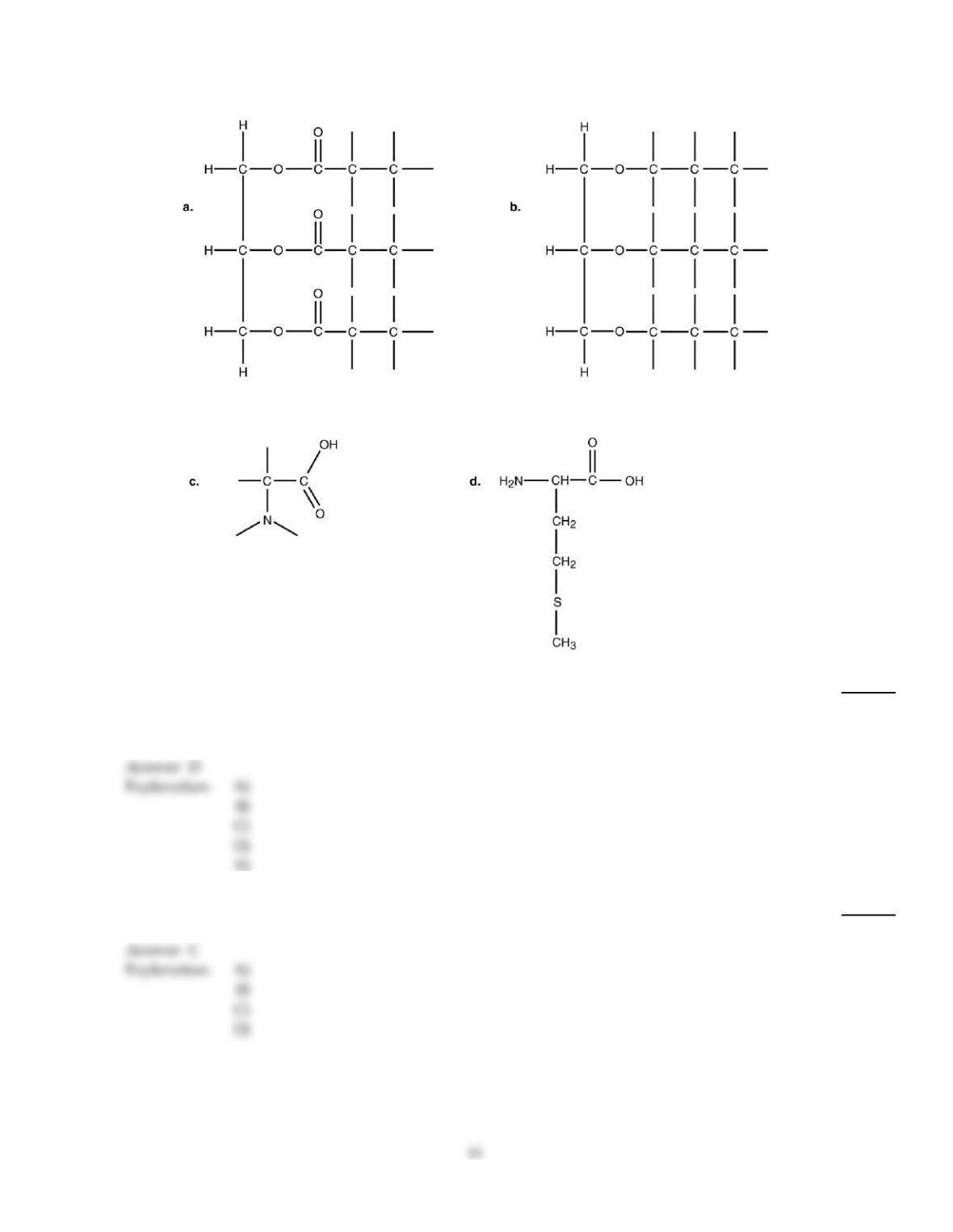
Figure 2.2
34)
Archaea differ from bacteria in the composition of the cell membrane lipids. Archaea have
ether–bonded lipids, shown in part ________ of Figure 2.2, and bacteria have ester–bonded lipids,
shown in part ________ of Figure 2.2.
34)
A)
b; c
B)
d; c
C)
a; d
D)
b; a
E)
c; d
35)
Which type of molecule contains the alcohol glycerol?
35)
A)
carbohydrate
B)
protein
C)
phospholipids
D)
DNA
36)
Starch, dextran, glycogen, and cellulose are polymers of
36)
A)
amino acids.
B)
fatty acids.
C)
glucose.
D)
acids.
E)
nucleic acids.
37)
Which molecule is composed of a chain of amino acids?
37)
A)
nucleic acid
B)
lipid
C)
protein
D)
carbohydrate
Explanation:
38)
Desulfovibrio bacteria can perform the following reaction: S6–
S2–. These bacteria are
38)
A)
hydrolyzing sulfur.
B)
oxidizing sulfur.
C)
synthesizing sulfur.
D)
reducing sulfur.
Explanation:
39)
Radioisotopes are frequently used to label molecules in a cell. The fate of atoms and molecules in a
cell can then be followed. Assume Saccharomyces cerevisiae is grown in a nutrient medium
containing the radioisotope 32P. After a 48–hour incubation, the majority of the 32P would be
found in the S. cerevisiae’s
39)
A)
water.
B)
carbohydrates.
C)
cell wall.
D)
proteins.
E)
plasma membrane.
Explanation:
Explanation:
40)
If you viewed one single protein using a microscope, you would observe multiple ________
structures.
40)
A)
secondary
B)
tertiary
C)
primary
D)
primary and secondary
E)
secondary and tertiary
41)
Identify the following reaction: Lactose + H2O
Glucose + Galactose
41)
A)
exchange reaction
B)
dehydration synthesis reaction
C)
reversible reaction
D)
ionic reaction
E)
hydrolysis reaction
E
42)
Which are the primary molecules making up plasma membranes in cells?
42)
A)
nucleic acids
B)
carbohydrates
C)
lipids
D)
proteins
C
43)
Which of the following statements about the atom 12
6C is FALSE?
43)
A)
Its atomic weight is 12.
B)
Its atomic number is 6.
C)
It has 12 neutrons in its nucleus.
D)
It has 6 protons in its nucleus.
E)
It has 6 electrons orbiting the nucleus.
C
A
44)
Based upon the valence numbers of the elements magnesium (2) and hydrogen (1), predict how
many covalent bonds would form between these atoms to achieve the full complement of electrons
in their outermost energy shells.
44)
A)
one
B)
two
C)
three
D)
four
45)
Which of the following is the type of bond holding K+ and I– ions in KI?
45)
A)
covalent bond
B)
ionic bond
C)
hydrogen bond
TRUE/FALSE. Write ‘T’ if the statement is true and ‘F’ if the statement is false.
46)
Any compound that contains carbon is only considered to be organic.
46)
47)
The density of liquid water is greater than the density of ice.
47)
48)
Elements only achieve the full complement of electrons in outermost energy cells by donating or
sharing electrons.
48)
49)
All forms of life function optimally at a pH of 7.
49)
50)
The formation of ADP from ATP can be defined as a hydrolytic reaction.
50)
51)
There are some forms of life on Earth that can survive without water.
51)
52)
Individual covalent bonds are stronger than individual ionic bonds.
52)
53)
Covalent bonds are always shared equally.
53)
54)
All chemical reactions are, in theory, reversible.
54)
55)
A basic solution is expected to contain more hydrogen ions than hydroxyl ions.
55)
ESSAY. Write your answer in the space provided or on a separate sheet of paper.
56)
A bacterium that grows at a temperature of 37°C transports both glucose and NaCl into its cytoplasm. Which is
most easily dissolved in the cytoplasm? Explain how the bonds of these molecules impact disassociation rate.
57)
Describe how the properties of phospholipids make these molecules well suited for plasma membranes.
58)
A scientist claims that when a protein is denatured, it can be expected that its secondary structure will more
likely be retained when compared to all other levels of protein structure structures. Do you agree? Explain.
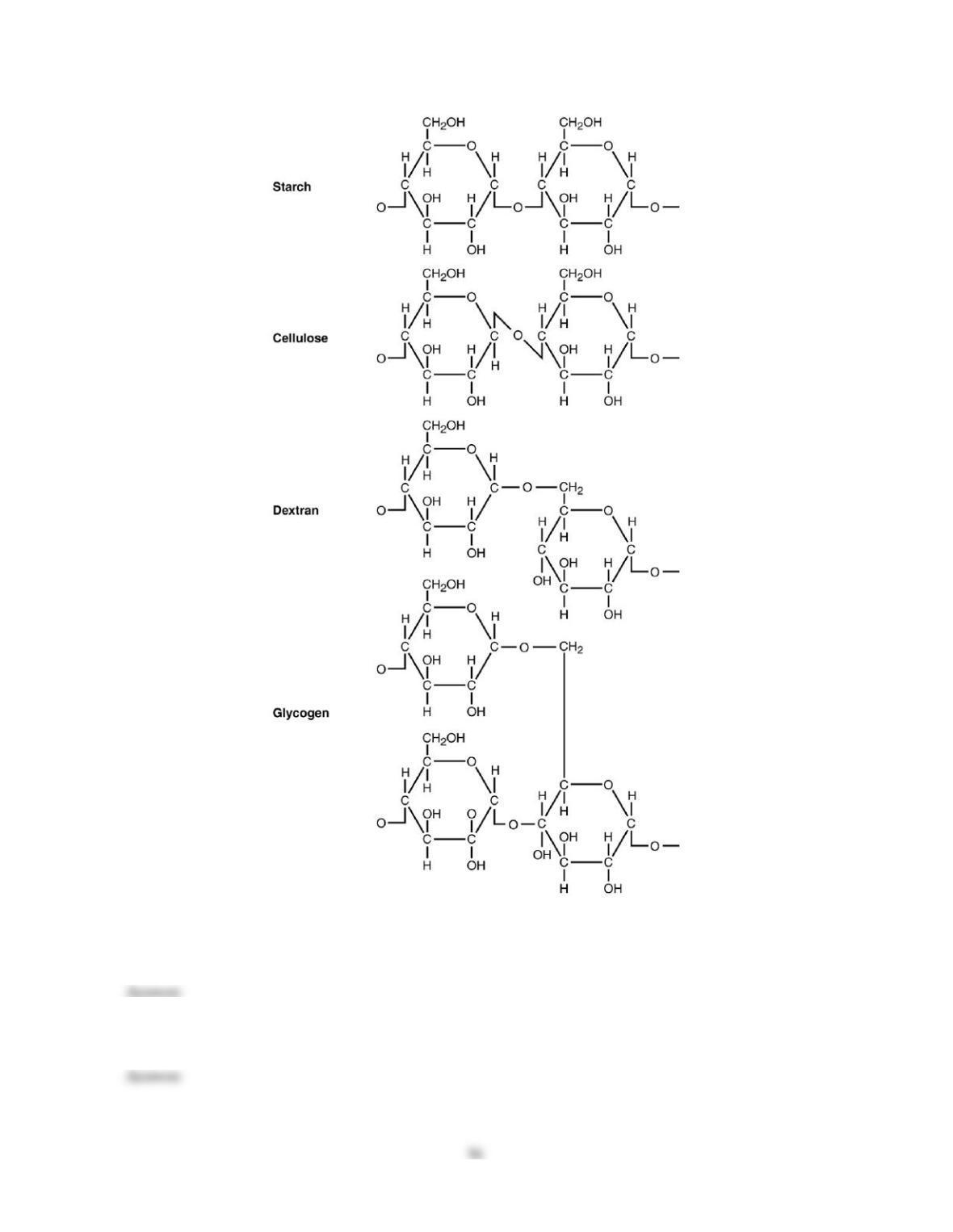
Figure 2.5
59)
Use Figure 2.5 to answer the following. Starch, cellulose, dextran, and glycogen are polysaccharides. How are
they similar? To what are their different properties due? Why can’t an enzyme that hydrolyzes starch degrade
cellulose?
60)
Compare a molecule of a nucleotide to ATP. Could a cell simply insert ATP into DNA without altering it?
Explain.
Answer Key
Testname: C2

Answer Key
Testname: C2