Chapter 2—Financial Statement and Cash Flow Analysis
MULTIPLE CHOICE
1. A company’s balance sheet shows the value of assets, liabilities, and stockholders’ equity:
a.
at the end of the fiscal year
b.
for any given period of time
c.
at a specific point in time
d.
over an annual period
e.
at the end of the calendar year
2. On a balance sheet, retained earnings are not “unspent cash” because:
a.
they have been paid out to common stockholders
b.
they have an arbitrarily assigned value
c.
they are always changing
d.
they have been used to finance the firm’s assets
e.
they are an estimate of future inflows
3. For both managers and external financial analysts, __________ is the single most important
accounting number found on the income statement.
a.
net income (net profit after tax)
b.
earnings before interest and taxes (EBIT)
c.
earnings available for common stockholders
d.
operating profit
e.
gross margin
4. Earnings per share (EPS) is calculated by:
a.
dividing pretax income by the number of shares of common stock outstanding
b.
dividing the dividends paid by the number of shares of common stock outstanding
c.
dividing earnings available for common stockholders by the number of shares of common
stock outstanding
d.
dividing net profits after tax by the total number of preferred and common stock shares
outstanding
e.
none of the above
5. Pennywise, Inc. had a great year. Sales reached an all-time high of $s million, with a gross margin of
$gm million. Depreciation was recorded at $d. Earnings before interest and taxes were $ebit million,
interest was $i million, and total taxes were $t. The firm’s operating cash flow (OCF) was:
a.
$w1
b.
$w2
c.
$ans
d.
$w3
e.
$w4
6. In May, GoGreen, Inc. increased its inventory of home composting kits, expecting sales to spike with
warmer weather. This decision resulted in __________ for the firm.
a.
a decrease in depreciation expense
b.
an increase in depreciation expense
c.
an inflow of cash
d.
an outflow of cash
e.
a decrease in earnings
7. While examining her firm’s Statement of Cash Flows, Amy discovered an unusually large increase in
accounts receivable. This might occur if:
a.
the firm was holding more inventory
b.
the firm had softened its credit requirements
c.
sales had increased significantly
d.
a & b
e.
b & c
8. Net working capital:
a.
is a measure of a firm’s overall liquidity
b.
is defined as total assets minus current liabilities
c.
reflects decreasing firm solvency as it increases
d.
all of the above
e.
none of the above
9. When evaluating financial ratios, analysts typically examine a firm’s ratio values:
a.
compared to firms in other industries
b.
compared to the firm’s previous years’ ratios
c.
compared to regional averages
d.
compared to firms with similar net profit margins
e.
all of the above
10. Why is the quick ratio a more appropriate measure of liquidity than the current ratio for a large-
airplane manufacturer?
a.
It recognizes the contribution of all assets so that analysts can see how “quickly” a firm
can satisfy its short-term obligations.
b.
It recognizes that parts can be quickly converted to cash.
c.
It provides a better measure of overall liquidity when a firm has highly liquid inventory.
d.
It is not more appropriate. The current ratio would provide better information in this
situation.
e.
It excludes inventory from the numerator of the ratio because it is difficult to convert
inventory to cash and most sales are made on a credit basis.
11. __________ ratios would provide the best information regarding total return to common stockholders.
a.
Profitability
b.
Activity
c.
Liquidity
d.
Market
e.
Debt
12. Jane’s Foods, Inc., a retail grocery chain, has an inventory turnover ratio of 18.7. The industry average
is 16.8. The difference in these ratios shows that Jane’s Foods, Inc.:
a.
carries larger inventories than the industry average.
b.
has lower sales than the average firm in the industry.
c.
sells its goods at a slower rate than the industry average.
d.
sells its goods more quickly than the industry average.
e.
invests more in inventory per dollar of sales than the industry average.
13. The one fixed asset that is not depreciated is __________.
a.
cash
b.
inventories
c.
plant
d.
land
e.
equipment
14. A __________ expresses all income statement entries as a percentage of sales.
a.
ratio income statement
b.
statement of retained earnings
c.
common-size income statement
d.
common-size balance sheet
e.
cash flow analysis
15. Noncash charges, such as __________, are expenses that appear on the income statement but do not
involve an actual outlay of cash.
a.
investment flows, operating flows, financing flows
b.
NOPAT
c.
free cash flows
d.
depreciation, amortization, and depletion allowance
e.
All of the above
16. The firm’s managers use ratios to __________.
a.
generate an overall picture of the company’s financial health
b.
monitor the firms’ performance from period to period
c.
isolate developing problems
d.
monitor all aspects of the firm’s financial situation
e.
all of the above
17. Return on total assets (ROA) is equal to __________.
a.
net profit margin total asset turnover
b.
[earnings available for common stockholders / sales] [sales / total assets]
c.
earnings available for common stockholders / total assets
d.
the product of the components of the DuPont System
e.
all of the above
18. When a firm has no “other income,” its operating profit and __________ are equal.
a.
net income
b.
net profit after taxes
c.
EPS
d.
EBIT
e.
EAT
19. The __________ flows result from debt and equity financing transactions.
a.
financing
b.
operating
c.
investment
d.
cash
e.
free cash
20. The firm’s __________ are primarily interested in ratios that measure the short-term liquidity of the
company and its ability to make principal and interest payments.
a.
board of directors
b.
creditors
c.
owners
d.
financial managers
e.
customers
21. A firm changes from LIFO to FIFO; this change will be found in the
a.
The balance sheet
b.
The income statement
c.
The statement of cash flows
d.
Notes to the financial statements
22. In 2011, a firm books the following: increase in cash, $0; increase in inventories $in; increase in
accounts receivable, $ar; increase in accounts payable, $ap; what is the firms change in net working
capital?
a.
$0
b.
-$ans
c.
$ans
d.
$ans1
23. A manager has a choice of depreciation methods, 5 year straight line or 5 year MACRS; which is the
most likely choice, and why?
a.
MACRS to decrease taxes
b.
Straight line to minimize depreciation expense
c.
Straight line to match financial accounting records
d.
Both choices are simply accounting choices with no real economic impact
24. Which of the following is an inflow of corporate cash?
a.
Dividends
b.
Increasing treasury stock
c.
Purchasing treasury bills
d.
Depreciation charges
MATCHING
Match each cash flow to its type:
a.
Inflow
b.
Outflow
1. Dividends paid
2. Decrease in any liability
3. Depreciation
4. Sale of stock
5. Repurchase of stock
6. Decrease in any asset
Match the following ratios to the appropriate category:
a.
Current
b.
Assets-to-equity (A / E)
c.
Earnings per share
d.
Price / earnings
e.
Average payment period
7. Profitability
8. Liquidity
9. Market Value
10. Activity
11. Debt
Match the following terms to their definitions with their proper agency and rules:
a.
accepted accounting rules
b.
developed accepted accounting rules
c.
responsible for regulating publicly held U.S. companies
d.
accounting standards followed by most developed countries
12. FASB
13. SEC
14. GAAP
15. IAS
Match the following terms to their definitions:
a.
cash
b.
marketable securities
c.
accounts receivable
d.
gross property
e.
net property
16. liquid, short-term investment
17. original cost of an asset
18. asset that can be used directly as a means of payment
19. original cost of an asset minus accumulated depreciation
20. amount customers owe the firm from sales made on credit
Match the following flows to their definitions:
a.
operating flows
b.
investment flows
c.
financing flows
d.
free cash flow
e.
non-cash charges
21. associated with the purchase or sale of fixed assets and business interests
22. result from debt and equity financing
23. cash flow available to investors
24. expenses that appear on the income statement but do not involve an actual outlay of cash
25. directly related to the production and sale of the firm’s products or services
Match the following account changes with cash inflows and outflows:
a.
inflows
b.
outflows
26. decrease in inventory
27. increase in accounts receivable
28. depreciation
29. repurchase of common stock
30. dividend paid
SHORT ANSWER
1. Consider a firm with a current ratio of cr, a quick ratio of qr, and an inventory turnover ratio of tr. If
the firm has inventories of $i million, what are their current assets and cost of goods sold?
2. The DuPont System allows us to relate the return on total assets and the return on common equity to
various measures of firm characteristics. Consider a firm with a ROA of roa1.
a.
If you were analyzing a firm that had sales of $s and total assets of $ta, how much in earnings
were available for common shareholders?
b.
If the firm had common stockholders’ equity of $se, what would be the firm’s ROE?
c.
If we compare this firm to another similar firm in the industry we find that the comparison
firm has an ROA and ROE of roa2 and roe20, respectively. Given this information, calculate
the comparison firm’s ratio of total assets to common stock equity. How does this ratio differ
from our firm?
d.
Interpret the performance differences between these firms.
earnings available for common shareholders = roa1 $ta = $ea
b.
ROE = $ea / $se = roe10 or roe1%
ROE = ROA A / E
roe20 = roa2 A / E therefore, A / E = ae2 (virtually the same as for our firm, i.e. $ta / $se =
of assets whereas the comparison firm earned p2 cents on each dollar of assets, thereby
accounting for its greater return on common stockholder equity.
= (current assets – inventory) / current liabilities
= (current assets – inventory) / (current assets / cr)
3. Consider a firm with an ROA of 0.04 and ROE of 0.13. A comparison firm from the same industry has
an ROA of 0.06 and an ROE of 0.191667. Both firms have the same degree of financial leverage as
reflected in their identical assets-to-equity ratios of 3.194445. Suppose we were to learn that our
comparison firm is 70 years old. Our firm is relatively young. Taking into account this new
information, interpret the performance differences between these firms.
4. Given the balance sheets provided for Local Oil Co (2003 and 2004) below, calculate the following
ratios for both 2003 and 2004:
a.
Current ratio
b.
Quick ratio
c.
Debt ratio
d.
Assets-to-equity
e.
Debt-to-equity
Local Oil Co. Balance Sheet 2003 and 2004 ($ in millions)
Assets
2004
2003
Current Assets
Cash and cash equivalents
$ 220
$ 200
Marketable securities
50
40
Accounts receivable
1,750
1,550
Inventories
i4
i3
Other
150
160
Total current assets
$tca4
$tca3
Fixed assets
Gross property, plant, and equipment
$9,550
$9,025
Less: Accumulated Depreciation
(3,450)
(3,250)
Net property, plant, and equipment
$6,100
$5,775
Intangible assets and others
750
575
Net fixed assets
$6,850
$6,350
Total assets
$ta4
$ta3
Liabilities and Stockholders’ Equity
Current liabilities
Accounts payable
$ap4
$ap3
Notes payable
np4
np3
Accrued expenses
ae4
ae3
Total current liabilities
$tcl4
$tcl3
Long term liabilities
Deferred taxes
$ dt4
$ dt3
Long-term debt
2,000
1,800
Total long-term liabilities
$tltl4
$tltl3
Total Liabilities
$tl4
$tl3
Stockholders’ equity
Preferred stock
$ 240
$ 240
Common stock par value
240
220
Paid-in capital in excess of par
1250
1075
Retained earnings
re4
re3
Less: Treasury stock
(550)
(480)
Total stockholders’ equity
$tse4
$tse3
Total liabilities and stockholders’ equity
$ta4
$ta3
5. If one of the entries on the asset side of the balance sheet is measured with error, what must happen to
the other side of the balance sheet? Do we expect items near the top of the balance sheet to be more or
less subject to measurement errors?
6. Consider a firm that shows an increase in liquidity according to the current ratio, but a decrease in
liquidity according to the quick ratio for some interval of time. How would you decide if liquidity has
improved or deteriorated?
7. Identify the four key financial statements required by the SEC for reporting to stockholders.
Current ratio =
b.
Quick ratio =
d.
8.
a.
Calculate the net profit margin, total asset turnover, assets–to–equity ratio, and ROE using the
data in the following table for firms in the same industry.
Sales
Earnings available
for common
stockholders
Total assets
Stockholder’s
equity
Axel Co.
$sa
ea
ta
$sea
Blue Co.
sb
eb
tb
seb
Carol Co
sc
ec
tc
sec_
David Co.
sd
ed
td
sed
b.
Evaluate each firm’s performance relative to the other three firms in the industry.
Net profit margin
Total asset
turnover
Assets-to-Equity
Ratio
ROE
Axel Co.
Blue Co
roeb%
Carol Co.
roec%
David Co.
roed%
b.
Axel Co. appears to have the best financials
Blue Co. has a low net profit margin indicating the need for lower costs or higher prices.
Carol Co. has both a low total assets turnover and a low assets–to-equity ratio. The low
that the firm is not taking advantage of financial leverage (debt).
weaknesses by using more financial leverage which is reflected in its high assets-to-equity
ratio, i.e., high risk.
9. The following financial data is given for four firms:
Net profit margin
Total asset
turnover
Assets-to-Equity
Ratio
ROE
Axel Co.
15%
1.33
1.50
30.0%
Blue Co
5%
1.33
1.50
10.0%
Carol Co.
15%
1.00
1.07
16.0%
David Co.
12%
1.04
2.40
30.0%
1.
balance sheet
2.
income statement
3.
statement of retained earnings
4.
statement of cash flows
What additional information would you require to complete your analysis of the companies presented
here?
10. What determines the order in which assets and liabilities appear within their respective balance sheet
sections?
11. What is the final step in the income statement?
12. What is the purpose of the statement of retained earnings?
13. Why do financial managers tend to be more interested in free cash flow (FCF) than in the net operating
profit after taxes?
14. What is financial leverage?
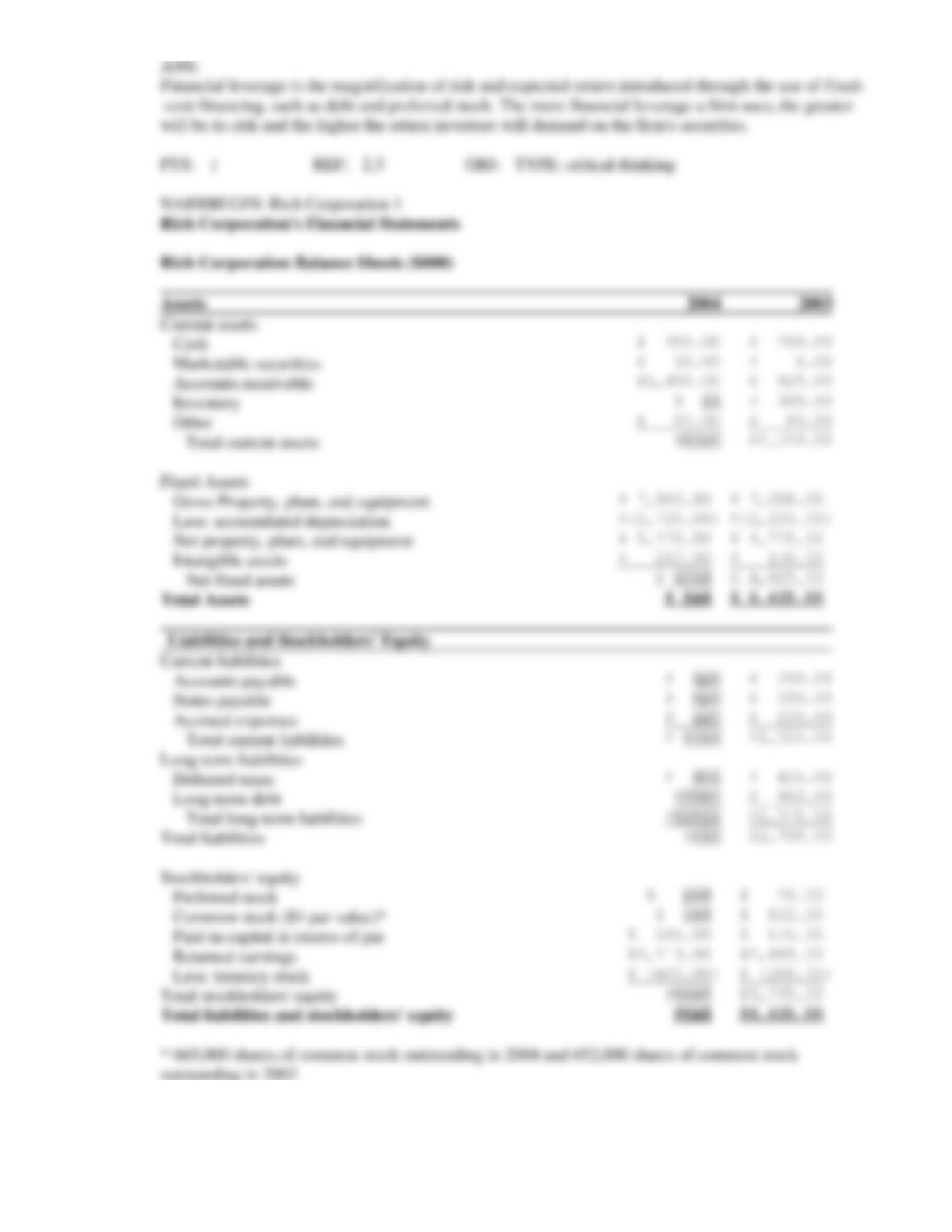
Cash
Marketable securities
Inventory
Total current assets
Gross Property, plant, and equipment
Net property, plant, and equipment
Net fixed assets
Current liabilities
Accounts payable
Accrued expenses
Long-term liabilities
Long-term debt
Total long-term liabilities
Preferred stock
Common stock ($1 par value)*
Retained earnings
Total stockholders’ equity
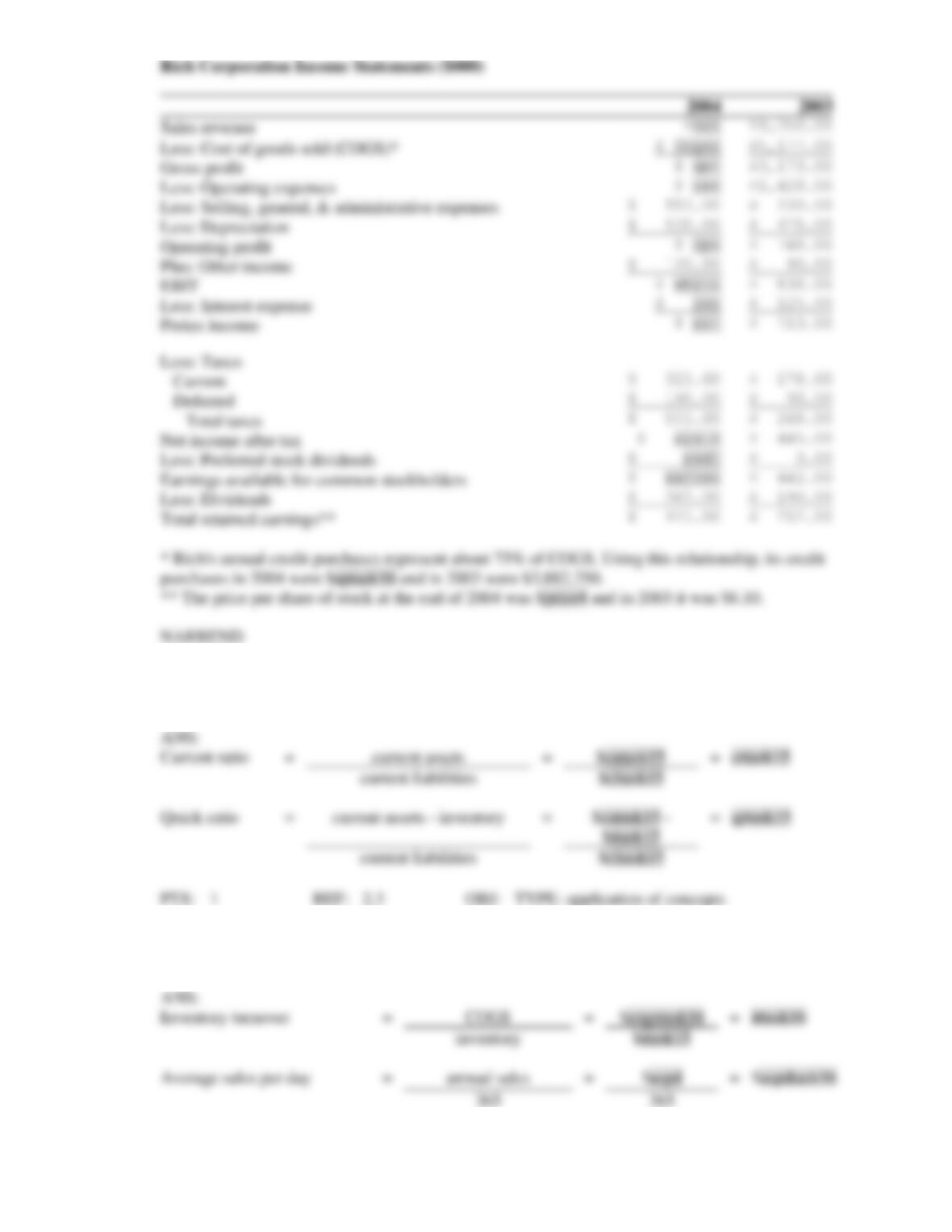
15. Refer to Rich Corporation’s Financial Statements. Calculate the liquidity ratios for Rich Corporation in
2004.
16. Refer to Rich Corporation’s Financial Statements. Calculate the activity ratios for Rich Corporation in
2004.
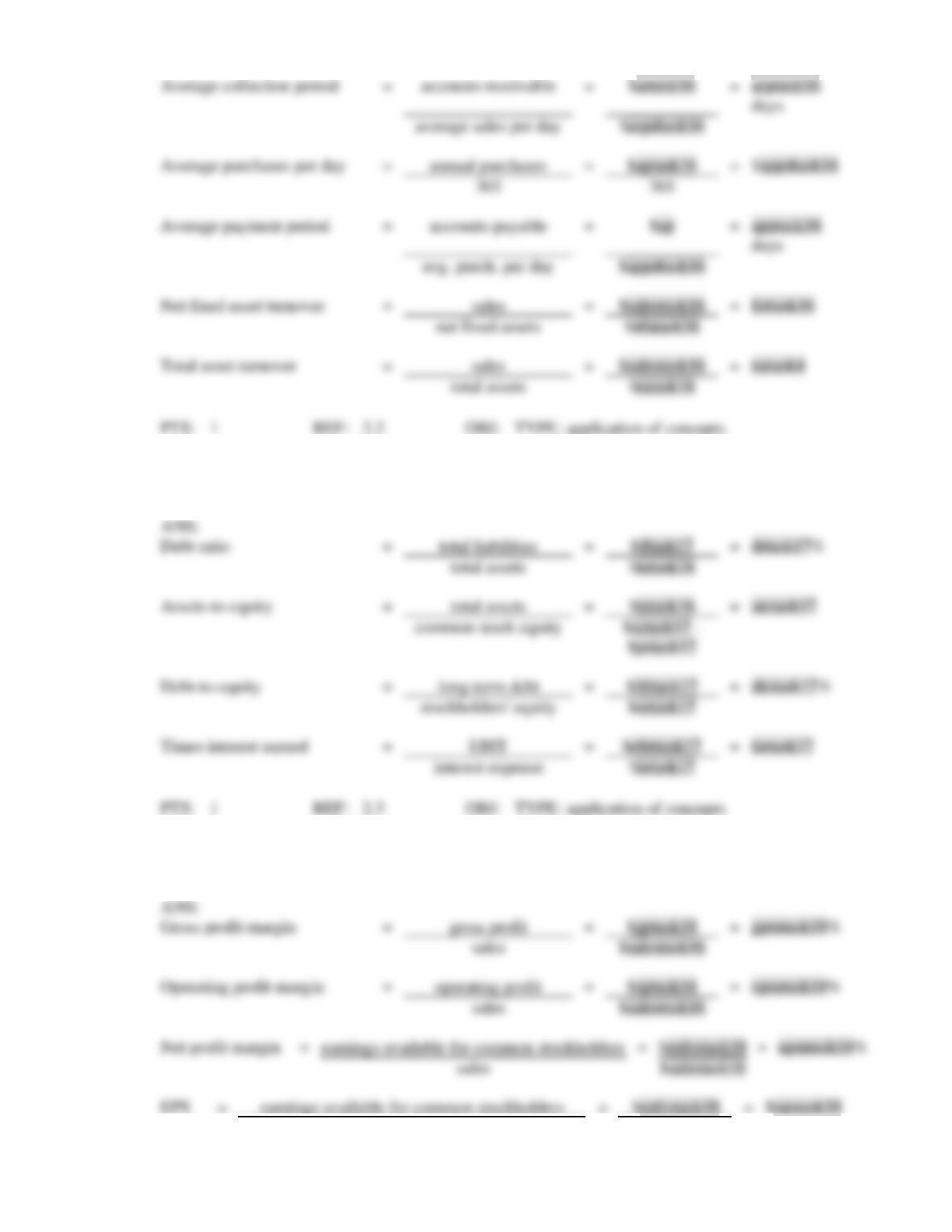
atetask17
dtetask17%
17. Refer to Rich Corporation’s Financial Statements. Calculate the debt ratios for the Rich Corporation in
2004.
Gross profit margin
gpmtask18%
Operating profit margin
opmtask18%
Net profit margin
$eafcstask18
npmtask18%
$epstask18
18. Refer to Rich Corporation’s Financial Statements. Calculate the profitability ratios for Rich
Corporation in 2004.
days
Net fixed asset turnover
fattask16
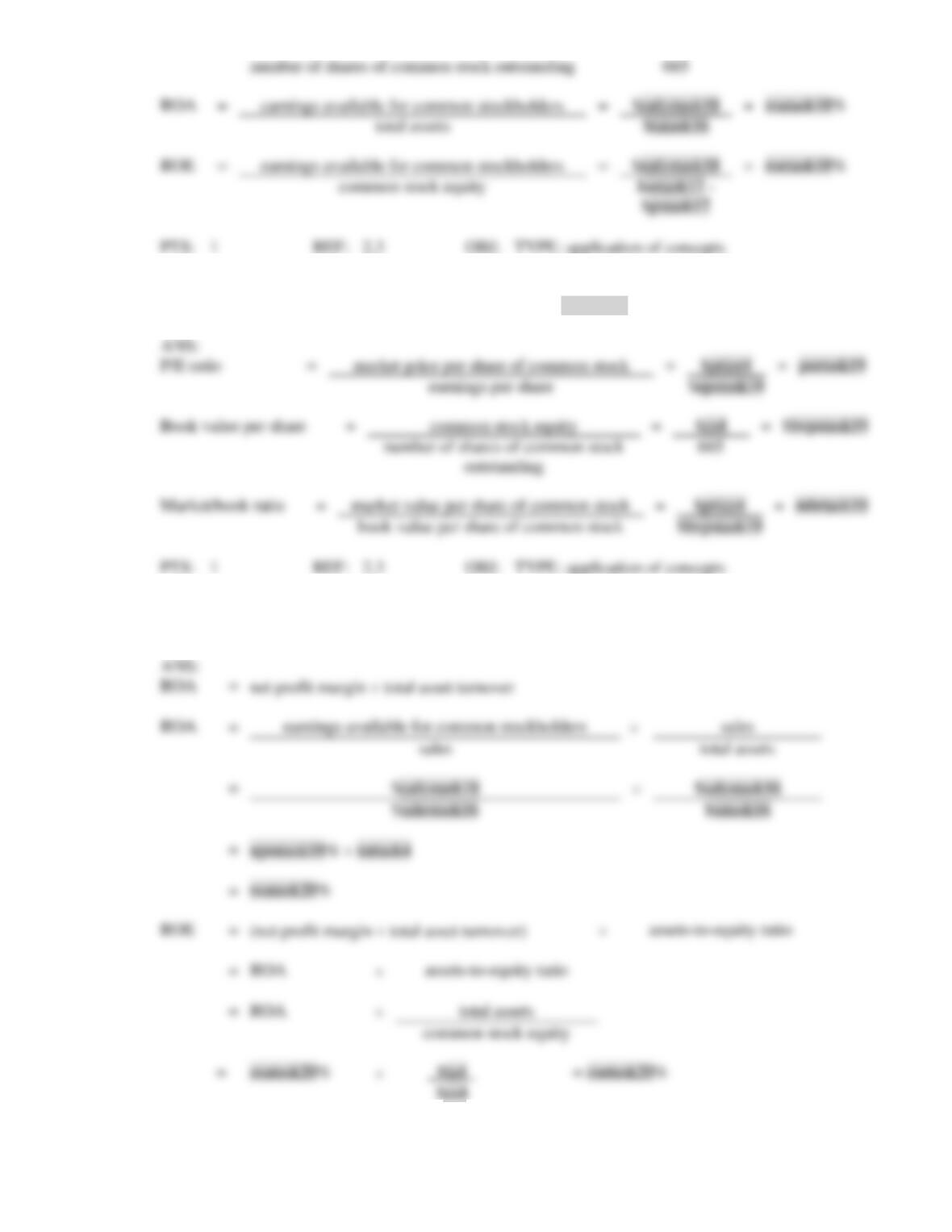
19. Refer to Rich Corporation’s Financial Statements. Calculate the market ratios for the Rich Corporation
in 2004 assuming the firm’s earnings per share (EPS) are $epstask19.
20. Refer to Rich Corporation’s Financial Statements. Calculate the ROA and ROE ratios using the
DuPont system for Rich Corporation in 2004.
ESSAY
1. In a well-written essay, discuss the types of financial information sought by at least three different
potential users of financial statements. What difficulties arise when creating a set of accounting
statements for multiple users? Do you believe that there is a single set of accounting rules that, once
found, will solve all reporting controversies?
2. Given the appropriate financial statements, what is required to do a complete ratio analysis and
interpretation of the ratio for a given corporation? What other analyses might you do?
3. How do you calculate a firm’s free cash flow (FCF)?
4. What are the basic steps in constructing a statement of cash flows?